
Submitted:
04 April 2026
Posted:
07 April 2026
You are already at the latest version
Abstract
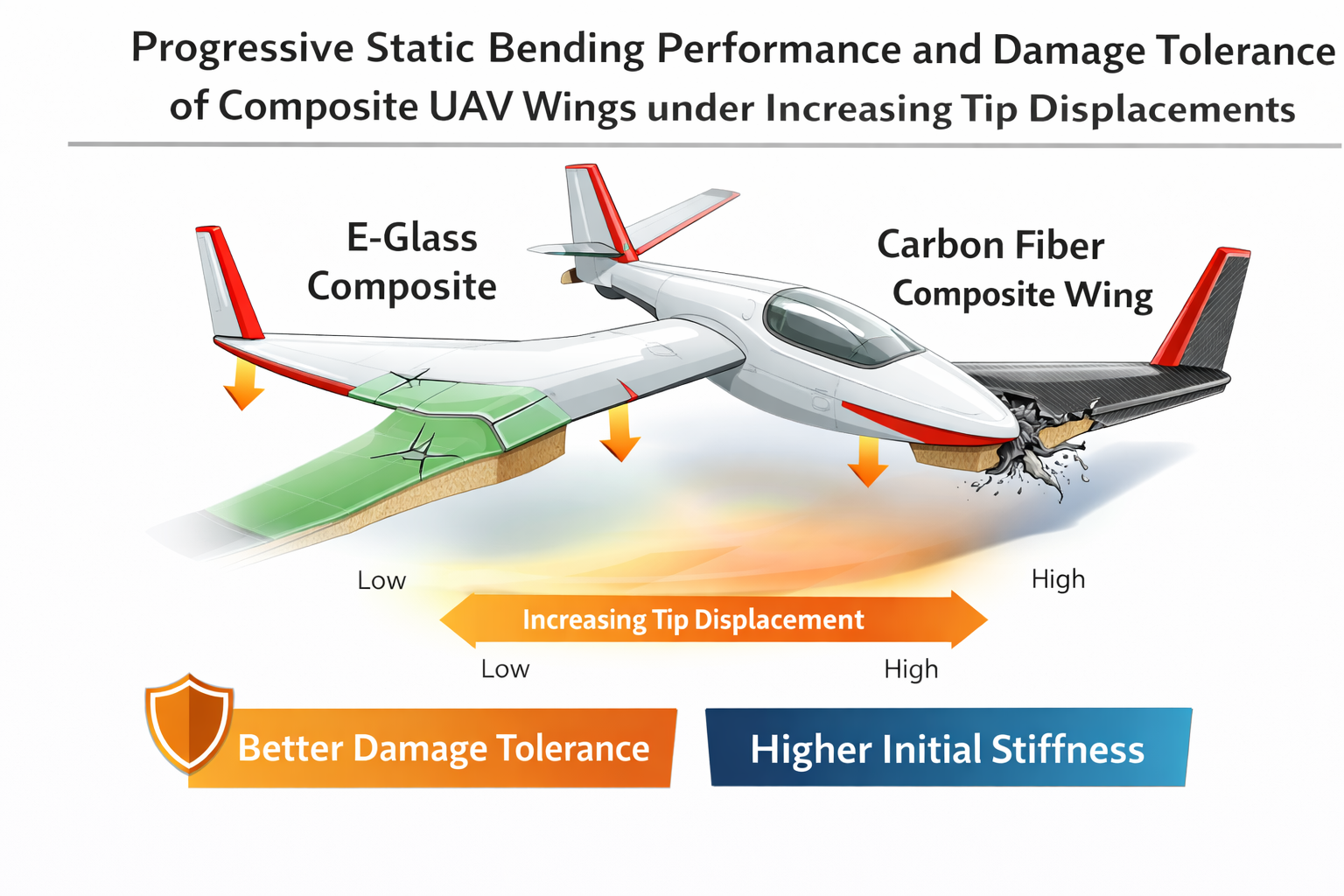
The static bending behaviour of unmanned aerial vehicle (UAV) wings fabricated from composite materials is a crucial determinant of structural performance, particularly under progressive deformation demands that span from nominal service loads to severe deflection conditions. This study develops a progressive, displacement-controlled framework to compare the static bending response of hybrid E-glass/epoxy and carbon-fibre-reinforced polymer (CFRP)/epoxy wings, both with Paulownia internal structure, and a full Paulownia baseline, under increasing tip displacements. Finite element simulations capture load–displacement response, stress redistribution, and energy absorption across displacement regimes from −5 to −50 mm. Results demonstrate that CFRP-skinned wings exhibit higher initial stiffness in the elastic regime, whereas E-glass skins provide improved energy absorption and more progressive stress distribution at large displacements. Conversely, Paulownia alone performs poorly under severe bending, confirming the essential role of composite skins for bending load resistance. The findings underscore the importance of displacement regime classification in static bending assessments and suggest that E-glass composites can offer effective, damage-tolerant alternatives to CFRP for UAV wing applications, particularly where large deformation tolerance is required.
Keywords:
UAV wing
; static bending
; finite element analysis
; composite materials
; E-glass
; carbon fiber reinforced polymer (CFRP)
; paulownia wood
; damage tolerance
; energy absorption
Copyright: This open access article is published under a Creative Commons CC BY 4.0 license, which permit the free download, distribution, and reuse, provided that the author and preprint are cited in any reuse.


