
Preprint
Review

This version is not peer-reviewed.

Epigenetic Regulation of Salt Stress Responses in Tomato: From DNA Methylation to Stress Memory

Submitted:

07 April 2026

Posted:

07 April 2026

You are already at the latest version

Abstract
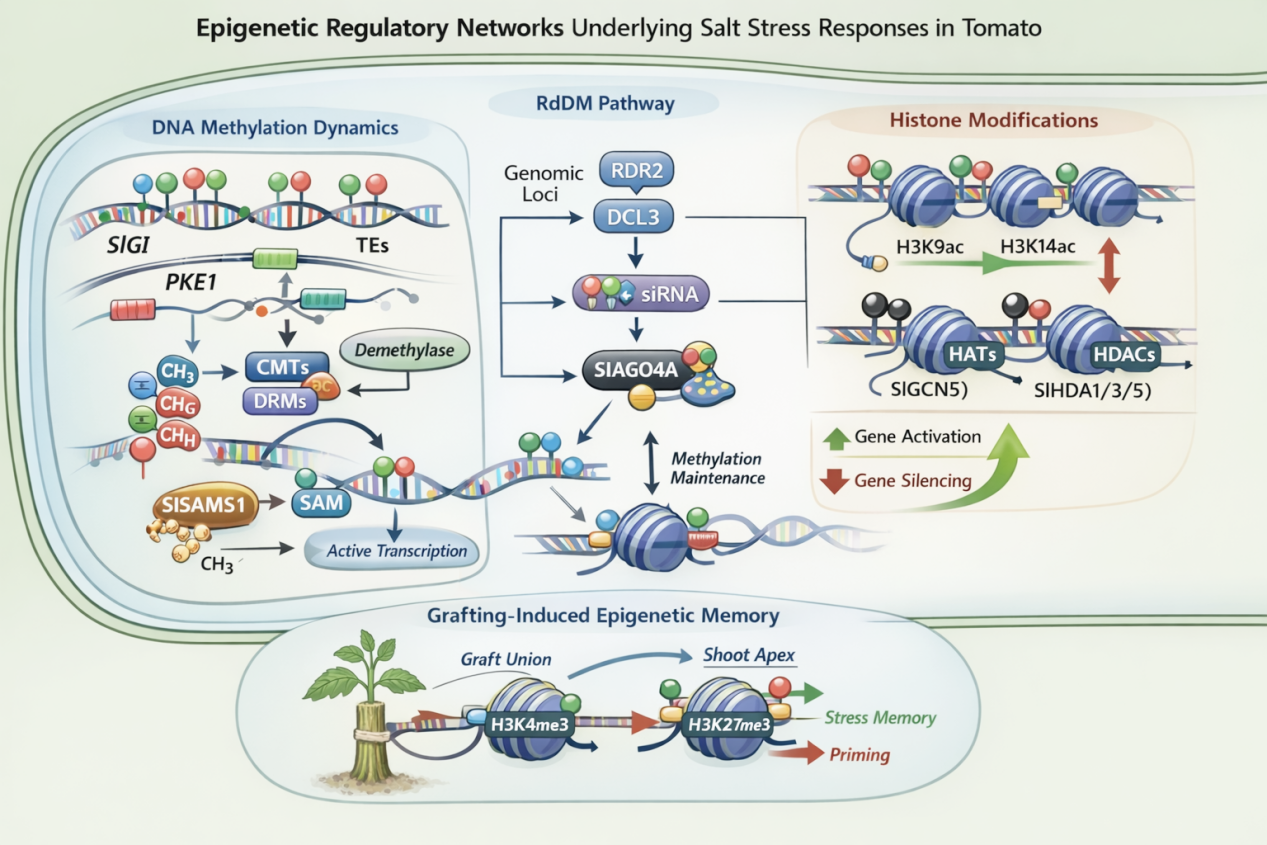
Soil salinization is increasingly threatening global agricultural productivity and food security, currently affecting over 6% of the world’s land and one-third of irrigated areas. Tomato (Solanum lycopersicum L.), a major vegetable crop worldwide, exhibits moderate sensitivity to salinity, which limits both its yield and fruit quality. In recent years, epigenetic regulation has gained attention as a key mechanism enabling flexible and reversible control of gene expression without altering DNA sequences. This review synthesizes current knowledge on the epigenetic control of salt stress responses in tomato, focusing on three interconnected levels: DNA methylation dynamics, RNA-directed DNA methylation (RdDM), and histone modifications. We explore how DNA methyltransferases reshape the methylome under salinity, using examples such as PKE1 and SlGI to illustrate functional gene-body methylation. The RdDM pathway is discussed with emphasis on the unexpected role of SlAGO4A as a negative modulator of stress tolerance and the growing evidence for RdDM-mediated regulation of transcription factors. We also examine the balanced regulation of histone acetylation and deacetylation, highlighting the conserved role of GCN5 in maintaining cell wall integrity and the diverse functions of HDACs (SlHDA1, SlHDA3, SlHDA5) in stress adaptation. Additionally, insights from wild tomato species and grafting-induced epigenetic changes are presented, revealing new dimensions of stress memory. Collectively, these epigenetic mechanisms constitute a complex regulatory framework that integrates stress responses with growth and development, providing potential targets for epigenetic breeding of salt-tolerant tomatoes.
Keywords: 
;  ;  ;  ;  ;  ;  ;  

1. Introduction

Soil salinization has become a major constraint to sustainable agriculture worldwide [1]. According to the Food and Agriculture Organization (FAO), more than 6% of the global land area and roughly one-third of irrigated farmlands are currently impacted by salinity, with estimates suggesting this figure could surpass 50% by 2050 [2]. High concentrations of soluble salts, especially sodium (Na+) and chloride (Cl-), induce osmotic imbalance, ion toxicity, and secondary oxidative stress, all of which severely hinder plant growth and development [3]. These adverse effects lead to considerable reductions in crop yields, posing serious risks to global food security [4,5]. Consequently, understanding the molecular basis of salt tolerance and developing resilient crop varieties have become critical priorities.
Tomato (Solanum lycopersicum L.) is one of the most economically significant vegetable crops globally, with annual production exceeding 180 million tons, and plays an essential role in human nutrition [6]. Beyond its economic importance, tomato serves as a valuable model system for investigating fruit development, ripening, and abiotic stress responses, owing to its well-annotated genome, efficient transformation systems, and relatively short life cycle [7]. Although wild relatives such as S. pimpinellifolium and S. pennellii have developed superior salt tolerance through adaptation to coastal or dry environments, domestication and breeding for high yield and fruit quality have resulted in the loss of many favorable salt-tolerance alleles in cultivated tomato [8,9,10]. As a result, cultivated tomato is generally regarded as moderately sensitive to salinity, with its growth, yield, and fruit quality substantially compromised under saline conditions [11,12].
Recent advances in high-throughput sequencing, multi-omics approaches, and genome editing have shifted research from physiological and phenotypic analyses toward a more detailed molecular understanding of salt stress responses in tomato [13]. These efforts have not only clarified the roles of well-known pathways—such as the Salt Overly Sensitive (SOS) pathway, abscisic acid (ABA) signaling, and antioxidant systems—but have also identified numerous new regulatory components and signaling modules [14,15,16,17,18]. Notable examples include the SlHAK20-mediated ion transport system [8], the SlSAMS1-triggered PA-NO-cGMP cascade [19], the SlWRKY57-VQ protein antagonistic module [20], the SlbHLH92-SlVQ16-H2S signaling pathway [21], and the CRY1a-HY5-mediated light signaling integration [22]. These discoveries have greatly expanded our view of the complex regulatory networks governing salt tolerance and have provided precise molecular targets for breeding stress-resilient varieties.
Epigenetic regulation involves reversible modifications to chromatin structure and DNA accessibility that influence gene expression without altering the underlying DNA sequence, thereby enabling phenotypic plasticity in response to environmental changes [23,24]. Recently, epigenetic mechanisms have been recognized as key players in coordinating tomato salt stress responses, primarily through DNA methylation, RNA-directed DNA methylation (RdDM), and histone modifications [25]. This review summarizes updated research progress in understanding the epigenetic regulation of salt stress in tomato, emphasizing dynamic chromatin changes and their functional relevance in stress adaptation. We also integrate findings from wild tomato species and grafting studies that highlight the potential of epigenetic variation for enhancing stress tolerance.

2. DNA Methylation Dynamics in Salt-Stressed Tomato

DNA methylation is a conserved epigenetic mark involving the addition of methyl groups to cytosine residues, catalyzed by DNA methyltransferases (MTases), and is generally linked to transcriptional repression. In plants, methylation occurs in three sequence contexts, CG, CHG, and CHH (where H = A, T, or C), each maintained by distinct enzymatic systems [26]. Under salt stress, plants undergo rapid and dynamic methylome reprogramming to fine-tune the expression of stress-responsive genes and maintain genome stability by silencing transposable elements (TEs) [27,28].
The tomato genome contains nine DNA methyltransferase genes: one METHYLTRANSFERASE 1 (MET1) responsible for CG methylation maintenance, three CHROMOMETHYLASES (CMTs) for non-CG methylation, four DOMAINS REARRANGED METHYLTRANSFERASES (DRMs) involved in RdDM, and one METHYLTRANSFERASE-LIKE (METL) [29]. Transcript profiling has revealed that, except for MET1 and DRM8, all MTase genes are significantly regulated under salt stress [29], indicating that precise control of methylation writers is essential for reshaping the DNA methylation landscape under salinity.
The functional consequences of this remodeling depend on the sequence context and genomic region. In tomato, salt stress frequently induces CHH hypomethylation, particularly near TEs adjacent to stress-responsive genes, which may facilitate their rapid transcriptional activation. Conversely, hypermethylation within specific gene bodies has been associated with stable gene repression, although the functional implications of gene-body methylation are complex and not always linked to silencing [29,30,31].
A notable example of functional gene-body methylation is the PKE1 gene, which encodes a proline-, lysine-, and glutamine-rich protein. In tomato leaves, salt-induced hypermethylation within the PKE1 coding region is strongly correlated with reduced transcript levels. Functional studies have shown that the PKE1 protein interacts with an F-box protein to participate in post-transcriptional regulation, thereby contributing to salt tolerance [32]. This example illustrates how gene-body methylation can modulate protein interaction dynamics or alternative splicing rather than simply silencing gene expression. Although promoter hypermethylation of PKE1 has also been observed, its role in tissue-specific responses, particularly the differential regulation between leaves and fruits, remains unclear.

2.1. S-Adenosylmethionine Synthetase (SlSAMS): Linking Methyl Donor Metabolism to Epigenetic Regulation of Salt Tolerance

2.1.1. Overview of SlSAMS in Tomato Salt Tolerance

S-adenosylmethionine synthetase (SAMS) catalyzes the formation of S-adenosylmethionine (SAM) from methionine and ATP [33]. SAM is a central methyl donor for various cellular methylation reactions, including DNA, histone, and RNA methylation, and also serves as a precursor for polyamines and ethylene [34,35]. Thus, SAMS acts as a metabolic hub integrating multiple stress-responsive pathways.
In tomato, the SAMS family includes four members (SlSAMS1-4), which show distinct expression patterns under different abiotic stresses and hormone treatments [36,37]. Promoter analysis of SlSAMS1 has identified several stress-related cis-elements, such as ABA response elements, defense and stress response elements, and a salicylic acid response element, consistent with its induction by salt, drought, low temperature, and ABA [38]. Expression profiling indicates that SlSAMS1 is highly expressed in roots and flowers, with moderate levels in stems and fruits, suggesting tissue-specific roles in stress adaptation [37].
Overexpression of SlSAMS1 in tomato enhances tolerance to multiple abiotic stresses, including salt, drought, and alkali stress [38,39,40]. Physiological assessments have shown that SlSAMS1-overexpressing plants display improved water retention, enhanced photosynthesis, reduced reactive oxygen species (ROS) and malondialdehyde (MDA) accumulation, and increased activities of antioxidant enzymes such as superoxide dismutase (SOD), catalase (CAT), and ascorbate peroxidase (APX) [38]. Subsequent studies have uncovered downstream pathways through which SlSAMS1 exerts its protective effects, including polyamine-mediated signaling [39] and the maintenance of carbon and nitrogen metabolic balance [41]. Given SAM’s role as a universal methyl donor, a key question is whether SlSAMS1-mediated salt tolerance involves epigenetic regulation via DNA methylation.

2.1.2. SlSAMS1 Enhances Salt Tolerance Through DNA Methylation-Mediated Regulation of SlGI

To explore whether SlSAMS1-enhanced salt tolerance involves DNA methylation, Chen et al. (2023) performed whole-genome bisulfite sequencing (WGBS) and transcriptome sequencing (RNA-seq) on SlSAMS1-overexpressing (OE) and wild-type (WT) plants under control and salt stress conditions [40]. They confirmed that salt stress alone induces widespread methylation changes, with CG sites tending to undergo demethylation, while CHG and CHH sites are more prone to hypermethylation. Notably, SlSAMS1 overexpression did not drastically alter global methylation but instead induced specific methylation changes at certain loci (Figure 1).
KEGG and GO enrichment analyses of differentially methylated genes (DMGs) revealed that genes involved in the circadian rhythm pathway were significantly enriched among CHG-type DMGs in SlSAMS1-OE plants under salt stress. Among these, the GIGANTEA (SlGI) gene, a core circadian clock component, showed hypermethylation specifically in its gene body (CHG context) in SlSAMS1-OE plants under both control and salt conditions. This gene-body hypermethylation was associated with increased SlGI transcript levels, confirmed by RNA-seq and qRT-PCR. Bisulfite sequencing PCR (BSP) validated the elevated CHG methylation in the SlGI gene body. These findings align with studies showing that gene-body methylation, particularly in CHG contexts, can positively correlate with gene expression, unlike promoter methylation, which typically represses transcription [42]. Moreover, SlGI-overexpressing plants exhibited enhanced salt tolerance similar to SlSAMS1-OE plants, showing reduced growth inhibition, lower electrolyte leakage, decreased H2O2 and MDA levels, and higher antioxidant enzyme activities [40]. This study provides a clear example of how metabolic status (SAM availability) can influence DNA methylation at specific loci to modulate stress tolerance.

2.1.3. Mechanistic Insights: Linking SAM Availability to Epigenetic Regulation

The observation that SlSAMS1 overexpression increases both SAM content [38,39] and CHG methylation at the SlGI gene body provides a direct link between methyl donor metabolism and epigenetic regulation of stress tolerance. SAM is the universal methyl group donor for DNA methyltransferases, including CHROMOMETHYLASES (CMTs) responsible for CHG methylation and DRMs involved in RdDM [43,44]. In SlSAMS1-OE plants, expression of several DNA methyltransferase genes (DRM1, DRM2, DRM7, DRM8, and CMT3) was altered [40], suggesting that increased SAM availability may affect the expression or activity of these enzymes, leading to locus-specific methylation changes.
The specificity of these methylation changes, targeting particular loci such as SlGI rather than causing global alterations, implies that SlSAMS1 may interact with targeting mechanisms directing methylation to specific genomic regions. This could involve small RNAs, as studies in Arabidopsis have shown that 24-nt siRNAs guide DNA methylation to specific loci via the RdDM pathway [45]. Notably, SlSAMS1 overexpression also affected the expression of RNAi pathway genes, suggesting crosstalk between SAM metabolism and small RNA-mediated epigenetic regulation.

2.2. Insights from Wild Tomato Species: Comparative Methylomics

Comparative transcriptomic profiling of a salt-tolerant wild tomato species (S. pimpinellifolium ‘PI365967’) and a salt-sensitive cultivar (S. lycopersicum ‘Moneymaker’) has revealed differences in gene regulation under salt stress [46]. Although DNA methylation was not directly assessed, the expression patterns observed are consistent with epigenetic differences. The wild accession exhibited fewer salt-responsive genes overall, suggesting a more constitutive stress preparedness, possibly involving stable epigenetic marks. The SOS pathway was more active in the wild species, correlating with reduced Na+ accumulation in shoots. Additionally, a gene encoding salicylic acid-binding protein 2 (SABP2) was specifically induced in the wild species under salt stress, implicating SA signaling in its tolerance. Several glutathione S-transferase genes showed higher basal expression in the wild accession, indicating a primed detoxification system. These observations suggest that epigenetic mechanisms may contribute to the enhanced stress tolerance of wild tomato relatives by maintaining stress-related genes in a poised state.

3. RNA-Directed DNA Methylation (RdDM) in Salt Stress Responses

RNA-directed DNA methylation (RdDM) is a plant-specific epigenetic mechanism that directs de novo DNA methylation to homologous genomic loci via small interfering RNAs (siRNAs) [45]. In this pathway, Argonaute (AGO) proteins serve as core effectors, binding siRNAs and recruiting DNA methyltransferases to target sites. RdDM is particularly important for establishing and maintaining methylation at TEs and repetitive sequences, thereby preserving genome stability under stress conditions [47].
In tomato, 15 AGO proteins have been identified, with SlAGO4A being the ortholog of Arabidopsis AtAGO4, a key RdDM component [48,49]. Expression analyses show that SlAGO4A is significantly induced by salt and drought stress, suggesting its involvement in abiotic stress responses [50]. However, functional characterization has revealed an unexpected outcome: knockdown of SlAGO4A in transgenic tomato lines resulted in enhanced tolerance to salinity and drought [48]. Mechanistic studies showed that downregulation of SlAGO4A reduced transcript levels of multiple DNA methyltransferase genes (e.g., DRMs) and other RNA silencing components [48]. This suggests that SlAGO4A normally promotes the expression of methylation-associated genes, which maintain a repressive epigenetic state at certain stress-adaptive loci. Thus, SlAGO4A appears to function as a negative regulator of salt and drought tolerance in tomato. As a core RdDM factor, it may suppress the activation of stress-adaptive genes under non-stress conditions, reflecting an adaptive strategy that prioritizes growth and avoids unnecessary fitness costs.
This paradox—where a stress-induced gene limits stress tolerance—highlights the complex trade-offs between growth and stress adaptation in plants. Under stress, SlAGO4A induction may act as a feedback mechanism to prevent overactivation of stress responses, while its downregulation could release this brake, enabling more robust stress adaptation. This balance ensures effective stress responses without compromising long-term growth.

3.1. RdDM-Mediated Regulation of Transcription Factors: Lessons from Arabidopsis

Studies in Arabidopsis have provided detailed insights into how RdDM regulates stress-responsive transcription factors. The R2R3-MYB transcription factor AtMYB74 is controlled by RdDM under salt stress [51]. A cluster of five 24-nt siRNAs targets a region approximately 500 bp upstream of the AtMYB74 transcription start site, which is heavily methylated, especially in the CHH context. Under salt stress, siRNA accumulation decreases, leading to reduced CHH methylation and transcriptional activation of AtMYB74. Mutants defective in RdDM components (dcl3, rdr2, drm1/2/cmt3) show impaired salt-induced AtMYB74 expression and altered DNA methylation at its promoter. Overexpression of AtMYB74 causes hypersensitivity to NaCl during seed germination, indicating that precise control of its expression is crucial for salt tolerance. This example illustrates how dynamic changes in siRNA levels and RdDM activity can modulate transcription factor expression, a paradigm likely applicable to tomato homologs.

4. Precise Regulation of Histone Modifications

Histone post-translational modifications, particularly acetylation and methylation, play central roles in regulating gene transcription by altering chromatin accessibility [52]. Histone acetylation, catalyzed by histone acetyltransferases (HATs), generally correlates with transcriptional activation by neutralizing lysine charges and loosening histone-DNA interactions. Conversely, histone deacetylation, mediated by histone deacetylases (HDACs), is associated with transcriptional repression via chromatin compaction. There are 32 genes encoding HATs and 15 genes encoding HDACs in tomato [53,54]. Therefore, the balance between these opposing modifications is tightly regulated by multiple enzymes to ensure proper expression of salt stress-responsive genes (Figure 2).

4.1. Multifaceted Roles of Histone Deacetylases in Salt Stress Responses

Histone deacetylases remove acetyl groups from histone tails, promoting chromatin condensation and gene repression [55]. However, their roles in stress responses extend beyond simple repression, contributing to stress adaptation through fine-tuned regulation of specific target genes and pathways.

4.1.1. SlHDA1

The tomato HDAC gene SlHDA1, a homolog of Arabidopsis AtHDA19, has been functionally characterized in response to drought and salt stress [56]. Its expression is induced by ABA, GA3, IAA, and SA. RNAi-mediated silencing of SlHDA1 increased sensitivity to ABA and NaCl during seed germination and seedling growth. Under drought and salt stress, SlHDA1-RNAi plants showed reduced tolerance, with lower survival rates, decreased chlorophyll content, reduced proline accumulation, lower CAT activity, and higher MDA levels compared to wild-type. RNA-seq analysis revealed that many stress-related genes, including cytochrome P450s (SlCYP71A1, SlCYP736A12, SlCYP94A2), the ABA biosynthesis gene SlCYP707A4, the ABC transporter SlABCC10, and the voltage-dependent anion channel SlAH3, were downregulated in the RNAi lines. These results indicate that SlHDA1 positively regulates drought and salt tolerance, likely through ABA-mediated signaling pathways.

4.1.2. SlHDA3

SlHDA3, another RPD3/HDA1 subfamily member closely related to Arabidopsis AtHDA6, is induced by salt, drought, and ABA [57]. Silencing SlHDA3 increased ABA sensitivity during post-germination growth and reduced tolerance to drought and salt stress, as evidenced by lower survival rates, decreased chlorophyll and relative water content, reduced CAT activity, and elevated MDA and proline levels. Expression of ABA biosynthesis and signaling genes (SlPYL1-8, SlNCED1, SlNCED2, SlABF2, SlABF4) was downregulated in the RNAi lines under ABA treatment. RNA-seq identified 126 stress-related genes differentially expressed in SlHDA3-RNAi plants under salt stress, including downregulation of SlABCG28, SlGAME6, ant1, SlP18, SlMDR1, and SlKC807995, and upregulation of SlCYP707A1, SlCYP734A8, SlABCA3, and other P450 genes. These findings suggest that SlHDA3 acts as a positive regulator of abiotic stress tolerance, potentially by modulating stress-responsive gene expression.

4.1.3. SlHDA5

SlHDA5 is another RPD3/HDA1 family member induced by ABA, MeJA, and salt stress [58]. Silencing SlHDA5 increased sensitivity to salt and drought stress at both seedling and whole-plant stages. Under salt stress, SlHDA5-RNAi plants showed greater inhibition of hypocotyl and root growth, faster chlorophyll degradation in detached leaves, and earlier wilting. Under drought stress, they exhibited lower relative water content, reduced chlorophyll, and higher MDA levels compared to wild-type. Additionally, SlHDA5-RNAi seedlings were more sensitive to ABA, with shorter roots on ABA-containing medium. These results indicate that SlHDA5 positively regulates tolerance to salt, drought, and ABA, consistent with its expression patterns.
Collectively, studies on SlHDA1, SlHDA3, and SlHDA5 demonstrate that multiple tomato HDACs are involved in abiotic stress responses, often through ABA-dependent pathways and by modulating stress-related gene expression. The reduced tolerance observed in loss-of-function lines suggests that these HDACs generally act as positive regulators of stress adaptation, possibly by repressing negative regulators or fine-tuning protective gene expression.

4.2. Conserved Function of Histone Acetyltransferase GCN5 in Salt Tolerance

In contrast to HDACs, HATs promote transcriptional activation by acetylating specific lysine residues on histone tails. GCN5 (General Control Non-repressed 5), a core subunit of several transcriptional coactivator complexes, activates gene expression by acetylating H3K9 and H3K14.
In Arabidopsis, GCN5-mediated histone acetylation is essential for activating cell wall biosynthesis genes (e.g., CTL1, PGX3, MYB54) under salt stress. The gcn5 mutant shows severe growth inhibition and cell wall integrity defects under salinity, which are partially rescued by CTL1 overexpression and fully rescued by constitutive expression of wheat TaGCN5 [2,59]. These findings establish a direct link between GCN5-mediated epigenetic regulation and cell wall remodeling, a critical component of plant salt tolerance.
This mechanism is highly conserved across species. Tomato GCN5 catalyzes H3K9 and H3K14 acetylation, and its constitutive expression nearly completely rescues the growth defects of the Arabidopsis gcn5-7 mutant [60]. This cross-species complementation provides strong evidence that GCN5 function and its role in salt tolerance are conserved among monocots (wheat) and dicots (Arabidopsis, tomato).
Although direct validation the role of GCN5 in tomato salt tolerance is still needed, existing evidence strongly suggests that SlGCN5 plays a central and conserved role in maintaining cell wall integrity under salt stress [2,59,60]. The cell wall serves as the first line of defense against osmotic and ionic stress, and its maintenance is crucial for plant survival under saline conditions [61,62]. By activating cell wall-related genes through histone acetylation, GCN5 helps tomato plants maintain structural integrity and sustain growth under stress.
Future research should focus on identifying salt stress-responsive genes directly regulated by SlGCN5 in tomato using techniques such as chromatin immunoprecipitation sequencing (ChIP-seq) combined with transcriptomic analysis. Additionally, exploring how GCN5 coordinates with other epigenetic regulators and transcription factors will provide a more comprehensive understanding of the epigenetic regulatory network.

4.3. Histone Methylation in Salt Tolerance: A Gap in Tomato

The tomato genome encodes a substantial number of histone methylation regulators, including 52 histone methyltransferases (HMTs) and 26 histone demethylases (HDMs) [53]. Although the role of histone methylation in plant responses to salt stress has been well documented across various species, its functional characterization in tomato remains unexplored [28,63,64,65]. For instance, in Arabidopsis thaliana, salt stress induces increases in H3K4me3 levels and decreases in H3K27me3 levels, thereby modulating the expression of key stress-responsive genes such as RD29A, RD29B, and AtHKT1 [66,67]. In rice (Oryza sativa), the salt-tolerant cultivar Nonabokra exhibits lower H3K27me3 and higher H3K4me3 enrichment at the OsBZ8 locus compared with the salt-sensitive cultivar IR64, correlating with enhanced salt tolerance [68]. Similarly, in soybean (Glycine max), salt stress upregulates the expression of stress-related genes including Glyma20g30840 and Glyma08g41450, which is associated with increased H3K4me3 and decreased H3K9me2 levels [69]. Furthermore, the histone demethylase JMJ15 in Arabidopsis enhances salt tolerance by removing H3K4me3 from the WRKY46 and WRKY70 loci, leading to transcriptional repression of these genes [70]. Despite these advances, no studies to date have reported on the role of histone methylation in salt stress responses in tomato, highlighting a significant gap in our understanding of epigenetic regulation in this important crop species. This is particularly notable given that histone acetylation has been functionally characterized in tomato under abiotic stress [56,57,58], suggesting that the methylation machinery warrants similar investigation.

5. Grafting-Induced Epigenetic Changes and Stress Memory

Grafting has long been used to enhance abiotic stress tolerance in vegetable crops, including tomato [71]. Traditionally, grafting benefits have been attributed to physiological and biochemical traits conferred by vigorous or stress-tolerant rootstocks, such as improved water and nutrient uptake, ion exclusion, hormonal regulation, and antioxidant defense [72]. However, recent evidence indicates that grafting itself, independent of rootstock genotype, may induce epigenetic reprogramming that primes plants for enhanced stress tolerance, a phenomenon known as stress memory.
Fuentes-Merlos et al. (2023) provided key insights by showing that self-grafting (scion and rootstock from the same tomato cultivar ‘Momotaro’) triggers significant epigenetic modifications [73]. These include changes in histone methylation marks (e.g., H3K4me3 activation and H3K27me3 repression) and DNA methylation patterns in over 5,000 gene regions at the shoot apex. These changes were observed as early as one week after grafting and persisted for at least two weeks, influencing genes involved in nitrogen metabolism, stress responses, hormone signaling, cell cycle regulation, and chromosome organization [73].
Importantly, self-grafted plants exhibited remarkable drought tolerance compared to non-grafted controls, even without prior exposure to drought stress. This suggests that the wound-healing process inherent to grafting acts as a mechanical stress signal that activates epigenetic pathways, establishing stress memory. Key stress-related genes including those encoding ABA signaling components (ABI5, PYL10), heat shock proteins (HSP110/ClpB, HSP70), and other stress-responsive factors (ERD, GLP, NAF1) showed altered epigenetic marks correlated with changes in gene expression. These findings establish a model in which grafting itself primes plants for enhanced stress tolerance.
These findings have important implications for using grafting in saline environments. While selecting salt-tolerant rootstocks remains a cornerstone of grafting strategy, the epigenetic contribution of the grafting process itself may enhance the plant’s ability to cope with subsequent salt stress. In other words, grafting may prime the scion at the molecular level, enabling more rapid and robust activation of defense mechanisms upon salinity exposure.
Future research should focus on dissecting the epigenetic basis of rootstock–scion communication, identifying stable epigenetic marks associated with salt tolerance, and exploring the heritability and persistence of grafting-induced stress memory across generations or growing cycles.

6. Conclusions and Future Perspectives

The epigenetic regulation of salt stress responses in tomato involves multiple interconnected layers that together form a sophisticated regulatory network. DNA methylation dynamics, mediated by various DNA methyltransferases, enable rapid methylome reprogramming under stress. Examples such as PKE1 (gene-body methylation) and SlGI (SAMS1-mediated methylation) reveal novel mechanisms for fine-tuning stress tolerance. The RdDM pathway, through core components like SlAGO4A, illustrates the delicate balance between growth and stress adaptation, where stress-induced genes can paradoxically function as negative regulators to prevent overactivation of stress responses. Studies in Arabidopsis (AtMYB74) provide a mechanistic blueprint for RdDM-mediated control of transcription factor expression, likely applicable to tomato. Histone modifications, particularly acetylation and deacetylation mediated by HATs and HDACs, add another layer of regulatory complexity. Multiple HDACs (SlHDA1, SlHDA3, SlHDA5) have been characterized as positive regulators of stress tolerance, often acting through ABA signaling. GCN5 emerges as a conserved master regulator of cell wall integrity under salt stress. Furthermore, grafting-induced epigenetic changes highlight the potential for stress memory and epigenetic priming to enhance tolerance without genetic modification.
Despite significant progress, several key questions remain. First, the genome-wide dynamics of DNA methylation and histone modifications under salt stress require higher-resolution temporal and spatial analyses. Emerging technologies such as single-cell epigenomics could reveal cell-type-specific epigenetic responses masked in bulk tissue analyses. Second, the interplay between different epigenetic layers, namely DNA methylation, RdDM, and histone modifications, remains poorly understood. How do these mechanisms coordinate to achieve precise gene regulation? Do they act sequentially or in parallel? Third, the upstream signals that trigger epigenetic changes under salt stress need further investigation. How do plants sense salt stress and transduce these signals to the epigenetic machinery? Fourth, the heritability of stress-induced epigenetic changes and their potential for transgenerational stress memory in tomato remains largely unexplored. Grafting studies suggest that some epigenetic marks can be transmitted, but the stability and mechanisms of inheritance require further study.
From a translational perspective, the growing understanding of epigenetic regulation offers promising avenues for breeding salt-tolerant tomato varieties. Epigenetic marks could serve as biomarkers for stress tolerance, enabling marker-assisted selection. Moreover, targeted epigenetic editing using CRISPR-dCas9 systems fused with epigenetic modifiers could allow precise manipulation of DNA methylation or histone modification states at specific loci, potentially enhancing salt tolerance without the pleiotropic effects associated with traditional genetic modification. Finally, natural epigenetic variation within tomato germplasm, including wild relatives, could be harnessed for epigenetic breeding approaches.
In conclusion, epigenetic regulation represents a critical layer of control in tomato salt stress responses, integrating environmental signals with gene expression programs to achieve optimal stress adaptation. Continued research in this field will not only deepen our fundamental understanding of plant stress biology but also provide practical tools for developing salt-tolerant crops to meet the challenges of global food security in an era of increasing soil salinization.

Author Contributions

Conceptualization, C.C. and J.Y.; resources, C.C., X.D., C.L., and J.Y.; data curation, C.C., X.D., and H.Z.; writing—original draft, C.C. and J.Y.; writing—review and editing, C.C., H.Z., and J.Y.; visualization, C.C. and J.Y.; supervision, J.Y.; project administration, J.Y. All authors have read and agreed to the published version of the manuscript.

Funding

This work was financially supported by the Science and Technology Major Project of the Yunnan Province Science and Technology Department (no. 202502AE090025 to J.Y.), the Joint Agricultural Project of the Department of Science and Technology of Yunnan Province (202401BD070001-010), and the Yunnan Province Ye Zhibiao Expert Workstation (202505AF350029).

Data Availability Statement

No new data were created or analyzed in this study.

Acknowledgments

During the preparation of this manuscript, the authors used deepseek for the purposes of language editing. The authors have reviewed and edited the output and take full responsibility for the content of this publication.

Conflicts of Interest

The authors declare no conflicts of interest.

References

  1. Mukhopadhyay, R.; Sarkar, B.; Jat, H.S.; Sharma, P.C.; Bolan, N.S. Soil Salinity under Climate Change: Challenges for Sustainable Agriculture and Food Security. J. Environ. Manag. 2021, 280, 111736. [Google Scholar] [CrossRef]
  2. van Zelm, E.; Zhang, Y.; Testerink, C. Salt Tolerance Mechanisms of Plants. Annu. Rev. Plant Biol. 2020, 71, 403–433. [Google Scholar] [CrossRef] [PubMed]
  3. Ma, L.; Li, J.; Li, J.; Huo, Y.; Yang, Y.; Jiang, C.; Guo, Y. Plant Salt-Tolerance Mechanisms: Classic Signaling Pathways, Emerging Frontiers, and Future Perspectives. Mol. Plant 2026, 19, 538–570. [Google Scholar] [CrossRef] [PubMed]
  4. Munns, R.; Tester, M. Mechanisms of Salinity Tolerance. Annu. Rev. Plant Biol. 2008, 59, 651–681. [Google Scholar] [CrossRef] [PubMed]
  5. Zörb, C.; Geilfus, C.M.; Dietz, K.J. Salinity and Crop Yield. Plant Biol. 2019, 21, 31–38. [Google Scholar] [CrossRef]
  6. Szabo, K.; Varvara, R.A.; Ciont, C.; Macri, A.M.; Vodnar, D.C. An Updated Overview on the Revalorization of Bioactive Compounds Derived from Tomato Production and Processing By-Products. J. Clean. Prod. 2025, 497, 145151. [Google Scholar] [CrossRef]
  7. Rothan, C.; Diouf, I.; Causse, M. Trait Discovery and Editing in Tomato. Plant J. 2019, 97, 73–90. [Google Scholar] [CrossRef]
  8. Wang, Z.; Hong, Y.; Zhu, G.; Li, Y.; Niu, Q.; Yao, J.; Hua, K.; Bai, J.; Zhu, Y.; Shi, H.; et al. Loss of Salt Tolerance during Tomato Domestication Conferred by Variation in a Na+/K+ Transporter. EMBO J. 2020, 39, e103256. [Google Scholar] [CrossRef]
  9. Bonarota, M.S.; Kosma, D.K.; Barrios-Masias, F.H. Salt Tolerance Mechanisms in the Lycopersicon Clade and Their Trade-Offs. AoB Plants 2022, 14, plab072. [Google Scholar] [CrossRef]
  10. Gerakari, M.; Kyriakoudi, A.; Nokas, D.; Mourtzinos, I.; Chronopoulou, E.G.; Tani, E.; Avdikos, I. Evaluation of the Potential Use of Wild Relatives of Tomato (Solanum pennellii) to Improve Yield and Fruit Quality under Low-Input and High-Salinity Cultivation Conditions. Agronomy 2024, 14, 3042. [Google Scholar] [CrossRef]
  11. Al-Gaadi, K.A.; Zeyada, A.M.; Tola, E.; Alhamdan, A.M.; Ahmed, K.A.M.; Madugundu, R.; Edrris, M.K. Quantitative and Qualitative Responses of Hydroponic Tomato Production to Different Levels of Salinity. Phyton-Int. J. Exp. Bot. 2024, 93, 1311–1323. [Google Scholar] [CrossRef]
  12. Zhang, P.; Senge, M.; Dai, Y. Effects of Salinity Stress at Different Growth Stages on Tomato Growth, Yield, and Water-Use Efficiency. Commun. Soil Sci. Plant Anal. 2017, 48, 624–634. [Google Scholar] [CrossRef]
  13. Aamir, M.; Kashyap, S.P.; Krishna, R.; Kumar, V.; Ansari, W.A.; Almeida, C.; Singh, A.K. Advances in Salinity Tolerance Breeding in Tomato: From Conventional Breeding Tools to Genome Editing. Environ. Sustain. 2025, 8, 139–157. [Google Scholar] [CrossRef]
  14. Chen, X.; Huang, D.; Man, X.; Li, A.; Fang, H.; Lu, S.; Yang, D.; Liao, W. SlDCD and SlLCD Increased the Salt Tolerance in Tomato Seedlings by Enhancing Antioxidant and Photosynthesis Capacity. Plant Cell Rep. 2025, 44, 117. [Google Scholar] [CrossRef]
  15. Du, D.; Hu, X.; Song, X.M.; Xia, X.J.; Sun, Z.Y.; Lang, M.; Pan, Y.L.; Zheng, Y.; Pan, Y. SlTPP4 Participates in ABA-Mediated Salt Tolerance by Enhancing Root Architecture in Tomato. J. Integr. Agric. 2023, 22, 2384–2396. [Google Scholar] [CrossRef]
  16. Habibi, N.; Sharaf, Z.; Aryan, S.; Faqiri, S.M.; Fakoor, M.Y.; Fakhri, A. Enhanced SOS1 Gene Expression Confers Salt Tolerance in Tomato. Plant Gene 2026, 46, 100582. [Google Scholar] [CrossRef]
  17. Olías, R.; Eljakaoui, Z.; Li, J.; De Morales, P.A.; Marín-Manzano, M.C.; Pardo, J.M.; Belver, A. The Plasma Membrane Na+/H+ Antiporter SOS1 Is Essential for Salt Tolerance in Tomato and Affects the Partitioning of Na+ between Plant Organs. Plant Cell Environ. 2009, 32, 904–916. [Google Scholar] [CrossRef]
  18. Pye, M.F.; Dye, S.M.; Resende, R.S.; MacDonald, J.D.; Bostock, R.M. Abscisic Acid as a Dominant Signal in Tomato during Salt Stress Predisposition to Phytophthora Root and Crown Rot. Front. Plant Sci. 2018, 9, 525. [Google Scholar] [CrossRef]
  19. Liu, Y.; Ge, L.; Tang, H.; Zheng, J.; Hu, J.; Wang, J.; Yang, X.; Zhang, R.; Wang, X.; Li, X.; et al. cGMP Functions as an Important Messenger Involved in SlSAMS1-Regulated Salt Stress Tolerance in Tomato. Plant Physiol. Biochem. 2023, 204, 108097. [Google Scholar] [CrossRef] [PubMed]
  20. Ma, J.; Li, C.; Sun, L.; Ma, X.; Qiao, H.; Zhao, W.; Yang, R.; Song, S.; Wang, S.; Huang, H. The SlWRKY57-SlVQ21/SlVQ16 Module Regulates Salt Stress in Tomato. J. Integr. Plant Biol. 2023, 65, 2437–2455. [Google Scholar] [CrossRef]
  21. Lu, S.; Sun, Y.; Liu, X.; Wang, F.; Luan, S.; Wang, H. The SlbHLH92 Transcription Factor Enhances Salt Stress Resilience by Fine-Tuning Hydrogen Sulfide Biosynthesis in Tomato. Int. J. Biol. Macromol. 2024, 282, 137294. [Google Scholar] [CrossRef]
  22. Dong, H.; Di, Y.; Guo, Z.; Lou, S.; Ji, Z.; Wang, Z.; Li, P.; Zhou, Y.; Yu, J.; Hu, C. The CRYPTOCHROME 1a-ELONGATED HYPOCOTYL 5 Module Regulates Blue Light-Induced Salt Stress Tolerance in Tomato. Plant Physiol. 2025, 199, kiaf538. [Google Scholar] [CrossRef]
  23. Ashe, A.; Colot, V.; Oldroyd, B.P.D. How Does Epigenetics Influence the Course of Evolution? Philos. Trans. R. Soc. B Biol. Sci. 2021, 376, 20200111. [Google Scholar] [CrossRef]
  24. Abdulraheem, M.I.; Xiong, Y.N.; Moshood, A.Y.; Cadenas-Pliego, G.; Zhang, H.; Hu, J.D. Mechanisms of Plant Epigenetic Regulation in Response to Plant Stress: Recent Discoveries and Implications. Plants 2024, 13, 163. [Google Scholar] [CrossRef]
  25. Guo, M.; Wang, X.-S.; Guo, H.-D.; Bai, S.-Y.; Khan, A.; Wang, X.-M.; Gao, Y.-M.; Li, J.-S. Tomato Salt Tolerance Mechanisms and Their Potential Applications for Fighting Salinity: A Review. Front. Plant Sci. 2022, 13, 949541. [Google Scholar] [CrossRef]
  26. Zhang, H.; Lang, Z.; Zhu, J.K. Dynamics and Function of DNA Methylation in Plants. Nat. Rev. Mol. Cell Biol. 2018, 19, 489–506. [Google Scholar] [CrossRef]
  27. Liu, C.; Guo, Z.; Zhang, Y.; et al. The Response of DNA Methyltransferase and Demethylase Genes to Abiotic Stresses in Tomato Seedling. Plant Physiol. Biochem. 2024, 206, 108271. [Google Scholar]
  28. Zhang, D.; Zhang, D.; Zhang, Y.; Li, G.; Sun, D.; Zhou, B.; Li, J. Insights into the Epigenetic Basis of Plant Salt Tolerance. Int. J. Mol. Sci. 2024, 25, 11698. [Google Scholar] [CrossRef] [PubMed]
  29. Guo, X.; Xie, Q.; Li, B.; Su, H. Molecular Characterization and Transcription Analysis of DNA Methyltransferase Genes in Tomato (Solanum lycopersicum). Genet. Mol. Biol. 2020, 43, e20180295. [Google Scholar] [CrossRef]
  30. Liu, J.; He, Z. Small DNA Methylation, Big Player in Plant Abiotic Stress Responses and Memory. Front. Plant Sci. 2020, 11, 595603. [Google Scholar] [CrossRef] [PubMed]
  31. Ma, L.; Li, J.R.; Li, J.F.; Huo, Y.D.; Yang, Y.Q.; Jiang, C.F.; Guo, Y. Plant Salt-Tolerance Mechanisms: Classic Signaling Pathways, Emerging Frontiers, and Future Perspectives. Mol. Plant 2026, 19, 538–570. [Google Scholar] [CrossRef]
  32. Li, J.; Chen, C.; Wei, J.; Pan, Y.; Su, C.; Zhang, X. SpPKE1, a Multiple Stress-Responsive Gene Confers Salt Tolerance in Tomato and Tobacco. Int. J. Mol. Sci. 2019, 20, 2478. [Google Scholar] [CrossRef]
  33. Fontecave, M.; Atta, M.; Mulliez, E. S-adenosylmethionine: Nothing Goes to Waste. Trends Biochem. Sci. 2004, 29, 243–249. [Google Scholar] [CrossRef]
  34. Roje, S. S-Adenosyl-l-Methionine: Beyond the Universal Methyl Group Donor. Phytochemistry 2006, 67, 1686–1698. [Google Scholar] [CrossRef] [PubMed]
  35. Sauter, M.; Moffatt, B.; Saechao, M.C.; Hell, R.; Wirtz, M. Methionine Salvage and S-Adenosylmethionine: Essential Links between Sulfur, Ethylene and Polyamine Biosynthesis. Biochem. J. 2013, 451, 145–154. [Google Scholar] [CrossRef] [PubMed]
  36. Espartero, J.; Pintor-Toro, J.A.; Pardo, J.M. Differential Accumulation of S-Adenosylmethionine Synthetase Transcripts in Response to Salt Stress. Plant Mol. Biol. 1994, 25, 217–227. [Google Scholar] [CrossRef] [PubMed]
  37. Heidari, P.; Mazloomi, F.; Nussbaumer, T.; Barcaccia, G. Insights into the SAM Synthetase Gene Family and Its Roles in Tomato Seedlings under Abiotic Stresses and Hormone Treatments. Plants 2020, 9, 586. [Google Scholar] [CrossRef]
  38. Zhang, X.; Bao, Z.; Gong, B.; Shi, Q. S-Adenosylmethionine Synthetase 1 Confers Drought and Salt Tolerance in Transgenic Tomato. Environ. Exp. Bot. 2020, 179, 104226. [Google Scholar] [CrossRef]
  39. Gong, B.; Li, X.; VandenLangenberg, K.M.; Wen, D.; Sun, S.; Wei, M.; Li, Y.; Yang, F.; Shi, Q.; Wang, X. Overexpression of S-Adenosyl-l-Methionine Synthetase Increased Tomato Tolerance to Alkali Stress through Polyamine Metabolism. Plant Biotechnol. J. 2014, 12, 694–708. [Google Scholar] [CrossRef]
  40. Chen, X.; Chen, G.; Guo, S.; Wang, Y.; Sun, J. SlSAMS1 Enhances Salt Tolerance through Regulation of DNA Methylation of SlGI in Tomato. Plant Sci. 2023, 335, 111808. [Google Scholar] [CrossRef]
  41. Liu, Y.; Xin, X.; Zheng, J.; Ge, L.; Li, X.; Shi, Q.; Zhang, Y. SlSAMS1 Improves Carbon and Nitrogen Metabolism in Tomato under Salt Stress. Veg. Res. 2025, 5, e021. [Google Scholar] [CrossRef]
  42. To, T.K.; Saze, H.; Kakutani, T. DNA Methylation within Transcribed Regions. Plant Physiol. 2015, 168, 1219–1225. [Google Scholar] [CrossRef]
  43. Meyer, P. DNA Methylation Systems and Targets in Plants. FEBS Lett. 2011, 585, 2008–2015. [Google Scholar] [CrossRef]
  44. Sun, M.; Yang, Z.; Liu, L.; Duan, L. DNA Methylation in Plant Responses and Adaption to Abiotic Stresses. Int. J. Mol. Sci. 2022, 23, 6910. [Google Scholar] [CrossRef]
  45. Matzke, M.A.; Mosher, R.A. RNA-Directed DNA Methylation: An Epigenetic Pathway of Increasing Complexity. Nat. Rev. Genet. 2014, 15, 394–408. [Google Scholar] [CrossRef] [PubMed]
  46. Sun, W.; Xu, X.; Zhu, H.; Liu, A.; Liu, L.; Li, J.; Hua, X. Comparative Transcriptomic Profiling of a Salt-Tolerant Wild Tomato Species and a Salt-Sensitive Tomato Cultivar. Plant Cell Physiol. 2010, 51, 997–1006. [Google Scholar] [CrossRef]
  47. Liu, B.; Zhao, M. How Transposable Elements Are Recognized and Epigenetically Silenced in Plants? Curr. Opin. Plant Biol. 2023, 75, 102428. [Google Scholar] [CrossRef] [PubMed]
  48. Huang, W.; Xian, Z.; Hu, G.; Li, Z. SlAGO4A, a Core Factor of RNA-Directed DNA Methylation (RdDM) Pathway, Plays an Important Role under Salt and Drought Stress in Tomato. Mol. Breed. 2016, 36, 28. [Google Scholar] [CrossRef]
  49. Zilberman, D.; Cao, X.; Jacobsen, S.E. ARGONAUTE4 Control of Locus-Specific siRNA Accumulation and DNA and Histone Methylation. Science 2003, 299, 716–719. [Google Scholar] [CrossRef]
  50. Bai, M.; Yang, G.-S.; Chen, W.-T.; Mao, Z.-C.; Kang, H.-X.; Chen, G.-H.; Yang, Y.-H.; Xie, B.-Y. Genome-Wide Identification of Dicer-like, Argonaute and RNA-Dependent RNA Polymerase Gene Families and Their Expression Analyses in Response to Viral Infection and Abiotic Stresses in Solanum lycopersicum. Gene 2012, 501, 52–62. [Google Scholar] [CrossRef]
  51. Xu, R.; Wang, Y.; Zheng, H.; Lu, W.; Wu, C.; Huang, J.; Yan, K.; Yang, G.; Zheng, C. Salt-Induced Transcription Factor MYB74 Is Regulated by the RNA-Directed DNA Methylation Pathway in Arabidopsis. J. Exp. Bot. 2015, 66, 5997–6008. [Google Scholar] [CrossRef]
  52. Millán-Zambrano, G.; Burton, A.; Bannister, A.J.; Schneider, R. Histone Post-Translational Modifications—Cause and Consequence of Genome Function. Nat. Rev. Genet. 2022, 23, 563–580. [Google Scholar] [CrossRef]
  53. Cigliano, R.A.; Sanseverino, W.; Cremona, G.; Ercolano, M.R.; Conicella, C.; Consiglio, F.M. Genome-Wide Analysis of Histone Modifiers in Tomato: Gaining an Insight into Their Developmental Roles. BMC Genom. 2013, 14, 57. [Google Scholar] [CrossRef]
  54. Zhao, L.; Lu, J.; Zhang, J.; Wu, P.Y.; Yang, S.; Wu, K. Identification and Characterization of Histone Deacetylases in Tomato (Solanum lycopersicum). Front. Plant Sci. 2015, 5, 760. [Google Scholar] [CrossRef]
  55. Liu, X.; Yang, S.; Zhao, M.; Luo, M.; Yu, C.; Chen, C.; Tai, R.; Wu, K. Transcriptional Repression by Histone Deacetylases in Plants. Mol. Plant 2014, 7, 764–772. [Google Scholar] [CrossRef]
  56. Guo, J.; Wang, H. Histone Deacetylase Gene SlHDA1 Regulates Drought and Salt Tolerance in Tomato (Solanum lycopersicum). Sci. Hortic. 2023, 313, 111899. [Google Scholar] [CrossRef]
  57. Guo, J.; Wang, H.; Yang, Y.; Li, J.; Zhu, Z. Histone Deacetylase Gene SlHDA3 Is Involved in Drought and Salt Response in Tomato. Plant Growth Regul. 2023, 99, 359–372. [Google Scholar] [CrossRef]
  58. Yu, X.; Gao, Q.; Chen, G.; Guo, J.; Guo, X.; Tang, B.; Hu, Z. SlHDA5, a Tomato Histone Deacetylase Gene, Is Involved in Responding to Salt, Drought, and ABA. Plant Mol. Biol. Rep. 2018, 36, 36–44. [Google Scholar] [CrossRef]
  59. Zheng, M.; Liu, X.; Lin, J.; Liu, X.; Wang, Z.; Xin, M.; Yao, Y.; Peng, H.; Zhou, D.-X.; Ni, Z.; et al. Histone Acetyltransferase GCN5 Contributes to Cell Wall Integrity and Salt Stress Tolerance by Altering the Expression of Cellulose Synthesis Genes. Plant J. 2019, 97, 587–602. [Google Scholar] [CrossRef]
  60. Hawar, A.; Xiong, S.; Yang, Z.; Sun, B. Histone Acetyltransferase SlGCN5 Regulates Shoot Meristem and Flower Development in Solanum lycopersicum. Front. Plant Sci. 2022, 12, 805879. [Google Scholar] [CrossRef]
  61. Colin, L.; Ruhnow, F.; Zhu, J.K.; Zhao, C.; Zhao, Y.; Persson, S. The Cell Biology of Primary Cell Walls during Salt Stress. Plant Cell 2023, 35, 201–217. [Google Scholar] [CrossRef]
  62. Liu, J.; Zhang, W.; Long, S.; Zhao, C. Maintenance of Cell Wall Integrity under High Salinity. Int. J. Mol. Sci. 2021, 22, 3260. [Google Scholar] [CrossRef] [PubMed]
  63. Shi, L.; Cui, X.; Shen, Y. The Roles of Histone Methylation in the Regulation of Abiotic Stress Responses in Plants. Plant Stress 2024, 11, 100303. [Google Scholar] [CrossRef]
  64. Yu, M.H.; Liao, W.C.; Wu, K. Histone Methylation in Plant Responses to Abiotic Stresses. J. Exp. Bot. 2025, 76, 4771–4786. [Google Scholar] [CrossRef]
  65. Zhang, D.; Zhang, D.; Zhang, Y.; Li, G.; Sun, D.; Zhou, B.; Li, J. Insights into the Epigenetic Basis of Plant Salt Tolerance. Int. J. Mol. Sci. 2024, 25, 11698. [Google Scholar] [CrossRef] [PubMed]
  66. Sani, E.; Herzyk, P.; Perrella, G.; Colot, V.; Amtmann, A. Hyperosmotic Priming of Arabidopsis Seedlings Establishes a Long-Term Somatic Memory Accompanied by Specific Changes of the Epigenome. Genome Biol. 2013, 14, R59. [Google Scholar] [CrossRef]
  67. Shen, Y.; Chi, Y.; Lu, S.; Lu, H.; Shi, L. Involvement of JMJ15 in the Dynamic Change of Genome-Wide H3K4me3 in Response to Salt Stress. Front. Plant Sci. 2022, 13, 1009723. [Google Scholar] [CrossRef]
  68. Paul, A.; Dasgupta, P.; Roy, D.; Chaudhuri, S. Comparative Analysis of Histone Modifications and DNA Methylation at OsBZ8 Locus under Salinity Stress in IR64 and Nonabokra Rice Varieties. Plant Mol. Biol. 2017, 95, 63–88. [Google Scholar] [CrossRef] [PubMed]
  69. Song, Y.; Ji, D.; Li, S.; Wang, P.; Li, Q.; Xiang, F. The Dynamic Changes of DNA Methylation and Histone Modifications of Salt Responsive Transcription Factor Genes in Soybean. PLoS ONE 2012, 7, e41274. [Google Scholar] [CrossRef]
  70. Shen, Y.; Conde e Silva, N.; Audonnet, L.; Servet, C.; Wei, W.; Zhou, D.X. Over-Expression of Histone H3K4 Demethylase Gene JMJ15 Enhances Salt Tolerance in Arabidopsis. Front. Plant Sci. 2014, 5, 290. [Google Scholar] [CrossRef]
  71. Singh, H.; Kumar, P.; Kumar, A.; Kyriacou, M.C.; Colla, G.; Rouphael, Y. Grafting Tomato as a Tool to Improve Salt Tolerance. Agronomy 2020, 10, 263. [Google Scholar] [CrossRef]
  72. Kyriacou, M.C.; Colla, G.; Rouphael, Y. Grafting as a Sustainable Means for Securing Yield Stability and Quality in Vegetable Crops. Agronomy 2020, 10, 1945. [Google Scholar] [CrossRef]
  73. Fuentes-Merlos, M.I.; Bamba, M.; Sato, S.; Higashitani, A. Self-Grafting-Induced Epigenetic Changes Leading to Drought Stress Tolerance in Tomato Plants. DNA Res. 2023, 30, dsad016. [Google Scholar] [CrossRef] [PubMed]
Figure 1. SlSAMS1 Enhances Salt Tolerance by Increasing CHG Methylation of the SlGI Gene Body. A metabolic-epigenetic model showing how SlSAMS1 links S-adenosylmethionine (SAM) availability to locus-specific DNA methylation. In wild-type (WT) plants, low SlSAMS1 activity results in low SAM levels, basal CHG methyltransferase (CMT) activity, low CHG methylation at the SlGI gene body, and moderate SlGI expression, leading to basal salt tolerance. In SlSAMS1-overexpressing (OE) plants, elevated SlSAMS1 activity increases SAM levels, enhancing CMT activity and causing hypermethylation specifically within the SlGI gene body. This hypermethylation correlates with increased SlGI transcription, which boosts antioxidant enzyme activities and improves salt tolerance. The model emphasizes that SlSAMS1 does not induce global methylation changes but rather targets specific loci such as SlGI.
Preprints 206921 g001
Figure 2. Balanced Regulation of Histone Acetylation and Deacetylation under Salt Stress. Opposing actions of histone acetyltransferases (HATs) and histone deacetylases (HDACs) in tomato salt stress responses. Left: SlGCN5 (a HAT) acetylates histones H3K9 and H3K14, loosening chromatin and activating the expression of cell-wall biosynthesis genes (CTL1, PGX3, MYB54), thereby maintaining cell wall integrity under salinity. Right: SlHDA1, SlHDA3, and SlHDA5 (HDACs) remove acetyl groups, condensing chromatin. They act as positive regulators of salt tolerance by fine-tuning the expression of ABA signaling components (e.g., PYL, NCED, ABF) and other stress-related genes. The central balance scale symbolizes the equilibrium between acetylation and deacetylation; both mechanisms are required for optimal stress adaptation.
Preprints 206921 g002
Disclaimer/Publisher’s Note: The statements, opinions and data contained in all publications are solely those of the individual author(s) and contributor(s) and not of MDPI and/or the editor(s). MDPI and/or the editor(s) disclaim responsibility for any injury to people or property resulting from any ideas, methods, instructions or products referred to in the content.
Copyright: This open access article is published under a Creative Commons CC BY 4.0 license, which permit the free download, distribution, and reuse, provided that the author and preprint are cited in any reuse.
Prerpints.org logo

Preprints.org is a free preprint server supported by MDPI in Basel, Switzerland.

Subscribe

Disclaimer

Terms of Use

Privacy Policy

Privacy Settings

© 2026 MDPI (Basel, Switzerland) unless otherwise stated