Submitted:
04 April 2026
Posted:
07 April 2026
You are already at the latest version
Abstract
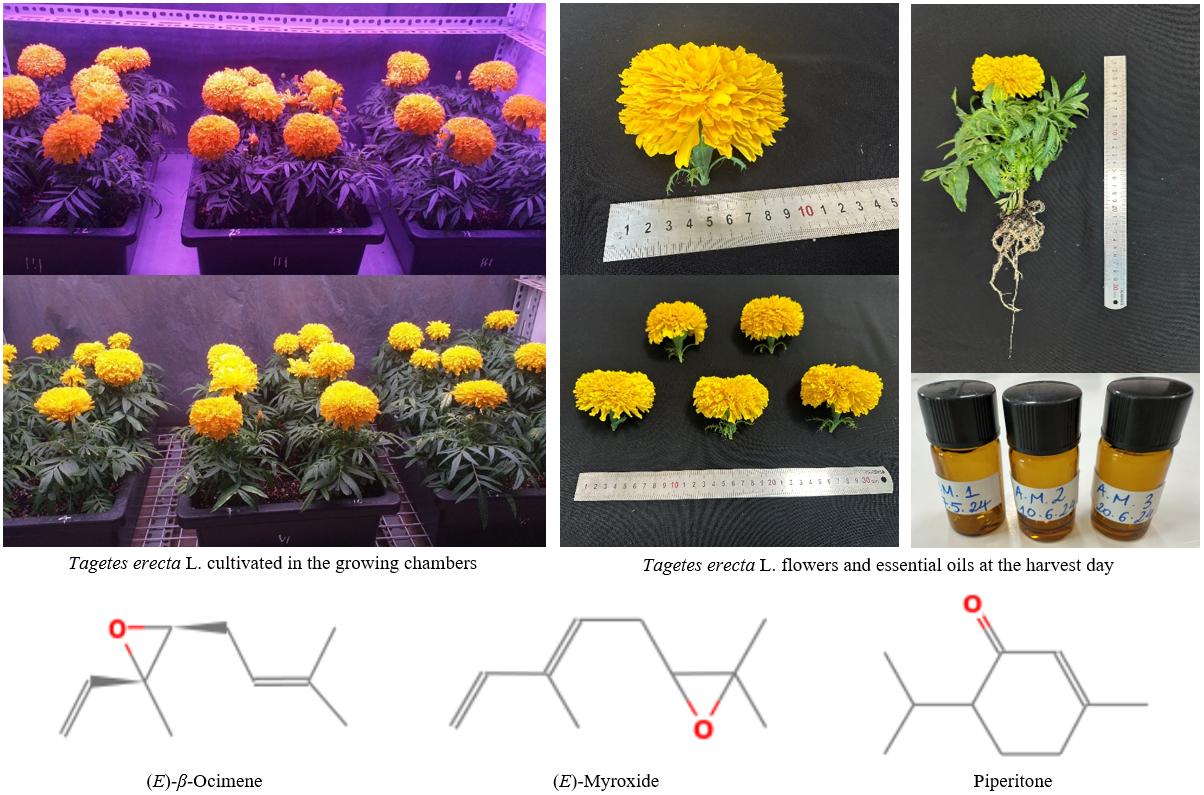
This study evaluated the effects of light spectral quality on shoot yield and essential oil of Tagetes erecta L. cultivated in controlled growth chambers. Plants were grown for up to 101 days under three LED lighting treatments with different red, blue, and white wavelength ratios and a constant 16 h photoperiod. The F2 treatment (5 red:1 blue) produced yields of fresh shoots, early blooming flowers, and oils of 271 ± 28 g/tray, 97.43 ± 13.14 g/tray, and 52.46 ± 5.41 mg/tray, respectively. These values were significantly higher (p < 0.05) than those of the F1 treatment (white:red-phosphor), and represented increases of 1.37-, 1.26-, and 1.38-fold, respectively. Gas chromatography identified three major oil constituents—(E)-β-ocimene (22.9–28.8%), (E)-myroxide (13.9–20.6%), and piperitone (7.3–9.6%)—among a total of 24—25 compounds. Essential oils inhibited from four to five of the seven tested microbial strains, with the notable activity against Escherichia coli and Candida albicans recorded in F2 and F1, respectively. These findings confirm that light spectral quality is a critical factor regulating flower, essential oil yield, and antimicrobial efficacy in T. erecta, and support the use of optimized LED spectra as a practical approach to improve plant’s yield and phytochemical quality.