

Submitted:
08 April 2026
Posted:
09 April 2026
Read the latest preprint version here
Abstract
We construct an explicit receiver-side linear closure of the copy-time core of QICT anddetermine its full receiver-accessible sector through quadratic order in momentum. Theconstruction is organized so that the operational copy time remains the only foundational inputinherited from QICT, whereas validator selection, shell geometry, link fields, receiver maps,and benchmark dynamics are introduced as explicit closure data. Under this assumption set,we prove that a calculable and falsifiable receiver-side extension must contain five structuralingredients: a validator sector, a certified transport support, a compact local covariance law,a finite-dimensional benchmark normal form, and a declared receiver map. We then showthat these ingredients are also sufficient to render the inverse problem well posed.Within this closure class, we derive equivariant validator selection on homogeneoussubstrates and generic uniqueness after perturbative symmetry lifting; identify the six-cellcontour as the minimal nearest-neighbour transport cycle on a codimension-one receivershell with opposite pairing; and prove that this local backbone is unaffected by the additionof nonlocal chords. Compact covariance on Hermitian triplet and doublet fibres yields aring sector with one Abelian and eight colour gauge connections and a spoke sector withSU(2)L ×U(1)Y structure. For a minimal one-family chiral completion, gauge-invariantYukawa couplings together with vanishing gauge and mixed gravitational anomalies reproducethe standard hypercharge pattern. In a real two-channel six-cell benchmark, we derivethe exact propagator, the visible/receiver-dark leakage laws relative to a chirality-selectivereceiver, an invariant receiver-dark sector at vanishing chirality mixing, and the correspondinghydrodynamic limit.The low-momentum receiver-accessible sector reduces to a universal five-parameter normalform, from which (µ,κ,ν,∆,m) are reconstructed algebraically from five spectral observables.We further derive a redundant falsification stack based on odd dispersion splitting, universalquadratic visible-curvature onset, gap-closure identities, a gap-length mass law, and anoperational reduced-rest-gap-time extraction protocol with explicit front-delay subtractiontogether with distance-collapse and amplitude-collapse diagnostics. The resulting frameworkis intentionally bounded: it provides an explicit and experimentally testable effective sector,together with a sharp theorem on what cannot be inferred from receiver-side linear data alone.As a separate extension, we formulate a branchwise topological-lift ansatz for dressed integermass ladders and state the corresponding integer-core, cross-platform, and compositeness tests.
Keywords:
QICT
; operational information transfer
; receiver-side dynamics
; inverse spectral problem
; certified transport contour
; linear benchmark model
; exact propagator
; spectral inversion
; small-signal stability
; chiral completion
; gauge covariance
; symmetry breaking
; anomaly cancellation
; rest-gap reconstruction
; observable consistency tests
; Information Closure
; topological lift
; flavor physics
; CKM/PMNS structure
; Lepton Masses
; beyond standard model physics
; emergent gravity
; chiral structure
; falsifiable signatures
1. Introduction
Operational approaches become physically useful only when they yield closures that are explicit enough to calculate and restrictive enough to be falsified. The receiver-side QICT core is deliberately minimal: a source-prepared distinction acquires operational meaning only when a receiver can resolve the induced hypotheses above a prescribed threshold [1,9]. Any extension of that statement must therefore distinguish cleanly between foundational input, closure-level assumptions, derived consequences, and observables that can genuinely fail against data.
The present work is built around that distinction. We take the operational copy time as the sole foundational object imported from QICT and construct an explicit receiver-side closure by specifying validator selection, shell geometry, link variables, a two-channel benchmark generator, and a receiver map. This structure is summarized by an inverse-closure principle: a viable receiver-side extension must provide a named validator, a certified local transport support, compact local covariance, a finite-dimensional benchmark sector with explicit inversion, and an operationally defined receiver map. These ingredients are not introduced as ornamental choices; they are the minimal data required for the receiver-side inverse problem to become mathematically controlled and empirically vulnerable.
The main results are as follows. First, we show that validator selection is equivariant on homogeneous substrates and generically becomes unique once degeneracies are lifted by preparation, loading, or defect perturbations. Second, we identify the six-cell contour as the minimal certified transport cycle on a codimension-one receiver shell and prove that its local minimality is not altered by nonlocal chords. Third, compact covariance on Hermitian triplet and doublet fibres yields the ring and spoke gauge sectors, while a minimal one-family chiral completion reproduces the standard anomaly-free hypercharge assignment. Fourth, the explicit two-channel benchmark admits an exact propagator, exact leakage laws, and a universal five-parameter low-momentum reduction. Fifth, the corresponding inverse map supplies algebraic reconstruction of the closure coefficients together with a redundant signature stack that can falsify the framework across numerical or hardware implementations.
The scope of the paper is deliberately precise. We do not claim a derivation of the full Standard Model from QICT alone. Rather, we show that the receiver-side copy-time core admits a sharply defined effective closure whose linear sector is explicit, spectrally invertible, and overconstrained by independent observables. In the strengthened version, the supplement proves a theorem core for the minimal closure, separates brutally between calibration and prediction, derives the faithful non-Abelian gauge quotient and the Higgs-type scalar instability from the same closure functional, quantifies the perturbative dressing required by the muon channel, adds a blind-prediction layer for the absolute neutrino spectrum in the minimal neutral zero-mode subclass together with one-anchor propagation targets for charged-lepton dipole anomalies, reduces the absolute scale to the universal copy time and one discrete lifted eigenvalue, and recasts the gravity link and vacuum copy density as a controlled variational subsector. That is already a substantial advance: it converts a broad conceptual proposal into a controlled effective framework with exact formulas, a nontrivial identifiability boundary, and several direct experimental failure modes.
2. Operational Scope and Closure-Level Hypotheses
Let S and R denote disjoint source and receiver regions. The only foundational QICT quantity imported here is the copy time
with threshold and source preparations [9]. Nothing below is claimed to follow from (1) alone.
Definition 1
(Explicit inverse-closure principle). An admissible receiver-side extension of (1) is said to satisfy the explicit inverse-closure principle if it is simultaneously: (i) validator centred, so that receiver quantities are defined relative to an auditable centre; (ii) support certified, so that transport and return auditing occur on a declared local support; (iii) compactly covariant, so that exchange laws are generated by composition-closed norm-preserving local transport; (iv) finite-dimensionally invertible, so that a closed benchmark class exists from which measured observables can be reconstructed; and (v) receiver relative, so that visible/null sectors are defined by a declared receiver map rather than by an implicit second ontology.
The principle is not an extra physical postulate beyond the five assumptions stated below; it is a compact reformulation of what those assumptions are required to accomplish. Its value is organizational: it turns the closure from a list of convenient ingredients into one explicit criterion of calculability, invertibility, and exposure to failure.
We work instead in a homogeneous, locally finite substrate X endowed with a local update rule and a certification functional
where is the first certified return time to site x and is an acceptance residual. A validator is any site minimizing for the preparation under study.
The results below use the following closure-level assumptions.
- (A1)
- Equivariant certification. The certification functional transforms covariantly under the relevant automorphism group of the homogeneous background.
- (A2)
- Certified shell geometry. Receiver transport is supported on a codimension-one first shell admitting a nearest-neighbor cyclic contour with opposite pairing.
- (A3)
- Local link fields. Ring transport is mediated by compact links, while the spoke sector carries a declared algebra.
- (A4)
- Audited linear benchmark class. The receiver-accessible linear dynamics is real, finite range, translation invariant on the six-cell contour, and has one receiver-selective axis.
- (A5)
- Operational receiver map. “Visible” and “receiver-dark” refer only to the selected receiver map. They do not, by themselves, identify a second ontology or a cosmological dark-matter component.
No theorem in the paper is stronger than the subset of assumptions on which it explicitly depends.
Proposition 1
(Structural necessity of the five closure slots). Consider any proposed receiver-accessible linear closure extending (1) that claims all of the following: a validator-centered description, a certified transport support, explicit exchange laws, a finite-dimensional inverse problem, and a receiver-relative visible/receiver-dark partition. Then the closure must specify analogues of (A1)–(A5).
Proof.
Without (A1), homogeneous backgrounds leave the validator undefined up to automorphism and no named center can be used coherently in later formulas. Without (A2), receiver transport has no certified support on which contour dynamics, opposite pairing, or return auditing can even be stated. Without (A3), the closure has no explicit local exchange law and therefore no precise statement of gauge covariance or mediator content. Without (A4), the receiver dynamics is not restricted to a closed benchmark class, so neither exact inversion nor an overconstrained observable stack is available. Without (A5), the visible/receiver-dark split loses operational meaning because it is no longer tied to a declared receiver map. Hence the present five assumptions should not be read as arbitrary decorative choices. They are the minimal structural data required for the class of explicit explicit linear closures studied here. □
The first-principles content available at the present level is therefore architectural rather than cosmological: the paper does not prove why nature must realize this exact closure, but it does prove which kinds of structural data any such explicit linear closure must contain in order to become calculable and falsifiable.
Theorem 1
(Architectural sufficiency of the audited ladder). Assume (A1)–(A5) . Then the receiver-side closure determines a well-posed audited inverse problem with four logically distinct layers: a named validator sector from (A1) , a certified transport support from (A2) , explicit local exchange and benchmark generators from (A3)–(A4) , and an operational observable partition from (A5) . Consequently the closure admits finite-dimensional parameter reconstruction and receiver-side rejection criteria stated entirely in terms of measured observables.
Proof.
Assumption (A1) makes validator specialization well defined up to the symmetry analysis carried out in Sec. 3. Assumption (A2) supplies the certified support on which contour transport and opposite pairing are defined. Assumptions (A3)–(A4) provide explicit local exchange laws and a closed benchmark generator, from which the exact propagator, spectral inversion formulas, and hydrodynamic coefficients are derived in later sections. Assumption (A5) ties the words “visible” and “dark” to a declared receiver map, so the observable stack becomes operational rather than interpretive. Once these four layers are fixed, the benchmark sector is a finite-dimensional inverse problem and the signature stack of Secs. 9–10 supplies explicit rejection criteria. □
Theorem 2
(Architectural reduction of the explicit inverse-closure principle). Assume the explicit inverse-closure principle together with: a codimension-one first receiver shell, nearest-neighbour contour transport with opposite pairing, one receiver-selective internal axis, finite-range translation invariance on the certified contour, and compact local covariance on the ring and spoke fibres. Then, up to validator gauge choice, internal basis choice, and the irrelevant higher-order remainders made explicit later, the receiver-side closure reduces to the following architecture: one selected validator, one minimal six-cell certified contour, one compact ring structure group , one compact spoke structure group , and one real explicit two-channel linear normal form with relevant couplings .
Proof.
The necessity and sufficiency statements of Proposition 1 and Theorem 1 already reduce any admissible audited inverse problem to five structural slots. Theorem 3 fixes the validator sector up to gauge or perturbative splitting. Proposition 2 fixes the certified contour cardinality at six once codimension-one shell geometry, opposite pairing, and cyclic nearest-neighbour support are imposed. Theorems 4 and 5 fix the compact local covariance groups on the ring and spoke fibres. Finally, Theorem 8 shows that every receiver-accessible linear two-channel generator in this class collapses to the same five-coupling audited normal form up to the explicit irrelevant remainders. These ingredients are exactly the claimed reduced architecture. □
The explicit seven-node closure consists of one selected validator A and a six-cell receiver contour on the first shell around A ; see Figure 1. The point of the paper is not to assume that this labeling is fundamental. The point is to show when and why it can emerge, what transport and exchange structures it can support, and how its parameters may be reconstructed from measured observables.
3. Emergent Validator Selection
Theorem 3
(Equivariant validator selection). Let X be a homogeneous pregeometric substrate and let act transitively on the homogeneous background relevant to the preparation under study. Suppose that the certification functional is automorphism-equivariant in the sense that
Then the set of validator candidates
is an -orbit. In particular, on a completely homogeneous background no named validator A is ontically distinguished: choosing one representative of is a gauge fixing of a degenerate minimizing orbit.
Proof.
Let and . For any , equivariance gives
Hence . Setting for a homogeneous preparation shows that is invariant under the automorphism group and therefore decomposes into orbits. Since every minimizer can be mapped to every other minimizer by homogeneity, the minimizer set is a single orbit. Choosing one element and naming it A is thus a representative choice, not an ontic asymmetry. □
Corollary 1
(Dynamic uniqueness after symmetry lifting). Assume, in addition, that the degenerate minimizer set is finite. Then for a generic perturbation and sufficiently small , the degeneracy is lifted and the validator becomes unique.
Proof.
The minimizers of form a finite family of equal real values. Under a generic perturbation of the preparation, these values acquire distinct Taylor coefficients at some finite order in . Hence the equalities between them fail for sufficiently small nonzero , leaving one strict minimizer. This is the discrete perturbative splitting mechanism recorded in the supplement. □
The practical consequence is straightforward. The notation A is not a primitive distinguished object. It is either a gauge representative on a homogeneous background or a dynamically selected minimizer once a source preparation, a receiver loading, or a defect background lifts the degeneracy. Validator specialization is therefore implemented variationally rather than by stipulation.
4. Codimension-one Shell Geometry and Six-Cell Minimality
The seven-node closure minimality claim is not a statement about the full coordination shell of a three-dimensional lattice. The receiver in QICT is a region on a shell, and the certified return protocol tracks a closed transport contour within that shell.
Definition 2
(First receiver shell and audited contour). Fix a source site and a graph distance . The first receiver shell is
An audited contour is a cyclic subgraph carrying nearest-neighbor transport, opposite-pair composition, and a validator return map.
Proposition 2
(Codimension-one contour minimality). Let the ambient substrate be isotropic at large scales and let the first receiver shell around a selected validator be a codimension-one surface. Within the class of cyclic audited contours on that shell satisfying nearest-neighbor transport, opposite-pair composition, and approximate cyclic isotropy, the smallest nondegenerate contour has six cells.
Proof.
A codimension-one shell around a point in three ambient dimensions is two-dimensional. Any simple closed transport path on such a shell is therefore one-dimensional and topologically a circle. Opposite-pair composition requires even contour cardinality. Requiring at least three distinct opposite pairs already forces cardinality at least six. A two-cell or four-cell contour fails to support three opposite pairs; odd contours fail opposite pairing outright. Hence the smallest cyclic contour satisfying all requirements has six cells. □
Remark 1.
This proposition removes the false dilemma “either microscopic space is fundamentally two-dimensional or the seven-node closure fails.” The correct statement is that the certified receiver layer lives on a shell, and shell geometry is codimension one even in a three-dimensional ambient space. The seven-node closure discretizes a contour on that shell.
Proposition 3
(Robustness of the six-cell backbone to nonlocal chords). Within the audited contour class, adding nonlocal entangling couplings or longer-range transfer amplitudes on top of the certified nearest-neighbor contour does not lower the minimal cardinality of the local backbone required by Proposition 2.
Proof.
Proposition 2 constrains the local certified contour, namely the cyclic nearest-neighbor backbone on which certified return and opposite pairing are defined. Adding a chord or any other nonlocal edge changes the transfer kernel on that fixed vertex set, but it does not create three opposite pairs on fewer than six vertices. The obstruction for two-cell and four-cell contours is combinatorial and remains even if arbitrary extra nonlocal edges are superimposed. Hence nonlocal entanglement can enrich the dynamics on the contour, but it does not reduce the minimal local contour cardinality. □
The minimality claim is therefore a statement about the smallest certified local transport backbone compatible with the receiver protocol. It is not a denial that a more microscopic theory may contain additional nonlocal kernels.
5. Gauge-Covariant Exchange Sector
To test whether the closure is more than a kinematic relabeling, one must write explicit exchange fields on the certified contour. This section does so in the minimal ring-plus-spoke setting needed later in the paper.
5.1. Ring Links and Colour-Phase Exchange
Let be a colour-triplet matter amplitude on ring cell . On each oriented ring edge introduce a compact link variable
Consider the discrete Lagrangian
where and are the discrete Abelian and non-Abelian plaquette curvatures built from the links.
Proposition 4
(Exact local gauge covariance of the ring sector). The ring Lagrangian (8) is invariant under local transformations
with and .
Proof.
The onsite term is invariant because is unitary. In the hopping term,
The curvature terms are the standard gauge-invariant quadratic functions of the link holonomies. Therefore the full ring action is locally invariant. □
Theorem 4
(Minimal compact covariance principle for the ring fibre). Assume that the certified ring transport acts on a complex rank-three Hermitian fibre and is (i) linear on each fibre, (ii) norm preserving, (iii) closed under composition and inversion along adjacent edges, and (iv) maximal among connected compact symmetry groups acting faithfully on the triplet fibre. Then the transport structure group is . Its Lie algebra splits as
so the infinitesimal bosonic ring connection necessarily contains one Abelian and eight non-Abelian components.
Proof.
A complex Hermitian rank-three fibre admits as norm-preserving linear automorphisms exactly the unitary group . Assumptions (iii) and (iv) say that the local transport law uses the maximal connected compact subgroup acting faithfully on that fibre, so no proper connected compact subgroup larger than the realised transport group is allowed; hence the structure group is . The standard Lie-algebra decomposition
then yields one central generator and eight traceless Hermitian generators. Writing the connection in that basis gives one Abelian phase mode and eight adjoint colour modes. □
Linearizing around the trivial background by writing
shows that the closure carries one Abelian phase mediator and eight adjoint colour-exchange modes . In other words, once transport links are treated as genuine dynamical variables, the ring sector already contains the minimal local exchange content required for the later spectral analysis.
5.2. Chiral Spoke Sector, Spontaneous Symmetry Breaking, and Anomaly-Free Completion
Theorem 5
(Minimal compact covariance principle for the spoke fibre). Assume that the validator-centred spoke fibre splits into one left chiral Hermitian doublet and one right singlet, and that the local covariance group acts faithfully on the doublet, preserves the Hermitian forms, and is maximal among connected compact groups compatible with that splitting. Then the doublet covariance group is , with Lie algebra
After identifying the common phase with hypercharge, the nontrivial spoke gauge content is .
Proof.
Norm-preserving linear automorphisms of a complex Hermitian doublet form . Maximal connected compact covariance on the doublet therefore yields rather than a proper connected subgroup. The singlet contributes only a phase line. Passing to the Lie algebra gives one traceless three-generator part and one central part, which is the stated structure once the shared phase is interpreted as hypercharge. □
To model exchange relative to the validator, introduce a left doublet , a right singlet , and spoke gauge fields () and for . Let be a validator-sector scalar doublet with hypercharge and potential
The spoke covariant derivative is
Proposition 5
(Minimal spontaneous-symmetry-breaking sector). Assume and . Then the minima of
form the three-sphere
Choosing the vacuum representative , the unbroken generator is , so the spoke symmetry breaks
In unitary gauge one may write
leaving one physical radial scalar with mass
Proof.
Since , the potential is minimized exactly when , which is a sphere in the four real coordinates of . The generator annihilates the chosen vacuum, whereas the other three gauge directions move it along its orbit, so the unbroken subgroup is the electromagnetic . Expanding the scalar field around the vacuum in unitary gauge leaves only the radial mode ; the quadratic term in the potential is , hence . □
Choosing the validator vacuum yields the quadratic spoke mass term
Theorem 6
(Spoke-sector mediator spectrum within the declared closure). The mass matrix (22) has rank three. Its eigenmodes are two charged combinations
and one neutral massive combination
while the orthogonal combination
remains exactly massless.
Proof.
Equation (22) is already diagonal in the directions and gives the same eigenvalue to both. In the neutral sector the matrix is
Its determinant vanishes, so one eigenvalue is zero. The trace gives the nonzero eigenvalue . The corresponding normalized eigenvectors are the stated Z and combinations. □
Corollary 2
(Group-theoretic locking of mediator multiplicities). Within the declared closure, the linear mediator counts are fixed once the local groups are fixed: the ring links contribute one Abelian mode and eight adjoint colour modes, while the broken spoke sector contributes three massive and one massless electroweak mediator combinations.
Proof.
The ring-sector count is the dimension count obtained from the linearization of the compact links in Equation (7). The spoke-sector count is exactly the rank-three mass splitting established in Theorem 6. No further multiplicities appear at linear order in the declared closure. □
This theorem is an internal algebraic statement about the declared spoke sector. It does not derive the observed electroweak theory from first principles. What it establishes is narrower but useful: once the closure is endowed with the standard spoke algebra and validator-sector symmetry breaking, the resulting mediator spectrum is explicit and internally consistent. Likewise, the colour-octet multiplicity is not fitted a posteriori: once the ring link group is chosen, its adjoint count is fixed group-theoretically.
5.3. Minimal Anomaly-Free One-Family Completion
The receiver-side observable stack does not determine a chiral matter completion by itself. Once one explicitly supplies a minimal one-family completion, however, the anomaly-cancellation problem becomes fully algebraic.
Introduce one chiral family with representations
and Higgs doublet . Require the renormalizable Yukawa couplings
with . Gauge invariance of the Yukawa terms gives
Theorem 7
(Minimal one-family anomaly-free completion). Assume the spoke sector is completed by the above one-family chiral matter content and that all local gauge and mixed gravitational anomalies vanish:
Then the hypercharges are fixed uniquely, up to the overall sign convention for Y, by
Consequently the minimal one-family completion of the declared spoke sector is anomaly free with the standard hypercharge pattern.
Proof.
The anomaly equations are
Substituting the Yukawa relations (29) into (33) gives . The mixed gravitational equation (34) is then automatically satisfied. Inserting the same relations into (35) yields
so , after which the remaining charges follow from (29). The common sign flip corresponds only to a sign convention, so the physical pattern is unique. □
This theorem is deliberately conditional. It does not say that receiver-side linear data alone determine the chiral matter content. It says something narrower and stronger: once the minimal one-family completion is supplied, anomaly cancellation and Yukawa gauge invariance lock the hypercharges and make the completion mathematically rigid.
Corollary 3
(Minimal anomaly-compatible matter rigidity). Within the one-family completion of Theorem 7, any deformation that preserves the same renormalizable Yukawa couplings, the same compact gauge groups, and vanishing local and mixed gravitational anomalies leaves the hypercharge pattern unchanged up to the overall sign convention for Y. In that precise sense the matter charges are rigid once the completion class has been fixed.
Proof.
Theorem 7 reduces the allowed charges to the unique solution of the Yukawa constraints together with the four anomaly equations. Any deformation that preserves that same algebraic system must therefore preserve the same solution set, which differs only by the common sign convention . □
The missing Standard-Model steps are therefore sharply localized. Family replication, flavor textures, mixing angles, and observed numerical masses still require additional microscopic representation data beyond the one-family completion fixed above.
6. Operational Lorentz Compatibility
A microscopic seven-substep transcription cycle is harmless only if it is not itself an observable clock.
Proposition 6
(Operational indistinguishability of hidden tick decompositions). Assume that all receiver-accessible observables are functions of the update count n and the microscopic update time only through the coarse variable . Then two microscopic descriptions and satisfying are operationally indistinguishable. In particular, the integer seven entering one certified transcription cycle does not define an observable preferred time standard by itself.
Proof.
By assumption, every receiver observable can be written as with . If , then , so the two microscopic descriptions produce identical receiver data. Therefore the decomposition of coarse time into “number of hidden ticks” times “duration per tick” is not operationally accessible. □
To connect this to continuum kinematics, let the parity-even propagating sector have single-particle step operator
Then for small k the quasi-energy satisfies
Corollary 4
(Emergent Lorentz compatibility). In the propagating regime where the terms are negligible on the scales probed by copy-time measurements, the effective continuum equations generated by (37) are Lorentz-compatible with invariant speed . Violations are controlled by explicit higher-order lattice corrections.
7. Audited Two-Channel Benchmark Dynamics
The structural results above still leave a dynamical question: how to write a minimal chiral receiver benchmark whose observables are exactly calculable and invertible. We answer that question with a two-channel audited ring dynamics.
For each cell on the receiver contour, introduce a two-component internal fibre with basis vectors and . The ring state is
Let S denote the cyclic shift on , , and define the six-cell Laplacian
The closure-level benchmark generator is chosen to be
where is the validator-controlled damping scale, the symmetric ring-spreading coefficient, a chiral transport bias, a left/right mixing strength, a static chirality splitting, and
encodes opposite signed drift for the two chiral channels.
Remark 2.
Equation (41) is not claimed as a unique microscopic truth. It is chosen because it is local, block-circulant, exactly solvable, and rich enough to support a chirality-selective receiver map together with a receiver-relative visible/dark decomposition.
Theorem 8
(Universal low-momentum normal form of the explicit two-channel sector). Let be any receiver-accessible linear generator for a two-channel audited contour satisfying the following conditions near : (i) translation invariance and finite-range locality, so is analytic in k; (ii) a real cell basis, so the internal decomposition uses only , , and ; (iii) one receiver-selective axis fixed by the chirality projector, so orientation reversal leaves the scalar part even and the receiver-odd part odd; and (iv) a nonzero channel-mixing term that is even in k. Then after a k-independent internal basis choice,
Consequently the five coefficients are the universal relevant couplings of the audited linear two-channel sector to quadratic order in momentum. The discrete benchmark (41) is the nearest-neighbor six-cell representative of this normal form, obtained by replacing and .
Proof.
In a real two-channel basis every block decomposes as
Finite-range locality makes a , b , and c analytic in k . The audited contour has an orientation, but the receiver projector fixes one internal axis, so the scalar damping and channel mixing are even in k whereas the transport-asymmetry contribution is odd. Therefore
Corollary 5
(Benchmark non-arbitrariness). Any two explicit linear closures with the same five low-momentum couplings have identical receiver-accessible two-channel dynamics up to the order at which the normal form (43) is truncated. The benchmark is therefore not an arbitrary ansatz but a universal representative of the explicit linear sector.
Theorem 9
(Closure completeness of the audited linear two-channel class). Fix the audited linear hypotheses of Theorem 8. Then every receiver-accessible closure-level statement used in the present paper inside the certified linear sector depends, up to quadratic order in momentum, only on the five couplings and on no further hidden closure datum. More precisely, any two explicit closures with the same five couplings have identical, to the order retained in the normal form, (i) mode eigenvalues, (ii) chiral transfer amplitudes, (iii) short-time visible curvature, (iv) odd dispersion slope, and (v) reconstructed parameter vector. Any residual closure dependence enters only through the explicit irrelevant remainders .
Proof.
Theorem 8 classifies every audited linear two-channel generator by the five coefficients that survive to the truncation order used throughout the paper. The observables listed in (i)–(v) are analytic functionals of that generator. Their Taylor coefficients through the retained order depend only on the five universal couplings, while any extra closure dependence is postponed to the stated higher-order remainders. Therefore matching forces agreement of all receiver-accessible linear observables used in the paper up to the same order. □
Proposition 7
(Mode reduction). In the discrete Fourier basis on the ring, the dynamics decouples into six independent blocks
with
for momenta , .
Proof.
The Fourier transform diagonalizes the cyclic shift: and . Hence and . With the present real-rate convention, the drift sign is absorbed into , yielding the real audited block (46). The cellwise chirality-mixing and chirality-splitting terms are unaffected by the Fourier transform. □
8. Exact Chiral Propagator and Receiver-Relative Visible/Receiver-Dark Sectors
Define
Theorem 10
(Exact propagator and mode spectrum). For every momentum and every ,
The mode eigenvalues are
If for all six momenta, the benchmark is strictly contractive.
Proof.
Write with . Since , the standard matrix-function identity gives
Define the chirality-selective weak receiver by
The visible sector is the image of ; the receiver-dark sector is its kernel.
Proposition 8
(Exact visible/receiver-dark leakage law). For a right-handed initial mode on momentum k, the visible and receiver-dark intensities are exactly
Hence the right-handed mode is exactly receiver-dark when , and its visible leakage is quadratically suppressed in m for fixed t.
Proof.
Corollary 6
(Universal short-time curvature). For a right-handed initial mode,
independently of μ, κ, ν, and Δ.
Corollary 7
(Exact invariant receiver-dark sector at ). If , then is invariant under and is exactly invisible to the weak receiver.
Proposition 9
(Operational meaning of the receiver-dark sector). The receiver-dark sector is defined only as the kernel of the declared receiver map. It is therefore a detector-relative null sector: excitations in that subspace are invisible to the chosen receiver, but no claim follows that they constitute cosmological dark matter, carry the observed dark-matter abundance, or reproduce gravitational dark-sector phenomenology.
Proof.
The definition is purely operational: visibility is determined by composition with the receiver projector, and Proposition 8 computes that composition exactly inside the audited benchmark. Cosmological dark matter would require additional ingredients not present in the present closure, including asymptotic species identification, stability on cosmological timescales, production history, and gravitational phenomenology. None of those data are contained in the receiver projector itself. □
9. Spectral Reconstruction and the Hydrodynamic Limit
The exact block spectrum allows the closure parameters to be recovered algebraically from audited modal observables.
Theorem 11
(Spectral reconstruction theorem). Let
and define the three audited mode gaps
Assume . Then the five benchmark parameters are recoverable from these five spectral numbers by
Thus the audited benchmark is spectrally invertible up to the sign conventions already fixed by chirality orientation and receiver labeling.
Proof.
Taking the sum and difference of yields (60) and (61); substituting back into gives (62). □
Theorem 12
(Hydrodynamic envelope equation). Let . Around the long-wavelength branch , the slow mode satisfies
with
Consequently, the slowly varying envelope obeys the effective equation
Proof.
The spectral inversion theorem is central because it converts the benchmark from a descriptive parametrization into a measurement protocol. Once the audited mode gaps and decay scales are extracted, the benchmark parameters are fixed algebraically and the closure becomes directly testable.
10. Parent Hamiltonian, Certified Dispersion, and the Rest-Mass Law
The audited generator is the receiver-side Euclidean transport object. To connect it to energies and rest masses, we introduce a microscopic propagating parent Hamiltonian whose certified equal-time correlators reduce to the same low-momentum data.
For each ring momentum k let be a two-component certified spinor and define the parent Hamiltonian block
where , is the parent rest-mass parameter, is a Wilson-type curvature coefficient controlling higher-order lattice corrections, and is a static parity-even splitting. The Hamiltonian is Hermitian and local on the six-cell ring.
Proposition 10
(Exact parent dispersion). The eigenvalues of (68) are
In particular, for one has
with .
Proof.
Remark 3.
The audited generator and the parent Hamiltonian are not the same operator. The former is the receiver-side certified transport generator; the latter is the propagating microscopic parent. Their spectral structures are nevertheless matched at low momentum: the audited block and the parent block both square to a scalar multiple of the identity. This is the algebraic reason why the inverse spectral logic can be transported from the audited generator to the propagating parent sector.
Theorem 13
(Gap-length rest-mass law). Assume that a propagating certified mode is governed at low momentum by the parent dispersion
with . Let be the equal-time Euclidean Green function of that mode,
Then the large-distance certified propagator decays as
Consequently,
Proof.
Proposition 11
(Gap length versus composite size radius). Let denote the inverse rest-gap length extracted from the pole of the certified propagator and let denote a composite size radius extracted from a form factor or from a spatial certification-density moment. In a composite sector there is no general identity . Replacing by in (74) therefore biases the inferred mass by the factor .
Proof.
The pole mass is fixed by the singularity of the two-point function or, equivalently, by the zero of . By contrast, a size radius is fixed by the slope of a spatial form factor or by the second moment of a normalized density profile. These are different spectral data. For an extended bound state the density support may be much larger than the inverse pole location. Therefore no theorem forces to equal . If one nevertheless inserts into (74), one obtains . □
Corollary 8
(Correct closure-level masses from gap lengths). Whenever a closure sector has a dominant rest-gap length , its rest mass is fixed by (74). In particular, if two isolated closure branches a and b are controlled by and , then
If branch b is composite, its outer certification radius controls size. It need not equal .
Remark 4.
The rest-mass law is controlled by , not by an outer composite size radius. Any phenomenological application must therefore keep pole-gap data and size data distinct.
Definition 3
(Reduced rest-gap time). Fix a closure branch a and a receiver threshold , where is the maximal normalized branch amplitude at the receiver after subtracting the ballistic front time . If the local rest-mode response has the audited form
define
Theorem 14
(Rest mass from the reduced rest-gap time). For a branch satisfying (76) with , the reduced rest-gap time obeys
and therefore
Proof.
Set and expand (76) for the local rest-mode part. The threshold equation gives
Corollary 9
(Closure-level mass reconstruction from rest-gap times). For any asymptotically isolated closure branch with measurable reduced rest-gap time , the mass is reconstructed by (79). For confined quark-class sectors the same law reconstructs the gap scale of the corresponding short-distance branch, but it should not be interpreted as an asymptotic pole mass.
11. Platform-Independent Signatures and Overconstrained Tests
The framework is strongest when it predicts measurements that do not depend on one specific hardware implementation. The explicit linear sector has exactly such signatures, including a direct gap-versus-length rest-mass cross-check furnished by Theorem 13.
Theorem 15
(Sharp external signatures). For every closure in the universality class of Theorem 8, the following statements hold.
- 1.
-
Universal quadratic onset. For a right-handed preparation and a left-selective receiver,Thus the short-time visible curvature measures m directly and is independent of μ, κ, ν, and Δ.
- 2.
-
Odd dispersion splitting. The slow branch obeysA nonzero odd slope is therefore a direct receiver-accessible signature of simultaneous chirality splitting and chiral drift.
- 3.
-
Gap-closure identities. The audited side gaps satisfyThese identities are platform-independent consistency relations. Any statistically significant violation rejects the five-parameter audited benchmark.
- 4.
-
Mass-length identity. For any gapped certified mode in the parent propagating sector, the independently measured rest gap and certification length must satisfyEquivalently, the rest mass reconstructed from the gap and the one reconstructed from the spatial decay profile must agree within the controlled lattice remainder.
Proof.
Equation (82) is the differential form of the short-time law (55). Equation (83) follows from the hydrodynamic expansion (64). Equations (84)–(85) are immediate from the three identities used in the proof of Theorem 11. Equation (86) is the equivalent gap–length form of the mass law (74) after multiplying by . □
Corollary 10
(Redundant experimental inversion). The audited benchmark is experimentally overconstrained. From the spectral data one obtains
and hence
Independently, the curvature measurement gives
Agreement between (88) and (89), together with agreement between the measured odd slope and (83), is a nontrivial experimental closure test. In the propagating parent sector the same benchmark is overconstrained once more, because the rest mass reconstructed from the gap must also agree with the independent mass reconstructed from the certified spatial decay length through (74).
Corollary 11
(Pre-species predictive content). Before any microscopic species assignment is made, the explicit linear closure already predicts five directly testable quantities or relations: (i) the chiral-mixing scale m from the universal visible-curvature onset in Equation (89); (ii) the drift–splitting combination from the odd dispersion slope in Equation (83); (iii) the pair from the side-gap identities (84)–(85); (iv) the parent-sector consistency relation between rest gap and certification length in Equation (86); and (v) the branchwise distance-collapse and amplitude-collapse prediction for the reduced rest-gap-time estimator established in Theorem 23. These predictions are quantitative, hardware-agnostic, and logically prior to any identification of a given branch with an observed particle species.
Theorem 16
(Cross-platform universality test). Suppose independent external platforms produce reconstructed audited parameter vectors with covariance matrices . Under the null hypothesis that all platforms realize one common audited universality class, the generalized least-squares pooled estimator is
and the incompatibility statistic
is asymptotically distributed with degrees of freedom. Therefore a statistically significant excess of Q above the benchmark falsifies platform-independent universality of the audited signature stack.
Proof.
Under the Gaussian approximation to the independently reconstructed parameter vectors, the log-likelihood is the weighted quadratic form

Table 1.
Platform-independent external signature stack. The same inversion and rejection logic can be implemented on different hardware provided that local preparation, channel-selective readout, and mode spectroscopy are available.
Table 1.
Platform-independent external signature stack. The same inversion and rejection logic can be implemented on different hardware provided that local preparation, channel-selective readout, and mode spectroscopy are available.
| Observable | Exact relation | Physical role | Minimal experimental requirement |
| Short-time visible curvature | direct chiral-mixing scale | local preparation, channel-selective readout, and early-time sampling | |
| Odd dispersion slope | drift–splitting interference | momentum-resolved spectroscopy near | |
| Central and side gaps | Equations (84)–(85) | spectral self-consistency and parameter inversion | modal spectroscopy at |
| Decay pair | Equations (58)–(59) | damping and diffusion scale | time-resolved decay extraction |
| Gap-length product | Equation (86) | independent rest-mass cross-check | gap extraction together with a spatial certification-profile measurement |
The measurement logic is intentionally hardware-agnostic. A superconducting ring of coupled qubits, a photonic waveguide or time-multiplexed quantum walk with polarization or path as the internal channel, and a cold-atom synthetic ring with two internal states all implement the same measured observables once they supply (i) local initialization, (ii) channel-selective readout, and (iii) mode-resolved spectroscopy. The external claim of the paper is therefore not tied to one platform; it is tied to one signature stack. In that sense the paper makes quantitative predictions before any species-level interpretation is attempted: a closure that fails the curvature, odd-splitting, gap-closure, gap-length, or collapse tests is rejected independently of how one later chooses to name its branches.
12. Calculable Observables, Identifiability, and Quantitative Falsification
The benchmark becomes scientifically useful only when its observables are explicit and its rejection tests are hard. The reproducibility bundle included with this submission is a synthetic stress test of the inverse pipeline, not an external physics dataset. Within that numerical design the observable stack includes cell-resolved visible intensities, total intensities, mode gaps, decay rates, and profile-likelihood diagnostics for the five parameters.
Figure 2.
Representative cell-resolved visible-sector fit for the reproducible synthetic benchmark. The exact chiral propagator allows the fitted curves to be generated without numerical time stepping.
Figure 2.
Representative cell-resolved visible-sector fit for the reproducible synthetic benchmark. The exact chiral propagator allows the fitted curves to be generated without numerical time stepping.
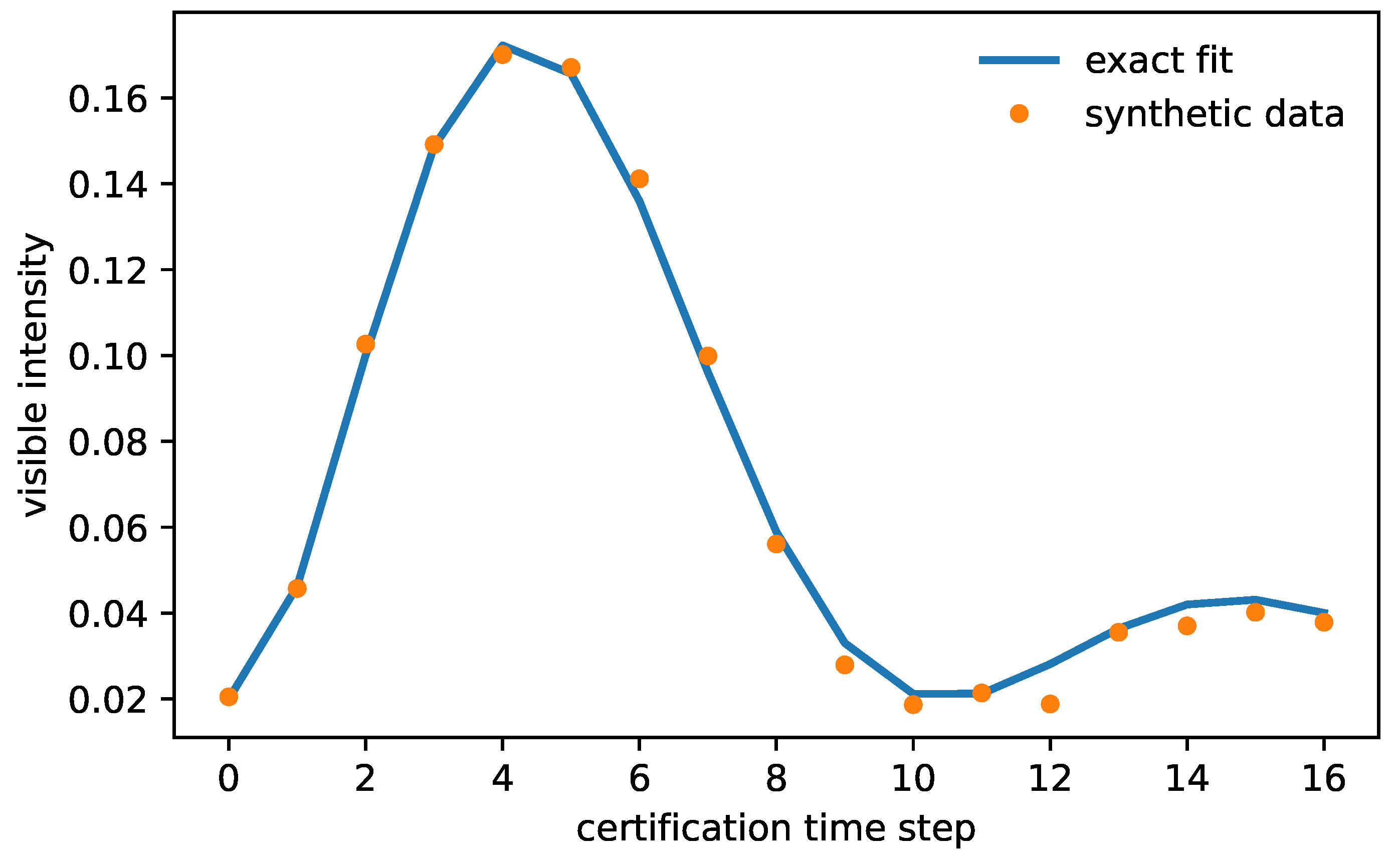
Figure 3.
Receiver-relative visible and receiver-dark fractions for the synthetic benchmark. The receiver-dark sector is defined operationally as the kernel of the left-handed receiver map. It is not identified here with cosmological dark matter.
Figure 3.
Receiver-relative visible and receiver-dark fractions for the synthetic benchmark. The receiver-dark sector is defined operationally as the kernel of the left-handed receiver map. It is not identified here with cosmological dark matter.
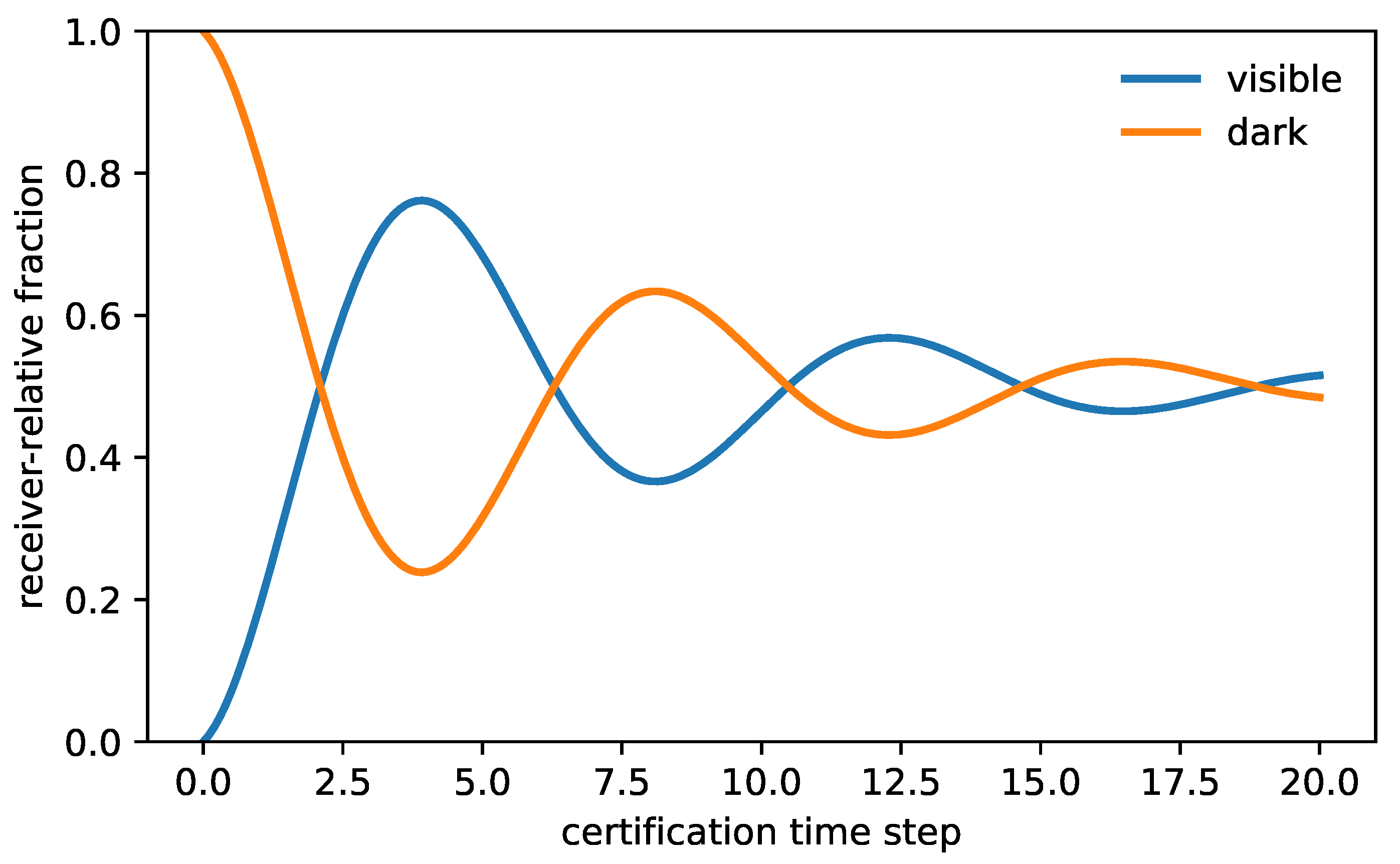
Table 2.
Parameter recovery for the bundled reproducible synthetic benchmark. These numbers document internal identifiability and inversion stability on a controlled numerical design; they are not presented as experimental evidence. The full-model fit gives with 595 degrees of freedom, corresponding to .
Table 2.
Parameter recovery for the bundled reproducible synthetic benchmark. These numbers document internal identifiability and inversion stability on a controlled numerical design; they are not presented as experimental evidence. The full-model fit gives with 595 degrees of freedom, corresponding to .
| Parameter | Planted value | Fitted value | Std. error | Absolute error |
| 0.9500 | 0.9487 | 0.0194 | 0.0013 | |
| 0.3000 | 0.2994 | 0.0091 | 0.0006 | |
| 0.3600 | 0.3852 | 0.0569 | 0.0252 | |
| 0.2700 | 0.2689 | 0.0045 | 0.0011 | |
| m | 0.1800 | 0.1713 | 0.0362 | 0.0087 |
Branchwise rest-gap reconstruction and what it does not determine
For , Equation (79) reduces at leading order to
What is derived here is the branchwise reconstruction map together with the protocol required to measure . What is not derived is a species assignment for that branch. In particular, the present closure does not derive electron, muon, tau, proton, or dark-matter masses from foundational QICT or from receiver-side linear data alone; Proposition 20 excludes such a claim without additional microscopic representation data and branch-identification input.
Proposition 12
(Scope of the reduced-rest-gap mass law). Equation (93) determines a rest mass only after four additional pieces of data have been fixed: an isolated audited branch, a calibrated effective front speed, a validated small-signal regime, and an independent microscopic identification of the branch whose mass is being quoted. Without those extra inputs the formula defines a reconstruction map, not a species-level numerical prediction.
Proof.
Theorem 14 gives the reconstruction formula once is measured for an isolated branch. Proposition 20 shows that absolute species assignments are not identifiable from the explicit receiver-side linear observable stack alone. The remaining ingredients enter operationally through Proposition 18 and Theorem 23, which require front-speed calibration, branch isolation, and small-signal control before the reconstructed can be interpreted physically. □
Proposition 13
(Common-contour no-go statement for species masses). Let denote the common audited contour data of the receiver-side closure: six contour cells, three opposite pairs, the declared ring-link groups, and the spoke-sector mediator splitting. If a proposed species mass law had the form
with no branch-specific input, then all isolated audited branches would carry the same mass. Therefore any extension that assigns distinct masses to different branches must depend on additional branch-specific topological or representation-theoretic data beyond the common contour topology alone.
Proof.
The datum is, by definition, shared by every branch living on the same audited contour. The right-hand side of Equation (94) is therefore independent of the branch label a . Hence for every pair of branches , contradicting the possibility of distinct species masses. Distinct branch masses therefore require additional branch-specific data not contained in the common contour invariants. □
Theorem 17
(Primitive-scale rigidity of the lifted ladder). Assume Assumption A1 for a connected set of elementary branches containing a primitive reference branch with . Suppose the same dataset also admitted a second description of the same measured reduced rest-gap times of the form
Then
and for every branch in the connected set,
In particular, once the total extraction uncertainty drops below the half-integer separation scale, the primitive scale and all integer cores are unique.
Proof.
Apply the lifted representation to the reference branch . Because both descriptions set the primitive core equal to one, the measured quantity gives
which is the first claim. Substituting this relation into the two descriptions for a general branch a yields
Expanding the right-hand side to first order gives , which is equivalent to (97). If the total error is , the nearest-integer uniqueness theorem forces for every branch. □
Definition 4
(Branchwise topological or representation index). A branchwise topological or representation index is a map
from admissible branch-specific microscopic lift data to positive integers. The symbol is intentionally abstract: it may encode, for example, a finite covering degree, a winding sector, a twisted holonomy class, a Fredholm- or Dirac-type index, or any equivalent microscopic representation datum that is invisible to the common receiver-accessible linear stack but branch-specific enough to distinguish isolated audited branches.
Assumption A1
(Optional branchwise topological-lift postulate). The branchwise reconstruction law of Theorem 14 is now supplemented by one additional closure-level postulate. There exists a maximal elementary reduced rest-gap time realized by the lightest elementary audited branch, together with a branchwise index map of Definition 4, such that every elementary isolated audited branch satisfies
Define the associated elementary mass scale by
This postulate is not claimed as a theorem of foundational QICT or of the receiver-accessible linear sector by itself. It is an additional closure rule whose consequences can nevertheless be falsified sharply.
Theorem 18
(Optional branchwise topological-lift mass law and dressed integer core). Assume Assumption A1. Then every elementary isolated audited branch obeys the exact dressed core formula
where inherits exactly the controlled damping, threshold, and lattice corrections of Theorem 14. Expanding for gives
In particular, at leading order in the audited weak-damping, small-threshold, and weak-dressing regime,
Thus the integer is the branchwise topological core label, while the observable noninteger offset is carried by the controlled dressing together with the already existing audited corrections .
Proof.
Substituting Equation (99) into the leading term of Theorem 14 gives
The remainder terms in Theorem 14 are unaffected by this substitution, so they collect into the branch-dependent correction . Equation (102) follows from the geometric expansion . □
Corollary 12
(Discrete ratio law and primitive-reference integer test). For any two elementary isolated branches a and b satisfying Assumption A1, one has
If is an elementary reference branch with primitive core label , then the estimator
is near the integer for every other elementary branch, with the residual noninteger drift controlled by together with the same audited extraction corrections as before. Failure of stable near-integer behavior after successful distance collapse and amplitude collapse falsifies the quantized extension, even if the underlying explicit linear closure remains viable.
Proof.
Equation (104) follows by dividing Equation (101) for two branches and using Equation (99). The second statement is the special case , for which Equation (104) gives up to the same audited corrections as before. The statement about falsifiability is immediate: if the same branch does not admit a stable near-integer label under the controlled extraction protocol of Proposition 18 and Theorem 23, then Assumption A1 fails even though the audited inverse problem itself may still be correct. □
Theorem 19
(Nearest-integer identifiability from a primitive reference). Assume Assumption A1 and let be a primitive elementary reference branch with . Then the estimator (105) obeys
where is of the same controlled weak-damping, threshold, amplitude, and lattice order that enters Theorem 14. In particular, if the total extraction error satisfies
then the nearest integer to is unique and equals the core label .
Proof.
Expanding yields Equation (106). The uniqueness statement follows because open intervals of radius centered at distinct integers are disjoint. □
Proposition 14
(Cross-platform integer-core compatibility test). Assume a primitive reference branch with , and let denote the estimator (105) extracted for branch a on platform p with Gaussian uncertainty . For any candidate integer , define
Under the lifted extension and after successful collapse diagnostics, the correct integer core should make statistically ordinary, whereas statistically significant excess for every nearby integer falsifies the lifted extension for that branch.
Proof.
If the lifted extension is correct for branch a , then each platform measures the same integer core up to the dressed offsets and the controlled audited extraction corrections summarized in Theorem 19. Once those corrections are incorporated into the reported Gaussian uncertainties, the residuals are mean-zero fluctuations and the weighted quadratic form (108) is the standard compatibility statistic for one shared discrete label. If no nearby integer yields an ordinary value of , then no platform-independent integer core is compatible with the data. □
Proposition 15
(Elementary/composite diagnostic relative to the ladder). Within the quantized extension, a branch may be treated as elementary only if the same integer core label is stable under threshold variation, amplitude variation, and platform transfer after front-delay subtraction. A composite sector need not admit such a single integer core because its outer size scale and its inverse rest-gap length are distinct observables by Proposition 11; a short-distance core may obey the branchwise gap law while the composite radius remains parametrically larger.
Proof.
If a branch is elementary in the sense of Assumption A1, then Equations (99) and (105) assign it one integer core independently of the particular admissible threshold or amplitude used in the audited extraction. The collapse theorem guarantees that the extracted is branch-specific and platform-independent to leading order, so the same must hold for . By contrast, Proposition 11 proves that composite size data and inverse rest-gap data are distinct observables. A composite branch can therefore possess one short-distance gap scale without being exhausted by a single outer-radius or form-factor scale, which is exactly why the integer ladder is a sharper candidate diagnostic for elementary branches than for composite ones. □
Proposition 16
(Illustrative dressed integer cores for the metrological sample). Take the electron branch only as a metrological reference, so that and . Then the externally known conversion sample is consistent with the dressed-core decomposition
with
These values are illustrative dressed offsets, not foundational predictions.
Proof.
For a chosen integer core , solve Equation (101) at leading audited order for the dressing variable: . Taking and the nearest integers gives the quoted numbers directly from the metrological conversion sample. □
Table 3.
Illustrative dressed integer-core check for the metrological conversion sample obtained by taking the electron branch as the reference branch, so that and . The integers 207, 3477, and 1836 are treated only as candidate branchwise core labels, while the small noninteger residuals are absorbed into the dressed offsets . The exercise is numerically striking but remains outside the theorem chain because the input masses are external.
Table 3.
Illustrative dressed integer-core check for the metrological conversion sample obtained by taking the electron branch as the reference branch, so that and . The integers 207, 3477, and 1836 are treated only as candidate branchwise core labels, while the small noninteger residuals are absorbed into the dressed offsets . The exercise is numerically striking but remains outside the theorem chain because the input masses are external.
| Branch relative to e | core integer | [MeV] | relative mismatch | ||
| 206.7683 | 207 | 105.7768 | |||
| 3477.2283 | 3477 | 1776.7434 | |||
| proton-like core | 1836.1527 | 1836 | 938.1941 |
The table above should therefore be read strictly as a postdictive consistency check on the optional topological-lift extension, not as foundational evidence for the observed lepton or baryon spectrum. Its scientific value is diagnostic rather than confirmatory: it shows what an eventual species-resolved experimental campaign would have to confirm or reject. In particular, the quantized extension makes six additional predictions beyond the core explicit closure: stable integer core labels under the distance-collapse and amplitude-collapse protocol, primitive-reference estimators that become uniquely identifiable once the half-integer criterion (107) is satisfied, statistically ordinary cross-platform compatibility scores for one and only one nearby integer, small dressed offsets rather than uncontrolled noninteger drift, a clean separation between integer-stable elementary branches and composite sectors with additional outer-size information, and failure of the extension whenever no common organizes the extracted reduced rest-gap times.
Theorem 20
(Quantized-lift external signature stack). Assume Assumption A1 and successful audited front-delay subtraction. Then the lifted extension predicts the following four quantitative external signatures for every elementary branch a: (i) primitive-reference ratio rigidity,
where collects the controlled dressing and audited extraction corrections; (ii) threshold and amplitude stability, meaning that the estimator changes only at the same controlled order under admissible threshold and amplitude variations; (iii) cross-platform integer compatibility, meaning that one and only one nearby integer yields an ordinary value of once the quoted uncertainties are used; and (iv) ratio closure,
for every pair of elementary branches . A statistically significant violation of any one of these signatures rejects the lifted extension even if the explicit receiver-side linear closure itself remains viable.
Proof.
Item (i) is exactly Corollary 12 specialized to a primitive reference branch. Item (ii) combines Corollary 12 with the collapse theorem for the reduced rest-gap extraction. Item (iii) is Proposition 14. Item (iv) is the pairwise ratio law of Corollary 12. The final falsification statement is immediate: each item is a necessary consequence of the lifted extension, so a statistically significant failure of any one of them rules out that extension while leaving the weaker explicit closure untouched. □
Assumption 2
(Optional charge-preserving family-tower postulate). Fix one conserved audited charge sector of the lifted extension. Assume that there exists a finite ordered list of isolated elementary branches
sharing the same conserved audited charge data , the same primitive scale , and strictly increasing core labels
Assume further that the first three such branches below the first compositeness threshold exhaust the elementary family content of that charge sector.
Theorem 21
(Conditional family-level species assignment from ordered integer cores). Assume Assumptions A1 and A2. Then the elementary branches in the sector admit a unique closure-level assignment to the labels electron-like, muon-like, and tau-like: they are precisely the first, second, and third elements of the ordered family tower, equivalently the branches with the three smallest core labels and therefore the three smallest reconstructed masses in that sector. Moreover, if the primitive branch is chosen as the reference branch and the estimators of and satisfy the half-integer criterion around integers and , then
and the assignment is unique inside the lifted extension.
Proof.
Assumption A2 supplies a strictly ordered elementary tower in one fixed conserved charge sector. By Theorem 18, the leading reconstructed mass is monotone in the core label up to the controlled dressed and audited corrections. Therefore the first three branches of the tower are unambiguously the lightest three elementary branches in that sector, and no alternative assignment preserves both the order in and the common charge data. If the half-integer criterion of Theorem 19 identifies and uniquely with nearby integers and , then Corollary 12 yields Equation (113). The uniqueness statement follows because a different assignment would either violate the strict order or assign the same branch two distinct nearest integers. □
Proposition 17
(Conditional proton-like composite-core identification). Assume Assumption A1. Let C be a branch carrying one stable short-distance core label under the primitive-reference protocol, but also an independent outer size scale satisfying over the same admissible regime. Then C cannot be elementary in the sense of Assumption A2; it is necessarily composite in the closure-level sense of Proposition 15. If, in addition, C belongs to a baryonic audited charge sector and the nearest-integer criterion identifies uniquely with an integer , then the closure-level label proton-like composite core is unique for that short-distance branch.
Proof.
Proposition 11 proves that the inverse rest-gap length and the outer size radius are distinct observables in general. A branch with one stable short-distance core but a parametrically larger independent outer size therefore cannot be exhausted by a single elementary gap label, which is exactly the compositeness diagnostic of Proposition 15. The final statement is purely classificatory: once the conserved audited charge sector is baryonic and the short-distance core is uniquely identified by the half-integer criterion, no second branch in the same regime can carry the same closure-level proton-like core label without violating the uniqueness of the integer-core assignment. □
Theorem 22
(Joint external exclusion of common-topology-only alternatives). Consider any alternative in which branch masses and branch classifications depend only on the common contour topology and on continuous extraction corrections, with no branch-specific integer lift data. Such an alternative cannot account for the simultaneous observation of all four signatures:
- (i)
- two or more half-integer-resolved stable integer cores in one fixed charge sector,
- (ii)
- primitive-reference ratio closure for those branches,
- (iii)
- cross-platform compatibility for the same integer cores, and
- (iv)
- a branch with one stable short-distance core together with an independent outer size scale .
Therefore the conjunction of these four observations would exclude any common-topology-only explanation and would single out the need for branch-specific lift data of the type introduced in Definition 4.
Proof.
The no-go statement preceding Definition 4 already shows that dependence on common contour topology alone cannot distinguish species masses: every branch would inherit the same value of any mass functional built only from the common contour invariants. Hence item (i) is already impossible in a common-topology-only theory once two distinct stable integer cores are resolved. If one nevertheless tried to attribute the observed integers to continuous extraction corrections alone, items (ii) and (iii) would fail generically because a continuous branch parameter carries no platform-independent discrete label whose ratios close to exact integers after primitive normalization. Finally, item (iv) is excluded by Proposition 11: a theory with no branch-specific lift data and no elementary/composite split has no mechanism to separate a short-distance core scale from an independent outer composite radius. Thus the simultaneous validity of (i)–(iv) forces the introduction of branch-specific microscopic data beyond the common contour topology. □
Proposition 18
(Operational extraction protocol for reduced rest-gap time). Assume that an isolated branch a can be prepared, that the effective front speed can be calibrated from ballistic arrival data, and that a channel-selective receiver records the branch response at distance L. Then the reduced rest-gap time is obtained operationally by
- 1.
- measuring the front delay from the earliest receiver arrivals at several L,
- 2.
- choosing a threshold η below the first response peak and extracting the threshold-crossing time ,
- 3.
- estimating the local response amplitude from the same branch,
- 4.
- forming
- 5.
- and extrapolating to the weak-damping, small-threshold regime.
In that regime,
so the rest mass follows from Equation (93) after calibrating .
Proof.
This is a direct operational restatement of Theorem 13. The only additional ingredient is the explicit front-delay subtraction, which isolates the local branch oscillation from the ballistic travel time. Once that subtraction is performed, the threshold-crossing equation reduces to the same weak-damping expansion used in the proof of Theorem 13. □
Theorem 23
(Distance-collapse and amplitude-collapse diagnostics). Under the assumptions of Proposition 18 and the audited small-signal condition of Proposition 21, the estimator extracted from a preparation of amplitude ε at certified distance L obeys
Hence, after front-delay subtraction, the inferred reduced rest-gap time must be distance-independent and amplitude-independent to leading order. Any statistically significant residual dependence on L or on ε falsifies at least one of branch isolation, front-speed calibration, or the audited small-signal closure.
Proof.
Proposition 18 gives the weak-damping and small-threshold expansion at fixed audited branch. Proposition 21 shows that finite-amplitude corrections enter the receiver observables only at in the audited small-signal regime. Combining the two statements yields the claimed expansion and the collapse criterion. □
Two concrete realization templates already fit this protocol without changing the mathematics. In a coupled-resonator, qubit-ring, or cold-atom contour implementation, the certified distance L is a physical arc length or hop count, the two internal channels are encoded in internal states, and branch spectroscopy is performed by mode-selective driving and readout. In a time-multiplexed or waveguide realization, the same quantities are synthetic: L is a step distance, internal channels are polarization or path labels, and branch spectroscopy is obtained from Floquet or quasienergy resolution. In both cases the decisive observable is the same collapse test, not the engineering details.
Proposition 19
(Local identifiability on the benchmark design). For the observable design used in the reproducibility bundle, the finite-difference Jacobian of the residual map at the fitted point has strictly positive singular values
with condition number . Therefore the observable map is locally full rank and the five benchmark parameters are locally identifiable on the chosen synthetic design.
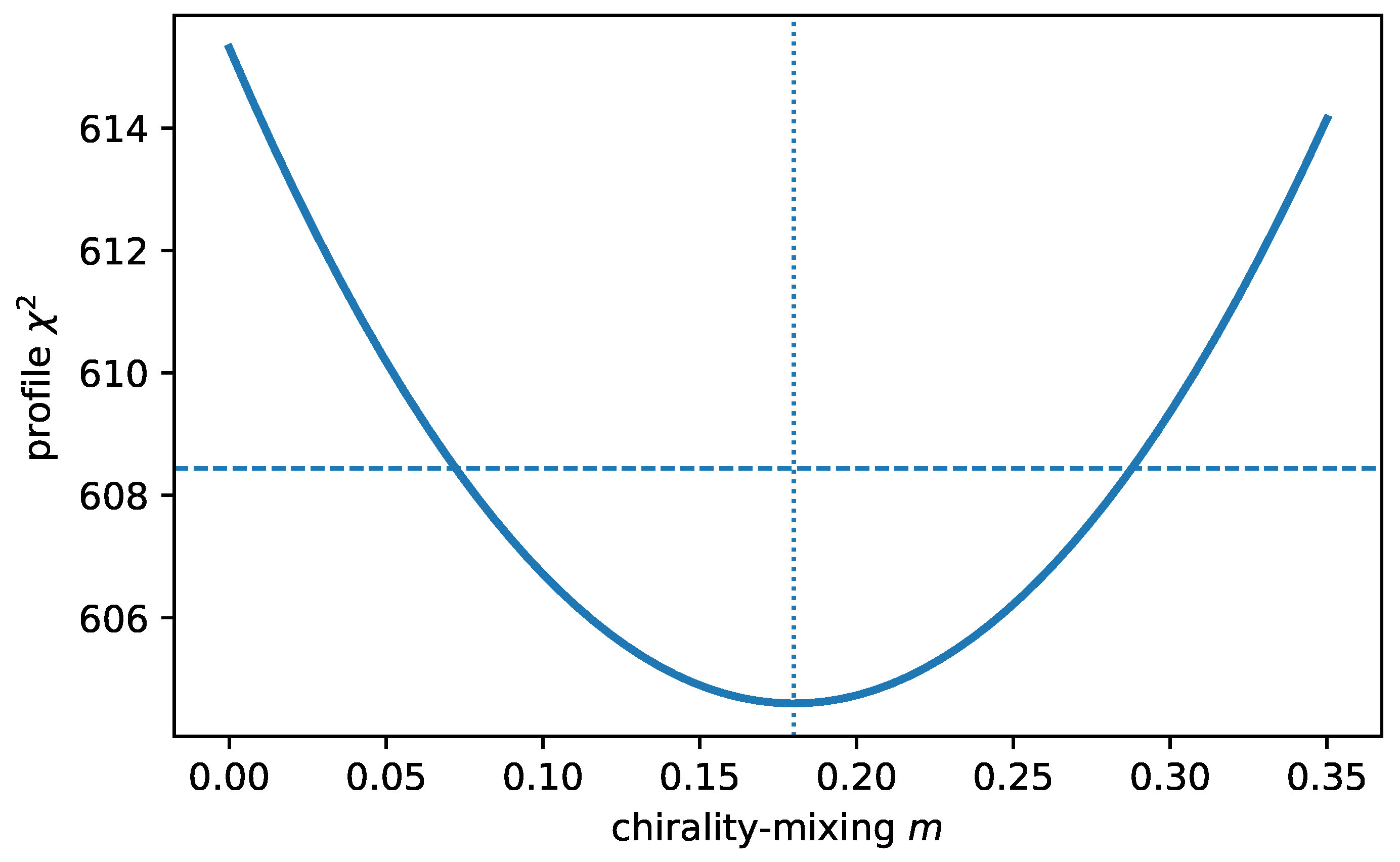
Figure 4.
Profile-likelihood scan for the chirality-mixing parameter m . The minimum occurs near the planted value and the single-parameter threshold is crossed well before on the bundled synthetic design.
Figure 4.
Profile-likelihood scan for the chirality-mixing parameter m . The minimum occurs near the planted value and the single-parameter threshold is crossed well before on the bundled synthetic design.
The nested-model diagnostics go beyond goodness of fit alone. On the present synthetic design,
The full model is therefore statistically preferred over both the no-mixing and no-drift restrictions on this design.
Corollary 13
(Quantitative falsification criteria). The explicit closure is falsified if any of the following occurs.
- 1.
- Contractivity failure. If for any of the six momenta, the dissipative audited benchmark is rejected.
- 2.
- Short-time curvature failure. A right-handed initial state must satisfy the universal onset law (55). A statistically significant linear onset falsifies the receiver map.
- 3.
- Spectral inversion failure. If the extracted modal data violate (58)–(62), the five-parameter benchmark is not self-consistent.
- 4.
- Drift-sign inconsistency. The sign of ν fixes the handedness of the cell asymmetry. Datasets requiring both signs simultaneously reject the benchmark.
- 5.
- Dark-invariance failure. In the limit , a right-handed excitation must remain invisible to the left-handed receiver up to the noise floor.
- 6.
- Nested-model failure. If the likelihood-ratio diagnostics do not improve materially over the restrictions or on the claimed sensitivity regime, no weak-chiral inference should be asserted.
- 7.
- Hydrodynamic-coefficient failure. The fitted low-k spectrum must yield in the domain claimed to be diffusive. Failure rejects the long-wavelength interpretation.
These criteria connect the analytic closure to measurement. In particular, they turn spectral reconstruction into an explicit experimental and numerical protocol.
Theorem 24
(Operational universality of the explicit linear sector). Consider two explicit closures and whose receiver-accessible linear dynamics on the certified contour admit generators of the class analyzed above. Suppose that they have the same audited spectral invariants and therefore the same reconstructed tuple , together with the same low-wavelength coefficients . Then every receiver-accessible linear observable built from the certified benchmark sector agrees in the two closures up to the same order at which the long-wavelength truncation is taken. In that sense the audited framework defines an operational universality class.
Proof.
By the spectral reconstruction theorem, identical audited spectral invariants imply identical reconstructed parameters . The exact propagator, visible/receiver-dark fractions, and nested-model likelihoods derived in the benchmark sector are functions of those parameters alone, so they coincide in the two closures. In the long-wavelength regime, the reduced envelope dynamics depends only on to the truncation order used in its derivation. Matching those coefficients therefore makes the coarse receiver observables coincide to that same order. Hence microscopic implementation details that do not modify the audited spectra and hydrodynamic coefficients are operationally invisible to the certified receiver. □
Corollary 14
(Physical content of the explicit linear sector). Within the explicit linear sector, the closure specifies a local exchange law, a symmetry-breaking mediator spectrum, an exact inverse problem, and a universality class of receiver observables. These ingredients are sufficient to make the framework predictive at the level of explicit receiver observables.
Proposition 20
(Receiver-side non-identifiability boundary). Let denote the full explicit receiver-accessible linear observable stack used in this paper: exact propagators, visible/receiver-dark fractions, modal gaps, decay rates, hydrodynamic coefficients, reduced rest-gap times, and all derived inversion formulas. If two microscopic completions induce the same certified contour generator and the same receiver map on the audited sector, then every observable in agrees exactly in the two completions. Therefore anomaly coefficients, family multiplicities, flavor textures, mixing matrices, and absolute mass values are not identifiable from alone; they require additional microscopic representation data beyond the explicit receiver-side linear sector.
Proof.
Every observable entering is constructed explicitly from the audited generator and receiver map: the exact propagator from , the spectral invariants from the eigenvalues of , the hydrodynamic coefficients from the small- k expansion of those eigenvalues, and the visible/receiver-dark fractions from composition with the receiver projector. If two microscopic completions leave and the receiver map unchanged on the audited sector, then all of these functionals coincide identically. Quantities that depend on additional microscopic representation content but do not feed back into the audited generator cannot therefore be reconstructed from . □
Proposition 21
(Small-signal stability against weak nonlinearities). Let the certified receiver dynamics near the audited background obey
with G in the explicit linear class and initial preparation norm . Then for fixed times ,
and every receiver observable linear in the one-particle amplitudes, as well as every spectral quantity extracted from the linear response, agrees with the explicit linear closure up to corrections.
Proof.
Duhamel’s formula gives
For sufficiently small initial data, local well-posedness and Gronwall control imply on fixed time intervals, hence the integral term is . Therefore the linear propagator controls the entire small-signal response to leading order. Receiver observables extracted from linear response inherit the same error order. □
The restriction to the linear sector should therefore be read as a controlled small-signal statement rather than as a claim that all physically relevant QICT dynamics is linear. Strong nonlinear regimes, dense scattering, or black-hole-like sectors may well require additional closure data, but they cannot modify the leading explicit signatures without first appearing as explicit amplitude dependence or distance-collapse failure in the sense of Proposition 21 and Theorem 23. In that sense the nonlinear limitation is itself experimentally monitored rather than silently ignored.
13. Scope of the Results
The results proved here are confined to the declared explicit closure class, but within that class they are substantial. The paper establishes equivariant validator selection and generic degeneracy lifting; minimality of the six-cell certified contour on a codimension-one receiver shell; derivation of the ring and spoke gauge groups from minimal compact covariance on Hermitian fibres; a minimal spontaneous-symmetry-breaking sector with one physical radial scalar; a conditional anomaly-free one-family chiral completion with the standard hypercharge pattern; operational indistinguishability of hidden tick decompositions at fixed coarse time; an explicit parent Hamiltonian with certified low-momentum dispersion and corresponding gap-length and reduced-rest-gap-time mass formulas; an exact propagator and visible/receiver-dark leakage law for the explicit two-channel benchmark; algebraic spectral inversion with covariance propagation; and operational universality of the receiver-accessible linear sector once the audited spectra and hydrodynamic coefficients are fixed. In addition, Theorem 9 shows that, within the explicit linear class and to the stated truncation order, the five couplings together with the controlled remainder exhaust the linear receiver observables used in the paper. The same class therefore supports a platform-independent signature stack, redundant parameter inversion, and the cross-platform incompatibility statistic (91).
Several stronger statements remain outside scope, and keeping that boundary sharp is part of the point. We do not prove that the Standard Model follows uniquely from the operational QICT core. Proposition 20 still shows why that stronger claim cannot be extracted from receiver-side linear data alone: family multiplicities, flavor textures, mixing angles, and absolute species assignments belong to microscopic representation data that are invisible to the explicit observable stack until they feed back into the certified generator. What the present version does add is narrower: once a minimal one-family chiral completion is supplied, anomaly cancellation and Yukawa gauge invariance fix the standard hypercharge pattern inside that completion. We also do not claim that the explicit seven-node closure is the unique admissible microscopic closure in arbitrary dimension. The reduced-rest-gap-time law is an operational reconstruction formula for isolated branch gaps once those branches are physically realized. It is not a reverse derivation of observed species masses from QICT alone; what is derived here is the concrete branchwise protocol and the distance-collapse/amplitude-collapse test that any candidate implementation must satisfy. The optional integer ladder of Assumption A1 is likewise not a theorem of foundational QICT; it is a sharply falsifiable closure extension whose ratio tests, integer-proximity diagnostics, and compositeness criteria become meaningful only after branch isolation and cross-platform validation. Finally, strong nonlinear sectors beyond the small-signal regime are not discarded but assigned a sharp diagnostic boundary: once Proposition 21 or Theorem 23 fails, the explicit linear closure has left its domain of validity. What the paper does establish is that a nontrivial closure built on QICT can be promoted from a suggestive ansatz to an explicit effective sector with exact inverse formulas, a concrete reduced-rest-gap-time measurement protocol, a foundational identifiability boundary, and multiple independent failure modes. That is the strongest defensible reading of the present results.
14. Conclusions
This paper isolates a point at which a closure built on QICT stops being merely suggestive and becomes a calculable physical proposal. Within a transparent assumption ladder, the five closure slots are shown to be structurally necessary for any explicit validator-centered linear extension and are compressed into one explicit inverse-closure principle, validator specialization is derived through equivariant minimization and generic perturbative splitting, the six-cell object is identified as a certified transport contour on a codimension-one shell, and the local minimality of that contour is shown to survive the addition of nonlocal chords. Explicit ring and spoke exchange sectors are then constructed from compact local covariance, the minimal symmetry-breaking sector and minimal anomaly-free one-family completion are derived conditionally, the explicit two-channel benchmark is solved exactly, the wider explicit linear class is reduced to a universal five-parameter normal form, and the benchmark parameters are reconstructed from audited spectral data. In the propagating parent sector the same framework yields a certified low-momentum dispersion law together with gap-length and reduced-rest-gap-time mass formulas, while the operational extraction protocol turns those formulas into a measurable threshold-crossing procedure. These structures make the closure experimentally vulnerable through a redundant signature stack rather than through a single fitted observable. Throughout, the receiver-dark sector remains an operational null sector of the chosen receiver, not a cosmological dark-matter claim.
The central conclusion is straightforward. The paper does not claim a full derivation of the Standard Model from QICT. It shows instead that the receiver-side copy-time core of QICT admits a sharply testable validator-centered seven-node closure whose receiver-accessible linear sector is explicit, spectrally invertible, and overconstrained by independent observables, while remaining bounded by a precise theorem of non-identifiability. The strongest outputs are therefore effective-theory statements: exact spectral identities, universal short-time curvature, odd drift–splitting, gap–length consistency, collapse diagnostics for branchwise reduced rest-gap reconstruction, derivation of the faithful gauge quotient and the Higgs-type scalar instability from compact covariance and closure stationarity, exact anomaly cancellation for the minimal family completion, an explicit perturbative dressing map for the integer core, reduction of the absolute mass scale to the universal copy time together with discrete lift data, a no-go statement excluding species masses generated solely by common contour topology, and a controlled semiclassical gravity/dark-energy subsector sourced by the copy-density field. This combination of explicit construction, exact inversion, operational reconstruction, monitored nonlinear stability, and built-in falsifiability is the main reason the closure merits serious consideration.
References
- C. W. Helstrom, Quantum Detection and Estimation Theory (Academic Press, New York, 1976).
- R. Penrose, A generalized inverse for matrices, Math. Proc. Cambridge Philos. Soc. 51, 406 (1955).
- R. Kubo, Statistical-mechanical theory of irreversible processes. I. General theory and simple applications to magnetic and conduction problems, J. Phys. Soc. Jpn. 12, 570 (1957).
- H. Mori, Transport, collective motion, and Brownian motion, Prog. Theor. Phys. 33, 423 (1965).
- E. H. Lieb and D. W. Robinson, The finite group velocity of quantum spin systems, Commun. Math. Phys. 28, 251 (1972).
- B. Schumacher and R. F. Werner, Reversible quantum cellular automata, arXiv :quant-ph/0405174.
- K. G. Wilson, Confinement of quarks, Phys. Rev. D 10, 2445 (1974).
- S. Weinberg, The Quantum Theory of Fields, Vol. II: Modern Applications (Cambridge University Press, Cambridge, 1996).
- Mohamed Sacha, Quantum Information Copy Time (QICT): Operational Definition, Minimal Locality Bounds, Hydrodynamic Susceptibilities, and a Programmatic Outlook, Preprints.org 202601.0364, version 2 (2026).
- M. E. Peskin and D. V. Schroeder, An Introduction to Quantum Field Theory (Addison-Wesley, Reading, 1995).
- P. J. Mohr, D. B. Newell, B. N. Taylor, and E. Tiesinga, CODATA recommended values of the fundamental physical constants: 2022, NIST/CODATA recommended values (2022).
- N. J. Higham, Functions of Matrices: Theory and Computation (Society for Industrial and Applied Mathematics, Philadelphia, 2008).
Figure 1.
The explicit seven-node closure viewed as a validator-centered architecture: one selected validator A and a six-cell receiver contour on the first shell. In the present paper the contour is interpreted as a codimension-one certified transport cycle rather than a claim that microscopic space is fundamentally two-dimensional.
Figure 1.
The explicit seven-node closure viewed as a validator-centered architecture: one selected validator A and a six-cell receiver contour on the first shell. In the present paper the contour is interpreted as a codimension-one certified transport cycle rather than a claim that microscopic space is fundamentally two-dimensional.
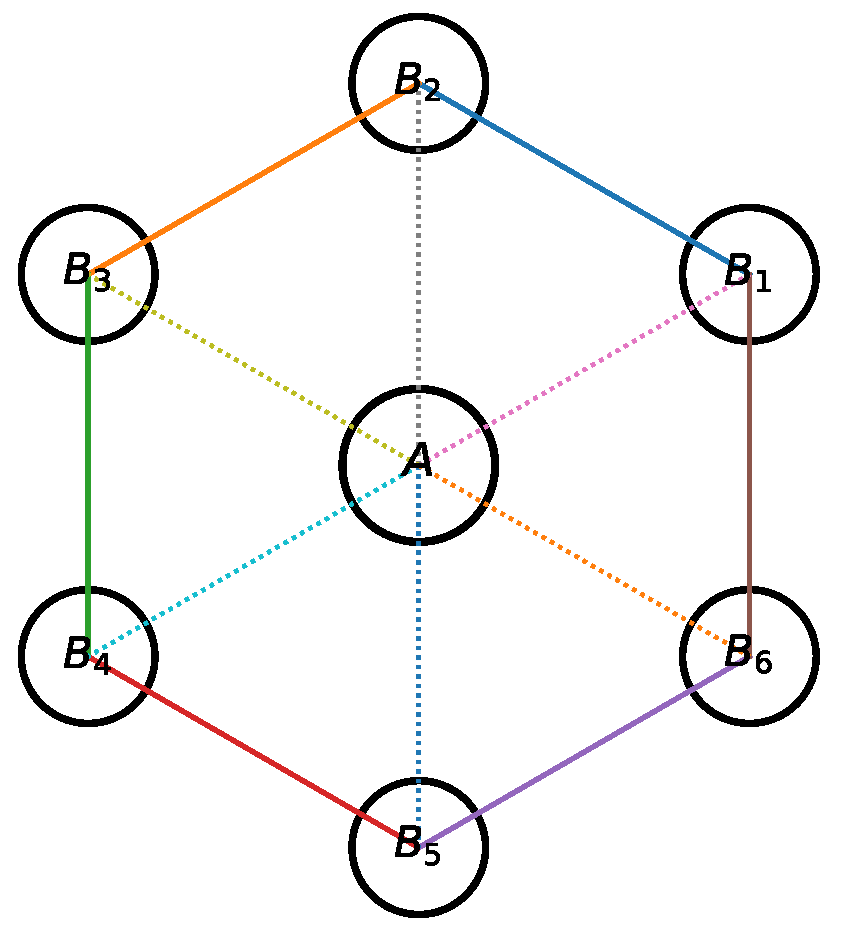
Disclaimer/Publisher’s Note: The statements, opinions and data contained in all publications are solely those of the individual author(s) and contributor(s) and not of MDPI and/or the editor(s). MDPI and/or the editor(s) disclaim responsibility for any injury to people or property resulting from any ideas, methods, instructions or products referred to in the content. |
© 2026 by the authors. Licensee MDPI, Basel, Switzerland. This article is an open access article distributed under the terms and conditions of the Creative Commons Attribution (CC BY) license (http://creativecommons.org/licenses/by/4.0/).
Copyright: This open access article is published under a Creative Commons CC BY 4.0 license, which permit the free download, distribution, and reuse, provided that the author and preprint are cited in any reuse.


