

Submitted:
30 October 2026
Posted:
03 November 2026
You are already at the latest version
Abstract
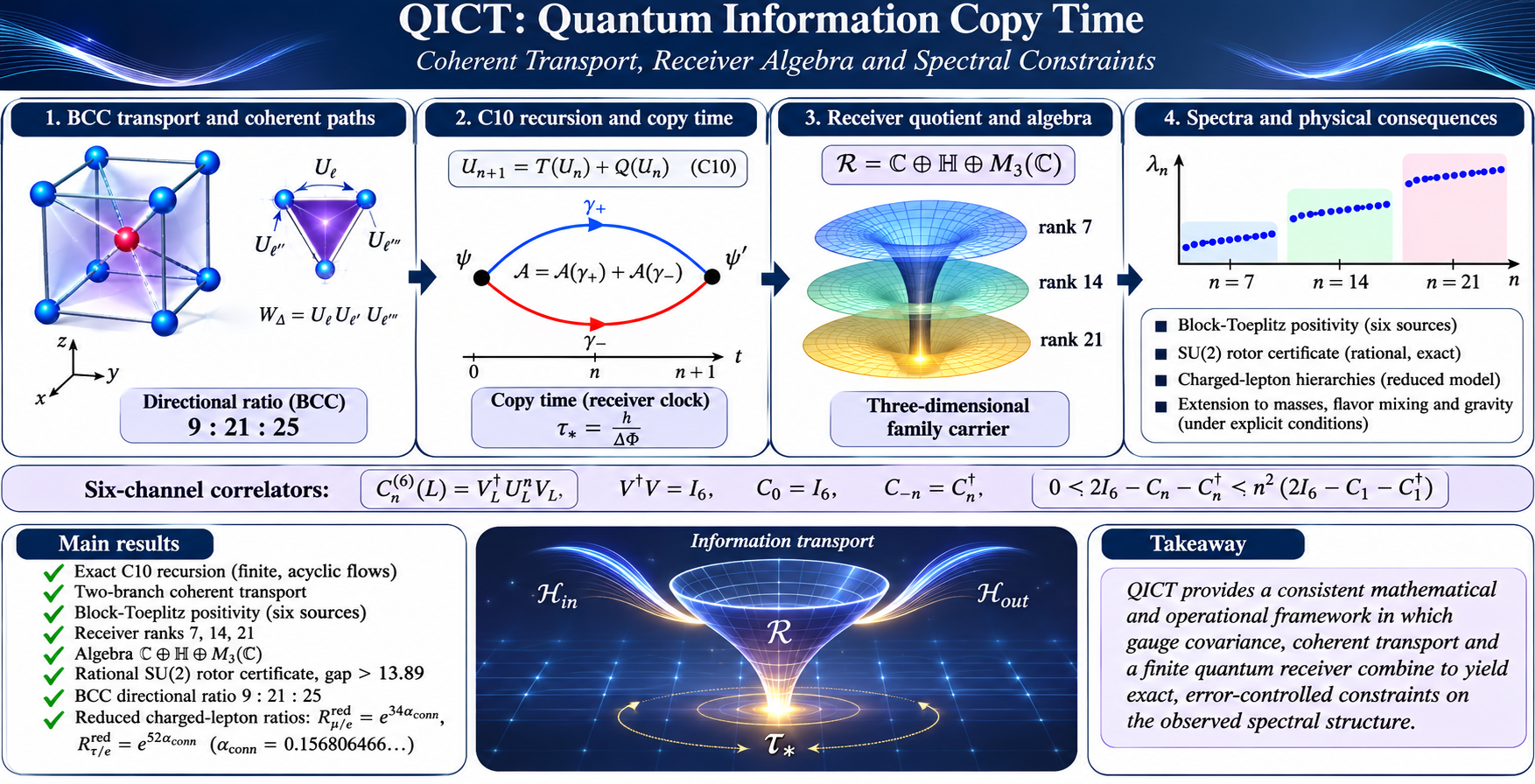
Gauge symmetry constrains the charges and representations available to matter, but it does not determine the spectrum recorded by a quantum receiver. That spectrum depends on the state and on the coherent histories through which amplitudes reach the receiver. Quantum Information Copy Time (QICT) makes this dependence explicit through gauge-covariant transport on a body-centered-cubic complex. For finite acyclic C10 flows, we derive an exact recursion for ordered, noncommuting path amplitudes and a stability estimate controlled by edge-occupation weights. Six normalized Gauss-compatible sources then define two-branch matrix moments with exact block-Toeplitz positivity. Under stated representation assumptions, the receiver quotient has ranks 7, 14, and 21 and carries the algebra \( \mathbb C\oplus\mathbb H\oplus M_3(\mathbb C) \), alongside a distinct three-dimensional family carrier. Finite calculations establish a rational SU(2) rotor certificate, the BCC directional ratio \( 9{:}21{:}25 \), and reduced charged-lepton ratios 206.731294355... and 3477.038653953.... Together these results connect receiver geometry, coherent gauge transport, and constrained spectral observables within an error-controlled finite framework. Physical masses, flavor mixing, and gravitational response additionally require a selected positive-energy interacting state and convergent source kernels.
Keywords:
finite spectral geometry
; lattice gauge dynamics
; stationary relative evolution
; matrix moment problems
; source-resolved spectroscopy
; tensor response
Copyright: This open access article is published under a Creative Commons CC BY 4.0 license, which permit the free download, distribution, and reuse, provided that the author and preprint are cited in any reuse.