
Submitted:
03 April 2026
Posted:
07 April 2026
You are already at the latest version
Abstract
This study aimed to examine variables associated with emotional manipulation levels in adults and to describe current patterns using a decision tree method as a classification-based analytical approach. The research sample consisted of 543 adults (358 women, 65.93%; 185 men, 34.07%) residing in Turkey, aged 18 to 45 years (M = 25.79, SD = 6.24). Data were collected using a researcher-developed personal information form, the Manipulation Scale in Human Relations, the Rosenberg Self-Esteem Scale, and the Relationship Scales Questionnaire. Emotional manipulation scores were dichotomized into low versus high groups using a median split to facilitate CART-based classification. Classification and Regression Tree was used to examine the hierarchical structure of variables related to emotional manipulation levels and to identify classification patterns among study variables. Data were stratified-randomly split into training and test sets (70/30), and tree complexity was tuned via cross-validation using cost-complexity pruning. Model performance indicated good classification accuracy, with a test-set accuracy of 0.81 (sensitivity = 0.74, specificity = 0.88, precision = 0.86, F1 = 0.79) and training accuracy of 0.86. The findings indicated several influential variables in classifying emotional manipulation levels, ranked by importance: preoccupied attachment style, self-esteem, age, dismissive attachment style, gender, secure attachment style, and fearful attachment style. Preoccupied attachment style was identified as the most salient variable in differentiating between high and low emotional manipulation groups. The decision tree structure showed that younger adults with higher preoccupied attachment scores were more frequently classified into the high emotional manipulation group. Self-esteem emerged as the second most influential variable, with lower self-esteem levels being more commonly observed among individuals classified in the high emotional manipulation group. Age also played a notable role in classification, with higher emotional manipulation classifications occurring more frequently among younger individuals. Dismissive attachment style contributed to the differentiation of emotional manipulation levels, particularly within specific attachment and age profiles. Gender-related patterns indicated that men were more frequently classified into higher emotional manipulation groups, especially among individuals with low self-esteem. Overall, the findings highlight the multifactorial and hierarchical nature of emotional manipulation classifications. They contribute to the literature by showing how attachment-related characteristics, developmental factors, and psychological variables jointly differentiate emotional manipulation profiles.
Keywords:
emotional manipulation
; self-esteem
; attachment styles
; decision tree
1. Introduction
The ability to manage and influence others’ emotions represents a critical dimension of interpersonal functioning that can manifest in both adaptive and maladaptive forms (Austin & O’Donnell, 2013). As a specific form of emotional influence, manipulation involves the strategic use of social and cognitive abilities such as persuasion and strategic thinking to deliberately change, influence, and exploit the interpersonal environment (Jones & Paulhus, 2011). This phenomenon is defined as an intentional and often covert form of social influence that aims to alter others’ perceptions or behaviors through deceptive or coercive psychological strategies (Braiker, 2004). In this process, the manipulator aims to undermine the victim’s conscious and consensual decision-making by weakening the victim’s will, creating cognitive distortions, applying emotional pressure, or manipulating perceptions (Bursten, 1972). Furthermore, manipulators tend to act in line with their own interests and desires, using the other person’s vulnerabilities, emotional weaknesses, or lack of knowledge to push them toward a desired direction (Buss et al., 1987; Jones & Paulhus, 2011). Therefore, a core characteristic of manipulation is that it involves deception, emotional pressure, or an intention to control, typically to the detriment of the victim (Braiker, 2004). Within this broader framework, emotional manipulation refers specifically to the strategic use of emotions to influence others’ judgments and behaviors.
Emotional manipulation is a specific type of manipulation that, as the name suggests, targets the individual's emotions and emotional vulnerabilities (Braiker, 2004). This form of manipulation typically originates through gradual and insidious processes of escalation (Bursten, 1972), characterized by the manipulator's use of covert tactics that make initial detection particularly challenging for victims (Braiker, 2004). Specifically, in this type of manipulation, the manipulator attempts to direct the other person according to their own desires by using their emotional vulnerabilities, fears, feelings of guilt, love, empathy ability, or value system (Clempner, 2017). Common tactics include gaslighting, love bombing, guilt-tripping, playing the victim role, emotional blackmail, silent treatment, humiliation, and criticism (Braiker, 2004). The primary function of these manipulative strategies is to create a power imbalance in the relationship and enable the manipulator to gain control through systematic erosion of autonomy (Stark, 2007). Individuals characterized by manipulative tendencies are generally self-centered, narcissistic, or have low self-esteem, while also exhibiting characteristics such as lack of empathy and difficulty in setting boundaries (Bereczkei, 2018). In the present study, emotional manipulation is considered as an individual-level interpersonal tendency rather than clinically defined coercive control.
To explain how emotional manipulation arises and persists in interpersonal contexts, it is important to consider both individual characteristics and relational tendencies. In line with this view, the present study uses a classification model that includes attachment styles as relational schemas, alongside self-esteem and key demographic variables (age and gender). This approach aims to clarify the hierarchical and potentially interacting contributions of these variables to emotional manipulation tendencies.
Among these variables, attachment styles, which reflect how individuals perceive themselves and others in close relationships, are addressed as one of the key variables whose relationship with emotional manipulation is examined in this research. Attachment style refers to relatively stable psychological patterns that guide individuals’ expectations, emotions, and behavioral strategies in interpersonal contexts (Ein-Dor, Mikulincer, & Shaver, 2011). Developed through early caregiving experiences, these patterns influence intimacy, trust, and emotion regulation across romantic, social, and professional relationships in adulthood (Mikulincer et al., 2005; Fraley & Roisman, 2019). In this respect, attachment styles provide an important theoretical framework for understanding how individuals manifest manipulative tendencies in interpersonal relationships.
The most critical developmental period in the formation of attachment style is considered to be infancy and early childhood (Mikulincer & Shaver, 2016; Fraley & Roisman, 2019). Attachment theories emphasize that interactions established with caregivers during this period form the basis of cognitive-emotional representations that individuals develop about themselves and others, and that these representations transform into relatively stable attachment tendencies over time (Mikulincer & Shaver, 2016; Fraley & Roisman, 2019). While the caregiver's sensitive, consistent, and accessible responses to the child's needs support the development of a sense of security and effective emotion regulation strategies, insensitive, inconsistent, or rejecting caregiving experiences increase the likelihood of insecure attachment patterns such as mistrust, avoidance of intimacy, or excessive dependency (Mikulincer, Shaver, & Pereg, 2003). In the adult attachment literature, attachment styles are mostly conceptualized based on the individual's self-perception and expectations toward others, and are defined through different combinations of these two dimensions (Mikulincer & Shaver, 2007, 2016). Within this framework, secure attachment is characterized by relatively positive representations of both the self and others, reflecting confidence in one’s own worth and in others’ availability and responsiveness. Securely attached individuals tend to approach close relationships with trust and reciprocity and demonstrate effective emotion regulation in interpersonal contexts (Shaver et al., 2019). In contrast, insecure attachment patterns are linked to dysfunctional interpersonal strategies such as avoidance of intimacy, excessive approval seeking, or conflicting tendencies in relationships. Dismissive attachment tendency is associated with the individual developing positive expectations toward themselves but negative expectations toward others, with a tendency to maintain emotional distance and overemphasize independence in close relationships (Mikulincer & Shaver, 2016). Preoccupied attachment tendency is characterized by the individual having negative representations about themselves but positive representations about others, with intense proximity, approval, and reassurance seeking (Mikulincer & Shaver, 2016). In fearful attachment tendency, individuals hold negative expectations about both themselves and others, which leads to conflicting relational behaviors characterized by a simultaneous desire for intimacy and avoidance of closeness. This internal conflict is associated with interpersonal instability and increased vulnerability to personality pathology, making relational functioning particularly challenging for individuals with insecure attachment patterns (Meyer et al., 2001).
In this context, another fundamental variable addressed in the research is self-esteem, which refers to individuals’ general perceptions of self-worth, acceptance, and competence (Orth & Robins, 2014). Self-esteem is conceptualized as a relatively stable self-evaluation reflecting how individuals appraise their own value, competencies, and importance, and it is widely regarded as a key component of psychological well-being (Orth & Robins, 2022). Contemporary theoretical and empirical research indicates that self-esteem is not merely a subjective emotional state (Orth & Robins, 2022), but rather a psychological resource associated with individuals’ capacity to cope with stress (Orth et al., 2012), functioning in interpersonal relationships (Murray et al., 2006), and emotional resilience (Orth et al., 2018).
Building on this framework, the present study focuses on how cognitive structures such as attachment styles and self-esteem—both of which are theorized to develop early in life—are associated with tendencies of emotional manipulation in adulthood. Attachment styles are conceptualized as cognitive–emotional schemas that play a central role in shaping interpersonal expectations and behaviors. Using a decision tree classification approach, this study examines the hierarchical contribution of attachment styles and self-esteem to the differentiation of emotional manipulation levels. In doing so, the findings provide evidence regarding how variations in attachment-related characteristics and self-esteem are jointly associated with emotional manipulation profiles, thereby contributing to the literature without implying causal effects.
When the literature is examined, numerous studies have been conducted to understand the psychological characteristics and consequences experienced by individuals exposed to manipulation and coercive control (Stark, 2007; Sweet, 2019). Research indicates that victims of manipulative and psychologically abusive relationships frequently experience diminished autonomy, erosion of identity, and heightened emotional distress (Dutton et al., 1999; Stark, 2007). Akiş and Öztürk (2021), who emphasize that individuals exposed to manipulation often display low self-confidence and low self-esteem, argue that these vulnerabilities may increase the likelihood of being targeted as victims. They further state that such individuals are prone to feelings of helplessness, worthlessness, and guilt, and are more susceptible to threats and deception. Over time, continued exposure to manipulation may lead to a weakening of the individual’s sense of self and identity. Similarly, Tekiner (2022) emphasizes that manipulative individuals tend to select victims who appear psychologically vulnerable or powerless. Furthermore, Bursten (1972) notes that individuals characterized by intense feelings of inadequacy, excessive approval-seeking, difficulty asserting boundaries, and avoidant coping strategies may be more susceptible to manipulative dynamics. Overall, the literature suggests that exposure to manipulation and psychological control is associated with reductions in self-esteem, impaired self-confidence, increased depressive and anxiety symptoms, feelings of inadequacy and loss of control, and difficulties in social and relational functioning (Dutton et al., 1999; Sweet, 2019).
On the other hand, research directly addressing the self-esteem and attachment style profiles of individuals exhibiting manipulative tendencies is scarce. When the relevant literature is examined, studies on manipulators are mostly addressed with variables such as the dark triad (Şenyuva & Yavuz, 2024), cognitive distortions (Esin, 2022), childhood traumas (Tekiner, 2022), narcissism (Bursten, 1972), socio-emotional control (Nagler et al., 2014), empathy (Grieve & Panebianco, 2013), relationship satisfaction and self-compassion (Kayıtmaz, 2024), self-sabotage (Köse, 2019), belonging (Çınar, Yazıcı, & Tekiner, 2022), and differentiation of self (Şen, 2023). Although some research has investigated the associations of attachment styles and self-esteem with broader personality traits and suggested their potential relevance to manipulative tendencies (Bylsma et al., 1997), empirical studies systematically examining how manipulative tendencies vary across attachment styles and levels of self-esteem remain extremely limited (Schotman, 2022). Accordingly, the present study aims to contribute to the literature by identifying distinct psychological profiles associated with manipulative tendencies based on self-esteem and attachment-related variables, rather than by proposing causal explanations.
Despite the growing body of research on emotional manipulation, notable gaps remain regarding the joint and hierarchical examination of psychological and demographic variables associated with manipulation tendencies. Prior studies have predominantly focused on isolated associations, offering limited insight into how attachment styles, self-esteem, and basic demographic variables collectively differentiate individuals with varying levels of emotional manipulation. Moreover, existing findings do not clearly indicate how the relative contributions of attachment styles vary in distinguishing emotional manipulation profiles when considered jointly with self-esteem. In addition, the use of interpretable, person-oriented classification approaches capable of revealing variable importance and hierarchical decision structures has been comparatively limited. Addressing these gaps, the present study applies a Classification and Regression Tree (C&RT) model to examine emotional manipulation levels in relation to attachment styles (secure, fearful, preoccupied, and dismissive), self-esteem, age, and gender in an adult sample. By identifying the relative contribution and hierarchical ordering of these variables in distinguishing emotional manipulation profiles, this study aims to provide a systematic and data-driven representation of the psychological and demographic patterns associated with emotional manipulation.
Decision Tree
Decision trees are a widely used machine learning technique within the framework of supervised learning that model data in a hierarchical structure to address classification and regression tasks (Breiman et al., 1984; Hastie, Tibshirani, & Friedman, 2009). This approach is applicable to classification problems when the dependent variable is categorical and to regression problems when the dependent variable is continuous. Decision trees operate by recursively partitioning the dataset into increasingly homogeneous subgroups based on predictor variables, thereby uncovering interpretable decision rules associated with the target outcome (Loh, 2011).
The tree structure begins with a root node representing the full dataset and proceeds through a series of splits at internal nodes, each based on a variable and a threshold that best differentiates the outcome of interest. This process continues until terminal (leaf) nodes are reached, which represent the final classification or estimated value for observations falling within that node (Breiman et al., 1984). Rather than implying causal relationships, decision trees provide an interpretable framework for examining how combinations of variables are hierarchically associated with outcome classifications.
Among decision tree methods, different algorithms exist; however, this study employs the C&RT (Classification and Regression Trees) algorithm, which can analyze the effects of variables on emotional manipulation levels in both classification and regression contexts. C&RT creates models for both categorical and continuous target variables by recursively dividing the data through binary splits (Breiman et al., 1984). At each node, the data is split in a way that creates the most homogeneous subsets in terms of the target variable; subsequently, more parsimonious and generalizable models are obtained through pruning techniques on the resulting "maximum tree" (Hastie et al., 2009).
Among the advantages of decision trees are their ability to process both numerical and categorical variables in the same model, their lack of need for special assumptions regarding data distribution, and their production of understandable "if-then" rules (Loh, 2011). These features provide significant flexibility in analyses conducted with psychological and demographic data and facilitate the interpretation of the model (Loh, 2011). In this context, C&RT analysis was preferred in this study to reveal the relative effects of psychological and demographic variables on emotional manipulation levels in a hierarchical structure. The accuracy of the model was evaluated using training and test data, and the obtained decision rules were constructed in a way that can be applied to larger datasets (Breiman et al., 1984; Loh, 2011).
Through this approach, the analysis yields explicit decision paths that indicate which psychological and demographic variables are most influential, under which conditions, and in what hierarchical order they contribute to emotional manipulation tendencies. The resulting terminal nodes define distinct risk profiles, allowing the identification of combinations of variables associated with higher or lower levels of manipulation. Thus, the decision tree analysis provides not only variable importance but also an interpretable structure of how manipulation tendencies emerge across different individual profiles.
2. Method
2.1. Research Model
This study used a cross-sectional design to examine factors associated with adults’ emotional manipulation levels. A decision tree classification approach based on the C&RT algorithm was applied to model the hierarchical relationships among psychological and demographic variables and to describe how different combinations of these variables classify individuals with varying levels of emotional manipulation. In line with a correlational survey framework, the study aimed to characterize the pattern of associations among variables (Creswell & Creswell, 2018).
2.2. Study Group
A total of 601 adults were recruited. Prior to the main analyses, the dataset was screened to ensure data quality by checking missing data, inattentive responding, and outliers. Participants were excluded if they had incomplete responses on key measures, showed indicators of careless responding (e.g., repetitive response), or exhibited extreme values on primary variables identified using Tukey’s 1.5 × IQR criterion. After these procedures, the final sample consisted of 543 adults living in Turkey (358 women, 65.93%; 185 men, 34.07%). Participants were aged 18–45 years (M = 25.79, SD = 6.24). Data were collected in 2024 via an online survey administered through Google Forms. All participants provided informed consent, and the study procedures were approved by the relevant institutional ethics committee as stated in the Ethical Statement section.
2.3. Data Collection Tools
2.3.1. Personal Information Form
A brief personal information form was used to collect basic demographic data from participants. Specifically, participants reported their gender and age.
2.3.2. Manipulation Scale in Human Relations
The Manipulation Scale in Human Relations, developed by Yılmaz (2018), assesses individuals’ tendencies to use manipulative behaviors in interpersonal relationships. The scale is a 39-item instrument rated on a 5-point Likert scale and comprises five subdimensions: aggressive manipulation, emotional manipulation, victim selection, self-concealment, and strategy use. In the scale development study, internal consistency was reported to be high for all subdimensions (Cronbach’s alpha = .92–.95), and acceptable for the total score (alpha = .90). Confirmatory factor analysis supported the five-factor structure and indicated acceptable model fit (X²/df = 2.16, NFI = .93, TLI = .91, IFI = .93, RMSEA = .05, GFI = .93, AGFI = .90). In the present study, internal consistency reliability was re-examined for the current sample. The total score of the Manipulation Scale in Human Relations showed high internal consistency (Cronbach’s alpha = .92), indicating that the items reliably measured the same underlying construct in this dataset.
2.3.3. Relationship Scales Questionnaire
Attachment styles were assessed using the Relationship Scales Questionnaire, originally developed by Griffin and Bartholomew (1994) and adapted into Turkish by Sümer and Güngör (1999). The RSQ consists of 17 items measuring four attachment styles: secure, dismissive, fearful, and preoccupied. Participants rated how well each statement described them on a 7-point Likert scale ranging from 1 (does not describe me at all) to 7 (describes me completely). Secure and dismissive attachment were each assessed with five items, whereas preoccupied and fearful attachment were assessed with four items each. Subscale scores were computed by averaging item responses within each attachment style. Following the common scoring approach for the RSQ, participants can be classified into the attachment style for which they obtain the highest subscale score. Previous research has noted that RSQ subscales may show relatively low internal consistency, while demonstrating acceptable test–retest reliability. In the Turkish adaptation study, a four-factor structure was supported, and test–retest reliability coefficients ranged from .54 to .61 across the four dimensions (Sümer & Güngör, 1999). In the present study, internal consistency reliability (Cronbach’s alpha) for the subscales was .60 for secure attachment, .65 for dismissive attachment, .62 for fearful attachment, and .66 for preoccupied attachment. Consistent with prior RSQ research, these alpha coefficients were modest, which may be expected given the brief length of the subscales and the heterogeneous content of attachment-related items.
2.3.4. Rosenberg Self-Esteem Scale
Self-esteem was assessed using the Rosenberg Self-Esteem Scale, originally developed by Rosenberg (1965) and adapted into Turkish by Cuhadaroglu (1986). Although the broader Rosenberg inventory includes multiple subdimensions, only the self-esteem subscale was used in the present study. The self-esteem subscale consists of 10 items rated on a 4-point Likert scale ranging from 1 (strongly agree) to 4 (strongly disagree). Items 1, 2, 4, 6, and 7 are reverse-coded. Total scores range from 10 to 40, with higher scores indicating higher self-esteem. Previous research reported adequate reliability for the original scale (internal consistency = .80; test–retest = .85) and for the Turkish adaptation (internal consistency = .71; test–retest = .75) (Cuhadaroglu, 1986). In this study, reliability was re-estimated for the current dataset, and the 10-item self-esteem subscale yielded a Cronbach’s alpha of .88, indicating high internal consistency.
2.4. Data Analysis
The analysis examined factors associated with emotional manipulation using decision tree modeling to explore the relational patterns among variables. Emotional manipulation was represented in a hierarchical structure, and significant splits and associations at each node were identified using statistical methods. This approach clarified the relative strength of relationships between the examined variables and emotional manipulation. Furthermore, the interactions among variables were evaluated in line with validity principles, based on the descriptive and relational findings obtained
2.4.1. Model Specifications and Stopping Rules
In this study, a Classification and Regression Tree (C&RT) model was developed to examine the factors most strongly associated with emotional manipulation susceptibility in adult romantic relationships. The C&RT algorithm consists of three steps: creation of the maximum tree, tree pruning, and selection of the optimal tree. The C&RT algorithm creates the classification tree by applying binary splitting of attributes to right and left nodes based on class labels (Breiman et al., 1984; Loh, 2011). To ensure model robustness and generalizability, the dataset (N = 543) was randomly partitioned into training (70%, n = 381) and testing (30%, n = 162) subsets using stratified random sampling to maintain the distribution of the outcome variable across both sets. Several stopping rules were implemented to optimize model performance and prevent overfitting. Specifically, a minimum of 20 cases was required for a parent node to be eligible for splitting (minsplit = 20), while each child node was required to contain at least 10 cases (minbucket = 10) to ensure statistical reliability and prevent the creation of overly specific terminal nodes. The complexity parameter (cp) was set to 0.005 to control tree growth, requiring that any split must improve the overall model fit by at least 0.5%. The maximum tree depth was set to 30 levels, though the final pruned tree was considerably shallower to maintain interpretability. The Gini impurity index was employed as the splitting criterion to determine the optimal splits at each node, measuring the probability of misclassification at each potential split point. Following initial tree growth, cost-complexity pruning was applied with 10-fold cross-validation (xval = 10) to determine a tree size that balanced model complexity and fit. The pruning process retained the tree size that provided the best cross-validated performance while maintaining a parsimonious structure.
3.4.2. Model Perfonmance Evaluation
In this study, performance evaluation criteria based on binary classification were used for model performance evaluation measurement. These criteria were determined as accuracy, sensitivity, specificity, precision, and F-score. The classification to be used for the criteria and the calculation of the criteria are given in Table 1.
"Sensitivity" is the probability that the predicted model is also positive (1) when the observed model is positive (1), while "specificity" is the probability that the predicted model is also negative (0) when the observed model is negative (0). In the constructed cross-table, both sensitivity and specificity probabilities are expected to be high simultaneously. With the ROC curve, the plotting of the model's sensitivity against the model's (1-specificity) ratio at different cut-off points is obtained. As done in every classification process, methods deal with establishing the balance between sensitivity and specificity. The area under the ROC curve can be defined as AUC (area under curve), and this AUC is accepted as the best indicator of the model's success in distinguishing positives from negatives. When this area is 1, it means that positives are perfectly separated from negatives.
All analyses were conducted using R statistical software (version 4.4.3; R Core Team, 2025) with the rpart package (version 4.1.24; Therneau & Atkinson, 2025) for tree construction, the caret package (version 7.0.1; Kuhn, 2024) for model validation and performance evaluation, the rpart.plot package (version 3.1.4; Milborrow, 2024) for tree visualization, and the pROC package (version 1.19.0.1; Robin et al., 2024) for ROC curve analysis and AUC calculation.
3. Results
3.1. Descriptive Statistics
Descriptive statistics were computed to characterize the sample and examine the distribution of key study variables. The final sample comprised 543 participants with a mean age of 25.79 years (SD = 4.23; range = 18-45 years). The primary outcome variable, emotional manipulation, yielded a mean score of 117.43 (SD = 18.94; range = 62-165). The attachment dimensions yielded the following mean scores: preoccupied attachment (M = 11.96, SD = 2.51; range = 5-18), fearful attachment (M = 16.00, SD = 2.28; range = 9-22), secure attachment (M = 21.74, SD = 6.30; range = 7-35), and dismissive attachment (M = 20.01, SD = 2.82; range = 12-29). Self-esteem scores exhibited a mean of 24.17 (SD = 4.44; range = 11-39). The gender distribution of the sample consisted of 358 women (65.9%) and 185 men (34.1%).
3.2. Classification and Regression Tree (C&RT) Analysis
In this study, a decision tree model was constructed to examine the hierarchical structure of variables involved in the classification of emotional manipulation levels. The final model included nine terminal nodes based on the training sample of 381 participants and classified individuals into higher and lower emotional manipulation groups through hierarchical splits involving attachment styles, self-esteem, age, and gender.
Figure 1.
Decision Tree for Emotional Manipulation. NOTE: In the decision tree visualization, each node contains three key pieces of information. At the top of each node is the predicted emotional manipulation level (“High” or “Low”). In the middle, a two-number distribution is presented, where the first number indicates the number of individuals observed in the high emotional manipulation group, and the second number indicates the number of individuals observed in the low emotional manipulation group. At the bottom of each node, the percentage of participants represented by that node is reported. For instance, a node displaying “High / 98 - 6 / 27%” indicates that, within this profile, 98 individuals are observed in the high emotional manipulation group, 6 individuals are observed in the low emotional manipulation group, and 27% of the total sample falls into this category.The conditions shown on the branches between nodes (e.g. “Preoccupied < 13”) indicate the splitting criteria used by the model. The color shading reflects the relative concentration of the predicted outcome within each node, with darker red tones indicating a higher proportion of high emotional manipulation cases and green tones indicating a higher proportion of low emotional manipulation cases.
Figure 1.
Decision Tree for Emotional Manipulation. NOTE: In the decision tree visualization, each node contains three key pieces of information. At the top of each node is the predicted emotional manipulation level (“High” or “Low”). In the middle, a two-number distribution is presented, where the first number indicates the number of individuals observed in the high emotional manipulation group, and the second number indicates the number of individuals observed in the low emotional manipulation group. At the bottom of each node, the percentage of participants represented by that node is reported. For instance, a node displaying “High / 98 - 6 / 27%” indicates that, within this profile, 98 individuals are observed in the high emotional manipulation group, 6 individuals are observed in the low emotional manipulation group, and 27% of the total sample falls into this category.The conditions shown on the branches between nodes (e.g. “Preoccupied < 13”) indicate the splitting criteria used by the model. The color shading reflects the relative concentration of the predicted outcome within each node, with darker red tones indicating a higher proportion of high emotional manipulation cases and green tones indicating a higher proportion of low emotional manipulation cases.
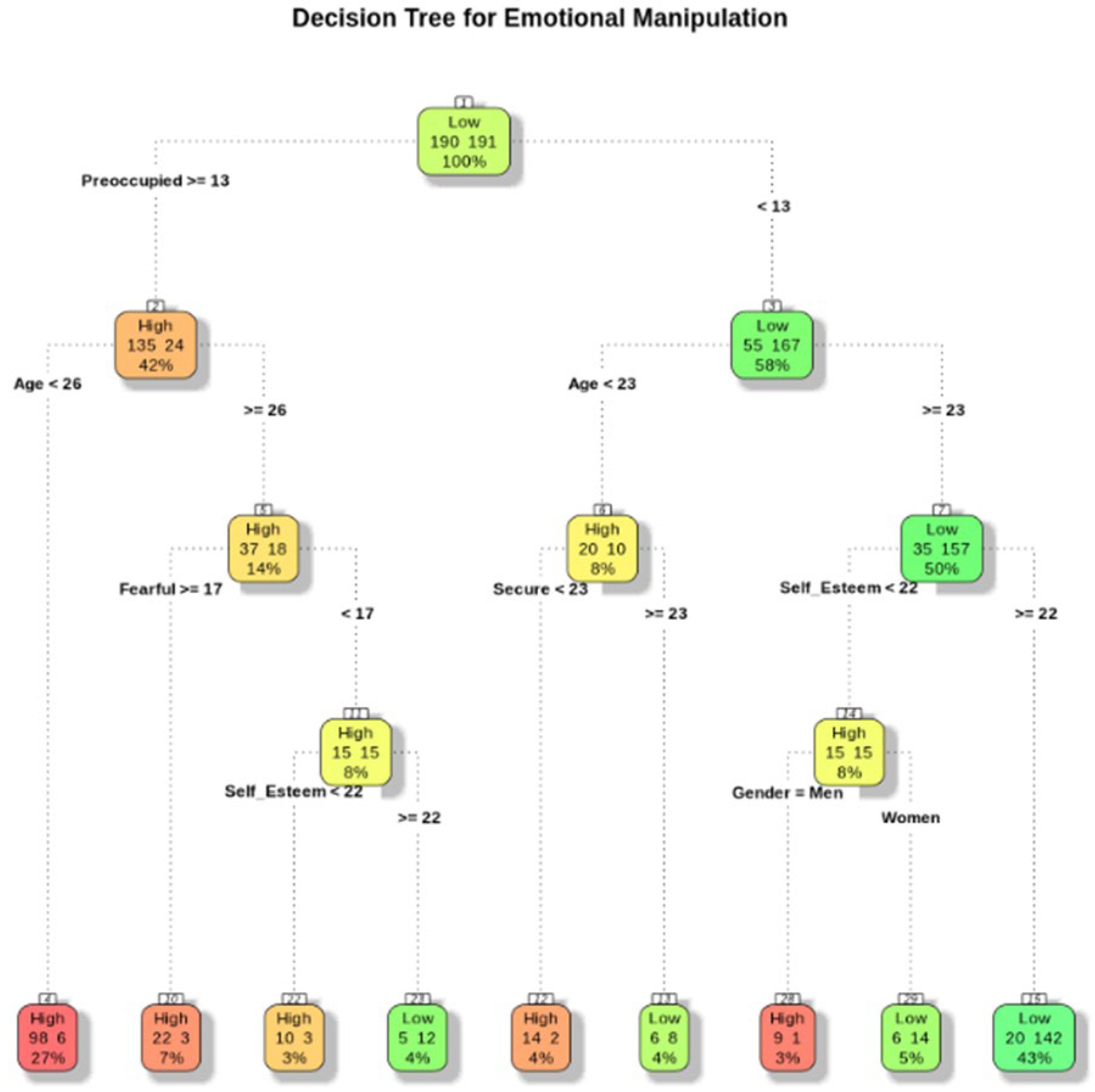
The final pruned C&RT model was constructed using the training sample (N = 381) and resulted in nine terminal nodes. At the root node, the distribution of emotional manipulation was nearly balanced (High = 190, Low = 191), indicating no substantial class imbalance at baseline. The first split was based on preoccupied attachment, with a threshold value of 13, partitioning the sample into two subgroups characterized by distinct conditional distributions of emotional manipulation.
Among individuals with preoccupied attachment scores of 13 or higher (n = 159; 42% of the training sample), 135 individuals (85%) were observed in the high emotional manipulation group, whereas 24 individuals (15%) were observed in the low group. Within this branch, age functioned as a secondary splitting variable at a threshold of 26 years. Among individuals younger than 26 years (n = 104), 98 (94%) were observed in the high emotional manipulation group and 6 (6%) in the low group. For those aged 26 years and older (n = 55), 37 (67%) were observed in the high group and 18 (33%) in the low group. Within this older subgroup, fearful attachment further partitioned the data at a threshold of 17. Individuals with fearful attachment scores of 17 or higher (n = 25) showed 22 cases (88%) in the high group and 3 (12%) in the low group. In contrast, those with fearful attachment scores below 17 (n = 30) displayed an even distribution (15 high, 15 low). Within this latter subgroup, self-esteem emerged as an additional splitting variable at a threshold of 22. Individuals with self-esteem scores below 22 (n = 13) were predominantly observed in the high emotional manipulation group (77%, n = 10), whereas those with scores of 22 or higher (n = 17) were more frequently observed in the low group (71%, n = 12).
In contrast, among individuals with preoccupied attachment scores below 13 (n = 222; 58% of the training sample), 167 individuals (75%) were observed in the low emotional manipulation group and 55 (25%) in the high group. Within this branch, age again functioned as a splitting variable at a threshold of 23 years. Among individuals younger than 23 years (n = 45), 30 (67%) were observed in the high emotional manipulation group, whereas 15 (33%) were observed in the low group. Secure attachment further partitioned this younger subgroup at a threshold of 23. Individuals with secure attachment scores below 23 (n = 16) showed a high concentration in the high emotional manipulation group (88%, n = 14), whereas those with secure attachment scores of 23 or higher (n = 29) displayed a more balanced distribution (13 high, 16 low).
Among individuals aged 23 years and older within the Preoccupied < 13 branch (n = 177), 152 (86%) were observed in the low emotional manipulation group and 25 (14%) in the high group. Within this subgroup, self-esteem served as an additional splitting variable at a threshold of 22. Individuals with self-esteem scores of 22 or higher (n = 147) were predominantly observed in the low group (93%, n = 137), whereas those with scores below 22 (n = 30) showed an even distribution (15 high, 15 low). Within this low self-esteem subgroup, gender emerged as a final partitioning variable. Among men (n = 10), 9 (90%) were observed in the high emotional manipulation group, whereas among women (n = 20), 6 (30%) were observed in the high group and 14 (70%) in the low group.
Overall, the hierarchical structure of the decision tree illustrates how combinations of attachment dimensions, age, self-esteem, and gender contribute to conditional classification patterns of emotional manipulation within the training sample. These node-specific proportions represent conditional distributions derived from recursive partitioning and should not be interpreted as population-level prevalence estimates or causal effects.
In C&RT models, variable importance is computed based on the total reduction in node impurity (Gini index) attributable to each predictor across the entire tree structure. The variable importance rankings derived from the decision tree model are summarized in Table 2.
Preoccupied attachment style exhibited the highest importance score (68.61), indicating that it was the variable most frequently involved in the hierarchical splitting process of the model. This pattern indicates that preoccupied attachment was the primary splitting variable within the decision tree structure.
Self-esteem ranked second with an importance score of 34.76, followed closely by age, which ranked third with an importance score of 34.33. These importance values indicate that self-esteem and age were similarly involved in the classification process across multiple branches of the tree, although their contributions were conditional on specific node-level splits. Within the context of decision tree modeling, these rankings reflect the relative contribution of variables to the model’s classification structure rather than the magnitude of their effects or causal influence.
The dismissive attachment style ranked fourth in the variable importance analysis (importance score = 28.48), indicating that it contributed to the classification structure of the decision tree across several branches. Gender followed as the fifth most frequently utilized variable, with an importance score of 21.58, reflecting its contribution within specific decision pathways. The fearful attachment style ranked sixth, with an importance score of 18.27, indicating comparatively lower involvement in the splitting structure.
Secure attachment exhibited the lowest importance score (4.11), indicating that it was least frequently used in the hierarchical splitting process. Within the decision tree framework, this low importance suggests that secure attachment contributed minimally to the differentiation of individuals into higher versus lower emotional manipulation groups and was primarily involved in a small number of terminal classification paths.
Overall, the distribution of variable importance values reflects a multifactorial classification structure underlying emotional manipulation tendencies. Preoccupied attachment emerged as the most prominent classifier within the model, while self-esteem and age together constituted a substantial portion of the remaining classification structure. The other variables—dismissive attachment, gender, fearful attachment, and secure attachment—contributed incrementally within specific conditional pathways, highlighting the hierarchical and interaction-based nature of the decision tree model rather than the dominance of any single predictor.

Table 3.
Decision Tree Performance Metrics.
| Dataset | Accuracy | Sensitivity | Specificity | Precision | F1_Score |
|---|---|---|---|---|---|
| Training | 0.86 | 0.81 | 0.92 | 0.91 | 0.85 |
| Test | 0.81 | 0.74 | 0.88 | 0.86 | 0.79 |
The developed decision tree model demonstrated satisfactory classification performance in distinguishing emotional manipulation levels, achieving an accuracy of 86% in the training set (n = 381) and 81% in the test set (n = 162). Sensitivity values were 0.81 for the training set and 0.74 for the test set, indicating that the model successfully classified a substantial proportion of individuals in the high emotional manipulation category. Specificity values were 0.92 and 0.88, respectively, suggesting that individuals in the low emotional manipulation category were classified with high accuracy.
The difference in accuracy between the training and test sets was 5%, and the difference in F1-scores was 0.06, suggesting limited performance decline when applied to unseen data. In addition, the model yielded high precision values (training = 0.91, test = 0.86) and balanced accuracy rates (87% and 81%, respectively), suggesting relatively stable classification performance across outcome categories.
Overall, these findings indicate that the decision tree model—optimized using 10-fold cross-validation and predefined model constraints (cp = 0.005, minbucket = 10, maxdepth = 5)— provides a stable and interpretable classification framework for differentiating emotional manipulation profiles. The model should not be interpreted as a diagnostic tool but rather as an exploratory classification framework for examining how psychological and demographic variables are hierarchically organized within distinct classification pathways.
The ROC curve analysis presented in Figure 2 evaluates the classification performance of the decision tree model in distinguishing high and low emotional manipulation groups across the training and test sets. The area under the curve (AUC) value for the training set was 0.93, indicating excellent discriminative ability in differentiating between the two outcome categories. In the test set, the AUC value was 0.90, suggesting that the model maintains high discriminative performance when applied to previously unseen data.
The small difference between the training and test AUC values (ΔAUC = 0.03) suggests stable discriminative performance across datasets and demonstrates acceptable generalization performance. Furthermore, the close proximity of both ROC curves to the upper-left corner reflects an appropriate trade-off between sensitivity and specificity across classification thresholds, indicating that the model effectively distinguishes between high and low emotional manipulation classifications.
The fact that both AUC values exceed 0.90 indicates that the decision tree model substantially exceeds chance-level discrimination (AUC = .50) across both datasets. Overall, the ROC analysis supports the model’s discriminative capacity within the present sample as a classification tool for identifying emotional manipulation profiles. Consistent with the decision tree methodology, these results reflect classification-based differentiation rather than linear, correlational, or causal relationships between the included variables.
4. Discussion and Conclusions
This study examines the psychological and demographic factors underlying emotional manipulation tendencies in adults through a comprehensive Classification and Regression Tree (C&RT) analysis. The hierarchical structure of the model illustrates how variables such as attachment styles, self-esteem, gender, and age interact in shaping emotional manipulation tendencies within specific relational and developmental contexts. The developed model demonstrated strong and consistent classification performance across both the training and test sets, indicating a robust decision structure.
When the findings were evaluated across the full sample, the variables that emerged as the most influential classifiers of emotional manipulation within the decision tree model were preoccupied attachment style, self-esteem, age, dismissive attachment style, gender, fearful attachment style, and secure attachment style, respectively. Importantly, beyond identifying influential variables, the decision tree framework provides conditional and profile-based insights into how combinations of psychological and demographic characteristics jointly differentiate individuals with respect to emotional manipulation tendencies.
Rather than estimating average linear associations, the C&RT approach reveals distinct classification pathways by specifying the conditions under which individuals are more likely to be classified into higher or lower emotional manipulation profiles. This person-centered and interactional perspective allows emotional manipulation to be conceptualized not as a uniform trait or behavior, but as a context-dependent tendency that emerges through the dynamic interplay of attachment-related patterns, self-evaluative processes, and developmental factors.
The findings indicate that preoccupied attachment style emerged as the most salient splitting variable within the decision tree model, differentiating individuals classified into higher versus lower emotional manipulation tendencies across specific conditional pathways. Importantly, within the C&RT framework, this finding does not imply a direct or linear relationship; rather, it highlights the central role of preoccupied attachment in combination with other variables such as age, self-esteem, and gender in shaping classification outcomes.
According to Bartholomew and Horowitz’s (1991) four-category attachment model, individuals with a preoccupied attachment style are characterized by negative internal working models of the self and positive internal working models of others. This configuration is associated with excessive dependency, heightened approval-seeking, and a pronounced fear of abandonment in close relationships. Mikulincer and Shaver (2007) describe preoccupied attachment as involving hyperactivation strategies, in which chronic activation of the attachment system motivates intense efforts to maintain proximity and obtain reassurance. Within this context, individuals may adopt maladaptive interpersonal strategies, including tendencies toward emotional manipulation, as a means of preserving relational closeness.
Similarly, Cassidy and Berlin (1994) noted that individuals with preoccupied attachment may engage in persistent attention-seeking behaviors, emotional dependency, and guilt induction to sustain their partners’ involvement. Although empirical studies directly examining the link between preoccupied attachment and emotional manipulation remain limited, Schotman (2022) provides direct evidence, showing that preoccupied attachment significantly differentiates individuals with higher levels of emotional manipulation tendencies. Complementing this evidence, Wei, Russell, and Zakalik (2005) reported that preoccupied attachment is associated with lower relationship satisfaction and elevated relational stress. These findings suggest that, under certain conditions, such stress may be managed through manipulative interpersonal strategies rather than adaptive regulation.
Feeney (1999) further emphasized that individuals with preoccupied attachment experience difficulties in emotional regulation and a heightened need for control within relationships. Consequently, whether consciously or unconsciously, they may rely on strategies such as guilt induction, exaggerated emotional expression, emotional blackmail, or self-victimization to secure reassurance and maintain relational bonds (Dutton & Painter, 1993; Knox, Karantzas, & Ferguson, 2023). Additionally, behaviors such as excessive monitoring or attempts to restrict a partner’s social environment can serve as anxiety-driven regulatory strategies aimed at reducing perceived threats of abandonment.
Taken together, and consistent with both attachment theory and emerging empirical evidence, the findings of the current study indicate that preoccupied attachment occupies a central position within the hierarchical structure of emotional manipulation classifications. Rather than representing a universal vulnerability, preoccupied attachment appears to function as a key contextual factor that, in interaction with developmental and self-esteem variables, differentiates individuals who are more likely to exhibit elevated emotional manipulation tendencies.
The findings of the current study indicate that self-esteem emerged as discriminating variables within the decision tree model, ranking second in the variable importance order. Within the C&RT framework, this result reflects the role of self-esteem in differentiating individuals classified into higher versus lower emotional manipulation tendency profiles under specific conditional pathways, rather than indicating a direct or linear association.
Self-esteem is conceptualized as a multidimensional construct reflecting individuals’ perceptions of themselves as valuable, acceptable, and lovable (Harter, 1999). Although empirical studies directly examining the relationship between self-esteem and emotional manipulation tendencies remain limited, several lines of indirect evidence are noteworthy. For example, Kurtyılmaz, Can, and Ceyhan (2017) demonstrated that self-esteem influences relational aggression through social anxiety. Because emotional manipulation strategies are often considered core components of relational aggression, this finding may be interpreted as an indirect indicator of self-esteem’s role in manipulative interpersonal dynamics. Complementing this perspective, Grieve and Panebianco (2013) reported a significant association between aggression-related traits and emotional manipulation tendencies.
Moreover, previous research suggests that adults with low self-esteem, heightened dependency needs, or insecure attachment patterns may be particularly vulnerable to maladaptive relationship dynamics, including manipulative interpersonal strategies (Braiker, 2004; Mruk, 2006). In this context, the present findings indicate that lower self-esteem may act as a contextual vulnerability factor, increasing the likelihood of individuals being classified into profiles characterized by higher emotional manipulation tendencies under certain relational and developmental conditions.
Furthermore, tendencies toward emotional manipulation have frequently been studied in relation to personality traits associated with the Dark Triad—narcissism, Machiavellianism, and psychopathy (Austin, Farrelly, Black, & Moore, 2007). The complex relationships between self-esteem and personality traits, particularly narcissism and Machiavellianism, are noteworthy in individuals exhibiting manipulative behavior. Individuals with narcissistic traits often display an inflated self-image, which may, paradoxically, be rooted in fragile or low self-esteem. Narcissistic individuals may also engage in manipulative tactics to enhance social status and elicit admiration from others (Austin, Farrelly, Black, & Moore, 2007). Within this theoretical and empirical framework, the emergence of self-esteem as a key distinguishing variable in the present decision tree model represents a significant and theoretically coherent finding.
Another notable finding of the study is that age emerged as a discriminating variable within the decision tree model, ranking third in terms of variable importance. Overall, individuals classified into younger age-based nodes were more frequently assigned to higher emotional manipulation tendency groups compared to those in older age-based nodes, suggesting that developmental stage plays a significant contextual role in the hierarchical structure of manipulation tendencies. This pattern is largely consistent with previous research. Tekiner (2022) reported that individuals in emerging adulthood exhibit higher levels of emotional manipulation in their relationships compared to those in young and middle adulthood. Similarly, Şenyuva and Yavuz (2024) found that participants aged 25–34 displayed significantly higher emotional manipulation levels than those aged 35–44. These findings align with the classification patterns observed in the current decision tree model, in which younger age thresholds were associated with a higher likelihood of being classified into elevated emotional manipulation tendency profiles.
However, the literature also presents mixed findings. For example, Esin (2022) reported that manipulation levels were highest among individuals aged 34–41, suggesting that age-related patterns may vary depending on contextual, relational, or individual factors. From this perspective, age may be relevant not only in terms of engaging in emotional manipulation strategies but also regarding susceptibility to manipulative dynamics within relationships.Developmental explanations offer further insight into these findings.
Aftab and Malik (2021) suggested that although manipulation tendencies may appear at similar levels during adolescence and young adulthood, the expression and consequences of such behaviors differ across developmental stages. As emotional regulation skills, social awareness, and interpersonal competencies mature with age, the likelihood of relying on manipulative interpersonal strategies may decrease.
Dismissive attachment style emerged as the fourth discriminating variable within the decision tree model. Rather than indicating a direct or linear effect, this finding suggests that dismissive attachment contributes to the classification of emotional manipulation tendencies within specific conditional pathways involving other psychological and demographic variables. Dismissive attachment is conceptualized as a form of avoidant attachment characterized by an excessive emphasis on autonomy and a defensive denial of the need for closeness and dependence in interpersonal relationships (Bartholomew & Horowitz, 1991).
When the relevant literature is examined, empirical studies directly linking attachment styles to emotional manipulation are notably limited. One of the few studies addressing this association is Schotman (2022), who examined lying and emotional manipulation in relation to attachment styles and found that avoidant attachment was significantly associated with higher levels of both lying and manipulation. This finding provides empirical support for the classification patterns observed in the present study.
According to Mikulincer and Shaver (2007), individuals with avoidant attachment experience discomfort with emotional intimacy and dependence. As a result, they employ strategies to maintain emotional distance in relationships, such as ignoring a partner’s emotional needs, avoiding emotional sharing, or physically distancing themselves. These behaviors, whether conscious or unconscious, can exert a manipulative effect on the partner’s emotional responses. Moreover, individuals with avoidant attachment tend to avoid direct conflict; instead of confronting issues, they may express anger or dissatisfaction in passive-aggressive ways, including sarcastic comments, shrugging, or refusing to communicate (Pistole, 1989; Hazan & Shaver, 1987). Notably, the use of “silent treatment” serves as a manipulative tool, generating anxiety, guilt, or helplessness in their partners to punish them, achieve compliance, or steer an argument in their favor (Bowlby, 1969; Tamara, 2023). From this perspective, it is significant that avoidant attachment positively predicts tendencies toward emotional manipulation.
From a decision tree perspective, the emergence of dismissive attachment as a discriminating variable suggests that avoidant relational strategies may contribute to higher emotional manipulation classifications under particular combinations of attachment insecurity, self-esteem, age, and gender. Thus, dismissive attachment appears to play a meaningful contextual role in the hierarchical differentiation of emotional manipulation tendencies rather than representing a generalized or uniform vulnerability.
When the findings of the study are considered in terms of gender, men were more frequently classified into higher emotional manipulation tendency groups within the decision tree model compared to women. Importantly, this result does not indicate a uniform gender difference across the entire sample; rather, gender functioned as a contextual discriminating variable within specific conditional pathways involving attachment style, self-esteem, and age.
This classification pattern aligns with a substantial body of empirical research reporting higher levels of emotional manipulation tendencies or manipulativity-related traits among men (Grieve & Panebianco, 2013; Brewer & Abell, 2017; Esin, 2022; Tekiner, 2022; Şenyuva & Yavuz, 2024). Hyde, Grieve, Norris, and Kemp (2021) found that women are significantly less likely than men to engage in both malicious and insincere emotional manipulation, suggesting that such behaviors are particularly prevalent in traditional societies that valorize stereotypical male traits, such as assertiveness and independence. Similarly, Hyde and Grieve (2014), in a study examining participants’ beliefs about their ability to manipulate others emotionally and the frequency of such behaviors, reported that men scored higher on both measures.
In a study examining the predictive power of hegemonic masculinity on emotional manipulation—described by some societies as the respected and dominant form of masculinity (Harding, 2007), characterized by asserting power, behavior, and control in interpersonal relationships through methods such as violence, emotional distance, and aggressive attitudes, and which is a cultural phenomenon (Connell, 1998)—it was found that hegemonic masculinity has a predictive effect on manipulative behavior in both men and women (Waddell et al., 2020). This is consistent with research in the literature suggesting that men may resort more to manipulative strategies to compensate for or maintain control over their social or emotional insecurities.
In the decision tree analysis, it was found that manipulation levels are high in men with lower levels of preoccupied attachment but higher age and low self-esteem. This finding supports theoretical approaches that argue that low self-esteem may direct individuals toward maladaptive interpersonal strategies for self-protection or approval-seeking purposes. Baumeister, Smart, and Boden (1996) state that one of the fundamental reasons underlying men's mental manipulation of women is "the search for control and power in the relationship." For this reason, they emphasize that men with low self-esteem may feel more secure by making their partner feel worthless.
Secure and fearful attachment styles emerged as the another discriminating variables within the decision tree model. Studies related to attachment styles are almost nonexistent in the field, and no study investigating the relationship with these variables has been found. However, fearful attachment is also a form of avoidant attachment and emerges as a variable that significantly associated with emotional manipulation in the study conducted by Schotman (2022). Fearful attachment style is a form of attachment characterized by the individual both desiring closeness and fearing closeness, manifesting itself through contradictory and inconsistent behaviors (Main & Solomon, 1986). This complex internal conflict may increase the individual's susceptibility both to being a victim of emotional manipulation and to exhibiting manipulative behaviors. On the other hand, it is frequently stated in the literature that securely attached individuals are quite resistant to emotional manipulation. However, no finding has been encountered in the literature regarding individuals showing manipulative tendencies having a secure attachment style.
In this respect, the finding that secure attachment style emerged as a predictor of emotional manipulation should be interpreted cautiously. As discussed earlier, the internal consistency of the secure attachment subscale was relatively low, which may have affected the stability and reliability of this result. Moreover, within a decision tree framework, the emergence of a variable does not necessarily indicate a direct or dominant effect. Rather, it reflects the variable’s role within specific conditional pathways formed by interactions with other predictors. In this context, secure attachment may function as a differentiating variable only under particular combinations of self-esteem, age, or gender, rather than representing a general vulnerability to emotional manipulation. Therefore, this finding should not be interpreted as contradicting existing attachment literature, but as a context-dependent result specific to the hierarchical structure of the model. From a theoretical perspective, secure attachment is generally associated with effective emotional regulation, autonomy, and adaptive interpersonal functioning, which are typically considered protective factors against manipulative relationship dynamics (Mikulincer & Shaver, 2016; Fraley & Roisman, 2019). However, emerging research suggests that securely attached individuals may still engage in strategic interpersonal behaviors depending on contextual demands and relational goals, particularly in situations involving power negotiation or boundary setting (Overall & Simpson, 2015; Simpson, Rholes, & Phillips, 2015).
5. Conclusions
In conclusion, this study demonstrates how levels of emotional manipulation in adulthood are shaped by the combined contribution of demographic variables (age and gender) and psychological characteristics (attachment styles and self-esteem) using a comprehensive decision tree analysis. Within this hierarchical structure, preoccupied attachment style emerged as the most salient discriminating variable, particularly among younger adults, suggesting that individuals with elevated preoccupied attachment scores tend to be classified into higher levels of emotional manipulation tendencies.
The prominent role of preoccupied attachment underscores the importance of relational schemas and attachment-related anxieties in the manifestation of manipulative tendencies. At the same time, the contributions of self-esteem, age, and secure attachment provide a more nuanced and integrative understanding of emotional manipulation. Specifically, age-related differences observed in the model suggest that developmental maturation may serve as a regulatory context in which attachment-related vulnerabilities are expressed differently across adulthood. Additionally, the gender-specific patterns identified in conjunction with low self-esteem point to the relevance of considering individual differences when interpreting emotional manipulation tendencies.
From a clinical and preventive perspective, the findings suggest that addressing attachment-related insecurities—particularly preoccupied attachment—may be relevant for young adults. The consistent differentiation associated with self-esteem levels also underscores the importance of strengthening self-concept in psychoeducational and therapeutic settings. Rather than pointing to a single causal pathway, the results highlight the interactive role of attachment, developmental factors, and psychological characteristics in emotional manipulation tendencies.
6. Recommendations
Based on the findings of this study, several suggestions can be offered for both practical application and future research. Firstly, in interventions conducted with individuals exhibiting preoccupied and avoidant attachment patterns, developing emotional regulation skills and cognitive restructuring work addressing reassurance seeking and fear of abandonment are crucial. Psycho-educational programs and individual/group-based interventions aimed at strengthening self-esteem can play a protective role in preventing manipulative relationship dynamics. In this context, it is recommended to expand preventive work that supports self-perception, especially during young adulthood.
The findings obtained in the context of gender highlight the importance of addressing power, control, and relationship dynamics in psychoeducational interventions for men. It is thought that programs that question gender norms and promote healthy relationship skills can contribute to reducing manipulative behaviors. At the same time, professionals working in family, marriage, and couples counseling can conduct couple-level analyses and examine how the attachment styles and self-esteem of both partners affect relationship dynamics. This can facilitate understanding spouses who exhibit manipulative tendencies and the underlying dynamics of these tendencies. Additionally, interventions can be implemented to help couples better understand each other, improve relationship harmony, and reduce conflict between couples.
In future research, longitudinal designs can be used to examine causal relationships, and additional psychosocial variables can be included in the model to better understand manipulation. Overall, this study contributes to the literature on the psychological determinants of manipulative behavior and demonstrates the value of advanced statistical modeling in revealing complex behavioral patterns. New studies can be conducted with individuals of different ages and marital statuses. Studies with couples could also be valuable. Including questions about whether participants have received any psychological or psychiatric help in future research could yield meaningful results. Because the variables and sub-dimensions are numerous, and manipulation can also be considered unidimensional, the sub-dimensions were not included in the analysis. Therefore, it is recommended that the sub-dimensions of manipulation be examined in future studies. Finally, it is anticipated that conducting cross-cultural research on variables influencing emotional manipulation will make a significant contribution to the literature.
8. Limitations
Several limitations should be considered when interpreting the findings. First, due to the cross-sectional design, the results reflect associations and classification patterns rather than temporal or causal relationships. In addition, although the C&RT approach provides an interpretable and data-driven representation of hierarchical differentiation among variables, it remains an exploratory classification method and should not be construed as establishing directional effects.
Second, the sample may reflect specific demographic characteristics of the population from which it was drawn, which may limit the generalizability of the findings to different cultural or age groups.
Another limitation concerns the internal consistency of the Relationship Scales Questionnaire. The Cronbach’s alpha coefficients for some subscales were below conventional thresholds. Nevertheless, this instrument was selected because it does not require participants to be currently involved in a romantic relationship, thereby allowing inclusion of a broader adult sample. Future studies may benefit from employing attachment measures with stronger psychometric properties to strengthen measurement precision.
Finally, the model was limited to the psychological and demographic variables included in the analysis. Other contextual or personality-related factors that may be associated with emotional manipulation were not examined and warrant further investigation.
Author Contributions
Conceptualization, M.S. ; methodology, S.O.S.; analysis, S.O.S.; investigation, M.S. and S.O.S ; data curation, M.S. and S.O.S.; writing—original draft preparation, M.S. and S.O.S; writing—review and editing, M.S. and S.O.S.
Funding
This research received no external funding.
Institutional Review Board Statement
The study was conducted in accordance with the Declaration of Helsinki, and approved by the Institutional Review Board of Mersin University (protocol code 12 and date of approval 29.01. 2024).
Informed Consent Statement
Written informed consent was obtained from all participants prior to the experiment.
Data Availability Statement
The data are available upon request to the corresponding author.
Acknowledgments
The authors would like to thank all participants for their time and cooperation.
Conflicts of Interest
The authors declare no conflicts of interest.
References
- Aftab, S. R., & Malik, J. A. (2021). Mediating role of moral disengagement between emotional manipulation and psychological well-being: Does age matter? Behavioral Sciences, 11, 117. [CrossRef]
- Akiş, A. D., & Öztürk, E. (2021). Pathological narcissism: A comprehensive evaluation from the perspective of emotional abuse and “gaslighting.” Artuklu Journal of Human and Social Science, 6, 1–31.
- Austin, E. J., & O’Donnell, M. M. (2013). Development and preliminary validation of a scale to assess managing the emotions of others. Personality and Individual Differences, 55(7), 834–839. [CrossRef]
- Austin, E. J., Farrelly, D., Black, C., & Moore, H. (2007). Emotional intelligence, Machiavellianism and emotional manipulation. Personality and Individual Differences, 43(4), 761–772. [CrossRef]
- Bartholomew, K., & Horowitz, L. M. (1991). Attachment styles among young adults: A test of a four-category model. Journal of Personality and Social Psychology, 61(2), 226–244. [CrossRef]
- Baumeister, R. F., Smart, L., & Boden, J. M. (1996). Relation of threatened egotism to violence and aggression: The dark side of high self-esteem. Psychological Review, 103, 5–33. [CrossRef]
- Bereczkei, T. (2018). The manipulative skill: Cognitive devices and their neural correlates. Brain and Cognition, 99, 24–31. [CrossRef]
- Bowlby, J. (1969). Attachment and loss: Vol. 1. Attachment. Basic Books.
- Braiker, H. B. (2004). Who’s pulling your strings? How to break the cycle of manipulation and regain control of your life. McGraw-Hill.
- Breiman, L., Friedman, J. H., Olshen, R. A., & Stone, C. J. (1984). Classification and regression trees. Wadsworth International Group.
- Brewer, G., & Abell, L. (2017). Machiavellianism, relationship satisfaction, and romantic relationship quality. Europe’s Journal of Psychology, 11, 563–569. [CrossRef]
- Buss, D. M., Gomes, M., Higgins, D. S., & Lauterbach, K. (1987). Tactics of manipulation. Journal of Personality and Social Psychology, 52(6), 1219–1229. [CrossRef]
- Bursten, B. (1972). The manipulative personality. Archives of General Psychiatry, 26, 318–321. [CrossRef]
- Bylsma, W. H., Cozzarelli, C., & Sümer, N. (1997). Relation between adult attachment styles and global self-esteem. Basic and Applied Social Psychology, 19, 1–16. [CrossRef]
- Cassidy, J., & Berlin, L. J. (1994). The insecure/ambivalent pattern of attachment: Theory and research. Child Development, 65(4), 971–981. [CrossRef]
- Clempner, J. B. (2017). A game theory model for manipulation based on Machiavellianism: Moral and ethical behavior. Journal of Artificial Societies and Social Simulation, 20, 1–12. [CrossRef]
- Connell, R. W. (1998). Masculinities and globalization. Men and Masculinities, 1, 3–23. [CrossRef]
- Creswell, J. W., & Creswell, J. D. (2018). Research design: Qualitative, quantitative, and mixed methods approaches (5th ed.). SAGE Publications.
- Cuhadaroglu, F. (1986). Self-esteem in the adolescent (Unpublished doctoral dissertation). Hacettepe University, Institute of Social Sciences.
- Çınar, S. E., Yazıcı, S., & Tekiner, B. (2022). The power of the sense of belonging in manipulations in emerging adult relationships. Journal of Society & Social Work, 33, 97–112.
- Dutton, D. G., & Painter, S. L. (1993). Emotional attachments in abusive relationships: A test of traumatic bonding theory. Violence & Victims, 8(2), 105–120. [CrossRef]
- Dutton, M. A., Goodman, L. A., & Bennett, L. (1999). Court-involved battered women’s responses to violence: The role of psychological abuse. Violence and Victims, 14(1), 89–104.
- Ein-Dor, T., Mikulincer, M., & Shaver, P. R. (2011). Attachment insecurities and the processing of threat-related information: Studying the schemas involved in insecure people’s coping strategies. Journal of Personality and Social Psychology, 101(1), 78–93. [CrossRef]
- Esin, N. N. (2022). Investigation of relationship manipulation in terms of cognitive distortions (Unpublished Master’s Thesis). Istanbul Aydın University, Institute of Graduate Education.
- Feeney, J. A. (1999). Adult romantic attachment and couple relationships. In J. Cassidy & P. R. Shaver (Eds.), Handbook of attachment: Theory, research, and clinical applications (pp. 355–377). Guilford Press.
- Fraley, R. C., & Roisman, G. I. (2019). The development of adult attachment styles. Annual Review of Psychology, 70, 451–475. [CrossRef]
- Grieve, R., & Panebianco, L. (2013). Assessing the role of aggression, empathy, and self-serving cognitive distortions in trait emotional manipulation. Australian Journal of Psychology, 65, 79–88. [CrossRef]
- Griffin, D. W., & Bartholomew, K. (1994). Models of the self and other: Fundamental dimensions underlying measures of adult attachment. Journal of Personality and Social Psychology, 67(3), 430–445. [CrossRef]
- Harding, D. J. (2007). Cultural context, sexual behavior, and romantic relationships in disadvantaged neighborhoods. American Sociological Review, 72, 341–364. [CrossRef]
- Harter, S. (1999). The construction of the self: A developmental perspective. In L. Festinger et al. (Eds.), Self-esteem across the lifespan: Issues and interventions (pp. 61–91). Academic Press.
- Hastie, T., Tibshirani, R., & Friedman, J. (2009). The elements of statistical learning: Data mining, inference, and prediction (2nd ed.). Springer.
- Hyde, J., & Grieve, R. (2014). Able and willing: Refining the measurement of emotional manipulation. Personality and Individual Differences, 64, 131–134.
- Hyde, J., Grieve, R., Norris, K., & Kemp, N. (2021). The dark side of emotional intelligence: The role of gender and the Dark Triad in emotional manipulation at work. Australian Journal of Psychology, 72, 307–317. [CrossRef]
- Hazan, C., & Shaver, P. (1987). Romantic love conceptualized as an attachment process. Journal of Personality and Social Psychology, 52, 511–524. [CrossRef]
- Jones, D. N., & Paulhus, D. L. (2011). The role of impulsivity in the Dark Triad of personality. Personality and Individual Differences, 51(5), 679–682. [CrossRef]
- Kayıtmaz, K. Ş. (2024). Examining the level of relationship satisfaction in individuals with romantic relationships according to the variables of self-understanding and emotional manipulation (Published Master’s Thesis). Istanbul Sabahattin Zaim University, Institute of Postgraduate Education.
- Knox, L., Karantzas, G. C., & Ferguson, E. (2023). The role of attachment, insecurity, and stress in partner maltreatment: A meta-analysis. Trauma, Violence, & Abuse, 25(1), 721–737. [CrossRef]
- Köse, H. (2019). The relationship between manipulation and self-sabotage levels in human relations of university students (Unpublished Master’s Thesis). Ondokuz Mayıs University, Institute of Educational Sciences.
- Kuhn, M. (2024). Caret: Classification and regression training (R package version 7.0.1).
- Kurtyılmaz, Y., Can, G., & Ceyhan, A. A. (2017). Relationships among relational aggression and self-esteem, social connectedness, and social anxiety levels of university students. Turkish Psychological Counseling and Guidance Journal, 7, 33–52.
- Loh, W.-Y. (2011). Classification and regression trees. Wiley Interdisciplinary Reviews: Data Mining and Knowledge Discovery, 1(1), 14–23. [CrossRef]
- Main, M., & Solomon, J. (1990). Procedures for identifying infants as disorganized/disoriented during the Ainsworth Strange Situation. In M. T. Greenberg, D. Cicchetti, & E. M. Cummings (Eds.), Attachment in the preschool years (pp. 121–160). University of Chicago Press.
- Meyer, B., Pilkonis, P. A., Proietti, J. M., Heape, C. L., & Egan, M. (2001). Attachment styles and personality disorders as predictors of symptom course. Journal of Personality Disorders, 15(5), 371–389. [CrossRef]
- Mikulincer, M., Shaver, P. R., & Pereg, D. (2003). Attachment theory and affect regulation: The dynamics, development, and cognitive consequences of attachment-related strategies. Motivation and Emotion, 27, 77–102. [CrossRef]
- Mikulincer, M., Shaver, P. R., Gillath, O., & Nitzberg, R. A. (2005). Attachment, caregiving, and altruism: Boosting attachment security increases compassion and helping. Journal of Personality and Social Psychology, 89(5), 817–839. [CrossRef]
- Mikulincer, M., & Shaver, P. R. (2007). Attachment in adulthood: Structure, dynamics, and change. Guilford Press.
- Mikulincer, M., & Shaver, P. R. (2016). Attachment in adulthood: Structure, dynamics, and change (2nd ed.). Guilford Press.
- Milborrow, S. (2024). rpart.plot: Plot rpart trees (R package version 3.1.4).
- Mruk, C. J. (2006). Self-esteem research, theory, and practice: Toward a positive psychology of self-esteem (3rd ed.). Springer Publishing Company.
- Murray, S. L., Holmes, J. G., & Collins, N. L. (2006). Optimizing assurance: The risk regulation system in relationships. Psychological Bulletin, 132(5), 641–666. [CrossRef]
- Nagler, U. K. J., Reiter, K. J., Furtner, M. R., & Rauthmann, J. F. (2014). Is there a “dark intelligence”? Emotional intelligence is used by dark personalities to emotionally manipulate others. Personality and Individual Differences, 65, 47–52. [CrossRef]
- Orth, U., Erol, R. Y., & Luciano, E. C. (2018). Development of self-esteem from age 4 to 94 years: A meta-analysis of longitudinal studies. Psychological Bulletin, 144(10), 1045–1080. [CrossRef]
- Orth, U., & Robins, R. W. (2014). The development of self-esteem. Current Directions in Psychological Science, 23(5), 381–387. [CrossRef]
- Orth, U., & Robins, R. W. (2022). Is high self-esteem beneficial? Revisiting a classic question. American Psychologist, 77(1), 5–17. [CrossRef]
- Orth, U., Robins, R. W., & Widaman, K. F. (2012). Life-span development of self-esteem. Journal of Personality and Social Psychology, 102(6), 1271–1288. [CrossRef]
- Overall, N. C., & Simpson, J. A. (2015). Attachment and dyadic regulation processes. Current Opinion in Psychology, 1, 61–66. [CrossRef]
- Paulhus, D. L., & Williams, K. M. (2002). The Dark Triad of personality: Narcissism, Machiavellianism, and psychopathy. Journal of Research in Personality, 36(6), 556–563. [CrossRef]
- Pistole, M. C. (1989). Attachment in adult romantic relationships: Style of conflict resolution and relationship satisfaction. Journal of Social and Personal Relationships, 6, 505–510. [CrossRef]
- R Core Team. (2025). R: A language and environment for statistical computing (Version 4.4.3) [Computer software]. R Foundation for Statistical Computing.
- Robin, X., Turck, N., Hainard, A., & others. (2024). pROC: Display and analyze ROC curves (R package version 1.19.0.1).
- Rosenberg, M. (1965). Society and the adolescent self-image. Princeton University Press.
- Schotman, M. (2022). The effect of attachment style on pathological lying and manipulation in young-adult women (Unpublished master’s thesis). Tilburg University, School of Social and Behavioral Sciences.
- Shaver, P. R., Mikulincer, M., & Cassidy, J. (2019). Attachment, caregiving in couple relationships, and prosocial behaviour in the wider world. Current Opinion in Psychology, 25, 16–20.
- Simpson, J. A., & Rholes, W. S. (Eds.). (2015). Attachment theory and research: New directions and emerging themes. Guilford Press.
- Stark, E. (2007). Coercive control: How men entrap women in personal life. Oxford University Press.
- Sümer, N., & Güngör, D. (1999). Psychometric evaluation of adult attachment styles scales on a Turkish sample and a cross-cultural comparison. Turkish Journal of Psychology, 14, 71–106.
- Sweet, P. L. (2019). The sociology of gaslighting. American Sociological Review, 84(5), 851–875. [CrossRef]
- Şen, G. S. (2023). The investigation of romantic relationship quality according to self-differentiation and emotional manipulation level (Unpublished Master’s Thesis). Dokuz Eylül University, Institute of Educational Sciences.
- Şenyuva, E., & Yavuz, K. F. (2024). Assessment of the relationship between Dark Triad personality patterns and psychological manipulation: Istanbul sample. Cyprus Turkish Journal of Psychiatry & Psychology, 6, 223–231. [CrossRef]
- Tamara, K. (2023). The influence of attachment styles on the acceptability of psychological abuse (Published Master’s Thesis). University of Twente, Faculty of Behavioural, Management and Social Sciences.
- Therneau, T., & Atkinson, B. (2025). rpart: Recursive partitioning and regression trees (R package version 4.1.24) [Computer software]. https://CRAN.R-project.org/package=rpart.
- Tekiner, B. (2022). Investigation of manipulation in interpersonal relations in the context of childhood traumas, self-object needs, and Dark Triad personality traits (Unpublished Master’s Thesis). Haliç University, Institute of Postgraduate Education.
- Waddell, J., Thompson, K., & Martinez, R. (2020). Psychological manipulation in intimate partner relationships: A meta-analysis. Journal of Interpersonal Violence, 35, 3045–3071. [CrossRef]
- Wei, M., Russell, D. W., & Zakalik, R. A. (2005). Adult attachment, social self-efficacy, self-disclosure, loneliness, and subsequent depression for freshman college students: A longitudinal study. Journal of Counseling Psychology, 52(4), 602–614. [CrossRef]
- Yılmaz, H. (2018). Manipulation scale in human relations. MANAS Journal of Social Research, 7, 449–467.
Figure 2.
ROC Curves:Training and Test Set.
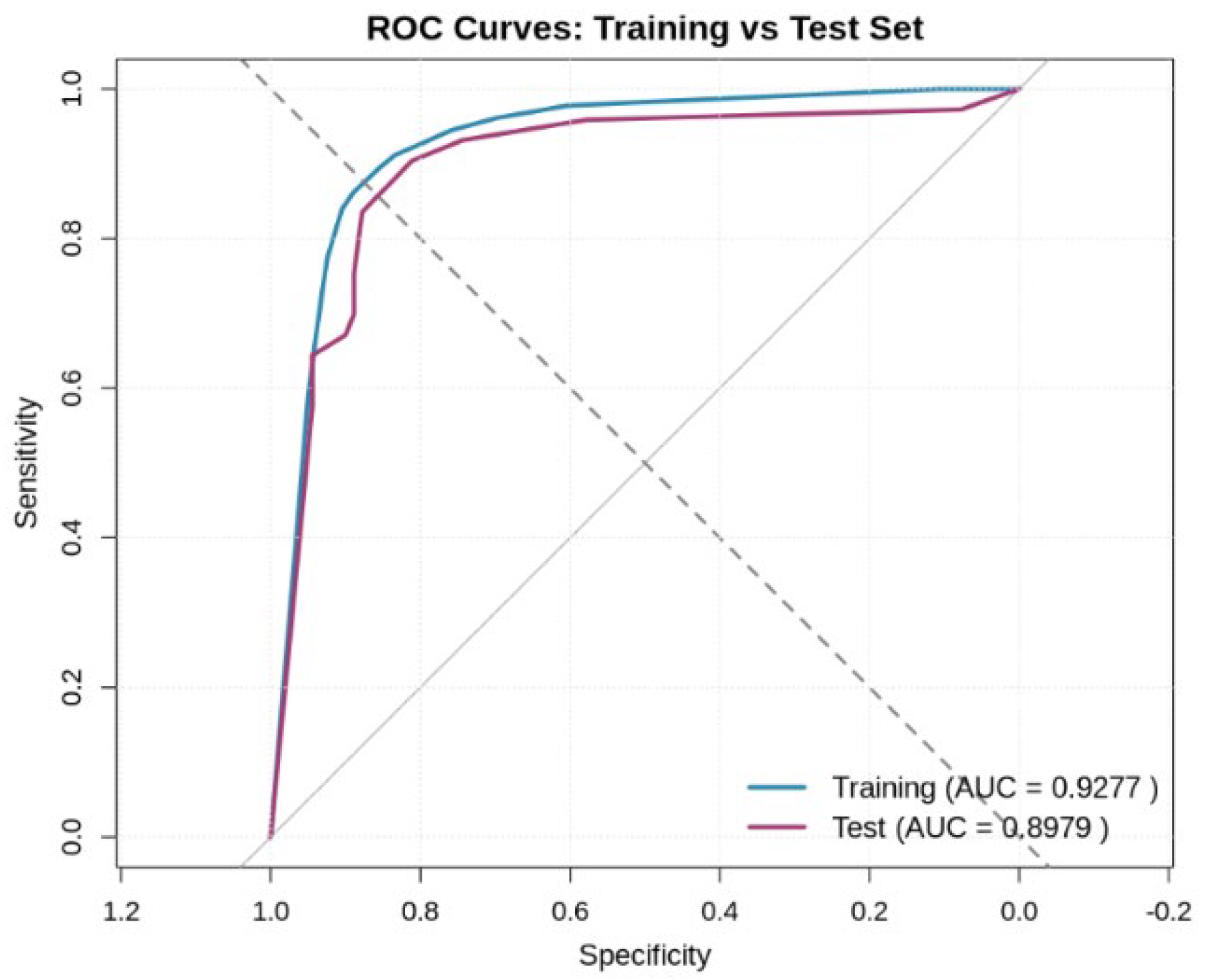
Table 1.
Performance Metric.
| Predicted | Actual | Metric | Formula | |
|---|---|---|---|---|
| Actual=1 | Actual=0 | Sensitivity (Recall) | TP / (TP + FN) | |
| Predicted = 1 | True Positive (TP) | False Positive (FP) | Specificity | TN / (TN + FP) |
| Predicted = 0 | False Negative (FN) | True Negative (TN) | Precision | TP / (TP + FP) |
| Accuracy | (TP + TN) / (TP + FP + FN + TN) | |||
| F-score | 2 * (Precision * Sensitivity) / (Precision + Sensitivity) | |||
Table 2.
Variable Importance Rankings in the Decision Tree Model for Emotional Manipulation Classification.
Table 2.
Variable Importance Rankings in the Decision Tree Model for Emotional Manipulation Classification.
| Rank | Variable | Score | Relative (%) |
|---|---|---|---|
| 1 | Preoccupied | 68.61 | 32.6 |
| 2 | Self_Esteem | 34.76 | 16.5 |
| 3 | Age | 34.33 | 16.3 |
| 4 | Dismissive | 28.48 | 13.6 |
| 5 | Gender | 21.58 | 10.3 |
| 6 | Fearful | 18.27 | 8.7 |
| 7 | Secure | 4.11 | 2.0 |
Note. Variable importance values reflect the relative contribution of predictors to the hierarchical splitting structure of the decision tree and should not be interpreted as effect sizes or indicators of causal influence.
Disclaimer/Publisher’s Note: The statements, opinions and data contained in all publications are solely those of the individual author(s) and contributor(s) and not of MDPI and/or the editor(s). MDPI and/or the editor(s) disclaim responsibility for any injury to people or property resulting from any ideas, methods, instructions or products referred to in the content. |
© 2026 by the authors. Licensee MDPI, Basel, Switzerland. This article is an open access article distributed under the terms and conditions of the Creative Commons Attribution (CC BY) license (http://creativecommons.org/licenses/by/4.0/).
Copyright: This open access article is published under a Creative Commons CC BY 4.0 license, which permit the free download, distribution, and reuse, provided that the author and preprint are cited in any reuse.


