
Submitted:
02 April 2026
Posted:
07 April 2026
You are already at the latest version
Abstract
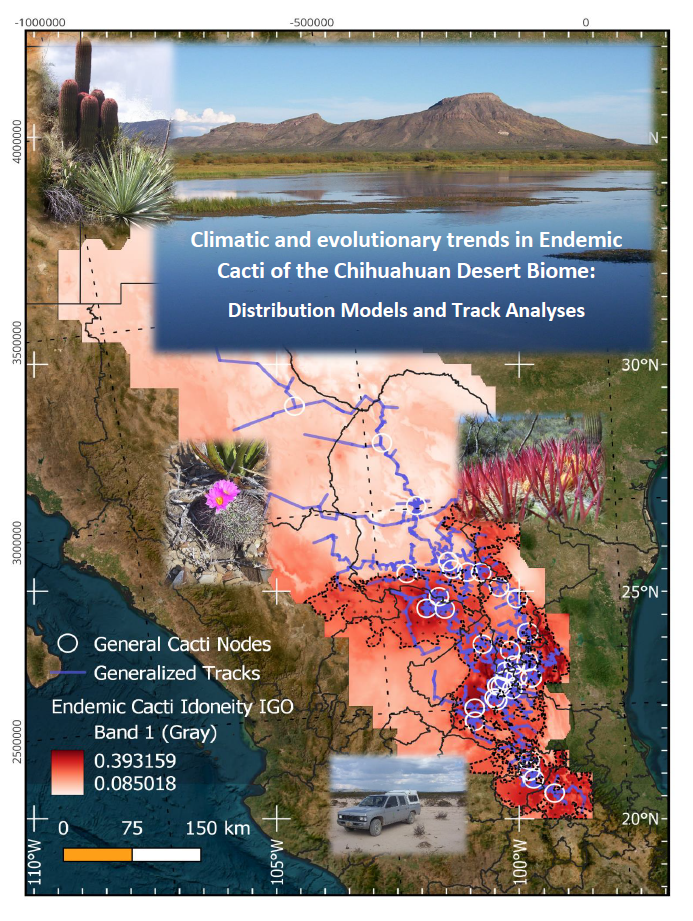
North America´s largest semi-arid lands form the Chihuahuan Desert Biome, which had fluctuated between Interglacial and Glacial conditions for eight million years. Cacti prob-ably came from South America after substantial distancing from Africa, and pollen fossils reveal their arrival in Mexico some 51.6 Ma. We have examined distributions of 119 strict-ly endemics (36.17 % of overall 329 species) and model 75 species represented in well de-fined and relatively large disjunct area groups. We modeled Species Distribution Models (SDMs) using MAXENT algorithms for present and past climates for the region, following our detailed models on climate after Sánchez-Santillán and García detailed numerical methods and Co-Kriging tools. Scotese, Van Devender, Betancourt, and Roy-Priyadarsi were utilized for modelling the glacial part. A total of 4030 registers were sampled from the Central America and North America Cacti Database (UNAM), a comprehensive set of hard information from 68 herbaria and containing over 62,000 vouchers. Registers com-prised 3719 modelable species´ specimens. Track and node analyses were applied using PANBIOTRACKS. We identified the colonization patterns and general evolutionary trends for the species. We modeled detailed combined layers of idoneity and overlap them to tracks and nodes in order to detect biogeographic trends and patterns.
Keywords:
climate change
; Interglacial-Glacial-Oscillation
; biogeography
; track and node analyses
; Cactaceae
Copyright: This open access article is published under a Creative Commons CC BY 4.0 license, which permit the free download, distribution, and reuse, provided that the author and preprint are cited in any reuse.


