

Submitted:
01 April 2026
Posted:
03 April 2026
You are already at the latest version
Abstract
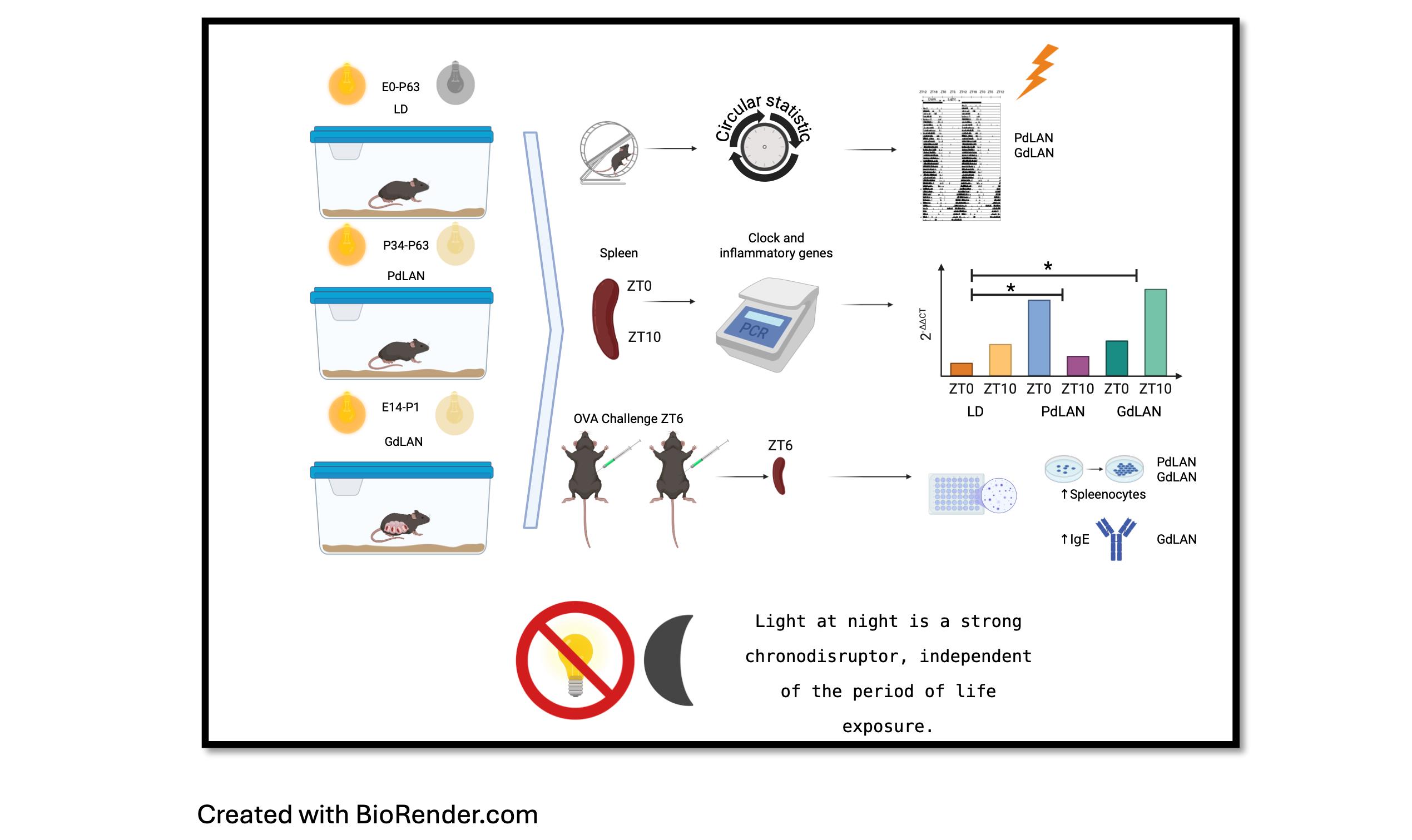
The current use of artificial light during natural dark phase had been acquired contaminant dimensions, which is named “light pollution”. It is well known that the exposure to dim light at night (dLAN) during the postnatal period severely impair the immune system and related organs, but few reports have demonstrated the effect of dim light when exposed during foetal periods. That is why this report ask does dim light at night in two different stages of development (i.e., prenatal vs. postnatal exposure) generate a long-lasting dysregulation of circadian rhythms that modifies the circadian immune organization and responses of the spleen in the early adulthood? To answer this question, we exposed two groups of C57BL/6J male mice to dim night light at gestational and postnatal period and compared to control groups where the mice were exposured to light-dark conditions (12 h each, LD). Parametric and non-parametric activity/rest values were analyzed with circular statistics. Compared to their controls, we found differences in alpha, onset, offset, M10 and L5 startime in dLAN groups. We also assessed the transcript levels of clock genes and genes that mediate inflammation in spleen tissue and found a dampening daily variation in mRNA expression in both experimental groups. Finally, we use an ovalbumin (OVA) allergy challenge to test the B-cell response in the spleen and found a significant higher cell recruitment to the spleen and more anti-OVA IgE. Together, these results clearly show that dLAN, affects the peripheral molecular clocks and responses from the spleen and these effects are independent of period of life exposure of dim light at night.
Keywords:
dim light at night
; circadian disruption
; developmental programming
; splenic immune response
; inflammation
Copyright: This open access article is published under a Creative Commons CC BY 4.0 license, which permit the free download, distribution, and reuse, provided that the author and preprint are cited in any reuse.


