

Submitted:
01 April 2026
Posted:
03 April 2026
You are already at the latest version
Abstract
The use of microbial inoculants is a promising and sustainable alternative to agrochemicals. However, their field efficacy is inconsistent. This review critically evaluates the scientific basis for using microbial inoculants in modern agriculture, analyzing their complex interactions within agroecosystems. We demonstrate that the effectiveness of inoculants is governed by predictable ecological principles, rather than random processes. The formation of plant microbiomes follows distinct, deterministic patterns, with specific colonization patterns for each compartment and a strong influence from soil type and climate. Furthermore, this review demonstrates that, for plant-beneficial microorganisms used as bioinoculants, their antimicrobial metabolites function not merely as weapons, but as sophisticated ecosystem engineers that selectively reshape microbial communities. Compounds of plant growth-promoting microorganisms like cyclic lipopeptides, macrolactins, 2,4-DAPG, and gliotoxin demonstrate dose-dependent regulatory effects, enhancing specific soil functions while maintaining community stability. The transition from microbial monocultures to synergistic consortia proves essential, though success depends on matching inoculant composition to plant chemical signaling profiles. Practical recommendations include prioritizing native stress-tolerant strains, implementing soil-specific formulations, and developing metabolite-based preparations that function as ecological modulators rather than broad-spectrum suppressants. This ecological framework provides the scientific foundation for the next generation of predictable and effective microbial inoculants.
Keywords:
biopesticides
; biofertilizers
; biological agents
; plant protection
; plant-microbe interactions
; soil health
; lipopeptides
; macrolactin
; 2
; 4-diacetylphloroglucinol
; gliotoxin
Introduction
The human desire to improve soil fertility and protect crops from pathogens dates back as far as the history of plant cultivation. Initially, these efforts were empirical and focused primarily on adding organic matter, which was essentially the first, unintentional attempt to manage the microbial community in an agroecosystem (Vasilchenko, Vasilchenko 2024).
However, the true revolution in this field took place in the 19th century, after the discovery of the crucial role of microorganisms in ecological processes (Dawson 1900; D'Abramo, Neumeyer 2020). In 1886, German scientists Hermann Hellriegel and Hermann Wilfarth made a significant breakthrough by experimentally demonstrating the phenomenon of symbiotic nitrogen fixation between root nodule bacteria and legumes (Böhm, Wissemeier, 2025). This discovery was quickly put to commercial use: by 1891, F. Nobbe and L. Hiltner received a patent (US444799A (1891) for the world's first bacterial inoculant called Nitragin (Dawson 1900). The practical application of this product almost immediately became a subject of international scientific discussion, as evidenced by J.A. Voelcker's work "Nitragin" (1896), which analyzed this new method and its use of "pure cultures" of bacteria for legumes (Voeleker, 1896). The early technology involved growing bacteria in an agar medium and then suspending the resulting cells in water. This suspension was then applied directly to the soil or seeds.
In the 20th century, the Green Revolution shifted the focus to synthetic agrochemicals. However, growing pressure from society concerned about environmental safety led to a shift towards the concept of integrated pest management. Within this framework, biological methods, including the use of microbial inoculants, have begun to occupy an increasingly important place.
Statistics confirm the growing demand for this area. By 2009, the global market for biopesticides was estimated at $1.6 billion USD, representing a significant share of the agrochemical sector (Glare et al. 2012). This commercial momentum stands in stark contrast to persistent fundamental knowledge gaps. While thousands of studies describe molecular mechanisms of antagonism in vitro and the effects of individual strains on plants in vivo, there is a lack of understanding about how introduced inoculants interact with established, complex microbiomes in the soil and plants. This gap between commercial adoption and ecological understanding is the main paradox this review aims to address.
This knowledge gap raises a logical question. It is known that plants actively recruit and shape their microbiome from the surrounding soil, which plays a key role in nutrient cycling, hormone synthesis, siderophore production, and pathogen defense. If this mechanism is well-established by nature, then, in what cases, is the targeted application of microbial inoculants truly necessary and effective?
The purpose of this review is to assess the scientific validity of microbial inoculants and define their effectiveness. Rather than demonstrating their overall usefulness, we will focus on analyzing specific agronomic scenarios where their use offers undeniable advantages, as well as situations where it may be ineffective. The focus will be on the following questions: how the indigenous microbiome colonizes plants at different stages of their life cycle and how this process is influenced by the use of inoculants; how effective inoculant application depends on soil type and fertility; whether inoculation can increase plant resistance to abiotic stress; and finally, how promising biopreparations based on purified metabolites are as an alternative to living crops.
1. Plant-Driven Assembly of the Microbiome: Rules of Recruitment from Seed to Maturity
The rhizosphere – the root zone – is a microbial hotspot that plays a key role in shaping the plant's microbiome. The plant directly influences the composition of the community through root exudates creating a unique environment enriched with specific taxa, such as Actinobacteria, Proteobacteria and Bacteroidetes which are significantly more abundant here than in soils outside the root zone (Ling et al. 2022). The cause-and-effect relationship of this process has been experimentally confirmed. The introduction of a synthetic analogue of corn exudates into soil in vitro has significantly increased the number of bacteria and changed their metabolic profiles, as well as the genetic structure of the bacterial community (Blagodatskaya et al. 2014). A large-scale meta-analysis of 557 samples confirmed that the rhizosphere acts as a selective filter, forming its community from the "seed bank" of bulk soil. This naturally leads to a reduction in overall alpha diversity compared to the soil (Ling et al. 2022). The functional profile of the rhizosphere is highly specific. Metagenomic analysis has shown a significant enrichment of genes involved in nitrogen fixation and denitrification, ranging from 11% to 182%, while genes related to nitrification are depleted.
The established rhizosphere microbiome acts as a source for bacteria to colonize the internal root tissues, known as the endosphere. Bacteria enter through wounds or areas of lateral root growth and then spread through the vascular system to the aboveground parts of the plant, including stems, leaves (phyllosphere) and fruits (carposphere) (Adeleke et al. 2021; Taiqiang et al. 2023). Niche differentiation across plant compartments is a fundamental principle of microbiome organization. Studies on a wide variety of crops, from Arabidopsis thaliana to tea plants, demonstrate a clear division of communities between soil, roots, stems, and leaves (Taiqiang et al. 2023). Moreover, the root mycobiome of the tea plant had virtually no overlap with the soil mycobiome, demonstrating a high degree of specificity and stability. This formed rhizosphere microbiome serves as a source for colonization of the internal tissues of the root (endosphere), from which microorganisms can move through the vascular system to aboveground parts of the plant. However, for above-ground parts, especially leaves, the rhizosphere is not the only and often not the primary source of microorganisms. Direct microbial influx from soil and air creates a complex mixture that is subject to different ecological rules.
Soil is the main source of microbes for leaves, but their migration is a complex, multi-stage process. Most bacteria colonize leaves randomly: their success is determined not by a specific advantage, but by random processes (dispersion, drift) (Figure 1A). This explains the diversity of natural microbiomes in the phyllosphere (Mayer, et al. 2025). In contrast, deterministic colonization is possible for a limited number of taxa. These bacteria possess specialized niches, often associated with the utilization of unique plant secondary metabolites (e.g., glucosinolates in A. thaliana or benzoxazinoids in maize) (Thoenen et al. 2024). Research on benzoxazinoids reveals a dual mechanism for chemical control. On the one hand, MBOA (6-methoxy-2-benzoxazolinone) serves as a selective chemoattractant for beneficial bacteria such as Azospirillum. On the other hand, its derivative, APO (2-amino-3H-phenoxazin-3-one) directly inhibiting up to 43% of rhizosphere bacteria, including many strains of Bacillus, while leaving resistant Pseudomonaceae unaffected (Schandry et al. 2021). These examples clearly demonstrate how the plant actively constructs its rhizosphere community through complex chemical signaling. The plant does not passively filter, but actively creates a barrier to inoculants that are not adapted to its specific metabolic profile (Figure 1A).
However, this chemical strategy of the plant also creates windows of opportunity. Strains resistant to the plant's antimicrobial metabolites (such as APO) gain a selective advantage. Moreover, the most effective rhizobacteria themselves employ similar ecological tactics to establish themselves in the community. A telling example is the Bacillus velezensis strain SQR9. Like APO, it exerting antagonism against a portion of the native rhizosphere community, cleansing niches. At the same time, similar to MBOA, it creates conditions for the enrichment of compatible strains for cooperative interactions (Liu et al. 2025). A meta-analysis of synthetic communities revealed a tendency for rhizobiomes to self-organize into two discrete functional states, the key determinant of which is the presence or absence of bacteria of the genus Bacillus (Selten, de Jonge 2025). The success of these inoculants lies in their ability to shift the natural community towards the target Bacillus-associated state. However, this shift is tightly controlled by abiotic (pH) and biotic factors, including the plant's chemical profile and immune status, which play a primary role.
It is noteworthy that deterministic colonization often depends on interspecies interactions and signals received by the microbe early in seedling development (Kandel et al. 2017). Therefore, attempts to directly "populate" the phyllosphere or alter the existing rhizosphere community of an adult plant through simple surface application of inoculants are likely to compete with natural processes and established niches. In this case, a key question arises: What factors and at what stages can we specifically influence the development of a plant's microbiome in order to improve the efficacy of microbial preparations?
A) Inoculum sources and the main pathways for microorganisms to reach the plant. The primary flow is from the soil "seed bank" to the rhizosphere, where community composition is shaped by the selective influence of root exudates. A limited systemic pathway indicates the potential dissemination of endophytes from the roots to the aboveground parts via the vascular system. Stochastic colonization of the phyllosphere occurs directly from the soil and air and is largely dependent on random processes (drift, dispersion). B) Hierarchy of environmental filters determining community composition. The initial microbial pool is shaped by the most general abiotic conditions, such as region and soil type. Plant species/genotypes act as the primary biotic filters, selecting taxa that are responsive to their specific signals. These plant compartments, including rhizosphere, endosphere, and phyllosphere, act as the final and most specific filters, creating unique conditions for the final microbiome composition in each organ. The arrows indicate the direction of cascade influence. C) The resulting structure of the plant microbiome. The stable "core" microbiome includes taxa consistently associated with a given plant species, whose presence is determined by the host. "Satellite" taxa are numerous but low-abundance groups whose occurrence is largely stochastic. Arrows indicate inoculation strategies: successful ones aim for integration into the "core," while unsuccessful ones compete for the "satellite" pool.
The answer to this question lies in the hierarchy of factors that determine microbiome assembly (Figure 1B). The community composition in each compartment is unique and is determined by a combination of factors. Plant species and genotype play a significant role, but they are not the only factors (Xiao et al. 2025; Gfeller et al. 2025). Interestingly, although agricultural practices (fertilizer application and crop type) can significantly influence the rhizosphere microbial community in the short term (Wemheuer et al. 2017; Correa-Galeote et al. 2018), their long-term impact seems to be limited. A comparison of the rhizosphere microbiomes of domesticated wheat and its wild ancestor under typical agricultural conditions revealed that the composition and structure of the microbial communities are highly conserved (Fang et al. 2025). This indicates that the basic microbiome structure, shaped by the host plant, is highly stable. The key consequence of domestication is not a global change in the entire community, but a shift in the recruitment of specific taxa. For example, cultivated forms show a steady enrichment in the Rhizobiaceae family, while their wild relatives show a steady enrichment in the Burkholderiaceae family (Hernández-Terán et al. 2025). This hierarchy of factors was clearly demonstrated in a field study of commercial sugarcane plantings. The plant compartment had the greatest influence, followed by the geographic region, with crop age and variety having a lesser impact (Hamonts et al. 2018). This highlights the primary role of environmental conditions and plant ecology over genetics in community formation.
The end result is the formation of a stable "core microbiome", a community of closely associated microorganisms with a specific plant species. In addition, there are "satellite" taxa in smaller numbers, but their contribution to the plant's stability and health is significant. For example, they help suppress pathogens (Lundberg et al. 2012; Tian et al. 2017; Qiao et al. 2024) (Figure 1 C).
Thus, existing research suggests that the composition and function of the rhizobiome is not random, but rather a predictable result of ecological processes. This dichotomy between stochastic and deterministic processes not only explains, but also determines, the success or failure of microbial inoculants. Successful bioinoculants must target specific niches, such as scavenging specific metabolites, or contain key species capable of stabilizing microbial networks. Attempts to introduce strains that would compete within a common pool are doomed to failure (Figure 1C).
Therefore, when studying the microbiomes of agricultural ecosystems, the focus should shift from analyzing taxonomic diversity to studying functional characteristics and identifying deterministic niches (co-occurrence networks and exudate metabolomics), which will form the scientific basis for the next generation of effective microbial products.
2. Soil Fertility and the Microbiome: The Relationship Between Plant Yield and Soil Type with the Use of Inoculants
2.1. The Influence of Abiotic Factors on the Effectiveness of Microbial Inoculants
The effectiveness of microbial inoculants depends on soil type, fertility and climate conditions. This has been confirmed by numerous studies, which have also shown that all these factors are closely related. A meta-analysis has shown that the introduction of nitrogen-fixing microorganisms can contribute to an increase in soil organic carbon (SOC) reserves. However, this effect is not uniform and is influenced by climatic conditions (Sun et al. 2025). The greatest efficiency of nitrogen fixation in SOC accumulation is observed in warmer and drier regions. A positive correlation with average annual temperature and a negative correlation with precipitation indicates the maximum advantage of these microorganisms under stressful conditions. Thus, the successful use of nitrogen-fixing inoculants, such as those based on rhizobia or free-living bacteria, is highly dependent on the specific region. The greatest benefits are expected not in optimal conditions, but in marginal conditions, where the ability of these inoculants to provide nitrogen for plants is fully realized, leading to increased soil fertility. This shifts the strategy from searching for "universal" strains to regionally adapted solutions.
2.2. The Combined Influence of Climate and Soil Conditions
A comprehensive study on wild strawberries demonstrates that the formation of the plant microbiome is determined by a stable set of abiotic factors, the influence of which is replicated across continents (Mittelstrass et al. 2021). This conclusion is supported by a pan-European study of Arabidopsis thaliana's phyllosphere, which revealed two distinct microbiome types geographically confined to Northern and Southern Europe. The key factor explaining this variability is the Palmer Drought Stress Index (PDSI), which is the best predictor of microbiome composition surpassing other climatic parameters and plant phenotypic traits (Karasov et al. 2024; Mohkam-Singh et al. 2025; Semenov et al. 2025). Taken together, these data indicate that the natural assembly of the plant microbiome is predetermined by a complex of abiotic factors, primarily moisture availability. This creates a fundamental basis for regional variability in soil and phyllosphere communities, into which artificially introduced inoculants must integrate.
2.3. The Role of Soil Type and Fertility Gradients
The key parameters that determine the type and quality of soil are SOC and pH, which directly shape the environment for the microbiome and serve as the main abiotic filters (Mohkam-Singh, Nunes, 2025). The direct influence of soil type on rhizobiome formation is supported by a fundamental study on Arabidopsis thaliana, where it was shown that soil type is a primary factor significantly influencing the bacterial community in the rhizosphere and root endosphere (Lundberg et al. 2012).
A meta-analysis provides a quantitative assessment of the feasibility of using bioinoculants to increase SOC. Although the average increase was +0.44 grams C/kg, this effect was highly context-dependent. It was statistically significant and greatest (+0.97 grams C/ kg) in tropical humid climates, where soils had low initial SOC levels and high mineralization rates. In contrast, the effect was not significant in arid climates or on soils with high initial levels of SOC (Just et al. 2024).
A recent study has shown that the relationship between SOC and the agronomic effectiveness of bioinoculants follows an inverted U-shaped curve. The highest level of effectiveness is achieved at moderate levels of SOC (~1.5%) (Huang et al. 2025). This phenomenon can be explained by the concept of the "SOC-immune-microbiome axis". A moderate level of SOC represents a "window of opportunity", where the resource base is sufficient to support the activity of inoculants, but the immune and competitive barriers in the rhizosphere have not become insurmountable yet.
Experimental confirmation of the power of this factor comes from a study in which the authors created a soil fertility gradient by mixing soils with high and low fertility. The gradient acted as an ecological filter, forming statistically different bacterial communities at each point (Qiao et al. 2024). This result not only confirms the importance of fertility, but also provides a methodology: using these gradients as a tool to stress test and select the most competitive strains for creating synthetic consortia (Qiao et al. 2024).
Data analysis shows that the effectiveness of bioinoculants (their contribution to soil organic carbon accumulation and colonization success) depends non-linearly on the soil context, primarily on initial soil organic carbon content and pH. The maximum increase in SOC is observed in conditions that promote rapid organic matter turnover, such as warm and humid regions. Soil fertility itself acts as a powerful filter, forming a resident community that contributes to the overall carbon cycle. This requires a shift from generic solutions to more precise ones: mandatory pre-plant soil testing, the use of soil fertility gradients to select stress-tolerant crop varieties, and the regional adaptation of fertilizer formulations. Therefore, the use of bioinoculants should be based on a precise consideration of soil conditions and the target function, rather than on the assumption of their universal effectiveness.
3. Secondary Antimicrobial Metabolites of Bioinoculants are a Factor in the Formation of the Plant Rhizosphere and Their Impact on Crop Yield and Fertility
3.1. From Antagonism to Signaling: A Paradigm Shift in Understanding the Role of Antibiotics
Until the beginning of the 21st century, antibiotics produced by microorganisms were mainly viewed in the context of interspecies competition, as a tool for direct antagonism to inhibit the growth of competing organisms (Waksman 1947) (Figure 2A). This property has long been seen as a key factor in determining the effectiveness of bioinoculants. However, with the advent of omics technology, a new perspective has emerged that sees antibiotics as signaling and regulatory molecules (Davies 1990; Linares et al. 2006; Yim et al. 2007; Fajardo, Martínez 2008; Romero et al. 2011; Spagnolo et al. 2021). In this capacity, antimicrobial metabolites of bioinoculants act as ecosystem engineers, capable of deliberately altering not only the taxonomic composition, but also the functional state of the entire microbial community (Figure 2B).
A significant argument in favor of this concept is direct concentrations of antibiotics in natural environments. A meta-analysis of 887 measurements showed that their content in soils and sediments typically ranges from 1/4 to 1/230 of clinically relevant doses (Chow et al. 2021). This suggests that their primary ecological role is likely not lethal antagonism, but rather sublethal regulatory effects.
3.2. In Situ Evidence Suggests that Bioinoculants Create a Stable "Chemical Environment" in the Rhizosphere
Direct quantitative measurements using High-Performance Liquid Chromatography-Mass Spectrometry confirm that bioinoculant strains actively synthesize antibiotics directly in the rhizosphere (Raaijmakers, Mazzola 2012). For example, in cucumber inoculated with Bacillus subtilis, surfactin and iturin A concentrations reach 33 and 630 μg/g fresh weight of roots, respectively, by the 78th day of vegetation, even under competitive pressure in highly fertile soil (Kinsella et al. 2009). Other studies have found 59 micrograms of surfactin and 1 milligram of iturin per gram of cucumber roots (Kinsella et al., 2009) and 0.3 micrograms of surfactin and 0.02 micrograms of fengycin per gram of tomato roots (Debois et al. 2015). Similarly, on rice roots, B. subtilis NH-100 produced up to 200 mg/L surfactin (Sarwar et al. 2018). Pseudomonas, in turn, produces 1.65-2.77 μg/g of 2,4-diacetylphloroglucinol (2,4-DAPG) in the wheat rhizosphere, depending on the strain (Raaijmakers, Mazzola 2012).
Taken together, these data suggest that bioinoculants create a stable and growing chemical background of biologically active compounds in the rhizosphere. This background inevitably exerts selective pressure on the composition and structure of the microbial community.
3.3. Mechanisms of Influence: Molecular Interference and Chemical Communication
Bioinoculants alter the functional state of the microbiome not only through direct antimicrobial action but also through complex molecular interference (Figure 2B). Studies have shown that secondary metabolites can cause a significant change in the metabolome profile of cells in response to chemical signals from pathogens. For instance, Bacillus amyloliquefaciens alters its spectrum of synthesized macrolactins and polyketides when exposed to metabolites from Ralstonia solanacearum (Onuh et al. 2025). A key finding was that the production of protective lipopeptides in B. velezensis was dramatically increased in the presence of the pathogen, which acted as a metabolic trigger (Cao et al. 2018). In parallel, B. velezensis metabolites modulate the Phytophthora sojae transcriptome by suppressing virulence genes (pectate lyases, components of the MAPK/PKA signaling pathways).
Secondary metabolites of Pseudomonas also play a role in interspecies and interpopulation communication. In the rhizosphere, 2,4-DAPG and phloroglucinol act as signals. 2,4-DAPG increases the expression of the phlA gene in other strains, while phloroglucinol regulates the production of pyoluteorin in neighboring bacteria (Maurhofer et al. 2004; Clifford et al. 2016). 2,4-DAPG from P. kilonensis F113 enhances the phytostimulating effect of Azospirillum brasilense on wheat (Combes-Meynet et al. 2011). Treatment with 2,4-DAPG of Neurospora crassa conidia also causes a transient increase in intracellular Ca2+, suggesting its role in signaling pathways (Troppens et al. 2013).
These data suggest that bioinoculants may be involved in a chemical arms race with pathogens, dynamically influencing their physiology and reducing their pathogenic potential through mechanisms other than simple antagonism (Figure 2B). Genomic studies confirm this ecological specialization, showing that rhizobacteria, particularly those belonging to the genus Pseudomonas, have an increased capacity for secondary metabolite synthesis compared to soil isolates (Stringlis et al., 2018).
3.4. Antibiotics as "Ecosystem Engineers": from Cells to Metabolites
The question arises: if antibiotic production is a key feature of bioinoculants and living cells have a limited lifespan, can purified metabolites be used? Although research in this area is still limited, existing data suggests that such a strategy may be promising, but there is a critical caveat: Only metabolites that act at environmentally relevant concentrations and in the context of rhizosphere interactions are effective. A meta-analysis of the effects of tetracyclines, quinolones and sulfonamides shows that their use leads to a significant reduction in microbial biomass: total - by 17%, bacterial - by 20%, fungal - by 30%. This confirms their fundamentally different, destructive impact on soil ecosystems (Chen et al. 2023). Combined stressors, such as conventional antibiotics and elevated temperature, disrupt microbial communities and nutrient cycling, further causing destabilization of microbial networks (Jane et al. 2021). This demonstrates a fundamental difference between the toxicological effects of extra-systemic chemical stressors and the regulatory function of autochthonous signaling molecules in their natural ecological niche.
3.5. Selective Remodeling of the Rhizobiome by Specific Metabolites
A pioneering 1998 study showed that the production of trifolitoxin antibiotic by Rhizobium etli on beans selectively reduces the diversity of susceptible proteobacteria, without affecting the majority of the microbial community. This provides early evidence for antibiotics as selective ecosystem engineers, rather than agents of total suppression (Robleto et al. 2008).
Modern research not only specifies, but also significantly expands this concept. It demonstrates that secondary antimicrobial metabolites are capable not only of restructuring the composition of a community, but also of stimulating its functional activity. A striking example is gliotoxin, a metabolite of fungi of the genus Trichoderma and Aspergillus. New data show that this compound acts as a "driving factor" for stress, to which microbes respond not by suppression, but by adaptation and a sharp increase in functional activity (Teslya et al. 2024a). Its influence significantly increases microbial respiration (mineralization activity) and enhances the activity of enzymes key to the carbon, nitrogen, and phosphorus cycles. This demonstrates that antibiotics can serve as stimulants, forcing communities to restructure themselves to perform ecological functions more efficiently (Teslya et al. 2024b). Other metabolites exhibit a similar yet specific complex effect. For example, cyclic lipopeptides produced by B. velezensis selectively alter the taxonomic composition of the microbiome, increasing fungal diversity and activating enzymes involved in carbon, nitrogen, and phosphorus cycling (Vasilchenko et al. 2025).
The most detailed picture of ecological engineering is revealed by metagenomic studies, demonstrating how different antimicrobial metabolites of PGP bacteria specifically restructure the functional landscape of soil communities. Metagenomic profiling has shown that macrolactin A from B. velezensis acts as a highly specific environmental filter, suppressing a range of Gram-positive bacteria while significantly increasing the relative abundance of key symbiotic genera of Pseudomonadota, such as Bradyrhizobium and Mesorhizobium, which play a crucial role in nitrogen fixation (Yuan et al. 2016; Poshvina et al. 2025). Functional gene analysis revealed that exposure to macrolactin A triggers profound microbiome restructuring, the nature of which is critically dependent on dose. Low concentrations of macrolactin A act as a signaling modulator, enriching genes involved in chemotaxis, intercellular communication, and efflux pump function, indicating adaptive community mobilization. At high doses, macrolactin A acts as a selective factor, shifting the metabolic profile towards increased biosynthesis of secondary metabolites and ion transport.
A similar dose-dependent principle is demonstrated by 2,4-DAPG, which, by suppressing Mucoromycota and Actinomycetota, causes enrichment of the phylum Pseudomonadota and dose-dependent activation of enzymes of the carbon and nitrogen cycles (Teslya et al. 2025). Functional profiling revealed that exposure to high doses of 2,4-DAPG causes targeted suppression of metabolic pathways associated with maintaining cellular vitality in the microbiome. Simultaneously, there is a sharp activation of adaptive systems designed to respond to stress. The greatest enrichment is observed in gene categories responsible for xenobiotic resistance and stabilization of cellular macromolecules. This indicates a selective pressure that selects strains with enhanced mechanisms for detoxification and maintaining homeostasis under antimicrobial stress.
3.6. Towards a Strategy for Targeted Selection of Bioinoculants
The analysis of the presented data leads to a fundamental conclusion: antimicrobial metabolites act as "engineers", carrying out targeted remodeling of the rhizobiome through a universal mechanism called ecological dualism, - "signal-stressor". At low, ecologically relevant concentrations, these compounds serve as signaling molecules, mobilizing communities (as in the case of macrolactin A). However, at higher doses, they act as selective agents that radically alter the metabolic landscape, favoring adapted and functionally beneficial taxa, as demonstrated by 2,4-DAPG.
Therefore, when developing bioinoculants and selecting strains, it is strategically important to shift the focus from searching for producers of antibiotics with broad "killing power" to selecting strains that synthesize compounds that act as subtle "ecosystem engineers." The key criterion should be their ability not to completely suppress the rhizobiome, but to precisely modulate its structure and function. Ideal candidates, such as cyclic lipopeptides, 2,4-DAPG, and gliotoxin, are effective precisely because their action goes beyond simple antagonism.
4. Practical Recommendations for the Creation of Bioinnoculants
A modern trend in agriculture is the transition from empirical screening to targeted design of bio-products based on ecological principles. The data presented in previous chapters allow us to formulate a systematic strategy aimed at overcoming key barriers to field efficiency.
A key paradigm shift involves moving away from the focus on strains with the maximum expression of specific PGP traits (in vitro production of phytohormones and antibiotics) and towards selection based on "ecological competence". A promising candidate strain should be able to not only grow well in a Petri dish, but also possess a range of adaptations for survival and success in the highly competitive environment of the rhizosphere. These include:
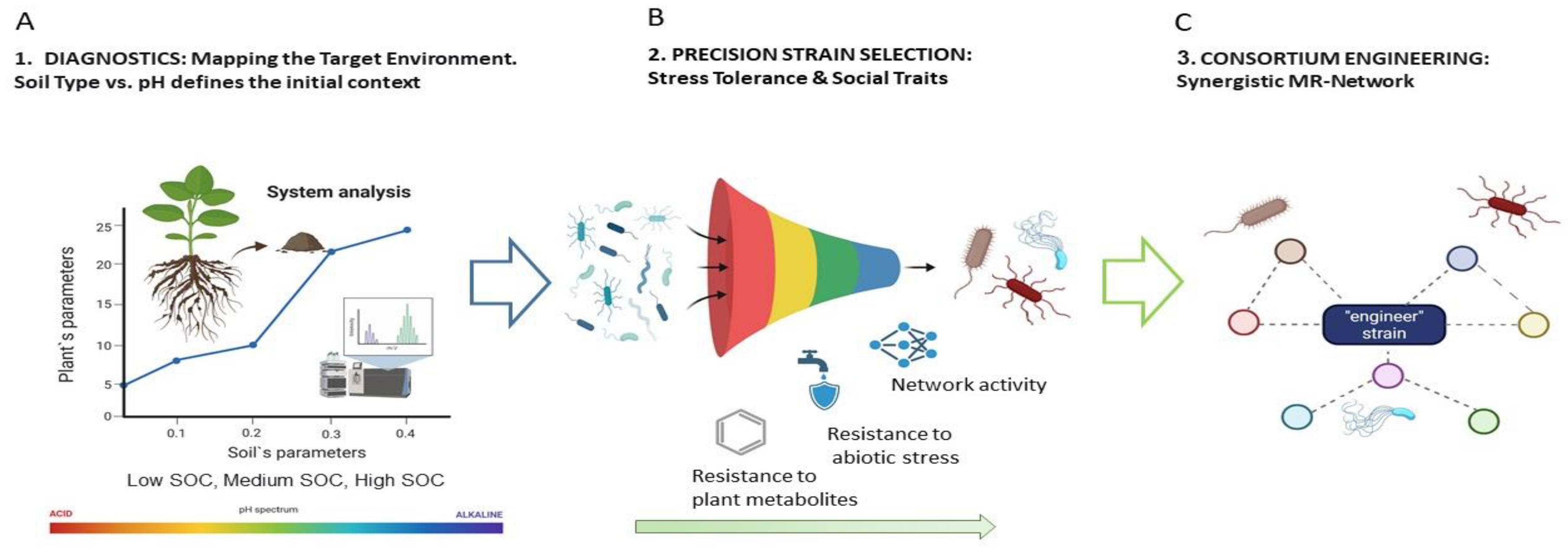
1. The ability to withstand the environmental challenges of the target agricultural ecosystem, such as low pH and osmotic stress (Figure 3A).
2. The capacity to resist the effects of specific secondary metabolites produced by the host plant, such as the benzoxazinoid APO in cereals (Figure 3B).
3. The presence of social interaction mechanisms: the capacity for chemotaxis, quorum sensing, and the formation of cooperative biofilms with other rhizobacteria (Figure 3B).
A striking illustration of this approach is the B. velezensis SQR9 strain, whose effectiveness is due to its outstanding ability to restructure microbial networks (Liu et al. 2025). It acts as a "social hub". By exhibiting selective antagonism, it suppresses part of the native community, while simultaneously creating conditions for enrichment with moderately related cooperative Bacillus strains. This leads to the formation of a stable and functionally active consortium. Precisely this "network competence" should become the priority criterion for selection (Figure 3C).
Critical progress has been made in implementing the principle of selecting based on ecological competence with the development of the rhizoSMASH computational tool (Li et al. 2025). This algorithm, based on genomic synteny, predicts the presence of catabolic gene clusters associated with rhizosphere competence (rCGCs) in bacteria, that is, their genetically determined ability to utilize specific components of root exudates.
The presence of these clusters has been shown to be highly correlated with successful colonization of the rhizosphere, which has been confirmed in two independent validation studies. RhizoSMASH therefore provides a missing link between genomic data and field performance predictions, enabling the targeted selection of strains with the potential for successful colonization in a specific plant host during genomic screening, before the need for labor-intensive seeding experiments.
4.2. Consortium Design: the Principle of Synergy Between Moderately Related Communities
The data convincingly demonstrate the benefits of polymicrobial drugs. However, an effective consortium is not just a collection of strong producers, but rather a synergistic community. Studies show that artificial communities of moderately related strains exhibit higher synergy in plant growth promotion and better plant biomass production compared to communities of highly related strains or antagonistic mixtures (Liu et al. 2025).
When forming a consortium, conscious selection of secondary metabolite producers is critical. It's crucial strategically to select not the strains with the greatest "killing power," but rather those that produce compounds acting as "ecosystem engineers": cyclic lipopeptides (surfactin, iturin), 2,4-DAPG, and gliotoxin, and other compounds capable of dose-dependent modulation of the community.
4.3. Taking into Account the Soil-Climatic Context: From Universality to Precision
The effectiveness of an inoculant is not inherent; it only manifests itself in suitable soil and climatic conditions. Therefore, development and application must begin with diagnostics (Figure 3A).
1. SOC and pH are the primary diagnostic parameters. Maximum agronomic performance is expected in soils with moderate SOC percentage, where there is a "window of opportunity" for colonization.
2. It is necessary to select and test strains that are tolerant to stressors prevalent in the region, such as drought and salinity. The greatest economic and environmental benefits of inoculants, especially those that fix nitrogen, are expected in marginal and degraded agroecosystems where they act as triggers for fertility restoration.
3. The SOC gradient methodology is a powerful tool for stress testing and selecting the most competitive strains adapted to a specific level of fertility.
4. Compatibility with the host plant's chemical strategy. The plant actively shapes its microbiome through secondary metabolites. Ignoring this chemical dialogue guarantees inoculation failure.
5. Formulation technologies for inoculant protection are necessary, but not sufficient. To overcome the survivability barrier, encapsulation technologies in biodegradable polymers and the creation of combined carriers based on clays and humic substances are being actively developed to provide protection against abiotic stress and controlled cell release (Monica et al 2025). However, these technologies are of secondary importance. Without taking into account the ecological principles listed above, even a perfectly protected but environmentally incompetent strain will quickly be eliminated from the rhizosphere.
Conclusion
Thus, the path to creating stable and effective bioinoculants for the next generation lies not in further optimization of strains isolated from the environment, but in their ecologically conscious integration into agroecosystems. The proposed approach thus translates ecological principles into specific protocols. Instead of in vitro screening, it involves: metabolomic analysis of exudates to identify chemical targets; stress selection on soil gradients to select context-tolerant strains; assessment of network parameters (co-encounter networks) to identify candidate "social hubs"; and molecular tracking (qPCR, Stable Isotope Probing) to validate survival. Soil SOC analysis remains a key diagnostic tool at the planning stage, predicting the fundamental possibility of successful inoculation. This methodological framework enables the systematic creation of products that are functional extensions of the target agroecosystem rather than "universal strains".
Author Contributions
Alexey S. Vasilchenko: Conceptualization, Writing – original draft, Formal analysis, Funding acquisition. Anastasia V. Teslya: Writing – Formal analysis, Review & editing.
Funding
The Ministry of Science and Higher Education of the Russian Federation (FEVZ 2024-0005) has supported this work.
Data Availability Statement
No data was used for the research described in the article.
Declaration of Competing Interest
The authors declare that they have no known competing financial interests or personal relationships that could have appeared to influence the work reported in this paper.
References
- Adeleke, BS; Babalola, OO; Glick, BR. Plant growth-promoting root-colonizing bacterial endophytes. Rhizosphere 2021, 20, 100433. [Google Scholar] [CrossRef]
- Onuh, Augustine C.; Manopaek, R; Vangnai, AS; Tiyayon, P; Vinayavekhin, N. Dynamics of Microbial Metabolism in Postharvest Fruit: An Omics Perspective. J Agric Food Chem. 2025, 73, 12525–12536. [Google Scholar] [CrossRef]
- Blagodatskaya, E; Blagodatsky, S; Anderson, T-H; Kuzyakov, Y. Microbial growth and carbon use efficiency in the rhizosphere and root-free soil. PLoS ONE 2014, 9, e93282. [Google Scholar] [CrossRef]
- Böhm, W; Wissemeier, AH. Contribution to the HiStory Series in Plant Nutrition. J Plant Nutr Soil Sci. 2025, 188, 585–592. [Google Scholar] [CrossRef]
- Cao, Y; Pi, H; Chandrangsu, P; et al. Antagonism of two plant-growth promoting Bacillus velezensis isolates against Ralstonia solanacearum and Fusarium oxysporum. Sci Rep. 2018, 8, 4360. [Google Scholar] [CrossRef]
- Chen, J; Zhu, B; Zhang, Y. A meta-analysis on the responses of soil microbial biomass and community structure to antibiotics. Appl Soil Ecol. 2023, 184, 104786. [Google Scholar] [CrossRef]
- Chow, LKM; Ghaly, TM; Gillings, MR. A survey of sub-inhibitory concentrations of antibiotics in the environment. J Environ Sci (China) 2021, 99, 21–27. [Google Scholar] [CrossRef] [PubMed]
- Clifford, JC; Buchanan, A; Vining, O; Kidarsa, TA; Chang, JH; McPhail, KL; Loper, JE. Phloroglucinol functions as an intracellular and intercellular chemical messenger influencing gene expression in Pseudomonas protegens. Environ Microbiol. 2016, 18, 3296–3308. [Google Scholar] [CrossRef] [PubMed]
- Combes-Meynet, E; Pothier, JF; Moënne-Loccoz, Y; Prigent-Combaret, C. The Pseudomonas secondary metabolite 2,4-diacetylphloroglucinol is a signal inducing rhizoplane expression of Azospirillum genes involved in plant-growth promotion. Mol Plant Microbe Interact. 2011, 24, 271–284. [Google Scholar] [CrossRef]
- Correa-Galeote, D; Bedmar, EJ; Arone, GJ. Maize endophytic bacterial diversity as affected by soil cultivation history. Front Microbiol. 2018, 9, 484. [Google Scholar] [CrossRef]
- Davies, J. What are antibiotics? Archaic functions for modern activities. Mol Microbiol. 1990, 4, 1227–1232. [Google Scholar]
- Dawson, M. Nitragin and the nodules of leguminous plants. Philos Trans R Soc Lond B Biol Sci. 1900, 192, 1–28. Available online: http://www.jstor.org/stable/91813 (accessed on 26 November 2025).
- Debois, D; Fernandez, O; Franzil, L; et al. Plant polysaccharides initiate underground crosstalk with bacilli by inducing synthesis of the immunogenic lipopeptide surfactin. Environ Microbiol Rep. 2015, 7, 570–582. [Google Scholar] [CrossRef]
- D'Abramo, F; Neumeyer, S. A historical and political epistemology of microbes. Centaurus 2020, 62, 321–330. [Google Scholar] [CrossRef]
- Fang, J; Blaschkauer, M; Distelfeld, A; et al. Comparison of Rhizosphere Microbiomes Between Domesticated and Wild Wheat in a Typical Agricultural Field: Insights into Microbial Community Structure and Functional Shifts. J Fungi (Basel) 2025, 11, 168. [Google Scholar] [CrossRef]
- Fajardo, A; Martínez, JL. Antibiotics as signals that trigger specific bacterial responses. Curr Opin Microbiol. 2008, 11, 161–167. [Google Scholar] [CrossRef]
- Gfeller, V; Schneider, M; Bodenhausen, N; et al. Crop genotype modulates root rot resistance-associated microbial community composition and abundance of key taxa. Environ Microbiome 2025, 20, 53. [Google Scholar] [CrossRef] [PubMed]
- Glare, T.; Caradus, J; Gelernter, W.; Jackson, T.; Keyhani, N.; Köhl, J.; Marrone, P.; Morin, L.; Stewart, A. Have biopesticides come of age? Trends in Biotechnology 2012, 30(5), 250–258. [Google Scholar] [CrossRef] [PubMed]
- Hamonts, K; Trivedi, P; Garg, A; et al. Field study reveals core plant microbiota and relative importance of their drivers. Environ Microbiol. 2018, 20, 124–140. [Google Scholar] [CrossRef] [PubMed]
- Han, X; Shen, D; Xiong, Q; et al. The plant-beneficial rhizobacterium Bacillus velezensis FZB42 controls the soybean pathogen Phytophthora sojae due to bacilysin production. Appl Environ Microbiol. 2021, 87, e01601–e01621. [Google Scholar] [CrossRef]
- Hernández-Terán, A; Escalante, AE; Rebolleda-Gómez, M. Plant domestication does not reduce diversity in rhizosphere bacterial communities. New Phytol 2025. [Google Scholar] [CrossRef]
- Huang, Y; Tang, S; Liu, R; et al. Soil organic carbon mediates plant immunity-rhizosphere microbiome interactions and controls colonization resistance to microbial inoculants. Cell Host Microbe 2025, 33, 1929–1944.e7. [Google Scholar] [CrossRef]
- Just, BS; Marks, EAN; Roquer-Beni, L; Llenas, L; Ponsà, S; Vilaplana, R. Biofertilization increases soil organic carbon concentrations: results of a meta-analysis. Int J Agric Sustain. 2024, 22, 2361578. [Google Scholar] [CrossRef]
- Kandel, SL; Joubert, PM; Doty, SL. Bacterial Endophyte Colonization and Distribution within Plants. Microorganisms 2017, 5, 77. [Google Scholar] [CrossRef] [PubMed]
- Karasov, TL; Neumann, M; Leventhal, L; Pathodopsis Team. Continental-scale associations of Arabidopsis thaliana phyllosphere members with host genotype and drought. Nat Microbiol. 2024, 9, 2748–2758. [Google Scholar] [CrossRef] [PubMed]
- Kinsella, K; Schulthess, CP; Morris, TF; Stuart, JD. Rapid quantification of Bacillus subtilis antibiotics in the rhizosphere. Soil Biol Biochem. 2009, 41, 374–379. [Google Scholar] [CrossRef]
- Linares, JF; Gustafsson, I; Baquero, F; Martínez, JL. Antibiotics as intermicrobial signaling agents instead of weapons. Proc Natl Acad Sci U S A 2006, 103, 19484–19489. [Google Scholar] [CrossRef]
- Ling, N; Wang, T; Kuzyakov, Y. Rhizosphere bacteriome structure and functions. Nat Commun. 2022, 13, 836. [Google Scholar] [CrossRef]
- Li, T; Li, D; Chen, X; Gérard, F; Li, M; Wu, J; Gao, J. Compartments of roots and mature leaves are key hubs in the connectivity of tea-plant mycobiomes and are influenced by environmental factors and host age. Sci Total Environ. 2023, 893, 164827. [Google Scholar] [CrossRef]
- Li, Y; Sun, M; Raaijmakers, JM; et al. Predicting rhizosphere-competence-related catabolic gene clusters in plant-associated bacteria with rhizoSMASH. Nat Commun. 2025, 16, 8400. [Google Scholar] [CrossRef]
- Liu, Y; Jia, B; Ren, Y; et al. Bacterial social interactions in synthetic Bacillus consortia enhance plant growth. iMeta 2025, 4, e70053. [Google Scholar] [CrossRef]
- Lucas, JM; Sone, BM; Whitmore, D; Strickland, MS. Antibiotics and temperature interact to disrupt soil communities and nutrient cycling. Soil Biol Biochem. 2021, 163, 108437. [Google Scholar] [CrossRef]
- Lundberg, DS; Lebeis, SL; Paredes, SH; et al. Defining the core Arabidopsis thaliana root microbiome. Nature 2012, 488, 86–90. [Google Scholar] [CrossRef]
- Maurhofer, M; Baehler, E; Notz, R; Martinez, V; Keel, C. Cross talk between 2,4-diacetylphloroglucinol-producing biocontrol pseudomonads on wheat roots. Appl Environ Microbiol. 2004, 70, 1990–1998. [Google Scholar] [CrossRef]
- Mayer, T; Teutloff, E; Unger, K; et al. Deterministic colonization arises early during the transition of soil bacteria to the phyllosphere and is shaped by plant-microbe interactions. Microbiome 2025, 13, 102. [Google Scholar] [CrossRef]
- Mittelstrass, J; Sperone, FG; Horton, MW. Using transects to disentangle the environmental drivers of plant-microbiome assembly. Plant Cell Environ. 2021, 44, 3515–3525. [Google Scholar] [CrossRef]
- Mohkam-Singh; Nunes, Márcio R. A 30-Year overview of soil fertility, soil quality, and soil health research in Florida. Ecological Indicators, Volume Volume 176(2025), 113660. [CrossRef]
- Monica, S; Panneerselvam, S; Rajasekaran, R; et al. Recent Advances in Bioinoculant Formulations and Their Shelf-Life: A Review. Curr Microbiol. 2025, 82, 506. [Google Scholar] [CrossRef] [PubMed]
- Nobbe, F; Hiltner, L. Inoculation of the soil for cultivating leguminous plants. US Patent 570,813. 1896. Available online: https://patents.google.com/patent/US570813A/en.
- Okubara, PA; Bonsall, RF. Accumulation of Pseudomonas-derived 2,4-diacetylphloroglucinol on wheat seedling roots is influenced by host cultivar. Biol Control. 2008, 46, 322–331. [Google Scholar] [CrossRef]
- Poshvina, DV; Balkin, AS; Dilbaryan, DS; Vasilchenko, AS. Unravelling the response of the soil microbiome to macrolactin A: A metagenomic study. Chemosphere 2025, 387, 144645. [Google Scholar] [CrossRef] [PubMed]
- Qiao, Y; Wang, Z; Sun, H; et al. Synthetic community derived from grafted watermelon rhizosphere provides protection for ungrafted watermelon against Fusarium oxysporum via microbial synergistic effects. Microbiome 2024, 12, 101. [Google Scholar] [CrossRef]
- Raaijmakers, JM; Mazzola, M. Diversity and natural functions of antibiotics produced by beneficial and plant pathogenic bacteria. Annu Rev Phytopathol. 2012, 50, 403–424. [Google Scholar] [CrossRef]
- Robleto, EA; Borneman, J; Triplett, EW. Effects of bacterial antibiotic production on rhizosphere microbial communities from a culture-independent perspective. Appl Environ Microbiol. 1998, 64, 5020–5022. [Google Scholar] [CrossRef]
- Romero, D; Traxler, MF; López, D; Kolter, R. Antibiotics as signal molecules. Chem Rev. 2011, 111, 5492–5505. [Google Scholar] [CrossRef] [PubMed]
- Sarwar, A; Hassan, MN; Imran, M; et al. Biocontrol activity of surfactin A purified from Bacillus NH-100 and NH-217 against rice bakanae disease. Microbiol Res. 2018, 209, 1–13. [Google Scholar] [CrossRef] [PubMed]
- Schandry, N; Jandrasits, K; Garrido-Oter, R; Becker, C. A practical guide to sequencing and analyzing synthetic bacterial communities. bioRxiv 2021, 2021.01.12.425818. [Google Scholar] [CrossRef]
- Selten, G; de Jonge, R. Bacillus drives functional states in synthetic plant root bacterial communities. Genome Biol. 2025, 26, 270. [Google Scholar] [CrossRef] [PubMed]
- Semenov, MV; Zhelezova, AD; Ksenofontova, NA; Ivanova, EA; Nikitin, DA; Semenov, VM. Microbiological Indicators for Assessing the Effects of Agricultural Practices on Soil Health: A Review. Agronomy 2025, 15, 335. [Google Scholar] [CrossRef]
- Spagnolo, F; Trujillo, M; Dennehy, JJ. Why Do Antibiotics Exist? mBio 2021, 12, e0196621. [Google Scholar] [CrossRef] [PubMed]
- Stringlis, IA; Zhang, H; Pieterse, CMJ; Bolton, MD; de Jonge, R. Microbial small molecules—weapons of plant subversion. Nat Prod Rep. 2018, 35, 410–433. [Google Scholar] [CrossRef]
- Sun, X; Chen, J; Kuzyakov, Y; et al. Meta-analysis shows that planting nitrogen-fixing species increases soil organic carbon stock. Nat Ecol Evol. 2025, 9, 2046–2056. [Google Scholar] [CrossRef]
- Teslya, AV; Gurina, EV; Poshvina, DV; Stepanov, AA; Iashnikov, AV; Vasilchenko, AS. Fungal secondary metabolite gliotoxin enhances enzymatic activity in soils by reshaping their microbiome. Rhizosphere 2024, 32, 100960. [Google Scholar] [CrossRef]
- Teslya, AV; Iashnikov, AV; Poshvina, DV; Stepanov, AA; Vasilchenko, AS. Extracellular enzymes of soils under organic and conventional cropping systems: Predicted functional potential and actual activity. Agronomy 2024, 14, 2634. [Google Scholar] [CrossRef]
- Teslya, AV; Stepanov, AA; Poshvina, DV; Petrushin, IS; Vasilchenko, AS. From lab to field: Context-dependent impacts of Pseudomonas-produced 2,4-diacetylphloroglucinol on soil microbial ecology. Biomolecules 2025, 15, 1578. [Google Scholar] [CrossRef]
- Thoenen, L; Kreuzer, M; Pestalozzi, C; et al. The lactonase BxdA mediates metabolic specialisation of maize root bacteria to benzoxazinoids. Nat Commun. 2024, 15, 6535. [Google Scholar] [CrossRef] [PubMed]
- Tian, B; Zhang, C; Ye, Y; et al. Beneficial traits of bacterial endophytes belonging to the core communities of the tomato root microbiome. Agric Ecosyst Environ. 2017, 247, 149–156. [Google Scholar] [CrossRef]
- Troppens, DM; Chu, M; Holcombe, LJ; Gleeson, O; O’Gara, F; Read, ND; Morrissey, JP. The bacterial secondary metabolite 2,4-diacetylphloroglucinol impairs mitochondrial function and affects calcium homeostasis in Neurospora crassa. Fungal Genet Biol. 2013, 56, 135–146. [Google Scholar] [CrossRef] [PubMed]
- Vasilchenko, AS; Dilbaryan, DS; Poshvina, DV; et al. Bacillus-derived cyclic lipopeptides modulate microbiome structure and enzymatic activity of soil and increase productivity of potato (Solanum tuberosum L.). Rhizosphere 2025, 33, 101033. [Google Scholar] [CrossRef]
- Vasilchenko, AV; Vasilchenko, AS. Plaggic anthrosol in modern research: Genesis, properties and carbon sequestration potential. CATENA 2024, 234, 107626. [Google Scholar] [CrossRef]
- Voeleker, JA. 'Nitragin' or the use of 'pure cultivation' bacteria for leguminous crops. J R Agric Soc Engl. 1896, 7, 253–264. [Google Scholar]
- Waksman, SA. What is an antibiotic or an antibiotic substance? Mycologia 1947, 39, 565–569. [Google Scholar] [CrossRef] [PubMed]
- Wemheuer, F; Kaiser, K; Karlovsky, P; Daniel, R; Vidal, S; Wemheuer, B. Bacterial endophyte communities of three agricultural important grass species differ in their response towards management regimes. Sci Rep. 2017, 7, 40914. [Google Scholar] [CrossRef] [PubMed]
- Xiao, L; Zhao, Q; Deng, J; Cui, L; Zhang, T; Yang, Q; Zhao, S. Comparative analysis of rhizosphere microbiomes in different blueberry cultivars. Horticulturae 2025, 11, 696. [Google Scholar] [CrossRef]
- Yim, G; Wang, HH; Davies, J. Antibiotics as signalling molecules. Philos Trans R Soc Lond B Biol Sci. 2007, 362, 1195–1200. [Google Scholar] [CrossRef]
- Yuan, J; Zhao, M; Li, R; et al. Antibacterial compound macrolactin alters the soil bacterial community and abundance of the gene encoding PKS. Front Microbiol. 2016, 7, 1904. [Google Scholar] [CrossRef]
Figure 1.
Conceptual model of plant microbiome formation: sources, filters, and community structure.
Figure 1.
Conceptual model of plant microbiome formation: sources, filters, and community structure.
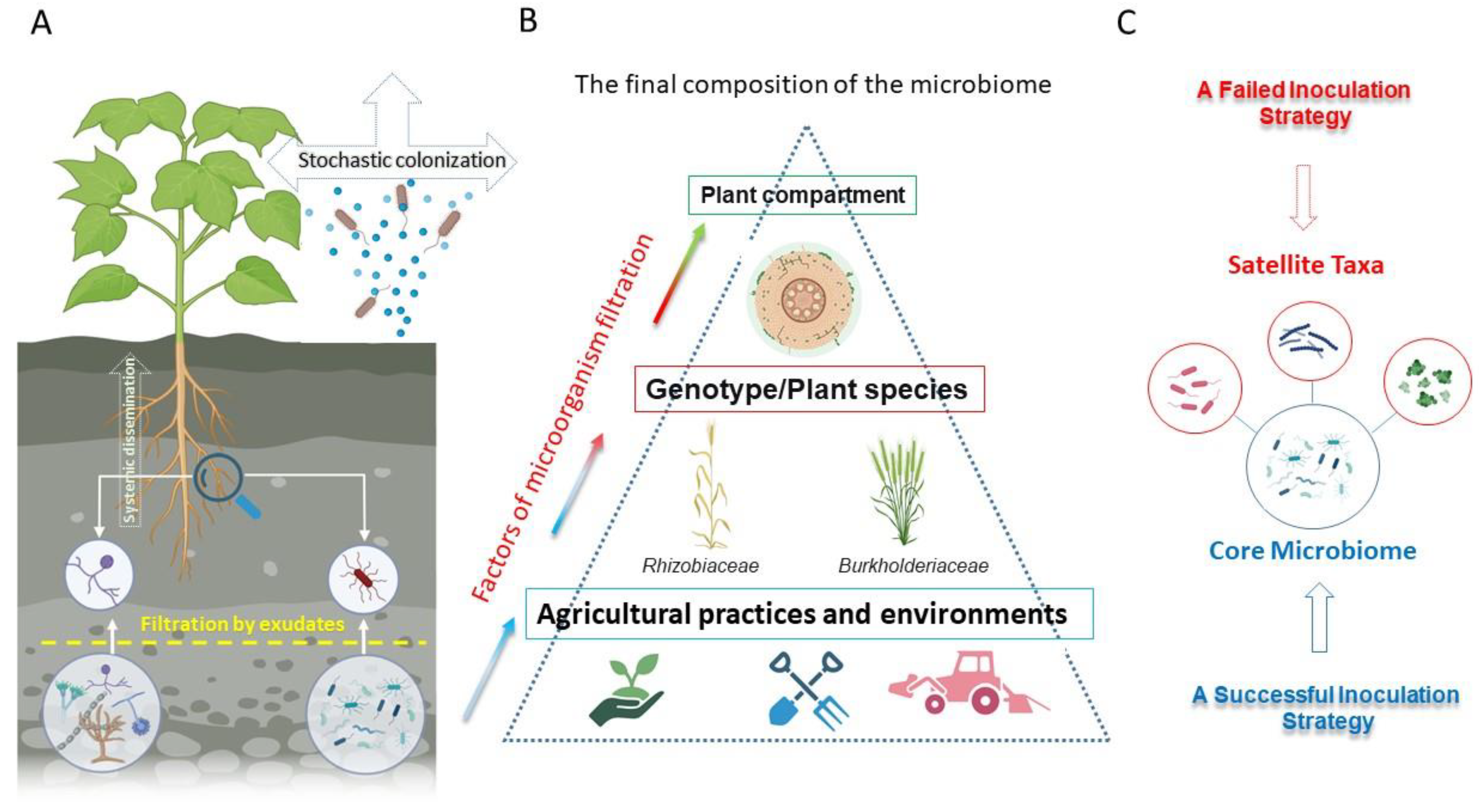
Figure 2.
Evolution of the paradigm: from antibiotics as “weapons” to metabolites as “ecosystem engineers”. A) The producing cell secretes antibiotic molecules that have a broad or narrow range of activity. This concept focuses on the lethal antagonism of competitors. B) At low concentrations (signal modulator): The metabolite modulates the physiology of neighboring cells, enhancing chemotaxis and communication. At high concentrations (selective stressor): The metabolite selectively suppresses sensitive taxa while promoting the enrichment of resistant or beneficial microorganisms. This dual role defines the metabolite's function as an "ecosystem engineer", purposefully restructuring the community.
Figure 2.
Evolution of the paradigm: from antibiotics as “weapons” to metabolites as “ecosystem engineers”. A) The producing cell secretes antibiotic molecules that have a broad or narrow range of activity. This concept focuses on the lethal antagonism of competitors. B) At low concentrations (signal modulator): The metabolite modulates the physiology of neighboring cells, enhancing chemotaxis and communication. At high concentrations (selective stressor): The metabolite selectively suppresses sensitive taxa while promoting the enrichment of resistant or beneficial microorganisms. This dual role defines the metabolite's function as an "ecosystem engineer", purposefully restructuring the community.
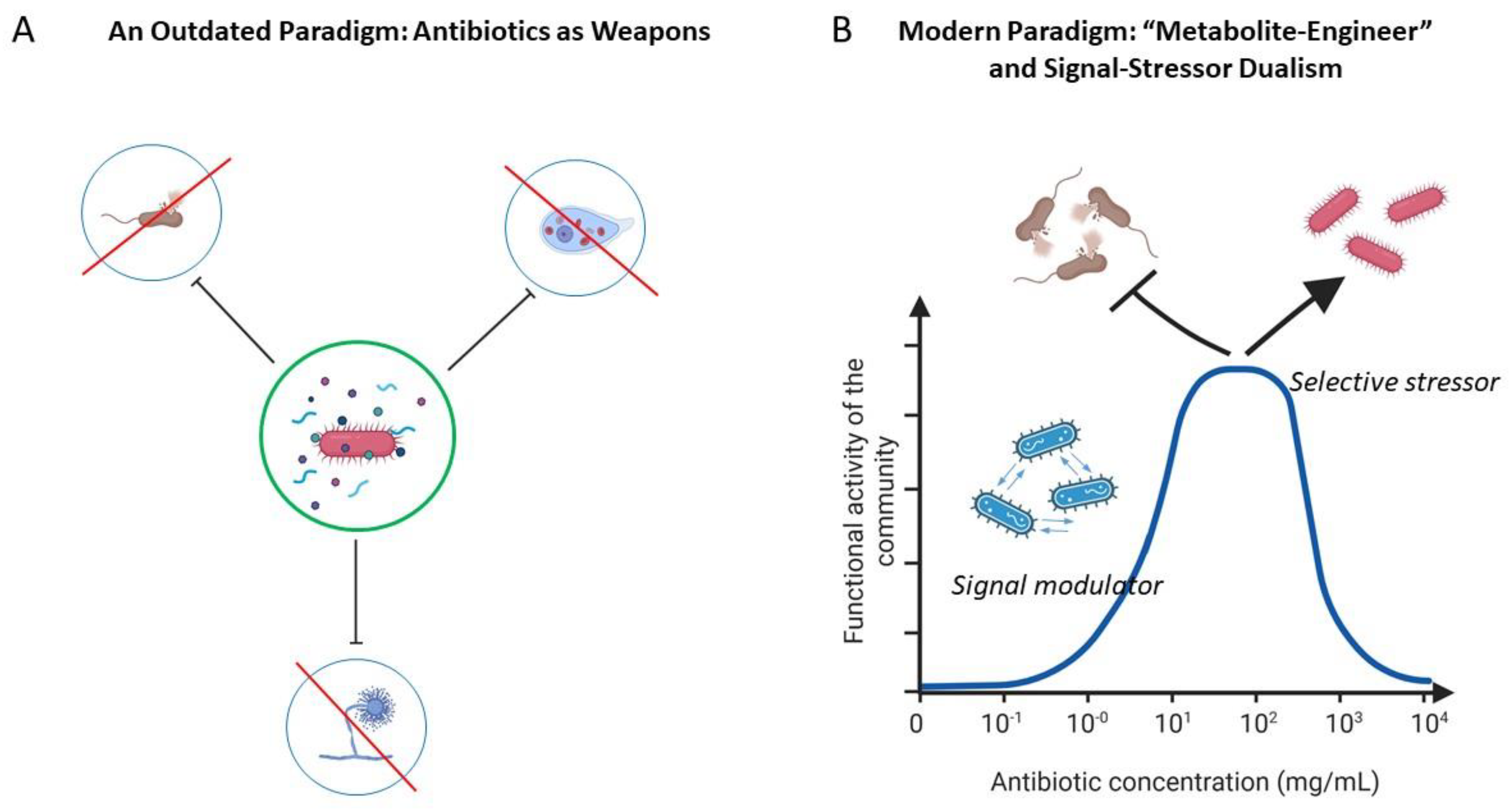
Figure 3.
Roadmap for the development of a next-generation context-sensitive bioinoculant. (A). Context diagnostics. Determining the physicochemical parameters of the soil (SOC, pH) and the plant's metabolomic profile to formulate target criteria for bioinoculant selection. (B). Selection for ecological competence. Screening and selection of strains based on complex traits: resistance to abiotic stress, resistance to secondary plant metabolites, and the presence of social functions (biofilm, cooperation). (C). Formation of the target rhizobiome. Introduction of selected strains and their integration into the resident community, resulting in the formation of a stable and functionally active microbiome in the soil-plant system.
Figure 3.
Roadmap for the development of a next-generation context-sensitive bioinoculant. (A). Context diagnostics. Determining the physicochemical parameters of the soil (SOC, pH) and the plant's metabolomic profile to formulate target criteria for bioinoculant selection. (B). Selection for ecological competence. Screening and selection of strains based on complex traits: resistance to abiotic stress, resistance to secondary plant metabolites, and the presence of social functions (biofilm, cooperation). (C). Formation of the target rhizobiome. Introduction of selected strains and their integration into the resident community, resulting in the formation of a stable and functionally active microbiome in the soil-plant system.
Disclaimer/Publisher’s Note: The statements, opinions and data contained in all publications are solely those of the individual author(s) and contributor(s) and not of MDPI and/or the editor(s). MDPI and/or the editor(s) disclaim responsibility for any injury to people or property resulting from any ideas, methods, instructions or products referred to in the content. |
© 2026 by the authors. Licensee MDPI, Basel, Switzerland. This article is an open access article distributed under the terms and conditions of the Creative Commons Attribution (CC BY) license (http://creativecommons.org/licenses/by/4.0/).
Copyright: This open access article is published under a Creative Commons CC BY 4.0 license, which permit the free download, distribution, and reuse, provided that the author and preprint are cited in any reuse.


