

Submitted:
01 April 2026
Posted:
02 April 2026
You are already at the latest version
Abstract
The transition from fossil-based resources to renewable feedstocks is a cornerstone of industrial decarbonization. A critical component of this shift lies in deriving intermediates and value-added products from biomass. Among renewable resources, lignin stands out as a promising candidate due to its wide availability, abundance, and non-competitiveness with food production, making it an ideal starting material. The removal and depolymerization of lignin to produce aromatic chemicals can significantly enhance the material usability of all lignocellulose constituents. The removal and depolymerization of lignin to produce aromatic chemicals can significantly enhance the material usability of all lignocellulose constituents. Herein, a process for the polyoxometalate-catalyzed oxidative depolymerization of technical lignins to produce the monoaromatic compounds vanillin (Va), methyl vanillate (MeVa), syringaldehyde (Sy), and methyl syringate (MeSy) is demonstrated, offering the possibility to achive high monoaromatic yields of up to 12wt%.
Keywords:
lignin valorization
; depolymerization
; polyoxometalate
; catalysis
; oxidation
; biomass
1. Introduction
With regard to the sustainable production of aromatic compounds, lignin represents the only biogenic source that is already composed of aromatic structures. Lignin is a complex, highly branched, three-dimensional and aromatic biopolymer, which makes up about 15–40% of lignocellulosic biomass. With an estimated annual production of about 20 Gt per year, lignin holds far greater potential for use in the chemical industry than merely being burned as a low-energy fuel. [1,2,3,4,5]
Lignin consists mainly of the three phenolic components p-coumaryl alcohol, coniferyl alcohol, and sinapyl alcohol. It is formed by radical polymerization of these three components, generating ether linkages, aryl–aryl linkages, or even cyclic structures. The three phenolic components and their corresponding units are shown in Figure 1. The only difference between these monomers, referred to as p-hydroxyphenyl (H), guaiacyl (G), and syringyl (S) units, lies in the degree of methoxylation at the meta-position, which ranges from zero to two. Due to its radical formation mechanism, lignin is not a defined chemical macromolecule but is extremely inhomogeneous and because of its complex structure, lignin is also only poorly biodegradable. [1,6,7,8]
Through pulping processes, lignin is separated from cellulose and hemicellulose during the isolation of cellulose from wood. Various mechanical or chemical modifications of lignocellulose are carried out, resulting in lignin from these processes being obtained as technical lignin with differing properties. The best-known industrial pulping processes are the Kraft process (or sulfate process), the Sulfite process (from which lignosulfonates are produced), the Soda process, and the Organosolv process. The lignins produced by these methods vary in molecular weight, sulfur content, and solubility. Lignosulfonates, for example, have comparatively high molecular weights of up to 50,000 Da and sulfur contents of up to 10%, while being soluble in water at all pH values. Organosolv lignins, in contrast, exhibit low molecular weights of around 1,000 Da, no sulfur content, and solubility primarily in organic solvents. [6,9]
To date, lignin is used industrially only to a limited extent, and its applications are mostly restricted to lignosulfonates and Kraft lignin. The main field of application is in civil engineering, where lignosulfonates act as water-reducing agents in concrete and cement, improving strength and resistance to degradation. Lignins are also used as binders in animal feed and as dispersing agents in dyes, pigments, or pesticides, and they can serve as dust-binding agents. Another application is the chemical depolymerization to produce vanillin, the main flavor component of vanilla, enabling its use in the food and perfume industries; this is carried out e.g., by the company Borregaard LignoTech. [9,10,11,12,13,14]
Due to the low vanillin content in the vanilla plant, which is only around 2%, and because of the complex extraction process, the price of this natural vanillin is extremely high, at 1,000 to 4,000 USD/kg. Therefore, the majority (about > 90%) of vanillin is produced synthetically, resulting in lower prices. Synthetic production is dominated by routes starting from BTX compounds derived from crude oil, via the intermediates catechol and guaiacol. Approximately 15% of the vanillin produced originates from lignin. In this case, lignin-containing side streams from the sulfite process are oxidized under alkaline conditions to produce vanillin. [15,16,17,18,19,20,21,22,23]
Vanillin is used primarily in the food and cosmetics industries, but it also represents an important basic chemical in the pharmaceutical industry. Vanillin and its derivatives—vanillic acid, vanillyl alcohol, 2-methoxyhydroquinone, and methyl vanillate—show high potential for use in the polymer industry, as they can be further modified (i.e., by epoxy, cyclic carbonates, allyl, amine, alcohol or carboxylic units) for the production of polymers such as polyesters, epoxy resins, or composite materials. [15,24,25,26,27] The same applies to syringaldehyde, a molecule chemically similar to vanillin (only with the addition of a methoxy group in meta-position), and its derivatives syringic acid, syringyl alcohol, or syringol. [28,29,30,31,32,33]
Polyoxometalates (POMs) are inorganic metal-oxide clusters whose properties can be tailored to a specific reaction offering the ability to catalyze both acid/base and redox reactions. Due to their versatility, POMs are frequently used in green catalytic reactions, such as the synthesis of heterocycles or the conversion of biomass into value-added products. [34,35,36,37] In particular, transition-metal-substituted POMs are used in selective catalytic biomass conversion, including acid-catalyzed esterification, dehydration, delignification or fractionation of biomass, oxidative desulfurization, and most prominently in selective oxidation. [38,39,40,41,42,43]
The main objective of the present study was to develop and optimize a process for the homogeneously catalyzed oxidative depolymerization of technical lignins to produce the monoaromatic compounds vanillin (Va), methyl vanillate (MeVa), syringaldehyde (Sy), and methyl syringate (MeSy).
2. Results and Discussion
2.1. Characterization of Technical Lignins
This study was conducted exclusively using technical lignins and no model substrates in order to demonstrate its industrial applicability. These technical lignins were obtained from commercial suppliers, industrial partners or other research institutes. An overview of all 13 lignin substrates used can be found in Table 1. All of these lignins were characterized prior to their use in catalytic experiments. Their elemental composition (elements C, H, N, S), structural composition (by NREL method), and molecular weight distribution (by GPC) were determined.
2.1.1. Elemental Composition
The elemental composition of the lignins was determined in order to evaluate the lignin substrates and to determine the carbon mass balances of the depolymerization experiments. The complete results of the elemental analysis can be found in Table S1 (in the Supporting Information). It was found that, regardless of the biomass or pulping type, the carbon content of all lignins was always between 55 and 65 wt.-%. Only S7 showed a lower carbon content of only 30 wt.-%, which was due to a significantly higher moisture content of up to 66 wt.-% in this substrate. Therefore, this substrate was in a highly viscous, liquid form. All technical lignins show a typical hydrogen content of 5-8 wt.-% and a negligible nitrogen content of approx. 0-1 wt.-%. The sulfur content was within the expected range of 2-3 wt.-% for kraft lignins, 0 wt.-% for organosolv lignins, and between 5-8 wt.-% for sulfite lignins.
2.1.2. Compositional Analysis
A compositional analysis of the technical lignins was performed to determine the amounts of carbohydrates, moisture, and ash. These ingredients are impurities that can’t be converted into aromatic products. Therefore, these amounts must be considered when calculating product yields. Figure 2 shows the results of the composition analysis of substrates S1 to S13.
All organosolv lignins (S1, S4, S5 and S9) showed high purity with a proportion of approx. 90 wt.-% acid insoluble lignin. Due to the pulping treatment with organic solvents, increased solubility in aqueous media was not to be expected here either. The kraft lignins (S2, S3 and S8) and soda lignin (S13), on the other hand, varied more. These showed contents of acid insoluble lignin ranging from 60 to 97 wt.-%. The substrates S2 and S3 showed a significantly higher proportion of carbohydrates, with the moisture content of all three kraft lignins being around 4-8 wt.-%. The high content of carbohydrates indicates insufficient treatment of the softwood during pulping or a too harsh precipitation method, which led to co-precipitation with the lignin. Substrates S10, S11, and S12 were all pretreated using hydrolysis-similar processes and showed moderate contents of 64-75 wt.-% acid insoluble lignin. All of these substrates showed mainly carbohydrate impurities, which again indicates incomplete hydrolysis treatment and thus recondensation of lignin-carbohydrate complexes, as already described by Feng et al. [44] Only the lignosulfonate S7 did not contain any acid insoluble lignin. The amount of acid soluble lignin was 66 wt.% in this case, caused by the inorganic sulfite groups, which significantly increase water solubility.
2.1.3. Molecular Weight Distribution
The molecular weight distribution of the substrates S1-S13 was determined by gel-permeation chromatography (see Table 2). The table shows that the organosolv lignins (S1, S4, S5, S9) have weight average molecular weights (Mw) of 2200 to 3000 Da with a number average molecular weight (Mn) of 800 to 1100 Da and polydispersities (D) between 2.8 and 3.2, which mostly correspond to values known from the literature. Only the polydispersities showed lower values than those reported in the literature. [6,9,45,46]
For the kraft lignins (S2, S3, S8), Mw values between 5400 and 6700 Da, Mn values between 1300 and 1500 Da, and D values between 4.3 and 4.6 were determined, which are higher than those reported in the literature, especially for Mw and D. [6,9,47,48] In contrast, the sulfite lignin (S7) showed significantly lower values than those described in the literature. [6,9,49] The soda lignin (S13) yielded values that corresponded to those known from literature. [6,9,50] The hydrolysis lignins (S6, S12) showed the largest differences, with Mw values between 1100 and 9300 Da, Mn values between 500 and 1000 Da, and dispersities between 2.3 and 10. This can be explained by the different approaches and fractionation techniques used in hydrolysis pulping.
In addition, the molecular weight distributions of some substrates are shown graphically in Figure S1. The deviations and the different results explained above clearly show that, in general, when using technical lignins, not only the GPC methodology used, but also and in particular, the origin of the biomass, the details of the pulping process, and the purity of the lignins have a significant influence on the results.
2.2. Substrate Selection
For the evaluation of the substrate screening, as well as for the following investigations, three factors were decisive for the subsequent selection: First, a maximum carbon content in the liquid phase, since effective depolymerization driven by the homogeneous POM catalyst takes place in the liquid phase. Second, maximizing the yield of the monoaromatics Va, MeVa, Sy, and MeSy while third minimizing the yield of undesirable side products with a carbon chain length of C1-C5, as the third factor.
The substrate screening with all 13 commercial lignin substrates was performed once with and once without a reference catalyst. The results of the experiments without a catalyst, which served as blank experiments, can be found in Figure S2. All experiments were carried out in a 10-fold reactor setup (see Section 3.2). For this purpose, the reactors were filled with 500 mg lignin substrate, 200 mg H8PV5Mo7O40 (abbreviated as HPMo-V5) POM-catalyst, and 10 mL methanol as solvent. The reaction conditions were 20 bar oxygen partial pressure, a reaction temperature of 140 °C, and a reaction time of 24 h. In addition, no stirring was applied during the experiments. These reaction parameters were based on preliminary works of Albert et al. and Voitl et al. [51,52,53]
The results of the substrate screening with the reference catalyst are shown in Figure 3. The carbon content in the gas, liquid, and solid phases is shown for each substrate, and the substrates are sorted according to the respective pulping processes to simplify comparison.
First of all, the results show that the carbon content in the gas phase does not exceed 8 wt.-%. This indicates that under the applied experimental conditions, only a small proportion undergoes complete oxidation to CO2 and CO. However, it is important to note that this proportion is not higher than in the blank experiments (Figure S2).
Regarding to the solid content, it is particularly noteworthy that after the reaction with substrate S7, no solids remained in the reaction solution, whereas in the blank experiment, the solid content was still 23% Figure S2). This result can be attributed to the high amount of inorganic sulfur functionalization in sulfite lignin, which leads to a high solubility in aqueous solutions (regardless of pH). This was not unexpected as the compositional analysis performed previously showed that S7 was the only substrate with high solubility in acidic environments (Figure 2).
The carbon content in the liquid phase of the reaction solutions from the experiments with all kraft lignins (S2, S3, S8) as well as the organosolv lignins S1 and S5 and the hydrolyzed softwood lignin S6 is lower than in the blank experiments. The increased content in the solid phase indicates that the use of the catalyst could lead to a higher frequency of condensation or repolymerization reactions of the lignin, resulting in the formation of humin-like compounds (similar to pseudo-lignin). [54,55]
The organosolv lignins S4 and S9 showed no significant change in carbon balance compared to the blank experiments. Overall, the carbon content in the liquid phase for both substrates is promising with around 83 wt.-%. The remaining substrates S10 to S13, on the other hand, showed a slight increase in carbon content in the liquid phase compared to the blank experiments (Figure S2).
Based on these results, three of the 13 lignins tested were selected for further investigation. This selection was based on the highest carbon content in the liquid phase, but also on the desire to include at least one kraft lignin (as representative of the most commonly used process type). For this reason, the substrates S3 (kraft lignin), S4 (organosolv lignin), and S7 (sulfite lignin) were selected for further investigations.
2.3. Solvent Selection
The solvent screening experiments were conducted analogously to the substrate screening experiments using the previously selected substrates S3, S4, and S7 (see Section 2.2). Four different solvent systems were investigated: (1) pure methanol (MeOH), (2) a mixture of 50 vol.-% MeOH and 50 vol.-% H2O, (3) pure ethanol (EtOH), and (4) a mixture of 50 vol.-% EtOH and 50 vol.-% H2O. The selection of the solvent systems was based on the criteria that they should exhibit high solubility for the desired products, the catalyst, and the substrates, making a mixture of polar organic solvents and water most suitable.
The results of the solvent screening are presented in Figure 4, showing the carbon content in the gas, liquid, and solid phases for each substrate and solvent system.
Firstly, it is noticeable that the solid content increases significantly from 15 wt.-% and 32 wt.-% respectively, when changing the solvent from pure MeOH to all other solvent mixtures, with the use of substrates S3 and S4, up to 55 wt.-%. This can be attributed either to reduced solubility or to enhanced recondensation and the formation of pseudolignin. Additionally, the carbon content in the gas phase increases, particularly when changing to the solvent mixture MeOH/H2O, from approximately 2 wt.-% to as high as 17 wt.-% (S7). This indicates an increase in unselective oxidation to CO2 and CO, which could be caused by the higher activity of the catalyst in strongly aqueous solutions. The results of the experiments conducted in pure ethanol are similar to those in the MeOH/H2O solution, especially for S3 and S4. Using substrate S7 in ethanol resulted in a significantly higher solid fraction of 41 wt.-%, which can be explained by the fact that this substrate is insoluble in ethanol.
The highest average carbon contents in the liquid phase were observed in pure methanol. Consequently, these solutions were subsequently analyzed using GC-MS to identify and quantify the reaction products. Figure 5 shows the chromatograms of these measurements for the liquid phase samples from the conversion of substrates S3, S4, and S7 in pure methanol.
Based on the retention times, three product groups can be identified: (1) In the range of 3 to 10 min, predominantly aliphatic hydrocarbons with a maximum carbon chain length of 6 are present, most of which are further functionalized methyl ester groups. (2) In the range of 10 to 15 min, mainly monoaromatic compounds were detected. (3) For retention times over 15 min, the products are likely dimers, trimers, or oligomers, which could not be specifically identified.
The results in Figure 5 clearly show that significant amounts of all four targeted monoaromatic compounds were only found in the reaction solution using S4 as a substrate, while only small amounts of syringaldehyde were detected using S3, and no monoaromatic compounds were observed using S7. Consequently, the monoaromatic products in the reaction solutions using substrate S4 were further examined and quantified (see Figure 6).
In all four reaction solutions, the four monoaromatic products Va, MeVa, Sy, and MeSy were detected, with the yield in pure methanol being the highest at slightly over 3 wt.-%. All other solvent systems resulted in comparable yields of only 1.5 wt.-% of monoaromatic compounds. Notably, the yields of MeVa and MeSy were significantly higher in pure methanol, with 1.3 wt.-% and 0.8 wt.-%, respectively, which is likely due to the esterification of carboxylic acid derivatives of Va and Sy.
2.4. Catalyst Selection
The catalyst selection was also carried out under the same conditions as the previous screening experiments. However, instead of pure methanol, a MeOH/H2O mixture of 95:5 v/v was used as a solvent. This was done due to the limited solubility of some of the used catalysts. Due to their crystalline nature, all POMs exhibit high solubility in water. However, their solubility in methanol at reaction temperatures is multifaceted. To ensure complete solubility of all POM catalysts, a water content of 5 vol% was added to the solvent.
A total of 28 different POM catalysts were investigated (see Table 5 in Section 3.1). The following transition metals, each with different degrees of substitution, were incorporated: V, Co, Mn, Ni, Nb, In, and mixtures of them. The catalyst mass was consistently kept constant at 200 mg, even though this resulted in different molar amounts of the POMs.
Figure 7 shows the yields of monoaromatic components from the catalyst screening experiments using substrate S4. The carbon balances for each phase are shown in Figure S3.
First of all, Figure 7 shows that the yields of monoaromatics obtained using the various catalysts vary between 2 and 8 wt.-%. The carbon balance (Figure S3), however, shows consistent results for all catalysts used, with approximately 5 wt.-% in the gas phase, 60–80 wt.-% in the liquid phase, and 15–35 wt.-% in the solid phase. This indicates that the depolymerization of lignin into monoaromatic compounds works with all tested POM catalysts.
Compared to the control experiment (blank), all tested catalysts were able to increase the yields of monoaromatic compounds. The unsubstituted, commercially available POM catalysts (HPMo-0, HPW-0, and HSiW-0) resulted in comparable yields of up to 4 wt.-%, with yields of MeVa and MeSy being twice as high compared to the blank experiment, due to the stronger Brønsted acidity induced by the POM catalysts.
The use of V-substituted POMs led to significantly lower yields of monoaromatic compounds in amounts comparable to the blank experiment. This can be explained due to the high RedOx activity of the vanadium species, which leads to further degradation of the monoaromatics. [56]
The protonated Co-substituted, Ni-substituted and disubstituted Ni-POMs resulted in comparable yields, with the highest yields of monoaromatic compounds ranging from 7 to 8 wt.-%. Furthermore, it was found that the yields of Sy and MeSy were consistently higher than those of Va and MeVa. This might be due to a milder depolymerization with these POMs, as beech wood is a hardwood which generally contains more syringyl units.
Given the highest yields of monoaromatic compounds with in total 8.3 wt.%, HPMo-Ni3 was selected for further investigations. However, with this catalyst, the solvent system was further fine-tuned (Figure S4). In this process, different volume ratios of MeOH and H2O as solvents were investigated, and a ratio of 8:2 (v/v) was ultimately selected for the further kinetic studies.
2.5. Influence of Reaction Time
The time-dependent monoaromatic yields were determined through twelve individual experiments carried out in 20 mL batch autoclaves. In total, this allowed the reaction time range of 2–24 hours to be investigated. The reaction parameters for the experiments were based on the previously optimized conditions. Only the substrate had to be changed, as substrate S4 was no longer available in sufficient quantities. Instead, substrate S1 was used, which was also an organosolv softwood lignin and, in preliminary investigations (except for slightly lower yields), showed results comparable to those of substrate S4.
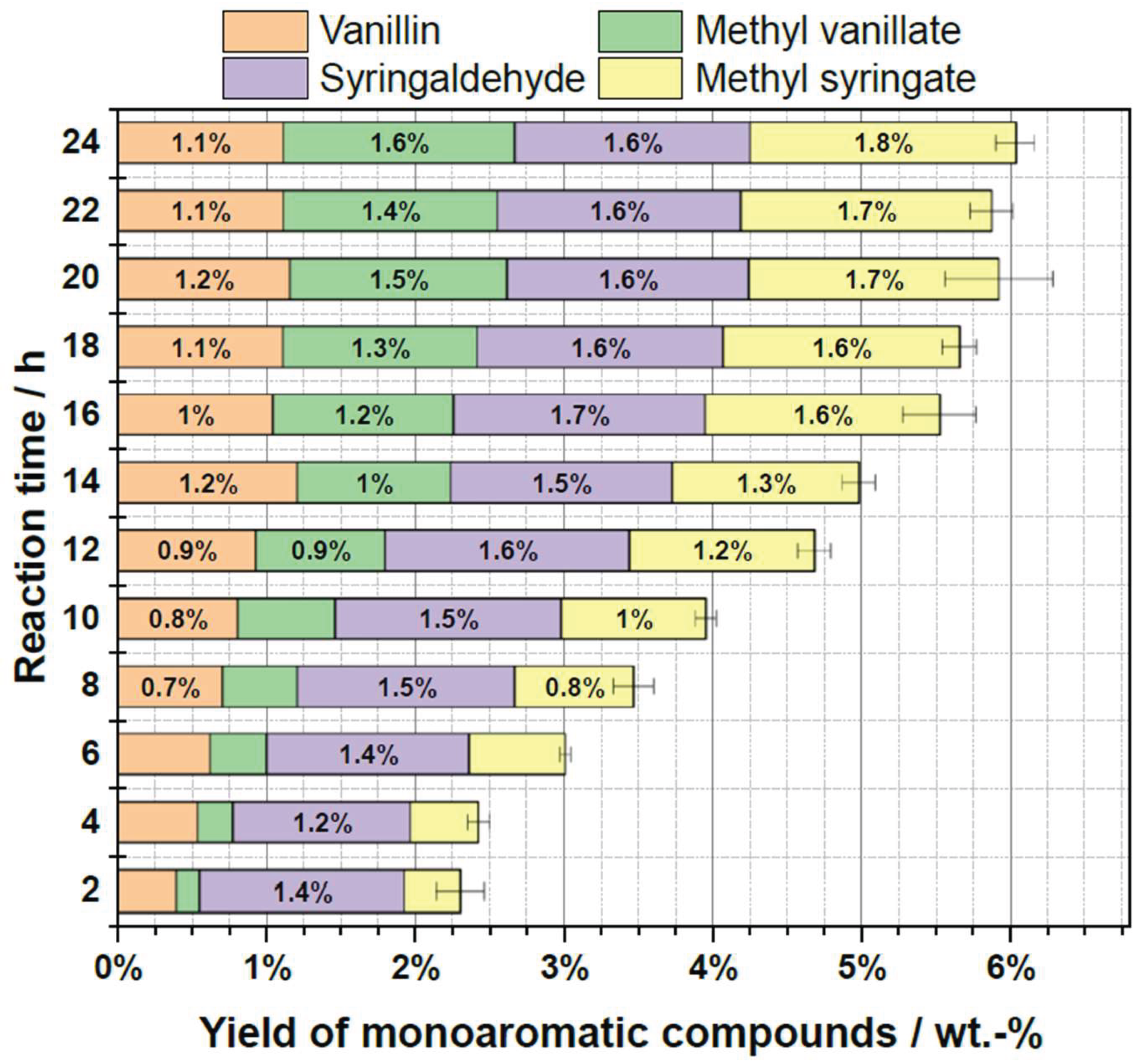
The yields of monoaromatic compounds for the experiments with different reaction times are shown in Figure 8. Initially, after 2 hours of reaction time, the yields of monoaromatics were low at approximately 2.2 wt.-%. These increased to about 6 wt.-% during the course of reaction and remained relatively constant thereafter. This course corresponds to a classic, equilibrium-limited batch reaction. However, when considering the distribution of monoaromatics, some shifts can be observed depending on the reaction time. At the beginning, approximately 75% of the desired monoaromatics formed were Sy. Over increasing reaction time, the absolute concentration of Sy remained constant, while the concentrations of Va, MeVa, and MeSy steadily increased. This suggests that the rate of formation of Sy equaled its rate of degradation. The concentration of Va also stagnated, but only after 14 hours, which again indicates that the rates of formation and degradation were equal. Finally, the concentration of the methyl ester appeared to increase slowly but steadily, indicating stability of these compounds rather than degradation.
The slow increase in the concentration of methyl esters leads to the hypothesis that these are by-products formed from vanillin and syringaldehyde, respectively. A possible reaction network is proposed in Scheme 1. First, the lignin is dissolved under the thermal, oxidative and acidic conditions and partially degraded into oligomers. These are then further degraded to the desired products Va and Sy, which likely originate from the guaiacyl and syringyl units, respectively. Subsequently, Va and Sy are oxidized to their respective carboxylic acids (vanillic acid and syringic acid) and, under acidic conditions and in the presence of methanol, esterified to the products MeVa and MeSy. A separate experiment using syringaldehyde as a substrate also demonstrated that syringaldehyde was not only degraded to syringic acid, but also to vanillin and subsequently to MeVa. This reaction step could be initiated by the oxidation of one of the methoxy groups, either to formaldehyde under mild oxidation conditions or even to carbon dioxide under more severe conditions.
Several short-chain ester compounds, such as methyl formate, were also detected and quantified as further by-products during the reaction. The concentration of these by-products (particularly methyl formate and methyl acetate) increased significantly with increasing reaction time, with methyl formate even achieving higher yields by weight than the sum of the desired monoaromatics. For this reason, and given that the yield of the monoaromatics remained approximately constant from a reaction time of approximately 16 hours onwards, a reaction time of 16 hours was selected for further investigations.
2.6. Influence of Oxygen Partial Pressure
To investigate the effect of the concentration of dissolved oxygen in the reaction solution on the monoaromatic yield, an oxygen partial pressure variation was conducted to vary the partial pressure of oxygen. This was carried out under conditions otherwise identical to those of the previous experiments. Previously, the experiments were carried out at a reaction pressure of 20 bar, which corresponded to an oxygen partial pressure of 14 bar prior to heating the reactor. In addition to this oxygen partial pressure, two further initial pressures (5 bar and 27.5 bar) were also investigated. The yields of monoaromatics resulting from the experiments are shown in Figure 9.
Firstly, it can be seen that increasing the initial oxygen pressure from 14 bar to 27.5 bar has no positive effect on the overall yield of monoaromatics (both around 5.6 wt.-%). Furthermore, reducing the pressure to 5 bar also results in lower overall yields of monoaromatics (4.8 wt.-%). However, a closer look on the data reveals that, as the initial oxygen pressure increases, there is a shift in the ratios from higher yields of Sy (1.7 wt.-% at 5 bar compared to 1.1 wt.-% at 27.5 bar) towards high yields of Va (1.2 wt.-% at 27.5 bar compared to 0.7 wt.-% at 5 bar) and, in particular, MeVa (1.9 wt.-% at 27.5 bar compared to 0.9 wt.-% at 5 bar). This confirms the reaction network outlined in Scheme 1, which postulates that Sy is converted to Va via oxidation and the elimination of a methoxy group.
In summary, it can be concluded that a minimum value for the partial pressure of oxygen is required to maximize the overall yield of monoaromatic compounds. However, a further increase in the partial pressure does not lead to a further increase in the overall yield, but does influence the distribution of the monoaromatic compounds: at higher pressures, the ratio shifts in favor of Va and MeVa, whilst at lower pressures it shifts in favor of Sy and MeSy.
2.7. Upscaling and Further Improvements
Using the experimental conditions resulting from the above-described optimizations, an upscaling was subsequently carried out. The 3-fold experimental setup described in Section 4.2 was used for this purpose. This resulted in an upscaling by a factor of 3. Both the solvent volume and the quantities of substrate and catalyst were tripled.
The upscaling enabled the overall yields of monoaromatics to be increased from 5.6 wt.-% to 6.8 wt.-% (Figure 10). However, the ratios of the monoaromatic compounds remained constant. This increase in yield can be explained by a higher surface area-to-volume ratio of the reactor ground, which made undissolved lignin more accessible for the solvent. This is also reflected in the reduced solids content after the reaction (16 wt.-% compared to 21 wt.-% in the small 10-fold reactors).
Further optimizations were then carried out in this larger setup (Figures S5 & S6). The influence of the stirrer speed (in all previous experiments, the reaction solution was not stirred), of the reaction temperature, and the influence of the catalyst loading were investigated. The stirrer speed was increased from 0 rpm via 500 rpm up to 1000 rpm, and the reaction temperature was increased in steps of 20 K from 120 °C to 160 °C. In the investigation of the catalyst loading, substrate:catalyst ratios of 1, 2.5 and 4 were examined. Here, the stirrer speed showed no significant influence on the yield of monoaromatics, suggesting that there is no mass transfer limitation regarding the oxygen in the system. An increased temperature, on the other hand, also led to higher yields of monoaromatics (approx. 6 wt.-% at 160 °C compared to approx. 4 wt.-% at 120 °C), whilst an increase in catalyst loading had an even higher effect on the yields of monoaromatics (approx. 1 wt.-% at a substrate:catalyst ratio of 1 compared to approx. 7 wt.-% at a substrate:catalyst ratio of 4). An increasing reaction temperature or decreasing catalyst mass led to a higher kinetics of depolymerization to monoaromatics than that of degradation to short-chain methyl esters or CO and CO2. Depolymerization was therefore more driven by temperature, whereas degradation was more influenced by the amount of catalyst. For this reason, the catalyst ratio was examined in more detail.
2.8. Influence of Catalyst Loading
As the increased substrate-to-catalyst ratio had a positive effect on the yield of monoaromatics, this ratio was subsequently increased further; in other words, the amount of catalyst was reduced until the maximum yield of monoaromatics was achieved. The results are shown in Figure 11. In this context, a catalyst loading of 375 mg corresponds to the substrate-to-catalyst ratio of 4:1 described above.
The diagram shows that the yields of monoaromatics increase as the catalyst loading decreases, up to a loading of 150 mg (corresponding to a substrate-to-catalyst ratio of 10:1), from an initial total of 8.3 wt.-% to approx. 11 wt.-%. Furthermore, a shift in the distribution of the monoaromatics is observed. Whilst at a substrate-to-catalyst ratio of 4:1 the yields of methyl esters were approximately twice as high as those of the corresponding aldehydes, at a substrate-to-catalyst ratio of 10:1 the yields of the aldehydes have increased more significantly. This means that the formation of aldehydes is favored at lower catalyst concentrations, which can be explained by a reduced Brønsted acidity resulting from the reduction in catalyst loading.
2.9. Determination of Reaction Order and Activation Energy
Following the intensive optimization of the reaction conditions, a kinetic study was carried out to determine the reaction order and the activation energy. The following optimized standard conditions were used for this purpose:
- Reaction temperature: 160 °C
- Residence time: 16 h
- Stirring speed: 50 rpm (to enable homogeneity)
- O2 partial pressure at T0: 14 bar
- Solvent system: Methanol/water at 8:2 v/v ratio
- Solvent volume: 30 mL
- Substrate: Softwood organosolv lignin S1
- Substrate mass: 1,500 mg
- Catalyst: HPMo-Ni3
- Catalyst mass: 150 mg
To determine the reaction order, equations (1) – (3) were used. Here, r is the reaction rate, i denotes component i, T is the temperature, c is the concentration, t is the reaction time, k is the reaction constant and m is the partial reaction order of component i. By selecting a sufficient oxygen partial pressure, the oxidation of the lignin becomes the rate-determining step, rather than the reoxidation of the catalyst. This means that the concentrations of the oxidized catalyst and methanol can be assumed to be constant during the reaction. All constants (k, coxidized catalyst, cmethanol) can therefore be summarized to give the effective reaction rate k′eff. This leads to reff, the effective reaction rate, which, through the application of the natural logarithm, enables the graphical determination of the reaction order.
To determine the reaction order, experiments with different initial lignin concentrations were carried out. The corresponding final concentrations of the desired monoaromatics are shown in Table 3. These data were used for the logarithmic plot in Figure 12, and the reaction order m was determined from the slope of the linear fit to be approx. 1.8. This value suggests a complex reaction mechanism involving many intermediate steps.
To determine the activation energy, experiments were carried out under the optimized conditions but at different temperatures from 140 °C to 170 °C. This is based on the Arrhenius equation (Eq. (4)) and the natural logarithm of this equation (Eq. (5)), where A is the pre-exponential factor, EA the activation energy, R the universal gas constant, and T the temperature.
These equations were used to calculate the effective rate constants at different temperatures, which were then plotted over 1/T. The results are shown in Table 4 and Figure 13. The linear fit leads to an activation energy of 12.7 kJ mol-1. This value is lower than reported in literature for the oxidative lignin depolymerization. However, the values reported there also vary considerably between 29.1 kJ mol-1 [57] and 170.8 kJ mol-1 [58]. This highlights the advantage of the chosen combination of substrate and catalyst.
3. Materials and Methods
3.1. Catalyst Synthesis
In total, 28 polyoxometalate catalysts were used for the oxidative depolymerization of the different lignins. These included three commercial catalysts as shown in Table 5. All other catalysts were synthesized according to the synthesis procedures based on the publications of Odyakov et al. [59] and Raabe et al. [60,61,62]. Both, the lacunary method as well as the self-assembly method have been used for the synthesis.

Table 5.
Overview of utilized catalysts.
| Category | Chemical Formula | Abbreviation |
| Commercial | H3PMo12O40 | HPMo-0 |
| H3PW12O40 | HPW-0 | |
| H3SiW12O40 | HSiW-0 | |
| Vanadium | H4PV1Mo11O40 | HPMo-V1 |
| H5PV2Mo10O40 | HPMo-V2 | |
| H6PV3Mo9O40 | HPMo-V3 | |
| H7PV4Mo8O40 | HPMo-V4 | |
| H8PV5Mo7O40 | HPMo-V5 | |
| Cobalt | H7PCo1Mo11O40 | HPMo-Co1 |
| H11PCo2Mo10O40 | HPMo-Co2 | |
| H15PCo3Mo9O40 | HPMo-Co3 | |
| Na7PCo1Mo11O40 | NaPMo-Co1 | |
| Na15PCo3W9O40 | NaPW-Co3 | |
| K10P2Co1W17O62 | WD-Co1 | |
| Manganese | H7PMn1Mo11O40 | HPMo-Mn1 |
| H11PMn2Mo10O40 | HPMo-Mn2 | |
| K10P2Mn1W17O62 | WD-Mn1 | |
| Nickel | H7PNi1Mo11O40 | HPMo-Ni1 |
| H11PNi2Mo10O40 | HPMo-Ni2 | |
| H15PNi3Mo9O40 | HPMo-Ni3 | |
| Niobium | Na6PNb3Mo9O40 | NaPMo-Nb3 |
| Indium | H15PIn4Mo8O40 | HPMo-In4 |
| Disubstituted | H8PV1Mn1Mo10O40 | HPMo-V1Mn1 |
| H12PV1Mn2Mo9O40 | HPMo-V1Mn2 | |
| H14PV3Mn2Mo7O40 | HPMo-V3Mn2 | |
| H12PV5Mn1Mo6O40 | HPMo-V5Mn1 | |
| H11PNi1Mn1Mo10O40 | HPMo-Ni1Mn1 | |
| H11PNi1Co1Mo10O40 | HPMo-Ni1Co1 |
The vanadium-substituted POMs were synthesized by first suspending molybdenum trioxide in deionized water, adding a 25% phosphoric acid solution and heating under reflux forming a clear yellow solution. In parallel, divanadium pentoxide was suspended in water and cooled to 0 °C. While stirring this solution, a 30% hydrogen peroxide solution was added dropwise. This led the divanadium pentoxide to dissolve in form of a red/brown solution and a release of oxygen gas was observed. A 25% phosphoric acid solution was added to the batch and stirred at room temperature. This vanadium solution was then added dropwise to the refluxing molybdenum solution. The mixture was subsequently refluxed for an additional 60 minutes, cooled to room temperature, and finally filtered and concentrated.
The disubstituted V-Mn-POMs were synthesized by adding 30°% hydrogen pentoxide in a solution of divanadium pentoxide in water at 5 °C. This resulted in a brown solution while oxygen gas was released. The solution was warmed to room temperature, and 25% phosphoric acid was added. Then the solution was again cooled to 5 °C. In a second solution, molybdenum trioxide was suspended in water, and 25% sulphuric acid was added. This solution was then heated to reflux for 60 min forming a clear yellow solution. Solution 1 was added to solution 2 dropwise while being heated and refluxed for another 30 min. After that time, a manganese acetate solution was added to the mixture and the solution was continued to be heated and refluxed for further 90 min and finally concentrated by evaporation.
For the synthesis of the manganese-, nickel-, and cobalt-substituted POMs as well as for the disubstituted Ni-Mn- and Ni-Co-POMs, the corresponding acetate salts were used and dissolved in water. These solutions were each added dropwise to another solution containing molybdenum trioxide or sodium tungstate dihydrate and 25% phosphoric acid, which had previously been heated under reflux for 60 minutes.
Sodium POMs were obtained by neutralizing an acidic POM in solution with sodium hydroxide. And sodium containing POMs could be purified by a nanofiltration method described by Raabe et al. [41].
The indium-substituted POM was synthesized using indium(III) hydroxide dissolved in a 37% hydrochloric acid solution. This solution was added to a lacunary solution, which was prepared by dissolving sodium molybdate dihydrate and disodium hydrogen phosphate in water and adjusting the pH value to ~1 by adding 37% hydrochloric acid solution. The mixture was then heated and refluxed for 30 min. Afterwards the pH was adjusted to a value of ~2 by adding sodium carbonate solution. Analogously, the niobium-POM was formed, by dissolving potassium hexaniobate in a 1.5% hydrogen peroxide solution and then adding this to the Lacunary solution. After heating and refluxing for 60 min, the pH was adjusted to 1.6 by adding a hydrochloric acid solution. Both the indium- and niobium-POMs were finally filtered and purified using the nanofiltration method.
3.2. Catalytic Experiments
For the screening experiments, a 10-fold reactor setup consisting of 10 parallel 20 mL Hastelloy (C-276) autoclaves in batch mode was used. The reactors were heated by a heating plate to temperatures up to 200 °C. Each autoclave was connected to a burst disk, which limits the maximum pressure to 90 bar.
The experiments started by filling the reactors with substrates, catalysts and solvents. After closing the autoclaves (sealed with a PTFE gasket), they were placed in the heating plate and connected to the piping system. The reactors were purged three times with 20 bar of oxygen and finally pre-pressurized to 14 bar at room temperature (for an experiment at 20 bar at 140 °C). After reaching the desired reaction temperature, usually after 10-15 min, the time was noted as reaction start. At the end of the reaction time, the reactors were removed from the heating plate and cooled down to room temperature. Each, a sample of the gas phase, the liquid phase as well as any remaining solids (filtered off from the liquid) were taken for further analytics.
The upscaling and process optimization experiments were performed analogously in a 3-fold reactor setup consisting of three parallel autoclaves, each with a volume of 100 mL. In contrast to the 10-fold plant, each reactor was equipped with a gas entrainment stirrer and the reactors were sealed with a graphite sealings. The reactors could be heated individually by heating jackets.
Similarly to the 10-fold plant, all reactors were filled with substrate, catalyst and solvent, closed and three times purged with 20 bar of oxygen. After pre-pressurizing to 14 bar at room temperature (for an experiment at 20 bar at 140 °C), the stirrer speed was set to 300 rpm and the temperature was set to the desired value. After reaching the reaction temperature, the stirrer speed was set to 100 rpm, marking the time of reaction start. To terminate the reaction, the temperature was switched off and the heating jackets were removed. After cooling down, gas samples were taken and the reactors opened to filter the liquid phase for collecting all remaining solids and taking a sample of the liquid phase.
All solid samples were first dried in an oven at 40 °C for 24 h, weighed and then analyzed by elemental analysis. The liquid samples were utilized primarily for gas-chromatography coupled with mass-spectrometry (GC-MS), but also for Karl-Fisher-titration, gel-permeation-chromatography (GPC), or pH value analysis. The gas phases were analyzed by gas-chromatography (GC).
4. Conclusions
The overarching goal of this work was the process development of an oxidative, POM-catalyzed homogeneous depolymerisation method for technical lignins to obtain the monoaromatic compounds vanillin (Va), methyl vanillate (MeVa), syringaldehyde (Sy), and methyl syringate (MeSy),. The project encompassed multiple work packages including lignin characterization, screening of various technical lignins as substrates, POM-catalysts, and solvent systems, as well as a detailed process parameter optimization and determination of kinetic parameters.
5. Patents
Patent: WO 2017012608 “Method for the selective depolymerization of lignin to various fractions of platform chemicals”.
Patent: EP4671230 “Method for the preparation of monoaromatic derivatives by oxidative depolymerization of lignin, polyoxometalate catalyst and its use in the method for the preparation of monoaromatic derivatives”.
Supplementary Materials
The following supporting information can be downloaded at the website of this paper posted on Preprints.org, Table S1: Elemental composition of all lignin substrates including carbon, hydrogen, nitrogen, sulfur and oxygen (CHNSO). C, H, N, S were measured, and O is calculated by the remaining amount.; Figure S1: Molecular weight distribution of two softwood kraft lignins (S2 and S3), one beech wood organosolv lignin (S4), one spruce wood organosolv lignin (S5) and a softwood sulfite lignin (S7).; Figure S2: Carbon balance of the lignin substrate screening for the oxidative depolymerization without catalyst as a control experiment. Reaction conditions: 140 °C, 20 bar oxygen partial pressure, 24 h, 0 rpm, 10 mL MeOH, 500 mg substrate, no additional catalyst.; Figure S3: Carbon balance by weight and phase for the catalyst system screening. Reaction conditions: 140 °C, 20 bar oxygen partial pressure, 24 h, 0 rpm, 10 mL solvent (MeOH/H2O 95:5 v/v), 500 mg substrate (S4), 200 mg catalyst.; Figure S4: Yield by weight of the desired monoaromatic compounds for the optimization of solvent for the selected POM catalyst HPMo-Ni3. Reaction conditions: 140 °C, 20 bar oxygen partial pressure, 24 h, 0 rpm, 10 mL solvent, 500 mg substrate (S4), 200 mg catalyst HPMo-Ni3.; Figure S5: 3D-graph showing the influence on yield of aromatics for parameters temperature and substrate to catalyst ratio.; Figure S6: Comparison of process parameter influence on yield of monoaromatics. Shown are the effect of temperature (A), stirring speed (B) and substrate to catalyst ratio (C).
Author Contributions
D.V.: writing—original draft preparation, project administration; M.P.: conceptualization, methodology, validation, formal analysis, investigation, visualization; J.-C.R.: methodology, formal analysis; J.A.: resources, writing—review and editing, supervision. All authors have read and agreed to the published version of the manuscript.
Funding
This research was funded by Fachagentur Nachwachsende Rohstoffe (FNR), FKZ:2219NR439. The APC was waived by MDPI.
Data Availability Statement
The original contributions presented in this study are included in the article/Supplementary Material. Further inquiries can be directed to the corresponding author.
Acknowledgments
The authors thank the Central Element Analysis Department (ZEA), headed by Dirk Eifler, for measuring numerous ICP-OES samples and Michael Gröger for performing GPC and GC-MS measurements.
Conflicts of Interest
Declare conflicts of interest.
Abbreviations
The following abbreviations are used in this manuscript:
| BTX | Benzene, Toluene, Xylene |
| D | Polydispersity |
| EtOH | Ethanol |
| G | Guaiacyl unit |
| GC-MS | Gas chromatography coupled with mass spectroscopy |
| GPC | Gel-permeation chromatography |
| H | p-hydroxyphenyl unit |
| ICP-OES | Inductively coupled plasma optical emission spectroscopy |
| MeOH | Methanol |
| MeSy | Methyl syringate |
| MeVa | Methyl vanillate |
| Mn | number average molecular weight |
| Mw | weight average molecular weights |
| NREL | National renewable energy laboratory |
| POM | Polyoxometalate |
| PTFE | Polytetrafluoroethylene |
| RedOx | Reduction-oxidation-reaction |
| S | Syringyl unit |
| Sy | Syringaldehyde |
| Va | Vanillin |
References
- Behr, T. Seidensticker, Chemistry of Renewables; Springer Berlin Heidelberg: Berlin, Heidelberg, 2020. [Google Scholar]
- Cai, J.; He, Y.; Yu, X.; Banks, S. W.; Yang, Y.; Zhang, X.; Yu, Y.; Liu, R.; Bridgwater, A. V. Renewable and Sustainable Energy Reviews 2017, 76, 309–322. [CrossRef]
- Steinbrecher, T.; Albert, J.; Kaltschmitt, M. MDPI Sustain. Chem. 2025, 6, 38. [CrossRef]
- Kumaravel, S.; Thiruvengetam, P.; Karthick, K.; Sankar, S. S.; Karmakar, A.; Kundu, S. Biotechnology progress 2021, 37(2), e3111. [CrossRef]
- Steinbrecher, T.; Sherbi, M.; Bonk, F.; Lüdtke, O.; Albert, J.; Kaltschmitt, M. Biomass & Bioenergy 2024, 183, 107136. [CrossRef]
- Functional materials from lignin: Methods and advances. In Sustainable chemistry series; Loh, X.J., Kai, D., Li, Z., Eds.; World Scientific: Singapore, 2018; volume 3. [Google Scholar]
- Kaltschmitt, M.; Hartmann, H.; Hofbauer, H. Energie aus Biomasse; Springer-Verlag: Heidelberg, 2016. [Google Scholar]
- Menon, V.; Rao, M. Progress in energy and combustion science 2012, 38, 522–550. [CrossRef]
- J. D. Gargulak, S. E. Lebo, T. J. McNally, in Kirk-Othmer Encyclopedia of Chemical Technology (Ed: J. W. &. S. Inc), John Wiley & Sons, Inc, Hoboken, NJ, USA 2000.
- Figueiredo, P.; Lintinen, K.; Hirvonen, J. T.; Kostiainen, M. A.; Santos, H. A. Progress in Materials Science 2018, 93, 233–269. [CrossRef]
- Sen, S.; Patil, S.; Argyropoulos, D. S. Green Chem. 2015, 17(11), 4862–4887. [CrossRef]
- Saito, T.; Brown, R. H.; Hunt, M. A.; Pickel, D. L.; Pickel, J. M.; Messman, J. M.; Baker, F. S.; Keller, M.; Naskar, A. K. Green Chem. 2012, 14(12), 3295. [CrossRef]
- Conversion of Lignin into Bio-Based Chemicals and Materials. In Green Chemistry and Sustainable Technology; Xu, C., Ferdosian, F., Eds.; Springer Berlin Heidelberg, Berlin: Heidelberg, 2017. [Google Scholar]
- Industrial Lignin Production and Applications: Status Quo and Future Directions, 1st ed.; Pye, E.K., Ed.; Wiley-VCH: Weinheim, Bergstr, 2008. [Google Scholar]
- Kirk-Othmer encyclopedia of chemical technology: Vanillin. In A John Wiley & Sons, Inc., publication, 5th ed.; Havkin-Frenkel, D., Seidel, A., Kirk, R.E., Othmer, D.F., Eds.; Wiley-Interscience: Hoboken, NJ, 2005; Vol.12. [Google Scholar]
- Schutyser, W.; Renders, T.; van den Bosch, S.; Koelewijn, S.-F.; Beckham, G. T.; Sels, B. F. Chemical Society reviews 2018, 47(3), 852–908. [CrossRef]
- Walton, N. J.; Mayer, M. J.; Narbad, A. Phytochemistry 2003, 63(5), 505–515. [CrossRef]
- Cabeza Sánchez, Á.; Trygve Berglihn, O.; Ottaviano, E.; Rücker, T.; Pettersen, T.; Wittgens, B.; Aliko, A.; Gálvez, L.; López, M. Open Res Europe 2024, 4, 5. [CrossRef]
- Hocking, M. B. J. Chem. Educ. 1997, 74(9), 1055. [CrossRef]
- Ranadive, A. S.; Agric, J. Food Chem. 1992, 40(10), 1922–1924. [CrossRef]
- UN Food and Agriculture Organization. Vanilla production in 2017. 2017. [Google Scholar]
- Fache, M.; Boutevin, B.; Caillol, S. ACS Sustainable Chem. Eng. 2016, 4(1), 35–46. [CrossRef]
- Marić, I.; Guo, Y.; Fürst, M. J. L. J.; van Aelst, K.; van den Bosch, S.; de Simone, M.; Martins, L. O.; Sels, B. F.; Fraaije, M. W. Adv Synth Catal 2023, 365(22), 3987–3995. [CrossRef]
- Fache, M.; Boutevin, B.; Caillol, S. European Polymer Journal 2015, 68, 488–502. [CrossRef]
- Fache, M.; Darroman, E.; Besse, V.; Auvergne, R.; Caillol, S.; Boutevin, B. Green Chem 2014, 16(4), 1987–1998. [CrossRef]
- Schlemmer, W.; Nothdurft, P.; Petzold, A.; Riess, G.; Frühwirt, P.; Schmallegger, M.; Gescheidt-Demner, G.; Fischer, R.; Freunberger, S. A.; Kern, W.; Spirk, S. Angewandte Chemie (International ed. in English) 2020, 59(51), 22943–22946. [CrossRef] [PubMed]
- Elbs, K.; Lerch, H. J. Prakt. Chem. 1916, 93(1), 1–9. [CrossRef]
- Sriprasanthi, R. B.; Mohamad Ibrahim, M. N.; Shamsudeen, S.; Adam, F.; Bhawani, S. A. BioRes 2012, 7(3), 4377–4399. [CrossRef]
- Lee, J.; Li, Y.; Cheng, J.-T.; Liu, I.-M.; Cheng, K.-C. Pharmaceuticals 2024, 17, 538. [CrossRef]
- Llevot, A.; Grau, E.; Carlotti, S.; Grelier, S.; Cramail, H. Macromolecular rapid communications 2016, 37(1), 9–28. [CrossRef] [PubMed]
- Weng, T.-H.; Chen, T.-H.; Zheng, Q.; Weng, W.-H.; Huang, L.; Lai, D.; Fu, Y.-S.; Weng, C.-F. Biomedicine & pharmacotherapy 2021, 141, 111865. [CrossRef]
- Wu, J.; Fu, Y.-S.; Lin, K.; Huang, X.; Chen, Y.-J.; Lai, D.; Kang, N.; Huang, L.; Weng, C.-F. Biomedecine & pharmacotherapie 2022, 153, 113339. [CrossRef]
- Zhou, J.; Zhang, H.; Deng, J.; Wu, Y. Macromol. Chem. Phys. 2016, 217(21), 2402–2408. [CrossRef]
- Dai, G.; Li, Q.; Zang, D.; Wei, Y. Green Chem. 2023, 25, 6263–6269. [CrossRef]
- Zhong, J.; Pérez-Ramírez, J.; Yan, N. Green Chem. 2021, 23, 18–36. [CrossRef]
- Fan, C.; Guan, H.; Zhang, H.; Wang, J.; Wang, S.; Wang, X. Biomass Bioenergy 2011, 35, 2659–2665. [CrossRef]
- Song, Y.; Wang, X.; Qu, Y.; Huang, C.; Li, Y.; Chen, B. Catalysts 2016, 6, 49. [CrossRef]
- Albert, J.; Wasserscheid, P. Green Chem. 2015, 17(12), 5164–5171. [CrossRef]
- Albert, J. Faraday Discussions 2017, 202, 99–109. [CrossRef]
- Bertleff, *!!! REPLACE !!!*; Claußnitzer, J.; Korth, W.; Wasserscheid, P.; Jess, A.; Albert, J. ACS Sustain. Chem. Eng. 2017, 5, 4110–4118. [CrossRef]
- Raabe, J.; Poller, M. J.; Voß, D.; Albert, J. ChemSusChem 2023, 16, 16. [CrossRef]
- Preuster, P.; Albert, J. Energy Tech 2018, 6(3), 501–509. [CrossRef]
- Bukowski, A.; Esau, D.; Rafat Said, A. A.; Brandt-Talbot, A.; Albert, J. ChemPlusChem 2020, 85(2), 373–386. [CrossRef]
- Feng, N.; She, S.; Tang, F.; Zhao, X.; Chen, J.; Wang, P.; Wu, Q.; Rojas, O. J. Biomacromolecules 2023, 24(6), 2541–2548. [CrossRef]
- Zhang, H.; Fu, S.; Chen, Y. International journal of biological macromolecules 2020, 147, 607–615. [CrossRef] [PubMed]
- Ruwoldt, J.; Syverud, K.; Tanase-Opedal, M. Sustainable Chemistry for the Environment 2024, 6, 100102. [CrossRef]
- Deng, W.; Zhang, H.; Wu, X.; Li, R.; Zhang, Q.; Wang, Y. Green Chem 2015, 17(11), 5009–5018. [CrossRef]
- De Gregorio, G. F.; Prado, R.; Vriamont, C.; Erdocia, X.; Labidi, J.; Hallett, J. P.; Welton, T. ACS Sustainable Chem. Eng. 2016, 4(11), 6031–6036. [CrossRef]
- Prado, R.; Erdocia, X.; de Gregorio, G. F.; Labidi, J.; Welton, T. ACS Sustainable Chem. Eng. 2016, 4(10), 5277–5288. [CrossRef]
- Stärk, K.; Taccardi, N.; Bösmann, A.; Wasserscheid, P. ChemSusChem 2010, 3, 719–723. [CrossRef]
- Albert, J.; Lüders, D.; Bösmann, A.; Guldi, D. M.; Wasserscheid, P. Green Chem 2014, 16(1), 226–237. [CrossRef]
- Voitl, T.; Nagel, M. V.; von Rohr, P. R. Holzforschung 2010, 64, 13–19. [CrossRef]
- Voitl, T.; von Rohr, P. R. Ind. Eng. Chem. Res. 2010, 49(2), 520–525. [CrossRef]
- Wassenberg, A.; Esser, T.; Poller, M. J.; Albert, J. Materials 2023, 16(7), 2864. [CrossRef]
- Wassenberg, A.; Esser, T.; Poller, M. J.; Voß, D.; Albert, J. ChemSusChem 2025, e202401973. [CrossRef]
- Mürtz, S. D.; Raabe, J.-C.; Poller, M. J.; Palkovits, R.; Albert, J.; Kurig, N. ChemCatChem 2024, 16, 5. [CrossRef]
- Fargues, C.; Mathias, Á.; Rodrigues, A. Ind. Eng. Chem. Res. 1996, 35(1), 28–36. [CrossRef]
- Werhan, H.; Mir, J. M.; Voitl, T.; Rudolf von Rohr, P. Holzforschung 2011, 65(5), 703–709. [CrossRef]
- Odyakov, V. F.; Zhizhina, E. G.; Maksimovskaya, R. I. Applied Catalysis A: General 2008, 342(1-2), 126–130. [CrossRef]
- Raabe, J.-C.; Aceituno Cruz, J.; Albert, J.; Poller, M. J. Inorganics 2023, 11(4), 138. [CrossRef]
- Raabe, J.-C.; Jameel, F.; Stein, M.; Albert, J.; Poller, M. J. Dalton Transactions 2024, 53, 454–466. Available online: https://pubs.rsc.org/en/content/articlelanding/2023/dt/d3dt03883a. [CrossRef] [PubMed]
- Raabe, J.; Esser, T.; Jameel, F.; Stein, M.; Albert, J.; Poller, M. J. Inorganic Chemistry Frontiers 2023, 10, 4854–4868. [CrossRef]
Figure 1.
Scheme of the three phenylpropanoid lignin monomers, so-called monolignols, and their corresponding unit designations inside the lignin polymer. [6].
Figure 1.
Scheme of the three phenylpropanoid lignin monomers, so-called monolignols, and their corresponding unit designations inside the lignin polymer. [6].
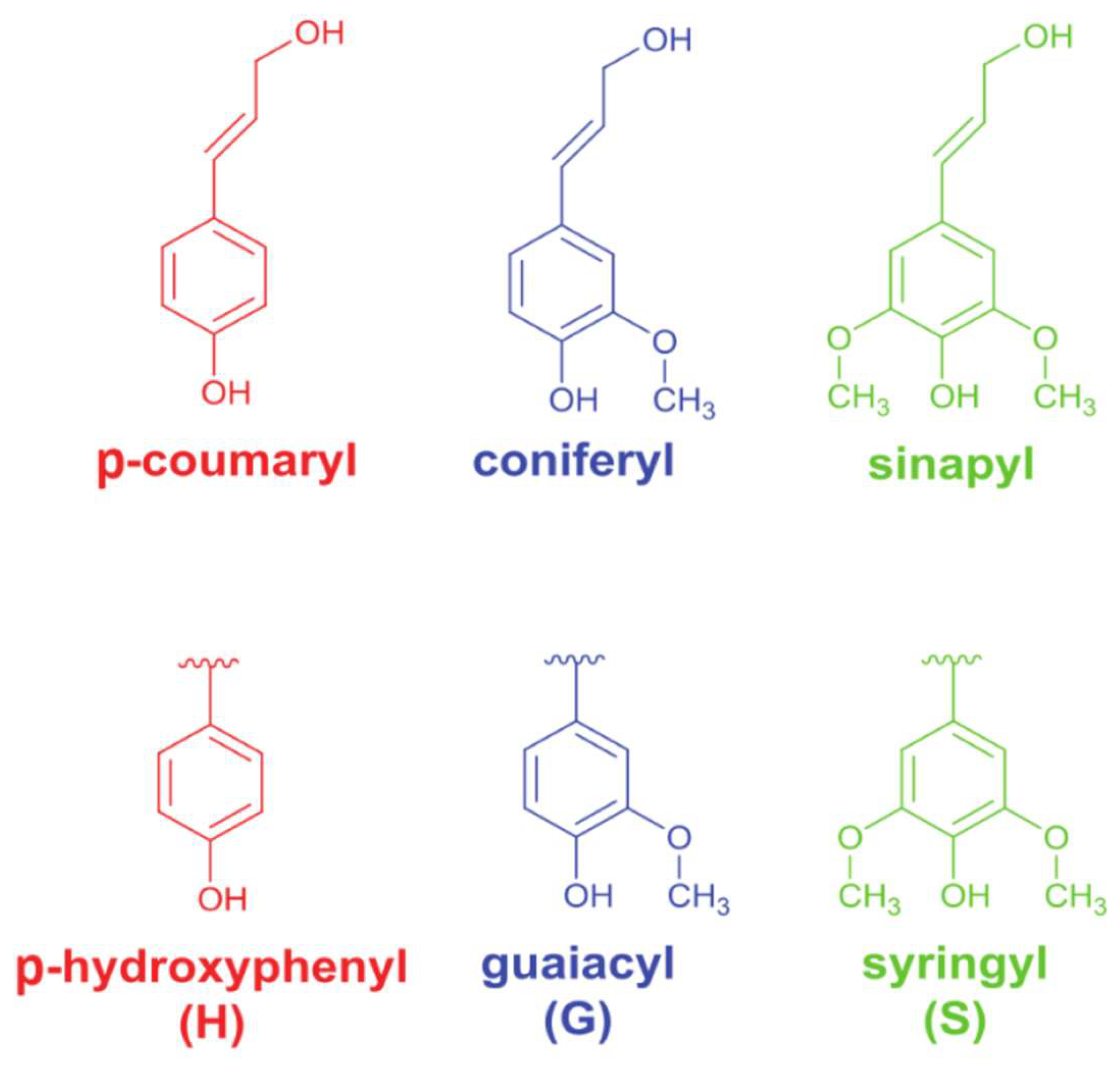
Figure 2.
Mass distribution for acid insoluble lignin, acid soluble lignin, water or moisture, ash and carbohydrates in lignin substrates S1 to S13 by NREL.
Figure 2.
Mass distribution for acid insoluble lignin, acid soluble lignin, water or moisture, ash and carbohydrates in lignin substrates S1 to S13 by NREL.
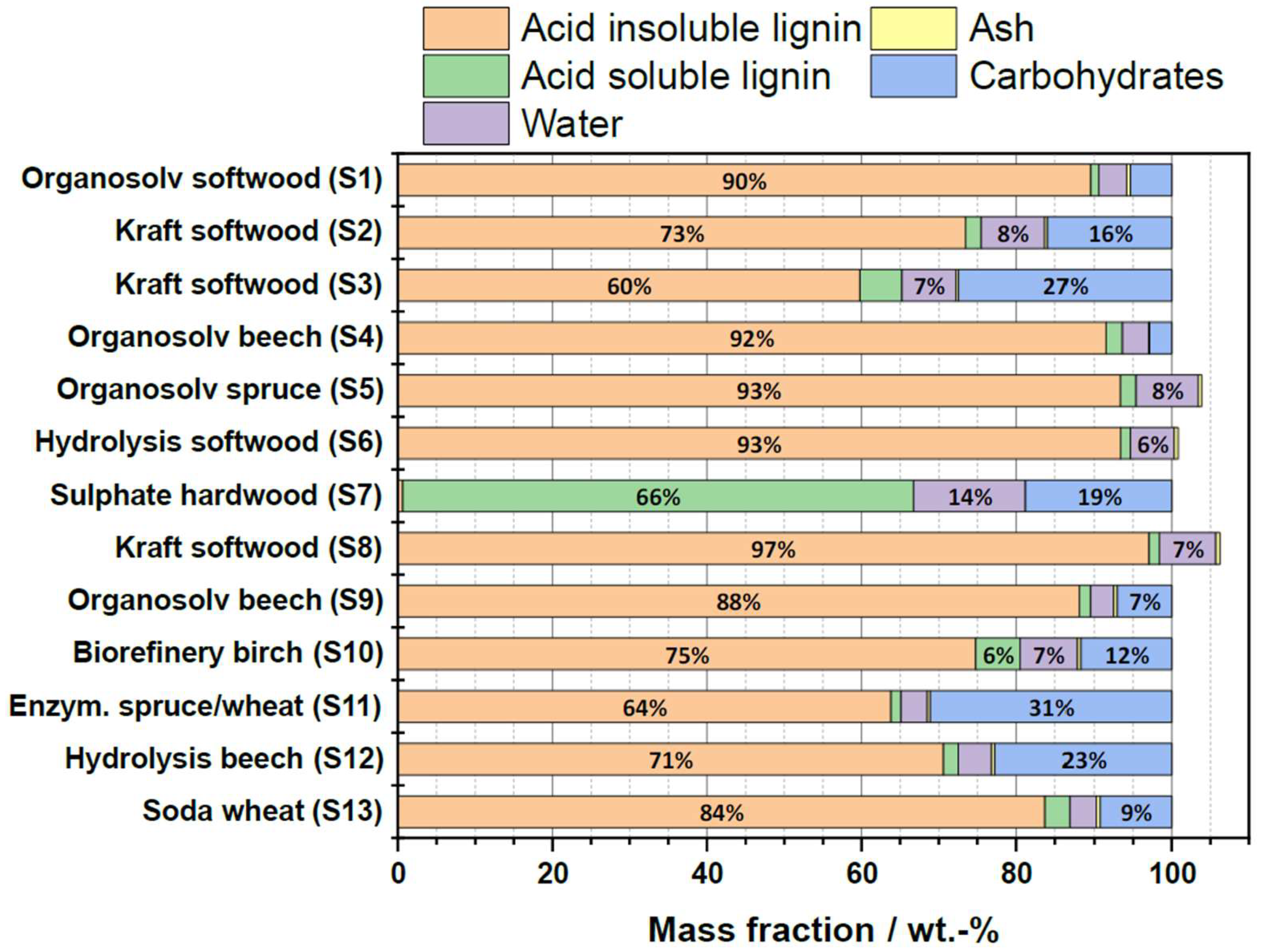
Figure 3.
Carbon balance of the lignin substrate screening for the oxidative depolymerization using HPMo-V5 as POM catalyst. Reaction conditions: 140 °C, 20 bar oxygen partial pressure, 24 h, 0 rpm, 10 mL MeOH, 500 mg substrate, 200 mg HPMo-V5 catalyst.
Figure 3.
Carbon balance of the lignin substrate screening for the oxidative depolymerization using HPMo-V5 as POM catalyst. Reaction conditions: 140 °C, 20 bar oxygen partial pressure, 24 h, 0 rpm, 10 mL MeOH, 500 mg substrate, 200 mg HPMo-V5 catalyst.
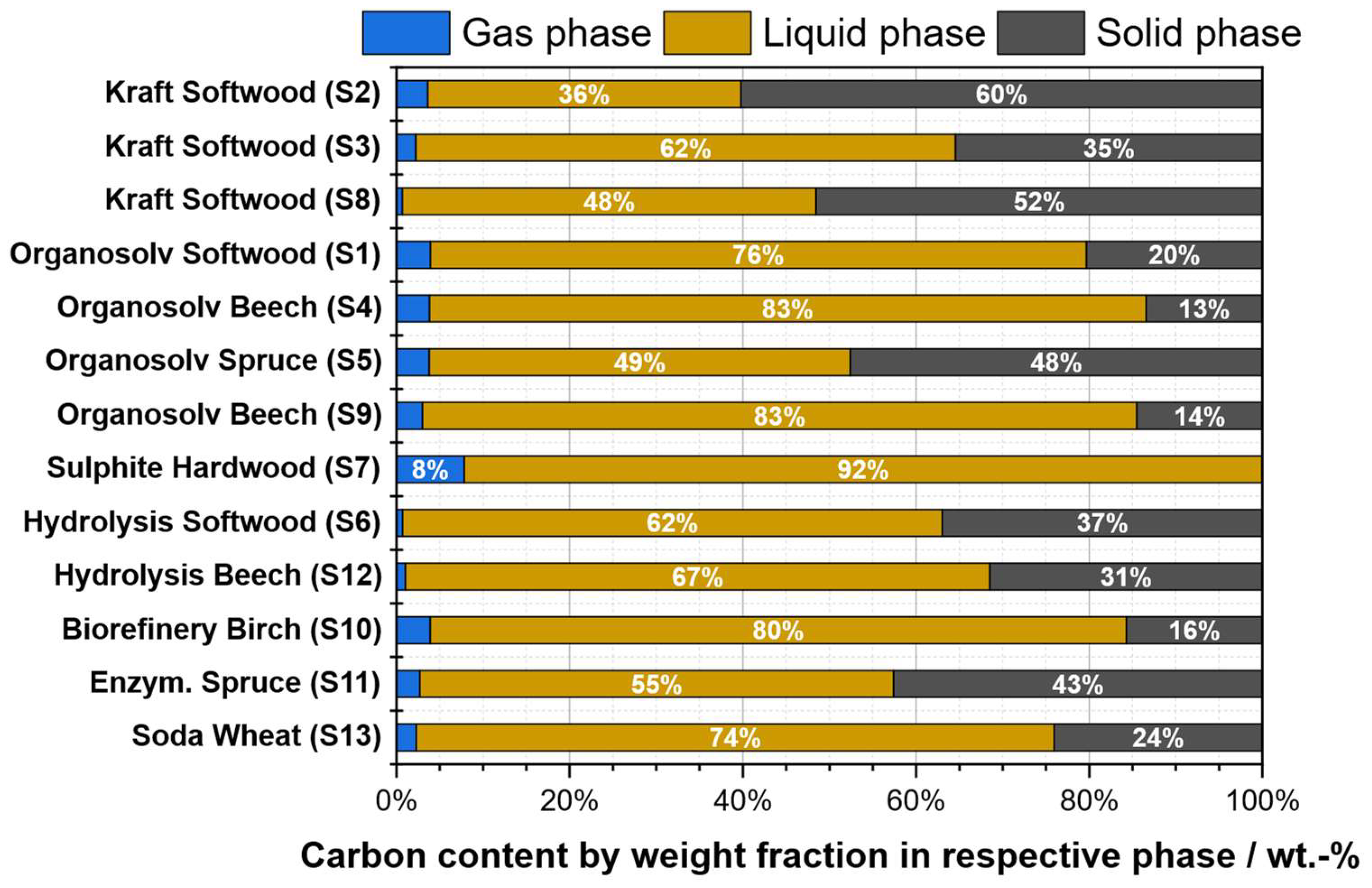
Figure 4.
Carbon balance of the experiments for the selection of a suitable solvent for the oxidative depolymerization of the kraft softwood lignin (S3), the organosolv beech lignin (S4) and the sulfite hardwood lignin (S7). Reaction conditions: 140 °C, 20 bar oxygen partial pressure, 24 h, 0 rpm, 10 mL solvent (MeOH, MeOH/H2O 1:1 v/v, EtOH, EtOH/H2O 1:1 v/v), 500 mg substrate (S3, S4, S7), 200 mg HPMo-V5 catalyst.
Figure 4.
Carbon balance of the experiments for the selection of a suitable solvent for the oxidative depolymerization of the kraft softwood lignin (S3), the organosolv beech lignin (S4) and the sulfite hardwood lignin (S7). Reaction conditions: 140 °C, 20 bar oxygen partial pressure, 24 h, 0 rpm, 10 mL solvent (MeOH, MeOH/H2O 1:1 v/v, EtOH, EtOH/H2O 1:1 v/v), 500 mg substrate (S3, S4, S7), 200 mg HPMo-V5 catalyst.
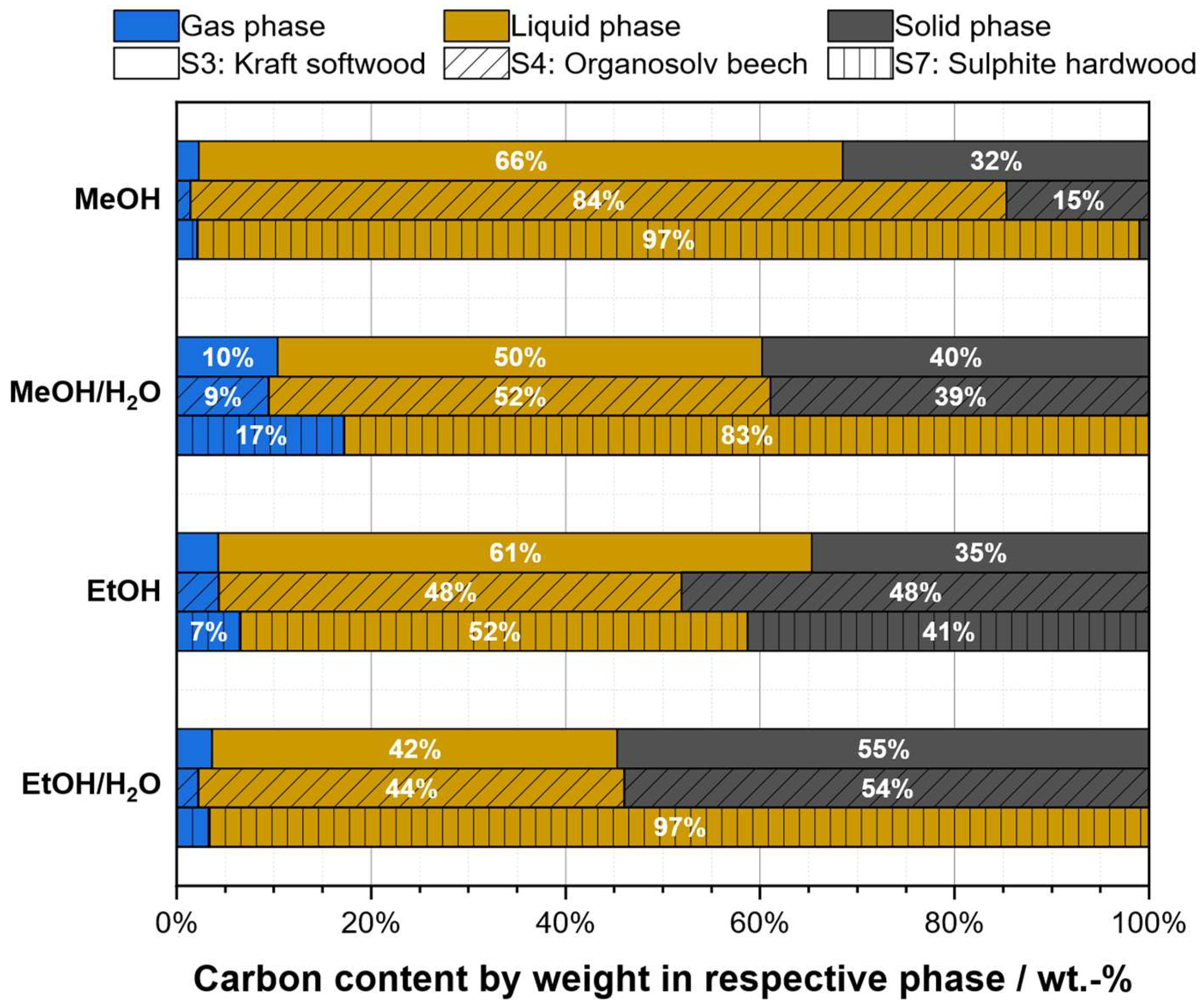
Figure 5.
GC-MS Chromatograms for the product liquid phases of the conversion of the substrates S3, S4 and S7 in pure methanol. Reaction conditions: 140 °C, 20 bar oxygen partial pressure, 24 h, 0 rpm, 10 mL solvent (MeOH, MeOH/H2O 1:1 v/v, EtOH, EtOH/H2O 1:1 v/v), 500 mg substrate (S3, S4, S7), 200 mg HPMo-V5 catalyst.
Figure 5.
GC-MS Chromatograms for the product liquid phases of the conversion of the substrates S3, S4 and S7 in pure methanol. Reaction conditions: 140 °C, 20 bar oxygen partial pressure, 24 h, 0 rpm, 10 mL solvent (MeOH, MeOH/H2O 1:1 v/v, EtOH, EtOH/H2O 1:1 v/v), 500 mg substrate (S3, S4, S7), 200 mg HPMo-V5 catalyst.
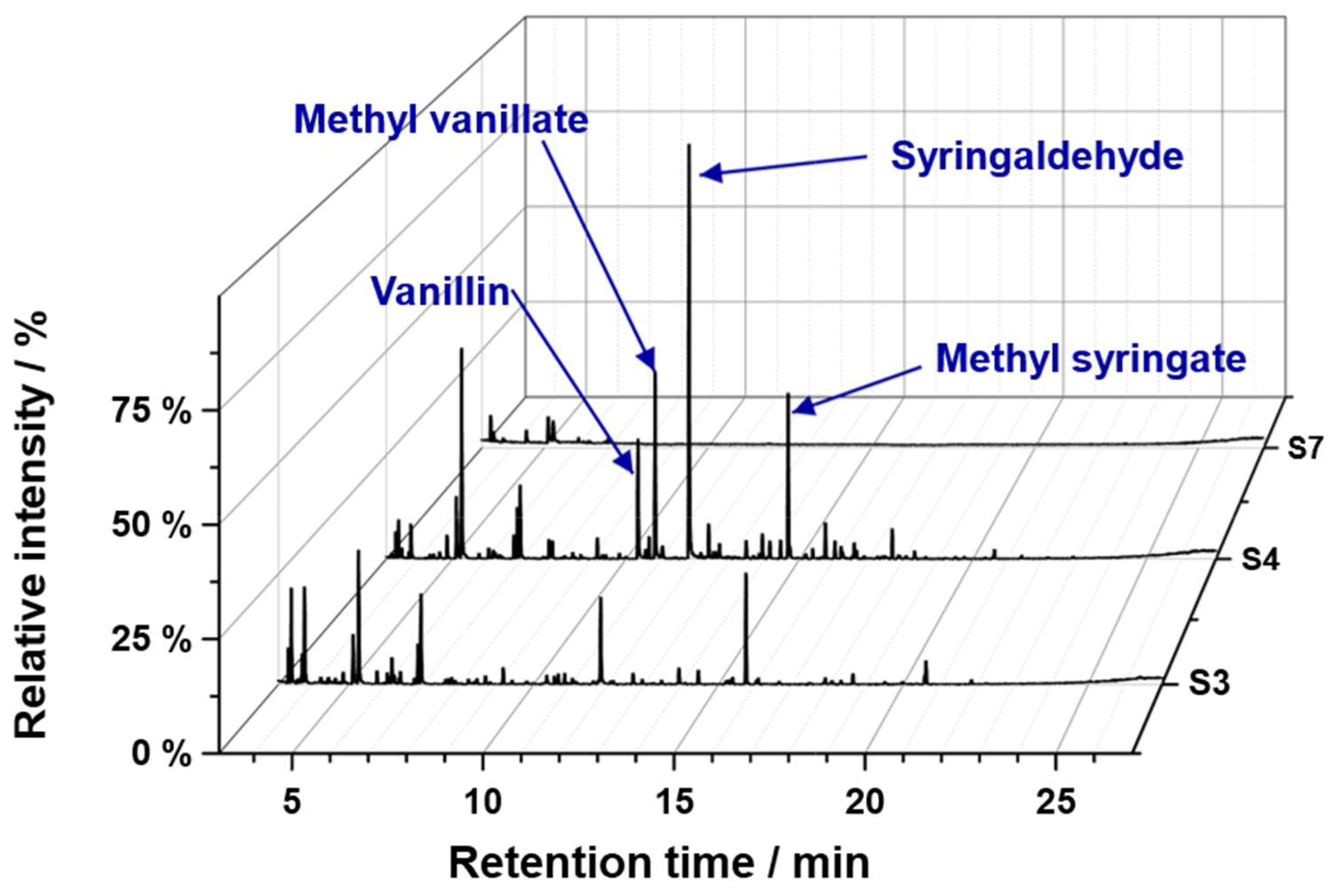
Figure 6.
Yield by weight of the desired monoaromatic compounds for the solvent screening with the organosolv beech lignin (S4). Reaction conditions: 140 °C, 20 bar oxygen partial pressure, 24 h, 0 rpm, 10 mL solvent (MeOH, MeOH/H2O 1:1 v/v, EtOH, EtOH/H2O 1:1 v/v), 500 mg substrate (S4), 200 mg HPMo-V5 catalyst.
Figure 6.
Yield by weight of the desired monoaromatic compounds for the solvent screening with the organosolv beech lignin (S4). Reaction conditions: 140 °C, 20 bar oxygen partial pressure, 24 h, 0 rpm, 10 mL solvent (MeOH, MeOH/H2O 1:1 v/v, EtOH, EtOH/H2O 1:1 v/v), 500 mg substrate (S4), 200 mg HPMo-V5 catalyst.
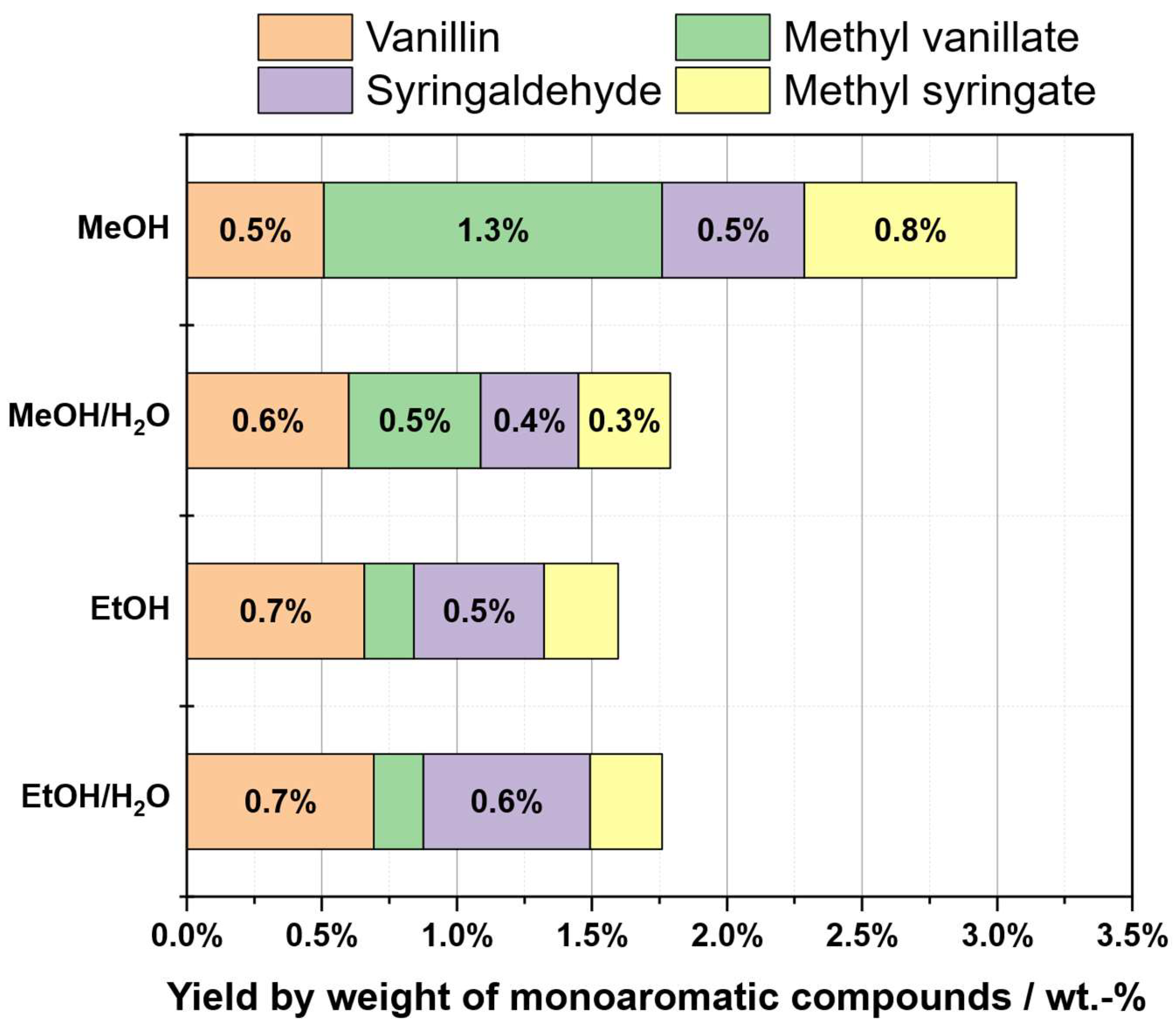
Figure 7.
Yield by weight of the desired monoaromatic compounds for the catalyst screening experiments. Reaction conditions: 140 °C, 20 bar oxygen partial pressure, 24 h, 0 rpm, 10 mL solvent (MeOH/H2O 95:5 v/v), 500 mg substrate (S4), 200 mg catalyst.
Figure 7.
Yield by weight of the desired monoaromatic compounds for the catalyst screening experiments. Reaction conditions: 140 °C, 20 bar oxygen partial pressure, 24 h, 0 rpm, 10 mL solvent (MeOH/H2O 95:5 v/v), 500 mg substrate (S4), 200 mg catalyst.
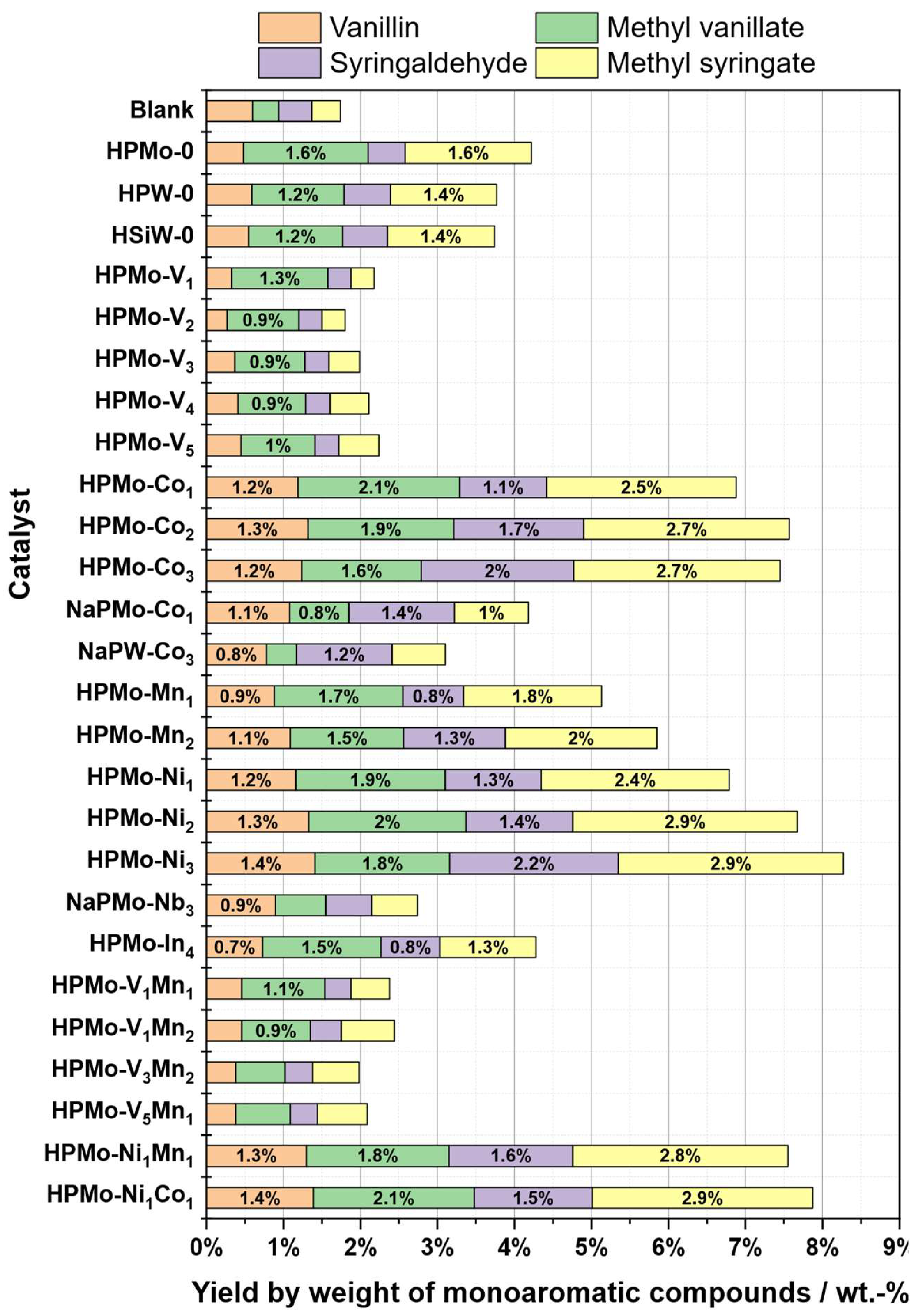
Figure 8.
Yield by weight of the desired monoaromatic compounds for the investigation of reaction time influence. Reaction conditions: 140 °C, 20 bar oxygen partial pressure, 2-24 h, 0 rpm, 10 mL solvent (MeOH/H2O 8:2 v/v), 500 mg substrate (S1), 200 mg HPMo-Ni3 catalyst.
Figure 8.
Yield by weight of the desired monoaromatic compounds for the investigation of reaction time influence. Reaction conditions: 140 °C, 20 bar oxygen partial pressure, 2-24 h, 0 rpm, 10 mL solvent (MeOH/H2O 8:2 v/v), 500 mg substrate (S1), 200 mg HPMo-Ni3 catalyst.
Scheme 1.
Proposed reaction network describing the formation of all four monoaromatic products originating from the lignin substrate including the formation of vanillin from syringaldehyde.
Scheme 1.
Proposed reaction network describing the formation of all four monoaromatic products originating from the lignin substrate including the formation of vanillin from syringaldehyde.
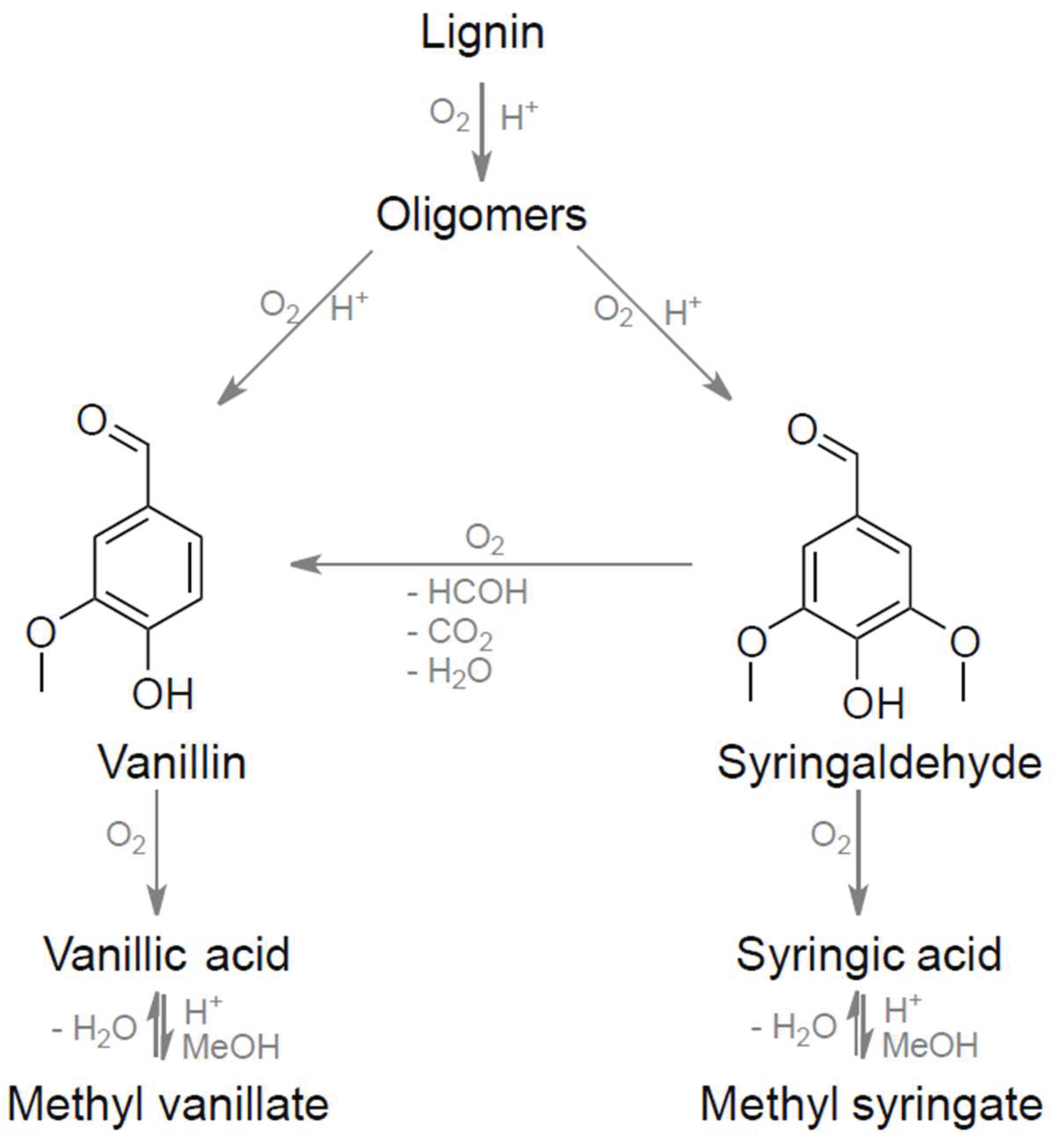
Figure 9.
Yield by weight of the desired monoaromatic compounds for the investigation on oxygen partial pressure influence. Reaction conditions: 140 °C, 5/14/27.5 bar oxygen initial partial pressure, 24 h, 0 rpm, 10 mL solvent (MeOH/H2O 8:2 v/v), 500 mg substrate (S1), 200 mg catalyst HPMo-Ni3.
Figure 9.
Yield by weight of the desired monoaromatic compounds for the investigation on oxygen partial pressure influence. Reaction conditions: 140 °C, 5/14/27.5 bar oxygen initial partial pressure, 24 h, 0 rpm, 10 mL solvent (MeOH/H2O 8:2 v/v), 500 mg substrate (S1), 200 mg catalyst HPMo-Ni3.
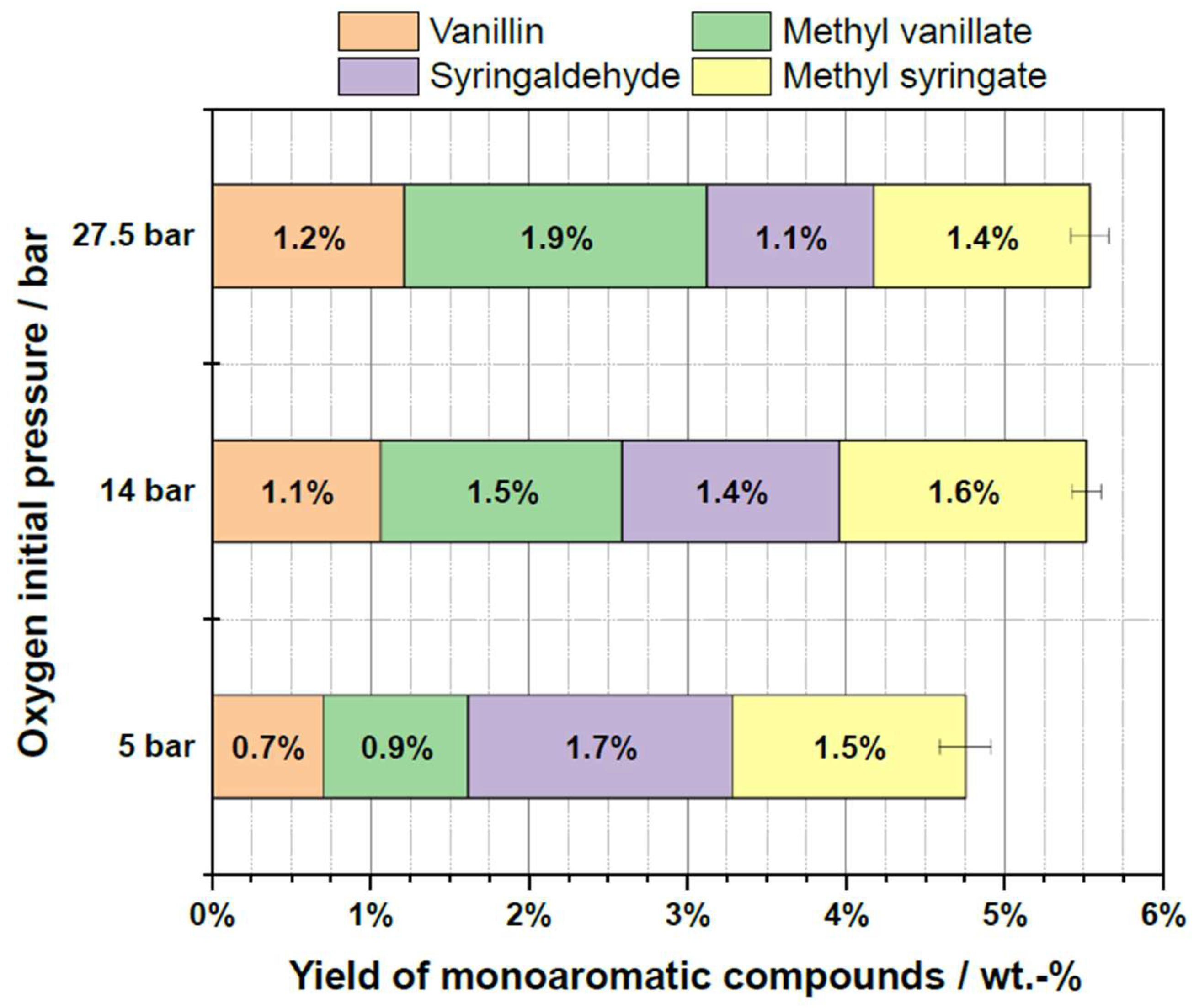
Figure 10.
Comparison of yields by weight of the desired monoaromatic compounds investigated in Setup 1 (10-fold) & Setup 2 (3-fold). Reaction conditions 140 °C, 20 bar oxygen partial pressure, 16 h, 0 rpm, 10&30 mL solvent (8:2 v/v MeOH:H2O), 500&1500 mg substrate (S1), 200&600 mg catalyst HPMo-Ni3.
Figure 10.
Comparison of yields by weight of the desired monoaromatic compounds investigated in Setup 1 (10-fold) & Setup 2 (3-fold). Reaction conditions 140 °C, 20 bar oxygen partial pressure, 16 h, 0 rpm, 10&30 mL solvent (8:2 v/v MeOH:H2O), 500&1500 mg substrate (S1), 200&600 mg catalyst HPMo-Ni3.
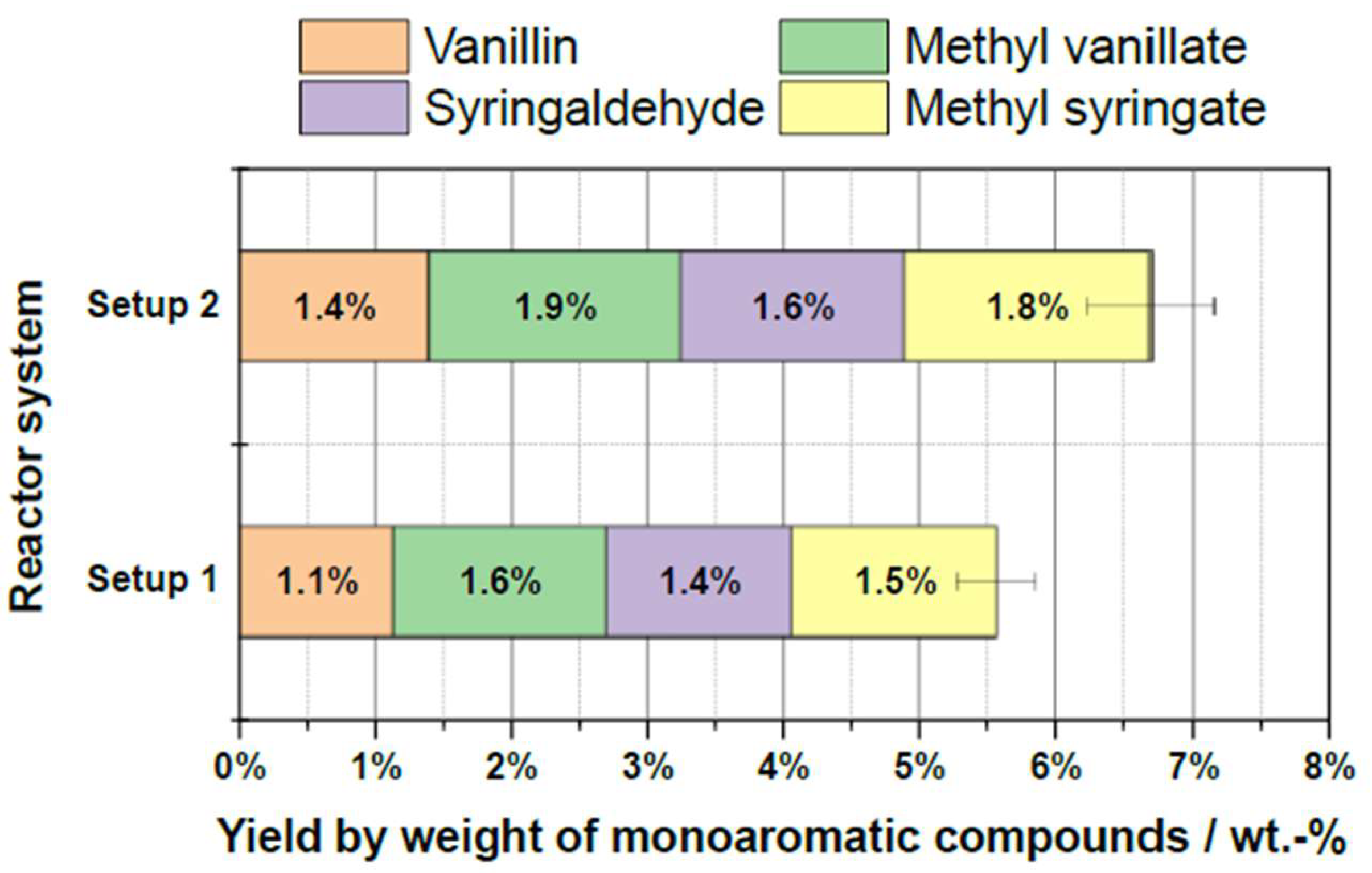
Figure 11.
Monoaromatic yields of the catalyst loading optimization. Reaction conditions: 160 °C, 14 bar oxygen partial pressure, 16 h, 0 rpm, 30 mL solvent (8:2 v/v MeOH:H2O), 1500 mg substrate (S1), 375;300;200;150;100 mg catalyst HPMo-Ni3.
Figure 11.
Monoaromatic yields of the catalyst loading optimization. Reaction conditions: 160 °C, 14 bar oxygen partial pressure, 16 h, 0 rpm, 30 mL solvent (8:2 v/v MeOH:H2O), 1500 mg substrate (S1), 375;300;200;150;100 mg catalyst HPMo-Ni3.
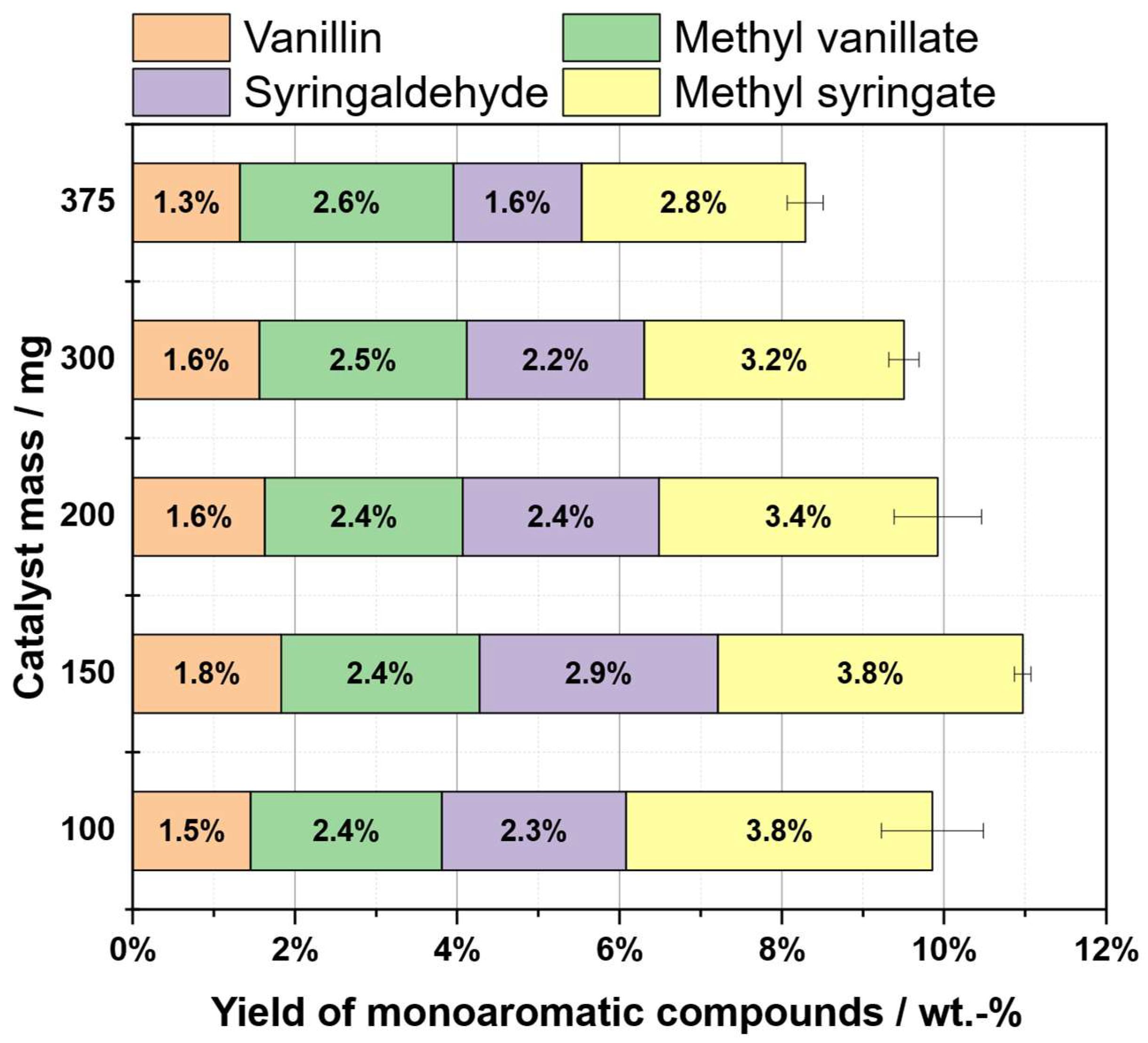
Figure 12.
Logarithmic plot of the effective reaction rate over the initial lignin concentration including four measured data points and a linear fit. Reaction conditions: 160 °C, 14 bar oxygen partial pressure, 16 h, 50 rpm, 30 mL solvent (8:2 v/v MeOH:H2O), varying substrate mass (S1), 600 mg catalyst HPMo-Ni3.
Figure 12.
Logarithmic plot of the effective reaction rate over the initial lignin concentration including four measured data points and a linear fit. Reaction conditions: 160 °C, 14 bar oxygen partial pressure, 16 h, 50 rpm, 30 mL solvent (8:2 v/v MeOH:H2O), varying substrate mass (S1), 600 mg catalyst HPMo-Ni3.
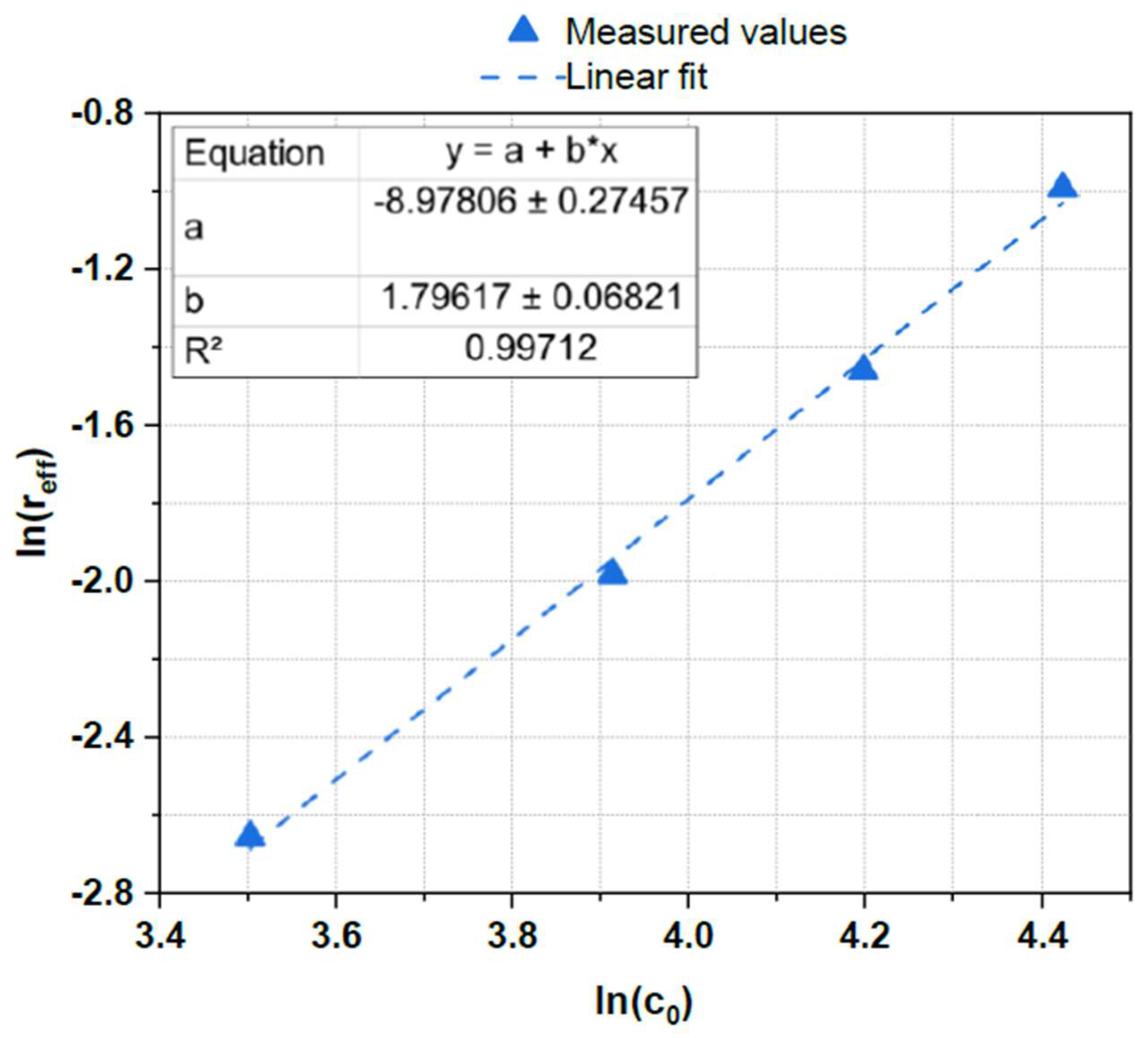
Figure 13.
Logarithmic plot of the effective rate constant over reaction temperature including four measured data points and a linear fit. Reaction conditions: 140-170 °C, 14 bar oxygen partial pressure, 16 h, 50 rpm, 30 mL solvent (8:2 v/v MeOH:H2O), 1.500 mg substrate (S1), 600 mg catalyst HPMo-Ni3.
Figure 13.
Logarithmic plot of the effective rate constant over reaction temperature including four measured data points and a linear fit. Reaction conditions: 140-170 °C, 14 bar oxygen partial pressure, 16 h, 50 rpm, 30 mL solvent (8:2 v/v MeOH:H2O), 1.500 mg substrate (S1), 600 mg catalyst HPMo-Ni3.
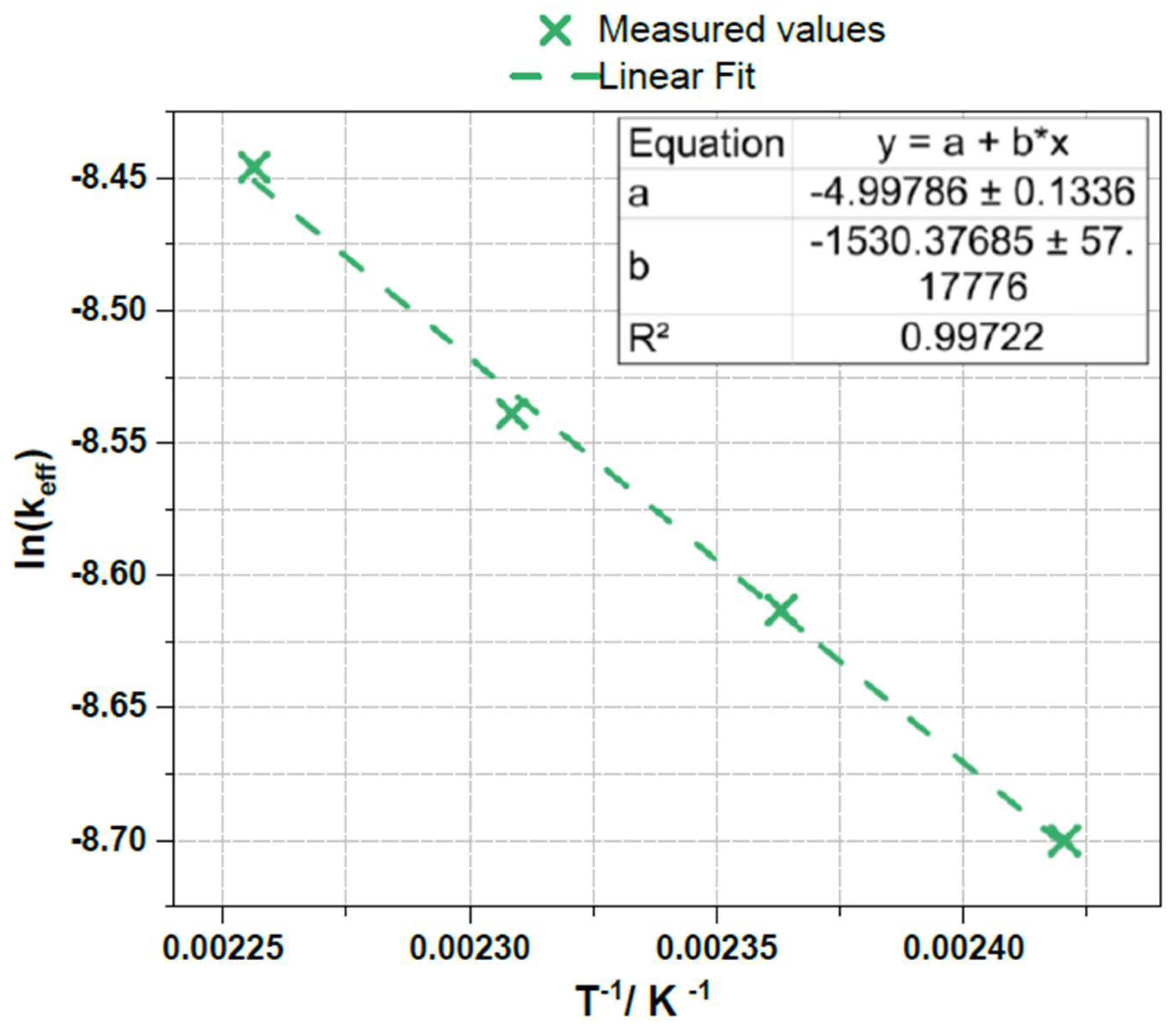
Table 1.
Overview of the lignin substrates including provider, biomass type and pulping type information.
Table 1.
Overview of the lignin substrates including provider, biomass type and pulping type information.
| Substrate # | Provider | Biomass type | Pulping type |
| S1 | FAU Erlangen | Softwood | Organosolv |
| S2 | Merck | Softwood | Kraft |
| S3 | Merck | Softwood | Kraft |
| S4 | Fraunhofer CBP, Leuna | Beech wood | Organosolv |
| S5 | Fraunhofer CBP, Leuna | Spruce wood | Organosolv |
| S6 | LignoPure, Hamburg | Softwood | Hydrolysis |
| S7 | LignoPure, Hamburg | Hardwood | Sulphate |
| S8 | LignoPure, Hamburg | Softwood | Kraft |
| S9 | Fraunhofer CBP, Leuna | Beech wood | Organosolv |
| S10 | LignoPure, Hamburg | Birch wood | 2G Biorefinery |
| S11 | LignoPure, Hamburg | Spruce wood & wheat straw | Enzymatic |
| S12 | LignoPure, Hamburg | Beech wood | Hydrolysis |
| S13 | LignoPure, Hamburg | Wheat straw | Purified Soda |
Table 2.
Molecular weight distribution by weight (Mw), by number (Mn) and polydispersity of different lignin substrates by pulping process type.
Table 2.
Molecular weight distribution by weight (Mw), by number (Mn) and polydispersity of different lignin substrates by pulping process type.
| Substrate # | Lignin description | Mw / Da | Mn / Da | D / - |
| S1 | Organosolv softwood | 2513 | 864 | 2.9 |
| S2 | Kraft softwood | 5391 | 1260 | 4.3 |
| S3 | Kraft softwood | 6177 | 1378 | 4.5 |
| S4 | Organosolv beech | 2234 | 800 | 2.8 |
| S5 | Organosolv spruce | 3607 | 1133 | 3.2 |
| S6 | Hydrolysis softwood | 1111 | 475 | 2.3 |
| S7 | Sulphate hardwood | 3717 | 783 | 4.7 |
| S8 | Kraft softwood | 6680 | 1456 | 4.6 |
| S9 | Organosolv beech | 3049 | 852 | 3.6 |
| S10 | 2G Biorefinery birch | 7215 | 844 | 8.6 |
| S11 | Enzymatic spruce&wheat | 1613 | 705 | 2.3 |
| S12 | Hydrolysis beech | 9348 | 977 | 9.6 |
| S13 | Soda wheat | 5910 | 1212 | 4.9 |
Table 3.
Initial lignin concentration and monoaromatic concentrations after reaction during the determinsation of reaction order. Reaction conditions: 160 °C, 14 bar oxygen partial pressure, 16 h, 50 rpm, 30 mL solvent (8:2 v/v MeOH:H2O), varying substrate mass (S1), 600 mg catalyst HPMo-Ni3.
Table 3.
Initial lignin concentration and monoaromatic concentrations after reaction during the determinsation of reaction order. Reaction conditions: 160 °C, 14 bar oxygen partial pressure, 16 h, 50 rpm, 30 mL solvent (8:2 v/v MeOH:H2O), varying substrate mass (S1), 600 mg catalyst HPMo-Ni3.
| Entry # | Initial lignin concentration / mg mL-1 | Monoaromatic concentration / mg mL-1 |
| 1 | 33.2 | 1.1 |
| 2 | 50.2 | 2.2 |
| 3 | 66.7 | 3.7 |
| 4 | 83.4 | 5.9 |
Table 4.
Summary of reaction temperature variation and its effect on monoaromatic concentrations after reaction. Reaction conditions: 140-170 °C, 14 bar oxygen partial pressure, 16 h, 50 rpm, 30 mL solvent (8:2 v/v MeOH:H2O), 1.500 mg substrate (S1), 600 mg catalyst HPMo-Ni3.
Table 4.
Summary of reaction temperature variation and its effect on monoaromatic concentrations after reaction. Reaction conditions: 140-170 °C, 14 bar oxygen partial pressure, 16 h, 50 rpm, 30 mL solvent (8:2 v/v MeOH:H2O), 1.500 mg substrate (S1), 600 mg catalyst HPMo-Ni3.
| Entry # | Reaction temperature / °C | Monoaromatic concentration / mg mL-1 |
| 1 | 140 | 3.0 |
| 2 | 150 | 3.3 |
| 3 | 160 | 3.5 |
| 4 | 170 | 3.9 |
Disclaimer/Publisher’s Note: The statements, opinions and data contained in all publications are solely those of the individual author(s) and contributor(s) and not of MDPI and/or the editor(s). MDPI and/or the editor(s) disclaim responsibility for any injury to people or property resulting from any ideas, methods, instructions or products referred to in the content. |
© 2026 by the authors. Licensee MDPI, Basel, Switzerland. This article is an open access article distributed under the terms and conditions of the Creative Commons Attribution (CC BY) license (http://creativecommons.org/licenses/by/4.0/).
Copyright: This open access article is published under a Creative Commons CC BY 4.0 license, which permit the free download, distribution, and reuse, provided that the author and preprint are cited in any reuse.


