

Submitted:
01 April 2026
Posted:
02 April 2026
You are already at the latest version
Abstract
This study evaluated the effect of byproduct from mining process of granite rock doses in cultures of high demand in soil fertility with annual and perennial cycles, such as soybean and Tamani perennial grass, for two years in the municipality of Paragominas-PA. Experimental design was in randomized blocks comprising five treatments and five replications. Treatments comprised doses of byproduct from granite rock of 1000, 2000, 4000 and 6000 kg ha-1 and a control treatment (without application) applied in soybean and Tamani perennial grass. Soil parameters and crops productivity were evaluated for two years. The higher doses showed positive effects on soil fertility parameters, including potassium increases. Crops productivity had low responses to application or residual effects of the byproduct from granite rock mining process from Tracuateua-PA. The byproduct from mining process of granite rock has low influence in soil fertility and yield of soybean and Tamani perennial grass.
Keywords:
nutrient release dynamics
; rock remineralization
; soil chemical attributes
1. Introduction
Application of byproducts from mining and quarrying industries in soil as remineralization has emerged as a new practice in agriculture. This technology has been indicated to agriculture as an alternative to reduce the use and dependence of soluble fertilizers, mostly imported [1], besides it is viable to the large quantity of waste from mining and quarrying industries [2].
Agriculture adoption of the remineralization practice has been increased due to the high demand and prices of mineral fertilizers; however, it is necessary to be alert to the viability evaluation, because the relation of cost/benefits is highly dependent on chemical and granulometric composition of the byproducts, besides logistic and application costs [3,4]. Geologic diversity in quarries and mining can generate many byproducts along the production process, however its use in agriculture must attend to specificities of legislation [5].
Remineralizers are defined as mineral materials that were mechanically processed to reduce particle size to be able to modify fertility indexes by inclusion of macro and microminerals to plants, as well as improving the soil properties as physical or physicochemical or biological activities, in addiction it must present sum of bases (CaO, MgO, K2O) equal or superior to 9% along with K2O equal or superior to 1% [6].
Byproducts from sedimentary, metamorphic, and igneous rocks are easily obtained with potential as natural nutrient supplier under adjusted management because they can supply micronutrients and reduce nutrient leaching [7]. However, still there little information about the efficient rocks, using ways, and some inconsistencies about the effects of short to long time in soil properties, as well as available nutrients to plants. Even in adjusted materials as remineralizations there are few or no satisfactory answers to crops [7,8].
Basalt rock dust (BRD) from São Paulo showed positive effects through the soil acidity reducing and improving de levels of base saturation [9]. Dacite rock is potential to be an environmental solution to soil fertilization problem because it does not require chemical processing and can be used as it is mined [10]. Rock processing is highly efficient in increasing the agronomic effectiveness. Silicate rock powders must be seriously considered as amendment for strongly weathered soils in the humid- and subhumid tropics since they could fill the unresolved and escalating gap for affordable and accessible K sources and micronutrient soil amendments, however the positive results prevail with mafic and ultramafic rocks like basalts and rocks containing nepheline or glauconite [4].The aim was evaluating doses of the byproduct from granite mining from Tracuateua-Pará produced by crush (coarse granulometry), with no additional processing, in annual and perennial crops, as respectively, soybean (Glycine max) and forage grass Tamani (Megathyrsus maximus cv. BRS Tamani) for two years in Paragominas-Pará-Brazil.
2. Materials and Methods
The research was carried out with experiments to evaluate the doses of 1000, 2000, 4000 e 6000 kg ha-1 of the byproduct from granite mining and a control (Table 1) from Tracuateua, Pará, Brazil in crops of soybean (Glycine max) and forage grass Tamani (Megathyrsus maximus cv. BRS Tamani) by two years.
There was no previous processing in byproduct from granite mining, it was evaluated as well as it was generated in the quarry. Generally, it is marketed as crushed stone (Table 1), mainly so that it doesn’t involve additional costs. The rock is a granite with predominant minerals of quartz, feldspar plagioclase (albite), k-feldspar (microcline) and mica (biotite/muscovite and chlorite). Feldspars are minerals subject to weathering, therefore, they release nutrients such as calcium, magnesium, and potassium, while quartz does not react (Table 1).
Experimental areas were in Paragominas-PA, northeast of Pará state (2º 25’ and 4º 09’ South and 46º 25’ and 48º 54’ West). Climate characteristics are warm and wet of Awi type from Koppen [11]. The rainy tropical climate occurs between December to June, while the expressive dry period in July to November. During the experimental period, the total precipitation and average temperature were 3811.2 and 2423.6 mm and 27.5 and 26.7º C, respectively in 2020 and 2021 (Figure 1).
The byproduct from granite mining from Tracuateua was applied by throwing in experimental areas (Table 2) under Latossolo Amarelo (Typic Hapludox) uniform, deep, clayey [12]. Physical analysis of the soil indicated composition of 774, 126 and 100; and 770, 126 and 100 g kg-1 of clay, silt, and sand, respectively to areas cropped with soybean and Tamani.
2.1. Experimental Design
Experimental design for both crops, soybean and Tamani, was in randomized blocks with five treatments, four doses of byproduct from granite mining from Tracuateua, 1000, 2000, 4000 and 6000 kg ha-1 application and a control (no application) with five replications. The experimental units comprised a plot of 50 m² (10 lines of 10 m) to soybean and 16 m² of Tamani grass.
2.2. Soybean Experimental
Soybean was grown in two experimental crops 2019/2020 and 2020/2021 with cultivar CZ 48B32 IPRO in a commercial farm, near to the Paragominas Campus, Federal Rural University of the Amazon, Pará, Brazil. The arrangement of 0.5 m between rows and 0.065 m between plants. Treatment application was realized 30 days before soybean sowing.
Soybean evaluation comprised yield and mass of one thousand grains. Samples were manually collected from 20 m linear in the center of each experimental unit. The grains were mechanically threshed and weighted and posteriorly subsampled for humidity determination. Parameter values were adjusted by 13% of humidity according to discount Equation 1 (1) and adjustment to Equation 2 (2).
Discount by humidity D (%) = [(Initial humidity − 13) x 100] / (100-13)],
Adjusted weight (g) = Sample mass − [Sample mass x (D/100)]
2.3. Tamani Experimental
In the experimental area of the Paragominas Campus, Federal Rural University of the Amazon, Pará, Brazil, Tamani grass was sowed simultaneously to treatments application, as well as a fertilization with 100 kg ha-1 of monoammonium phosphate (10% de N e 48% de P2O5). Establishment fertilization comprised 40 kg ha-1 of N and K2O, respectively by urea and potassium chloride after the first and second harvests at 2020/2021. In 2021/2022 were applied two fertilizations of 40 kg ha-1 of N as urea after the first and sixth harvests.
Evaluations in forage grass comprised the dry matter productivity through harvests by cutting up 25 cm from ground surface realized when dossel was around 50 cm according to recommendations [13]. There were four and six harvests, respectively, in 2020/2021 and 2021/2022. Average height of dossel before harvests were 64.8, 64.5, 51.7 and 49.0 cm during 2020-2021 and 52.5, 50.8, 48.7, 44.4, 62.4 and 50.8 cm during 2021-2022.
Samples were collected by scissor and a sampler of 1 m² in the center of each plot, following to weighed and subsampled to determine dry matter content in the oven under 65° by 72 h. After sampling, all remainder from the plots were harvested at the same height.
In the end of each soybean crop and one-year cycle of Tamani were realized soil sampled in layer of 0-20 cm to analyze soil fertility.
2.4. Statistical Analysis
Data were organized in Excel and submitted to statistical analysis in normality study by Shapiro-Wilk with p>0.05. Variables non-attended in normal criteria were analyzed by BOX- COX from package “fpp” of the R software or nonparametric of Kruskal-Wallis. Data were analyzed by ANOVA using “emmeans” and “agricolae” packages from R software. Significative effects among levels were analyzed by regression study with significative time effect or interaction resulted in deployment.
3. Results
3.1. Soybean Experimental
Increment doses of byproduct of granite mining from Tracuateua-PA showed no effect on the yield and mass of one thousand grains in the two crops (Table 3).
In soil, the content of potassium, calcium, magnesium, and aluminum, as well as values of CEC and organic matter showed effects from treatments after first crop 2019/20, while after the second crop (2020/21), the effects were observed to pH values, as well as contents of phosphorus, potassium, and calcium (Table 4).
Potassium content in soil was linearly positive according to the increment in doses of byproduct after the first soybean crop in 2019/20, while calcium, magnesium, CEC, and organic matter showed negative linear effect. Aluminum in soil also was adjusted in a positive linear curve as answer to the doses increment, however under a low correlation coefficient. In the second soybean crop (2020/2021), residual effects was observed through higher values to pH (CaCl2), P and K in intermediate doses, while the Ca values were linearly increased (Table 4).
3.2. Tamani Experimental
In the evaluation period of 12 months, the dry matter production (DMP) of Tamani in 2020- 2021 and 2021-2022 were 11,487 e 12,818 kg ha-1 with a total of 4 and 6 cuts, respectively. Yield by harvest in 12 months after establishment showed negative quadratic effect (p<0.05) for treatments, which adjusted in equation DMP (kg ha-1 of DM) = -4E-05x2 + 0.1689x + 2869.3 (R² = 0.8268), while in the second period (12 to 24 months), there was no the residual effect from treatments (Table 5).
There was no effect from treatments to dry matter content in two evaluated periods (Table 5), as well as to interaction of treatments x harvest to dry matter production (p=0.8533 and 0.8889, in first and second period, respectively) and dry matter content (p=0.6510 and 0.8189, in first and second period, respectively).
Dry mass production in two 12 months periods were, respectively of, 11,518 kg ha-1 and 12,777 kg ha-1, showing some variability among harvests as consequence of climatic influences from different seasons, mainly for water availability (Figure 1) and fertilization management.
In soil fertility parameters there was no influence in all experimental periods (Table 6).
4. Discussion
Weathering is a geological/geo-environmental process that degrades and transforms rocks [14].
Silicate rock powders can enhance soil fertility and contribute to carbon sequestration, but their effectiveness depends on the rock type, soil characteristics, and microbial responses [15].
The understanding of complex nature from minerals is necessary to define appropriate analytical procedures allowing characterize satisfactorily the composition and bioavailability of elements in rocks [16], once the responsiveness from crops to remineralization must be associated with conjugated effects and factors according to the rock composition, not only the potassium. Byproduct chemical composition expressed in bases did not reach the value of the Sum of Bases (CaO + MgO + K2O) of 9% required to characterize the remineralizing product [17]. The predominant mineralogy from this granite rock composed of plagioclase and potassium feldspars indicates potential to release calcium, sodium, and potassium to soil solutions by weathering [18]. The release of nutrients from rock for plants is dependent on physical, chemical, and biological processes to solubilize [18,19,20]. Three igneous rocks (phonolite, diabase, and granite) sieved to 0.05 mm and thoroughly mixed into soils to maximize contact between particles, roots, and the microbial community resulted in enrichment microbial taxa linked to weathering, nutrient cycling, and plant growth promotion [14].
Rock granulometry also influences the time of nutrient release, in this case byproduct of granite mining from Tracuateua-Pará possibly was negatively influenced by high size of particles (Table 1), besides superficial application. The byproduct applied was classified as coarse crumbs and it has only 2,5% mass with the low granulometry (< 0.3 mm) recommended for effective soil remineralization [21,22].
4.1. Soybean Experimental
Soybean yield (Table 3) was inferior to the 2,979 and 2,995 kg ha-1 observed as crop averages of 2019/2020 and 2020/2021 in Pará state [23]. The absence of treatments effect in yield and for mass of one thousand grains (Table 3) reflected low influence of byproduct of granite mining in short time, even under increasing levels of potassium in soil (Table 4).The effects of linear increasing of potassium in soil in first period (12 months) a quadratic in residual period (12-24 months) were followed by high levels of this nutrient in control, above to the potassium recommendation for soybean in Pará [24], probably justifying the absence of answer from the culture.
Calcium in soil showed a distinct answer to doses of byproduct of granite mining from Tracuateua-Pará in each cropping (Table 4). Linear negative effect of calcium and magnesium in soil in first cropping can be dilution effect as consequence of high levels of the byproduct containing low levels of these nutrients (Table 1) or could be resulted of soil heterogeneity due to surface application in no-till farming systems summed to slow nutrient release, as is typical from this material, mainly under high granulometry.
In the second soybean crop, treatment effects were influenced by lime application by farm. There was positive linear effects from doses increments in calcium from soil, even with high values due to liming. In the same way, the linear positive effect from treatments to aluminum in soil was totally neutralized in the second soybean crop, while pH (CaCl2) increased and the quadratic effect on phosphorus with treatments occurred only in the second crop (Table 4), in accordance with [2] who also observed reduced active and potential acidity and increased calcium with the limestone application.
4.2. Tamani Experimental
Tamani grass showed the highest dry matter production under doses of 1000, 2000 e 3000 kg ha-1 of byproduct of granite mining in the first experimental period, but the decrease in the highest dose resulted in a negative quadratic curve. The increasing supply of potassium through the byproduct doses was not followed by dry mass production after 3000 kg ha-1, thus the potassium efficiency utilization was inversely proportional to the increased potassium levels [25]. The residual evaluation (until 24 months) showed no effect of treatments on dry mass production. Accumulated production of of dry mass of Tamani in both periods of 12 months were similar from study of Embrapa Gado de Corte of 14.800 kg ha-1 [26]. The absence of influence from other nutrients besides K is corroborated by other study [27], because the low nutrients and solubility from igneous rocks with high silica content as granite. Characteristics of original rock may justify the low responsiveness in crop production, mainly in crops with fast cycles as soybean or crops with high exigences such as Tamani grass. Potassium content in soil was higher in the residual period, however with no treatment effect in both evaluated periods, as well as other evaluated parameters in soil fertility (Table 6). The high roots mass typical from tropical grass along with the straw deposition and microorganisms activity can provide a favorable environment to nutrients recycling and uptake.
Rock characteristics and high particle size, even with high doses applications, could justify the absence effects or low influences in crops. Igneous rock rich in silica, as granite, generally contains low levels of nutrients and solubility, although it contains large nutrients and non-essential nutrients, thus rock characteristics require high application levels turning laborious and expensive, besides the reduced agronomic efficiency in crops of short cycle [27].
Low influence from byproduct of granite mining from Tracuateua in soil fertility and crops makes it fragile to recommend as a remineralizer, mainly considering the vies economic with logistic and application. The byproduct processing as mill could accelerate nutrients released by the weathering process; however, it could include one more cost to byproduct requiring caution.
5. Conclusions
Application of higher levels of byproduct from granite mining from Tracuateua-PA showed beneficial effects to soil fertility, mainly to potassium content, however showed no influence after 12 months under intensive management of forage grass.
Vegetable productivity shows low or no influences on application or residual of byproduct from granite mining from Tracuateua-PA up to 6 Mg ha-1. It’s necessary more studies with less granulometry granite byproduct application to better soil remineralizer evaluation.
Author Contributions
Conceptualization: Letícia de Abreu Faria and Rubens Muller Kautzmann. Methodology: Ronilson Martins Silva, Iara Maciel da Silva and Letícia de Abreu Faria. Validation: Raimundo Vagner de Lima Pantoja and Anderson Ivis Carvalho Corrêa. Formal analysis: Ronilson Martins Silva and Letícia de Abreu Faria. Investigation: Ronilson Martins Silva, Iara Maciel da Silva, and Raimundo Vagner de Lima Pantoja. Resources: Letícia de Abreu Faria, Rubens Muller Kautzmann and Fernanda de Fátima da Silva Devechio. Data curation: Ronilson Martins Silva, Inara Araújo Mota and Fernanda de Fatima da Silva Devechio. Writing—original draft preparation: Ronilson Martins Silva, Iara Maciel da Silva and Raimundo Vagner de Lima Pantoja. Writing—review and editing: Ronilson Martins Silva, Inara Araújo Mota, Fernanda de Fatima da Silva Devechio and Letícia de Abreu Faria. Visualization: Anderson Ivis Carvalho Corrêa and Letícia de Abreu Faria. Supervision: Ronilson Martins Silva, Fernanda de Fátima da Silva Devechio and Letícia de Abreu Faria. Project administration: Ronilson Martins Silva, Iara Maciel da Silva and Raimundo Vagner de Lima Pantoja. Funding acquisition: Letícia de Abreu Faria, Rubens Muller Kautzmann and Fernanda de Fátima da Silva Devechio. All authors have read and agreed to the published version of the manuscript.
Funding
This research received no external funding.
Conflicts of Interest
The authors declare no conflicts of interest.:
Abbreviations
The following abbreviations are used in this manuscript:
| BRD | Basalt rock dust |
| K | Potassium |
| m | Meter |
| m² | Square meters |
| N | Nitrogen |
| MTG | Represents the weight of one thousand soybean grains |
| CEC | Cation Exchange Capacity |
| P | Phosphorus |
| Ca | Calcium |
| DMP | Dry matter production |
| DM | dry matter |
| cm | Centimeters |
| mm | millimeter |
| ns | not significant |
References
- Palma, H. H.; Granados, A. I. N.; Neckel, A.; Osorio, D. P.; Ríos, A. L. M.; Ramos, C. G. Valorization of mineral by-products through soil remineralization enhances sustainable agriculture and circular economy outcomes. Discov. Sustain., 2025, v. 6, art. 1134. [CrossRef]
- Luchese, A. V.; Leite, I. J. G. C.; Giaretta, A. P. S.; Alves, M. L.; Pivetta, L. A.; Missio, R. F. Use of quarry waste basalt rock powder as a soil remineralizer to grow soybean and maize. Heliyon, 2023, v. 9, n. 3, art. e14050. [CrossRef]
- Assunção, S. G. S.; Silva, B. C.; Cruz, D. C.; Oliveira, M. F.; Brasil, E. P. F. Remineralizers in the Brazilian agricultural context. J. Agric. Sci. Res., 2024, v. 4, n. 11. [CrossRef]
- Swoboda, P.; Döring, T. F.; Hamer, M. Remineralizing soils? The agricultural usage of silicate rock powders: A review. Sci. Total Environ., 2022, v. 807, n. 150976, p. 150976.
- Benevides Filho, P. R. R.; Blaskowski, A. E.; Ramos, M. N.; Lessa, L. G. F.; Zamberlan Filho, A. N.; Abreu-Junior, C. H.; Jani, A. D.; Capra, G. F.; Nogueira, T. A. R. Potential soil remineralizers from silicate rock powders (SRP) as alternative sources of nutrients for agricultural production (Amazon Region). Minerals, 2023, v. 13, art. 1255. [CrossRef]
- BRASIL. Instrução Normativa Nº 5, de 10 de março de 2016. Ficam estabelecidas as regras sobre definições, classificação, especificações e garantias, tolerâncias, registro, embalagem, rotulagem e propaganda dos remineralizadores e substratos para plantas, destinados à agricultura. Brasília, DF: Diário Oficial da União, 2016.
- Medeiros, F. P.; Theodoro, S. H.; Carvalho, A. M. X.; Oliveira, V. S.; Oliveira, L. C.; Almeida, R. M. P.; Viana, M. B.; Gomide, C. S. The combination of crushed rock and organic matter enhances the capture of inorganic carbon in tropical soils. J. S. Am. Earth Sci., 2023, v. 152, art. 105254. [CrossRef]
- Manning, D. A. C.; Theodoro, S. H. Enabling food security through use of local rocks and minerals. Extr. Ind. Soc., 2020, v. 7, n. 2, p. 480–487. [CrossRef]
- Ribeiro, M. C.; Martins, A. R.; Alves, R. S.; Lessa, L. G. F.; Pereira, H. S.; Galindo, F. S.; Teixeira Filho, M. C. M.; Abreu-Junior, C. H.; Jani, A. D.; Capra, G. F.; Ganga, A.; Nogueira, T. A. R. Basalt rock dust as a soil remineralizer in upland rice grown in tropical soils: residual effects on soil fertility, Si availability, and leaf anatomy. J. Clean. Prod., 2025, v. 520, art. 146063. [CrossRef]
- Ramos, C. G.; Santos de Medeiros, D.; Gómez, L. A.; Oliveira, M. L. S.; Schneider, I. A. H.; Kautzmann, R. M.; Silva, L. F. O. Avaliação do remineralizador de solo a partir de subproduto da mineração de rochas vulcânicas: prova experimental utilizando aveia preta e cultura do milho. Nat Resour Res, 2020, 29, 1583-1600.
- Bastos, T. X.; Silva, G. F. G.; Pacheco, N. A.; Figueiredo, R. O. Informações agroclimáticas do município de Paragominas para o planejamento agrícola. In: CONGRESSO BRASILEIRO DE METEOROLOGIA, 14., 2006, Florianópolis. Anais... Florianópolis: SBMET, 2006.
- Rodrigues, T. E.; Santos, P. L. Dos; Valente, M. A.; Rego, R. S.; Gama, J. R. N. F.; Silva, J. M. L. Da; Santos, E. Da S.; Rollim, P. A. M. Zoneamento agroecológico do Município de Paragominas, Estado do Pará. Belém: Embrapa Amazônia Oriental, 1999. 64 p.
- SOESP—Sementes do Oeste Paulista. Panicum maximum cv. BRS Tamani. Avaliable at: http://www.sementesoesp.com.br/produto.php?idprod=21. Acesso em:17/02/2026.
- Oliveira, R. L.; Andrade, N.; Freitas, C. C. G.; Oliveira, A. M. S.; Silva, D. F.; Vieira, M. S.; Mendonça, R. S.; Barros, F. M. R.; Azevedo, A. C.; Andreote, F. D. Rock powder type and soil texture shape microbial community shifts and plant biomass responses in highly weathered tropical soils. Appl. Soil Ecol. 2025, v 215. 106489. [CrossRef]
- Sandeep, C. S.; He, H.; Senetakis, K. Experimental and analytical studies on the influence of weathering degree and ground-environment analog conditions on the tribological behavior of granite. Eng. Geol. 2022, 304. 106644. [CrossRef]
- Plata, L. G.; Ramos, C. G.; Oliveira, M. L. S.; Oliveira, L. F. S. Release kinetics of multi-nutrients from volcanic rock mining by-products: Evidences for their use as a soil remineralizer. J. Clean. Prod., 2021, v. 279, art. 123668. [CrossRef]
- MAPA—Ministério da agricultura, pecuária e abastecimento. Instrução Normativa Nº 5 and 6. Brasília: MAPA/ SDA/CGAL, 2016.
- Dalmora, A.C.; Ramos, C.G.; Plata, L.G.; Costa, M.L.; Kautzmann, R.M.; Silva, L.F.O. Understanding the mobility of potential nutrients in rock mining byproducts: An opportunity for more ssustainable agriculture and mining. Sci. Total Environ. 2020, v. 70, 136240.
- Ramos, C. G.; Querol, X.; Dalmora, A. C.; Pires, K. C. J.; Schneider, I. A. H.; Oliveira, L. F. S.; Kautzmann, R. M. Evaluation of the potential of volcanic rock waste from southern Brazil as a natural soil fertilizer. J. Clean. Prod., 2017, v. 142, pt. 4, p. 2700–2706. [CrossRef]
- Ribeiro, I. D. A.; Volpiano, C. G.; Vargas, L. K.; Granada, C. E.; Lisboa, B. B.; Passaglia, L. M. P. Use of mineral weathering bacteria to enhance nutrient availability in crops: A review. Front. Plant Sci., 2020, v. 11, art. 590774. [CrossRef]
- Martins, E.S.; Martins, E.S.; Hardoim, P.R. Princípios geoquímicos, mineralógicos e biológicos do manejo de remineralizadores de solo. Inf. Agropecu., 2023, v.44, n.321, p.26-39.
- Medeiros, D.S.; Sanchotene, D.M.; Ramos, C.G.; Oliveira, L.F.S.; Sampaio, C.H.; Kautzmann, R.M. Soybean crops cultivate with dacite rock by-produtct: A proof of a cleaner technology to soil remineralization. J. Environ. Chem. Eng., 2021, v. 9 106742.
- CONAB. Companhia Nacional De Abastecimento. Série histórica das safras. Avaliable at: https://www.conab.gov.br/info-agro/safras/serie-historica-das-safras. Accessed: 03 april. 2025.
- Cravo, M. S.; Brasil, E. C.; Costa Netto, J. R.; Silveira Filho, A.; Elhusny, J. C. Soja. In: Brasil, E.C.; Cravo, M.S.; Viegas, I.J.M. Recomendações de calagem e adubação para o Estado do Pará. 2nd ed., Brasília, Brazil, Embrapa, 2020.
- Soratto, R. P.; Crusciol, C. A. C.; Campos, M.; Gilabel, A.P.; Costa, C. H. M.; Castro, G. S. A.; Ferrari Neto, J. Eficiência e efeito residual de fontes alternativas de potássio em culturas de grãos. Pesq. Agropecu. Bras., 2022, v. 56 (Y), e02686. [CrossRef]
- Jank, L.; Santos, M. F. Capim-BRS Tamani (Panicum maximum Jacq.) híbrido de maior qualidade, porte baixo e fácil manejo. Brasília, Brazil, Embrapa, 2021.
- Van Straaten, P. Farming with rocks and minerals: challenges and opportunities. An. Acad. Bras. Ciênc., 2006, v. 78, p. 731-747.
Figure 1.
Climatic data of experimental period of 2019 to 2022. Source: AGRITEMPO (2023).
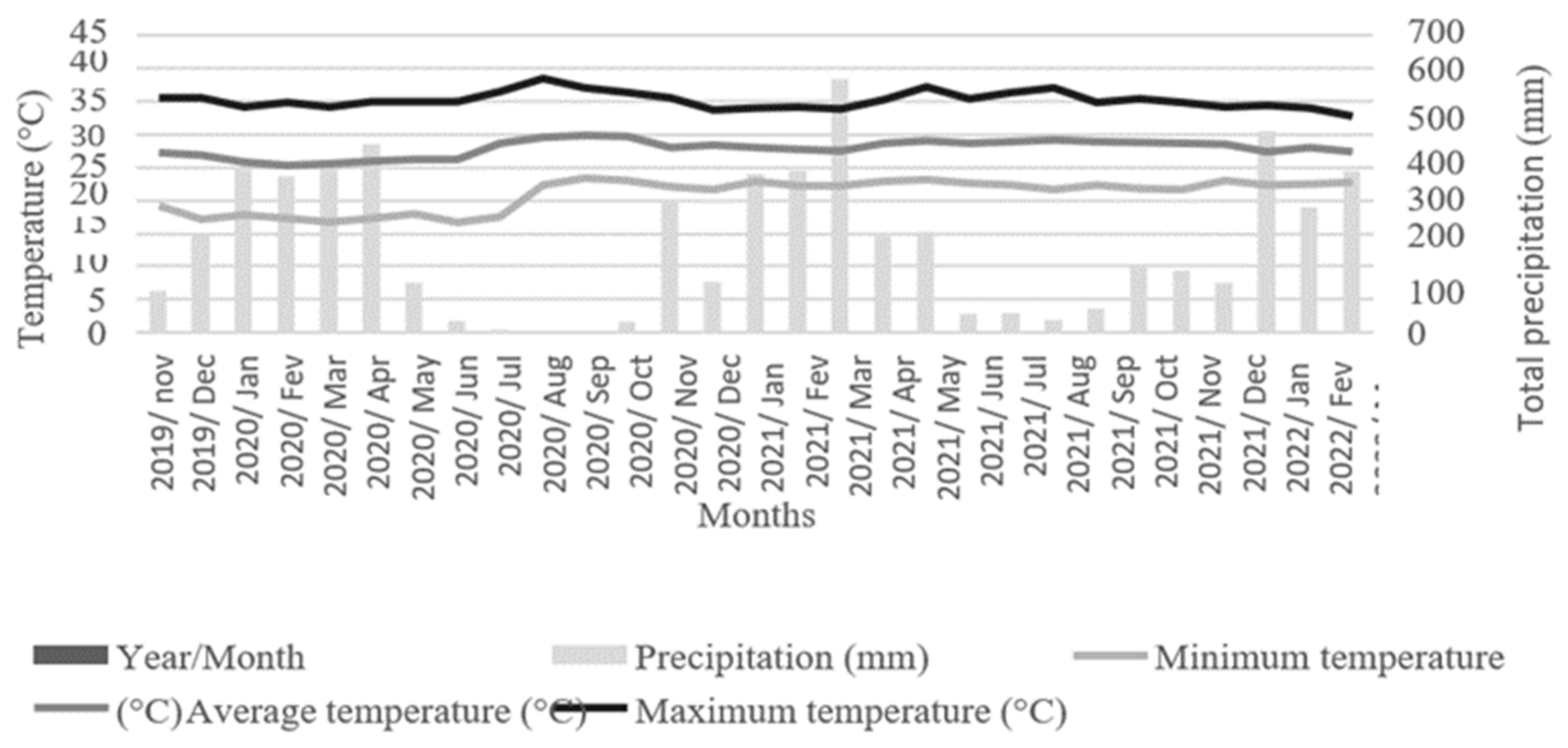

Table 1.
Chemical and physical composition of the byproduct from granite mining from Tracuateua, Pará, Brazil.
Table 1.
Chemical and physical composition of the byproduct from granite mining from Tracuateua, Pará, Brazil.
| Chemical characterization (%) | |||||||||
|---|---|---|---|---|---|---|---|---|---|
| SiO2 | Al2O3 | Fe2O3 | CaO | MgO | TiO2 | P2O5 | Na2O | K2O | MnO |
| 73.7 | 15.4 | 1.6 | 0.63 | 0.26 | 0.14 | 0.342 | 3.61 | 5.03 | 0.03 |
| Predominant minerals | |||||||||
| Quartz—SiO2 Albite—(Na,Ca)AlSi3O8 Microcline—KAl Si3O8 | |||||||||
| Physical characterization | |||||||||
| > 2.00 mm | > 0.84 mm | > 0.30 mm | <0.30 mm | ||||||
| 182 g (32.5%) | 285 g (51%) | 78 g (14%) | 14 g (2.5%) | ||||||
Table 2.
Chemical characterization of soil fertility (0-20 cm) before experimental stablishment of soybeanand Tamani.
Table 2.
Chemical characterization of soil fertility (0-20 cm) before experimental stablishment of soybeanand Tamani.
| pH | P* | S | K | Ca | Mg | Al | H+Al | CEC | MO |
| CaCl2 | mg dm-3 | mmolc dm-3 | g dm-3 | ||||||
| Soybean crop | |||||||||
| 5 | 24.2 | 8 | 2.46 | 29.1 | 10 | 0 | 31.5 | 73.1 | 24.7 |
| Tamani crop | |||||||||
| 5.4 | 4 | 11 | 2.3 | 32 | 10 | 0.02 | 22 | 66.3 | 34 |
*Resin method.
Table 3.
—Yield and mass of one thousand grains (MTG) in the two soybean crops under application levels of byproduct of granite mining from Tracuateua-PA.
Table 3.
—Yield and mass of one thousand grains (MTG) in the two soybean crops under application levels of byproduct of granite mining from Tracuateua-PA.
| Levels | Soybean crops 2020/2021 | Soybean crops 2021/2022 | ||
|---|---|---|---|---|
| Yield | MTG | Yield | MTG | |
| kg ha-1 | kg ha-1 | g | kg ha-1 | g |
| 0 | 2581.7 | 160.02 | 2269.9 | 159.54 |
| 1000 | 2794.0 | 160.14 | 2429.8 | 154.74 |
| 2000 | 2430.9 | 160.16 | 2435.9 | 158.12 |
| 3000 | 2612.8 | 160.32 | 2173.6 | 159.90 |
| 6000 | 2581.9 | 160.36 | 2364.3 | 161.22 |
| CV (%) | 3.6 | 3.7 | 17.8 | 5.7 |
| P value | 0.4770 | 0.7260 | 0.8597 | 0.8885 |
Table 4.
Parameters of soil fertility after application of the granite mining by-product of Tracuateua-PA in the 2019/2020/2021 harvests.
Table 4.
Parameters of soil fertility after application of the granite mining by-product of Tracuateua-PA in the 2019/2020/2021 harvests.
| Soybean crop 2019/2020 | ||||||||||
| Parameters | Levels of byproduct of granite mining (kg ha-1) | CV(%) | p valor | Equation | R² | |||||
| 0 | 1000 | 2000 | 3000 | 6000 | ||||||
| pH | CaCl2 | 4.84 | 4.74 | 5.1 | 4.86 | 4.66 | 5.2 | 0.0641 | ns* | ns* |
| P† | mg dm-3 | 21.4 | 24.2 | 21.0 | 23.4 | 27 | 31.1 | 0.7326 | ns* | ns* |
| K | mmolc dm-3 | 2.34 | 2.36 | 2.82 | 2.76 | 3.14 | 16.8 | 0.0286* | y = 0.0001x + 2.3543 | 0.8781 |
| Ca | mmolc dm-3 | 17.2 | 12.6 | 19.2 | 13.6 | 10.2 | 32.9 | 0.0147** | y = -0.001x + 17.019 | 0.4257 |
| Mg | mmolc dm-3 | 4.2 | 5.2 | 7.2 | 5.0 | 3.4 | 31.1 | 0.0001** | y = -0.0002x+5566 | 0.1459 |
| Al | mmolc dm-3 | 2.0 | 4.6 | 1.7 | 3.2 | 4.5 | 66.8 | 0.0134* | y = 0.0003x + 2.4981 | 0.2470 |
| H+Al | mmolc dm-3 | 29.8 | 31.9 | 28.4 | 28.0 | 29.8 | 8.0 | 0.0525 | ns* | ns* |
| CEC | mmolc dm-3 | 53.6 | 52.0 | 57.8 | 49.6 | 46.6 | 10.3 | 0.0088** | y = -0.0013x + 54.981 | 0.4852 |
| M.O. | g dm-3 | 21.0 | 21.7 | 22.1 | 20.5 | 20.2 | 5.1 | 0.0127* | y = -0.0002x + 21.621 | 0.3930 |
| Soybean crop 2020/2021 | ||||||||||
| Parameters | Levels of byproduct of granite mining (kg ha-1) | CV(%) | p valor | Equation | R² | |||||
| 0 | 1000 | 2000 | 3000 | 6000 | ||||||
| pH | CaCl2 | 5.1 | 5.4 | 5.4 | 5.32 | 5.34 | 3.08 | 0.0005* | y = -2E-08x² + 0.0001x + 5.1699 | 0.5539 |
| P† | mg dm-3 | 7.0 | 7.6 | 10.0 | 8.6 | 6.6 | 23.1 | 0.0129* | y = -3E-07x² + 0.0016x + 6.8942 | 0.7610 |
| K | mmolc dm-3 | 2.04 | 3.86 | 2.72 | 2.76 | 2.00 | 35.2 | 0.006** | y = -9E-08x² + 0.0004x + 2.5202 | 0.3873 |
| Ca | mmolc dm-3 | 27.0 | 35.6 | 35.8 | 37.2 | 41.4 | 22.7 | 0.011* | y = 0.002x + 30.6 | 0.7709 |
| Mg | mmolc dm-3 | 8.0 | 9.0 | 9.2 | 8.4 | 7.4 | 14.6 | 0.0681 | ns* | ns* |
| Al | mmolc dm-3 | 0.0 | 0.0 | 0.0 | 0.0 | 0.0 | 0.0 | ns | ns* | ns* |
| H+Al | mmolc dm-3 | 32.8 | 26.6 | 30.0 | 35.4 | 32.8 | 19.2 | 0.181 | ns* | ns* |
| CEC | mmolc dm-3 | 70.2 | 75.0 | 77.6 | 83.6 | 83.6 | 14.2 | 0.2002 | ns* | ns* |
| M.O. | g dm-3 | 19.6 | 21.4 | 23.0 | 24.0 | 22.8 | 16.6 | 0.2429 | ns* | ns* |
ns*: not significant.
Table 5.
Dry matter production (DMP) and dry matter cohntent (DM) of forage grass Tamani under application levels of byproduct of granite mining from Tracuateua- PA during period of 24 months.
Table 5.
Dry matter production (DMP) and dry matter cohntent (DM) of forage grass Tamani under application levels of byproduct of granite mining from Tracuateua- PA during period of 24 months.
| Levels of byproduct of granite mining (kg ha-1) | 2020/2021 | 2021/2022 | ||
| DMP | DM | DMP | DM | |
| kg ha-1 | % | kg ha-1 | % | |
| 0 | 2772.2 | 21.4 | 2121.9 | 25.3 |
| 1000 | 3193.0 | 21.1 | 2044.0 | 25.7 |
| 2000 | 2995.1 | 20.9 | 2247.8 | 24.6 |
| 3000 | 2950.2 | 20.4 | 2105.1 | 25.4 |
| 6000 | 2448.5 | 21.7 | 2163.0 | 25.4 |
| CV (%) | 30.23 | 10.1 | 31.8 | 18.7 |
| P value | 0.015 | 0.3211 | 0.6974 | 0.5612 |
Table 6.
—Chemical characterization of soil fertility post 12 months and residual period (12 to 24 months) in layer of 0-20 cm for Tamani.
Table 6.
—Chemical characterization of soil fertility post 12 months and residual period (12 to 24 months) in layer of 0-20 cm for Tamani.
| Levels of byproduct of granite mining (kg ha-1) | ||||||||
|---|---|---|---|---|---|---|---|---|
| Soil Fertility | 0 | 1000 | 2000 | 3000 | 6000 | CV(%) | p value | |
| Parameter | 12 months after Tamani sowing (2020-2021) | |||||||
| pH | CaCl2 | 5.54 | 5.34 | 5.62 | 5.4 | 5.54 | 4.8 | 0.388 |
| P* | mg dm-3 | 32 | 35.2 | 33.8 | 27.2 | 33.8 | 32.1 | 0.9063 |
| S | mg dm-3 | 13 | 13.8 | 11.8 | 12.4 | 12.6 | 22.6 | 0.8733 |
| K | mmolc dm-3 | 1.8 | 1.6 | 1.9 | 1.9 | 2 | 21.3 | 0.6335 |
| Ca | mmolc dm-3 | 30.4 | 27.4 | 32 | 28.6 | 30 | 18.8 | 0.2455 |
| Mg | mmolc dm-3 | 10.6 | 9.2 | 11.2 | 9.6 | 10 | 12.8 | 0.115 |
| H+Al | mmolc dm-3 | 27 | 23.6 | 24 | 23.6 | 22.8 | 24.7 | 0.8881 |
| CEC | mmolc dm-3 | 69.8 | 62.2 | 68.8 | 64.2 | 65.2 | 12.5 | 0.407 |
| O.M. | g dm-3 | 1.7 | 1.5 | 1.64 | 1.66 | 1.58 | 12.9 | 0.6826 |
| Residual period (12 to 24 months) after Tamani sowing (2021-2022) | ||||||||
| pH | CaCl2 | 5.54 | 5.5 | 5.44 | 5.48 | 5.44 | 3.4 | 0.9104 |
| P* | mg dm-3 | 6.4 | 8.2 | 6.4 | 6.6 | 5.8 | 37.3 | 0.8867 |
| S | mg dm-3 | 4.8 | 6.2 | 4.2 | 3.4 | 3.6 | 50.4 | 0.3202 |
| K | mmolc dm-3 | 2.6 | 2.46 | 2.92 | 2.54 | 2.6 | 27.4 | 0.8891 |
| Ca | mmolc dm-3 | 42.8 | 41.2 | 40.4 | 41 | 40.6 | 23.2 | 0.9628 |
| Mg | mmolc dm-3 | 11.4 | 10.2 | 10.8 | 10.6 | 10.4 | 17.7 | 0.8068 |
| H+Al | mmolc dm-3 | 25 | 25.2 | 24.6 | 28.8 | 29.4 | 14.8 | 0.1795 |
| CEC | mmolc dm-3 | 56.8 | 53.8 | 54.4 | 54.2 | 53.4 | 19.9 | 0.973 |
| O.M. | g dm-3 | 2.96 | 3.04 | 3.16 | 3.14 | 3.3 | 16.5 | 0.6853 |
Disclaimer/Publisher’s Note: The statements, opinions and data contained in all publications are solely those of the individual author(s) and contributor(s) and not of MDPI and/or the editor(s). MDPI and/or the editor(s) disclaim responsibility for any injury to people or property resulting from any ideas, methods, instructions or products referred to in the content. |
© 2026 by the authors. Licensee MDPI, Basel, Switzerland. This article is an open access article distributed under the terms and conditions of the Creative Commons Attribution (CC BY) license.
Copyright: This open access article is published under a Creative Commons CC BY 4.0 license, which permit the free download, distribution, and reuse, provided that the author and preprint are cited in any reuse.


