

Submitted:
30 March 2026
Posted:
01 April 2026
You are already at the latest version
Abstract
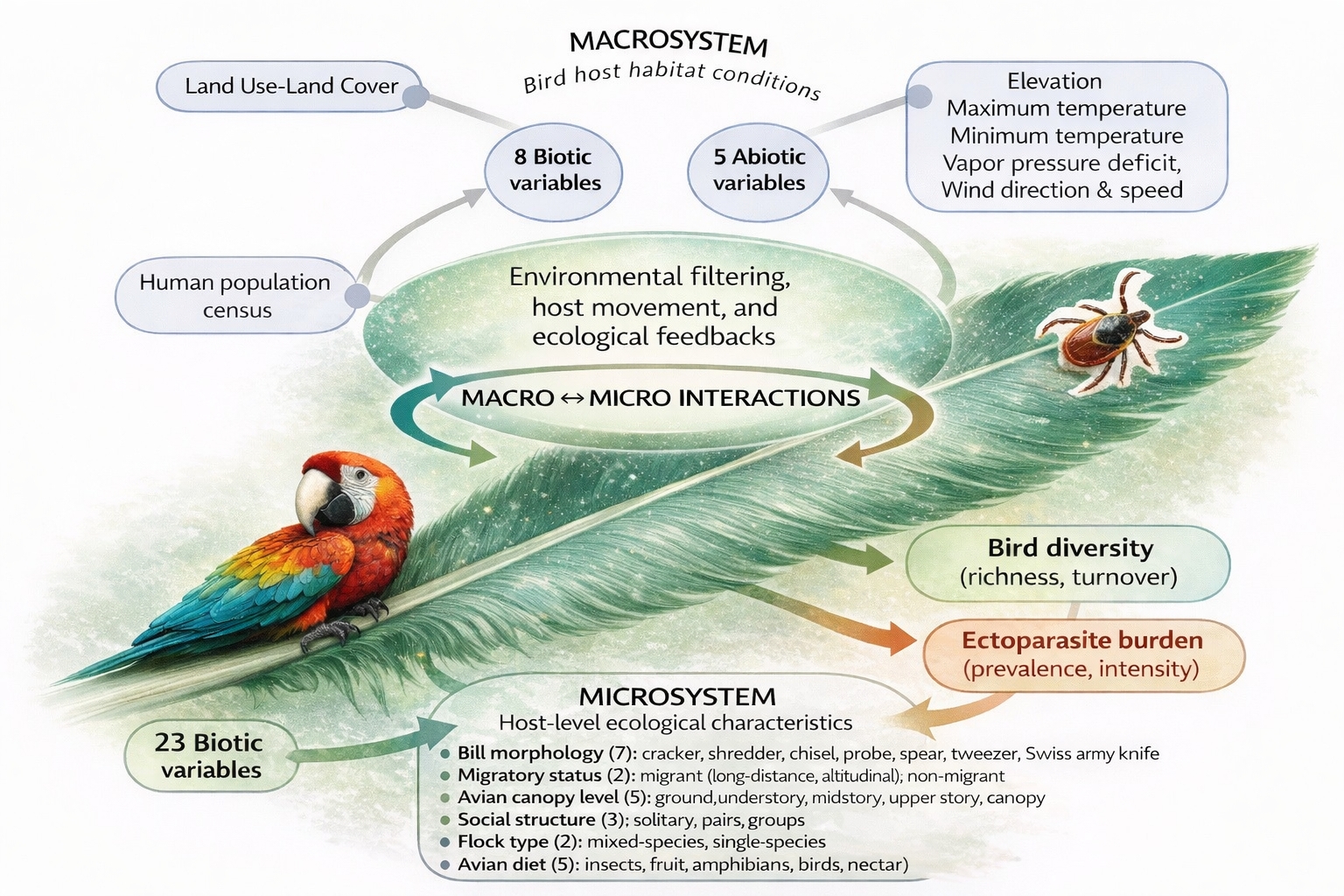
To understand tropical avian ectoparasitism, we analyzed bird–tick data and remote-sensing habitat metrics across the Colombian Andes (2008-2019), sampling 1,164 birds (204 species) across 15 localities (538-3121 m a.s.l.). Macrohabitat variables, land use/land cover (LULC), forest structure, and bioclimatic data were derived from Sentinel-2/CIAT raster products (5 km buffers); microhabitat variables comprised avian morphological and behavioral traits. Random Forest Models (RFMs) linked host and habitat factors to tick presence. Tick prevalence and host assemblages varied significantly by elevation and Andean region. Eastern Andean sites had the highest bird richness and tick infestation rates, whereas middle elevations had the lowest. Remote sensing revealed major LULC shifts over the study period. Forest decline and increased cropland/grassland, especially in the Western Andes, while Eastern sites showed a mixture of habitat loss and recovery. Macrohabitat models identified elevation and vegetation structure (Barren/Sparse vegetation, Closed shrublands) as strong predictors of tick presence (AUC = 95; R² = 62.3%). Microhabitat models highlighted host behavior and morphology (mixed-flock participation, bill shape, foraging strata) (AUC = 82.5%). The integrated model performed best (AUC = 98; R² = 76.4%), confirming that tick–bird dynamics are driven by combined environmental gradients and host traits. Our findings emphasize the value of multi-scale, remote-sensing-informed frameworks for predicting ectoparasite risk in complex tropical systems.
Keywords:
avian ectoparasites
; tick parasitism
; Neotropics
; Colombian Andes
; remote sensing
; Sentinel-2
; land use/land cover
; Random Forest
; host–parasite interactions
; elevation gradient
Copyright: This open access article is published under a Creative Commons CC BY 4.0 license, which permit the free download, distribution, and reuse, provided that the author and preprint are cited in any reuse.


