

Submitted:
31 March 2026
Posted:
01 April 2026
You are already at the latest version
Abstract
Cockroaches display a double symbiosis: an obligate intracellular one with Blattabacterium cuenoti, and a complex extracellular intestinal non-vertically transmitted microbiota, that may be affected by horizontally transmitted factors. Four experiments using 16S rRNA gene amplicon sequencing analyzed the microbiota of the hindgut and feces of adult cockroaches to understand the influence of the environment, feces, and host genetic background on hindgut microbiota acquisition and development. We observed that sample type, rearing conditions, and host influenced microbiota composition. Furthermore, the induction of germ-free cockroaches placed in non-sterile conditions had a greater impact on microbiota than rearing conditions, also showing that in absence of fecal inputs the cockroach gut microbiota is strongly diminished. Moreover, when exploring fecal microbiota differences between three cockroach species, the greatest divergence was found between Periplaneta americana and Blattella germanica, with Blatta orientalis being placed in an intermediate position. Therefore, P. americana was selected for fecal transplantation on B. germanica. This transplantation experiment indicates that host species clearly influence intestinal bacterial selection, limiting full integration of donor-derived communities. Overall, these results suggest that beyond other factors the host species had the strongest influence on shaping the cockroach gut microbiota.
Keywords:
cockroach
; microbiota acquisition
; environmental influence
; coprophagy
; fecal transplantation
; host effect
1. Introduction
Insects are the most diverse and abundant metazoans on Earth, with around one million described species [1]. Most of them are involved in symbiotic associations with bacteria, ranging from mutualistic to parasitic. These interactions can have significant effects on the reproduction and metabolism of the host insects [2], among other aspects of the host’s life. In addition to these well-known effects, insect-associated bacteria also contribute to nutrient metabolism, immune regulation, and ecological adaptation, underscoring their evolutionary relevance. Broadly speaking, two symbiotic systems occur between insects and bacteria: endosymbiosis, like in aphids, where the primary endosymbiont Buchnera aphidicola supplies essential nutrients absent in the host imbalanced diet [3], and ectosymbiosis, such as that involving the gut microbiota of cockroaches and termites, which plays roles in digestion, detoxification, immune modulation, and resilience to environmental fluctuations, allowing both of them to thrive in constantly changing environments [4]. These two systems include functionally diverse associations in insects, and cockroaches illustrate this by combining a long-term obligate endosymbiont with a highly complex and environment-dependent gut microbiota.
Cockroaches are especially interesting because they harbor both symbiotic systems: the obligate intracellular endosymbiont Blattabacterium cuenoti, a vertically transmitted Gram-negative bacterium essential for the host’s survival, participating in nitrogen metabolism [5,6,7,8,9,10], and a complex and rich gut microbiota, which has been characterized for its composition, assembly during development and putative roles in host physiology [8,11,12,13,14,15,16,17,18,19,20,21]. Beyond nutritional functions, the cockroach gut microbiota may also influence host immunity and interactions with pathogens. In fact, studies in Blattella germanica have shown that gut bacteria can modulate susceptibility to entomopathogenic fungi, revealing microbiota-mediated effects on host-pathogen interactions [22].
In insects, gut diversity can be affected by many factors, both environmental and related to host genetics. For example, the strong correlation between host species and gut microbiota composition in omnivorous gregarious cockroaches suggests the importance of host species background in governing microbiota composition [20]. Other factors, like habitat, season, life stage, sex, treatment (antibiotics, pesticides, etc.), and diet, also affect gut microbiota composition [13,17,23,24]. However, despite extensive research, the relative contributions of host genetics versus environmental exposure remain unresolved. This “host genetics vs. environment” debate is particularly relevant in cockroaches, where both strong social behaviors and environmental microbial sources shape microbiota acquisition. Clarifying this issue is essential to understand the stability, evolution, and plasticity of insect–microbe associations.
B. germanica, a social insect from the order Blattodea, exhibits group behaviors, including selection of populated shelters, kin recognition, and chemical communication, among others [25,26,27,28]. Sharing shelter promotes coprophagy, where juveniles feed on adult feces, which is potentially involved in gut microbiota establishment and maturation [29,30]. Blattabacterium is the only bacterium present in the ootheca, confirming the absence of vertical transmission of gut microbiota [8]. Subsequently, newborn nymphs are germ-free and acquire bacteria in their first nymphal instar. By the second nymphal stage, their microbiota is established, primarily through ingesting feces from adults by coprophagy [17], an indirect form of vertical transmission mediated by social behavior and distinct from the transovarial transmission of Blattabacterium. Our recently developed gnotobiotic B. germanica population [31] enables the study of gut microbiota differences through different approaches, providing a model to understand the roles of the host, gut tissue, environment, and other factors in microbiota acquisition.
This study aimed to better understand the influence of the environment, feces, and genetic background of the host species on the acquisition and development of the gut microbiota in adult cockroaches. Four experiments were conducted (Figure 1) to (i) compare the microbiota of two B. germanica populations with the same genetic background but separated for two decades, (ii) study the environmental impact in one generation on germ-free B. germanica populations, (iii) compare the fecal microbiota of B. germanica, Periplaneta americana, and Blatta orientalis, and (iv) elucidate the role of the host in interspecies fecal transplantation.
2. Materials and Methods
2.1. Rearing Conditions of Cockroaches
All cockroach populations were reared in climatic chambers at 25 ºC, 60% humidity, and photoperiod of 12L:12D. They were fed with three different dog-food pellets—SAFE 125 (Rettenmaier Ibérica, Barcelona, Spain), Teklad Global 21% protein dog diet, 2021C (Envigo, Indiana, USA) and Vitality (Elmubas Ibérica, Gipuzkoa, Spain)—depending on experimental design and on the rearing location (Supplementary Table S1), and water was provided ad libitum.
2.2. Obtaining Germ-Free Cockroaches and Quality Control
Mature oothecae were collected from synchronized B. germanica adults, and their surfaces were sterilized by immersion for 20 seconds in 0.1% SDS, followed by 12 minutes of 2% peracetic acid with gentle shaking. Subsequently, the oothecae were rinsed twice with sterile type II water to remove the antiseptic solution and transferred to sterile gauze to remove water excess. The aseptic oothecae were incubated individually in sterile 50 mL tubes at 25 ºC until hatching, following our previously described methodology [31].
After hatching, quality control tests were conducted to assess the efficacy of the sterilization. Two nymphs from each ootheca and the ootheca itself were tested for microbial growth by plating them on BHI agar plates, which were incubated at 37 ºC for 24 hours and then transferred to 25 ºC for two weeks. In case of detection of microbial growth, contaminated batches were discarded. The protocol employed to verify sterility was established according to our previously described and validated methodology [31].
2.3. Insect Dissection
Female cockroaches of B. germanica were anesthetized with CO2 and maintained on ice until dissection. The insects were cleaned with 10% bleach and 70% ethanol solution, followed by a double wash with type II water. Subsequently, they were placed in a supine position on a silicone plate and fixed with entomological pins. The hindgut tissue was collected, opened longitudinally, and cleaned with Krebs-Ringer bicarbonate buffer (Sigma-Aldrich). Finally, the hindgut tissue was immediately frozen with liquid nitrogen and stored at -80 ºC.
Given the technical constraints associated with generating and maintaining germ-free individuals, together with the stringent sterility controls that required discarding any contaminated oothecae, sample sizes per group were necessarily limited while still ensuring consistent recovery of high-quality hindgut material for downstream microbiome analyses. Fecal sample numbers were adjusted accordingly to maintain a balanced design across sample types.
2.4. Experimental Designs
Experiment 1. To investigate the environmental effects on B. germanica populations with the same genetic background but separated for a long time, two laboratory populations of B. germanica were studied. The original population (rB) was reared at the Institute of Evolutionary Biology (CSIC-UPF, BCN) by X. Bellés’ group. The second population (rV1) was established at the Institute for Integrative Systems Biology (I2SysBio, VLC) from the initial population. Both populations were fed with dog-food pellets—SAFE 125 (Rettenmaier Ibérica, Barcelona, Spain), and Teklad Global 21% protein dog diet, 2021C (Envigo, Indiana, USA), respectively. Both populations have remained separated for over two decades. Adults were collected from a synchronized population between 0 and 48 hours after adult ecdysis. Five females from each population were dissected 10 days after the population started, and their hindgut tissues were collected. Additionally, four fecal samples were collected from adults of each population.
Experiment 2. To investigate the impact of different environments on hindgut microbiota, we initiated the study following our previously published protocol [31] to obtain germ-free nymphs, which were subsequently placed in separate environments. Mature oothecae were collected from females of a synchronized sex-balanced population of cockroaches established at the I2SysBio. The oothecae were sterilized following the protocol described previously. Once hatching had occurred and after checking for sterility, the nymphs emerged from the sterilized ootheca. They were used to initiate two populations maintained in two separate environments, preventing coprophagy of feces from adults. One population, comprising 80 nymphs, was placed in a climatic chamber at I2SysBio (rV1), while the other population, comprising 82 nymphs, was placed in a climatic chamber at ICBiBE (rV2). Both populations were fed with the same dog-food pellets (Teklad Global 21% protein dog diet, 2021C, Envigo, Indiana, USA). Adults were separated within 48 hours after ecdysis and maintained for 10 days. Hindgut tissues from five females in each population were then dissected.
Experiment 3. Feces from three laboratory-reared species were obtained to compare the fecal microbiota among cockroach species. Each location had its own dog-food pellets for feeding. Specifically, three populations of B. germanica raised in climatic chambers at rB, rV1, and rV2, plus one population of P. americana and another of B. orientalis, both raised at rV2, were examined. Four fecal samples per population were analyzed.
Experiment 4. To investigate how the host impacts the gut microbiota, germ-free populations of B. germanica were generated, as previously described. Following hatching and verification of axenic status, germ-free nymphs were divided into two populations. One group of 110 nymphs was given B. germanica feces for 15 days and reared in a climatic chamber at rV1. The other population of 108 nymphs was provided with P. americana feces for 15 days and reared at rV2. Both populations were fed with the same dog-food pellet (Teklad Global 21% protein dog diet, 2021C). Adults were collected within 48 hours after ecdysis and maintained for 10 days. Each transplanted population was maintained in the environment corresponding to the feces donor species, in order to prevent cross-contamination in the rearing chamber with the donor species’ microbiota. Hindgut tissues from five females in each group were then dissected and analyzed.
2.5. DNA Extraction and Metabarcoding Sequencing
The total DNA of hindgut and fecal samples was extracted using the Jet-Flex Genomic DNA Extraction Kit (Genomed, Germany) with modifications [18]. Metabarcoding sequencing was conducted at the facilities of FISABIO, Valencia (Spain). The extracted DNA served as a template for amplification using specific primers of the V3-V4 variable region of the 16S rRNA gene. The resulting amplicons were sequenced as 2×300 bp paired-end reads on a MiSeq platform (Illumina).
2.6. Sequence Processing and Taxonomic Assignment
Primer removal was carried out on raw sequence files using Cutadapt v3.2 [32], and untrimmed sequences were discarded. Reads were processed using DADA2 v1.18.0 [33]. Quality trimming and filtering were conducted for forward (260 bp, 3 maxEE) and reverse reads (210 bp, 5 maxEE). Amplicon sequence variants (ASVs) were determined, paired-end reads were merged, and chimeric sequences were eliminated. Taxonomy assignment was performed using IDTAXA classifier [34] from DECIPHER v2.18.0 [35] against SILVA v138 reference taxonomy database [36] using a 50% threshold. Unclassified ASVs, those identified as mitochondria or chloroplasts, not belonging to the Bacteria and Archaea domains, or matching the Blattabacterium endosymbiont, were removed. For taxonomic classification at the genus level, ASV counts were grouped based on the last identifiable taxonomic level, with higher levels marked as unclassified.
2.7. Microbiome Analysis
The analyses were carried out mainly with the R programming language, using Microbiome v1.22 [37], Phyloseq v1.44.0 [38], and Vegan v2.6-4 [39]. A significance threshold of 0.05 was set for all analyses.
Alpha diversity. For alpha diversity analysis, indexes were computed at the ASV level using the Microbiome package. Differences between groups were studied by pairwise comparisons. After evaluating normality with the Shapiro test and homogeneity of variance with the Levene test, we worked with the parametric pairwise.t.test with equal variances for Observed Richness and the parametric t.test with non-equal variances for Shannon’s Diversity Index (Supplementary Table S2). P-values were adjusted by the Benjamini-Hochberg (BH) method.
Beta diversity. For beta diversity analysis, Aitchison distances (Euclidean distance with CLR transformation) were used. Abundance data was centered log-ratio transformed (CLR) using the Microbiome package. Only taxa with abundance above 0.01% in at least one sample were considered. Inter-sample differences were investigated employing a Principal Component Analysis (PCA). Differences between groups were tested with a permutational multivariate analysis of variance (PERMANOVA) and 10,000 permutations using Vegan’s “adonis2” function at ASVs (Supplementary Table S3) and genus levels (Supplementary Table S4). Pairwise comparisons between groups were corrected using the BH method. A model using the “betadisper” function was also calculated to test group homogeneity later using the “permutest” function. Furthermore, pairwise homogeneity differences between groups were also analyzed using TukeyHSD on the betadisper objects. Finally, variables of interest were studied by means of a PERMANOVA at the genus level for each experimental design with different models (Supplementary Table S5). Furthermore, for each experimental-design PCA, the “scores” function from the Vegan package was used to obtain the ordination scores of the top 50 taxa for the first two principal components.
Differential abundance analysis. Significant differences in taxon abundances were evaluated using ALDEx2 v1.32.0 [40]. Only taxa with abundance above 0.01% in at least one sample were considered. GLM and KW tests for one-way ANOVA of two or more conditions were used, using 1,000 Monte Carlo samples. P-values were adjusted using the BH method. Only significant taxa in both tests were conserved. Heatmaps based on Z-scored average relative abundances were generated using ComplexHeatmap v2.16.0 [41].
Similarity analysis. Taxa similarities between groups of interest were analyzed using ComplexUpset v1.3.3 [42] and ggvenn v0.1.10 [43] at the genus level. For the resulting plots, a taxon was considered to be present in the groups if it was detected in at least one sample.
Microbiome core analysis. Core microbiome analysis was done at the genus level using the Microbiome package, with a relative abundance threshold of 0.0001 and a prevalence threshold of 1 (presence in all samples). Taxonomy graphics were generated using Metacoder v0.3.6 [44].
3. Results
Sample codes follow a unified structure identifying the host species (Bge: Blattella germanica; Pam: Periplaneta americana; Bor: Blatta orientalis), sample type (H: hindgut; F: feces), and the experimental conditions, including: germ-free status (GF: germ-free individuals), fecal donor during transplantation (BgeF: fecal input from B. germanica; PamF: fecal input from P. americana), and rearing environment (rB: rearing place Barcelona in CSIC-UPF; rV1: rearing place Valencia1 in I2SysBio; rV2: rearing place Valencia2 in ICBiBE). For example, “Bge_H_GF_PamF_rV2” corresponds to a B. germanica hindgut sample obtained from a germ-free recipient transplanted with P. americana feces and reared in environment V2.
3.1. Global Microbial Diversity
Across all experiments (Figure 1), 50 samples were analyzed (Supplementary Table S1). After processing, 6,146,692 reads were retained, comprising 3,004 ASVs with an average of 122,934 reads per sample (minimum: 34,810 and maximum: 1,041,372 reads).
The hindgut and fecal microbiotas of cockroaches are complex and diverse (Supplementary Figure S1). With 19 phyla identified, Bacteroidota was usually the most abundant (43.09% on average), followed by Firmicutes (24.68%), Proteobacteria (12.55%), Fusobacteriota (9.18%) and Desulfobacterota (5.45%). At the genus level, most of the community remained unclassified (60.18% on average). Among classified genera, Fusobacterium was the most abundant (9.18%), followed by Dysgonomonas (8.58%) and Desulfovibrio (3.96%), all of which were highly depleted in untransplanted germ-free samples.
For alpha diversity (Figure 2A-B), fecal samples exhibited the highest richness and diversity, with significant differences observed (Supplementary Table S2). Among feces, B. orientalis displayed higher richness and diversity than B. germanica and P. americana. As expected, untransplanted germ-free gut samples exhibited the lowest richness and diversity (Bge_H_GF_rV1 and Bge_H_GF_rV2) with significant differences when compared to other groups. The standard B. germanica gut samples (Bge_H_rB and Bge_H_rV1) showed intermediate values between those from fecal samples and those from untransplanted germ-free gut samples, with no significant differences between the two groups. Finally, regarding gut transplanted samples, those transplanted with P. americana feces (Bge_H_GF_PamF rV2) displayed significant lower richness and diversity than B. germanica intra-species feces transplants (Bge_H_GF_BgeF rV1), which was also the case when comparing with standard B. germanica gut samples. Meanwhile, the B. germanica intra-species feces transplants showed no significant differences in terms of diversity when comparing with standard B. germanica gut samples, but were significantly higher in richness.
When studying beta diversity at ASV and genus levels (Figure 2C-D), great heterogeneity was shown, with a variation in the PCA explained by the two first axes of 47.72% and 47.33%, which increased to 59.02% and 59.46% when adding the third component (Supplementary Figures S2 and S3), respectively. A noticeable effect of the host and the cockroach species of origin of the microbiota was observed. Regarding B. germanica, transient germ-free untransplanted guts (Bge_H_GF_rV1 and Bge_H_GF_rV2) exhibited great differences from the rest of the samples. Differences by rearing place were also found (rB, rV1 and rV2). Interestingly, gut transplanted with P. americana feces (Bge_H_GF_PamF_rV2) had an intermediate position at the ASV level. In contrast, at the genus level, it ended up being closer to the rest of B. germanica samples. These differences were significant across all groups when using a PERMANOVA at both taxonomic levels. Furthermore, permutest (P = 0.0001 at the ASV level, and P = 0.0156 at the genus level) and subsequent TukeyHSD revealed the presence of variance differences between groups (25 pairs at the ASV level and 2 pairs at the genus level), indicating that dispersion differences contribute to the observed multivariate differences in community composition (Supplementary Tables S3 and S4).
3.2. Comparison of the Gut Microbiota of Twinned Populations of B. germanica
The first experiment aimed to compare two populations of B. germanica with the same genetic background reared under similar environmental conditions but fed with different foods and that had remained separated for 20 years (rB and rV1). When comparing feces and gut microbiotas at the genus level (Figure 3A-B), the first component separated samples based on rearing place. While examining their associated taxa, unclassified Desulfobacterales, Elusimicrobium, and Endomicrobium characterize rV1, while others like Candidatus Symbiothrix, Pediococcus, and Acinetobacter drove differences towards rB. Meanwhile, the second component mainly separated samples by sample type. Unclassified Yersiniaceae, Bacteroides, and Paludibacter characterize fecal samples, while others like Acetobacter, Harryflintia, and Ralstonia drove differences toward gut samples. Different PERMANOVA models were performed (Supplementary Table S5-A1). In all models, rearing place explained most of the between-sample variation (R2=0.446), followed by sample type (R2=0.195), both being significant. Interaction effects between both variables were also detected, easily explained by the greater intra-similarity between rV1 samples.
Despite differences, most taxa were present in all four groups (Figure 3C and Supplementary Table S6-A1). Furthermore, 21 genera were found exclusively in feces in both locations. More genera were identified exclusively in feces from rB compared to rV1. Additionally, unique genera in both feces and gut for each place were found.
3.3. Exploring the Environmental Effect of Germ-Free Cockroaches
The second experiment studied the effect that the environment exerts on the gut microbiome. For this purpose, oothecae of B. germanica from the same rearing place were subjected to a sterilization process, and germ-free nymphs were placed in two different environments (rV1 and rV2), avoiding contact with feces within non-sterile conditions. When comparing control (Bge_H_rV1) with transient germ-free cockroach guts reared in two different environments (Bge_H_GF_rV1 and Bge_H_GF rV2), the first component separated samples based on the germ-free condition (Figure 4A-B). Upon examining their associated genera, unclassified Enterobacterales, Pseudomonas, and Delftia drove differences toward initial germ-free gut samples. In contrast, others like Alistipes, Mucispirillum, or Tannerella were more related to the control gut. Meanwhile, the second component separated samples by rearing place. Taxa like unclassified Enterobacterales drove differences towards rV1, while others, such as Hydrogenoanaerobacterium and Erysipelatoclostridium, characterized rV2. Different PERMANOVA models were performed (Supplementary Table S5-A2). In all models, the germ-free condition explained most of the between-sample variation (R2=0.496), followed by rearing place (R2=0.317), both being significant.
Despite differences, 29 taxa were present in all three groups (Figure 4C and Supplementary Table S6-A2). However, the majority are highly depleted in transient germ-free untransplanted guts, except for a few taxa that became highly abundant, displacing the rest of the microbial community (Supplementary Figure S1B). Additionally, 27 taxa were found exclusively in rV1’s gut control. These taxa, present in rV1 and rV2 B. germanica feces (Supplementary Table S6), were absent in guts from coprophagy-blocked individuals, indicating that they are acquired from feces and not environmentally transmitted.
3.4. Comparison of the Fecal Microbiota of Three Cockroach Species
The third experiment aimed to compare the fecal microbiota of B. germanica and two other cockroach species in order to choose the most suitable donor for subsequent inter-species fecal transplantation. When comparing the feces of the three cockroach species at the genus level (Figure 5A-B), the first component separated samples based on host species. The fecal microbiota of P. americana was the most divergent from B. germanica, while B. orientalis occupied an intermediate position. Upon examining their associated genera, unclassified Micrococcales, Candidatus Symbiothrix, Elizabethkingia, or Serratia characterized B. germanica feces. In contrast, others like Ruminococcus, or unclassified Burkholderiales, drove differences towards B. orientalis and P. americana. Meanwhile, the second component separated samples by rearing place. Samples in rV1 were arranged at the top, while rV2 and rB were at the center and bottom, respectively. Taxa like unclassified Acetobacteraceae and unclassified Enterococcaceae drove differences towards the positive axis, while others, such as Candidatus Symbiothrix, moved it towards the negative axis. Different PERMANOVA models were performed (Supplementary Table S5-A3). In all models, the host always explained most of the between-sample variation (R2=0.367-0.56), followed by the rearing place (R2=0.343), both being significant.
Despite the observed differences, 73 genera were shared by the feces of the three cockroaches (Figure 5C and Supplementary Table S6-A3). Only one taxon was unique to B. germanica and present in its three groups, while two genera were unique to B. orientalis. In contrast, 12 genera were exclusively found in P. americana. Furthermore, 18 genera were shared by B. orientalis and P. america while absent in B. germanica. Moreover, two genera were shared by all B. germanica populations and B. orientalis but absent from P. americana. Therefore, P. americana was chosen as the fecal donor for the cross-species fecal transplantation experiment, as it displayed the most differences and taxa of its own with respect to the recipient B. germanica.
3.5. Inter-Species Cockroaches’ Fecal Transplantation
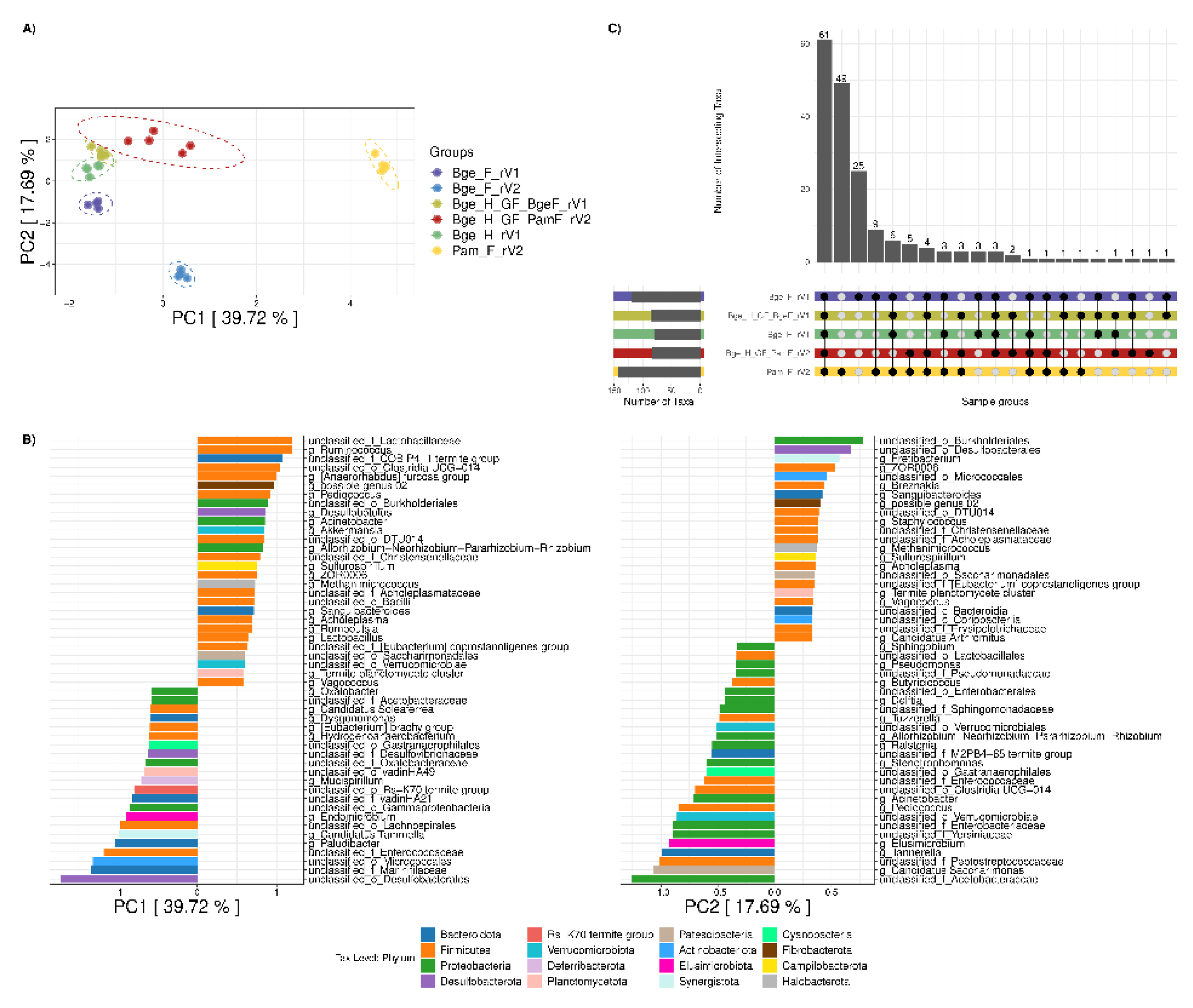
The fourth experiment explored the effect of fecal transplantation between cockroach species. For this purpose, oothecae of B. germanica from a single rearing place were subjected to a sterilization process, placed in two different environments (rV1 and rV2), and provided with different input feces from B. germanica and P. americana, respectively. Microbiota of donor feces (Bge_F_rV1 and Pam_F_rV2) and the host’s control gut (Bge_H_rV1) were compared with the gut microbiota of transplant recipients (Figure 6A-B). Host species mainly influenced the first component, although rearing place also played a role. Taxa such as Ruminococcus, or unclassified Lactobacillaceae, drove differences towards the positive axis related to P. americana and rV2. In contrast, others, like unclassified Marinifilaceae, and unclassified Desulfobacterales, drove differences towards the negative axis related to B. germanica and rV1. Meanwhile, the second component appeared to reflect a combination of factors, including sample type, transplant, and input feces species. Different PERMANOVA models were performed (Supplementary Table S5-A4). In all models, the host always explained more of the variation between samples than other variables (R2=0.146-0.362). All variables were significant in all models.
In total, 61 taxa were shared across all groups (Figure 6C and Supplementary Table S6-A4). The majority of taxa exclusive to feces were restricted to either P. americana or B. germanica, with 49 and 25 genera, respectively. Only nine genera were shared by the feces of both species. Taxa potentially influenced by the germ-free transplant process were also identified, with three taxa present in the standard B. germanica gut and donor feces but absent in transplanted guts. Additionally, four taxa were detected in all groups except the control B. germanica gut. Likewise, some taxa related to feces donors were found, with five taxa exclusive to donor P. americana and one exclusive to donor B. germanica.
A differential abundance analysis was also performed at the genus level (Supplementary Figure S4 and Supplementary Table S7). A total of 93 taxa showed significant differential abundance. The group of guts transplanted with B. germanica feces and the control gut of B. germanica clustered together. The closest group to these was the donor feces of B. germanica. These three groups presented both particular and different taxa clusters, which were generally more enriched in them. The next group in clustering was the gut transplanted with P. americana feces. It mainly presented particular enriched groups, and others shared with the furthest group, which consisted of donor feces of P. americana. The latter had the highest number of enriched taxa compared to the rest of the groups.
3.6. Analysis of the Core Microbiome
Only taxa detected in samples under standard conditions were considered for core analyses to explore highly prevalent taxa in the hindgut of B. germanica and feces of the three cockroach species (Supplementary Figure S5 and Supplementary Table S8). Genera like Fusobacterium, Dysgonomonas, Alistipes, Candidatus Soleaferrea, and Desulfovibrio were shared across all cores. Generally, they exhibited high abundances, whereas other common to all core taxa, including Oxalobacter, Robinsoniella, Hydrogenoanaerobacterium, and Raoultibacter were less abundant. Most core taxa belonged to phyla Firmicutes, Bacteroidota, and Proteobacteria. Notably, Patescibacteria and Verrucomicrobiota were absent in the hindgut core but shared by fecal cores. Meanwhile, Elusimicrobiota was shared exclusively by fecal cores of B. orientalis and P. americana. The hindgut core of B. germanica shared the most taxa with other cores but had the lowest number of taxa. Moreover, among fecal cores, B. germanica had the lowest number of taxa and was the only one without exclusive taxa. The fecal core of B. orientalis presented exclusive taxa, including phylum Cyanobacteria, and genera such as Anaerofustis, Sedimentibacter, Tuzzerella, or Ralstonia. Finally, the fecal core of P. americana had the highest number of total and exclusive taxa, including phyla Synergistota, Fibrobacterota, Campilobacterota, and Halobacterota, and genera such as Fretibacterium, Sulfurospirillum, Akkermansia, Desulfobotulus, or the Archaea Methanimicrococcus.
4. Discussion
In this work, we performed four different experiments, each with the goal of answering one particular question. The design has also allowed us to analyze the data globally and to understand the biotic and abiotic factors that drive gut microbiota acquisition in cockroaches. Thus, we analyzed the gut and feces from B. germanica, our model study, and feces from P. americana and B. orientalis. Fecal samples were included because coprophagy plays a role in shaping gut microbiota in gregarious insects [17,45]. The most abundant phyla were Bacteroidota, followed by Firmicutes and Proteobacteria, in concordance with previous studies in B. germanica [8,17,18,19,20], B. orientalis [46] and P. americana [20,21,47,48].
In the first experiment, we planned to address whether the genetic background of cockroaches has a greater impact than the environment in shaping the gut microbiota of adult cockroaches. We found that, after two decades of separated rearing (rB and rV1), both gut and fecal samples were more similar among samples from the same environment. It is worth mentioning that cockroaches in each environment were fed different types of food, highlighting the importance of diet as one of the environmental components, among other uncontrolled environmental factors. This corroborates previous results showing that diet is a key factor in microbiota composition in insects and other animals [13,49,50,51].
After these results, a second experiment was designed to study the effect of the abiotic environment on microbiota. Two initially germ-free B. germanica populations were reared in two different environments (rV1 and rV2), preventing contact with adult feces. We compared the gut microbiota composition from both populations with that of a control population reared in rV1. The lowest diversity and richness were found in the gut of transient germ-free cockroaches (Bge_H_GF_rV1 and Bge_H_GF_rV2), which was expected as these cockroaches could only acquire their microbiota through food and the environment. We also found that the microbiota of the two initially germ-free populations was more similar to each other than the two populations of cockroaches reared in the same environment and provided with the same diet (Bge_H_GF_rV1 and Bge_H_rV1), with the difference lying in the absence or presence of fecal inputs. This result highlights the importance of coprophagy as a key strategy for microbiota acquisition in adult cockroaches, as previously shown in some invertebrates [52,53], and to ensure adequate diversity and a stable community structure.
Considering that coprophagy is important for gut microbiota formation, in the third experiment, we studied the fecal microbiota from three species of cockroaches to understand their composition and how different fecal microbiotas depend on different factors. We found that the main factor that separates samples is the host species, even for species fed with the same type of diet and environment, in agreement with previous studies on different laboratory-raised species of genus Periplaneta for several generations under the same conditions [47]. Interestingly, fecal microbiotas from P. americana and B. orientalis, both members of the family Blattidae, cluster closer together compared with that of B. germanica, a member of the family Blattelidae, indicating that host genetics play a key role in favoring determined taxa over others in gut microbiota. As in previous works [20,54,55,56], the microbiota clustered strongly according to host species, thus indicating a significant relationship between host species identity and gut microbiome composition.
These results from the third experiment indicated that P. americana harbored the fecal microbiota most divergent from that of B. germanica. Accordingly, P. americana was selected as the donor species for the fourth experiment to provide the strongest contrast for assessing host-driven filtering during transplantation. Thus, to elucidate the role of the recipient host species in fecal transplantation, we used germ-free nymphs of B. germanica populations reared in two different environments (rV1 and rV2) provided with feces from two different donors (B. germanica and P. americana). Inter-species transplanted guts with P. americana feces showed lower richness and diversity than intra-species transplanted ones. In other studies, the gut microbiota of P. americana showed Shannon diversity values over 5 [48]. In contrast, in this study, B. germanica individuals transplanted with P. americana feces showed values around 3-4. Taken together, this suggests that the host can select certain taxa within the donor-derived microbiota; and that B. germanica retains only a subset of the P. americana microbiota, consistent with host-driven filtering and limited establishment of non-native taxa. Similar host-driven selection has been described in Drosophila melanogaster, which uses different genes and mechanisms to protect itself from potentially harmful microorganisms in the gut [57,58,59]. Comparable effects have also been reported in hemimetabolous insects such as termites and other Blattodea, where gut structure and host characteristics shape microbial assembly [14,60].
Insects rely on several host-driven mechanisms to filter and stabilize their gut microbial communities. Immune-based screening mediated by the Toll, IMD, and JAK/STAT pathways plays a central role in recognizing and restricting non-compatible microorganisms, thereby shaping which taxa can successfully colonize the gut environment [61]. In addition, the micro-environment of the digestive tract, with variations in gut pH, spatial oxygen gradients, and nutrient availability, may act as an ecological filter that favors specific bacterial lineages, as demonstrated in mechanistic studies of insect gut colonization [62]. These processes are consistent with the idea that immune regulation, physiological conditions, and molecular compatibility contribute to shaping how hosts selectively assemble and maintain their microbiota [59]. Although these mechanisms are best understood in D. melanogaster, comparable pathways have not yet been examined in cockroaches, and their role in Blattodea remains to be clarified. Our results fit well with this view, as the inter-species transplants showed lower diversity and a different community structure, and the germ-free groups became similar to each other regardless of the environment, indicating that B. germanica retains only part of the microbiota it receives. In this context, possible mechanisms in cockroaches may include immune screening, physicochemical constraints of the hindgut, and metabolic compatibility between the host and specific bacterial groups, as suggested for other insects.
Furthermore, we observed that there is a higher degree of divergence among the microbiota from donor feces than among the recipient gut samples in the presence of different feces and environments, and this seems to indicate again that the host species mainly influence the microbiota composition. This suggests a more dominant role of the host species over all other studied factors and reinforces the idea that the host shapes its gut microbiota [59]. Nevertheless, the effect of the species donor cannot be ruled out, as clearly seen in the PCA (Figure 6), because the gut microbiota of transplanted B. germanica receiving P. americana feces separated from the gut microbiota of control cockroaches and guts transplanted with B. germanica feces. However, the specific host mechanisms underlying this filtering in B. germanica remain unknown. Based on other insect systems, it is possible that a combination of immune regulation and hindgut physiology determines which taxa can successfully colonize the community. Testing this would require experimental approaches that integrate microbiome manipulation with host physiological responses.
Likewise, the fecal core microbiota of three ubiquitous species of cockroaches was characterized in a comparative manner. This is of particular interest as these cockroaches are considered as common pests that act as vectors of pathogens and antimicrobial resistance [63], providing a baseline that could serve as reference for future studies.
However, it must be acknowledged that the small sample size per group represents a limitation of this study and may reduce the ability to detect subtle or low-effect microbiota differences. Although the general patterns were consistent across experiments, larger cohorts will be necessary to increase statistical power and better resolve fine-scale variation.
5. Conclusions
Taken together, the results of the four experiments, we conclude that the acquisition of the gut microbiota in adult cockroaches is a multifactorial process. Therefore, different aspects of the environment (e.g. diet and rearing place) play a role in the development of their mature microbiota [64], being the biotic part, and especially feces, crucial for the establishment and development of cockroach gut microbiota. However, we have demonstrated that the factor that most strongly shapes the gut microbiota is the host species. Future work should test which host factors are most important (i.e. immune filtering versus hindgut physicochemical constraints) and how these interact with microbe–microbe relationships during colonization to gain a better understanding of gut microbiota acquisition in adult insects.
Supplementary Materials
The following supporting information can be downloaded at the website of this paper posted on Preprints.org. Figure S1: Microbiome composition barplots. The most abundant taxa are shown, representing the top 10 phyla (A) and top 30 genera (B) in terms of relative abundance. The rest of the taxa are summarized in the “other” taxon. Background colors and identifying labels match those used to name the experiments in Figure 1.; Figure S2: Interactive PCA plot with CLR transform data at the ASV level for the first three principal components PC1, PC2, and PC3. Related to Figure 2C.; Figure S3: Interactive PCA plot with CLR transform data at the genus level for the first three principal components PC1, PC2, and PC3. Related to Figure 2D.; Figure S4: Heatmap of the differentially abundant genera in the fecal transplant design. Z-scored average relative abundances by group are represented for the 93 significant taxa based on ALDEx2 results. On the left side, Log10 (average relative abundances) by group are also displayed, where gray cells represent absent taxa in the group.; Figure S5: Core microbiome analysis. Taxonomic relationships between different core genera for the hindgut of B. germanica including rV1 and rB (A), feces of B. germanica including rB, rV1, and rV2 (B), feces of B. orientalis in rV2 (C), and feces of P. americana in rV2 (D). Only genera detected in all the samples of each grouping in standard conditions were considered with a minimum relative abundance threshold of 0.0001. Color axes represent the core uniqueness of the different taxonomic levels, whereas the terminal nodes represent the Log10 (average relative abundance) by grouping of the different core genera.; Table S1: Detailed metadata of cockroach groups and samples.; Table S2: Alpha diversity tests at the ASV level based on Observed Richness and Shannon’s Diversity Index. For each metric, the results of the t tests are reported, along with the Shapiro and Levene tests used to verify the assumptions for their applicability. Adjusted p-values were corrected with the BH method. A significance level threshold of 0.05 was set.; Table S3: Global beta diversity tests at ASV level based on Aitchison distances. All groups were compared using a global and pairwise PERMANOVAS. A model using the “betadisper” function was also computed to test global and pairwise groups homogeneity using the permutest and TukeyHSD, respectively. Adjusted p-values were corrected with the BH method. A significance level threshold of 0.05 was set.; Table S4: Global beta diversity tests at genus level based on Aitchison distances. All groups were compared using a global and pairwise PERMANOVAS. A model using the “betadisper” function was also computed to test global and pairwise groups homogeneity using the permutest and TukeyHSD, respectively. Adjusted p-values were corrected with the BH method. A significance level threshold of 0.05 was set.; Table S5: Particular beta diversity PERMANOVA tests at the genus level for the different experimental designs based on Aitchison distances. A significance level threshold of 0.05 was set. Results are separated by experimental analyses (A1-A4).; Table S6: Presence-absence data at the genus level. Related to Venn diagrams and upset plots. Taxa were considered to be present in the groups if detected in at least one sample. Results are presented globally (All) and separated by experimental analyses (A1-A4).; Table S7: ALDEx2 difference abundance results at the genus level for the fecal transplant design. GLM and KW tests for one-way ANOVA of two or more conditions were used. P-values were adjusted using the BH method. A significance level threshold of 0.05 was set.; Table S8: Presence-absence data for the core genera. Only genera detected in all samples of each grouping in standard conditions were considered with a minimum relative abundance threshold of 0.0001.
Author Contributions
Conceptualization, A.L., C.G.F. and A.M.; methodology, C.G.F.; software, S.P.E.; formal analysis, S.P.E.; investigation, R.D.S.; resources, A.L. and A.M.; data curation, S.P.E. and R.D.S.; writing—original draft preparation, S.P.E., V.P.B. and R.D.S.; writing—review and editing, S.P.E., V.P.B., R.D.S., A.L., C.G.F. and A.M.; visualization, S.P.E., V.P.B. and R.D.S.; supervision, A.L. and A.M.; project administration, A.M.; funding acquisition, A.L. and A.M. All authors have read and agreed to the published version of the manuscrip.
Funding
This research was funded by Conselleria d’Educació, Generalitat Valenciana (Spain) (Prometeo/2018/133 and CIPROM/2021/042). S.P.E. was supported by an FPU grant from the Spanish Ministry of Universities (FPU20/05756).
Data Availability Statement
Sequence data were deposited to the European Nucleotide Archive under study accession PRJEB85908. Samples’ metadata are included in Supplementary Table S1. Data and code on which this work is based can be found on GitHub (https://github.com/tbcgit/Blattella_study).
Acknowledgments
Data processing was mainly performed on the high performance computing cluster Garnatxa at I2SysBio.
Conflicts of Interest
The authors declare no conflicts of interest.
Abbreviations
The following abbreviations are used in this manuscript:
| 16S rRNA | 16S ribosomal RNA gene |
| ANOVA | Analysis of Variance |
| ASV | Amplicon Sequence Variant |
| BCN | Barcelona |
| Bge | Blattella germanica |
| BgeF | Fecal input from B. germanica during transplantation |
| BH | Benjamini-Hochberg |
| BHI | Brain Heart Infusion |
| Bor | Blatta orientalis |
| CLR | Centered Log-Ratio transformation |
| CSIC-UPF | Institute of Evolutionary Biology, Spanish National Research Council - University Pompeu Fabra |
| F | Feces |
| GF | Germ-Free |
| GLM | Generalized Linear Model |
| H | Hindgut |
| I2SysBio | Institute for Integrative Systems Biology |
| ICBiBE | Cavanilles Institute of Biodiversity and Evolutionary Biology |
| IMD | Immune Deficiency |
| JAK/STAT | Janus Kinase/Signal Transducers and Activators of Transcription |
| KW | Kruskal Wallace |
| ns | Not Significant |
| Pam | Periplaneta americana |
| PamF | Fecal input from P. americana during transplantation |
| PCA | Principal Component Analysis |
| PERMANOVA | Permutational Multivariate Analysis of Variance |
| rB | rearing place Barcelona (CSIC-UPF) |
| rV1 | rearing place Valencia1 (I2SysBio) |
| rV2 | rearing place Valencia2 (ICBiBE) |
| SDS | Sodium Dodecyl Sulfate |
| USA | United States of America |
| VLC | Valencia |
References
- Sollai, G.; Solari, P. An overview of “Insect Biodiversity”. Diversity 2022, 14, 134. [CrossRef]
- Goryacheva, I.; Andrianov, B. Reproductive parasitism in insects. The interaction of host and bacteria. Biol. Commun. 2021 66, 17–27. [CrossRef]
- Latorre, A.; Moya, A. Role of symbiosis in evolution. In Evolution from the Galapagos: Two Centuries after Darwin; Trueba, G., Montúfar, C., Eds.; Springer: New york, USA, 2013; pp. 63–70. [CrossRef]
- Siddiqui, R.; Elmashak, Y.; Khan, N.A. Cockroaches: A potential source of novel bioactive molecule(s) for the benefit of human health. Appl. Entomol. Zool. 2023, 58, 1–11. [CrossRef]
- Sacchi, L.; Grigolo, A.; Laudani, U.; Ricevuti, G.; Dealessi, F. Behavior of symbionts during oogenesis and early stages of development in the German cockroach, Blattella germanica (Blattodea). J. Invertebr. Pathol. 1985, 46, 139–152. [CrossRef]
- Sacchi, L. Grigolo, A.; Mazzini, M.; Bigliardi, E.; Baccetti, B.; Laudani, U. Symbionts in the oocytes of Blattella germanica (L.) (Dictyoptera: Blattellidae): Their mode of transmission. Int. J. Insect Morphol. Embryol. 1988, 17, 437–446. [CrossRef]
- López-Sánchez, M. J.; Neef, A.; Peretó, J.; Patiño-Navarrete, R.; Pignatelli, M.; Latorre, A.; Moya, A. Evolutionary convergence and nitrogen metabolism in Blattabacterium strain Bge, primary endosymbiont of the cockroach Blattella germanica. PLoS Genet. 2009, 5, e1000721. [CrossRef]
- Carrasco, P.; Pérez-Cobas, A.E.; van de Pol, C.; Baixeras, J.; Moya, A.; Latorre, A. Succession of the gut microbiota in the cockroach Blattella germanica. Int. Microbiol. 2014, 17, 99–109 . [CrossRef]
- Patiño-Navarrete, R.; Piulachs, M.-D.; Belles, X.; Moya, A.; Latorre, A.; Peretó, J. The cockroach Blattella germanica obtains nitrogen from uric acid through a metabolic pathway shared with its bacterial endosymbiont. Biol. Lett. 2014, 10, 20140407. [CrossRef]
- Cazzaniga, M.; Domínguez-Santos, R.; Marín-Miret, J.; Gil, R.; Latorre, A.; García-Ferris, C. Exploring gut microbial dynamics and symbiotic interaction in Blattella germanica using rifampicin. Biology 2023, 12, 955. [CrossRef]
- Schauer, C.; Thompson, C.L.; Brune, A. The bacterial community in the gut of the cockroach Shelfordella lateralis reflects the close evolutionary relatedness of cockroaches and termites. Appl. Environ. Microbiol. 2012, 78, 2758–2767. [CrossRef]
- Schauer, C.; Thompson, C.; Brune, A. Pyrotag sequencing of the gut microbiota of the cockroach Shelfordella lateralis reveals a highly dynamic core but only limited effects of diet on community structure. PLoS ONE 2014, 9, e85861. [CrossRef]
- Pérez-Cobas, A.E.; Maiques, E.; Angelova, A.; Carrasco, P.; Moya, A.; Latorre, A. Diet shapes the gut microbiota of the omnivorous cockroach Blattella germanica. FEMS Microbiol. Ecol. 2015, 91, fiv022. [CrossRef]
- Mikaelyan, A.; Thompson, C.L., Hofer, M.J.; Brune, A. Deterministic assembly of complex bacterial communities in guts of germ-free cockroaches. Appl. Environ. Microbiol. 2016, 82, 1256–1263. [CrossRef]
- Tegtmeier, D.; Thompson, C.L.; Schauer, C.; Brune, A. Oxygen affects gut bacterial colonization and metabolic activities in a gnotobiotic cockroach model. Appl. Environ. Microbiol. 2016, 82, 1080–1089. [CrossRef]
- Kakumanu, M.L.; Maritz, J.M.; Carlton, J.M.; Schal, C. Overlapping community compositions of gut and fecal microbiomes in lab-reared and field-collected German cockroaches. Appl. Environ. Microbiol. 2018, 84, e01037-18. [CrossRef]
- Rosas, T.; García-Ferris, C.; Domínguez-Santos, R.; Llop, P.; Latorre, A.; Moya, A. Rifampicin treatment of Blattella germanica evidences a fecal transmission route of their gut microbiota. FEMS Microbiol. Ecol. 2018, 94, fiy002. [CrossRef]
- Domínguez-Santos, R.; Pérez-Cobas, A.E.; Latorre, A.; Moya, A.; García-Ferris, C. Unraveling assemblage, functions and stability of the gut microbiota of Blattella germanica by antibiotic treatment. Front. Microbiol. 2020, 11, 487. [CrossRef]
- Domínguez-Santos, R.; Pérez-Cobas, A.E.; Latorre, A.; Moya, A.; García-Ferris, C. Interkingdom gut microbiome and resistome of the cockroach Blattella germanica. MSystems 2021, 6, e01213-20. [CrossRef]
- Tinker, K. A.; Ottesen, E.A. Phylosymbiosis across deeply diverging lineages of omnivorous cockroaches (Order Blattodea). Appl. Environ. Microbiol. 2020, 86, e02513-19. [CrossRef]
- Tinker, K.A.; Ottesen, E.A. Differences in gut microbiome composition between sympatric wild and allopatric laboratory populations of omnivorous cockroaches. Front. Microbiol. 2021, 12, 703785. [CrossRef]
- Zhang, F.; Sun, X.X.; Zhang, X.C.; Zhang, S.; Lu, J.; Xia, Y.M.; Huang, Y.H.; Wang, X.J. The interactions between gut microbiota and entomopathogenic fungi: a potential approach for biological control of Blattella germanica (L.). Pest Manag Sci. 2018, 74, 438–447. [CrossRef]
- Motta, E.V.S.; Mak, M.; De Jong, T.K.; Powell, J.E.; O’Donnell, A.; Suhr, K.J.; Riddington, I.M.; Moran, N.A. Oral or topical exposure to glyphosate in herbicide formulation impacts the gut microbiota and survival rates of honey bees. Appl. Environ. Microbiol. 2020, 86, e01150-20. [CrossRef]
- Marín-Miret, J.; González-Serrano, F.; Rosas, T.; Baixeras, J.; Latorre, A.; Pérez-Cobas, A.E.; Moya, A. Temporal variations shape the gut microbiome ecology of the moth Brithys crini. Environ. Microbiol. 2022, 24, 3939–3953. [CrossRef]
- Nakayama, Y.; Suto, C.; Kumada, N. Further studies on the dispersion-inducing substances of the German cockroach, Blattella germanica (LINNE) (Blattaria: Blattellidae). Appl. Entomol. Zool. 1984, 19, 227–236. [CrossRef]
- Lihoreau, M.; Costa, J. T.; Rivault, C. The social biology of domiciliary cockroaches: colony structure, kin recognition and collective decisions. Insect Soc. 2012, 59, 445–452. [CrossRef]
- Wada-Katsumata, A.; Zurek, L.; Nalyanya, G.; Roelofs, W. L.; Zhang, A.; Schal, C. Gut bacteria mediate aggregation in the German cockroach. Proc. Natl. Acad. Sci. U.S.A. 2015, 112, 15678–15683. [CrossRef]
- Ware, J.; Megan, W. Termites, social cockroaches. In Encyclopedia of Biodiversity, (ed. Scheiner, S.M.) 517–541 (Academic Press, 2024). [CrossRef]
- Osawa, R.; Blanshard, W.H.; Ocallaghan, P.G. Microbiological studies of the intestinal microflora of the koala, Phascolarctos cinereus. 2. Pap, a special maternal faeces consumed by juvenile koalas. Aust. J. Zool. 1993, 41, 611–620. [CrossRef]
- Videvall, E., Bensch, H. M., Engelbrecht, A., Cloete, S. & Cornwallis, C. K. Coprophagy rapidly matures juvenile gut microbiota in a precocial bird. Evol. Lett. 2023, 7, 240–251. [CrossRef]
- Domínguez-Santos, R.; Baixeras, J.; Moya, A.; Latorre, A.; Gil, R.; García-Ferris, C. Gut microbiota is not essential for survival and development in Blattella germanica, but affects uric acid storage. Life 2024, 14, 153. [CrossRef]
- Martin, M. Cutadapt removes adapter sequences from high-throughput sequencing reads. EMBnet J. 2011, 17, 10–12. [CrossRef]
- Callahan, B.J.; McMurdie, P.J.; Rosen, M.J.; Han, A.W.; Johnson, A.J.A.; Holmes, S.P. DADA2: high-resolution sample inference from Illumina amplicon data. Nat. Methods 2016, 13, 581–583. [CrossRef]
- Murali, A.; Bhargava, A.; Wright, E.S. IDTAXA: a novel approach for accurate taxonomic classification of microbiome sequences. Microbiome 2018, 6, 140. [CrossRef]
- Wright, E.S. Using DECIPHER v2.0 to analyze big biological sequence data in R. R J. 2016, 8, 352–359. https://journal.r-project.org/articles/RJ-2016-025/.
- Quast, C.; Pruesse, E.; Yilmaz, P.; Gerken, J.; Schweer, T.; Yarza, P.; Peplies, J.; Glöckner, F.O. The SILVA ribosomal RNA gene database project: improved data processing and web-based tools. Nucleic Acids Res. 2013, 41, D590–D596. [CrossRef]
- Lahti, L.; Shetty, S. Tools for microbiome analysis in R. Bioconductor 2017. [CrossRef]
- McMurdie, P.J.; Holmes, S. phyloseq: an R package for reproducible interactive analysis and graphics of microbiome census data. PLoS One 2013, 8, e61217. [CrossRef]
- Oksanen, J.; Simpson, G.L.; Blanchet, F.G.; Kindt, R.; Legendre, P.; Minchin, P.R.; O’Hara, R.B.; Solymos, P.; Stevens, M.H.H.; Szoecs, E.; Wagner, H.; Barbour, M.; Bedward, M.; Bolker, B.; Borcard, D.; Carvalho, G.; Chirico, M.; De Caceres, M.; Durand, S.; Evangelista, H.B.A.; FitzJohn, R.; Friendly, M.; Furneaux, B.; Hannigan, G.; Hill, M.O.; Lahti, L.; McGlinn, D.; Ouellette, M.H.; Ribeiro Cunha, E.; Smith, T.; Stier, A.; Ter Braak, C.J.F.; Weedon, J.H. vegan: Community Ecology Package. R package version 2.6-4. 2022. https://cran.r-project.org/package=vegan.
- Fernandes, A.D.; Reid, J.N.; Macklaim, J.M.; McMurrough, T.A.; Edgell, D.R.; Gloor, G.B. Unifying the analysis of high-throughput sequencing datasets: characterizing RNA-seq, 16S rRNA gene sequencing and selective growth experiments by compositional data analysis. Microbiome 2014, 2, 15. [CrossRef]
- Gu, Z.; Eils, R.; Schlesner, M. Complex heatmaps reveal patterns and correlations in multidimensional genomic data. Bioinformatics 2016, 32, 2847–2849. [CrossRef]
- Krassowski, M.; Arts, M.; Laggery, C. krassowski/complex-upset: v1.3.3. R package version 1.3.3. Zenodo, 2021 . [CrossRef]
- Yan, L. ggvenn: Draw Venn diagram by ‘ggplot2’. R package version 0.1.10 https://cran.r-project.org/package=ggvenn (2023).
- Foster, Z. S., Sharpton, T. J. & Grünwald, N. J. Metacoder: an R package for visualization and manipulation of community taxonomic diversity data. PLoS Comput. Biol. 2017, 13, e1005404. [CrossRef]
- Onchuru, T.O.; Martinez, A.J.; Ingham, C.S.; Kaltenpoth, M. Transmission of mutualistic bacteria in social and gregarious insects. Curr. Opin. Insect Sci. 2018, 28, 50–58. [CrossRef]
- Schapheer, C.; González, L.M.; Villagra, C. Microorganism diversity found in Blatta orientalis L. (Blattodea: Blattidae) cuticle and gut collected in urban environments. Insects 2024, 15, 903. [CrossRef]
- Lee, S.; Kim, J.Y.; Yi, M.H.; Lee, I.Y.; Lee, W.J.; Moon, H.S.; Yong, D.; Yong, T.S. Comparative microbiome analysis of three species of laboratory-reared Periplaneta cockroaches. Korean J. Parasitol. 2020, 58, 537–542. [CrossRef]
- Tinker, K.A.; Ottesen, E.A. The core gut microbiome of the American cockroach, Periplaneta americana, is stable and resilient to dietary shifts. Appl. Environ. Microbiol. 2016, 82, 6603–6610. [CrossRef]
- Leeming, E.R.; Johnson, A.J.; Spector, T.D.; Le Roy, C.I. Effect of diet on the gut microbiota: rethinking intervention duration. Nutrients 2019, 11, 2862. [CrossRef]
- Huang, K.; Wang, J.; Huang, J.; Zhang, S.; Vogler, A.P.; Liu, Q.; Li, Y.; Yang, M.; Li, Y.; Zhou, X. Host phylogeny and diet shape gut microbial communities within bamboo-feeding insects. Front. Microbiol. 2021, 12, 633075. [CrossRef]
- Rinninella, E.; Tohumcu, E.; Raoul, P.; Fiorani, M.; Cintoni, M.; Mele, M.C.; Cammarota, G.; Gasbarrini, A.; Ianiro, G. The role of diet in shaping human gut microbiota. Best Pract. Res. Clin. Gastroenterol. 2023, 62–63, 101828. [CrossRef]
- Jahnes, B.C.; Herrmann, M.; Sabree, Z.L. Conspecific coprophagy stimulates normal development in a germ-free model invertebrate. PeerJ 2019, 7, e6914. [CrossRef]
- Vera-Ponce de León, A.; Jahnes, B.C.; Otero-Bravo, A.; Sabree, Z.L. Microbiota perturbation or elimination can inhibit normal development and elicit a starvation-like response in an omnivorous model invertebrate. MSystems 2021, 6, e00802-21. [CrossRef]
- Qin, M.; Jiang, L.; Qiao, G.; Chen, J. Phylosymbiosis: The eco-evolutionary pattern of insect–symbiont interactions. Int. J. Mol. Sci. 2023, 24, 15836. [CrossRef]
- Li, J.; Wei, X.; Huang, D.; Xiao, J. The phylosymbiosis pattern between the fig wasps of the same genus and their associated microbiota. Front. Microbiol. 2022, 12, 800190. [CrossRef]
- Qin, M.; Jiang, L.; Kholmatov, B.R.; Qiao, G.; Chen, J. Phylosymbiotic structures of the microbiota in Mollitrichosiphum tenuicorpus (Hemiptera: Aphididae: Greenideinae). Microb. Ecol. 2022, 84, 227–239. [CrossRef]
- Lemaitre, B.; Hoffmann, J. The host defense of Drosophila melanogaster. Annu. Rev. Immunol. 2007, 25, 697–743. [CrossRef]
- Kuraishi, T.; Hori, A.; Kurata, S. Host-microbe interactions in the gut of Drosophila melanogaster. Front. Physiol. 2013, 4, 375. [CrossRef]
- Douglas, A.E. The molecular basis of bacterial-insect symbiosis. J. Mol. Biol. 2014, 426, 3830–3837. [CrossRef]
- Brune, A.; Dietrich, C. The gut microbiota of termites: digesting the diversity. Annu. Rev. Microbiol. 2015, 69, 145–166. [CrossRef]
- Zhang, S.; Wang, Z.; Luo, Q.; Zhou, L.; Du, X.; Ren, Y. Effects of microbes on insect host physiology and behavior mediated by the host immune system. Insects 2025, 16, 82. [CrossRef]
- Schmidt, K.; Engel, P. Mechanisms underlying gut microbiota–host interactions in insects. J. Exp. Biol. 2021, 224, jeb207696. [CrossRef]
- Derguini, A.; Basher, N.S. Cockroaches as Vectors of Pathogens and Antimicrobial Resistance: Evidence from Healthcare, Community, and Agricultural Settings. Insects 2026, 17, 310. [CrossRef]
- Renelies-Hamilton, J.; Germer, K.; Sillam-Dussès, D.; Bodawatta, K.H.; Poulsen, M. Disentangling the relative roles of vertical transmission, subsequent colonizations, and diet on cockroach microbiome assembly. MSphere 2021, 6, e01023-20. [CrossRef]
Figure 1.
Experimental designs. The four experiments include the cockroach species used, rearing places, and sample types. CSIC-UPF, BCN: Institute of Evolutionary Biology, Spanish National Research Council - University Pompeu Fabra, Barcelona; I2SysBio, VLC: Institute for Integrative Systems Biology, Valencia; ICBiBE, VLC: Cavanilles Institute of Biodiversity and Evolutionary Biology, Valencia; rB: rearing place Barcelona (CSIC-UPF); rV1: rearing place Valencia1 (I2SysBio); rV2: rearing place Valencia2 (ICBiBE); H: hindgut; F: feces; GF: germ-free; Bge: Blattella germanica; Pam: Periplaneta americana; Bor: Blatta orientalis; BgeF: fecal input from B. germanica during transplantation; PamF: fecal input from P. americana during transplantation.
Figure 1.
Experimental designs. The four experiments include the cockroach species used, rearing places, and sample types. CSIC-UPF, BCN: Institute of Evolutionary Biology, Spanish National Research Council - University Pompeu Fabra, Barcelona; I2SysBio, VLC: Institute for Integrative Systems Biology, Valencia; ICBiBE, VLC: Cavanilles Institute of Biodiversity and Evolutionary Biology, Valencia; rB: rearing place Barcelona (CSIC-UPF); rV1: rearing place Valencia1 (I2SysBio); rV2: rearing place Valencia2 (ICBiBE); H: hindgut; F: feces; GF: germ-free; Bge: Blattella germanica; Pam: Periplaneta americana; Bor: Blatta orientalis; BgeF: fecal input from B. germanica during transplantation; PamF: fecal input from P. americana during transplantation.
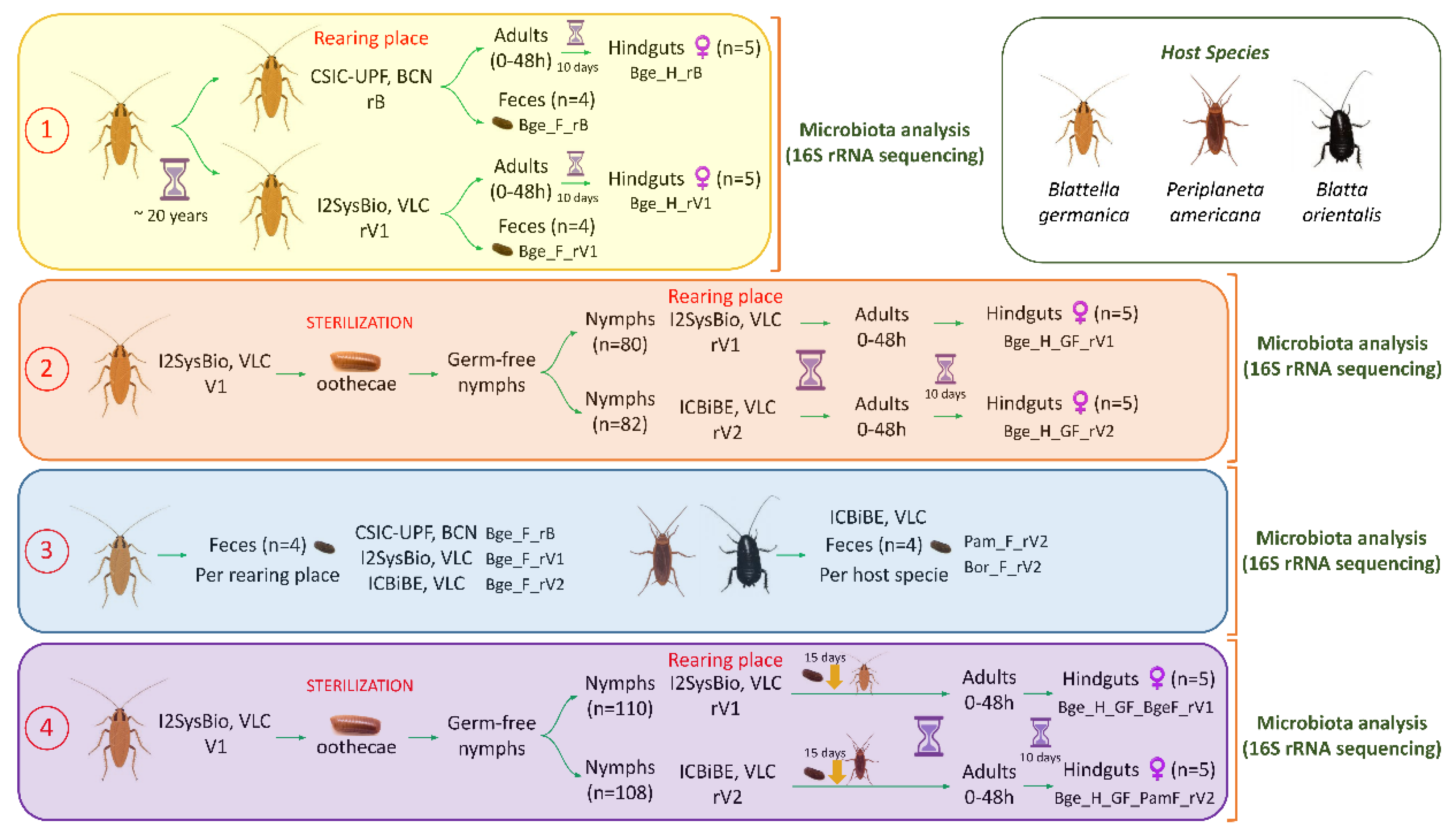
Figure 2.
Global diversity analysis. Alpha diversity metrics, including Observed Richness (A) and Shannon Diversity Index (B), were obtained at the ASV level for the different groups. In the box plots, the black line within the box marks the median, and the yellow triangle is the mean. Background colors and identifying labels match those used to name the experiments in Figure 1. Not significant (ns) comparisons in pairwise t tests (adjusted p-value > 0.05) are indicated, while the rest of possible comparisons were significant. Beta diversity was also explored by means of a PCA with CLR transform data at the ASV (C) and genus (D) levels. Ellipses represent 95% confidence intervals. For further detail, see interactive PCAs in Supplementary Figures S2 y S3. Experiment labels are shown next to the legend for each group. Sample nomenclature follows the structure described at the beginning of the Results section.
Figure 2.
Global diversity analysis. Alpha diversity metrics, including Observed Richness (A) and Shannon Diversity Index (B), were obtained at the ASV level for the different groups. In the box plots, the black line within the box marks the median, and the yellow triangle is the mean. Background colors and identifying labels match those used to name the experiments in Figure 1. Not significant (ns) comparisons in pairwise t tests (adjusted p-value > 0.05) are indicated, while the rest of possible comparisons were significant. Beta diversity was also explored by means of a PCA with CLR transform data at the ASV (C) and genus (D) levels. Ellipses represent 95% confidence intervals. For further detail, see interactive PCAs in Supplementary Figures S2 y S3. Experiment labels are shown next to the legend for each group. Sample nomenclature follows the structure described at the beginning of the Results section.
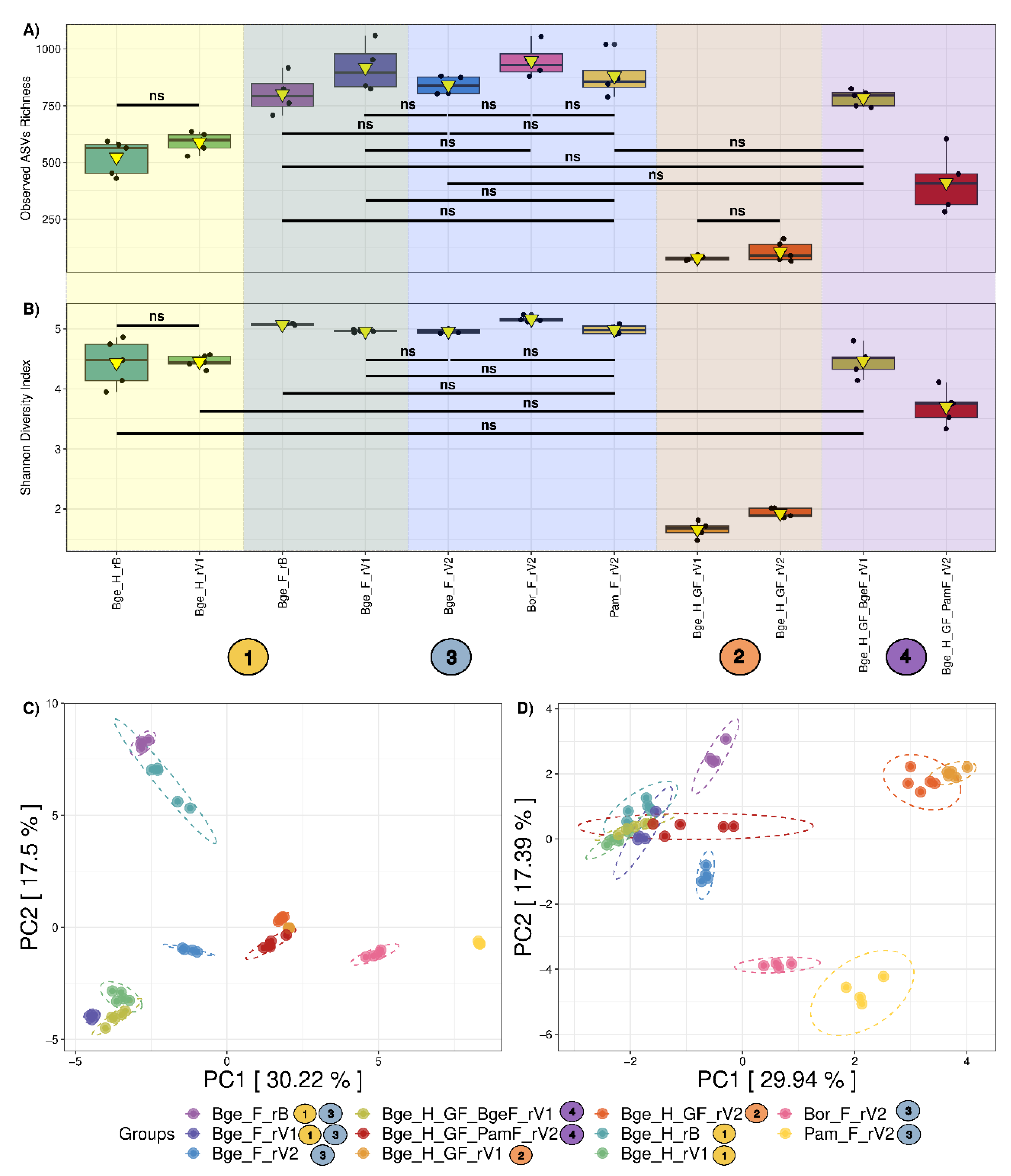
Figure 3.
Experiment 1: Comparing twinned populations of B. germanica. Beta diversity was explored by means of a PCA with CLR transform data at the genus level (A). Ellipses represent 95% confidence intervals. The ordination scores of the top 50 taxa are shown for the first two principal components, PC1 and PC2 (B). A Venn diagram of the intersections between genera from the different experimental groups is also shown (C). Bge_F_rB: Barcelona feces; Bge_H_rB: Barcelona hindgut; Bge_F_rV1: Valencia1 feces; Bge_H_rV1: Valencia1 hindgut.
Figure 3.
Experiment 1: Comparing twinned populations of B. germanica. Beta diversity was explored by means of a PCA with CLR transform data at the genus level (A). Ellipses represent 95% confidence intervals. The ordination scores of the top 50 taxa are shown for the first two principal components, PC1 and PC2 (B). A Venn diagram of the intersections between genera from the different experimental groups is also shown (C). Bge_F_rB: Barcelona feces; Bge_H_rB: Barcelona hindgut; Bge_F_rV1: Valencia1 feces; Bge_H_rV1: Valencia1 hindgut.
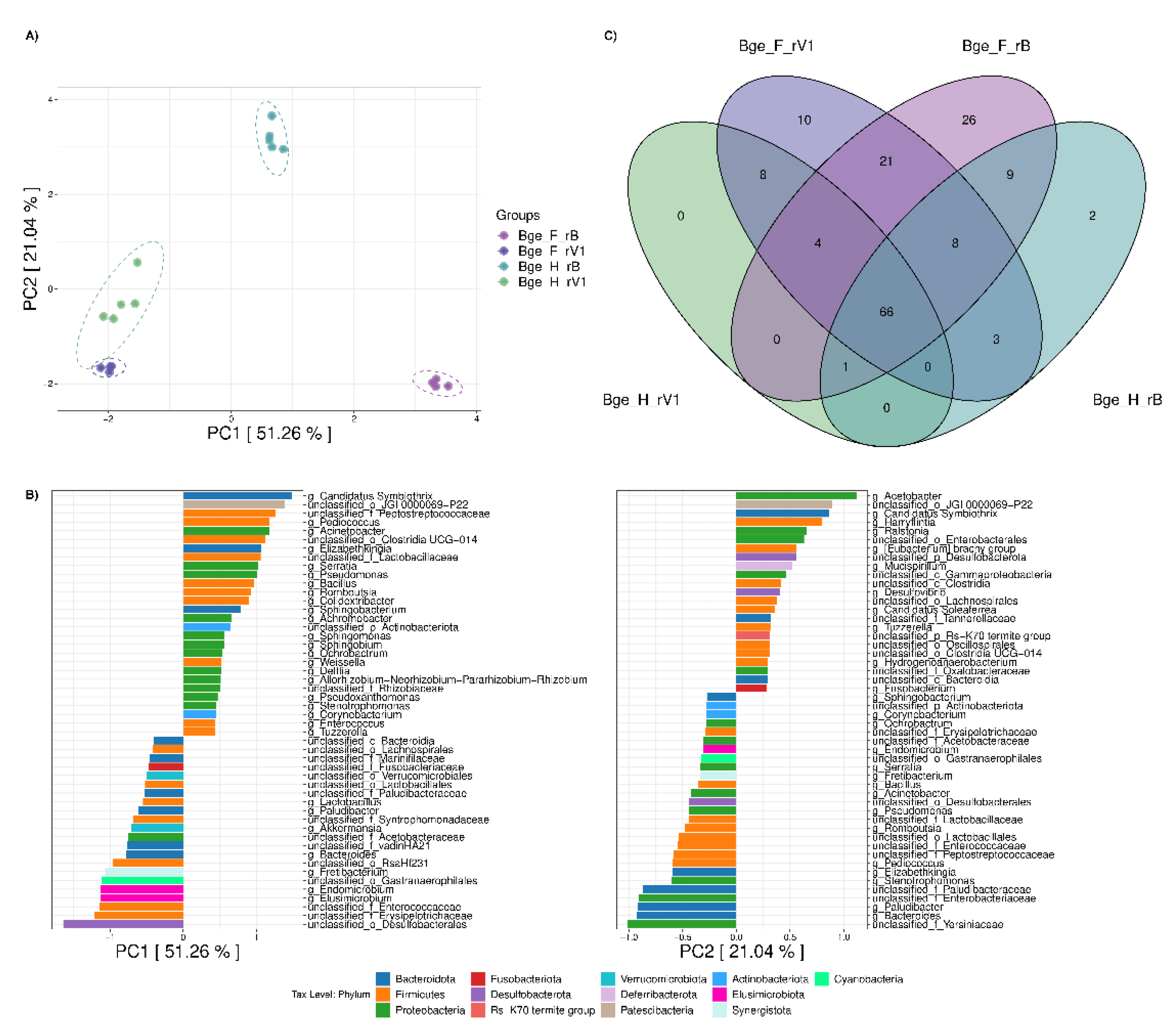
Figure 4.
Experiment 2: Environmental effects on transient germ-free B. germanica cockroaches. Beta diversity was explored by means of a PCA with CLR transform data at the genus level (A). Ellipses represent 95% confidence intervals. The ordination scores of the top 50 taxa are shown for the first two principal components, PC1 and PC2 (B). A Venn diagram of the intersections between genera from the different experimental groups is also shown (C). Bge_H_rV1: Valencia1 hindgut (standard hindgut control); Bge_H_GF_rV1: germ-free Valencia1 hindgut; Bge_H_GF_rV2: germ-free Valencia2 hindgut.
Figure 4.
Experiment 2: Environmental effects on transient germ-free B. germanica cockroaches. Beta diversity was explored by means of a PCA with CLR transform data at the genus level (A). Ellipses represent 95% confidence intervals. The ordination scores of the top 50 taxa are shown for the first two principal components, PC1 and PC2 (B). A Venn diagram of the intersections between genera from the different experimental groups is also shown (C). Bge_H_rV1: Valencia1 hindgut (standard hindgut control); Bge_H_GF_rV1: germ-free Valencia1 hindgut; Bge_H_GF_rV2: germ-free Valencia2 hindgut.
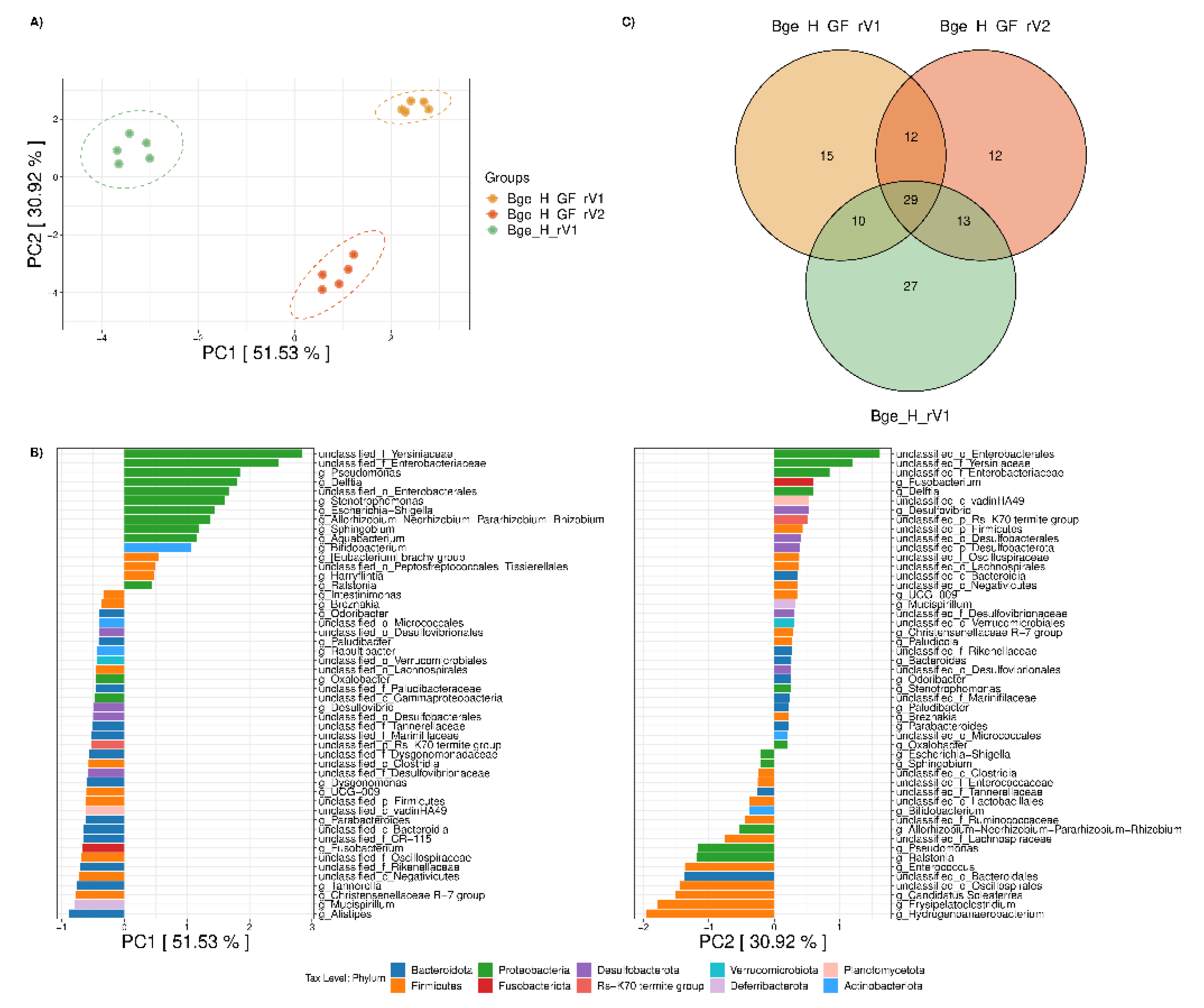
Figure 5.
Experiment 3: Exploring feces microbiome of different species of cockroaches. Beta diversity was examined by means of a PCA with CLR transform data at the genus level (A). Ellipses represent 95% confidence intervals. The ordination scores of the top 50 taxa are shown for the first two principal components, PC1 and PC2 (B). An upset plot of the intersections between genera from the different experimental groups is also shown (C). Bge_F_rB: B. germanica in Barcelona; Bge_F_rV1: B. germanica in Valencia1; Bge_F_rV2: B. germanica in Valencia2; Bor_F_rV2: B. orientalis in Valencia2; Pam_F_rV2: P. americana in Valencia2.
Figure 5.
Experiment 3: Exploring feces microbiome of different species of cockroaches. Beta diversity was examined by means of a PCA with CLR transform data at the genus level (A). Ellipses represent 95% confidence intervals. The ordination scores of the top 50 taxa are shown for the first two principal components, PC1 and PC2 (B). An upset plot of the intersections between genera from the different experimental groups is also shown (C). Bge_F_rB: B. germanica in Barcelona; Bge_F_rV1: B. germanica in Valencia1; Bge_F_rV2: B. germanica in Valencia2; Bor_F_rV2: B. orientalis in Valencia2; Pam_F_rV2: P. americana in Valencia2.
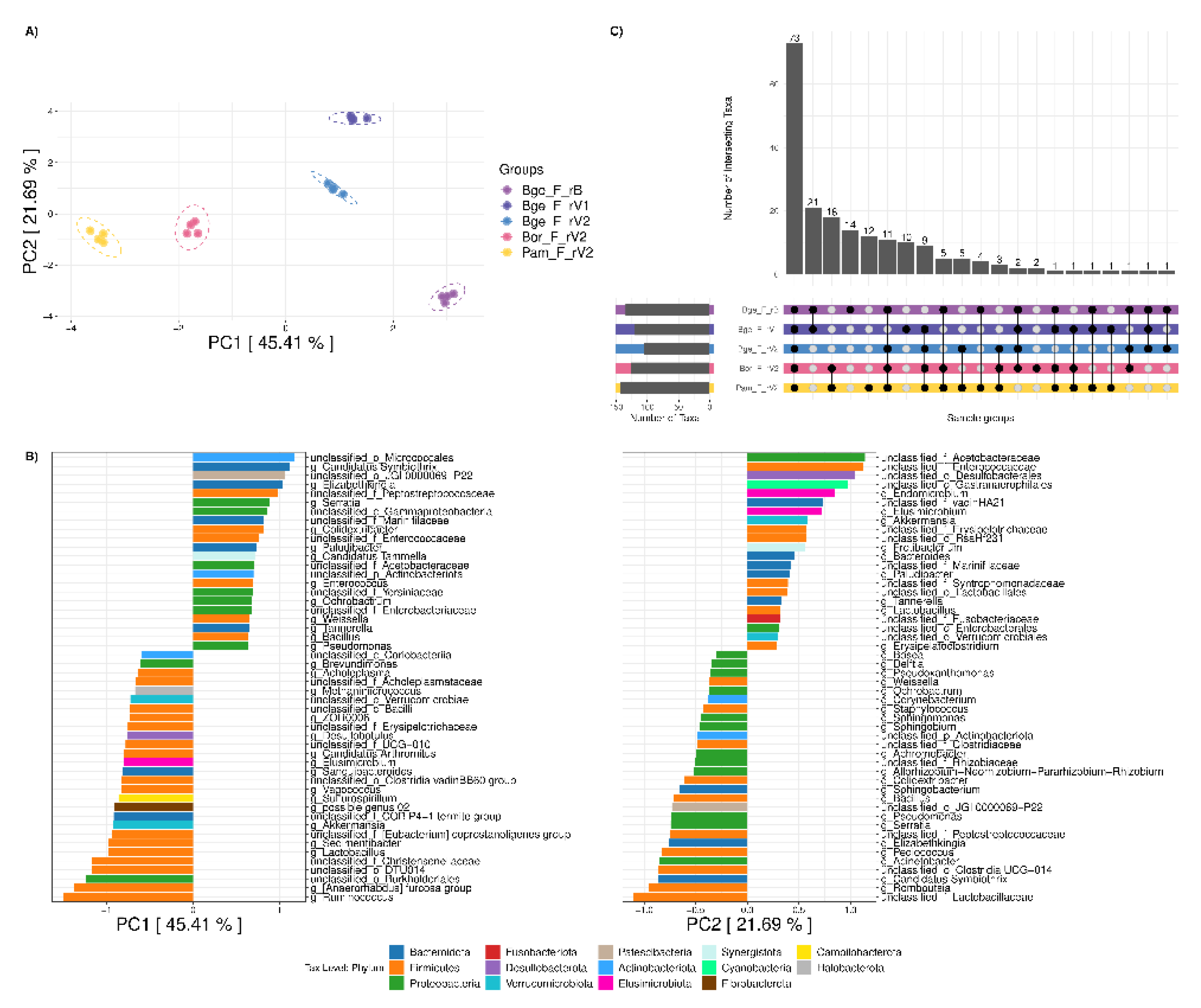
Figure 6.
Experiment 4: Inter-species cockroaches’ fecal transplantation. Beta diversity was explored by means of a PCA with CLR transform data at the genus level (A). Ellipses represent 95% confidence intervals. The ordination scores of the top 50 taxa are shown for the first two principal components, PC1 and PC2 (B). Bge_F_rV2 group (B. germanica feces in Valencia2) was included only in PCA analysis to differentiate possible environmental effects better. An upset plot of the intersections between genera from the different experimental groups is also shown. Bge_H_rV1: B. germanica hindgut in Valencia1 (standard hindgut control); Bge_F_rV1: B. germanica feces in Valencia1 (intra-species feces donor); Pam_F_rV2: P. americana feces in Valencia2 (inter-species feces donor); Bge_H_GF_BgeF_rV1: hindgut of germ-free transplanted B. germanica in Valencia1 (intra-species transplant); Bge_H_GF_PamF_rV2: hindgut of germ-free transplanted B. germanica in Valencia2 with P. americana feces (inter-species transplant).
Figure 6.
Experiment 4: Inter-species cockroaches’ fecal transplantation. Beta diversity was explored by means of a PCA with CLR transform data at the genus level (A). Ellipses represent 95% confidence intervals. The ordination scores of the top 50 taxa are shown for the first two principal components, PC1 and PC2 (B). Bge_F_rV2 group (B. germanica feces in Valencia2) was included only in PCA analysis to differentiate possible environmental effects better. An upset plot of the intersections between genera from the different experimental groups is also shown. Bge_H_rV1: B. germanica hindgut in Valencia1 (standard hindgut control); Bge_F_rV1: B. germanica feces in Valencia1 (intra-species feces donor); Pam_F_rV2: P. americana feces in Valencia2 (inter-species feces donor); Bge_H_GF_BgeF_rV1: hindgut of germ-free transplanted B. germanica in Valencia1 (intra-species transplant); Bge_H_GF_PamF_rV2: hindgut of germ-free transplanted B. germanica in Valencia2 with P. americana feces (inter-species transplant).
Disclaimer/Publisher’s Note: The statements, opinions and data contained in all publications are solely those of the individual author(s) and contributor(s) and not of MDPI and/or the editor(s). MDPI and/or the editor(s) disclaim responsibility for any injury to people or property resulting from any ideas, methods, instructions or products referred to in the content. |
© 2026 by the authors. Licensee MDPI, Basel, Switzerland. This article is an open access article distributed under the terms and conditions of the Creative Commons Attribution (CC BY) license (http://creativecommons.org/licenses/by/4.0/).
Copyright: This open access article is published under a Creative Commons CC BY 4.0 license, which permit the free download, distribution, and reuse, provided that the author and preprint are cited in any reuse.


