

Submitted:
30 March 2026
Posted:
01 April 2026
You are already at the latest version
Abstract
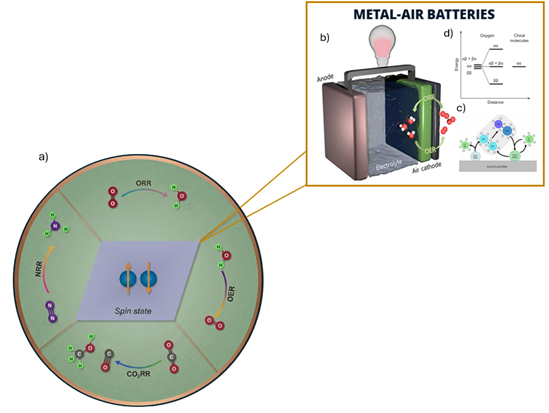
The chiral-induced spin selectivity (CISS) effect enables spin-selective transport of electrons through chiral systems, linking handedness with spin polarization. This review provides a comprehensive examination of the emerging field of chiral electrocatalysis, detailing also the extensive experimental and theoretical endeavor conducted to gain a deeper understanding of the fundamental physical principles and mechanistic characteristics of this phenomenon. In particular, the CISS effect has garnered significant attention within the scientific community due to its potential for broad applicability across several fields, ranging from spintronics to biology. Among them, the prospective harnessing of CISS effect into electrocatalytic processes offers an innovative strategy to improve the performance of energy conversion and storage technologies. This review deeply examines the practical applications of the CISS effect across different electrocatalytic reactions, with particular emphasis on its influence on the oxygen reduction reaction (ORR) and its critical role in energy conversion systems where ORR reaction is a key process - such as in metal-air batteries, whose safety and performance can be enhanced through spin-selective electron transport.
Keywords:
chiral-induced spin selectivity
; chiral electrocatalysis
; metal-air batteries
; spin-dependent reaction pathways
; energy conversion and storage
Copyright: This open access article is published under a Creative Commons CC BY 4.0 license, which permit the free download, distribution, and reuse, provided that the author and preprint are cited in any reuse.


