
Submitted:
16 March 2026
Posted:
17 March 2026
You are already at the latest version
Abstract
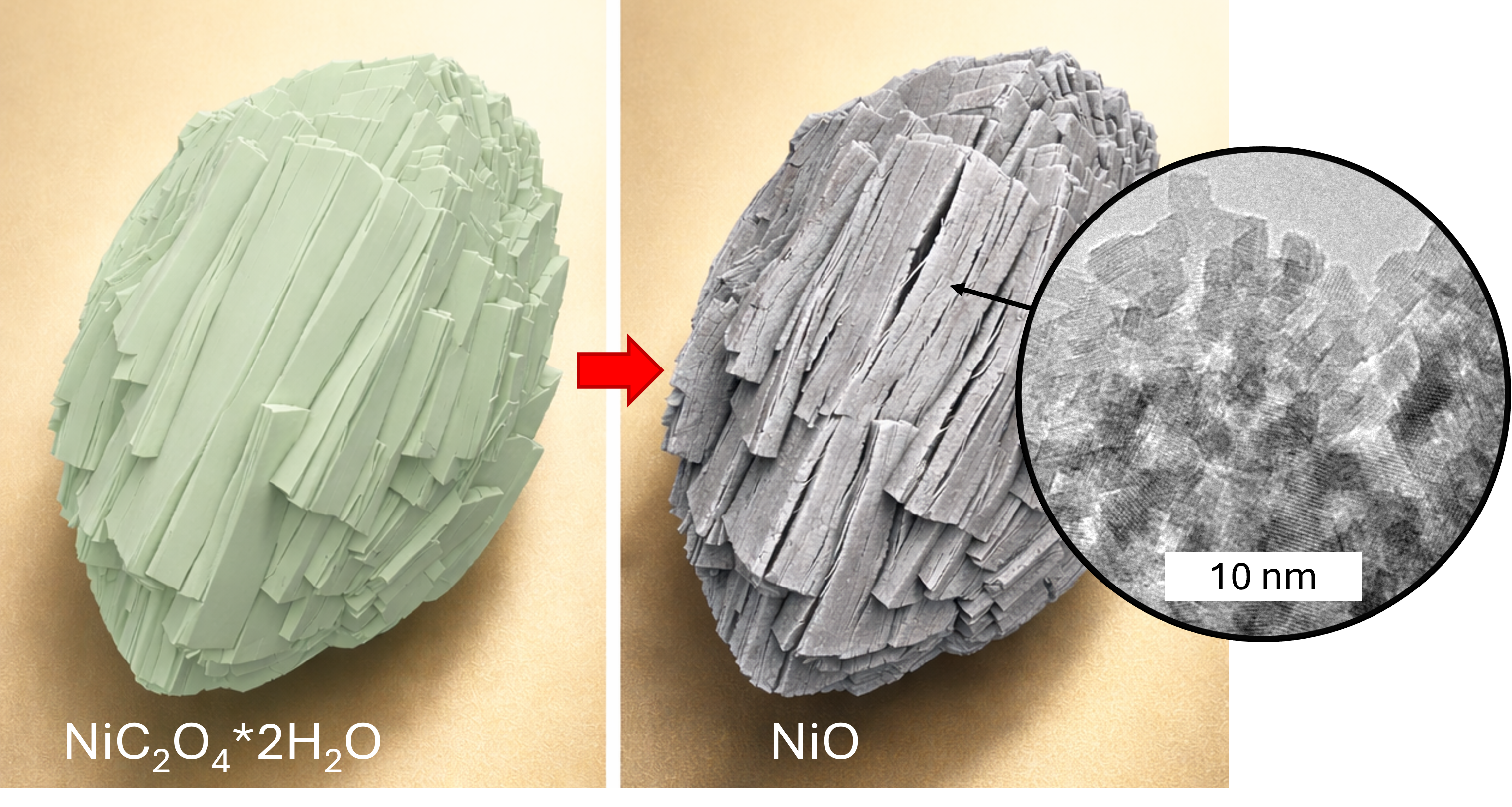
This work presents a comprehensive investigation of the thermal decomposition of nickel oxalate dihydrate as a precursor for the synthesis of porous NiO, with particular emphasis on microstructural formation and evolution. The transformations occurring at successive stages of the reaction were examined using SEM, TEM, N₂ adsorption, TG–DSC–MS, and in situ powder XRD, enabling the mechanisms of pore formation to be elucidated. The decomposition results in the formation of a porous pseudomorph composed of NiO nanoparticles with an average size of approximately 4 nm. The resulting microstructure exhibits hierarchical porous architecture. During dehydration, macropores are generated as a result of crystal fragmentation into blocks several hundred nanometers in size. Subsequent oxalate decomposition leads to the formation of mesoporous aggregates composed of nanometer-sized particles. The factors governing the parameters of the porous microstructure are analyzed. Owing to its hierarchical pore system, the obtained NiO demonstrates significant potential for applications in heterogeneous catalysis, gas sensing, electrodes for super-capacitors and Li-ion batteries, and photoelectrochemical devices. In such systems, macropores facilitate mass transport by reducing diffusion resistance, while mesopores provide a high accessible surface area for adsorption and catalytic reactions.
Keywords:
thermal decomposition of precursors
; pseudomorph
; microstructure
; fracture
; diffusion-controlled pore growth
Copyright: This open access article is published under a Creative Commons CC BY 4.0 license, which permit the free download, distribution, and reuse, provided that the author and preprint are cited in any reuse.


