
Submitted:
13 March 2026
Posted:
16 March 2026
You are already at the latest version
Abstract
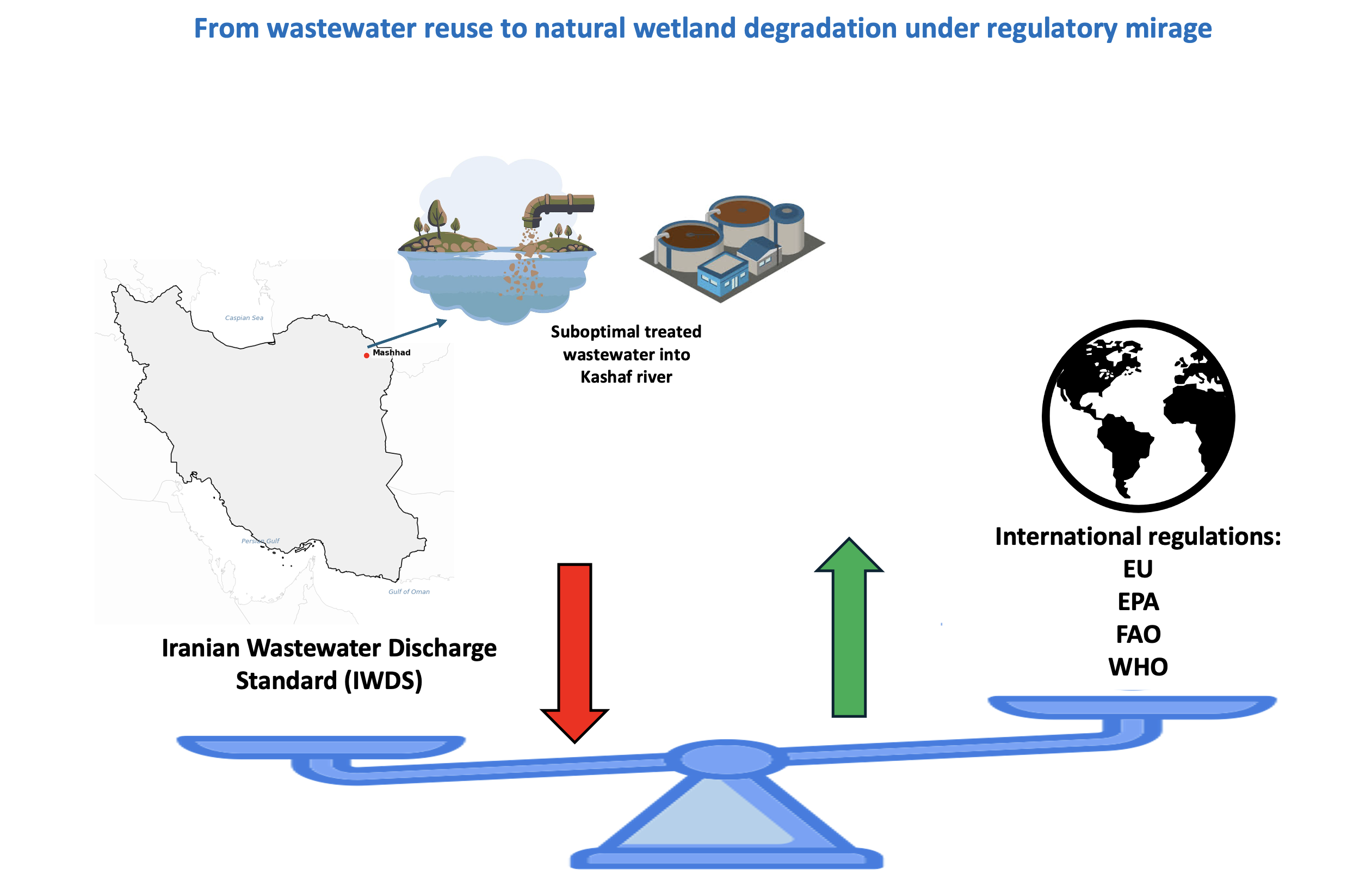
Water scarcity compels wastewater reuse, but lax discharge standards generate a regulatory mirage, misleading the public about safety. Despite formal compliance, treated effluent severely harms Iran’s effluent‑dependent Kashaf River, driving eutrophication, salinization, and the downstream transport of unregulated contaminants of emerging concern, including PFAS and pharmaceuticals. These pressures extend beyond the river channel to adjacent natural wetlands, which act as de facto nature‑based treatment systems yet are progressively transformed into sacrificial sinks for excess nutrients, salts, heavy metals, and micropollutants. By benchmarking the Iranian Wastewater Discharge Standards (IWDS) against international guidelines (WHO, EU, FAO), this study quantifies a “Permissibility Gap” frequently greater than 10 for key parameters such as BOD₅, nutrients, and trace metals, revealing how concentration‑based limits ignore cumulative mass load and mixture toxicity at the basin scale. The Kashaf River case demonstrates that current end‑of‑pipe regulation undermines both natural wetlands and planned nature‑based solutions, including constructed wetlands, in arid regions where effluent reuse is unavoidable. The study argues that aligning discharge standards with global benchmarks, adopting mass‑based permits, and explicitly regulating contaminants of emerging concern are prerequisites for truly safe wastewater reuse and for protecting wetland ecosystems in effluent‑dependent basins.
Keywords:
wastewater reuse
; regulatory failure
; emerging contaminants
; river pollution
Copyright: This open access article is published under a Creative Commons CC BY 4.0 license, which permit the free download, distribution, and reuse, provided that the author and preprint are cited in any reuse.


