
Submitted:
13 March 2026
Posted:
13 March 2026
You are already at the latest version
Abstract
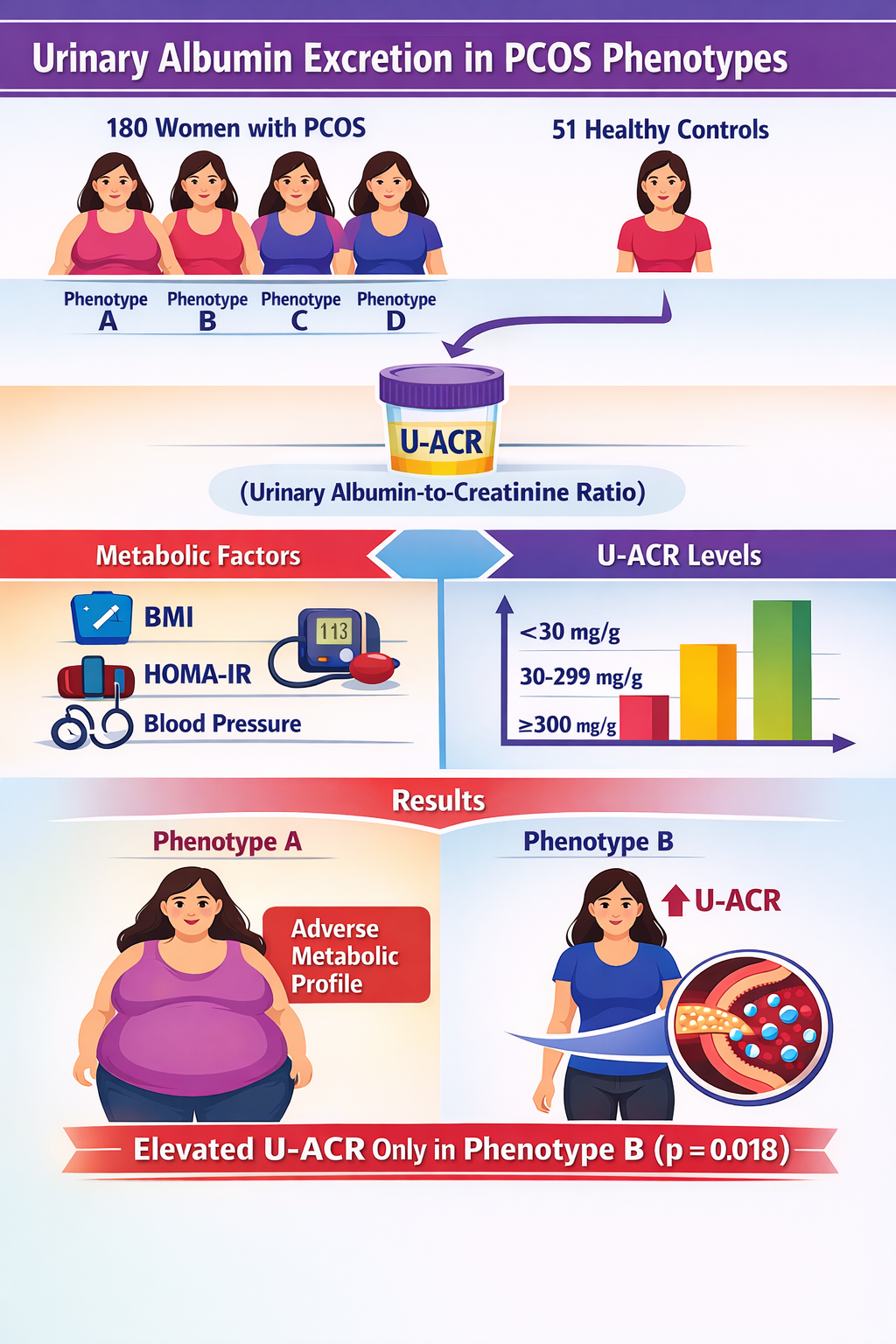
Background/Aim: Albuminuria is an established marker of endothelial dysfunction and an independent predictor of cardiovascular risk. Polycystic ovary syndrome (PCOS) is associated with early metabolic and vascular abnormalities; however, whether urinary albumin excretion differs across PCOS phenotypes remains unclear. This study aimed to evaluate urinary albumin excretion using the urinary albumin-to-creatinine ratio (U-ACR) across distinct PCOS phenotypes and to examine its association with metabolic parameters. Materials and Methods: In this cross-sectional study, 180 women aged 18-35 years with PCOS and 51 age-matched healthy controls were included. PCOS phenotypes were classified according to the Rotterdam criteria as Phenotype A (n = 96), Phenotype B (n = 19), Phenotype C (n = 35), and Phenotype D (n = 30). Insulin resistance was assessed using the homeostasis model assessment for insulin resistance (HOMA-IR). Urinary albumin and creatinine levels were measured in morning urine samples, and U-ACR was calculated. Results: Age was comparable across all groups. Body mass index, waist circumference, diastolic blood pressure, and HOMA-IR were significantly higher in Phenotype A compared with controls and other phenotypes, indicating a more adverse metabolic profile. Serum creatinine levels were similar across all groups. Despite this unfavorable metabolic profile in Phenotype A, U-ACR was significantly elevated only in Phenotype B compared with controls (p = 0.018) and Phenotype D (p = 0.016). No significant correlations were observed between U-ACR and age, body mass index, or HOMA-IR. When participants were categorized according to U-ACR levels (< 30, 30-299.9, and ≥ 300 mg/g creatinine), no significant differences in category distribution were observed between the total PCOS cohort, phenotype subgroups, and controls. Conclusion: Among PCOS phenotypes, U-ACR elevation was observed exclusively in Phenotype B despite similar renal function markers. Notably, this occurred even though Phenotype A exhibited a more adverse metabolic profile, suggesting a dissociation between metabolic burden and early microvascular involvement across PCOS phenotypes. These findings indicate that vascular risk in PCOS may be phenotype-dependent and support the potential value of phenotype-oriented cardiovascular risk assessment.
Keywords:
polycystic ovary syndrome
; polycystic ovary phenotypes
; albumin-to-creatinine ratio
; albuminuria
; endothelial dysfunction
Copyright: This open access article is published under a Creative Commons CC BY 4.0 license, which permit the free download, distribution, and reuse, provided that the author and preprint are cited in any reuse.


