

Submitted:
11 March 2026
Posted:
13 March 2026
You are already at the latest version
Abstract
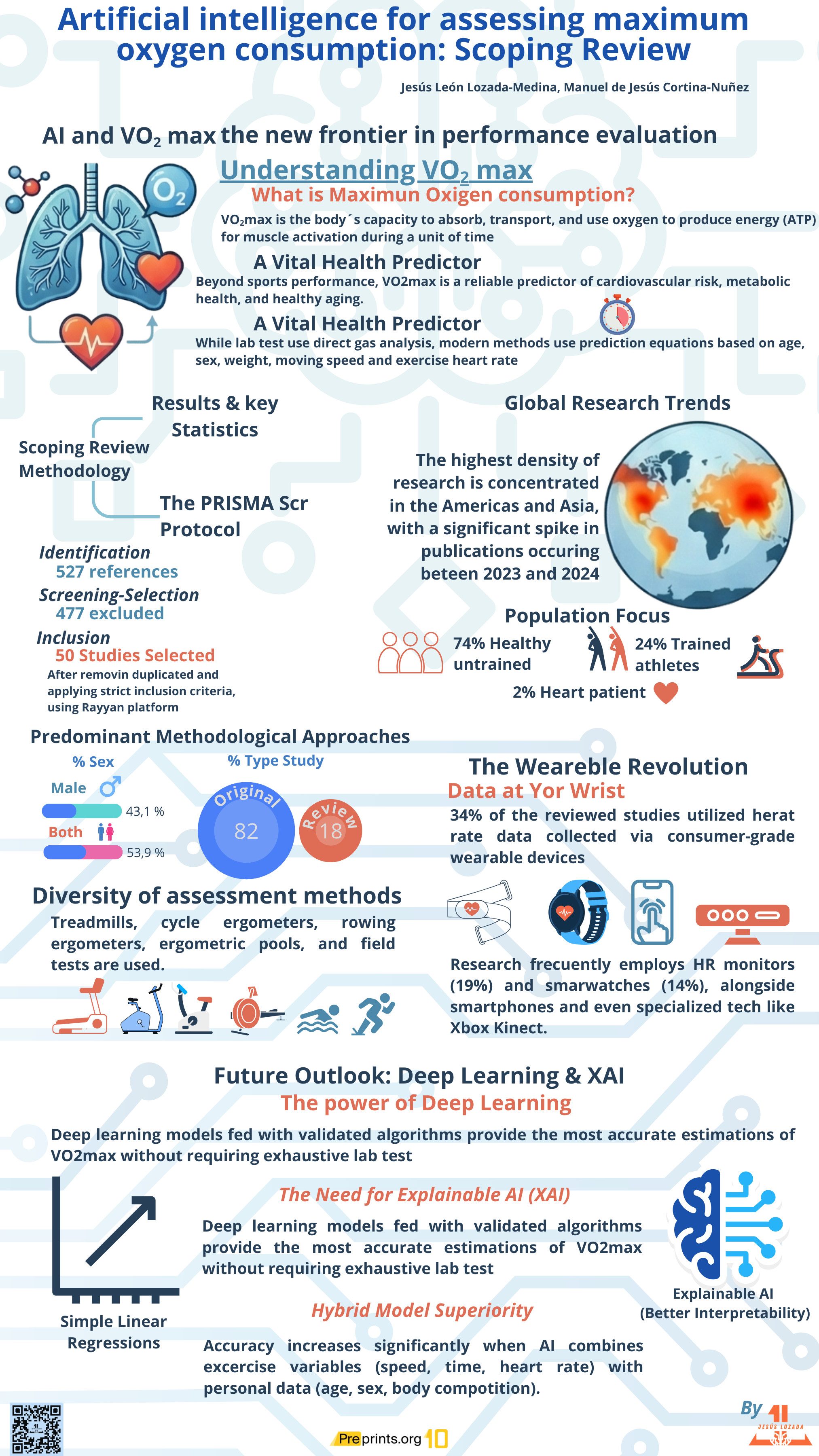
Maximum oxygen consumption (VO2max) is the ability to absorb, transport, and use oxygen in the body to produce useful energy for muscle activation in a unit of time. For years, devices have been developed to estimate physical performance, including VO2max. In view of the above, it can be considered that the use of artificial intelligence can facilitate interpretation and even generate estimates based on available data. In this regard, this study aims to review the use of artificial intelligence in the assessment of maximum oxygen consumption. A scoping review was conducted in accordance with the following stages: (i) identification of the research question: What would be the use of AI to predict VO2? (ii) identification of relevant studies: searching academic databases and AI search engines; (iii) selection of studies: the PRISMA ScR protocol was applied, selecting 50 studies; (iv) graphing the data in the results (v): finding studies published since 2009 with a higher publication rate in countries in the Americas and Asia; it is concluded that the use of deep learning fed with validated algorithms allows for a more accurate estimation of VO2max and that its evaluation requires the use of explainable AI training, starting with the linear regressions available in the literature and continuing with decision trees, to predict performance and offer a classification of it.
Keywords:
artificial intelligence
; VO2 max
; aerobic test
; sports
1. Introduction
Maximum oxygen consumption (VO2max) is defined as the ability to absorb, transport, and use oxygen in the body to produce useful energy for muscle activation in a unit of time. In this way, oxygen is used in cellular respiration to produce adenosine triphosphate (ATP) by accepting electrons and combining with the hydrogen produced in glycolysis, beta oxidation of fatty acids, and Krebs cycle reactions. In short, VO2max indicates a person's ability to synthesize ATP aerobically, because although intensities higher than VO2max can be achieved, when the demand for ATP exceeds the production generated aerobically, it will be supplied by other metabolic pathways, such as glycolysis in a non-oxidative state and phosphagen reserves (to a lesser degree and very limited).
Tests to measure VO2max require exercises that activate large muscle groups, considering sufficient intensity and duration to reach the maximum level of aerobic energy production for a given time. To obtain accurate and reliable value, it is necessary to carry out a standardized test. There are multiple exercises where different tests can be performed, such as walking (running, marching, or walking). (Andersen et al., 2008; K. Cooper, 1968; Leger & Lambert, 1982), riding a bicycle (Anagnostopoulos et al., 2026; Jalanko et al., 2026), swimming (de Matos et al., 2022), rowing (Godfrey et al., 2019), skiing (Broussouloux et al., 1996) or skating (Lozada-Medina et al., 2013); These exercises can be performed using calibrated ergometers such as treadmills, cycle ergometers, rowing ergometers, step ergometers, or hand crank ergometers, as well as through field tests where the exercise is performed in an appropriate setting, such as athletic tracks, courts, swimming pools, ski slopes, or skating rinks. However, to determine the VO2max value, either in relative units of ml-1.kg.min-1 or absolute units of L.min-1, It can be measured using metabolic analyzers with Breath-by-Breath systems, with normal mixture or mixed chambers. (Cosmed, 2023; García-Tabar et al., 2018; Ward, 2018), with fixed devices in the laboratory (ADInstrumentos, 2022; ADInstruments, 2011; Cosmed, 2021, 2025; Srivastava et al., 2024) or portable (Cosmed, 2022; Kim et al., 2025; Winkert et al., 2020), while for its estimation it is necessary to apply, in addition to the standardized test protocol either in the field or in the laboratory, a prediction equation developed according to population characteristics, age, sex, training status, and in some cases even body composition, each formula requires data such as weight, height, level achieved during the test, either in stages or in final speed reached. Some of the most used field tests involve running 20-meter sprints (Andersen et al., 2008; Leger et al., 1988; Leger & Lambert, 1982), running on an athletic track (K. H. Cooper, 1968; Giovanelli et al., 2019) or in open fields (Ortiz-Pulido, 2018), in the lab, they can be performed on different ergometers such as treadmills. (Koutlianos et al., 2013), cycle ergometer (Silva, A et al., 2005), hand ergometer (Brown et al., 2015) and step boxes (Neshitov et al., 2023; Padilla-Alvarado & Lozada-Medina, 2012), and whose results should be evaluated according to the same characteristics populations considered for their development, and in some cases they can be divided by age groups and even by degree of maturity (Padilla-Alvarado et al., 2025).
In this regard, the tests require the intervention of qualified personnel. However, for years, devices have been developed to estimate physical performance, providing metrics that, based on the regression equations mentioned above, allow VO2 max to be estimated, (Carrier et al., 2023), In consideration of the above, it can be considered that the use of big data, machine learning, and artificial intelligence can facilitate interpretation and even generate estimates of variables based on available data. In this regard, this study aims to review the use of artificial intelligence in the assessment of maximum oxygen consumption.
Methodology
Following the best practices of a scoping review (Arksey & O’Malley, 2005) the following steps were taken: (i) identification of the research question, (ii) identification of relevant studies, (iii) selection of studies, (iv) graphing of data in the results, (v) collation, summary, and communication of the results in the discussion.
Stage 1: Identifying the research question
The research question covers a population, namely people who engage in physical activity and sports. The concept is the estimation of VO2, and the context is the use of AI for assessment in physical activity and sports. This raises the question for analysis: What would be the use of AI for predicting VO2?.
2. Materials and Methods
Following the best practices of a scoping review (Arksey & O’Malley, 2005) the following steps were taken: (i) identification of the research question, (ii) identification of relevant studies, (iii) selection of studies, (iv) graphing of data in the results, (v) collation, summary, and communication of the results in the discussion.
Stage 1: Identifying the research question
The research question covers a population, namely people who engage in physical activity and sports. The concept is the estimation of VO2, and the context is the use of AI for assessment in physical activity and sports. This raises the question for analysis: What would be the use of AI for predicting VO2?
Stage 2: Identifying relevant studies: Data sources and search strategy
In identifying relevant studies, the following formula with Boolean operators was used: (VO2 max OR maximum oxygen consumption OR maximum oxygen update) AND (New test) AND (artificial intelligence OR Software) AND (prediction) AND (evaluation OR Assessment); This formula was used in the academic databases: SportDiscus, ProQuest, ScienceDirect, PubMed, Scopus, and Google Scholar. Searches were also conducted in AI search engines: Research Rabbit app, Open Knowledge Map, SemanticScholar, and Search.carrot2 The Preferred Reporting Items for Systematic Reviews and Meta-Analyses extension for Scoping Reviews (PRISMA ScR) protocol was applied to identify relevant studies (McGowan et al., 2020; Tricco et al., 2018), through the support of the Rayyan platform (Rayyan, 2025), which facilitates and automates the review stages shown in Figure 1.
Stage 3: Study selection
References were imported from the databases and AI search engines, eliminating duplicates in the first instance. In the next round, the data was reviewed using the following keywords as inclusion criteria: VO2, artificial intelligence, machine learning, neural network, software, people, artificial neural networks, humans, device, smartwatch, wearable devices. Studies involving animals and gas emissions related to environmental issues were excluded. Once the selection was made, the final extraction of the full-text works began, with 50 works included (Figure 1).
3. Results
Stage 4: Charting the data
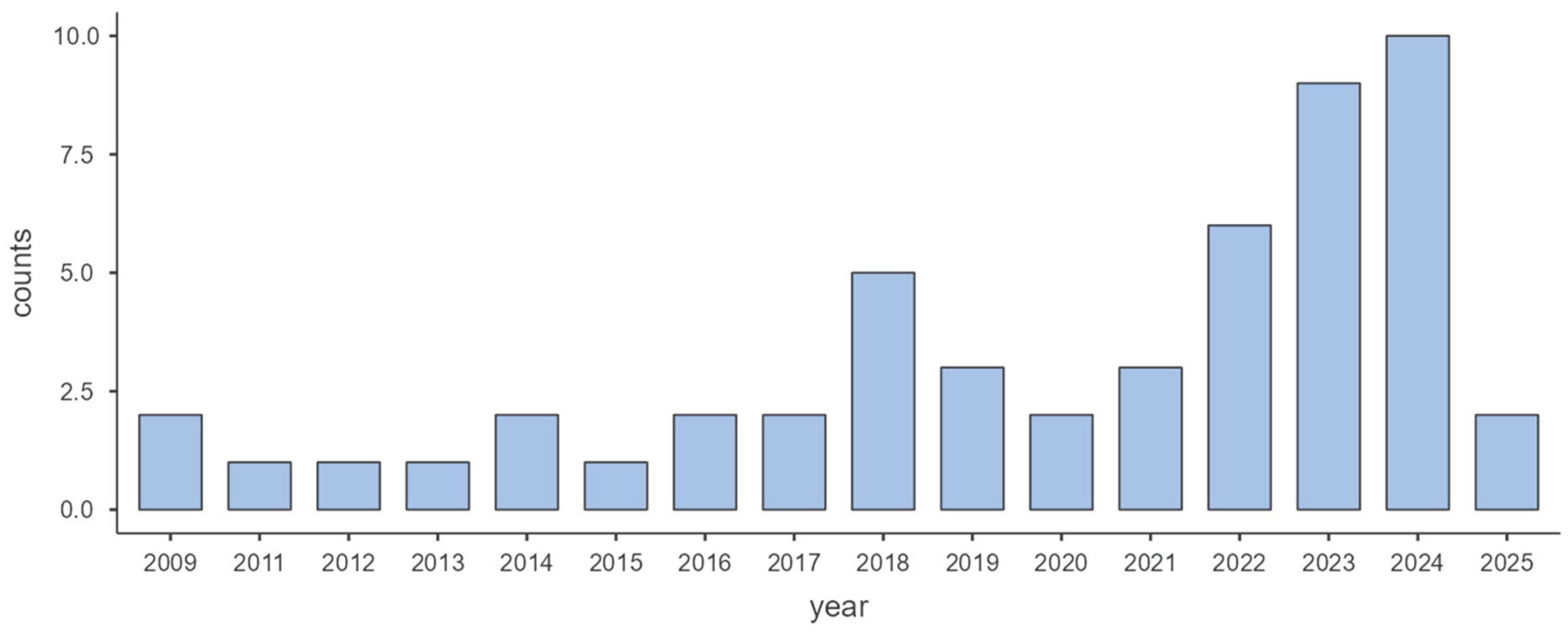
Below are the main results of the review, beginning with the frequency of publications by year, identifying an increase in related production between 2023 and 2024. It should be noted that the topic has been addressed since 2009.
Figure 2.
Frequency of publications per year in which VO2 was measured or estimated with the intention of evaluating the results using AI.
Figure 2.
Frequency of publications per year in which VO2 was measured or estimated with the intention of evaluating the results using AI.
It can be observed that the highest density of publications related to AI and VO2max is found in the Americas and Asia, with no records of related studies for Africa (Figure 3).
Stage 5: collating, summarizing and reporting the results
Table 1 shows that most of the studies are original, and that only one was conducted exclusively with females, while 53% of the studies were conducted on both sexes. In terms of the type of population, 74% of the studies were conducted on untrained but healthy individuals, 24% on trained subjects, and 2% on cardiac patients. Regarding the methodology used to generate prediction models, 36% of the studies were developed using machine learning (ML) or artificial intelligence (AI), 38% used maximal exercise testing and direct gas analysis in the laboratory, and 8% used validated field tests. Thirty-four percent of the studies took heart rate (HR) into account using specific monitors, smartphones, and smartwatches.
4. Discussion
This study reviewed the use of artificial intelligence in assessing maximum oxygen consumption. The literature consulted is conclusive in confirming VO2max as a reliable predictor of health, cardiovascular risk, and aerobic potential, which is consistent given that VO2max is also considered the most widely used parameter for characterizing the effective integration of the central nervous, cardiopulmonary, and metabolic systems. (Day et al., 2003)reinforcing the role that these variable plays in decision-making for health promotion programs, healthy aging, and sports training. Therefore, the estimation of this variable is required for various contexts and populations. Field or laboratory tests, maximal or submaximal, are usually performed, depending on the need, type of population, and availability of equipment for measuring the variables, either for direct or indirect determination.
In this order of ideas, it has been found that hybrid models that combine maximal and submaximal exercise variables with information collected through questionnaires significantly improve VO2max prediction (Abut & Akay, 2015), Others indicate that predictive accuracy increases when variables such as running speed and exercise time are incorporated (Akay et al., 2017), Some artificial neural networks even allow VO2max to be estimated while participating in active video games (Barry et al., 2016; Oh et al., 2022), although the limitations of dynamic system models for predicting VO2 and HR have been reported (Borror, 2018; Borror et al., 2019) The integration of machine learning into exercise physiology can improve the analysis of physiological parameters, collecting and interpreting data more efficiently during endurance exercises. In this way, the use of explainable AI tools will favor the interpretability of machine learning models. (Carrier et al., 2023); In this regard, it has been shown that the use of wearable devices to collect data before and during exercise has proven to be valid in athletes. (Carrier et al., 2023; Li et al., 2024), recreational runners (De Brabandere et al., 2018), soccer players (Düking et al., 2024), healthy subjects of both sexes (Liu et al., 2023; Muntaner-Mas et al., 2021; Sant’ Ana et al., 2024; Ye et al., 2023) to estimate VO2max.
Similarly, the studies reviewed agree that hybrid models, artificial neural networks, (Akay et al., 2013, 2017; Ashfaq, 2022; Ashfaq et al., 2022; Barry et al., 2016; Henriques et al., 2017; Shokrollahi, 2012; Zignoli et al., 2020) and machine learning algorithms such as support vector machine (SVM) models (Akay et al., 2017; Alzamer et al., 2021; Cheng et al., 2019; Liu et al., 2023; Schumacher et al., 2024), random forest (RF) models (Akay et al., 2017; Asadi et al., 2023) and deep learning (Szijarto et al., 2023; Watanabe et al., 2024), In addition to improving the accuracy of VO2max estimation, they represent a quick way to estimate VO2max because they do not require a specific stress test to be performed, but rather the collection of data on the subjects, including variables such as age, sex, body weight, physical activity levels and history, heart rate, running speed during exercise, and even biochemical variables (Grzebisz-Zatońska, 2024), Adapting to different populations, facilitating clinical decision-making and sports training, in short, AI is establishing itself as a decisive tool for estimating VO2 in different contexts and populations.
It should be noted that traditional tests to measure VO2max require a significant amount of time, which makes them impractical for use with large populations. Without wishing to detract from their validity but rather seeking to obtain quality information about a population in the shortest possible time, using alternative prediction models facilitates the estimation of VO2max in a larger group and in less time. In this regard, relying on data provided by mobile or wearable devices allows VO2max to be assessed outside the laboratory in various contexts (clinical, sports, and public health). Similarly, in contexts or situations where it is not possible to perform a maximal test, AI-based models are a viable and reliable alternative for estimating VO2max.
Finally, interdisciplinary collaboration between exercise physiologists, data scientists, and other related and interested professionals can be considered for future studies and technological developments to enhance the optimal development of AI use in VO2max estimation and assessment.
5. Conclusions
In light of the results of the review, it was evident that the use of AI in VO2max estimation still requires further study and development, taking into account the available background information on different populations. Similarly, according to empirical studies, the use of deep learning fed by validated algorithms allows for a more accurate estimation of VO2max. For its evaluation, it is necessary to resort to explainable AI training, starting with the linear regressions available in the literature and continuing with decision trees, to predict performance and offer a classification of it.
References
- Abut, F., & Akay, M. F. (2015). Machine learning and statistical methods for the prediction of maximal oxygen uptake: recent advances. Medical Devices: Evidence and Research, 369–379.
- ADInstrumentos. (2022). Sistema de adquisición de datos digitales PowerLab C. https://www.adinstruments.com/products/powerlab/c.
- ADInstruments. (2011). Dispositivo de hardware de adquisición de datos PowerLab 35 (DAQ). https://www.adinstruments.com/products/powerlab-daq-hardware.
- Akay, M. F., Aktürk, E., & Balıkçı, A. (2013). VO 2 max prediction from submaximal exercise test using artificial neural network. 2013 21st Signal Processing and Communications Applications Conference (SIU), 1–3.
- Akay, M. F., Çetin, E., Yarım, İ., Bozkurt, Ö., & Özçiloğlu, M. M. (2017). Development of novel maximal oxygen uptake prediction models for Turkish college students using machine learning and exercise data. 2017 9th International Conference on Computational Intelligence and Communication Networks (CICN), 186–189.
- Alzamer, H., Abuhmed, T., & Hamad, K. (2021). A short review on the machine learning-guided oxygen uptake prediction for sport science applications. Electronics, 10(16), 1956.
- Anagnostopoulos, K., Spassis, A., Kokkotis, C., Smilios, I., Chatzinikolaou, A., Douda, H. T., & Batrakoulis, A. (2026). Μaximal Fat Oxidation During Cycle Ergometer Protocols in Obese Adults: A Scoping Review. Diseases, 14(1), 4. [CrossRef]
- Andersen, L. B., Andersen, T. E., Andersen, E., & Anderssen, S. A. (2008). An intermittent running test to estimate maximal oxygen uptake: The Andersen test. Journal of Sports Medicine and Physical Fitness, 48(4), 434–437.
- Arksey, H., & O’Malley, L. (2005). Scoping studies: Towards a methodological framework. International Journal of Social Research Methodology: Theory and Practice, 8(1), 19–32. [CrossRef]
- Asadi, S., Tartibian, B., & Moni, M. A. (2023). Determination of optimum intensity and duration of exercise based on the immune system response using a machine-learning model. Scientific Reports, 13(1). [CrossRef]
- Ashfaq, A. (2022). PREDICTION OF OXYGEN UPTAKE (VO2) USING NEURAL NETWORKS.
- Ashfaq, A., Cronin, N., & Müller, P. (2022). Recent advances in machine learning for maximal oxygen uptake (VO2 max) prediction: A review. Informatics in Medicine Unlocked, 28, 100863.
- Barry, G., Tough, D., Sheerin, P., Mattinson, O., Dawe, R., & Board, E. (2016). Assessing the Physiological Cost of Active Videogames (Xbox Kinect) Versus Sedentary Videogames in Young Healthy Males. Games for Health Journal, 5(1), 68–74. [CrossRef]
- Borror, A. (2018). A mathematical model for predicting HR max, VO2 max, and oxygen uptake kinetics during treadmill walking and running at varied intensities.
- Borror, A., Mazzoleni, M., Coppock, J., Jensen, B. C., Wood, W. A., Mann, B., & Battaglini, C. L. (2019). Predicting oxygen uptake responses during cycling at varied intensities using an artificial neural network. Biomedical Human Kinetics, 11(1), 60–68.
- Broussouloux, O., Lac, G., Rouillon, J. D., & Robert, A. (1996). Evaluation of young cross-country skiers by running and roller-skiing tests. Science & Sports, 11(2), 120–123. [CrossRef]
- Brown, A. B., Kueffner, T. E., O’Mahony, E. C., & Lockard, M. M. (2015). Validity of arm-leg elliptical ergometer for Vo2 max analysis. Journal of Strength and Conditioning Research, 29(6), 1551–1555. [CrossRef]
- Carrier, B., Helm, M. M., Cruz, K., Barrios, B., & Navalta, J. W. (2023). Validation of aerobic capacity (VO2max) and lactate threshold in wearable technology for athletic populations. Technologies, 11(3), 71.
- Cheng, J.-C., Chiu, C.-Y., & Su, T.-J. (2019). Training and evaluation of human cardiorespiratory endurance based on a fuzzy algorithm. International Journal of Environmental Research and Public Health, 16(13), 2390.
- Cooper, K. (1968). Una Forma de Valorar el Máximo Consumo de Oxígeno. Correlación entre las Evaluaciones de Campo y de Laboratorio. 1–5.
- Cooper, K. H. (1968). A Means of Assessing Maximal Oxygen Intake. Jama, 203(3), 201. [CrossRef]
- Cosmed. (2021). COSMED - COSMED Fitmate PRO: Test Vo2Max, umbral aeróbico y anaeróbico, prescripción de ejercicio físico. https://www.cosmed.com/en/resources/video/84-fitmate/1116-cosmed-fitmate-pro-vo2max-test-aerobic-and-anaerobic-threshold-physical-exercise-prescription.
- Cosmed. (2022). COSMED - K5: Wearable Metabolic System for both laboratory and field testing. https://www.cosmed.com/en/products/cardio-pulmonary-exercise-test/k5.
- Cosmed. (2023). COSMED - AMIS 24, la nueva Cámara de Mezcla Adaptativa. https://www.cosmed.com/en/news/company/1615-amis-24-the-new-adaptive-mixing-chamber.
- Cosmed. (2025). COSMED - Q-NRG Max The new generation of metabolic monitor. https://www.cosmed.com/en/products/cardio-pulmonary-exercise-test/q-nrg-max.
- Day, J. R., Rossiter, H. B., Coats, E. M., Skasick, A., & Whipp, B. J. (2003). The maximally attainable V̇o2 during exercise in humans: the peak vs. maximum issue. Https://Doi.Org/10.1152/Japplphysiol.00024.2003, 95(5), 1901–1907. [CrossRef]
- De Brabandere, A., Op De Beéck, T., Schütte, K. H., Meert, W., Vanwanseele, B., & Davis, J. (2018). Data fusion of body-worn accelerometers and heart rate to predict VO2max during submaximal running. PloS One, 13(6), e0199509.
- de Matos, C. C., Marinho, D. A., Duarte-Mendes, P., & de Souza Castro, F. A. (2022). VO2 kinetics and bioenergetic responses to sets performed at 90%, 92.5%, and 95% of 400-m front crawl speed in male swimmers. Sport Sciences for Health 2022 18:4, 18(4), 1321–1329. [CrossRef]
- Düking, P., Ruf, L., Altmann, S., Thron, M., Kunz, P., & Sperlich, B. (2024). Assessment of Maximum Oxygen Uptake in Elite Youth Soccer Players: A Comparative Analysis of Smartwatch Technology, Yoyo Intermittent Recovery Test 2, and Respiratory Gas Analysis. Journal of Sports Science and Medicine, 23(2), 351–357. [CrossRef]
- García-Tabar, I., Eclache, J. P., Aramendi, J. F., & Gorostiaga, E. M. (2018). Quality control of open-circuit respirometry: real-time, laboratory-based systems. Let’s spread “good practice.” European Journal of Applied Physiology, 118(12), 2719–2720. [CrossRef]
- Giovanelli, N., Scaini, S., Billat, V., & Lazzer, S. (2019). A new field test to estimate the aerobic and anaerobic thresholds and maximum parameters. European Journal of Sport Science, (July), 1–7. [CrossRef]
- Godfrey, R., Newbury, J., Chatfield, S., Pattni, J., Wakelin, A., & Quinlivan, R. (2019). P.121Development of a rowing ergometer protocol to test whole body VO2peak in McArdle disease. Neuromuscular Disorders, 29, S83–S84. [CrossRef]
- Grzebisz-Zatońska, N. (2024). The Relationship between Inflammatory Factors, Hemoglobin, and VO2 Max in Male Amateur Long-Distance Cross-Country Skiers in the Preparation Period. Journal of Clinical Medicine, 13(20), 6122. [CrossRef]
- Henriques, J., Carvalho, P., Rocha, T., Paredes, S., Cabiddu, R., Trimer, R., Mendes, R., Borghi-Silva, A., Kaminsky, L., Ashley, E., Arena, R., & Myers, J. (2017). A non-exercise based V02max prediction using FRIEND dataset with a neural network. Annual International Conference of the IEEE Engineering in Medicine and Biology Society. IEEE Engineering in Medicine and Biology Society. Annual International Conference, 2017, 4203–4206. [CrossRef]
- Jalanko, P., Laitinen, E., Vlachopoulos, D., Gao, Y., Nurmi, T., Barker, A. R., Bond, B., Lee, E., & Haapala, E. A. (2026). Measuring V̇O2max in adolescents: verification phase and impact of time averaging strategies. European Journal of Applied Physiology. [CrossRef]
- Kim, J., Hong, K. R., Hwang, I. W., Wen, X., Shen, J. H., Kim, H. J., Kenyon, J., Geller, J., Evans, R. K., Lee, J. M., & Kim, Y. (2025). The validity of the ˙VO2 Master Pro for measuring oxygen consumption during sedentary activity and treadmill walking and jogging. Applied Physiology, Nutrition and Metabolism, 50. [CrossRef]
- Koutlianos, N., Dimitros, E., Metaxas, T., Deligiannis, A. S., & Kouidi, E. (2013). Indirect estimation of VO2max in athletes by ACSM’s equation: Valid or not? Hippokratia, 17(2), 136–140.
- Leger, L., & Lambert, J. (1982). A maximal multistage 20-m shuttle run test to predict VO2 max. European Journal of Applied Physiology and Occupational Physiology, 49(1), 1–12. [CrossRef]
- Leger, L., Mercier, D., Gadoury, C., & Lambert, J. (1988). The multistage 20 metre shuttle run test for aerobic fıtness. Journal of Sports Sciences, 6(2), 93–101.
- Li, N., Hu, W., Ma, Y., & Xiang, H. (2024). Machine learning prediction of pulmonary oxygen uptake from muscle oxygen in cycling. Journal of Sports Sciences, 42(14), 1299–1307.
- Liu, Y., Herrin, J., Huang, C., Khera, R., Dhingra, L. S., Dong, W., Mortazavi, B. J., Krumholz, H. M., & Lu, Y. (2023). Nonexercise machine learning models for maximal oxygen uptake prediction in national population surveys. Journal of the American Medical Informatics Association : JAMIA, 30(5), 943–952. [CrossRef]
- Lozada-Medina, J., Padilla, J., Torres, Y., & Paredes, W. (2013). Valoración de la potencia aeróbica por medio de test progresivos e incrementales en patinadoras de carreras categoría cadetes del estado Barinas. Dimensión Deportiva, 6(1), 43–52.
- McGowan, J., Straus, S., Moher, D., Langlois, E. V., O’Brien, K. K., Horsley, T., Aldcroft, A., Zarin, W., Garitty, C. M., Hempel, S., Lillie, E., Tunçalp, Ӧzge, & Tricco, A. C. (2020). Reporting scoping reviews—PRISMA ScR extension. In Journal of Clinical Epidemiology (Vol. 123, pp. 177–179). Elsevier USA. [CrossRef]
- Muntaner-Mas, A., Martinez-Nicolas, A., Quesada, A., Cadenas-Sanchez, C., & Ortega, F. B. (2021). Smartphone App (2kmFIT-App) for Measuring Cardiorespiratory Fitness: Validity and Reliability Study. JMIR MHealth and UHealth, 9(1), e14864. [CrossRef]
- Neshitov, A., Tyapochkin, K., Kovaleva, M., Dreneva, A., Surkova, E., Smorodnikova, E., & Pravdin, P. (2023). Estimation of cardiorespiratory fitness using heart rate and step count data. Scientific Reports (Nature Publisher Group), 13(1), 15808. [CrossRef]
- Oh, W., An, Y., Min, S., & Park, C. (2022). Comparative Effectiveness of Artificial Intelligence-Based Interactive Home Exercise Applications in Adolescents with Obesity. Sensors, 22(19). [CrossRef]
- Ortiz-Pulido, R. (2018). Maximal oxygen consumption in mexican university students: Comparing five predictive test. Revista Internacional de Medicina y Ciencias de La Actividad Fisica y Del Deporte, 18(71), 521–535. [CrossRef]
- Padilla-Alvarado, J., & Lozada-Medina, J. L. (2012). Análisis Comparativo de la Condición Física Aeróbica en Función de la Maduración Somática en Estudiantes de un Liceo Bolivariano del estado Barinas, Venezuela. Revista Electrónica Actividad Física y Ciencias, 1(4), 1–28. http://www.revistas.upel.edu.ve/index.php/actividadfisicayciencias/article/view/1097.
- Padilla-Alvarado, J., Lozada-Medina, J. L., & Cortina-Nuñez, M. de J. (2025). Aerobic power profile in young athletes according to age and bio banding. Retos, 71, 1215–1227. [CrossRef]
- Rayyan. (2025). https://new.rayyan.ai/.
- Sant’ Ana, J., Sant’ Ana, Y. A., Coswig, V. S., Carminatti, L. J., & Diefenthaeler, F. (2024). Reliability of the mobile App to measure aerobic training parameters during maximum incremental treadmill test. Sport Sciences for Health, 20(2), 509–516. [CrossRef]
- Schumacher, B. T., LaMonte, M. J., LaCroix, A. Z., Simonsick, E. M., Hooker, S. P., Parada Jr, H., Bellettiere, J., & Kumar, A. (2024). Development, validation, and transportability of several machine-learned, non-exercise-based VO2max prediction models for older adults. Journal of Sport and Health Science, 13(5), 611–620.
- Shokrollahi, N. (2012). Prediction of Maximum Oxygen Uptake from Maximal and Non-Exercise Variables using Machine Learning Methods. Cukurova University.
- Silva, A, C. E., Dias, M, R., Franco, V, H., Lima, J, R. De, & Novaes, J da, S. (2005). Estimativa do limiar de Conconi por meio da Escala de Borg em Cicloergômetro. Fit e Perf, 4(4), 215–219. [CrossRef]
- Srivastava, S., Tamrakar, S., Nallathambi, N., Vrindavanam, S. A., Prasad, R., & Kothari, R. (2024). Assessment of Maximal Oxygen Uptake (VO2 Max) in Athletes and Nonathletes Assessed in Sports Physiology Laboratory. Cureus. [CrossRef]
- Szijarto, A., Tokodi, M., Fabian, A., Lakatos, B. K., Shiida, K., Tolvaj, M., Eles, Z., Magyar, B., Soos, A., & Sydo, N. (2023). Deep-learning based prediction of peak oxygen uptake in athletes using 2D echocardiographic videos. European Heart Journal-Cardiovascular Imaging, 24, jead119-244.
- Tricco, A. C., Lillie, E., Zarin, W., O’Brien, K. K., Colquhoun, H., Levac, D., Moher, D., Peters, M. D. J., Horsley, T., Weeks, L., Hempel, S., Akl, E. A., Chang, C., McGowan, J., Stewart, L., Hartling, L., Aldcroft, A., Wilson, M. G., Garritty, C., … Straus, S. E. (2018). PRISMA extension for scoping reviews (PRISMA-ScR): Checklist and explanation. In Annals of Internal Medicine (Vol. 169, Number 7, pp. 467–473). American College of Physicians. [CrossRef]
- Ward, S. A. (2018). Open-circuit respirometry: real-time, laboratory-based systems. European Journal of Applied Physiology, 118(5), 875–898. [CrossRef]
- Watanabe, T., Tohyama, T., Ikeda, M., Fujino, T., Hashimoto, T., Matsushima, S., Kishimoto, J., Todaka, K., Kinugawa, S., Tsutsui, H., & Ide, T. (2024). Development of deep-learning models for real-time anaerobic threshold and peak VO2 prediction during cardiopulmonary exercise testing. European Journal of Preventive Cardiology, 31(4), 448–457. [CrossRef]
- Winkert, K., Kamnig, R., Kirsten, J., Steinacker, J. M., & Treff, G. (2020). Inter- and intra-unit reliability of the COSMED K5: Implications for multicentric and longitudinal testing. PLoS ONE, 15(10), e0241079. [CrossRef]
- Ye, X., Sun, M., Yu, S., Yang, J., Liu, Z., Lv, H., Wu, B., He, J., Wang, X., & Huang, L. (2023). Smartwatch-Based Maximum Oxygen Consumption Measurement for Predicting Acute Mountain Sickness: Diagnostic Accuracy Evaluation Study. JMIR MHealth and UHealth, 11. [CrossRef]
- Zignoli, A., Fornasiero, A., Ragni, M., Pellegrini, B., Schena, F., Biral, F., & Laursen, P. B. (2020). Estimating an individual’s oxygen uptake during cycling exercise with a recurrent neural network trained from easy-to-obtain inputs: A pilot study. PLoS One, 15(3), e0229466.
Figure 1.
Preferred Reporting Items for Systematic Reviews and Meta-Analyses, Scoping Review (PRISMA-ScR).
Figure 1.
Preferred Reporting Items for Systematic Reviews and Meta-Analyses, Scoping Review (PRISMA-ScR).
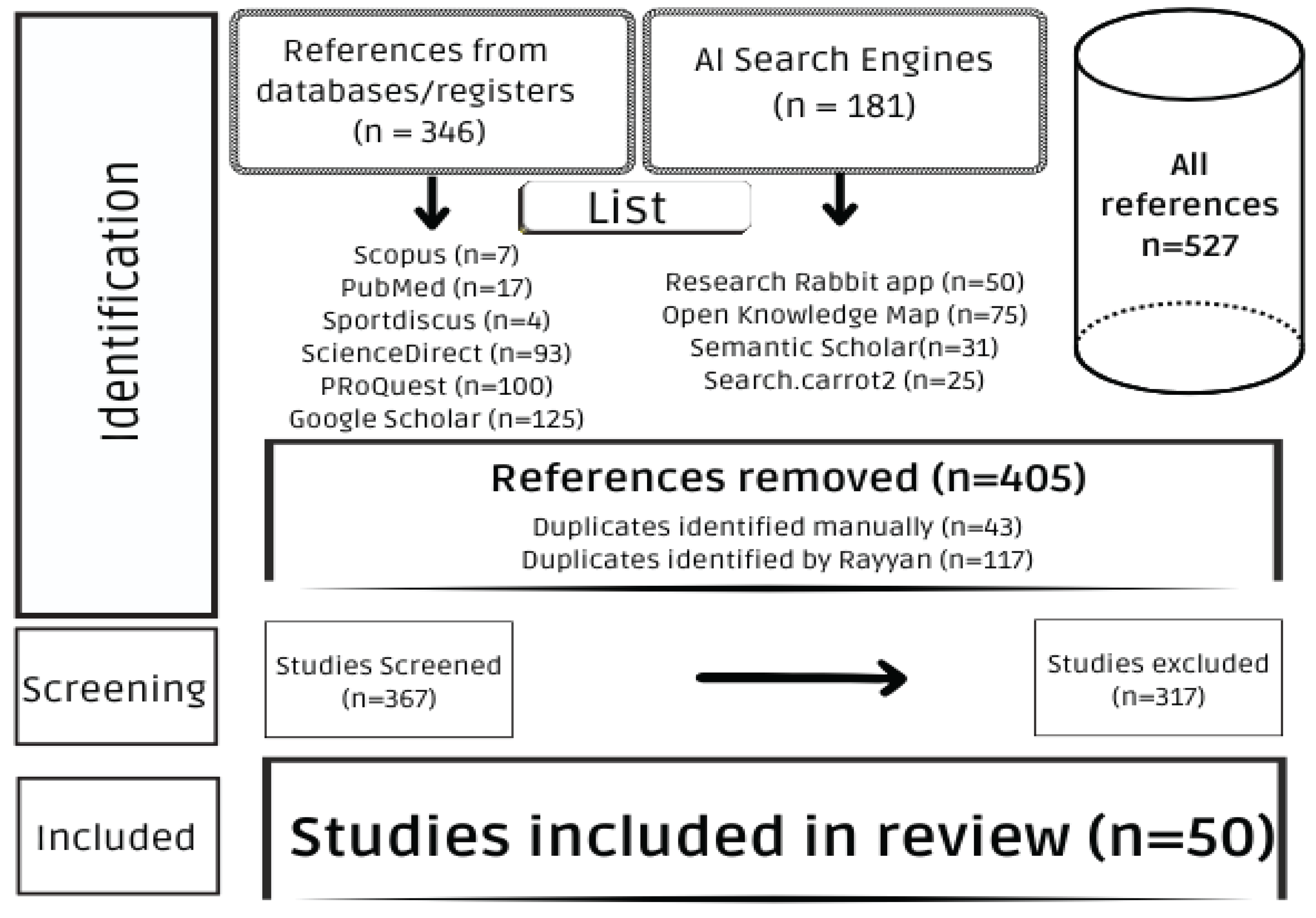
Figure 3.
Geographic density of the selected studies.
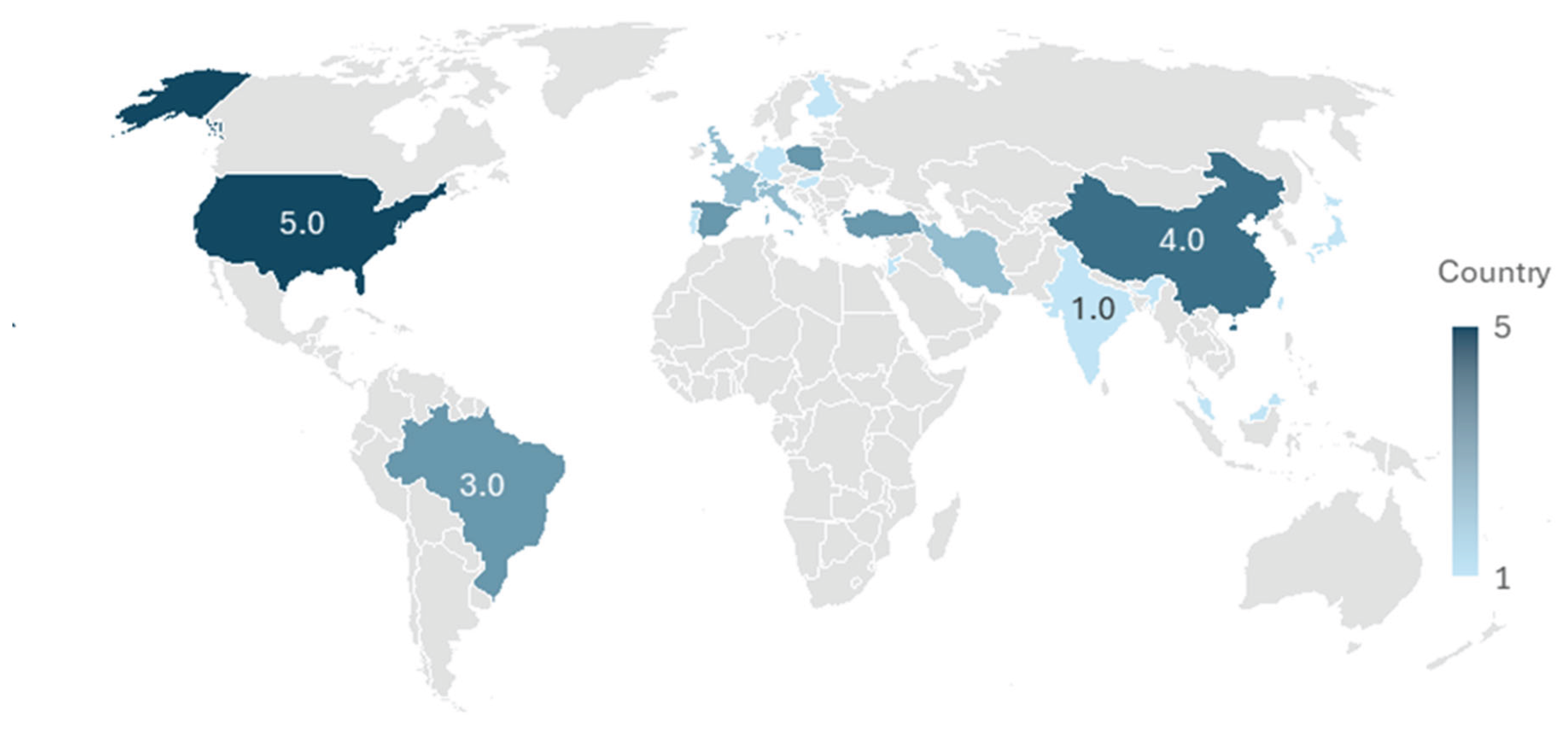

Table 1.
Variables and frequencies of the characteristics that make up the selected studies .
| Variable | Characteristics | Counts | % of Total |
|---|---|---|---|
| Type-Study | Original | 41 | 82,0% |
| Review | 9 | 18,0% | |
| Sex | Female | 1 | 2,0% |
| Male | 22 | 43,1% | |
| Both | 27 | 52,9% | |
| N/R | 1 | 2,0% | |
| Population (type) | Heart patient | 1 | 2,0% |
| No Trained Healthy | 37 | 74,0% | |
| Trained | 12 | 24,0% | |
| Methodology | Machine Learning (ML) / Artificial Intelligence (IA) | 18 | 36,0% |
| Maximal Exercise Test And Direct Gas Analysis | 19 | 38,0% | |
| Non-Exercise Prediction Models / ML/ AI | 2 | 4,0% | |
| Submaximal Exercise Test | 2 | 4,0% | |
| Submaximal Exercise Test/Direct Gas Analysis | 3 | 6,0% | |
| Validated Field Tests | 4 | 8,0% | |
| Validated Field Tests / Direct Gas Analysis | 2 | 4,0% | |
| Wearable used | Accelerometer | 1 | 2,0% |
| GPS | 1 | 2,0% | |
| HR monitor | 8 | 16,0% | |
| HR monitor, Smartphone | 2 | 4,0% | |
| Smartphone | 2 | 4,0% | |
| Smartwacht (HR and other variables) | 7 | 14,0% | |
| Xbox Kinect | 1 | 2,0% |
Disclaimer/Publisher’s Note: The statements, opinions and data contained in all publications are solely those of the individual author(s) and contributor(s) and not of MDPI and/or the editor(s). MDPI and/or the editor(s) disclaim responsibility for any injury to people or property resulting from any ideas, methods, instructions or products referred to in the content. |
© 2026 by the authors. Licensee MDPI, Basel, Switzerland. This article is an open access article distributed under the terms and conditions of the Creative Commons Attribution (CC BY) license (http://creativecommons.org/licenses/by/4.0/).
Copyright: This open access article is published under a Creative Commons CC BY 4.0 license, which permit the free download, distribution, and reuse, provided that the author and preprint are cited in any reuse.


