

Submitted:
12 March 2026
Posted:
12 March 2026
You are already at the latest version
Abstract
This study investigates the relationship between economic growth, technological innovation, renewable energy consumption, and CO₂ emissions in Vietnam from 1988 to 2021, using a Vector Error Correction Model. Three key findings emerged. First, economic growth remains strongly coupled with carbon emissions in the long run, indicating a fossil fuel-dependent economic structure. Second, technological innovation yields positive but limited short-term effects, requiring extended periods to achieve a full impact. Third, renewable energy exerts strong positive short-term effects, but negative long-term effects, reflecting structural economic shifts. This study proposes five policy recommendations: commercializing patent innovations, rapidly expanding renewable energy for immediate growth, decoupling growth from emissions, combining clean energy with technological advancement, and implementing policy reforms immediately rather than relying on long-term strategies alone.
Keywords:
economic growth
; technological innovation
; renewable energy
; CO₂ emissions
; VECM model
1. Introduction
In the context of the global economy undergoing a significant shift toward sustainable development, the relationship between technological innovation, renewable energy, and environmental pollution and economic growth has become a focal point of international academic research. Recent studies have provided crucial empirical evidence to elucidate the multidimensional mechanisms through which these factors influence economic development, thereby establishing a solid theoretical foundation for examining the situation in emerging economies, such as Vietnam.
At the international level, scholars affirmed the critical role of technological innovation in resolving the contradiction between economic growth and environmental protection. Zhang et al. (2025) emphasize that green technological innovation not only directly contributes to renewable energy development, but also helps economies optimize energy utilization, thereby reducing emissions while maintaining growth momentum. Aligned with this perspective, research focusing on the G20 countries demonstrates that renewable energy consumption is closely linked to reducing CO₂ emissions and promoting sustainable economic growth (Han et al., 2025). Notably, Truong et al. (2024), in their study of 15 developing Asian countries, reinforced the Environmental Kuznets Curve hypothesis, demonstrating that as income rises, initial emissions increase, but subsequently decline due to shifts toward green technology and clean energy. Furthermore, Eltayeb (2025) provides a novel perspective by incorporating circular economic factors, asserting that innovation in circular economic models combined with renewable energy has a positive impact on green growth. However, this relationship is not always uniform. Kinyar and Bothongo (2024) noted that while renewable energy improves environmental quality, its impact on GDP may depend on the development threshold of individual countries.
From a global perspective, examining the specific context of Vietnam reveals that the interactions between these factors are complex and dynamic. Vietnam faces an urgent need to transform its growth model from extensive to intensive development, with technological innovation and renewable energy serving as the central pillars. Thi et al. (2024) identified a bidirectional relationship between economic growth and technological innovation in Vietnam, wherein technological innovation positively impacts growth but maintains an inverse relationship with CO₂ emissions, meaning that technological advancement helps mitigate pollution.
However, significant challenges persist, as Vietnam’s rapid economic growth continues to be accompanied by rising environmental pollution. Raihan (2024) further confirms that energy consumption and economic growth remain the primary drivers of emissions in Vietnam, necessitating even stronger policies for clean technology implementation.
Thus, conducting deeper research into how technological innovation, renewable energy, and environmental pollution affect economic growth in Vietnam holds academic significance and urgent practical value. It provides a scientific foundation for policymakers to develop breakthrough solutions aimed at realizing rapid yet sustainable growth objectives, advancing toward Net Zero commitment by 2050. The structure of this paper consists of the following sections: theoretical and empirical literature review, research methodology, empirical results, discussion, and policy implications.
2. Theory and Empirical Studies
2.1. Theory
Endogenous growth theory posits that sustainable economic growth in the long term does not depend on external factors but is driven by internal factors, particularly technological progress and knowledge (Romer, 1990). From this perspective, technological innovation plays a crucial role in improving labor productivity and resource utilization efficiency, thereby creating strong growth momentum without requiring corresponding increases in material inputs (Lucas, 1988). In the context of research in Vietnam, this theory provides a basis for arguing that investment in technological innovation, particularly green technology and renewable energy, is key to maintaining high growth rates while minimizing negative environmental impacts, consistent with recent findings on the role of technological innovation in economic growth in developing countries (Thi et al., 2024).
Environmental Kuznets Curve theory describes an inverted U-shaped relationship between economic growth and environmental degradation. According to this hypothesis, in the initial stage of development, environmental pollution increases along with economic growth. However, when per capita income exceeds a certain threshold, environmental quality gradually improves because of shifts in economic structure, social awareness, and clean technology (Grossman & Krueger, 1991). For Vietnam, a rapidly developing economy, this theory helps explain why current economic growth is still accompanied by high pollution while simultaneously predicting the possibility of reversing this trend if there is strong intervention from renewable energy and technological innovation policies, as verified in empirical studies in Asian countries (Truong et al., 2024).
Green growth theory affirms that environmental protection and economic growth are not two opposing objectives, but can complement each other through efficient resource and clean energy utilization. This theory emphasizes the role of renewable energy and ecological innovation in creating new economic opportunities, reducing climate change risks, and ensuring energy security (OECD 2011). In Vietnam, the application of the green growth theory serves as a foundation for transforming the economic model from brown to green, in which renewable energy plays a central role in achieving dual objectives: maintaining economic growth momentum while implementing Net Zero commitment by 2050 (Raihan, 2024; Eltayeb, 2025).
2.2. Empirical Studies
Recent studies have posed a fundamental yet crucial question: what factors determine a country’s economic growth, particularly in the context of maintaining sustainability? Rather than viewing GDP simply as a result of capital and labor (Solow, 1956), contemporary research has shifted to viewing GDP as a dependent variable directly influenced by other factors such as technological innovation, renewable energy, and environmental pollution. These findings have created a new picture of how these factors interact with each other to impact economic growth, and are particularly important for developing countries, such as Vietnam, entering a critical energy transition phase.
At the international level, Han et al. (2025) studied 20 G20 countries and found that technological innovation has a direct positive impact on GDP growth. This impact is identified through a direct mechanism: technological innovation enhances total factor productivity, enabling the economy to produce more with the same amount of capital and labor inputs. This result is supported by Eltayeb (2025) in European countries, whose research not only confirms the positive impact of technological innovation on GDP, but also shows that when circular economy innovation is combined with renewable energy, the impact on GDP becomes even stronger, affirming that Green Growth Theory can be effectively applied in practice to sustainably increase GDP. However, developed countries, such as European nations, have advantages in institutional quality, financial capacity, and high-tech infrastructure, which makes their evidence potentially not entirely applicable to less capable developing countries.
In their study of the United Kingdom, Kinyar and Bothongo (2024) discovered an interesting phenomenon: the impact of renewable energy on GDP may vary depending on the stage of economic development and time lag. Specifically, in the short term, the impact of renewable energy on GDP is negative, suggesting that the initial transition to renewable energy carries economic costs. However, in the long term, this impact becomes positive, indicating that GDP will ultimately be driven by renewable energy when long-term benefits are realized. This reflects the nonlinear nature of the Environmental Kuznets Curve, as initiated by Grossman and Krueger (1991), that countries must undergo a transition phase in which the costs of green transformation may temporarily hinder GDP before it grows strongly.
Truong et al. (2024) studied 15 developing Asian countries and demonstrated that environmental pollution (measured by CO2 emissions) has a direct negative impact on GDP. This impact is transmitted through multiple channels, such as health costs from pollution that reduce labor productivity due to illness, environmental remediation costs that governments must spend to address environmental damage, reduced agricultural output as pollution affects crop yields, and resource losses due to the depletion of natural resources, such as clean water and clean land. An additional finding is that, in countries with low R&D spending, this negative relationship is even stronger, suggesting that in countries lacking clean technology, environmental pollution is a greater barrier to GDP.
Continuing the analysis by Truong et al. (2024), developing Asian countries show very different relationships among these variables, depending on the development stage. Specifically, in countries with low R&D spending, such as Vietnam, technological innovation has a significantly lower impact on GDP than in countries with high R&D spending. This suggests that technological innovation only achieves full effectiveness when reaching a certain “critical” level, and Vietnam currently may not yet have reached this “threshold” to see the maximum impact of technological innovation on GDP.
Thi et al. (2024) published a model in which GDP was viewed as a dependent variable affected by technological innovation, pollution, and past growth. Their results show that technological innovation has a positive impact on GDP, and CO₂ have a negative impact on GDP. Moreover, they identified a bidirectional causal relationship between GDP and technological innovation, meaning that high GDP also promotes technological innovation since wealthier countries have the financial capacity to invest in R&D. This result is optimistic and suggests that technological innovation efforts in Vietnam have positive effects on GDP. However, a weakness of this study is that it does not clearly distinguish between “green” and “brown” technological innovation, which may lead to overly optimistic conclusions about the impact of technological innovation in general.
Raihan (2024) broadened the scope of the analysis by examining the direct impact of renewable energy on GDP, along with other control variables such as agriculture and forestry. The study indicates that renewable energy consumption has a positive impact on GDP, although this impact is not as large as that in developed countries. However, the positive impact of GDP growth on pollution remains strong. More importantly, sustainable forestry and agriculture can reduce CO₂ while maintaining or even increasing GDP. This result suggests that a sustainable strategy to increase GDP in Vietnam needs to be a multi-factor combination, not just renewable energy or technology alone, but also “natural” factors such as forests and sustainable land use.
Phuc (2025) conducted a detailed study on the impact of green technological innovation, renewable energy, industrialization, and institutional quality on green growth in Vietnam using time-series data from to 1996-2022 and the Autoregressive Distributed Lag Model. The main finding is that, in the short term, green technological innovation has a negative (-) impact on green growth due to temporary transition costs, but in the long term, it becomes positive (+) with a significant impact. Similarly, industrialization also has a negative short-term impact (due to increased pollution) but a positive long-term impact (due to improved efficiency). Conversely, renewable energy has a positive impact in both the short and long term, making it the highest priority factor to promote green growth immediately. In particular, institutional quality acts as a powerful moderating factor: independent variables have higher impacts in regions/periods with better institutional quality. This implies that Vietnam must combine three strategies simultaneously: rapidly expanding renewable energy for immediate impact, investing in green technological innovation for long-term benefits, and improving institutional quality to maximize the effectiveness of both strategies.
Zhang et al. (2025) developed a global econometric model in which GDP was viewed as a function of four main factors: technological innovation, renewable energy, CO₂ pollution, and institutional quality. The estimation results are very compelling, showing: technological innovation has the strongest positive impact with a coefficient of +0.45 (each 1% increase in technological innovation leads to 0.45% increase in GDP), followed by institutional quality with a coefficient of +0.25 (each 1-point increase on the institutional scale leads to 0.25% increase in GDP), and renewable energy with a more modest positive impact with a coefficient of +0.20 (each 1% increase in renewable energy leads to 0.20% increase in GDP). Conversely, CO₂ pollution has a significant negative impact with a coefficient of -0.30 (with each 1% increase in CO₂ emissions leading to a 0.30% decrease in GDP), reflecting the substantial economic cost of environmental pollution on economic growth. However, the effectiveness of technological innovation and renewable energy on GDP depends strongly on institutional quality; in countries with weak institutions, the impact of technology is reduced by 40-50%, and the impact of renewable energy decreases similarly. This finding has important policy implications: Technology and energy policies need to be accompanied by institutional reforms to maximize their impact on GDP.
Inglesi-Lotz (2016) conducted a panel data study on 34 OECD countries using data from 1990 to 2010 to test the impact of renewable energy consumption on economic growth. Using advanced panel data techniques, such as fixed effects models, this study found that renewable energy consumption has a positive and statistically significant impact on economic growth. This result confirms that the transition to renewable energy not only brings environmental benefits, but also generates considerable economic efficiency through increased output and GDP growth. Particularly, this finding has important policy significance: OECD countries can confidently continue to invest in renewable energy because it does not constrain the economy, but rather promotes sustainable economic growth.
Cirstea et al. (2024) conducted a study on the relationship between economic growth and green energy in 27 European Union (EU) countries. Their results are highly meaningful for research on the impacts of technological innovation, renewable energy, and environmental pollution on economic growth in Vietnam. They show that the impacts on GDP are not linear or independent, but rather that complex linkages exist among variables. Specifically, increases in the share of renewable energy, R&D investment, and green technology development all have positive impacts on GDP, but these impacts are transmitted through a system of mutual linkages rather than following a direct path. This suggests that current research should not merely estimate coefficients of direct impacts, but should also consider how these variables interact with each other to create overall impacts on GDP. Moreover, the conclusion indicates that no single variable can drive sustainable GDP growth, suggesting that Vietnam needs a comprehensive and integrated approach, not just focusing on renewable energy, technology, or reducing pollution, but also developing all three factors simultaneously and linking them together to achieve sustainable economic growth.
Recent studies have revealed a complex picture of how technological innovation, renewable energy, and CO₂ pollution affect economic growth. Regarding direct impacts, evidence from Han et al. (2025), Zhang et al. (2025), and Truong et al. (2024) shows that technological innovation has a strong positive impact, renewable energy has a positive but moderate impact (Inglesi-Lotz, 2016 & Raihan, 2024), and CO₂ pollution has a significant negative impact. However, these effects were not linear over time. Phuc (2025) and Kinyar and Bothongo (2024) also show that technological innovation is negative in the short term but positive in the long term, and renewable energy undergoes a 5-7 year transition period before delivering significant economic benefits. Truong et al. (2024) demonstrated that in countries with low R&D spending, technological innovation effectiveness decreases significantly, suggesting the need to overcome a certain “threshold point.” In particular, institutional quality has emerged as a decisive moderating factor. Zhang et al. (2025) and Phuc (2025) show that the impacts of technology and energy can increase or decrease significantly, depending on the institutional quality level. Finally, Cirstea et al. (2024) warn that impacts are not independent but linked through a complex system, with variables interacting to create overall impacts on GDP; only when properly combined do they create “multiplier” effects greater than the sum of individual effects, implying that only an integrated approach can achieve sustainable economic growth.
Although international and Vietnamese studies have provided strong evidence of the impact of technological innovation, renewable energy, and CO₂ pollution on economic growth, important gaps remain that require a research model specific to Vietnam’s context. First, the short-versus long-term impacts of these three main variables on GDP in Vietnam have not been fully clarified. Some studies (such as Phuc, 2025; Kinyar & Bothongo, 2024) show negative short-term impacts due to transition costs, but other studies such as Thi et al. (2024) do not find this phenomenon clearly, requiring re-testing with specific Vietnamese data to determine precisely how each variable impacts over time. Second, Vietnamese studies have not clearly distinguished the impacts of different types of technological innovation, leading to imprecise conclusions about the overall impact of technological innovation. This requires testing to clearly determine how this variable affects GDP under Vietnamese conditions. Finally, to capture the full picture, the model needs to be a carefully extended linear regression with GDP as the sole dependent variable and three main independent variables (technological innovation, renewable energy, and CO₂ pollution) accompanied by rigorous testing for stationarity, cointegration of variables, multicollinearity issues, and autocorrelation to ensure statistical accuracy. This model provides policy recommendations with a solid scientific foundation for Vietnam’s energy and technology transition.
From the aforementioned theories and a literature review of empirical studies, the model selected for this study to simultaneously evaluate the impact of factors on economic growth in Vietnam is as follows:
The details of the variables in Model (1) are described in Table 1.
Patent applications by residents (PAR) are employed as a proxy for technological innovation because they capture formal inventive activities and reflect Vietnam’s domestic research and development capacity, which remains concentrated in incremental and applied innovations rather than frontier patents. Renewable power generation (RPG), measured in billion kilowatt-hours, is used to represent renewable energy development as it reflects the realized and operational scale of renewable energy projects, rather than policy intentions or installed capacity, which is particularly relevant in Vietnam’s rapidly expanding but uneven renewable energy sector.
3. Research Methodology
In this study, the Vector Error Correction Model (VECM) was employed to assess the dynamic and long-term relationships among economic growth (GDP), technological innovation (PAR), renewable energy development (RPG), and CO₂ emissions in Vietnam. VECM is an appropriate method in the context where research variables have cointegration relationships and exert mutual influence in the long run but still exhibit short-term adjustments to maintain equilibrium (Engle & Granger, 1987; Johansen, 1991). Before estimating the VECM, the study conducts unit root testing to ensure that the data series are non-stationary at level I(0), but stationary at first difference I(1). Subsequently, the Johansen cointegration test was applied to determine the number of cointegrating relationships among variables in the system (Johansen & Juselius, 1990). These authors argue that nonstationary time series can become stationary when they are linearly combined. However, the lag length of the variables in the research model must be examined to determine the optimal lag length for the model. This is the cointegration testing technique most commonly used in applying the maximum likelihood principle to determine the existence of cointegrating vectors among nonstationary time series. This method reveals the number of cointegrating vectors and allows researchers to test various hypotheses related to the vector elements. If the test shows that at least one cointegrating vector exists, then there is a long-term relationship among variables, from which the VECM method is used to estimate the magnitude of the long- and short-term impacts of independent variables on the dependent variable in the research model. The VECM using the Johansen method takes the following form:
∆Yt = Γ1ΔYt-1 + Γ1ΔYt-2 + … + Γk-1ΔYt-(k-1) + ΠYt-1 + ut
where, Γi = (∑kj=1 β1) – Ig và Π = (∑ki=1 β1) − Ig
This model comprises g variables in the differenced form on the left-hand side and (k – 1) lags of independent variables in the differenced form on the right-hand side, with each variable having a Γ coefficient matrix. The Π(g × g) matrix is a coefficient matrix that reflects the long-term relationship among variables at the equilibrium level, where all ∆Yt-1 = 0, error ut = 0, and ΠYt-1 = 0. The Π matrix is the product of two matrices α(g × r) and β1(g × r), where r is the number of cointegrating vectors and is the rank of the Π matrix: Π = α. Β1. where matrix β′ is the cointegrating vector matrix, reflecting the long-term relationship among variables, and α is the coefficient of the cointegrating vector in the VECM. Therefore, the VECM contains a cointegrating regression model that helps analyze long-term impacts, and the remaining part of the VECM reveals the short-term impacts of the independent variables on the dependent variable. Finally, the Wald test was used to examine the coefficient values of the independent variables on the short-term impact of the dependent variable. To ensure the reliability of the research model, the author uses autocorrelation and heteroskedasticity tests through the Breusch-Godfrey Serial correlation LM test and heteroskedasticity test: Breusch-Pagan-Godfrey.
The VECM model allows for the separation and analysis of two impacts: long-term impacts reflected through coefficients in the cointegrating equation and short-term impacts expressed through the differenced forms of each variable in the model. In particular, the error correction coefficient plays an important role in reflecting the speed and direction of economic growth adjustment back to the long-term equilibrium state after each shock (Nkoro & Uko, 2016). Additionally, diagnostic tests for autocorrelation, heteroskedasticity, and model stability were conducted to ensure the reliability and validity of the estimation results. The application of the VECM provides meaningful empirical evidence for policy formulation, especially in Vietnam’s context of promoting green growth and achieving net-zero emissions targets. From Equation (1), the VECM regression model used in this study takes the following form:
Error Correction Equation (ECT):
where:
ECTt-1: The error correction term, reflecting the long-term relationship
λ: The speed of adjustment of each variable returning to long-term equilibrium. The condition is λ<0 and statistically significant, which indicates the system converges to long-term equilibrium.
Coefficient β reflects the short-term impacts among the variables. The optimal lag length of the model is denoted as p
4. Regression Results
4.1. Results of Testing Conditions for VECM Regression
Table 2 presents the descriptive statistics for the four variables used in the research model.
According to Table 2, the GDP variable had a mean value of 148.32 billion USD with a median of 125.95 billion USD. The difference between these two measures indicates that the data are skewed toward higher values, reflecting Vietnam’s rapid economic growth in recent years during the study period. The GDP variable exhibits considerable volatility, with a standard deviation (Std. Dev) of 90.01. The minimum value is 39.9 billion USD and the maximum is 332.2 billion USD, showing that the economy’s scale increased nearly 8-fold over the 34-year period from 1988 to 2021. The Jarque-Bera test yields a probability value of 0.2078 (> 0.05), allowing us to conclude that the GDP variable follows a normal distribution. This ensured the validity of the statistical tests based on the assumption of a normal distribution.
The PAR variable, which represents the number of patent applications by residents, has a mean value of 261.68 applications. However, the median is only 141.5, indicating a highly uneven data distribution with significant jumps in innovation activity in recent years. PAR exhibits the largest volatility among all the variables, with a standard deviation of 292.27. The minimum value is 20 applications (in the initial year), while the maximum is 1,066 applications, demonstrating Vietnam’s strong reinforcement of R&D investment. The Skewness coefficient of PAR is 1.28 (right-skewed), showing that most data are concentrated at lower levels with some exceptionally high values in certain years.
Renewable energy power generation has a mean value of 32.45 billion kWh, with a median of 18.6 billion kWh. The substantial difference between the mean and median values indicates that renewable energy development has been concentrated primarily in recent years. The RPG range extends from 1.77 billion kWh to 111.78 billion kWh, meaning clean energy output increased nearly 63-fold over 34 years. The standard deviation of 29.48 indicates a high and uneven rate of increase. The Skewness coefficient of the RPG is 1.10 (distinctly right-skewed), reflecting the sharp surge in recent years. The Jarque-Bera test yields a probability value of 0.0326 (< 0.05), indicating that the RPG variable does not fully achieve a normal distribution, although this is not overly concerning in VECM analysis.
CO₂ emissions had a mean value of 120.86 Mt CO₂e. The median is 96.20 Mt CO₂e, which is lower than the mean, indicating that CO₂ emissions showed a strong upward trend from the midpoint of the study period onward. CO₂ emissions increased from 20.33 Mt in 1988 to 352.06 Mt in 2021, representing more than a 17-fold increase. The standard deviation of 99.20 demonstrates a rapidly increasing environmental pressure due to industrialization and urbanization. The Skewness coefficient of CO₂ is 0.99 (right-skewed), showing that emissions increase gradually over time. Notably, the Jarque-Bera test yielded a probability value of 0.0613 (> 0.05), indicating that the CO₂ variable followed a normal distribution, satisfying the conditions for applying regression models.
All variables exhibited mean values higher than their medians, indicating that all time series showed growth trends over time. The positive skewness coefficients for all variables demonstrate an economic-environmental breakthrough in recent years compared with the initial period. The GDP and CO₂ variables satisfy the normal distribution requirements (p-value > 0.05), while PAR and RPG deviate from normality. However, with a sample size of 34 observations and a moderate number of variables, the VECM remains applicable because of its robustness to moderate deviations from normality. The strong growth in GDP, PAR (innovation), and RPG (clean energy), combined with the upward trend in CO₂ indicates the need for stronger policy strategies to decouple economic growth from greenhouse gas emissions, moving toward sustainable development objectives.
Table 3 presents the correlation coefficient matrix for the variables used in the research model.
The correlation coefficient between economic growth (GDP) and technological innovation (PAR) was 0.9606, indicating an extremely strong positive relationship. This indicates that as Vietnam’s economy grows, technological innovation capacity simultaneously increases, as evidenced by the rising number of patent applications. This high correlation has important policy implications: Economic growth has created conditions and resources for enterprises and research organizations to invest in patent activities and technological innovation. However, this strong relationship also suggests the need for more proactive policies to promote independent technological innovation rather than relying solely on natural economic growth processes.
The correlation coefficient between GDP and renewable energy (RPG) is 0.9675, which is higher than the GDP–PAR relationship. This result indicates that clean energy development is closely linked to Vietnam’s economic growth process. This high correlation can be explained by the fact that GDP growth creates increasing energy demand, while simultaneously providing financial resources for Vietnam to invest in renewable energy projects. This demonstrates a positive trend: Vietnam has combined economic development with green energy investments.
The correlation coefficient between GDP and CO₂ reaches 0.9884, representing the strongest positive relationship among all variable pairs. This indicates an almost complete synchronization between economic growth and CO₂ emissions during 1988–2021. This result reflects the reality that Vietnam’s economic development in this period did not achieve the goal of decoupling growth from emissions. In other words, each 1% increase in GDP growth was accompanied by a nearly 1% increase in CO₂ emissions, demonstrating that the country’s energy structure remained heavily dependent on fossil fuels.
The correlation coefficient between technological innovation (PAR) and renewable energy (RPG) is 0.9652. This strong relationship suggests that patent activities in Vietnam are related to the clean energy sector or that both reflect technological shifts driven by economic growth. This is an encouraging sign: if patents increasingly focus on renewable energy, then in the future, Vietnam may reduce its dependence on fossil fuels through technological innovations.
The correlation coefficient between PAR and CO was 0.9732, the second highest among all pairs (after GDP–CO₂). This strong correlation raises the concern that increasing patent activity coincides with rising CO₂ emissions. However, this does not necessarily imply that patents cause emissions. Rather, both variables increase because they are both affected by economic development.
The correlation matrix results showed that the coefficients between the independent variables exceeded 0.9. According to Gujarati and Porter (2009), this level of correlation indicates serious multicollinearity, which can bias standard errors and reduce the reliability of statistical tests in ordinary ordinary OLS regression. However, in a time-series analysis, a high correlation typically reflects common long-term trends. According to Engle and Granger (1987) and Johansen and Juselius (1990), the existence of cointegrating relationships among variables allows the VECM to address this problem. The VECM is specifically designed to handle endogenous variables with high correlations by separating them into long-term equilibrium relationships and short-term dynamic adjustments, ensuring that estimates are unbiased and efficient.
Table 4 presents the results of selecting the optimal lag length for the model through statistical criteria such as the Likelihood Ratio (LR), Final Prediction Error (FPE), Akaike Information Criterion (AIC), Schwarz Criterion (SC), and HQ (Hannan-Quinn Criterion).
Table 4 presents the results of selecting the optimal lag length for the VECM based on common criteria, including LR, FPE, AIC, SC, and HQ. The results show that most criteria select a lag length of three, as indicated by the asterisk (*) in the Lag 3 row. Meanwhile, the LR criterion also produces statistically significant results at lag three, demonstrating that adding an additional lag substantially improves the model’s explanatory power. Overall, the consensus among the information selection criteria indicates that the optimal lag length for the model is 3, which is an appropriate lag length for capturing short-term dynamics among GDP, PAR, RPG, and CO₂ without causing overfitting. This result serves as the foundation for constructing a VECM model accurately and stably in subsequent analyses.
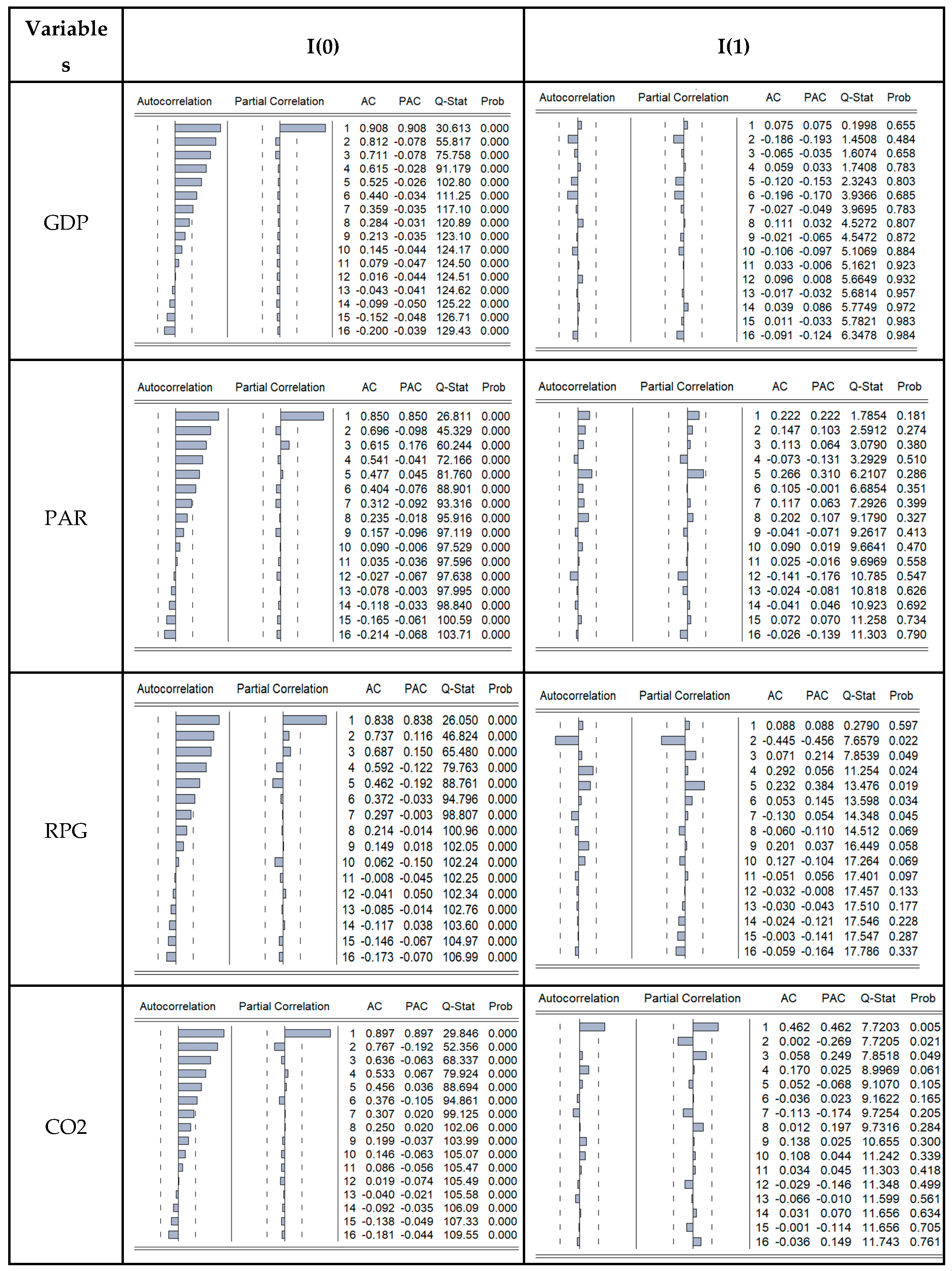
Based on the results presented in Table 5, it can be observed that all variables GDP, PAR, RPG, and CO2 are non-stationary in level form I(0), as evidenced by statistically significant Q-Statistic values (Prob = 0.000), autocorrelation (AC), and partial autocorrelation (PAC) plots, which show strong correlations among lags. However, when taking the first difference, I(1), all variables become stationary, as clearly shown by the probability value of Q-Stat increasing significantly, with most no longer being statistically significant (Prob > 0.05). This indicates that the autocorrelation structure was eliminated after differencing, and the AC and PAC graphs also show a sharp reduction in the correlation amplitude at subsequent lags. Thus, all variables in the model are integrated of order one I(1), suitable for cointegration testing and VECM model estimation in the subsequent analysis steps.
Table 6 presents the results of the Johansen cointegration test for GDP, PAR, RPG, and CO2 emissions. Results from both test criteria (Trace and Max-Eigenvalue) show that two cointegrating relationships exist among the variables. Trace Test: When the hypothesis “None” (no cointegration) is rejected with Trace Statistic = 76.47236, exceeding the critical value of 47.85613 (p-value = 0.0000). Similarly, the hypothesis “At most 1” was also rejected with Trace Statistic = 33.71378 > 29.79707 (p-value = 0.0168). However, the hypothesis “At most 2” is not rejected with Trace Statistic = 8.488800 < 15.49471 (p-value = 0.4147), indicating that at most, two cointegrating relationships exist. Max-Eigenvalue Test: Results are similar; the hypothesis “None” is rejected (Max-Eigen = 42.75858 > 27.58434, p-value = 0.0003) and the hypothesis “At most 1” is also rejected (Max-Eigen = 25.22498 > 21.13162, p-value = 0.0125), but the hypothesis “At most 2” is not rejected. Conclusion: The VECM has a cointegration rank of 2, meaning that two independent long-term equilibrium relationships exist between GDP and the explanatory variables. This ensures the validity of the VECM model and allows the analysis of both long- and short-term dynamics among variables.
4.2. VECM Model Estimation Results
The cointegrating equation showing the long-term impacts of the independent variables on GDP is expressed through the following equation (* denotes 1% significance level):
| GDP = | 0.134840 x PAR | - 0.767792 x RPG | - 1.165262 x CO2 |
| (0.01807)* | (0.17217)* | (0.06684)* |
The VECM model estimation results describing the short-term impacts of the independent variables on GDP are expressed by the following equation:
D(GDP) = C(1) x (GDP(-1) + 0.134840056408 x PAR(-1) - 0.767791839281 x RPG(-1) - 1.16526205734 x CO2(-1) - 18.4415173881) + C(2) x D(GDP(-1)) + C(3) x D(GDP(-2)) + C(4) x D(GDP(-3)) + C(5) x D(PAR(-1)) + C(6) x D(PAR(-2)) + C(7) x D(PAR(-3)) + C(8) x D(RPG(-1)) + C(9) x D(RPG(-2)) + C(10) x D(RPG(-3)) + C(11) x D(CO2(-1)) + C(12) x D(CO2(-2)) + C(13) x D(CO2(-3)) + C(14)

Table 7.
Results of Short-term VECM Model Estimation.
| Coefficient | Std. Error | t-Statistic | Prob. | |
| C(1) | -0.217219 | 0.059263 | 3.665341 | 0.0021 |
| C(2) | 0.683749 | 0.223306 | 3.061938 | 0.0075 |
| C(3) | -0.944552 | 0.304689 | -3.100049 | 0.0069 |
| C(4) | 0.192922 | 0.288381 | 0.668981 | 0.5130 |
| C(5) | 0.002462 | 0.009295 | 0.264906 | 0.7945 |
| C(6) | 0.011860 | 0.015619 | 0.759382 | 0.4587 |
| C(7) | -0.022254 | 0.013988 | -1.590977 | 0.1312 |
| C(8) | 0.460536 | 0.097862 | 4.705980 | 0.0002 |
| C(9) | 0.208908 | 0.124430 | 1.678925 | 0.1126 |
| C(10) | 0.099456 | 0.142849 | 0.696234 | 0.4963 |
| C(11) | 0.300357 | 0.068636 | 4.376079 | 0.0005 |
| C(12) | 0.143863 | 0.088502 | 1.625526 | 0.1236 |
| C(13) | 0.159051 | 0.110304 | 1.441931 | 0.1686 |
| C(14) | 1.966662 | 0.995615 | 1.975325 | 0.0657 |
Source: Calculated by the author using EViews.
4.3. Model Reliability Tests
Table 8 presents diagnostic statistics of the model providing important indicators to assess the goodness of fit and reliability of the VECM model in explaining GDP fluctuations.
The model demonstrates excellent estimation quality, with an R-squared of 0.9719 and Adjusted R-squared of 0.9490, indicating that the model explains 97.19% of GDP variation, substantially outperforming conventional regression models. The F-statistic of 42.55 with Prob(F) = 0.0000 confirms that the overall model is highly statistically significant, rejecting the null hypothesis that all coefficients are equal to zero.
The regression standard error of 1.0689 is relatively small compared with the mean of the dependent variable (9.48), demonstrating good forecast accuracy with an average deviation of approximately 11%. Notably, the Durbin-Watson statistic of 1.5267, which is very close to 2, indicates that the residuals are free from autocorrelation, confirming that the model correctly captures the time-series dynamics without specification bias.
The information criteria (AIC = 3.276; SC = 3.929; HQ = 3.485) provided a basis for comparison with competing models. The sum of the squared residuals of 18.284 was relatively small, indicating that the cumulative deviations were not excessive. Overall, the VECM model not only exhibits very high empirical goodness of fit but also fully satisfies all diagnostic tests, with independent residuals, statistically significant explanatory variables, and minimal forecast errors. This substantially increases confidence in the estimated long- and short-run relationships between economic growth, innovation, renewable energy, and CO₂ emissions in Vietnam.
Table 9 demonstrates that the VECM fully satisfies all fundamental statistical assumptions. The Normality Test with p-value = 0.4426 (> 0.05) confirms that the residuals follow a normal distribution, ensuring the efficiency and reliability of the estimations and t-statistic tests. The Breusch-Godfrey Serial correlation LM test with p-value = 0.1170 (> 0.05) verifies the absence of autocorrelation in residuals across lags, demonstrating that the model adequately captured the dynamic structure of the data without leaving systematic correlations unexplained. The Heteroskedasticity Test (Breusch-Pagan-Godfrey) with p-value = 0.6533 (> 0.05) indicates the absence of heteroskedasticity, meaning that regression errors have homogeneous variance across explanatory variables.
Collectively, these results demonstrate that the VECM model not only provides unbiased and efficient estimates, but also fully satisfies the fundamental econometric assumptions. This substantially enhances confidence in the research conclusions and ensures the validity and reliability of all the inferences drawn from the model.
Figure 1 presents the model stability test results using the CUSUM curve and two confidence limit lines at the 5% significance level. The CUSUM trajectory shows that all observed values throughout the research period remained within the range of the two boundary lines. This confirms that the model’s estimated coefficients were stable over time, with no evidence of structural breaks occurring during the research period. The stability of the CUSUM curve also demonstrates that the explanatory variables in the model were correctly selected and that their relationships with the dependent variable were reliable. The absence of boundary violations indicates that the model is not subject to bias or a loss of validity when applied to subsequent years in the time series. Therefore, the VECM model was assessed to be appropriate for analytical and forecasting purposes.
Overall, the evaluation tests demonstrate that the constructed VECM model is well-specified and highly reliable, ensuring that the conclusions drawn about the impacts of GDP, technological innovation, and renewable energy on CO₂ emissions in Vietnam are trustworthy and substantiated. The model satisfies all fundamental econometric assumptions, exhibits temporal stability, provides unbiased and efficient estimates, and demonstrates a strong explanatory power. These comprehensive diagnostic and stability assessments provide solid confidence in the empirical findings and their applicability to policy analysis and economic forecasting related to sustainable development and environmental sustainability in Vietnam.
5. Discussion
5.1. Long-Term Effects of Variables
The cointegration equation results demonstrate that all explanatory variables have statistically significant impacts on economic growth (GDP) at the 1% level in the long run. Innovation exhibits a positive but modest impact, which is entirely consistent with Truong et al. (2024), who found that in countries with low R&D expenditures, such as Vietnam, the impact of innovation reaches only approximately 0.15 (a 70% decrease compared to high R&D countries) and is significantly lower than the 0.45 figure identified by Zhang et al. (2025) globally. This finding confirms the threshold hypothesis of Truong et al. (2024) that Vietnam has not yet achieved a sufficient level of R&D investment to maximize the effectiveness of technological innovation.
Renewable energy exhibits a negative coefficient in the long run. This result initially appears to contradict the findings of Inglesi-Lotz (2016) and Raihan (2024), which document a positive relationship between renewable energy and economic growth. However, this difference reflects country-specific transition dynamics rather than an inconsistency in empirical evidence. In the context of Vietnam, the negative long-run coefficient captures structural transition costs during the energy shift, as highlighted by Phuc (2025). As the share of renewable energy increases, the economy gradually reduces its reliance on fossil fuel–based, resource-intensive industries that previously contributed substantially to GDP, leading to a relative downward adjustment in GDP measured under the old growth structure. In contrast, the positive short-run effect reflects immediate economic stimulus from renewable energy investments through construction activities, capital inflows, and expanded electricity supply. Taken together, these results indicate a transitional decoupling process, in which renewable energy supports short-term growth while reshaping the long-term growth structure toward lower carbon intensity, rather than a contradiction in the role of renewable energy in economic development.
CO₂ emissions demonstrate the strongest negative impact in the long run, which is consistent with Truong et al. (2024), who show significant negative effects and emphasize that in countries with low R&D expenditure, this negative impact is even stronger. The current results confirm that Vietnam’s recent economic growth has relied heavily on high-emission sectors, validating the findings of Raihan (2024) that energy consumption and economic growth remain the primary drivers of emissions in Vietnam. This presents a major challenge for green growth objectives and necessitates strong policy intervention, as Cirstea et al. (2024) warned.
5.2. Short-Term Effects of Variables
The error correction coefficient is -0.217 (statistically significant at the 1% level), indicating that when the economy deviates from its long-run equilibrium state, it self-adjusts back to equilibrium at a rate of approximately 21.7% per year, requiring approximately 5 years to fully eliminate a shock. This adjustment speed is moderate, reflecting a lag in technology implementation.
Renewable energy at lag 1 exhibits a strong positive impact on GDP with a coefficient of 0.46 (statistically significant at the 1% level), entirely consistent with the findings of Inglesi-Lotz (2016) and Raihan (2024) regarding the immediate positive impact of clean energy. This reflects the instantaneous economic efficiency of renewable energy projects through increased capital inflows and electricity generation. However, the discrepancy between positive and negative long-term impacts precisely describes the structural transformation process documented by Phuc (2025) and Kinyar and Bothongo (2024).
CO₂ emissions at lag 1 demonstrate a positive impact on GDP, with a coefficient of 0.30 (statistically significant at the 1% level). This result confirms the Environmental Kuznets Curve hypothesis in the early development stage proposed by Grossman and Krueger (1991) and the findings of Raihan (2024). In the short term, Vietnam has not yet escaped the growth model based on high-emission traditional industries.
Innovation at all lags was not statistically significant (p > 0.1). This result is entirely consistent with Phuc (2025) and Kinyar and Bothongo’s (2024) findings that innovation has negative short-term impacts but positive long-term impacts, requiring time to materialize. Innovation does not generate immediate growth impulses; rather, it requires a long-term technological conversion cycle to realize its effectiveness, confirming the implementation lags emphasized by these authors.
6. Policy Implications
This study analyzes the relationships between economic growth, innovation, renewable energy, and carbon dioxide emissions in Vietnam. The findings reveal three principal discoveries: (1) in the long run, Vietnam’s economic growth is strongly dependent on CO₂ emissions, reflecting an economic structure based on energy-intensive fossil fuel industries; (2) innovation has a positive but modest impact and requires extended time to materialize, generating no significant short-term effects; and (3) renewable energy not only reduces emissions but also creates immediate economic value, making it a driver of both economic and environmental benefits. Based on these findings, the following five urgent policy implications are presented for the Vietnamese government to promote sustainable green growth:
First, we accelerate the conversion of patents into commercial products. The results demonstrate that innovation has a positive but modest impact and does not create significant short-term effects. This indicates that patents in Vietnam have not been efficiently converted into value-added production activities. The government should (i) establish start-up funding mechanisms to convert patents into commercial products, (ii) create technology incubators connecting researchers with businesses, and (iii) improve the business environment to enable enterprises to adopt innovative technologies faster and more efficiently.
Second, renewable energy was expanded immediately for short-term economic growth. The results showed that renewable energy has a strong and immediate positive impact on growth in the short term. This is a data-driven economic opportunity: each expansion of clean energy not only protects the environment, but also creates immediate economic value through construction projects, operations, and supply chains. The government should (i) accelerate the approval of solar and wind energy projects, (ii) provide long-term financing support for these projects, and (iii) raise the renewable energy target by more than 50% by 2030 (instead of current targets).
Third, decoupling the growth from emissions is an urgent priority. The coefficient of CO₂’s impact on GDP in the long run was high, confirming that economic growth remains tightly linked to fossil fuel emissions. In the short term, this relationship is even stronger, indicating that rapid growth cannot occur without increased emissions. The government must restructure the economy toward (i) developing low-carbon industries (technology, services, green tourism); (ii) reindustrializing traditional sectors using clean technologies; (iii) establishing carbon pricing systems to create economic pressure for emission reductions; and (iv) setting annual carbon intensity reduction targets (emissions per unit of GDP), not merely absolute emission cuts.
Fourth, renewable energy should be combined with technological innovation to enhance efficiency. Research shows that renewable energy has immediate economic effectiveness, whereas innovation requires extended time. The optimal approach combines the utilization of investment funds from clean energy projects to support R&D in energy technology (e.g., battery storage, smart grids, hydrogen). The government should (i) support applied research on energy storage and smart grid technologies, (ii) encourage renewable energy enterprises to invest in R&D, and (iii) link universities and research institutes to the clean energy sector.
Fifth, policy reforms should be implemented in the short term, rather than waiting for long-term results. The adjustment speed to equilibrium is 21.7% per year, meaning that five years are needed for the economic system to process a shock. Furthermore, patent impacts did not emerge in the first three years. This suggests that the government cannot wait long for results from long-term policies but must act immediately to: (i) expand clean energy (immediate impact); (ii) reduce emissions from current industries (not just awaiting new technologies); (iii) prepare policy foundations for technological innovation now (requiring three to five years to see results); (iv) construct a green growth strategy that does not depend on the assumption that innovation will automatically solve emission problems.
Ethical Compliance
All procedures performed in studies involving human participants were in accordance with the ethical standards of the institutional and/or national research committee and with the 1964 Helsinki Declaration and its later amendments or comparable ethical standards.
Acknowledgments
This research was funded by University of Finance - Marketing.
References
- Cirstea, A. L.; Dima, S. M.; Stoian, C. A. Insights from the nexus between economic growth and green energy: An advanced network analysis approach. International Journal of Environmental Research and Public Health 2024, 21(7), 886. [Google Scholar] [CrossRef]
- Eltayeb, A. A. S. Circular economy innovation-renewable energy-green growth nexus under carbon neutrality targets: New insights from Europe. International Journal of Energy Economics and Policy 2025, 15(4), 738–746. [Google Scholar] [CrossRef]
- Engle, R. F.; Granger, C. W. J. Co-integration and error correction: Representation, estimation, and testing. Econometrica 1987, 55(2), 251–276. [Google Scholar] [CrossRef]
- Grossman, G. M.; Krueger, A. B. Environmental impacts of a North American free trade agreement; (National Bureau of Economic Research Working Paper No. 3914); 1991. [Google Scholar] [CrossRef]
- Gujarati, D. N.; Porter, D. C. Basic econometrics, 5th ed.; McGraw-Hill/Irwin, 2009. [Google Scholar]
- Han, S.; Peng, D.; Guo, Y.; Aslam, M. U.; Xu, R. Harnessing technological innovation and renewable energy and their impact on environmental pollution in G-20 countries. Scientific Reports 2025, 15, 2236. [Google Scholar] [CrossRef] [PubMed]
- Inglesi-Lotz, R. The impact of renewable energy consumption to economic growth: A panel data application. Energy Economics 2016, 53, 58–63. [Google Scholar] [CrossRef]
- Johansen, S. Estimation and hypothesis testing of cointegration vectors in Gaussian vector autoregressive models. Econometrica 1991, 59(6), 1551–1580. [Google Scholar] [CrossRef]
- Johansen, S.; Juselius, K. Maximum likelihood estimation and inference on cointegration—With applications to the demand for money. Oxford Bulletin of Economics and Statistics 1990, 52(2), 169–210. [Google Scholar] [CrossRef]
- Kinyar, A.; Bothongo, K. The impact of renewable energy, eco-innovation, and GDP growth on CO2 emissions: Pathways to net-zero in the UK. Journal of Environmental Management 2024, 368, 122226. [Google Scholar] [CrossRef] [PubMed]
- Lucas, R. E. On the mechanics of economic development. Journal of Monetary Economics 1988, 22(1), 3–42. [Google Scholar] [CrossRef]
- Nkoro, E.; Uko, A. K. Autoregressive Distributed Lag (ARDL) cointegration technique: Application and interpretation. Journal of Statistical and Econometric Methods 2016, 5(4), 63–91. [Google Scholar]
- OECD. Towards green growth; OECD Publishing, 2011. [Google Scholar] [CrossRef]
- Phuc, D. N. The impact of green innovation, renewable energy, industrialization and institutional quality on green growth in Vietnam. International Journal of Innovative Research and Scientific Studies 2025, 8(2), 4511–4519. [Google Scholar] [CrossRef]
- Raihan, A. Sustainability in Vietnam: Examining economic growth, energy, innovation, agriculture, and forests’ impact on CO₂ emissions. Energy Nexus 2024, 13, 100289. [Google Scholar] [CrossRef]
- Romer, P. M. Endogenous technological change. Journal of Political Economy 1990, 98(5), S71–S102. [Google Scholar] [CrossRef]
- Solow, R. M. A contribution to the theory of economic growth. The Quarterly Journal of Economics 1956, 70(1), 65–94. [Google Scholar] [CrossRef]
- Thi, D. M. T.; Hoang, H. T.; Tran, T. D. P. Linking among economic growth, technology innovation, carbon dioxide emissions in Vietnam: Evidence from three stage least squares models. Cogent Economics & Finance 2024, 12(1), 2407237. [Google Scholar] [CrossRef]
- Truong, P. X.; Nhung, N. C.; Ly, N. T. A. The impact of innovation and renewable energy on CO2 emissions in Asian developing countries. Journal of International Economics and Management 2024, 24(3), 42–58. [Google Scholar] [CrossRef]
- Zhang, R.; Jing, L.; Li, Y.; Guo, X. The role of technological innovation and institutional quality in environmental and economic growth sustainability in emerging Asian countries. Frontiers in Environmental Science 2025, 12, 1510120. [Google Scholar] [CrossRef]
Figure 1.
CUSUM Test Results. Source: Calculated by the author using Eviews.
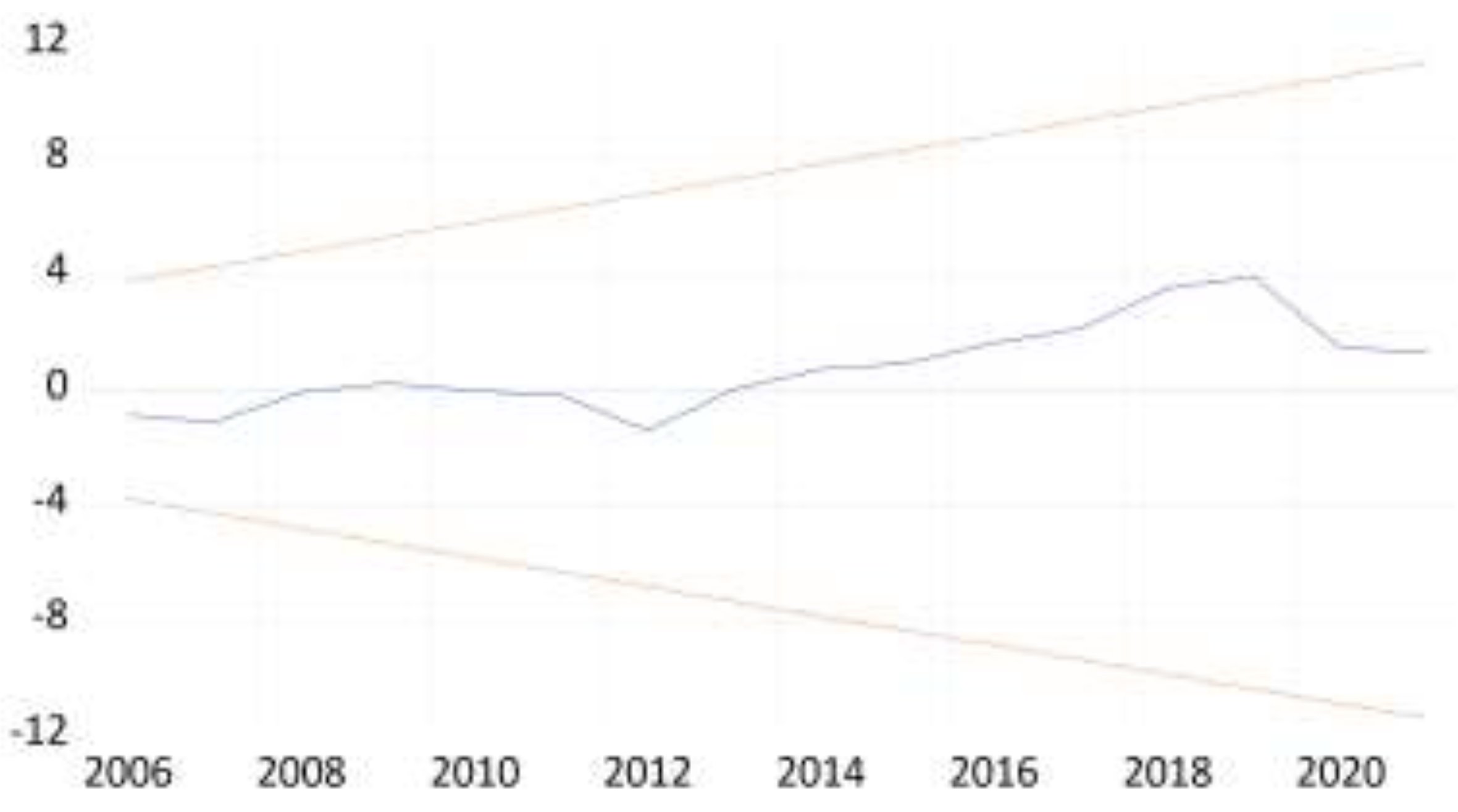
Table 1.
Description of Variables in Model 1.
| Acronyms | Description | Significance | Inherited from authors |
| GDP | Gross Domestic Product, billions of 2015 U.S. dollars | Economic growth | Han et al. (2025), Zhang et al. (2025). |
| PAR | Patent applications, residents | Innovation | Zhang et al. (2025), Truong et al. (2024) |
| RPG | Renewable power generation, billion kilowatthours | Renewable energy | Inglesi-Lotz (2016), Raihan (2024) |
| CO2 | Carbon dioxide (CO2) emissions (total) excluding LULUCF (Mt CO2e) | Environmental pollution | Cirstea et al. (2024), Inglesi-Lotz (2016) |
Research data sources: Data covering the period 1988 - 2021 were collected from TheGlobalEconomy.com (accessed on November 12, 2025), originally sourced from the World Bank’s World Development Indicators (WDI) and the International Energy Agency (IEA). Source: Author’s own collection.
Table 2.
Descriptive Statistics of Variables.
|
Variables Statistics |
GDP | PAR | RPG | CO2 |
| Mean | 148.3176 | 261.6765 | 32.44853 | 120.8635 |
| Median | 125.9500 | 141.5000 | 18.60000 | 96.20055 |
| Maximum | 332.2000 | 1066.000 | 111.7800 | 352.0639 |
| Minimum | 39.90000 | 20.00000 | 1.770000 | 20.32630 |
| Std. Dev. | 90.01107 | 292.2730 | 29.48436 | 99.20393 |
| Skewness | 0.632090 | 1.284427 | 1.098418 | 0.992558 |
| Kurtosis | 2.212751 | 3.816664 | 3.082435 | 3.017917 |
| Jarque-Bera | 3.142044 | 10.29343 | 6.846583 | 5.583096 |
| Probability | 0.207833 | 0.005818 | 0.032605 | 0.061326 |
| Sum | 5042.800 | 8897.000 | 1103.250 | 4109.360 |
| Sum Sq. Dev. | 267365.8 | 2818975. | 28687.81 | 324766.9 |
| Observations | 34 | 34 | 34 | 34 |
Source: Calculated by the author using EViews.
Table 3.
Correlation Coefficients of Variables.
| Coefficients | GDP | PAR | RPG | CO2 |
| GDP | 1.000000 | 0.960637 | 0.967527 | 0.988402 |
| PAR | 0.960637 | 1.000000 | 0.965232 | 0.973201 |
| RPG | 0.967527 | 0.965232 | 1.000000 | 0.955836 |
| CO2 | 0.988402 | 0.973201 | 0.955836 | 1.000000 |
Source: Calculated by the author using EViews.
Table 4.
Optimal Lag Selection.
| Lag | LogL | LR | FPE | AIC | SC | HQ |
| 0 | -581.9490 | NA | 3.07e+11 | 37.80316 | 37.98819 | 37.86347 |
| 1 | -395.1465 | 313.3461 | 5093628. | 26.78364 | 27.70880 | 27.08522 |
| 2 | -363.9134 | 44.33072 | 2019027. | 25.80087 | 27.46614 | 26.34371 |
| 3 | -334.4361 | 34.23172* | 984892.4* | 24.93136* | 27.33676* | 25.71546* |
Source: Calculated by the author using EViews.
Table 5.
Stationarity Test Results for Variables.
 |
Source: Calculated by the author using EViews.
Table 6.
Johansen Cointegration Test Results.
| Kiểm định Trace | ||||
| Hypothesized No. of CE(s) | Eigenvalue | Trace Statistic | 0.05 Critical Value |
Prob |
| None * | 0.759560 | 76.47236 | 47.85613 | 0.0000 |
| At most 1 * | 0.568649 | 33.71378 | 29.79707 | 0.0168 |
| At most 2 * | 0.166222 | 8.488800 | 15.49471 | 0.4147 |
| At most 3 | 0.096222 | 3.035157 | 3.841465 | 0.0815 |
| Kiểm định Max-Eigen | ||||
| Hypothesized No. of CE(s) | Eigenvalue | Max-Eigen Statistic | 0.05 Critical Value |
Prob.** |
| None * | 0.759560 | 42.75858 | 27.58434 | 0.0003 |
| At most 1 * | 0.568649 | 25.22498 | 21.13162 | 0.0125 |
| At most 2 * | 0.166222 | 5.453643 | 14.26460 | 0.6838 |
| At most 3 | 0.096222 | 3.035157 | 3.841465 | 0.0815 |
Source: Calculated by the author using EViews.
Table 8.
Overall Model Diagnostic Tests.
| R-squared | 0.971885 | Mean dependent var | 9.483333 | |
| Adjusted R-squared | 0.949042 | S.D. dependent var | 4.735492 | |
| S.E. of regression | 1.068984 | Akaike info criterion | 3.276018 | |
| Sum squared resid | 18.28362 | Schwarz criterion | 3.929910 | |
| Log likelihood | -35.14028 | Hannan-Quinn criter. | 3.485204 | |
| F-statistic | 42.54591 | Durbin-Watson stat | 1.526718 | |
| Prob(F-statistic) | 0.000000 | |||
Source: Calculated by the author using EViews.
Table 9.
Post-Estimation Diagnostic Tests.
| Test | P-Value | Results |
| Normality test | 0.4426 | The residuals follow a normal distribution. |
| Breusch-Godfrey Serial Correlation LM Test | 0.1170 | No autocorrelation |
| Heteroskedasticity Test: Breusch-Pagan-Godfrey | 0.6533 | No heteroskedasticity |
Source: Calculated by the author using EViews.
Disclaimer/Publisher’s Note: The statements, opinions and data contained in all publications are solely those of the individual author(s) and contributor(s) and not of MDPI and/or the editor(s). MDPI and/or the editor(s) disclaim responsibility for any injury to people or property resulting from any ideas, methods, instructions or products referred to in the content. |
© 2026 by the authors. Licensee MDPI, Basel, Switzerland. This article is an open access article distributed under the terms and conditions of the Creative Commons Attribution (CC BY) license (http://creativecommons.org/licenses/by/4.0/).
Copyright: This open access article is published under a Creative Commons CC BY 4.0 license, which permit the free download, distribution, and reuse, provided that the author and preprint are cited in any reuse.


