
Submitted:
10 March 2026
Posted:
11 March 2026
You are already at the latest version
Abstract
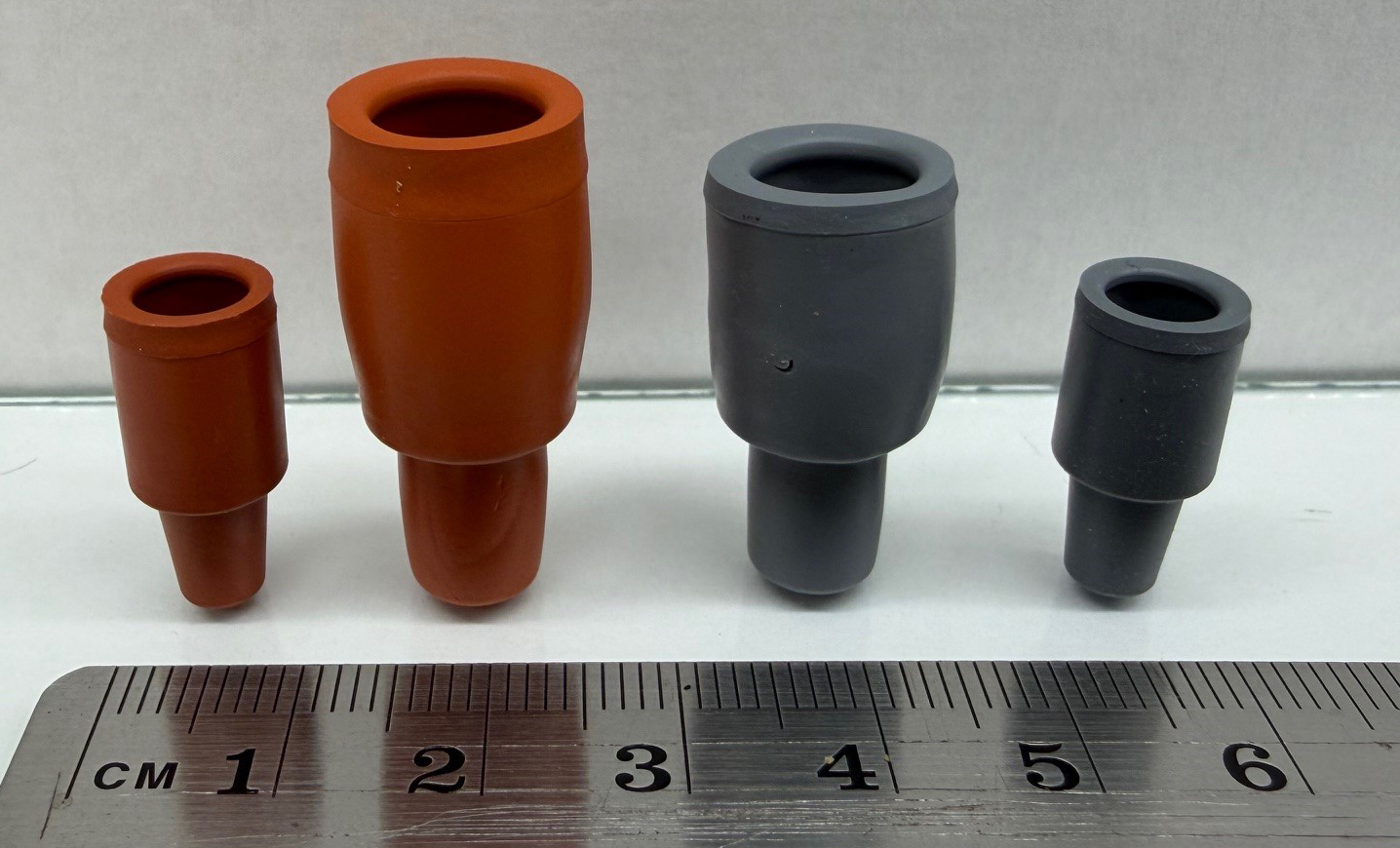
Insect attractant lures come in many formats, one of which utilizes tapered rubber sleeve stoppers, normally utilized to seal laboratory glassware openings. Their cup-shape top happens to be ideal to pipet a solution within this cavity, and, through permeation, load quantities of active ingredients. The expansion or swelling of the rubber facilitates the permeation of the active within its matrix, a role that dichloromethane performs well. Dichloromethane is also favored due to its volatility and broad chemical compatibility. However, this solvent is possibly on the verge of retirement, which would mean finding alternatives. It was found that several other common laboratory solvents could serve as replacement, and of those tested, tetrahydrofuran outperformed dichloromethane in terms of overall volume uptake and swelling. When loading the septum/sleeve with larger amounts of active, a full soaking methodology can disperse the active throughout the rubber sleeve as well as reduce labor requirement since batches can be processed compared to manually pipetting a solution to individual sleeves.
Keywords:
insect lures
; solvents
; septa
; rubber sleeve stopper
1. Introduction
Most, if not all, chemicals have positive and negative properties with the latter usually being discovered after the fact. Many pesticides, such as dichlorodiphenyltrichloroethane (DDT) were very effective controlling insects, however, its less desirable effects were discovered later and lead to phasing out its use in 1972 [1]. DDT residue can still be found on old spraying sites, and even in living organisms, a testament to its persistence [2].
When the Montreal Protocol was established to reduce and eliminate the use of ozone-depleting substances, chloroform and carbon tetrachloride were among the first to be targeted to be phased out, or to see their use restricted, while dichloromethane (DCM) was not initially targeted.
Recently, the US EPA (United States Environmental Protection Agency) finalized a ban on most uses of DCM [3] which has some insect lure producers wondering if they will be able to continue to access DCM sources to load active into 5 x 11mm tapered rubber sleeve stoppers. These stoppers also double as a septa style sampling port and thus earned the name “septa” which stuck with scientists using them for insect attractant lures and will be referred to as septa hereafter. DCM has been the status quo “go to” solvent for so many years; surely, there are other common solvents that can be alternatives, and research into these was not needed until now.
We did what most laboratories would have done; open up our solvent cabinet, picked out potential candidates and tested them. Two septa formulations were considered: the well known red rubber septa, formerly from Wheaton, now DWK Lifesciences (Duran Wheaton Kimble) [4] and the grey halobutyl from West Pharma [5] in their capacity to take up solvent relative to DCM. The swelling capacity of a solvent on a septum is directly related to the amount of active that can be absorbed within the septa. For microgram or lower scale loading, absorption capacity is not nearly as important and hexanes is often adequate to this end [6]. There is no doubt that halogenated solvents have played a pivotal role in organic and medicinal chemistry [7,8] and finding alternatives in those fields will bring their own challenges which is not included in the scope of this study.
The common top-load method used to prepare septa-based lures involves pipetting a solution of active within the cup of the septum and allowing it to permeate into the rubber via localised solvent-induced swelling, followed by a waiting period for the solvent to evaporate. While this method has limitations, it remains viable for milligram (or lower) level daily release rates (RR). Even though rubber septa are not meant to compete against pouches, sleeves and bubble caps for higher RR passive lures [9], we also want to report on a variant loading method for septa that is less laborious and has the potential to load several hundred milligrams of active within rubber septa.
Racemic (E)-6,10-dimethyl-5,9-undecadien-2-ol, herein referred to as Fuscumol, is attractive to several Tetropium ssp. when combined with other compounds and host tree volatiles [10]. Fuscumol lures are often deployed in a septa package and have been used for monitoring and surveillance of Tetropium ssp. and non-native longhorn beetles for several years, making them a suitable test platform for comparing RR patterns.
2. Materials and Methods
2.1. Chemicals and Septa
Pentane, hexanes, tetrahydrofuran (THF), diethyl ether, t-butyl methyl ether (tBuOMe), acetone, DCM, isopropanol and acetonitrile were of ACS grade or better and used without further purification. Fuscumol was obtained from Bedoukian Research Inc (product P7100-98). The red rubber septa from DWK were from existing stock that was about a year old. Polymer formulations can change over time and are usually proprietary blends. Some formulations maintain their properties longer than others. For instance, remaining septa from an open bag of Thomas Scientific 16x9mm septa (Product # 1780J07) that was found in a laboratory drawer in 2009, retain perfect elasticity to this day. A second line, produced for VWR, now Avantor, (Catalog No. 8909-548), purchased nearly a decade ago, also retains its original elasticity. The DWK line of product (formerly Wheaton), sealed in packages of 100, saw several of them develop a vacuum from within and over the span of 3-4 years since purchasing, generated a compacted and deformed clump of septa which never occurred in previous lots (see Supplementary Figure S1 in supporting info). These septa could not be used to prepare lures and were discarded. The packaging suggested a regular polyethyene membrane, which is usually permeable to ambient air. If oxygen was being consumed by the rubber and that the packaging was impermeable, a vacuum would still be unlikely since nitrogen would remain. Product labeling indicates that all 10 bags of 100 came from the same batch lot and the fact that only some bags were affected adds to the mystery of the phenomenon. The septa were stored at room temperature in a cabinet until needed. The remaining unaffected bags of septa are still usable. The grey halobutyl from West Pharma (Item # 10600275) were purchased in 2019 and are still intact to this day.
Using Quorpak jars, a batch of septa of each type were pre-cleaned for the soaking loading method experiment and other needs, by soaking in DCM for 2 hours followed by decanting the solvent (recovered via rotary evaporation) which was repeated with fresh or recovered solvent a total of 3 cycles, removing some plasticizers and other small molecules trapped within (mass of extract determined during solvent recovery). Air drying for up to 3 days is required for full solvent evaporation. Septa were not pre-cleaned for the alternative solvent assay as this maintained the original formulation of the rubber during this first swelling event.
2.2. Loading Method via Soaking
The soaking method to load active into septa involves making a dilute solution of active, adding several septa to a chemically resistant sealable jar such as the Quorpak bottles and waiting long enough to swell the septa to maximum volume. In this example, DCM was used and septa tend to float which meant adding some form of stirring to the jar, either via magnetic stirring or by angular tumbling of a square jar using a PVC tube section and a simple rock tumbler set at an angle to help promote even uptake of active by all septa (see Supplementary Figure S2 in supporting info). Alternatively, using a regular jar set upright, adding an inert mesh and weight to fully submerge them will achieve the same results providing swelling volume does not exceed liquid levels. 24 Hours later, the liquid is recovered using a large Buchner funnel. It may be possible to reuse it for subsequent batches so long as the concentration of the active remains constant to produce the same load. The septa are rinsed with a minimum fresh solvent to wash off surface residue which may not be a necessary step depending on the situation. They are then spread on a clean inert surface in a fume hood for 3 days or until their mass is stable to 0.1 mg. This method cuts out much of the labor of manually pipetting a volume into the cup part of the sleeve.
Six replicates were prepared for each red and grey septa. Small triangular notches were cut out to identify them (0-5 notches) during weighing. They were then placed in a jar large enough to accommodate their swollen state, containing 10% (10g/100ml) or 30% (30g/100ml) solutions of fuscumol. Once fully swollen, each septa was taken out, surface rinsed with fresh solvent and weighed once surface liquid disappeared, especially from the hollow section of the tapered area. A stable measurement could not be taken due to the rapidly evaporating solvent, therefore, the reading was taken as soon as possible.
Enough septa were prepared to establish RR in indoor and outdoor settings during the summer months. The indoor conditions were simply a fume hood, and the septa were hung using safety pins and string. The face velocity of the hood was 1.6 m/s, and the ambient temperature was 21 °C. The outdoor assay was a nearby treed area, and the septa were hung under a white corrugated plastic canopy to limit rain exposure since water droplets would alter weight measurements. The canopy would also reduce direct sunlight exposure, making it more comparable to indoor conditions with artificial lighting.
2.3. Solvent Uptake Trials
Pairs of septa, one with a notch cut out and one without were weighed and placed in a 20 ml scintillation vial containing the test solvent. They were periodically shaken to free them from compression against the vial wall and the other septa, and solvent was topped off as required to keep them submerged. They were removed 24 hours later and weighed again as described above. Four replicates of each septa formulation were done against each solvent.
Septa were left to air dry in a fume hood to visually ensure that they returned to their normal state or possibly lose structural integrity. Aside some slight discoloration, all septa appeared to remain intact. (see Supplementary Figure S3 in supporting info).
3. Results
3.1. Loading Method via Soaking
During the septa washing step, it is interesting to note that the red septa contained 100 mg of extractables per septa (40 g / 400) while the grey septa only contained 13 mg (5 g / 400). Precleaning is usually done as a precaution against a possible repulsive effect from internal contents, some of which could possess sufficient volatility (base smell), that may shut down trap activity. To the best of our knowledge, the extracted mixture has never been assayed against a target insect, thus it remains unclear if precleaning is beneficial. A study that utilised the Thomas Scientific septa loaded nanogram levels of active onto unrinsed septa that resulted in good trap capture [6]. However, the amount of extractables within that product is unknown. Solvent washing red rubber septa also leads to hardening of the elastomer over time, meaning that long-term stocking of rinsed septa is not advisable.
The loading method via soaking proved to be impressive as the uptake of fuscumol reached high levels (Table 1). After air drying, the red septa loaded from a 30% wt / v solution of fuscumol, almost doubled in weight and possessed the elasticity akin to that of gelatin yet maintained its original shape, albeit in a larger proportion. The grey septa were not as susceptible to DCM uptake and thus, had lower amounts of absorbed fuscumol.
RR were then measured in an indoor and outdoor setting to establish their performance range. They were weighed daily late in the morning (11:00AM), avoiding the added mass of dew condensation. Measurements were not taken on rainy days. Concerning indoor lures (Figure 1), RR were higher for both red and grey septa during the first 20 days and saw a progressive reduction over time. Conversely, outdoor lures (Figure 1) maintained their RR throughout the study. With linear regression and the equation y = mx + b, the slope m represents RR. For instance, the 30% fuscumol red septa measured indoors, RR was 9.2mg/day over the first 20 days, then dropped to 3.1mg/day.
An unexpected phenomenon occurred with the 30% fuscumol soaked red septa. During the third week, some began losing structural integrity, stretching under the effect of gravity and by the 52nd day, became viscous liquid (see Supplementary Figure S4 in supporting info). Data collection ended when a given septa could no longer be weighed without loosing septa material.
3.2. Solvent Uptake Trials
During the solvent uptake study to identify viable alternative choices to DCM, it was visually clear within minutes that tetrahydrofuran was as effective as DCM, with the ethers and hydrocarbons close behind. DCM weight uptake % was still highest for red septa, however it was THF that scored highest for grey septa. While weight percent is an accepted representation of results, factoring solvent density to consider volume uptake paints a slightly different picture (Table 2) where THF outperforms DCM in both septa types.
Acetone, isopropanol and acetonitrile are the only solvents from this study that would not be suitable alternatives since they do not penetrate the polymer sufficiently, likely due to their polar nature (see dielectric constants in Table 2). They could still be utilised for low level loads of active if they happen to be compatible with the active in question.
4. Discussion
4.1. Septa Loading via Swelling Method
Many polymerisation reactions can produce slightly different results with each batch as chain growth is dependant on how much monomer is available and within reach of the reactive end of each chain. These growing chains intertwine and form knots, resulting in pore size variations. If a crosslinker agent is used, chains become covalently attached to themselves, allowing the final object to retain its original shape. A higher standard deviation in the loading mass, as seen with the red septa, might point to a higher level of internal pockets. Contrarily, the grey septa have a lower deviation suggesting a more uniform polymerisation process. Swelling of polymers using solvents is well studied to evaluate effects on their mechanical properties and overall matrix limitations [11]. Ultimately, if a minimum set load is desired, factoring an excess that surpasses that standard deviation would meet that set target. However, higher loading, may lead to increased RR which possesses the risk of exiting the attractive RR range of an active [12]. Even though a dose response trial is often part of the development stage of a lure, the low and high attraction limits are not always established. Nonetheless, it remains that RR that are either too low or too high may be agonistic to the desired attraction effect.
With RR established from a given load, regression can serve to tune in the desired load or RR. Using the two data points in this study and forcing the intercept to cross at zero, a 2.7g/0.1L should be needed to load 50mg in red septa. However, that was not verified.
We observed first order release rates for the indoor assays and zero order release rates for the outdoor assays. In an indoor setting, air flow, temperature and relative humidity are controlled compared to an outdoor setting that is exposed to weather variations. Septa prepared via a surface absorption method likely have most of the active near the surface of the inner cup. However, with a fully swollen septa, where the distribution of the active should be spread throughout its entirety, it was expected to see an increase in release rate from surface evaporation, followed by a decrease over time due to the secondary limiting factor, internal diffusion towards the surface. This trend appears to be occurring for indoor measurements and could be related to air movement. Wind is usually variable in an outdoor environment but within a fume hood, it remains constant and thus, surface evaporation would also be constant.
The outdoor measurements were mostly linear with some variation that corelated with higher humidity days, adding mass to the septa, negating the day’s release. Average daily temperatures will also affect RR for obvious reasons [13]. A recent publication took great care to assess weather effects on passive dispensers [14]. Given the outdoor lures were placed in a shaded and partly treed area, a microclimate bubble might have kept humidity somewhat constant except during rain events. The addition of an adsorbed water layer on the surface of the septa might also act as a barrier, reducing the release of hydrophobic actives, lowering surface evaporation to the point that internal diffusion can maintain the surface supply.
Lure designs that display zero-order RR remain ideal over first order since the RR is stable throughout their expected duration. Therefore, outdoor trials would yield better data and possibly avoid surprises during deployment exercises such as field trials and monitoring efforts, especially in warmer regions. In case of restrictive off-season climate such as winter, indoor trials allow prototyping until outdoor data can be generated. Daily measurements can be misleading; since RR is mostly dependent on ambient temperature, it would be safe to predict that a large fraction of the emissions will occur during the warmer period of the day compared to the cooler hours of evening and night. On summer days, it was not uncommon to record outdoor RR that were nearly double that of indoor RR (unpublished data).
Regarding the melting red septa, the threshold loading that enables this effect was not determined. The polymer network of the red septa is degraded when sufficient fuscumol and DCM is present. Melting did not occur with the 10% septa (loaded with 209mg). The threshold conditions lie somewhere between 209 and 537mg. Therefore, it is not suspected that lures containing lower loads of fuscumol (i.e., 50mg or less) are at risk.
It is possible to recycle and reuse the solution in subsequent batches if the used solution concentration remains constant. While this was not tested, it would have been simple to verify. The decision to reuse the solution will depend on the value of the active.
A final advantage of the loading via swelling method is that the shape of the carrying rubber is no longer important. Should sheets of the rubber be available or made in house, and, if the thickness is uniform, RR per unit of area can be determined and lures cut to size to meet experimental needs, similar to Shin Estsu type dispensers [15].
4.2. Alternative Solvent Study
Since the overall formulation of commercial septa are not always divulged, testing a variety of solvents is the sure way to assess swelling potential of the solvent-septa pair being considered. Most septa are made from rubbery polymers which usually tend to possess long hydrocarbon chains for flexibility but also a minimum degree of cross linking between chains to impart elasticity, the ability to return to their original shape. Of the solvents tested in this study, mid and low polarity solvents proved to be viable choices for both septa considered with THF achieving the highest volume uptake levels. It is unfortunate that of the more polar solvents tested, no viable choice presented itself, even if the best is acetone. Polar active compounds (surpassing that of fuscumol) may require a different lure matrix than a rubber septum if the active is to be distributed throughout the passively diffusing material.
None of the tested solvents appeared to damage the structure of the tested septa (Supplementary Figure S3 in supporting info) which suggests that solvent alone does not destroy the polymer network of the rubber. That may change when adding the active to the equation. A final advantage of THF over DCM is that septa are denser than THF and sink which eliminate the need to keep septa submerged during loading.
5. Conclusions
Septa rubber formulations tend to be proprietary blends and likely have seen changes over time. This may have an impact on septa performance from previous data. A good measure of reassurance can be had by comparing indoor (or outdoor) RR of each batch produced (or acquired) using simple gravimetric methodology when possible. It is recommended that end users establish the RR in their own geography to avoid surprises and plan accordingly. When large batches of lures are to be made, the swelling method can become a more efficient use of time.
Halogenated solvents such as DCM may be difficult to acquire in the future. Transitioning to a different solvent is very much possible and is only limited by the solubility and stability of the active within the chosen solvent. Loading amount can be easily tailored to need using the data from prototype testing. Pushing the upper loading limits of septa as lure dispensers is certainly an option and can lead to undesirable effects. Prototype testing ahead of time will, again, limit surprises and give users the reassurance that the passive dispensers being scrutinized are operating at the desired level.
Supplementary Materials
The following supporting information can be downloaded at the website of this paper posted on Preprints.org.
Author Contributions
Conceptualization, G.L. and P.D.M.; methodology, G.L.; investigation, G.L.; data analysis, G.L.; data interpretation, G.L. and P.D.M.; writing—original draft preparation, G.L.; writing—review and editing, G.L. and P.D.M.; project administration, P.D.M. All authors have read and agreed to the published version of the manuscript.
Funding
No funding was required for this work.
Data Availability Statement
The original contributions presented in the study are included in the article, further inquiries can be directed to the corresponding author.
Conflicts of Interest
The authors declare no conflicts of interest.
References
- Carson, R. Silent Spring; Penguin Modern Classics: London, England, 2000.
- Kurek, J.; MacKeigan, P.W.; Veinot, S.; Mercer, A.; Kidd, K.A. Ecological Legacy of DDT Archived in Lake Sediments from Eastern Canada. Environmental Science & Technology 2019, 53, 7316–7325. [CrossRef]
- EPA, U. Biden-Harris Administration Finalizes Ban on Most Uses of Methylene Chloride, Protecting Workers and Communities from Fatal Exposure. Available online: https://www.epa.gov/newsreleases/biden-harris-administration-finalizes-ban-most-uses-methylene-chloride-protecting (accessed on June 3).
- DWK Life Sciences: Glassware & Packaging Solutions. Available online: https://www.dwk.com/na/ (accessed on June 3 2025).
- West Pharmaceutical Services, Inc - Drug Packaging and Delivery Solutions Available online: https://www.westpharma.com/ (accessed on June 3 2025).
- Svensson, G.P.; Löfstedt, C.; Skals, N. The odour makes the difference: male moths attracted by sex pheromones ignore the threat by predatory bats. Oikos 2004, 104, 91–97. [CrossRef]
- Mainkar, P.; Ray, A.; Chandrasekhar, S. SOLVENTS: From Past to Present. ACS Omega 2024, 9, 7271–7276. [CrossRef]
- Jordan, A.; Stoy, P.; Sneddon, H.F. Chlorinated Solvents: Their Advantages, Disadvantages, and Alternatives in Organic and Medicinal Chemistry. Chemical Reviews 2021, 121, 1582–1622. [CrossRef]
- Nielsen, M.-C.; Sansom, C.E.; Larsen, L.; Worner, S.P.; Rostás, M.; Chapman, R.B.; Butler, R.C.; de Kogel, W.J.; Davidson, M.M.; Perry, N.B.; et al. Volatile compounds as insect lures: factors affecting release from passive dispenser systems. New Zealand Journal of Crop and Horticultural Science 2019, 47, 208–223. [CrossRef]
- Sweeney, J.; Gao, W.; Gutowski, J.M.; Hughes, C.; Kimoto, T.; Kostanowicz, C.; Li, Y.; MacQuarrie, C.J.K.; Mayo, P.; Meng, Q.; et al. Diversity in trap color and height increases species richness of bark and woodboring beetles detected in multiple funnel traps. PLOS ONE 2025, 20, e0322412. [CrossRef]
- Metze, F.K.; Sant, S.; Meng, Z.; Klok, H.-A.; Kaur, K. Swelling-Activated, Soft Mechanochemistry in Polymer Materials. Langmuir 2023, 39, 3546–3557. [CrossRef]
- Roelofs, W.L. Threshold hypothesis for pheromone perception. Journal of Chemical Ecology 1978, 4, 685–699. [CrossRef]
- McDonough, L.M.; Brown, D.F.; Aller, W.C. Insect sex pheromones. Journal of Chemical Ecology 1989, 15, 779–790. [CrossRef]
- Corbetta, M.; Bricchi, L.; Rossi, V.; Fedele, G. The Dynamics of Pheromone Release in Two Passive Dispensers Commonly Used for Mating Disruption in the Control of Lobesia botrana and Eupoecilia ambiguella in Vineyards. Insects 2024, 15. [CrossRef]
- Bradley, S.J.; Suckling, D.M.; McNaughton, K.G.; Wearing, C.H.; Karg, G. A temperature-dependent model for predicting release rates of pheromone from a polyethylene tubing dispenser. Journal of Chemical Ecology 1995, 21, 745–760. [CrossRef]
Figure 1.
Average (n=3) release rates of fuscumol lures (10% and 30%) in indoor and outdoor settings.
Figure 1.
Average (n=3) release rates of fuscumol lures (10% and 30%) in indoor and outdoor settings.
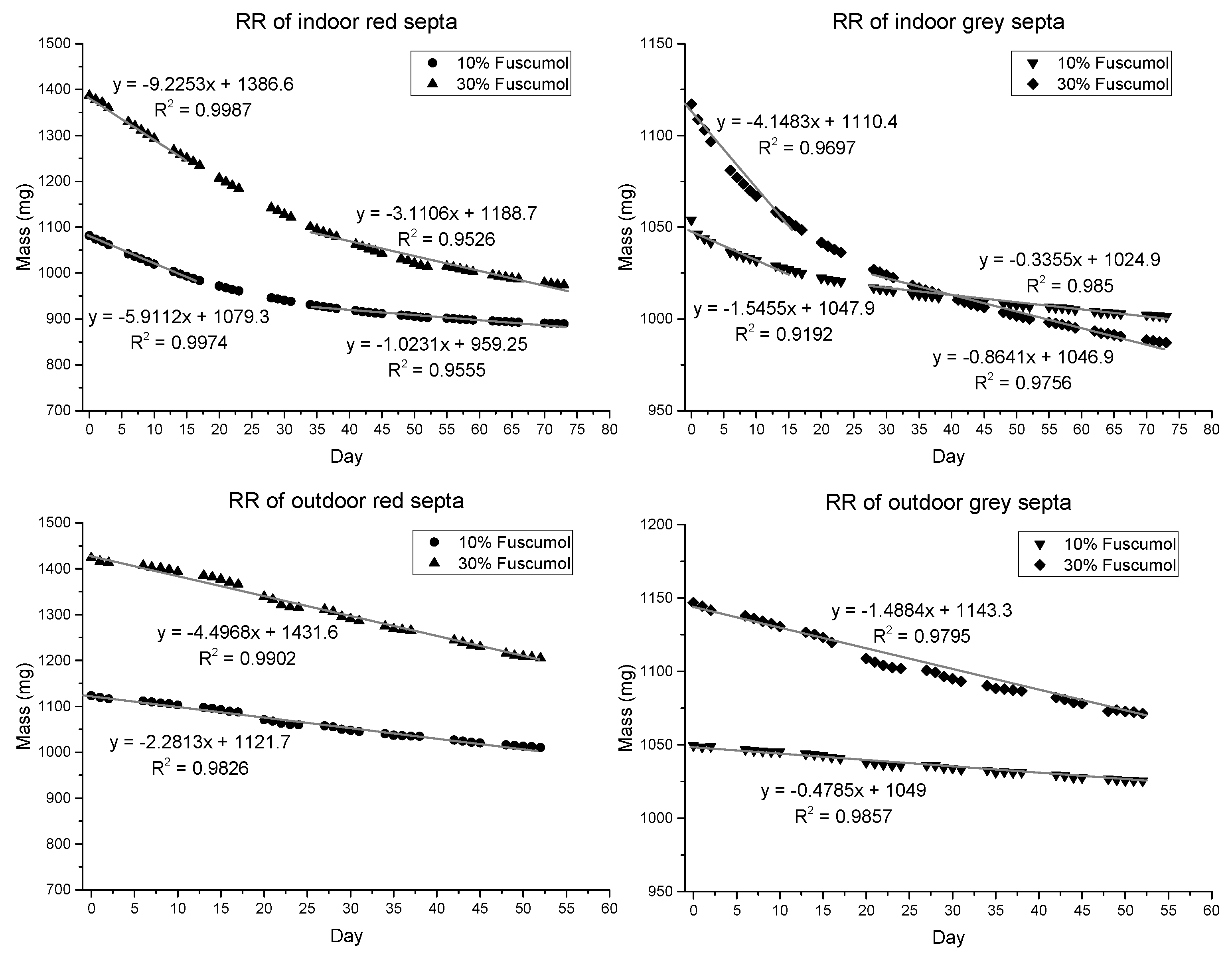

Table 1.
Average fuscumol uptake in red and grey septa (n=6).
| Original (g) |
Treated (g) |
Load (mg) |
|||
| 10% red | 0.5871 | 0.7962 | 209 | ± | 7 |
| 30% red | 0.5716 | 1.1082 | 537 | ± | 19 |
| 10% grey | 0.6721 | 0.7325 | 60 | ± | 2 |
| 30% grey | 0.6662 | 0.8328 | 167 | ± | 2 |
Table 2.
Average solvent volume uptake in red and grey rubber septa (n=4).
| Solvent | Chemical | Dielectric | Red septa | Grey septa |
| class | constant (ε) | Average uptake (ml) | Average uptake (ml) | |
| DCM | Organohalide | 8.9 | 1.46±0.04 | 0.84±0.04 |
| THF | Ether | 7.6 | 1.85±0.02 | 1.54±0.02 |
| t-BuOMe | Ether | 2.6 | 1.11±0.05 | 1.07±0.03 |
| Diethyl ether | Ether | 4.3 | 0.92±0.02 | 0.75±0.01 |
| Hexanes | Hydrocarbon | 1.9 | 0.95±0.04 | 1.41±0.03 |
| Pentane | Hydrocarbon | 1.8 | 0.77±0.02 | 1.05±0.01 |
| Acetone | Ketone | 20.7 | 0.07±0.01 | 0.09±0.01 |
| Isopropanol | Alcohol | 17.9 | 0.03±0.004 | 0.03±0.01 |
| Acetonitrile | Nitrile | 35.9 | 0.02±0.01 | 0.02±0.005 |
Disclaimer/Publisher’s Note: The statements, opinions and data contained in all publications are solely those of the individual author(s) and contributor(s) and not of MDPI and/or the editor(s). MDPI and/or the editor(s) disclaim responsibility for any injury to people or property resulting from any ideas, methods, instructions or products referred to in the content. |
© 2026 by the authors. Licensee MDPI, Basel, Switzerland. This article is an open access article distributed under the terms and conditions of the Creative Commons Attribution (CC BY) license (http://creativecommons.org/licenses/by/4.0/).
Copyright: This open access article is published under a Creative Commons CC BY 4.0 license, which permit the free download, distribution, and reuse, provided that the author and preprint are cited in any reuse.


