

Submitted:
09 March 2026
Posted:
11 March 2026
You are already at the latest version
Abstract
Rheumatoid arthritis (RA) is traditionally diagnosed once clinical joint swelling becomes apparent. However, many patients report non-localized stiffness in very early stage then preceding overt synovitis. The transitional processes linking systemic autoimmunity to localized joint inflammation remain incompletely conceptualized. This study proposed a conceptual stage-dependent transition model distinguishing a reversible inflammatory phase from a structurally consolidated phase. Tenosynovitis and joint ultrasound gray scale (GS)-negative/Power Doppler (PD)-positive synovitis were conceptualized as reversible states, whereas GS synovial hypertrophy was hypothesized to represent local immune consolidation. In this framework, “threshold” denoted a conceptual transition point rather than a fixed numerical value, at which gradual inflammatory amplification results in qualitative transition from reversible immune activation to structurally stabilized inflammation (Figure 1). A minimal dynamic representation was introduced to illustrate the theoretical plausibility of threshold-like behavior (Figure 2). Based on this model, we proposed a conceptual algorithm for ultra-early, time-limited intervention prior to structural consolidation (Figure 3). This study was hypothesis-generating and aims to provide a theoretical basis for reconsidering intervention timing in RA.
Keywords:
rheumatoid arthritis
; synovitis
; tenosynovitis
; stage-dependent transition model
INTRODUCTION
Rheumatoid arthritis (RA) is a chronic autoimmune inflammatory disease characterized by synovial inflammation and progressive joint destruction [1]. Autoantibody production, including rheumatoid factor (RF) and anti-citrullinated protein antibodies (ACPA), often precedes clinical disease by years. Nonetheless, the presence of autoimmunity does not invariably result in immediate clinical arthritis, suggesting transitional processes between systemic immune activation and localized joint inflammation.
In clinical practice, RA is typically diagnosed when joint swelling becomes evident [2]. However, many patients retrospectively complain of non-localized stiffness before objective synovitis develops. Recent advances in musculoskeletal ultrasound allow detection of tenosynovitis and joint synovitis [3,4]. Power Doppler (PD) mode detects abnormal vascularity indicates inflammatory activity, and gray scale (GS) mode detects synovial structural abnormality. Tenosynovitis and PD-positive synovitis without GS hypertrophy are early imaging findings and potentially identified inflammatory activity before structural remodeling occurs.
Despite growing recognition of preclinical and early inflammatory stages [5], a coherent conceptual framework linking immunologic progression with imaging-defined stages remains insufficiently articulated. We therefore proposed a stage-dependent transition model that integrates immunologic amplification, ultrasound findings, and structural progression (Figure 1).
CONCEPTUAL FLAMEWORK
Threshold Hypothesis
In this study, the progression of arthritis was linked to both immunological progression and change in musculoskeletal ultrasound imaging. Although a “threshold” was established using these image findings as an indicator, it did not denote a fixed numerical cutoff but rather a conceptual boundary at which continuous amplification of inflammatory activity results in qualitative transition.
Reversible Inflammatory Phase
Low-level inflammatory activity may exist within synovial and tenosynovial tissues while structural integrity is maintained. This stage corresponds to tenosynovitis, and/or GS-negative/PD-positive joint synovitis. As noted above, ultrasound GS mode detects structural abnormalities, primarily synovial hypertrophy, whereas PD mode detects abnormal vascularity indicative of active inflammation.
Inflammatory amplification is present but potentially reversible. In Figure 1, this phase lay between the PD detection threshold and the structural consolidation threshold.
Structural Consolidation Phase
If inflammatory activity persists and local inflammatory cytokine production, immune cell accumulation, and synovial proliferation exceed a critical level, structural remodeling ensues. GS synovial hypertrophy (pannus formation) becomes detectable.
We hypothesized that this stage reflected stabilization of local inflammatory circuits and potential establishment of localized immunologic memory. Clinical observations that recurrence frequently involve initially affected joints are consistent with this interpretation. In Figure 1, this transition was represented by crossing the structural consolidation (GS) threshold.
Thus, RA onset may involve stage-dependent transition rather than purely continuous progression.
Minimal Dynamic Representation (Figure 2)
denotes the systemic immune elevation derived from genetic and environmental predispositions. The nonlinear term reflects the self-amplifying cycle where synovial cytokines trigger further inflammation, while represents the counter-regulatory and dissipative mechanisms. The right side of the figure showed the correlation between immunological progression and the imaging-defined stages based on ultrasound. While no imaging abnormalities are observed at the initial onset of systemic autoimmunity, as the inflammatory activity (represented by the left y-axis) increase, the imaging changes shown in Figure 1 emerge. Concurrently, these immunological abnormalities have become established.
To demonstrate theoretical consistency, inflammatory activity may be conceptualized using a minimal nonlinear system:
Where:
: local inflammatory activity,
: background immunologic input,
: positive feedback (self-amplification),
: regulatory/dissipative processes,
: nonlinearity enabling switch-like behavior.
As illustrated schematically in Figure 2, nonlinear amplification might produce threshold-like transitions separating reversible states from structurally stabilized inflammation. This equation was presented solely as a conceptual illustration. It was not intended as a mechanistic RA model nor fitted to empirical data but served to demonstrate theoretical plausibility of the threshold framework. The nonlinear feedback term represents a generic biological amplification process commonly used to model switch-like transitions in biological systems.
Conceptual Ultra-Early Intervention Algorithm (Figure 3)
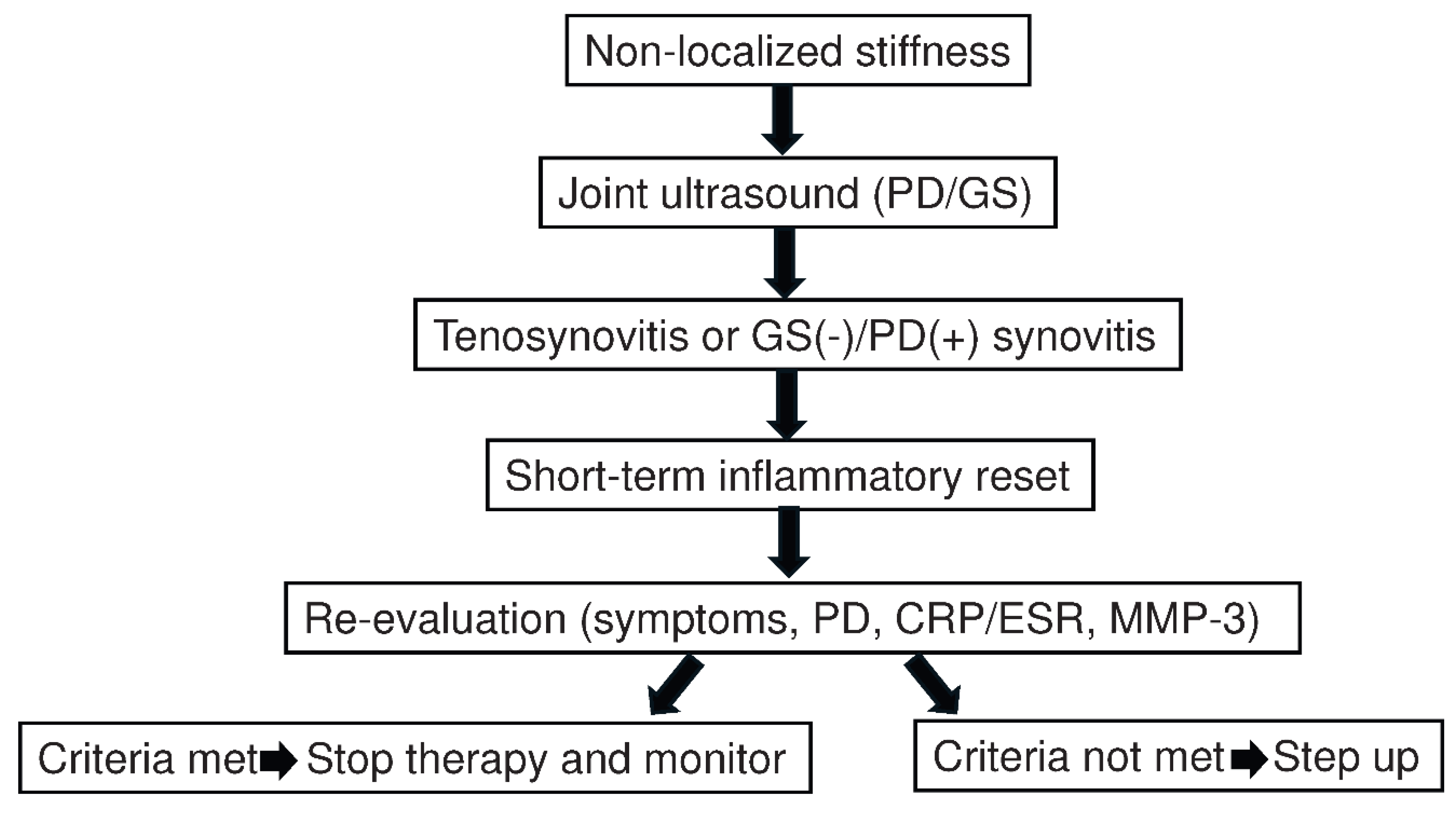
Based on the stage-dependent model, we proposed a conceptual intervention algorithm (Figure 3).
This framework applies to patients with positive immunologic markers (RF and/or ACPA), and strong clinical suspicion of RA after exclusion of alternative inflammatory arthritis.
In patients presenting with non-localized stiffness:
1. Ultrasound evaluation (PD and GS) is performed.
2. Tenosynovitis or GS-negative/PD-positive synovitis defines the reversible inflammatory phase.
3. Short-term inflammatory control (“inflammatory reset”) is initiated.
4. Re-evaluation is performed after a defined observational period (typically 3–6 months in routine clinical practice), evaluating: symptoms, PD activity, inflammatory markers such as C-reactive protein (CRP)/erythrocyte sedimentation rate (ESR), and optionally matrix metalloproteinase-3 (MMP-3).
If remission criteria—symptom resolution and disappearance of PD activity—are fulfilled, therapy may be discontinued with continued monitoring. If criteria are not met, escalation may be recommended.
This algorithm does not presuppose definitive diagnostic criteria for ultra-early RA and is not intended for asymptomatic autoantibody-positive individuals.
DISCUSSION
We proposed that RA onset might involve stage-dependent transition from a reversible inflammatory state to structural consolidation. Figure 1 conceptualizes this progression, Figure 2 demonstrates theoretical plausibility through minimal nonlinear dynamics, and Figure 3 translates the framework into a clinical decision algorithm.
In this model (figure 2), represents the systemic immunologic baseline driven by diverse predisposing factors, such as genetic susceptibility and environmental triggers. The term characterizes the positive feedback loop inherent in RA pathology, where inflammatory cytokines produced by the proliferating synovium further amplify the inflammatory response. Conversely, accounts for regulatory and dissipative processes, including immune suppression and metabolic clearance, effectively acting as the system's "brake."
The sigmoidal rise observed in the transition from the onset to progression phase aligns with the findings of McInnes and Schett [5], who described a discontinuous transition from a pre-clinical state to clinical onset triggered by a breach of local thresholds.
As the disease enters the chronic Phase, the inflammatory intensity stabilizes at a steady-state high plateau. This persistent state is biologically underpinned by the 'friend to foe' transformation of fibroblast-like synoviocytes (FLS). As detailed by Mousavi et al. [6], FLS undergo a fundamental phenotypic switch, acquiring tumor-like invasive properties and establishing self-sustaining paracrine and autocrine feedback loops. This transformation may contribute to stabilization of the inflammatory state, the joint in a state of chronic activation, mathematically represented in our model by a slope approaching zero. Thus, the model captures the irreversible transition from a reversible immune response to a refractory pathology.
This framework explains how, once the system transitions to the active phase, the self-reinforcing feedback stabilizes the inflammatory state. Therefore, our model underscores the critical importance of therapeutic intervention to preempt the stabilization of inflammation into a chronic phase in RA.
GS synovial hypertrophy is hypothesized to serve as a clinical surrogate marker of local immune stabilization. If structural consolidation indeed reflects stabilization of inflammatory circuits, suppressing inflammation prior to this stage may reduce chronic fixation and recurrence (Figure 3).
Currently, no established diagnostic method exists for ultra-early RA. Although RF or ACPA positivity increases risk, not all individuals progress to clinical disease. Therefore, this framework should be interpreted as hypothesis-generating rather than prescriptive.
Prospective studies are required to determine whether early suppression of PD activity reduces transition to GS-positive structural consolidation and whether GS hypertrophy correlates with immunologic memory formation.
Reinterpreting RA onset as a state transition rather than purely continuous progression may provide a theoretical basis for refining intervention timing.
Declaration of conflicting interest
The authors declare that there is no conflict of interest.
Acknowledgement
AI use statement. During the preparation of this manuscript, we used ChatGPT (GPT-5.2, OpenAI) to verify the logical consistency of the research content and to assist in drafting and refining the English manuscript. Following the use of this tool, we reviewed and edited the content as needed and took full responsibility for the final version of the manuscript.
References
- Smolen, JS; Aletaha, D; Barton, A; et al. Rheumatoid arthritis. Nat Rev Dis Primers 2018, 4(1), 18001. [Google Scholar] [CrossRef] [PubMed]
- Aletaha, D; Neogi, T; Silman, AJ; et al. 2010 Rheumatoid arthritis classification criteria: an American College of Rheumatology/European League Against Rheumatism collaborative initiative. Annals of the Rheumatic Diseases 2010, 69(9), 1580–8. [Google Scholar] [CrossRef] [PubMed]
- Fukae, J; Tanimura, K; Atsumi, T; et al. Sonographic synovial vascularity of synovitis in rheumatoid arthritis. Rheumatology 2014, 53(4), 586–91. [Google Scholar] [CrossRef] [PubMed]
- Sahbudin, I; Pickup, L; Nightingale, P; et al. The role of ultrasound-defined tenosynovitis and synovitis in the prediction of rheumatoid arthritis development. Rheumatology 2018, 57(7), 1243–52. [Google Scholar] [CrossRef] [PubMed]
- McInnes, IB; Schett, G. Pathogenetic insights from the treatment of rheumatoid arthritis. The Lancet 2017, 389(10086), 2328–37. [Google Scholar] [CrossRef] [PubMed]
- Mousavi, MJ; Karami, J; Aslani, S; et al. Transformation of fibroblast-like synoviocytes in rheumatoid arthritis; from a friend to foe. Autoimmun Highlights 2021, 12(1), 3. [Google Scholar] [CrossRef] [PubMed]
Figure 1.
Stage-Dependent Transition Model in Rheumatoid arthritis. Schematic representation of inflammatory progression from disease onset to chronic in rheumatoid arthritis. The vertical axis represents local inflammatory state, and the horizontal axis represents time. Crossing the joint ultrasound Power Doppler (PD) detection threshold corresponds to tenosynovitis or gray scale (GS)-negative/PD-positive synovitis (reversible inflammatory phase). Crossing the structural consolidation (GS) threshold corresponds to synovial hypertrophy and structural fixation (structural consolidation phase).
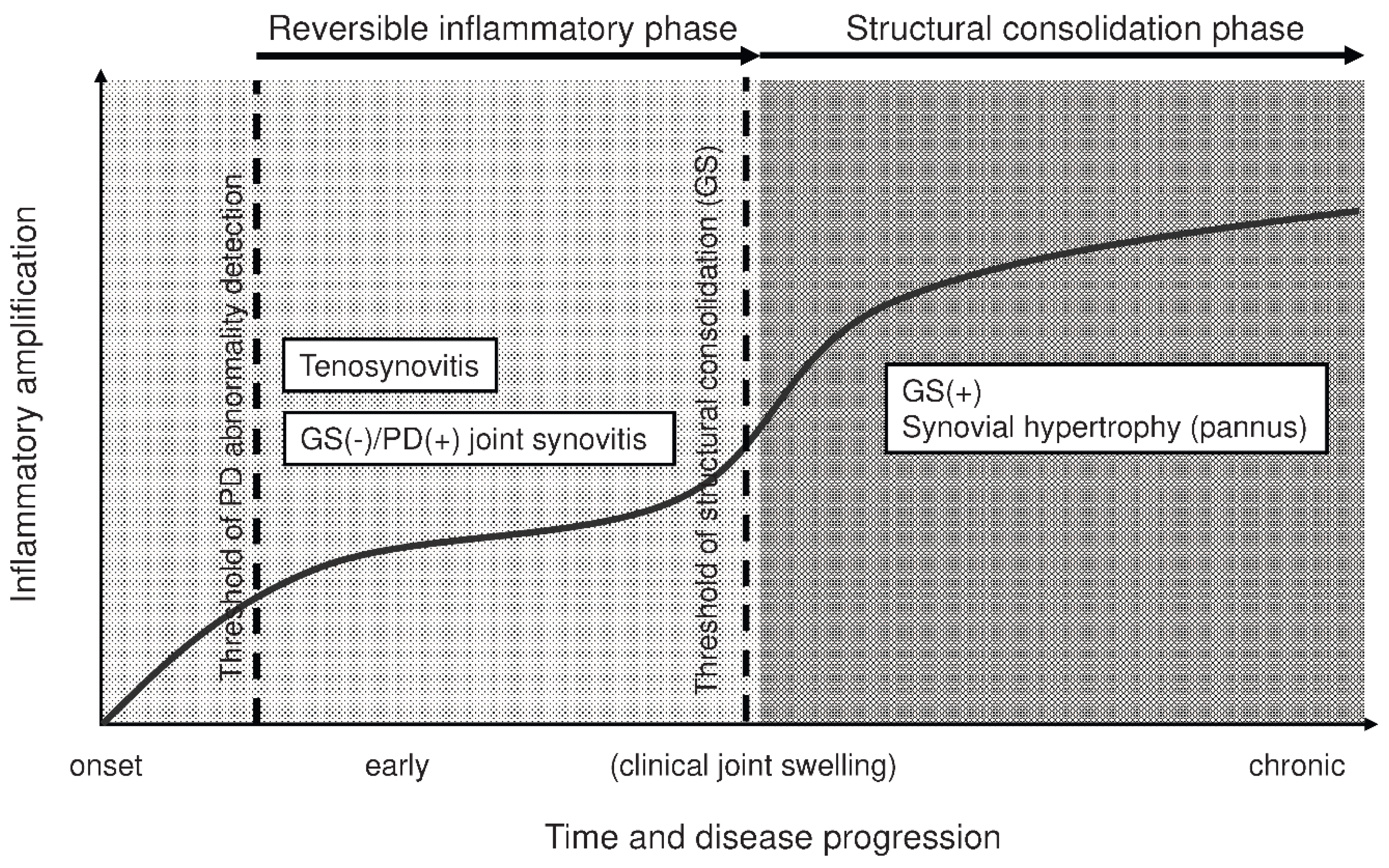
Figure 2.
Minimal Dynamic Threshold Model. Schematic nonlinear model illustrating how positive feedback dynamics may generate threshold-like transitions. The equation shown is conceptual and not intended as a mechanistic rheumatoid arthritis model. The variable
Figure 2.
Minimal Dynamic Threshold Model. Schematic nonlinear model illustrating how positive feedback dynamics may generate threshold-like transitions. The equation shown is conceptual and not intended as a mechanistic rheumatoid arthritis model. The variable
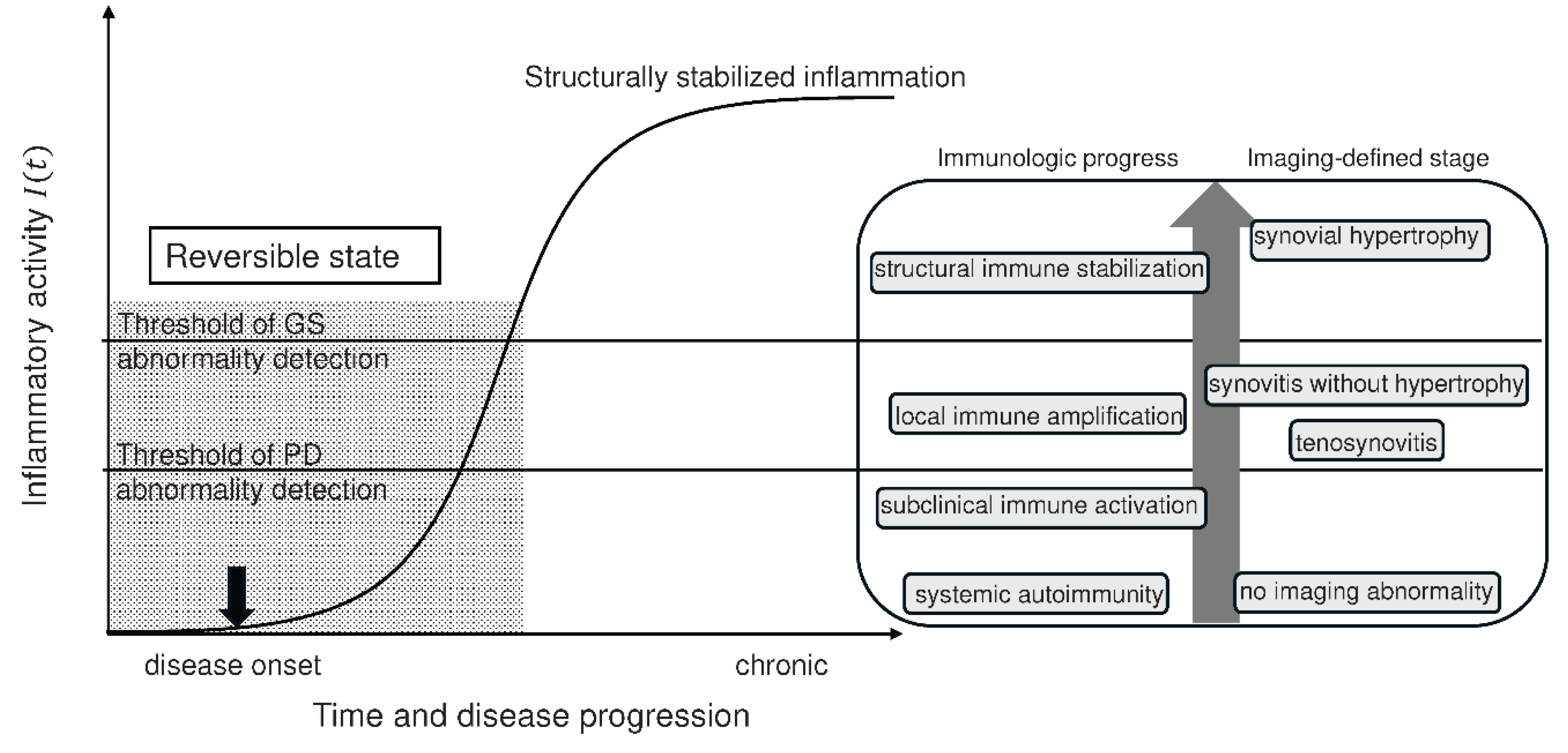
Figure 3.
Conceptual Ultra-Early Intervention Algorithm in rheumatoid arthritis.Box-and-arrow algorithm derived from the threshold framework. Tenosynovitis or gray scale (GS)-negative/Power Doppler (PD)-positive synovitis defines the reversible phase. Short-term inflammatory control is followed by reassessment. Fulfilled criteria (as mentioned in conceptual ultra-early intervention algorithm) allow discontinuation and monitoring; otherwise, step-up therapy is recommended.
Disclaimer/Publisher’s Note: The statements, opinions and data contained in all publications are solely those of the individual author(s) and contributor(s) and not of MDPI and/or the editor(s). MDPI and/or the editor(s) disclaim responsibility for any injury to people or property resulting from any ideas, methods, instructions or products referred to in the content. |
© 2026 by the authors. Licensee MDPI, Basel, Switzerland. This article is an open access article distributed under the terms and conditions of the Creative Commons Attribution (CC BY) license (http://creativecommons.org/licenses/by/4.0/).
Copyright: This open access article is published under a Creative Commons CC BY 4.0 license, which permit the free download, distribution, and reuse, provided that the author and preprint are cited in any reuse.