

Submitted:
06 March 2026
Posted:
09 March 2026
You are already at the latest version
Abstract
Brazil harbors 13% of the world’s biodiversity, yet agricultural expansion threatens its biomes. Because 71% of the country is under rural properties, farmers are pivotal for conservation. In a rural municipality within the Atlantic Forest biome, we developed a citizen science project engaging students and farmers to monitor wildlife in forest remnants using camera traps. We documented the endangered Puma concolor and the invasive Sus scrofa, alongside other native fauna. Beyond new records, the initiative fostered dialogue, countered misinformation, and strengthened local partnerships, demonstrating how community-based science can reconcile biodiversity conservation with agricultural production.
Keywords:
sustainable agriculture
; human–wildlife coexistence
; ecosystem services for agricultural production
; biodiversity in rural landscapes
; Puma concolor
; Atlantic Forest biome
; scientific denialism
Brazil is a highly diverse country, and its share of the world’s biota has been estimated at 13.1%, comprised of 1.8 million named species [1]. At the same time, Brazil is also a global agribusiness player and is one of the world’s leading producers of soybean, maize and animal protein. This introduces significant environmental risk. Brazilian environmental legislation dictates that from 20% to 80% of native flora in rural properties must be preserved; in other words, deforestation is forbidden by law [2]. The rate of preservation depends on the biome the property is located in. For example, 80% of the native vegetation in rural properties in the Amazon must be preserved, yet agricultural expansion is among the main causes of deforestation in Brazil.
From 6.4 to 8.8 million hectares of native vegetation are lost each year in the tropics largely driven by agricultural expansion [3]. Brazil houses almost half the area of South America, and 71% of its 8.51 million km² are covered by rural properties. This comprises of approximately 5 million rural properties and these hold 53% of Brazil’s native flora, which is split into six terrestrial biomes: Amazon, Cerrado, Caatinga, Pantanal, Pampa and Atlantic Forest [2]. These statistics highlight farmers’ relevance for the conservation of both Brazilian biodiversity and the ecosystem services essential for agricultural production. Policies and strategies aimed at the conservation of Brazilian biodiversity that do not include farmers and the forests on their properties are therefore unlikely to succeed [2,4,5].
The aim of the conservation of native flora in rural properties is in no small part to help protect Brazilian agricultural production. The future of Brazilian agriculture is uncertain without the ecosystem services of the country’s biomes [2,6]. There are many examples of ecosystem services that Brazilian agriculture depends on. For example, Atlantic Forest remnants in rural properties in Southeastern Brazil provide habitat for pollinators in soybean, orange, coffee and bean crops, among others. The restoration of Atlantic Forest in areas close to crops could increase these sites’ yearly yield by approximately US$ 900 million [7]. Native bees distributed in this biome, such as Tetragonisca angustula and Melipona quadrifasciata, could intensify pollination in crops and, consequently, their productivity, without the need for increasing the areas area under cultivation [7].
Despite the urgency of tropical forest conservation, some Brazilian farmers have opposed the zero-deforestation agenda because they see environmental regulations mandating native vegetation preservation in rural properties as a burden [8]. Brazilian farmers believe in their right to deforest. They claim this right is unduly repressed by this environmental legislation. Furthermore, they hold an outdated understanding of development, since they still associate deforestation with social and economic progress [8]. Illegal deforestation perpetrated by farmers is frequent in all Brazilian biomes [5] and opposition to forest conservation in the countryside has largely resulted from the so-called ‘conspiracy theories’, as well as from disinformation and scientific denialism [8]. It has been suggested that the spread of false information is driven by agribusiness corporations against sustainability policies that would require substantial changes in their businesses [8]. These corporations have substantial political and economic power, and farmers replicate false information in ‘echo chambers’ like social media groups [8].
Some farmers are skeptical about deforestation’s ecological consequences and do not believe that deforestation in the Amazon leads to lower rainfall rates. Farmers sometimes react to this knowledge by dismissing it as theories developed by “mad scientists” [8]. This reaction has also been observed when they are confronted with empirical research by Brazilian scientists showing that large-scale deforestation in the Southern Brazilian Amazon is associated with reduced regional rainfall, potentially resulting in agricultural revenue losses of up to approximately US$1 billion annually under high-deforestation scenarios [9]. The core issue lies in getting a different perspective, regardless of the complex cultural causes that the distorted views of conservation emerge from. Positive changes will only be achieved if other viewpoints are introduced to farmers.
Chapada Municipality is located in Northern Rio Grande do Sul State, Brazil [28°03′18″S 53°04′04″W]. This rural municipality, whose population and territory mostly feature low population density, has high rates of residents living in rural areas and land use is primarily for agricultural purposes [10]. Its population was close to 10,000 people in 2022 and soybean crops are this municipality’s key economic driver [11]. Chapada territory is inside the Atlantic Forest biome, which is a global biodiversity hotspot and provides ecosystem services to 65% of the Brazilian population [12]. This biome has been overexploited since the arrival of European colonizers in 1500 AD. Its destruction has intensified in the 20th century due to the expansion of agricultural frontiers. Currently, only 25% of the Atlantic Forest’s original territory remains in place [12].
How can one form partnerships with farmers aimed at conserving forest remnants in their properties?
Adopting sustainable agriculture practices is essential if we are to achieve global food security and agricultural resilience [13]. There is no single path to accomplish the complex task of building alliances with farmers. Nevertheless, environmental and science education are relevant tools to fight misinformation. Educational opportunities are essential to mitigate scientific denialism and conspiracy theories driving Brazilian farmers’ anti-environmentalism [8,14]. Reaching farmers and their communities requires a structured initiative, and in rural Chapada we developed a program to facilitate dialogue between the local community and wildlife ecologists.
Despite some evidence of pumas (Puma concolor) living in Chapada’s rural area (footprints), their presence in rural landscapes was discounted by both farmers and local authorities. The likely presence of pumas in this region was seen as opportunity for developing scientific and environmental education projects for farmers. A citizen science project was carried out with adolescent students and teachers from Olho da Coruja Forest School, which follows the forest school pedagogical approach. Project participants were trained to use and install 21 ‘trap’ cameras set by scientists from the Universidade Federal de Rondonópolis (Brazil), Royal Holloway, University of London and the University of Reading (UK) who provided the camera traps. Local businesses supported the work by funding some project costs (logistics for camera visits).
The students worked under the supervision of an adult to install cameras in rural property habitat fragments. They responsible for monitoring the cameras’ batteries, collecting the memory chips, downloading the images to their computers and analyzing them. The group monitored rural forest remnants in Chapada from August 2023 to February 2025. The project and a WhatsApp number were publicized in the local press to engage residents. Farmers were asked to report any signs of pumas in their properties. The cameras were installed on the properties of farmers who made contact with the researchers. Interestingly, even without noticing the presence of felines in their properties, several messages came in from farmers inviting the researchers to install cameras in their properties due to curiosity about the fauna in them. On the other hand, some farmers refused the researchers’ request to install cameras in areas presenting higher probability of puma sighting, such as riverbanks.
Pictures and footage of a Puma concolor specimen in rural Chapada were collected (Figure 1 and supplementary material 1]. Puma concolor is considered an endangered species in Rio Grande do Sul State [15].
Surprisingly, the installed cameras also recorded wild boars (Sus scrofa) in this landscape (Figure 2). To the best of our knowledge, this is the first record of this species in Northern Rio Grande do Sul State. Wild boars are an invasive species causing significant damage to agricultural crops and to the biodiversity of the six Brazilian biomes [16]. The species were identified by scientists from the Universidade Federal de Rondonópolis and the Royal Holloway, University of London.
Despite its wide geographic distribution, ranging from Canada to Chile, the Puma concolor population is declining in Latin America. A literature review published in the journal ‘Mammal Review’ collated over 400 biotic interactions between pumas and other species. They may directly and indirectly regulate their prey population size [17]. Their presence is a good indicator of ecosystem integrity [17]. Dickman et al. (2015) [18] ranked Puma concolor among the felid species demanding the highest conservation priority given their potential to act as ‘umbrella’ species for the conservation of other species. According to these authors, Brazil, Argentina, Bolivia, Chile and Peru are priority countries in South America when it comes to the conservation of Puma concolor and other felids [18].
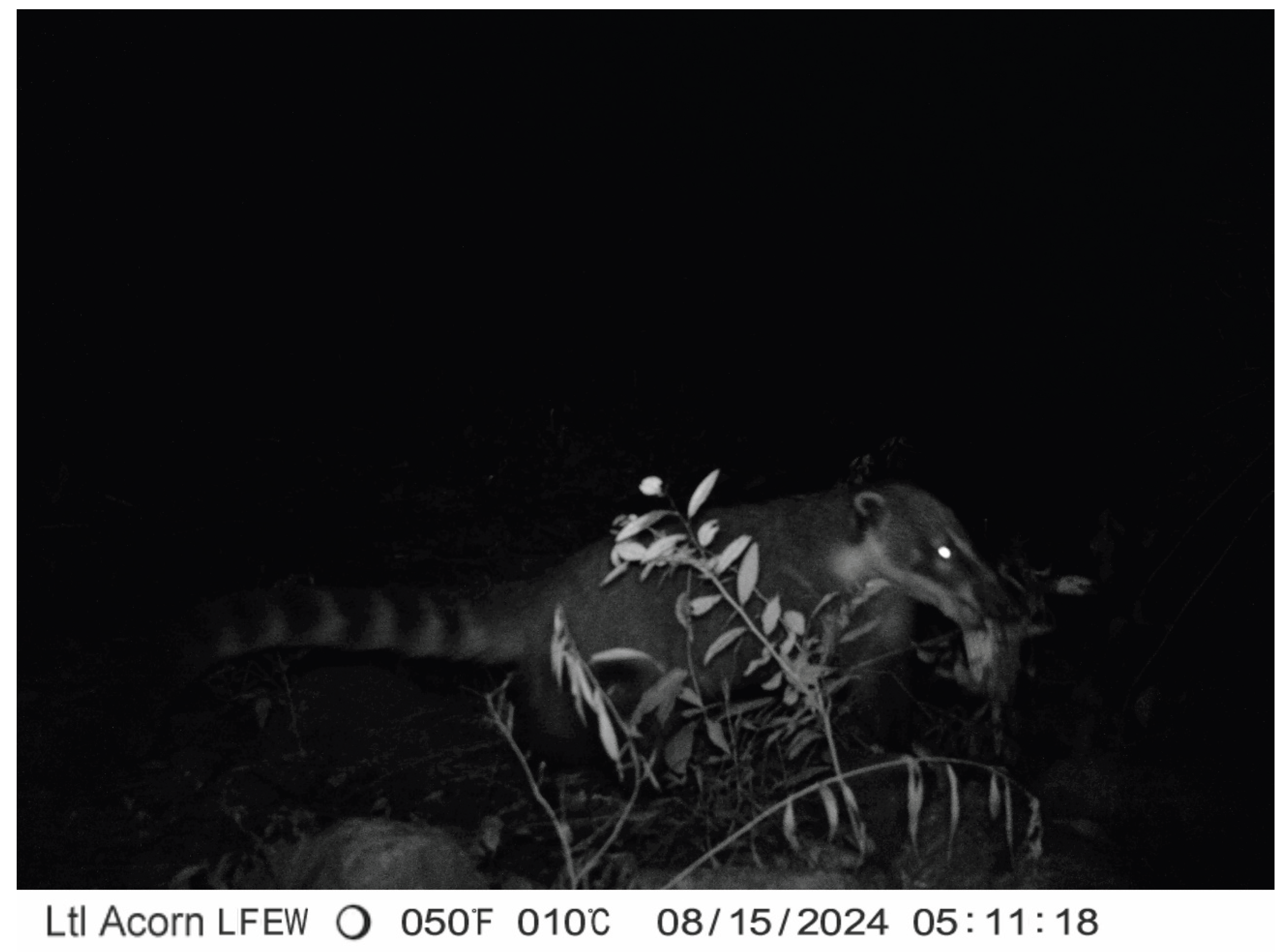
Pumas are even more ecologically relevant in regions where jaguars (Panthera onca) have become locally extinct in Latin America, as in Rio Grande do Sul State. They prey on wild boars [19] and this behavior is likely to be translated into an ecosystem service provided by these felines to Brazilian farmers. Although the main aim was to find if pumas were present in the area, other animals were also photographed, including capybara (Hydrochoerus hydrochaeris), brown brocket deer (Mazama gouazoubira), (Figure 3) and ring-tailed coati (Nasua nasua), the latter of which is also an endangered species in Rio Grande do Sul (Figure 4), [15].
Several educational assignments were carried out with the collected wildlife records. Students enrolled in the forest school attended a scientific writing workshop taught by Professor Juan Pedro Ruiz from ‘Autonomous University of Madrid’. The Spanish scholar was able to travel to Brazil due to resources granted by Chapada municipality. The results and the importance of conserving the Atlantic Forest biodiversity for agricultural production were discussed during two meetings with the students’ parents. FM radio stations are the most popular means of local communication, particularly in the rural area of Chapada. A science outreach program entitled “Urban Photosynthesis,” which is broadcast on two local radio stations, aired 43 editions with daily information about the camera trap research, its results, and also about sustainable agriculture, and about wild boar sightings and the importance of conserving Puma concolor for agriculture.
Despite the presence of resistance to environmental regulation, a growing body of research has shown that many Brazilian farmers will actively collaborate to biodiversity conservation, adopt sustainable intensification practices, restore native vegetation and pay for ecosystem-services programs [20]. Students, farmers and other social actors’ involved in the citizen science project helped launch PUMAS NGO. This name is an acronym for Pessoas Unidas pelo Meio Ambiente, Agricultura e Sociedade [People United for the Environment, Agriculture and Society, in Portuguese]. This non-governmental organization’s main goals are to implement forest conservation projects in rural areas in partnership with local farmers. These local-scale initiatives are welcome and indeed essential as they directly help address Brazil’s greatest challenge, namely that of reconciling agriculture with the conservation of the country’s enormous biodiversity and resulting ecosystem services, many of which are essential for agricultural production.
Supplementary Materials
The following supporting information can be downloaded at the website of this paper posted on Preprints.org. Video S1: Footage of Puma concolor in an rural landscape of Chapada, Brazil.
Author Contributions
Conceptualization, data curation, writing – original draft preparation, writing – review & editing, F.A.; conceptualization, methodology, writing – original draft preparation, writing – review & editing, A.G.; conceptualization, writing – original draft preparation, writing – review & editing, A. S.; writing – original draft, investigation, writing – review & editing, D.S.A; investigation, writing – review & editing, F.F.; C.H.S.; A.L.; A.V.A.; B.L.B.S.; D.O.Z.; E.S.; F.E.A.; G.B.; G.C.B.; H.L.M.S.; I.S.P.; M.C.Z.T.; T.B.R.; V.A.K.P.; V.S.G.; V.D.; conceptualization, supervision, writing – review & editing, M.D.E.F. All authors have read and agreed to the published version of the manuscript.
Funding
This research received no external funding.
Data Availability Statement
The original contributions presented in this study are included in the article/supplementary material. Further inquiries can be directed to the corresponding author.
Acknowledgments
We would like to thank Prefeitura Municipal de Chapada, Cooperativa dos Agricultores de Chapada (COAGRIL), Banco Cooperativo Sicredi, Supermercado Donna, Grupo Simpatia de Comunicação and Donna Flora Biocosméticos.
Conflicts of Interest
The authors declare no conflicts of interest.
References
- Lewinsohn, T. M.; Prado, P. I. How many species are there in Brazil? Conservation Biology 2005, 19(3), 619–624. [Google Scholar] [CrossRef]
- Vacchiano, M. C.; Santos, J.; Angeoletto, F.; Silva, N. M. Do data support claims that Brazil leads the world in environmental preservation? Environmental Conservation 2019, 46(2), 118–120. [Google Scholar] [CrossRef]
- Pendrill, F.; Gardner, T. A.; Meyfroidt, P.; Persson, U. M.; Adams, J.; Azevedo, T.; West, C. Disentangling the numbers behind agriculture-driven tropical deforestation. Science 2022, 377(6611), eabm9267. [Google Scholar] [CrossRef] [PubMed]
- Scherr, S. J.; McNeely, J. A. Biodiversity conservation and agricultural sustainability: towards a new paradigm of ‘ecoagriculture’ landscapes. Philosophical Transactions of the Royal Society B: Biological Sciences 2008, 363(1491), 477–494. [Google Scholar] [CrossRef] [PubMed]
- Gonzaga, C. A. C.; Roquette, J. G.; Angeoletto, F.; Silgueiro, V. D. F.; Macedo, L. O. B.; Valdiones, A. P.; da Silva, N. M. The Public Prosecutor’s Office’s experience using Global Forest Watch to monitor and deter deforestation in the Cerrado. Environmental Conservation 2024, 51(3), 236–241. [Google Scholar] [CrossRef]
- Lovejoy, T. E.; Nobre, C. Amazon tipping point. Science Advances 2018, 4(2), eaat2340. [Google Scholar] [CrossRef] [PubMed]
- Moreira, E. F.; Tourinho, L.; Chaves, R. B.; Boscolo, D. Potencial do serviço ecossistêmico de polinização no estado de São Paulo.; Instituto de Estudos Avançados da USP: São Paulo; Instituto de Pesquisas Ambientais: São Paulo, Brasil, 2024. [Google Scholar]
- Andrade Aragão, R. B.; Lima, M. G. B.; Burns, G. L.; Ross, H.; Biggs, D. ‘Greenlash’and reactionary stakeholders in environmental governance: An analysis of soy farmers against zero deforestation in Brazil. Forest Policy and Economics 2024, 166, 103267. [Google Scholar] [CrossRef]
- Leite-Filho, A. T.; Soares-Filho, B. S.; Davis, J. L.; Abrahão, G. M.; Börner, J. Deforestation reduces rainfall and agricultural revenues in the Brazilian Amazon. Nature Communications 2021, 12(1), 2591. [Google Scholar] [CrossRef] [PubMed]
- Instituto Brasileiro de Geografia e Estatística. Classificação e caracterização dos espaços rurais e urbanos do Brasil: uma primeira aproximação. Available online: https://www.ibge.gov.br/geociencias/organizacao-do-territorio/tipologias-do-territorio/15790-classificacao-rural-e-urbana.html (accessed on 12 January 2026).
- Instituto Brasileiro de Geografia e Estatística. Panorama — Chapada (RS). Instituto Brasileiro de Geografia e Estatística. Available online: https://cidades.ibge.gov.br/brasil/rs/chapada/panorama (accessed on 6 February 2026).
- Resende, A. F.; Gavioli, F. R.; Chaves, R. B (...); Brancalion, P. H. How to enhance Atlantic Forest protection? Dealing with the shortcomings of successional stages classification. Perspectives in Ecology and Conservation 2024, 22(2), 101–111. [Google Scholar] [CrossRef]
- Xu, M. Towards a Sustainable Future: Agricultural Environmental Science Driving Global Agricultural Transformation. Agricultural Environment and Sustainability 2025, 100001. [Google Scholar] [CrossRef]
- Mellberg, S.; Danielsson Friberg, A.; Nygren, T. Science education against misinformation: an educational intervention in upper-secondary schools. International Journal of Science Education 2025, 1–33. [Google Scholar] [CrossRef]
- Estado do Rio Grande do Sul. Decreto n.º 51.797, de 8 de setembro de 2014: Declara as espécies da fauna silvestre ameaçadas de extinção no Estado do Rio Grande do Sul; Diário Oficial do Estado. (DOE n.º 173, 9 de setembro de 2014), 2014.
- Martins, F.; Mourão, G. M.; Campos, Z.; Pellegrin, A.; Silva, V. S. Activity pattern and habitat selection by invasive wild boars (Sus scrofa) in Brazilian agroecosystems. Mastozoología neotropical 2019, 26(1), 129–141. [Google Scholar] [CrossRef]
- LaBarge, L. R.; Evans, M. J.; Miller, J. R.; Cannataro, G.; Hunt, C.; Elbroch, L. M. Pumas Puma concolor as ecological brokers: a review of their biotic relationships. Mammal Review 2022, 52(3), 360–376. [Google Scholar] [CrossRef]
- Dickman, A. J.; Hinks, A. E.; Macdonald, E. A.; Burnham, D.; Macdonald, D. W. Priorities for global felid conservation. Conservation Biology 2015, 29(3), 854–864. [Google Scholar] [CrossRef] [PubMed]
- Guerisoli, M. M.; Gallo, O.; Martinez, S.; Luengos Vidal, E. M.; Lucherini, M. Native, exotic, and livestock prey: assessment of puma Puma concolor diet in South American temperate region. Mammal Research 2021, 66(1), 33–43. [Google Scholar] [CrossRef]
- Prado, R. B.; Overbeck, G. E.; Duarte, G. T.; Monteiro, M. M.; Moreira, R. A.; Roza, C. G.; Altmann, A.; (...). Thematic Report on Agriculture, Biodiversity and Ecosystem Services: Summary for Policymakers. Biota Neotropica 2025, 25(4), e20251845. [Google Scholar] [CrossRef]
Figure 1.
Puma concolor on a rural property in Chapada, Brazil.
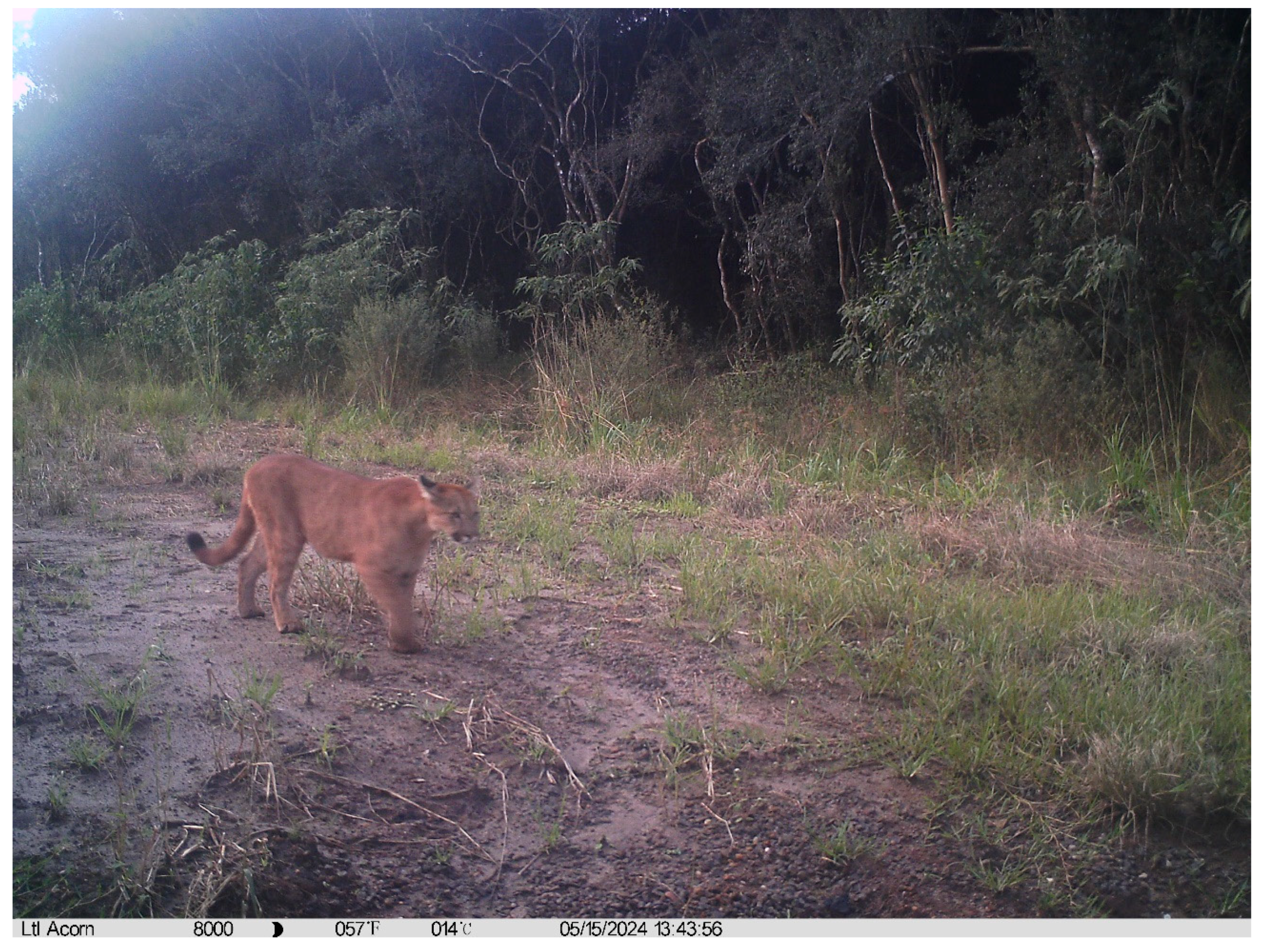
Figure 2.
Sus scrofa recorded in a rural property located in Chapada, Brazil.
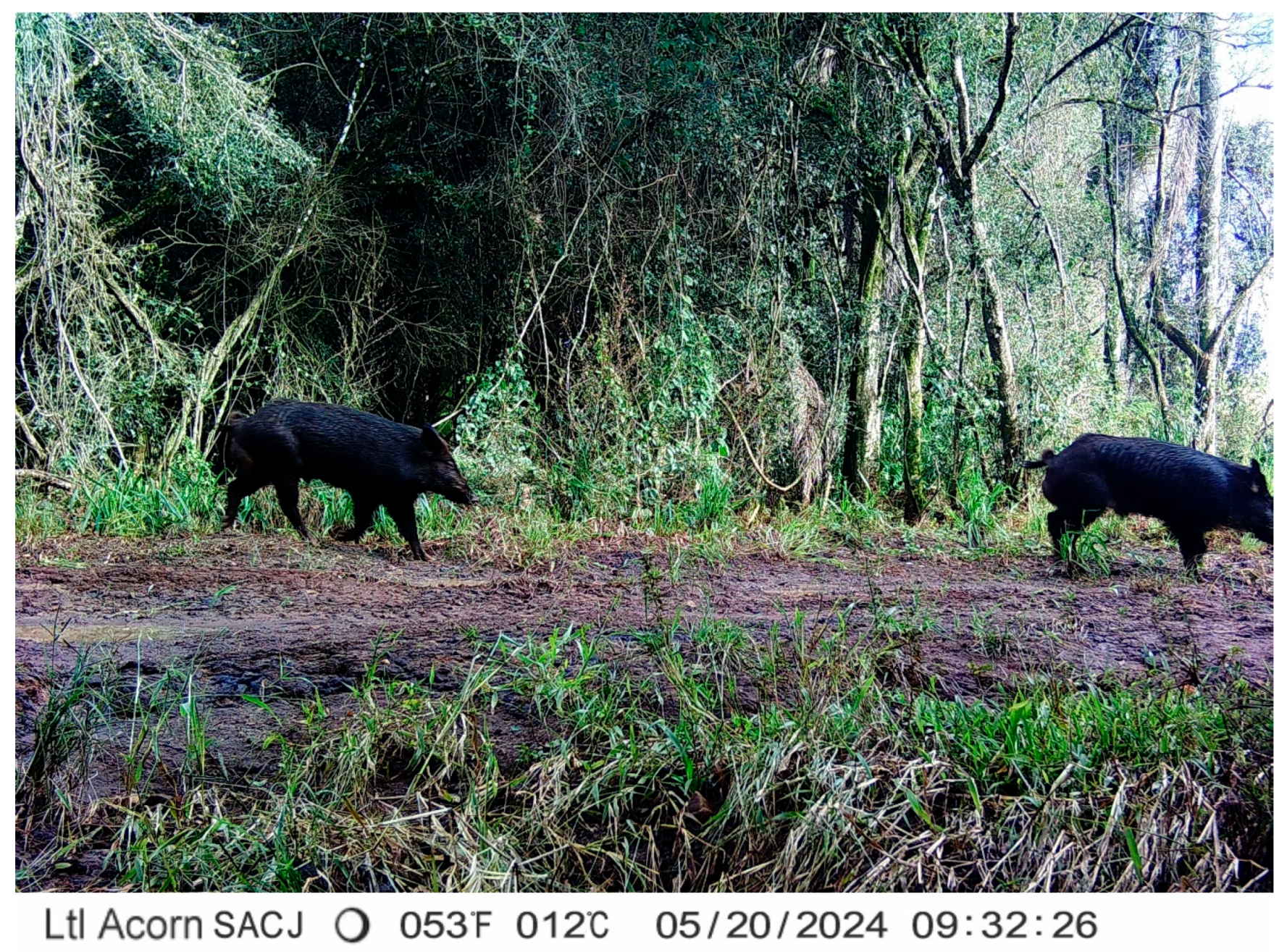
Figure 3.
Mazama gouazoubira recorded in a rural property located in Chapada, Brazil.
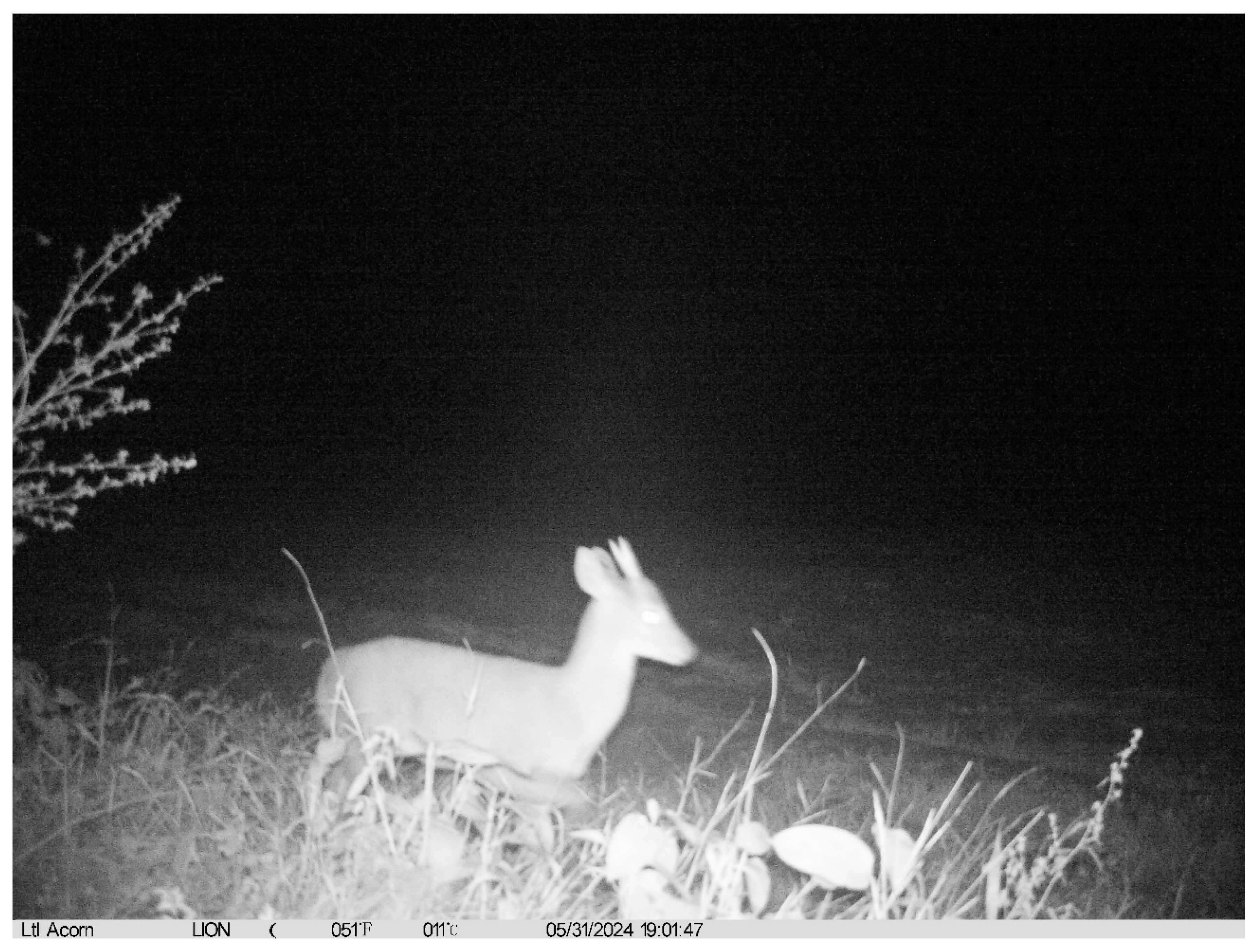
Figure 4.
Ring-tailed coati (Nasua nasua) with prey between its teeth.
Disclaimer/Publisher’s Note: The statements, opinions and data contained in all publications are solely those of the individual author(s) and contributor(s) and not of MDPI and/or the editor(s). MDPI and/or the editor(s) disclaim responsibility for any injury to people or property resulting from any ideas, methods, instructions or products referred to in the content. |
© 2026 by the authors. Licensee MDPI, Basel, Switzerland. This article is an open access article distributed under the terms and conditions of the Creative Commons Attribution (CC BY) license (http://creativecommons.org/licenses/by/4.0/).
Copyright: This open access article is published under a Creative Commons CC BY 4.0 license, which permit the free download, distribution, and reuse, provided that the author and preprint are cited in any reuse.


