
Submitted:
06 March 2026
Posted:
10 March 2026
You are already at the latest version
Abstract
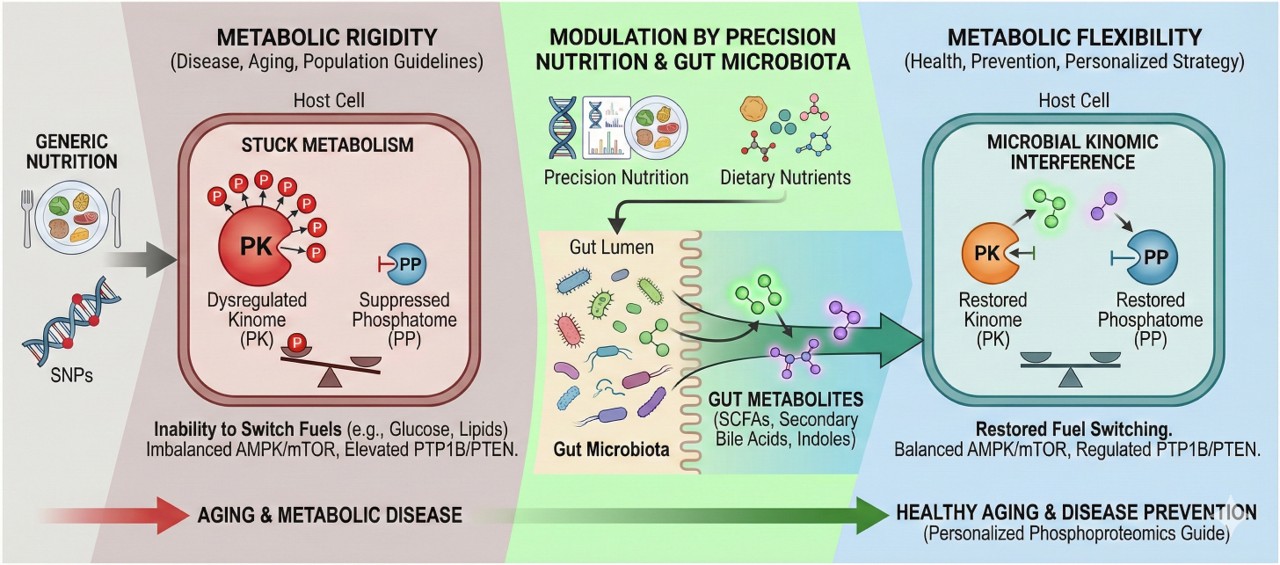
This review explores the modulation of the host cellular flexibility “kinome" (protein kinases) and "phosphatome" (protein phosphatases) by dietary nutrients and gut microbiota metabolites, proposing a potential paradigm in the strategies for healthy aging and metabolic disease prevention. While mainstream nutrition approaches focus on population-wide guidelines, precision nutrition exploits the innovations in personal molecular networks and systems medicine, integrating genomics and metabolomics to address "metabolic rigidity"—the cell inability to switch between fuel sources. The review examines how master molecular regulators like AMPK and mTOR, and "metabolic brakes" like PTP1B and PTEN, are affected by single nucleotide polymorphisms (SNPs) and microbial signals (SCFAs, secondary bile acids, indoles). Specifically, the "microbial kinomic interference" hypothesis is discussed, where gut metabolites act as remote ligands for host signaling enzymes. Finally, the potential role of a personalized phosphoproteomics strategy is highlighted as an effective functional readout to guide nutritional interventions, aiming to restore metabolic plasticity through a gut microbiota/multi-omics approach.
Keywords:
precision nutrition
; kinome
; microbiota
; metabolic flexibility
; PTP1B
; AMPK
; mTOR
; nutrigenomics
; phosphoproteomics
Copyright: This open access article is published under a Creative Commons CC BY 4.0 license, which permit the free download, distribution, and reuse, provided that the author and preprint are cited in any reuse.


