

Submitted:
06 March 2026
Posted:
09 March 2026
You are already at the latest version
Abstract
This study explains cryptocurrency investment decisions by integrating personality traits, influencer credibility, and social influence within the Stimulus–Organism–Response (SOR) framework. The position model of openness, extraversion, conscientiousness, influencer credibility, and social influence as stimuli; heuristic bias and herding behaviour as organism states; and cryptocurrency investment decision as the response, with risk tolerance operating as a serial mediating mechanism. Data were collected from 367 Indonesian retail cryptocurrency investors using an online survey and analysed with SEM-PLS (SmartPLS) and one-tailed significance testing. The measurement model demonstrates adequate convergent validity and reliability, and discriminant validity is supported by HTMT values below the recommended threshold. Structural results support all hypothesized relationships (H1–H12). Openness (β = 0.132), extraversion (β = 0.326), and conscientiousness (β = 0.195) positively influence the tendency toward heuristic bias. Influencer credibility (β = 0.303) and social influence (β = 0.285) positively influence herding behaviour. Heuristic bias positively affects risk tolerance (β = 0.585) and investment decision (β = 0.407), while herding behaviour positively affects risk tolerance (β = 0.185) and investment decision (β = 0.106). Risk tolerance positively affects investment decision (β = 0.354) and mediates the effects of heuristic bias (indirect β = 0.200) and herding behaviour (indirect β = 0.078) on investment decision. The model explains substantial variance in investment decisions (Adjusted R² = 0.623) and moderate variance in risk tolerance (Adjusted R² = 0.507). The findings extend SOR to sentiment-driven digital asset markets by showing that cognitive shortcuts and socially transmitted cues shape risk tolerance before translating into investment actions, and they highlight the importance of behavioural risk-mitigation and disclosure practices in crypto ecosystems.
Keywords:
cryptocurrency investment decisions
; SOR
; personality traits
; influencer credibility
; social influence
; heuristic bias
; herding behaviour
; risk tolerance
; SEM-PLS
Introduction
Cryptocurrency has emerged as one of the most disruptive innovations in financial markets, offering decentralized transactions and alternative investment opportunities. Bitcoin, introduced by Nakamoto in 2008, marked the beginning of a new era in peer-to-peer digital currency systems [1]. Cryptocurrencies are based on blockchain technology, a distributed ledger system that secures transactions using cryptographic protocols [2]. This technological foundation has attracted increasing attention from both investors and regulators worldwide.
The global adoption of cryptocurrencies has grown rapidly. In 2016, there were an estimated 5 million users worldwide, and by December 2022, this figure had risen to more than 425 million [3]. Indonesia officially legalized and recognized cryptocurrency trading in 2023, with more than 22.91 million registered investors by the end of 2024 [4]. This demonstrates that cryptocurrencies are no longer a niche phenomenon but have become mainstream in investment portfolios.
However, cryptocurrency markets are characterized by extreme volatility and intense sensitivity to external events. For example, the collapse of FTX in November 2022 caused Bitcoin’s price to fall sharply to USD 17,200 [5]. On the other hand, positive signals, such as the U.S. Securities and Exchange Commission’s approval of Bitcoin ETFs in January 2024, pushed prices above USD 49,000 [6]. Such fluctuations highlight the role of investor sentiment and behaviour in driving market dynamics.
In uncertain environments, investors often rely on heuristics, or mental shortcuts, to simplify complex information. While useful, these shortcuts can lead to heuristic bias, producing systematic judgment errors that influence trading decisions [7]. In addition, investors frequently exhibit herding behaviour, imitating others’ actions rather than analysing fundamentals, thereby contributing to market inefficiency [8].
Social media has further amplified these behavioural tendencies. Studies have shown that information from influencers on platforms such as Twitter and TikTok can significantly affect trading decisions and even trigger buying frenzies in specific cryptocurrencies [9]. Research also documents that social media influencers can influence not only brand consumption but also speculative investment behaviour [10]. These findings indicate that influencer credibility and social influence are essential drivers of herding in cryptocurrency markets.
Although research on behavioural finance has long examined heuristic biases and herding, most studies focus on traditional markets such as stocks [11]. In the cryptocurrency context, evidence is still limited, and antecedents such as personality traits, influencer credibility, and social influence are rarely integrated into a single model [12]. Furthermore, the mediating role of risk tolerance, which could explain how biases translate into investment decisions, has not been thoroughly investigated [13].
Therefore, this study applies the Stimulus-Organism-Response (SOR) framework to integrate traits, influencer credibility, and social influence as antecedents of heuristic and herding biases, with risk tolerance as a mediating mechanism that leads to cryptocurrency investment decisions. This approach aims to advance behavioural finance by explaining not only what investors do but also why and how psychological and social factors influence decision-making in volatile markets.
2. Literature Review and Hypothesis Development
2.1. Stimulus Organism Response (SOR) Framework
The SOR framework by Mehrabian and Russel [14] explains how external stimuli influence internal states, which in turn drive behavioural responses. In this study, personality traits, influencer credibility, and social influence are positioned as stimuli; heuristic bias and herding behaviour as organism states; and cryptocurrency investment decisions as the response. Risk tolerance acts as a mediating variable that sequentially transmits the influence of biases toward investment outcomes [15].
2.2. Relationship Between Personality Traits and Heuristic Bias
Trait Theory, introduced by Costa and McCrae [16], provides a lens for understanding how individual differences in traits affect information processing and judgment. For example, individuals high in openness to experience are more curious and inclined to seek diverse perspectives, which may reduce their reliance on simplistic heuristics [17]. On the other hand, individuals with high extraversion may exhibit impulsive decision-making due to their sociability and excitement-seeking tendencies, which may increase their susceptibility to heuristic biases [18]. Similarly, conscientious individuals, characterized by diligence and cautiousness, may be more methodical in evaluating information and less likely to depend on heuristics [19]. This theoretical perspective supports the view that personality traits, as relatively stable individual differences, are significant antecedents of cognitive biases such as availability, representativeness, anchoring, overconfidence, and the gambler’s fallacy. Thus, under the SOR model, personality traits (S) influence how individuals (O) process decisions through heuristic mechanisms, particularly in dynamic, high-uncertainty settings such as cryptocurrency markets, where rapid decisions are often made without complete information.
Openness to experience reflects an individual’s tendency to seek new experiences, engage in imaginative thinking, and embrace novel ideas [16]. This personality trait has significant implications for decision-making processes, particularly in uncertain and complex environments. Individuals with high levels of openness are often drawn to unconventional solutions and creative approaches to problem-solving, which may inadvertently increase their reliance on heuristic shortcuts [20]. Based on those premises, we formulate our hypothesis as follows:
H1: Openness positively influences heuristic bias
Another trait, extraversion, is characterized by sociability, assertiveness, and a tendency to seek excitement and external stimulation [16]. Individuals with high levels of extraversion are more likely to rely on intuition and experience when making decisions, which may increase their susceptibility to heuristic biases.
Extraverts tend to prefer quick and confident decision-making, often based on limited information, which aligns with the use of heuristics as mental shortcuts [20]. For example, they might rely on availability bias, making decisions based on recent or highly salient events rather than evaluating comprehensive data. This bias may be particularly pronounced in fast-moving and dynamic markets, such as cryptocurrency investments, where extraverts are drawn to the excitement of frequent price fluctuations and market trends [21]. Given these tendencies, we formulate the second hypothesis as follows:
H2: Extraversion positively influences heuristic bias
Conscientiousness refers to an individual’s tendency to exhibit self-discipline, organization, and goal-directed behaviors [16]. People high in conscientiousness are typically systematic, careful, and diligent in their decision-making processes. However, in highly volatile contexts such as cryptocurrency, where decisions must be made under time pressure, conscientious investors may turn to heuristics as a structured means to simplify complexity and reduce uncertainty, thereby reinforcing the influence of heuristic bias, which is often employed to simplify complex decisions under time pressure or cognitive load [22].
Conscientiousness may also interact with anchoring bias, in which initial information unduly influences judgments [23]. High conscientiousness is associated with a desire for consistency and precision, which leads individuals to rely heavily on initial data points as a foundation for subsequent decisions, even when new, contradictory information becomes available [20]. For example, a conscientious investor may anchor their expectations for a cryptocurrency’s performance to its historical prices, despite recent changes in sentiment and environmental conditions. Based on those premises, we formulate our hypothesis as follows:
H3: Conscientiousness positively influences heuristic bias
2.3. Relationship Between Social Influence and Herding Behaviour
Social influence plays a central role in shaping herding behaviour in cryptocurrency markets, where investment decisions are often made under uncertainty and limited fundamental information. Unlike stock markets, which rely on financial statements and analyst reports, cryptocurrency markets are heavily driven by signals and sentiments shared on social media [24]. Influencers on platforms such as Twitter, X, YouTube, and TikTok are credible sources of information, and their perceived expertise and trustworthiness strongly influence investors’ willingness to follow their recommendations [25]. Rapid dissemination of information through social media marketing, hashtags, and trending discussions accelerates emotional contagion and fosters collective decision-making, often leading to herding [26]. In such contexts, credibility and social pressure function as external stimuli that elicit psychological responses, including herding, consistent with the SOR framework.
H4: Influencer credibility positively influences herding behaviour.
2.4. Relationship Between Social Influence and Herding Behaviour
Social influence refers to the pressure or encouragement from peers, family, and colleagues that shapes individual decision-making [27]. In cryptocurrency markets, where information is limited and uncertainty is high, investors often look to the behaviour and opinions of close social groups for guidance. These interpersonal influences can create conformity pressures that encourage individuals to follow the collective actions of their network, even without independent analysis [28]. Through mechanisms such as peer discussion, family endorsement, or workplace trends, social influence fosters imitation, which can translate into herding behaviour, particularly when investors seek validation and reassurance in volatile markets [29].
H5: Social influence positively influences herding behaviour.
2.5. Relationship Between Heuristic Bias and Cryptocurrency Investment Decision
In the SOR framework, heuristic bias is viewed as an organism (O) that represents internal cognitive shortcuts that guide how investors perceive and process information before making choices. Heuristic bias arises when individuals rely on rules of thumb or intuitive judgments rather than in-depth analysis. This tendency is particularly prevalent in uncertain and speculative markets, such as cryptocurrency markets [30]. Given the decentralized and volatile nature of crypto assets, investors often rely on heuristics to simplify complex information, but this may lead to systematic errors that affect their trading behaviour [31].
Previous studies indicate that specific forms of heuristic bias, such as overconfidence and availability bias, significantly influence investment outcomes. Overconfident investors may underestimate risks and overestimate their predictive skills, whereas availability bias leads them to overweight recent or easily recalled events, resulting in distorted risk assessments and suboptimal decisions [32]. Although financial literacy has been shown to mitigate these effects by helping investors recognize and manage biases [33], heuristic processing continues to play a critical role in shaping cryptocurrency investment decisions.
H6: Heuristic bias positively affects cryptocurrency investment decision.
2.6. Relationship Between Heuristic Bias and Risk Tolerance
Heuristic bias refers to cognitive shortcuts that individuals use to simplify decision-making under uncertainty, but which often lead to systematic errors in judgment [34]. In financial contexts, including cryptocurrency, such biases directly influence how investors perceive and evaluate risks, thereby shaping their tolerance for uncertainty. For instance, availability bias leads investors to overweight vivid or recent market events, such as sharp price swings, which may lead to excessive optimism or excessive caution in risk-taking [35]. Similarly, anchoring bias can distort risk perception by causing investors to fixate on reference points such as entry prices, thereby skewing evaluations of acceptable risk exposure [36].
Other heuristics, such as representativeness, also play a critical role in risk perception. By assuming that past patterns, such as consistent price increases, will continue, investors may underestimate the inherent volatility of cryptocurrencies and overstate their ability to bear risk [37]. Prior studies show that heuristic biases compromise investors’ capacity to make objective risk evaluations, ultimately influencing their willingness to accept risk in highly uncertain markets [38]. Based on this reasoning, heuristic bias is expected to significantly affect risk tolerance.
H7: Heuristic bias positively affects risk tolerance.
2.7. Relationship Between Herding Behaviour and Cryptocurrency Investment Decision
In the SOR framework, herding behaviour is categorized as the organism (O). It reflects internalized psychological processes that arise when investors respond to external pressures, such as peer influence, social norms, or dominant market sentiment. Herding behaviour refers to the tendency of individuals to follow the actions of the majority without conducting independent analysis [39]. This tendency is particularly evident in cryptocurrency markets, where high volatility, speculative dynamics, and asymmetric information make investors more reliant on crowd cues as a coping mechanism for uncertainty [8]. In such contexts, herding becomes a typical adaptive response that shapes trading strategies and short-term decision-making.
However, herding behaviour can create inefficiencies and risks by distorting investors’ risk awareness. When investors imitate others, they may neglect independent evaluation and assume safety in numbers, which often results in price bubbles, panic selling, or exaggerated market volatility [40]. Empirical evidence shows that herding can directly influence investment decisions in cryptocurrencies by amplifying collective reactions to news and trends [41]. Although financial literacy may mitigate these effects by encouraging independent analysis and risk diversification [42]. Many investors remain vulnerable to crowd-driven decision-making. Therefore, herding behaviour is expected to significantly influence cryptocurrency investment decisions.
H8: Herding behaviour positively affects cryptocurrency investment decision.
2.8. Relationship Between Herding Behaviour and Risk Tolerance
Herding behaviour, defined as the tendency of investors to imitate others’ actions rather than relying on independent judgment, is common in financial markets, including cryptocurrency markets [28]. In highly volatile environments, such as crypto trading, herding may elevate risk tolerance by creating a sense of security in numbers, as collective action is perceived to reduce individual exposure [17]. Conversely, during downturns, herding can amplify risk aversion when investors collectively sell assets, reinforcing fear and lowering risk tolerance [38].
Recent findings emphasize that herding serves as a coping mechanism under uncertainty, in which limited information and rapid market fluctuations prompt investors to conform to navigate risk [43]. This dual role suggests that herding behaviour significantly influences individual risk tolerance in cryptocurrency investment decisions.
H9: Herding behaviour positively influences risk tolerance.
2.9. Relationship Between Risk Tolerance and Cryptocurrency Investment Decision
In the SOR framework, risk tolerance denotes an internal psychological state (O) that reflects the extent of uncertainty or potential loss an individual is willing to accept when making financial decisions. It is a critical factor influencing participation in speculative markets, such as cryptocurrency markets, where volatility and uncertainty predominate [44]. Individuals with higher risk tolerance are more inclined to invest in crypto assets, perceiving extreme fluctuations as opportunities for high returns, whereas those with low tolerance tend to avoid such investments [45].
Empirical evidence highlights that risk tolerance directly shapes investment decisions in crypto markets. Investors with greater risk tolerance are more willing to withstand volatility, market manipulation, or hacking threats and may adopt long-term strategies despite short-term losses [46]. Conversely, lower tolerance leads investors to seek safer instruments. Thus, risk tolerance emerges as a key determinant of cryptocurrency investment behaviour, influencing whether individuals choose to engage in or withdraw from this high-risk financial environment [47].
H10: Risk tolerance positively influences cryptocurrency investment decisions.
2.10. Mediating Effect of Risk Tolerance on the Relationship Between Heuristic Bias and Cryptocurrency Investment Decision
Risk tolerance is a key psychological factor that guides investors in managing uncertainty and balancing potential risks with expected returns. It supports more measured and rational investment decisions by filtering impulsive or emotion-driven actions that may harm financial outcomes [48]. Empirical evidence shows that risk tolerance significantly influences investment behaviour, including in cryptocurrency markets [41].
Within the SOR framework, risk tolerance functions as a mediating mechanism that transmits the effect of heuristic bias into investment decisions. Heuristic biases such as overconfidence, representativeness, and availability influence how investors perceive risk, which in turn shapes their investment behaviour [37]. Prior studies confirm that risk tolerance operates as an intervening process rather than a simple boundary condition, making mediation theoretically stronger than moderation [49]. Accordingly, risk tolerance is expected to mediate the relationship between heuristic bias and cryptocurrency investment decisions.
H11: Risk tolerance mediates the positive effect of heuristic bias on cryptocurrency investment decisions.
2.11. Mediating Effect of Risk Tolerance on the Relationship Between Herding Behavior and Cryptocurrency Investment Decision
Risk tolerance is a central mechanism that explains how herding behaviour translates into cryptocurrency investment decisions. Investors with higher risk tolerance are more willing to embrace volatility and uncertainty, which amplifies herding effects by increasing the likelihood that they follow collective market trends in pursuit of potential gains [44]. By perceiving group behaviour as a signal of opportunity, these investors are prone to align their decisions with prevailing market sentiment, even at considerable risk.
Conversely, investors with lower risk tolerance prioritize security and independent evaluation, thereby reducing susceptibility to collective influence [50]. This suggests that risk tolerance mediates the impact of herding on investment decisions by moderating whether group behaviour is adopted as guidance or resisted in favour of individual judgment. Thus, risk tolerance serves as an intervening process that channels the influence of herding behaviour into cryptocurrency investment choices [45].
H12: Risk tolerance mediates the positive effect of herding behaviour on cryptocurrency investment decision.
Research Model
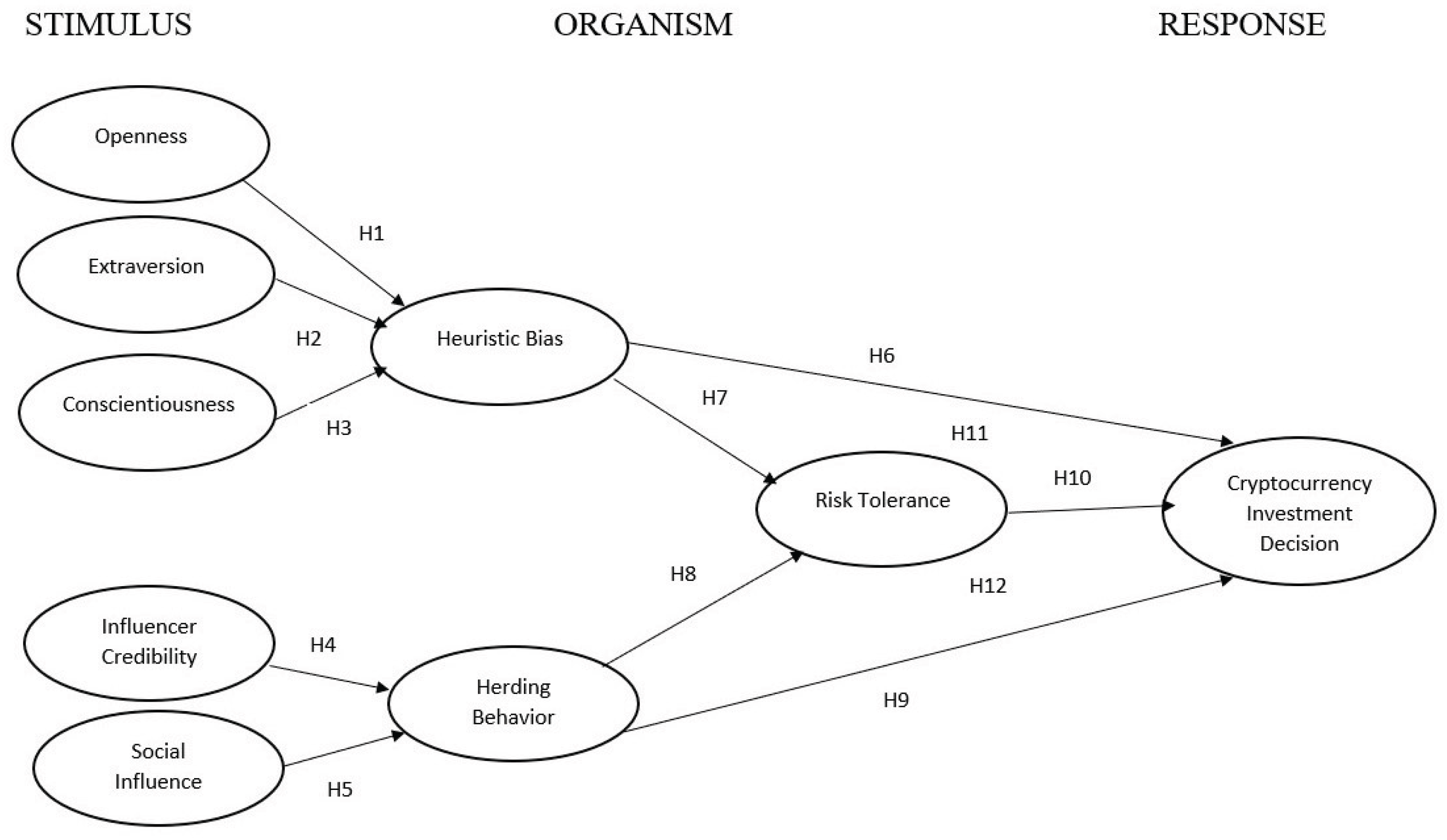
This study applies the Stimulus–Organism–Response (SOR) framework to explain cryptocurrency investment decisions. Stimuli consist of internal factors (personality traits) and external factors (influencer credibility, social influence). The organism reflects investors’ cognitive and emotional states, namely heuristic bias, herding behavior, and risk tolerance. The response is the final decision to invest in cryptocurrency. Heuristic bias and herding behavior function as parallel mediators, while risk tolerance acts as a serial mediator, linking these biases to investment outcomes. This dual mediation captures both direct and cascading psychological mechanisms. The model will be empirically tested using SEM-PLS, which enables simultaneous assessment of direct, indirect, and mediating effects.
Figure 1.
Research Model.
3. Research Methodology
3.1. Material and Method
This study employs a quantitative research approach, appropriate for analysing relationships among variables using measurable data [51]. A survey method is employed to examine how psychological and social factors influence cryptocurrency investment, with statistical analysis employed to ensure objectivity and validity [52]. The independent variables are openness, extraversion, conscientiousness, influencer credibility, and social influence; the mediators are heuristic bias, herding behaviour, and risk tolerance; the dependent variable is the cryptocurrency investment decision. Questionnaires for retail investors are developed based on prior literature and preliminary studies.
This study relies on primary data collected via online questionnaires distributed via Google Forms. The respondents are retail investors with prior experience trading cryptocurrencies, ensuring that the data reflect actual market behaviour. The questionnaire includes demographic items such as age, gender, and education; questions on investment experience and knowledge; and statements related to the study variables, measured on a five-point Likert scale. To complement this, secondary data were obtained from reputable journals, conference proceedings, and regulatory sources, providing additional context on cryptocurrency development, regulation, and market dynamics. Integrating primary and secondary data strengthens the research foundation and enhances the robustness of the findings.
The population of interest is retail cryptocurrency investors, classified as an unknown population due to their rapid and dynamic growth. Given this, the study employs purposive non-probability sampling. The selection criteria require respondents to actively invest in cryptocurrency, follow at least one crypto influencer, and have been exposed to influencer content within the past three months. These criteria ensure the sample is directly aligned with the study’s theoretical framework, focusing on individuals influenced by both psychological factors and social stimuli. The sample size was determined using G*Power, with f² = 0.15, α = 0.01, power = 0.95, and three predictors, yielding a minimum required sample size of 157 respondents. For comparison, the sample-to-variable ratio approach proposed by Memon [53] was also applied, based on 16 variables, yielding a requirement of 320 respondents. Using both methods provides robust justification for the adequacy of the sample size.
3.2. Operationalization of Variables
The variables used in this study were adapted from previously validated scales in the literature. Extraversion, defined as a personality trait reflecting sociability, optimism, and friendliness, was measured using four indicators: interest in surroundings, comfort around people, ability to handle social situations, and ease of making new friends, adapted from Treerotchananon et al. [20]. Similarly, openness, which refers to imaginative tendencies and risk-taking abilities, was measured through four items, including proposing new ideas, being full of ideas, and enjoying imaginative thinking, also derived from Treerotchananon et al. [20]. Conscientiousness, which describes individuals with clear goals, confidence, and organizational abilities, was captured using four indicators, such as preparedness, organization, planning, and execution, also sourced from Treerotchananon et al. [20].
Influencer credibility was operationalized as a multidimensional construct comprising expertise, trustworthiness, attractiveness, and similarity. Expertise reflects the influencer’s perceived knowledge, skills, and experience in investment, measured with three items. Trustworthiness was assessed using three indicators that measure the extent of confidence placed in influencers. Attractiveness, reflecting likability and communication style, was measured with four items, while similarity, referring to shared values and mindsets with influencers, was measured with four items. All these dimensions were adapted from Aren and Hamamci [54]. Social influence, referring to pressures from peers, family, and significant others, was measured through four indicators, such as advice, motivation, and perceived encouragement to invest in cryptocurrency, adapted from Kala and Chaubey [55].
Heuristic bias was treated as a multidimensional second-order construct consisting of five dimensions: representativeness, availability, overconfidence, gambler’s fallacy, and anchoring and adjustment. Representativeness was measured with five indicators reflecting reliance on trends and past performance. Availability was assessed using five items assessing ease of information recall and reliance on new updates. Overconfidence was measured with four indicators reflecting investors’ perceived superior knowledge and timing ability. The gambler’s fallacy was assessed using three items reflecting belief in corrective market movements. In contrast, anchoring and adjustment were measured using four items related to reliance on experience and recent price trends. These dimensions were adopted from Jain et al. [37].
Herding behaviour, defined as individuals’ tendency to imitate others’ investment actions, was measured using five items, such as reacting to and following other investors’ buying and selling decisions, adapted from Kaur et al. [56]. Risk tolerance, defined as the degree to which individuals are willing to accept uncertainty in financial decision-making, was measured using five indicators, including scepticism toward new instruments, preference for predictable returns, and seeking guarantees, derived from Singh and Biswas [57]. Lastly, the cryptocurrency investment decision, defined as the process of deciding whether, when, and how much to invest in digital assets, was measured with four indicators, such as goal achievement, confidence, independence in decision-making, and portfolio performance, adapted from Kaur et al. [56].
4. Result and Discussion
4.1. Demographic of Respondents
This section provides a detailed overview of the demographic profile of the 367 respondents who were included in the final dataset. The demographic characteristics describe the composition of cryptocurrency investors who participated in this study and help contextualize the behavioural patterns observed in subsequent analyses. Demographic respondents were presented in Table 1
Based on Table 1, most respondents were male (76.84%), confirming prior findings that men are more involved in speculative, technology-driven investments [58]. The age profile was dominated by young adults, particularly those aged 21–30 years (35.24%), consistent with studies showing that younger individuals adopt emerging financial technologies more quickly due to higher digital literacy and risk-taking tendencies [59].
By profession, students accounted for the largest share (40.60%), followed by private employees (29.97%), indicating strong participation among young and early-career individuals. Most respondents had relatively short investment experience: 41.96% had invested for 1–2 years, and 29.97% for less than 1 year, suggesting that the sample was largely composed of beginner investors [60].
Regarding financial allocation, 64.31% of respondents invested less than 10% of their monthly income in cryptocurrency, while 29.97% allocated 11–25%. This pattern reflects a cautious investment approach and limited financial exposure to crypto assets [61].
4.2. Common Method Bias, Validity, and Construct Reliability
Common method bias (CMB) arises when a single data collection method inflates relationships among variables. To enhance the assessment’s robustness, the study did not rely on a single procedure but used two complementary methods to detect common method bias. First, Harman’s single-factor test in SPSS showed a variance of 34.8%, below the 50% threshold, indicating no dominant single factor [62]. Followed by a marker variable, Attitude Toward the Colour Blue (ATCB), which was tested using a full collinearity assessment; all VIF values were below 3.3 [63]. Both results confirm that CMB was not a concern in this study.
Two constructs were modelled as higher-order reflective–reflective: Heuristic Bias (representativeness, anchoring and adjustment, availability, gambler’s fallacy, and overconfidence) and Influencer Credibility (similarity, attractiveness, trustworthiness, and expertise). Using a two-stage approach, lower-order latent variable scores were first generated via the PLS algorithm and then specified as reflective indicators of the higher-order constructs. Convergent validity and reliability were reassessed, and the results confirm a robust, theoretically consistent measurement model (Table 2).
Table 2 presents the confirmatory assessment of the measurement model, including outer loadings, convergent validity (AVE), and internal consistency reliability (Cronbach’s alpha and composite reliability). The results show that all indicators load adequately on their respective constructs and that each construct meets the recommended thresholds for reliability and convergent validity.
Similarly, a discriminant validity test was conducted using the Heterotrait-Monotrait (HTMT) ratio to ensure that the higher-order constructs were empirically distinct. The results of the HTMT analysis for the higher-order constructs are presented in Table 3. All HTMT values were below the recommended threshold of 0.90, indicating that the higher-order measurement model satisfied the criteria for discriminant validity
4.3. Hypothesis Testing
After all lower- and higher-order constructs meet the criteria in the confirmatory factor analysis, the next step is to conduct hypothesis testing. Hypothesis testing was conducted using SmartPLS bootstrapping to obtain t-statistics, p-values, and path coefficients, which served as the basis for determining whether to accept or reject the research hypothesis. Hypothesis testing was conducted using the bootstrapping procedure in SmartPLS with 5,000 subsamples to obtain t-statistics, p-values, and path coefficients. A one-tailed significance test was applied, as all hypotheses were formulated with clear directional expectations based on prior theory and empirical findings. The results of this hypothesis testing are presented in Table 4
Bootstrapped results from SmartPLS support all hypothesized relationships (H1–H12). Personality traits significantly predict heuristic bias, with extraversion (β = 0.326, f² = 0.082) and conscientiousness (β = 0.195, f² = 0.027) showing meaningful effects, whereas openness (β = 0.132, f² = 0.011) is significant but of negligible magnitude. Both influencer credibility (β = 0.303, f² = 0.070) and social influence (β = 0.285, f² = 0.062) significantly increase herding behaviour. Downstream, the heuristic bias strongly predicts risk tolerance (β = 0.585, f² = 0.459) and investment decision (β = 0.407, f² = 0.188), whereas herding has significant but small effects on investment decision (β = 0.106, f² = 0.019) and risk tolerance (β = 0.185, f² = 0.046). Risk tolerance also positively influences investment decisions (β = 0.354, f² = 0.154) and significantly mediates the effects of heuristic bias (indirect β = 0.200) and herding (indirect β = 0.078) on investment decisions.
In terms of explanatory power, the model accounts for a moderate-to-strong proportion of the variance in cryptocurrency investment decisions (adjusted R² = 0.623) and a moderate proportion of the variance in risk tolerance (adjusted R² = 0.507). The explained variance is moderate for heuristic bias (0.327) and weak-to-moderate for herding behaviour (0.287), indicating that while the included personality and social stimuli are important, additional contextual factors likely also shape herding and heuristic formation in crypto markets.
4.4. Discussion
This study interprets cryptocurrency investment decisions using the Stimulus–Organism–Response (SOR) framework, where personality traits and social stimuli shape internal cognitive and social processes that ultimately drive investment behaviour [14]. The results indicate that openness, extraversion, and conscientiousness positively predict heuristic bias, but openness shows only a negligible effect size. This pattern is consistent with evidence that openness is associated with representativeness-based pattern recognition in uncertain decision environments [21]. It also aligns with findings that open individuals tend to form optimistic expectations and rely on intuitive judgments in speculative contexts [17]. In settings characterized by limited benchmarks and information overload, openness can promote intuitive and creative processing rather than systematic analysis [20]. The sample profile supports this interpretation: younger investors are typically more willing to adopt emerging financial technologies, yet often rely on heuristic processing when formal financial knowledge is limited [59]. This context is relevant for Indonesia, where the investor base is dominated by younger cohorts [64].
Extraversion has a stronger, practically meaningful influence on heuristic bias. This is consistent with evidence that extraverts are more responsive to salient and emotionally engaging information in fast-moving markets, which can increase reliance on heuristic cues [21]. It also supports prior work showing that extraversion is associated with overconfidence in decision-making, which contributes to heuristic-based judgments [65]. Conscientiousness also positively predicts the use of heuristic biases, suggesting that even planning-oriented investors may use cognitive shortcuts when faced with complex, time-sensitive information. This aligns with the argument that conscientious individuals rely on simplifying heuristics to maintain a sense of control under complexity [22]. It is also consistent with evidence linking conscientiousness to anchoring-type behaviour, where reference points disproportionately shape subsequent judgments [20]. Inexperience can further intensify this tendency, as novice investors often adhere rigidly to initial rules or early assumptions to compensate for knowledge gaps [23].
The results also show that influencer credibility significantly increases herding behaviour. This is consistent with evidence that social-media investment information can shape collective investor behaviour and encourage imitation when the source is trusted [66]. Credibility reduces uncertainty and increases confidence in the message, which accelerates behavioural convergence in volatile markets [54]. Influencer credibility can also amplify emotional transmission within online communities, reinforcing synchronized sentiment and herding dynamics [67]. The link between emotional contagion and herding provides an additional mechanism supporting this effect [68]. In cryptocurrency markets, where standardized fundamentals and authoritative reporting are limited, investors may rely on narrative-driven, socially mediated information, further elevating the role of credible influencers [24] . Under conditions of information asymmetry, socially validated and authoritative cues are especially likely to guide behaviour [28].
Social influence also significantly increases herding behaviour. This aligns with the view that social influence operates through normative and informational pressures rather than the authority of a single source [69]. Social influence reflects the extent to which individuals perceive expectations from important others to conform, which becomes more salient under uncertainty [27]. Herding is more likely when investors interpret others’ actions as signals of superior information, particularly when objective valuation is difficult [28]. Community-driven endorsement and collective enthusiasm can further intensify conformity and fear of missing out in speculative markets [29].
Heuristic bias has a strong positive effect on risk tolerance and a moderate positive effect on cryptocurrency investment decisions. This supports the argument that heuristic-based processing becomes more influential when information is complex or incomplete, shaping how investors engage with financial markets [30]. Biases such as overconfidence and availability can distort perceptions of risk and return, increasing decisiveness and optimism in trading behavior [70]. Overconfidence can also reduce investors’ awareness of downside risk and weaken objective risk evaluation, which is particularly consequential in highly volatile crypto markets [32]. The strong effect of heuristic bias on risk tolerance is consistent with evidence that heuristics meaningfully shape risk perception and acceptance [35]. Representativeness can lead investors to extrapolate past performance and underestimate downside risk in speculative assets [71]. Reliance on intuitive shortcuts can also reduce the accuracy of risk assessment, increasing willingness to accept uncertainty [37]. These patterns are consistent with findings that overconfidence can elevate risk tolerance, particularly among investors with experience navigating gains and losses [50].
Herding behaviour positively affects both cryptocurrency investment decisions and risk tolerance, although the direct effect on investment decisions is small. This finding is consistent with evidence that collective market behaviour influences investor decisions when reliable fundamentals are limited [8]. In such environments, herding can function as a coping strategy under uncertainty [39]. Herding is also associated with reduced verification and independent research because most actions are assumed to reflect better information (Kyriazis, 2020). However, herding’s substantive impact may weaken as investors gain experience, supporting the view that experienced investors become more selective rather than blindly following the crowd [72]. The relationship between herding and risk tolerance also reflects prior work showing that social validation can reduce perceived risk and increase willingness to tolerate volatility [17]. At the same time, herding can shift risk tolerance differently across market states, potentially amplifying risk aversion during downturns [38].
Risk tolerance positively predicts cryptocurrency investment decisions, confirming that risk acceptance is a key internal condition for participating in highly volatile assets [44]. This is consistent with evidence that risk tolerance determines participation in volatile markets, including crypto assets [73]. It also aligns with findings that, in markets characterized by extreme volatility, risk tolerance is a primary driver of allocation to digital assets [38]. Importantly, the mediation results show that risk tolerance transmits the effects of heuristic bias and herding to investment decisions. This supports the view that heuristics shape risk perceptions rather than merely influencing final choices [30]. It also aligns with evidence that heuristic shortcuts influence how uncertainty is interpreted, increasing willingness to accept risk in complex financial settings [37]. In addition, collective movements can psychologically reassure investors, lower perceived risk, and thereby increase risk tolerance prior to action [74]. Overall, the results reinforce the proposition that behavioural biases and social cues become more dominant when markets are volatile, information-asymmetric, and sentiment-driven [34]. They also align with evidence that behavioural mechanisms are amplified in speculative environments relative to conventional markets [75].
5. Research Implication
5.1. Theoretical Implication
This study presents an integrative SOR traits-based model that links personality, heuristic biases, social stimuli, herding behaviour, and risk tolerance to explain cryptocurrency investment decisions. Theoretical novelty is not derived from introducing new variables, but from re-specifying how established behavioural mechanisms operate in digital, sentiment-driven, and information-asymmetric markets, where cognitive and social forces interact more intensely than in conventional settings.
A central contribution is the empirical validation and extension of the Stimulus–Organism–Response framework to cryptocurrency investment behaviour [14]. Rather than assuming a direct stimulus–response linkage, the findings show that organism-level mechanisms—heuristic bias, herding behaviour, and risk tolerance play a decisive role in transforming external stimuli into behavioural outcomes. External stimuli such as influencer credibility and social influence do not act as direct triggers of investment decisions; instead, they form internal evaluations and affective states that facilitate risk acceptance before action is taken.
Positioning risk tolerance as a mediating mechanism also challenges classical perspectives that treat risk tolerance as a stable and largely exogenous trait [76]. The results suggest that risk tolerance is dynamically shaped by heuristic processing and social herding contexts, particularly under uncertainty and information asymmetry [37]. This insight distinguishes cryptocurrency markets from mature financial markets, where stronger institutional regulation, analyst coverage, and standardized reporting reduce asymmetry and support more analytical decision-making [75]. In contrast, the absence of standardized valuation frameworks and authoritative information channels in crypto amplifies reliance on cognitive shortcuts and socially transmitted signals, consistent with the argument that behavioural biases intensify under uncertainty and ambiguity [34].
The significant effects of influencer credibility and social influence on herding behaviour also extend social learning and credibility-based explanations into digital asset investing [77]. The results support the notion that credibility cues embedded in social media environments function as powerful market stimuli, positioning influencers as surrogate experts and encouraging imitation under uncertainty [78]. This is consistent with recent evidence that social media can materially shape collective financial beliefs and behaviour in speculative markets [54].
This study contributes to behavioural finance by showing that personality traits do not exert equivalent substantive influence even when statistically significant. Extraversion and conscientiousness provide more explanatory power for heuristic bias, whereas openness appears more of a background disposition with limited behavioural impact in speculative investment contexts. This challenges the implicit assumption that traits operate symmetrically in shaping biased decision-making and suggests that trait–bias relationships are contingent on market structure, volatility, and information conditions.
This study also contributes to trait theory by showing that the behavioural expression of personality in investment contexts is highly contingent on market conditions. Within the Big Five perspective, traits represent stable predispositions that shape how individuals attend to, interpret, and respond to environmental cues, including complex information environments such as financial markets [16]. The findings indicate that extraversion and conscientiousness exhibit more substantively meaningful links to heuristic bias than openness, suggesting that traits do not operate symmetrically in shaping biased decision-making in speculative settings. This pattern aligns with the view that trait–behaviour linkages depend on situational strength and uncertainty: when markets are volatile, and information is ambiguous, trait-consistent processing becomes more pronounced, but different traits are activated through different pathways [79]. Accordingly, the results extend trait-based explanations in behavioural finance by distinguishing statistical significance from substantive influence and by demonstrating that the translation of traits into heuristic processing is conditioned by information asymmetry rather than being uniform across traits [34].
5.2. Practical Implication
The findings provide actionable implications for key stakeholders in the cryptocurrency ecosystem by translating behavioural mechanisms into practical interventions. For cryptocurrency exchanges and fintech platforms, the significant role of heuristics and herding behaviour underscores the need to embed behavioural risk-mitigation features in trading systems. Platforms can implement dynamic warning tools that activate when trading volume is abnormal, prices move sharply, or crowd-driven buy–sell patterns emerge. Such interventions may include pre-trade pop-up alerts that prompt users to reconsider common cognitive shortcuts, such as anchoring to previous price peaks or purchasing trending assets without verification, thereby encouraging more reflective decision-making. Given that social influence significantly shapes herding behaviour, platforms can also strengthen information verification by facilitating moderated online communities and periodic offline meetups that promote responsible discussion and reduce the spread of misinformation.
For regulators and supervisory bodies in Indonesia, such as Bappebti and the Financial Services Authority (OJK), the significant effect of influencer credibility on herding behaviour highlights the need for targeted governance of crypto-related promotional content. Regulators may consider disclosure requirements for influencer communications, including statements of financial interests, paid endorsements, and standardized risk warnings. A formal code of ethics or a registration mechanism for crypto influencers could further reduce information asymmetry and discourage misleading signals that disproportionately affect retail investors. Regulatory communication should also provide clear public guidance on the legal status of crypto assets and the applicable transaction taxes, including recent policy changes, while strengthening investor education on fraud prevention and risk differentiation across asset categories. Education efforts should emphasize the greater downside risks of small-cap tokens, including rapid drawdowns and delisting risks, compared with more established large-cap assets.
Investment advisors and financial educators can use these results to redesign investor profiling and literacy programs. Beyond conventional financial indicators, risk-profiling tools should incorporate behavioural dimensions, such as susceptibility to heuristic processing and social influence, to identify investors who may be prone to speculative decision patterns. Educational interventions should move beyond general financial literacy toward debiasing strategies that directly address anchoring, availability, and representativeness biases commonly observed in crypto trading environments. Collaboration between financial educators and university academics can support the development of a crypto-literacy handbook that integrates evidence-based insights with practical guidance in an accessible language.
For influencers and digital content creators, the findings imply an ethical responsibility to communicate transparently and avoid sensationalized narratives that may amplify speculative risk. Credibility can be strengthened through consistent demonstration of expertise, clear alignment with audience values, and trustworthy communication practices, including explicit disclosure of conflicts of interest and avoidance of misleading performance claims. Recent public disputes and legal complaints involving influencer-driven token promotions indicate that retail audiences are increasingly critical and willing to pursue formal remedies when they perceive harm, underscoring the importance of responsible content standards.
For retail investors, the results emphasize that cognitive shortcuts and social pressure can unintentionally increase risk tolerance and trigger impulsive actions. Investors may benefit from disciplined strategies that limit emotionally driven decisions during downturns, such as predefined position-sizing rules and risk caps, to prevent exposure that exceeds their tolerance. The findings also suggest that awareness of individual personality tendencies can support better self-regulation. Extraverted investors may be more sensitive to social cues and therefore more vulnerable to herding and momentum-driven trades. Investors high in openness may be more attracted to novel projects and thus more exposed to availability and representativeness biases. More conscientious investors may adopt systematic strategies and risk controls but remain susceptible to anchoring on initial price targets. Collectively, these implications support the development of a more behaviourally informed, transparent, and resilient cryptocurrency investment ecosystem.
6. Conclusions
This study uses the Stimulus–Organism–Response (SOR) framework to explain cryptocurrency investment decisions by positioning personality traits (openness, extroversion, conscientiousness), influencer credibility, and social influence as stimuli; heuristic bias and herding behavior as organisms; and cryptocurrency investment decisions as responses, with risk tolerance as a serial mediator. Based on SEM-PLS analysis on 367 retail investors, all hypotheses are supported. The model has strong explanatory power for cryptocurrency investment decisions and moderate explanatory power for risk tolerance, making it suitable for understanding crypto investment decisions in volatile and sentiment-driven markets.
Openness, extraversion, and conscientiousness all positively influenced heuristic bias. However, the effect of openness was significant but very small, whereas extraversion had the largest effect, followed by conscientiousness. These findings suggest that, in the rapidly changing crypto investment environment, social-impulsive tendencies (extraversion) and structured tendencies that seek control in complex situations (conscientiousness) are more likely to encourage the use of cognitive shortcuts than openness to new ideas alone.
Influencer credibility and social influence positively affect herding behaviour. This confirms that herding among crypto investors arises not only from market dynamics but also from the informational authority of perceived credible influencers, as well as normative pressure and validation from the social environment (family, friends, colleagues) when investors face uncertainty.
Heuristic bias strongly influences risk tolerance and moderately influences investment decisions. Herding behaviour also positively affects risk tolerance and investment decisions, but its direct effect on investment decisions is relatively small. Thus, crypto investment decisions are more influenced by cognitive mechanisms (heuristics) than by social imitation alone, although herding still plays a role as a behavioural driver.
Risk tolerance positively influences cryptocurrency investment decisions and mediates the effects of heuristic bias and herding behaviour on them. This finding strengthens the argument that risk tolerance is dynamic and can be shaped by exposure to cognitive biases and social pressure before ultimately influencing investment decisions.
Limitations of this study are that macroeconomic conditions, such as investor understanding of market conditions (bullish vs. bearish), global sentiment, investor understanding of recent regulations, and external events such as exchange scandals or changes in tax policy, have not been included in the model. However, the cryptocurrency market is highly sensitive to news and sentiment, so these factors are able to strengthen or weaken the influence of heuristic bias and herding on risk tolerance and investment decisions.
Suggestions for future research include treating these macro variables as contextual factors in the model, either as moderating or control variables. Future research could examine whether bullish and bearish market conditions strengthen or weaken the influence of heuristics and herding on risk tolerance and investment decisions. Similarly, investors’ understanding of global sentiment and regulatory changes could be analysed to determine whether macroeconomic and regulatory literacy can mitigate the impact of cognitive bias and social pressure.
Future research could also conduct multi-group analyses by comparing hypothesis test results between investors with less than one year of experience and those with more than one year, as well as between Gen Z and non-Gen Z groups. This approach aims to determine whether the strength of the relationship between variables differs significantly by experience level and generational characteristics.
References
- Rubasinghe, D. I. Transaction Verification Model over Double Spending for Peer-to-Peer Digital Currency Transactions based on Blockchain Architecture. Int. J. Comput. Appl. 2017, vol. 163(no. 5), 24–31. [Google Scholar] [CrossRef]
- Phillips, R. C.; Gorse, D. Cryptocurrency price drivers: Wavelet coherence analysis revisited. PLoS One 2018, vol. 13(no. 4), 1–21. [Google Scholar] [CrossRef]
- de Best, R. “Estimate of The Monthly Number of Cryptocurrency Users Worldwide 2016-2022,” 2023. Available online: https://www.statista.com/statistics/1202503/global-cryptocurrency-user-base/.
- Liman, U. S. The Financial Services Authority (OJK) noted that crypto transactions surged 335.91 percent in 2024. Antaranews.com. Available online: https://www.antaranews.com/berita/4642781/ojk-catat-transaksi-kripto-melonjak-33591-persen-pada-2024.
- Briola; Vidal-Tomás, D.; Wang, Y.; Aste, T. Anatomy of a Stablecoin’s failure: the Terra-Luna case. 2022. Available online: http://arxiv.org/abs/2207.13914.
- Macheel, T. Bitcoin Rallies to 2-year High of $49,000 then Fizzles as Crypto ETFs Debut. cnbc.com. Available online: https://www.cnbc.com/2024/01/10/bitcoin-falls-ether-surges-after-sec-greenlights-launch-of-us-bitcoin-etfs.html.
- Sathishkumar, R.; Vijayalakshmi, P. Heuristic Behaviour of Individual Investors on Investment Decision – A Study with Special Reference to Tirunelveli District. Int. J. Res. Anal. Rev. 2019, 120–125. [Google Scholar]
- Rahyuda, H.; Candradewi, M. R. Determinants of Cryptocurrency Investment Decisions (Study of students in Bali). Invest. Manag. Financ. Innov. 2023, vol. 20(no. 2), 193–204. [Google Scholar] [CrossRef]
- Ye, Z.; Liu, W.; Qu, Q.; Jiang, Q.; Pan, Y. A Cryptocurrency Price Prediction Model Based on Twitter Sentiment Indicators. In Communications in Computer and Information Science;Shenzhen Institute of Advanced Technology, Chinese Academy of Sciences; T. Y., M. T., K. M.K., S. V.S., and P. Z., Eds; Springer Science and Business Media Deutschland GmbH: Shenzhen, 518055, China, 2022; pp. 411–425. [Google Scholar] [CrossRef]
- Li, W.; Bao, L.; Chen, J.; Grundy, J.; Xia, X.; Yang, X. Market Manipulation of Cryptocurrencies: Evidence from Social Media and Transaction Data. ACM Trans. Internet Technol. 2024, vol. 24(no. 2), 1–26. [Google Scholar] [CrossRef]
- Ahmad, M.; Shah, S. Z. A. Overconfidence Heuristic-driven Bias in Investment decision-making and Performance: Mediating Effects of Risk Perception and Moderating Effects of Financial Literacy. J. Econ. Adm. Sci. 2022, vol. 38(no. 1), 60–90. [Google Scholar] [CrossRef]
- Almeida, J.; Gonçalves, T. C. A Decade of Cryptocurrency Investment Literature: A Cluster-Based Systematic Analysis. Int. J. Financ. Stud. 2023, vol. 11(no. 2). [Google Scholar] [CrossRef]
- Gautam, S.; Kumar, P. Behavioral biases of investors in the cryptocurrency market. AIP Conf. Proc. 2023, vol. 2782(no. 1), 20105. [Google Scholar] [CrossRef]
- Mehrabian; Russell, J. A. The Basic Emotional Impact of Environment. Percept. Mot. Skills 1974, vol. 38, 283–301. [Google Scholar] [CrossRef]
- De Bortoli, D.; Da Costa, N.; Goulart, M.; Campara, J. Personality traits and investor profile analysis: A behavioral finance study. PLoS One 2019, vol. 14(no. 3), 1–18. [Google Scholar] [CrossRef]
- Costa, P. T.; McCrae, R. R. The five-factor Model of Personality and its Relevance to Personality Disorders. J. Personal. Disord. 1992, vol. 6(no. 4), 343–359. [Google Scholar] [CrossRef]
- Akhtar, F.; Das, N. Investor Personality and Investment Performance: from the Perspective of Psychological Traits. Qual. Res. Financ. Mark. 2020, vol. 12(no. 3), 333–352. [Google Scholar] [CrossRef]
- Sashikala, V.; Chitramani, P. Personality of individual investors. Res. J. Soc. Sci. 2019, vol. 10(no. 7), 186–193. Available online: www.aensi.in.
- Baker, H. K.; Kapoor, S.; Khare, T. Personality traits and behavioral biases of Indian financial professionals. Rev. Behav. Financ. 2023, vol. 15(no. 6), 846–864. [Google Scholar] [CrossRef]
- Treerotchananon; Changchit, C.; Cutshall, R.; Lonkani, R.; Prasertsoontorn, T. The Influence of Personality Traits on Stock Investment Retention: Insights from Thai Investors. J. Risk Financ. Manag. 2024, vol. 17(no. 11). [Google Scholar] [CrossRef]
- Jayawardena, M. A.; Nanayakkara, N. S. How Does Loss Aversion Mediate the Relationship Between Personality Traits and Efficiency of Skills in Investment Decision-Making? Int. Rev. Manag. Mark. vol. 15(no. 1), 293–301, 2025. [CrossRef]
- James; Seranmadevi, R. Unpacking the Psychology of Investment Intention: The Role of Emotional Intelligence, Personality Traits, and Risk Behaviour. Int. Res. J. Multidiscip. Scope 2024, vol. 5(no. 1), 198–206. [Google Scholar] [CrossRef]
- Mayfield; Perdue, G.; Wooten, K. Investment Management and Personality Type. Financ. Serv. Rev. 2008, vol. 17, 219–236. [Google Scholar] [CrossRef]
- Wolk, K. Advanced Social Media Sentiment Analysis for Short-term Cryptocurrency Price Prediction. Expert Syst. 2019, no. April, 1–16. [Google Scholar] [CrossRef]
- Ohanian, R. Construction and validation of a scale to measure celebrity endorsers’ perceived expertise, trustworthiness, and attractiveness. J. Advert. 1990, vol. 19(no. 3), 39–52. [Google Scholar] [CrossRef]
- Li, T.; Chen, H.; Liu, W.; Yu, G.; Yu, Y. Understanding The Role of Social Media Sentiment in Identifying Irrational Herding Behavior in The Stock Market. Int. Rev. Econ. Financ. 2023, vol. 87, 163–179. [Google Scholar] [CrossRef]
- Cialdini, R. B.; Goldstein, N. J. Social influence: Compliance and Conformity. Annu. Rev. Psychol. 2004, vol. 55(no. 1974), 591–621. [Google Scholar] [CrossRef]
- Bikhchandani, S.; Sharma, S. Herd Behavior in Financial Markets. IMF Staff Pap. 2001, vol. 47(no. 3), 279–310. [Google Scholar] [CrossRef]
- Paseru, K.; De Valencia, C.; Hendratno, S. P. Analysis Factors Influencing Gen Z on Investment Decisions of Cryptocurrency in Indonesia. In in Proceedings of the 2023 6th International Conference on Computers in Management and Business, in ICCMB ’23, New York, NY, USA, 2023; Association for Computing Machinery; pp. 37–42. [Google Scholar] [CrossRef]
- Kasoga, P. S. Heuristic Biases and Investment Decisions: Multiple Mediation Mechanisms of Risk Tolerance and Financial Literacy—a Survey at the Tanzania Stock Market. J. Money Bus. 2021, vol. 1(no. 2), 102–116. [Google Scholar] [CrossRef]
- Badlani; Yadav, R. A.; Kumar, A. Psychological Impact of Cryptocurrency Volatility on Investor Emotions and Decision Making. J. Reatt. Ther. Dev. Divers. 2023, vol. 6(no. 7), 204–214. Available online: https://www.scopus.com/inward/record.uri?eid=2-s2.0-85165452587&partnerID=40&md5=db3f684253485ed05e7a30d8145de18b.
- Zain, S.; Qureshi, F.; Iqbal, J.; Sultana, S. Overconfidence Bias and Investment Performance: A Mediating Effect of Risk Propensity. Borsa istanbul Rev. 2022, vol. 22(no. 4), 780–793. [Google Scholar] [CrossRef]
- Rehmat; Khan, A. A.; Hussain, M.; Khurshid, S. An Examination of Behavioral Factors Affecting the Investment Decisions: The Moderating Role of Financial Literacy and Mediating Role of Risk Perception. J. Innov. Res. Manag. Sci. 2023, vol. 4(no. 2), 1–16. [Google Scholar] [CrossRef]
- Tversky; Kahneman, D. Judgment under Uncertainty: Heuristics and Biases. Uncertain. Econ. 1974, vol. 5(no. 1), 17–34. [Google Scholar] [CrossRef]
- Baker, H. K.; Ricciardi, V. Understanding Behavioral Aspects of Financial Planning and Investing. J. Financ. Plan. 2015, vol. 13(no. 3), 22–26. [Google Scholar]
- Epley, N.; Gilovich, T. Putting adjustment back in the anchoring and adjustment heuristic: Differential Processing of Self-Generated and Experimenter-Provided Anchors. Psychol. Sci. 2001, vol. 12(no. 5), 391–396. [Google Scholar] [CrossRef]
- Jain; Walia, N.; Singla, H.; Singh, S.; Sood, K.; Grima, S. Heuristic Biases as Mental Shortcuts to Investment Decision-Making: A Mediation Analysis of Risk Perception. Risks 2023, vol. 11(no. 4), 1–22. [Google Scholar] [CrossRef]
- Bouri; Gupta, R.; Roubaud, D. Herding Behavioral in Cryptocurrencies. Financ. Res. Lett. 2019, vol. 29(no. 1), 216–221. [Google Scholar] [CrossRef]
- Ballis; Verousis, T. Behavioural Finance and Cryptocurrencies. Rev. Behav. Financ. 2022, vol. 14(no. 4), 545–562. [Google Scholar] [CrossRef]
- Kyriazis, N. A. Herding Behaviour in Digital Currency Markets: An Integrated Survey and Empirical Estimation. Heliyon 2020, vol. 6(no. 8), e04752. [Google Scholar] [CrossRef]
- Almansour, Y.; Elkrghli, S.; Almansour, A. Y. Behavioral Finance Factors and Investment Decisions: A Mediating Role of Risk Perception. Cogent Econ. Financ. 2023, vol. 11(no. 2), 1–20. [Google Scholar] [CrossRef]
- Adil, M.; Singh, Y.; Ansari, M. S. How financial literacy moderate the association between behaviour biases and investment decision? Asian J. Account. Res. 2022, vol. 7(no. 1), 17–30. [Google Scholar] [CrossRef]
- Sharma, R. Ghosh; Sharma, C. S. Cryptocurrency in the Light of Sentiments: A Bibliometric Approach. Indian J. Financ. 2024, vol. 18(no. 2), 60–75. [Google Scholar] [CrossRef]
- Srinivasan; Karthikeyan, P. Investigating self-efficacy and behavioural bias on investment decisions. Finance 2023, vol. 26(no. 4), 119–133. [Google Scholar] [CrossRef]
- Grable, J.; Lytton, R. H. Financial risk tolerance revisited: the development of a risk assessment instrumentâ. Financ. Serv. Rev. 1999, vol. 8(no. 3), 163–181. [Google Scholar] [CrossRef]
- Veerasingam, N.; Teoh, A. P. Modeling cryptocurrency investment decision: evidence from Islamic emerging market. J. Islam. Mark. 2023, vol. 14(no. 7), 1817–1835. [Google Scholar] [CrossRef]
- Boubaker, S.; Karim, S.; Naeem, M. A.; Rahman, M. R. On the Prediction of Systemic Risk Tolerance of Cryptocurrencies. Technol. Forecast. Soc. Change 2024, vol. 198(no. 3), 122963. [Google Scholar] [CrossRef]
- Aeknarajindawat, N. The Combined Effect of Risk Perception and Risk Tolerance on the Investment Decision Making. J. Secur. Sustain. Issues 2020, vol. 9(no. 2), 807–818. [Google Scholar] [CrossRef] [PubMed]
- Hussain, S.; Rasheed, A. Risk tolerance as mediating factor in individual financial investment decisions: a developing-country study. J. Stud. Econ. Econom. 2023, vol. 47(no. 2), 185–198. [Google Scholar] [CrossRef]
- Singh, Y.; Adil, M.; Haque, S. M. I. Personality Traits and Behaviour Biases: the Moderating Role of Risk-tolerance. Qual. Quant. 2023, vol. 57(no. 4), 3549–3573. [Google Scholar] [CrossRef] [PubMed]
- Hair, J. F.; Hult, G. T. M.; Ringle, C. M.; Sarstedt, M.; Danks, N. P.; Ray, S. An Introduction to Structural Equation Modeling; 2021; pp. 1–29. [Google Scholar] [CrossRef]
- Hair, J. F.; Ringle, C. M.; Hult, G. T. M.; Sarstedt, M. A Primer on Partial Least Squares Structural Equation Modeling 2022. [CrossRef]
- Memon, A.; Ting, H.; Cheah, J.-H.; Thurasamy, R.; Chuah, F.; Cham, T. H. Sample Size for Survey Research: Review and Recommendations. J. Appl. Struct. Equ. Model. 2020, vol. 4(no. 2), 1–20. [Google Scholar] [CrossRef]
- Aren, S.; Hamamci, H. N. The direct and indirect effects of financial influencer credibility on investment intention. Croat. Rev. Econ. Bus. Soc. Stat. 2024, vol. 10(no. 1), 57–69. [Google Scholar] [CrossRef]
- Kala; Chaubey, D. S. Cryptocurrency adoption and continuance intention among Indians: moderating role of perceived government control. Digit. Policy, Regul. Gov. 2023, vol. 25(no. 3), 288–304. [Google Scholar] [CrossRef]
- Kaur, J. Jain; Sood, K. ‘All are investing in Crypto, I fear of being missed out’: examining the influence of herding, loss aversion, and overconfidence in the cryptocurrency market with the mediating effect of FOMO. Qual. Quant. 2023, vol. 58(no. 1), 2237–2263. [Google Scholar] [CrossRef]
- Singh; Biswas, A. Dissecting investment frequency: examining the role of social influence, investors’ perception of gender discrimination, involvement, access to information and risk tolerance. Soc. Responsib. J. 2024, vol. 20(no. 10), 2212–2236. [Google Scholar] [CrossRef]
- Senkardes, G.; Akadur, O. A Research on the Factors Affecting Cryptocurrency Investments within the Gender Context. J. Business, Econ. Financ. 2021, vol. 10(no. 4), 178–189. [Google Scholar] [CrossRef]
- Fujiki, H. Crypto Asset Ownership, Financial Literacy, and Investment Experience. Appl. Econ. 2021, vol. 53(no. 39), 4560–4581. [Google Scholar] [CrossRef]
- Hadan, H.; Zhang-Kennedy, L.; Nacke, L.; Mäkelä, V. Comprehending the Crypto-Curious: How Investors and Inexperienced Potential Investors Perceive and Practice Cryptocurrency Trading. Int. J. Human–Computer Interact. 2024, vol. 40(no. 19), 5675–5696. [Google Scholar] [CrossRef]
- Patrick, L.; Garces, D. M.; Shen, Y. Robust Optimal Investment and Consumption Strategies with Portfolio Constraints and Stochastic Environment. Eur. J. Oper. Res. 2025, vol. 322(no. 2), 693–712. [Google Scholar] [CrossRef]
- Kock. Common Method Bias: A Full Collinearity Assessment Method for PLS-SEM BT - Partial Least Squares Path Modeling: Basic Concepts, Methodological Issues and Applications; Link, Springer Nature, Latan, H., Noonan, R., Eds.; Springer International Publishing: Cham, 2017; pp. 245–257. [Google Scholar] [CrossRef]
- Miller, B. K.; Simmering, M. J. Attitude Toward the Color Blue: An Ideal Marker Variable. Organ. Res. Methods 2022, vol. 26(no. 3), 409–440. [Google Scholar] [CrossRef]
- Ismoyo, B. Crypto Investors Reach 18 Million, 80 Percent From Generation Z to Millennials. Tribunnews.com.
- He, Y.; Lei, P. Differential pathways from personality to risk-taking: how extraversion and negative emotionality shape decision-making through overconfidence. Front. Psychol. vol. 16(no. 7), 1–13, 2025. [CrossRef]
- Wang, Y.; Chen, R. Cryptocurrency price prediction based on multiple market sentiment. In Proceedings of the Annual Hawaii International Conference on System Sciences, 2020; pp. 1092–1100. [Google Scholar] [CrossRef]
- Meyer, A.; Sandner, P.; Cloutier, B.; Welpe, I. M. High on Bitcoin: Evidence of Emotional Contagion in the YouTube Crypto Influencer Space. J. Bus. Res. 2023, vol. 164, 113850. [Google Scholar] [CrossRef]
- Raafat, R. M.; Chater, N.; Frith, C. Herding in Humans. Trends Cogn. Sci. 2009, vol. 13(no. 10), 420–428. [Google Scholar] [CrossRef] [PubMed]
- Jin, S. A. A.; Phua, J. Following celebrities’ tweets about brands: The impact of Twitter-based electronic word-of-mouth on consumers source credibility perception, buying intention, and social identification with celebrities. J. Advert. 2014, vol. 43(no. 2), 181–195. [Google Scholar] [CrossRef]
- Sudirman, W. F. R.; Winario, M.; Priyatno, A. M.; Assyifa, Z. Risk Tolerance: Heuristic Bias Towards Investment Decision Making. J. Theory Appl. Manag. 2023, vol. 16(no. 2), 266–279. [Google Scholar] [CrossRef]
- Salman, M.; Khan, B.; Khan, S. Z.; Khan, R. U. The impact of heuristic availability bias on investment decision-making: Moderated mediation model. Bus. Strateg. Dev. 2021, vol. 4(no. 3), 246–257. [Google Scholar] [CrossRef]
- Setiyono; Tandelilin, E.; Hartono, J.; Hanafi, M. M. Detecting the existence of herding behavior in intraday data: Evidence from the indonesia stock exchange. Gadjah Mada Int. J. Bus. 2013, vol. 15(no. 1), 27–44. [Google Scholar] [CrossRef]
- Murugappan, M.; Nair, R.; Krishnan, S. Global Market Perceptions of Cryptocurrency and the Use of Cryptocurrency by Consumers: A Pilot Study. J. Theor. Appl. Electron. Commer. Res. 2023, vol. 18(no. 4), 1955–1970. [Google Scholar] [CrossRef]
- Ranaweera, S. S.; Kawshala, B. A. H. Influence of Behavioral Biases on Investment Decision Making with Moderating Role of Financial Literacy and Risk Attitude: A Study Based on Colombo Stock Exchange. South Asian J. Financ. 2022, vol. 2(no. 1), 56–67. [Google Scholar] [CrossRef]
- Shiller, R. J. Measuring Bubble Expectations and Investor Confidence. J. Psychol. Financ. Mark. 2010, vol. 1(no. 1), 37–41. [Google Scholar] [CrossRef]
- Joo, S. H.; Grable, J. E. An exploratory framework of the determinants of financial satisfaction. J. Fam. Econ. Issues 2004, vol. 25(no. 1), 25–50. [Google Scholar] [CrossRef]
- Bandura, Social Learning Theory; Prentice Hall: New Jersey, 1977. [CrossRef]
- Hovland, I.; Janis, I. L.; Kelley, H. H. Communication and Persuasion; Psychological Studies of Opinion Change; Yale University Press, 1953. [Google Scholar]
- Luo, J.; Cao, Q.; Zhang, S. How do personality traits affect investors’ decision on crypto market including cryptocurrencies and NFTs? Rev. Behav. Financ. 2024, vol. 16(no. 4), 600–619. [Google Scholar] [CrossRef]

Table 1.
Demographic of Respondents.
| Gender | Amount | Percentage |
| Male | 282 | 76.84 |
| Female | 85 | 23.16 |
| Age | Amount | Percentage |
| Less than 21 years | 89 | 24.25 |
| 21 – 30 years | 130 | 35.24 |
| 31 – 40 years | 77 | 20.98 |
| 41 – 50 years | 46 | 12.53 |
| More than 50 years | 25 | 6.81 |
| Profession | Amount | Percentage |
| Student | 149 | 40.60 |
| Private employee | 110 | 29.97 |
| Entrepreneur | 54 | 14.71 |
| Professional | 31 | 8.45 |
| Public employee | 16 | 4.36 |
| Others | 7 | 1.91 |
| Investment Experience | Amount | Percentage |
| Less than 1 year | 110 | 29.97 |
| 1 – 2 years | 154 | 41.96 |
| 3 – 4 years | 68 | 18.53 |
| 5 years and above | 35 | 9.54 |
| Percentage of Income | Amount | Percentage |
| Less than 10% | 236 | 64.31 |
| 11 – 25% | 110 | 29.97 |
| 26 – 50% | 17 | 4.63 |
| More than 50% | 4 | 1.09 |
Table 2.
Higher-Order Convergent Validity and Construct Reliability.
| Variable/Indicator | Loading | |
| Extraversion (AVE = 0.645, α = 0.816, CR = 0.879) | ||
| EXT.1 | I am interested in my surroundings | 0.800 |
| EXT.2 | I feel comfortable around people | 0.785 |
| EXT.3 | I am able to handle social situations | 0.792 |
| EXT.4 | I am able to get along with new friends easily | 0.833 |
| Openness (AVE = 0.631, α = 0.806, CR = 0.872) | ||
| OPE.1 | I like proposing new ideas | 0.756 |
| OPE.2 | I am full of ideas | 0.832 |
| OPE.3 | I am highly imaginative | 0.802 |
| OPE.4 | I enjoy hearing new ideas | 0.786 |
| Conscientiousness (AVE = 0.647, α = 0.818, CR = 0.880) | ||
| CON.1 | I am always prepared | 0.774 |
| CON.2 | I am organized | 0.803 |
| CON.3 | I make plans and follow through | 0.807 |
| CON.4 | I carry out my plan as expected | 0.833 |
| Influencer Credibility (AVE = 0.712, α = 0.866, CR = 0.908) | ||
| Latent Variable Attractiveness | 0.872 | |
| Latent Variable Expertise | 0.770 | |
| Latent Variable Trustworthiness | 0.845 | |
| Latent Variable Similarity | 0.884 | |
| Social Influence (AVE = 0.651, α = 0.821, CR = 0.882) | ||
| SOC.1 | People who influence my decision feel that I should invest in cryptocurrency | 0.825 |
| SOC.2 | People whose opinion I appreciate advise me to invest in cryptocurrency | 0.790 |
| SOC.3 | People who influence my behaviour share the positive aspect of cryptocurrency | 0.805 |
| SOC.4 | My family motivates me to use cryptocurrency as an investment decision | 0.806 |
| Heuristic Bias (AVE = 0.727, α = 0.906, CR = 0.930) | ||
| Latent Variable Representativeness | 0.865 | |
| Latent Variable Availability | 0.836 | |
| Latent Variable Overconfidence | 0.857 | |
| Latent variable Gambler’s Fallacy | 0.857 | |
| Latent Variable Anchoring and Adjustment | 0.851 | |
| Herding Behaviour (AVE = 0.636, α = 0.857, CR = 0.897) | ||
| HER.1 | Other investors’ decisions in cryptocurrency investment have influenced my investment decisions | 0.808 |
| HER.2 | Other investors’ decisions regarding cryptocurrency volume have an impact on my investment decisions | 0.808 |
| HER.3 | I usually react quickly to the changes in other investors’ decisions | 0.803 |
| HER.4 | I usually follow other investors’ reactions to the crypto market | 0.756 |
| HER.5 | Other investors’ decisions on buying and selling cryptocurrency have an impact on my investment decision | 0.810 |
| Risk Tolerance (AVE = 0.628, α = 0.802, CR = 0.871) | ||
| RIS.1 | I am a bit sceptical when investing in new financial instruments | 0.793 |
| RIS.2 | I prefer to continue with my current investments rather than try my hand at new investment avenues | 0.750 |
| RIS.3 | I refrain from making risky investments | 0.812 |
| RIS.4 | I usually invest money in financial instruments whose returns I am able to anticipate | 0.775 |
| Cryptocurrency Investment Decision (AVE = 0.652, α = 0.733, CR = 0.849) | ||
| CID.1 | My cryptocurrency investment helps me achieve my investment goals | 0.784 |
| CID.2 | I am confident that I can make accurate cryptocurrency investment decisions | 0.803 |
| CID.3 | I make all cryptocurrency investment decisions myself | 0.795 |
| CID.4 | My cryptocurrency portfolio returns justify my investment decisions | 0.743 |
Table 3.
Higher-Order Heterotrait-Monotrait (HTMT) Ratio.
| CID | CON | EXT | HER | HEU | IC | OPE | RIS | SOC | |
| CID | |||||||||
| CON | 0.647 | ||||||||
| EXT | 0.655 | 0.764 | |||||||
| HER | 0.665 | 0.484 | 0.507 | ||||||
| HEU | 0.871 | 0.565 | 0.621 | 0.652 | |||||
| IC | 0.662 | 0.639 | 0.611 | 0.566 | 0.730 | ||||
| OPE | 0.617 | 0.839 | 0.807 | 0.484 | 0.552 | 0.601 | |||
| RIS | 0.898 | 0.510 | 0.565 | 0.661 | 0.817 | 0.576 | 0.551 | ||
| SOC | 0.680 | 0.578 | 0.538 | 0.583 | 0.605 | 0.787 | 0.492 | 0.558 |
CID: Cryptocurrency Investment Decision, CON: Conscientiousness, EXT: Extraversion, HER: Herding Behaviour, IC: Influencer Credibility, OPE: Openness, RIS: Risk Tolerance, SOC: Social Influence.
Table 4.
Hypothesis Testing.
| Hypothesis | Path coefficient | t-value | p-value | BCI-LL | BCI-UL | F2 | Decision |
| H1: OPE → HEU | 0.132 | 1.963 | 0.025 | 0.018 | 0.241 | 0.011 | Supported |
| H2: EXT → HEU | 0.326 | 5.158 | 0.000 | 0.222 | 0.428 | 0.082 | Supported |
| H3: CON → HEU | 0.195 | 2.960 | 0.002 | 0.085 | 0.305 | 0.027 | Supported |
| H4: IC → HER | 0.303 | 3.844 | 0.000 | 0.183 | 0.444 | 0.070 | Supported |
| H5: SOC → HER | 0.285 | 3.551 | 0.000 | 0.142 | 0.405 | 0.062 | Supported |
| H6: HEU → CID | 0.407 | 6.051 | 0.000 | 0.302 | 0.526 | 0.188 | Supported |
| H7: HEU → RIS | 0.585 | 13.205 | 0.000 | 0.514 | 0.660 | 0.459 | Supported |
| H8: HER → CID | 0.106 | 2.015 | 0.022 | 0.014 | 0.188 | 0.019 | Supported |
| H9: HER → RIS | 0.185 | 3.478 | 0.000 | 0.095 | 0.268 | 0.046 | Supported |
| H10: RIS → CID | 0.354 | 6.517 | 0.000 | 0.260 | 0.438 | 0.154 | Supported |
| H11: HEU → RIS → CID | 0.200 | 6.189 | 0.000 | 0.146 | 0.252 | - | Supported |
| H12: HER → RIS → CID | 0.078 | 3.292 | 0.001 | 0.040 | 0.119 | - | Supported |
R2 Adjusted: CID: 0.623, HER: 0.287, HEU: 0.327, RIS: 0.507. OPE: Openness, EXT: Extraversion, CON: Conscientiousness, IC: Influencer Credibility, SOC: Social Influence, HEU: Heuristic Bias, HER: Herding Behaviour, RIS: Risk Tolerance, CID: Cryptocurrency Investment Decision.
Disclaimer/Publisher’s Note: The statements, opinions and data contained in all publications are solely those of the individual author(s) and contributor(s) and not of MDPI and/or the editor(s). MDPI and/or the editor(s) disclaim responsibility for any injury to people or property resulting from any ideas, methods, instructions or products referred to in the content. |
© 2026 by the authors. Licensee MDPI, Basel, Switzerland. This article is an open access article distributed under the terms and conditions of the Creative Commons Attribution (CC BY) license (http://creativecommons.org/licenses/by/4.0/).
Copyright: This open access article is published under a Creative Commons CC BY 4.0 license, which permit the free download, distribution, and reuse, provided that the author and preprint are cited in any reuse.


