
Submitted:
06 March 2026
Posted:
06 March 2026
You are already at the latest version
Abstract
This paper investigates the seasonal and daily responses of the zonal‑mean O₃ mass‑mixing ratio to polar‑vortex disturbances during the boreal winter of 2023/2024, using MERRA‑2 data for the period 1 October 2023–30 April 2024. In addition to the expected latitudinal coupling during SSW events, the seasonal ozone field exhibited a pronounced zonally asymmetric distribution, referred to as the zonally asymmetric ozone oscillation (ZAOO), most evident in the lower stratosphere throughout the winter months. The seasonal behaviour of the ozone tendency was also investigated. To provide a plausible explanation for the observed features, a combination of the Quasi-biennial oscillation (QBO), dynamical transport, and photochemical processes was considered. For the first time, TEM diagnostics were applied to individual winter seasons and specific SSW events, enabling detailed examination of ozone‑tendency variability across latitude and altitude. The results provide clear quantification of the dynamical and net chemical contributions to both the seasonal (October–April) and specific SSW event ozone tendencies. These findings support systematic assessments of each intriguing winter and SSW event, offering new opportunities to identify links between SSW type and the dominant mechanisms shaping the ozone‑tendency response.
Keywords:
residual mean circulation
; zonally asymmetric ozone oscillation
; ozone tendency
; TEM diagnostics
1. Introduction
The main feature of the stratosphere is its stability that comes from the temperature increase with height. The latter is caused mainly by ozone absorbing ultraviolet solar radiation from about 250 to 300 nm; its radiative heating and cooling peak maximizes at the stratopause. Wave activity from below is a major driver of stratospheric variability and forced the stratosphere away from radiative equilibrium. Upward-propagating atmospheric waves transfer momentum and energy from the troposphere into the stratosphere, where they exert a central influence on the large-scale circulation. It is known that any systematic transfer of angular momentum can only be balanced by the Coriolis torque associated with a latitudinal mass flux in the stratosphere [1].
Atmospheric ozone is mainly produced in the tropical upper stratosphere where solar radiation is sufficiently intense to dissociate continuously molecular oxygen and then transported towards higher latitudes by the mentioned above latitudinal mass flux. Such global meridional mass circulation that is characterized by tropospheric air rising into the stratosphere in the tropics, moving poleward in stratosphere before descending in the middle and high latitudes is known as the Brewer-Dobson circulation (BDC) [2]. The zonally averaged “mass circulation” of the stratosphere is defined simply by the transport of material conservative tracers, such as ozone below ∼40 km, where it is long lived [3], or radioactive isotopes [4]. This means that while the BDC can be obtained directly from model output, the observed changes in the circulation can be only found indirectly from the behavior of material tracers. Therefore, such results are subject to a certain degree of uncertainty. According to [2], the term Brewer–Dobson circulation (BDC) refers specifically to the single-cell, time-averaged equator-to-pole stratospheric mass circulation.
The BDC is a wave-driven circulation [5]. Both models and observations show that stratospheric wave driving is dominated by planetary-scale Rossby waves [6], as the stationary planetary waves (SPWs) are the dominant contributor, but transient eastward and westward propagating planetary waves (PWs) and synoptic-scale waves also contribute to the Rossby waves driving [7]. The dominant planetary-scale Rossby wave drag can only be westward, consequently the forced meridional overturning flow is only poleward [8,9], i.e. it sucks up air in the tropics and pushes it down in the middle and high latitudes, at least in the steady state limit. The BDC is commonly described as comprising one deep branch and two shallow branches [10]. The deep branch, located in the winter middle and upper stratosphere, is primarily driven by planetary-scale waves, whereas the two shallow branches in the lower stratosphere of both hemispheres are forced predominantly by synoptic-scale waves [11]. The mesospheric mass transport, contrary to the stratospheric BDC, is from summer to winter pole. The reason is that the dominant wave forcing is from gravity waves which can exert both a net eastward (in summer) and westward (in winter) drag on the mean flow[11,12].
A discrepancy between the diabatic and Eulerian-mean circulations was identified, arising from the nonlinear rectification of eddy transport processes that contribute to the mean flow. To address this, [13,14] formulated the residual mean meridional circulation (RMC), which unifies the effects of both eddy and mean transports into a single dynamically consistent framework. The RMC explicitly incorporates the eddy heat and momentum fluxes that drive the stratosphere away from radiative equilibrium, and it provides the relatively slow advective component of the BDC.
Seasonal and interannual variability in the BDC exert a substantial influence on the global ozone distribution [15,16,17,18]. [19] were the first to show that climate change leads to an acceleration of the residual mean circulation (RMC), implying enhanced ozone transport toward mid- and high latitudes. Subsequent studies [20,21] demonstrated that the climate-change response consists of two additive components: (i) a direct, radiatively driven diabatic temperature change, and (ii) a circulation-driven response that includes the associated adiabatic temperature adjustment. These two effects can be considered independently when assessing ozone changes. Above approximately 35–40 km, ozone is primarily under photochemical control, making the temperature-driven response dominant at those altitudes, whereas transport-related changes are expected to play a larger role in the lower stratosphere. Because most atmospheric ozone resides in the lower stratosphere, the total column ozone (TCO) distribution largely mirrors the ozone distribution in that region and shows a pronounced hemispheric asymmetry, with maxima occurring during the winter–spring seasons [22].
Stratospheric dynamics influences ozone distribution both directly, through the transport of ozone itself, and indirectly, by modulating ozone chemistry via temperature changes and the redistribution of other chemical species. Chemical ozone loss is therefore strongly shaped by dynamical processes. For instance, dynamical differences explain why springtime ozone depletion is far more severe in the Antarctic than in the Arctic, and why interannual variability in ozone loss is largest in the Northern Hemisphere (NH). Consequently, observed ozone changes arise from an interplay of dynamical and chemical effects, and these influences combine in a non-additive way [23].
In winter, SPWs generated in the troposphere by topography and land–ocean thermal contrasts can propagate upward into the stratosphere, where they amplify, break, and dissipate. The resulting wave drag drives a poleward BDC, with mass continuity producing upwelling in the tropics and downwelling in the extratropics. This circulation transports ozone from its primary production region in the tropical upper stratosphere into the extratropical lower stratosphere, where its chemical lifetime is long. Variations in stratospheric PW drag influence ozone in the expected manner: enhanced wave drag strengthens the BDC, leading to a greater buildup of extratropical ozone during the winter–spring period [15,16]. Because changes in wave drag modulate the BDC globally, they produce coupled ozone responses across latitudes. This results in an approximate compensation between tropical and extratropical ozone anomalies, analogous to the compensation observed in temperature variations [24]. When extratropical ozone is high, reflecting enhanced downwelling that transports ozone-rich air from the upper stratosphere, tropical ozone tends to be low due to strengthened upwelling that brings ozone-poor air upward from below [15].
The most distinctive wintertime phenomena in the stratosphere are sudden stratospheric warmings (SSWs), which occur at high latitudes almost exclusively in the NH [25,26,27,28,29]. These events are characterized by anomalous amplification of PWs, primarily SPWs, and by strong wave drag that weakens or even reverses the climatological wintertime eastward winds, leading to rapid temperature increases in the polar stratosphere. SSWs make winter dynamically most active season in the stratosphere [29,31] and are associated with large anomalies in the distribution of ozone and other small constituents (e.g., nitrous oxide, nitrogen oxides). Consequently, the most pronounced ozone changes, both in TCO [32,33,34,35,36], and in the vertical ozone structure [37,38,39,40,41] are also expected to occur during winter.
During the boreal winter of 2023/2024, the quasi-biennial oscillation (QBO) was in its easterly phase, and according to the Holton–Tan relationship [42,43] the polar vortex would be expected to be weak. However, the analysis by [44], comparing MERRA-2 zonal-mean zonal wind at 10 hPa and 60°N with the representative 75-year NCEP/NCAR climatology, revealed that the polar vortex was in fact very strong, particularly in November. Furthermore, the same analysis revealed several peaks in the MERRA-2 zonal-mean temperature at 10 hPa that exceeded the uncertainty range of the NCEP/NCAR climatology. These temperature enhancements, together with the accompanying by zonal-mean zonal wind anomalies, were associated with a few strong SSW events, studied by [44,45,46], which characterized this winter as “unusually disturbed”.
The primary aim of this paper is to investigate ozone variability during the above-mentioned “unusually disturbed” winter between October 2023 and April 2024, using MERRA-2 reanalysis data. Special attention is given to the SSW disturbed periods, particularly the February–March episode, during which TCO reached exceptionally high values. We further attempt to determine the specific altitude and latitude structures of the ozone tendency changes during this period and to clarify the physical mechanisms responsible for these variations. It is worth noting that similar studies exist, but they are based on time-averaged results, i.e., by averaging ozone variability over many winters and typically over a latitudinal band (e.g., [39,47]). In contrast, our aim is to examine how well the Transformed Eulerian-Mean (TEM) continue equation [48] performs in a specific case and how reliable the resulting diagnostics are, bearing in mind the uncertainties that affect the indirect assessment of BDC/RMC variability.
The paper is structured as follows. The second section describes the data and analysis methods used in the study. The third part examines the seasonal behaviour of the ozone changes modulated by the BDC/RMC together with the altitude-latitude structure of the monthly ozone tendencies. In the fourth section, we apply the TEM continuity equation for zonal mean ozone to the MERRA-2 dataset in order to quantify the contributions of RMC advection, eddy transport and n et chemistry to both the seasonal and the concrete vertical and latitude patterns of the local ozone tendencies. The final section provides the discussion and summary.
2. Data and Analysis Methods
2.1. The MERRA-2 Reanalysis Data
The MERRA-2 is the latest version of the global atmospheric reanalysis for the satellite era produced by NASA Global Modeling and Assimilation Office (GMAO) using the Goddard Earth Observing System Model (GEOS) version 5.12.4. The dataset consists of instantaneous three-dimensional meteorological fields available at 6-hour intervals and analyzed on 42 pressure levels. The data are downloaded from: https://disc.gsfc.nasa.gov/datasets/M2I6NPANA_5.12.4/ summary. The original grid resolution is 0.5° latitude × 0.625° longitude, with pressure levels spanning from the surface (1000 hPa) up to 0.1 hPa (~65 km). For the purposes of this study, the data were spatially averaged to a 2° × 2° grid and temporally averaged to a daily resolution. The variables used include geopotential height, temperature, zonal and meridional wind components, and vertical pressure velocity, which was converted to vertical wind speed. Previous evaluations of MERRA-2 performance indicate that the surface temperature fields exhibit good accuracy over the Atlantic and Aegean regions [49,50]. [51] further quantified temperature-profile errors across seasons and geographic regions.
To examine the ozone response to the unusually disturbed winter 2023/2024, MERRA-2 ozone data were used. These data were obtained from the same NASA source as the meteorological fields described above. The ozone fields were processed using the same spatial averaging (2° × 2°) and temporal resolution (daily means) as the other MERRA-2 variables employed in this study. Details on the MERRA-2 ozone product and its underlying assimilation procedures are provided by [52] and [39]. In this study ozone is presented as a mass mixing ratio, defined as the mass of ozone per kilogram of air (expressed in units of 10-6 kg kg⁻¹).
2.2. Diagnostic and Data Analysis
The contribution of planetary-scale Rossby waves to the RMC is quantified using the Eliassen–Palm flux divergence (EPFD), which represents the wave-induced forcing of the mean flow. Wave activity propagation is characterized by the meridional and vertical components of the Eliassen–Palm (EP) flux. Both EPFD and EP flux are computed following the standard formulation presented in [48]:
where ϕ and z are the latitude and log-pressure height, respectively, ρo is the reference density, a is the mean Earth’s radius, and f is the Coriolis parameter; u, v, and w are the zonal, meridional, and vertical wind components respectively, and Ѳ is the potential temperature. The overbar and prime represent the zonal mean and the departure from the zonal mean, respectively while the subscripts denote partial derivatives. F is the EP-flux vector, where Fϕ and Fz are the meridional and vertical components respectively. EPFD corresponds to and presents the wave forcing to the zonal mean zonal flow.
We note that, following [48], the EP flux can be interpreted as the product of the wave group velocity and the wave activity density. [53] examined the relative contributions of the individual terms in Eq. (2) and showed that the northward eddy momentum flux dominates the meridional component of the EP flux, whereas the northward eddy heat flux provides the primary contribution to its vertical component.
In addition to the planetary-scale Rossby waves, small-scale gravity waves (GWs) also influence the polar vortex, with their effects typically being most pronounced in the upper stratosphere and mesosphere [54,55,56]. The MERRA-2 dataset provides, alongside the atmospheric parameters mentioned above, the parameterized zonal GW drag (GWD) and these data are downloaded from: https://goldsmr5.gesdisc.eosdis.nasa.gov/data/ MERRA2/M2T3NPUDT.5.12.4/. The GWD used here represents a sum of orographic GWD [57] and non-orographic GWD [58]. Orographic GWs are typically generated by flow over mountain ranges, whereas non-orographic GWs arise from various meteorological processes such as convection, frontal systems, or jet-stream instabilities. Examining the major SSW in March 2024, [45] highlighted not only the role of planetary waves but also the contribution of GWD to the breakdown of the polar vortex. Furthermore, [59] investigated in detail the role of the GWs in shaping the climatology of the BDC. The authors found that GWs help drive the low-latitude part of shallow branches and also induce a poleward extension of the deep branch in all seasons except summer.
As outlined in the Introduction, our aim is to examine the concrete vertical and latitudinal structures of local ozone tendencies in order to quantify the respective contributions of residual mean circulation advection, eddy transport, and chemical production and loss. These local changes in the ozone tracer ¯ζ tendency are evaluated using the Transformed Eulerian Mean (TEM) continuity equation, which expresses the evolution of the ozone tendency as the combined result of transport processes and chemical sources and sinks, as follows [48]:
where is the zonal mean mass mixO3 tendency and is a result of transport processes that occur due to advection by the residual circulation (v*, w*), the eddy effects , and the chemical production minus loss rate (P-L) [48]. The scale height is represented by an H of 7 km.
The and in Eq. (3) denote the TEM residual meridional and vertical winds defined as:
According to [39] M represents the diffusive effects of the eddies, plus advective effects that are not represented by the residual mean circulation. These eddy effects are defined as the divergence of the eddy transport vector (M), with components:
We note that the sum of the first three terms on the right-hand-side of Eq. (3) corresponds to the ozone tendency arising from dynamical processes, whereas the last term represents the ozone tendency due to net chemistry. As discussed by [39], an additional correcting-tendency term is also included in the last term of Eq. (3). This term originates from the incremental analysis update [60] used in the GEOS-5 data assimilation system and acts as an additional forcing that constrains the model toward observations.
3. Results
3.1. Impact of the RMC on the Seasonal Variability of the MERRA-2 Ozone and Its Tendency
The analyzed boreal winter period spans seven months, from October 2023 to April 2024. In addition to the core winter months (December, January, and February), it also encompasses the adjacent fall and spring equinoctial months. To examine the seasonal evolution of the studied parameters, we use smoothed time series based on a 31-day running mean, complemented by monthly mean values.
Figure 1 presents altitude–time cross-sections of the MERRA-2 smoothed zonal mean ozone mass mixing ratio (in units of 10-6 kg/kg) at different latitudes arranged from top to bottom in ascending order (each plot is labeled at the top with its corresponding latitude). The left column displays profiles for tropical latitudes, while the right column presents those for high-latitude region. The tropical latitudes show no pronounced seasonal ozone variations, except for a distinct decrease at around 30°N below approximately 35 km (~4 hPa) during December–January. In contrast, the high-latitude region exhibits three clear periods of ozone enhancement: (i) an autumn increase in October–November, which peaks at 60–70°N in October and weakens toward 80°N; (ii) a winter enhancement in January, most evident at 80°N, and (iii) a late-winter to early-spring amplification in February–March, well developed between 70°N and 80°N. Another notable feature in the high-latitude region is the clear downward shift in the altitude of the zonal-mean ozone mass-mixing-ratio maximum, from around 40 km in October to approximately 30–35 km in March, followed by an increase again in April.
Figure 2a shows latitude–time cross-sections of the MERRA-2 smoothed zonal-mean ozone mass mixing ratio at several altitudes, arranged from top to bottom in ascending order, as each panel is labeled with its corresponding geopotential height level. The left column shows levels where ozone concentrations peak at high latitudes, while the right column displays levels where ozone reaches its largest values in the tropics. We emphasize that only geopotential levels with long ozone lifetimes are considered, namely those in the lower and middle stratosphere. The lower-stratospheric plots show a February–March enhancement that peaks at 30 hPa (~25 km), as well as a January increase that is visible only at 50 hPa (~21 km) and 30 hPa. In general, the seasonal variations in the middle stratosphere resemble those in the lower stratosphere, although some distinct latitudinal features emerge. At 20 hPa (~27 km), the February–March enhancement at high latitudes is accompanied by a slight weakening around 30°N. In contrast, at 10 hPa (~32 km) and especially at 5 hPa (~37 km), the same enhancement is accompanied by an increase at lower latitudes. A similar pattern appears for the weaker December–January enhancement: while this feature is associated with some ozone reduction at lower latitudes at 20 hPa and 10 hPa, the well seen January amplification at 5 hPa (~37 km) coincides with a modest tropical increase.
Figure 2b presents a latitude–time cross-section of the MERRA-2 TCO (in DU). Overall, the seasonal pattern appears typical; however, we highlight the exceptionally large maximum in March, which reaches the remarkable value of 616 DU.
Figure 3 presents polar maps of the monthly mean mass mixO3 at geopotential level 30 hPa (left column of plots, ~25 km height) and 3 hPa (right column of plots, ~41 km height) for months from December 2023 to March 2024 arranged from upper most pair of plots to bottom ones. The purpose of this figure is to illustrate the longitudinal seasonal variability in both the lower and the upper stratosphere during the months when the major seasonal enhancements discussed above occurred. A close examination of the longitudinal ozone distribution in the lower stratosphere (left column) shows that during the typical winter months, December, January, and February, paired regions of low and high ozone concentrations form near the North Pole. In these months, the low-ozone regions lie close to, or even almost over the pole (as in December), whereas the high-ozone regions are displaced equatorward and centered at roughly 60°N. In March, however, the pattern changes markedly: the region of maximum ozone concentration shifts north of 60°N, extends to almost cover the Pole, and becomes centered near longitude ~180°E, while the smaller negative anomaly is pushed farther away. The ozone distribution in the upper stratosphere (right column) shows consistently low ozone concentrations over the North Pole in all months. During the typical winter months, the regions with the lowest ozone values are located near the Pole and within the Eastern Hemisphere, between 0°E and 90°E. The longitudinal bands with the highest ozone concentrations occur mainly at lower to middle latitudes and predominantly within the Western Hemisphere (as those in December and February). In March, however, the band of maximum ozone concentration shifts to a latitude of roughly 60°N and extends across both the Eastern and Western Hemispheres, spanning longitudes from approximately 30°E to 240°E.
The Introduction states that the seasonal variability of the Brewer–Dobson circulation (BDC) strongly influences the global ozone distribution. Because the residual mean circulation (RMC) represents the relatively slow advective branch of the BDC, it likewise plays a major role in shaping ozone transport and its spatial structure. The contributions of planetary waves (PWs) and gravity waves (GWs) to the RMC can be quantified using the Eliassen–Palm flux divergence (EPFD), as defined in Eq. (1), and gravity wave drag (GWD), respectively. In the MERRA-2 reanalysis, the parameterized zonal GW drag is provided directly and is therefore used here to represent the GW contribution.
Figure 4 shows altitude–time cross-sections of the combined EPFD and GWD forcing (m s⁻¹ day⁻¹) at selected extratropical latitudes, indicated at the top of each panel. Only extratropical latitudes are examined because planetary-scale Rossby waves reach their maximum amplitudes there, and because extratropical PWs drive an essential part of the diabatic circulation; this forcing is the primary reason for the annual cycle in temperature at the tropical tropopause [31]. Figure 4 highlights several key features: (i) the dominant forcing is westward, with EPFD contributing mainly in the stratosphere and GWD dominating in the lower mesosphere; (ii) stratospheric forcing peaks during December, January, and February at all latitudes; notably, during March, when the major SSW occurs, the forcing weakens substantially in the second half of the month; (iii) stratospheric forcing increases above roughly 40 km and continues up to the stratopause (around 55 km); and (iv) mesospheric forcing maximizes between October and January at 60° N and 70° N.
Figure 5 shows the altitude–latitude distribution of the MERRA-2 monthly-mean RMC (m s⁻¹) for months characterized by strong wave-driven forcing based on EPFD and GWD, namely December 2023 through March 2024. The vectors depict the vertical velocity multiplied by a factor of 100. The RMC is directly computed using Eqs. (4) and (5). A careful inspection of Figure 5 reveals several key features of the RMC observed during the unusually disturbed boreal winter of 2023/2024: (i) overall, it exhibits a basic single-cell structure that transports air masses poleward before they descend in the mid- and high latitudes, i.e., the primary characteristic of the BDC [2]; (ii) the strongest velocities occur in December and January, when wave forcing is at its maximum, whereas in March the circulation weakens relative to February, consistent with the forcing shown in Figure 4, and (iii) all panels display a tropical atmospheric circulation pattern in which air rises near the equator, moves poleward near the tropopause, and descends around 30°N; this is the well-known Hadley cell. These RMC characteristics are generally valid for most winters. In addition to the lower-mesospheric enhancement of the RMC, driven mainly by GWD, there is also an amplification of the RMC between approximately 35 km and 50 km that is forced entirely by the EPFD. While the lower-mesospheric enhancement plays an important role in mesosphere–stratosphere coupling, the stratospheric enhancement has a significant impact on the ozone distribution.
The tendency of the ozone concentration, defined as the local time rate of change of ozone, is an important characteristic whose seasonal behaviour is examined here. Figure 6a presents the altitude–time distribution of the MERRA-2 smoothed zonal-mean mass-mixing-ratio tendency of O₃ (10⁻⁶ day⁻¹) at 70° N for the period October 2023–April 2024; the thick white line marks the zero contour. Apart from some enhancement in early October, the figure clearly reveals large zone of negative ozone tendency in late October-November. It was mentioned in the Introduction that comparing the MERRA-2 zonal-mean zonal wind at 10 hPa and 60°N with the representative 75-year NCEP/NCAR climatology, [44] revealed that the polar vortex was very strong in November and at the same time was associated with very low MERRA-2 zonal-mean polar temperature at 10 hPa. Both the MERRA-2 zonal-mean zonal wind and temperature exceeded the uncertainty range of the NCEP/NCAR climatology. [61] noted that an unusually strong and cold polar vortex suppresses the transport of ozone into the polar region. The extremely low temperatures also enhance halogen-induced chemical ozone depletion [62]. Together, the reduced dynamical transport and intensified chemical loss processes account for the pronounced negative ozone tendency observed in November.
Further, Figure 6a shows four periods of strong positive ozone tendencies around December 2023, and in January, February, and March 2024. Their altitude distributions differ notably: while the December and February maxima are centered near 30 km, those in January and March occur around 45 km and 40 km, respectively. All four positive-tendency zones are associated with the three strong SSW events that occurred in January, February, and March, whereas the December enhancement corresponds to the so-called “unrealized” SSW described in detail by [44] and [45]. It is important to emphasize that both studies use the classical definition of an SSW: in addition to a reversal of the latitudinal temperature gradient from negative to positive, there must also be a reversal of the zonal-mean zonal wind in the stratosphere, from its typical wintertime eastward direction to westward. When this wind reversal at 60° N occurs at the 10 hPa geopotential level, the event is classified as a major SSW.
Figure 6b shows the altitude–latitude distribution of the monthly-mean zonal-mean ozone mass-mixing-ratio tendency from December 2023 through March 2024. The positive ozone tendencies at mid- and high latitudes during these months are fully consistent with their altitude distribution in Figure 6a, and Figure 6b further clarifies their latitude structure. All panels, especially those for February and March, display negative tendencies in the high-latitude upper stratosphere, located above the regions of positive ozone tendency. This pattern arises from enhanced wave drag and a strengthened BDC/RMC before and during the SSW events, which intensify downwelling in the polar stratosphere. The downwelling transports ozone-rich air from the upper stratosphere into the lower stratosphere, producing a vertical redistribution that generates a negative ozone tendency aloft and a positive tendency below. A characteristic ozone-tendency pattern also appears in the tropics: a region of negative tendency in the lower stratosphere with a positive tendency above. This structure reflects the altitude-dependent sensitivity of ozone to temperature, as different chemical cycles dominate at different altitudes. Tropical upwelling leads to cooling, which enhances ozone loss in the lower stratosphere. In contrast, cooling in the mid- and upper stratosphere reduces ozone destruction, producing a region of positive tendency.
The above section presented the main latitude, altitude, and longitude features of the seasonal MERRA-2 ozone behaviour during the boreal winter of 2023/2024, as well as the impact of the seasonal variability of the RMC on it. The association between RMC variability and the wave forcing described by the EPFD and GWD was demonstrated. The MERRA-2 TCO was also examined and its anomalously high monthly mean values were highlighted. An important characteristic of the ozone field during the considered winter was the presence of a strong zonally asymmetric distribution throughout the typical winter months, particularly evident in the lower stratosphere (Figure 3). The seasonal behaviour of the ozone density tendency was also examined.
3.2. Mechanisms Driving MERRA-2 Ozone Anomalies During the Most Disturbed Period February–March 2024
3.2.1. General Features of the Ozone Anomalies Observed During February-March
The seasonal MERRA-2 ozone features clearly showed that the largest ozone anomalies occurred in February–March, which is why this interval is examined in detail. For this purpose, daily ozone data are used for the period 1 February–31 March 2024. During this interval, two strong SSW events took place: a minor SSW with central days on 17–18 February and a major SSW with an onset on 4 March [44,45,46,63]. It is worth noting that the major SSW in March was not a final warming and decayed around 25-26 March. However, in mid-March a new polar vortex began to form in the upper stratosphere, reaching speeds of about 30–35 m/s and persisting until it dissipated around 25–26 April 2024 [45].
Figure 7 shows the altitude–time structure of the daily zonal-mean O₃ mass-mixing ratio (10⁻⁶ kg kg⁻¹) at extratropical latitudes from 50° N (upper-left panel) to 80° N (lower-right panel) for the period 1 February–31 March 2024, during which two strong SSW events occurred. Three regions of enhanced ozone anomalies can be identified: (i) an anomaly during the first ten days of February, which weakens with increasing latitude; (ii) the strongest anomaly, occurring from late February into March and peaking near the onset of the major SSW on 4 March; notably, only at 80° N does a separate, weaker anomaly appear around 17–18 February, associated with the minor SSW; and (iii) an anomaly developing in the second half of March, likely related to the final amplification of the polar vortex, which also weakens toward higher latitudes.
Figure 8 shows the latitude–time structure of the zonal-mean O₃ mass-mixing ratio (10⁻⁶ kg kg⁻¹) at different geopotential levels, indicated at the top of each panel, for the period 1 February–31 March 2024. The left column corresponds to lower-stratospheric altitudes between roughly 16 km and 25 km, where several ozone anomalies can be identified: (i) a positive anomaly during the first ten days of February, most clearly expressed at 30 hPa with a maximum between 40–50° N, though its signature is still detectable at 100 hPa at higher latitudes; (ii) a distinct positive polar anomaly associated with the strong minor SSW in mid-February (~15–20 February), well developed at 50 hPa and 30 hPa, and beginning to emerge at 100 hPa; and (iii) the strongest positive anomaly, linked to the major SSW in March, most pronounced at 30 hPa. This anomaly intensifies in two latitude bands, polar (~70–90° N) and mid-latitudes (~40–50° N). While the polar anomaly reflects both stages of the major SSW, around 4 March and 15 March [45], the mid-latitude anomaly strengthens only during the onset on 04 March.
The right column of plots shows the anomalies in the middle stratosphere, between roughly 27 km and 40 km. All of the positive ozone anomalies described above are also present at these height levels. The anomaly during the first ten days of February is clearly visible at the uppermost level near 41 km. The polar anomaly associated with the strong February SSW can be identified at both 20 hPa and 10 hPa, accompanied by additional tropical ozone enhancements, particularly at 10 hPa. However, at the uppermost level (3 hPa), the polar anomaly disappears and is replaced by a negative region, with only a positive response remaining at tropical latitudes. The positive response to the major SSW in March, with amplifications at both polar and mid-latitudes, is well defined at 20 hPa and 10 hPa, where it is accompanied by tropical enhancements as well. At the uppermost level, however, the polar positive anomaly is surrounded by a strong negative anomaly that extends almost to the equator. Notably, a new positive polar ozone anomaly appears at the end of February at both 10 hPa and 3 hPa, accompanied by some mid-latitude enhancement. This anomaly is most likely associated with the preconditioning phase of the major SSW event.
Figure 9 shows polar maps of the O₃ mass-mixing ratio (10⁻⁶ kg kg⁻¹) at 30 hPa (left column, ~25 km), 3 hPa (middle column, ~41 km), and the TCO (right column, in DU) for 19 February (top row), 3 March (middle row), and 15 March 2024 (bottom row). These dates correspond to the strong February SSW (19 February), the onset of the major SSW (03 March), and its second stage (15 March). The minor SSW in February is mainly driven by SPW1 [44], and the ozone anomalies at 30 hPa (top row), characterized by a pair of negative and positive maxima near the Pole, represent the response to this SPW1. The positive anomaly is located near 150° E and 300° E, while the negative one appears in the Eastern Hemisphere (EH) between 0° and 90° E. At the upper level (3 hPa), however, the ozone distribution differs: the polar region is dominated by a negative anomaly, and the positive response is confined to the Western Hemisphere (WH) between 20° N and 40° N. The TCO response largely reflects the ozone distribution at 30 hPa, with positive maxima near 150° E and 300° E, although contributions from other levels are also present.
The middle row of plots illustrates the onset of the major SSW in early March. Its first stage is driven mainly by SPW1, although the contribution of SPW2 is also significant. The ozone distribution at 30 hPa reflects the combined influence of both waves, with a clear dominance of SPW1; the negative anomaly again appears in the EH between 0° and 90° E, while the positive anomaly is concentrated in the WH between 120° E and 360° E. At the upper level (3 hPa), the ozone distribution closely resembles that at 30 hPa. The TCO pattern fully reflects this similarity, showing a negative response in the EH between 0° and 90° E and a positive response between approximately 120° E and 330° E.
The bottom row of plots corresponds to the second stage of the major SSW, characterized by a renewed amplification of the disturbed westward zonal flow. This stage exhibits a comparatively rare configuration of the polar vortex: an anticyclone positioned directly over the Pole and persisting for nearly a week, approximately from 14 to 20 March [45]. At 30 hPa, the ozone distribution shows a predominantly positive anomaly centered over the Pole, accompanied by a negative anomaly farther from the Pole, again located in the Eastern Hemisphere between 0° and 90° E. At the upper level (3 hPa), however, the ozone pattern differs markedly: a negative anomaly occupies the region over the Pole and extends into the Western Hemisphere between 180° E and 330° E, while a strong positive anomaly appears between 40° N and 70° N and longitudes 30° E to 240° E. The TCO distribution largely reflects the ozone structure at 30 hPa, with a pronounced positive anomaly covering fully the Pole.
This subsection examined the spatial response of stratospheric ozone to a strong minor SSW with central dates of 17–18 February, as well as to a major SSW consisting of two distinct stages. The first stage, driven by planetary-scale Rossby waves, was associated with the preconditioning and onset of the event around 4 March. The second stage, occurring between 14 and 20 March, was characterized by an anticyclone positioned directly over the Pole. The results highlight the tight coupling between the disrupted polar vortex during these SSW events and the ozone distribution, particularly in the lower stratosphere (30 hPa) and in the TCO. Notably, during the second stage of the major SSW, there is a striking correspondence between the geopotential anticyclone and the positive ozone anomalies at 30 hPa, as well as the TCO pattern, each centered over the Pole.
3.2.2. TEM Diagnostics of Seasonal (Oct 2023–Apr 2024) and Disturbed (Feb–Mar 2024) Ozone Tendency Behavior
The changes in the zonal-mean ozone tendency are examined using the TEM ozone continuity equation, given by Eq. (3) [48]. The main objective of this subsection is to analyze the vertical and latitudinal structure of the local ozone tendencies in order to quantify the respective contributions of residual-mean circulation advection, eddy transport, and chemical production and loss to both, seasonal (October 2023-April 2024) and disturbed February–March 2024 behavior. One may ask why it is useful to evaluate a specific winter season or SSW event, given that Eq. (3) has so far been applied only to composite winters and major SSW events, typically averaged over broad latitude bands. The motivation is that winter seasons, as well as major SSW events, differ substantially from one another and often exhibit pronounced latitude–altitude variability. For example, the boreal winter of 2023/2024 featured a sequence of strong SSWs, culminating in an unusual major SSW in March that did not constitute a final warming. Moreover, during March the monthly-mean MERRA-2 TCO reached exceptionally high values (Figure 2b), a result supported by independent measurements and reported by [64]. In addition, although the QBO during the 2023/2024 boreal winter was in its easterly phase, the polar vortex in November was very strong and associated with very low polar temperatures, which affected the ozone distribution. These factors motivate an attempt to estimate the relative contributions of dynamical and chemical effects on ozone.
It was noted earlier that the sum of the first three terms on the right-hand side of Eq. (3) represents the ozone tendency driven by dynamical processes, whereas the final term, corresponds to the net chemical contribution. Following the approach of [47], we also define the net chemistry as the residual between and the sum of the three dynamical terms in Eq. (3). In addition to the correcting-tendency term [60] included in and discussed by [39], it should be emphasized that also contains unavoidable MERRA-2 errors and computational uncertainties.
First, we examine the TEM diagnostics of the seasonal evolution, represented by the smoothed zonal-mean O₃ mass-mixing-ratio tendency (10⁻⁶ day⁻¹) at 80°N for the period October 2023–April 2024. Figure 10a shows the MERRA-2 ozone tendency (left panel) and the difference between the data-derived and dynamically driven tendencies, which provides an approximate chemical production-minus-loss term (right panel). The magnitudes of the smoothed ozone tendencies are notably weaker than both the dynamically and chemically driven tendencies derived from TEM Eq. (3), consistent with the findings of [47]. A comparison between the seasonal behavior of the MERRA-2 smoothed ozone tendency at 70°N (Figure 6a) and at 80°N (Figure 10a, left panel) reveals a generally similar pattern. However, the positive ozone tendency response is slightly stronger at 80°N, while in the upper stratosphere it appears more fragmented compared with that at 70°N.
Figure 10b shows the dynamical mechanisms shaping the dynamically driven ozone tendency distribution. The top row presents the residual-mean circulation (RMC) advection: combined horizontal and vertical components (top-left), horizontal only (top-middle), and vertical only (top-right). The bottom row shows the corresponding eddy-transport contributions in the same order. In all panels, the thick pastel-blue line marks the zero contour. The advection term is dominated by its vertical component, producing opposite responses in the lower–middle stratosphere (below ~35 km) and the upper stratosphere (above ~40 km). In the lower region, the response is weakly positive, with a February–March maximum near ~25 km and a weaker December–January signal. In contrast, the upper stratosphere shows a negative response, strongest in October–November around ~50 km. Overall, the vertical RMC advection contributes to: (i) a positive lower-stratospheric tendency from December to early March; (ii) a negative response in November between ~40–50 km; and (iii) a negative response in April near ~50 km. The eddy-transport term produces mostly positive ozone tendencies, especially in the upper stratosphere (above ~35–40 km), persisting through most of winter with enhancements in October and December–January. In contrast, a negative response appears in January–February between ~35–45 km, driven by the same mechanism. During the analysed period, both horizontal and vertical components contribute to the eddy-transport effects, with a slight dominance of the horizontal component.
The right panel of Figure 10a shows the approximate net-chemistry contribution. It largely counteracts the eddy-transport effects, producing an overall negative tendency not only in the upper stratosphere but also in the lower stratosphere. The only positive signal appears in January–February between ~35–45 km. Because net chemistry acts in opposition to eddy transport, the wintertime ozone tendency above ~35 km (left panel of Figure 10a) is shaped mainly by the interplay between these two processes, likely explaining its fragmented structure. In contrast, the negative ozone tendency in March–April at ~20–35 km is driven solely by chemistry.
The next step in our analysis is to examine the disturbed period from 1 February to 31 March, when two strong SSW events occurred. As noted earlier, we apply the TEM diagnostics at specific latitudes and geopotential levels because of the substantial latitude–altitude variability. We restrict the analysis to levels where ozone concentrations are higher at extratropical latitudes than in the tropics. Figure 11 shows altitude–time (left column) and latitude–time (right column) structures of the daily zonal-mean O₃ mass-mixing-ratio tendency (10⁻⁶ day⁻¹) at 80° N (top-left), 60° N (bottom-left), 40 hPa (~23 km; top-right), and 100 hPa (~16 km; bottom-right). The thick pastel-blue line marks the zero contour. These panels reveal several common features but also notable temporal and vertical/latitudinal differences. For this reason, we focus in particular on the variability at 80° N, where the largest changes occur and at 50 hPa (~21 km), where the absolute ozone concentration maximizes.
Figure 12a shows the altitude–time structure of the daily zonal-mean O₃ mass-mixing-ratio tendency (10⁻⁶ day⁻¹) at 80° N. The three panels display: the MERRA-2 ozone tendency (left), the dynamical term from the TEM continuity equation (3), representing the dynamically driven tendency (middle), and the difference between the data-derived and dynamically driven tendencies, which provides an approximate estimate of the net chemical production-minus-loss term (right). The responses of the MERRA-2 ozone tendency (left) to the strong minor SSW in February and the major SSW in March exhibit several distinct features: (i) before and during the central days of 17–18 February, the response is positive between approximately 20 km and 40 km, followed shortly afterward by a negative response lasting about a week; (ii) a similar pattern appears before and during the onset of the major SSW on 4 March; however, the altitude range of the positive response is broader, extending from roughly 20 km to 50–55 km, and the subsequent negative response persists slightly longer, and (iii) a positive response is also evident during the second stage of the major SSW, spanning altitudes of about 30–50 km. The responses of the dynamically driven ozone tendency, calculated from Eq. (3), to both SSW events, shown in the middle panel, generally support the MERRA-2 results. However, several differences are apparent: (i) the positive response is somewhat larger; (ii) while the negative response to the minor SSW is stronger and extends higher, between roughly 20 km and 50 km, the corresponding negative response to the major SSW is nearly absent, and (iii) a positive response to the second stage of the major SSW is present, but it is confined to altitudes around 30–40 km.
Figure 12b further separates the dynamical contributions. The top row shows the effects of residual-mean circulation (RMC) advection: the combined horizontal and vertical RMC advection (top-left), horizontal advection alone (top-middle), and vertical advection alone (top-right). The bottom row presents the corresponding eddy-transport contributions: combined horizontal and vertical eddy transport (bottom-left), horizontal eddy transport only (bottom-middle), and vertical eddy transport only (bottom-right). The contribution of RMC advection, particularly its vertical component, to the SSW-related ozone-tendency response exhibits two main characteristics: (i) it produces a weak positive response up to roughly 35 km, with an overall negative response above this altitude throughout the period; and (ii) it drives the lowest positive maxima, centred near 25 km, associated with the two SSW events. The eddy transport, especially its vertical component, plays a major role in shaping the ozone-tendency response above ~30 km during the strong minor SSW in February. It also contributes partly to the positive response around 35 km prior to the onset of the major SSW and during its second stage. The meridional (horizontal) component of the eddy transport shapes the positive response near ~50 km before and during the onset of the major SSW and provides a key contribution to the positive response during the second stage of the major SSW.
The right panel of Figure 12a shows the approximate net-chemistry contribution. Net chemistry partly counteracts the vertical RMC advection and produces an overall positive response above roughly 45–50 km. It generates a strong positive ozone-tendency signal during and after the minor February SSW between about 35–45 km, as well as negative tendencies both before and after the onset of the major SSW in March. These negative tendencies indicate that net chemistry acts in opposition to the eddy-transport mechanism.
Figure 13a presents the latitude–time structure of the daily zonal-mean O₃ mass-mixing-ratio tendency (10⁻⁶ day⁻¹) at 50 hPa. The three panels show: the MERRA-2 ozone tendency (left), the dynamically driven tendency (middle), and the difference between the data-derived and dynamically driven tendencies, which provides an approximate estimate of the net-chemical term (right). The ozone-tendency response to the minor SSW consists of three main features: (i) a strong positive polar response (70–90° N), accompanied by a negative response between 50–70° N prior to the central days of 17–18 February; (ii) a short-lived positive response between roughly 40–70° N around the central SSW days, and (iii) a weak negative tropical response (0–20° N) before and during the central phase of the minor SSW. The response to the major SSW is characterized by two well-defined, positively inclined features between approximately 55° N and 90° N, associated with a negative tropical response (around 0–30° N) before and during the SSW onset. The dynamically driven ozone-tendency response closely resembles the data-derived pattern, though some differences are evident: (i) the second positively inclined response to the major SSW appears only between 70–90° N; and (ii) the negative tropical responses to both SSW events are not expressed. In fact, the dynamically driven tropical response between the equator and ~20° N is almost entirely negative throughout the considered period.
The panels in Figure 13b are arranged in the same manner as those in Figure 11b, but for the geopotential level of 50 hPa (~21 km). At this level, the dominant contribution to the extratropical ozone-tendency responses during both SSW events comes from RMC advection (upper-left), particularly its vertical component (upper-right). The latter also produces a weak negative response across much of the tropical region. The eddy-transport term (bottom-left) plays a secondary role, contributing mainly to the polar positive response during the minor SSW and to the first inclined response associated with the major SSW. Both horizontal and vertical eddy-transport components influence the response, but with some predominance of the horizontal component (bottom-middle).
The right panel of Figure 13a shows the approximate net-chemistry contribution. In this case, the net-chemical effect is generally weak. It again counteracts the vertical RMC advection and produces an overall positive response between the equator and ~20° N, except before and during the onset of the major SSW, when the response becomes negative. Net chemistry also generates a modest positive response between ~60–80° N before and during the central days of the minor SSW. These positive tendencies once more indicate that chemistry acts in opposition to the eddy-transport mechanism.
We focused on quantifying the contributions of dynamical and chemical mechanisms to the ozone-tendency distribution specifically at the geopotential level 50 hPa (~21 km) not only because the absolute ozone concentration maximizes there, but also because TCO is determined primarily by ozone in the lower stratosphere. This implies that the mechanisms shaping the latitude structure at 50 hPa are likely those governing the latitude structure of the TCO tendency. This relationship is illustrated in Figure 14: Figure 14a shows the latitude–time structure of total column ozone (TCO, in DU; top panel) and the zonal-mean temperature at 50 hPa (~21 km; bottom panel), while Figure 14b presents the TCO tendency (in DU day⁻¹). All panels cover the period 1 February–31 March 2024. The TCO exhibits positive responses to both SSW events: polar enhancements around 75–90° N during and after the minor SSW in February, a positive response around 60–80° N during the preconditioning phase of the major SSW, and an exceptionally strong response poleward of ~60° N throughout most of March, intensifying during the onset and second stage of the major event. The temperature distribution at 50 hPa shows a positive relationship with the TCO pattern. The TCO-tendency structure closely resembles the corresponding ozone-tendency distribution in Figure 13a (left panel). The strong similarity between the two tendencies therefore suggests that they are generated by the same underlying mechanisms.
The above subsection examined in detail the seasonal altitude structure of ozone tendencies from October 2023 to April 2024, as well as the altitude–time and latitude–time patterns of the ozone-tendency responses to the minor and major SSW events in February and March. By applying the TEM continuity equation to both smoothed and daily zonal-mean O₃ mass-mixing-ratio data, we identified the main mechanisms driving these responses. The analysis shows that the TEM continuity equation can be applied effectively to individual SSW events, enabling detailed investigation of ozone-tendency variability at specific latitudes and altitudes.
4. Discussion
The present paper examines the seasonal and daily responses of the zonal-mean O₃ mass-mixing ratio to disturbances of the polar vortex during the boreal winter of 2023/2024. This particular winter season was selected because of its unusually disturbed conditions, described in detail by [44]. Using the classical definition of an independent major SSW event proposed by [27,45], based on MERRA-2 data, identified only one major SSW with an onset on 4 March. Other researchers, such as [46] and [63], reported two major SSWs in January and March, while [65] very recently identified three major SSW events occurring in January, February, and March. It is worth noting that these three studies are based on the ERA-5 dataset. According to [66], winters with three major SSWs occur roughly once every 250 years. This highlights how exceptional and scientifically intriguing the boreal winter of 2023/2024 truly was.
As noted above, ozone is an effective absorber of solar radiation and therefore plays a key role in maintaining the stability of the stratosphere. However, dynamical processes exert a strong influence on ozone, particularly in the lower stratosphere, through both transport and chemistry. Consequently, ozone is an important component in the coupling between chemistry, radiation, and dynamics. Given the unusually disturbed conditions during the examined winter, these considerations motivated us to investigate the ozone response to such disturbances.
We noted earlier that this study includes not only the core winter months (December, January, and February) but also the transitional autumn (October and November) and spring (March and April) months, primarily because of their potential interrelations. The seasonal MERRA-2 altitude–ozone structures (Figure 1) reveal, in addition to the strong enhancements in January and late February/March associated with the major SSW events, a weaker amplification in October. The October increase is likely related to the potential GW contribution to the BDC during September–November in both hemispheres, as GWs typically exert a stronger influence on the BDC in autumn than in spring [59]. The latitude–ozone structures (Figure 2) demonstrate a noticeable coupling between tropical and extratropical latitudes, particularly during February/March, visible across all panels. A similar coupling can also be identified in January at certain geopotential levels. In general, such coupling, driven by the BDC/RMC, would be expected to exhibit the opposite sign when averaged over many winters. However, during a specific winter with unusually disturbed conditions, additional factors may contribute. For example, tropical dynamics are strongly modulated by the QBO. Hence, it is likely that the QBO’s influence on the circulation determined whether positive or negative relationships emerged at different geopotential levels. The seasonal MERRA-2 TCO also demonstrated exceptionally large value in March, 616 DU. The association between RMC variability and wave forcing, as described by the EPFD and GWD, as well as the effects of the RMC on the seasonal ozone distribution, was also demonstrated.
An important feature of the seasonal ozone field was the presence of a pronounced zonally asymmetric distribution, referred to as the zonally asymmetric ozone oscillation (ZAOO), throughout the typical winter months, particularly evident in the lower stratosphere (Figure 3). Several studies have reported significant temperature and PW changes during winters characterized by large ZAOOs [67,68,69]. [70] noted that neglecting ZAOO effects in simulations may lead to a failure to capture important radiative–dynamical feedbacks and changes in PW propagation. They also found that zonally asymmetric ozone heating (ZAOH) produces a warmer and weaker polar vortex during January and February, along with a higher frequency of SSWs. This mechanism could be one of the factors contributing to the unusually large number of SSW events observed during the boreal 2023/2024 winter.
The seasonal behaviour of the ozone tendency was also examined (Figure 6). The stratospheric ozone tendency responds positively to all strongly disturbed polar vortex cases (in December, January, February, and March), as shown in Figure 6a. Their differing altitude distributions are supported by the monthly mean altitude–latitude ozone-tendency structures. An attempt was made to clarify some typical features of the monthly mean ozone tendencies; however, it remains unclear why tropical ozone tendencies are usually negative in both the lower and upper stratosphere, with a narrow positive region between them. A plausible explanation for these features may again involve the QBO, through a combination of dynamical transport and photochemical processes [71].
As discussed earlier, the winter deep branch of the BDC shapes alternating negative and positive vertical ozone zones in the lower and upper stratosphere. During the easterly QBO phase (EQBO), which prevailed in winter 2023/2024, [72] reported that tropical ozone concentrations decrease in the lower and mid-upper stratosphere but increase in the transition region between them. An anomalous upward motion (additional to the BDC upwelling) occurs in the lower stratosphere during EQBO, transporting ozone-poor tropospheric air upward and producing additional cooling. Both processes lead to a decrease in ozone concentration over time, i.e., a negative ozone tendency in the lower stratosphere. The strengthened upwelling also reduces the residence time of air parcels in the ozone-producing region, limiting oxygen photolysis and ozone production in the upper stratosphere, again leading to a negative ozone tendency. The positive ozone tendency observed in the narrow transition region (near ~35 km) is attributed by [72] to QBO-induced transport of ozone-rich air from above. In contrast to the lower stratosphere, the mid-stratospheric circulation associated with the EQBO phase often involves weak descending motion or reduced upwelling at altitudes of ~30–37 km, likely related to the ozone QBO [73]. Therefore, the observed monthly mean ozone tendencies (Figure 6b) are driven by the interplay between the BDC and the EQBO-related ozone changes.
The second part of this study focuses on the largest ozone anomalies observed in February–March, when two strong SSW events occurred: a minor SSW with central days on 17–18 February and a major SSW with an onset on 4 March 2024. [45] reported that the major SSW consisted of two distinct stages: the first stage, driven by planetary-scale Rossby waves and associated with the preconditioning and onset of the event, and the second stage, occurring between 14 and 20 March, characterized by an anticyclone positioned directly over the Pole. The results presented here highlight the tight coupling between the disrupted polar vortex during these SSW events and the ozone distribution, particularly in the lower stratosphere (30 hPa) and in the TCO. Notably, during the second stage of the major SSW, there is a striking correspondence between the geopotential anticyclone and the positive ozone anomalies at 30 hPa, as well as the TCO pattern, all centered over the Pole (Figure 9).
The final subsection of this study quantified the contributions of residual-mean circulation advection, eddy transport, and chemical production and loss to both the seasonal (October 2023–April 2024) and the disturbed February–March 2024 behavior of local ozone tendencies derived from the MERRA-2 dataset. A notable limitation of this analysis lies in the method used to estimate net chemistry, defined as the difference between the data-derived and dynamically driven tendencies from the TEM continuity Eq. (3). We emphasized that this residual provides only an approximate estimate of the chemical production-minus-loss term and discussed several possible reasons for this. [47] pointed out an additional factor: Eq. (3) does not include the contribution of gravity waves to ozone transport. Although the calculation of dynamically driven tendencies incorporates horizontal and vertical eddy transport, [11] noted that horizontal eddy transport, in particular, is strongly influenced by forcing from the breaking of resolved gravity waves.
The TEM diagnostics of the seasonal evolution, represented by the smoothed zonal-mean O₃ mass-mixing-ratio tendency, are applied at 80°N for the period October 2023–April 2024 (Figure 10). Comparison with the diagnostics at 70°N (Figure 6a) shows a generally similar pattern, although some differences emerge in the positive ozone-tendency response, particularly in the upper stratosphere. The dynamical diagnostics indicate that: (i) vertical RMC advection contributes to a positive lower-stratospheric tendency from December to early March, and to a negative response in November between ~40–50 km and in April near ~50 km; and (ii) the eddy-transport term produces predominantly positive ozone tendencies, especially in the upper stratosphere (above ~35–40 km), persisting through most of winter, with enhancements in October and December–January and a negative response in January–February between ~35–45 km. The analysis further shows that both horizontal and vertical components contribute to the eddy-transport effects, with a slight dominance of the horizontal component.
The approximate net-chemistry contribution shows that it largely counteracts the eddy-transport effects, producing an overall negative tendency not only in the upper stratosphere but also in the middle stratosphere. Because of this opposition, the wintertime ozone tendency above ~35 km is shaped primarily by the interplay between these two processes, which likely explains its fragmented structure. In contrast, the negative ozone tendency observed in March–April at ~20–35 km is driven solely by chemistry.
The TEM diagnostics of the daily zonal-mean O₃ mass-mixing-ratio tendencies are applied at 80°N for the period 1 February–31 March 2024, during which two strong SSW events occurred: a minor SSW with central days on 17–18 February and a major SSW with onset on 4 March (Figure 12). The dynamical diagnostics show that: (i) the vertical component of RMC advection produces a weak positive response below ~35 km and drives the positive maxima near 25 km associated with the two SSW events; and (ii) both components of eddy transport contribute to the ozone-tendency response during these SSW events. While the vertical eddy-transport component plays the dominant role in shaping the ozone-tendency response above ~30 km during the strong minor SSW in February, the horizontal component produces the positive response near ~50 km before and during the onset of the major SSW and provides a key contribution to the positive response during the second stage of the major event. In this case, the net-chemistry contribution partly acts in opposition to the vertical eddy-transport during the minor SSW and to the horizontal eddy-transport during the major SSW, but the negative ozone tendency observed in late March is driven only by chemistry.
The final case examines the latitude–time structure of the daily zonal-mean O₃ mass-mixing-ratio tendency at 50 hPa during the disturbed February–March period (Figure 13). The dynamical diagnostics show that: (i) the dominant contribution to the extratropical ozone-tendency responses during both SSW events arises from the vertical component of RMC advection; it also produces a weak negative response across much of the tropics hence, it is responsible for the opposite tendencies between tropical and higher latitudes; and (ii) the eddy-transport term, driven predominantly by its horizontal component, plays a secondary role in shaping the polar positive response during the minor SSW, as well as the preconditioning and the major SSW in March. Notably, the net-chemistry contribution is generally weak, with one exception: a modest positive response between ~60–80° N before and during the central days of the minor SSW, when chemistry again acts in opposition to the eddy-transport mechanism. It also partly counteracts the vertical RMC advection and produces an overall positive response in the tropical region.
5. Conclusions
The present paper investigates both the seasonal and daily responses of the zonal-mean O₃ mass-mixing ratio to the disturbed polar vortex during the boreal winter of 2023/2024. The main conclusions are organized into two groups: seasonal features and daily ozone variability.
Seasonal Ozone Features
- The most prominent characteristic is the presence of pronounced zonally asymmetric ozone oscillations throughout the three consecutive winter months, particularly evident in the lower stratosphere.
- The latitude–ozone structures reveal a noticeable coupling between tropical and extratropical latitudes during February–March. However, this coupling does not exhibit opposite-sign behavior at all geopotential levels, most likely due to the influence of the QBO.
- The monthly mean MERRA-2 TCO reveals extraordinarily large value of 616 DU, supported by other measurements.
- The extratropical seasonal ozone tendencies respond positively to all strongly disturbed polar vortex events (from December through March), although the vertical structure of this response varies. An attempt is made to clarify the origin of the tropical vertical ozone tendency distribution.
- The TEM diagnostics are applied for the first time to a specific winter season and at a specific latitude, showing that: (i) vertical RMC advection produces opposite ozone tendency responses with altitude, positive in the lower to mid-stratosphere and negative in the upper stratosphere; (ii) the eddy transfer term generates predominantly positive ozone tendencies in the upper stratosphere, although its fragmented structure, particularly at the examined latitude, results from the generally opposing effect of net chemistry; and (iii) the negative ozone tendency in late winter and spring is driven solely by net chemistry.
Daily Ozone Features
- The TCO and the ozone distribution, particularly in the lower stratosphere (30 hPa) reveals a tight coupling with the disrupted polar vortex during these SSW events.
- The TEM diagnostic is applied for the first time to specific SSW events at a defined latitude and geopotential level, enabling a detailed and effective examination of ozone-tendency variability across both latitude and altitude.
- Several key results emerge: (i) the vertical RMC advection drives the positive ozone-tendency response in both the lower- and high-latitude stratosphere and explains the opposite tendencies between the lower and upper stratosphere, as well as between the tropics and higher latitudes; (ii) in the mid-to-upper stratosphere, the ozone-tendency response is shaped by the interplay between eddy transport and net chemistry, with the horizontal component of eddy transport contributing more strongly than the vertical component; and (iii) the negative ozone tendency observed in late March is driven solely by chemistry.
- The strong similarity between the TCO pattern and the ozone-tendency structure at 50 hPa (~21 km) indicates that both are governed by the same underlying dynamical and chemical mechanisms, with an additional contribution from temperature.
The comparison of the dynamical and chemical contributions driving both the seasonal and daily ozone tendencies at 80°N shows that these mechanisms operate in nearly the same way. This similarity arises from the presence of multiple SSW events during this unusually disturbed winter. As a result, the evolution of the seasonal ozone tendencies is strongly influenced by the repeatedly disrupted polar vortex observed each month from December to March. In contrast, the strong negative response in November was shaped by an exceptionally strong polar vortex and extremely low polar temperatures, conditions that rendered the BDC anomalously weak.
The main contribution of this study is that it demonstrates the TEM continuity equation can be applied effectively to both individual winter seasons and specific SSW events, enabling detailed investigation of ozone-tendency variability at particular latitudes and altitudes. Numerous studies have emphasized the substantial diversity of boreal winters and SSW events. The results presented here provide a framework for systematically assessing each intriguing winter and SSW event, allowing new relationships to be identified between the type of SSW and the dominant mechanisms governing the ozone-tendency response.
Author Contributions
Conceptualization, D.P.; methodology, D.P. and P.M.; software, P.M.; validation, P.M.; formal analysis, D.P.; investigation, D.P.; resources, D.P.; data curation, P.M.; writing—original draft preparation, P.M. and D.P..; writing—review and editing, D.P.; visualization, P.M.; supervision, D.P.; funding acquisition, P.M. All authors have read and agreed to the published version of the manuscript.
Funding
Present work is supported by Contract No D01-321/30.11.2023 (Project “National Geoinformation Center (NGIC)” financed by the National Roadmap for Scientific Infrastructure 2020-2027 of Bulgaria.
Data Availability Statement
The MERRA-2 dataset are freely available at https://disc.gsfc.nasa.gov/datasets/M2I6NPANA_5.12.4/.
Acknowledgments
The authors express their gratitude to Global Modeling and Assimilation Office (GMAO) (2015), inst3_3d_asm_Cp: MERRA-2 3D IAU State, Meteorology Instantaneous 3-hourly (p-coord, 0.625x0.5L42), version 5.12.4, Greenbelt, MD, USA: Goddard Space Flight Center Distributed Active Archive Center (GSFC DAAC), Accessed Enter User Data Access Date at doi: 10.5067/VJAFPLI1CSIV.
Conflicts of Interest
The authors declare no conflicts of interest.
Abbreviations
The following abbreviations are used in this manuscript:
| MDPI | Multidisciplinary Digital Publishing Institute |
| TEM | Transformed Eulerian Mean |
| RMC | Residual Meridional Circulation |
| QBO | Quasi-biennial oscillation |
| SSW | Sudden Stratospheric Warming |
| ZAOO | Zonally Asymmetric Ozone Oscillation |
| BDC | Brewer–Dobson circulation |
| SPW | Stationary Planetary Wave |
| TCO | Total Column Ozone |
| EPFD | Eliassen–Palm Flux Divergence |
| GWD | Gravity Wawe Drag |
References
- Shepherd, T. G. Transport in the middle atmosphere. J. Meteorol. Soc. Jpn 2007, 85B, 165–191. [Google Scholar] [CrossRef]
- Butchart, N. The Brewer-Dobson circulation. Rev. Geophys 2014, 52, 157–184. [Google Scholar] [CrossRef]
- Dobson, G. M. B. Origin and distribution of polyatomic molecules in the atmosphere. Proc. R. Soc 1956, A236, 187–193. [Google Scholar] [CrossRef]
- Newel, R. E. Transfer through the tropopause and within the stratosphere. Q. J. R. Meteorol. Soc 1963, 89, 167–204. [Google Scholar] [CrossRef]
- Holton, J. R.; Haynes, P. H.; McIntyre, M. E.; Douglas, A. R.; Rood, R. B.; Pfister, L. Stratosphere-troposphere exchange. Rev. Geophys 1995, 33, 403–439. [Google Scholar] [CrossRef]
- Butchart, N.; Charlton-Perez, A. J.; Cionni, I.; Hardiman, S. C.; et al. Multimodel climate and variability of the stratosphere. J. Geophys. Res. 2011, 116, D05102. [Google Scholar] [CrossRef]
- Cohen, N. Y.; Gerber, E. P.; Bühler, O. What drives the Brewer-Dobson Circulation? J. Atmos. Sci. 2014, 71, 3837–3855. [Google Scholar] [CrossRef]
- Brewer, A. W. Evidence for a world circulation provided by measurements of helium and water vapour distribution in the stratosphere. Q. J. R. Meteorol. Soc. 1949, 75, 351–363. [Google Scholar] [CrossRef]
- Murgatroyd, R. J.; Singleton, F. Possible meridional circulations in the stratosphere and mesosphere. Q. J. R. Meteorol. Soc. 1961, 87, 125–135. [Google Scholar] [CrossRef]
- Birner, T.; Bönisch, H. Residual circulation trajectories and transit times into the extratropical lowermost stratosphere. Atmos. Chem. Phys. 2011, 11, 817–827. [Google Scholar] [CrossRef]
- Plumb, R. A. Stratospheric transport. J. Meteorol. Soc. Jpn. 2002, 80, 793–809. [Google Scholar] [CrossRef]
- Alexander, M. J.; et al. Recent developments in gravity-wave effects in climate models and the global distribution of gravity-wave momentum flux from observations and models. Q. J. R. Meteorol. Soc. 2010, 136, 1103–1124. [Google Scholar] [CrossRef]
- Andrews, D. G.; McIntyre, M. E. Planetary waves in horizontal and vertical shear: The generalized Eliassen-Palm relation and the mean zonal acceleration. J. Atmos. Sci. 1976, 33, 2031–2048. [Google Scholar] [CrossRef]
- Andrews, D. G.; McIntyre, M. E. Generalized Eliassen-Palm and Charney-Drazin theorems for waves on axisymmetric mean flows in compressible atmospheres. J. Atmos. Sci. 1978, 35, 175–185. [Google Scholar]
- Fusco, A. C.; Salby, M. L. Interannual variations of total ozone and their relationship to variations of planetary wave activity. J. Clim. 1999, 12, 1619–1629. [Google Scholar] [CrossRef]
- Randel, W. J.; Wu, F.; Stolarski, R. S. Changes in column ozone correlated with the stratospheric EP flux. J. Meteorol. Soc. Jpn. 2002, 80, 849–862. [Google Scholar] [CrossRef]
- Jiang, X.; Eichelberger, S. J.; Hartmann, D. L.; Shia, R.; Yung, Y. L. Influence of doubled CO2 on ozone via changes in the Brewer-Dobson circulation. J. Atmos. Sci. 2007, 64, 2751–2755. [Google Scholar] [CrossRef]
- Weber, M.; Dikty, S.; Burrows, J. P.; Garny, H.; Dameris, M.; Kubin, A.; Abalichin, J.; Langematz, U. The Brewer-Dobson circulation and total ozone from seasonal to decadal time scales. Atmos. Chem. Phys. 2011, 11(11), 221–11,235. [Google Scholar] [CrossRef]
- Rind, D.; Suozzo, R.; Balachandran, N. K.; Prather, M. J. Climate change and the middle atmosphere, Part I: The doubled CO2 climate. J. Atmos. Sci. 1990, 47, 475–494. [Google Scholar] [CrossRef]
- Fomichev, V. I.; Jonsson, A. I.; de Grandpré, J.; Beagley, S. R.; McLandress, C.; Semeniuk, K.; Shepherd, T. G. Response of the middle atmosphere to CO2 doubling: Results from the Canadian Middle Atmosphere Model. J. Clim. 2007, 20, 1121–1144. [Google Scholar] [CrossRef]
- McLandress, C.; Jonsson, A. I.; Plummer, D. A.; Reader, M. C.; Scinocca, J. F.; Shepherd, T. G. Separating the dynamical effects of climate change and ozone depletion. Part I: Southern Hemisphere stratosphere. J. Clim. 2010, 23, 5002–5020. [Google Scholar] [CrossRef]
- Fioletov, V. E. Ozone climatology, trends, and substances that control ozone. Atmos. Ocean 2008, 46, 39–67. [Google Scholar] [CrossRef]
- Shepherd, T. G. Dynamics, stratospheric ozone, and climate change. Atmos. Ocean 2008, 46, 117–138. [Google Scholar] [CrossRef]
- Yulaeva, E.; Holton, J. R.; Wallace, J. M. On the cause of the annual cycle in tropical lower-stratospheric temperatures. J. Atmos. Sci. 1994, 51, 169–174. [Google Scholar] [CrossRef]
- Matsuno, T. A dynamical model of the stratospheric sudden warming. J. Atmos. Sci. 1971, 28, 1479–1494. [Google Scholar] [CrossRef]
- Liu, H.-L.; Roble, R.G. A study of a self-generated stratospheric sudden warming and its mesospheric–lower thermospheric impacts using the coupled TIME–GCM/CCM3. J. Geophys. Res. 2002, 107(D23), 4695. [Google Scholar] [CrossRef]
- Charlton, A. J.; Polvani, L. M. A New Look at Stratospheric Sudden Warmings, Part I: Climatology and Modeling Benchmarks. J. Climate 2007, 20, 449–469. [Google Scholar] [CrossRef]
- Butler, A. H.; Seidel, D. J.; Hardiman, S. C.; Butchart, N.; Birner, T.; Match, A. Defining sudden stratospheric warmings. Bulletin of the American Meteorological Society 2015, 96, 1913–1928. [Google Scholar] [CrossRef]
- Baldwin, M. P.; Ayarzagüena, B.; Birner, T.; Butchart, N.; Butler, A. H.; Charlton-Perez, A. J.; et al. Sudden stratospheric warmings. Rev. Geophys 2021, 59, e2020RG000708. [Google Scholar] [CrossRef]
- Baldwin, M. P.; Birner, T.; Brasseur, G.; Burrows, J.; Butchart, N.; Garcia, R. 100 years of progress in understanding the stratosphere and mesosphere. Meteorological Monographs 2019, 59, 27.1–27.62. [Google Scholar] [CrossRef]
- Butchard, N. The stratosphere: a review on the dynamics and variability. Weather Clim. Dynam. 2022, 3, 1237–1272. [Google Scholar] [CrossRef]
- Züllig, W. Relation between the intensity of the stratospheric circumpolar vortex and the accumulation of ozone in the winter hemisphere. Pure and Applied Geophysics 1973, 206(108), 1544–1552. [Google Scholar] [CrossRef]
- Weber, M.; Dhomse, S.; Wittrock, F.; Richter, A.; Sinnhuber, B.-M.; Burrows, J. P. Dynamical control of NH and SH winter/spring total ozone from gome observations in 1995–2002. Geoph. Res. Lett. 2003, 30(11), 1583. [Google Scholar] [CrossRef]
- Schranz, F.; Fernandez, S.; Kampfer, N.; Palm, M. Diurnal variation in middle-atmospheric ozone observed by ground-based microwave radiometry at Ny-Alesund over 1 year. Atmo. Chem. Phys. 2018, 18, 4113–4130. [Google Scholar] [CrossRef]
- Manney, G. L.; Livesey, N. J.; Santee, M. L.; Froidevaux, L.; Lambert, A.; Lawrence, Z. D.; Millan, L. F.; Neu, J. L.; Read, W. G.; Schwartz, M. J.; et al. Record-low Arctic stratospheric ozone in 2020. MLS observations of chemical processes and comparisons with previous extreme winters. Geoph. Res. Lett. 2020, 47, e2020GL089 063. [Google Scholar] [CrossRef]
- Mukhtarov, P.; Miloshev, N.; Bojilova, R. Stratospheric warming events in the period January March 2023 and their impact on stratospheric ozone in the Northern hemisphere. Atmosphere 2023, 14, 1762. [Google Scholar] [CrossRef]
- Kiesewetter, G.; Sinnhuber, B.-M.; Vountas, M.; Weber, M.; Burrows, J. P. A long-term stratospheric ozone data set from assimilation of satellite observations: High-latitude ozone anomalies. J. Geoph. Res. Atmosphere 2010, 115, D10307. [Google Scholar] [CrossRef]
- Hitchcock, P.; Shepherd, T. G.; Manney, G. L. Statistical characterization of Arctic polar-night jet oscillation events. J. Climate 2013, 26(6), 2096–2116. [Google Scholar] [CrossRef]
- Lubis, S.W.; Silverman, V.; Matthes, K.; Harnik, N.; Omrani, N.E.; Wahl, S. How does downward planetary wave coupling affect polar stratospheric ozone in the Arctic winter stratosphere? J. Atmos. Sci. 2017, 74, 2437–2458. [Google Scholar] [CrossRef]
- de la Cámara, A.; Abalos, M.; Hitchcock, P. Changes in stratospheric transport and mixing during sudden stratospheric warmings. J. Geoph. Res. Atmospheres 2018, 123, 3356–3373. [Google Scholar] [CrossRef]
- Silverman, V.; Harnik, N.; Matthes, K.; Lubis, S.W.; Wahl, S. Radiative effects of ozone waves on the Northern Hemisphere polar vortex and its modulation by the QBO. Atmos. Chem. Phys. 2018, 18(9), 6637–6659. [Google Scholar] [CrossRef]
- Holton, J. R.; Tan, H.-C. The influence of the equatorial quasi-biennial oscillation on the global circulation at 50 mb. J. Atmos. Sci. 1980, 37(10), 2200–2208. [Google Scholar] [CrossRef]
- Anstey, J. A.; Shepherd, T. G. High-latitude influence of the quasi-biennial oscillation. Quarterly Journal of the Royal Meteorological Society 2014, 140(678), 1–21. [Google Scholar] [CrossRef]
- Pancheva, D.; Mukhtarov, P.; Bojilova, R. Unusually disturbed middle atmosphere during boreal winter 2023/2024 based on MERRA-2: Part 1. Two minor stratospheric warmings. Adv. Spce Res. 2025, 75, 5499–5522. [Google Scholar] [CrossRef]
- Pancheva, D.; Mukhtarov, P. Unusually disturbed middle atmosphere during boreal winter 2023/2024 based on MERRA-2: Part2. Major stratospheric warming and the response of Arctic ozone to it. Adv. Spce Res. 2025, 76, 6985–7012. [Google Scholar] [CrossRef]
- Lee, S. H.; Butler, A.H.; Manney, G.L. Two major sudden stratospheric warmings during winter 2023/2024. Weather 2025, 80, 2. [Google Scholar] [CrossRef]
- Shi, G.; Krochin, W.; Sauvageat, E.; Gunter Stober, G. Ozone anomalies over the polar regions during stratospheric warming events. Atmos. Chem. Phys. 2024, 2024(24), 10187–10207. [Google Scholar] [CrossRef]
- Andrews, D. G.; Holton, J. R.; Leovy, C. B. Middle atmosphere dynamics; Academic Press, 1987. [Google Scholar]
- Luo, B.; Minnett, P. J.; Szczodrak, M.; Nalli, N. R.; Morris, V. R. Accuracy assessment of MERRA-2 and ERA-Interim sea surface temperature, air temperature, and humidity profiles over the atlantic ocean using AEROSE measurements. J. Climate 2020, 33(16), 6889–6909. [Google Scholar] [CrossRef]
- Kara, G. T.; Elbir, T. Evaluation of ERA5 and MERRA-2 Reanalysis Datasets over the Aegean Region, Türkiye. Dokuz Eylül Üniversitesi Mühendislik Fakültesi Fen ve Mühendislik Dergisi 2024, 26(76), 9–21. [Google Scholar] [CrossRef]
- Qiao, Y.; Ji, D.; Shang, H.; Xu, J.; Xu, R.; Shi, C. The Fusion of ERA5 and MERRA-2 Atmospheric Temperature Profiles with Enhanced Spatial Resolution and Accuracy. Remote Sens. 2023, 15, 3592. [Google Scholar] [CrossRef]
- Bosilovich, M. G.; Akella, S.; Coy, L.; Cullather, R.; et al. MERRA-2: Initial Evaluation of the Climate. Technical Report Series on Global Modeling and Data Assimilation. Tech. Rep. 2015. NASA/TM-2015-104606. Available online: https://gmao.gsfc.nasa.gov/pubs/docs/Bosilovich785.pdf.
- Robinson, W. A. An application of the quasi-geostrophic Eliassen-Plam Flux to the analysis of stratospheric data. J. Atmos. Sci. 1986, 43(10), 1017–1023. [Google Scholar] [CrossRef]
- Wang, L.; Alexander, M. J. Gravity wave activity during stratospheric sudden warmings in the 2007.2008 Northern Hemisphere winter. J. Geophys. Res. 2009, 114, D18108. [Google Scholar]
- Limpasuvan, V.; Richter, J. H.; Orsolini, Y. J.; Stordal, F.; Kvissel, O.-K. The roles of planetary and gravity waves during a major stratospheric sudden warming as characterized in WACCM. J. Atmos. Solar-Terr. Phys. 2012, 78–79, 84–98. [Google Scholar] [CrossRef]
- Albers, J. R.; Birner, T. Vortex preconditioning due to planetary and gravity waves prior to sudden stratospheric warmings. J. Atmos. Sci. 2014, 71(11), 4028–4054. [Google Scholar] [CrossRef]
- McFarlane, N. A. The effect of orographically excited gravity wave drag on the general circulation of the lower stratosphere and troposphere. J. Atmos. Sci. 1987, 44, 1775–1800. [Google Scholar] [CrossRef]
- Garcia, R. R.; Boville, B. A. Downward control of the mean meridional circulation and temperature distribution of the polar winter stratosphere. J. Atmos. Sci. 1994, 51, 2238–2245. [Google Scholar] [CrossRef]
- Sato, K.; Hirano, S. The climatology of the Brewer-Dobson circulation and the contribution og the gravity waves. Atmos. Chem. Phys. 2019, 19, 4517–4539. [Google Scholar] [CrossRef]
- Bloom, S. C.; Takacs, L. L.; da Silva, A. M.; Ledvina, D. Data Assimilation Using Incremental Analysis Updates. Mon. Weather Rev. 1996, 124, 1256–1271. [Google Scholar] [CrossRef]
- Limpasuvan, V.; Hartmann, D. L.; Thompson, D. W. J.; Jeev, K.; Yung, Y. L. Stratosphere-troposphere evolution during polar vortex intensification. J. Geophys. Res. 2005, 110, D24101. [Google Scholar] [CrossRef]
- Isaksen, I. S. A.; Zerefos, C.; Wang, W.-C.; Balis, D.; Eleftheratos, K.; et al. Attribution of the Arctic ozone column deficit in March 2011. Geophys. Res. Lett. 2012, 39, L24810. [Google Scholar] [CrossRef]
- Qian, L.; Rao, J.; Ren, R.; Chunhua ShI, Ch.; Liu, S. Enhanced stratosphere-troposphere and tropics-Arctic couplings in the 2023/24 winter. Communications Earth & Environment 2024, 5, 631. [Google Scholar] [CrossRef]
- Newman, P. A.; Lait, L. R.; Kramarova, N. A.; Coy, L.; Frith, S. M.; Oman, L. D.; Dhomse, S. S. Record high march 2024 Arctic total column ozone. Geophys. Res. Lett. 2024, 51, e2024GL110924. [Google Scholar] [CrossRef]
- Vorobeva, E.; Orsolini, Y. The impact of tropospheric blocking on the duration of the sudden stratospheric warmings in boreal winter 2023/24. Weather Clim. Dynam. 2025, 6, 1015–1026. [Google Scholar] [CrossRef]
- Ineson, S.; Dunston, N. J.; Scaife, A. A.; Andrews, M. B.; Lockwood, J. F.; Pang, B. Statistics of sudden stratospheric warmings using a large model ensemble. Atmos. Sci. Lett. 2023, 25, e1202. [Google Scholar] [CrossRef]
- Gabriel, A.; Peters, D.; Kirchner, I.; Graf, H.-F. Effect of zonally asymmetric ozone on stratospheric temperature and planetary wave propagation. Geophys. Res. Lett. 2007, 34, L06807. [Google Scholar] [CrossRef]
- Son, S.-W.; et al. The impact of stratospheric ozone recovery on the Southern Hemisphere westerly jet. Science 2008, 320, 1486–1489. [Google Scholar] [CrossRef]
- Waugh, D. W.; Oman, L.; Newman, P. A.; Stolarski, R. S.; Pawson, S.; Nielsen, J. E.; Perlwitz, J. Effect of zonal asymmetries in stratospheric ozone on simulated Southern Hemisphere climate trends. Geophys. Res. Lett. 2009, 36, L18701. [Google Scholar] [CrossRef]
- McCormack, J. P.; Nathan, T. R.; Cordero, E. C. The effect of zonally asymmetric ozone heating on the Northern Hemisphere winter polar stratosphere. Geophys. Res. Lett. 2011, 38, L03802. [Google Scholar] [CrossRef]
- Xie, J.; Qi Tang, Q.; Prather, M.; Richter, J.; Zhang, Sh. Disentangling the chemistry and transport impacts of the quasi-biennial oscillation on stratospheric ozone. Atmos. Chem. Phys. 2025, 25, 9315–9333. [Google Scholar] [CrossRef]
- Zhang, J.; Zhang, Ch.; Zhang, K.; Xu, M.; et al. The role of chemical processes in the quasi-biennial oscillation (QBO) signal in stratospheric ozone. Atmos. Environment 2021, 244, 117906. [Google Scholar] [CrossRef]
- Bai, X. Y.; Huang, K. M.; Zhang, S. D.; Huang, C. M.; Gong, Y. Anomalous changes of temperature and ozone QBOs in 2015−2017 from radiosonde observation and MERRA-2 reanalysis. Earth Planet. Phys. 2021, 5(3), 280–289. [Google Scholar] [CrossRef]
Figure 1.
Altitude–time cross-sections of the MERRA-2 smoothed zonal mean ozone mass mixing ratio (in units of 10-6 kg/kg) are shown at different latitudes arranged from top to bottom in ascending order; each plot is labeled at the top with its corresponding latitude. The left column displays profiles for tropical latitudes, while the right column presents those for high-latitude regions.
Figure 1.
Altitude–time cross-sections of the MERRA-2 smoothed zonal mean ozone mass mixing ratio (in units of 10-6 kg/kg) are shown at different latitudes arranged from top to bottom in ascending order; each plot is labeled at the top with its corresponding latitude. The left column displays profiles for tropical latitudes, while the right column presents those for high-latitude regions.
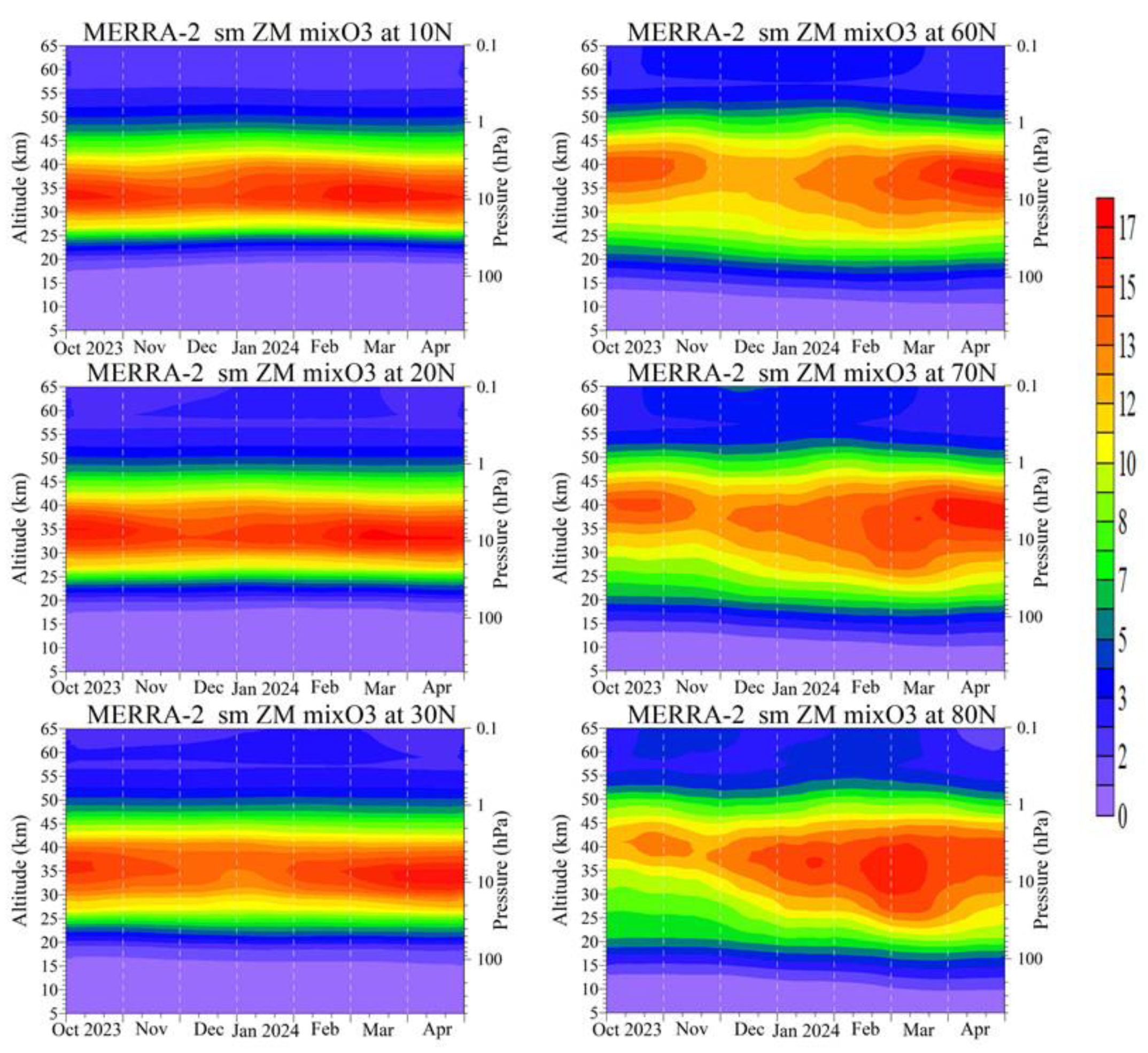
Figure 2.
(a) Latitude–time cross-sections of the MERRA-2 smoothed zonal-mean ozone mass mixing ratio (in kg/kg) at several altitudes, arranged from top to bottom in ascending order. Each panel is labeled with its corresponding geopotential height level. The left column shows levels where ozone concentrations peak at high latitudes, while the right column displays levels where ozone reaches its largest values in the tropics; (b) Latitude-time cross-sections of the MERRA-2 total column ozone (TCO, in DU).
Figure 2.
(a) Latitude–time cross-sections of the MERRA-2 smoothed zonal-mean ozone mass mixing ratio (in kg/kg) at several altitudes, arranged from top to bottom in ascending order. Each panel is labeled with its corresponding geopotential height level. The left column shows levels where ozone concentrations peak at high latitudes, while the right column displays levels where ozone reaches its largest values in the tropics; (b) Latitude-time cross-sections of the MERRA-2 total column ozone (TCO, in DU).
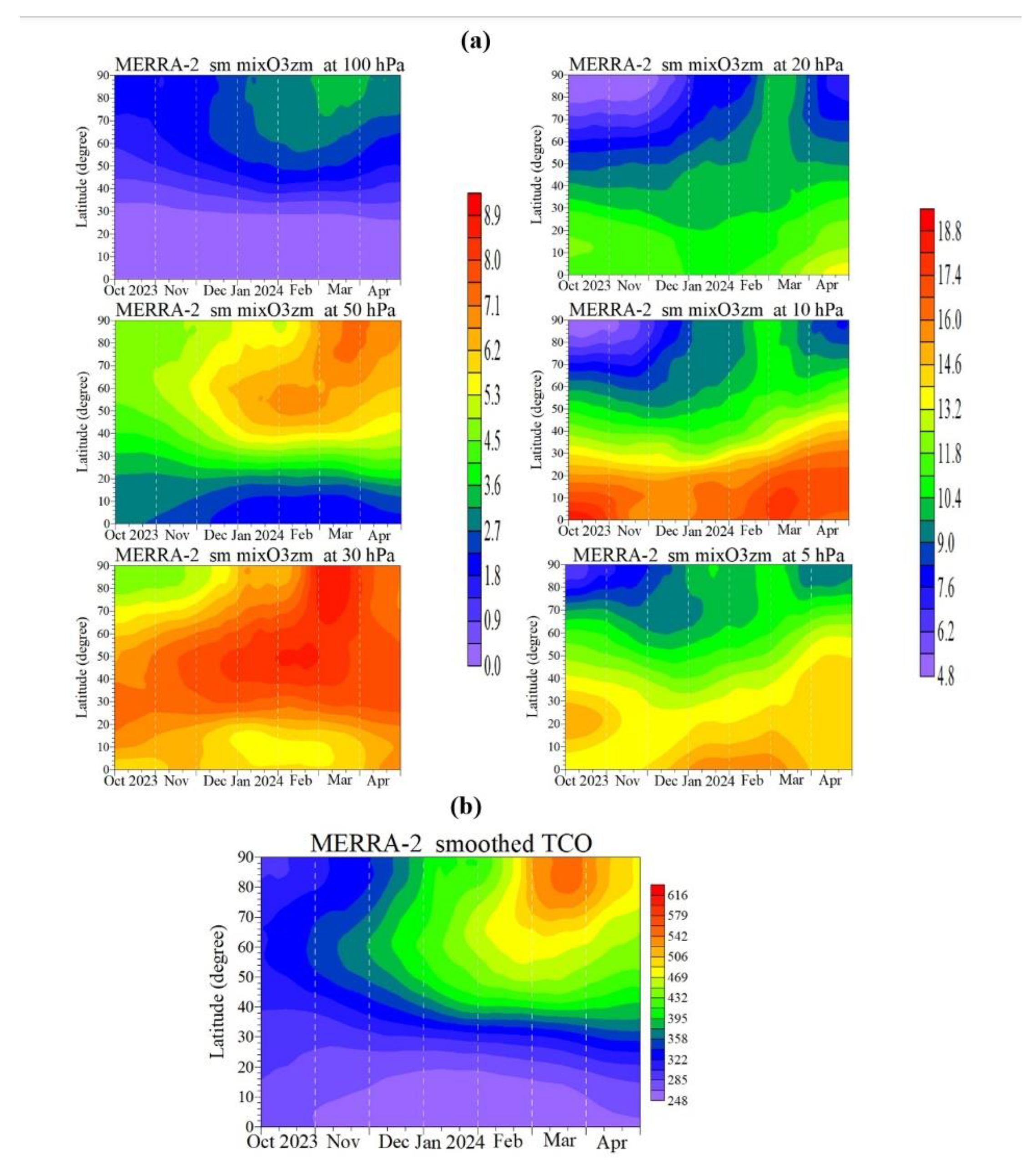
Figure 3.
Polar maps of the monthly mean mass mixO3 (in 10-6 kg/kg) at geopotential level 30 hPa (left column of plots, ~25 km height) and 3 hPa (right column of plots, ~41 km height) for months from December 2023 to March 2024 arranged from upper most pair of plots to bottom one.
Figure 3.
Polar maps of the monthly mean mass mixO3 (in 10-6 kg/kg) at geopotential level 30 hPa (left column of plots, ~25 km height) and 3 hPa (right column of plots, ~41 km height) for months from December 2023 to March 2024 arranged from upper most pair of plots to bottom one.
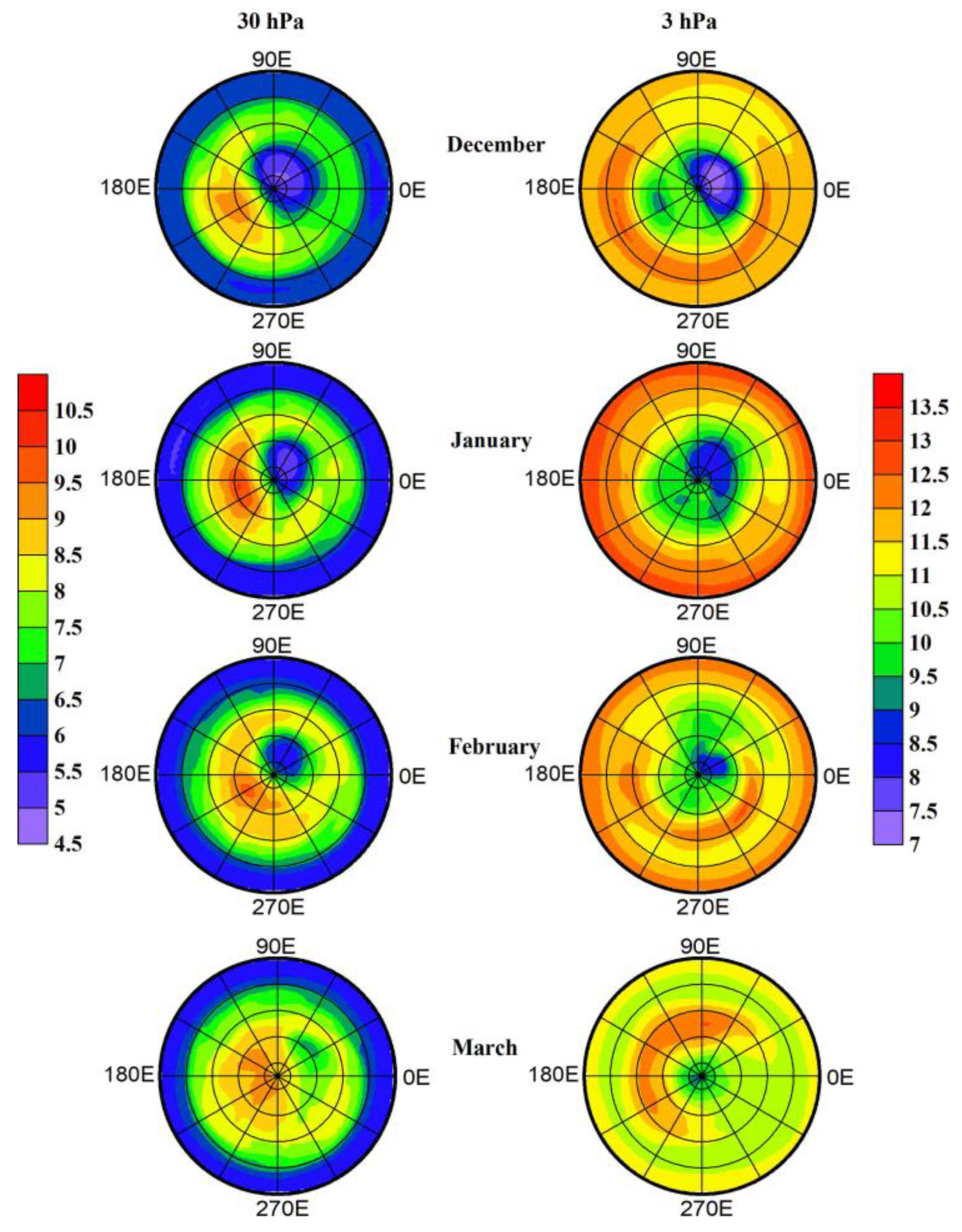
Figure 4.
Altitude–time cross-sections of the combined EPFD and GWD forcing (m s⁻¹ day⁻¹) at selected extratropical latitudes. The latitude corresponding to each panel is indicated at the top.
Figure 4.
Altitude–time cross-sections of the combined EPFD and GWD forcing (m s⁻¹ day⁻¹) at selected extratropical latitudes. The latitude corresponding to each panel is indicated at the top.
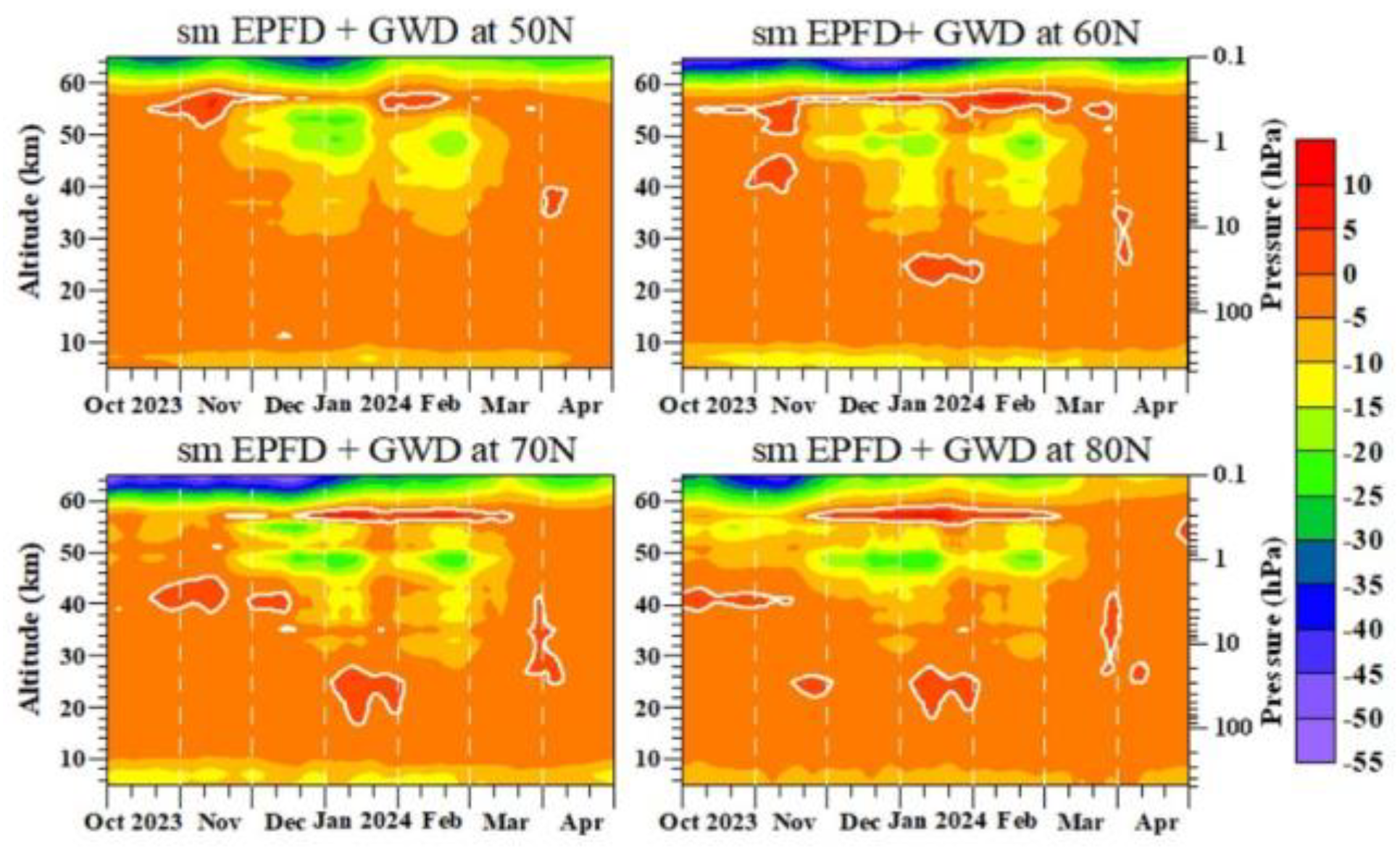
Figure 5.
Altitude–latitude distribution of the MERRA-2 monthly-mean RMC (m s⁻¹) for months characterized by strong wave-driven forcing based on EPFD and GWD, i.e., December 2023 through March 2024. Vectors show the vertical velocity multiplied by a factor of 100.
Figure 5.
Altitude–latitude distribution of the MERRA-2 monthly-mean RMC (m s⁻¹) for months characterized by strong wave-driven forcing based on EPFD and GWD, i.e., December 2023 through March 2024. Vectors show the vertical velocity multiplied by a factor of 100.
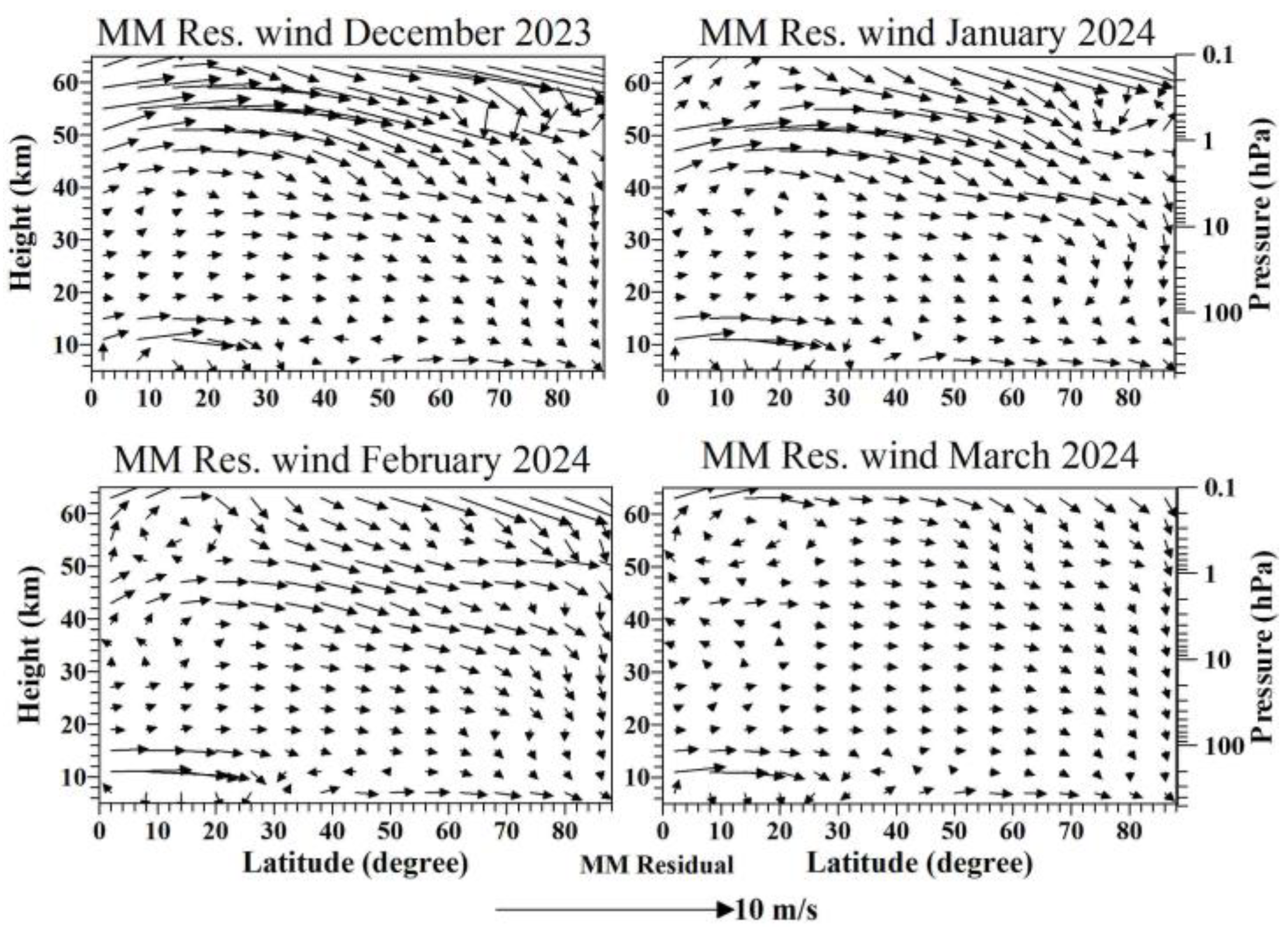
Figure 6.
(a) Altitude–time distribution of the MERRA-2 smoothed zonal-mean mass-mixing-ratio tendency of O₃ (10⁻⁶ day⁻¹) at 70° N for the period October 2023–April 2024. (b) Altitude–latitude distribution of the monthly-mean zonal-mean mass-mixing-ratio tendency of O₃ for December 2023 through March 2024. The white thick line marks the zero line.
Figure 6.
(a) Altitude–time distribution of the MERRA-2 smoothed zonal-mean mass-mixing-ratio tendency of O₃ (10⁻⁶ day⁻¹) at 70° N for the period October 2023–April 2024. (b) Altitude–latitude distribution of the monthly-mean zonal-mean mass-mixing-ratio tendency of O₃ for December 2023 through March 2024. The white thick line marks the zero line.
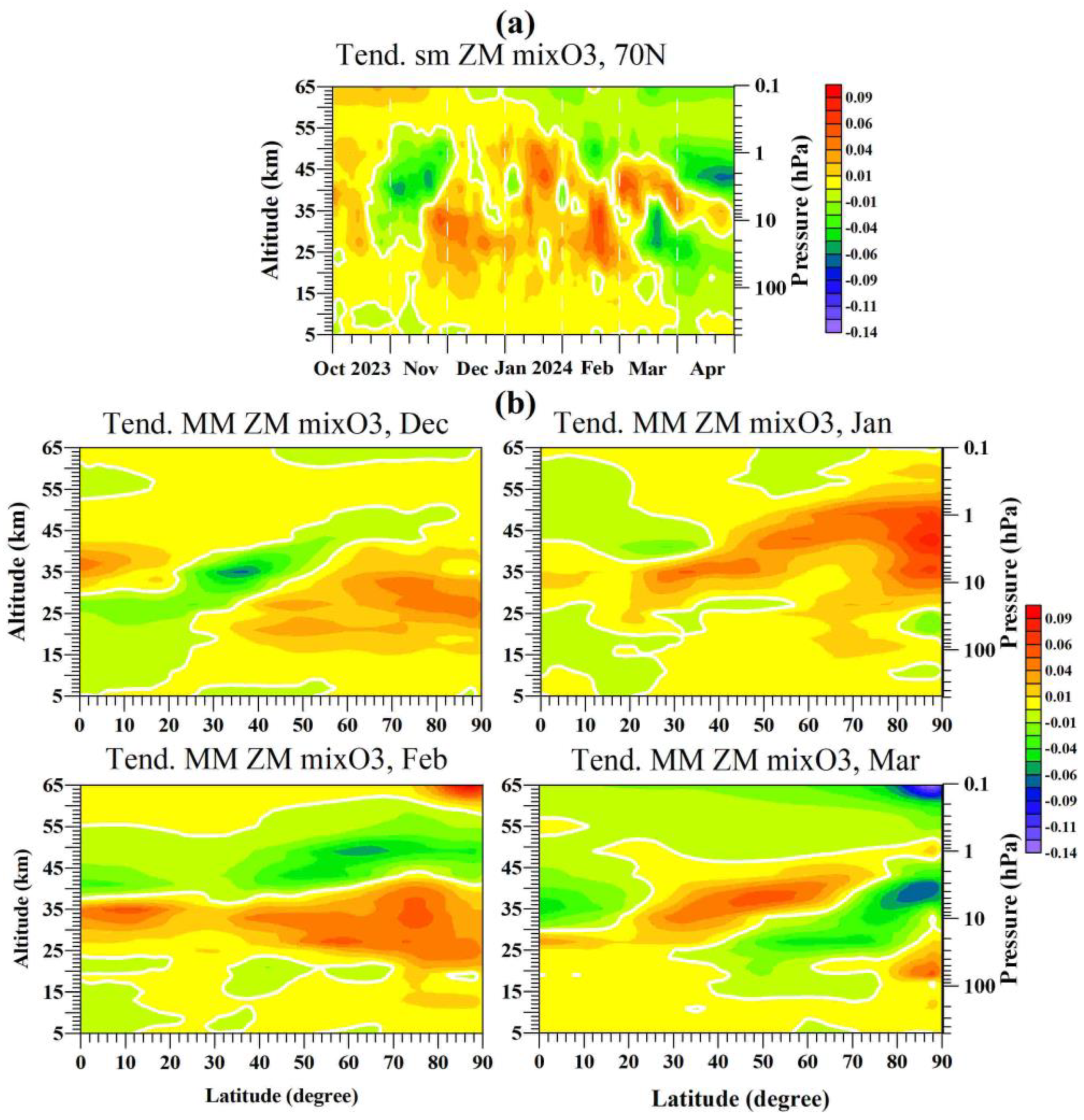
Figure 7.
Altitude–time structure of the daily zonal-mean O₃ mass-mixing ratio (10⁻⁶ kg kg⁻¹) at extratropical latitudes from 50° N (upper-left panel) to 80° N (lower-right panel) for the period 1 February–31 March 2024, during which two strong SSW events occurred.
Figure 7.
Altitude–time structure of the daily zonal-mean O₃ mass-mixing ratio (10⁻⁶ kg kg⁻¹) at extratropical latitudes from 50° N (upper-left panel) to 80° N (lower-right panel) for the period 1 February–31 March 2024, during which two strong SSW events occurred.
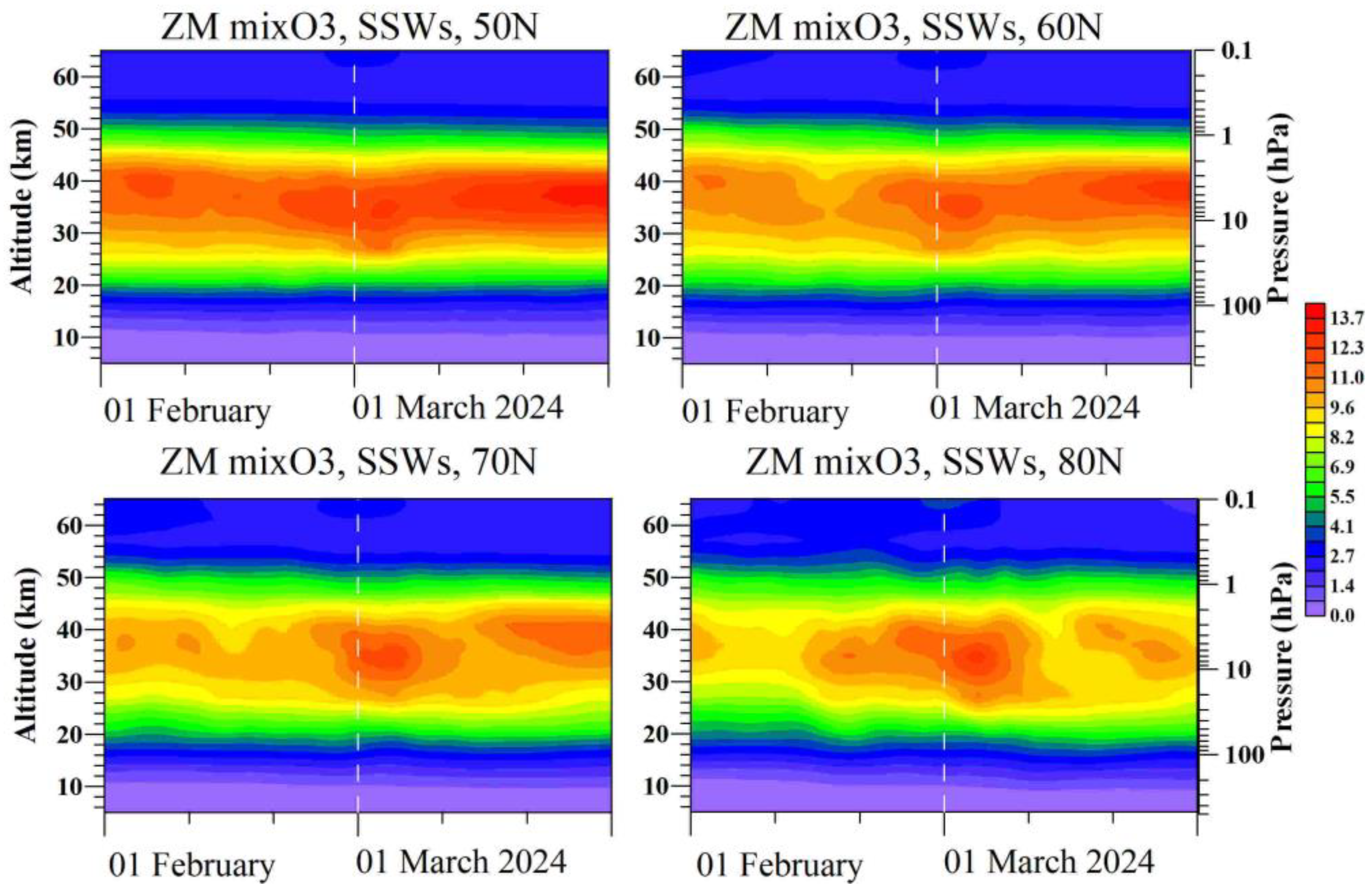
Figure 8.
Latitude–time structure of the zonal-mean O₃ mass-mixing ratio (10⁻⁶ kg kg⁻¹) at different geopotential levels, indicated at the top of each panel, for the period 1 February–31 March 2024, during which two strong SSW events occurred.
Figure 8.
Latitude–time structure of the zonal-mean O₃ mass-mixing ratio (10⁻⁶ kg kg⁻¹) at different geopotential levels, indicated at the top of each panel, for the period 1 February–31 March 2024, during which two strong SSW events occurred.
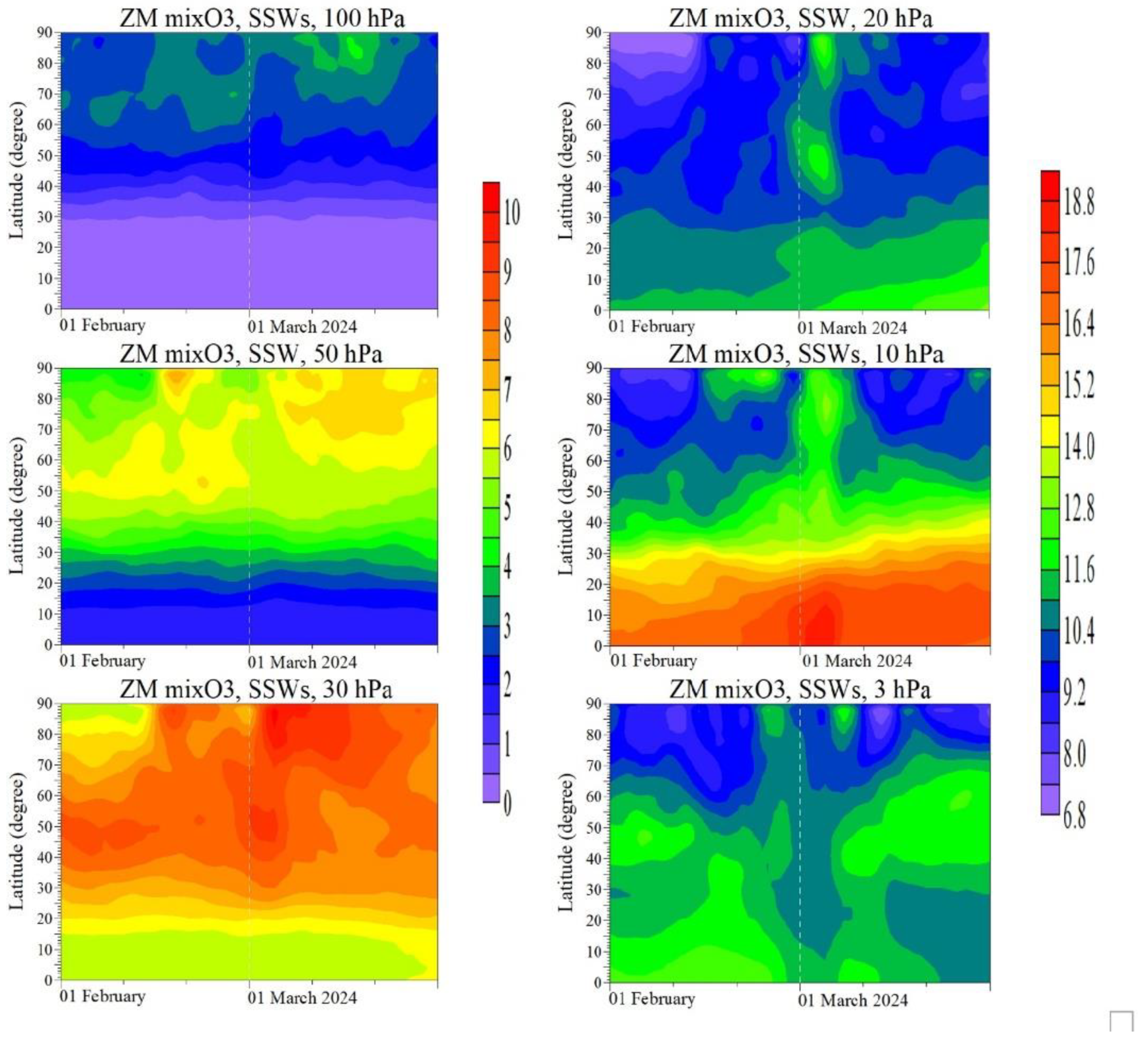
Figure 9.
Polar maps of the O₃ mass-mixing ratio (10⁻⁶ kg kg⁻¹) at the geopotential levels 30 hPa (left column, ~25 km), 3 hPa (middle column, ~41 km), and the TCO (right column, in DU) for 19 February 2024 (top row), 3 March 2024 (middle row), and 15 March 2024 (bottom row).
Figure 9.
Polar maps of the O₃ mass-mixing ratio (10⁻⁶ kg kg⁻¹) at the geopotential levels 30 hPa (left column, ~25 km), 3 hPa (middle column, ~41 km), and the TCO (right column, in DU) for 19 February 2024 (top row), 3 March 2024 (middle row), and 15 March 2024 (bottom row).
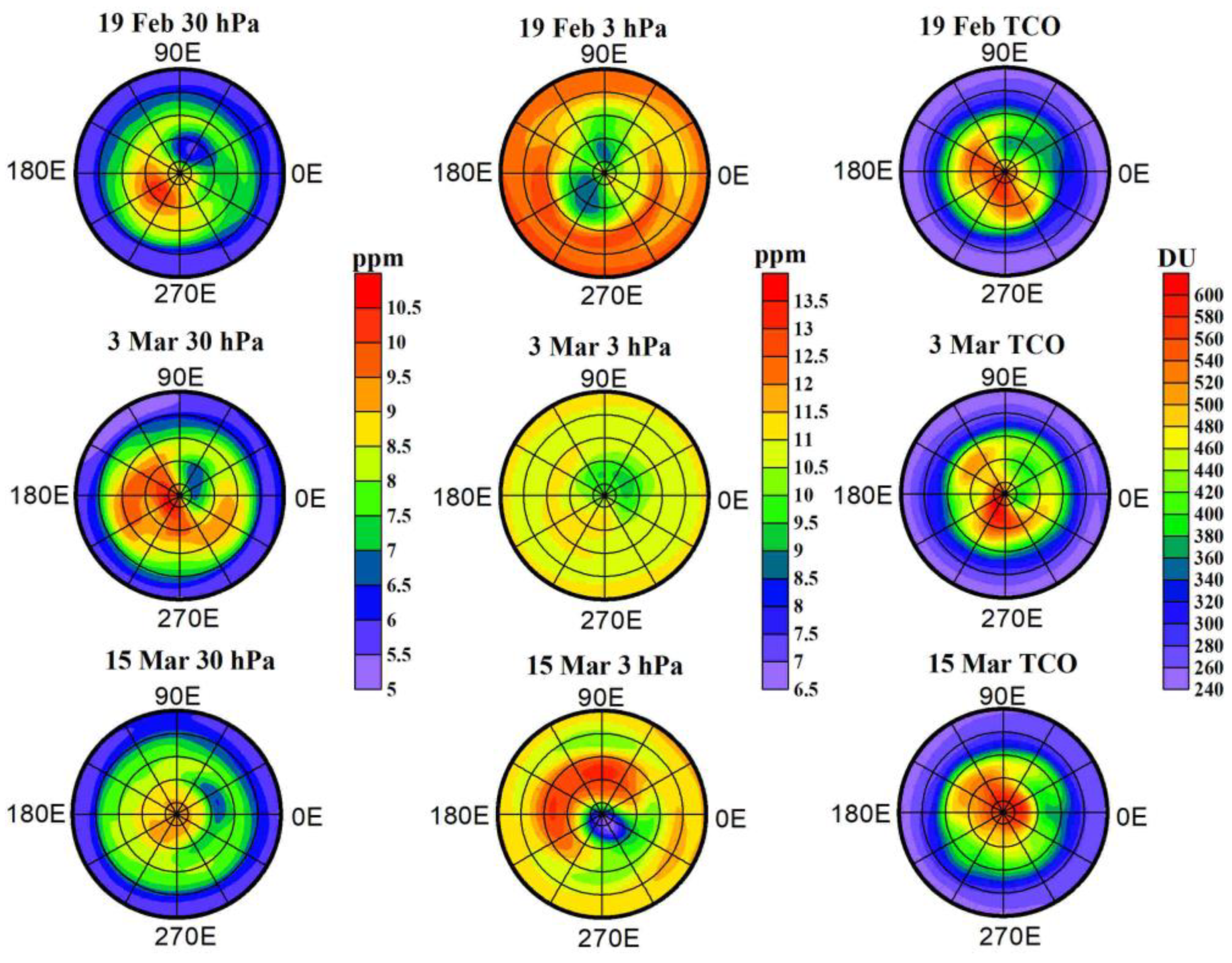
Figure 10.
Altitude–time structure of the smoothed zonal-mean O₃ mass-mixing-ratio tendency (10⁻⁶ day⁻¹) at latitude 80°N during the period Octo2023-Apr 2024 and obtained from: (a) the MERRA-2 ozone data tendency (left panel) and the difference between the data-derived and dynamically driven tendencies, representing an approximate chemical production-minus-loss term (right panel); (b) the sum of horizontal and vertical advection by the RMC (top-left panel), horizontal advection only (top-middle), vertical advection only (top-right), the sum of horizontal and vertical eddy-transport effects (bottom-left), horizontal eddy transport only (bottom-middle), and vertical eddy transport only (bottom-right). The pastel blue thick line marks the zero contour.
Figure 10.
Altitude–time structure of the smoothed zonal-mean O₃ mass-mixing-ratio tendency (10⁻⁶ day⁻¹) at latitude 80°N during the period Octo2023-Apr 2024 and obtained from: (a) the MERRA-2 ozone data tendency (left panel) and the difference between the data-derived and dynamically driven tendencies, representing an approximate chemical production-minus-loss term (right panel); (b) the sum of horizontal and vertical advection by the RMC (top-left panel), horizontal advection only (top-middle), vertical advection only (top-right), the sum of horizontal and vertical eddy-transport effects (bottom-left), horizontal eddy transport only (bottom-middle), and vertical eddy transport only (bottom-right). The pastel blue thick line marks the zero contour.
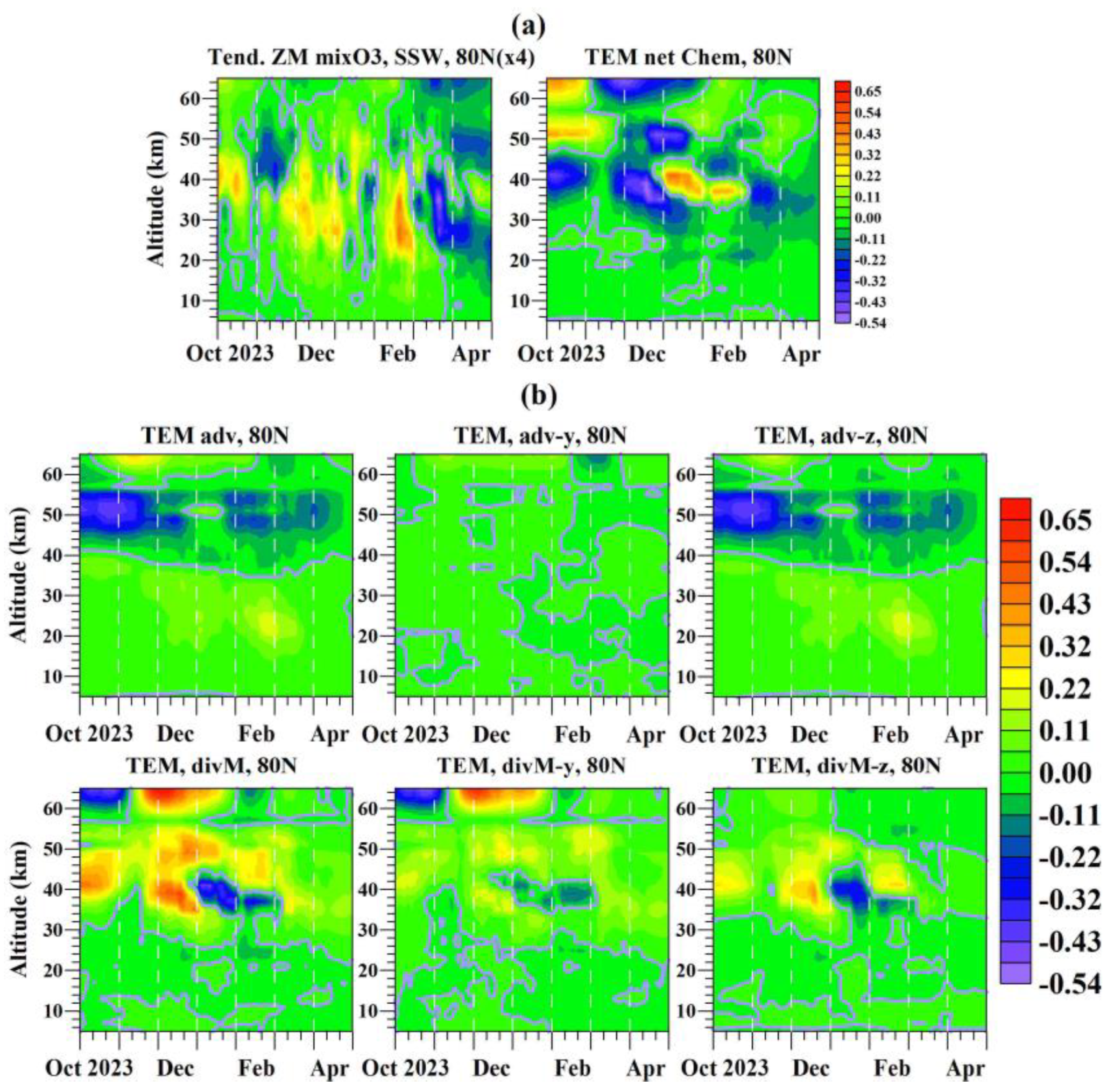
Figure 11.
Altitude–time (left column) and latitude-time (right column) structures of the daily zonal-mean O₃ mass-mixing-ratio tendency (10⁻⁶ day⁻¹) at high latitudes 80° N (top-left panel) and 60° N (bottom-left panel) as well as at geopotential levels 40 hPa (top-left panel, ~23 km) and 100 hPa (bottom-right panel, ~16 km) during 1 February–31 March 2024, when two strong SSW events occurred. The pastel blue thick line marks the zero contour.
Figure 11.
Altitude–time (left column) and latitude-time (right column) structures of the daily zonal-mean O₃ mass-mixing-ratio tendency (10⁻⁶ day⁻¹) at high latitudes 80° N (top-left panel) and 60° N (bottom-left panel) as well as at geopotential levels 40 hPa (top-left panel, ~23 km) and 100 hPa (bottom-right panel, ~16 km) during 1 February–31 March 2024, when two strong SSW events occurred. The pastel blue thick line marks the zero contour.
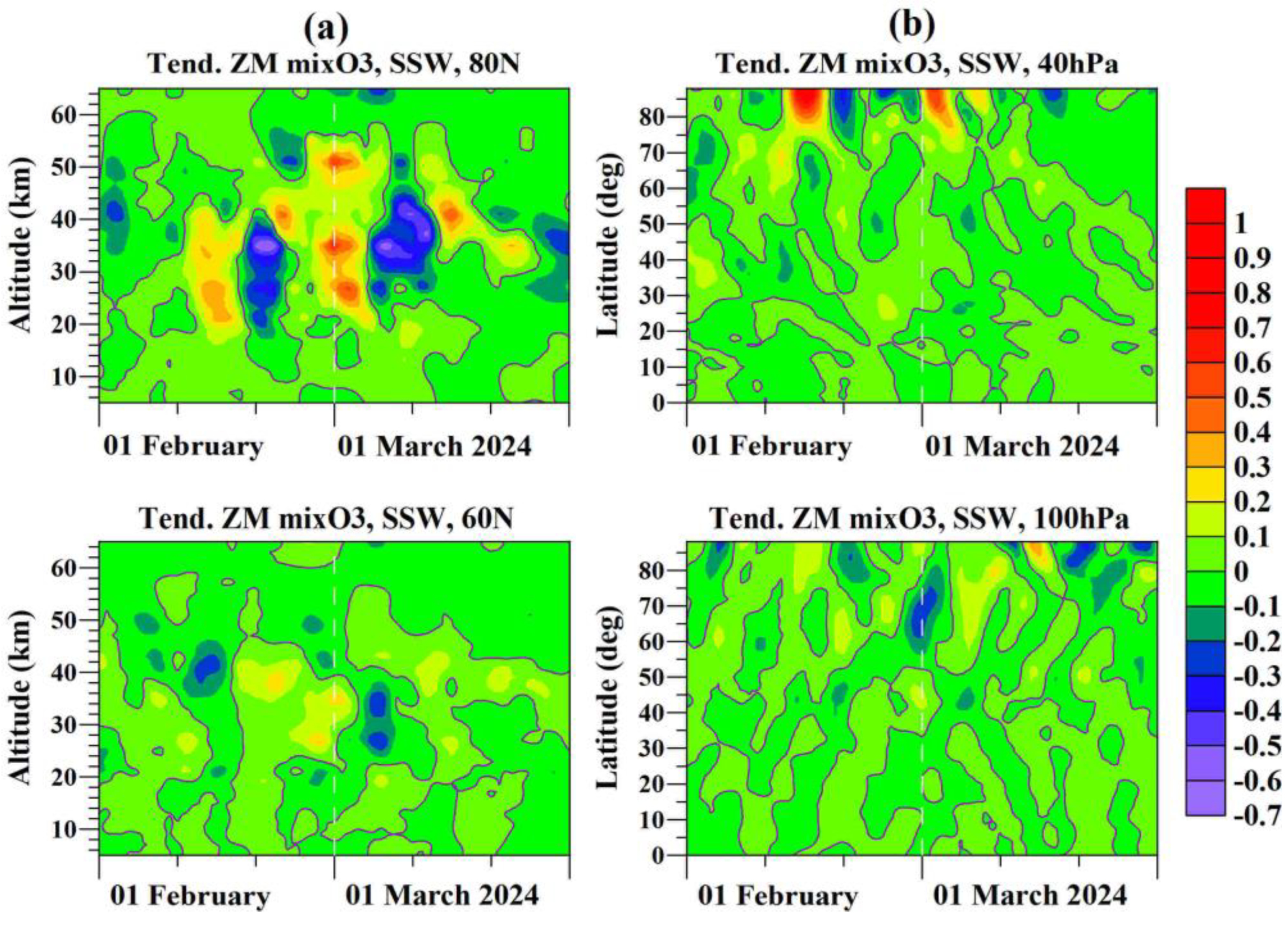
Figure 12.
Altitude–time structure of the daily zonal-mean O₃ mass-mixing-ratio tendency (10⁻⁶ day⁻¹) at latitude 80°N during the period February-March 2024 and obtained from: (a) the MERRA-2 ozone data tendency (left panel), the dynamical term of the TEM continuity equation (3), representing the dynamically driven tendency (middle panel), and the difference between the data-derived and dynamically driven tendencies, representing an approximate chemical production-minus-loss term (right panel); (b) the sum of horizontal and vertical advection by the RMC (top-left panel), horizontal advection only (top-middle), vertical advection only (top-right), the sum of horizontal and vertical eddy-transport effects (bottom-left), horizontal eddy transport only (bottom-middle), and vertical eddy transport only (bottom-right). The pastel blue thick line marks the zero contour.
Figure 12.
Altitude–time structure of the daily zonal-mean O₃ mass-mixing-ratio tendency (10⁻⁶ day⁻¹) at latitude 80°N during the period February-March 2024 and obtained from: (a) the MERRA-2 ozone data tendency (left panel), the dynamical term of the TEM continuity equation (3), representing the dynamically driven tendency (middle panel), and the difference between the data-derived and dynamically driven tendencies, representing an approximate chemical production-minus-loss term (right panel); (b) the sum of horizontal and vertical advection by the RMC (top-left panel), horizontal advection only (top-middle), vertical advection only (top-right), the sum of horizontal and vertical eddy-transport effects (bottom-left), horizontal eddy transport only (bottom-middle), and vertical eddy transport only (bottom-right). The pastel blue thick line marks the zero contour.
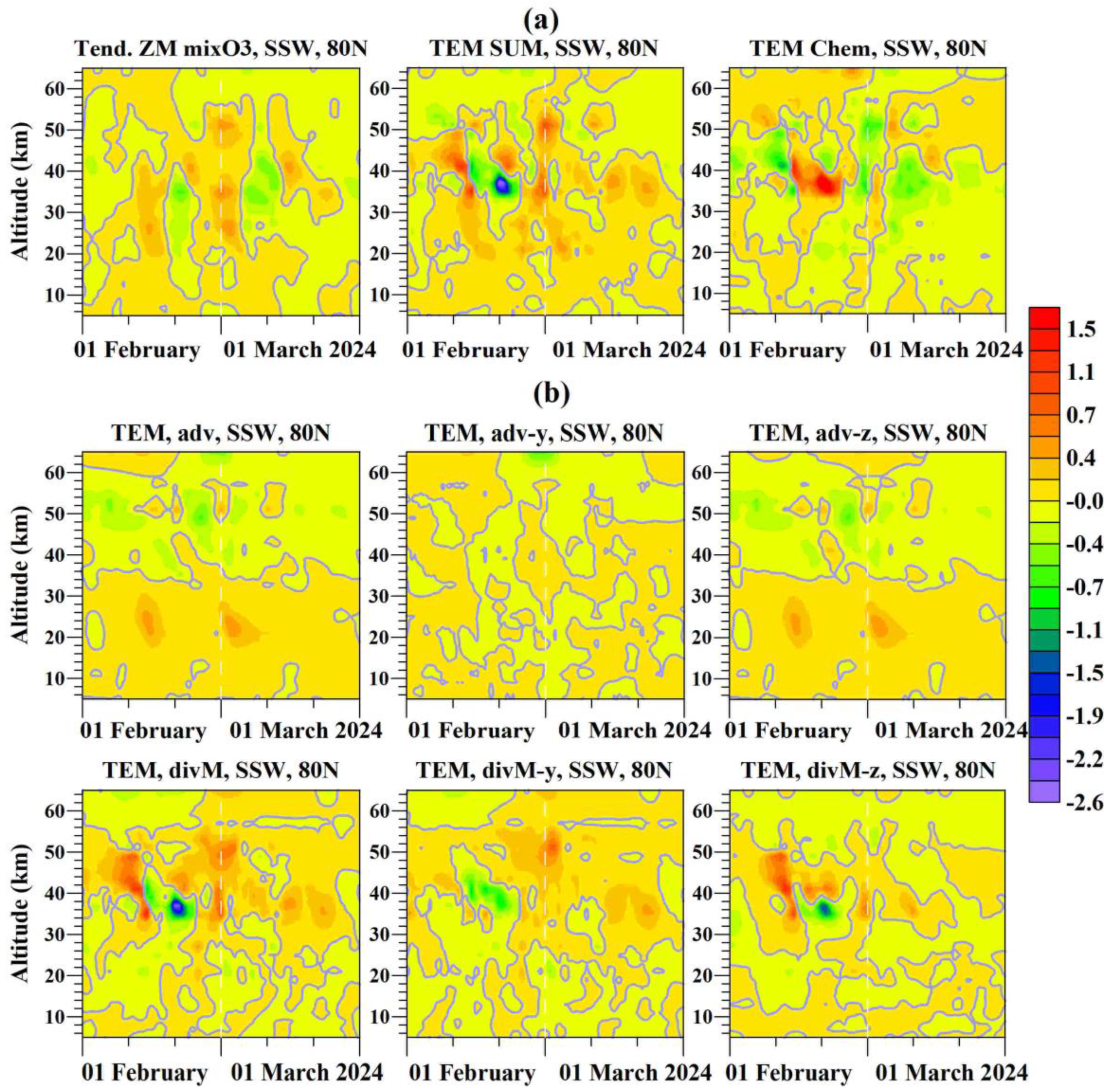
Figure 13.
The same as Figure 12, except showing the latitude–time structure of the daily zonal-mean O₃ mass-mixing-ratio tendency (10⁻⁶ day⁻¹) at the geopotential level of 50 hPa (~21 km).
Figure 13.
The same as Figure 12, except showing the latitude–time structure of the daily zonal-mean O₃ mass-mixing-ratio tendency (10⁻⁶ day⁻¹) at the geopotential level of 50 hPa (~21 km).
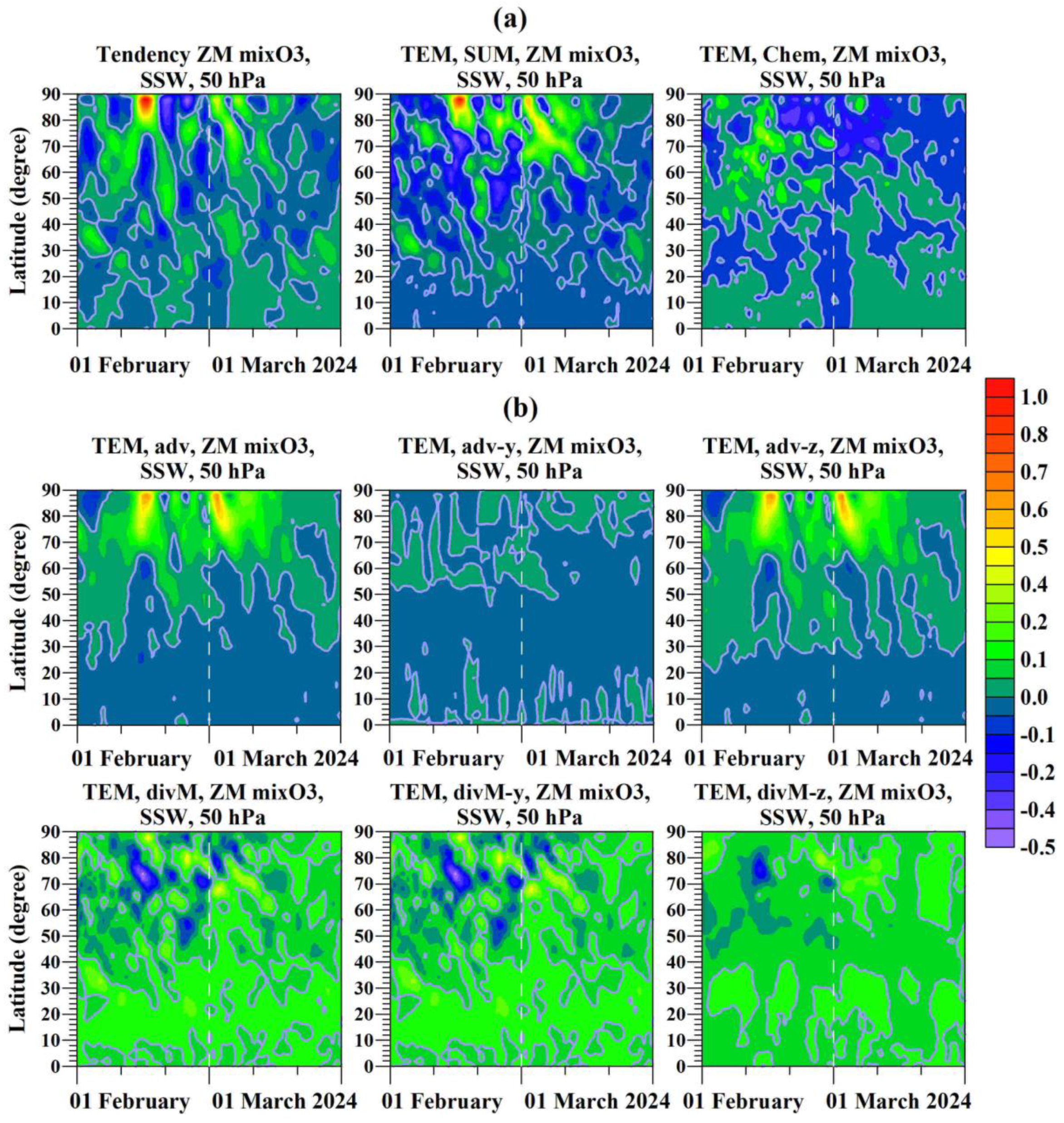
Figure 14.
(a) Latitude–time structure of the total column ozone (TCO, in DU; top panel) and the zonal-mean temperature at 50 hPa (~21 km; bottom panel); (b) TCO tendency (in DU day⁻¹). All plots cover the period 1 February–31 March 2024, when two strong SSW events occurred.
Figure 14.
(a) Latitude–time structure of the total column ozone (TCO, in DU; top panel) and the zonal-mean temperature at 50 hPa (~21 km; bottom panel); (b) TCO tendency (in DU day⁻¹). All plots cover the period 1 February–31 March 2024, when two strong SSW events occurred.
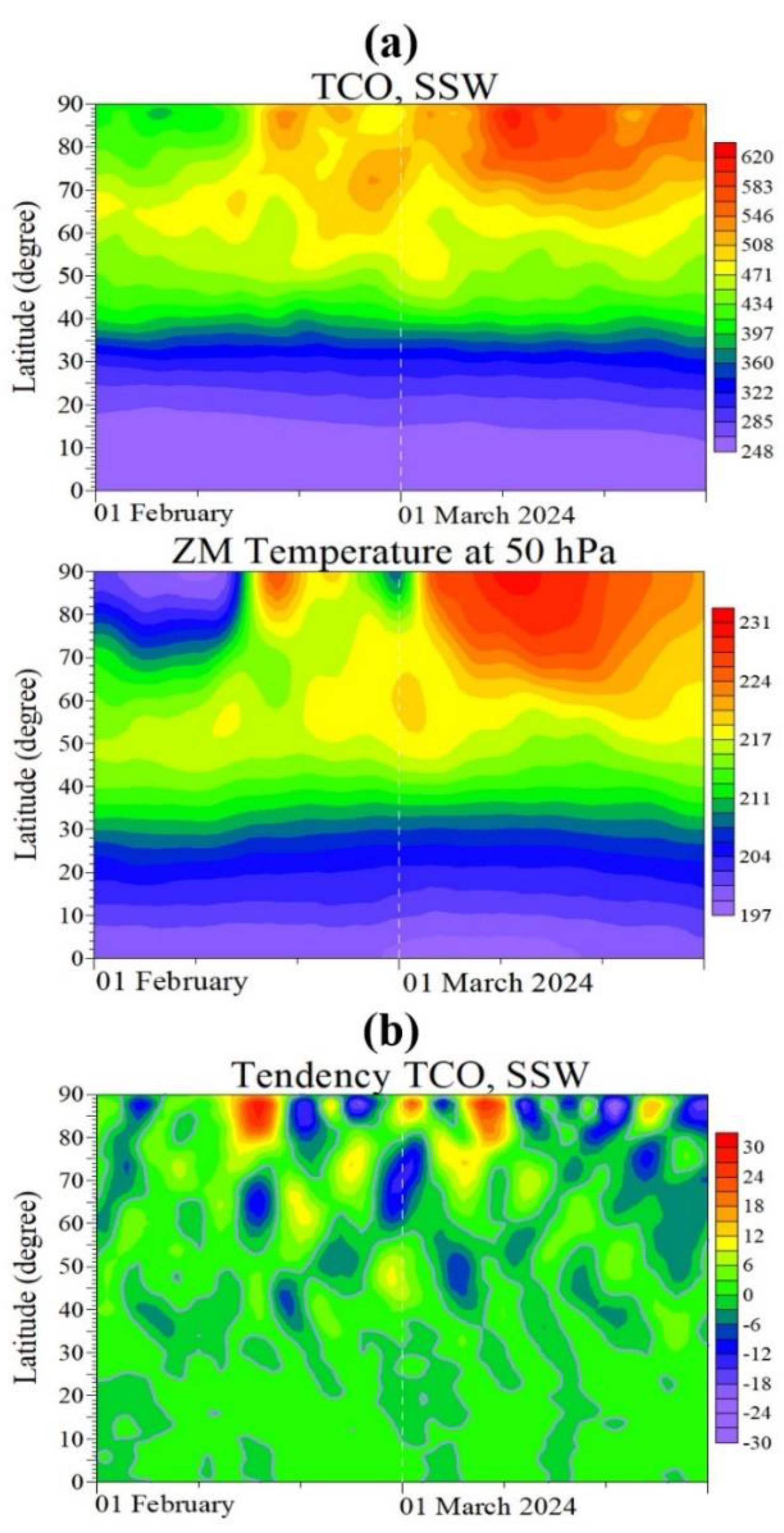
Disclaimer/Publisher’s Note: The statements, opinions and data contained in all publications are solely those of the individual author(s) and contributor(s) and not of MDPI and/or the editor(s). MDPI and/or the editor(s) disclaim responsibility for any injury to people or property resulting from any ideas, methods, instructions or products referred to in the content. |
© 2026 by the authors. Licensee MDPI, Basel, Switzerland. This article is an open access article distributed under the terms and conditions of the Creative Commons Attribution (CC BY) license (http://creativecommons.org/licenses/by/4.0/).
Copyright: This open access article is published under a Creative Commons CC BY 4.0 license, which permit the free download, distribution, and reuse, provided that the author and preprint are cited in any reuse.


