Submitted:
05 March 2026
Posted:
06 March 2026
You are already at the latest version
Abstract
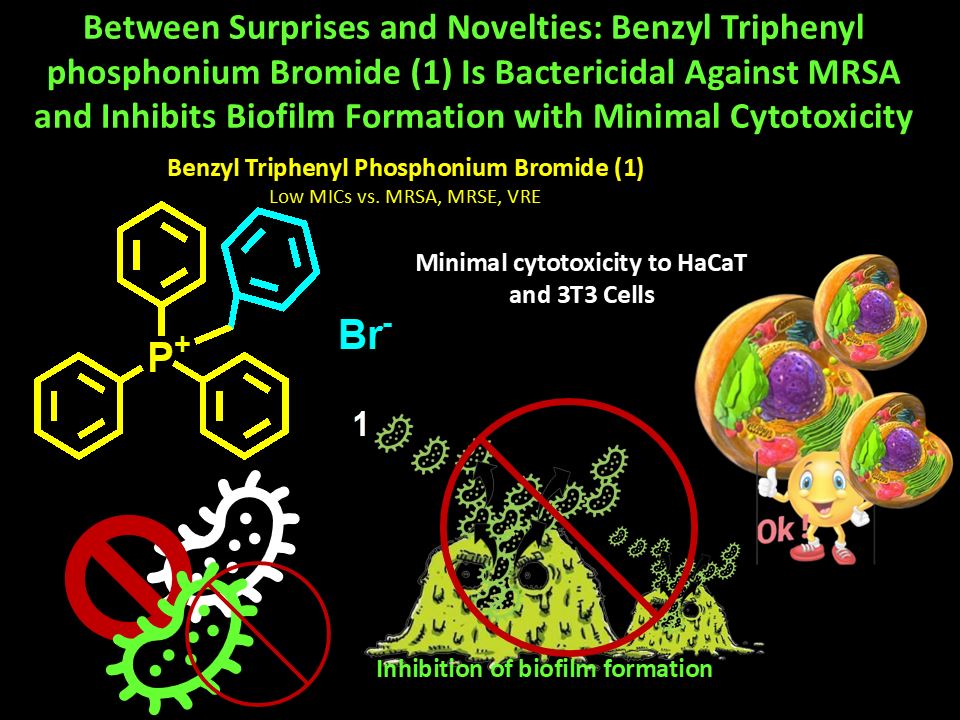
Background. Quaternary phosphonium salts (QPSs) are extensively researched since represent new promising weapons to counteract critical superbugs, regardless their robust pattern of resistance. Methods. Here, dynamic light scattering analysis was carried out on QPSs 1, 3 and 4 recently reported and already found active against cancer cells, and phosphine 2 unveiling particles of 700-800 nm for 2, 3 and 4 and positive Zeta-potential (ζ-p ) for all (+4.2-+38.1 mV). 1, 3 and 4 plus 2, were microbiologically evaluated, assessing minimum inhibitory concentration values (MICs) (1-4), time-killing curves (1), and anti-biofilm capacity (1). Results. MICs on a total of 23 Gram-positive and Gram-negative clinically isolated superbugs, evidenced that, poorly soluble 2, 3 and 4 exhibited not reproducible MICs, while 1 provided interesting MICs, which made it worthy of further investigations. In fact, 1 was active against clinically relevant multidrug-resistant (MDR) Gram-positive species and not active against MDR Gram-negative species including Pseudomonas aeruginosa. Specifically, MICs = 16-32 µg/mL and 16-64 µg/mL were determined against methicillin-resistant Staphylococcus aureus (MRSA) and S. epidermidis (MRSE) respectively. MICs = 32-64 µg/mL were observed against teicoplanin- and vancomycin-resistant (VRE) Enterococcus faecalis and E. faecium and no activity against P. aeruginosa (> 128 µg/mL). Notably, time-kill experiments established that 1 was bactericidal against MRSA, while strongly inhibited (up to 100%) the formation of biofilm produced by the strongest biofilm-producers S. epidermidis and S. aureus isolates of our collection, at MICs and 2.5 × MIC concentrations, depending on isolates considered. Interestingly, if used against Staphylococci, and mainly MRSA, 1 was softly haemolytic. It was no cytotoxic against not tumorigenic human keratinocytes (HaCaT) and murine embryonic fibroblasts (3T3) in all cases. Structure-activity relationships have been studied, leading to outcomes which could be of great help for designing optimized new QPSs. Conclusions. Findings of this study overturn previous antimicrobial reports on compound 1, suggesting it as a new excellent weapon to counteract bacterial resistance and biofilm production by MRSA and MRSE superbugs, as well as thinkable for future in vivo experiments and clinical development.