
Submitted:
05 March 2026
Posted:
06 March 2026
You are already at the latest version
Abstract
Automobiles have been the pivotal instrument shaping the cities' structures and urban lives. While promising numerous benefits, the successful introduction of self-driving cars depends not only on their technical completeness, but mostly on the market acceptance for these disruptive transformations. To gauge the market response, we first summarize the most recent 15 research applying technical acceptance model (TAM) to compare their objectives, findings, and applied constructs around the countries. Then we examine to identify some influential factors whether or not the public use these self-driving machines, using 519 Korean samples. We use three groups as the system characteristics, social influence, and individual differences to do the quantitative survey and the structure equation model (SEM). The findings show that technical completeness, law and regulations, media support, perceived cost, trial and experience influence significantly on perceived usefulness and again on the usage intention while perceived safety do not significantly influence perceived usefulness. The results of this study help to strengthen existing knowledge about the self-driving cars by emphasizing the key elements that drive the intention to use the self-driving cars in the future.
Keywords:
self-driving cars
; technology acceptance model (TAM)
; system characteristics
; social influence
; individual differences
; usage intention
1. Introduction
Automobiles have been the centerpiece instruments in shaping the cities’ structures and urban lives. The size, design, or function of a city has been largely determined by its transportation capabilities. As the door-to-door connected capabilities, automobiles have been the most convenient transportation methods over subways, buses, or trains, for examples. To make these urban lives more useful, numerous social and legal infrastructures such as highways, bridges, gas stations, traffic laws and regulations or license bureaus, are prerequisites for every modern city worldwide. At the near completion of full self-driving technologies, we now face the bigger transformation of automobile industries, from gasoline engine to motor based, and from human to machine driving.
These transformations of automobile industries create enormous disruption and changes in our city structures and potentials. World automakers such as Tesla, General Motors, and BYD are eager to know these market shifts to self-driving technologies. Policy makers are further keen interested to see what factors are influential at accepting these self-driving technologies [1,2,3,4]. Over the past few years, demonstration of self-driving technologies has been tested vigorously in several countries, including the United States and China [5,6,7,8]. At this juncture, we yet need more market reaction data from various countries, on these disruptive transformations of the automobile industries, and the resulting future city infrastructure.
Self-driving cars may provide numerous benefits, for example, to enjoy complete freedom from driving responsibility, sleeping, watching TV, or writing a report [9]. Unlike human driving vehicles, autonomous driving technologies can minimize the driving stress and enhance individuals’ leisure time [10,11,12]. At the level of society, self-driving cars have the potential to revolutionize mobility speed by reducing vehicle collisions, often caused by human errors and misjudgments [13,14,15,16]. Besides that, the adoption of self-driving cars can enhance, optimize, and reshape the usage of land, i.e., parking lots, the cross section redesign to speed up traffic stream [11,14,17,18,19].
While promising numerous benefits, the successful introduction of self-driving cars depends not only on their technical completeness, but mostly on the market acceptance for these disruptive transformations. It is mainly on the psychological barrier to use these robot cars [14,15,20]. Compared to the current human driving vehicles, self-driving cars pass total control of the vehicle to the machine [12,19,21,22,23].
Several obstacles such as social ethics and moral dilemmas [2,15,20], high transition costs to self-driving vehicles [24,25], privacy concerns for cyberattacks [26,27,28], etc, have relevantly weakened the public acceptance of self-driving cars. For example, in Australia, the concerns of self-driving cars are focusing on cyberattack issues [29]. Therefore, in order to accelerate the full transition towards autonomous mobile society, it is urgent to see how the public perceive the inroad of self-driving cars and their intention to adopt these unmanned vehicles into their daily lives [14,30,31,32].
The purposes of this study are thus two-folds. The first is to give the most recent summary of the technology acceptance model (TAM) based research around the countries. The TAM has proven to be a reliable and robust theoretical framework widely tested in numerous settings such as Internet, smartphones, and telecommunications [1,16,33]. By doing so, we would like to identify some key factors recognized by automobile researchers in many countries including the United State, China, Malaysia, etc. Utilizing the prior research’s findings of influential factors, the second is to examine what factors are significantly perceived by Korean society. The Korean market, some affluent 25 million congested in Seoul, Incheon, and the surrounding Gyeonggi province, is the perfect testbed for the consumers’ behaviors and attitudes. The contribution of this paper is, it is hoped, to give a slice but important understanding of the feature space to the consumers, automakers, and police makers in the upcoming future.
2. Theoretical Basis
2.1. Driverless Technology
Self-driving cars, also known as autonomous vehicles (AVs), driverless, unmanned, automated vehicles, or Internet of Vehicles (IOV), are the robotic vehicles equipped with on advanced sensors such as cameras, radars, GPS, and LiDar to detect moving objects and their surrounding environment. The control systems of self-driving cars, then with help of artificial intelligence (AI) software technologies, make real-time decisions for destinations [12,17,34,35,36,37,38]. These sensor – control system – execution AI-software technologies are able to overcome human limitations [39,40]. Based on the level of autonomy, SAE defines the six auto levels of driving automation, from Level 0 (no automation), to Level 5 (full automation), presented in Table 1 [41].
With the advanced development of artificial intelligence (AI) and deep learning, autonomous driving technologies are expected to take over, disrupt, and disentitled the current transportation industry as well as our modern city lives in the coming decade [31,34,37].
Moreover, self-driving cars are designed with the promising benefits of improving road safety and traffic congestion [13,24,43]. An approximately 1.19 million traffic fatalities happened in 2021 with an estimated 69% of the fatalities are aged between 18 to 59, and 23% of them are individuals aged 60 and above [44]. Beyond the traffic fatalities, between 20 to 50 million people suffer from lasting disabilities due to non-fatalities traffic accidents [35]. Therefore, AI-powered robotic cars are the solution to the road collisions and traffic fatalities caused by human errors and misjudgments [17,39,40]. Unlike robots, human drivers’ performance tends to get affected by fatigue, distraction, stress as well as aging [14]. However, self-driving cars that are powered by artificial intelligence technologies are able to drive flexibility and continuously by themselves without feeling tired, stressed or getting distracted [36]. This indicates that driving tasks are able to be done efficiently, in consequence, road safety can be improved and cost due to the road collisions can be reduced significantly [32,45].
Apart from that, self-driving cars are developed to transform mobility by enhancing travel opportunities to the minors, elderly, and individuals that are restricted to drive by law due to physical or mental disabilities [3,9,14,22,30,36,43]. The driverless technologies are expected to overcome the limitation possessed by the conventional vehicles, consequently, the traffic participation of the underserved population can be secured [14]. Therefore, social equality as well as society lifestyle can be enhanced with the adoption of self-driving cars [39].
Furthermore, autonomous cars are designed to transform the global transportation landscape as well as the ecosystem [2,18]. Self-driving cars are expected to consume less parking spaces as they are able to drive themselves to the nearest parking lot after dropping off passengers [14]. In turn, less parking facilities are needed compared to the traditional conventional vehicles and more lands can be utilized to create green spaces [11]. Additionally, self-driving cars that are not reliant on fossil fuels are expected to decrease carbon emissions as well as environmental pollution [28,46,47]. Therefore, the widespread adoption of self-driving cars are viewed as the key mobility technologies in shaping smart cities and also to accelerate sustainability in the coming decades [48,49].
2.2. Overview of Prior Research on Self-Driving Cars
Several studies have addressed the adoption of self-driving cars and the benefits of utilising robotic cars. Table 2 shows the recent summary of the 15 TAM-based prior research.
Early research highlights that the advancements in artificial intelligence (AI), advanced sensors, and machine learning have made autonomous driving possible [37,54]. Chan and Lee [26] examined factors influencing Malaysian users’ behavioral intention to use autonomous cars and mediating role of trust by including constructs such as perceived compatibility, social influence, personal innovativeness, trust, behavioral intention, and TAM. The findings indicate that compatibility and personal innovativeness shape the behavioral intention, while trust drives the adoption of self-driving cars. Chen et al. [29] examined Australians’ intention to use fully self-driving cars through extended TAM with data privacy and trust by including perceived trust, perceived data privacy, attitude, behavioral intention, and TAM. The findings show that the acceptance of fully automated vehicles in Australia is influenced by perceived usefulness, perceived ease of use, trust, and data privacy concerns.
Besides that, Choi and Ji [50] investigated factors that drive users to trust and adopt self-driving cars in Korea by including constructs such as trust, system transparency, technical competence, situation management, perceived risk, external locus of control, sensation seeking, behavioral intention, and TAM. The findings indicate that trust and perceived usefulness are important in adopting self-driving cars. Dirsehan and Can [45] examined users’ attitudes towards adopting robot cars by focusing on trust and sustainability concerns. This study included behavioral intention, trust, sustainability concerns, and TAM as the constructs. The findings show that individual adoption of self-driving cars is driven by perceived usefulness, perceived ease of use, trust, and sustainability concerns. He et al. [31] examined how consumers’ personality traits and perceptions influence the intention to adopt autonomous cars by including AV adoption intention, optimism, innovativeness, discomfort, insecurity, average value, and TAM. The findings show that personality traits and perceived usefulness of self-driving cars boost the adoption intention.
In addition, Ho et al. [51] explored the factors that affect Malaysian elderly’s acceptance of self-driving cars among elderly by including trust in institutions, trust in performance, perceived performance risk, perceived privacy risk, attitude acceptance, and TAM. The findings indicate that elderly acceptance of self-driving cars in Malaysia is driven by performance trust more than institutional trust or perceived risks. Iranmanesh et al. [25] explored and ranked the factors that influence attitudes and intentions to use self-driving cars in Vietnam by including constructs such as attitude, intention to use AVs, personal innovativeness, data privacy concern, lack of price sensitivity, and TAM. The findings show that TAM explains self-driving cars adoption with perceived ease of use as key factors, personal innovativeness weakens perceived ease of use, privacy concerns strengthen perceived usefulness, and price sensitivity shows no impact. Li et al. [52] examined psychological factors in contactless technology adoption in Singapore by combining health belief model, TAM, perceived susceptibility, self-efficacy, cues to action, and intention to use. The findings explain that health belief factors and technological characteristics drive the willingness to accept contactless technology.
Furthermore, Meyer-Waarden and Cloarec [28] examined how performance and effort expectancy, social recognition, hedonism, technology security, and privacy concerns shape trust, user well-being, and drive the intention to use self-driving cars in France. This study includes constructs such as TAM, UTAUT, intention to use, etc. The findings indicate that behavioral intentions to use self-driving cars, performance expectancy, social recognition, well-being, hedonism, trust, and technology security boost the adoption of self-driving cars, while privacy concerns weaken trust. Nastjuk et al. [14] identified the acceptance of autonomous driving from end-user perception in Germany by combining TAM, attitude, compatibility, ecological awareness, desire to exert control, enjoyment, privacy concerns, price evaluation, personal innovativeness, relative advantage, subjective norm, trust, and usage intention. The findings show that social influence, system characteristics, and individual factors influence the acceptance of autonomous driving. Pang et al. [40] investigated factors shaping Malaysian acceptance of self-driving cars and the moderating role of socio demographic variables. This study includes attitude, subjective norm, perceived behavioral control, acceptance, TAM, and TPB as the constructs. The findings show that self-driving cars acceptance of Malaysian is driven by trust, perceived usefulness, perceived ease of use, and socio demographic that moderate these effects.
Moreover, Park et al. [21] identified the factors influencing consumers’ intention to use self-driving cars in Korea by including social influence, facilitating condition, intention to use, and TAM as the constructs. The findings indicate that social influence, facilitating conditions, and perceived usefulness are crucial for the adoption of autonomous cars. Rejali et al. [23] examined fully autonomous vehicle (FAV) acceptance in Iran by comparing TAM, TPB, and UTAUT framework. The findings show TPB best explained the acceptance of FAV, exceeding TAM and UTAUT. Xiao and Goulias [53] investigated the relationship between observed and latent construct in the acceptance of self-driving cars in the United States by including constructs such as intention to use AVs and TAM. The findings indicate that perceived usefulness is an important factor of behavioral intention. Yuen et al. [1] examined the factors affects user’s behavioral intention to use self-driving cars in China by including relative advantages, image, compatibility, result demonstrability, visibility, trialability, behavioral intention, innovation diffusion theory (IDT), and TAM as the constructs. The findings indicate that the adoption of self-driving cars is driven by IDT, TAM, perceived usefulness, perceived ease of use, relative advantage, and compatibility.
Table 2 shows the summary of constructs indicating that TAM theory has been widely applied to studies on self-driving cars across several countries. The purpose of our study is to apply TAM as a framework to analyze the intention to use self-driving cars in Korean samples.
2.3. Self-Driving Cars in Korea
Facing transformation from human to machine driving, automobile industries and research institutions all around the world, including Korea, are trying to test their pilot products to understand the market reactions about the introduction of self-driving cars. Korean researchers and authorities acknowledge that the transformation impact brought by autonomous machines will be deep and enormous to the country, to the extent that every corner of the society will be affected. The full adoption of autonomous technologies is expected to reshape the city structures as well as the key sectors in Korea, including job market, sharing economy, realty, insurance system, and etc.
Despite the very early stage in the process of the full adoption of autonomous technologies in Korea, a few pilot projects have been implemented by the authorities to accelerate the acceptance of self-driving cars. Seoul Metropolitan Government and Anyang city both have launched a level 3 conditional automation buses to test the city’s public transportation system in 2024 [55,56]. Level 3 autonomy allows the buses to perform certain levels of driving tasks independently, while human intervention is only needed in emergency situations [41].
Besides that, in October 2025, a level 4 high automation shuttle bus named ‘Roii’ was introduced in Gyeongju, Korea. This fully unmanned autonomous shuttle was piloted at the Asia-Pacific Economic Cooperation (APEC) 2025 with the purpose to accommodate up to eight passengers to circulate around the summit venues [57]. Level 4 autonomy means that the vehicles can operate independently by themselves with zero intervention from humans within mapped areas [41].
Accordingly, in order to accelerate the widespread adoption of autonomous driving in Korea, we propose the following research model and hypotheses to examine some important factors that influence the usage intention of self-driving cars.
3. Research Design
3.1. Research Question
Autonomous vehicles, in a form of the public taxi or bus, are recently tested in Seoul, Incheon, or Gyeonggi province [57]. However, the full adoption of self-driving cars are yet to come, because of such barriers as safety, lack of government support, public and privacy concerns [58,59,60].
The study is guided by the research question of what factors influence the usage intention of self-driving cars in Korea, while applying TAM theory. In the Table 2, the recent 15 TAM research identifies some crucial factors. From their contribution, we choose six factors, and group them into three distinctive groups as system characteristics (technical completeness, perceived safety), social influence (laws and regulation, media support), and individual differences (perceived cost, trial and experience shape). Thus, this study aims to examine how these six variables shape the perceived usefulness of self-driving vehicles. In addition, this study investigates the role of perceived ease of use in strengthening perceived usefulness within the TAM theory. Then, we in turn evaluate how perceived usefulness impacts the intention to use self-driving cars. Therefore, the research aims to provide a comprehensive understanding of these six factors, or three groups that drive the usage intention of self-driving cars in Korea.
3.2. Research Model
We include technical completeness and perceived safety into the group of system characteristics. These two factors refer to the technological issues of the autonomous driving system [27,33,49]. There are two factors, laws and regulations and media support in the social influence group. Social influence is defined as the external effects from the authority or society that shapes the users’ perception of self-driving cars [21,33]. There are also two factors, perceived cost as well as trial and experience in the group of individual differences. Individual differences are defined as the internal influences arising from the users’ personality or education background to determine the value and usefulness of self-driving cars [2,33,48]. Further, we also included gender, age, and monthly income, in order to test the moderating effects. Figure 1 shows the research model that guides this study.
3.3. Research Hypotheses
3.3.1. Hypotheses on System Characteristics
- 1.
- Technology Completeness
Technical completeness refers to the reliability and maturity level of the technological performance of self-driving cars. Prior studies emphasize that risk perception and trust are linked positively to the acceptance of self-driving cars [3,4]. A higher level of technology completeness is expected to enhance the perceived usefulness of self-driving cars [16,51]. Conversely, incompleteness of autonomous technologies such as cybersecurity and data privacy risk creates uncertainty as well as discourages the adoption of robot cars [32]. Therefore, this study proposes the following hypothesis.
H1. Technical completeness has a negative (-) effect on perceived usefulness in self-driving cars.
- 2.
- Perceived Safety
Safety of autonomous technologies refers to the security that self-driving cars can enhance users’ safety by protecting them from traffic collisions caused by human errors [10,17,20,32]. Besides that, safety stands out as the foundation of self-driving cars with promising benefits such as increasing road safety, reducing traffic accidents and fatalities [14,22,32,36,39,43]. The advanced inbuilt sensors, cameras, and software of self-driving cars enable them to perform driving tasks that surpass human capabilities [61]. If users perceive autonomous cars as a useful vehicle for protecting themselves from vehicle crashes, their intention to adopt it is likely to increase [62,63]. Therefore, this study proposes the following hypothesis.
H2. Perceived safety has a positive (+) effect on perceived usefulness in self-driving cars.
3.3.2. Hypotheses on Social Influence
- 1.
- Laws and Regulations
Laws and regulations refers to the support and strategies provided by the authority in order to encourage the adoption of self-driving cars [5,24,27]. Authority support is essential for addressing legislative challenges such as driving regulations, data privacy concerns, social and ethical issues in order to influence the adoption of self-driving cars [18,54,59,60]. The absence of supportive regulatory frameworks may result in resistance adoption from users due to the unsolved legal and ethical issues [58]. Therefore, strong authority support is expected to positively influence the users’ intention to adopt autonomous cars. Accordingly, this study proposes the following hypothesis.
H3. Laws and regulations have a positive (+) effect on perceived usefulness in self-driving cars.
- 2.
- Media Support
Media support refers to the information regarding the self-driving cars cascading by the media to the public. Media coverage of autonomous technologies plays a significant role in shaping users’ perception about self-driving cars [5,35,64]. Both positive and negative media exposures play a significant role in influencing the users’ intention to adopt self-driving cars. For example, when the media often highlights the benefits of robot cars to the public, such as enhanced safety and convenience [18,36], then the intention to accept autonomous technologies will increase. Positive and informative media reports can reduce uncertainty and enhance awareness in self-driving cars [23,47]. Therefore, this study proposes the following hypothesis.
H4. Media support has a positive (+) effect on perceived usefulness in self-driving cars.
3.3.3. Hypotheses on Individual Differences
- 1.
- Perceived Cost
Perceived cost refers to the users’ evaluation of the benefits and value obtained from the autonomous cars based on the price they have paid have been discussed broadly in the diffusion of innovation theory [65]. Given that autonomous cars are generally more expensive than conventional vehicles, price sensitivity has played a crucial role in influencing the intention to use self-driving cars [24,25,46]. For example, if the users perceive the cost of autonomous cars as reasonable compared to the value they gain, then the perceived usefulness increases. Therefore, this study proposes the following hypothesis.
H5. Perceived cost has a positive (+) effect on perceived usefulness in self-driving cars.
- 2.
- Trial and Experience
Trial and experience refers to the opportunities for users to participate in pilot programs or test drives of self-driving cars. Direct engagement with autonomous cars allows users to understand the technology and evaluate the performance as well as the value of the vehicles, which further reduces uncertainty about self-driving cars [1,11,19,66]. Prior studies highlight that experiential learning of autonomous technologies can reduce uncertainty about autonomous technologies and enhance the acceptance of self-driving cars [17,32]. Therefore, this study proposes the following hypothesis.
H6. Trial and experience have a positive (+) effect on perceived usefulness in self-driving cars.
3.3.4. Hypotheses on Technology Acceptance Model (TAM)
- 1.
- Perceived Ease of Use
Perceived ease of use refers to which users believe that adopting self-driving cars will require minimal effort [67]. When the users perceive autonomous cars as easy to operate and blend into their daily routines, perceived usefulness is likely to be strengthened [9,14,63]. Conversely, if self-driving cars are seen as complex or difficult to use, then perceived usefulness may be inclined. Therefore, this study proposes the following hypothesis.
H7. Perceived ease of use has a positive (+) effect on perceived usefulness.
- 2.
- Perceived Usefulness
Perceived usefulness refers to which users believe that adopting self-driving cars will enhance their daily lives by improving convenience as well as efficiency [67]. For example, when the users believe that self-driving cars are compatible with their daily routines and beneficial in terms of saving time, reducing stress, or increasing accessibility, then their usage intention can be strengthened [1,9,47,63]. However, if autonomous technologies are not seen as useful, then the adoption of self-driving cars may be inclined. Therefore, this study proposes the following hypothesis.
H8. Perceived usefulness has a positive (+) effect on intention to use self-driving cars.
3.4. Measurement Items
The construct names, the measurement items, and the following references for each construct are listed in Table 3. Total measurement items are 34.
4. Empirical Analysis
4.1. Data Collection and Sample Characteristics
4.1.1. Data Collection
The target population for this study is Korean residents resided in Seoul, Incheon, and Gyeonggi province, where about rather affluent 25 million people are located in the compact cities and surrounding areas. The sample is aged 18 and above who represent the early adopters of self-driving cars. The survey questionnaires were conducted through Google Forms and distributed via platforms like KakaoTalk from September 23, 2025 to October 6, 2025, for about two weeks. The survey was facilitated by 9 graduate program students from Incheon National University. Ultimately, a total of 519 valid questionnaires were collected for analysis, while 13 responses were excluded due to illogical answers and completion time less than 120 seconds. Prior to the main data collection, a pilot test was conducted in advance on a small sample to ensure the clarity and reliability of the survey instrument.
4.1.2. Sample Characteristics
The analysis in this study was conducted on the general characteristics of the sample and categorized them into demographic features such as gender, age, and monthly income. The results of this demographic analysis are presented in Table 4.
Survey results indicate that out of 591 participants, 62% were male and 38% were female, indicating a higher proportion of male respondents. This distribution reflects the observation that men tend to show greater interest in the automobile industry. This suggests that the findings may be more reflective of male perspectives, while female perspectives are less represented.
According to the age distribution, 13% of the respondents were in their 20s, 21% in their 30s, 33% in their 40s, 26% in their 50s, and 7% were aged above. The age distribution reveals that the majority of the participants were middle aged, with 33% in their 40s and 26% in their 50s. The results suggest that the findings largely reflect the individual in their midlife, who typically have greater purchasing power in new automobile technologies, while younger and older generations are less responsive.
Among the participants, 9.6% responded earning below 2 million Korean Won per month, 23.7% responded earned between 2 to 4 million Korean Won per month, 25.8% responded earned between 4 to 6 million Korean Won per month, 25% responded earned between 6 to 10 million Korean Won per month, and 15.8% responded earned above 10 million Korean Won per month. The monthly income distribution indicates that the majority of the respondents fall into the middle to upper middle income group whose average monthly income is between 2 to 10 million Korean Won. While a smaller proportion of the participants belongs to the lowest and higher income group. The results suggest that this study’s findings largely reflect the average earners, which is relevant when examining the affordability of adopting new automobile technologies.
4.2. Analysis Approach
This study utilizes software R to analyze the valid sample data. Several analytical procedures were employed in order to ensure the robustness of the findings. First, Harman’s single factor test was applied to examine the presence of common method bias and exploratory factor analysis (EFA) was conducted to further examine the dimensional structure of the measurement items. In addition, reliability, validity, and correlation analyses were conducted using standardized factor loading (λ), Cronbach’s Alpha, composite reliability (CR), and average variance extracted (AVE) beforehand in order to examine the hypotheses [70]. Finally, confirmatory factor analysis (CFA) and structural equation modeling (SEM) was employed to validate the hypothesized measurement and structural models.
4.2.1. Measurement Modeling
The analysis of Harman’s single factor test shows that a single factor accounted for 51% of the variance suggesting that common method bias is not a concern for this study. Subsequently, the results of exploratory factor analysis (EFA) indicated that items loaded strongly on their respective latent constructs, with only minor cross-loadings observed. The nine latent constructs explained that 78.3% of the total variance exceeded the recommended threshold of 60%. This outcome provides initial evidence of discriminant validity and supports the adequacy of the measurement model for further confirmatory analysis. The detailed loadings standardized factor loading (λ), Cronbach’s Alpha, composite reliability (CR), and average variance extracted (AVE) for each measure are presented in Table 5. The confirmatory factor analysis (CFA) demonstrated that the measurement model provides an overall good fit to the data. Specifically, the standardized factor loadings (λ) are ranging from 0.704 to 0.908, which all exceed the acceptable threshold of 0.50. Additionally, Cronbach’s alpha all exceeded 0.70, indicating strong internal consistency and composite reliability (CR) are above 0.70, confirming construct reliability, while average variance extracted (AVE) value all are above 0.50, confirming the convergent validity.
Furthermore, the χ2 is 1301.296 with 491 degrees of freedom, which both values were statistically significant. The results are expected with large sample sizes as the Chi-square test is highly sensitive to the sample size. The ratio of χ2 / df is 2.65, which is below the threshold of 3.0, indicating acceptable fit; CFI is 0.956, IFI is 0.956, and NFI is 0.923, all exceeding the 0.90 threshold, confirming good fit. However, the GFI is 0.854 and AGFI is 0.823, both fell below 0.90 threshold, suggesting moderate fit. Besides that, the RMR is 0.050, which is below 0.05, indicating excellent fit; while RMSEA is 0.056, which is below 0.08, indicating good fit. These results show that the measurement model demonstrates satisfactory fit with most indices exceeding recommended threshold, despite GFI and AGFI being moderate fit.
As summarized in Table 6, the Fornell-Larcker test of discriminant validity analysis shows that the square root of the AVE ranges from 0.809 to 0.918, which all exceed the threshold of 0.50. These results confirm adequate convergent validity and reliability of the measurement model. However, the correlation between PEOU and UI is 0.921, which exceeded the square root of the AVE value of both constructs, indicating a lack of discriminant between these two constructs. Similarly, the correlation between PC and UI is 0.880, which is close to the square root of AVE value of PC which is 0.889. The results suggest borderline discriminant validity. In addition, the correlation between PU and PEOU is 0.809, which is equal to the square root of AVE value of PEOU. This indicates a lack of discriminant validity between these two constructs.
As shown in Table 7, discriminant analysis was further analysed using the Heterotrait-Monotrait ratio of correlations (HTMT) to strengthen the analysis [71]. Most construct pairs produced HTMT values within the recommended threshold, thereby discriminant validity is supported. However, the HTMT value between PEOU and UI shows lack of discriminant between the two constructs, while PC and UI indicate borderline discriminant validity. These findings align with the Fornell-Larcker results that identified the overlap between PEOU and UI as well as the borderline case between PC and UI. Nonetheless, the conceptual distinction between PC, PEOU, and UI remains theoretically established in the prior literature [67,72,73]. This suggests that while measurement overlap is evident, the constructs remain theoretically distinct and are appropriately retained as separate dimensions within the framework.
4.2.2. Path Analysis
The results of path significance analysis based on the structure equation analysis modelling are represented in Figure 2 and Table 8. The goodness-of-fit of the structural model is examined using multiple indices, including χ2 / df = 2.65, RMSEA = 0.056, GFI = 0.854, AGFI = 0.823, TLI = 0.950, and CFI = 0.956.
The results of the structural model estimation shows that seven of the eight hypothesized relationships positively influence perceived usefulness. The results provided strong support for the provided theoretical framework. Specifically, H1 technical completeness (i.e, technically not sound, may cause accident) indicates a significant negative effect on perceived usefulness (β = -0.076, p = 0.001), suggesting that technical incompleteness strongly impacts the users negatively and to reduce the practical usefulness of self-driving cars. Additionally, H3 laws and regulations (β = 0.213, p < 0.001), H4 media support (β = 0.066, p = 0.015), H5 perceived cost (β = 0.162, p < 0.001), and H6 trial and experience (β = 0.170, p < 0.001) shows significant positive effects on perceived usefulness.
Furthermore, H7 perceived ease of use (β = 0.413, p < 0.001) significantly and positively influenced perceived usefulness, confirming its role in the technology acceptance. While H8 perceived usefulness (β = 0.913, p < 0.001) appears as a strong positive influence on usage intention. This indicates that perceived usefulness is a critical element in the adoption of self-driving cars.
In contrast, H2 perceived safety (β = 0.028, p = 0.513) did not significantly influence perceived usefulness. The results demonstrate that safety concerns are important in shaping general attitudes towards self-driving cars, but it may not directly convert into the perception of usefulness. Prior studies revealed that risk and safety do not directly enhance the perceived usefulness [4,60,74]. Instead, safety concerns are more closely associated with individual’s willingness to adopt self-driving cars by how safe they believe the vehicle to be, rather than by whether they perceive it as useful.
4.3. Moderating Effect Tests
To examine whether demographic characteristics moderate the relationships between the variables, multiple-group analysis was conducted across gender, age, and monthly income as summarized in Table 9. Pairwise parameter comparison was employed to assess differences between the subgroups with Critical Ratios (CR) used to test the presence of moderating effects. A structural path is considered significantly different across groups when the absolute value of CR exceeds 1.96. As summarized in Table 10, the results indicated significant moderating effects for the relationship between PS and PU by gender and monthly income, while other paths remained stable across subgroups.
For the gender group, the relationship between perceived usefulness and usage intention are highly significant for both male (ꞵ0 = 0.808, p < 0.001) and female (ꞵ1 = 0.777, p < 0.001). The critical ratios (CR = 0.546) indicated no significant difference between genders and this suggests that usefulness of autonomous cars are important in shaping usage intention among genders. Correspondingly, most variables of perceived usefulness are significant in gender groups with critical ratios below 1.96 which show no moderation. However, the relationship between perceived safety and perceived usefulness (CR = -2.152) are significant for female (ꞵ1 = 0.147, p < 0.05) than for male (ꞵ0 = -0.014, p > 0.05). The results indicated that females are more influenced by safety when evaluating the usefulness of self-driving cars.
For the age group, the relationship between perceived usefulness and usage intention are significant for group aged below 40s (ꞵ0 = 0.837, p < 0.001) and aged above 40s (ꞵ1 = 0.720, p < 0.001). The critical ratios (CR = 1.198) indicated that younger users may rely heavily on the usefulness of autonomous cars when forming the usage intention. Besides that, the other variables of perceived usefulness are significant for both groups but show no strong moderating effect. The results indicated that perceived usefulness is significant in influencing adoption intention of users aged below 40s.
For the monthly income group, the relationship between perceived usefulness and usage intention are highly significant in both monthly income below 6 million Won (ꞵ0 = 0.821, p < 0.001) and above 6 million Won (ꞵ1 = 0.785, p < 0.001) with critical ratios (CR = 0.625) indicated no difference. However, the relationship between perceived safety and perceived usefulness (CR = 2.492) shows significant relationship for income below 6 million Won group (ꞵ0 = 0.146, p < 0.01) compared to income above 6 million Won group (ꞵ1 = -0.333, p > 0.05). The results indicated that monthly income moderate the effect of perceived safety on perceived usefulness, while lower income users are sensitive to the security concerns.
5. Discussion
This study highlights that perceived usefulness is shaped by technical completeness, laws and regulations, media support, perceived cost as well as trial and experience. While the insignificant effect of perceived safety on perceived usefulness suggests that safety is considered as an expectation rather than a determinant of usefulness. Users may assume that self-driving cars have met safety standards, therefore safety does not directly enhance the perception of practical utility.
Additionally, perceived ease of use appeared as the strongest determinant of perceived usefulness among all variables. In turn, perceived usefulness proved to be a key element in determining usage intention. These results confirm that perceived ease of use and perceived usefulness remains as core determinants in TAM. Moreover, the significant effects of technical completeness, laws and regulations, media support, perceived cost as well as trial and experience highlight that system characteristics, social influence, and individual differences are crucial in shaping the perceived usefulness of self-driving cars. This indicates that adoption of robot cars is influenced by broader environmental conditions rather than individual evaluations.
Furthermore, the multiple-group analysis revealed significant differences patterns across gender, age, and monthly income groups. Gender groups indicated that female users are more sensitive to safety concerns when evaluating the usefulness of self-driving cars. This finding shows that female users are more cautious and emphasize safety when engaging with technologies. Next, age groups indicated that users aged below 40s appear to rely more heavily on perceived usefulness in forming usage intention although the difference did not reach conventional significance. In addition, monthly income groups indicated that users who earned below 6 million Won per month are more concerned about safety when evaluating the usefulness of self-driving cars. This finding suggests the potential importance of addressing safety concerns to enhance perceived usefulness among low to moderate income users.
Overall, these findings suggest that perceived usefulness is shaped by both individual differences and social influence. Despite perceived safety being considered as a critical factor for trust and adoption, this study determined the variable did not significantly influence perceived usefulness.
5.1. Theoretical Implications
This study aims to investigate the key factors that influence the usage intention of self-driving cars in Korea. First, the insignificant effect of perceived safety on perceived usefulness challenges the traditional assumptions that safety directly enhances utility. These findings indicate the need for future models to consider safety as a determinant of trust instead of perceived usefulness.
Second, the significant influence of perceived ease of use and perceived usefulness reaffirm their role within TAM. This indicates that both constructs remain fundamental elements of adoption in emerging technologies. The results provide empirical support for the robustness of TAM in explaining the adoption of self-driving cars.
Third, system characteristics such as technical completeness, social influence such as laws and regulations as well as media support, and individual differences such as perceived cost as well as trial and experience highlight the importance of technological, external, and internal dimensions in shaping the perceived usefulness. These findings indicate that TAM needs to be expanded to include broader contextual variables by recognizing that adoption of self-driving cars is not solely determined by individual evaluations.
5.2. Practical Implications
This study provides valuable insights to widespread adoption of self-driving cars in Korea. About the near completion of the full artificial intelligence software-controlled automation technologies, our society will now shift to the bigger change of the automobile industries themselves, and further to the restructuring of our downtowns and stretching suburban areas. To ignite these enormous, prolonged social and economic transformation, the early adoption of these new mobile technologies will be a very important process. If we adopt and use these self-driving cars well, our cities become very frictionless, automated places where the self-driving cars and the public share the land of cities better.
The findings suggest that perceived safety should be treated as a baseline expectation. Therefore, manufacturers and regulators should communicate safety clearly and transparently in order to build trust among different user groups. Technical completeness must be balanced with user’s perception, as overly complex systems risk skepticism, while simplified interfaces enhance acceptance. Further, laws and regulations as well as media support plays a decisive role in accelerating the adoption of self-driving cars. Finally, perceived cost together with trial and experience highlight the importance of affordability and accessibility. Pilot program and test drive initiatives can reduce uncertainty and strengthen perceived usefulness.
5.3. Limitations and Future Research
This study has limitations, including the sample of this study mainly consisting of residents from Korea, which may introduce regional bias. Future research should include a broader range of geographical and cultural contexts in the study. Additionally, the measurement model demonstrated potential borderline discriminant validity issues between several constructs. The results suggest that future research should consider refine measurement items to better capture conceptual distinctions. Furthermore, surveying people with a certain understanding level of autonomous technology in a broader range of geographical areas will help to provide valuable insights for the global promotion of self-driving cars.
6. Conclusion
This study examined factors that influence the usage intention of self-driving cars by using TAM in the Korean market. The findings show that the robustness of TAM with perceived usefulness emerged as the significant variables of usage intention. This study identified technical completeness, laws and regulations, media support, perceived cost, trial and experience as well as perceived ease of use significantly shaped perceived usefulness and highlighted the multidimensional nature of self-driving cars acceptance. At the same time, the results indicate perceived safety did not significantly influence perceived usefulness, suggesting that safety is considered as a baseline expectation that is associated with trust. In addition, the results of multiple-group analysis indicated that gender, age, and monthly income significantly influence the usage intention of self-driving cars.
The practical implications of these findings emphasize the importance of technology maturity, regulatory clarity, positive media communication, cost consideration, and trial opportunities with usability. This study is limited to the sample from Korea. Future research should expand to a broader range of geographical and cultural context with refined measurement models. In conclusion, this study reveals that self-driving cars provide considerable advantages for individuals and society, but several user related concerns must be addressed before the transition for large-scale adoption.
Author Contributions
Conceptualization, K.L. and S.D.H.; methodology, K.L. and S.D.H.; software S.D.H.; validation, K.L. and S.D.H.; formal analysis, S.D.H.; investigation, K.L. and S.D.H.; resources, K.L. and S.D.H.; data curation, K.L. and S.D.H.; writing—original draft preparation, S.D.H.; writing—review and editing, K.L. and S.D.H.; visualization, K.L. and S.D.H.; supervision, K.L.; project administration, K.L.; funding acquisition, K.L. All authors have read and agreed to the published version of the manuscript.
Funding
This research was supported by Professor Kidong Lee.
Acknowledgments
This study was supported by Incheon National University Research Grant in 2019.
Conflicts of Interest
The authors declare no conflicts of interest.
References
- Yuen, K.F.; Cai, L.; Qi, G.; Wang, X. Factors influencing autonomous vehicle adoption: An application of the technology acceptance model and innovation diffusion theory. Technology Analysis & Strategic Management 2021, 33, 505–519. [Google Scholar]
- Alqahtani, T. Recent Trends in the Public Acceptance of Autonomous Vehicles: A Review. Vehicles 2025, 7, 45. [Google Scholar] [CrossRef]
- Naiseh, M.; Clark, J.; Akarsu, T.; Hanoch, Y.; Brito, M.; Wald, M.; Webster, T.; Shukla, P. Trust, risk perception, and intention to use autonomous vehicles: an interdisciplinary bibliometric review. AI & society 2025, 40, 1091–1111. [Google Scholar]
- Kenesei, Z.; Kökény, L.; Ásványi, K.; Jászberényi, M. The central role of trust and perceived risk in the acceptance of autonomous vehicles in an integrated UTAUT model. European Transport Research Review 2025, 17, 8. [Google Scholar] [CrossRef]
- Yang, Y.; Kim, Y.; Lee, K. Research on the willingness to use Robotaxis based on ride-sharing: Targeting Chinese consumers. Journal of International Trade & Commerce 2023, 19, 1–18. [Google Scholar]
- Kolodny, L. Elon Musk hypes $30,000 Tesla self-driving Cybercab and larger Robovan at robotaxi event. CNBC 2024. [Google Scholar]
- Lee, K.; Yang, Y. An Empirical Research on Intension to Use Robotaxi in China: Testing the Public Trust Factor. Korean Business Education Review 2024, 39(1), 219–240. [Google Scholar] [CrossRef]
- Jarrett, C. Come Along For A Ride In The Zoox Robotaxi, An Autonomous Vehicle That Could Reinvent The Way You Move Around The City. In Amazon; 2025. [Google Scholar]
- Cugurullo, F.; Acheampong, R.A. Fear of AI: an inquiry into the adoption of autonomous cars in spite of fear, and a theoretical framework for the study of artificial intelligence technology acceptance. AI & society 2024, 39, 1569–1584. [Google Scholar]
- Saghir, C.; Sands, G. Realizing the potential of autonomous vehicles. Planning Practice & Research 2020, 35, 267–282. [Google Scholar] [CrossRef]
- Tan, S.Y.; Taeihagh, A. Adaptive governance of autonomous vehicles: Accelerating the adoption of disruptive technologies in Singapore. Government Information Quarterly 2021, 38, 101546. [Google Scholar] [CrossRef]
- Nazari, F.; Noruzoliaee, M.; Mohammadian, A.K. Autonomous Vehicle Adoption Behavior and Safety Concern: A Study of Public Perception. Multimodal Transportation 2025, 100252. [Google Scholar] [CrossRef]
- Martínez-Díaz, M.; Soriguera, F. Autonomous vehicles: theoretical and practical challenges. Transportation research procedia 2018, 33, 275–282. [Google Scholar] [CrossRef]
- Nastjuk, I.; Herrenkind, B.; Marrone, M.; Brendel, A.B.; Kolbe, L.M. What drives the acceptance of autonomous driving? An investigation of acceptance factors from an end-user’s perspective. Technological Forecasting and Social Change 2020, 161, 120319. [Google Scholar] [CrossRef]
- Martin, R.; Kusev, P.; Van Schaik, P. Autonomous vehicles: How perspective-taking accessibility alters moral judgments and consumer purchasing behavior. Cognition 2021, 212, 104666. [Google Scholar] [CrossRef]
- Ho, J.S.; Tan, B.C.; Lau, T.C.; Pang, S.M. A Review of Technology Acceptance Model Application in User Acceptance of Autonomous Vehicles. JOIV: International Journal on Informatics Visualization 2025, 9, 1503–1512. [Google Scholar] [CrossRef]
- Yuen, K.F.; Wong, Y.D.; Ma, F.; Wang, X. The determinants of public acceptance of autonomous vehicles: An innovation diffusion perspective. J.Clean.Prod. 2020, 270, 121904. [Google Scholar] [CrossRef]
- Sitinjak, C.; Md Said, M.H.; Hassim, J.Z. Navigating the future: Autonomous vehicle integration challenges and opportunities in Malaysia. Journal of Infrastructure, Policy and Development 2024, 8, 2995. [Google Scholar] [CrossRef]
- Yang, Y.; Wang, Y.; Liu, J.; Lee, K. An empirical study on the structural assurance mechanism for trust building in autonomous vehicles based on the trust-in-automation three-factor model. Sustainability 2024, 16, 8258. [Google Scholar] [CrossRef]
- Ng, Y. Understanding passenger acceptance of autonomous vehicles through the prism of the trolley dilemma. International Journal of Human–Computer Interaction 2024, 40, 2185–2194. [Google Scholar] [CrossRef]
- Park, J.; Hong, E.; Le, H.T. Adopting autonomous vehicles: The moderating effects of demographic variables. Journal of Retailing and Consumer Services 2021, 63, 102687. [Google Scholar] [CrossRef]
- Miller, K.; Chng, S.; Cheah, L. Understanding acceptance of shared autonomous vehicles among people with different mobility and communication needs. Travel Behaviour and Society 2022, 29, 200–210. [Google Scholar] [CrossRef]
- Rejali, S.; Aghabayk, K.; Esmaeli, S.; Shiwakoti, N. Comparison of technology acceptance model, theory of planned behavior, and unified theory of acceptance and use of technology to assess a priori acceptance of fully automated vehicles. Transportation research part A: policy and practice 2023, 168, 103565. [Google Scholar] [CrossRef]
- Adnan, N.; Nordin, S.M.; bin Bahruddin, M.A.; Ali, M. How trust can drive forward the user acceptance to the technology? In-vehicle technology for autonomous vehicle. Transportation research part A: policy and practice 2018, 118, 819–836. [Google Scholar] [CrossRef]
- Iranmanesh, M.; Ghobakhloo, M.; Foroughi, B.; Nilashi, M.; Yadegaridehkordi, E. Factors influencing attitude and intention to use autonomous vehicles in Vietnam: findings from PLS-SEM and ANFIS. Information Technology & People 2024, 37, 2223–2246. [Google Scholar]
- Chan, W.M.; Lee, J.W.C. 5G connected autonomous vehicle acceptance: The mediating effect of trust in the technology acceptance model. Asian Journal of Business Research 2021, 11, 40–61. [Google Scholar] [CrossRef]
- Kim, J.H.; Lee, G.; Lee, J.; Yuen, K.F.; Kim, J. Determinants of personal concern about autonomous vehicles. Cities 2022, 120, 103462. [Google Scholar] [CrossRef]
- Meyer-Waarden, L.; Cloarec, J. “Baby, you can drive my car”: Psychological antecedents that drive consumers’ adoption of AI-powered autonomous vehicles. Technovation 2022, 109, 102348. [Google Scholar] [CrossRef]
- Chen, Y.; Khalid Khan, S.; Shiwakoti, N.; Stasinopoulos, P.; Aghabayk, K. Analysis of Australian public acceptance of fully automated vehicles by extending technology acceptance model. Case Studies on Transport Policy 2023, 14, 101072. [Google Scholar] [CrossRef]
- Erskine, M.A.; Brooks, S.; Greer, T.H.; Apigian, C. From driver assistance to fully-autonomous: Examining consumer acceptance of autonomous vehicle technologies. Journal of Consumer Marketing 2020, 37, 883–894. [Google Scholar] [CrossRef]
- He, X.; Zhang, H.; Guo, J.; Wang, Y. Understanding the Adoption of Autonomous Vehicles in China Based on TRI and TAM. World Electric Vehicle Journal 2025, 16, 23. [Google Scholar] [CrossRef]
- Park, I.R.; Kim, S.; Moon, J. Why do people resist AI-based autonomous cars?: Analyzing the impact of the risk perception paradigm and conditional value on public acceptance of autonomous vehicles. PloS One 2025, 20, e0313143. [Google Scholar] [CrossRef] [PubMed]
- Venkatesh, V.; Bala, H. Technology acceptance model 3 and a research agenda on interventions. Decision sciences 2008, 39, 273–315. [Google Scholar] [CrossRef]
- Tyagi, A.K.; Aswathy, S.U. Autonomous Intelligent Vehicles (AIV): Research statements, open issues, challenges and road for future. International Journal of Intelligent Networks 2021, 2, 83–102. [Google Scholar] [CrossRef]
- Vafaei-Zadeh, A.; Yi, T.J.; Hanifah, H.; Nikbin, D.; Shojaei, S.A. Examining autonomous vehicle adoption: A media-based perception and adoption model. Travel Behaviour and Society 2025, 40, 101041. [Google Scholar] [CrossRef]
- Schwing, M.; Reit, V.; Selinka, S.; Kuhn, M.; Meyer-Waarden, L. How Consumer Experience Shapes the Adoption of Autonomous Technologies: A Longitudinal Study With Shared Autonomous Vehicles. Journal of Consumer Behaviour 2025, 24, 1133–1153. [Google Scholar] [CrossRef]
- Wang, K.; Shen, C.; Li, X.; Lu, J. Uncertainty quantification for safe and reliable autonomous vehicles: A review of methods and applications. IEEE Transactions on Intelligent Transportation Systems, 2025. [Google Scholar]
- Yang, Y.; Wang, Y.; Bi, X. Factors Influencing Purchase of Advanced Intelligent Driving Vehicles in China: A Perspective of Value-Based Adoption Model. World Electric Vehicle Journal 2025, 16, 154. [Google Scholar] [CrossRef]
- Alshkeili, A.; Ghosh, B. User Acceptance of Adoption of Autonomous Vehicles. Transportation Research Procedia 2023, 72, 4428–4435. [Google Scholar] [CrossRef]
- Pang, S.M.; Ho, J.S.; Tan, B.C.; Lau, T.C.; Khan, N. Navigating the Road to Acceptance: Unveiling Psychological and Socio-Demographic Influences on Autonomous Vehicle Adoption in Malaysia. Sustainability 2024, 16, 8262. [Google Scholar] [CrossRef]
- SAE International Taxonomy and Definitions for Terms Related to Driving Automation Systems for On-Road Motor Vehicles. SAE, Warrendale, PA, USA, 2021.
- Yang, Y. Research on the Factors of Trust in Using Autonomous Vehicles in China: Based on the Perspective of Structural Assurance. 2024. [Google Scholar]
- Huang, Y.; Qian, L. Understanding the potential adoption of autonomous vehicles in China: The perspective of behavioral reasoning theory. Psychology & Marketing 2021, 38, 669–690. [Google Scholar] [CrossRef]
- World Health Organization Global Status Report on Road Safety 2023. In World Health Organization; 2023.
- Dirsehan, T.; Can, C. Examination of trust and sustainability concerns in autonomous vehicle adoption. Technology in Society 2020, 63, 101361. [Google Scholar] [CrossRef]
- Rangel, V.A.; Vafaei-Zadeh, A.; Hanifah, H.; Nikbin, D. Understanding autonomous vehicle adoption intentions in Malaysia through behavioral reasoning theory. Transportation Research Part F: Traffic Psychology and Behaviour 2024, 107, 1214–1231. [Google Scholar] [CrossRef]
- Zhang, Y.; Younghwan, P. Exploring Factors Influencing Chinese Consumers’ Acceptance of Autonomous Delivery Vehicle Services. Journal of Distribution Science 2025, 23, 63–75. [Google Scholar]
- Ho, J.S.; Sri Nusa Ahmad, L.Y.; Tan, B.C. A Conceptual Framework for Acceptance of Autonomous Vehicle in Malaysia. International Journal of Management, Finance and Accounting 2024, 5, 152–169. [Google Scholar] [CrossRef]
- Derakhshan, S.; Nosrat Nezami, F.; Wächter, M.A.; Stephan, A.; Pipa, G.; König, P. A situated inspection of autonomous vehicle acceptance–A population study in virtual reality. International Journal of Human–Computer Interaction 2025, 41, 5225–5244. [Google Scholar] [CrossRef]
- Choi, J.K.; Ji, Y.G. Investigating the importance of trust on adopting an autonomous vehicle. Int.J.Hum.-Comput.Interact. 2015, 31, 692–702. [Google Scholar] [CrossRef]
- Ho, J.S.; Tan, B.C.; Lau, T.C.; Khan, N.; Pang, S.M. Elderly Acceptance of Autonomous Vehicles in Malaysia: An Extended Technology Acceptance Model with Multidimensional Trust and Perceived Risk. JOIV: International Journal on Informatics Visualization 2025, 9, 624–633. [Google Scholar] [CrossRef]
- Li, X.; Yuen, K.F.; Wang, X.; Wong, Y.D. Contactless technologies adoption during the coronavirus pandemic: a combined technology acceptance and health belief perspective. Technology analysis & strategic management 2023, 35, 905–918. [Google Scholar]
- Xiao, J.; Goulias, K.G. Perceived usefulness and intentions to adopt autonomous vehicles. Transportation research part A: policy and practice 2022, 161, 170–185. [Google Scholar] [CrossRef]
- Zhao, J.; Liang, B.; Chen, Q. The key technology toward the self-driving car. International Journal of Intelligent Unmanned Systems 2018, 6, 2–20. [Google Scholar] [CrossRef]
- Marsh, N. Look, no hands! My trip on Seoul’s self-driving bus. BBC, 2024. [Google Scholar]
- Sung, Y.; Yeom, H. Anyang’s self-driving bus ‘Zuyaro’ enhances public transportation coverage. The Chosun Daily 2024. [Google Scholar]
- Yoo, J.; Park, J. Gyeongju APEC Showcases Korea’s AI, XR, IT Innovations. The Chosun Daily 2025. [Google Scholar]
- Byun, H. Can new policies help Korea catch up in autonomous driving? The Korea Herald 2025. [Google Scholar]
- Lee, I. Kim Yun-duk pledges government support to boost South Korea autonomous driving industry. ChosunBiz 2025. [Google Scholar]
- Vacca, E.A.; Ko, J. Explaining Commuters’ Acceptance of Autonomous Vehicles Using the UTAUT2 Model: A Case Study of Seoul, South Korea. Sustainability 2025, 17. [Google Scholar] [CrossRef]
- Kim, K.J.; Wang, S. Regional differences in public perceptions of autonomous vehicles facing moral dilemmas: a comparative study between the United States, Hong Kong, and China. Universal Access in the Information Society 2025, 24, 1369–1377. [Google Scholar] [CrossRef]
- Huang, T. Psychological factors affecting potential users’ intention to use autonomous vehicles. PLoS one 2023, 18, e0282915. [Google Scholar] [CrossRef] [PubMed]
- Dong, Z.; Pham Thi, T.D.; Duong, N.T. What drives people to use self-driving cars? An integrated model. BMC psychology 2025, 13, 1363. [Google Scholar] [CrossRef]
- Hoo, S.D.; Lee, K.; Lee, Z.; Lestari, V. Understanding Perception Factors Shaping the Intention to Use Autonomous Vehicles(AVs): Focusing on Public Trust. Journal of The Korean Society of Disaster Information 2025, 21(4), 1066–1083. [Google Scholar] [CrossRef]
- Rogers, E.M.; Singhal, A.; Quinlan, M.M. Diffusion of innovations. In An Integrated Approach to Communication Theory and Research; Diffusion of innovations; Routledge, 2014; pp. 432–448. [Google Scholar]
- Si, H.; Duan, X.; Cheng, L.; De Vos, J. Adoption of shared autonomous vehicles: Combined effects of the external environment and personal attributes. Travel Behaviour and Society 2024, 34, 100688. [Google Scholar] [CrossRef]
- Davis, F.D.; Al-Suqri, MN. Technology acceptance model: TAM. In Information Seeking Behavior and Technology Adoption; Al-Aufi, AS, 1989; Volume 205, p. 5. [Google Scholar]
- Bruckes, M.; Grotenhermen, J.; Cramer, F.; Schewe, G. Paving the way for the adoption of autonomous driving: Institution-based trust as a critical success factor. 2019, 1–16. [Google Scholar]
- Du, H.; Zhu, G.; Zheng, J. Why travelers trust and accept self-driving cars: An empirical study. Travel behaviour and society 2021, 22, 1–9. [Google Scholar] [CrossRef]
- Fornell, C.; Larcker, D.F. Evaluating structural equation models with unobservable variables and measurement error. J.Market.Res. 1981, 18, 39–50. [Google Scholar] [CrossRef]
- Henseler, J.; Ringle, C.M.; Sarstedt, M. A new criterion for assessing discriminant validity in variance-based structural equation modeling. Journal of the academy of marketing science 2015, 43, 115–135. [Google Scholar] [CrossRef]
- Moore, G.C.; Benbasat, I. Development of an instrument to measure the perceptions of adopting an information technology innovation. Information systems research 1991, 2, 192–222. [Google Scholar] [CrossRef]
- Venkatesh, V.; Davis, F.D. A theoretical extension of the technology acceptance model: Four longitudinal field studies. Management science 2000, 46, 186–204. [Google Scholar] [CrossRef]
- Yang, Y.; Kim, M. Promoting Sustainable Transportation: How People Trust and Accept Autonomous Vehicles—Focusing on the Different Levels of Collaboration Between Human Drivers and Artificial Intelligence—An Empirical Study with Partial Least Squares Structural Equation Modeling and Multi-Group Analysis. Sustainability 2024, 17, 125. [Google Scholar]
Figure 1.
Research model.
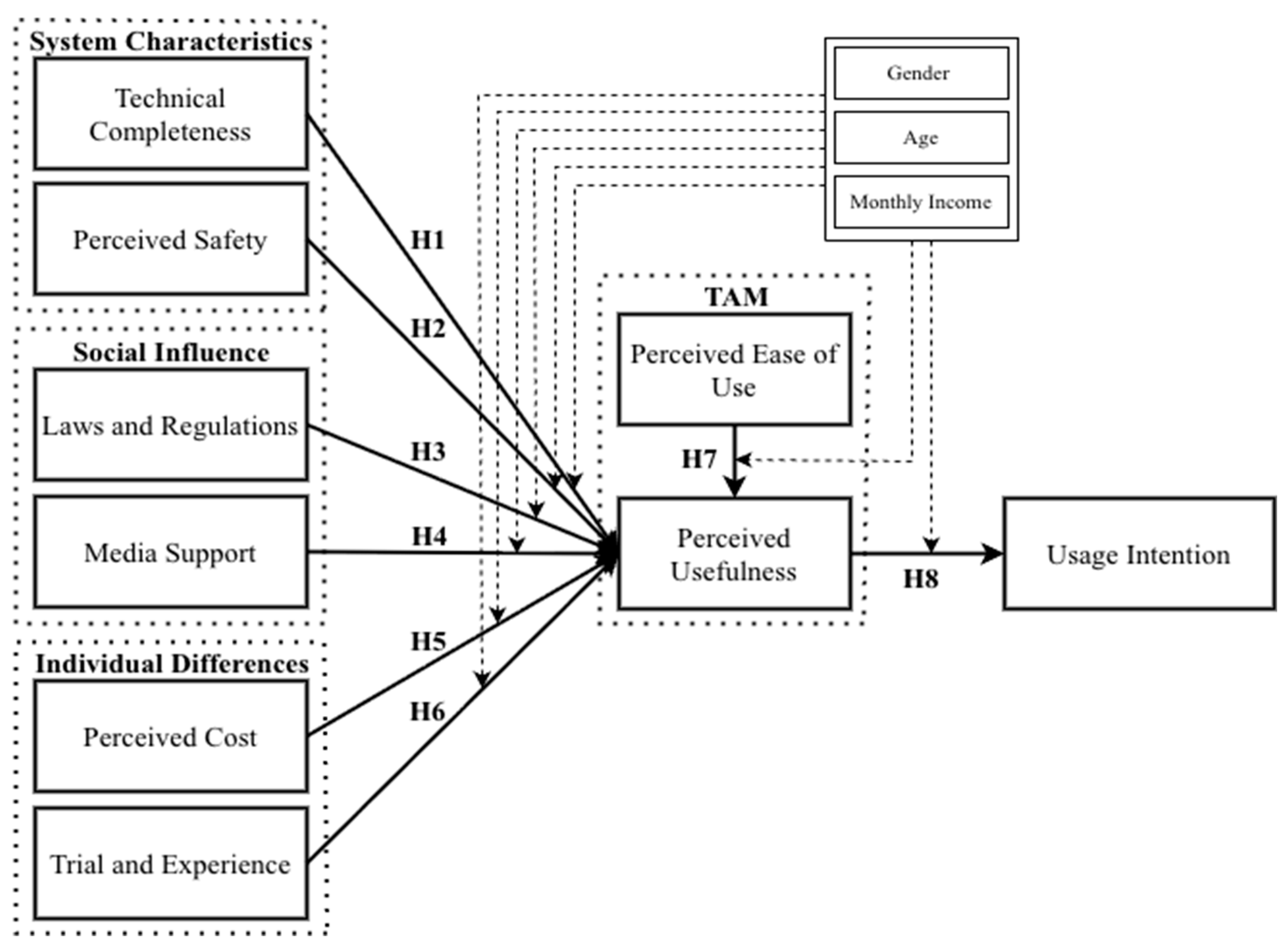
Figure 2.
Structure estimation of the theoretical model.
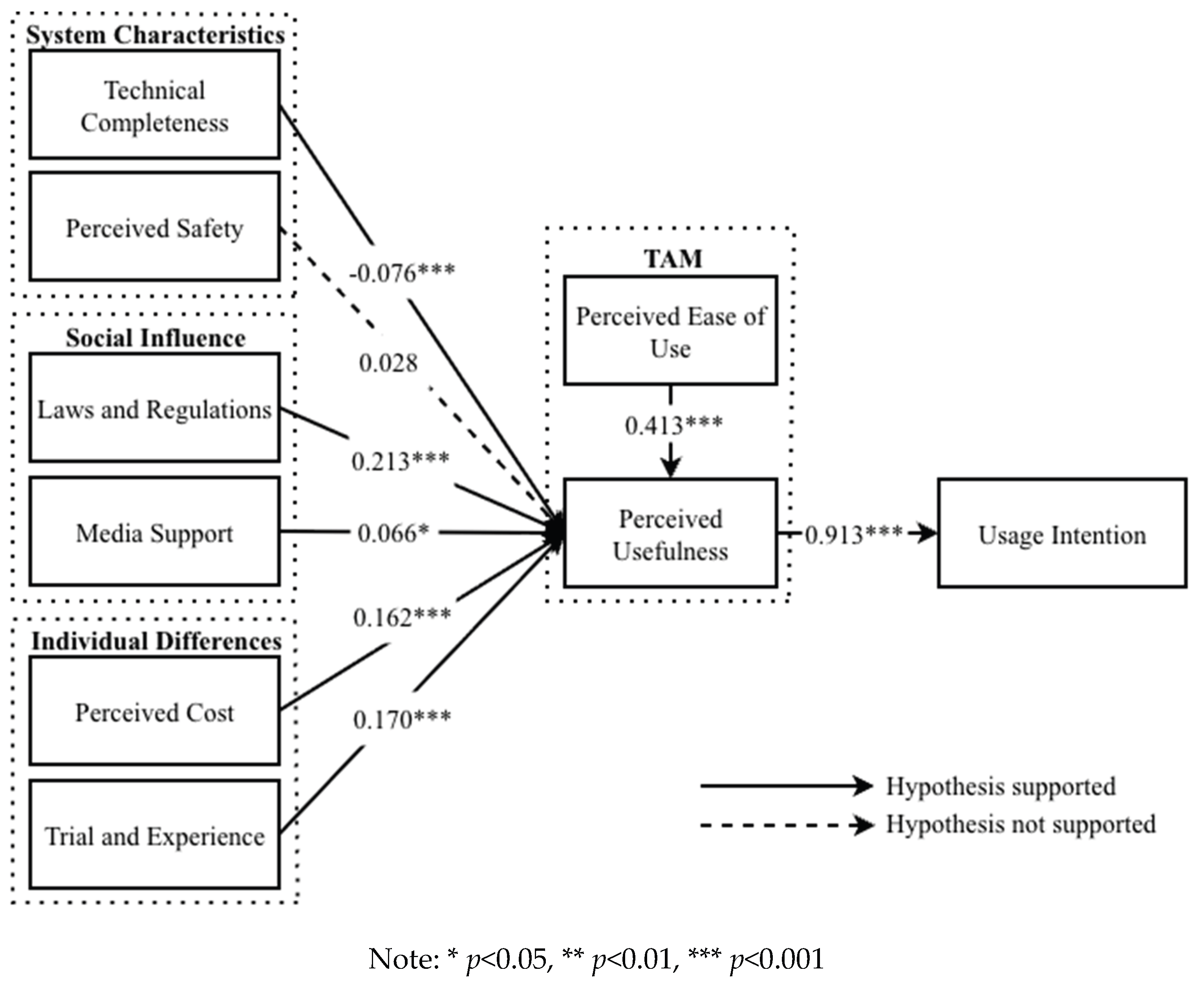

Table 1.
SAE level of automation.
| Level | 0 | 1 | 2 | 3 | 4 | 5 |
|---|---|---|---|---|---|---|
| Auto Level | No | Driver Assistance | Partial Automation | Conditional Automation | High Automation | Full Automation |
| Sensing | The human monitors the driving environment | The automated system monitors the driving environment | ||||
| Control System | Full control | Feet off | Hands off | Eyes off | Mind off | Driver off |
| Execution | Human | Human | Machine | Machine | Machine | Machine |
Source: [42].
Table 2.
Summary of prior research on self-driving cars across countries.
| Source | Objective | Constructs | Findings |
|---|---|---|---|
| [26] | Examining factors influencing behavioral intention to adopt 5G connected autonomous vehicles (CAVs) and mediating role of trust | Perceived Compatibility, Social Influence, Personal Innovativeness, Trust, Behavioral Intention, TAM | Compatibility and personal innovativeness shape behavioral intention, while trust drives adoption of self-driving cars |
| Malaysia | |||
| [29] | Examining Australians’ behavioral intention to adopt fully self-driving cars through an extended TAM includes data privacy and trust | Perceived Trust, Perceived Data Privacy, Attitude, Behavioral Intention, TAM | Australians’ acceptance of fully automated vehicles is influenced by perceived usefulness, perceived ease of use, trust, and data privacy concern |
| Australia | |||
| [50] | Examining factors that drive users to trust and adopt self-driving cars | Trust, System Transparency, Technical Competence, Situation Management, Perceived Risk, External Locus of Control, Sensation Seeking, Behavioral Intention, TAM | Trust and perceived usefulness are critical factors of users’ intention to adopt self-driving cars |
| Korea | |||
| [45] | Examining attitudes toward adopting self-driving cars by focusing on trust and sustainability concerns | Behavioral Intention, Trust, Sustainability Concerns, TAM | Individual adoption of self-driving cars is driven by perceived usefulness, perceived ease of use, trust, and sustainability concerns |
| Turkey | |||
| [31] | Examining how consumers’ personality traits and perceptions influence the intention to adopt self-driving cars | AV Adoption Intention, Optimism, Innovativeness, Discomfort, Insecurity, Average Value, TAM | Personality traits and perceived usefulness of self-driving cars boost the adoption intention |
| China | |||
| [51] | Investigating factors that affect the acceptance of self-driving cars among elderly in Malaysia | Trust in Institutions, Trust in Performance, Perceived Performance Risk, Perceived Privacy Risk, Attitude, Acceptance, TAM | Elderly acceptance of self-driving cars in Malaysia is driven by performance trust more than by institutional trust or perceived risks |
| Malaysia | |||
| [25] | Exploring and ranking the factors that influence attitudes and intentions to use self-driving cars | Attitude, Intention to Use AVs, Personal Innovativeness, Data Privacy Concern, Lack of Price Sensitivity, TAM | TAM explains self-driving cars adoption with perceived ease of use as key factors, personal innovativeness weakens perceived ease of use, privacy concerns strengthen perceived usefulness, while price sensitivity shows no impact |
| Vietnam | |||
| [52] | Investigating psychological factors in contactless technology adoption by combining health belief model and TAM | Perceived Severity, Perceived Susceptibility, Self-efficacy, Cues to Action, Intention to Use, Health belief model, TAM | Health belief factors and technological characteristics drive the willingness to accept contactless technology |
| Singapore | |||
| [28] | Understanding how performance and effort expectancy, social recognition, hedonism, technology security, and privacy concerns shape trust and well-being as well as drive the intention to use self-driving cars | Effort Expectancy, Social Recognition, Hedonism, Technology Security, Privacy Concerns, Performance Expectancy, User Well-being, Technology Trust, User Innovativeness, Behavioral Intention of Use, TAM, UTAUT | Behavioral intention to use self-driving cars, performance expectancy, social recognition, well-being, hedonism, trust, and security boost self-driving cars adoption, while privacy concern weaken trust |
| France | |||
| [14] | Identifying the acceptance of autonomous driving from end-user perception | Attitude, Compatibility, Ecological Awareness, Desire to Exert Control, Enjoyment, Privacy Concerns, Price Evaluation, Personal Innovativeness, Relative Advantage, Subjective Norm, Trust, Usage Intention, TAM | Social influence, system characteristics, and individual factors influence acceptance of autonomous driving |
| Germany | |||
| [40] | Investigating the factors shaping Malaysians’ acceptance of self-driving cars and the moderating role of socio demographic variables | Attitude, Subjective Norm, Perceived Behavioral Control, Acceptance, TAM, TPB | Self-driving cars acceptance of Malaysian is driven by trust, perceived usefulness, perceived ease of use, and socio demographic factors moderating these effects |
| Malaysia | |||
| [21] | Identifying the factors influencing consumers’ intention to use self-driving cars | Social Influence, Facilitating Condition, Intention to Use, TAM | Social influence, facilitating conditions, and perceived usefulness are crucial for self-driving cars adoption |
| Korea | |||
| [23] | Investigating FAV acceptance in Iran by comparing TAM, TPB, and UTAUT framework | Attitudes, Behavioral Intention, Subjective Norms, Perceived Behavioral Control, Performance Expectancy, Effort Expectancy, Social Influence, Facilitating Condition, TAM, TPB, UTAUT | TPB best explained the acceptance of FAV, exceeding TAM and UTAUT |
| Iran | |||
| [53] | Investigating the relationship between observed and latent construct in the acceptance of self-driving cars | Intention to Use AVs, TAM | Perceived usefulness is the crucial factor of behavioral intention |
| United States | |||
| [1] | Examining factors affects user’s behavioral intention to use self-driving cars | Relative Advantage, Image, Compatibility, Result Demonstrability, Visibility, Trialability, Behavioral Intention, Innovation Diffusion Theory (IDT), TAM | Self-driving cars adoption is driven by IDT, TAM, perceived usefulness, perceived ease of use, relative advantage, and compatibility |
| China |
Table 3.
Description of questionnaire variables.
| Construct | Measurement item | Source |
|---|---|---|
| Technical Completeness (TC) |
I think self-driving cars still pose risks. | [28,31,46] |
| I hesitate to use self-driving cars because of its risks. | ||
| I think self-driving cars are not yet completely safe. | ||
| I am concerned that self-driving cars might cause accidents. | ||
| Perceived Safety (PS) |
I think self-driving cars can reduce the occurrence of accidents. | [5,68] |
| I believe that self-driving cars can cope with unexpected situations. | ||
| I think self-driving cars can drive safely even at night or in poor weather. | ||
| I believe that self-driving cars can ensure personal and private data security. | ||
| Laws and Regulations (LR) |
I will use self-driving cars if government provides supportive cost subsidies. | [18,19,66] |
| I will use self-driving cars if government develops a sound legal system. | ||
| I will use self-driving cars if government develops comprehensive insurance system. | ||
| I will use self-driving cars if government invests in the relevant infrastructure. | ||
| Media Support (MS) |
I frequently see reports on AVs in various media. | [7,66,69] |
| I frequently see reports on the intelligent travel of AVs in various media. | ||
| I frequently see reports on the safe travel of AVs in various media. | ||
| Perceived Cost (PC) |
I think self-driving cars offer good value for their cost. | [25,46] |
| I believe the benefits of self-driving cars are greater than the purchase cost. | ||
| I think self-driving cars provide economic benefits in the long term. | ||
| I think using self-driving cars is a cost-effective choice. | ||
| Trial and Experience (TE) |
It is very important for me to be able to test drive self-driving cars. | [7,17] |
| I would like to have the opportunity to use self-driving cars on a trial basis. | ||
| I am more likely to use self-driving cars since it is testing operation. | ||
| Perceived Ease of Use (PEOU) |
I am positive about using new technology. | [21,40,67] |
| I believe autonomous driving technology represents the future of driving. | ||
| I like trying out the latest technology before others. | ||
| My interest in using self-driving cars increases as technology develops. | ||
| Perceived Usefulness (PU) |
Self-driving cars would be compatible with my mobility needs. | [21,25,45,67] |
| Self-driving cars would be suitable for my lifestyle. | ||
| Self-driving cars would be compatible with current trends. | ||
| Autonomous driving technology will greatly reduce the burden on drivers. | ||
| Usage Intention (UI) |
I am looking forward to self-driving cars’ official commercial operation. | [7,21,23] |
| I will actively choose self-driving cars. | ||
| I will actively try self-driving cars for shared mobility. | ||
| I will actively recommend self-driving cars to people around me. |
Table 4.
Demographic statistics.
| Demographic features | Frequency (n=591) | Percentage (%) | |
|---|---|---|---|
| Gender | Male | 323 | 62% |
| Female | 196 | 38% | |
| Age | 20s | 68 | 13.1% |
| 30s | 108 | 20.8% | |
| 40s | 173 | 33.4% | |
| 50s | 133 | 25.6% | |
| Above 60s | 37 | 7.1% | |
| Monthly income | Below 2 million Won | 50 | 9.6% |
| 2~4 million Won | 123 | 23.7% | |
| 4~6 million Won | 134 | 25.8% | |
| 6~10 million Won | 130 | 25.0% | |
| Above 10 million Won | 82 | 15.8% | |
Table 5.
Confirmatory factor analysis results.
| Construct | Items | λ | α | CR | AVE |
|---|---|---|---|---|---|
| Technical Completeness (TC) |
TC1 | 0.811 | 0.917 | 0.918 | 0.739 |
| TC2 | 0.855 | ||||
| TC3 | 0.885 | ||||
| TC4 | 0.880 | ||||
| Perceived Safety (PS) |
PS1 | 0.897 | 0.900 | 0.901 | 0.699 |
| PS2 | 0.902 | ||||
| PS3 | 0.834 | ||||
| PS4 | 0.704 | ||||
| Laws and Regulations (LR) |
LR1 | 0.860 | 0.955 | 0.957 | 0.843 |
| LR2 | 0.958 | ||||
| LR3 | 0.947 | ||||
| LR4 | 0.910 | ||||
| Media Support (MS) |
MS1 | 0.914 | 0.934 | 0.939 | 0.832 |
| MS2 | 0.968 | ||||
| MS3 | 0.851 | ||||
| Perceived Cost (PC) |
PC1 | 0.876 | 0.937 | 0.938 | 0.790 |
| PC2 | 0.899 | ||||
| PC3 | 0.875 | ||||
| PC4 | 0.904 | ||||
| Trial and Experience (TE) |
TE1 | 0.825 | 0.907 | 0.905 | 0.765 |
| TE2 | 0.898 | ||||
| TE3 | 0.897 | ||||
| Perceived Ease of Use (PEOU) |
PEOU1 | 0.766 | 0.884 | 0.874 | 0.654 |
| PEOU2 | 0.794 | ||||
| PEOU3 | 0.756 | ||||
| PEOU4 | 0.907 | ||||
| Perceived Usefulness (PU) |
PU1 | 0.924 | 0.910 | 0.915 | 0.746 |
| PU2 | 0.954 | ||||
| PU3 | 0.772 | ||||
| PU4 | 0.724 | ||||
| Usage Intention (UI) |
UI1 | 0.887 | 0.946 | 0.949 | 0.819 |
| UI2 | 0.928 | ||||
| UI3 | 0.886 | ||||
| UI4 | 0.914 |
Note: Model fit statistics: χ2 = 1301.296, df = 491, χ2 / df = 2.65, CFI = 0.956, GFI = 0.854, AGFI = 0.823, IFI = 0.956, NFI = 0.923, RMR = 0.050, RMSEA = 0.056.
Table 6.
Fornell-Larcker test of discriminant validity.
| TC | PS | LR | MS | PC | TE | PEOU | PU | UI | |
|---|---|---|---|---|---|---|---|---|---|
| TC | 0.860 | ||||||||
| PS | -0.321 | 0.836 | |||||||
| LR | -0.120 | 0.581 | 0.918 | ||||||
| MS | -0.084 | 0.570 | 0.496 | 0.912 | |||||
| PC | -0.227 | 0.778 | 0.653 | 0.500 | 0.889 | ||||
| TE | -0.107 | 0.618 | 0.788 | 0.517 | 0.685 | 0.874 | |||
| PEOU | -0.112 | 0.742 | 0.737 | 0.597 | 0.785 | 0.803 | 0.809 | ||
| PU | -0.201 | 0.679 | 0.772 | 0.580 | 0.719 | 0.778 | 0.809 | 0.864 | |
| UI | -0.249 | 0.765 | 0.752 | 0.552 | 0.880 | 0.801 | 0.921 | 0.821 | 0.905 |
Note: Diagonal values are the square root of average variance extracted. Off diagonal values are Pearson correlation of constructs.
Table 7.
Heterotrait-Monotrait ratio of correlations (HTMT).
| TC | PS | LR | MS | PC | TE | PEOU | PU | UI | |
|---|---|---|---|---|---|---|---|---|---|
| TC | 1.000 | ||||||||
| PS | 0.336 | 1.000 | |||||||
| LR | 0.124 | 0.582 | 1.000 | ||||||
| MS | 0.081 | 0.592 | 0.521 | 1.000 | |||||
| PC | 0.219 | 0.794 | 0.656 | 0.520 | 1.000 | ||||
| TE | 0.099 | 0.615 | 0.787 | 0.535 | 0.683 | 1.000 | |||
| PEOU | 0.112 | 0.731 | 0.716 | 0.619 | 0.775 | 0.777 | 1.000 | ||
| PU | 0.167 | 0.695 | 0.793 | 0.616 | 0.741 | 0.817 | 0.848 | 1.000 | |
| UI | 0.236 | 0.771 | 0.760 | 0.568 | 0.881 | 0.798 | 0.907 | 0.836 | 1.000 |
Table 8.
Significant test of the path coefficients.
| Path | β | S.E | C.R | p-Value | Hypothesis | |||
|---|---|---|---|---|---|---|---|---|
| H1 | PU | ← | TC | -0.076 | 0.029 | -3.316 | 0.001 | Supported |
| H2 | PU | ← | PS | 0.028 | 0.043 | 0.654 | 0.513 | Not Supported |
| H3 | PU | ← | LR | 0.213 | 0.040 | 5.651 | *** | Supported |
| H4 | PU | ← | MS | 0.066 | 0.027 | 2.434 | 0.015 | Supported |
| H5 | PU | ← | PC | 0.162 | 0.049 | 3.769 | *** | Supported |
| H6 | PU | ← | TE | 0.170 | 0.052 | 3.677 | *** | Supported |
| H7 | PU | ← | PEOU | 0.413 | 0.083 | 7.014 | *** | Supported |
| H8 | UI | ← | PU | 0.913 | 0.033 | 24.479 | *** | Supported |
Note: *** p<0.001.
Table 9.
Subgroups with different backgrounds.
| Group | Subgroup | Group Size |
|---|---|---|
| Gender | Male | 323 |
| Female | 196 | |
| Age | Below 40s | 176 |
| 40s and above | 343 | |
| Monthly income | Below 6 million Won | 307 |
| 6 million Won and above | 212 |
Table 10.
Results of moderating effect tests.
| Group | Relationship | β0 | t0 | β1 | t1 | CR | ||
|---|---|---|---|---|---|---|---|---|
| Male (0) vs. Female (1) |
TC | → | PU | -0.039 | -1.342 | -0.028 | -0.577 | -0.204 |
| PS | → | PU | -0.014 | -0.316 | 0.147 | 2.466* | -2.152 | |
| LR | → | PU | 0.277 | 5.994*** | 0.218 | 3.931*** | 0.814 | |
| MS | → | PU | 0.104 | 3.069** | 0.068 | 1.504 | 0.641 | |
| PC | → | PU | 0.106 | 2.137* | 0.166 | 2.376* | -0.696 | |
| TE | → | PU | 0.236 | 4.999*** | 0.189 | 3.348*** | 0.637 | |
| PEOU | → | PU | 0.266 | 4.413*** | 0.273 | 3.966*** | -0.081 | |
| PU | → | UI | 0.808 | 22.578*** | 0.777 | 16.940*** | 0.546 | |
| Below 40s (0) vs. 40s and above (1) |
TC | → | PU | -0.020 | -0.714 | -0.089 | -1.746 | 1.190 |
| PS | → | PU | 0.070 | 1.635 | 0.030 | 0.434 | 0.503 | |
| LR | → | PU | 0.236 | 6.107*** | 0.286 | 3.866*** | -0.600 | |
| MS | → | PU | 0.082 | 2.647** | 0.121 | 2.311* | -0.642 | |
| PC | → | PU | 0.126 | 2.652** | 0.070 | 0.931 | 0.630 | |
| TE | → | PU | 0.204 | 4.721*** | 0.204 | 3.110** | -0.002 | |
| PEOU | → | PU | 0.290 | 5.358*** | 0.306 | 3.764*** | -0.164 | |
| PU | → | UI | 0.837 | 25.248*** | 0.720 | 13.958*** | 1.918 | |
| Below 6 million Won (0) vs. 6 million Won and above (1) |
TC | → | PU | -0.046 | -1.129 | -0.035 | -1.057 | -0.211 |
| PS | → | PU | 0.146 | 2.753** | -0.033 | -0.683 | 2.492 | |
| LR | → | PU | 0.242 | 4.269*** | 0.241 | 5.407*** | 0.015 | |
| MS | → | PU | 0.091 | 2.190* | 0.095 | 2.651** | -0.072 | |
| PC | → | PU | 0.034 | 0.589 | 0.183 | 3.279** | -1.867 | |
| TE | → | PU | 0.151 | 2.669** | 0.248 | 5.374*** | -1.331 | |
| PEOU | → | PU | 0.343 | 5.093*** | 0.264 | 4.516*** | 0.887 | |
| PU | → | UI | 0.821 | 18.821*** | 0.785 | 21.030*** | 0.625 | |
Note: * p<0.05, ** p<0.01, *** p<0.001.
Disclaimer/Publisher’s Note: The statements, opinions and data contained in all publications are solely those of the individual author(s) and contributor(s) and not of MDPI and/or the editor(s). MDPI and/or the editor(s) disclaim responsibility for any injury to people or property resulting from any ideas, methods, instructions or products referred to in the content. |
© 2026 by the authors. Licensee MDPI, Basel, Switzerland. This article is an open access article distributed under the terms and conditions of the Creative Commons Attribution (CC BY) license (http://creativecommons.org/licenses/by/4.0/).
Copyright: This open access article is published under a Creative Commons CC BY 4.0 license, which permit the free download, distribution, and reuse, provided that the author and preprint are cited in any reuse.


