1. Introduction
In modern manufacturing cutting parameters play vital role in the milling process and have significant effect on tool and workpiece. As such is paramount to consider cutting forces and their effect during milling process for several reasons such as tool wear, surface quality, dimensional accuracy, machine stability and energy consumption [
1,
2,
3]. Considering cutting forces and their effects during milling can help optimize the machining parameters in manufacturing process [
4,
5,
6].
Milling is one of most used manufacturing processes, yet accurate understanding of power consumption and cutting forces under milling conditions remains not utilized to its full potential. As power consumption is directly related to energy efficiency and operational cost manufacturing sector, it requires reliable data and reasons to improve milling process. Experimental investigations reported in the literature show considerable variability in measured cutting forces and power consumption, particularly with respect to the influence of cutting speed, feed rate, depth of cut and type of materials [
7]. Effect of cutting speed on cutting forces in the literature can be described contradictory as no impact [
8] or increasing impact [
9,
10]. An increase in feed per tooth corresponds to an increase in chip thickness, what results in greater cutting forces and power consumption [
11,
12]. Overall differences in machine tools, measurement systems, and cutting conditions make it difficult to simply compare results or generalize conclusions. Based on this there is a need for measurement of cutting forces and power consumption during process of milling. Data are required not only to better understand process of milling but also to validate predictive models and support overall optimization of process aimed at energy consumption without decreasing quality of milling performance
Creating a low-cost, constrained-motion dynamometer for milling applications is difficult. Some design achieves accurate three-axis force measurement at a fraction of the cost of commercial systems, addressing the need for more affordable and adaptable measurement tools in research and industry [
13].
A milling table integrated with PVDF thin-film sensors was used to measure cutting forces without an external dynamometer [
14]. This research demonstrated a lightweight, flexible approach to force sensing, showing the evolution toward embedded and intelligent measurement systems in milling operations. Cutting force measurement has critical role in understanding machining performance, tool wear, and surface quality. An accurate force data from a dynamometer can be used to analyse tool condition and optimize process parameters in difficult-to-cut materials [
15].
Dynamometers as the most reliable instruments for direct cutting force monitoring. There are several types of dynamometer that use different sensing methods such as piezoelectric, strain-gauge, and others. [
16]. Dynamometers are capable of measuring four-component forces in real time. This design significantly improves sensitivity and response speed, representing a step forward in dynamic and multi-axis force measurement for high-speed milling [
17].
Energy consumption increases with higher spindle speeds and decreases with higher feed rates, while surface quality follows the opposite trend [
18].
Cutting parameters affect both cutting forces and cutting temperature during face milling of material [
19]. Milling strategies influence productivity, roughness and vibration, these are important parameters while searching for optimal milling path [
20].
This article deals with the use of cutting force and cutting power data obtained during the milling of medium density fibre wood boards to create predictive models using machine learning. First, the measured data are processed and evaluated statistically to determine the statistical significance of the effects of individual technical and technological milling parameters.
Following the statistical evaluation, the study progresses to the creation and parameterization of machine learning models. These models are then rigorously tested to assess their suitability for the specific type of data. The evaluation is based on the correlation coefficient of measured and predicted data and on their root main square error.
2. Materials and Methods
Samples of medium density fibre (MDF) boards were used as experimental material which were cut to dimensions of 350 × 160 × 18 mm. Medium Density Fibreboard (MDF) is an engineered wood product produced by hot-pressing wood fibbers bound with synthetic resins, most commonly urea–formaldehyde (UF), under controlled heat and pressure [
21]. Manufacturer of sample material MDF E1 (EN ISO 12460-5) company KRONOSPAN (Zvolen, Slovakia) guarantees technical specification according to technical sheet of manufactured product. Material density is 750 kg·m
3 ±7% and tolerance of thickness is ±0,2mm. All other details are in technical sheet on manufacturer website. Before Experimental measurement occurred, material was formatted to required dimensions and milled around the perimeter for purpose of removal of unwanted shortcomings or inaccuracies.
2.1. Cutting Tool Used in Experiment
Tool used in experiment was spiral monolithic 3-spiral end mill SCH3UFN284R 20 × 90 × 20 (Freud, S.p.A, Italy) with parameters in
Table 1.
2.2. CNC Machining Centre
Measurements occurred at a 5-axis CNC machining centre, specifically Z5-31 SCM TECH (SCM Group, Rimini, Italy). This CNC machine is well-suited for furniture panel production, designed for high-precision tasks in complex 3D shaping, contouring, and drilling operations. At the core of the machine is an 11 kW “Prisma 5” vertical electro-spindle with a high-speed capacity of up to 24,000 rpm, allowing it to handle demanding routing and milling operations. The spindle is belt-driven and water-cooled, ensuring consistent thermal management. CNC machine spindle follows HSK 63 standard, offering excellent rigidity and fast tool changes.
CNC machines capability is supported by a broad movement envelope, typically around 3110 mm (X), 1300–1550 mm (Y), and 160 mm (Z), with continuous rotation along axes B (±320°) and C (±640°). This enables complex multi-sided machining without repositioning the workpiece. Safety and ergonomics are embedded into the machine design through features like bumper-style collision protection, automatic lubrication, and dust extraction interfaces. The control system is PC-based [
22].
2.3. Power Consumption Mesurement
Device used for measurement of power consumption of milling process was a three-phase power quality analyser MI 2893 Power Master XT (Metrel d.o.o., Slovenia). The power analyser was connected to the electrical power supply of the CNC machining centre. It was connected with the help of current probes and voltage clamps. The voltage clamps were connected to the phase conductors, zero and protective conductor using the installed socket 32 A5P. The current probes were connected in the direction of the current flow, in the case of the opposite connection, the values measured on the terminals would be negative. After the connection of measuring circuit, a test measurement of the signal was realized on the phases. Program used for measuring power consumption was Metrel PowerView v3.0.
2.4. Cutting Forces Mesurement
Cutting force measurements were performed using a three-component piezoelectric dynamometer (Kistler 9257B, Kistler Group). The Kistler 9257B is a piezoelectric, multicomponent dynamometer designed to capture orthogonal force components Fx, Fy, Fz during machining operations, including milling, turning, and grinding. In our case we will be using it in process of milling.
It integrates four three-component quartz force sensors, preload-mounted be-tween a baseplate and a 100 × 170 mm top plate. This assembly enables measurement of forces and moments with high stiffness and natural frequency [
23].
Dynamometer was mounted onto wooden particleboard which was fixed to CNC machine centre using pneumatic grippers. This method was used for fixing dynamometer in place during milling. Experimental sample was fastened onto dynamometer with hex bolts, that kept material during milling process in fixed place. We set minimal safe distance to be 50 milometers. This area was monitored and marked. Tool path was closely monitored and if tool encroached onto marked area milling process would be stopped im-mediately.
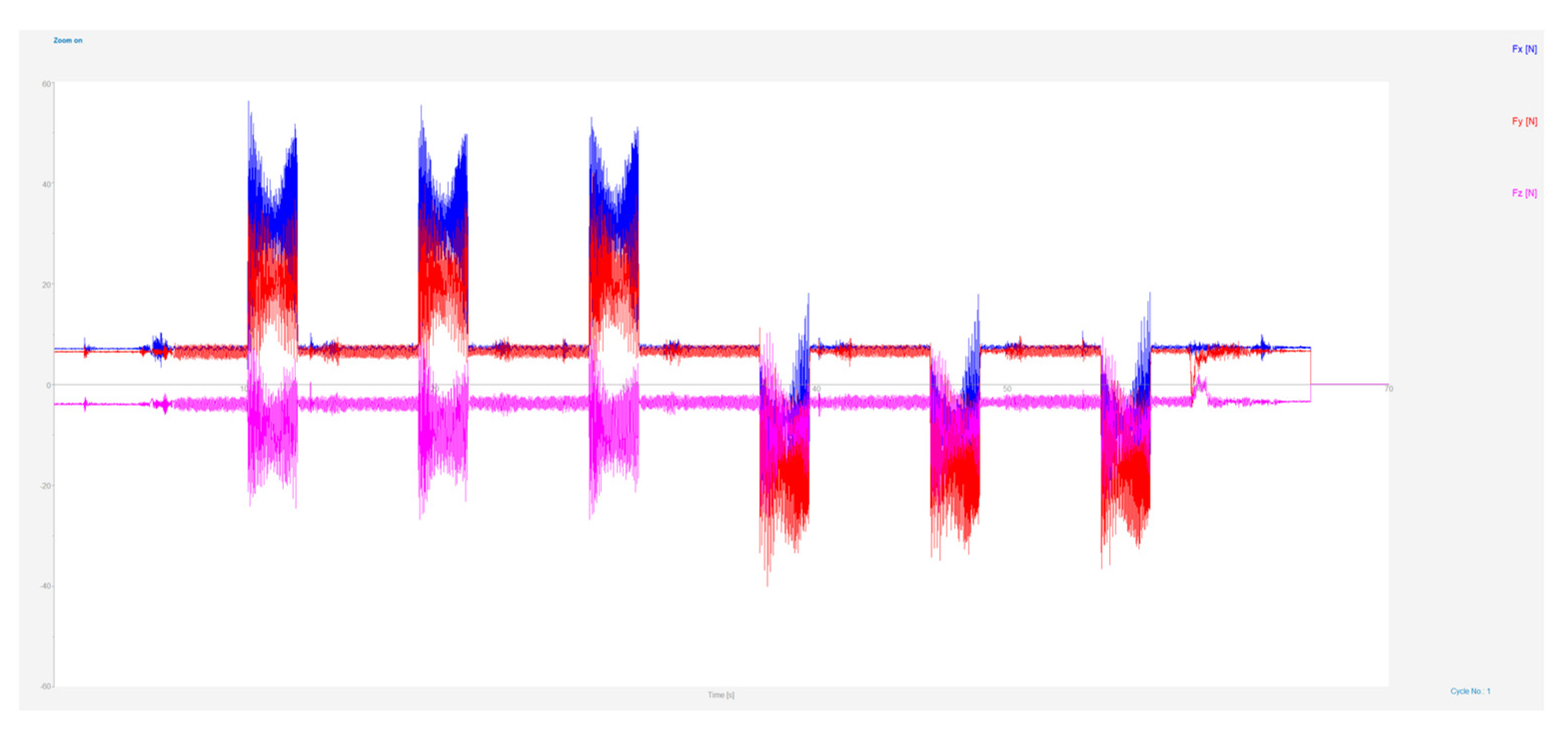
Program used for cutting forces measurement was DynoWare v3.2.5.0. Sampling rate of signal during measurement was 5000 Hz. The entire milling cycle with one sample was recorded in one measurement, which includes 3 conventional and 3 climb millings. Overall force was computed as:
where F
x, F
y and
Fz are measured forces in x, y and z axis according to coordinate system of dynamometer.
2.5. Cutting Parameters
The cutting parameters were selected according to the practical operation based on several factors of the CNC milling machine and the recommended cutting conditions for the applied cutting tool. Spindle speeds of 14,000, 16,000, and 18,000 rpm and feed speeds of 6, 8, and 10 m/min were chosen to cover a range of machining conditions commonly used in high-speed milling. These parameters are summarised in
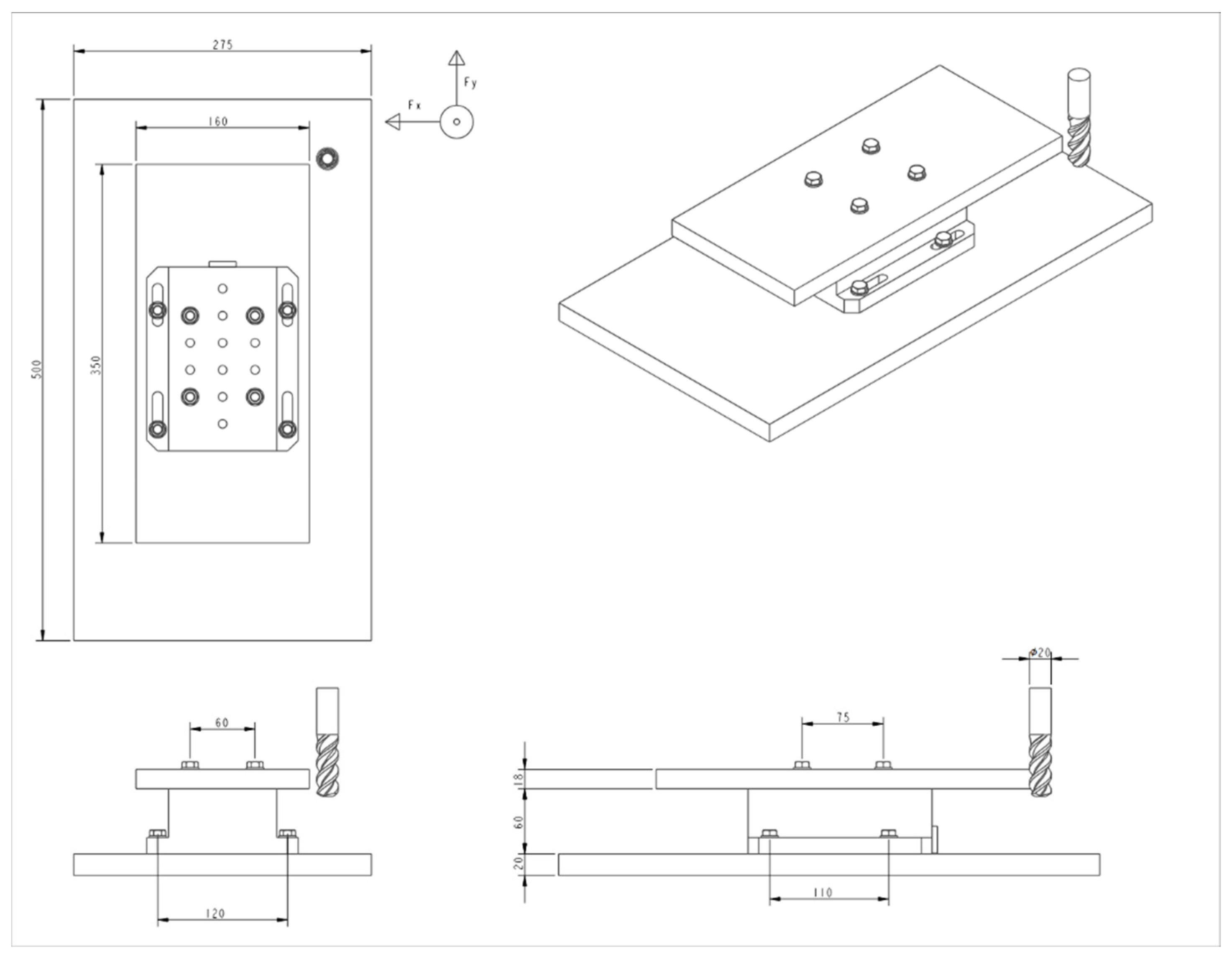
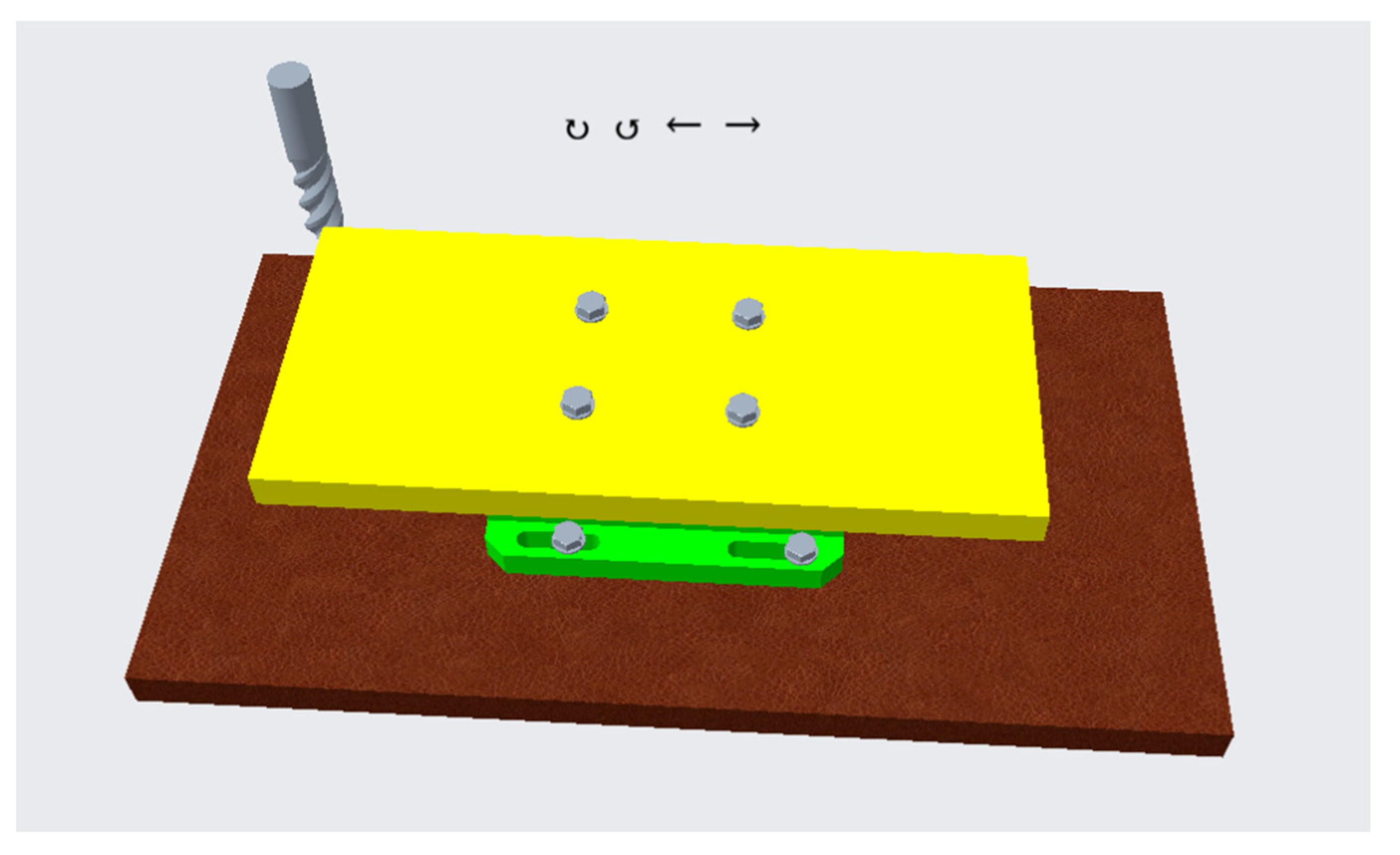
Table 2. This range enabled the investigation of the influence of cutting speed and feed speed on the milling process while maintaining process stability and preventing excessive tool wear. Furthermore, both up milling (conventional milling) and down milling (climb milling) were employed to assess changes in power consumption and measurements of cutting forces. The experimental milled assembly is shown in
Figure 1 and
Figure 2.
2.6. Other Factors
Measurement Uncertainty is always a factor to consider, as such device were calibrated and tested before experiment occurred.
3. Results
Power consumption was calculated as power consumed during milling process from which was subtracted power consumption while CNC machine was in idle mode. Cutting forces were more straightforward as measuring tool has its own software that showed entire experimental process with detailed graph of any components of cutting forces. In order to work with data, random noise and volatility were reduces. This is done in order to reveal a clearer, more coherent signal for data analysis. All calculations were done by software baring the exception of making it absolute value as depending on which side forces were applied one was negative. Negative value only meant that forces were applied in other direction.
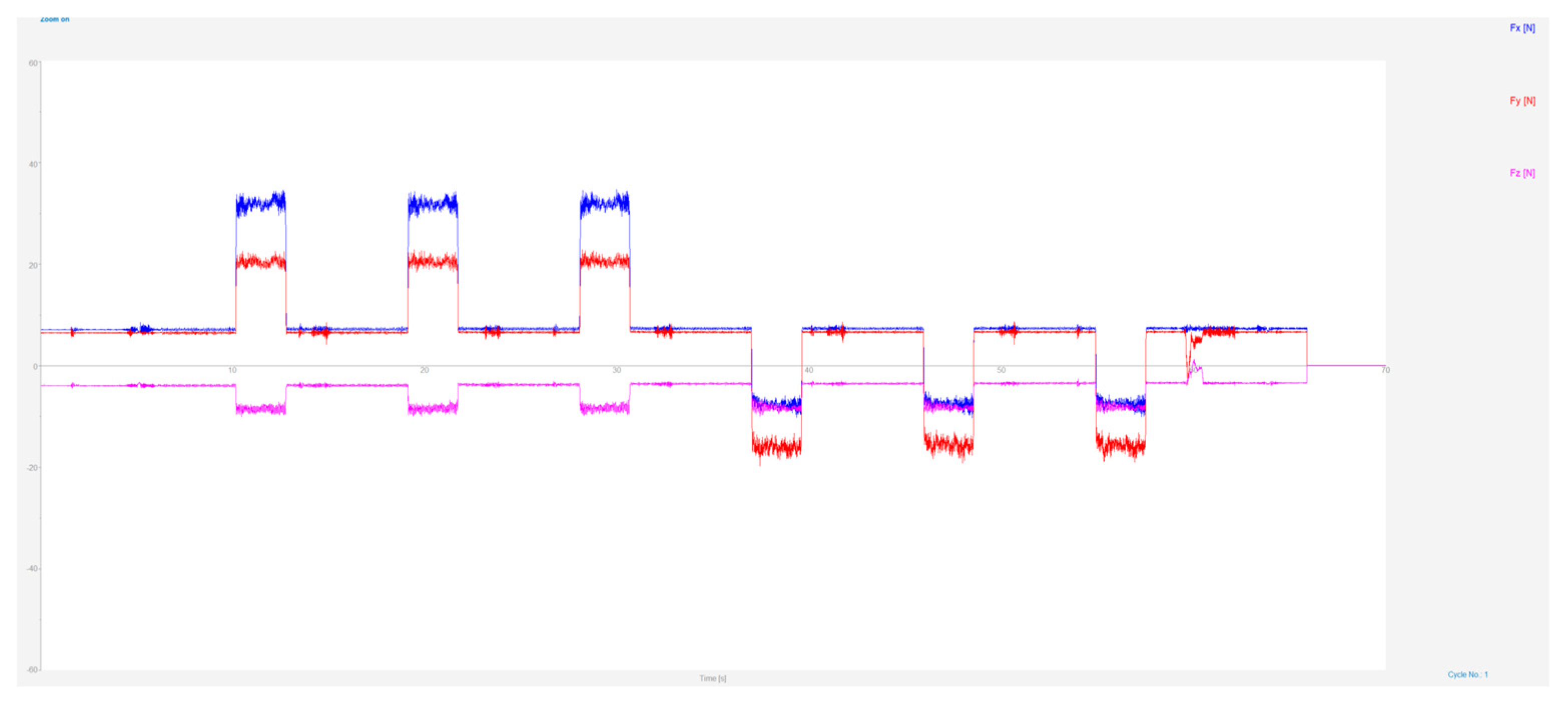
Figure 3 shows recorded data after three climb and three conventional millings.
Figure 4 shows recorded data after filtering. Based on this figure, forces were calculated as absolute value of difference between cutting force during idle time and cutting force during milling process. After last spike there is slight change in forces this was due to part of CNC machine passing over and transferring forces with rubber curtain.
3.1. Statistical Evaluation
The statistical significance of machining parameters was evaluated using analysis of variance (ANOVA), a method originally developed by Fisher [
24] and widely applied in engineering experimental designs like Montgomery [
25] to determine the relative contribution of cutting parameters to response variables.
For purpose of statistical evaluation, we used program STATISTICA (TIBCO Software inc.). This program was chosen based on availability, technical understanding of software, utilities and personal preference.
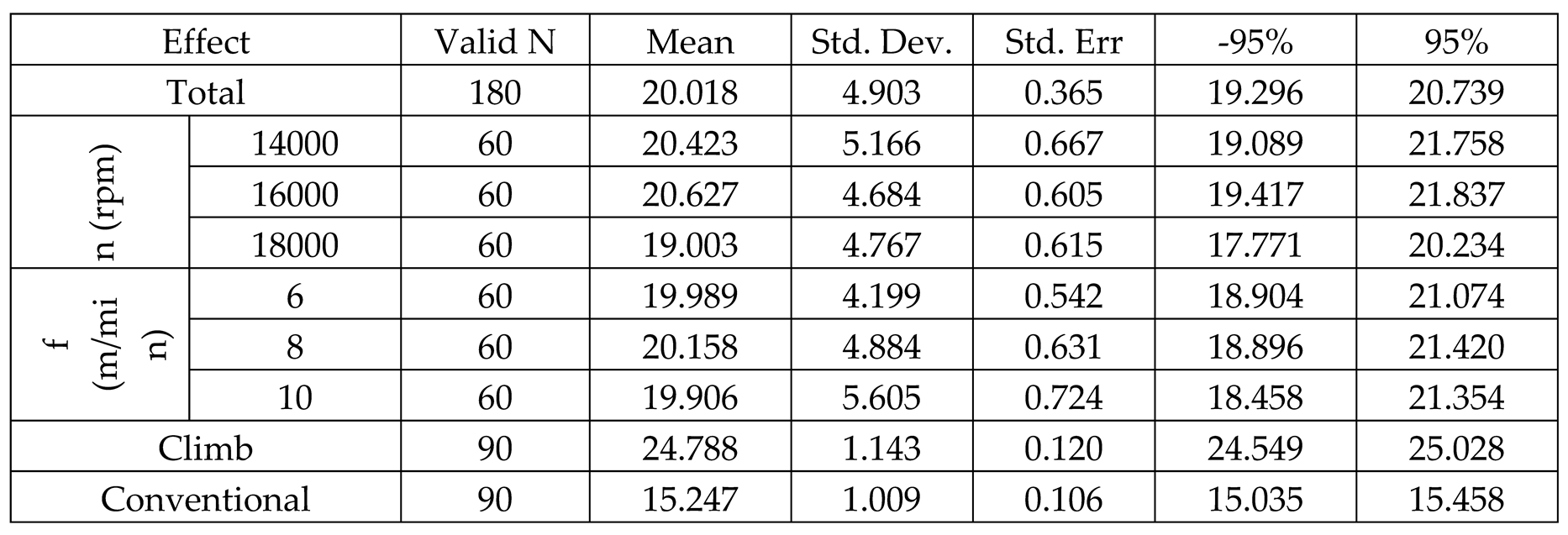
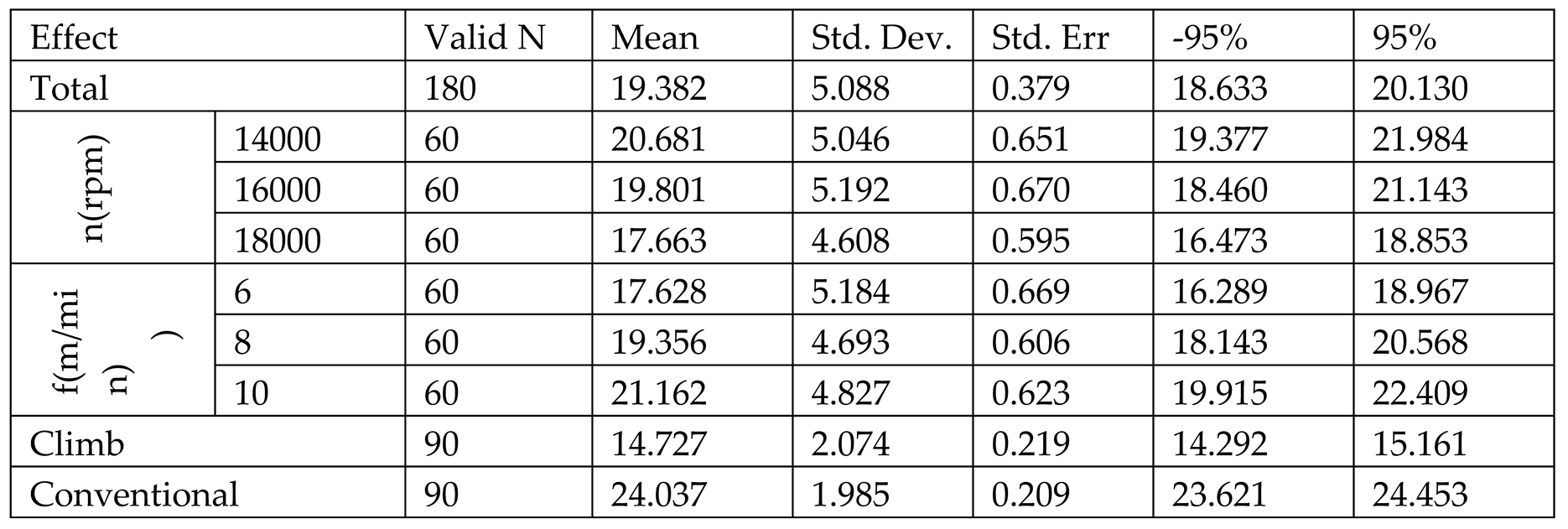
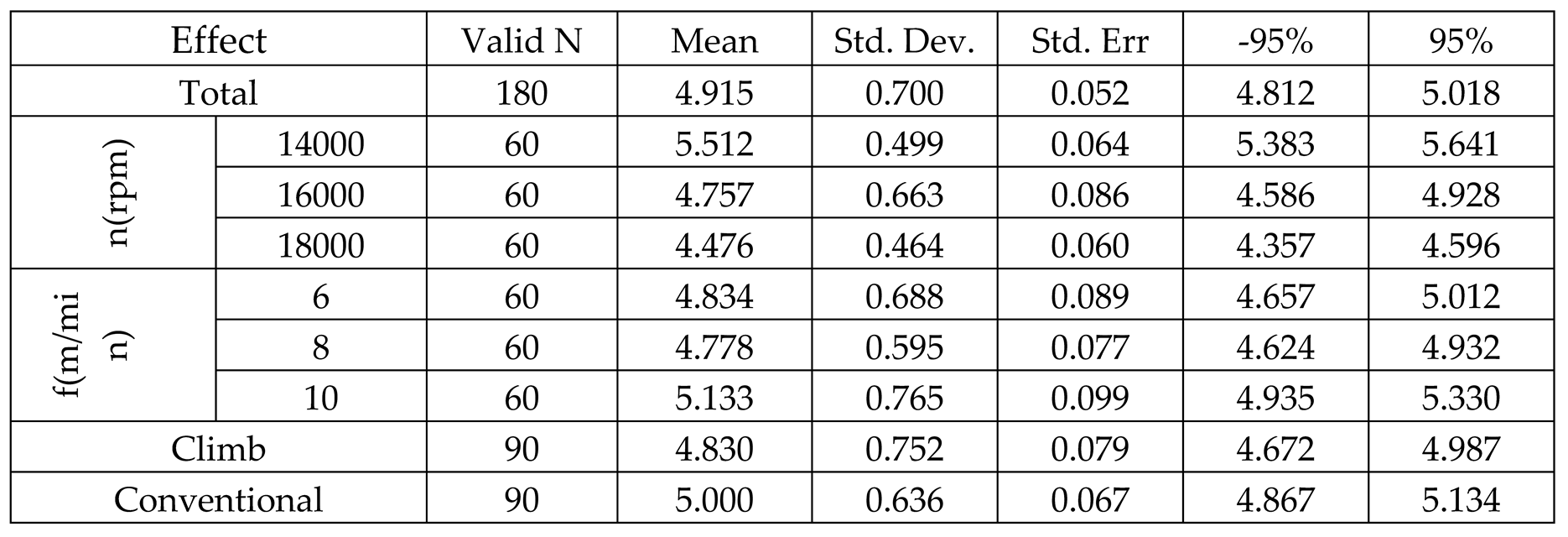
Table 3,
Table 4,
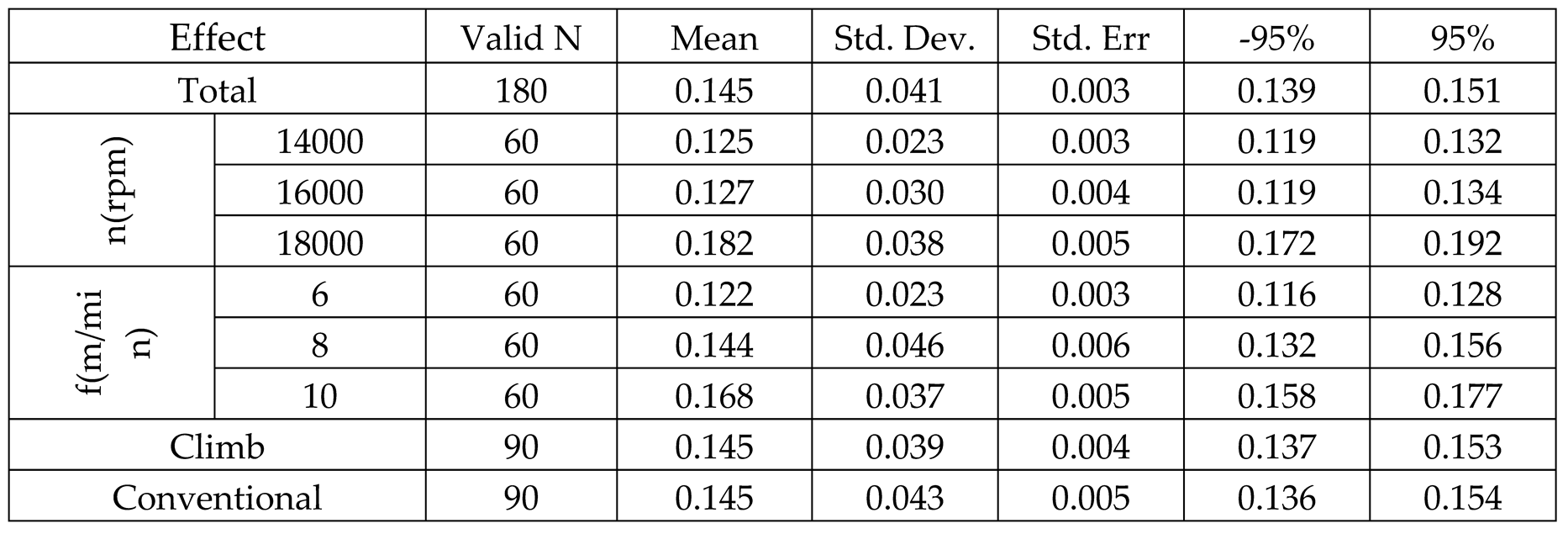
Table 5,
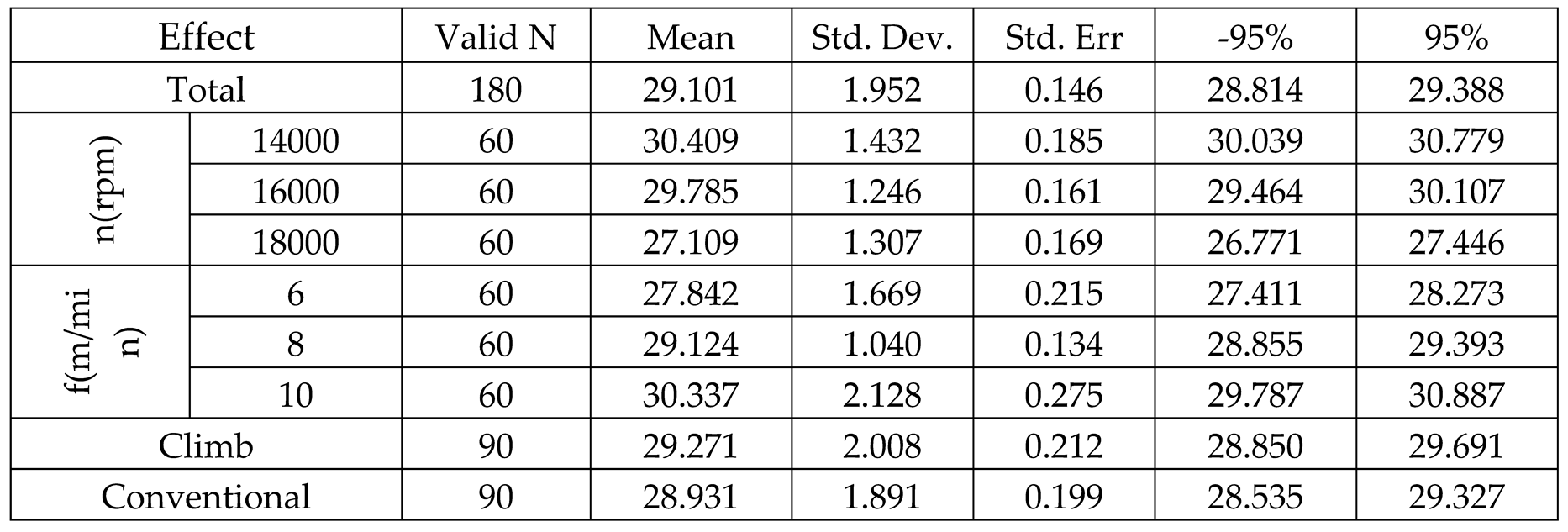
Table 6 and
Table 7 summarise descriptive statistics of measured variables. As main tool chosen for analysis was ANOVA (analysis of variance), in order to determine statistically significant differences between the means of independent groups for forces
Fx,
Fy,
Fz, overall force
Fc, and cutting power
P. It is essential for comparing multiple groups simultaneously. For analysis purposes, we took all force components as absolute values. As during experiment different combination of feed speed (
f), rotation of milling tool (
n) and different types of milling (conventional, climb) were used.
Analysis of variance was conducted to examine the groups of data and if there is significant corelations.
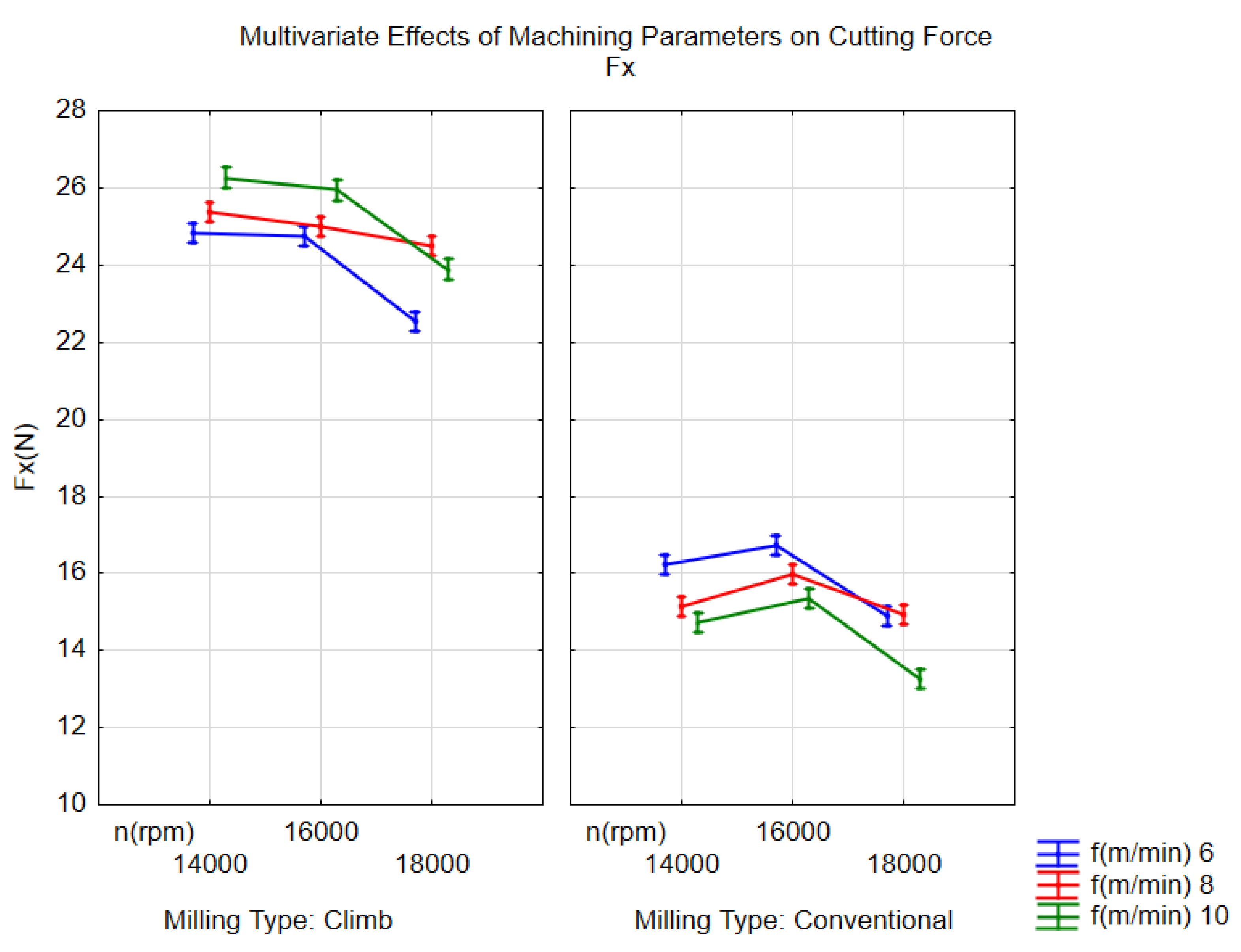
Table 8 shows comparisons between the data acquired during experiment. The highest influence of technological parameters was on the measured force
Fx.
Figure 5 shows how the change of force Fx is influenced by milling parameters. Climb milling had a component of this force greater than conventional.
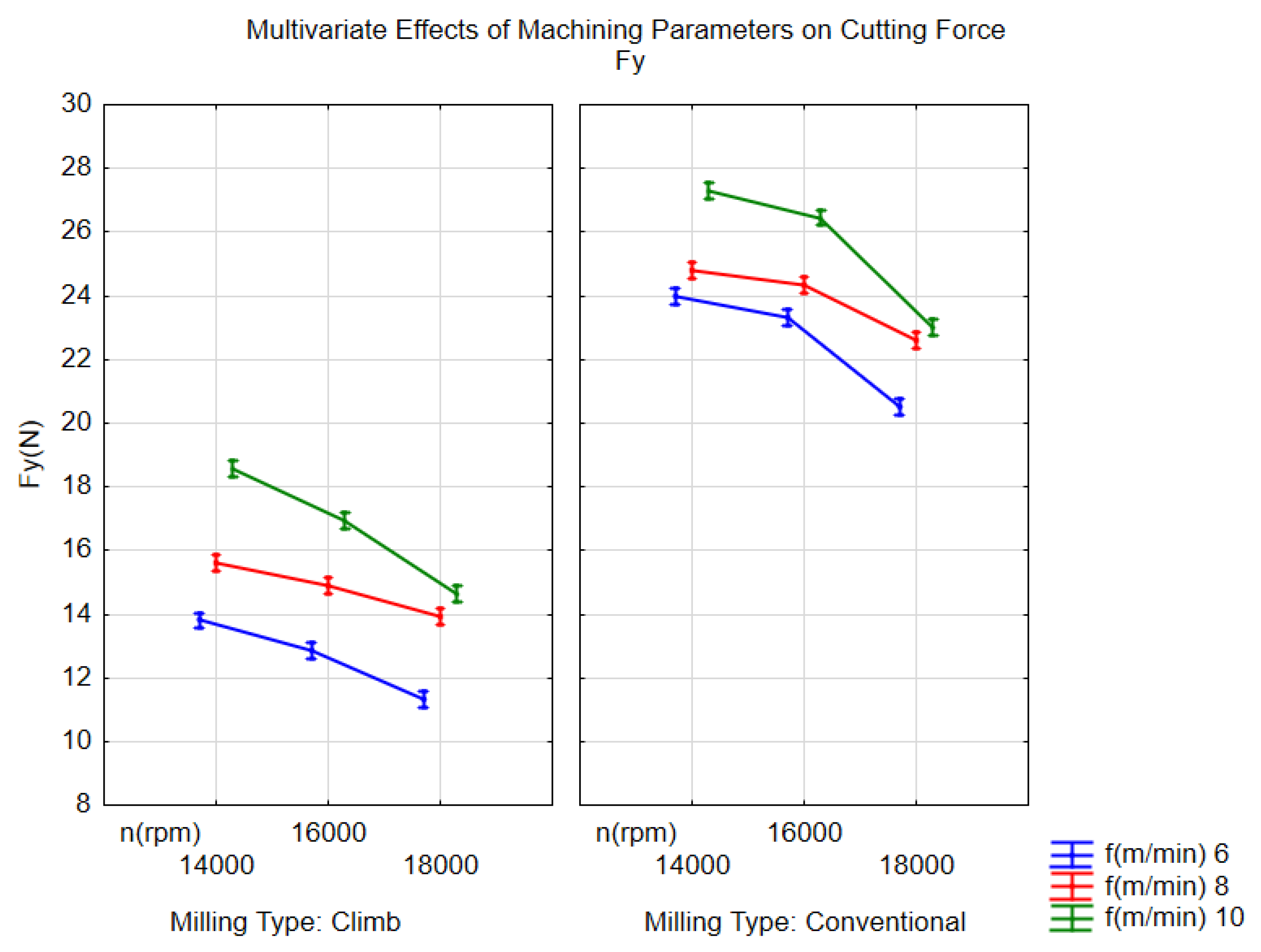
Figure 6 shows that with increase of feed speed measured force increases, also the force decrease with increase revolution of cutting tool. Here, on the contrary, climb milling had a smaller component of this force than conventional milling.
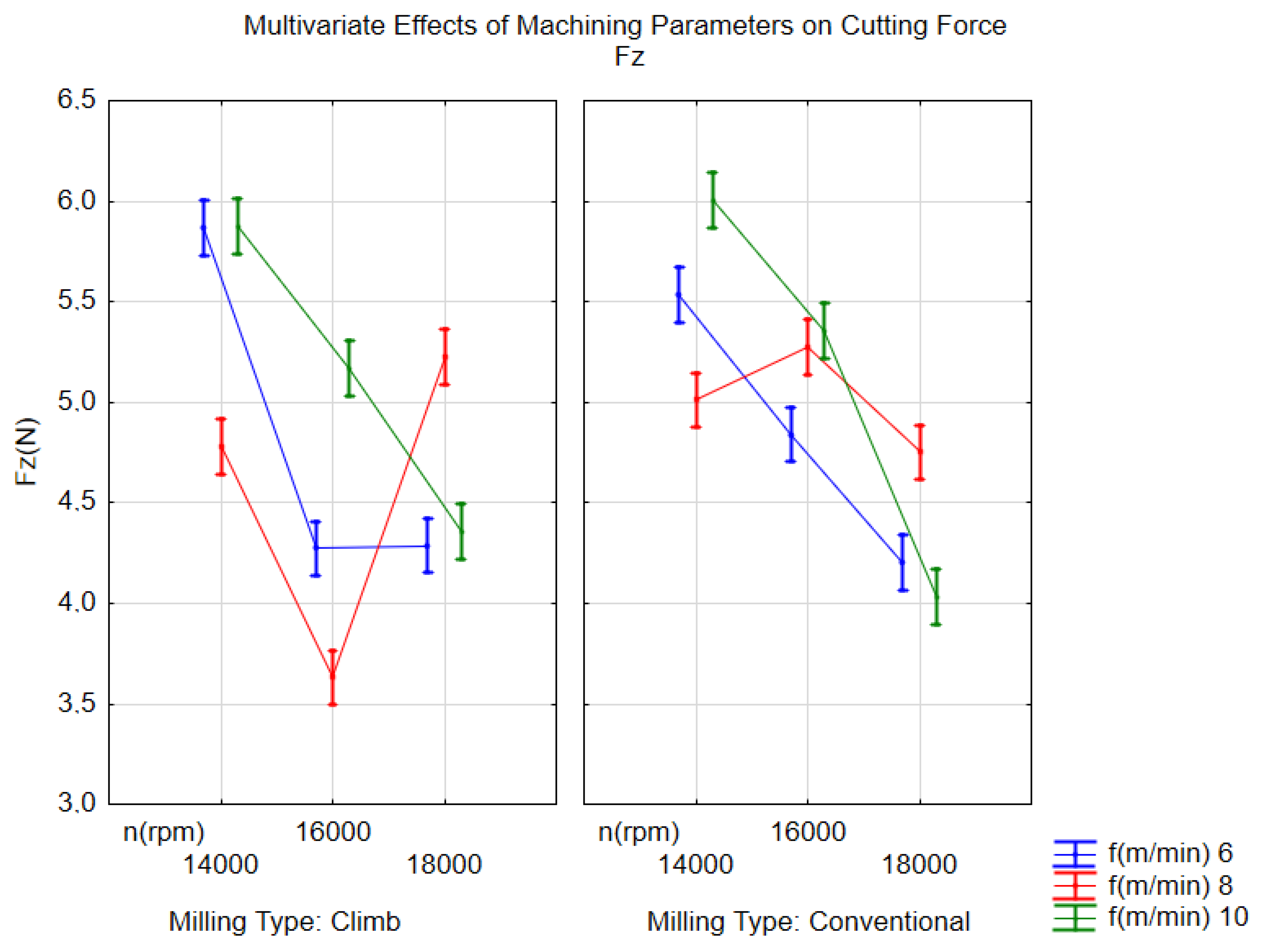
Figure 7 shows how cutting parameters influence cutting force in direction Fz, graph shows all cutting parameters are in range of each other with little change less than 2 N.
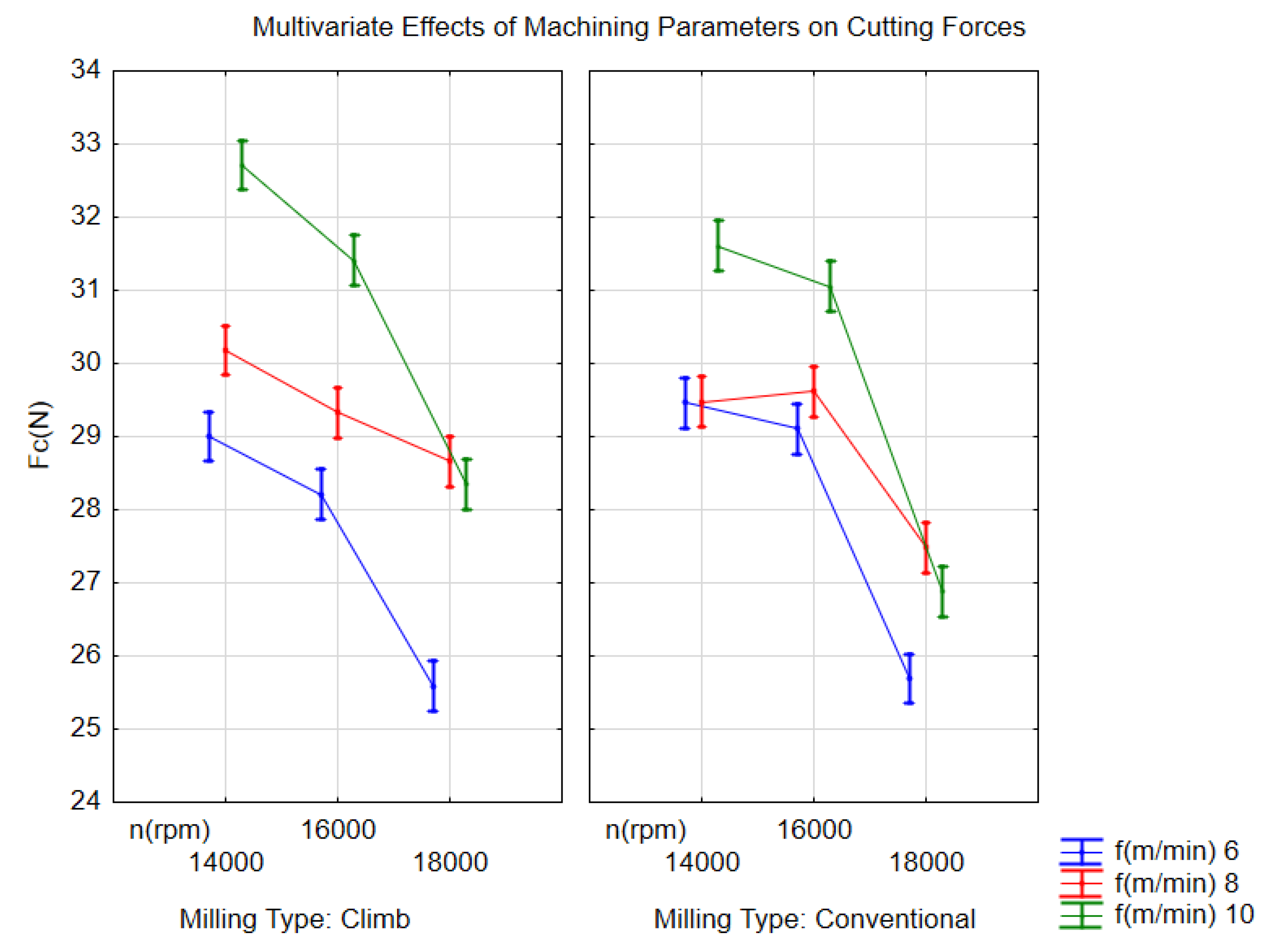
Figure 9 shows graph of dependence of computed force Fc on technological parameters. It can be seen that computed force increases with increase of feed speed, and decreases with increase of rotation of tool. This fact also comes for theory of cutting, when cutting force decrease with increase in cutting speed due to decreasing thickness of removed material. This graph shows that force doesn’t change much with change of milling type.
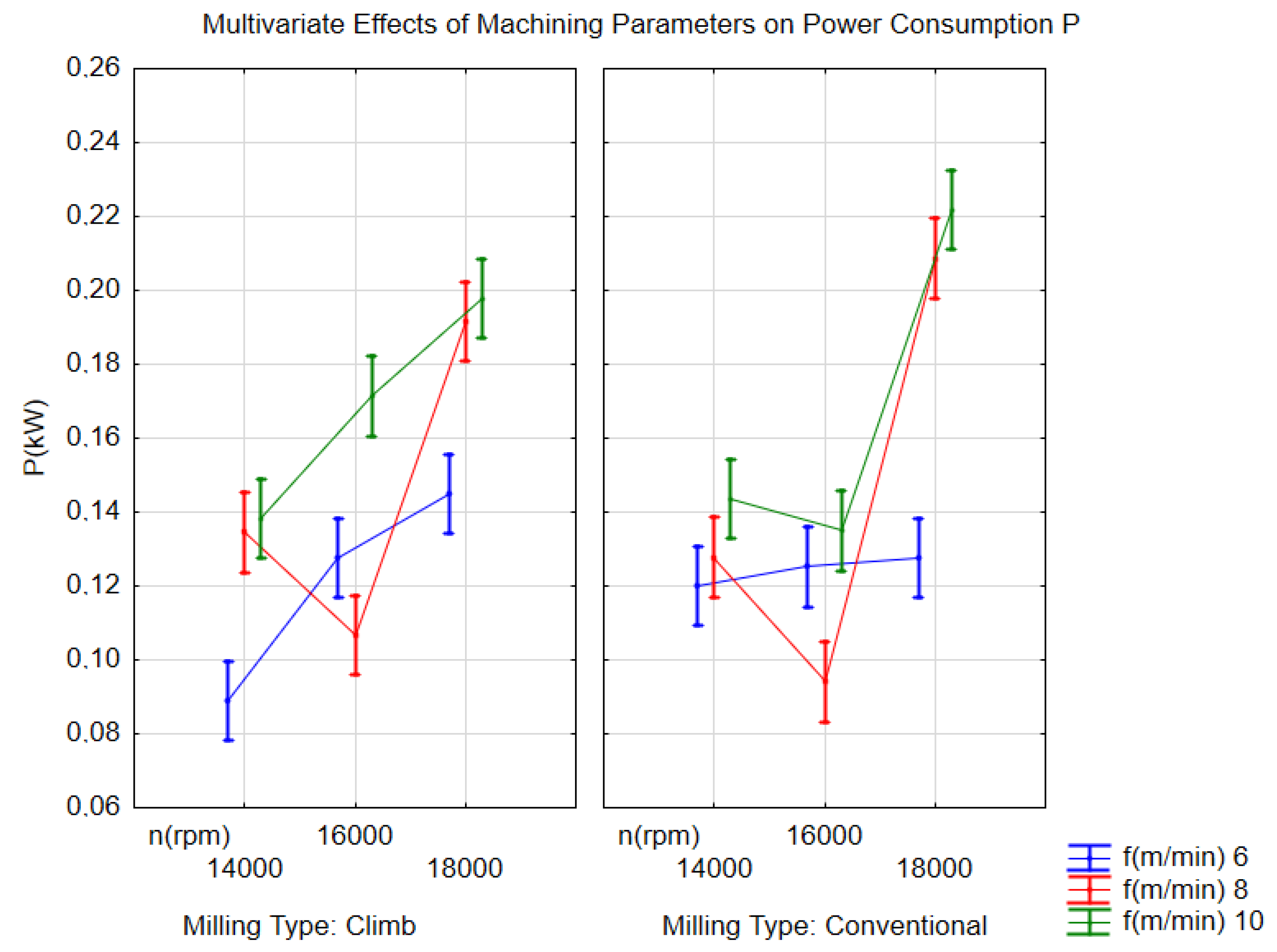
Figure 8 shows the dependence of the consumed power required for material removal by the technological parameters of milling. With increasing speed of rotation of tool, the consumed electrical power increases mainly due to higher currents flowing through the electrical winding of the electric spindle.
F-test determines whether differences between group means are statistically significant by comparing variability between groups to variability within groups. In ANOVA SS (Sum of Squares) measures total variation, MS (Mean Square) is SS divided by its degrees of freedom, F is the ratio of between-group variance to within-group variance (MS between / MS within), and p is the probability of observing such an F value if there is actually no real difference between groups.
From data in
Table 9 it can be seen that all examined factors have a statistically significant effect on the force
Fx. Spindle speed
n (rpm) demonstrates a strong influence (F = 284.98, p < 0.001), while feed rate
f (m/min) also shows statistical significance (F = 6.00, p = 0.003). Milling type exhibits the highest F value (F = 24853.98, p < 0.001), indicating that it is the dominant factor affecting Fx. Based on the magnitude of the F statistics, milling type contributes most substantially to variations in Fy, followed by spindle speed, whereas feed rate has a comparatively smaller effect.
All investigated factors are highly statistically significant (p < 0.001) for force
Fy according to results in
Table 10. Milling type yields the largest F value (F = 23848.25), indicating the strongest influence on Fy. Feed rate (F = 1145.58) and spindle speed (F = 883.48) also demonstrate pronounced and statistically significant effects. These results confirm that Fz is strongly dependent on both cutting conditions and the selected milling type.
The f-test results in
Table 11 reveal statistically significant effects of all three factors (p ≤ 0.001) for parameters
Fz. Spindle speed shows the greatest impact (F = 360.90), followed by feed rate (F = 45.66). Although milling type is statistically significant (F = 27.38, p = 0.000001), its effect is comparatively smaller. Therefore, Fz is predominantly influenced by spindle speed, with secondary contributions from feed rate and milling type.
In
Table 12 results indicate that spindle speed (F = 614.56, p < 0.001), feed rate (F = 311.32, p < 0.001), and milling type (F = 17.31, p < 0.001) all significantly influence parameter Fc. Among these factors, spindle speed exhibits the strongest effect, followed by feed rate, while milling type contributes to a lesser extent. Therefore, Fc is predominantly governed by cutting conditions.
The f-test for power consumption in
Table 13 indicates that spindle speed (F = 210.13, p < 0.001) and feed rate (F = 104.58, p < 0.001) significantly influence the response. In contrast, milling type does not exhibit a statistically significant effect (F = 0.01, p = 0.931). This suggests that parameter P is determined mainly by cutting conditions rather than by the type of milling process.
3.2. Predictive Modeling
Matlab Prediction Learner was used as a tool for creation of predictive models. Main goal was to predict total force Fc. This program allows wide selection of different model types, their training, testing and is then followed by comparison. Main parameters used for comparison are Root Mean Square Error (RMSE) and coefficient of determinator R2. The parameters RMSE of created models should be as close as possible to value of 1. It is also important to compare RMSE values for the training and testing datasets. If trained and tested data have large difference between each other it may indicate that model has memorised the training data and is therefore unsuited for new data.
Data used as predictors for model training were: spindle speed (n), feed speed (f) and milling type. Dependent variable was total force created by milling tool during process of material removal from workpieces. To choose right model, initial training and testing were carried out using all available model in Matlab environment, after which models were subsequently compared. The testing data originated from measured dataset obtained during experiments, this data is about 10% from total measured data.
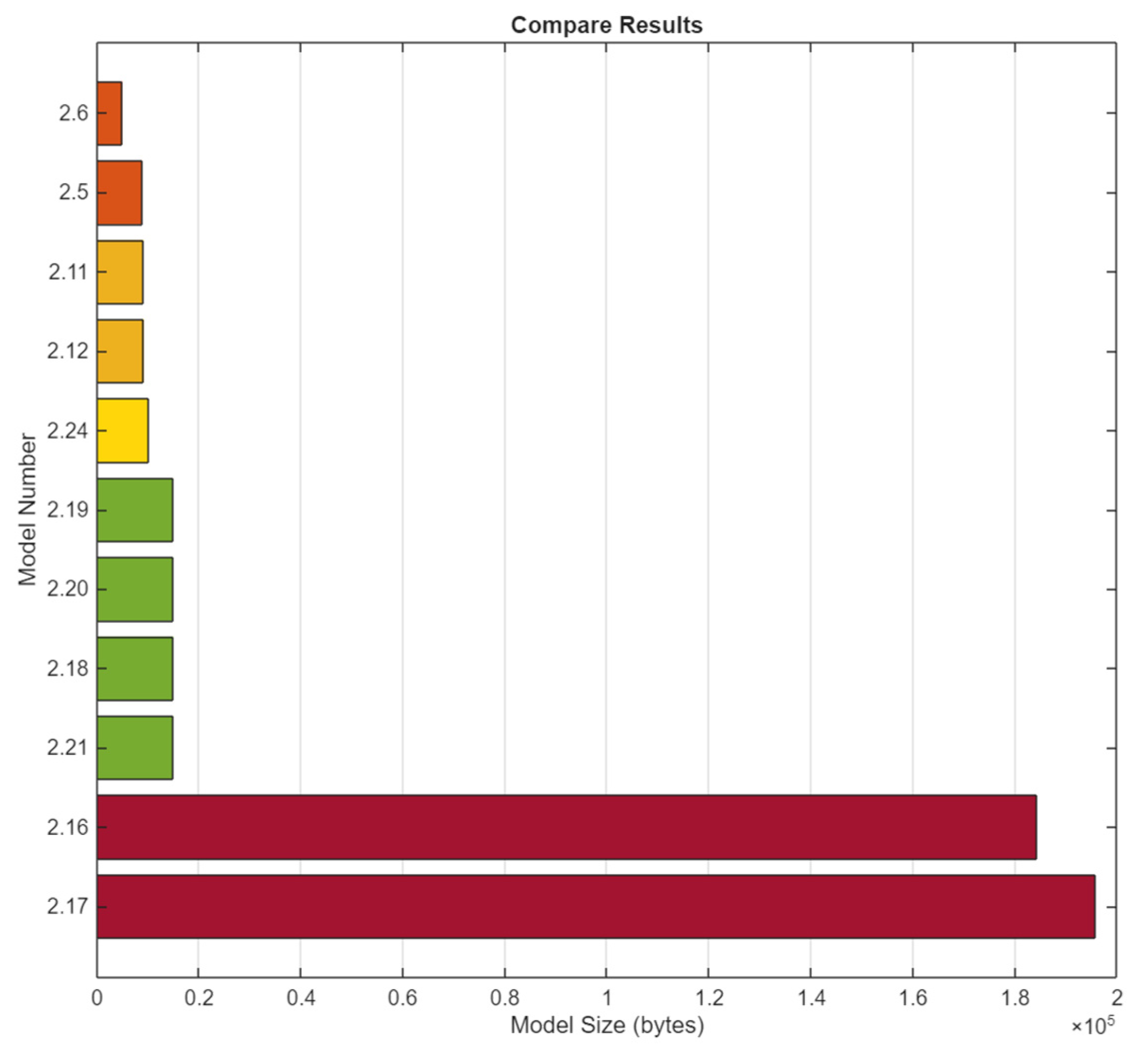
After filtering clearly unsuitable models (RMSE ≥ 0.7 and R2 ≤ 0.8), the remaining models were further compared with respect to their size in bytes. The size of the resulting models for Boosted Trees (Model No. 2.16) and Bagged Trees (Model No. 2.17) exceeded 18 × 104 bytes, while the other models were below 1.5 × 104 bytes what is shown Figure. With a larger dataset, this imbalance would be even more apparent, for this reason models with this high of requirement were removed from further analysis.
Figure 10.
Comparison of models by required memory.
Figure 10.
Comparison of models by required memory.
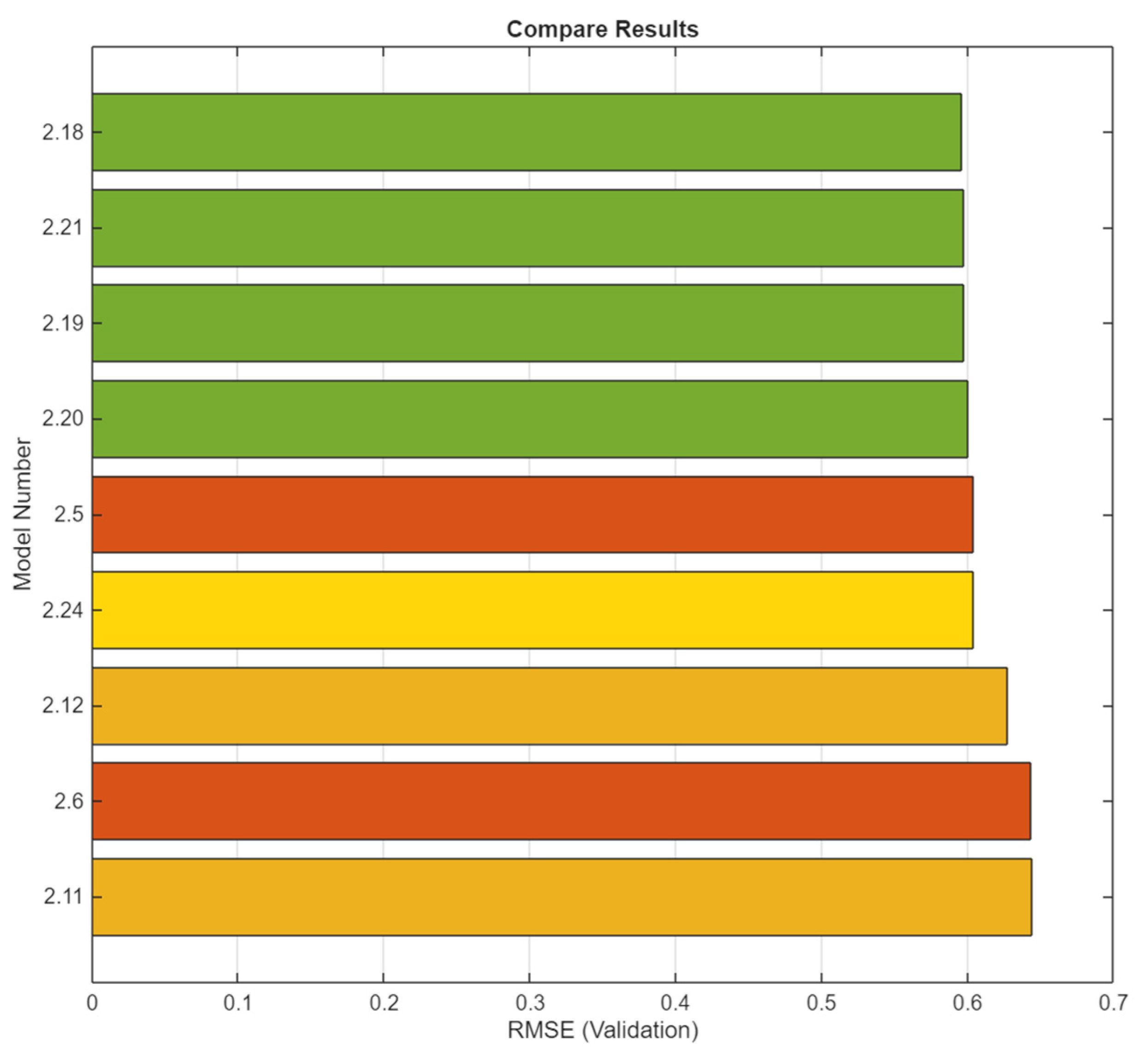
The filtered models (RMSE ≤ 0.7 and R
2 ≥ 0.8) are shown in
Figure 11, with their RMSE and R
2 being very similar.
The values of RMSE (Root Main Square Error), MSE (Main Square Error), R
2 (Coefficient of determination) and MAE (Main Absolute Error) for both validation and test are in
Table 14. Table also contains training time and model size. From their comparison, the Fine Tree model appears to be optimal, which has low RMSE, short training time (3,88s) and reasonable model size (8919 bytes).
Based on comparison in
Table 14, the Fine Tree model (Model No. 2.5) was further analysed.
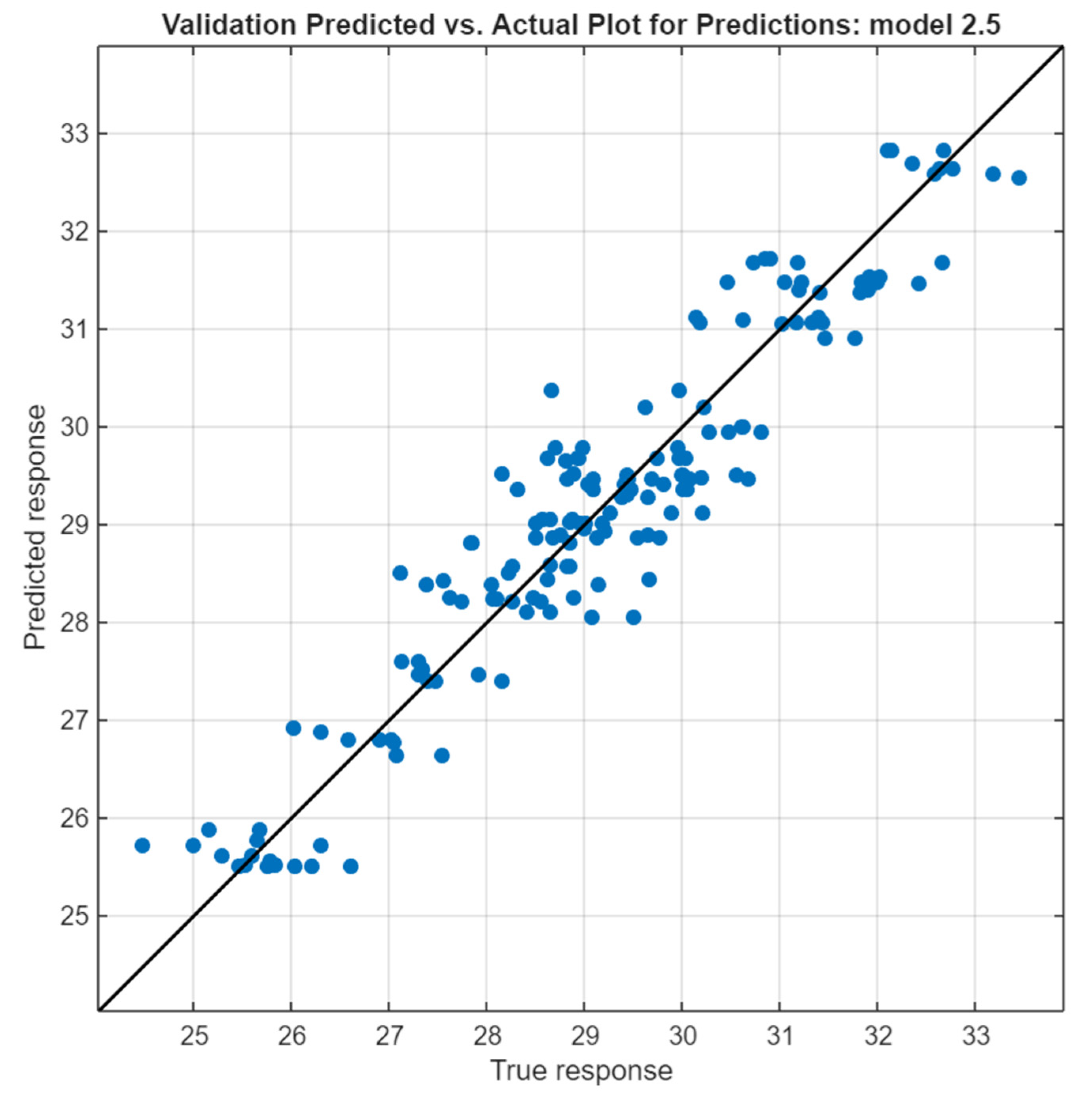
Figure 12 shows the predicted response compared to the true response. These approximate have linear relationship where their distance from line represents the prediction model error.
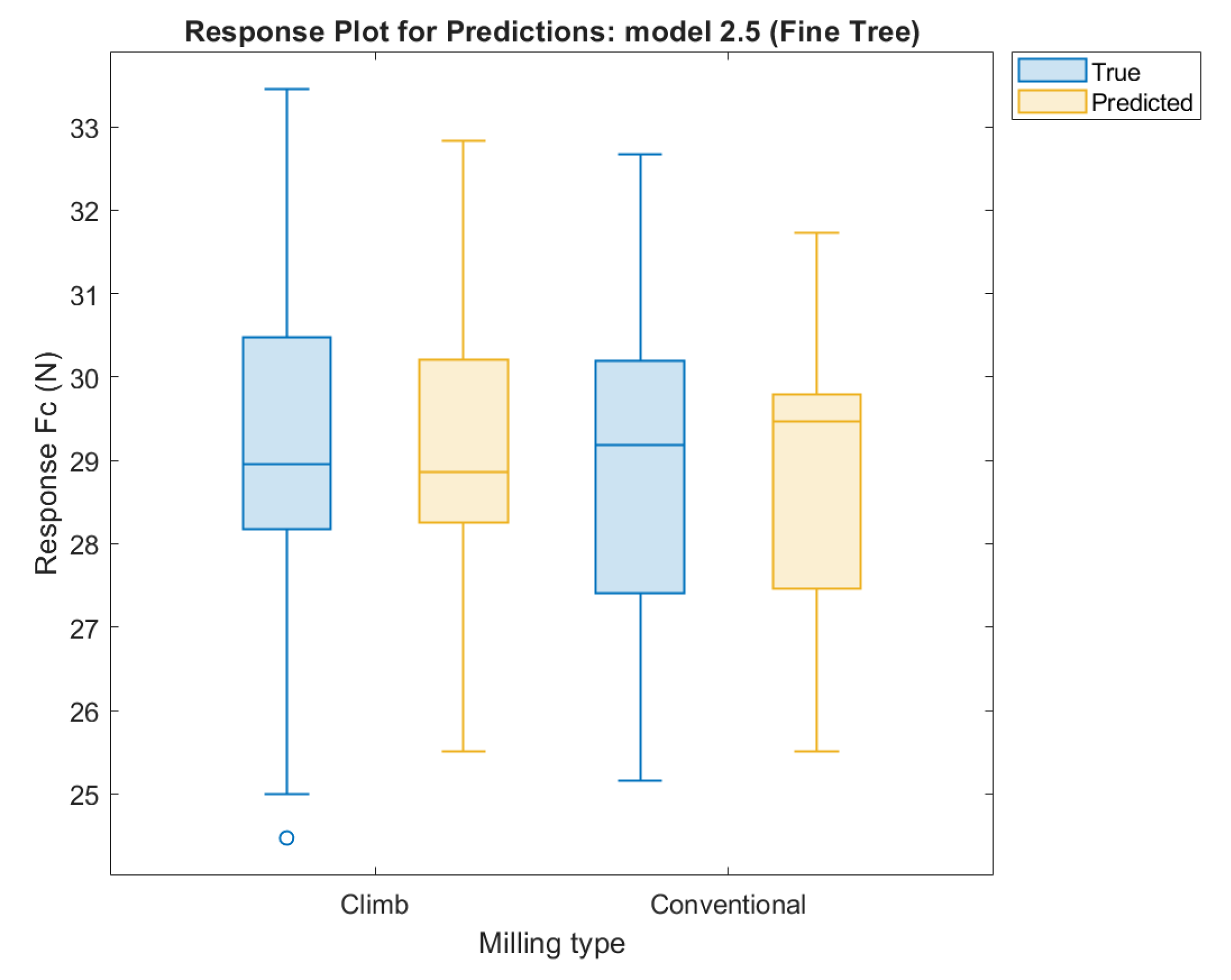
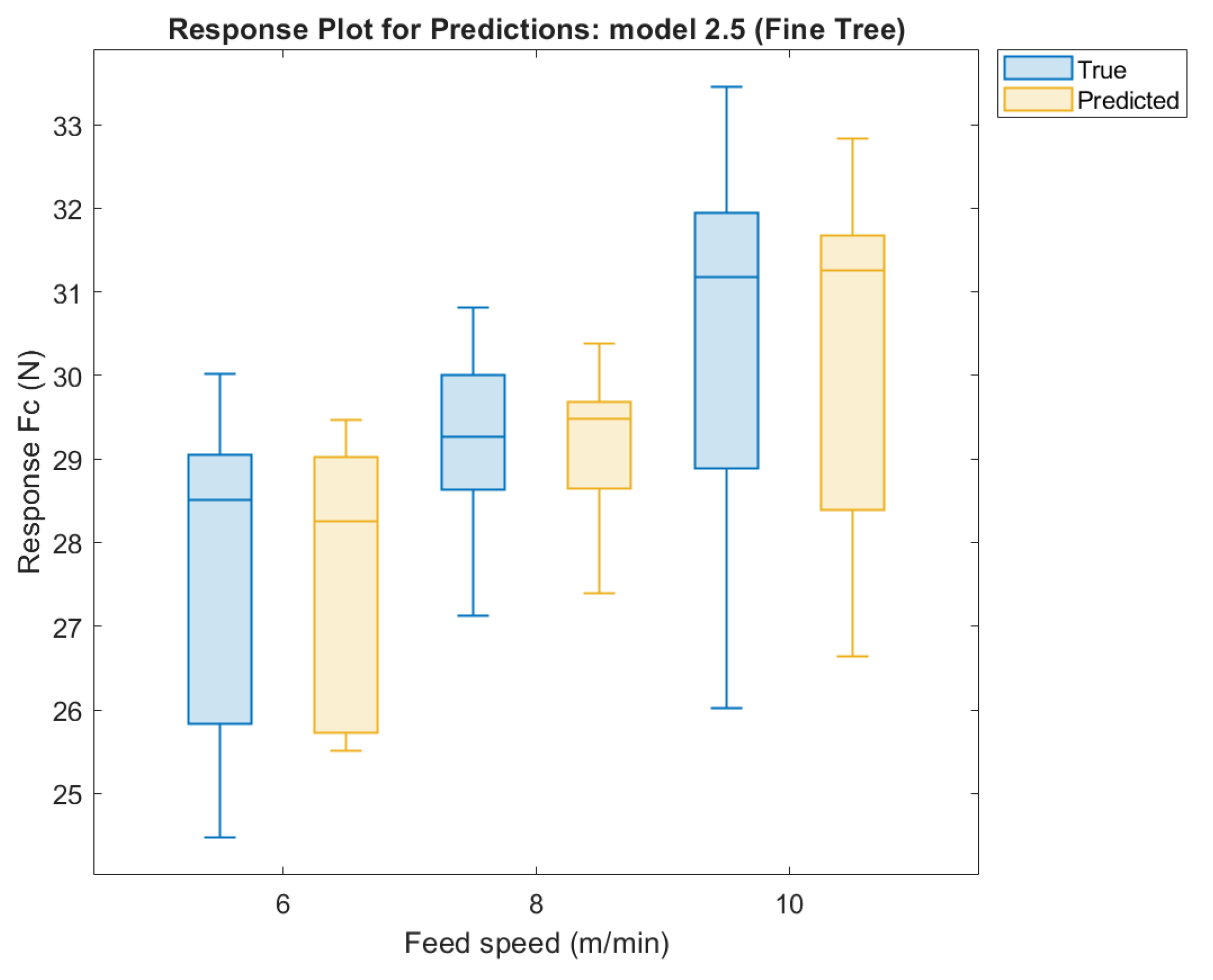
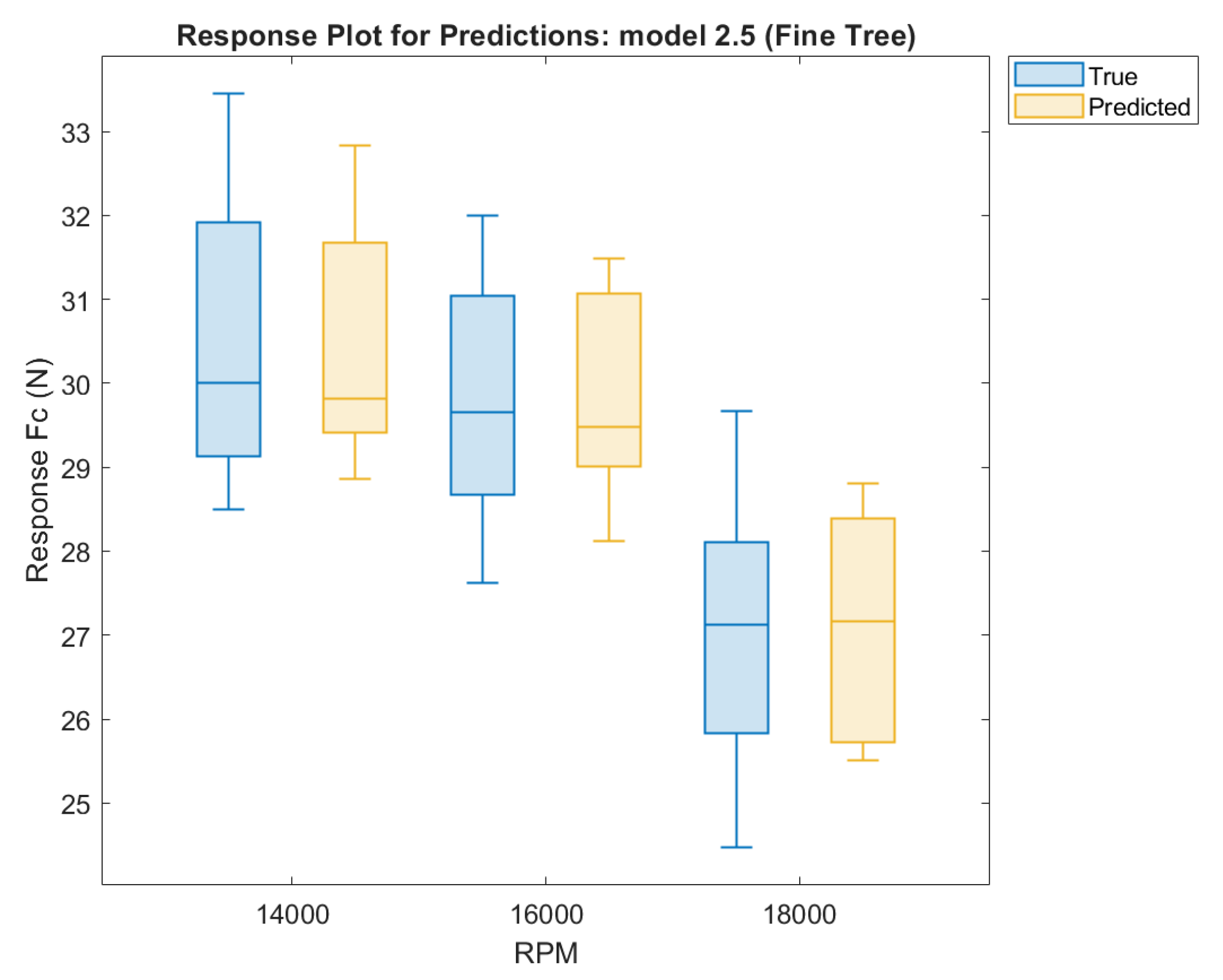
Figure 12,
Figure 13,
Figure 14 and
Figure 15 show comparison between measured and predicted values for individual predictors in box graph format. From first look at figures it is clear that learned model predicts value that is within values of experimental measurements. It can be seen that there is slight shift, that may be a consequence to amount of training data. By further expanding and learning the model can decrease inaccuracy. It should be emphasized that not all predictors and their change appeared to be statistically significant during ANOVA analysis.
3.3. Comparison of Residual Values for Validated and Tested Data
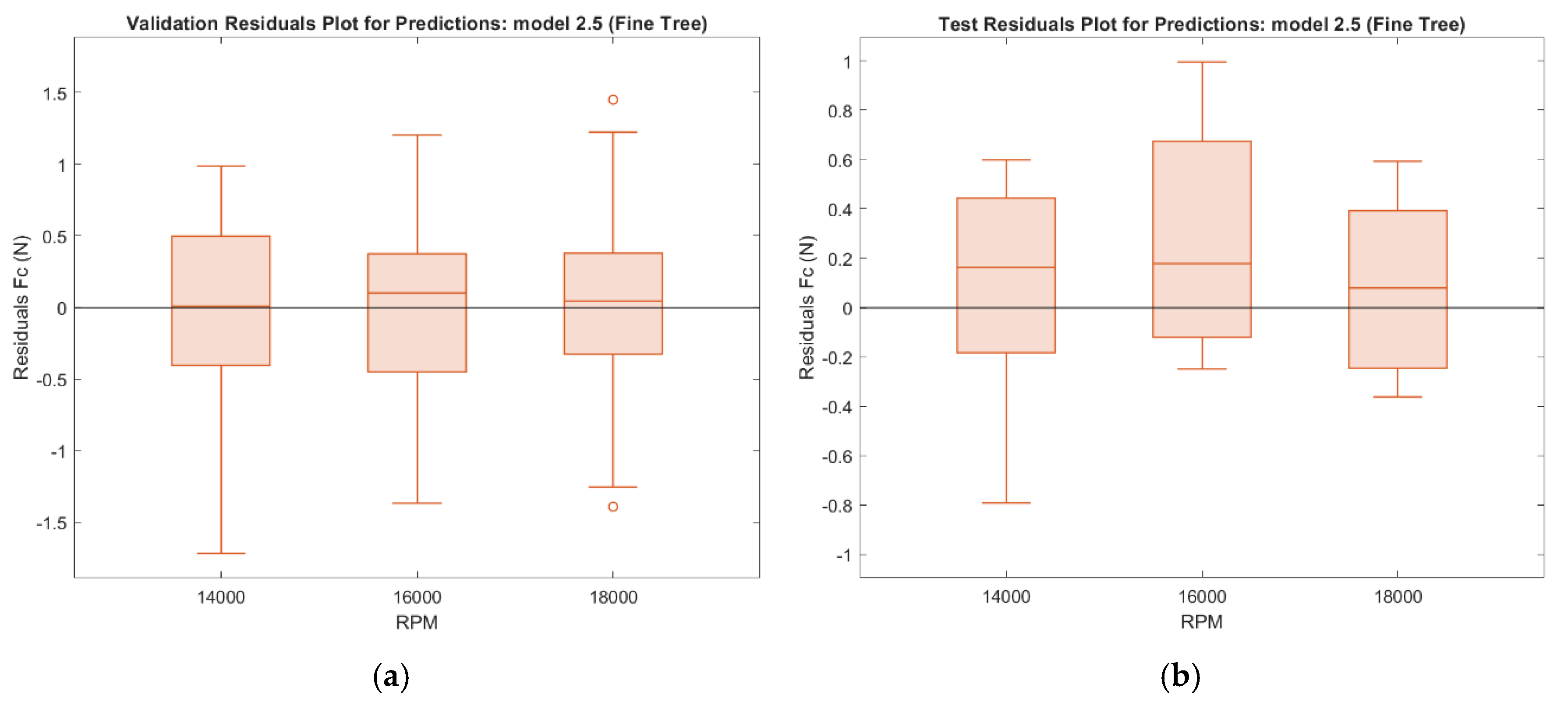
The residuals values should be randomly distributed around zero, without any visible pattern (such as a linear trend). If a pattern appears, it may indicate that the model has memorized the training data rather than learning general relationships, which limits its ability to perform well on new unseen data. The residual comparisons for the Fine Tree model (Model No. 2.5), analysed by individual predictors for the validated and tested values, are presented in
Figure 16.
Figure 16 shows a comparison of validation residuals (a) and test residuals (b) for the RPM predictor. The distribution for validation residuals is around the zero value in the interval ± 0.5 N, some extreme values are +1 respectively -1.5 N. The distribution for test residuals is more in positive values, but also lies in the value around 0.5, i.e., corresponds to the validated residuals. This means that model can be considered as suitably trained.
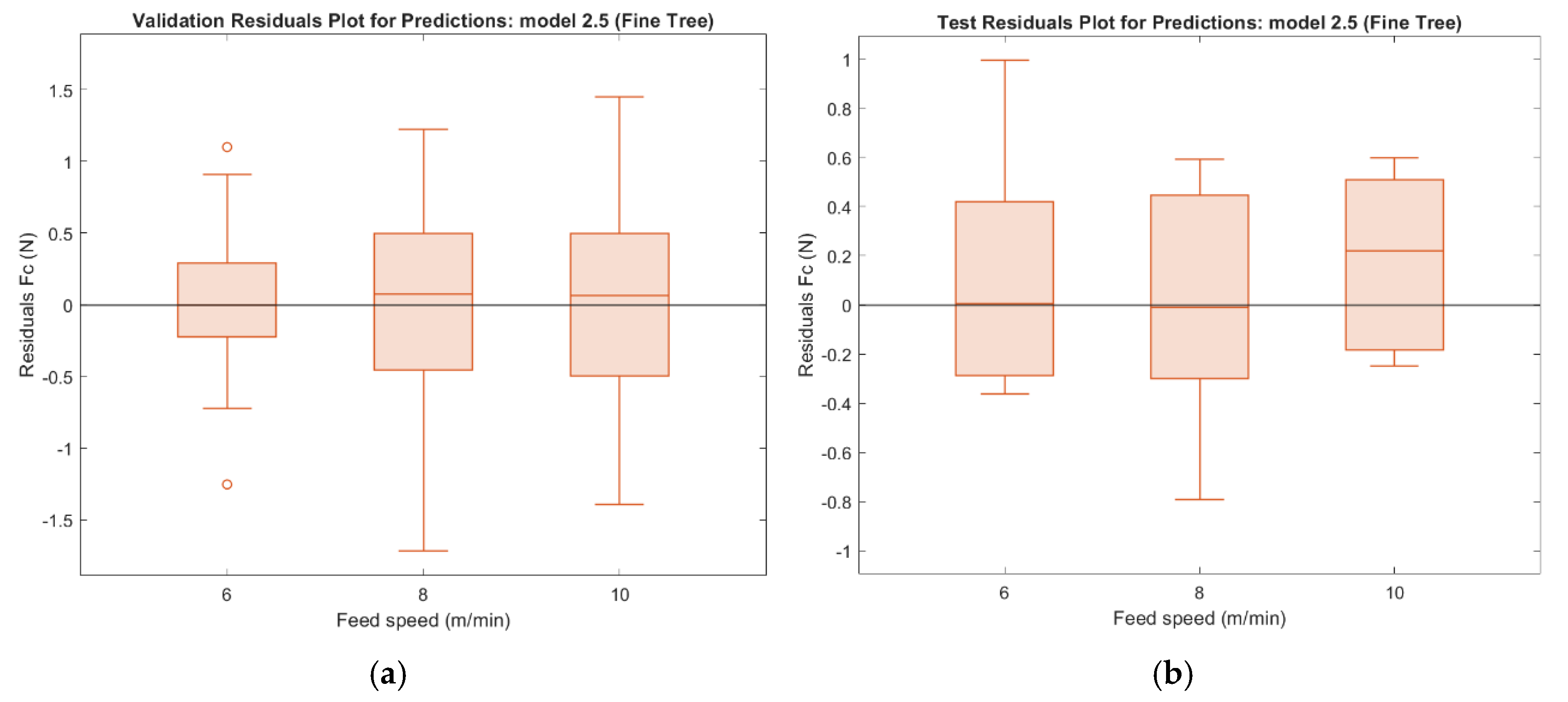
Figure 17 shows a comparison of validation residuals (a) and test residuals (b) for the Feed speed predictor. The distribution for validation residuals is around the zero value in the interval ± 0.5 N, some extreme values are +1.5 respectively -1.5 N. The test residuals are slightly shifted toward positive values; however, most of them also fall within ±0.5 N. Overall, the distribution of test residuals corresponds well to that of the validation residuals. This means that model can be considered as suitably trained.
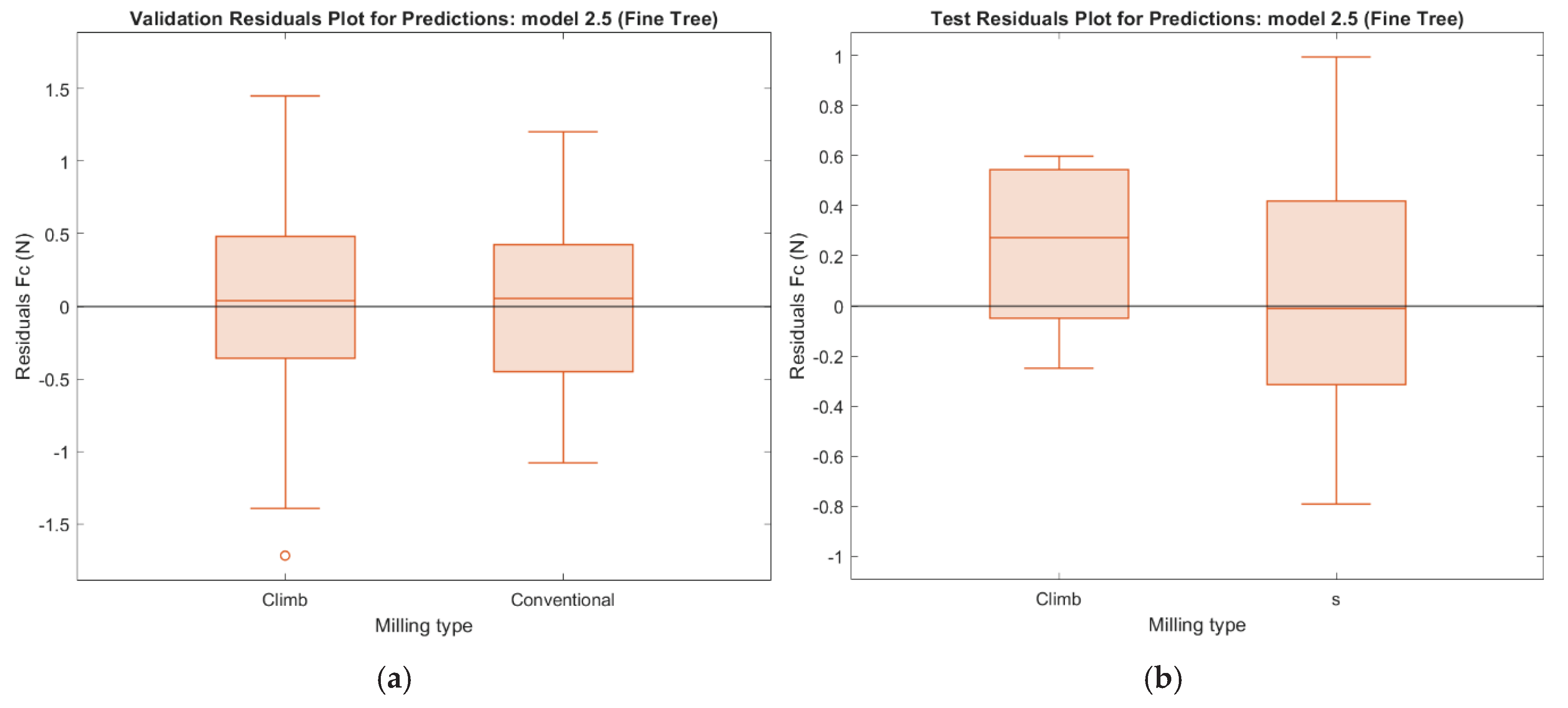
Figure 18 shows a comparison of validation residuals (a) and test residuals (b) for the Direction of milling predictor. The distribution for validation residuals is around the zero value in the interval ± 0.5 N, some extreme values are +1.5 respectively -1.5 N. The distribution for test residuals is more in positive values, especially at climb milling. Nevertheless, the majority of values remain within ±0.5 N, indicating that the distribution of test residuals is similar to that of the validation residuals. This means that model can be considered as suitably trained.
4. Discussion
The presented research investigated the influences of technical and technological parameters (rotation speed of tool, feed speed of tool and type of milling) on generated forces and energetical consumption during milling process of board material of MDF samples. Next objective of the research was accessing the possibility of using calculated total force Fc for the purpose of developing prediction models and evaluation of their accuracy. From the point of view of evaluating the consumption of electrical energy and, this does not seem to be entirely suitable for prediction models. First, the influence of technological variables on it is statistically the least pronounced. Furthermore, the consumed electrical energy and its measurement is an integral function of electrical currents and voltages, which affects its evaluation in real time.
From the perspective of force effects, individual orthogonal force components and cutting total power were evaluated. Force components were oriented according to configuration specified by the sensor manufacturer and were calculated as the absolute difference between the values measured during milling process and during idling of machine. Conventional milling exhibited lower values of the Fx component and higher values of the Fy component compared to climb milling. The Fz force component showed similar values regardless of the milling type. At the same time, the total cutting force Fc was slightly higher during climb milling, whereby similar findings have been reported in Hanincová et al. [
26]. If the force components Fx and Fy were assessed, the type of milling has the greatest influence on their change based on the F-test. However for the calculated total cutting force, spindle speed was the most influential factor. For power consumption most influential factor was also spindle speed. It was also confirmed that power consumption increases with higher spindle speed.
4.1. Model Comparison
From the point of view of assessing the suitability for the obtained data for creation predictive models, linear regression was chosen. This is more suitable than classic multi-layer neural networks, for this type of obtained data due to their small number and individual dependencies. By comparing individual models with respect to the correlation coefficient, mean square error, and training time most suitable type of model is Fine Tree. Decision tree models are often analysed as suitable for predicting the quality of the created surface [
27,
28,
29]. At the same time, other applications of machine learning are being verified and tested to prevent undesirable phenomena occurring during machining, which are often modified for specific applications [
30].
5. Conclusions
The aim of this study was to evaluate the suitability of data on cutting forces and electrical energy consumption generated during the milling of MDF boards for the development of predictive models. Although MDF boards represent a relatively homogeneous material, this characteristic did not present a limitation, particularly in the interpretation of the developed and tested model for the total cutting force Fc. In addition, the statistical significance of technological parameters with respect to the measured variables was assessed. Duncan’s post-hoc test confirmed significant effects, especially for the total cutting force, across all independent variables. The main findings can be summarized as follows:
A statistically significant effect on the measured variables was observed primarily in the force-related responses, particularly in the calculated total cutting force Fc. In contrast, for electrical energy consumption, statistically similar data sets were identified when changing spindle speed from 14,000 to 16,000 rpm and when altering the milling type (climb vs. conventional milling).
Based on the F-test results, spindle speed exerted the greatest influence on both the total cutting force Fc and electrical energy consumption, while milling type had the smallest overall effect. For the force components in the x and y directions, the direction of milling had the most pronounced influence, which is consistent with the theoretical principles of cutting mechanics and force decomposition in an orthogonal coordinate system.
Force effects in the z-axis direction were negligible compared to the force components in the x and y directions.
The development of predictive models appears to be an effective approach for estimating force effects based on input technical and technological parameters. Predictive models in the form of decision trees proved to be easily interpretable and exhibited low prediction error, without indications of overfitting or underfitting.
The developed model is straightforward to interpret and can be further extended by incorporating additional input variables.
Author Contributions
Conceptualization, T.Č. and P.K. (Peter Koleda); methodology T.Č. and P.K. (Peter Koleda); material preparation, R.K.; CNC program preparation, J.Š.; CNC machine operation, L.Š.; measurement of power consumption P.K. (Peter Koleda); measurement of cutting forces T.Č.; Data Curation T.Č. and P.K. (Peter Koleda); statistical evaluation T.Č. and P.K. (Peter Koleda), model creation P.K. (Peter Koleda); model testing and training P. K. (Peter Koleda); Visualization, T.Č. and P.K. (Pavol Koleda); writing-original draft preparation, T.Č. and P.K. (Peter Koleda); writing-review and editing, P.K. (Peter Koleda) and Z.V.; Supervision P.K. (Peter Koleda); Project Administration T.Č. and P.K. (Peter Koleda); Funding Acquisition T.Č. and P.K. (Peter Koleda). All authors have read and agreed to the published version of the manuscript.
Funding
This research was co-funded by APVV-20-0403 „FMA analysis of potential signals suitable for adaptive control of nesting strategies for milling wood-based agglomerates” and the EU NextGenerationEU through the Recovery and Resilience Plan for Slovakia under project No. 09I03-03-V05-00016.
Institutional Review Board Statement
Not applicable.
Informed Consent Statement
Not applicable.
Data Availability Statement
The raw data supporting the conclusions of this article will be made available by the corresponding author on request.
Conflicts of Interest
The authors declare no conflicts of interest.
References
- Petre, I.M.; Găvruş, C. Influence of the Cutting Force upon Machining Process Efficiency. Mater. Today Proc. 2023, 72, 586–593. [Google Scholar] [CrossRef]
- Chatterjee, K.; Zhang, J.; Dixit, U.S. Data-driven Framework for the Prediction of Cutting Force in Turning. IET Collab. Intell. Manuf. 2020, 2, 87–95. [Google Scholar] [CrossRef]
- Hernández-González, L.W.; Curra-Sosa, D.A.; Pérez-Rodríguez, R.; Zambrano-Robledo, P.D. Modeling Cutting Forces in High-Speed Turning Using Artificial Neural Networks. TecnoLógicas 2021, 24, 43–61. [Google Scholar] [CrossRef]
- Wyeth, D.J.; Goli, G.; Atkins, A.G. Fracture Toughness, Chip Types and the Mechanics of Cutting Wood. A Review COST Action E35 2004–2008: Wood Machining–Micromechanics and Fracture. Holzforschung 2009, 63, 2. [Google Scholar] [CrossRef]
- Anh, Nguyen Thi; Tung, Tran Thanh. Cutting force prediction in end milling processes: Analytical models and applications. Applications in Engineering Science, Volume Volume 23(2025), 100250. Available online: https://www.sciencedirect.com/science/article/pii/S2666496825000482. [CrossRef]
- Felhő, C.; Namboodri, T.; Delgado Sobrino, D.R. Analysis of Cutting Forces Response to Machining Parameters Under Dry and Wet Machining Conditions in X5CrNi18-10 Turning. Eng 2026, 7, 33. [Google Scholar] [CrossRef]
- Korkmaz, M.E.; Gupta, M.K.; Li, Z.; Krolczyk, G.M.; Kontoglu, M.; Binali, R.; Ysar, N.; Pimenov, D.Yu. Indirect Monitorin of machining characteristics via advanced sensor systems: a critical review. The international Journal of Adv. Manuf. Technology 2022, 120, 7043–7078. [Google Scholar] [CrossRef]
- Franz, N.C. An Analysis of Chip Formation in Wood Machining; University of Michigan: Ann Arbor, MI, USA, 1958. [Google Scholar]
- Pahlitzsch, G.; Dziobek, K. Untersuchungen Über Das Bandschleifen von Holz Mit Geradliniger Schnittbewegung. Holz Als Roh-Und Werkst. 1959, 17, 121–134. [Google Scholar] [CrossRef]
- Porankiewicz, B.; Bermudez, E.J.; Tanaka, C. Cutting Forces by Peripheral Cutting of Low Density Wood Species. BioResources 2007, 2, 671–681. [Google Scholar] [CrossRef]
- Hlásková, L.; Orlowski, K.A.; Kopecký, Z.; Jedinák, M. Sawing Processes as a Way of Determining Fracture Toughness and Shear Yield Stresses of Wood. BioResources 2015, 10, 5381–5394. [Google Scholar] [CrossRef]
- Orlowski, K.; Ochrymiuk, T. A Newly-Developed Model for Predicting Cutting Power during Wood Sawing with Circular Saw Blades. Maderas Cienc. Tecnol. 2017, 19, 149–162. [Google Scholar] [CrossRef]
- Gomez, M.; Schmitz, T. Low-cost, constrained-motion dynamometer for milling force measurement. Manufacturing Letters Available at. 2020. [Google Scholar] [CrossRef]
- Luo, M.; Chong, Z.; Liu, D. Cutting Forces Measurement for Milling Process by Using Working Tables with Integrated PVDF Thin-Film Sensors. Sensors Available at. 2018, 18(11), 4031. [Google Scholar] [CrossRef] [PubMed]
- Rosca, A. S.; Craciunoiu, N.; Geonea, I. D.; Ciurezu Gherghe, L. Experimental measurement of the cutting forces and wear of the drill in processing X17CrNi16-2 martensitic stainless steel. Mechanics & Mechanical Engineering Available at. 2021, vol 12, pg. 269–287. [Google Scholar] [CrossRef]
- Sousa, V.F.C.; Silva, F.J.G.; Fecheira, J.S.; Lopes, H.M.; Martinho, R.P.; Casais, R.B.; Ferreira, L.P. Cutting Forces Assessment in CNC Machining Processes: A Critical Review. Sensors. Available at. 2020. [CrossRef]
- Yun, K.; Liu, M.; Bing, J.; Xiao, L.; Wan, L. Development and Testing of an Integrated Rotating Dynamometer Based on Fiber Bragg Grating for Four-Component Cutting Force Measurement. Sensors Available at. 2018, 18(4). [Google Scholar] [CrossRef]
- Bal, B. C.; Dumanoğlu, F. Surface roughness and processing time of a medium density fiberboard cabinet door processed via CNC router, and the energy consumption of the CNC router. BioRes Available at. 2019, 14(4), 9500–9508. [Google Scholar] [CrossRef]
- Ji, F.; Zhu, Z. Investigation of Cutting Forces and Temperature in Face Milling of Wood–Plastic Composite Using Radial Basis Function Neural Network Materials. 2025, 18(20), 4731. [Google Scholar] [CrossRef]
- Silva, F. J. G.; Martinho, R. P.; Magalhães, L. L.; Fernandes, F.; Sales-Contini, R. C. M.; Durão, L. M.; Casais, R. C. B.; Sousa, V. F. C. A Comparative Study of Different Milling Strategies on Productivity, Tool Wear, Surface Roughness, and Vibration. Journal of Manufacturing and Materials Processing 2024, 8(3), 115. [Google Scholar] [CrossRef]
- Hong, M.; Lubis, M.A. R.; Park, B. Effect of Panel Density and Resin Content on Properties of Medium Density Fiberboard. KoreaScience 2017. [Google Scholar] [CrossRef]
- SMC. Technical manual SCM-Tech Z5. 2015. Available online: https://www.scribd.com/document/694632836/SCM-Tech-Z1-Z2-Z5.
- Kistler. Instruction Manual: Quartz 3-Component Dynamometer Type 9257B. 2019. Available online: https://www.kistler.com/SK/en/cp/multicomponent-dynamometers-9257b/P0000675.
- Fisher, R. A. Statistical methods for research workers; Oliver & Boyd: Edinburgh, 1925. [Google Scholar]
- Montgomery, D. C. Design and analysis of experiments, 8th ed.; John Wiley & Sons: Hoboken, NJ, 2017. [Google Scholar]
- Hanincová, L.; Procházka, J.; Novák, V. Comparative Analysis of Cutting Forces in CNC Milling of MDF: The Role of Tool Coatings, Cutting Speed, and Feed Per Tooth. Coatings 2024, 14, 1085. [Google Scholar] [CrossRef]
- Rodríguez, J. J.; Quintana, G.; Bustillo, A.; Ciurana, J. A decision-making tool based on decision trees for roughness prediction in face milling. International Journal of Computer Integrated Manufacturing 2017, 30(9), 943–957. [Google Scholar] [CrossRef]
- Przybyś-Małaczek, A.; Antoniuk, I.; Szymanowski, K.; Kruk, M.; Kurek, J. Ap-plication of Machine Learning Algorithms for Tool Condition Monitoring in Milling Chipboard Process. Sensors 2023, 23, 5850. [Google Scholar] [CrossRef]
- Viswanathan, P.C.; Sridharan, N.V.; Mahanta, T.K.; et al. A Comparative Study on Tree-Based Classifiers for Condition Monitoring of Face Milling Tool. J. Vib. Eng. Technol. 2025, 13, 214. [Google Scholar] [CrossRef]
- Aggogeri, F.; Pellegrini, N.; Tagliani, F.L. Recent Advances on Machine Learning Applications in Machining Processes. Appl. Sci. 2021, 11, 8764. [Google Scholar] [CrossRef]
Figure 1.
Simplified drawing of experiment.
Figure 1.
Simplified drawing of experiment.
Figure 2.
3D model of experiment (Creo parametric).
Figure 2.
3D model of experiment (Creo parametric).
Figure 3.
Record of raw data of cutting forces.
Figure 3.
Record of raw data of cutting forces.
Figure 4.
Record of data of cutting forces after filtering.
Figure 4.
Record of data of cutting forces after filtering.
Figure 5.
Analysis of variance for Fx force dependence on technological parameters.
Figure 5.
Analysis of variance for Fx force dependence on technological parameters.
Figure 6.
Analysis of variance for Fy force dependence on technological parameters.
Figure 6.
Analysis of variance for Fy force dependence on technological parameters.
Figure 7.
Analysis of variance for Fz force dependence on technological parameters.
Figure 7.
Analysis of variance for Fz force dependence on technological parameters.
Figure 8.
Analysis of variance for Fc force dependence on technological parameters.
Figure 8.
Analysis of variance for Fc force dependence on technological parameters.
Figure 9.
Analysis of variance for P force dependence on technological parameters.
Figure 9.
Analysis of variance for P force dependence on technological parameters.
Figure 11.
Comparison of filtered models.
Figure 11.
Comparison of filtered models.
Figure 12.
Distribution of predicted responses according to their true values.
Figure 12.
Distribution of predicted responses according to their true values.
Figure 13.
Measured and predicted values of milling type.
Figure 13.
Measured and predicted values of milling type.
Figure 14.
Measured and predicted values of feed speed.
Figure 14.
Measured and predicted values of feed speed.
Figure 15.
Measured and predicted values of revolutions of milling tool.
Figure 15.
Measured and predicted values of revolutions of milling tool.
Figure 16.
Residuals for RPM Predictor a) Validation residuals, b) Test Residuals.
Figure 16.
Residuals for RPM Predictor a) Validation residuals, b) Test Residuals.
Figure 17.
Residuals for feed speed Predictor a) Validation residuals, b) Test Residuals.
Figure 17.
Residuals for feed speed Predictor a) Validation residuals, b) Test Residuals.
Figure 18.
Residuals for milling Predictor a) Validation residuals, b) Test Residuals.
Figure 18.
Residuals for milling Predictor a) Validation residuals, b) Test Residuals.
Table 1.
Parameters of cutting tool.
Table 1.
Parameters of cutting tool.
| Parameter |
Description/Value |
| Tool type |
End mill |
| Construction |
Monolithic (solid tool) |
| Cutting edge geometry |
Spiral/Helical |
| Number of flutes |
3 |
| Tool diameter |
20 mm |
| Chip removal |
Positive |
Table 2.
Parameters of variation used in experiment.
Table 2.
Parameters of variation used in experiment.
| Parameter |
Values |
| Spindle speed (rpm) |
14 000, 16 000, 18 000 |
| Tool feed rate (m/min) |
6, 8, 10 |
| Milling type |
Conventional, Climb |
Table 3.
Descriptive statistics of Fx.
Table 3.
Descriptive statistics of Fx.
Table 4.
Descriptive statistics of Fy.
Table 4.
Descriptive statistics of Fy.
Table 5.
Descriptive statistics of Fz.
Table 5.
Descriptive statistics of Fz.
Table 6.
Descriptive statistics of P.
Table 6.
Descriptive statistics of P.
Table 7.
Descriptive statistics of overall force Fc.
Table 7.
Descriptive statistics of overall force Fc.
Table 8.
Analysis of variance.
Table 8.
Analysis of variance.
| Variable |
SS |
df |
MS |
SS |
df |
MS |
F |
p |
| P |
0,250 |
17 |
0,015 |
0,048 |
162 |
0,000298 |
49,259 |
0,00 |
|
Fx
|
4276,886 |
17 |
251,582 |
26,703 |
162 |
0,164832 |
1526,290 |
0,00 |
|
Fy
|
4607,697 |
17 |
271,041 |
26,497 |
162 |
0,163560 |
1657,138 |
0,00 |
|
Fz
|
79,995 |
17 |
4,706 |
7,728 |
162 |
0,047705 |
98,640 |
0,00 |
|
Fc
|
633,681 |
17 |
37,275 |
48,615 |
162 |
0,300095 |
124,212 |
0,00 |
Table 9.
F-test for parameter Fx.
Table 9.
F-test for parameter Fx.
| Effect |
SS |
MS |
F |
p |
|
n(rpm)
|
93.95 |
46.97 |
284.98 |
0.000000 |
|
f(m/min)
|
1.98 |
0.99 |
6.00 |
0.003054 |
|
Milling Type
|
4096.73 |
4096.73 |
24853.98 |
0.000000 |
Table 10.
F-test for parameter Fy.
Table 10.
F-test for parameter Fy.
| Effect |
SS |
MS |
F |
p |
|
n(rpm)
|
289.00 |
144.50 |
883.48 |
0.000000 |
|
f(m/min)
|
374.74 |
187.37 |
1145.58 |
0.000000 |
|
Milling Type
|
3900.61 |
3900.61 |
23848.25 |
0.000000 |
Table 11.
F-test for parameter Fz.
Table 11.
F-test for parameter Fz.
| Effect |
SS |
MS |
F |
p |
| n(rpm) |
34.43 |
17.22 |
360.90 |
0.000000 |
| f(m/min) |
4.36 |
2.18 |
45.66 |
0.000000 |
| Milling Type |
1.31 |
1.31 |
27.38 |
0.000001 |
Table 12.
F-test for parameter Fc.
Table 12.
F-test for parameter Fc.
| Effect |
SS |
MS |
F |
p |
| n(rpm) |
368.85 |
184.43 |
614.56 |
0.000000 |
| f(m/min) |
186.85 |
93.43 |
311.32 |
0.000000 |
| Milling Type |
5.19 |
5.19 |
17.31 |
0.000052 |
Table 13.
F-test for parameter P.
Table 13.
F-test for parameter P.
| Effect |
SS |
MS |
F |
p |
| n(rpm) |
0.13 |
0.06 |
210.13 |
0.000000 |
| f(m/min) |
0.06 |
0.03 |
104.58 |
0.000000 |
| Milling Type |
0.00 |
0.00 |
0.01 |
0.930993 |
Table 14.
Comparison of selected models.
Table 14.
Comparison of selected models.
| Model Number |
Model Type |
Validated |
Tested |
Training Time (s) |
Model Size (bytes) |
| RMSE |
MSE |
R2
|
MAE |
MAE |
MSE |
RMSE |
R2
|
| 2.18 |
Squared Exponential GPR |
0.6 |
0.36 |
0.91 |
0.48 |
0.37 |
0.21 |
0.46 |
0.95 |
3.96 |
14957 |
| 2.21 |
Rational Quadratic GPR |
0.6 |
0.36 |
0.91 |
0.48 |
0.37 |
0.21 |
0.46 |
0.95 |
3.85 |
14988 |
| 2.19 |
Matern 5/2 GPR |
0.6 |
0.36 |
0.91 |
0.48 |
0.37 |
0.21 |
0.46 |
0.95 |
3.89 |
14937 |
| 2.20 |
Exponential GPR |
0.6 |
0.36 |
0.91 |
0.48 |
0.36 |
0.21 |
0.46 |
0.95 |
3.92 |
14943 |
| 2.5 |
Fine Tree |
0.6 |
0.36 |
0.9 |
0.48 |
0.36 |
0.2 |
0.44 |
0.95 |
3.88 |
8919 |
| 2.24 |
Wide Neural Network |
0.6 |
0.37 |
0.9 |
0.49 |
0.36 |
0.2 |
0.44 |
0.95 |
4 |
10117 |
| 2.12 |
Medium Gaussian SVM |
0.63 |
0.39 |
0.9 |
0.51 |
0.38 |
0.26 |
0.51 |
0.93 |
3.47 |
9180 |
| 2.6 |
Medium Tree |
0.64 |
0.41 |
0.89 |
0.51 |
0.52 |
0.41 |
0.64 |
0.9 |
3.88 |
4979 |
| 2.11 |
Fine Gaussian SVM |
0.64 |
0.42 |
0.89 |
0.51 |
0.35 |
0.2 |
0.45 |
0.95 |
3.46 |
9100 |
|
Disclaimer/Publisher’s Note: The statements, opinions and data contained in all publications are solely those of the individual author(s) and contributor(s) and not of MDPI and/or the editor(s). MDPI and/or the editor(s) disclaim responsibility for any injury to people or property resulting from any ideas, methods, instructions or products referred to in the content. |
© 2026 by the authors. Licensee MDPI, Basel, Switzerland. This article is an open access article distributed under the terms and conditions of the Creative Commons Attribution (CC BY) license (http://creativecommons.org/licenses/by/4.0/).