

Submitted:
04 March 2026
Posted:
05 March 2026
You are already at the latest version
Abstract
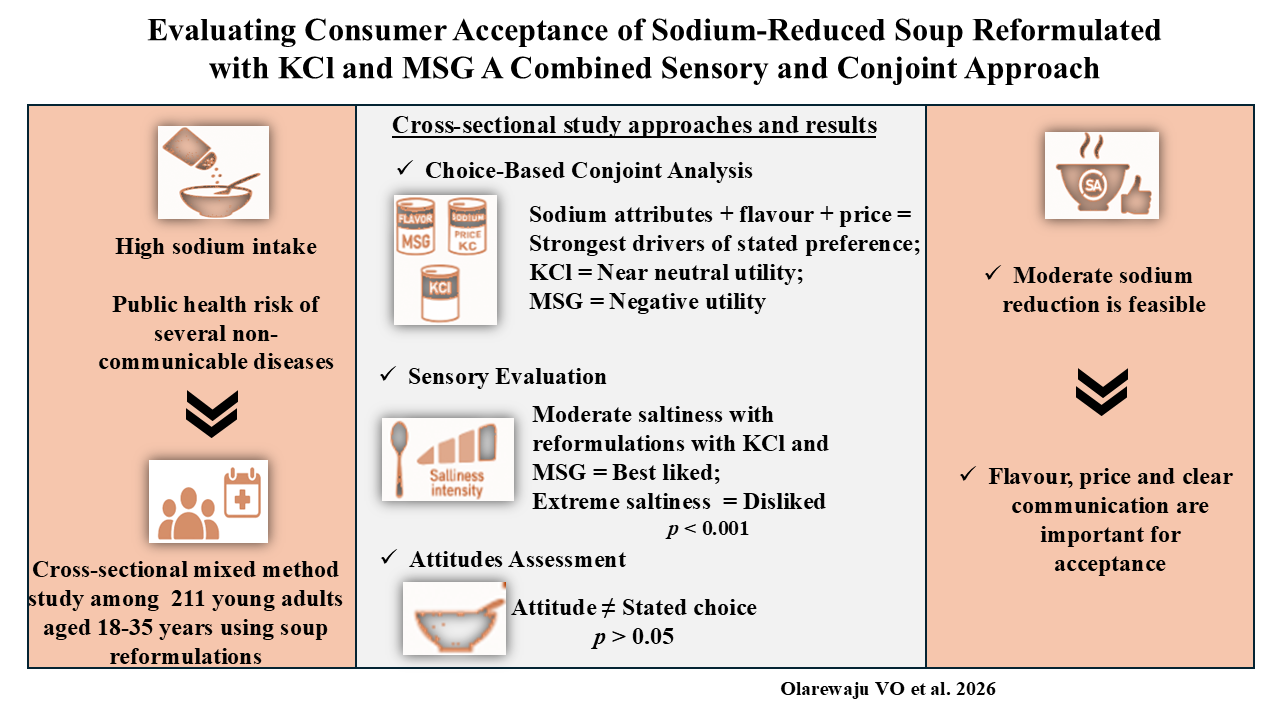
Excess sodium intake is a growing public health concern in Malaysia. Reformulation using potassium chloride (KCl) and monosodium glutamate (MSG) offers a potential strategy to reduce sodium while maintaining palatability, although consumer responses to these ingredients remain mixed. This study examined young adults’ preferences for sodium-reduced canned soup and evaluated how flavour, sodium information, price, and additive-related cues influence stated choice, alongside sensory evaluation of sodium-reduced formulations. A cross-sectional mixed-method study was conducted among 211 Malaysian young adults. Participants completed a choice-based conjoint (CBC) experiment comprising six hypothetical purchase tasks that varied across seven product attributes. Multinomial logit models estimated part worth utilities and attribute importance. Sensory evaluation was conducted in a controlled environment using the generalised Labelled Magnitude Scale (gLMS) and Labelled Affective Magnitude (LAM) scale to assess saltiness intensity and pleasantness across soup formulations. Sodium-related attributes accounted for approximately 36% of stated decision weight, with sodium reduction percentage and flavour emerging as the strongest drivers of stated choice. Moderately sodium-reduced formulations incorporating KCl and MSG achieved favourable sensory ratings. Young adults’ acceptance of sodium-reduced soup is shaped primarily by flavour, sodium cues, and affordability. Sensory findings support the feasibility of sodium reduction using KCl and MSG without compromising palatability.
Keywords:
sodium reduction
; conjoint analysis
; sensory evaluation
; KCl
; MSG
; consumer acceptance
; young adults
; Malaysia
Copyright: This open access article is published under a Creative Commons CC BY 4.0 license, which permit the free download, distribution, and reuse, provided that the author and preprint are cited in any reuse.


