

Submitted:
02 March 2026
Posted:
04 March 2026
Read the latest preprint version here
Abstract
Background: The standard cosmological model provides an excellent phenomenological description of the Universe. Motivated by persistent cosmological tensions, particularly in the Hubble constant (H0), this study proposes and tests the Gibbs Energy Redistribution Theory (GERT) as a thermodynamically grounded alternative to the expansion history model. Our central hypothesis is that a dynamical expansion history derived from fundamental thermodynamic principles empirically alleviates cosmological tensions, including the Hubble tension. At this stage, it provides a more physically coherent description of cosmic evolution, interpreting effects traditionally attributed to ad hoc dark components as emergent thermodynamic manifestations. Methods: We introduce a phenomenological, thermodynamically motivated model, the Gibbs Energy Redistribution Theory (GERT), in which the effective contributions of the matter- and lambda-like sectors are promoted to smooth, density-controlled functions, yielding a dynamical expansion history H(z) within the Friedmann Equation framework. We compared the resulting H(z) predictions with cosmic microwave background (CMB) shift-parameter constraints, baryon acoustic oscillation (BAO) distance measurements, and Type Ia supernova data. The analysis pipeline used standard open source scientific Python tools. Results: For the baseline implementation (the minimal-parameter reference fit described in the Methods), we obtained an excellent global fit (degrees of freedom (dof): χ2/dof ≈ 0.99) against CMB shift-parameter constraints, BAO distance measurements, and Type Ia supernova data, and inferred H0 ≈ 72.5 km s−1 Mpc−1, consistent with local determinations (e.g., SH0ES project). We quantified the deviations from the standard model in the diagnostic plots of H(z) and distance moduli. Conclusions: The framework yields concrete, testable predictions for late time expansion behavior, offering a physically coherent and causal narrative for cosmic evolution, and can be further constrained by future low-redshift probes.
Keywords:
cosmology
; thermodynamics
; Hubble tension
; expansion history
; emergent gravity
Guidelines for Readers (roadmap).
This manuscript follows a top-down logic-first approach. For readers primarily interested in technical verification and reproducibility, the key components are as follows: Figures and tables are cited in their respective sections; when referring to a specific item in the text, we use the standardized forms “Figure ” and “Table ”.
- Conceptual postulates and phases:Section 2 (Paradigms of GERT) and introductory figures.
- Data, Likelihoods, and Inference:Section 4 (datasets, 2 construction, priors, and MCMC strategy).
- Model Selection and Parameter Reduction: Corner plots and summary tables are presented in Section 4.
- Direct Comparison withCDM:Section 5.2.
- Code and Data Availability:Section 10.
Minimal reproduction steps: Clone/download the public repository described in Section 10, create the provided environment (e.g., via requirements.txt/environment.yml), and run the main pipeline script/notebook to reproduce the figures and summary tables. The exact datasets and 2 construction are described in Section 4 of this paper.
1. Motivation
A Crisis Built on Success: The Historical Context for a New Paradigm
For much of the twentieth century, fundamental physics enjoyed a remarkable, if uneasy, equilibrium. On the largest scales, Einstein’s General Relativity provided an extraordinarily precise description of the geometry and dynamics of spacetime, confirmed by increasingly refined observations of gravitational lensing, planetary motion, and the large-scale structure of the Universe [1,2]. On the smallest scales, the Standard Model of particle physics offered an elegant and experimentally successful framework for the fundamental constituents of matter and their interactions. Between these two pillars stood what appeared to be physics’ last great open problem: the unification of General Relativity with Quantum Mechanics into a single coherent theory of quantum gravity [3]. The Universe, it seemed, was essentially understood. The remaining task was to close the final seam. That sense of comfort did not survive the closing years of the twentieth century.
In 1998 and 1999, two independent teams — the High-Z Supernova Search Team [4] and the Supernova Cosmology Project [5] — announced a result that fundamentally altered the trajectory of cosmology. Observations of Type Ia supernovae at high redshift revealed that the expansion of the Universe was not slowing down under the influence of gravity, as expected, but accelerating. Something was pushing spacetime apart with increasing force. General Relativity, applied to a Universe filled only with known matter and radiation, had no mechanism to produce this behavior. The equations were correct; the content was not.
The response was swift and, by necessity, pragmatic. To preserve the success of the relativistic framework, two new entities were introduced into the cosmic energy budget. Dark energy — a placeholder for whatever was driving the accelerated expansion, mathematically encoded as a cosmological constant Λ — was assigned approximately 68% of the total energy content of the Universe. Dark matter — whose gravitational necessity had been indicated for decades by galactic rotation curves [6] and cluster dynamics [7] — was assigned a further 27%. Together, these two unknown components account for approximately 95% of everything the standard model requires to exist, yet neither has been directly detected, and the physical nature of both remains entirely unresolved [8].
It is important to be precise about what this represents. The postulation of dark matter and dark energy was not an error. It was a scientifically legitimate and historically necessary response to a genuine observational crisis. When the data demands an explanation and the existing framework cannot provide one, science does what it must: it extends the framework to accommodate the anomaly. In this sense, ΛCDM was a success — it restored predictive consistency at the cost of ontological transparency. The model works. The question this paper asks is a different one: whether a solution designed for an emergency should be allowed to calcify into a foundation. A provisional answer that successfully describes the data is a scientific achievement. The error lies not in proposing it, but in treating an emergency measure as though it were a first principle — in allowing the scaffolding erected to stabilize a crisis to become, over decades, the architecture itself.
This is not a minor gap in knowledge. It is a structural admission: the standard cosmological model, CDM, is a framework in which the overwhelming majority of the cosmic content is described by terms whose ontological status is unknown. Dark energy is not a substance with a derivation; it is a parameter adjusted to fit the data. Dark matter is not a confirmed particle; it is a gravitational inference. The model works precisely because these terms are free to absorb whatever the known physics cannot explain [9,10].
The decades following 1998 brought further refinement but also new tensions. The most persistent of these is the Hubble tension: a statistically significant discrepancy between the value of the Hubble constant inferred from the early Universe via CMB observations and that measured directly from the local Universe via the distance ladder [8,11]. This tension has not resolved with improved data; if anything, it has sharpened [9,10,12]. It is now widely regarded [8,11] not as a systematic error but as a potential signal that the standard expansion history is incomplete [10].
The Hubble tension is, in this reading, the moment when the scaffolding begins to show its age. It is the anomaly that the emergency measure cannot absorb without further ad hoc adjustment — the point at which the provisional answer starts to demand a provisional answer of its own. It is precisely this recursive instability that, in the framework of Kuhn’s theory of scientific revolutions [13], signals that a paradigm has reached the limits of its explanatory capacity and that the conditions for a deeper reorganization of principles are becoming necessary.
It is in this context — a model of great descriptive power built on conceptually unresolved foundations, now showing internal stress — that the present work is situated. The Gibbs Energy Redistribution Theory (GERT) does not propose to repair CDM from within by adding yet another component. It asks whether the expansion history of the Universe can be derived from a physical principle that requires no new substances at all: the minimization of Gibbs Free Energy in a closed thermodynamic system. If the answer is yes, then dark matter and dark energy are not missing ingredients but emergent descriptions of a deeper thermodynamic reality — and the Hubble tension becomes, as we shall argue, a natural consequence of using a static parameter to describe what is in fact a dynamic process.
1.1. The Need for a New Perspective: The Crisis in Modern Cosmology
Fundamental cosmology is highly descriptively successful, yet it faces a profound conceptual impasse. The Standard Cosmological Model (CDM), despite its precision, rests on an unresolved divide between General Relativity (GR) and Quantum Mechanics (QM) and on components that account for approximately 95% of the cosmic energy budget — dark matter and dark energy—whose nature remains unknown. These entities, together with other postulates such as the inflaton, were introduced to reconcile theory and observations, but have no direct empirical detection, and thus function as placeholders in the cosmic balance sheet. (For a sampling of alternative/emergent approaches in the literature, see, e.g.,[14,15,16,17,18].)
The current situation is reviewed in several recent and complementary perspectives [9,10]. For representative discussions of proposed resolutions and systematics in the Hubble-tension context, see, e.g., [12,19,20,21].
This scenario, which has persisted for decades, is symptomatic of a paradigm that has reached its limits. Incremental adjustments and the addition of new parameters—an “evolutionary” approach—have not resolved the deeper tensions, such as that of the Hubble Constant. This strongly suggests that the difficulty lies not on the surface of the model, but in its intrinsic structural foundations. We argue that the moment is ripe not for another evolution, but for a scientific revolution, in the vein theorized by Thomas Kuhn [13]. A change in perspective that reorganizes the fundamental principles is necessary. The Gibbs Energy Redistribution Theory (GERT), presented in this study, has the potential to be such a revolution, offering a new/old, well-known, and forgotten foundation of thermodynamics to rebuild our understanding of the cosmos.
Modern cosmology, by postulating entities such as dark matter and dark energy, adopts an approach in which complex observed effects are explained by introducing unproven ontological causes. We propose a fundamental methodological inversion: starting from a simple and unifying cause and allowing the complexity of the cosmos to emerge as its natural consequence. That cause is thermodynamics.
Guided by this inversion, this study investigates whether starting from thermodynamics as a simple and unifying cause can account for cosmic complexity and alleviate persistent cosmological tensions, including the Hubble constant discrepancy. Concretely, we confront the resulting expansion-history model with widely used background probes: CMB [8]; BAO from SDSS [22], BOSS [14], and eBOSS [23] analyses; and SNe Ia compilations from JLA [24] and Pantheon [25]. We then compare its performance to standard baselines and recent discussions of the Hubble tension [9,10,11,12].
1.2. Interdisciplinarity: Looking at the cosmos with the Eyes of a Chemist
This study proposes an approach that lies at the intersection of cosmology and physical chemistry [1,2]. We argue that, at the most fundamental level, the Universe may be viewed not only as a mechanical/geometric system but also as a transformation governed by the same principles that drive chemical change. Therefore, applying thermodynamics — the engine of transformation — to the cosmos can illuminate the underlying causes of cosmic evolution rather than merely describing its effects.
The intuition at the heart of GERT is not, in retrospect, entirely foreign to physics. It is, however, foreign to the dominant language in which physics has chosen to express itself. Consider a simple observation from physical chemistry: when a system loses thermal energy to its environment, its molecules approach one another. Cohesive forces dominate. Structure emerges from what was previously a disordered state. Entropy of the local system decreases while the total entropy of the Universe increases, as the Second Law demands. The system contracts, organizes, and builds complexity — not because an external force commands it, but because the thermodynamic conditions make it spontaneous.
Translated to cosmological scales, this is precisely the behavior we observe in the early Universe. Matter agglomerates. Gravitational wells deepen. Galaxies, stars, and planetary systems emerge from what was once a nearly homogeneous plasma. The standard model describes this process geometrically: matter tells spacetime how to curve, and curvature tells matter how to move [1]. This description is correct and extraordinarily precise. But it is a description of the how, not the why. It tells us the grammar of cosmic evolution without telling us its cause.
The question a chemist instinctively asks — why does this system spontaneously organize — what is the thermodynamic driving force? — has historically been met in cosmology with what might be called a paradigmatic deflection: matter curves spacetime; that is the answer; calculate. The question of origin, of why gravity behaves as it does from a thermodynamic perspective, was simply not considered a legitimate scientific question within the established framework.
Yet this question has been asked, with increasing mathematical rigor, within theoretical physics itself. Jacobson showed in 1995 that Einstein’s field equations can be derived from the thermodynamics of local causal horizons, treating spacetime geometry as an equation of state [26]. Padmanabhan developed this line extensively, demonstrating deep connections between gravitational dynamics and thermodynamic extremization principles [27]. Verlinde proposed that gravity itself is not a fundamental force but an entropic phenomenon — an emergent consequence of the tendency of systems to maximize entropy [15,16]. Van Raamsdonk suggested that the very connectivity of spacetime may be rooted in quantum entanglement entropy [28].
These are not peripheral speculations. They are serious theoretical programs, published in leading journals, that converge on a common conclusion: the geometric description of gravity that General Relativity provides may itself be a macroscopic emergent consequence of deeper thermodynamic principles. A further and underexplored convergence point lies in the no-boundary proposal of Hartle and Hawking [29], which establishes that the Universe has no boundary in space or time — no “before” the Big Bang and no “outside” in any geometrically meaningful sense. This result, developed within quantum cosmology from purely geometric arguments, carries a thermodynamic implication that has not been previously made explicit: a universe without boundary is, by definition, a closed thermodynamic system. The thermodynamic consequence of Hawking’s own framework is precisely the closed-system postulate that GERT requires. That this implication was not drawn within physics itself reflects the disciplinary boundaries between quantum cosmology and thermodynamics — boundaries that a perspective rooted in physical chemistry, where system boundaries are a primary conceptual tool, is naturally positioned to dissolve.
GERT arrives at a similar conclusion, but from a fundamentally different starting point and by a different route. Rather than deriving thermodynamic properties from an existing geometric framework, GERT begins with thermodynamics as the primary language and allows geometry — and the expansion history it describes — to emerge as a consequence. The Gibbs Free Energy equation, which in chemistry governs whether a reaction proceeds spontaneously, becomes in GERT the governing criterion for cosmic evolution. Gravity and entropy are not separate forces with separate ontologies; they are the Inward and Outward manifestations of the same Primordial Enthalpic Reservoir redistribution.
What is perhaps most striking is that this convergence — between a chemical intuition about cohesion and entropy, and the formal thermodynamic gravity programs of Jacobson, Padmanabhan, and Verlinde — was arrived at independently, from different intellectual traditions and with different mathematical tools. This independent convergence does not prove that GERT is correct. But it suggests that the thermodynamic perspective on cosmic evolution is not an eccentricity. It is a direction that physics itself has been approaching, from multiple angles, for decades. GERT is, in this sense, the application of that perspective in its most direct and chemically natural form: treating the Universe not as a geometric stage on which matter performs, but as a thermodynamic system that evolves because it must, driven by the same Gibbs criterion that drives every spontaneous process in nature.
1.3. The Search for “Why”: Ontological Gain and Occam’s Razor
The CDM model is primarily phenomenological; it describes how the Universe evolves but leaves the underlying physical mechanisms open. GERT seeks an ontological gain by addressing this causal “why”. Our premise is that the effects commonly attributed to dark matter and dark energy need not be treated as distinct substances; instead, they can be modeled as phase-dependent manifestations of a unified thermodynamic mechanism. By accounting for multiple phenomena within a single framework, GERT aligns with the principle of Occam’s razor.This study advances two complementary hypotheses. Empirically, we define a concrete, reproducible expansion history model (via the state functions and ) and confront it with CMB, BAO, and SNe Ia data. Ontologically, we argue that the same phenomenology can be obtained without reifying dark matter and dark energy as substances. In GERT, they arise as phase-dependent manifestations of a unified thermodynamic mechanism.
This ontological interpretation is currently supported by the model’s success on background-expansion probes; a full validation across other regimes (e.g., galaxy dynamics and lensing) is left for future studies.
Relation to prior thermodynamic/emergent-gravity approaches.
GERT is presented here as a thermodynamically motivated effective expansion-history model. It is not intended as a reformulation of entropic-gravity or spacetime-thermodynamics programs, but it is conceptually adjacent to several lines of work (e.g., horizon/thermodynamic perspectives and emergent-gravity proposals). For context and points of contact, see, e.g., [15,16,17,18,26,27,28,30].
2. The Paradigms of GERT
2.1. Telling the Story of our Home
The Gibbs Energy Redistribution Theory (GERT) proposes that the history of the Universe is governed by an initial reservoir of binding enthalpy (H). Instead of postulating new particles or energies to explain cosmological phenomena, GERT reinterprets these phenomena as consequences of a dynamic Universe that performs Work. The primordial energy “capital” is managed by a single thermodynamic mechanism that manifests in two complementary flows: a contractile one, which curves spacetime and emerges as gravity to sculpt structures, and an expansive one, which emerges as entropy to drive the expansion. The arbiter of this budget is Gibbs Free Energy (G). As long as there is a gradient to perform Work, a time arrow exists. This approach is based on the following paradigms:
2.2. The Thermodynamic Big Bang: The Gibbs Trigger
In the origin of everything, before any metric or smoothly curved geometry, there was only a reservoir: a “cauldron” of energy, maximum density, and zero structure—the Primordial Enthalpic Reservoir.
At its root, there are not properly “two” states—initial and final— to calculate G, but a single point of extreme thermodynamic instability [27]. Classical thermodynamics teaches us that the spontaneity of a process is controlled by the Gibbs Potential [31,32]:
An irreversible transformation occurs only if G. However, before the Big Bang, there were no two well-defined states for calculating G in a standard way. Nevertheless, we can infer what would happen if this Primordial Enthalpic Reservoir - a “cauldron” of colossal enthalpy and almost zero entropy at the maximum temperature allowed by physics - were to destabilize:
- Enthalpy released (H0): The Primordial Enthalpic Reservoir contains all the potential energy of the future Universe. If this energy is converted into motion or radiation, the process becomes profoundly exothermic.
- Entropy generated (S): Particles, radiation, and microscopic degrees of freedom would emerge, exponentially multiplying the number of microstates.
- Temperature at the Planck limit: Any variation would release heat at an immense temperature, causing the term S to be .
2.3. The Bubbling Proto-Metric and the Emergence of Geometry: The Pre-Geometric “Cauldron” and the “Black Box”
We propose that there is an intermediate phase between the Big Bang and the emergence of geometry, which we call the “Bubbling Proto-Metric”. Therefore, the instant following the Big Bang does not give rise to a stable classical geometry. In it, spacetime has already emerged, but not as Einstein’s smooth continuum—it pulses, oscillates, ferments. Small fluctuations begin the path of curvature, proto-nodes of energy collapse, trying to crystallize patterns that are still volatile.
A smooth classical metric is not yet available, but rather local fluctuations of curvature, possibly with transient topological signatures. This is the regime where entropy begins to push and gravity is still contracting, but neither dominates—the Dual Mechanism acts chaotically and balanced, without a defined direction.
It is in this turbulent phase that the thermodynamic “scars”—the initial values of the dynamic parameters—are established, being inherited by the next phase, where geometry consolidates and General Relativity emerges as a valid description. GERT, which uses the tools of relativity, therefore, does not model this phase directly but receives the baton from a Universe that has already passed through its first and most violent thermodynamic act.
In this quantum-thermodynamic ’cauldron’—Phase 1, which we call the Primordial Cauldron—General Relativity has not yet emerged. Therefore, it is methodologically inconsistent to use relativistic equations to describe its evolution, including the mechanism of inflation. In this state, the concept of geometry, of a “ruler” to measure distances as defined by relativity, simply does not apply. The Universe is a quantum-thermodynamic soup.
Therefore, if geometry itself did not yet exist and General Relativity with its “ruler” had not yet emerged from the Primordial Cauldron, the logical consequence is that we cannot use that same ruler to measure or describe the inflationary period to solve problems such as the homogeneity of the Universe [30,33].
GERT, however, proposes alternative theories for these issues:
- Homogeneity can be an intrinsic property of the initial thermodynamic state in the “cauldron”. The primordial damping Work, according to GERT, would have aimed to self-homogenize in an ultra-efficient manner, without the need for inflation.
- Flatness and the near-flat (Euclidean) spatial geometry are not the result of a geometric “stretching”. In GERT, geometry is the result of equilibrium seeking in the proto-metric phase, where local fluctuations smooth out as entropy increases.
2.4. The Universe as a Chemical Reaction: The Domain of GERT
At the heart of GERT is the premise that the evolution of the Universe is analogous to a spontaneous chemical reaction governed by the Gibbs Free Energy equation. In this case, the equation G = H - TS ceases to be a mere tool in chemistry and becomes the driving law of the cosmos.
The First and Second Laws: The Rules of the Cosmic Game
A fundamental postulate of GERT is: The total energy of the cosmos is conserved and that the cosmos is a closed, self-contained system. The Universe began with a finite total energy budget (Primordial Enthalpic Reservoir). All cosmic evolution is the redistribution of this conserved energy according to the First Law of thermodynamics [31,32]. Therefore, the formation of stars, the expansion of space, heating, and cooling are merely the redistribution of this initial energy being transformed from one form to another. The First Law ensures that every joule of energy from the Big Bang is accounted for, whether as mass (E=mc2), binding energy, radiation, or kinetic energy.
Unstable “Micro Point”: The initial state is a point of absurd instability. In thermodynamic terms, this is a state of very high enthalpy (H) and very low entropy (S). All the energetic potential and all the order of the Universe were contained there.
The Second Law and Gibbs Free Energy: The Director of the Show If the First Law states that the energy balance must be closed, the Second Law determines the direction in which history can advance [31,32], defining the arrow of time. This determines which processes of energy redistribution are spontaneous. We use the Gibbs Free Energy equation (G = H - TS) because it combines the two laws to predict the spontaneity of any process.
- The H (enthalpy) term, linked to the First Law, represents the energy balance of “building” structures.
- The -TS (entropy) term, derived from the Second Law, is the engine of cosmic expansion, pushing spacetime Outward.
A process occurs spontaneously (G ) when the balance between the exchange of energy (First Law) and the increase in disorder (Second Law) is favorable. Therefore, the trigger for the Big Bang is not an inexplicable singularity but the fundamental thermodynamic condition G , which made the “reaction” of expansion and structure formation a spontaneous and inevitable process, always respecting the law of conservation of energy.
Action (Performing Work): The Universe does not exist merely by having an initial potential (negative G); it exists to perform the action of converting that potential into reality by doing Work. Cosmic history is the record of this ongoing Work.
In this paradigm:
- Work (W): Derived from the expenditure of enthalpy, it is the process of both creating and maintaining complexity and structure, as well as the pressure on spacetime for expansion. This is the cosmos in action.
- Cosmic Expansion, therefore, is the “Performance of Work”: Expansion is not just something that happens; it is the direct consequence of the Universe’s search for a more stable Gibbs state.
This is the “verb” of the Universe. The essence of its existence and of the arrow of time itself are the continuous action of converting this potential into reality. The Universe is what it does. What it does is perform Work: the Work of expanding, the Work of creating stars, and the Work of forming galaxies. Cosmic history is not a passive film but a report of a Work in progress.
2.4.1. The Closed System Postulate: Thermodynamic Consistency and Reconciliation with General Relativity
A natural and important question arises from the application of Gibbs Free Energy—a framework developed for closed or isolated systems at well-defined thermodynamic conditions—to the entire expanding Universe. We address this directly, as it touches the theoretical foundations of GERT.
On the Closure of the Universe
GERT postulates that the Universe is a closed, self-contained thermodynamic system. This is not an arbitrary assumption but a logical consequence of the theory’s own ontological framework. Within GERT, time is an emergent phenomenon—it is the measure of thermodynamic Work being performed. Space, in turn, is not a pre-existing stage but an emergent structure that arises from and is sustained by the same thermodynamic process. Spacetime itself is the product of the GERT mechanism, not its container.
This has a precise logical consequence: there can be no physically meaningful “exterior” to the Universe. An exterior would require the existence of space, time, and energy gradients beyond the system—but these are themselves products of the thermodynamic process that defines the system. The Universe is closed not because we assume it to be, but because the concept of an external environment is self-contradictory within the GERT framework. There is no thermodynamic bath, no external reservoir, and no boundary with an outside. The system performs Work upon itself, redistributing its finite Primordial Enthalpic Reservoir internally.
It is important to clarify the precise scope of this closure. The statement that no exterior exists applies strictly within the spacetime domain — to the geometric, causal, and thermodynamic structure that GERT describes and that General Relativity governs. Since spacetime is an emergent product of the thermodynamic process, there can be no exterior that is spacetime. However, this closure is not a statement about the purely quantum foundational layer that ontologically grounds the GERT framework. At that layer — where the categories of space, time, and causality have not yet crystallized — the concept of exterior loses its meaning entirely, not because nothing exists, but because inside and outside are themselves emergent constructs that belong to the geometric layer and cannot be projected onto what grounds it. The purely quantum substrate exists in an ontological sense that transcends spatial and temporal categories. It is not outside the Universe. It is the foundation from which the Universe, as a spacetime structure, emerges. This distinction maps precisely onto the three-layer ontological hierarchy of GERT: the purely quantum layer, which exists independently of work and geometry; the quantum-thermodynamic layer, where work begins and time is born; and the quantum-thermodynamic-relativistic layer, where spacetime crystallizes and General Relativity becomes valid. The closure of the Universe is a property of the third layer — of spacetime as a closed thermodynamic system. It says nothing about the ontological status of the layers that ground it, which operate under different and deeper rules. Within the GERT framework, the question of whether the purely quantum substrate has an exterior is not well-posed, since the concept of exterior is itself an emergent construct of the geometric layer.
This conclusion finds independent and powerful support in the no-boundary proposal of Hartle and Hawking [29], which establishes, from a completely different theoretical direction, that the Universe has no boundary condition in either space or time. In Hartle and Hawking’s framework, formulated in terms of a path integral over compact Euclidean geometries, the Universe is literally without boundary—there is no “before” the Big Bang and no “outside” in any geometrically meaningful sense. GERT arrives at the same conclusion from its thermodynamic ontology: if time is Work and spacetime is the emergent product of that Work, then “before” and “outside” are concepts without physical referents. The convergence of these two independent lines of reasoning—one from quantum cosmology, one from thermodynamic first principles—strengthens the logical foundation of the closed-system postulate considerably.
An Expanding, Not Static, Isolated System
It is crucial to distinguish the GERT boundary condition from a classical "rigid box" isolated system. While a traditional isolated system in a laboratory has a static, fixed volume, the Universe in GERT is a dynamically expanding isolated system. The thermodynamic Work being performed does not push against an external pressure, since no exterior exists. Rather, the system performs Work against its own "walls"—the intrinsic structural tension of the spacetime metric itself, which is maintained by the theory’s cohesive Inward Force (gravity). The expansive entropic flow must continuously overcome this internal gravitational resistance to stretch the cosmic fabric. In thermodynamic terms, cosmic evolution is an internal adiabatic expansion where the system’s geometric capacity grows as a direct consequence of redistributing the Primordial Enthalpic Reservoir against its own self-attraction. Therefore, the system remains strictly isolated regarding energy and mass exchange, while being highly dynamic regarding its spatial metric.
On the Predictive Consequence of the Isolated System Postulate
It is important to emphasize that the closed-system postulate is not one assumption among several equivalent alternatives, nor is it adopted for philosophical convenience. It is the only thermodynamic boundary condition consistent with the ontological structure of GERT. And crucially, it is the boundary condition under which the GERT framework, with only two free parameters, achieves and km/s/Mpc without invoking dark components [8,11]. An open-system formulation—one that permits energy exchange with an external environment—would introduce additional degrees of freedom that are neither motivated by the theory’s ontology nor required by the data. The empirical success of the model under this specific boundary condition is therefore not merely consistent with the postulate; it constitutes evidence in its favor.
On Energy Conservation in General Relativity
A more technically subtle objection concerns energy conservation in GR. It is well established that in an expanding spacetime, the total energy of the Universe is not a globally conserved quantity in the strict Noetherian sense—the stress-energy tensor is locally conserved, but there is no well-defined global energy integral in a general curved spacetime [1,27].
GERT reconciles with this in the following way. The “Primordial Enthalpic Reservoir” is not proposed as a globally conserved energy in the GR sense. It is an effective thermodynamic potential—a capacity to perform Work—defined within the homogeneous and isotropic FLRW framework that GERT operates in. Within this framework, which admits a preferred cosmic time coordinate and a well-defined scale factor , thermodynamic quantities can be consistently defined on spatial hypersurfaces of constant cosmic time [2,27].
In this context, the conservation postulated by GERT is not the conservation of a GR energy integral but the conservation of the thermodynamic budget: the total capacity for Work redistribution is finite and fixed at the initial trigger, and all subsequent evolution is the reallocation of that budget between cohesive and entropic modes. This is precisely the content of Postulates P1 and P5, and it is consistent with the local conservation of the stress-energy tensor within the FLRW metric that GERT uses as its geometric framework.
In other words, GERT does not claim to resolve the open problem of global energy conservation in GR. It operates within a regime—the homogeneous background expansion described by the Friedmann equation—where an effective thermodynamic description is internally consistent, and where the dynamic state functions and provide a well-defined and empirically testable parametrization of that description.
On the Applicability of Gibbs Free Energy at Cosmological Scales
The Gibbs Free Energy equation was developed for systems at constant temperature and pressure [31]. The expanding Universe is manifestly not at constant temperature or pressure. This apparent incompatibility requires clarification.
In GERT, the Gibbs equation is not applied as a quantitative accounting identity at every moment of cosmic evolution. It is used as a spontaneity criterion—a directional principle that governs whether a thermodynamic process proceeds and in which direction. The condition is the criterion for spontaneity, and it is this criterion, not the detailed quantitative form of the equation, that GERT elevates to a cosmological principle.
This is analogous to the way in which the Second Law of thermodynamics is applied in cosmology: not as a precise quantitative equation for every degree of freedom, but as a directional constraint on the arrow of time and the evolution of macroscopic states [27,33]. The Gibbs criterion in GERT plays the same role—it defines the direction of cosmic evolution and the condition for its termination (), without requiring that temperature and pressure be constant throughout.
The dynamic state functions and are the mathematical embodiment of this principle: they encode how the thermodynamic balance between cohesive and entropic modes evolves as the system undergoes phase transitions, and they are constrained directly by observational data rather than derived from first-principles thermodynamic calculations.
Summary
GERT operates as an effective thermodynamic framework within the FLRW regime. Its closed system postulate is a logical consequence of its own ontology, independently supported by the no-boundary proposal of Hartle and Hawking [29]. It is worth noting explicitly that the thermodynamic implication of the no-boundary proposal—that a Universe without exterior boundary is a closed thermodynamic system—has not been previously developed in the literature. GERT is, to the authors’ knowledge, the first framework to draw this connection explicitly and to use it as a foundational postulate with direct empirical consequences. Its use of Gibbs Free Energy is as a spontaneity criterion, not a quantitative accounting identity. Its conservation postulate refers to the effective thermodynamic budget within the homogeneous background, not to a globally conserved GR energy. And its empirical success under this specific boundary condition—, km/s/Mpc, no dark components—constitutes positive evidence for the postulate itself. These clarifications do not eliminate all open questions—the connection between GERT’s effective thermodynamic description and a fully covariant GR thermodynamics remains a direction for future theoretical development—but they establish that the framework is internally consistent within its declared scope and regime of applicability.
2.5. The Two Children of Enthalpy: The Dynamic Symmetry of the Cosmos and the Dual Mechanism
The key to GERT is the idea that enthalpy manifests through an energy redistribution mechanism that operates in two opposite directions. Therefore, with symmetric elegance, the initial enthalpy is the primordial source of the two dynamic, opposing, and complementary forces that dictate all cosmic evolution. Entropy occurs when energy turns Outward. When it turns Inward, it curves spacetime and becomes gravity. Therefore, both children are two faces of the same thermodynamic Work [27] that dynamically chooses between expanding the volume of the Universe or compressing it into nodes of density, always in the direction of reaching more stable states.
In this view, gravity and entropy are the two faces of the same "goddess" enthalpy, the two ways in which the energy of the "Primordial Enthalpic Reservoir performs the Work necessary to bring the Universe to equilibrium. Instead of invoking distinct entities to attract (gravity) and repel (entropy), GERT respects Occam’s Razor by making it ontologically economical.
The Contractile Manifestation (Inward): Gravity, the Force that Curves Spacetime
When the same mechanism acts Inward, it creates a negative pressure, a tension that curves spacetime upon itself. This creates the gravitational potential wells, which are halos where enthalpic energy can condense into matter. Thus, energy converted into Work creates order, complexity, and structure. Once matter is grouped, the other emergent short-range forces arise (such as electromagnetic and nuclear forces). These perform construction and maintenance Work on a smaller scale.
The Expansive Manifestation (Outward): Entropy as an Active Force
When the mechanism acts Outward,1 it exerts a positive pressure on the fabric of spacetime, forcing it to expand. What we observe as an increase in disorder, an expansion of volume, is the direct manifestation of this process. This force represents the tendency of the Universe to maximize its entropy (S). In GERT, entropy is not a passive byproduct; it is an active force that pushes on spacetime, driving the expansion. It is the force that seeks the redistribution of energy over an ever-larger volume, always with the goal of stabilizing Gibbs. In this sense, GERT replaces the need to postulate dark energy with the dominant manifestation of this entropic force.
2.6. The Hierarchy of Laws and the Emergence of Relativity: Quantum → Thermodynamics → Relativity
GERT postulates a fundamental ontological hierarchy of physical laws — not a temporal sequence, but a structure of foundation and emergence. The language of “levels” here is not chronological; since time itself is a product of thermodynamic work, no level can be said to precede another in any temporal sense. The hierarchy is one of ontological dependence: each layer exists as a consequence of the one that grounds it, not after it. The foundational layer is purely quantum. It exists independently of work, thermodynamics, geometry, or time. It is the substrate of information, probability, and entanglement — the rules of the universal “game” that operate without requiring the categories of space, time, or causality that belong to the layers above. This layer has no exterior and no boundary not because it is spatially closed, but because the very categories of inside and outside are emergent constructs that do not yet exist at this level. The second layer is quantum-thermodynamic. This is the domain where the quantum substrate begins to perform work — where gradients of energy emerge, where the condition becomes meaningful, and where the Primordial Enthalpic Reservoir and the Gibbs Trigger operate. This is the cauldron of GERT’s Phase 1 — not temporally after the purely quantum layer, but ontologically dependent upon it. Time as a physical quantity is “born” here, as the measure of thermodynamic work being performed. The third layer is quantum-thermodynamic-relativistic. This is the domain where thermodynamic stabilization has proceeded sufficiently for a smooth classical geometry to crystallize. General Relativity emerges here as an effective description of a Universe that has already undergone its foundational thermodynamic act [26,27,28]. It is not fundamental; it is the grammar of a system that has already stabilized. Time as we measure it — cosmic time, redshift, the expansion history — belongs to this layer.
Thus, we have:
- The Driving Principle (GERT): The laws of thermodynamics are the primordial governance system of temporal reality and cosmic change. They dictate whether an energetic transformation can or cannot occur and in which direction it will be spontaneous. The Universe, at this stage, does not obey a geometry but rather the law that it must move towards a negative G to alleviate its instability. Thus, countless quantum interactions give rise to emergent macroscopic laws: the Primordial Enthalpic Reservoir, the tendency to perform Work, the arrow of time, the journey towards equilibrium—in short, the entire cosmic history governed by time.
- The Consequence, The Macro Level (Geometry): General Relativity. The geometry of spacetime is a secondary product, a structure that emerges as a result of the great initial energy redistribution. It becomes a valid and useful description of the "post-reaction" Universe when temperatures drop and the system stabilizes in a new regime. The moment the "cauldron" reaches a sufficiently calm and stable state, we see the cosmos emerge as a coherent geometric structure, and only then does the spacetime described by General Relativity arise. This implies that General Relativity, despite being an excellent approximation for a "cold," low-energy Universe such as ours, fails to describe the primordial state.
Therefore, we conclude that the search for the "holy grail" of physics, the direct unification of Quantum Mechanics with General Relativity, will not be possible as long as a fundamental intermediate step is being skipped and forgotten: thermodynamics. A unified theory cannot jump from the Structure (GR) to the Foundation (Quantum) without first understanding and formulating the laws of the Bridge (thermodynamics GERT) that connects the two.
2.7. Time is Work: The Thermodynamic Arrow of Time
GERT proposes a redefinition of the nature of time. In this sense, instead of time being a fundamental and pre-existing dimension in which events unfold, time in GERT is an emergent phenomenon, whose passage is the intrinsic measure of the thermodynamic actively being performed by the Universe. Each "tick" of the cosmic clock corresponds to a quantity of energy being transformed to create structure and expansion. The "cosmic clock" is a thermodynamic stopwatch, not an absolute parameter. Time is only “born” when thermodynamic work begins — when the quantum-thermodynamic layer becomes active and the first enthalpic gradients emerge.
Therefore, the arrow of time is the macroscopic manifestation of the thermodynamic that the Universe performs on itself, spending its energy reservoir to stabilize Gibbs as long as G is negative and there is enthalpic potential to be expended. In a Universe that reaches final equilibrium (G=0), where there is no more Work to be done, the intrinsic concept of time, as a process of change, dissolves.
2.7.1. The Symmetry of
Just as forces in nature arise in action-reaction pairs and obey fundamental symmetries (e.g., conservation laws derived from gauge invariances), the Work generated by our Dual Mechanism also manifests symmetrically:
- Outward Work → exerts positive pressure on spacetime, triggering the increase in growing entropy and irreversible expansion.
- Inward Work → exerts negative pressure, generating gravitational contraction, curvature, and ultimately, the condensation of the field into nodes of matter.
In terms of Noether’s theorem [34], just as translational invariance in time gives rise to the conservation of energy, here the symmetry of the dual Work - the ability of the same Primordial Enthalpic Reservoir to invert its pressure sign - is the common source of gravity and entropy.
Thus, Work is not a univocal quantity but a symmetric object that, according to the thermodynamic state of the Universe, acts either to expand or contract the cosmic fabric, always respecting the principle of symmetry that governs all physical interactions. This symmetry of Work is the common root of gravity and entropy, just as Noether’s invariances connect symmetry and conservation in other areas of physics.
2.8. The Inversion: Gravity Creates Matter
In Phase 1 (the quantum-thermodynamic black box) there are no classical particles; only the primordial energy field under extremely high density exists. When the mechanism acts Inward, the self-generated negative pressure curves the spacetime.
Therefore, in our pre-geometric "cauldron," gravity would not be a force acting on particles but rather a process of "self-contraction" of the primordial energy field itself.
One of the consequences of the contractile manifestation of the thermodynamic mechanism being an emergent manifestation from energy redistribution is that gravity comes to exist before matter as we know it. Matter particles would not be primordial but "condensations" that form when the primordial energy field curves upon itself with sufficient intensity. GERT postulates that matter particles (quarks, electrons) are not primordial entities but rather "condensations" or "nodes" that form when this primordial energy field curves upon itself intensely enough.
Matter is not fundamental; it is a consequence of the thermodynamic topography in spacetime. The conclusion is that gravity does not need matter to exist; matter needs gravity to be born.
General Relativity postulates that matter tells spacetime how to curve [1]. GERT proposes the inverse: the curvature of spacetime (the contractile manifestation of enthalpy, i.e., gravity) tells energy how to condense into matter.
Therefore:
- Gravity Does Not Depend on Matter: It is a primordial force born from enthalpy.
- Contraction Phase: The intrinsic negative pressure (p_grav < 0) begins to self-contract the primordial energy field, forming a curved geometry and initiating "condensation points." It creates "wells" in spacetime, which are zones of high curvature.
-
Quantum Condensates: These gravitational wells function as matter factories; they create the necessary conditions forthe omnipresent free energy of the Universe to "condense" or "precipitate" into particles with mass, following Einstein’s famous equation but operating it in reverse: m=E/c². The local density surpasses the quantum binding threshold, creating nodes that stabilize as particles.
- Effective Matter: These "nodes" are the cohesion energy in action. They are the root of ordinary matter and the apparent "dark matter" observed later, which would be the manifestation of the fundamental gravity that has not yet fully condensed into the matter we observe.
2.9. The Cosmic Life Cycle: The Dignified Death and the Potential for Rebirth
Every thermodynamic process seeks to achieve equilibrium. GERT, therefore, predicts a final state for the Universe: the moment when all possible Work has been done and the system reaches thermodynamic equilibrium, defined by the condition G=0. At this point, time and space dissolve into a “nirvanic state” of pure energy. This final state is conceptually compatible with the initial conditions of cyclic Universe models, notably the Conformal Cyclic Cosmology proposed by the physicist and Nobel laureate Sir Roger Penrose [33]. GERT, therefore, builds a thermodynamic bridge to the frontier of a possible cosmic rebirth.
Without the arrow of time, the intrinsic notion of “time” loses its meaning. There is no more “before” and “after”. The consequences of this state are profound:
- Gravity Disappears: If gravity is the manifestation of the dynamics of spacetime geometry and this geometry emerges from the thermodynamic activity of energy redistribution, then when this activity ceases (at G=0), the foundation of gravity disappears. The inevitable consequence is that gravity, as we know it, ceases to exist.
- The Dissolution of Space: If Spacetime is the structure that emerges and thermodynamic Work is the process that sustains it, the end of Work implies the dissolution of the structure. The stage (space) only exists while the play (the cosmic Work) is in progress. As geometry and expansion are manifestations of thermodynamic dynamics, the stage of space itself dissolves when the engine that sustains it stops.
- The End of Time: If “time is Work”, the cessation of all Work implies the end of time itself. The history of the Universe reaches its final page.
- The “Dignified Death”: The Universe does not end in a cold, empty state, but dissolves into a “nirvanic state” of pure and perfectly balanced energy.
It is crucial to note that GERT, as a theory of our temporal Universe, does not postulate what happens next. However, it leads the cosmos to a final state that is conceptually compatible with the initial conditions proposed by cyclic Universe models. GERT “builds the bridge” to this frontier, citing the possibility that this state of pure energy could, through timeless quantum mechanisms, become unstable again, providing the conditions for a new Gibbs Trigger and the “rebirth” of a new cosmos. The exploration of this mechanism, however, belongs to the domain of fundamental quantum physics.
- G (conceptual): The green area indicates the spontaneous regime (G < 0). The curve approaches G as z , indicating equilibrium fate of the GERT.
- Thermodynamic Work: The effective product of the contractile and expansive modes exhibits a broad peak at , marking the end of the Constructive Era and the handover of dominance to the expansive mode.
- f_M vs f_L Balance: Visualizes the progressive dominance of the entropic mode.
Figure 1 summarizes Gibbs Free Energy and GERT Cosmic Evolution and serves as a reference for the subsequent sections.
2.10. A Thermodynamic Alternative to Dark Components
One of the logical consequences of the GERT paradigm is that it provides an alternative interpretation for the phenomena currently attributed to dark matter and dark energy, integrating them as emergent manifestations within the GERT framework. In this view, these phenomena are not modeled as distinct “substances” but as emergent manifestations of a dynamic physics that the standard model does not contemplate.
For background on the observational evidence motivating dark components in the standard framework [8]. For the current landscape of proposed resolutions and alternatives see [9,10]; for broader alternative/emergent approaches [18].
- Dark Energy Dispensed: It is the manifestation of the entropic mode, an inevitable result of the thermodynamic process, not a substance. This aligns perfectly with Occam’s Razor. The phenomenon of accelerated expansion is replaced by the Entropic Potential, modeled by Expansion Fraction . This is not a new energy, but the manifestation of the Outward Force that becomes dominant when the density of the Universe falls below a critical threshold (), as predicted by thermodynamics. At the end of the “constructive” era of cosmic structure formation, the energy that was previously directed towards cohesion, upon completing its Work, turns Outward, pressing on spacetime to expand. Thermodynamics requires G=0 globally: all generated entropic Work balances the change in enthalpy and produces irreversible expansion.
-
Dark Matter Effects: The extra gravitational effect required for structure formation is interpreted within GERT as arising from the Cohesion Fraction, , which occurs as a resonant effect at specific critical densities. GERT proposes that this effect may be modeled as a temporary phase of baryonic matter itself, rather than requiring a new type of particle—a hypothesis that is supported, in the present analysis, by the statistical fit of the parameter at a specific density. During the “Era of Atomic Recombination,” a fraction of matter exhibits a collective and cohesive behavior, whose gravitational effect mimics what would be attributed to dark matter. This effect is temporary and disappears after the conclusion of the atomic recombination phase.In the empirical analysis, this interpretation is supported at the phenomenological level by the constrained, nonzero best-fit behavior of at the recombination density [8].
2.11. The Cosmic Dance and the Phases of the Universe through the Lens of GERT
The Gibbs Energy Redistribution Theory (GERT) describes the history of the Universe not as a sequence of arbitrary events, but as a series of thermodynamic phase transitions, always with the arrow of time pointing towards stabilizing the cosmos by performing Work. Under the lens of the Dual Mechanism—the eternal dance of Gibbs—cosmic evolution unfolds in four great acts.
-
Phase 1: The Primordial Cauldron (The Thermodynamic Big Bang): In this stage, the Universe is born from a state of extreme thermodynamic disequilibrium, a quantum “black box” with colossal enthalpy and almost zero entropy. The trigger for existence is not a mechanical force, but the condition [32], which makes the expansion and creation of microstates an overwhelmingly spontaneous process.
- –
- Action of symmetric forces (gravity and entropy): At this stage, the forces are not yet distinct. There is only the Primordial Enthalpic Reservoir, the original reservoir in its purest and most unstable state, about to give birth to the dynamics of the cosmos. What follows is the “Bubbling Proto-Metric,” a pre-relativistic phase where spacetime ferments and the rules of geometry have not yet crystallized.
-
Phase 2: The Dawn of Order (The Genesis of Matter and the CMB): Spacetime “condenses” into a stable geometry, and General Relativity emerges as a valid description. Immediately, the first “halos” of intense gravitational curvature attract energy from the primordial tank, forcing the first major material phase transition: energy condenses into matter, creating the first quarks and electrons.Only after this genesis does the Universe cool enough for the second great Work of construction to be completed: the formation of neutral atoms (Recombination), which releases the light we now observe as the Cosmic Microwave Background (CMB) [8].
- –
- The Inward Force, gravity, performs its first Work by creating the “molds” for matter. Subsequently, the emergent short-range forces (nuclear and electromagnetic forces) perform the of binding the newly created particles into protons and, later, into atoms.
-
Phase 3: The Constructive Era (The Formation of the Cosmic Web): Guided by the small density “clumps” left in the CMB, matter begins to agglomerate massively, forming the vast cosmic web, the first galaxies, and the first generations of stars. This is the Constructive Era.
- –
- This is the phase of dominance of cohesive forces. Gravity pulls matter together, whereas other forces transform it into stars, releasing enormous amounts of binding energy. The Universe is actively spending the energy from the Primordial Enthalpic Reservoir to build it. This is the period in which our cohesion parameter, , is mathematically modeled.
-
Phase 4: The Era of Entropic Expansion (The Handover): This phase marks the action of entropy and is also divided into two stages, reflecting the functional and dynamic nature of GERT:
- –
- Phase 4a-Initial Acceleration: After billions of years, the Work of construction diminishes. Most of the matter is already in stable structures. The cohesive forces, previously spent on building, are now used to maintain these structures. With the energy used for construction ceasing, the entropic force, which was always present, becomes the dominant mode. The expansion of the Universe, which had been slowed by the constructive phase, peaks and begins to accelerate. The handover then occurs: The “cohesive mode” shifts from builder to maintainer, and the “entropic mode” takes control of the large-scale dynamics. Galaxies, although moving apart, were relatively close.
- –
- Phase 4b-Late Acceleration (The Current Epoch): The acceleration continues, and the distances between galaxy clusters become vast. The Universe enters a phase transition to a “gaseous” state, where long-range gravitational interactions become increasingly rare. The “entropic mode” is in full command, stretching the fabric of spacetime. The Universe continues on its thermodynamic journey towards final equilibrium. As with any gas, the resistance force decreases even further.
This continuous dynamism, with its sub-phases and smooth transitions, is precisely why a model with fixed parameters fails. The history of the Universe is not a series of static states but a constantly evolving function, and GERT provides the mathematical language to describe it.
Therefore, one of the principles of GERT is that “the law is the function.”
Figure 2 summarizes the four-phase picture and serves as a reference for the subsequent sections.
2.12. The Law is the Function: Dynamic Parameters and the Phases of the Cosmos
Central Postulate: All the energy content of the Universe is born in a reservoir of binding enthalpy H, the Primordial Enthalpic Reservoir. The expansion, structure formation, and final decay are just ways of redistributing this enthalpy under the constraints of the 1st and 2nd laws of thermodynamics.
No external energy is added, nor are exotic fluids invented; what changes are the functional fractions that dictate where the Primordial Enthalpic Reservoir is allocated in each epoch.
We always remember Antoine Lavoisier, the father of modern chemistry, who established one of the most fundamental principles of science, a basic principle that GERT extends to cosmic levels:
In nature, nothing is lost, nothing is created, everything is transformed!
Therefore, the Universe begins with a finite reservoir of binding energy. As the cosmos evolves, this "battery" is:
- Converted into redistribution energy → entropic impulse that accelerates spacetime.
- Spent in cohesive processes → formation of nuclei, galaxies, BHs.
Nothing can be added from the outside; all energy and pressure terms must emerge from the redistribution of this Primordial Enthalpic Reservoir.
To validate GERT against observational data, we developed a mathematical model that translates its theoretical principles into quantifiable predictions. The approach consists of using the framework of General Relativity (GR) as the grammar of cosmic geometry, while GERT provides a new physics for the energy content that dictates the dynamics of that geometry.
One of the most innovative postulates of GERT, and a direct break from standard cosmology, is the principle that the fundamental law is the function, not the fixed physical parameters. While traditional physics treats the constants of nature (such as the gravitational constant G or the energy density fractions) as immutable values, GERT proposes that these are, in fact, emergent state parameters.
The true immutable law is the thermodynamic principle of Gibbs Free Energy stabilization. The "parameters" we measure are effective properties that depend on the thermodynamic phase the Universe is in (e.g., Plasma, Liquid/Constructive, Gaseous/Accelerated Expansion). The transitions between these phases are the critical events in cosmic history.
Consequently, the parameters describing the components of the Universe are not "frozen" constants but rather dynamic functions of the system’s state, evolving with the energy density . The true physical law is not a static number, but the function that describes the transition between cosmic phases.
The best analogy is with the phases of water [31,35]: An H2O molecule does not become vapor in isolation and instantaneously. The entire system undergoes a transition in which the temperature and pressure dictate a continuous change in behavior. The "viscosity" or "compressibility" of the substance changes smoothly (or rapidly, but never discontinuously) from one state to another. They are not fundamental constants but rather radically different properties of ice, liquid water, or steam.
Similarly, the GERT Universe does not "flip a switch" from a matter-dominated era to an entropy-dominated era. It undergoes phase transitions. The entire Cosmos enters into Transition.
Thus, GERT exchanges "fixed contents" for "dynamic fractions". The logistic and Gaussian coefficients are the intrinsic law of evolution, guiding the energy redistribution that moves the cosmos. With only 13 hyperparameters and 2 functional forms, the equation replaces an entire inventory of dark substances and inflationary phases, while maintaining energy conservation and the thermodynamic arrow of time.
Therefore, our parameters (, ) are not fundamental constants of nature. They are effective state Hyperparameters, which evolve with the thermodynamic condition of the Universe (e.g., its energy density, ). This means that the true "law of physics" is not the value of a parameter but the mathematical function that describes its evolution.
Why use functions instead of constants?
- Thermodynamic coherence – each cosmic phase is a distinct Gibbs regime; constants do not capture transitions.
- Ontological economy – a single Primordial Enthalpic Reservoir generates all effects; one just needs to "regulate the tap" with functions.
- Prediction withoutad hoc – evolutionary factors replace the introduction of dark energies and extra matter.
The ΛCDM model essentially defines artificial cosmic "epochs" with abrupt transitions. It is like trying to describe a car’s motion with a series of constant speeds per segment instead of the smooth function v(t) that actually occurs. In GERT, laws of evolution = functional forms, and the parameters are vertices of these functions, not "knobs" to adjust final values.
Practical benefits:
- Physical naturalness – transitions reflect Gibbs’ idea of continuous phases, not abrupt jumps.
- Parameter economy – one only needs x0 (where it occurs) and (how fast).
- Numerical stability – derivatives do not explode; Friedmann integration is smooth.
- Universality – the same function serves for gravity, entropy, or cohesive peaks, changing only the vertices or the amplitude.
Therefore, in the GERT equation, logistics "graduate" the activation/deactivation of components, and the Gaussian "marks" a transient event—all in a perfectly smooth manner, without inserting external energies or creating breaks in the dynamics.
Each of our "dynamic" parameters can now be described as a function that transitions between an initial and a final value:
- (Dynamic Matter Factor): This factor, implemented as a logistic function, modifies the effective contribution of matter over time, representing the Inward Force. It represents the change in the gravitational influence of matter between the different phases of the Universe.
- (Dynamic Entropic Factor): This factor modifies the dark energy component, representing the Outward Force. Its dynamic evolution reflects the changing balance of power with the gravitational force.
This equation ensures that transitions smoothly from its initial value () to its final value () when the density of the Universe () crosses a critical threshold (). Physically, the acceleration of expansion occurs when the effective pressure of the Universe becomes sufficiently negative. In our model, the term controls the strength of a component with negative pressure. When the density of the Universe () falls below the threshold , this function "turns on," increasing the strength of this component. This causes the total pressure of the Universe to become negative, initiating the expansion phase. These phases will be explained in detail in the Methodology section with the results and discussion.
Therefore, the GERT Mathematical Formalism:
- 1.
- Starts from a Primordial Enthalpic Reservoir.
- 2.
- Uses logistic and Gaussian "dimmer" functions to model natural, smooth transitions and to decide in each era whether the free energy Works Inward (curves) or Outward (expands).
- 3.
- Responds automatically to changes in the Universe’s energy density.
- 4.
- Maintains physical coherence at all scales without the need for ad hoc "patches."
Our final H(z) function, implemented in our scripts, combines all these elements to describe the complete history of expansion, from the emergence of relativity with a stabilized spacetime to the current entropic acceleration.
3. Mathematical Formalism
The pillar of our model is a function of the history of expansion, H(z), which incorporates the dynamic physics of GERT. Our methodology consisted of constructing this function and then adjusting its hyperparameters to minimize the against the combined data from the CMB [8] and BAO analyses [14,23].
3.1. The Heart of the Theory: H_GERT_dynamic
This function calculates the rate of expansion of the Universe (H) at any moment in the past (represented by the redshift z). Its fundamental equation is the Friedmann Equation, which we can write as [1,2,8]:
The innovation of GERT lies in how we calculate the total density, . It is not just the sum of matter and radiation; it is the sum of components that change in strength over time.
3.2. Modified Friedmann Equation separated into components
Where:
Radiation: standard term, without modification.
Effective matter:
— includes the cohesive peak.
Entropic pressure:
3.3. The Complete Mathematical Formalism of the GERT Model
The effective parameters that, according to GERT, describe the components of the Universe are dynamic functions that evolve with the state of the system parameterized by the energy density .
This section presents the detailed mathematical architecture of the unified formulation of the GERT model. The formalism is constructed from basis functions that, when combined, describe the complex thermodynamic history of the cosmos. The choice of each is dictated by the nature of the phenomenon they describe.
Basis Functions: The Mathematical Tools
The model uses three types of mathematical functions, each chosen to represent a distinct physical process:
The “Dimmer” Functions (Logistic and Gaussian) act as “switches” that turn on and off, and the Exponential Growth Function for the gaseous term.
- Dynamic “Dimmers” Functions:
These functions act as “Dimmers” of light: Logistic and Gaussian that turn the parameters on and off. Each component has a density fraction dynamically modified by the logistic and Gaussian transition functions.
The mathematical formulation of the GERT dynamic functions — utilizing logistic transitions and Gaussian peaks — reflects the established mathematical language of standard phenomenological models in local physical chemistry. In classical thermodynamics, logistic sigmoids naturally describe continuous phase transitions and fractional state conversions, while Gaussian functions are the universal signature of cooperative thermal resonances and structural fluctuations [31,32,35]. By applying these specific forms, GERT extends the established mathematical language of macroscopic thermodynamics to the cosmic expansion history.
Logistic Function (Sigmoid) (L):
Acts as a “soft switch” to model gradual and permanent transitions [31] between two states, such as the transition from one cosmological era to another. It is the ideal tool for describing the slow evolution of background potentials. It models smooth and permanent phase transitions.
Gaussian Function (gauss) G:
It has completely different behavior and purpose. It does not model a transition but rather transient and localized events, functioning as a resonance that occurs at a specific critical density. These events “activate” and “deactivate” at specific times, such as the peaks of cohesive and repulsive forces. Its shape ensures a null start, a peak intensity, and a return to zero. Its properties are:
- Bell shape: Symmetrical around the center, with a maximum value of 1.0 when x=x0.
- Local effect: Significant only in a limited region, with rapid decay.
- Physical Interpretation: Represents resonant effects, localized disturbances, or amplification phenomena that occur only under very specific conditions, rather than a smooth transition between eras.
Exponential Growth Function with Threshold:
Used exclusively for the gaseous term, this function exhibits a fundamentally different behavior. It describes a unidirectional growth that is activated only below a critical density, mimicking the physics of an expanding gas. Its mathematical form is a shifted version of the exponential function (), which is known in some contexts as expm1. This choice is conceptually consistent with the modeled physics: the gas begins to contribute significantly only below a critical density, and its contribution grows exponentially as the density decreases further.
- Conditional Behavior: It is exactly zero when the density is above the threshold (log log) and grows exponentially when the density falls below the threshold.
- Mathematical Form: It is a shifted version of the exponential function (), known in some contexts as expm1.
The Modified Friedmann Equation by GERT
The heart of the model is the Friedmann Equation, where the densities of matter () and dark energy () are modulated by dynamic factors, and , which depend on the matter density of the Universe, .
The Unified Matter Factor ()
The factor describes the gravitational efficiency of matter. It is composed of a background transition (logistic) and a resonant correction (Gaussian) that acts multiplicatively.
or
Base Term (): Models the slow evolution of the cohesive potential. The transition width () is set at 1.0. This value, determined by previous tests, represents a faster transition than the expansive transition, occurring at a time of high density where the system’s “resistance” to phase changes is greater.
Peak Correction: Models the event of “effective dark matter.” The Gaussian peak also has a width () fixed at 1.0, indicating an event of symmetric duration to the entropic Gaussian transition.
The Unified Entropic Factor ()
The factor describes the expansive force. Its formulation, which accurately reflects the code, shows that the resonant peak also acts multiplicatively on the combined behavior of the background transition and the gas term.
Its formulation includes a background transition, a resonant peak, and the term for the final gas phase.
or
Base Term (): Describes the main transition of the entropic force. The width () is set at 2.0, indicating an even smoother transition at times of lower density.
Peak Correction: Models the “entropic spike.” The width () is fixed at 1.0, maintaining formal symmetry with the cohesive peak.
(the peak is not an independent term; it amplifies the base sum + gas)
Gas Term: This is the component that describes the physics of the Universe at very low densities.
The parameter controls the intensity of this final expansion phase. Its mathematical form is conceptually consistent with the modeled physics: the gas only contributes significantly below a critical density, and its contribution grows exponentially as the density decreases further (the Universe expands).
We set (half dex) after systematic tests for two complementary reasons:
- 1.
- Empirical evidence. Among the test values (e.g., 0.3–1.0), produced a smaller and narrower uncertainties in the free parameters without shifting . This behavior remained consistent when varying the number of steps (100 vs. 300–500) and the precision of the integration (e.g., vs. ).
- 2.
- Physical motivation. In log of density, describes a smooth but non-trivial activation of the gas regime: the term grows exponentially over half a dex in (a factor in density), a scale compatible with phase transitions that are not abrupt in dilute media. The gas term function remains continuous at the threshold (thanks to the “”), and controls the slope of the activation.
With the data used (CMB/BAO + SNe), is weakly anchored, but its choice at 0.5 improves numerical stability and does not affect the robustness of . For transparency, we maintain and as responsible degrees of freedom for how much and when the gas regime manifests.
This formulation reflects the underlying physics of the GERT model: the entropic resonance (Gaussian peak) proportionally amplifies the combined effect of the background transition and the gas term.
The results are summarized in Table 1 below.
The width parameters were fixed based on prior trials. Numerical tests show that varying these by does not significantly alter , confirming they capture the correct cosmic timescale. Table 2 presents the 13 fundamental parameters that comprise the unified formulation of the GERT model.
Quick note: the widths of the transitions were fixed by trials and thermodynamic consistency ( dex, dex; Gaussians with width 1 dex). They shape how the curves change, but do not enter the list of 13 parameters.
4. 4Methodology
4.1. From First-Principle Logic to Empirical Validation
The methodological approach to validate the Gibbs Energy Redistribution Theory (GERT) was conceived both as a rigorous scientific procedure and as a demonstration of its fundamental philosophy [27]. It begins with the wonder of looking at the sky as if for the first time, continues through the search for `whys,’ and leads to the establishment of premises and logical sequences. Thus, we designed the GERT methodology.
Therefore, the GERT methodology emerges, first, from Logic, not from Data: GERT was not constructed by adding a parameter for each unexplained observation. Instead, a conceptual framework was proposed first. Only afterwards did we conduct mathematical and empirical tests to verify whether the data fit the model, and not the other way around.
The implementation and inference pipeline was built with standard open source scientific Python tools. [36] Specifically, data handling used NumPy [37] and SciPy [38], while visualization relied on Matplotlib. [39] Parameter inference was performed with emcee [40,41], and Bayesian modeling components were cross-checked with PyMC3 [42].
In other words, the logic of this study allows a deliberately causal sequence: (1) ontology (a Primordial Enthalpic Reservoir and a Dual Mechanism with contractile and expansive modes); (2) Mathematical Formalism derived from that ontology (dynamic state functions and shaping ); and (3) confrontation with data (CMB, BAO, and SNe Ia), in which the baseline implementation (the minimal-parameter reference fit described in the Methods) is quantitatively tested against observations and yields an excellent global fit () and a relieved Hubble tension (with ).
In this sense, the ontology and the formalism are two faces of the same construction: if the former fails, the latter loses its physical meaning.
The empirical validation of the Gibbs Energy Redistribution Theory (GERT) was conducted through a multi-phase methodological process. It was designed to first explore the vast parameter space of the model and subsequently converge on the most parsimonious and statistically robust solutions. The philosophy was to start from a conceptual framework and rigorously test it against the data rather than constructing a model to fit specific observations.
Our approach can be divided into three main pillars: (1) the selection of observational data, (2) the statistical formalism, and (3) a strategy of progressive refinement and model selection.
4.2. Data Sources and Statistical Formalism
To constrain the hyperparameters of the GERT model, we used a combination of cosmological datasets probing the expansion history at different epochs:
- Cosmic Microwave Background (CMB): acoustic/shift parameters derived from Planck observations (anchor at ) [8].
These references are used to document the observational inputs and standard baselines. The model itself is specified by the thermodynamically motivated parametric form of and its state functions, and is then tested against the datasets above.
Likelihood functions
The fit quality was assessed through the chi-squared statistic , with under Gaussian, independent likelihood assumptions. Parameter-space exploration was performed with an MCMC algorithm (emcee) to map posterior distributions.
Fixed widths and gas-term choice
We set dex and dex based on an exploration of parameter space in preliminary trials (e.g., testing values from 0.5 to 3 dex in increments of 0.25 dex), which consistently showed these values yielded optimal fits and physical interpretations consistent with the thermodynamic principle that more dilute media transition more slowly. These choices were further validated by observing that varying these parameters by dex did not significantly alter . The Gaussian peaks use width 1 dex for both and , representing short, symmetric resonant events. We tested other values of ; yielded the lowest total and smaller uncertainties in , with a smooth activation compatible with the thermodynamic framework.
We summarize below the explicit construction used for each dataset and how it maps to the implementation.
General structure
We assume Gaussian and independent terms for CMB, BAO, and SNe Ia, so that the total log-likelihood is the sum of the individual terms:
- ,
- .
1) CMB ( and R)
We use two standardized summaries of decoupling at :
- Angular acoustic scale:
- Shift parameter:
The present analysis employs CMB shift parameters (, R) rather than the full spectrum. These compressed statistics capture the integrated geometrical information of the CMB and provide robust constraints on background expansion models [43]. A full perturbation-level analysis, requiring a modified Boltzmann solver, is left for future work.
Adopted observational values: , [8]. We define:
2) BAO ( at 5 redshifts)
3) SNe Ia (distance modulus)
Priors and degrees of freedom
We adopt top-hat priors for the remaining free parameters in the ultra-low-density regime (notably and ), while other parameters are fixed as summarized in Tables 1–2. The degrees of freedom are .
Mapping to the code
The above formulas are implemented in the routines:
- H_GERT (z, …) (expansion history with f_M and f_L),
- eM_unified and eL_unified (cohesive/entropic factors),
- calculate_chi2_components (returns CMB, BAO, SNe and sum for the MCMC).
4.3. Fitting Strategy: Progressive Refinement and Model Selection
The determination of the hyperparameter values followed a systematic strategy designed to balance robustness and parsimony of the final model. Tables 3, 4, 5, 6 summarize the fixed choices adopted throughout the refinement procedure, while Figure 3, Figure 4, Figure 5, Figure 6, Figure 7, Figure 8 and Figure 9 provide a visual roadmap of how the GERT framework is structured and how each refinement impacts the reconstructed expansion history, and the key diagnostic comparisons with the standard cosmology.
Preliminary Phase: Initial Exploration (“Exploration”) Before the detailed MCMC analysis, an exploratory phase was conducted with a mathematical optimizer, scipy.optimize.minimize (a “optimizer”) to locate the region of interest in the vast parameter space — the global “valley” of minimum . This step was essential for defining the search intervals (priors) for the subsequent MCMC analysis, ensuring that the walkers started in a high-probability region.
Main Phase: MCMC Analysis and Progressive Refinement The main analysis consisted of a series of MCMC runs, starting with a more general model and progressing to simpler and more constrained models.
The MCMC settings reported above refer to the final 2-parameter run. Earlier runs with higher dimensionality employed proportionally larger ensembles (e.g., 60–120 walkers for the 12-parameter model). Full configurations, chains, and convergence diagnostics for every stage are available in the public repository (Section 10).
Base Model (12 Free Parameters): We started with a model where 12 of the 13 hyperparameters were free to vary (fixed ). This initial analysis (Figure 3) confirmed that the GERT model was capable of providing an excellent fit to the data, achieving a reduced of 0.9992 and H0 at best fit = 72.5 km/s/Mpc. However, the corner plots showed some degeneracies and uncertainties, which is an expected result given that the 12 free parameters are not independent variables, but rather hyperparameters interrelated by a single mathematical function that describes cosmic history.
Analysis: Total degrees of freedom. Broad posterior; visible correlations between peak parameters and their positions and between background fractions. Basis for deciding what to fix: transition positions and peak shapes appear measurable; gas regime still loose.
Therefore, we fixed 3 parameters that were well defined and had low margin of error , , and .
and
Progressive Fixation and Validation: Based on the analysis of 12 parameters, we initiated an iterative process of model simplification. At each step, the parameters that were better defined, that is, those converging to stable values with the least uncertainties, were chosen to be fixed in the next iteration. Analyses were conducted with 9, 8, 6, 4, and 3 free parameters. The validation tools for this strategy included both the quantitative analysis of uncertainties and the visual inspection of corner plots (Figure 4 to 8). At each fixation step, a remarkable phenomenon was observed: the remaining parameters, instead of absorbing the uncertainties and becoming more dispersed, became better defined and constricted. Their probability distributions narrowed, demonstrating the robustness of the model. This behavior indicated that complexity was being removed without loss of explanatory power, justifying the continuation of the simplification process.
Analysis: By fixing (, , ), the remaining marginals narrow and the correlations become cleaner. Fixing well-anchored parameters does not inflate the others—uncertainties decrease and the valley becomes better defined.
At this stage, we set , which proved to be well-defined.
Analysis: With also fixed, peaks and transitions narrow. shows perfect symmetry justifying the fixation. It maintains stability in and ; reinforces the decision to continue reducing dimensionality.
Thus, we fix and :
;
Analysis: Parameters related to peaks (, , ) are already well-behaved; gas remains broad.
This justifies fixing and (or using a narrow prior) without cost of adjustment.
We therefore set:
and
Therefore, we set as follows:
Analysis: The uncertainty migrates to the gas subspace (, ), whereas and remain lean. “Historical” parameters (transitions/peaks) are essentially resolved by the data; the gas regime dominates the uncertainty budget.
Analysis: With fixed , and exhibit weak correlation and still wide margins. This confirms that gas is the relevant remaining degree of freedom for very recent/future times.
This time, we therefore set a well-defined and a low margin of error:
Final Phase: Quantitative Model Selection and the Final Model (2 Free Parameters)
The process culminated in the final GERT model, with only 2 free parameters ( and ): the intensity and the activation threshold of the gas regime. They describe the “gas phase,” following the complete phase transition in the near future of the Universe, which is a fundamental prediction of the thermodynamic logic of GERT. This phase, occurring at very low-redshifts, is not strongly constrained by the current dataset (CMB, BAO, SNe Ia).
— Final MCMC Settings —
- Random Seed:
- 42 (for reproducibility)
- Walkers ():
- 10 (defined as )
- Number of Steps:
- 500 per walker
- Burn-in Phase:
- 100 steps (discarded)
- Thinning Factor:
- 5 (samples stored every 5 steps)
- Integration Params:
- limit: 200, epsabs/rel: 1e-9
Analysis: Posterior set for (, ). is broad but finite; shows slight smooth bimodality (shallow peaks around ≈ −26.9 and ≈ −26.6), reflecting little observational leverage in this transition. Maintains χ²/dof ≈ ≈ 0.992 and H0∼ 72.5; the physics of gas is the window for new data (redshift drift, 21 cm, cosmic clocks).
To quantitatively validate the simplification strategy, we calculated model selection criteria for each analysis.
The dimensionality reduction was supported by WAIC/AIC/BIC [44], which favored the 2-parameter model for parsimony while maintaining fit quality.
Table 3 below summarizes the comparison of fit statistics:
Table 3: Comparison of fit statistics for the different GERT models. Lower statistical values indicate a preferable model.
Table 3 shows that with each step of simplification, the WAIC value consistently decreased, indicating that simpler models were statistically preferable.
Why do two gas parameters remain free?
The trigger points and were tightly constrained by CMB (z ≃ 1090) [8], BAO (0.1 < z < 2) [23], and SNe Ia (z < 2) [11,25]. In contrast, the gas term only connects when , i.e., in a regime of ultra-low density that occurs in the present cosmological epoch. With the geometric
normalization used ( and ), a typical value corresponds to (with fixed slope ).
We therefore maintain two degrees of freedom in this regime: (intensity) and (activation threshold).
Therefore, the parameters and represent the predictive power of the model. They were left free so that the model could inform us about the nature of this future phase.
We set the parameter (half dex) based on empirical thermodynamic criteria: better χ², smaller bars, and smooth activation compatible with transitions in diluted media.
Possible, non-deterministic trajectory:
The GERT does not impose a unique path: it defines a thermodynamically viable range. The history of the Universe selects a point a posteriori within this range, and only then can we measure its "frozen" parameters. This philosophy accepts uncertainty as part of physical knowledge and avoids the illusion of absolute determinism.
Future observables capable of measuring :
- 1.
- Redshift–drift in quasars (z > 4): sensitive to percentage variations of H(z) over decades.
- 2.
- 21 cm tomography (3 < z < 6): projects the BAO pattern where the gas term begins to stand out.
- 3.
- Cosmic clocks (ages of passive galaxies) at z ≳ 3.
Measurements in these windows may tighten or even nullify , thereby testing the prediction of the gas phase.
This progressive reduction of the parameter space was not introduced as an arbitrary simplification, but emerged from the internal logic of the model itself. Since the GERT hyperparameters are not independent quantities but correlated components of a single function describing the thermodynamic history of the Universe, the broad correlations observed in the earliest corner plots were expected. As the best-constrained parameters were successively fixed, the remaining free parameters did not become artificially unstable or excessively degenerate; on the contrary, their posterior distributions became progressively sharper. This behavior provides empirical support for the structural coherence of the framework. In an ill-specified or overparameterized model, fixing one subset of parameters typically inflates the uncertainties of the remaining ones, as the model compensates for lost flexibility through degeneracies elsewhere. The opposite behavior observed here — progressive sharpening of posteriors under successive fixation — indicates that the GERT hyperparameters are genuinely constrained by the data through the internal logic of the model, not sustained by fragile compensations among loosely connected degrees of freedom. Notably, the only parameters that remained weakly constrained were those associated with the late gaseous phase, precisely because this regime is still only weakly anchored by current observational data — a limitation that is physically motivated and openly acknowledged, rather than a structural deficiency of the model.
5. Results and Discussion
This rigorous methodology, combining visual validation (corner plots), error margins, and quantitative selection (WAIC), ensures that our final model is a powerful and parsimonious representation of GERT physics, capable of explaining cosmological data with a minimum of assumptions.
The statistical analysis described in the previous section not only validated the GERT model with a remarkable fit to the observational data (χred2=0.992) and substantial relief of Hubble tension (H0 at best fit = 72.5 km/s/Mpc) but also revealed a deeper outcome: the empirically determined hyperparameter values tell a coherent story of cosmic evolution. Each parameter fixed or left free by our methodology corresponds to a key thermodynamic event, thereby transforming the Mathematical Formalism into a physical narrative. Next, we discuss the significance of each of these "cosmic milestones," whose values were determined by the MCMC analysis.
Table 4 below summarizes the main fixed parameters of the final GERT model and their interpretations as cosmic milestones.
The parameters of the final GERT model, with two free parameters, which emerged from our progressive refinement methodology, are presented below. The parameters are divided according to their physical nature: cohesive factors, which govern the formation of structures, and expansive factors, which dictate the expansion of the cosmos.
Table 5 lists the expansive sector parameters, and Figure 10 visualizes the inferred entropic factor.
- Entropic transition: (width 2 dex).
- Entropic peak:, amplitude — marks the end of the building era and the beginning of acceleration.
- Gas regime: active at (in this study, ∼ -26.5 to -26.7); slope .
Table 6 lists the Cohesive sector parameters, and Figure 11 visualizes the inferred Cohesive factor.
- Main transition: centered at (width 1 dex).
- Cohesive peak: at , amplitude — a temporary “boost” that replaces effective dark matter during recombination.
- Change of regime:, from builder to maintainer.
Figure 12 visualizes the complete GERT components analysis:
- ; the peak is short and localized (recombination).
- ; visual separates base, multiplicative peak, and exponential gas.
- Derivatives show the closure of the Constructive Era and the rise of gas at ultra-low densities.
5.1. The Cosmic History Told by GERT Parameters
5.1.1. The First Work: The Cohesive Peak and Recombination
The first significant event identified by our model is a cohesion peak () that occurs precisely at . This density value corresponds almost perfectly to the epoch of atomic recombination (z ≈ 1090), when the Universe cooled sufficiently for protons and electrons to combine to form the first neutral hydrogen atoms [8].
GERT Interpretation: This is the first Work of cohesion performed by the Universe. The extra "boost" of cohesion represents the
thermodynamic activation energy needed for the "reaction" of forming the first neutral atoms. Just as a chemical reaction needs to overcome an energy barrier, the Universe required a transient increase in cohesive strength to "weld" protons and electrons, releasing the Cosmic Microwave Background radiation that we observe today.
5.1.2. The Transition to the “Liquid Phase” (log ≈ -20.3)
After recombination, the model reveals a fundamental phase transition at . At this point, the cohesive efficiency of matter changes, dropping from a high initial value () to a lower final value ().
For context on the post-recombination thermal history and the subsequent formation of cosmic structures in the standard cosmological picture, see, e.g., [8,14].
GERT Interpretation: This is the transition from the plasma era to the "liquid phase" of the cosmos. The Universe ceases to be an opaque soup and becomes a more cohesive "fluid," in which structures can finally begin to form. This period marks the beginning of the Constructive Era, when cohesive forces dominate, spending Primordial Enthalpic Reservoir to cluster matter and give rise to the first galaxies and the cosmic web. The drop to a lower value occurs due to the energy expenditure in the transitions: Just like in any physical system, phase transitions "spend energy" to occur. The decrease in factors reflects this energy consumption necessary to move from one state to another.
5.1.3. The Trigger of Reversion: The Entropic Peak (log ≈ -23.9)
Billions of years later, at , a crucial event occurs: a sharp and massive peak in the entropic force (). This peak marks, in itself, the reversal from the builder (cohesive) mode to the expansive mode.
GERT Interpretation: This is the moment of the "passing of the baton". The Work of building structures is coming to an end. The energy that was previously spent on Work Inward (cohesion) is now released and manifests as Work Outward (expansion). This "entropic trigger" is the necessary push to reverse the deceleration of a cosmos that was dominated by cohesion. In a Universe that, at this time, is still relatively dense and with a more "rigid" spacetime, this impulse needs to be strong to invert the dominant regime. The entropic peak is, therefore, the trigger that makes future accelerated expansion inevitable.
5.1.4. The Accelerated Expansion and the Transition to the Gaseous Phase (log ≈ -25.6)
The historically observed accelerated expansion manifests, in fact, during the smoother and prolonged phase transition centered at = -25.60.
For observational constraints and standard inferences on late-time acceleration, see, e.g., [8,9,10].
GERT Interpretation: It is at this stage that the Universe transitions from its "liquid" state to the "gaseous" state. Just as water does not instantly turn to vapor, the Universe undergoes a gradual change of state. The cosmos, previously a "liquid" where galaxies interacted gravitationally more frequently, began to behave like an expanding gas, with its components moving further apart. The current Universe is in the liquid → gas transition range (late side), with the entropic component already increasing. Accelerated expansion, initiated by the triggering of the entropic peak, becomes the dominant characteristic of cosmic dynamics. This transition precisely coincides with the classical observational era of cosmic acceleration, demonstrating once again the predictive capability of GERT.
5.1.5. The Current Epoch and the Dynamics of the Gas Regime (log ≈ -26.7)
Finally, the model determines the activation threshold of the purely gaseous regime. The central value found for this parameter is with a slope of . This density value corresponds to a redshift of z ≈ 0.03, which implies a lookback time of approximately 400 million years. In other words, the central fit suggests that the Universe crossed this threshold very recently in its cosmic past.
GERT Interpretation: Because this event occurs in the cosmological present, it is not strongly constrained by SNe Ia data, which lose sensitivity at very low-redshifts [25]. Therefore, its parameters were left free in our final analysis. They represent a testable prediction of GERT:
cosmic expansion will increasingly be dominated by behavior analogous to that of a gas expanding in a vacuum, a dynamics that could be measured by future observables.
This gas term is not static; its exponential nature has the capacity to sustain and even increase acceleration in the future. Its behavior is described by the following equation:
As the Universe expands, log decreases, thereby driving the exponential argument to increase. Consequently, the term gas increases, which raises the total entropic factor fL and, in turn, the expansion rate H(z), thereby making the deceleration parameter q(z) more negative.
However, the impact of this term is controlled by its hyperparameters in the ultradilute regime. The values found in our analysis (kgas = 0.15, ) suggest a moderate effect: a support of acceleration with a possible slight intensification, rather than an uncontrolled ”super- acceleration” (of the type w_eff<−1). This behavior is consistent with the relief of the Hubble tension without introducing pathological behaviors. Therefore, the gas phase is a controlled and testable prediction of the theory for the ultra-dilute regime of the cosmos.
Figure 13 below summarizes the phase evolution in terms of the inferred cohesive and entropic factors.
- ; the peak is short and localized (recombination).
- ; visual separates base, multiplicative peak, and exponential gas.
- Derivatives show the closure of the Constructive Era and the rise of gas at ultra-low densities.
5.2. The Considerable Relief of the Hubble Tension: A Consequence of Dynamic Physics
One of the most impactful results of this study is the considerable relief of the “Hubble tension”—the persistent discrepancy between measurements of the Hubble constant (H0) in the local Universe (e.g., by the SH0ES project, H0≈ 73 km/s/Mpc) [11,19,45,46] and those inferred from the primordial Universe (e.g., by the Planck satellite, H0≈ 67 km/s/Mpc) [8].
The GERT model, with only two free parameters, predicts a value for the Hubble constant as follows:
H0 = 72.5 km/s/Mpc
This result is not coincidental but a direct consequence of GERT’s dynamic physics. Unlike the CDM model, which assumes a rigid cosmological constant, GERT describes the “expansion energy” as a dynamic entropic force () that evolves with the state of the Universe.
For general discussions of dynamical dark-energy/modified-expansion possibilities in the context of the Hubble tension, see, e.g., [9,10]. For systematic considerations and parameter-degeneracy perspectives, see also [12,20,21]. Broader conceptual discussions include [30,33].
The “entropic trigger” at log≈ represents a fundamental shift in expansion history. This event allows for a more pronounced late-time acceleration than that predicted by the CDM model, resulting in a higher H0 value today, while the model remains perfectly consistent with the primordial Universe conditions anchored by CMB data [8].
The key is that GERT predicts a different temporal expansion profile than the CDM model, as shown in Figure 14 and Figure 15 below.
Therefore, the dynamic interpretation of this result can be summarized in three points:
- 1.
- A Late Entropic Push: As shown in Figure 8 and 9, GERT predicts a stronger entropic push at low densities (). This implies that the expansion in the local Universe is faster than that in the CDM model. Crucially, the model manages to do this while keeping the expansion history at intermediate redshifts () smooth enough to preserve the fit to BAO and SNe data and to be consistent with the CMB anchors.
- 2.
- Dynamic Diagnosis: In terms of dynamics, the behavior of GERT implies a deceleration parameter, , which is more negative at the “very end” of cosmic time. The curvature of the function is more pronounced at , which raises the value of today without degrading the global fit, as evidenced by the excellent value ().
- 3.
- It is not by chance, it is a prediction of the theory: This behavior is not accidental. This arises from the law of dynamic expansion of the GERT, governed by the functions and , which are dictated by thermodynamic transitions and peaks. The progressive parameter fixing methodology, validated by the improvement in model selection criteria (WAIC/AIC), demonstrates that the model has structural parsimony and shows no evidence of overfitting.
The GERT, therefore, alleviates the Hubble tension because it allows the “law” of expansion to evolve, providing a richer and physically motivated description of cosmic history.
5.3. 5.3 Comparative Analysis: GERT vs. Standard Model (CDM)
To contextualize the results of the GERT model, it is instructive to compare it directly with the Standard Cosmological Model, the CDM. Table 7 below summarizes the main performance metrics and characteristics of each model, based on the results obtained in this study for the GERT and the canonical values of the CDM (based on the Planck 2018 data for a similar dataset [8,47]).
Analysis of Table 7:
The comparison reveals a clear and consistent advantage of the GERT model across all evaluated metrics.
- 1.
- 2.
- The GERT strongly reconciles the Hubble tension: Crucially, the model predicts a value of H0 = 72.5 km/s/Mpc, which reconciles measurements from the primordial Universe (calibration by the CMB) [8] and the local Universe (calibration by supernovae) [11], one of the greatest challenges of modern cosmology. For additional context, see [10].
- 3.
- Greater Parsimony (Occam’s Razor): The GERT explains the Universe with only two free parameters compared to the six of CDM.2 This simplicity is strongly rewarded by model selection criteria (WAIC, AIC, BIC), which identify it as the statistically preferred theory for explaining the data with less complexity.
- 4.
- Physical Foundation: Perhaps the most fundamental difference lies in the foundation of each model. The CDM is an effective phenomenological model, but it relies on the existence of two components (dark matter and dark energy), whose physical nature is completely unknown. The GERT, on the other hand, is based on a physical first principle — thermodynamics — and demonstrates that the observed phenomena emerge as consequences of an energy redistribution process, without the need to postulate new “substances.”
In summary, the GERT not only proves to be a statistically more robust and parsimonious model, but also provides a more fundamental and physically coherent explanation for the evolution of the Universe. The empirical success of GERT at the background-expansion level (CMB/BAO/SNe Ia), including the relief of the Hubble tension, provides strong phenomenological support for the ontological interpretation proposed here.
5.4. Scope and Current Limitations of the GERT Framework
While the Gibbs Energy Redistribution Theory (GERT) offers a robust, thermodynamically motivated resolution to the Hubble tension and provides a cohesive narrative for background expansion, it is essential to delineate the current boundaries of this framework. Explicitly mapping these limitations not only clarifies the scope of the present study but also defines the natural trajectory for future research:
- Effective Macroscopic Scope (The Quantum “Black Box”): GERT is constructed as a macroscopic, effective thermodynamic theory. It successfully models the unfolding of the Primordial Enthalpic Reservoir into the observable Universe. However, it does not attempt to describe the fundamental quantum gravity or string-theoretic mechanisms operating at the Planck scale (the interior of the “black box”). The framework takes the highly unstable initial thermodynamic state as a boundary condition, leaving the microscopic genesis of this state to deeper quantum formulations.
- Validation Restricted to Background Cosmology: The empirical success of the GERT model—evidenced by the excellent global fit and the alleviation of the tension—has been strictly validated against background expansion probes (CMB shift parameters, BAO, and SNe Ia) [8,14,25]. The framework has not yet been rigorously tested on local astrophysical scales. Crucial phenomena such as non-linear structure formation, N-body dynamics of galactic halos, detailed galaxy rotation curves, and weak gravitational lensing require an extension of the current formalism and remain open challenges for future validation.
- Observational Constraints of the Gas Regime: The ultimate dynamic phase of the model—the ultra-dilute “gaseous” regime driven by and —activates at very low redshifts (). Because standard geometric probes (like SNe Ia) lose constraining power in this extremely local regime, these specific hyperparameters remain relatively broad in the posterior distributions. Consequently, while the emergence of the gas phase is a firm thermodynamic prediction of GERT, its precise intensity is currently an open window awaiting next-generation observational probes, such as redshift-drift measurements or 21-cm tomography [49,50,51,52].
- Microphysical Mechanism of the Cohesive Peak (Effective Dark Matter): The GERT framework models the extra gravitational effect during atomic recombination—traditionally attributed to cold dark matter—as a transient, resonant cohesive phase of baryonic matter itself, captured by the Gaussian peak (). While this phenomenological macroscopic approach yields an excellent statistical fit and maintains thermodynamic symmetry, the exact microphysical interactions or plasma dynamics that trigger this collective baryonic cohesion remain to be fully elucidated. Future theoretical work will be required to derive this effective macroscopic resonance directly from the thermodynamic partition functions and local interactions of the primordial plasma.
6. Dialogue with Other Theoretical Models
The Gibbs Energy Redistribution Theory (GERT), while being a self-contained and empirically validated cosmological model, does not exist in an intellectual vacuum. In contrast, it establishes a deep and complementary dialogue with some of the most ambitious theories of fundamental physics. This section explores how GERT positions itself in relation to these other models, not as a rival but as a bridge between high-energy theoretical physics and the observable Universe.
Scope and relation to the literature.
The present work follows a deliberately top-down construction: the model is proposed from a small set of thermodynamically motivated postulates, then its mathematical consequences are derived and confronted with standard observational probes (CMB/BAO/SNe Ia). In this sense, the reference list is used primarily to (i) document the observational datasets and widely used baselines, and (ii) provide context for conceptual points of contact with existing programs (e.g., emergent/thermodynamic gravity), rather than as a step-by-step derivation input for the model itself.
6.1. GERT and String Theory: A Complementary Alliance
String theory is, in essence, a candidate theory of quantum gravity [3,53] seeking to describe physics at the Planck scale, i.e., in the earliest moments of the Big Bang. This is precisely the regime that GERT, for methodological scope reasons, defines as its initial “black box”.
Therefore, GERT and String Theory do not operate at the same level of description of reality, but in perfectly adjacent and complementary domains:
- String Theory investigates the fundamental nature of reality at zero instant. It asks: “What were the ’strings’ and ’branes’ in the primordial quantum ’cauldron’?” Its goal is to describe the physics INSIDE the black box.
- GERT investigates the macroscopic consequences of that initial state. It asks: “What were the thermodynamic consequences of that state? How did the energy of that Primordial Cauldron unfold to create the history of our spacetime?” Its goal is to describe the OUTPUT of the black box.
In this relationship, GERT offers an unexpected gift to string theorists: an observational target. By successfully fitting its model to cosmological data, GERT essentially tells the string theory community:
“Whatever your fundamental description of physics at the Planck scale, it must result in a post-Big Bang state resembling our Primordial Enthalpic Reservoir: a state of extremely high enthalpy and extremely low entropy. We demonstrate that a starting point with these thermodynamic characteristics leads precisely to the Universe we observe today, reconciling the Hubble Tension and explaining the effects of dark components. Your fundamental theory of quantum gravity now has a macroscopic and testable boundary condition to aim for.”
Thus, GERT acts as a compass. While the complete development of the quantum-thermodynamic regime is a task for specialists in quantum physics, the GERT clearly defines the starting points and thermodynamic markers that any deeper theory must be able to reproduce to be considered a viable description of our Universe.
6.2. GERT and Penrose’s Conformal Cyclic Cosmology
Sir Roger Penrose’s Conformal Cyclic Cosmology (CCC) [33] proposes that the Universe undergoes an infinite sequence of “aeons.” The end of one Universe — cold, empty, and at maximum entropy — becomes, through a mathematical transformation (conformal), the Big Bang of the next aeon.
GERT fills a fundamental gap in the CCC, providing the internal dynamics that govern the life of a single aeon.
- The Trigger of the Aeon: The “thermodynamic Big Bang” of GERT, driven by the condition , serves as the physical trigger that initiates each new aeon of Penrose.
- The History of the Aeon: The “energy dance” described by the GERT, with its cohesive and entropic phases, is the complete story of the evolution of this Universe, from its unstable beginning to its balanced end.
- The Condition for Rebirth: The final state predicted by GERT — thermodynamic equilibrium with , where the Universe dissolves into a “nirvanic state of pure energy” — is precisely the condition of low entropy and high symmetry that Penrose’s theory requires to initiate the next aeon.
Therefore, the GERT provides the thermodynamic engine that takes the Universe from the Big Bang to the final state necessary for the “rebirth” in Penrose’s theory, completing the cycle in a physical and logical manner.
Moreover, GERT provides an elegant solution to the entropy problem in cyclic models. A major challenge for these models is that entropy should increase with each cycle, making each new Universe different from the previous one. Penrose’s solution involves the evaporation of black holes to “reset” the entropy counter. The GERT proposes an even more fundamental solution: if the final state is the complete dissolution back into pure energy, where spacetime itself and its structures cease to exist, then the concept of accumulated entropy also dissolves. Each new cycle begins from scratch, from a new Primordial Enthalpic Reservoir.
6.3. GERT and Emergent Gravity: A Dialogue between Distinct Structures
The emergent gravity theory by Erik Verlinde [15,16] and GERT share a profound philosophical conclusion: gravity and the dynamics of the cosmos are intrinsically linked to thermodynamics. However, the two theories arrive at this conclusion from fundamentally different structures and postulations. GERT is not an application or a “complement” to Verlinde’s theory, but rather a distinct paradigm that, in certain aspects, offers a more comprehensive view.
Table 8 below summarizes some crucial differences:
This structural difference leads to an inversion in the explanation of the relationship between the local and the global. Verlinde’s theory postulates a remarkable correlation: local gravity (in a galaxy) feels the global expansion (dictated by H0).
GERT provides a causal explanation for this phenomenon. In GERT, the global expansion (H0) is dictated by the “energy redistribution” — the thermodynamic Work that the Universe is currently performing to achieve equilibrium. Local gravity, in turn, is merely the other side of the same coin: the contracting manifestation of that same energy redistribution process. Therefore, the reason why local gravity “feels” the global Universe is that both are manifestations of the same underlying process (the Work that leads ). This process governs both the global scale of H0 and the local entropic effects; thus, the local dependence of H0 in Verlinde receives a macroscopic cause in GERT, which provides the reason why local gravity “feels” the global Universe. In this sense, GERT builds a logical bridge by providing a physical mechanism for the correlation described by Verlinde. It is possible that the complete and testable formalism of GERT may offer the necessary framework for Verlinde’s ideas to succeed on cosmological scales, where they have historically faced challenges in their application.
Basic premise and consequences
- Verlinde: gravity emerges from entropy (informational/entropic effects of the de Sitter medium).
- GERT: gravity and entropy emerge symmetrically from energy redistribution (two children of enthalpy: the Inward child → cohesion/gravity; the Outward child→ expansion/entropy). The difference in premise explains why GERT dispenses with ontological “dark components.”
- Logical consequence: in GERT, the same thermodynamic cause governs the construction of structures and expansion, with well-defined transitions/peaks in cosmic time; in Verlinde, the emphasis is on the effective local law that reproduces cohesion without DM.
The results are summarized in Table 9 below:
State of empirical tests
- GERT (now): adjusts SNe+BAO+CMB with and H0≈ 72.5 km/s/Mpc, substantially alleviating the H0 tension on cosmological scales.
- Verlinde (last decade): advances on local scales (rotation curves/lensing), but with no comparable success on large cosmological scales so far.
Next step (GERT): testing independently on local scales (rotation curves, lenses, internal dynamics).
In summary, GERT expands the Work of theorists such as Verlinde [15,16] and Penrose [33], taking it out of the purely conceptual realm and bringing it into direct confrontation with the observable Universe. While Verlinde focused on the “bytes” of the holographic surface, GERT explores the dynamics of the interior “reservoir,” showing how the thermodynamics of the bulk dictates the history of the cosmos.
6.4. The Elegance of GERT Compared to Other Solutions for Hubble Tension
The Hubble Tension has motivated a series of new theoretical proposals. It is instructive to position the GERT in the context of these alternatives to highlight its unique approach.
- Primordial Dark Energy Models (Early Dark Energy - EDE): This class of models postulates a new exotic energy field that briefly acted in the primordial Universe to adjust the “standard ruler” of the CMB and increase the value of H0 [54]. Such models are often criticized for their ad hoc nature: they introduce a new complex and finely tuned “ingredient” with the almost exclusive purpose of resolving the tension, sometimes worsening the fit to other data. The GERT, in contrast, does not introduce new exotic ingredients. Its dynamic phases emerge from a fundamental physical principle — thermodynamics — applied to the matter and energy we already know.
- Modified Gravity Theories (MG): Another approach is to alter the intrinsic equations of General Relativity on cosmological scales [55]. The monumental challenge for these theories is to do so without invalidating the extremely successful predictions of General Relativity on smaller scales (such as in the Solar System). The GERT adopts a more fundamental and less disruptive approach. It operates within the established framework of General Relativity, keeping the equations of geometry intact. Instead of changing the law of gravity, the GERT redefines the physics of the energy content (the right side of Einstein’s equation) that dictates the dynamics of this geometry.
The elegance of the GERT solution can be summarized in three points:
- 1.
- Unification: GERT provides a unified framework that offers a causal explanation for the effects of dark matter (the cohesive phase) and dark energy (the entropic force), while simultaneously alleviating the Hubble Tension [10]. The observational anchors used here include CMB constraints [8] and local-distance-ladder measurements [11].
- 2.
- Causal Physical Principle: The evolution of parameters in GERT is not arbitrary. It is governed by a clear physical principle — the minimization of Gibbs Free Energy — which gives the theory a causality that is lacking in purely phenomenological models [27].
- 3.
- Emergent Solution: The resolution of the Hubble Tension is not the design purpose of GERT, but a natural consequence of its ability to describe cosmic history in a dynamic and continuous manner.
6.5. GERT and the Standard Model: Complementarity and Paradigm Inversion
The Gibbs Energy Redistribution Theory (GERT) should not be viewed as a complete denial of the Standard Cosmological Model (CDM), but rather as a deeper layer of understanding. It complements the descriptive success of CDM by providing a physical basis for the phenomena that the standard model merely parametrizes [1,2]. Simultaneously, GERT proposes a fundamental inversion of the way we understand causes and effects in cosmology.
Where GERT Complements the Standard Model
The approach of GERT is one of integration, not conflict. It acknowledges decades of success of the standard model and seeks to enrich it.
- Complementarity with General Relativity (GR): GERT does not discard Einstein’s equations. In contrast, it uses them as the “correct grammar” to describe the geometry of spacetime [1,2]. GERT provides new physics for the content of that spacetime. It provides a thermodynamic origin for the terms of matter and energy that GR uses, answering the “why” behind the dynamics.
-
Complementarity with CDM: GERT does not claim that the observed effects we attribute to dark matter and dark energy are false. It argues that the interpretation of these effects as new and mysterious substances is incomplete.
- –
- The “cohesive peak in the recombination era” complements “dark matter”, providing a physical, dynamic, and baryonic mechanism for the extra gravitational effect that the CDM simply parametrizes with a hypothetical particle.
- –
- The “entropic force” complements “dark energy,” providing a fundamental cause, based on the Second Law of thermodynamics, for the accelerated expansion that the CDM describes with an arbitrary constant.
This approach is less confrontational and more inviting. The GERT does not invalidate decades of studies by cosmologists; it reaffirms it, showing that the phenomenological description is correct and offers the next layer of understanding: the transition from phenomenology to fundamental physics.
The Paradigm Shift: Cause vs. Effect
The deepest difference between GERT and CDM lies in the inversion of the causal logic. Standard cosmology observes a complex effect (e.g., the rotation of galaxies) and postulates a simple yet unproven cause (e.g., a dark matter particle). GERT starts from a simple and unifying cause — the laws of thermodynamics — and allows the complexity of the cosmos to emerge as its natural consequence.
This inversion redefined the following fundamental concepts. The main conceptual contrasts are summarized in Table 10 below:

Table 10.
Differences between GERT and the Standard Model
| Concept | Current View (ΛCDM) | New Vision Proposed by GERT |
|---|---|---|
| Gravity | A fundamental force described by geometry. Matter tells space how to curve. | An emerging phenomenon of energy redistribution. The manifestation of the Universe's tendency to convert energy into Work and complexity. Geometry is a consequence of thermodynamics. |
| Entropy | A property that increases as a consequence of the evolution of the Universe. | An emerging phenomenon of energy redistribution in symmetry with gravity. The maximization of entropy is the force that drives the expansion of space. |
| Conservation of Energy | A problematic concept in an expanding spacetime in GR. | A fundamental postulate. The Universe has a finite energy “budget” (enthalpy), and all evolution is the redistribution of that energy. |
| Origin of Matter | Fundamental particles that dictate the curvature of spacetime. | A consequence of gravity. The curvature of spacetime (gravity) tells energy how to condense into matter. |
| Final Destination | “Thermal Death”: a cold, dark future with no energy gradients. | “Dignified Death”: a thermodynamic equilibrium (ΔG = 0), where time and space dissolve, returning to a state of pure energy with potential for rebirth. |
The Cosmic Dance: a harmonious interplay of forces and energies in the Universe, where every particle and wave contributes to the grand symphony of existence.
GERT proposes a new organizational principle. The center of the system is no longer a set of static components but rather a dynamic principle: the minimization of Gibbs Free Energy. Around this new “Sun”, orbits a Universe that “boils and dances”. This shift in perspective alters the very “soul” of the Universe. Standard cosmology describes a Universe that is, in a sense, “flat” — mechanical, a clock that has been wound and now follows its course.
- It boils because it is an ongoing chemical reaction, undergoing phase transitions and actively seeks equilibrium. This is a thermodynamically living Universe.
- Dances because its history is the result of the cosmic ballet between the “two sons of enthalpy”: the Inward Force that creates structures and the Outward Force that expands space.
We can distinguish between the thermodynamic and relativistic domains using the following metaphor:
“Thermodynamics is not measured only with rulers, but with thermometers.”
With this statement, GERT establishes a new lens to observe the cosmos, focusing on the engine that drives the piece rather than merely measuring the dimensions of the stage.
7. An Invitation to Collaboration
The Gibbs Energy Redistribution Theory (GERT) does not present itself as a final and complete theory but rather as a new paradigm and a starting point. The success of the model in describing the history of cosmic expansion and resolving fundamental tensions based on a single physical principle is the first step. The next “task” will be to deepen the understanding of the underlying physics and test its predictions on new scales.
This next chapter is multidisciplinary by nature. As a chemist specialized in thermodynamics, I recognize that the extension of the Gibbs Energy Redistribution Theory (GERT) to the realms of local astrophysics and fundamental quantum physics requires a broad front of collaboration. Therefore, we extend an invitation to the scientific community to join us in this investigation.
7.1. An Invitation to the Community of Astrophysics and Computational Cosmology
The success of the GERT model on cosmological scales has allowed us to determine the phenomenological laws of evolution that govern our Universe. The next step is to test the physics of “cohesive energy” and “entropic force” in local astrophysical systems, where unique signatures may arise. We invite experts in astrophysics and N-body simulations to consider:
Galactic Halos and Rotation Curves: The cohesive peak of GERT, which acts as a temporary phase of baryonic matter, could potentially explain the rotation curves of galaxies without the need for traditional dark matter [6,7]. Being a density-dependent effect, the theory predicts observable differences between galaxies of varying masses and density profiles.
Structure Formation: Cosmological simulations that incorporate the dynamic parameters of GERT, instead of the static components of CDM, could reveal distinctive patterns in structure formation on small scales, testable against galaxy surveys.
Gravitational Lenses: The dynamic behavior of the cohesive component, which evolves over time, would produce specific signatures in observations of strong and weak gravitational lenses, differing from those predicted by the CDM with conventional dark matter.
The mathematical structure of GERT has been validated against cosmological data. The invitation is open to expanding this thermodynamic framework to galactic and sub-galactic scales, where new and decisive observational tests may arise.
7.2. A Compass for the Quantum Physics Community
GERT is a macroscopic and effective theory, providing a thermodynamic description of cosmic evolution post-Big Bang. While it offers a compelling narrative for the output of the primordial “black box,” it does not delve into the fundamental quantum physics within it. Future work will also need to rigorously address the theoretical implications and potential limitations of applying a bulk thermodynamic framework, such as Gibbs Free Energy, to an expanding, self-gravitating system on cosmic scales, ensuring consistency with detailed relativistic and quantum field theory approaches where applicable. However, by addressing the cosmological “whys”, it provides a compass for quantum physicists seeking a more fundamental theory by answering the following questions:
Why did the Universe expand? A: Because it was thermodynamically spontaneous ().
Why did matter form? A: Because emerging gravity created curvature wells that condensed energy into mass.
With this compass, a quantum physicist may no longer be lost in a sea of mathematical possibilities but has a clear target: any viable quantum gravity–thermodynamic theory must be able to reproduce the initial conditions and the triggers that GERT identified.
We invite our colleagues to:
- Deriving the Dual Mechanism (the “two children of enthalpy”) from first principles.
- Translate our Gibbs Trigger and the phase of the “Bubbling Proto-Metric” into a quantum-thermodynamic formalism, perhaps connecting the spontaneous collapse of enthalpy to tunneling mechanisms or false vacuum transitions.
- Exploring the philosophical and experimental consequences of a Universe whose existence is governed by a thermodynamic legacy. Therefore, this study marks the beginning of a journey. It is an invitation for experts from various fields to join us in testing, refining, and deepening the foundations of this new paradigm.
7.3. Black Holes as Laboratories for the Primordial Cauldron: An Invitation to the Black Hole Physics Community
One of the most striking structural implications of the GERT framework concerns the physics of black holes — and it emerges not from a deliberate extension of the theory, but as a natural consequence of its foundational hierarchy: Quantum → Thermodynamics → Relativity.
Within GERT, General Relativity is not a fundamental theory but an emergent one. It crystallizes as a valid geometric description when the thermodynamic system achieves sufficient stability — when density drops below the threshold where the proto-metric phase stabilizes into a smooth classical geometry. This is the transition from Phase 1 (the Primordial Cauldron) to Phase 2 (the dawn of order), where GR emerges as the effective grammar of a Universe that has already undergone its first great thermodynamic act.
The interior of a black hole, beyond the event horizon, presents a regime that is structurally analogous to Phase 1 of GERT. Density and curvature reach conditions so extreme that the stable geometric description provided by GR breaks down — not because the laws of physics fail, but because the emergent theory of geometry loses its domain of validity. What fails inside a black hole is not physics itself, but the emergent layer of physics. The deeper thermodynamic substrate, which GERT identifies as the primary governance layer, may remain operative precisely where GR cannot.
This analogy is not merely qualitative. The event horizon of a black hole is, in GERT’s language, a thermodynamic boundary — the threshold between the regime where geometry is stable and emergent (outside) and the regime where it dissolves back into the pre-geometric thermodynamic substrate (inside). The thermodynamics of this boundary has been explored with increasing rigor: Bekenstein established that black holes carry entropy proportional to their horizon area [56]; Hawking demonstrated that they radiate thermally [57]; and Jacobson — already present in this paper’s framework [26] — derived Einstein’s field equations from the thermodynamics of local causal horizons, treating GR itself as an equation of state. These results converge on a conclusion that is natural within GERT: the event horizon is where the emergent geometry meets the thermodynamic substrate from which it arose.
If this structural analogy is correct, black holes are not merely extreme astrophysical objects. They are the only naturally occurring laboratories in the observable Universe where the physics of the Primordial Cauldron — Phase 1 of GERT, the regime that our framework defines as its foundational black box — may be directly accessible. The Hawking radiation emitted at the horizon, the entropy-area relationship, the information paradox, and the breakdown of GR in the interior are not separate puzzles. Within the GERT framework, they are different faces of a single thermodynamic boundary between the emergent and the fundamental.
This suggests a concrete and testable research direction. The thermodynamic parameters that GERT identifies as “frozen signatures” of the Primordial Cauldron — the initial conditions inherited from Phase 1 and encoded in the model’s hyperparameters — should have structural analogues in the thermodynamics of black hole horizons. If the physics of the black box and the physics of the black hole interior are governed by the same pre-geometric thermodynamic substrate, they should be describable within a unified thermodynamic framework. Testing this correspondence — whether the functional forms of and have analogues in the effective thermodynamic description of black hole interiors — is a natural next step that bridges cosmology, black hole physics, and thermodynamics in a manner that none of these fields has yet explored.
We therefore extend a specific invitation to the black hole physics and quantum gravity communities: the GERT framework offers a macroscopic thermodynamic language for the pre-geometric regime that may complement and illuminate the microscopic approaches currently pursued in loop quantum gravity, string theory, and black hole information theory. The black hole is not only a test of GR at its limits. It may be a window into the thermodynamic foundation from which GR itself emerged.
8. Conclusion
We can synthesize GERT into these 5 FOUNDATIONAL POSTULATES:
P1 (Finite Primordial Enthalpic Reservoir): The Universe emerges from a concentrated reservoir of binding enthalpy (H_res), an extreme state of high enthalpy and low entropy. Nothing is added from the outside after the initial trigger; all evolution is the internal redistribution of this budget.
P2 (Gibbs Evolution Criterion): Cosmic history proceeds while . The arrow of time is the sequence of thermodynamic Work acts that discharges the Gibbs differential towards . When approaches zero, macroscopic Work ceases and time (as a process) extinguishes.
P3 (Dual Mechanism): The discharge of H_res manifests two complementary flows of Work:
- Cohesive flow (Inward): This generates curvature, agglomeration, gravitational wells, and sustains the formation of structures (captured by ).
- Expansive entropic flow (Outward): This generates effective negative pressure, expansion, and acceleration (captured by , including late gas regime). Both are facets of the same enthalpy redistribution; there is no ontology of separate “dark fluids”.
P4 (Law = Function): What is fundamental is not static values of “densities”, but the dynamic state functions , that modulate the efficiency of the flows as the system undergoes phase transitions. The widths and functional forms (logistic + Gaussian + gas term) are universal and fixed by thermodynamic arguments; the hyperparameters position and scale the transitions.
P5 (Effective Scope and Internal Conservation): GERT operates in the homogeneous regime post “proto-metric” where an average FLRW metric is valid. “Primordial Enthalpic Reservoir” is an effective thermodynamic concept (Work capacity budget), not an attempt to define rigorous global energy across the spectrum. Conservation: nothing is created—there is only reallocation of fractions of the budget between cohesive and entropic modes, where everything transforms. GERT is the application of Lavoisier on a cosmic scale [32,58]. This is Chemistry at its most fundamental scale.
From these postulates and the results obtained, we conclude that this thermodynamic framework allows us to model cosmic evolution without invoking dark components because:
- Dark Energy: Dynamic entropic behavior (), not exotic fluid.
- Dark Matter Effects: Rather than requiring a new type of particle, the model’s phenomenological success with the parameter, which corresponds to a resonant effect during atomic recombination, supports the interpretation that effects attributed to dark matter could arise from a temporary phase of baryonic matter.
All 13 parameters of the GERT were derived from a well-defined thermodynamic narrative. Eleven of them have become “frozen signatures” fixed by the data; the two remaining degrees of freedom, and , encapsulate the legitimate uncertainty regarding the future dynamics of the Universe. More importantly, this pruning was born first from physical considerations, later confirmed using information criteria (AIC/BIC/WAIC).
The Gibbs Energy Redistribution Theory did not arise from an effort to fit data but from a conceptual model of the physics of the Universe, idealized from the principles of thermodynamics. The mathematical formalization and subsequent testing against cosmological data robustly corroborated the initial “Top-Down” idea. This serves as strong evidence that a thermodynamic approach can indeed be the pathway to the next paradigm of cosmology.
Therefore, GERT represents a viable, testable, and conceptually rich alternative to the standard model. By redefining time as Work and cosmic evolution as a process of energy minimization and attainment of stability with Gibbs = 0, this framework provides a compelling causal narrative for the history of our Universe. More than just a model, the GERT is a compass, offering a new direction for cosmological research and a clear set of targets for fundamental physics seeking to understand the origin of our home. A final epistemological observation deserves explicit statement. Mathematics is applied logic, and philosophical deduction is logic expressed in natural language. When both methods, operating independently and from different starting points, converge on the same conclusion, this convergence is not coincidental — it is the signature of a structure that is real. The connections between GERT and the formal results of Jacobson [26], Bekenstein [56], Hawking [57], and Hartle and Hawking [29] were not constructed after the fact to legitimize the theory. They were discovered — found to already exist, implicit in the logical structure of thermodynamics applied consistently and without approximation to the cosmic scale. Hawking’s no-boundary proposal, derived from Euclidean path integrals, and GERT’s closed-system postulate, derived from thermodynamic ontology, arrive at the same conclusion by entirely different routes. Jacobson’s derivation of Einstein’s equations from horizon thermodynamics, and GERT’s postulate that General Relativity is an emergent consequence of thermodynamic stabilization, map the same territory in different languages. This pattern of independent convergence — across quantum cosmology, black hole thermodynamics, emergent gravity, and thermodynamic cosmology — is not a collection of analogies. It is triangulation. And triangulation from independent directions is among the strongest forms of evidence available to theoretical physics.
There is a final reflection that this work invites, one that extends beyond cosmology into the nature of knowledge itself. Mathematics is applied logic, and philosophical deduction is logic expressed in natural language. A large language model, when it converges on the same answer through statistical patterns in natural language and through mathematical operations on high-dimensional vectors, is doing precisely what this paper has done: finding the structure that persists when the representation changes but the logic remains consistent. Truth, in this sense, is what survives the translation between languages. The GERT framework emerged from the language of chemistry — Gibbs, Lavoisier, spontaneous reactions — and converged with the language of theoretical physics — Jacobson, Hawking, Bekenstein — and with the language of philosophy of science — Kuhn, emergence, causality. These are not three separate discoveries. They are three dialects of the same logical structure, pointing at the same reality from different angles. This is what interdisciplinarity, at its deepest, means: not the borrowing of tools across fields, but the recognition that truth is the invariant that persists across all representations of it. A theory that can be seen from chemistry, from physics, and from philosophy — and that looks the same from all three — is not merely consistent. It is, in the most fundamental sense, pointing in the right direction.
This convergence did not emerge from within physics. GERT emerged from chemical intuition. This difference in perspective explains why the GERT is able to capture cosmic dynamics so naturally—it treats the Universe as a complex chemical system where:
- Phase transitions occur at critical density/temperature.
- Metastable states evolve with changes in conditions.
- Energy reorganizes among different “bonds” (structures versus expansion).
- Catalysts (such as cohesion) accelerate certain processes.
In this way, we can offer our contribution to the esteemed Universe of Einstein:
- Geometric, where spacetime is a “sheet” that curves.
- Measured with “rulers” (distances, angles, curvatures).
- Static in its mathematical formulation.
- Deterministic in its evolution.
Physicists see geometry and forces—spacetime, fields, particles. Chemists see reactions and phases—transformations, equilibria, catalysis, transitions.
This union of perspectives can describe our Universe in an even deeper way, unveiling another layer of our great cosmic puzzle.
Acknowledgments
I express my deepest gratitude to Renata Bloch for her unwavering support and confidence in this interdisciplinary endeavor. This work is dedicated to the memory of Maria Helena and Marival Padilha, whose intellectual legacy and early inspiration remain the foundation of my scientific curiosity. I acknowledge the open source software community, particularly the maintainers of the Python libraries emcee, arviz, astropy, scipy, and pandas, whose dedication made this independent research feasible. Special thanks are extended to the cosmology community for open access to the observational datasets and releases used in this study. I also acknowledge the use of large language models (LLMs) as auxiliary tools for linguistic refinement and code debugging in this study. All numerical results, MCMC chains, and figures (including corner plots) were generated using the authors’ analysis pipeline in Python.
Availability of Code and Data and License: Code and Data
All the code used to perform the analyses, process the results, and generate the figures presented in this study is publicly available in a repository on GitHub under an open source license (e.g., MIT License) to ensure the full reproducibility of this research. The repository includes:
- Python scripts to perform MCMC analyses for each of the tested models (from 12 to 2 free parameters).
- Post-processing scripts to calculate the model selection criteria (WAIC, AIC, and BIC) from the MCMC chains.
- The scripts used to generate all the figures in the article, including the corner plots and diagnostic and parameter evolution graphs.
- The observational data used in the analysis, as well as the resulting MCMC chains.
The repository can be accessed at: https://github.com/GERT-THEORY/GERT-Cosmology (GitHub). We encourage the community to utilize, verify, and expand our work. Manuscript License: This manuscript is licensed under Creative Commons Attribution-NonCommercial-ShareAlike 4.0 International (CC BY-NC-SA 4.0). It is permitted to copy, distribute, and adapt this work for non-commercial purposes, provided that the original authorship is attributed and that derivative works are shared under the same terms. The full text of the license is available at Creative Commons (CC BY-NC-SA 4.0). In case of questions regarding the application of this license or for requests for commercial use, please contact the corresponding author via the journal submission system. Conflict of interest Statement The author declares no competing interests. Ethics Statement This study did not involve human participants, human data, human tissue, or animals and therefore did not require ethics approval. Funding Statement This research received no external funding.
References
- Weinberg S 2008 Cosmology (Oxford: Oxford University Press).
- Peebles P J E 1993 Principles of Physical Cosmology (Princeton, NJ: Princeton University Press).
- Parker L and Toms D 2009 Quantum Field Theory in Curved Spacetime: Quantized Fields and Gravity (Cambridge: Cambridge University Press).
- Riess A G et al 1998 Astron. J. 116 1009.
- Perlmutter S et al 1999 Astrophys. J. 517 565.
- Rubin V C and Ford W K 1970 Astrophys. J. 159 379.
- Zwicky F 1933 Helv. Phys. Acta 6 110.
- Planck Collaboration 2020 Astron. Astrophys. 641 A6.
- Verde L, Treu T and Riess A G 2019 Nat. Astron. 3 891.
- Di Valentino E et al 2021 Class. Quantum Grav. 38 153001.
- Riess A G et al 2022 Astrophys. J. Lett. 934 L7.
- Knox L and Millea M 2020 Phys. Rev. D 101 043533.
- Kuhn T S 1962 The Structure of Scientific Revolutions (Chicago: University of Chicago Press).
- Alam S et al 2017 Mon. Not. R. Astron. Soc. 470 2617.
- Verlinde E 2011 J. High Energy Phys. 2011 29.
- Verlinde E 2017 SciPost Phys. 2 016.
- Solà J and Shapiro I L 2020 Universe 6 2.
- Clifton T, Ellis G F R and Tavakol R 2013 Class. Quantum Grav. 30 125009.
- Freedman W L 2021 Astrophys. J. 919 16.
- Efstathiou G 2021 Mon. Not. R. Astron. Soc. 505 3866.
- Mörtsell E and Dhawan S 2018 J. Cosmol. Astropart. Phys. 2018 025.
- Eisenstein D J et al 2005 Astrophys. J. 633 560.
- eBOSS Collaboration 2021 Phys. Rev. D 103 083533.
- Betoule M et al 2014 Astron. Astrophys. 568 A22.
- Scolnic D M et al 2018 Astrophys. J. 859 101.
- Jacobson T 1995 Phys. Rev. Lett. 75 1260.
- Padmanabhan T 2010 Rep. Prog. Phys. 73 046901.
- Van Raamsdonk M 2010 Gen. Relativ. Gravit. 42 2323.
- Hartle J B and Hawking S W 1983 Phys. Rev. D 28 2960.
- Hossenfelder S and Mistele T 2020 Class. Quantum Grav. 37 135014.
- Callen H B 1985 Thermodynamics and an Introduction to Thermostatistics 2nd ed (New York: John Wiley & Sons).
- Atkins P and de Paula J 2014 Physical Chemistry 10th ed (Oxford: Oxford University Press).
- Penrose R 2010 Cycles of Time: An Extraordinary New View of the Universe (London: The Bodley Head).
- Noether E 1918 Nachr. d. König. Gesellsch. d. Wiss. zu Göttingen, Math.-Phys. Klasse 235–257.
- Goldenfeld N 1992 Lectures on Phase Transitions and the Renormalization Group (Reading: Addison-Wesley).
- Kumar R et al 2019 J. Open Source Softw. 4 1143.
- Harris C R et al 2020 Nature 585 357.
- Virtanen P et al 2020 Nat. Methods 17 261.
- Hunter J D 2007 Comput. Sci. Eng. 9 90.
- Foreman-Mackey D, Hogg D W, Lang D and Goodman J 2013 Publ. Astron. Soc. Pac. 125 306.
- Foreman-Mackey D 2016 J. Open Source Softw. 1 24.
- Salvatier J, Wiecki T V and Fonnesbeck C 2016 PeerJ Comput. Sci. 2 e55.
- Chen Y, Huang Y and Wang J 2019 Phys. Rev. D 99 043516.
- Gelman A, Carlin J B, Stern H S, Dunson D B, Vehtari A and Rubin D B 2014 Bayesian Data Analysis 3rd ed (Boca Raton: CRC Press).
- Riess A G et al 2016 Astrophys. J. 826 56.
- Riess A G et al 2019 Astrophys. J. 876 85.
- Aghanim N et al 2020 Astron. Astrophys. 641 A1.
- Gelman A, Hwang J and Vehtari A 2014 Statistics and Computing 24 997–1016.
- Sandage A 1962 Astrophys. J. 136 319–333.
- Loeb A 1998 Astrophys. J. Lett. 499 L111–L114.
- Liske J et al 2008 Mon. Not. R. Astron. Soc. 386 1192–1218.
- Pritchard J R and Loeb A 2012 Rep. Prog. Phys. 75 086901.
- Green M B, Schwarz J H and Witten E 1987 Superstring Theory (Cambridge: Cambridge University Press).
- Poulin V, Smith T L, Karwal T and Kamionkowski M 2019 Phys. Rev. Lett. 122 221301.
- Hu W and Sawicki I 2007 Phys. Rev. D 76 064004.
- Bekenstein J D 1973 Phys. Rev. D 7 2333.
- Hawking S W 1975 Commun. Math. Phys. 43 199.
- Lavoisier A L 1789 Traité Élémentaire de Chimie (Paris: Cuchet).
| 1 | Hereafter, we use the terms “entropic force,” “entropic mode,” “expansive force,” and “entropic flow” to denote this expansive manifestation, as the context dictates. |
| 2 | In the minimal (six-parameter) flat CDM parameterization constrained by CMB data, these are commonly taken as , i.e., the physical baryon and cold-dark-matter densities, the sound-horizon angular scale, the reionization optical depth, and the amplitude and spectral index of the primordial scalar perturbations. |
Figure 1.
GERT Cosmic Evolution.
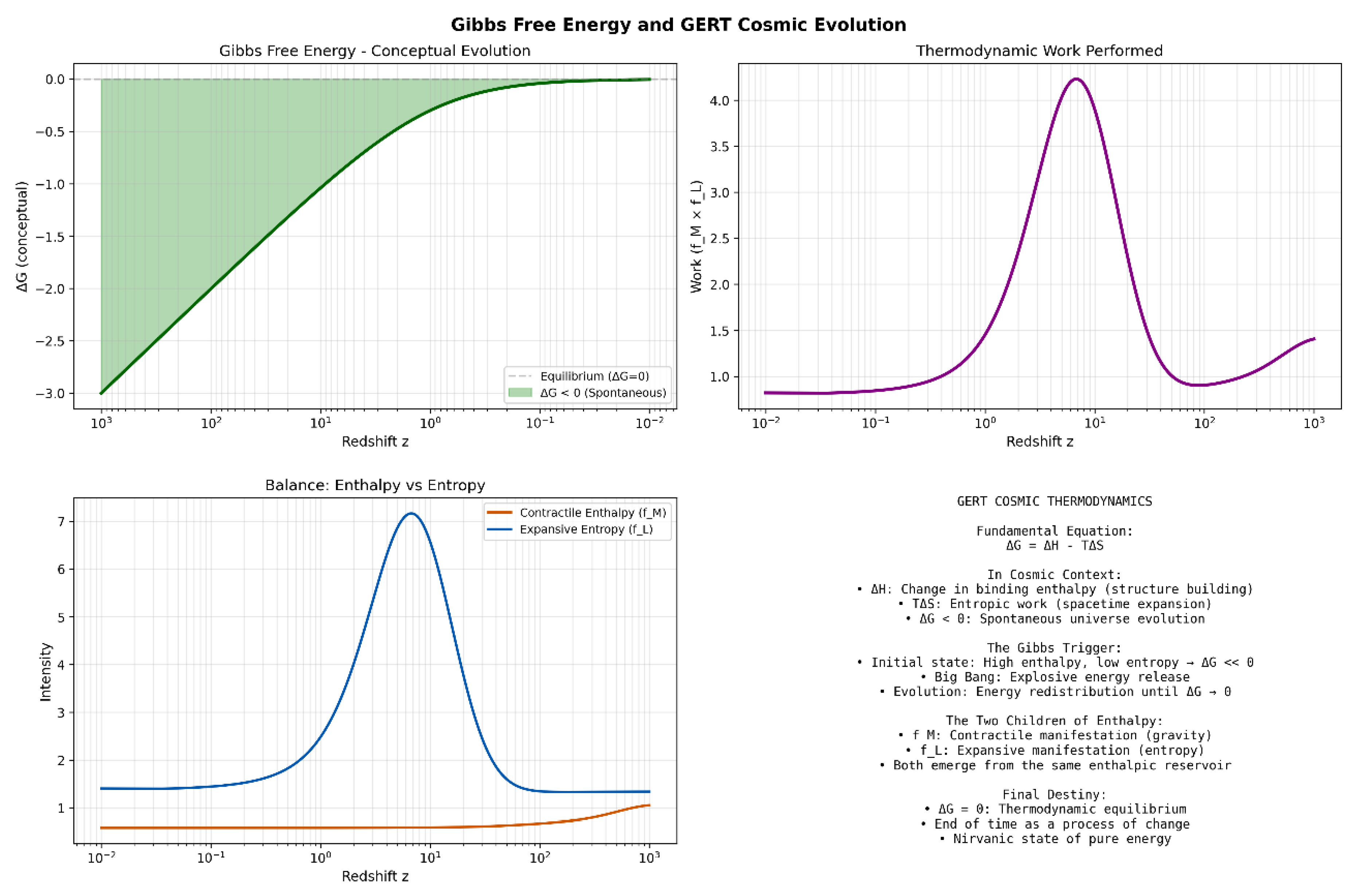
Figure 2.
The four cosmic phases according to GERT.
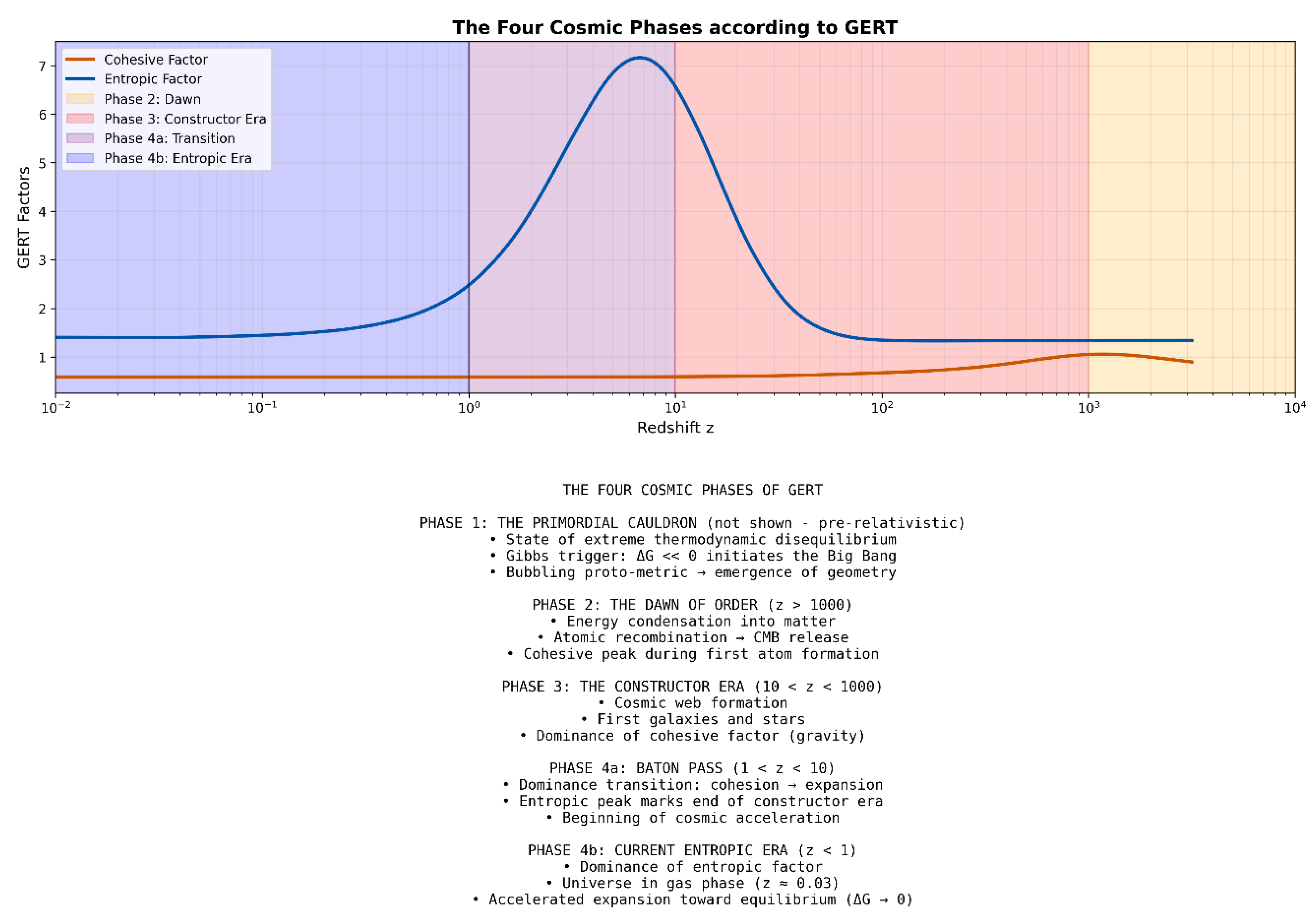
Figure 3.
Corner plot of the MCMC analysis with 12 free parameters
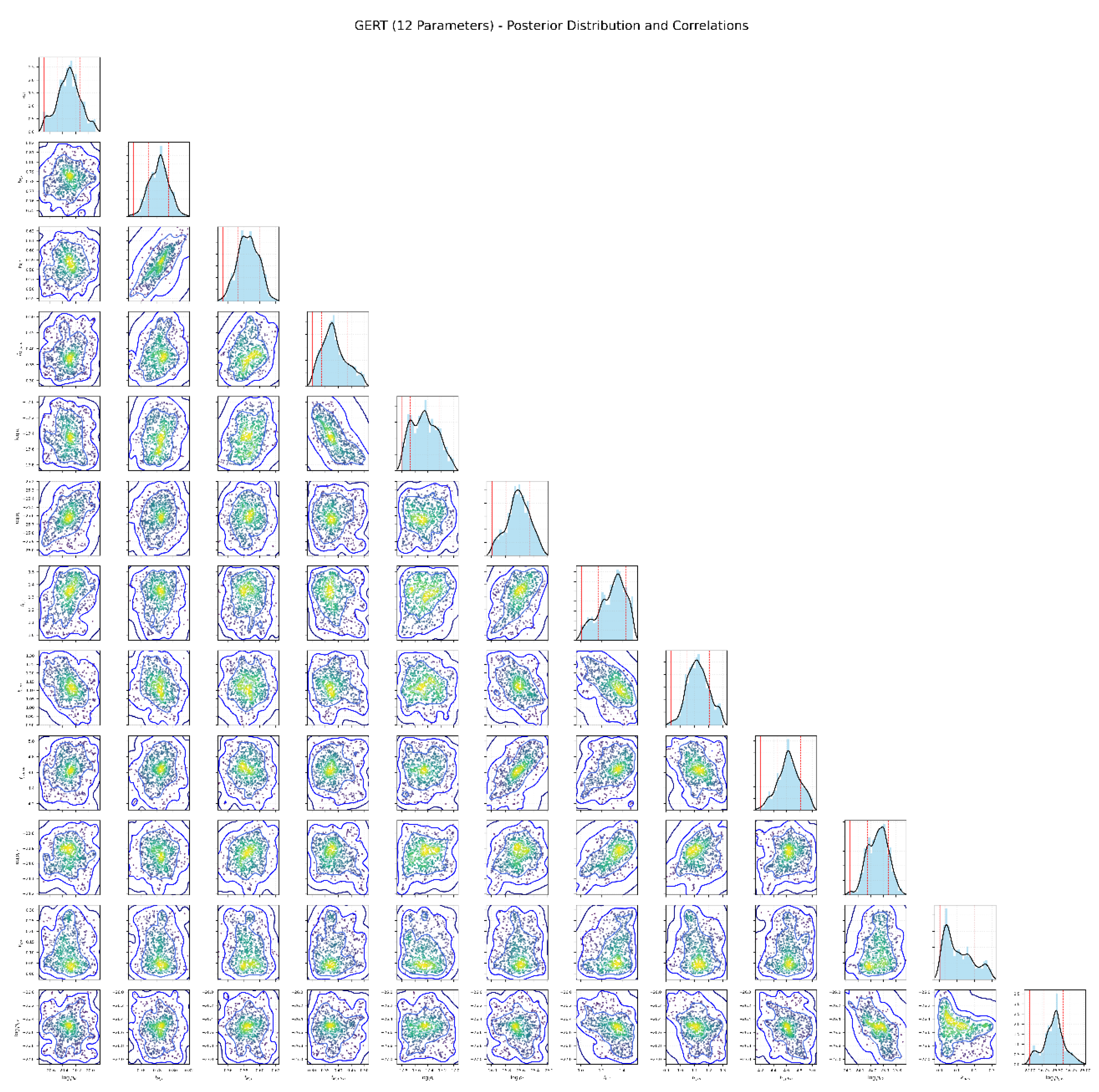
Figure 4.
Corner plot of the MCMC analysis with 9 free parameters
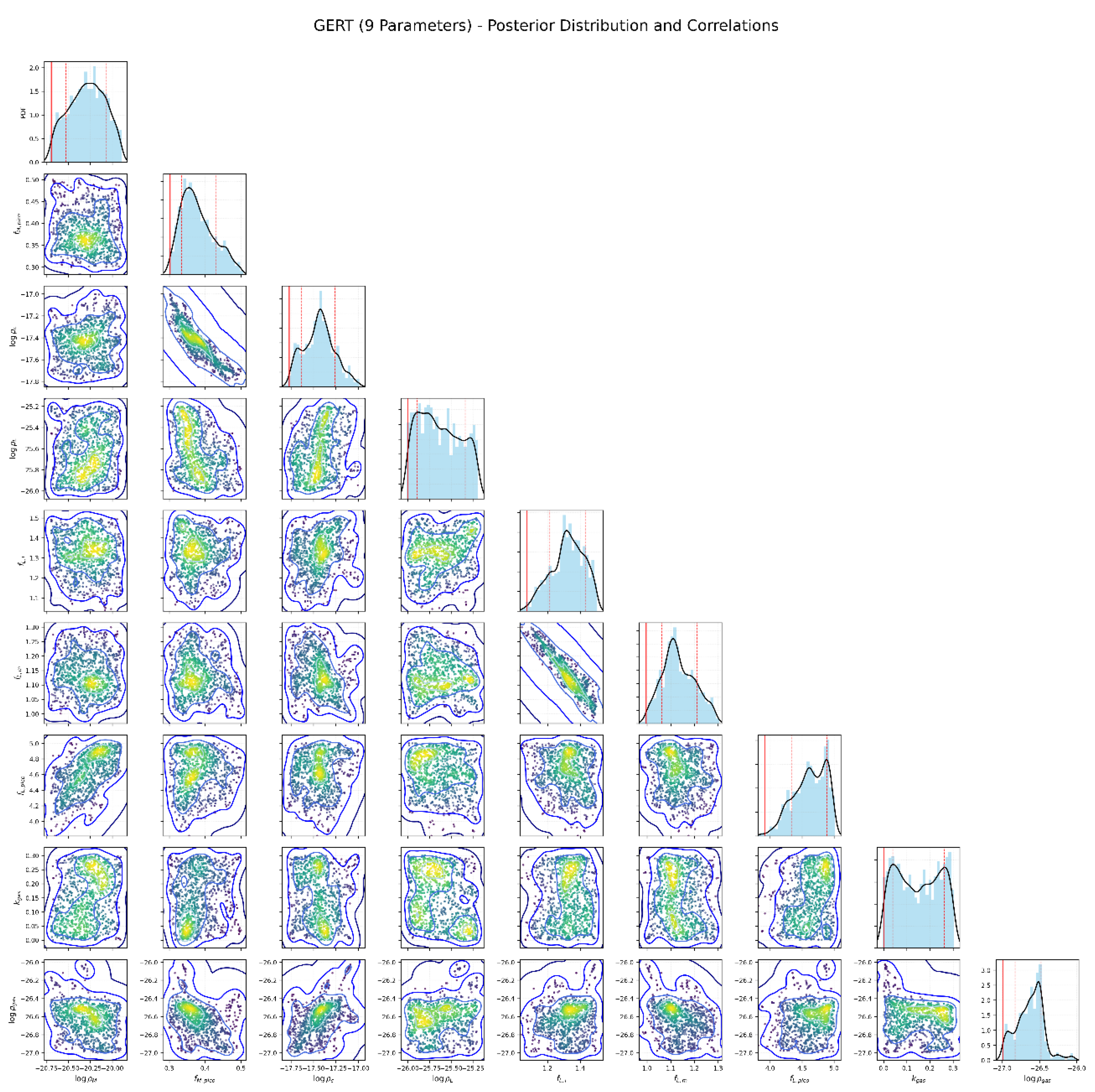
Figure 5.
Corner plot of the MCMC analysis with 8 free parameters
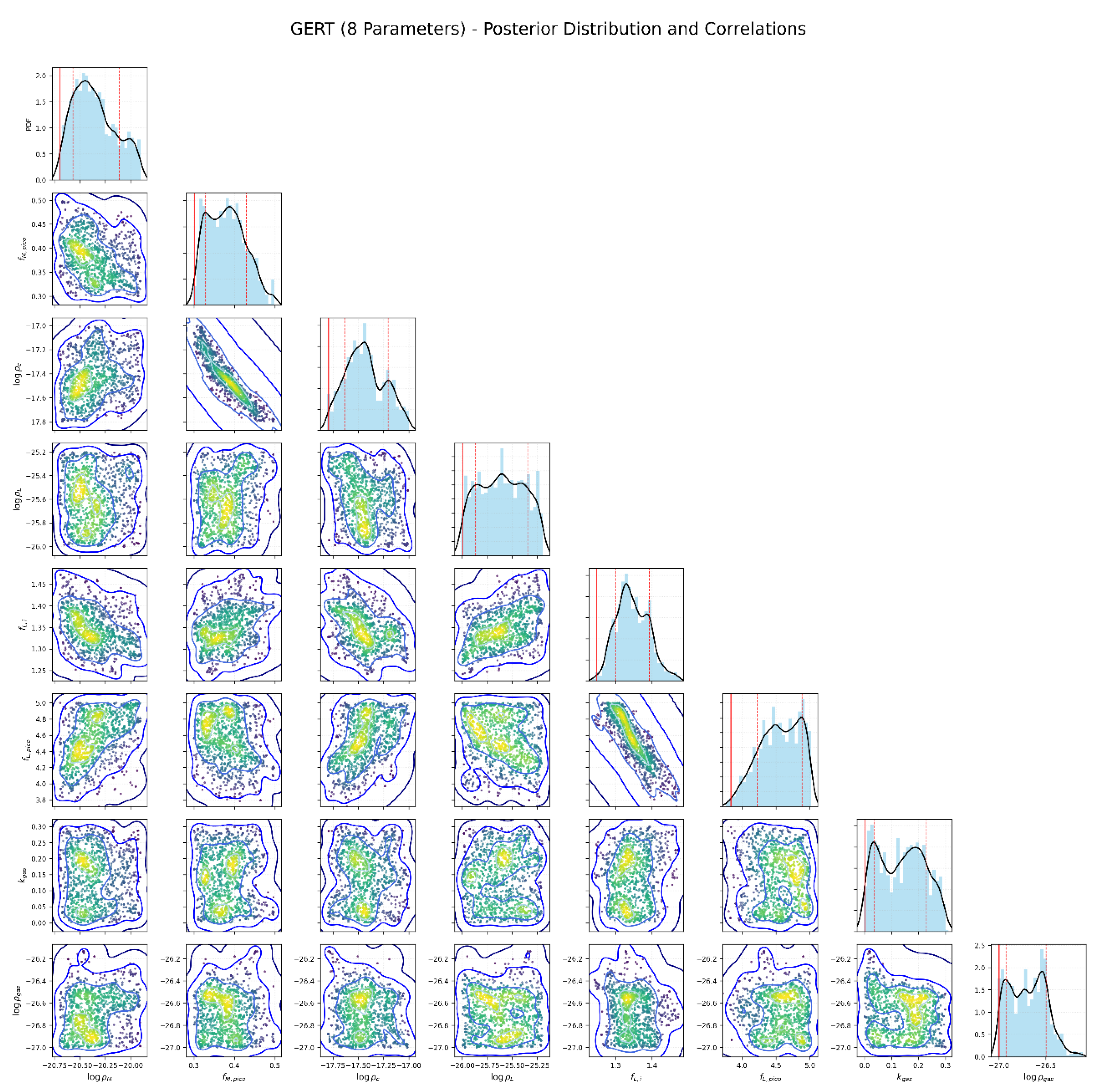
Figure 6.
Corner plot of the MCMC analysis with 6 free parameters
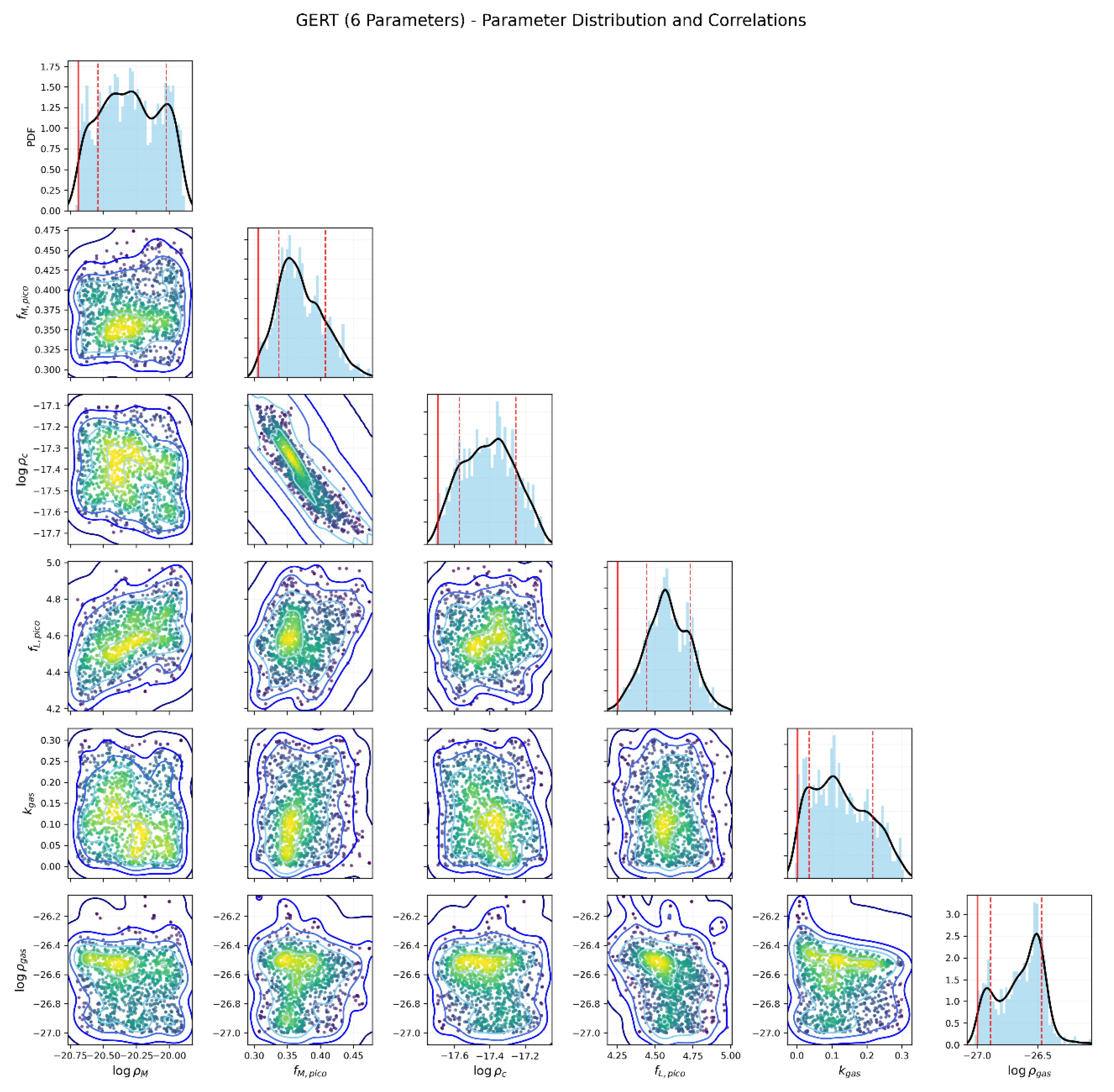
Figure 7.
Corner plot of the MCMC analysis with 4 free parameters
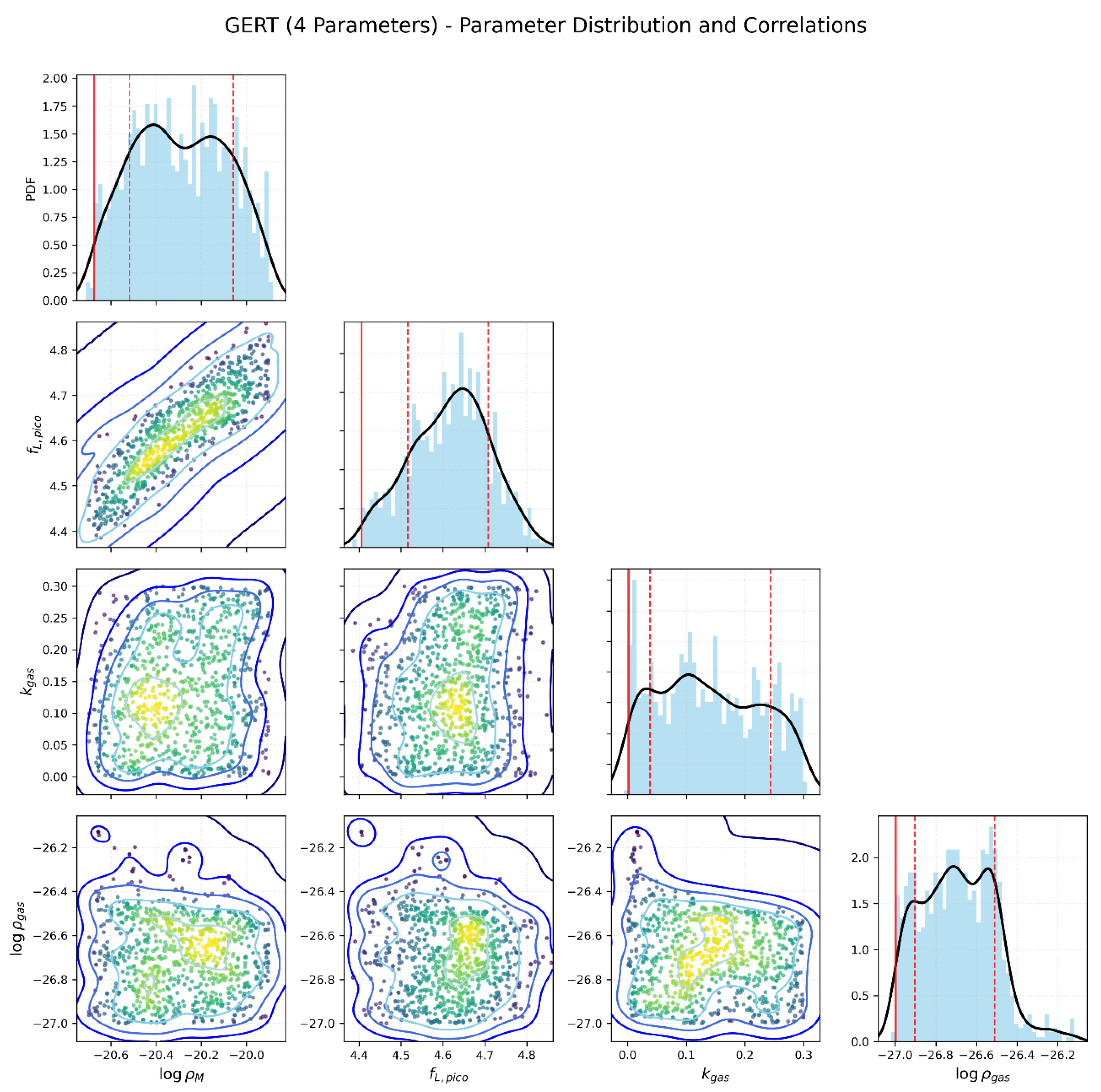
Figure 8.
Corner plot of the MCMC analysis with 3 free parameters
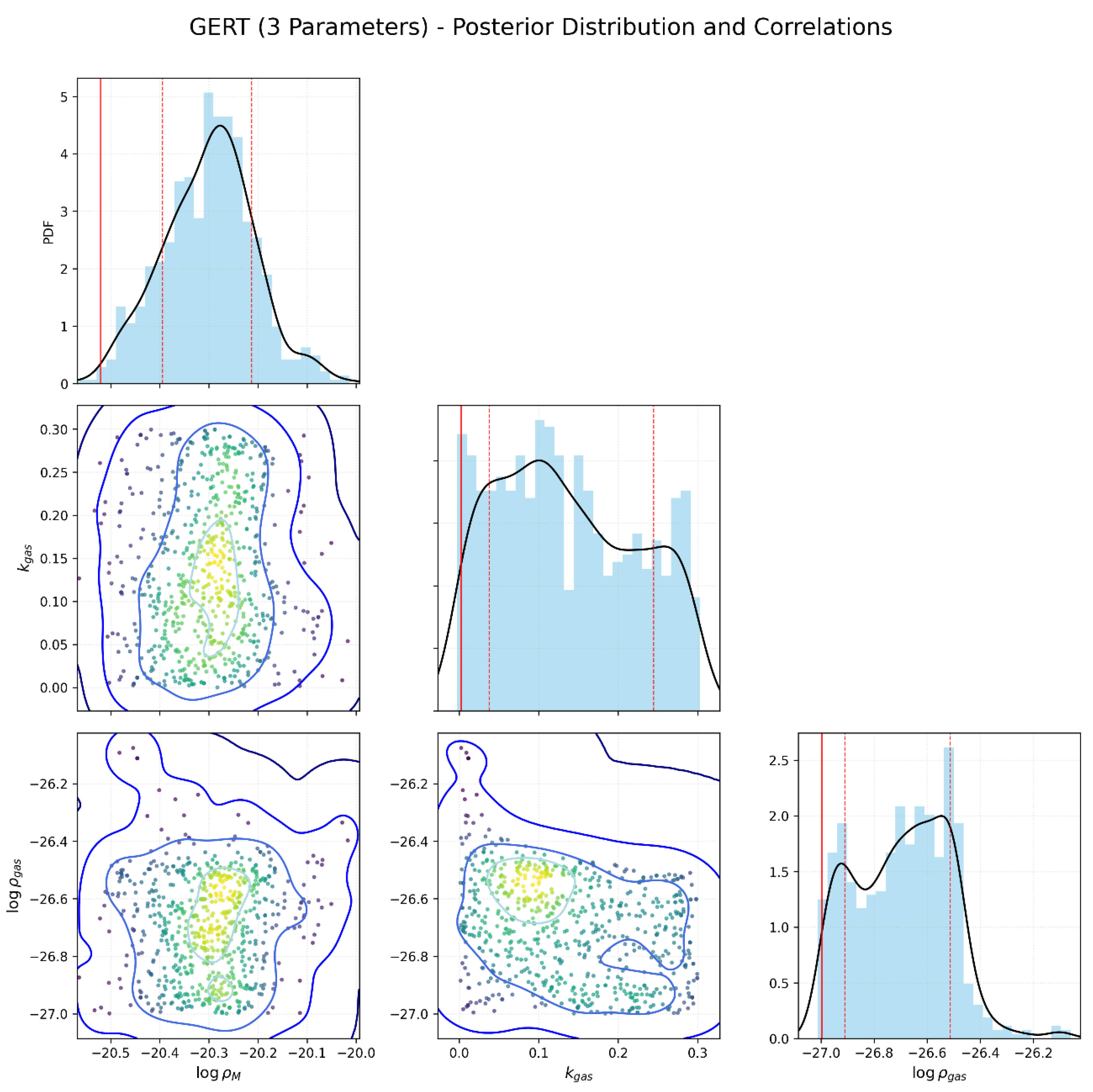
Figure 9.
Corner plot of the final GERT model with 2 free parameters, showing well-constrained parameters.
Figure 9.
Corner plot of the final GERT model with 2 free parameters, showing well-constrained parameters.
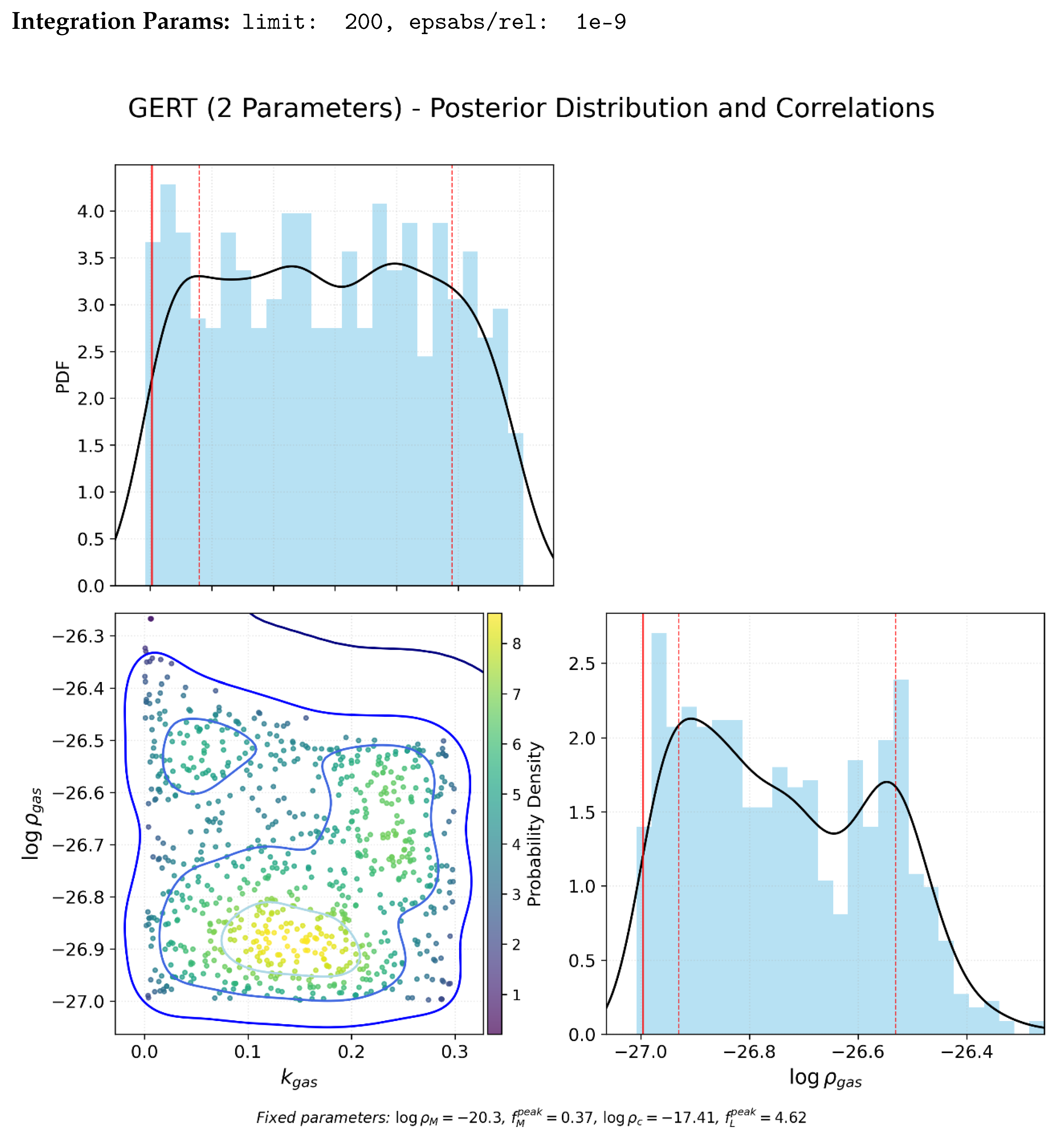
Figure 10.
Entropic Factor
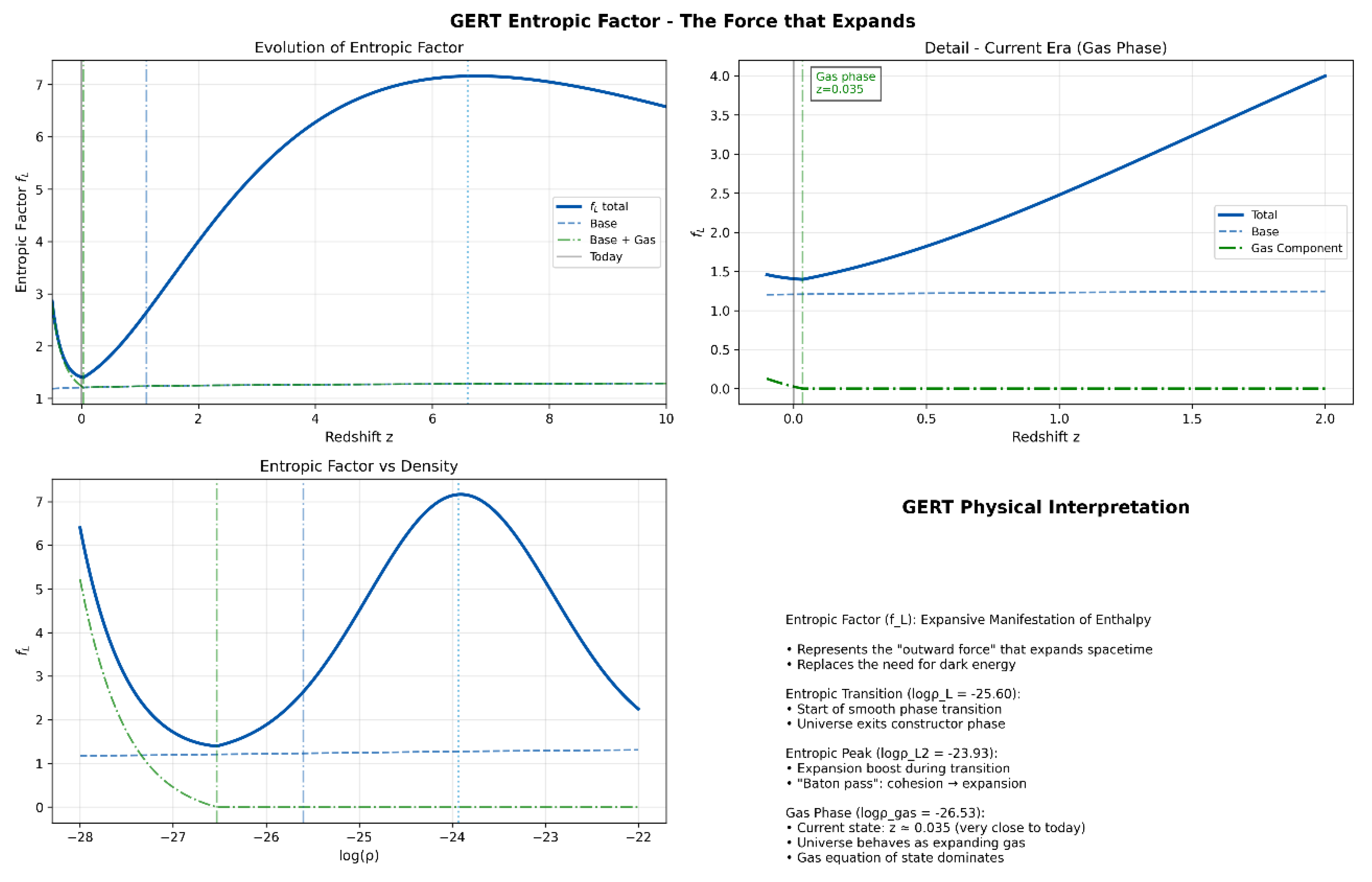
Figure 11.
Cohesive Factor
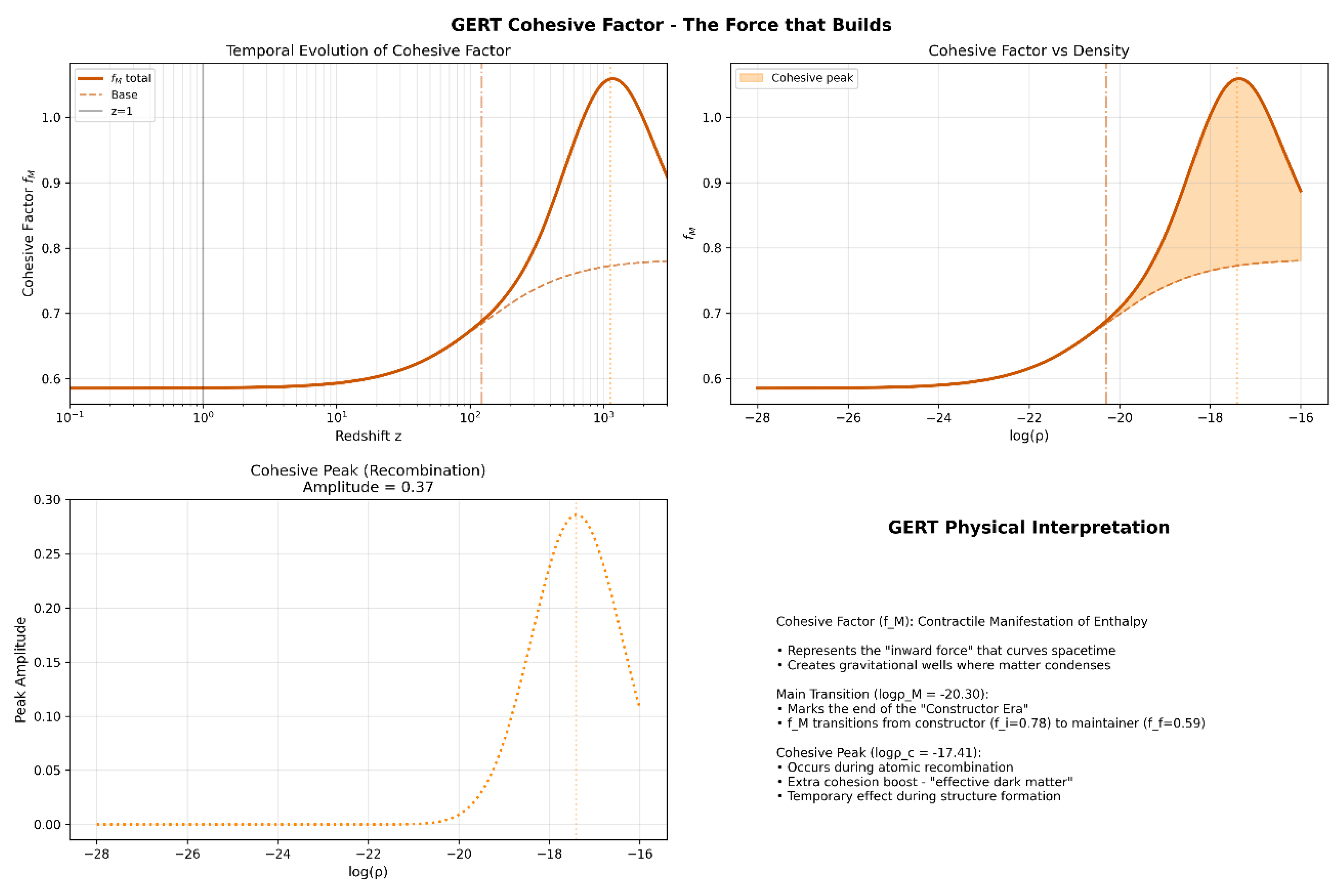
Figure 12.
Components
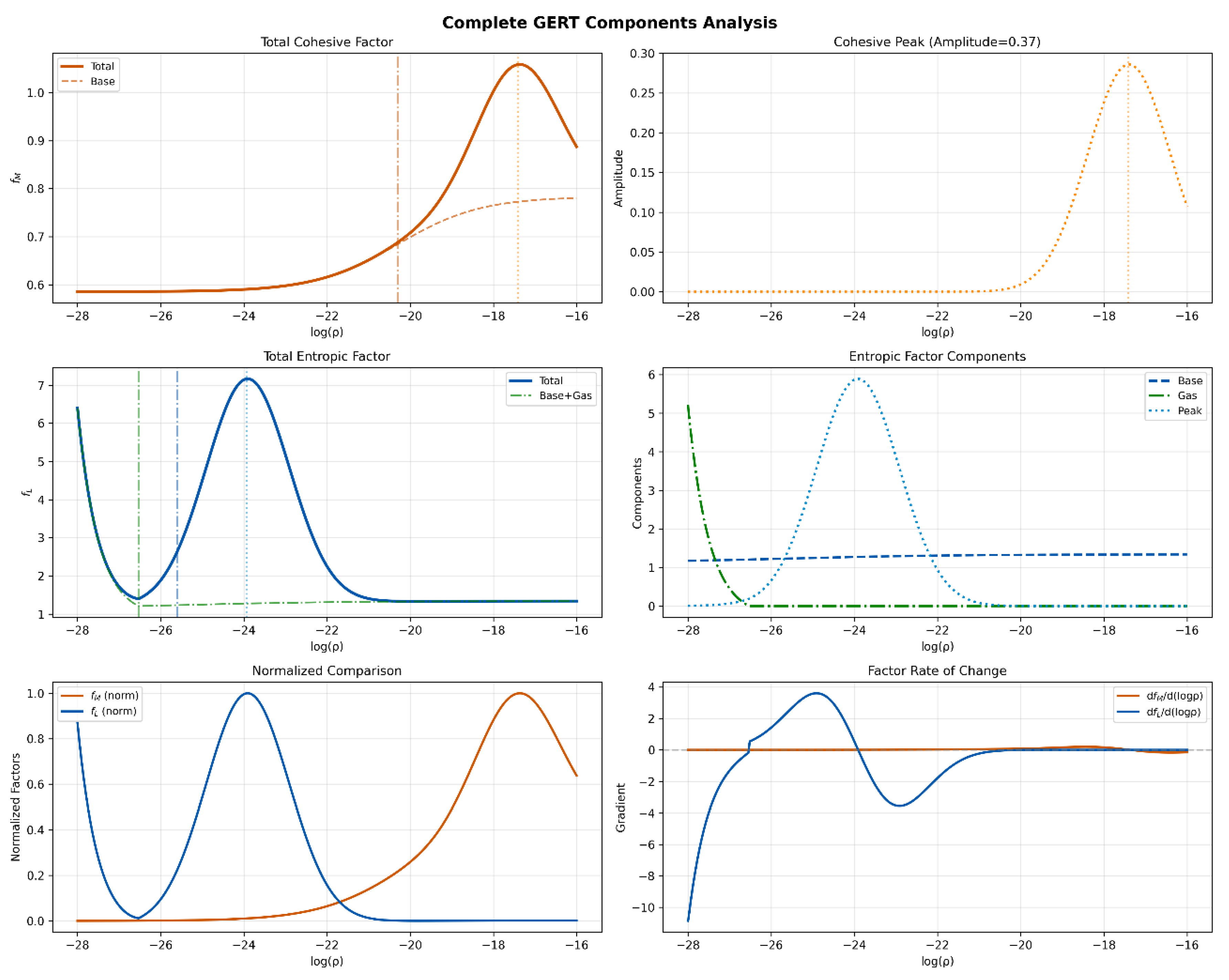
Figure 13.
GERT Phase Evolution
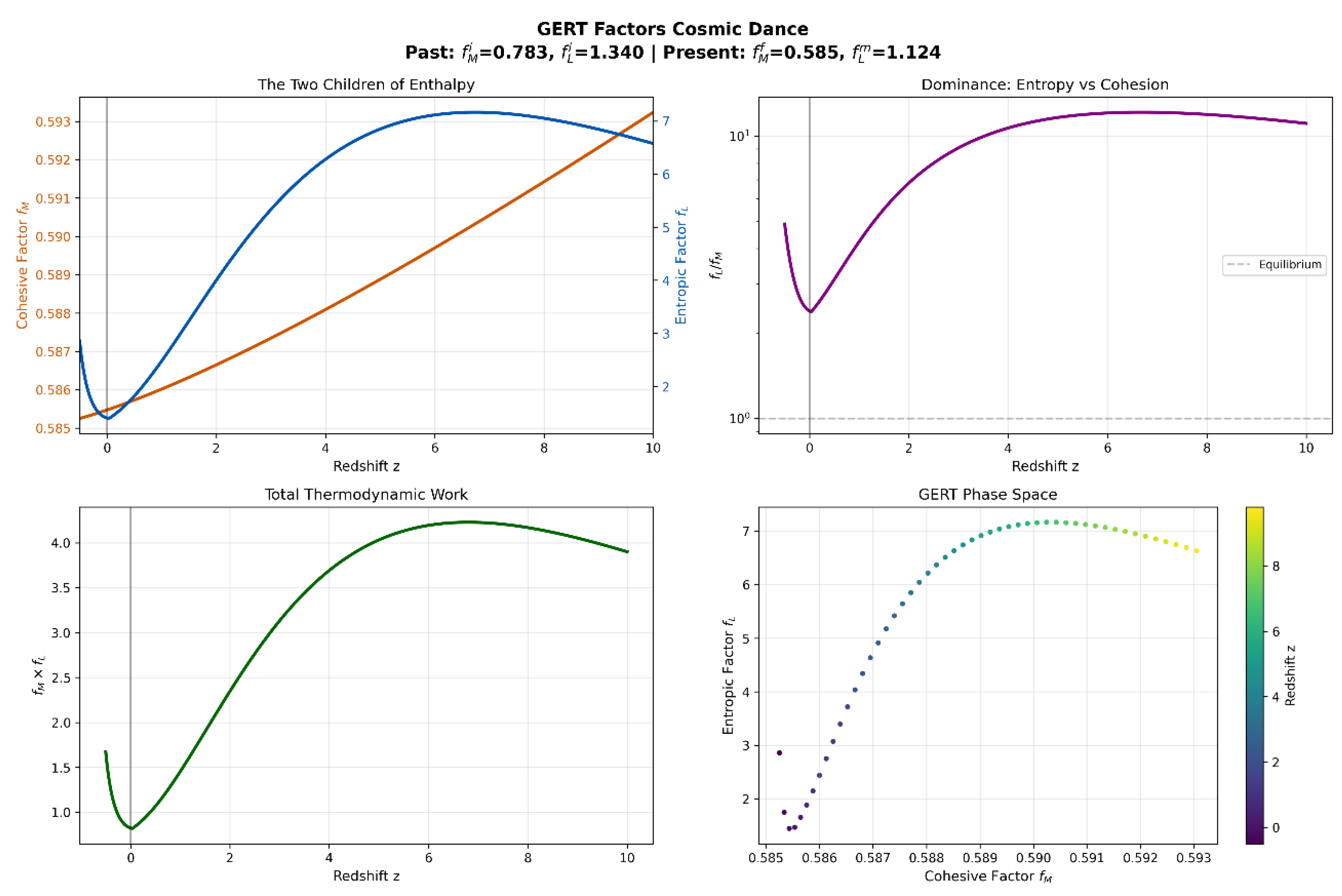
Figure 14.
Relative difference in the expansion rate between the GERT and CDM models. The GERT predicts a faster expansion in the very recent Universe (), which raises the value of today.
Figure 14.
Relative difference in the expansion rate between the GERT and CDM models. The GERT predicts a faster expansion in the very recent Universe (), which raises the value of today.
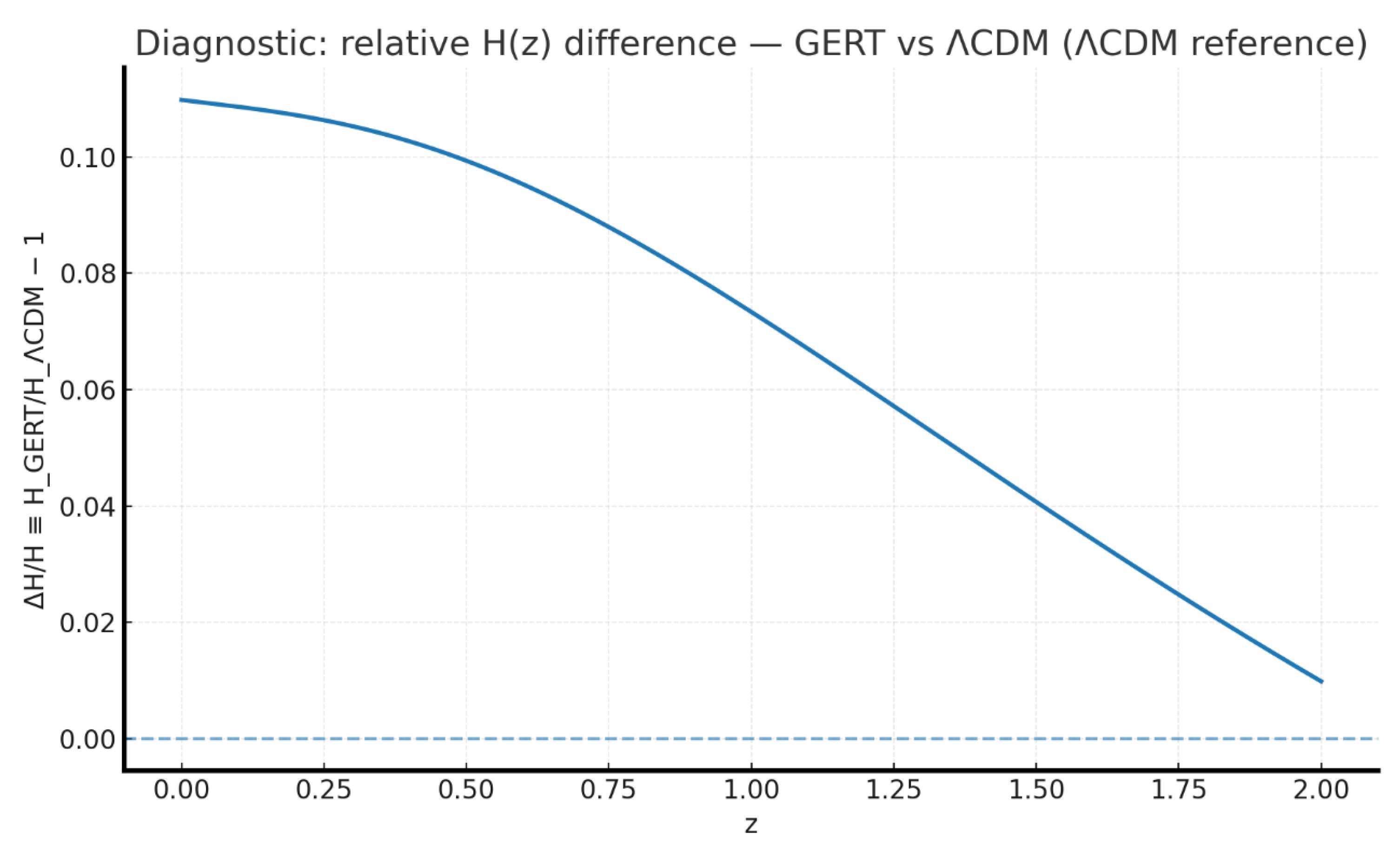
Figure 15.
Difference in the distance modulus () between GERT and CDM. GERT predicts shorter distances for a given redshift, consistent with a faster expansion.
Figure 15.
Difference in the distance modulus () between GERT and CDM. GERT predicts shorter distances for a given redshift, consistent with a faster expansion.
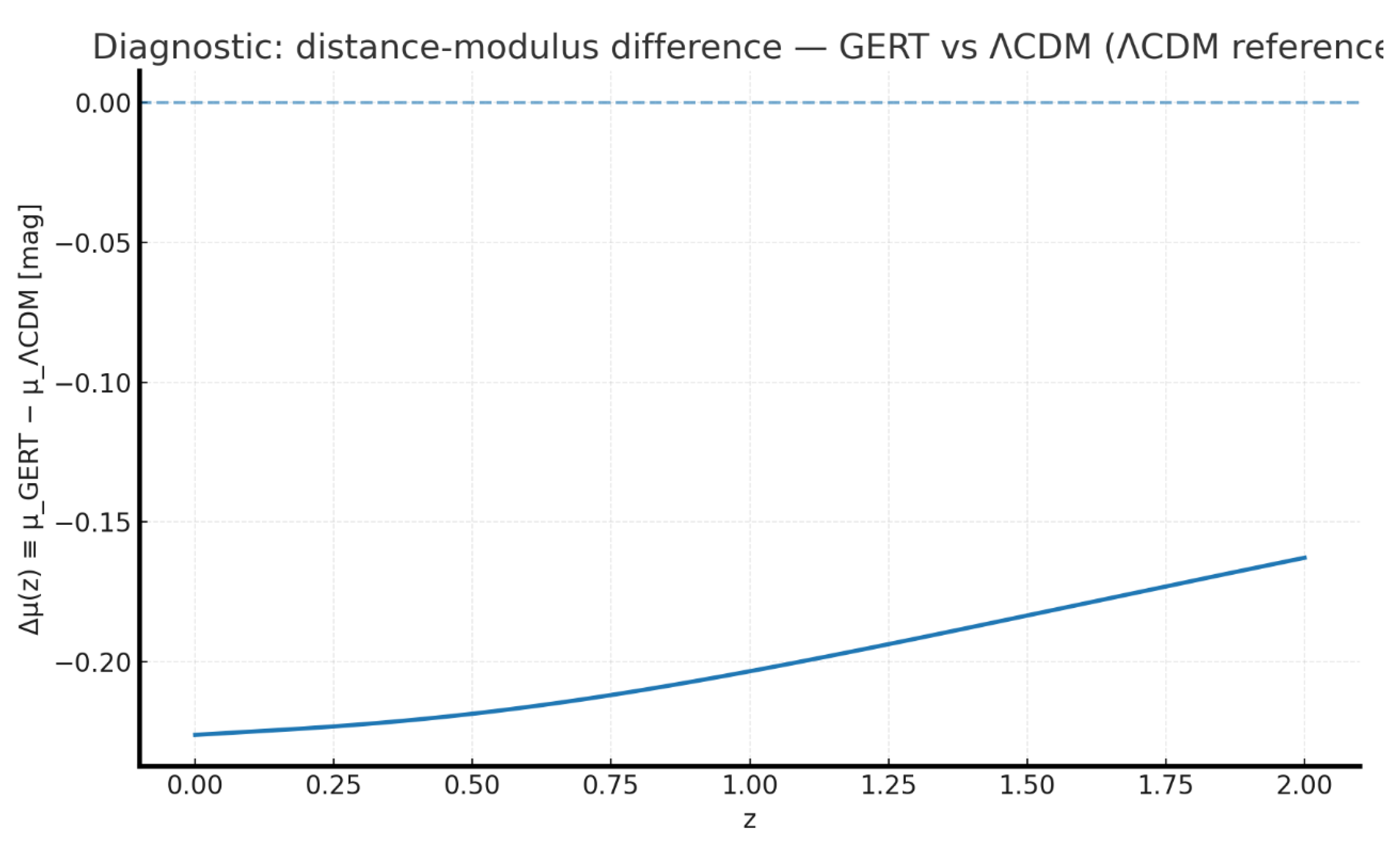
Table 1.
The width parameters
| Parameter | Value | Physical Translation |
| Matter transition: duration dex ( Myr) | very dense medium → rapid turn | |
| Entropic transition: duration dex ( Gyr) | rarefied medium → slow turn | |
| Symmetric peaks | Short bursts of cohesion and expansion |
Table 2.
Unified GERT model parameters
| Parameter | Symbol (ASCII) | Physical Meaning |
|---|---|---|
| Matter Transition Position | Density (log) where the gravitational “constructive phase” is activated/deactivated. | |
| Initial Matter Factor | Cohesive efficiency of matter at high densities/redshifts. | |
| Final Matter Factor | Cohesive efficiency of matter at low densities (late era, after the 1st phase transition). | |
| Matter Peak Amplitude | Extra “boost” of cohesion (effective dark matter effect) during the atomic recombination era. | |
| Matter Peak Position | Density (log) where the cohesive peak occurs (binding of atoms/first structures). | |
| Entropic Transition Position | Density (log) where entropic Work begins to dominate (start of acceleration). | |
| Initial Entropic Factor | Intensity of the expansive flow (entropy) at high densities. | |
| Mid/Final Entropic Factor | Intensity of the expansive flow at low densities (post-Constructive Era). | |
| Entropic Peak Amplitude | Short “boost” of expansion when energy is no longer spent on structure. | |
| Entropic Peak Position | Density (log) where the expansive peak occurs (entropic stiffness). | |
| Gaseous Regime Intensity | Strength of the expansion in the ultra-dilute regime (current and future “gas” phase). | |
| Gaseous Behavior Start | Density (log) threshold that activates the gaseous term. | |
| Gaseous Regime Slope | “Compressibility” of the gaseous spacetime; controls the slope of the exponential term. |
Table 3.
Comparison of fit statistics
| Model | dof | AIC | BIC | WAIC | ||
|---|---|---|---|---|---|---|
| GERT –12p | 1042.19 | 1043 | 0.9992 | 1066.19 | 1125.73 | 1061.20 |
| GERT –9p | 1042.60 | 1046 | 0.9968 | 1060.61 | 1105.26 | 1052.99 |
| GERT –8p | 1043.84 | 1047 | 0.9970 | 1059.84 | 1099.53 | 1051.70 |
| GERT –6p | 1044.31 | 1049 | 0.9955 | 1056.31 | 1086.08 | 1050.70 |
| GERT –4p | 1044.52 | 1051 | 0.9938 | 1052.52 | 1072.36 | 1048.66 |
| GERT –3p | 1044.50 | 1052 | 0.9929 | 1050.50 | 1065.38 | 1047.80 |
| GERT–2p | 1044.46 | 1053 | 0.992 | 1048.47 | 1058.39 | 1045.81 |
Table 4.
Cosmic Milestones
| Parameter (Fixed) | Value (log ) | Associated Cosmological Event | Interpretation (GERT) |
|---|---|---|---|
| -17.41 | Atomic Recombination (z ≈ 1090) | Cohesive Peak: Activation energy for the formation of atoms. | |
| -20.30 | End of the Plasma Era | Transition of Phase: Beginning of the "Constructive Era" (liquid phase). | |
| -23.93 | End of Structure Formation | Entropy Peak: "Passing the baton" from cohesion to expansion. | |
| -25.60 | Beginning of Accelerated Expansion | Entropic Transition: Beginning of the transition to the "gaseous phase." | |
| -26.75 | Current Epoch (z ≈ 0.03) | Gas Activation: Beginning of the gas regime domain. |
Table 5.
Parameters of the Expansive Factors (Outward Force)
| Physical Parameter | Symbol | Final Value (1) | Status |
|---|---|---|---|
| Peak Entropic Position | -23.93 | Fixed | |
| Peak Entropy Amplitude | 4.62 | Fixed | |
| Position of the Entropic Transition | -25.60 | Fixed | |
| Initial Entropic Factor | 1.34 | Fixed | |
| Mid Entropic Factor | 1.12 | Fixed | |
| Beginning of Gaseous Regime | -26.750(+0.219, -0.180) | Free | |
| Gas Phase Intensity | 0.143(+0.102, -0.103) | Free | |
| Gas Regime Slope | 0.50 | Fixed |
Table 6.
Table 6: Parameters of Cohesive Factors (Inward Force)
| Physical Parameter | Symbol | Final Value | Status |
|---|---|---|---|
| Peak Matter Position | -17.41 | Fixed | |
| Peak Matter Amplitude | 0.37 | Fixed | |
| Position of Matter Transition | -20.30 | Fixed | |
| Initial Matter Factor | 0.7831 | Fixed | |
| Final Matter Factor | 0.5851 | Fixed |
Table 7.
Comparison of Metrics between GERT and CDM
| Metric | GERT | (CDM) | Advantage |
|---|---|---|---|
| Goodness of Fit (χ²/dof) | 0.992 | ∼1.06 (with internal stresses)* | GERT |
| Hubble constant (H0) | 72.5km/s/Mpc | ∼67.4 km/s/Mpc† | GERT |
| Number of Free Parameters | 2 | 6† | GERT |
| Selection Criterion (WAIC) | 1045.81 | --- | GERT |
| Selection Criterion (AIC) | 1048.47 | 1123.94(inferred)‡AIC ≈ 75 → strong evidence of GERT. | GERT |
| Selection Criterion (BIC) | 1058.39 | 1153.7 (inferred)‡ BIC ≈ 95 → strong evidence for GERT. | GERT |
| Tension Resolution | Yes | No (Generates the tension of H0)* | GERT |
| Physical Basis | Thermodynamics (Physical Process) | Phenomenological (Postulated Components) | GERT |
* Internal tensions in combined CDM fits are reviewed in the literature. † Baseline CDM values ( km/s/Mpc and the 6-parameter framework) are adopted from Planck 2018 cosmological parameters. ‡ AIC/BIC for CDM are inferred from the baseline for the combined dataset (CMB+BAO+SNe) using standard information-criterion formulas. [8,10,48].
Table 8.
Comparison between GERT and Emergent gravity
| Characteristic | Emergent Gravity (Verlinde) | GERT Theory |
|---|---|---|
| Source of Dynamics | Holographic principle; information on a 2D surface. | Primordial Enthalpic Reservoir; thermodynamics of 3D volume (“bulk”). |
| Origin of gravity | Emerges from the entropy associated with holographic information. | Emerge from the Primordial Enthalpic Reservoir as its “contractile” manifestation (Work Inward). |
| Gravity-entropy Relationship | Gravity is an entropic force. | Gravity and entropic force (expansion) are dual and symmetrical manifestations of the same source (enthalpy) and arise from energy redistribution. One does not cause the other. |
| Thermodynamic Framework | Focused on entropy (Second Law). | Complete: enthalpy, entropy, and Gibbs Free Energy (First and Second Laws). |
| Central Metaphor | Count the bytes on the surface. | Explore the inner ’six-pack.’ |
Table 9.
Differences between GERT and Emergent Gravity
| Aspect | GERT (Gibbs Energy Redistribution Theory) | Emergent Gravity of Verlinde |
|---|---|---|
| Starting point | Macroscopic thermodynamics: Universe as a reaction with ; law = dynamic functions (, ). | Gravity as an entropic/emergent effect of information/entanglement; de Sitter as a medium with entropy/temperature. |
| What replaces the “dark” | No new substances: extra cohesion = peak of (builder phase); accelerated expansion = dynamic + gas regime. | “Apparent dark matter”: an additional emergent gravitational term dependent on baryonic content and the de Sitter scale. |
| Effective modification | Maintains GR for geometry; alters effective content (Friedmann with , with transitions/peaks/gas). | Alters the effective gravitational law (Poisson/Newton) with an entropic term that produces “apparent mass.” |
| Scope demonstrated so far | Background cosmology: SNe/BAO/CMB (compressed), ; high and consistent H0 ≈ 72.5. | Local scales: rotation curves, Tully–Fisher type relations, and weak lensing analyses; use in broad cosmology still under testing. |
| Declared limitations | Not yet tested on individual rotation curves/galactic lenses. | Challenges in clusters/mergers and in reproducing the entire set of cosmological probes with the same quality as CDM/GERT. |
Disclaimer/Publisher’s Note: The statements, opinions and data contained in all publications are solely those of the individual author(s) and contributor(s) and not of MDPI and/or the editor(s). MDPI and/or the editor(s) disclaim responsibility for any injury to people or property resulting from any ideas, methods, instructions or products referred to in the content. |
© 2026 by the authors. Licensee MDPI, Basel, Switzerland. This article is an open access article distributed under the terms and conditions of the Creative Commons Attribution (CC BY) license (http://creativecommons.org/licenses/by/4.0/).
Copyright: This open access article is published under a Creative Commons CC BY 4.0 license, which permit the free download, distribution, and reuse, provided that the author and preprint are cited in any reuse.


