

Submitted:
03 March 2026
Posted:
04 March 2026
You are already at the latest version
Abstract
Rapid urbanization has aggravated the challenges in sustaining the peri-urban rice farming sector. The challenges arising from rapid urbanization are threatening rice farmers in peri-urban areas due to increasing economic and land pressures. This has caused a significant marginalization among rice farmers. In Indonesia, despite contributing 13.28% of the national GDP in 2021, the agricultural sector is dominated by marginal farmers who struggle with poverty and lack of land ownership. This study aims to identify different pathways for marginalization of rice farmers by integrating spatiotemporal land use and land cover (LULC) change analysis, landscape fragmentation metrics, and system dynamics through causal loop diagrams (CLD). Furthermore, the redefinition of the term marginal rice farmers is done by considering the total cultivated rice field and broader factors that contribute to the self-reinforcing loop of marginalization. This study shows that rice farmer marginalization in peri-urban areas is caused by small land size or poverty, and reinforcing feedback between ecosystem service degradation, productivity decline, economic pressure, and land conversion that interact differently across landscape configuration. Moreover, this study enhances the understanding of peri-urban agricultural transformation and provides landscape-sensitive policy insights to support inclusive and resilient agricultural systems by reconceptualizing marginalization of rice farmers as a dynamic socio-spatial process.
Keywords:
Peri‐urban agriculture
; marginal farmers
; causal loop diagram
; LULC change analysis
1. Introduction
A peri-urban area is a junction of urban and rural areas, where elements of metropolitan and natural landscapes shape its development direction and dynamics. These areas play a critical role as buffers that provide essential ecosystem services, particularly food production, to urban and rural populations (Follmann 2022). Rapid urbanization is becoming a global trend as modern society pursues productivity and economic gains. However, after exceeding the urban development threshold, urbanization mutates into urban sprawl, exerting intense pressure on rural landscapes (Nadoushan 2022; Shaw et al. 2020). Urban sprawl is characterized by urban encroachment into peri-urban and rural areas, disrupting the ecological balance and causing a significant decline of agricultural land, which leads to the loss of agricultural land, forests, and vegetation land cover (Rustiadi et al. 2021). In Indonesia, this dynamic has contributed to the widespread marginalization of farmers, particularly rice farmers in peri-urban areas. Despite contributing 13.28% of the national gross domestic product (GDP) in 2021, the agricultural sector is carried by farmers who struggle with poverty and lack of land ownership (Statistics Indonesia 2021). Furthermore, in 2023, the food crop farming sector, including rice farming, was dominated by marginal farmers at 62% (Statistics Indonesia, 2023). Internationally, a marginal farmer is defined as a farmer who cultivates on less than 2 hectares of farmland. However, Indonesia applies a much lower threshold for marginal farmers, or Petani Gurem in Bahasa Indonesia, which is less than 0.5 hectares. This marginalization of rice farmers in peri-urban areas due to their limited access to land and resources amid intense urban sprawl is particularly concerning.
Previous studies examining the connection between farmland marginalization and peri-urban development have indicated that topographic and geomorphological factors significantly influence land use changes and agricultural viability (Wang & Cheng 2023; Wu et al. 2023). In agricultural landscapes, physical elements, such as land use patterns, elevation, and water source availability, interact with socioeconomic factors and shape different environments for farming livelihood (Wang et al. 2022; Wu et al. 2023). However, despite the extensive literature on urbanization and peri-urban transformation, little attention has been paid to how geomorphological differences within peri-urban basins shape diverse marginalization pathways for rice farmers. Thus, this study attempts to highlight the interconnected physical and socioeconomic pressures in peri-urban development that should be considered to prevent self-reinforcing feedback loops that drive the degradation of ecosystem services and intensify the marginalization of rice farmers.
The main objective of this study is to identify the different pathways for the marginalization of rice farmers by comparing cases in the upland and lowland landscapes of peri-urban areas. Additionally, the marginalization of rice farmers is reconceptualized by considering broader factors that contribute to the self-reinforcing loop of marginalization. This study has two research questions: 1) How do physical-spatial and socioeconomic marginalization of rice farmers unfold differently in lowland and upland landscapes? 2) How do physical-spatial and socioeconomic driving factors create a self-reinforcing loop for the marginalization of rice farmers? Furthermore, four districts in the Bandung Regency were selected as the study area. These districts were chosen because their basin geomorphological characteristics and rapid urban development provide an ideal context for examining rice farming marginalization in the same peri-urban area while also considering variations in geomorphological characteristics. This study highlights the feedback loops from physical and socioeconomic components interconnected in peri-urban rice farming that drive the degradation of ecosystem services and intensify the marginalization of rice farmers.
2. Conceptual Framework: A Social-Ecological and System Dynamic Perspective on the Marginalization of Rice Farmers
This chapter explains the social-ecological system (SES) and system dynamics (SD) perspectives as theoretical and analytical foundations for understanding the marginalization of rice farmers. The SES study is an approach to describe or visualize the complicated mechanisms and patterns of dynamic interactions between human and natural elements (Liu et al. 2023; Schlüter et al. 2019). Earlier studies on SES stated that SES is constructed from a connected complex adaptive system (CAS), which refers to networks of micro-interactions of socio-ecological elements that result in macro-level outcomes (Preiser et al. 2018; Schlüter et al. 2019). The current sustainable development challenges arise from the interplay of social-ecological coupling systems, which require a system-thinking approach that accounts for feedback loops and nonlinear dynamics (Gain et al. 2020).
Traditional approaches often address social and ecological issues separately, which can obscure our understanding of the complex causal relationships that bring changes in both social and ecological elements. The SES approach views social and ecological attributes as part of the same interconnected and interdependent system that is better equipped to address contemporary sustainable development challenges. While SES provides a conceptual lens for identifying and organizing components and their interactions, SD acts as an analytical tool that simulates the dynamics of SES components’ behaviors (Pruyt 2013). The use of SD and causal loop diagram (CLD) models originated from the systems thinking approach (Forrester 1968; Sterman 2000). In this case, systems thinking translates SES components into variables in CLD or as stocks, flows, and feedback loops in SD simulation (Meadows 2008). Through the perspective of SES, this study identified the social and ecological elements embedded in lowland and upland rice farming systems, followed by the use of CLD to map feedback loops and identify reinforcing processes in the marginalization of rice farmers.
The multifunctionality served by peri-urban areas often causes conflicts of interest between urban and rural societies. A previous study stated that the diverse functionality of peri-urban areas encourages agricultural actors to explore alternative business models and agricultural livelihood diversification (Yoshida 2020). Close proximity to urban areas allows for lower distribution costs and a direct marketing strategy that nurtures the connection between peri-urban farmers and consumers (Uematsu 2013). In contrast, the proximity of peri-urban areas to urban areas and the economic opportunities that come with them have resulted in a close interconnection and high sensitivity of peri-urban land use conversion. While the distance from the agricultural zone to the urban area had a positive impact on livelihood diversification and local market development, urban sprawl, as the spillover effect of urban growth, disturbs the environment for agricultural activity by causing farmland parcel and environmental degradation. This ultimately leads to the marginalization of farmers. Peri-urban areas are best observed as an integrated SES because they are formed through an accumulation of socio-ecological component interactions in the coupling of urban and rural systems, which generate their own system of peri-urban areas.
Partelow (2018) discussed the ongoing debate among SES scientists regarding bias in the representation of social components in SES applications. This bias is often attributed to the popularity of the SES approach among social scientists. This study addressed this discussion by combining social components and spatiotemporal analysis to build a set of variables that equally represent the social and ecological conditions of agricultural zones in peri-urban areas. Therefore, it accurately visualizes the pathways of physical and socioeconomic marginalization of rice farmers in lowland and upland landscapes. Additionally, CLD acts as a tool that structures and visualizes connections among all identified variables, revealing the reinforcing or balancing loops that emerge as core material for discussion (Crielaard et al. 2024; Kim 1992; Lane 2008). The integration of the SES approach with CLD offers a robust analytical combination to capture the complexity of peri-urban agricultural systems and the dynamics of rice farmers' physical and socioeconomic marginalization in the lowland and upland agricultural zones of peri-urban areas.
3. Materials and Methods
3.1. Study Area
Bandung Regency is the neighboring region of Bandung Capital City, which is experiencing rapid urbanization due to urban development in the capital city. Recent statistical data indicate that over the past decade, more than 50% of the total agricultural land in the Bandung Basin has been converted for non-agricultural uses (Statistics Indonesia 2023). This shift is accompanied by a rising prevalence of marginalized farming, particularly in Bandung Regency (Statistics Indonesia 2023). The geomorphological properties of the basin divide Bandung Regency into lowland and upland landscapes, resulting in diverse agricultural systems. Generally, agricultural zones in lowland landscapes are dominated by wet rice fields on flat farmlands, whereas those in upland landscapes are dominated by a mix of terraced rice fields, horticulture farms, and plantations. The rich variability in agricultural characteristics, coupled with the dynamics of land conversion in peri-urban areas, is suitable for exploring the different pathways for the marginalization of rice farmers.
The Indonesian government implemented a land reform policy (Basic Agrarian Law (UUPA), 1960) that covered the regulation for land rental and farmland management rights (Law No. 56 of 1960 and Law No. 2 of 1960). In 2009, an additional agrarian reform policy (Law no. 41 of 2009 concerning the Protection of Sustainable Food Agricultural Land (LP2B)) was implemented to protect food crop farmlands, including rice fields (Figure 1). As an integral component of LP2B regulation, the Rice Field Protection (LSD) regulation prevents broader rice field conversion for non-agricultural land use by mapping the selected protected rice fields. Currently, implementation of these policies relies on a hybrid approach that integrates top-down and bottom-up strategies. Furthermore, LSD regulations have been adopted at the district level, including Bandung Regency, which specifically created Rice Field Protection Regulation No. 1, 2019, followed by the establishment of protected rice field maps in 2021. The regulations were implemented by applying incentive and disincentive mechanisms specifically targeting rice farmers. However, this mechanism does not work because most farmers are not landowners. Thus, they have no authority over the farmlands they manage and cannot prevent farmland conversion. This loophole in the regulation has resulted in the ongoing conversion of farmland to built-up areas, despite regulations.
This study selected four study districts: Baleendah and Ciparay for the lowland landscape and Ibun and Pasirjambu for the upland landscape. The agricultural zones in the lowland landscape are dominated by rice farming, while upland agricultural zones are a mix of rice farming and horticultural/plantation farming. Baleendah and Ciparay districts have low elevations of approximately 664 m and 1,248 m above sea level, respectively (Statistics Indonesia, 2025). A significant portion of both districts consists of plain areas, making them suitable for rice farming. However, the Ciparay district has a varied topography that allows rice farmers in higher areas to mix rice farming with a small portion of horticulture farming. Ibun and Pasirjambu districts are located in mountainous or hilly terrains, with altitudes ranging from 765 to 1,057 m above sea level. Here, the agricultural zones are a combination of rice fields, horticulture farms, and tea and coffee plantations intertwined with patches of forest.
The majority of marginal rice farmers were tenant farmers, indicating that landless farmers dominated the rice-farming sector in the selected districts. Tenant farmers must pay rent to the landowner based on an agreement between the tenant farmers and the landowners. The most common land rent arrangement among rice farmers is to equally divide the total yield, while the production cost is fully covered by the farmers. This arrangement makes it impossible for farmers to gain adequate profits from trying out advanced agricultural businesses or innovations that could potentially improve their economic condition. To reduce production costs, the government provides fertilizer subsidies and seeds. Nevertheless, tenant farmers are still very vulnerable to rice field conversion because they have no authority to prevent it and might lose the rice field they work on if the owner decides to sell the field. In this case, farmers would have to search for other rice fields or switch their occupation to non-farming.
3.2. Methodology
This study utilized satellite and primary data to ensure the accurate interpretation of rice farming marginalization based on land use and land cover (LULC) change and rice field fragmentation analysis. For satellite data collection, we retrieved the Sentinel-2 Level-1C of all four studied regions using Google Earth Engine (GEE). The analysis covers the period between 2019 and 2025, representing the starting time of the Rice Field Protection Regulation (2019) and existing condition (2025). Therefore, we can compare the pre-implementation condition and the five years of post-implementation condition. The classification of LULC in peri-urban areas is complicated due to their heterogeneous and conjugate land-use configurations. Thus, to enhance the contrast between different LULC and highlight the rice field visualization, we retrieved data from the beginning of August 2019 and 2025, just before the harvesting month (usually September) of the first planting season. In special cases where there were shifts in the planting season, usually due to a prolonged dry season, an adjustment of the retrieval data period was made.
Supervised classification was employed to map the LULC changes in 2019 and 2025. Using the random forest classifier in GEE, LULC was classified into built-up areas, rice fields, horticulture/plantation, forest, and shrubs. To support LULC classification, a set of spectral indices was employed, including the Normalized Difference Vegetation Index (NDVI), Normalized Difference Moisture Index (NDMI), Normalized Difference Water Index (NDWI), Land Surface Water Index (LSI), Enhanced Vegetation Index (EVI), and Bare Soil Index (BSI). The total area of each LULC was then measured to compare the total areas of each LULC in 2019 and 2025.
Furthermore, this study employed landscape indices to understand land conversion and fragmentation dynamics in detail. Landscape indices are quantitative tools used to describe the spatial composition and configuration of LULC (McGarigal et al. 2012). Composition refers to the amounts of each LULC type existing in the same landscape. Configuration refers to the arrangement and interaction of all types of patches in the same landscape. In agricultural landscapes, these indices reveal the arrangement, connection, and fragmentation of patches in the studied area (Turner et al. 2003). When applied to rice farming zones, landscape indices reveal the extent of rice field fragmentation and conversion to other land uses, such as settlement areas, recreational facilities, and plantation areas. High landscape diversity or reduced cohesion often indicates a mixed and fragmented land system, which is characteristic of transitional peri-urban zones. To analyze the livelihoods of marginal rice farmers, landscape indices offer evidence of spatial constraints and opportunities that influence production systems. In the context of peri-urban areas, these indices are useful for assessing how urban expansion reshapes agricultural mosaics. A study conducted by Li and Wu (2004) addressed the issue of misuse and misinterpretation of landscape indices by highlighting the risk of disconnection of patterns emerging from mathematically constructed landscape indices from the pattern formation process. Additionally, Turner et al. (2003) highlighted the inability of landscape indices to identify qualitative changes. Therefore, pairing landscape indices with socioeconomic variables enables researchers to connect spatial processes with the social-ecological dynamics of farming households (Creswell 2014). Consequently, this study added qualitative data derived from reports by local agricultural extension agencies on program implementation, productivity, and challenges in rice farming to ensure the validity of the interpretation of landscape indices.
4. Results
4.1. Land Use and Land Cover Change Trends in the Lowland and Upland Landscapes
The LULC maps were extracted from the Sentinel-2 Multispectral Instrument Level-1C, followed by supervised classification of LULC using a random forest classifier in GEE. The results showed significant LULC changes between 2019 and 2025 in all four districts (Figure 2 and Figure 3). The total area of rice fields generally declined in all four districts, which briefly represents the potential of marginalization among rice farmers. Additionally, it demonstrates variations in LULC change patterns in lowland and upland landscapes.
The selected lowland districts experienced a significant decline in rice fields, followed by an increase in built-up areas (Figure 2). There was also a slight increase in horticulture and plantation farm areas and shrublands, and a decline in forest areas. Between 2019 and 2025, the landscape configuration of Baleendah District has transitioned from predominantly covered by rice fields to built-up areas. On the contrary, the Ciparay district is still dominated by rice fields, despite experiencing a significant decline in rice fields and an increase in built-up areas. Built-up areas, including residential and commercial zones, expanded by 5.33% in the Baleendah district and 2.97% in the Ciparay district, whereas rice fields declined by 11.58% and 5.79%, respectively. Furthermore, as shown in Figure 2, LULC configurations in Baleendah and Ciparay revealed proximity between built-up areas and rice fields, whereas horticulture and plantation farms were adjacent to forest areas. These patterns support the findings of potential LULC conversion trends from rice fields to built-up areas and from forest areas to horticulture or plantation farms in the lowland landscape.
In agricultural zones of lowland landscapes, shrubland acts as a buffer between rice fields and built-up areas during LULC conversions. These shrublands often originate from rice fields abandoned for land transactions. Typically, tenant farmers manage these rice fields, but landowners may decide to convert them into settlement areas. During the waiting period for the construction of these settlement areas, vegetation could grow, leading to the transformation of the land cover into shrublands. Some of these new settlement areas were fully completed by 2025, whereas others remained as shrublands. In satellite imagery, emerging road networks clearly outline the internal layout of housing complexes in this type of land cover. This situation emphasizes the importance of combining satellite imagery analysis with field surveys to gain a deeper understanding of the factors behind land conversions, particularly in regions with complex mixed land use configurations.
As shown in Figure 3, the upland landscape was dominated by forest and plantation areas. The two most common conversions were from rice fields to recreational areas, and from rice farms and forests to horticulture or plantation farms. Built-up areas, including residential and recreational areas, expanded by 2.91% in the Ibun district and 0.67% in the Pasirjambu district, whereas rice fields declined by 4.48% and 3.15%, respectively. Furthermore, horticultural and plantation areas increased by 7.46% and 4.90% in Ibun and Pasirjambu districts, respectively, whereas forest cover decreased slightly by 4.65% and 1.55%, respectively.
4.2. Land Use and Land Cover Fragmentation Trends in the Lowland and Upland Landscapes
Landscape fragmentation metrics provide a quantitative understanding of the distribution and structure of LULC across the study area. In this section, land fragmentation indices were employed to further assess the detailed patterns of LULC change and support the results of LULC change trends in 2019 and 2025. Landscape indices were measured using landscape ecology plugins in QGIS. Landscape proportion (LP) indicates the share of landscape occupied by a specific LULC class. A higher LP reflects a dominant and continuous land use type. Patch number (PN) represents the total number of patches that exist within each class, and more patches indicate higher fragmentation. Mean patch area (MPA) provides further information on the mean size of patches in the LULC class. Edge density (ED) measures the total length of patch boundaries relative to the area. High ED values indicate irregular and highly fragmented landscapes with complex edges. In total, the splitting Index (SI) indicates the number of equally sized patches required to occupy the entire landscape, where higher values represent fragmented landscapes.
There were differences in how the values of the selected indices were interpreted. For instance, a higher landscape proportion and mean patch area suggest a dominant and less fragmented LULC. In contrast, the other indices indicated that higher values corresponded to increased fragmentation. To enhance readability and facilitate comparison of landscape index results, all indices were normalized. Additionally, LP and MPA were reversed (multiplied by −1) because higher values of these indices indicate less fragmented LULC, whereas higher values of the other indices indicate greater fragmentation. This transformation ensured that higher values consistently represented higher fragmentation across all indices. Table 1 presents the landscape index scores for the LULC class in 2019 and 2025. The changes in values of landscape indices, highlighted in red, represent LULC changes associated with fragmentation characteristics. In contrast, green indicates LULC changes associated with non-fragmentation or agglomeration characteristics.
Overall, there was an increase in built-up areas and a decline in rice fields across all studied districts in these landscapes, indicating a conversion of rice fields to built-up areas. However, the details of PN, RMPA, and ED scores revealed differing patterns of built-up area encroachment into rice fields in lowland and upland landscapes. In the lowland landscape, particularly in the Baleendah district, the rising proportion of built-up areas corresponds to the emergence of small patches of these areas, signaling the development of new clusters of built-up regions outside existing urban boundaries, particularly in rice field zones. This finding is reinforced by higher ED scores, which indicate a complex boundary for built-up areas, potentially owing to the formation of new developments outside established regions. In the upland landscape, the increasing proportion of built-up areas was not followed by an increase in patches with a relatively uniform boundary. This suggests that the construction of new built-up areas extended from existing urban regions, resulting in the conversion of rice fields closest or adjacent to these built-up areas.
Furthermore, the geomorphological and climatic conditions in the upland landscape are conducive to horticulture and plantation activities, which tend to be more profitable. Consequently, many farmers in upland regions either combine rice farming with horticulture and plantation farming or entirely transition to these alternatives over time, leading to increased rice field conversions and deforestation. In the Ibun district, the encroachment of horticulture and plantation farms is less fragmented, following the existing LULC boundaries. In contrast, in the Pasirjambu district, the encroachment of horticulture and plantation farms into forest areas is fragmented and occurs in smaller clusters. A lower ED score indicated that these encroachments occurred primarily in forested zones. Additionally, despite being located in a lowland landscape, the Ciparay district seen an increased proportion of horticulture and plantation farms, possibly because of its varied geomorphological conditions. Furthermore, the encroachment of built-up areas in the Ciparay district was not as severe, resulting in less significant rice field fragmentation than in the Baleendah District. These findings of LULC transformation dynamics were further validated by secondary data from the Agricultural Census regarding the distribution of agricultural activities in the studied districts (Figure 4). It indicates that the districts’ geomorphological condition contributes to the dynamics of rice field conversions by influencing the direction of built-up areas development and farmers’ adaptive strategy to transition to a more profitable livelihood, such as horticulture/plantation farming in upland districts and non-farming livelihood in lowland districts.
5. Discussion: The Pathways for Rice Farmers’ Marginalization in Lowland and Upland Landscapes
5.1. The Influence of Varied Landscape Configurations on the Marginalization of Rice Farmers
The marginalization of rice farmers is closely linked to land conversion. However, existing discussions rarely address the varying patterns of marginalization influenced by different landscape configurations. While it is widely recognized that marginal farmers face poverty because of low productivity from small rice field plots, it has not been clearly established whether their experiences of land marginality are uniform across all landscape types. Furthermore, despite the varying driving factors and coping capacities that affect marginal farmers across regions, they are often perceived as homogeneous and impoverished groups in policy discussions. This study’s findings indicate that although the studied areas are geographically close and situated within the same peri-urban zones, the unique geomorphological conditions of lowland and upland districts produce distinct patterns of land transformation, which contribute differently to the feedback mechanism of rice farming marginalization. Furthermore, reports by local agricultural extension agencies enriched our understanding of these findings from physical-spatial and socio-economic perspectives by providing backgrounds on why land transformation occurs in these areas and how it affects the livelihoods of farmers (Table 2).
In lowland districts, the development of built-up areas tends to create fragmented clusters outside existing built-up areas. These fragmented built-up areas are usually new housing clusters built in rice farming zones. This type of landscape conversion constructs a mix of rice fields and housing areas, leading to problems, such as pest infestations and water pollution from domestic waste. Consequently, this caused a decline in rice production and exacerbated the marginalization of rice farmers. Conversely, in upland districts, built-up area development is generally constructed following the existing built-up areas, particularly in the lower areas of districts in the upland landscape. However, deforestation occurs in the upper part of districts in the upland landscape, driven by the development of tourism facilities and plantation farming. This deforestation has resulted in insufficient water resources for irrigation and has further disrupted rice production.
The varying geomorphological conditions in both landscapes also contribute to the enabling factors of rice farmers’ coping strategies in the face of agricultural crises such as crop failure. Lowland areas provide a suitable environment for rice cultivation, resulting in significantly higher rice yields. However, the physical characteristics of the lowland landscape are not suitable for horticultural or plantation farming, which limits the potential for secondary on-farm income. Consequently, rice farmers in lowland areas often opt for off-farm secondary income sources, such as construction labor and driving for online ride-sharing platforms. In times of urgent financial need, they resorted to informal debts from middlemen. In contrast, upland landscapes are less suitable for optimal rice production, but their physical conditions allow farmers to engage in horticulture or plantation farming, thus offering safe secondary income sources. The four studied districts in the lowland and upland landscapes demonstrate how different patterns and relationships in LULC class transformation uniquely contribute to the marginalization of rice farmers.
5.2. Reinforcement of Rice Farmers’ Marginalization Through Coupled Socio-Economic and Physical Driving Factors
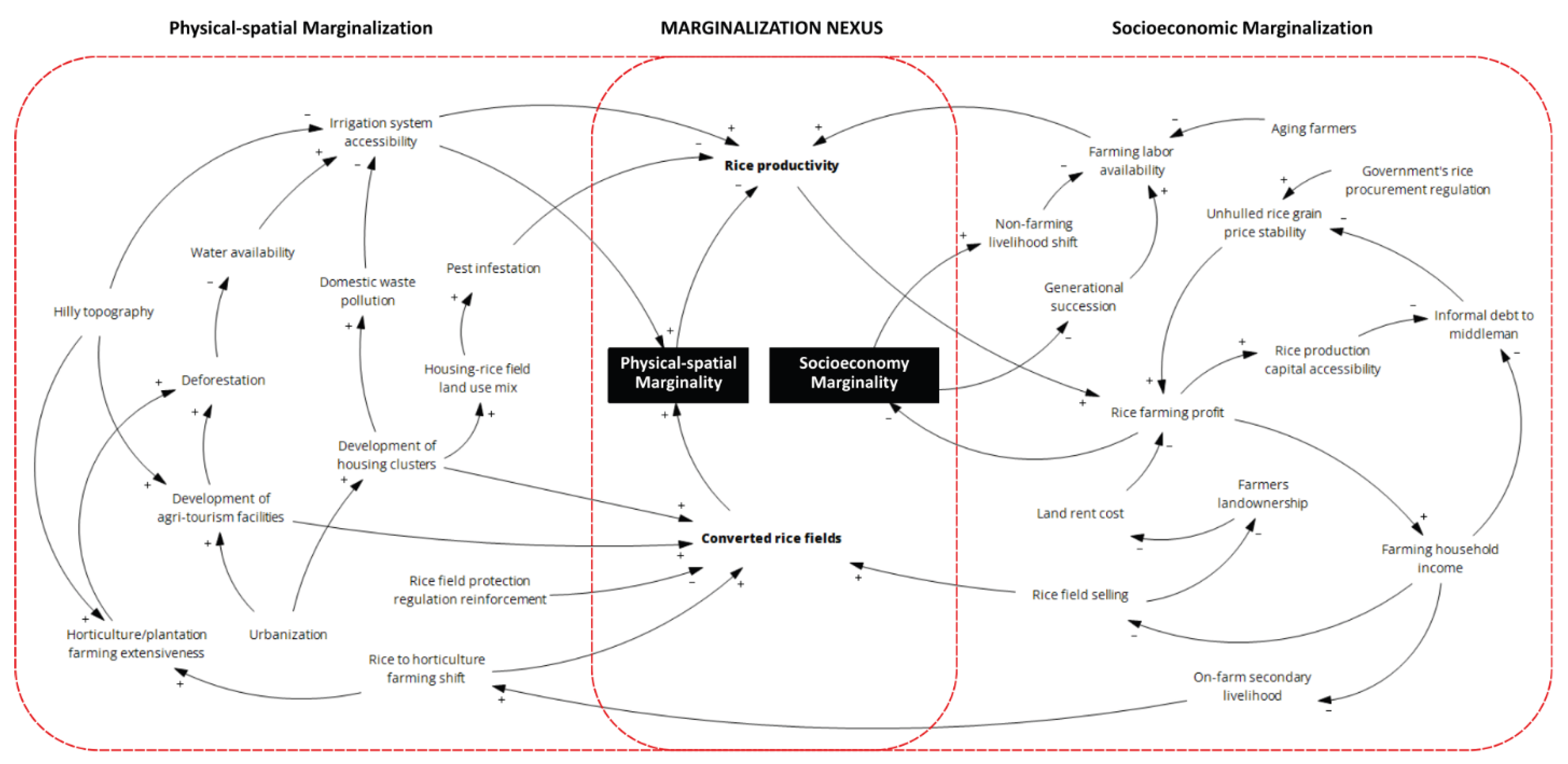
This study demonstrates that rice farmer marginalization in peri-urban landscapes occurs through coupled physical and socioeconomic feedback rather than through isolated pathways. The CLD indicates that rice farmer marginalization is driven by multiple reinforcing loops that link productivity decline and rice field conversion (Figure 4 and Figure 5). The CLD reveals that physical constraints, such as insufficient water sources, poor access to irrigation systems, and rice field conversion resulting from rapid urbanization in peri-urban areas, interact dynamically with socioeconomic components, including access to production capital, labor availability, and overall rice farming economic viability as the main livelihood of farmers. These self-reinforcing loops of rice farmers’ marginalization are exacerbated by weak balancing mechanisms of existing policy reinforcements, which are insufficient to counteract these self-reinforcing dynamics.
Rice productivity has emerged as a critical factor translating physical degradation into economic vulnerability. Rice productivity, which is tied to the sufficiency of productive farmland areas and irrigation systems, directly affects the economic viability of rice farming profits, farming household income, and production capital. In contrast, converted rice fields have emerged as a critical point that translates economic vulnerability into physical degradation. During an economic crisis, farmers tend to sell their assets, including rice fields, to meet their urgent financial needs, leading to a decline in rice fields, which triggers land conversion and ecological stress. This indicates that land conversion functions as both an outcome and driver of marginalization. This negative coping mechanism links economic vulnerability to physical degradation, creating a full circle that reinforces the feedback loop of rice farmers’ marginalization.
Figure 6.
Causal loop diagram of rice farmers' marginalization in the upland landscape.
5.3. Reconceptualizing Marginalization in Agriculture
Marginalization in the agricultural sector is commonly conceptualized into two separate domains: farmland and farmer marginalization. Studies related to farmland marginalization mainly focus on the physical attributes that drive land abandonment and decline in its economic value (Ahmadzai et al. 2022; Csikós & Tóth 2023; Kitano 2021), whereas studies on marginal farmers focus more on economic vulnerability and coping strategies among farmers (Chen et al. 2023; Faruque 2024; Napsiah & Hanjarwati 2024). Despite the close interlinkage between farmland and farmer marginalization, previous studies have addressed both phenomena in separate discussions. However, treating both marginalization independently eliminates the feedback mechanisms in which physical and socioeconomic factors interact.
To broaden the understanding of marginalization beyond the static condition of land scarcity, this study reconceptualizes the marginalization of rice farmers as an interconnection of dynamic socioeconomic and physical components. Marginalization extends beyond the conventionally emphasized issue of the small and unproductive size of cultivated rice fields. Rice farmers experience multifaceted forms of socioeconomic and physical-spatial marginalization, which reinforce and intensify their marginality. The marginalization of rice farmers is defined as the progressive deterioration of their access to economically viable rice farming systems and sufficient ecosystem services by reinforcing interactions between uncontrolled LULC conversions and socioeconomic pressures. Furthermore, marginal farmers are considered active land users who suffer from poverty traps despite actively adopting adaptive strategies. In the Indonesian context, this reconceptualization challenges the common perception of marginal rice farmers, which is often based solely on the size of their cultivated land. In terms of policymaking, this new concept advocates the reassessment of current agricultural support systems and their beneficiaries.
6. Conclusions
In discussions surrounding agricultural sustainability and food security, evaluation frameworks mainly focused on the dynamics of rice productivity as the primary criterion when assessing the sustainability of rice farming systems.
Consequently, the structural conditions that contribute to farmers’ inability to build a sustainable livelihood through rice farming as the main income have been frequently overlooked. Rice farmers’ marginalization can be viewed as a reflection of systemic dysfunction within the rice farming system, which highlights socioeconomic, institutional, and spatial imbalances. To foster a more sustainable rice farming system, this study presents a multidimensional analysis of rice farmer marginalization that extends beyond productivity indicators by focusing on the interplay of the physical-spatial and socioeconomic elements in the rice farming system. It explores the structural vulnerabilities that potentially exacerbate the decline of both productive rice fields and farming households.
A comparative analysis of lowland and upland landscapes highlights that geomorphological variation plays an important role in shaping distinct marginalization pathways. These variations in landscape configuration further shaped the coping strategies of farmers. Furthermore, this study revealed how marginalization of rice farmers is produced and reinforced through interconnected feedback mechanisms rather than isolated drivers by combining spatiotemporal LULC and landscape fragmentation analyses with CLDs. Critical factors in the marginalization nexus are rice productivity and converted rice fields. Thus, rice productivity translates from physical degradation to economic vulnerability. Conversely, rice field conversion translates economic vulnerability into physical degradation. These feedback mechanisms reinforce the poverty trap and environmental degradation, leading to self-reinforcing marginalization among rice farmers and disengagement from rice farming.
In conclusion, this study contributes to discussions on peri-urban agricultural development by reframing the marginalization of rice farmers as a coupled socio-ecological process embedded in a variety of landscape configurations and feedback loop dynamics of physical and socio-economic components. The integrated methodological framework proposed in this study offers a transferable approach for identifying sustainability risks in peri-urban agricultural areas with heterogeneous terrain, dominated by small farming households. The CLD suggests the need to move beyond sectoral responses toward integrated strategies that simultaneously protect productive landscapes, strengthen irrigation governance, expand access to affordable production capital, and support intergenerational farming continuity. By linking land-use dynamics, geomorphological variability, and farmers’ livelihood conditions provides insights for policymakers to promote more adaptive and socially inclusive agricultural planning.
Author Contributions
Conceptualization, A.A.; Methodology, A.A.; Software, A.A.; Validation, A.A. and S.I.; Formal Analysis, A.A.; Data Curation, A.A. and S.I.; Writing – Original Draft Preparation, A.A.; Writing – Review & Editing, A.A. and S.I.; Visualization, A.A.; Supervision, S.I.
Funding
No external funding was received for the research. Financial support for the article processing charge
was provided by Kyoto University and the Graduate School of Global Environmental Studies (GSGES).
Data Availability Statement
The satellite data used in this study were obtained from Sentinel-2 imagery available through the Google Earth Engine (GEE) platform. Secondary data were collected from official reports provided by local agricultural extension agencies. The processed datasets generated and analyzed during the current study are available from the corresponding author upon reasonable request and subject to agreement with the relevant data providers.
Conflicts of Interest
The authors declare no conflict of interest.:
Articles
Journal Articles
Ahmadzai H, Tutundjian S, Dale D, Brathwaite R, Lidderr P, Selvaraju R, Malhotra A, Boerger V, Elouafi I (2022) Marginal lands: potential for agricultural development, food security and poverty reduction. Rome, FAO.
Chen Q, Wu M, Xie H (2023) Tillage conditions or social economy? An analysis of the dominant driving force of farmland marginalization from the farmers' perspective, Land Use Policy, Volume 133, 106870, ISSN 0264-8377, https://doi.org/10.1016/j.landusepol.2023.106870.(https://www.sciencedirect.com/science/article/pii/S0264837723003368)
Crielaard L, Uleman JF, Châtel BDL, Epskamp S, Sloot PMA, Quax R (2024) Refining the causal loop diagram: A tutorial for maximizing the contribution of domain expertise in computational system dynamics modeling.Psychological Methods, 29(1), 169–201. https://doi.org/10.1037/met0000484
Csikós N, Tóth G (2023) Concepts of agricultural marginal lands and their utilisation: A review. Agricultural Systems. 204. 103560. 10.1016/j.agsy.2022.103560.
Creswell JW (2014) Research design: Qualitative, quantitative, and mixed methods approaches (3. ed., [Nachdr.]). SAGE Publ.
Faruque O (2024) Exploring the Socioeconomic Conditions of Marginal Farmers: A Case Study of Rangpur District, Bangladesh. Journal of Fareast International University, 2024, 7 (1), pp.12-20. hal-04928093
Follmann A (2022) Geographies of peri-urbanization in the global south. Geography Compass, 16(7), e12650. https://doi.org/10.1111/gec3.12650
Forrester JW (1968) Principles of Systems. Productivity Press, Cambridge, MA.
Gain AK, Giupponi C, Renaud FG, Vafeidis AT (2020) Sustainability of complex social-ecological systems: Methods, tools, and approaches. Regional Environmental Change, 20(3), 102, s10113-020-01692–01699. https://doi.org/10.1007/s10113-020-01692-9
Hovmand PS (2014) Community based system dynamics. Springer Science + Business Media. https://doi.org/10.1007/978-1-4614-8763-0
Kim DH (1992) Toolbox: Guidelines for drawing causal loop diagrams. The Systems Thinker, 3, 5-6
Kitano S (2021) Estimation of Determinants of Farmland Abandonment and Its Data Problems. Land, 10(6), 596.https://doi.org/10.3390/land10060596
Lane DC (2008) The emergence and use of diagramming in system dynamics: a critical account. Syst. Res., 25: 3-23. https://doi.org/10.1002/sres.826
Liu X, Wang Q, Liu S, Liu B, Kong F, Zhang W, Sun Q, Li H (2023) The association between different dimensions of social capital and cognition among older adults in China. Journal of Affective Disorders Reports, 11, 100466. https://doi.org/10.1016/j.jadr.2023.100466
McGarigal K, Cushman SA, Ene E (2012) FRAGSTATS v4: Spatial Pattern Analysis Program for Categorical and Continuous Maps. Computer Software Program Produced by the Authors at the University of Massachusetts, Amherst. http://www.umass.edu/landeco/research/fragstats/fragstats.html
Nadoushan MA (2022) Advancing urban planning in arid agricultural-urbanized landscapes of Iran: Spatial modeling evidence from a rapidly developing region. Sustainable Cities and Society, 87, 104230. https://doi.org/10.1016/j.scs.2022.104230
Napsiah N, Hanjarwati A (2024) Marginalization of Farmers in Sustaining Their Livelihoods Due to the Development of Yogyakarta International Airport, Indonesia. Society, 12(2), 575-590. https://doi.org/10.33019/society.v12i2.715
Meadows DH (2008) Thinking in Systems: A Primer. Chelsea Green, White River Junction.
Partelow S (2018) A review of the social-ecological systems framework: Applications, methods, modifications, and challenges. Ecology and Society, 23(4), art36. https://doi.org/10.5751/ES-10594-230436
Preiser R, Biggs R, De Vos A, Folke C (2018) Social-ecological systems as complex adaptive systems: Organizing principles for advancing research methods and approaches. Ecology and Society, 23(4), art46. https://doi.org/10.5751/ES-10558-230446
Pruyt E (2013) System Dynamics Models for Big Issues. The Netherlands: TU Delft Library.
Rustiadi E, Pravitasari AE, Setiawan Y, Mulya SP, Pribadi DO, Tsutsumida N (2021) Impact of continuous Jakarta megacity urban expansion on the formation of the Jakarta-Bandung conurbation over the rice farm regions, Cities, Volume 111, 103000, ISSN 0264-2751, https://doi.org/10.1016/j.cities.2020.103000.(https://www.sciencedirect.com/science/article/pii/S0264275120313482)
Schlüter M, Haider LJ, Lade SJ, Lindkvist E, Martin R, Orach K, Wijermans N, Folke C (2019) Capturing emergent phenomena in social-ecological systems: An analytical framework. Ecology and Society, 24(3), art11. https://doi.org/10.5751/ES-11012-240311
Shaw BJ, Van Vliet J, Verburg PH (2020) The peri-urbanization of Europe: A systematic review of a multifaceted process. Landscape and Urban Planning, 196, 103733. https://doi.org/10.1016/j.landurbplan.2019.103733
Sterman JD (2000) Business Dynamics: Systems Thinking and Modeling for a Complex World. Irwin McGraw-Hill, Boston.
Su G, Okahashi H, Chen L (2018) Spatial Pattern of Farmland Abandonment in Japan: Identification and Determinants. Sustainability, 10(10), 3676. https://doi.org/10.3390/su10103676
Turner BL, Kasperson RE, Matson PA, McCarthy JJ, Corell RW, Christensen L, Eckley N, Kasperson JX, Luers A, Martello ML, Polsky C, Pulsipher A, Schiller A (2003) A framework for vulnerability analysis in sustainability science. Proceedings of the National Academy of Sciences, 100(14), 8074–8079. https://doi.org/10.1073/pnas.1231335100
Veldhuis GA, Smits-Clijsen EM, van Waas RPM (2024) Techniques to enhance the public policy impact of qualitative system dynamics models. Syst. Dyn. Rev., 40: e1758. https://doi.org/10.1002/sdr.1758
Vennix JAM, Akkermans HA, Rouwette EAJA (1996) Group model-building to facilitate organizational change: an exploratory study. Syst. Dyn. Rev., 12: 39-58. https://doi.org/10.1002/(SICI)1099-1727(199621)12:1<39::AID-SDR94>3.0.CO;2-K
Von Braun J, Gatzweiler FW (Eds.) (2014) Marginality: Addressing the Nexus of Poverty, Exclusion and Ecology. Springer Netherlands. https://doi.org/10.1007/978-94-007-7061-4
Wang B, Cheng W (2023) Geomorphic influences on land use/cover diversity and pattern. CATENA, 230, 107245. https://doi.org/10.1016/j.catena.2023.107245
Wang F, Fu W, Chen J (2022) Spatial–Temporal Evolution of Ecosystem Service Value in Yunnan Based on Land Use. Land, 11(12), 2217. https://doi.org/10.3390/land11122217
Wu L, Yang Y, Yang H, Xie B, Luo W (2023) A Comparative Study on Land Use/Land Cover Change and Topographic Gradient Effect between Mountains and Flatlands of Southwest China. Land, 12(6), 1242. https://doi.org/10.3390/land12061242
Yoshida S (2020) Effects of Urbanization on Farmland Size and Diversified Farm Activities in Japan: An Analysis Based on the Land Parcel Database. Land, 9(9), 315. https://doi.org/10.3390/land9090315
Online Documents
Statistics Indonesia 2021
Statistics Indonesia 2023
Statistics Indonesia 2025
Bandung Regency Agricultural Census 2023
Figure 1.
Map of the studied districts and rice field protection areas.
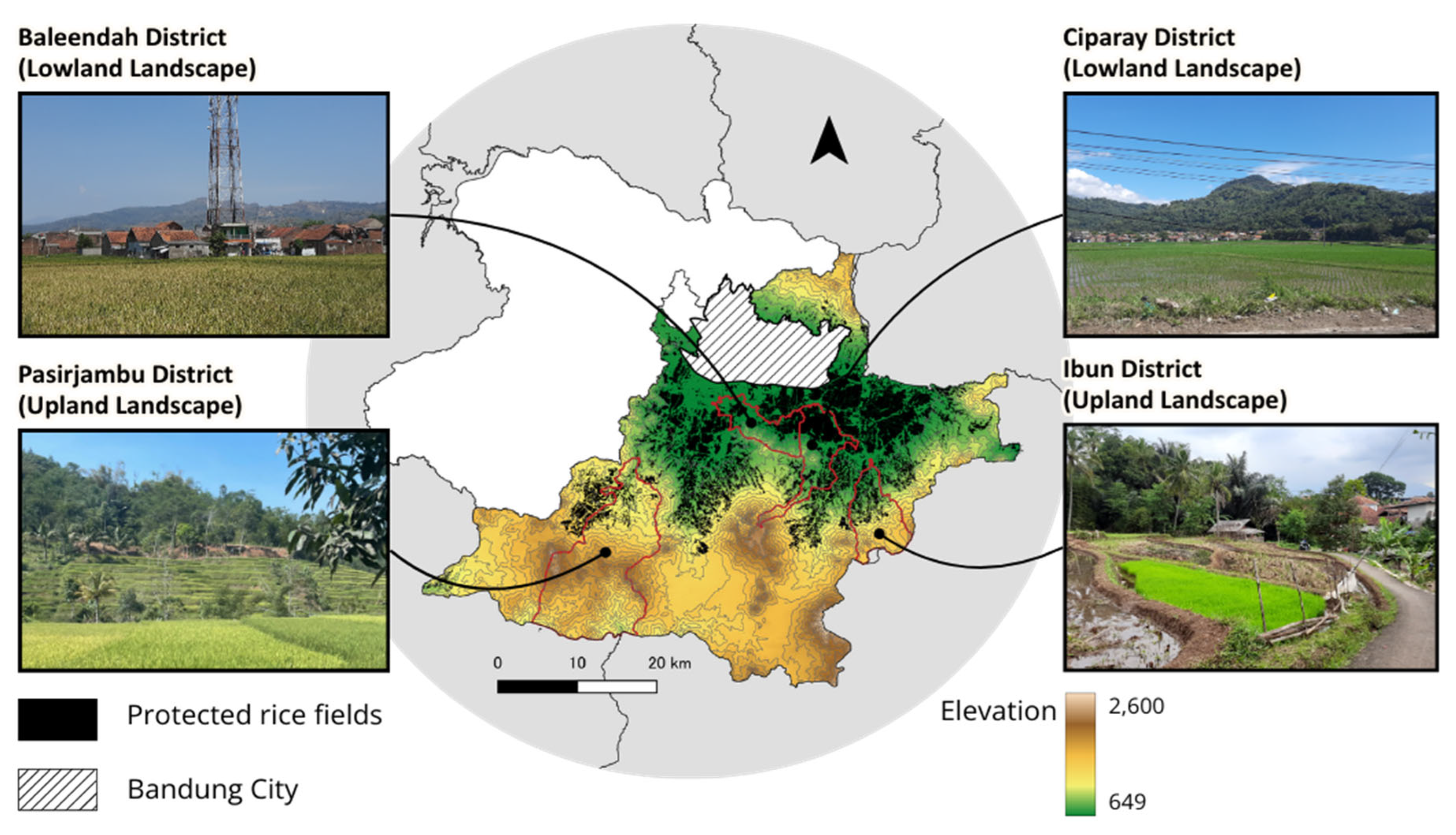
Figure 2.
LULC maps and proportions of lowland districts in 2019 and 2025.
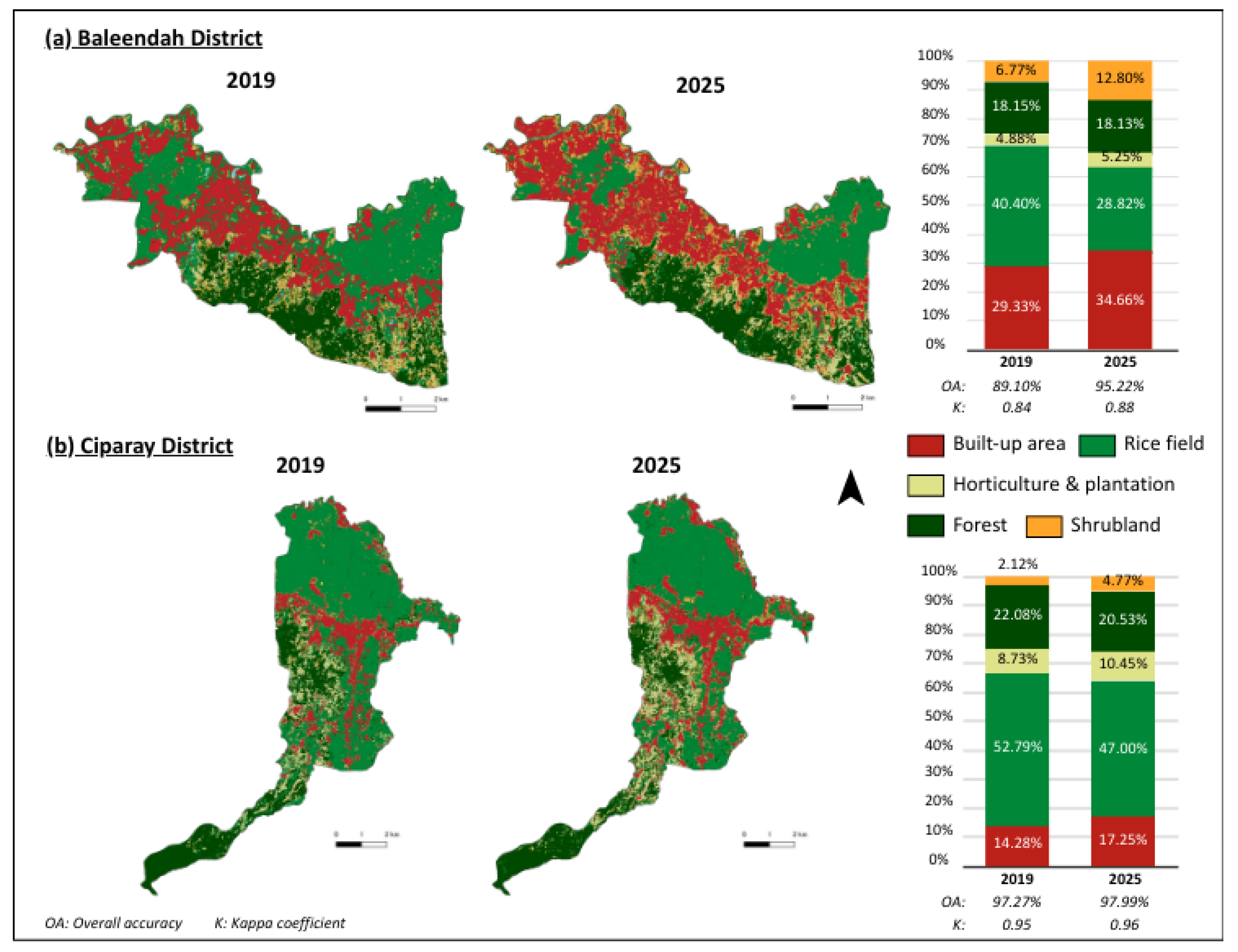
Figure 3.
LULC maps and proportions of upland districts in 2019 and 2025.
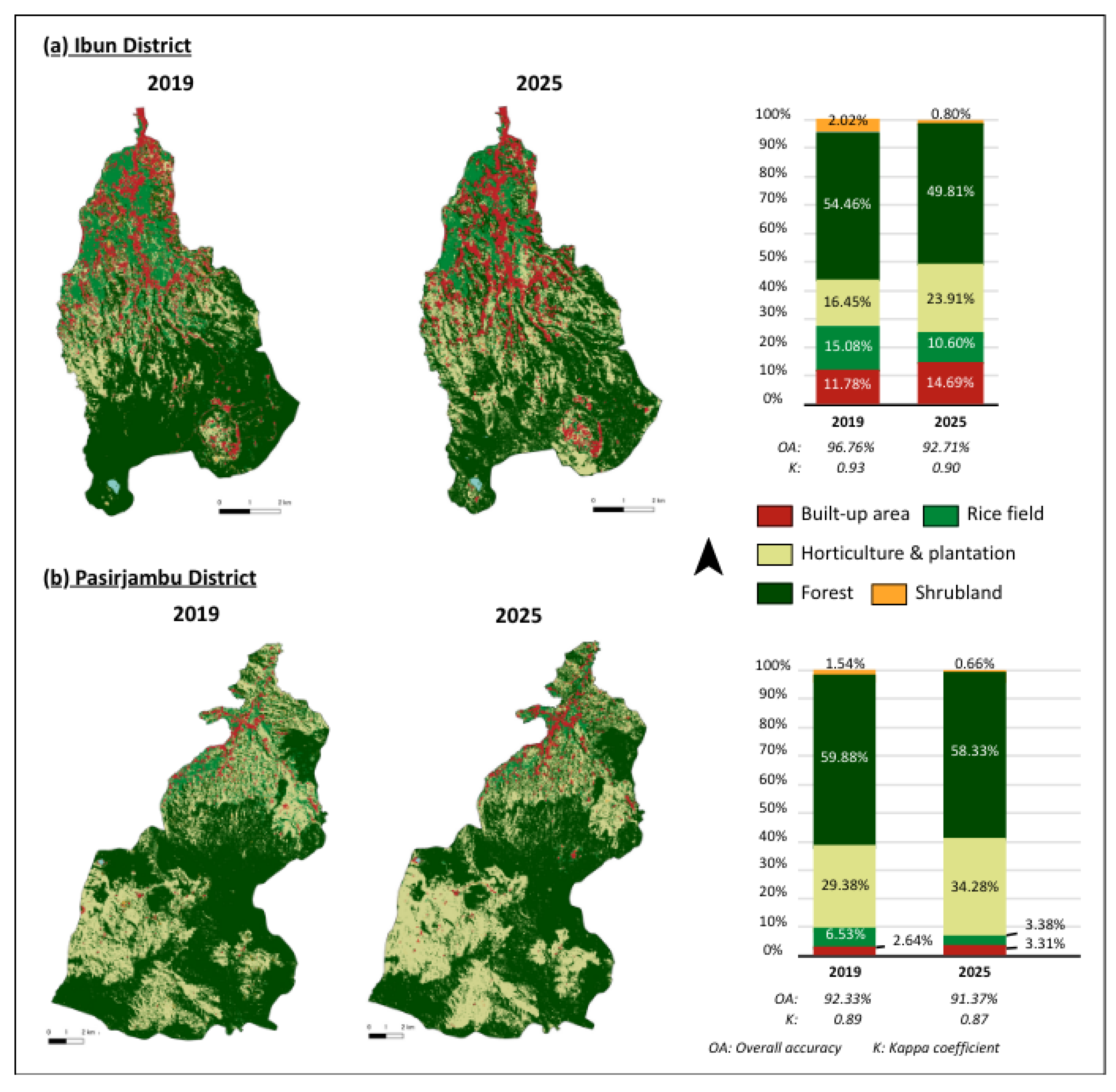
Figure 4.
Proportion of agricultural activities in the studied lowland and upland districts.
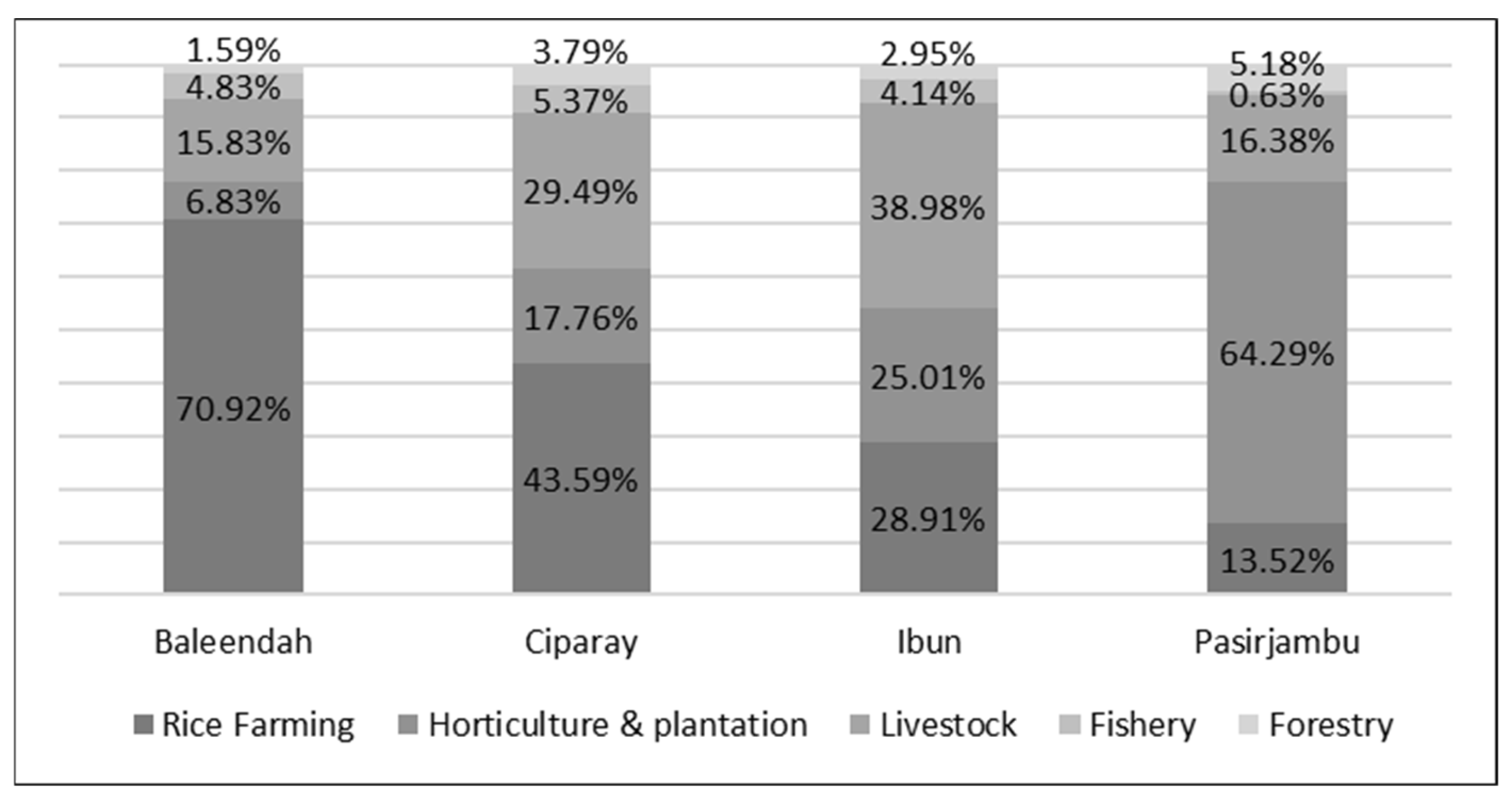
Figure 5.
Causal loop diagram of rice farmers' marginalization in the lowland landscape.
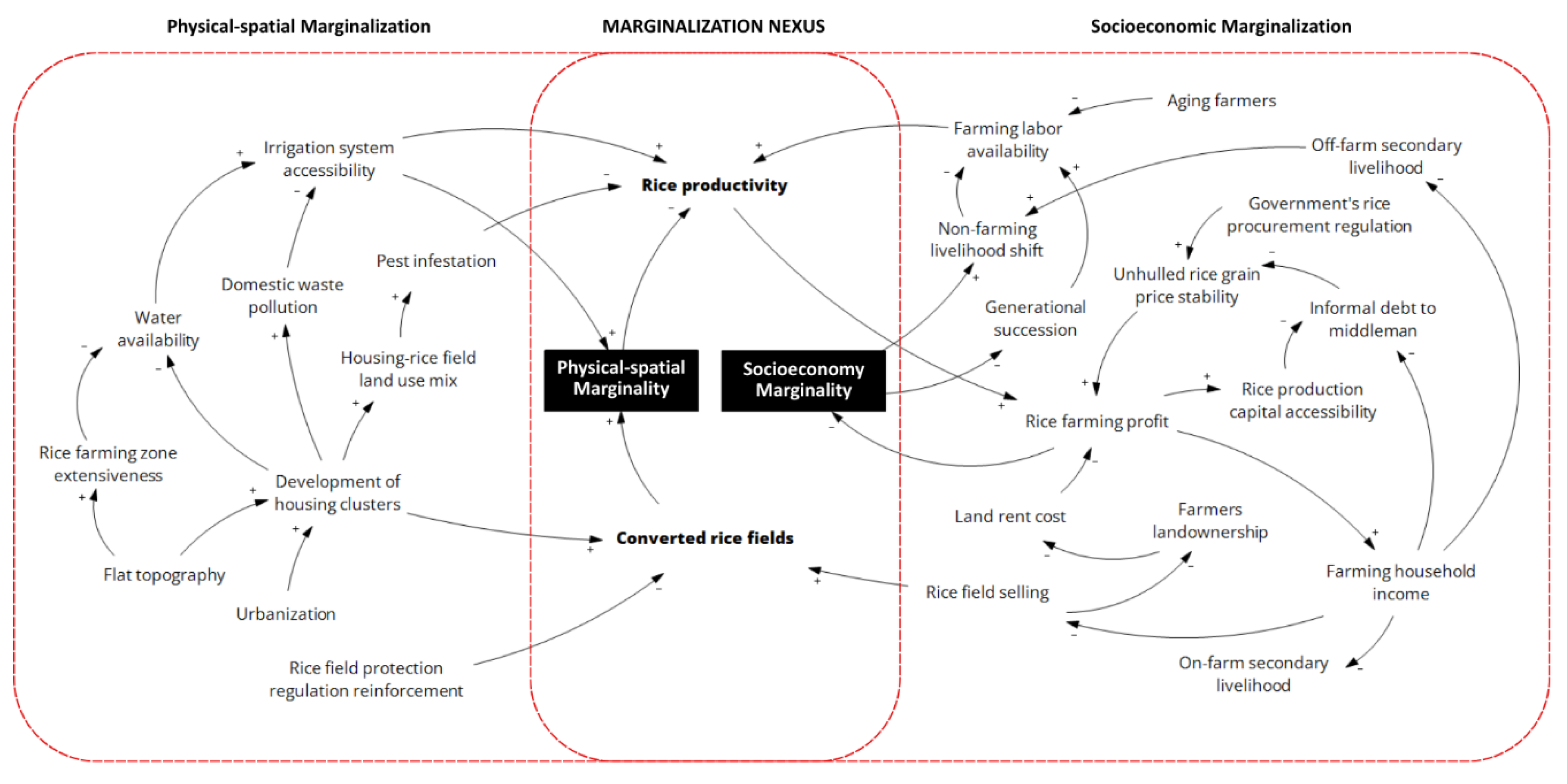

Table 1.
Temporal normalized landscape indices scores of lowland and upland landscapes in 2019 and 2025.
Table 1.
Temporal normalized landscape indices scores of lowland and upland landscapes in 2019 and 2025.
| District | LULC Class | Reversed Landscape Proportion (RLP) | Patch Number (PN) | Reversed Mean Patch Area (m²) (RMPA) | Edge Density (ED) | ||||||||
|---|---|---|---|---|---|---|---|---|---|---|---|---|---|
| 2019 | 2025 | Change | 2019 | 2025 | Change | 2019 | 2025 | Change | 2019 | 2025 | Change | ||
| Baleendah | Built-up | 0.52 | 0.43 | -0.09 | 0.00 | 0.04 | 0.04 | 0.00 | 0.41 | 0.41 | 0.38 | 0.38 | 0.00 |
| Rice field | 0.33 | 0.52 | 0.20 | 0.08 | 0.21 | 0.12 | 0.55 | 0.84 | 0.29 | 0.77 | 0.38 | -0.38 | |
| Horticulture/ plantation | 0.93 | 0.92 | -0.01 | 0.18 | 0.16 | -0.02 | 0.98 | 0.97 | -0.01 | 0.38 | 0.38 | 0.00 | |
| Forest | 0.70 | 0.70 | 0.00 | 0.02 | 0.03 | 0.01 | 0.61 | 0.65 | 0.03 | 0.38 | 0.38 | 0.00 | |
| Shrublands | 0.90 | 0.80 | -0.10 | 0.16 | 0.26 | 0.10 | 0.96 | 0.95 | -0.01 | 0.38 | 0.77 | 0.38 | |
| Ciparay | Built-up | 0.77 | 0.72 | -0.05 | 0.09 | 0.03 | -0.07 | 0.81 | 0.53 | -0.28 | 0.38 | 0.38 | 0.00 |
| Rice field | 0.12 | 0.22 | 0.10 | 0.31 | 0.25 | -0.06 | 0.74 | 0.71 | -0.02 | 0.77 | 0.77 | 0.00 | |
| Horticulture/ plantation | 0.86 | 0.83 | -0.03 | 0.27 | 0.26 | -0.01 | 0.96 | 0.95 | -0.01 | 0.38 | 0.38 | 0.00 | |
| Forest | 0.64 | 0.66 | 0.03 | 0.27 | 0.29 | 0.02 | 0.88 | 0.90 | 0.02 | 0.38 | 0.38 | 0.00 | |
| Shrublands | 0.98 | 0.93 | -0.04 | 0.17 | 0.39 | 0.22 | 0.99 | 0.99 | 0.00 | 0.00 | 0.38 | 0.38 | |
| Ibun | Built-up | 0.81 | 0.76 | -0.05 | 0.23 | 0.12 | -0.11 | 0.92 | 0.83 | -0.09 | 0.50 | 0.42 | -0.08 |
| Rice field | 0.76 | 0.83 | 0.08 | 0.37 | 0.37 | 0.01 | 0.94 | 0.96 | 0.02 | 0.54 | 0.46 | -0.08 | |
| Horticulture/ plantation | 0.73 | 0.61 | -0.13 | 0.49 | 0.50 | 0.01 | 0.95 | 0.92 | -0.03 | 0.85 | 0.96 | 0.12 | |
| Forest | 0.09 | 0.17 | 0.08 | 0.17 | 0.23 | 0.05 | 0.52 | 0.65 | 0.13 | 0.69 | 1.00 | 0.31 | |
| Shrublands | 0.98 | 1.00 | 0.02 | 0.33 | 0.08 | -0.25 | 1.00 | 1.00 | 0.00 | 0.23 | 0.08 | -0.15 | |
| Pasirjambu | Built-up | 0.97 | 0.96 | -0.01 | 0.14 | 0.09 | -0.05 | 0.91 | 0.84 | -0.07 | 0.08 | 0.08 | 0.00 |
| Rice field | 0.90 | 0.95 | 0.05 | 1.00 | 0.44 | -0.56 | 0.97 | 0.96 | -0.01 | 0.35 | 0.15 | -0.19 | |
| Horticulture/ plantation | 0.52 | 0.43 | -0.08 | 0.66 | 0.88 | 0.21 | 0.72 | 0.75 | 0.03 | 0.69 | 0.65 | -0.04 | |
| Forest | 0.00 | 0.03 | 0.03 | 0.56 | 0.74 | 0.19 | 0.31 | 0.49 | 0.18 | 0.58 | 0.65 | 0.08 | |
| Shrublands | 0.99 | 1.00 | 0.01 | 0.72 | 0.18 | -0.53 | 1.00 | 0.99 | -0.01 | 0.15 | 0.04 | -0.12 | |
Table 2.
The multidimensionality of marginalization in lowland and upland landscapes.
| Marginalization Dimensions | Lowland Landscape | Upland Landscape |
|---|---|---|
| Physical-spatial |
|
|
| Socio-economic |
|
|
Disclaimer/Publisher’s Note: The statements, opinions and data contained in all publications are solely those of the individual author(s) and contributor(s) and not of MDPI and/or the editor(s). MDPI and/or the editor(s) disclaim responsibility for any injury to people or property resulting from any ideas, methods, instructions or products referred to in the content. |
© 2026 by the authors. Licensee MDPI, Basel, Switzerland. This article is an open access article distributed under the terms and conditions of the Creative Commons Attribution (CC BY) license (http://creativecommons.org/licenses/by/4.0/).
Copyright: This open access article is published under a Creative Commons CC BY 4.0 license, which permit the free download, distribution, and reuse, provided that the author and preprint are cited in any reuse.


