

Submitted:
02 March 2026
Posted:
04 March 2026
You are already at the latest version
Abstract
Northeast China’s rust-belt cities have faced persistent concerns about stagnating labor productivity amid structural change. This paper studies how urban agglomeration benefits depend on local economic structure and ownership composition using an annual city-level panel. We estimate two-way fixed-effects models with city and year effects and city-clustered standard errors, complemented by dynamic specifications that account for productivity persistence. Results show a robust positive within-city association between population density and labor productivity. This density premium is structure-conditioned: the productivity payoff to density is significantly larger in city-years that are more industry-oriented. In contrast, an information-theoretic measure of sectoral imbalance (KL divergence from an industry–services balance benchmark) adds limited explanatory power once fixed effects, structural orientation, and controls are included, suggesting that directional orientation matters more than balance per se in this two-sector setting. Ownership composition is also informative. While SOE and private employment shares correlate with labor productivity in the fixed-effects models, the strongest and most stable finding emerges from ownership-mixing entropy: binary SOE–private employment entropy is positively associated with labor productivity in dynamic specifications, with meaningful heterogeneity across provinces. Overall, the evidence supports a conditional agglomeration view in which productivity dynamics in Northeast China reflect the interaction of density, structural orientation, and ownership complexity. The results highlight the importance of aligning urbanization with higher-value structural transformation and improving the institutional environment that enables productive SOE–private coexistence.
Keywords:
labor productivity
; agglomeration economies
; population density
; structural transformation
; entropy
; Kullback–Leibler divergence
; state-owned enterprises
; northeast China
1. Introduction
Urban agglomeration, the spatial concentration of people and firms, has long been linked to productivity differences across places. Classic microfoundations emphasize that dense environments can raise productivity through sharing (common inputs and infrastructure), matching (thicker labor and supplier markets), and learning (knowledge diffusion and faster imitation) [1]. Empirically, many studies document a positive association between density and output per worker, the so-called “density premium” [2]. At the same time, the literature stresses that interpreting density–productivity relationships requires care because sorting, omitted variables, and reverse causality can bias estimates [3]. Related work also highlights that observed spatial productivity advantages reflect a combination of agglomeration forces and selection mechanisms that may vary across contexts and sectors [4].
A growing concern is that the density premium is not uniform. The effectiveness of density in generating productivity depends on local economic structure and institutional conditions that govern whether proximity translates into specialization, reallocation, and learning. This heterogeneity is particularly salient in rust-belt and shrinking-city settings, where industrial legacies, restructuring pressures, and population outflows may weaken the channels that typically underpin agglomeration economies [5]. These issues are central to Northeast China, Liaoning, Jilin, and Heilongjiang, an old industrial base that has experienced long-run restructuring and renewed policy attention [6]. Recent evidence documents pervasive shrinkage dynamics across the three provinces and emphasizes that decline has become a notable regional phenomenon rather than a set of isolated cases [7,8]. Work on regional decline and structural change in Northeast China further suggests that deindustrialization and weak reallocation capacity can shape growth trajectories during periods of deterioration [9]. Yet, despite a large agglomeration literature, relatively little is known about when density continues to deliver productivity gains in an emerging-economy rust-belt context, and which structural features systematically condition those gains.
A second gap concerns how “structure” is conceptualized and measured in density–productivity studies. Existing work often conflates two distinct dimensions: (i) structural orientation (whether a city economy is more industry-oriented versus more service-oriented), and (ii) structural mixing/imbalance (how far a city is from a balanced sectoral distribution, regardless of which sector dominates). Treating these dimensions as interchangeable can obscure what type of structural change matters for agglomeration payoffs [10,11]. To separate them, we complement a directional industry–services orientation metric with information-theoretic measures, Shannon entropy and Kullback–Leibler (KL) divergence, that quantify distributional mixing or divergence independently of direction [12,13,14,15]. We extend the same logic to institutions by constructing ownership-mixing entropy based on employment shares across ownership forms, providing an interpretable descriptor of ownership complexity within cities over time.
This paper addresses these gaps by studying the density–productivity relationship in Northeast China using an annual panel of 34 prefecture-level cities (2007–2021). We estimate two-way fixed-effects models with city and year effects and standard errors clustered at the city level, interpreting coefficients as within-city conditional associations. We then complement static specifications with dynamic fixed-effects models including lagged productivity to account for persistence, treating these dynamic estimates as robustness given the well-known finite-T bias in dynamic fixed-effects settings [16]. Our empirical design allows the density premium to vary with (a) industry–services orientation, (b) sectoral imbalance/mixing captured by entropy and KL divergence, and (c) ownership composition and ownership-mixing entropy, and we also assess whether the estimated density premium changes over time during the restructuring period.
The study analysis makes three contributions. First, it provides evidence that the density–productivity relationship in Northeast China is structure-conditioned, clarifying a conceptual distinction between directional structural orientation and undirected mixing/imbalance. Second, it evaluates whether information-theoretic measures (entropy and KL divergence) add explanatory power beyond directional structure, helping to identify when “mixing/diversity” metrics are substantively informative for productivity dynamics. Third, the paper documents the role of ownership complexity by examining whether employment-based ownership-mixing entropy is systematically associated with labor productivity and whether such associations differ across provinces, highlighting the ownership-structure dimension of restructuring in China’s Northeast
The remainder of the paper is organized as follows. Section 2 reviews the related literature and motivates our hypotheses. Section 3 describes the data and variable construction, including the entropy and divergence measures. Section 4 presents the empirical strategy and reports the main results and robustness checks. Section 5 discusses implications, limitations, and directions for future research.
2. Literature Review
2.1. Structural Transformation, Service Quality, And Conditional Agglomeration
The relationship between sectoral composition and labor productivity cannot be reduced to the simple claim that “more services automatically raises productivity.” Structural transformation affects aggregate productivity through a composition effect: productivity rises when labor reallocates toward higher-productivity activities and may fall when labor shifts toward lower-productivity activities [17].
A key implication is that both the direction of structural change (industry-oriented vs. service-oriented) and the quality of the service sector matter. Producer (knowledge-intensive) services, such as finance, R&D, logistics, and business services, often function as intermediate inputs and can strengthen specialization and spillovers, whereas expansion concentrated in low-productivity local consumer services is less likely to generate comparable productivity externalities. Evidence for China is consistent with this distinction: producer-services agglomeration is associated with higher urban productivity, and the strength of this relationship varies across cities [18]. Related work also documents plausible mechanisms through which producer-services agglomeration can affect manufacturing outcomes, via scale effects, technology spillovers, and competition, using evidence on manufacturing carbon efficiency [19].
This distinction is particularly relevant in Northeast China, where recent city-level evidence describes a “premature deindustrialisation” pattern, marked by a co-decline in industry and construction employment, linked to weaker regional income trajectories, underscoring why the direction of structural change matters in old industrial bases [9].
This logic is especially relevant for regions undergoing restructuring from an old industrial base. Northeast China is widely described as China’s major old industrial base, shaped by heavy-industry concentration and a strong legacy of the planned economy, and facing path-dependent adjustment pressures [6,9]. In such settings, productivity performance is not determined by “industry versus services” as a dichotomy, but by whether industrial ecosystems remain dense while producer services co-develop as complementary inputs. Empirical evidence from Chinese cities supports the complementarity view: coordinated agglomeration of producer services with manufacturing is linked to higher urban green total factor productivity, with stronger effects when producer services are more knowledge-intensive [20]
Northeast China may not enjoy automatic agglomeration gains: comparative city-level evidence finds that enterprise agglomeration is negatively associated with urban productivity in the Northeast (in contrast to other regions), implying that any “density premium” is plausibly contingent on structural conditions [21]. Consistent with this caution, policy evidence from the 2014 revitalization round suggests that industrial-structure transformation and specialization clustering can occur without a statistically significant improvement in technical efficiency, reinforcing the view that restructuring does not necessarily translate into productivity gains [22].
Because theory implies competing mechanisms, we do not impose a single sign a priori; instead, we test whether the density premium is conditioned by (i) structural direction and (ii) mixing measures.”
H1:
Structural characteristics condition the density premium: (i) sectoral orientation and (ii) sectoral mixing (captured by entropy/relative entropy) may moderate the density–productivity relationship, with orientation expected to be the more salient dimension in restructuring regions.
2.2. Ownership Structure, Financing Frictions, and Density Premium
A central mechanism is differential access to finance. Using firm-level evidence on credit rationing, Gao, Li [23] find that state ownership is associated with a lower likelihood of credit rationing in China, i.e., SOEs are less likely to be credit-rationed, highlighting how ownership can systematically affect financing constraints and investment capacity [23]. At the same time, private firms commonly face ownership-based frictions in formal finance. Bai, Cai [24] show that private firms are significantly less funded through formal channels such as bank loans than state-owned firms, and therefore rely more on alternative finance such as trade credit; this provides direct evidence of “ownership discrimination” in financing and a clear substitution toward non-bank finance. This pattern is consistent with earlier evidence of bank discrimination against private firms in China’s transition context [25].
These ownership-linked financing asymmetries imply systematic differences in sectoral positioning and firm behavior, which matter for agglomeration Consistent with evidence that changes in the size of the SOE sector affect entrepreneurship and firm formation, SOE downsizing in the late 1990s is associated with improvements in the quantity and quality of entrepreneurship [26]. SOEs are more prevalent in capital-intensive and policy-relevant activities, while private firms are more represented in competitive segments, often under tighter financial constraints, shaping the extent to which dense urban environments translate into upgrading, coordination, and spillovers. In this sense, ownership composition can moderate the density premium through at least two mechanisms. First, in SOE-intensive cities, implicit guarantees and soft budget constraints may relax financing constraints and sustain higher leverage, but may also distort credit allocation and promote inefficiency, making the net productivity payoff from density theoretically ambiguous [27]. Second, in private, intensive cities, the density premium may be weaker if private activity is disproportionately concentrated in fragmented low-value segments and if financing frictions constrain longer-horizon investments that support learning and spillovers [24,25].We therefore measure ownership structure using both SOE/private employment shares and ownership entropy [12] to test whether dispersion adds information beyond dominance.
H2: The density–productivity association is conditioned by ownership structure: it varies with SOE and private employment shares, and is further moderated by ownership-share dispersion (ownership entropy), over and above the effects of the shares themselves.
3. Data, Variables, and Empirical Strategy
3.1. Study Area, Sample, and Panel Structure
Using city-level data from the China City Statistical Yearbook and provincial yearbooks for Liaoning, Jilin, and Heilongjiang, this study examines whether the density–productivity association varies with sectoral structure and ownership composition. The sample period (2007–2021) is chosen to cover a sustained phase of restructuring in Northeast China and to ensure consistent data availability across cities and variables.the study variables are included in Table 1.
3.2. Empirical Models
3.2.1. Fixed-Effects Framework and Interaction Design
The empirical strategy proceeds in three steps. First, a dynamic two-way fixed-effects model is estimated to account for persistence in productivity. Second, the density premium is allowed to vary with structural direction by including a density–structure interaction term. Third, information-theoretic measures are introduced as alternative moderators to test whether mixing/imbalance (sectoral and ownership dispersion) provides explanatory power beyond directional indicators
To test whether the density premium varies with structural orientation:
where are city fixed effects, are year fixed effects,
3.2.2. Entropy-Based Moderators
To capture “structural complexity” and “ownership mixing” using information-theoretic measures, two sets of entropy indicators are constructed All entropy measures are computed only when component shares are non-missing and strictly positive to avoid undefined logs.
- Sectoral entropy and KL divergence (industry vs. services)
Define sectoral shares using per-capita levels:
computed when ₜ > 0.
Sectoral Shannon entropy is:
computed when> 0 and> 0.
The Kullback–Leibler divergence from an equal-share benchmark (0.5, 0.5) is:
computed when > 0 and > 0.
- 2.
- Ownership entropy (binary: SOE vs. Private; main measure)
Define the binary ownership mass and normalized shares:
computed when > 0 and both shares are observed. The binary Shannon ownership entropy is:
computed when > 0 and > 0.
- 3.
- Ownership entropy (three-way: SOE, Private, S&T; auxiliary)
Define the three-way ownership mass and normalized shares:
computed when > 0 and all three shares are observed.
The three-way Shannon ownership entropy is:
computed when > 0, > 0, and ᵢₜ > 0.
The analysis incorporates three information-theoretic measures to distinguish conceptually different dimensions of “structure” that may condition the density–productivity association. First, sectoral KL divergence () measures how far a city’s industry–services distribution deviates from a balanced benchmark, capturing imbalance independently of whether the economy is industry- or service-oriented. Second, ownership entropy based on SOE–private employment shares () summarizes how mixed the local ownership composition is beyond dominance by either group; this is relevant in Northeast China where ownership type is closely tied to financing access and institutional support, so the co-presence of SOEs and private firms may reflect a different set of complementarities and constraints than a city dominated by one ownership form. Third, a three-way ownership entropy () extends this idea by incorporating the S&T employment share, capturing a broader institutional–organizational mix, albeit with reduced sample coverage. Together, these measures operationalize the literature’s distinction between direction (captured separately by ) and mixing/imbalance (captured by entropy/KL), allowing a direct empirical test of whether agglomeration gains in restructuring cities depend primarily on which activities dominate or on how dispersed the underlying ownership and sectoral shares are. dynamic FE with and density interaction:
While the dynamic FE with and density interaction:
And lastly the dynamic FE with (three-way) and density interaction:
These specifications separate direction () from mixing/imbalance (, , ), allowing a direct test of whether heterogeneity in the density premium is driven primarily by which activities/ownership types dominate or by dispersion in the underlying shares.
4. Discussion
4.1. Baseline Density Premium and Structural Conditioning
The results come in three steps. Table 2 estimates the baseline within-city density–productivity association using two-way fixed effects (city and year) with city-clustered standard errors, and tests structural conditioning via the density × industry–services interaction (static and dynamic models with lagged productivity). Table 2 then tests whether the density premium varies with the ownership environment, interacting density with mean-centered SOE and private employment shares. Table 3 finally augments the dynamic specification with DKL sectoral imbalance and ownership-entropy measures (binary and three-way) to evaluate whether dispersion adds explanatory power beyond fixed effects and controls
To provide intuition for the structural and ownership variables used in the regressions, Figure 1 maps the underlying sectoral and ownership shares across sample cities. Panel (a) shows SOE versus private employment shares, and Panel (b) shows industry versus services shares. The figure is descriptive and highlights cross-city heterogeneity in composition
Table 2 reports two-way fixed-effects estimates (city and year fixed effects; standard errors clustered at the city level) relating population density to labor productivity in Northeast Chinese cities. In the baseline static FE model, ln(Density) is positive and statistically significant (0.904, s.e. 0.301), indicating a positive within-city association between density and productivity over time after controlling for covariates and common year shocks. The structural orientation measure ln(Struct) is also positive and significant (0.271, s.e. 0.058), where ln(Struct)=ln(industry/service) and higher values indicate a more industry-oriented structure.
In dynamic specifications that include lagged productivity, productivity is highly persistent (0.469–0.453, p<0.01) and the density premium remains positive and significant (0.946–1.078, p<0.01); the density × structure interaction also remains positive though attenuated (0.099, s.e. 0.038).
4.2. Ownership Environment as a Moderator of the Density Premium
The study next examines whether the density–productivity association varies systematically with ownership intensity (Table 3). Interacting density with the mean-centered private employment share yields a negative and precisely estimated interaction term (ln(Density) × private share: −0.944, s.e. 0.185, p<0.01), indicating that the density premium is attenuated in more private-intensive city-years (relative to the sample mean). By contrast, the corresponding interaction with the mean-centered SOE_EMP share is positive but not statistically distinguishable from zero (0.175, s.e. 0.187). Figure 2 visualizes the implied marginal effect of density across low/mean/high values of private-sector intensity.
Figure 2 shows the estimated year-by-year marginal effects of on from a fixed-effects model that interacts with year indicators (city FE; year FE; baseline controls). Dashed lines denote 95% confidence intervals. The figure is descriptive, documenting temporal heterogeneity in within-city associations and serving as a diagnostic that motivates subsequent tests of structural conditioning
Figure 3 shows a monotonic decline in the estimated density premium as the private employment share rises, consistent with the negative interaction term in the dynamic FE model. The implied density–productivity association remains positive throughout the plotted range but is materially attenuated in more private-intensive city-years.
4.3. Entropy Indicators: Sectoral Imbalance Versus Ownership Mixing
Table 4 augments the dynamic specification with information-theoretic indicators. Column 1 adds DKL_sector, which measures the divergence of the industry–services composition from a balanced benchmark. The coefficient on DKL_sector is small and statistically indistinguishable from zero (0.217, s.e. 0.323), suggesting limited incremental explanatory power of sectoral imbalance in this two-sector implementation once fixed effects and baseline controls are included. In contrast, ownership dispersion measures are strongly related to productivity. Column 2 summarizes ownership structure using the binary ownership entropy H_own2 (SOE vs private), which is positive and precisely estimated (1.260, s.e. 0.324, p<0.01). Column 3 confirms robustness using a three-way entropy index H_own (SOE/private/ST), which remains positive and significant (1.155, s.e. 0.283) despite a modest reduction in sample size. These entropy coefficients should be interpreted as evidence that ownership mixing contains productivity-relevant information in the panel, rather than as a clean causal effect of diversification. Table 4 provides stronger support for ownership dispersion than for sectoral imbalance: DKL is not informative in this specification, whereas ownership entropy is robustly positive.
4.4. Robustness and Cross-Province Heterogeneity
Robustness checks in Table A1 and Table A2 show that the key density × structure interaction is not driven by any single city or sample restriction. In leave-one-city-out exercises, the interaction remains positive in all replications and varies within a narrow range (≈0.083–0.120). The same qualitative conclusions hold when excluding 2021, removing potentially influential cities, or restricting the sample by city size.
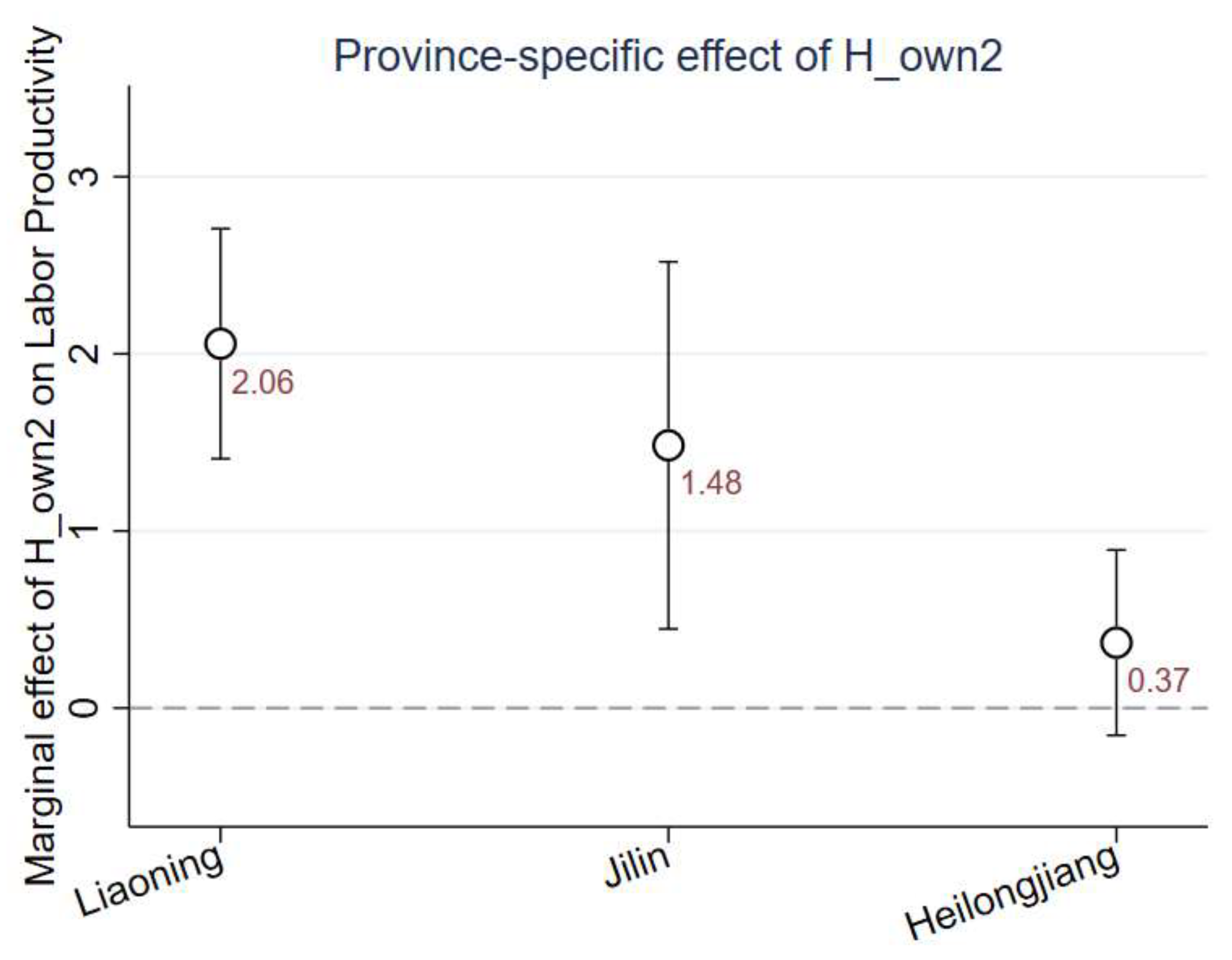
Figure A1 and Figure A2 provide complementary evidence on cross-province heterogeneity. Figure A1 indicates that the implied density premium increases with industry orientation in all three provinces, but the magnitude differs, with Liaoning exhibiting a consistently larger density premium than Jilin and Heilongjiang across the plotted range. Figure B2 shows that the estimated association between ownership entropy and productivity is sizable in Liaoning and Jilin but weaker in Heilongjiang, where it is not precisely estimated. These diagnostics reinforce two points: the core density × structure result is stable to standard robustness checks, and the strength of the conditioning patterns varies across Liaoning, Jilin, and Heilongjiang, an important consideration when translating the empirical regularities into province-specific discussion.
5. Discussions and Policy Reconcentration
5.1. Structure-Conditioned Agglomeration: Density Premium and Sectoral Orientation
The combined evidence supports a conditional agglomeration narrative. A positive density–productivity association is consistent with foundational evidence that productivity rises with the density of economic activity, reflecting localized externalities [2]. Beyond this baseline, the key result is that the density premium is structure-dependent: the significant density–structure interaction suggests that agglomeration gains are larger when city-years are more industry-oriented. This is in line with micro-foundations emphasizing that agglomeration operates through sharing, matching, and learning, and that the strength of these channels depends on the organization of production and the intensity of input–output linkages [1]. It also echoes work separating agglomeration forces from selection mechanisms (i.e., tougher competition in larger places), implying that observed productivity advantages can reflect a mix of external economies and compositional changes, precisely the type of heterogeneity our interaction is designed to capture [4]. China-specific evidence at both firm and city levels supports the view that agglomeration effects are substantial and that industrial composition conditions these benefits [28,29,30].
5.2. Why Sectoral KL Adds Little: Direction vs Imbalance and Measurement Granularity
On the contrary, the information-theoretic sector indicator based on divergence from a balanced industry–services split (DKL_sector) adds limited incremental explanatory power in the dynamic FE models. This is not contradictory: the directional structure measure captures which side dominates (industry versus services), whereas DKL captures distance from balance without direction. If the productivity-relevant margin is primarily whether the local economy is anchored in more tradable, input-linked activity versus low-value local services, then a direction-agnostic “imbalance” metric can be statistically weak even when a directional measure is strong. A second reason is measurement granularity: entropy-based “variety” measures are typically most informative when computed over richer sectoral detail (e.g., related vs. unrelated variety across many industries), whereas coarse two-sector partitions can compress variation and reduce power in fixed-effects frameworks [14]. the evidence indicates that, in Northeast China, the density premium is more plausibly interpreted as a function of structural orientation (industry relative to services) than of a coarse two-sector entropy proxy for “balance.” Accordingly, we center the empirical specification on directional structure interactions and treat sectoral entropy primarily as a diagnostic measure rather than a core explanatory channel.
5.3. Ownership Structure and Institutional Frictions: Shares, Mixing Entropy, and Productivity
Turning to ownership employment shares, we find that within-city changes in SOE and private employment shares correlate with labor productivity, but we interpret these coefficients as conditional associations rather than causal effects. A misallocation perspective highlights that ownership-linked frictions, especially unequal access to capital and factor-market distortions, can shape productivity outcomes, making share coefficients sensitive to local selection and sectoral composition [31,32].More importantly, ownership dispersion/mixing, summarized by information-theoretic measures (binary and three-way ), is strongly and robustly associated with higher productivity in our dynamic FE models. This pattern is consistent with evidence that state involvement is often associated with lower productivity and capital misallocation among listed firms, and that reforms affecting the state–nonstate boundary can be productivity-relevant [32,33].Complementary city-level evidence also suggests that SOE presence can influence local economic dynamics, by inhibiting manufacturing employment growth and by slowing the growth of non-SOEs in SOE-intensive cities, highlighting why an “ownership-mixing” descriptor can proxy for broader institutional and competitive conditions rather than a purely mechanical diversification effect [34,35].Accordingly, we treat ownership entropy primarily as an employment-based structural descriptor that summarizes ownership balance/mixing, rather than as a direct policy lever with a clean causal interpretation. See also [36]).
5.4. Limitations, Implications, and Future Research
Our empirical design is intentionally within-city and fixed-effects-based, so the estimates should be read as policy-relevant conditional relationships (net of time-invariant city factors) rather than as fully identified causal effects; importantly, the main interaction patterns are interpreted as heterogeneity in the density-productivity association rather than as a single mechanism claim. The entropy measures, especially ownership entropy, are used as compact, employment-based structural descriptors of ownership balance/mixing; when shares and entropy appear together, we treat them as a way to capture nonlinear dependence on ownership composition (e.g., dominance vs. balance) and interpret coefficients descriptively, avoiding structural over-claims. Likewise, our two-sector industry-services entropy is a parsimonious diagnostic proxy for balance; its limited incremental power relative to directional orientation is therefore interpreted as evidence that the economically relevant margin in Northeast China is structural direction (industry-linked activity versus local services) rather than balance per se, while acknowledging that finer sectoral detail could sharpen “variety” measurement. From a policy perspective, the results suggest that raising the productivity payoff of density is more likely when restructuring supports higher-value, tradable, and input-linked activities rather than service expansion in the abstract; that productivity differences across city-years are meaningfully associated with ownership mixing/balance, pointing to institutional conditions under which SOE–private coexistence translates into competition, learning, and reallocation (e.g., nondiscriminatory finance access, governance, and credible entry/exit); and that provincial heterogeneity cautions against uniform reform templates across Liaoning, Jilin, and Heilongjiang. Future work can strengthen interpretation by computing information-theoretic structure measures using finer sectoral granularity, connecting ownership mixing to firm-level reallocation channels, and exploiting quasi-experimental shocks or staggered policy reforms to tighten causal inference.
Author Contributions
O.A.R. conceived the study, developed the main analysis, wrote the manuscript, designed the methodology, and validated the results. J.R. provided supervision and secured funding for the research. M.I.A. contributed to the conceptual framework, methodology development, data sourcing, and validation. M.A.A. supported validation, visualization, and review the manuscript. All authors confirm that this manuscript, titled “ Carbon-Intensive Logistics and Food Security Resilience: Structural Vulnerability in Global Food Imports” is original work that has not been previously published nor submitted to any other journal or conference for consideration. Each author has contributed significantly to the development of this manuscript and has reviewed and agreed upon the final version for submission.
Funding
This research was supported by the Shenzhen Science and Technology Program (Grants No.: RKX20231110090859012 and JCYJ20220531095216037), the Fundamental Research Funds for the Central Universities (Grant No.: HIT.OCEF.2024047), and the Guangdong Provincial Self-Specialized Fund Upper-Level Project (Grant No.: 2023A1515012520).
Data Availability Statement
The data used in this study is available from the corresponding author, O.A.R, upon reasonable request.
Conflicts of Interest
The authors do not have any other relevant interests to declare.
Appendix A

Table A1.
Robustness of the density–structure interaction: alternative samples and influential-city checks.
Table A1.
Robustness of the density–structure interaction: alternative samples and influential-city checks.
| Variables | Main: Full sample | Main: Drop 2021 | Main: Exclude city 2 & 23 | Robust: drop big cities |
|---|---|---|---|---|
| L.ln(LP) | 0.453*** | 0.420*** | 0.442*** | 0.418*** |
| (0.0634) | (0.0648) | (0.0626) | (0.0657) | |
| ln(Dens) | 1.078*** | 1.339* | 1.064*** | 0.969** |
| (0.276) | (0.786) | (0.291) | (0.471) | |
| ln(Struct) | 0.189*** | 0.197*** | 0.222*** | 0.190*** |
| (0.0325) | (0.0339) | (0.0302) | (0.0343) | |
| c.ln(Dens)#c.ln(Struct) | 0.0994** | 0.107*** | 0.103** | 0.0976** |
| (0.0380) | (0.0369) | (0.0414) | (0.0424) | |
| Soe_Emp | 0.569*** | 0.611*** | 0.646*** | 0.618*** |
| (0.134) | (0.145) | (0.141) | (0.147) | |
| Pri_Emp | -0.836*** | -0.814*** | -0.815*** | -0.780*** |
| (0.260) | (0.270) | (0.264) | (0.282) | |
| Education | -0.0251 | -0.0354 | -0.0260 | -0.0628 |
| (0.0381) | (0.0379) | (0.0351) | (0.0436) | |
| Health | -0.223 | -0.261 | -0.208 | -0.467 |
| (0.274) | (0.300) | (0.314) | (0.307) | |
| 2009.year | 0.125*** | 0.131*** | 0.130*** | 0.140*** |
| (0.0212) | (0.0216) | (0.0212) | (0.0228) | |
| 2010.year | 0.107** | 0.122*** | 0.0978** | 0.131*** |
| (0.0422) | (0.0433) | (0.0419) | (0.0471) | |
| 2011.year | 0.266*** | 0.281*** | 0.254*** | 0.306*** |
| (0.0484) | (0.0512) | (0.0484) | (0.0538) | |
| 2012.year | 0.337*** | 0.358*** | 0.328*** | 0.386*** |
| (0.0623) | (0.0623) | (0.0625) | (0.0638) | |
| 2013.year | 0.375*** | 0.403*** | 0.372*** | 0.427*** |
| (0.0724) | (0.0743) | (0.0733) | (0.0778) | |
| 2014.year | 0.387*** | 0.423*** | 0.384*** | 0.445*** |
| (0.0706) | (0.0723) | (0.0715) | (0.0737) | |
| 2015.year | 0.397*** | 0.438*** | 0.405*** | 0.452*** |
| (0.0775) | (0.0804) | (0.0783) | (0.0821) | |
| 2016.year | 0.490*** | 0.530*** | 0.501*** | 0.537*** |
| (0.0810) | (0.0834) | (0.0827) | (0.0840) | |
| 2017.year | 0.512*** | 0.558*** | 0.531*** | 0.561*** |
| (0.0887) | (0.0933) | (0.0902) | (0.0954) | |
| 2018.year | 0.586*** | 0.632*** | 0.596*** | 0.624*** |
| (0.0847) | (0.0903) | (0.0862) | (0.0893) | |
| 2019.year | 0.631*** | 0.681*** | 0.646*** | 0.664*** |
| (0.0878) | (0.0937) | (0.0890) | (0.0938) | |
| 2020.year | 0.549*** | 0.599*** | 0.557*** | 0.588*** |
| (0.113) | (0.116) | (0.117) | (0.120) | |
| 2021.year | 0.709*** | 0.723*** | 0.707*** | |
| (0.120) | (0.124) | (0.189) | ||
| Constant | 0.966*** | 0.900 | 0.984*** | 1.151*** |
| (0.312) | (0.533) | (0.322) | (0.377) | |
| Observations | 451 | 442 | 424 | 397 |
| R² | 0.784 | 0.778 | 0.785 | 0.791 |
| Number of Cities | 34 | 34 | 32 | 30 |
Table A2.
Robustness of ownership entropy and alternative samples and “over-control” specification.
| Variables | Entropy: Base (no SOE/PRI) | Entropy: Drop 2021 | Entropy: Exclude city 2 & 23 | Entropy: +SOE & +PRI (over-control check) |
|---|---|---|---|---|
| L.ln(LP) | 0.484*** | 0.439*** | 0.476*** | 0.451*** |
| (0.0718) | (0.0735) | (0.0749) | (0.0645) | |
| ln(Dens) | 0.953*** | 0.782 | 1.043*** | 1.028*** |
| (0.313) | (0.774) | (0.331) | (0.308) | |
| H_own2 | 1.479*** | 1.595*** | 1.557*** | 0.868** |
| (0.322) | (0.340) | (0.358) | (0.351) | |
| ln(Struct) | 0.258*** | 0.268*** | 0.275*** | 0.232*** |
| (0.0375) | (0.0379) | (0.0372) | (0.0382) | |
| Soe_Emp | 0.416*** | |||
| (0.122) | ||||
| Pri_Emp | -0.442 | |||
| (0.278) | ||||
| Education | -0.0355 | -0.0411 | -0.0265 | -0.0278 |
| (0.0395) | (0.0379) | (0.0399) | (0.0359) | |
| Health | 0.0647 | 0.0602 | -0.0917 | -0.111 |
| (0.287) | (0.307) | (0.304) | (0.273) | |
| 2009.year | 0.106*** | 0.115*** | 0.117*** | 0.119*** |
| (0.0272) | (0.0260) | (0.0271) | (0.0227) | |
| 2010.year | 0.0426 | 0.0638 | 0.0528 | 0.0853** |
| (0.0427) | (0.0414) | (0.0443) | (0.0416) | |
| 2011.year | 0.179*** | 0.202*** | 0.190*** | 0.238*** |
| (0.0453) | (0.0441) | (0.0487) | (0.0470) | |
| 2012.year | 0.256*** | 0.286*** | 0.259*** | 0.316*** |
| (0.0610) | (0.0549) | (0.0654) | (0.0610) | |
| 2013.year | 0.280*** | 0.317*** | 0.292*** | 0.351*** |
| (0.0731) | (0.0702) | (0.0779) | (0.0719) | |
| 2014.year | 0.298*** | 0.340*** | 0.311*** | 0.375*** |
| (0.0794) | (0.0764) | (0.0860) | (0.0725) | |
| 2015.year | 0.319*** | 0.365*** | 0.350*** | 0.394*** |
| (0.0857) | (0.0847) | (0.0907) | (0.0802) | |
| 2016.year | 0.387*** | 0.432*** | 0.421*** | 0.472*** |
| (0.0929) | (0.0919) | (0.100) | (0.0842) | |
| 2017.year | 0.400*** | 0.445*** | 0.439*** | 0.483*** |
| (0.0979) | (0.100) | (0.105) | (0.0915) | |
| 2018.year | 0.482*** | 0.526*** | 0.508*** | 0.569*** |
| (0.0960) | (0.0999) | (0.105) | (0.0863) | |
| 2019.year | 0.527*** | 0.571*** | 0.569*** | 0.613*** |
| (0.0969) | (0.103) | (0.105) | (0.0900) | |
| 2020.year | 0.489*** | 0.534*** | 0.529*** | 0.536*** |
| (0.122) | (0.126) | (0.130) | (0.114) | |
| 2021.year | 0.657*** | 0.713*** | 0.739*** | |
| (0.160) | (0.176) | (0.134) | ||
| Constant | -0.176 | -0.0724 | -0.239 | 0.320 |
| (0.329) | (0.452) | (0.356) | (0.459) | |
| Observations | 451 | 442 | 424 | 451 |
| R² | 0.775 | 0.772 | 0.771 | 0.792 |
| Number of Cities | 34 | 34 | 32 | 34 |
Appendix B
Figure A1.
Province-specific density premium over industrial-to-services orientation.
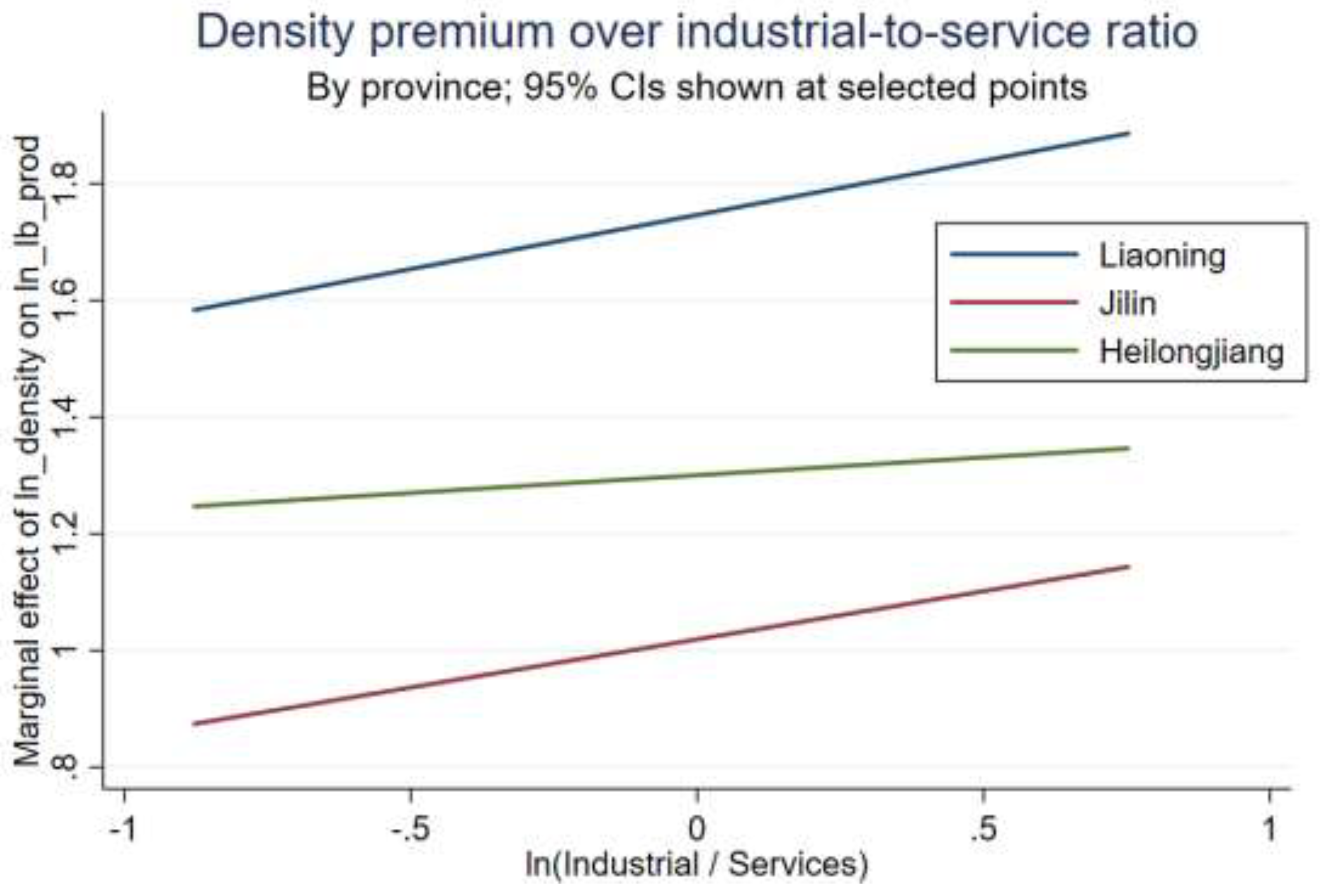
Figure A2.
Province-specific association of ownership entropy (H_own2) with labor productivity.
References
- Duranton, G.; Puga, D. Micro-foundations of urban agglomeration economies. In Handbook of Regional and Urban Economics; Henderson, J.V., Thisse, J.-F., Eds.; Elsevier: Amsterdam, The Netherlands, 2004; Volume 4, pp. 2063–2117. [Google Scholar]
- Ciccone, A.; Hall, R.E. Productivity and the density of economic activity. Am. Econ. Rev. 1996, 86, 54–70. [Google Scholar]
- Combes, P.-P.; Duranton, G.; Gobillon, L. The identification of agglomeration economies. J. Econ. Geogr. 2011, 11, 253–266. [Google Scholar] [CrossRef]
- Combes, P.-P.; Duranton, G.; Gobillon, L.; Puga, D.; Roux, S. The productivity advantages of large cities: Distinguishing agglomeration from firm selection. Econometrica 2012, 80, 2543–2594. [Google Scholar] [CrossRef]
- Martinez-Fernandez, C.; Audirac, I.; Fol, S.; Cunningham-Sabot, E. Shrinking cities: Urban challenges of globalization. Int. J. Urban Reg. Res. 2012, 36, 213–225. [Google Scholar] [CrossRef]
- Zhang, Q. Revitalizing old industrial base of Northeast China: Process, policy and challenge. Chin. Geogr. Sci. 2008, 18, 109–118. [Google Scholar] [CrossRef]
- Jiang, Y.; Chen, Z.; Sun, P. Urban shrinkage and urban vitality correlation research in the three northeastern provinces of China. Int. J. Environ. Res. Public Health 2022, 19, 10650. [Google Scholar] [CrossRef]
- Yu, S.; et al. Spatiotemporal evolution and driving mechanism of regional shrinkage at the county scale: The three provinces in northeastern China. PLOS ONE 2022, 17, e0271909. [Google Scholar] [CrossRef]
- Chen, Y. Regional decline and structural changes in Northeast China: An exploratory space–time approach. Asia-Pac. J. Reg. Sci. 2024, 8, 397–427. [Google Scholar] [CrossRef]
- Henderson, J.V. Marshall’s scale economies. J. Urban Econ. 2003, 53, 1–28. [Google Scholar] [CrossRef]
- Beaudry, C.; Schiffauerova, A. Who’s right, Marshall or Jacobs? The localization versus urbanization debate. Res. Policy 2009, 38, 318–337. [Google Scholar] [CrossRef]
- Shannon, C.E. A mathematical theory of communication. Bell Syst. Tech. J. 1948, 27, 379–423 and 623–656. [Google Scholar] [CrossRef]
- Kullback, S.; Leibler, R.A. On information and sufficiency. Ann. Math. Stat. 1951, 22, 79–86. [Google Scholar] [CrossRef]
- Frenken, K.; Van Oort, F.; Verburg, T. Related variety, unrelated variety and regional economic growth. Reg. Stud. 2007, 41, 685–697. [Google Scholar] [CrossRef]
- Content, J.; Frenken, K. Related variety and economic development: A literature review. Eur. Plan. Stud. 2016, 24, 2097–2112. [Google Scholar] [CrossRef]
- Nickell, S. Biases in dynamic models with fixed effects. Econometrica 1981, 49, 1417–1426. [Google Scholar] [CrossRef]
- McMillan, M.; Rodrik, D.; Verduzco-Gallo, Í. Globalization, structural change, and productivity growth, with an update on Africa. World Dev. 2014, 63, 11–32. [Google Scholar] [CrossRef]
- You, Z. The impact of the spatial agglomeration of producer services on urban productivity. J. Resour. Ecol. 2023, 14, 344–356. [Google Scholar] [CrossRef]
- Liu, X.; Zhang, X.; Sun, W. Does the agglomeration of urban producer services promote carbon efficiency of manufacturing industry? Land Use Policy 2022, 120, 106264. [Google Scholar] [CrossRef]
- Xu, H.; Xu, N. Industrial co-agglomeration and urban green total factor productivity: Multidimensional mechanism and spatial effect. Sustainability 2024, 16, 9415. [Google Scholar] [CrossRef]
- Zhang, M.; et al. Enterprise spatial agglomeration and economic growth in Northeast China: Policy implications for uneven to sustainable development. Sustainability 2023, 15, 11576. [Google Scholar] [CrossRef]
- Zhang, W.; Zhang, Y.; Li, W. Impact of Northeast revitalization policy on the industrial economy: Empirical evidence from central and southern Liaoning urban agglomeration. Appl. Econ. 2024, 56, 6648–6666. [Google Scholar] [CrossRef]
- Gao, H.; et al. State ownership and credit rationing: Evidence from China. Int. Rev. Econ. Financ. 2023, 88, 237–257. [Google Scholar] [CrossRef]
- Bai, M.; Cai, J.; Qin, Y. Ownership discrimination and private firms financing in China. Res. Int. Bus. Financ. 2021, 57, 101406. [Google Scholar] [CrossRef]
- Brandt, L.; Li, H. Bank discrimination in transition economies: Ideology, information, or incentives? J. Comp. Econ. 2003, 31, 387–413. [Google Scholar] [CrossRef]
- Fang, H.; et al. Reluctant Entrepreneurs: Evidence from China’s SOE Reform; Working Paper); National Bureau of Economic Research: Cambridge, MA, USA, 2023. [Google Scholar]
- International Monetary Fund. IMF Country Report No. 16/271; The People’s Republic of China: Selected Issues. International Monetary Fund: Washington, DC, USA, 2016.
- Au, C.-C.; Henderson, J.V. Are Chinese cities too small? Rev. Econ. Stud. 2006, 73, 549–576. [Google Scholar] [CrossRef]
- Hu, C.; Xu, Z.; Yashiro, N. Agglomeration and productivity in China: Firm level evidence. China Econ. Rev. 2015, 33, 50–66. [Google Scholar] [CrossRef]
- Li, Z.; Ding, C.; Niu, Y. Industrial structure and urban agglomeration: Evidence from Chinese cities. Ann. Reg. Sci. 2019, 63, 191–218. [Google Scholar] [CrossRef]
- Hsieh, C.-T.; Klenow, P.J. Misallocation and manufacturing TFP in China and India. Q. J. Econ. 2009, 124, 1403–1448. [Google Scholar] [CrossRef]
- Jurzyk, E.; Ruane, C. Resource Misallocation among Listed Firms in China: The Evolving Role of State-Owned Enterprises; IMF Working Paper No. 21/075; International Monetary Fund: Washington, DC, USA, 2021. [Google Scholar]
- Zhang, X.; Zhang, W.; Chen, F.; Guo, B. Does the mixed-ownership reform of Chinese state-owned enterprises improve their total factor productivity? Pac.-Basin Financ. J. 2023, 81, 102182. [Google Scholar] [CrossRef]
- Zheng, L. The impact of state-owned enterprises on the employment growth of manufacturing in Chinese cities: Evidence from economic census microdata. Urban Stud. 2021, 58, 1655–1673. [Google Scholar] [CrossRef]
- Ouyang, D. State-owned enterprise presence: Local spillovers. China Econ. Rev. 2024, 84, 102114. [Google Scholar] [CrossRef]
- Peng, P.; Zhu, X. Mixed-ownership reform and factor misallocation: Evidence from China. PLOS ONE 2024, 19, e0301034. [Google Scholar] [CrossRef] [PubMed]
Figure 1.
Spatial distribution of ownership and sectoral composition across sample cities.
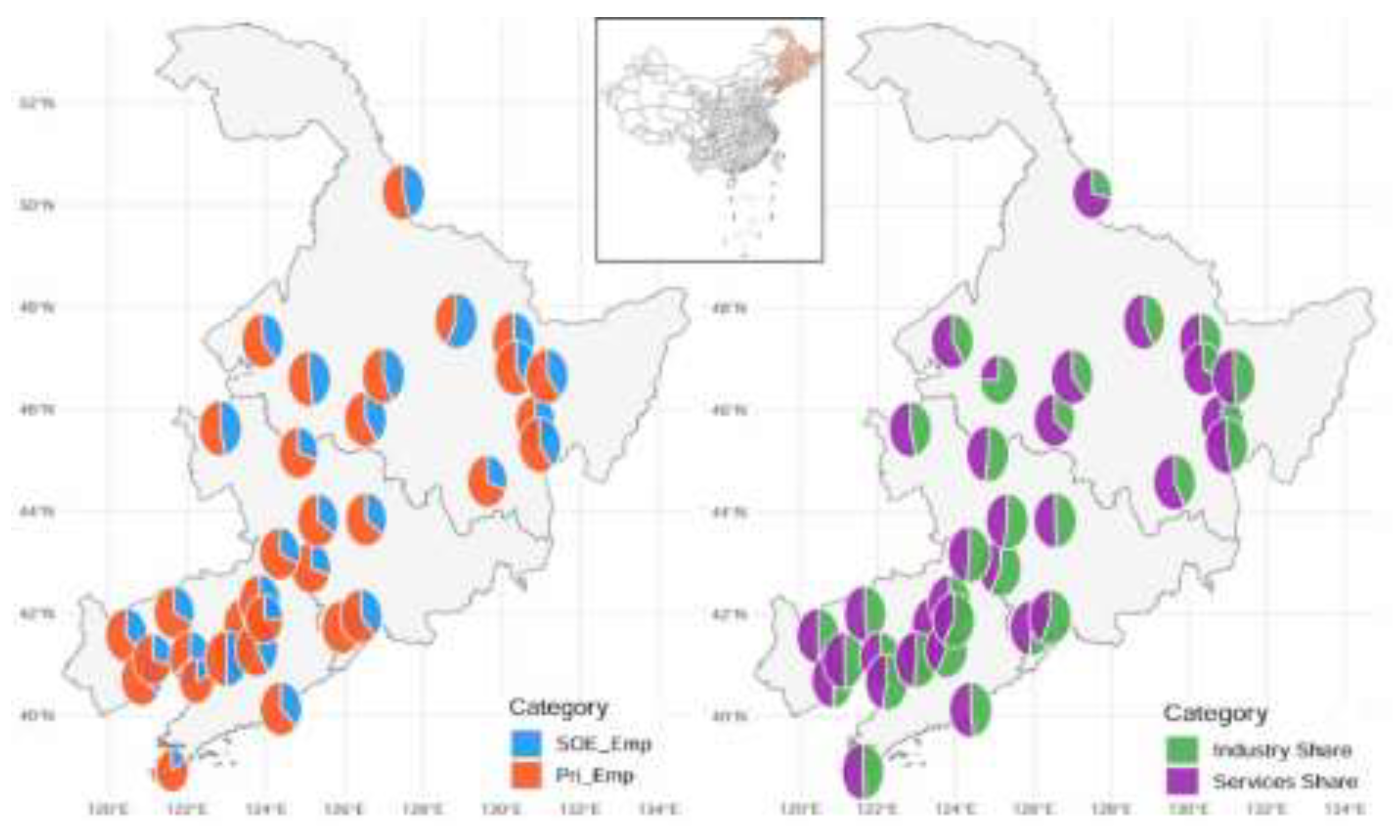
Figure 2.
Marginal effect of population density on labor productivity.
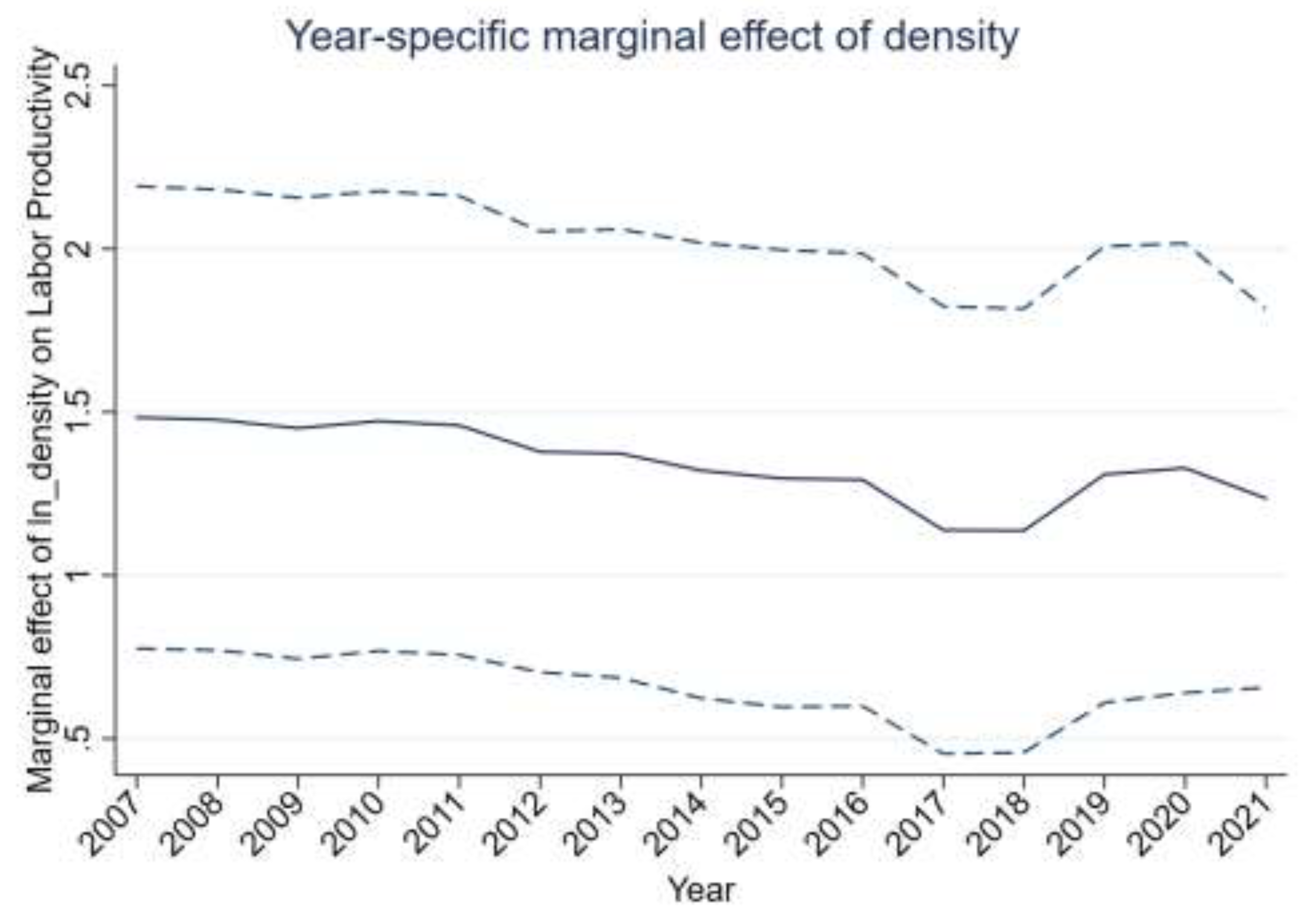
Figure 3.
Density premium by private-sector intensity (average marginal effects).
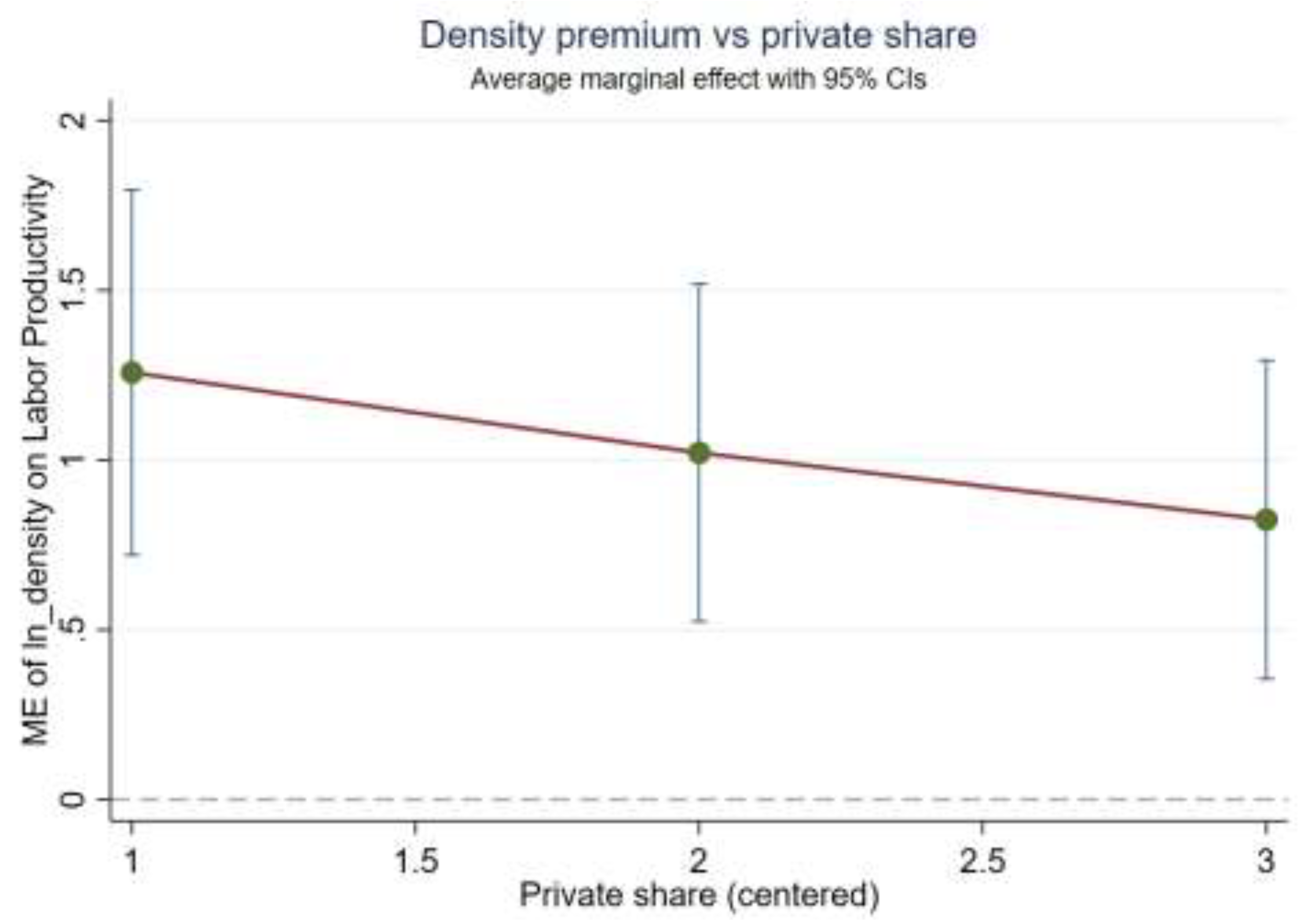
Table 1.
Definitions and Measurement of Model Variables.
| Variable (symbol) | Used in model as | Definition / Construction | Unit |
|---|---|---|---|
| Labor productivity (LP) | log units | ||
| Population density (DENS) | log / | ||
| Industry–service structure | log ratio | ||
| SOE_EMP employment share | share (0–1) | ||
| Private employment share | share (0–1) | ||
| S&T employment share | share (0–1) | ||
| Education (preferred) | % | ||
| Health index | index | ||
| Time fixed effects | i.year | Year dummies | , |
| City fixed effects | fe (xtreg, fe) | City fixed effects | , |
Table 3.
Dynamic fixed-effects models with centered ownership moderators.
| Variables | Dens×Private (centered) |
Dens×SOE (centered) |
|---|---|---|
| L.ln(LP) | 0.391*** | 0.468*** |
| (0.0663) | (0.0629) | |
| ln(Dens) | 1.034*** | 0.991*** |
| (0.247) | (0.296) | |
| Private_Emp (c.) | -0.475** | -0.708*** |
| (0.203) | (0.258) | |
| ln(Dens)× Private_Emp | -0.944*** | |
| (0.185) | ||
| SOE_Emp | 0.416*** | 0.611*** |
| (0.106) | (0.151) | |
| ln(Dens)×Soe_Emp | 0.175 | |
| (0.187) | ||
| ln(Struct) | 0.232*** | 0.215*** |
| (0.0314) | (0.0384) | |
| Education | -0.0234 | -0.0299 |
| (0.0376) | (0.0381) | |
| Health | 0.106 | -0.257 |
| (0.231) | (0.286) | |
| Constant | 0.873*** | 0.762*** |
| (0.202) | (0.214) | |
| City FE | Yes | Yes |
| Year FE | Yes | Yes |
| Observations | 451 | 451 |
| R² | 0.813 | 0.780 |
| Number of cities | 34 | 34 |
Notes: Standard errors in parentheses. City and year fixed effects included; year coefficients omitted for brevity. *** p<0.01, ** p<0.05, * p<0.10.
Table 2.
Two-way fixed-effects estimates: density premium and structural conditioning.
| Variables | Static FE Core |
Static FE dens×struct |
Dynamic FE | Dynamic FE +interaction |
|---|---|---|---|---|
| Ln(Dens) | 0.904*** | 1.091*** | 0.946*** | 1.078*** |
| (0.301) | (0.293) | (0.290) | (0.276) | |
| ln(Struct) | 0.271*** | 0.242*** | 0.206*** | 0.189*** |
| (0.0579) | (0.0528) | (0.0360) | (0.0325) | |
| ln(Dens) × ln(Struct) | 0.141*** | 0.0994** | ||
| (0.0507) | (0.0380) | |||
| Soe_Emp | 0.942*** | 0.846*** | 0.627*** | 0.569*** |
| (0.204) | (0.188) | (0.144) | (0.134) | |
| Pri | -0.786** | -0.908*** | -0.741*** | -0.836*** |
| (0.304) | (0.296) | (0.253) | (0.260) | |
| Edu | -0.0371 | -0.0309 | -0.0317 | -0.0251 |
| (0.0578) | (0.0555) | (0.0398) | (0.0381) | |
| Health | -0.525 | -0.473 | -0.252 | -0.223 |
| (0.482) | (0.444) | (0.298) | (0.274) | |
| L.ln(LP) | 0.469*** | 0.453*** | ||
| (0.0633) | (0.0634) | |||
| Constant | 1.686*** | 0.970*** | 0.966*** | 1.732*** |
| (0.287) | (0.323) | (0.312) | (0.300) | |
| Year FE | Yes | Yes | Yes | Yes |
| City FE | Yes | Yes | Yes | Yes |
| Observations | 485 | 485 | 451 | 451 |
| R² | 0.774 | 0.783 | 0.778 | 0.784 |
| Number of Cities | 34 | 34 | 34 | 34 |
Notes: Standard errors in parentheses. City and year fixed effects included; year coefficients omitted for brevity. *** p<0.01, ** p<0.05, * p<0.10.
Table 4.
Dynamic fixed-effects models augmented with entropy indicators.
| Variable | Dyn FE +DKL_sector |
Dyn FE +H_own2 (binary) |
Robust Dyn +H_own (3-way) |
|---|---|---|---|
| L.ln(LP) | 0.511*** | 0.478*** | 0.427*** |
| (0.0734) | (0.0721) | (0.0771) | |
| ln(Dens) | 0.998*** | 0.796*** | 0.638 |
| (0.277) | (0.285) | (0.717) | |
| DKL_sector | 0.217 | ||
| (0.323) | |||
| H_own2 (SOE vs Private) | 1.260*** | ||
| (0.324) | |||
| H_own (SOE/Private/ST) | 1.155*** | ||
| (0.283) | |||
| ln(Struct) | 0.266*** | 0.278*** | |
| (0.0396) | (0.0395) | ||
| Soe_Emp | 0.614*** | ||
| (0.135) | |||
| Pri | -0.813*** | ||
| (0.253) | |||
| Education | -0.00915 | -0.0342 | -0.0444 |
| (0.0383) | (0.0400) | (0.0396) | |
| Health | -0.170 | 0.123 | 0.145 |
| (0.296) | (0.288) | (0.296) | |
| Constant | 0.894*** | -0.0409 | 0.119 |
| (0.306) | (0.289) | (0.387) | |
| City FE | Yes | Yes | Yes |
| Year FE | Yes | Yes | Yes |
| Observations | 451 | 451 | 442 |
| R² | 0.752 | 0.776 | 0.772 |
| Number of cities | 34 | 34 | 34 |
Disclaimer/Publisher’s Note: The statements, opinions and data contained in all publications are solely those of the individual author(s) and contributor(s) and not of MDPI and/or the editor(s). MDPI and/or the editor(s) disclaim responsibility for any injury to people or property resulting from any ideas, methods, instructions or products referred to in the content. |
© 2026 by the authors. Licensee MDPI, Basel, Switzerland. This article is an open access article distributed under the terms and conditions of the Creative Commons Attribution (CC BY) license (http://creativecommons.org/licenses/by/4.0/).
Copyright: This open access article is published under a Creative Commons CC BY 4.0 license, which permit the free download, distribution, and reuse, provided that the author and preprint are cited in any reuse.


