

Submitted:
02 March 2026
Posted:
03 March 2026
You are already at the latest version
Abstract
This study evaluated the seasonal variability, origin, and ecological risk of heavy metals in the Pom-Atasta lagoon system, a tropical estuary in southeastern Mexico subject to increasing anthropogenic pressure. The main objective was to determine how seasonal changes influence the distribution, bioavailability, and risk of metals in sediments and benthic organisms. Thirty sampling stations were monitored during dry, rainy, and north wind seasons. Sediment concentrations of As, Cd, Cr, Ni, Pb, and V were measured, and bioaccumulation was assessed in the bivalve Rangia cuneata. Ecotoxicological risk was evaluated using the Adverse Effects Index (AEI), Toxic Risk Index (TRI), and Potential Ecological Risk Index (ERI). Results showed higher metal concentrations during the rainy and north wind seasons, likely due to increased runoff and sediment resuspension. Cr and Ni exhibited the highest enrichment, with values from 115.0 to 130.4 µg g-1 and from 60.5 to 75.9 µg g-1, respectively. The Ni showed the highest bioaccumulation factor (BSAF > 1.51) in R. cuneata, indicating high mobility and environmental availability. Weak correlations among some metals (As, Cr, Pb) suggest mixed natural and anthropogenic sources. TRI values indicated low to moderate toxic risk, and ERI classified most sites as low risk (ERI <60) at several stations. Organic carbon levels remained within tolerable limits (<10%) for benthic fauna. These findings highlight the role of seasonal dynamics in metal distribution and confirm R. cuneata as a suitable bioindicator for monitoring ecological health in tropical estuarine systems.
Keywords:
Terminos Lagoon
; Rangia cuneata
; heavy metals
; bioaccumulation
; ecological risk
; seasonal variation
1. Introduction
Many trace metals have been recognized as essential for metabolic processes in microorganisms; however, some of these metals can become toxic to biota above a specific threshold concentration and become a threat to the environment. The enrichment of metals in coastal ecosystems is caused by the contribution of anthropogenic sources such as mining, the use of fertilizers, metal smelting, burning of fossil fuels, manufacturing of batteries, pigments, cement, and plastics, among others. The persistence of each metal in ecosystems varies according to various abiotic and biotic factors that regulate mobility and bioavailability [1,2].
Several methodologies have been proposed to assess toxicity in sediments and the potential risks from heavy metals. Some of these methodologies include sediment quality guidelines and multiple pollution indices such as the enrichment factor, contamination degree, potential ecological risk index, and pollution load index. Many of these methodologies have contributed to understanding the level of contamination and toxicity in coastal environments [3,4]; however, under these evaluation criteria, it is not possible to interpret how these metals enter the food chain. Therefore, in practice, the bioaccumulation factor is evaluated in many marine organisms that may serve as a food source for coastal residents.
Many metals such as Pb, Cd, Co, Cr, and Cu are considered dangerous due to their long half-life and high accumulation capacity [5]. Some of these metals, such as Cd, Cr, and Cu, are associated with various health risks in humans, including cancer [6]. Therefore, knowing the concentration of these metals in ecosystems is required to conserve biodiversity and ensure the quality of life for organisms and human health [7]. Although sediments have been the first alternative for measuring the concentration of heavy metals, various benthic organisms are widely used as bioindicators of heavy metal pollution in aquatic systems, such as polychaetes, gastropods, bivalves, and decapod crustaceans [8,9], which helps to understand the processes of bioaccumulation and biomagnification in organisms.
The Area for the Protection of Flora and Fauna of the Terminos Lagoon, located in the southeast of Mexico, is one of the ecosystems considered among the most important due to its high biodiversity, critical habitat for commercially important species, and an important nesting area for sea turtles and migratory birds. It also has great significance because of the abundance of renewable natural resources of commercial interest. However, one of the most important economic activities in the region is oil exploration and exploitation, coupled with human settlements that discharge wastewater into the Laguna de Términos. It is a fact that the threat of contamination is constant due to the anthropogenic activities in the region, which is why a permanent program for monitoring water and sediment pollutants is promoted, with the aim of contributing to proposals that minimize environmental impact and support the development of efficient environmental management.
Within the protected area, there are the Atasta and Pom lagoons, covering an approximate area of 80 km2; these lagoons have also been constantly threatened by anthropogenic activities due to the installation of infrastructure for hydrocarbon exploration and transportation, wastewater discharge, deforestation, and exploitation of aquatic species [10]. One of the locally consumed species is the Rangia cuneata clam, but currently, the population of this species has significantly decreased at capture sites. This decline has been attributed to two hypotheses: overexploitation of the species and, on the other hand, contamination.
In this regard, there is no evaluation of the toxicity level of sediments and the bioaccumulation factor in Rangia cuneata, which would help establish a knowledge base to regulate the consumption of the species and protect its habitat, as sediment acts as a sink for heavy metals, both from natural and anthropogenic sources. Some studies confirm the importance of evaluating the metal concentration in clams and other species, as reported by Romero et al. [11], where the concentration of heavy metals in tissues of Ariopsis felis from lagoons adjacent to the Laguna de Términos represents a risk to consumers, particularly children or young individuals aged 8–15 years. This study analyzes the temporal variations of sediments in relation to the concentration of heavy metals, toxicity, and the bioaccumulation factor, using the Rangia cuneata clam as a bioindicator.
2. Materials and Methods
2.1. Study Area and Sampling
The study area is located in the western part of the Términos Lagoon between 18° 30´ and 18° 35´ N and 91° 50´ and 92° 20´ W within the coastal plain in the state of Campeche (Figure 1). The Atasta and Pom lagoons, with a surface area of 80 km2, are connected by a narrow channel, with an average depth for both lagoons of approximately 1.50 m. The tidal flow inputs into the Atasta Lagoon through a meandric marsh that connects with the Términos Lagoon, while the Pom Lagoon receives water from the San Ignacio River. The water mass exchange between the two lagoons contributes to the system’s low salinity of 0.32–3.17 UPS [10].
Sandy-silty sediments, typically deltaic, are the most widely distributed textural group in the Pom–Atasta lagoons. The submerged grassland vegetation type is very rare, and mangrove forests predominate around both lagoons [12]. Sediment sampling was carried out throughout the year for the three climatic periods: (1) dry season, from February to May; (2) rainy season, from June to September; and (3) north winds, from October to February [13].
A total of 30 stations were located in the Pom and Atasta lagoons in different sections representative of the diverse hydrological conditions (Figure 1); this corresponded to 15 stations for Pom Lagoon and 15 for Atasta Lagoon. Sediment samples were collected from the surface zone (5–10 cm deep) during the dry, rainy, and northerly months using a Van Veen dredge and kept refrigerated (4 °C) until the beginning of the analyses within 24 h. The sediments were oven-dried (Fisher Scientific) at 65 °C, homogenized, and passed through a sieve with a mesh size of <0.02 mm (20 µm sieve) for heavy metal analysis.
2.2. Sediment Analysis
Sediment characteristics were determined using the Bouyoucos hydrometer technique described in the Mexican standard NOM-021-RECNAT-2000 [14]. This method allows the quantitative determination of particle size distribution of the fine fractions of soils. The distribution of particles larger than 75 µm (retained on the No. 200 sieve) was determined by sieving, while particles smaller than 75 µm were determined by sedimentation using a hydrometer. Therefore, soil texture can be represented as the relative proportion of particle dimensional groups and provides a general overview of sediment physical properties.
Sediment pH was measured in a 1:2.5 (w/v) ratio of dry sample to deionized water using a multiparameter probe (Hanna HI9829). Organic matter (OM) and total organic carbon (TOC) were determined according to the Walkley and Black method and NOM-021-RECNAT-2000 [14,15].
Briefly, 0.5 g of sediment sieved through a 0.5 mm mesh was treated with 10 mL of 1 N potassium dichromate and 20 mL of concentrated sulfuric acid. After homogenization, 200 mL of distilled water and 5 mL of concentrated phosphoric acid were added, and the solution was titrated with 1 M ferrous sulfate. OM and TOC were calculated using the following equations:
where B is the volume of ferrous sulfate used to titrate the control (mL); T is the volume used to titrate the sample (mL); N is the normality of ferrous sulfate; g is the sample mass (g); and mcf is the moisture correction factor.
2.3. Metal Analysis
Heavy metal analysis in sediments was performed following EPA method 3051A for microwave-assisted acid digestion and EPA method 200.2 according to protocol SW-846 (US-EPA). For each sample, 0.25 g of dry sediment sieved through a 250 µm mesh was digested using 9 mL HNO3, 3 mL HCl, and 1 mL H2O2 in a microwave digestion system (Mars 6 CEM). Each digestion batch included a blank (BP), a fortified sample (MF), and a certified reference material (CRM). Digestion was conducted for 30 min at 180 °C, and samples were subsequently filtered.
The CRM consisted of BCR®-667 estuarine sediment (Institute for Reference Materials and Measurements, European Commission). Fortified samples were prepared by adding 0.25 µL of a multielement standard solution to 0.25 g of sediment prior to digestion. Calibration curves were prepared using standard solutions of Ni, V, Pb, As, Cd, and Cr. For clam samples, approximately 0.25 g of freeze-dried and homogenized Rangia cuneata tissue was digested with 2 mL H2O2 and 5 mL HNO3, then diluted to 20 mL with Milli-Q water. Samples were filtered through a 0.22 µm syringe filter prior to analysis. Metal concentrations were determined by microwave plasma atomic emission spectrometry (MP-AES; Agilent Technologies 4200).
2.4. Risk Assessment
The ecotoxicology of heavy metals in coastal system sediment was determined through analysis of the Adverse Effects Index (AEI), the Toxic Risk Index (TRI), and the Potential Ecological Risk Index (ERI). The AEI was determined by comparing the metal content in samples with sediment quality guidelines, thereby analyzing the metal levels exceeded in the samples compared to the guideline values. The AEI value was calculated using the following equation [3].
where Cₛᶦ is the metal concentration in the sediment sample (µg g−1) and was selected from the sediment quality guideline (µg g−1) as the threshold effect level (TEL) and the probable effect level (PEL). In the present study, the PEL was used to evaluate the sediment–biota effect level [16]. The criteria for AEI are: values of AEI < 1.0 mean that the metal concentration in the sample is not large enough to produce adverse effects on the biota; conversely, an AEI ≥ 1.0 is considered that the metal concentration could produce effects towards sedimentary fauna [3].
To better approximate the toxic risk (TRI), both the PEL () and TEL () effects of metal i were considered [17,18], described by the following equation. The toxic risk was classified into five categories based on the TRI values (Table 1).
The potential ecological risk index (ERI) was determined by summing the risk factors for all heavy metals in sediments and represents the sensitivity of the biological community to toxic substances [19]. Because the ERI can assess the effects of multiple contaminants on an ecosystem simultaneously, this method is very practical [2,20]. The risk potential can be determined using the following equations.
where Cs and Cr are the metal concentration in the sediment sample (µg g-1) and reference value (µg g-1): (As = 15, Pb = 70, Cr = 90, Ni = 57, V = 99), respectively. is the biological toxic response factor of an individual element (As = 10, Pb = 5, Cr = 2, Ni = 5, V = 2); is the ecological risk factor of an individual metal, classified as: values less than 40 suggest low ecological risk, ranges from 40 to 80 moderate risk, ranges from 80 to 160 considerable risk, ranges from 160-320 means high ecological risk, and > 320 very high risk. While the ERI index is the sum of ; ERI values less than 150 indicate low ecological risk, while ERI values in the range of 150–300, 300–600, and >600 are considered moderate, considerable, and very high risk, respectively. Cd is the comprehensive pollution index of multicontaminants, which represents the degree of pollution described in Table 1.
2.5. Biota-Sediment Accumulation Factor (BSAF)
The bioaccumulation factor (BSAF) used here for the clam Rangia cuneata allows us to understand the influence of sediments on aquatic organisms and to quantify the ability of the clam Rangia cuneata to digest or eliminate heavy metals; therefore, a high BSAF value indicates a low ability to digest and eliminate contaminants (high bioaccumulation). The BSAF determination was calculated using the equation:
where Corganism is the concentration of heavy metals in Rangia cuneata and Csediment is the concentration of metals in sediment.
2.6. Statistical Analysis
One-Way analysis of variance (ANOVA) with Duncan´s test was applied to determine the significant difference between the total concentration of trace metal and the potential ecological risk of the sediment sample (p<0.05) for the three climatic seasons and between lagoons; a post-Hoc Tukey test was considered to indicate a significant difference. Determination coefficient (R2) was derived from Pearson correlation analysis between the heavy metal concentration in clam and sediment.
3. Results and Discussions
3.1. Sediment Texture and Organic Content
Sediment particle size distribution (sand, silt, and clay) was analyzed following standard procedures. Statistically significant differences were observed in sand and silt content across seasons (ANOVA, p ≤ 0.01), whereas clay content showed no significant variation (p = 0.172). Tukey’s post-hoc test revealed that both sand (p = 0.014) and silt (p = 0.007) contents were significantly different during the northerly season compared to the dry and rainy seasons (Table 2).
The organic matter (OM) and total organic carbon (TOC) contents did not differ significantly across seasons (p = 0.172). In both lagoons, sediment composition followed the order: sand > silt > clay. OM and TOC content remained relatively consistent, with values ranging from 2.97% to 3.94% and 1.72% to 2.28%, respectively (Table 2).
According to Flemming [21], the high sand and silt content observed in the study area suggests a high ecosystem dynamic with a high influence of marine and river currents that contribute to the transport and deposition of these materials, which are high energy hydrodynamic conditions typical of lotic environments. On the other hand, the high OM content observed mainly in the vicinity of the towns at stations: A3 (from 4.41% to 4.69%); A4 (from 5.86% to 11.4%); A7 (from 5.86% to 8.55%); A10 (from 3.74% to 3.90%); A13 (from 7.37% to 9.89%) and P14 (from 4.81% to 7.76%) suggesting a possible contribution of wastewater as reported by Ruiz-Marin et al. [10]; which contributes significantly to the increase in organic carbon in sediment through the input of domestic and industrial wastewater; however, the TOC content obtained for both Pom and Atasta lagoons did not exceed the 10% limit according to the sediment quality guidelines of the Ontario Ministry of Environment and Energy-1993 [18], suggesting a level of sediment contamination that can be tolerated by the majority of benthic organisms.
3.2. Heavy Metal Concentrations in Sediment and Bioaccumulation in Mollusk
Trace metal analysis in sediment from the Pom-Atasta lagoon system showed values ranging from Cr (115.0 to 130.4 µg g-1) > Ni (60.5 to 75.9 µg g-1) > V (32.0 to 35.7 µg g-1) > As (12.7 to 15.4 µg g-1) > Pb (8.3 to 14.7 µg g-1) (Table 3). The concentrations of heavy metals exceeding the reference values for the quality of marine sediments and threshold effect slight ISQG-TEL were As, Cr, and Ni, indicating an ecological risk and accumulation of these highest metals in the sediment due to anthropogenic activities (Table 3).
Similarly, based on the reference values reported by Wedepohl [22], the content of As, Cr, and Ni in sediment were high, indicating metal enrichment from anthropogenic sources, while the low concentrations of Pb and V relative to the values in the upper crust suggest an origin from earth crust (Table 3). However, it is likely that the Pb and V have a historical origin, due to the manufacturing of batteries, paints, biocides, fertilizers, plastics, refineries, and fuels; activities that had little environmental regulation in past years. Overall, both lagoons were evaluated to have a low degree of contamination (Cd < 8) by heavy metals in sediment during the climatic seasons (Table 6, Table 7 and Table 8).
The oil industry’s role in the enrichment of Ni and V in ecosystems is recognized through contributions from hydrocarbon spills, where trace elements such as Fe, Ni, V, and Zn are inorganic components present in crude oil, with Ni and V being the most abundant [23]. The Terminos Lagoon protected natural area, and its fluvial-lagoon systems are located in one of the most productive oil and gas extraction and exploration areas in Mexico. Although the impact of these activities on adjacent ecosystems has been assessed, few restoration measures have been implemented. According to Magallanes-Ordoñez et al. [25], sediments enriched with Ni and V can occur naturally when these metals are related to terrigenous elements (rock weathering). In contrast, in ecosystems near hydrocarbon and gas exploration zones, the relationship with terrigenous elements is null.
Thus, to define the possible source of Ni and V enrichment in the study area, the Ni/V ratio was used as an empirical tool for correlation with the type of hydrocarbon in sediments. The criteria suggest that a low ratio (Ni/V < 0.5) indicates a hydrocarbon origin from marine organic matter; while high values (1 < Ni/V < 10) are derived from crude oil whose organic matter is of terrestrial or lacustrine origin [26]. In the present study, a significant correlation between N and V was observed during the dry, rainy, and northerly seasons (r=0.61, r=0.63, r=0.74, respectively), indicating that these elements have a similar source, unlike the rest of the heavy metals analyzed. Thus, the estimated Ni/V ratios for the three climatic seasons were >1 (1.8, 2.13, 2.12, respectively), similar to that reported for the Términos Lagoon and the coastal zone of Campeche (Mexico), and other regions of the world (Table 4). The results suggest that the probable origin is probably attributed to urban and industrial wastewater discharges [27]. The results show evidence that oil activities near the two lagoons do not fully contribute to the enrichment of the sediment by Ni and V; therefore, it is likely that natural biogeochemical processes characteristic of lacustrine systems also participate.
The Ni/V ratio alone is insufficient to definitively exclude hydrocarbons as a dominant source of contamination. While this ratio often suggests a stronger influence from urban and industrial wastewater, the presence of regional petroleum-related activities indicates that hydrocarbons remain a relevant environmental pressure and a potential source of heavy metal pollution. Therefore, the Ni/V ratio should be interpreted with caution, as it is neither exclusive nor conclusive in source attribution. This interpretation is supported by studies such as Yakubov et al. [28], which examined V and Ni concentrations in heavy oil asphaltenes and highlighted the variability of Ni/V ratios across petroleum sources. Their findings emphasize that although Ni/V ratios can help distinguish between anthropogenic inputs, they do not provide absolute source identification.
This is also supported by the low concentration ranges for Ni (from 60.5 to 75.9 µg g-1) and V (from 32.0 to 35.7 µg g-1) for both Pom and Atasta lagoons (Table 3); which do not greatly exceed the maximum limit concentrations of Ni (60 µg g-1) and V (211 µg g-1), to consider an ecosystem contaminated by accidental spills derived from oil production in coastal areas [29].

Table 4.
Ni/V concentration and ratio reported on the coasts of Campeche and Terminos Lagoon, Mexico.
Table 4.
Ni/V concentration and ratio reported on the coasts of Campeche and Terminos Lagoon, Mexico.
| Location | Ni (µg g-1) | V (µg g-1) | Rate Ni /V | Reference |
|---|---|---|---|---|
| Jinjiang River, China | 0.51-2.85 Media: 1.70 |
0.53 -1.91 Media: 0.97 |
1.75 | [27] |
| Terminos Lagoon, México | 13.5 – 164 Media: 88.75 |
9 – 61 Media: 35 |
2.53 | [25] |
| Terminos Lagoon, México | 16.29 – 56.45 Media: 20.08 |
Nd | 0 | [30] |
| Campeche Coast, Mexico | 0.56 -76.9 Media: 38.73 |
15.6 – 117.5 Media: 66.55 |
0.58 | [31] |
| Campeche and Tabasco coast, Mexico | 1.54 – 211 Media: 106.27 |
17.7 -59.6 Media: 38.65 |
2.65 | [29] |
| Atasta Lagoon, Mexico | 59.56 – 78.39 Media: 68.97 |
32.15 – 40.67 Media: 36.41 |
1.89 | This study |
| Pom Lagoon, Mexico | 61.37 – 73.43 Media: 67.4 |
30.70 – 33.1 Media: 31.9 |
1.05 | This study |
*n.d. not detected.
In the present study, the highest concentration of metals in sediment occurs during the rainy and northerly seasons (Table 3), attributed to the increase in rainfall runoff, fluvial contributions, and sediment resuspension [32]. The low correlation of As, Cr, Pb, and Cd; unlike Ni and V (Table 5) suggests that these metals could be transported to the Pom and Atasta lagoons, having origins both from natural contributions and derived from anthropogenic activities. A comparative analysis of the concentration of metals with other ecosystems, it is possible to observe that the levels of As, Cr, Pb, V obtained in the present work were generally lower than those reported in other studies; however, for this study, Ni and Cr were found with higher concentrations than reported by Zang and Liu (2014) [33] with Cr levels of 48.08 - 107.0 µg g-1; likewise by Liu et al. [27] with Cr and Ni levels of 39.3 - 92.1 µg g-1 and 17.2 - 41.4 µg g-1, respectively, and those reported by Norville [34] for Cr and Ni of 19.2 and 4.8 - 15.9 µg g-1, respectively; by Saher and Siddiqui [2] reporting Cr and Ni levels of 144.80 and 40.02 µg g-1, respectively; suggesting an enrichment of Cr and Ni for both lagoons (Pom and Atasta) from various anthropogenic sources including urban and industrial wastewater discharges.
On the other hand, the concentration ranges of heavy metals obtained from tissue of the clam Rangia cuneata were Ni (21.36 µg g-1) > Cr (9.48 µg g-1) > Hg (0.51 µg g-1) > Cd (0.43 µg g-1) > As (<0.3 µg g-1) > Pb (<1 µg g-1) (Table 3). The metal levels in Rangia cuneata showed a weak correlation with the metals Ni, Cr, As, Pb in sediment; it is important to mention that metals such as Cd and Hg found in Rangia cuneata tissue were not observed in sediment.
The presence of Cd and Hg in the tissues of Rangia cuneata, despite their absence in surrounding sediments, indicates that these metals were likely absorbed from the water column. Bivalves acquire nutrients through filter feeding, a process that exposes them to suspended particles potentially enriched with heavy metals even in environments where sediment contamination is minimal or undetectable. This interpretation aligns with the findings of Zhang et al. [35], who observed that heavy metal concentrations in bivalve tissues correlate more strongly with waterborne contamination than with sediment levels. Their study in Haizhou Bay, China, demonstrated that bivalves bioaccumulation patterns reflected metal concentrations in the water column rather than in adjacent sediments. Furthermore, the low correlation between sediment and tissue metal levels in Rangia cuneata supports the hypothesis that bioaccumulation occurs primarily through filtration of contaminated water. Hao et al. [32] also emphasize that filter feeding organisms possess a heightened capacity to concentrate contaminants such as heavy metals bound to organic matter or dissolved in water compared to benthic species or fish.
In the present study, the bioaccumulation order for Rangia cuneata was Ni > Pb > Cr > As; It is worth mentioning that, although Cr was the metal with the highest concentration in sediment, it showed a bioaccumulation factor of SBAF < 1; while a higher bioaccumulation was obtained for Ni (SBAF > 1) which was the second metal in order of lowest concentration in sediment (Table 3). Several bivalve species, including Rangaea cuneata, exhibit selective absorption of heavy metals, with a notable tendency to accumulate Ni in higher concentrations than Cr. This differential absorption is influenced by both environmental availability and physiological mechanisms [36]. Ni generally has greater bioavailability in aquatic environments than trivalent chromium Cr (III), which is less soluble and therefore more difficult to absorb by filter-feeding organisms. Ni solubility allows it to remain in ionic form, facilitating its interaction with biological membranes and its absorption into soft tissues. Furthermore, clams possess specific physiological adaptations that enhance the absorption of certain metals. Ni has a strong affinity for metallothioneins and other cellular proteins, allowing it to bind efficiently to tissues. This binding capacity contributes to its accumulation [37]. It is estimated that marine organisms in environments with high concentration of heavy metals generally have high SBAF values; however, this was not possible to observe in the present study, suggesting that the ability of bioaccumulation of heavy metals by Rangia cuneata is mainly related to the environmental background values that contribute more to the distribution of heavy metals in the ecosystem and therefore to greater exposure, this indicates that a heavy metal may be present in high concentrations but only in a limited area and consequently show low bioaccumulation ability; contrary to those heavy metals that have a greater dispersion or distribution in the sediments [32].
3.3. Heavy Metal Toxicity Assessment
The ecotoxicological profile analysis for the study area was determined using the adverse effect index (AEI) and the potential ecological risk index (TRI). Metals such as As, Cr, Pb, V, and Cd showed an AEI index < 1, indicating that the concentrations of these metals in the sediment of both lagoons during the climatic seasons are not high enough to produce adverse effects on the biota; meanwhile, Ni showed values for both lagoons that exceeded the AEI > 1 criterion, suggesting that Ni could produce effects on the sedimentary fauna. This is related to the metal that showed the highest biaccumulation factor (BSAF = 1.51) (Table 3). This could indicate that the Ni concentration is likely to affect the sedimentary environment, creating an unsuitable environment for the clam Rangia cuneata to increase its population in both lagoons. Based on the TRI indicator, both lagoons show heavy metal concentrations with a low to moderate toxic risk potential and a low ecological risk potential (ERI) (Figure 2). It was evident that Ni contributes to increasing ecological risk mainly for sedimentary fauna, and therefore, a permanent monitoring program should be considered in the study area to prevent possible impacts on other organisms.
Table 6.
Concentration of heavy metals (µg g-1) (Cf) and Cd for the dry season.
| Stations | Dry season | |||||
| As | Cr | Ni | Pb | V | Cd | |
| A1 | 22.96(1.53) | 165.24(1.84) | 68.89(1.21) | 10.48(0.15) | 37.84(1.15) | 5.11 |
| A2 | 23.77(1.58) | 121.96(1.36) | 64.58(1.13) | 10.58(0.15) | 33.41(1.29) | 4.56 |
| A3 | 5.79(0.39) | 118.41(1.32) | 62.8(1.10) | 7.59(0.11) | 34.64(0.69) | 3.26 |
| A4 | 15.64(1.04) | 116.24(1.29) | 56.67(0.99) | 10.76(0.15) | 33.76(0.52) | 3.82 |
| A5 | 0 | 133.17(1.48) | 57.68(1.01) | 8.56(0.12) | 38.81(1.57) | 3.01 |
| A6 | 13.97(0.93) | 114.13(1.27) | 55.97(0.98) | 12.17(0.17) | 34.82(1.16) | 3.71 |
| A7 | 2.69(0.18) | 128.24(1.42) | 73.34(129) | 11.16(0.16) | 36.87(0.0) | 3.42 |
| A8 | 13.09(0.87) | 112.46(1.25) | 63.76(1.12) | 13.29(0.19) | 33.82(1.07) | 3.77 |
| A9 | 10.69(0.71) | 137.15(1.52) | 60.17(1.06) | 8.16(0.12) | 35.77(0.80) | 3.77 |
| A10 | 26.95(1.8) | 108.51(1.21) | 58.16(1.02) | 7.9(0.11) | 32.39(0.22) | 4.46 |
| A11 | 38.77(2.58) | 122.9(1.37) | 49.36(0.87) | 11.09(0.16) | 31.27(2.81) | 5.29 |
| A12 | 9.15(0.61) | 104.92(1.17) | 48.43(0.85) | 9.55(0.14) | 28.84(1.90) | 3.05 |
| A13 | 12.38(0.83) | 113.02(1.26) | 65.87(1.16) | 9.11(0.13) | 35.26(2.29) | 3.72 |
| A14 | 8.18(0.55) | 116.07(1.29) | 47.27(0.83) | 6.68(0.10) | 27.32(0.0) | 3.04 |
| A15 | 18.9(1.26) | 123.35(1.37) | 60.56(1.06) | 4.94(0.07) | 37.89(0.63) | 4.15 |
| P1 | 22.75(1.52) | 131.15(1.46) | 72.95(1.28) | 9.28(0.13) | 40.04(1.34) | 4.79 |
| P2 | 29.27(1.95) | 212.42(2.36) | 109.87(1.93) | 6.23(0.09) | 54.19(1.37) | 6.88 |
| P3 | 2.08(0.14) | 110.5(1.23) | 47.43(0.83) | 10.4(0.15) | 26.73(0.26) | 2.62 |
| P4 | 11.38(0.76) | 482.4(5.36) | 34.42(0.60) | 5.15(0.07) | 36.27(1.13) | 7.16 |
| P5 | 18.3(1.22) | 120.65(1.34) | 73.77(1.29) | 10.78(0.15) | 39.66(1.40) | 4.41 |
| P6 | 5.32(0.35) | 110.96(1.23) | 50.35(0.88) | 6.7(0.10) | 30.45(2.73) | 2.87 |
| P7 | 24.76(1.65) | 93.08(1.03) | 50.91(0.89) | 8.25(0.12) | 29.14(1.07) | 3.99 |
| P8 | 21.9(1.46) | 119.84(1.33) | 78.47(1.38) | 3.31(0.05) | 40.4(0.77) | 4.62 |
| P9 | 12.49(0.83) | 83.86(0.93) | 31.32(0.55) | 8.23(0.12) | 28.35(0.53) | 2.72 |
| P10 | 14.14(0.94) | 94.05(1.05) | 70.81(1.24) | 3.86(0.06) | 32.93(0.81) | 3.62 |
| P11 | 4.85(0.32) | 55.01(0.61) | 22.31(0.39) | 4.66(0.07) | 13.78(1.34) | 1.53 |
| P12 | 18.76(1.25) | 62.18(0.69) | 16.37(0.29) | 1.6(0.02) | 14.07(0.94) | 2.39 |
| P13 | 21.8(1.45) | 101.86(1.13) | 59.16(1.04) | 7.13(0.10) | 33.59(1.33) | 4.06 |
| P14 | 12.88(0.86) | 103.94(1.15) | 70.15(1.23) | 11.4(0.16) | 33.59(0.10) | 3.75 |
| P15 | 17.4(1.16) | 131.96(1.47) | 132.35(2.32) | 11.21(0.16) | 43.02(0.79) | 5.54 |
| Mean (µg g-1) |
15.4 | 128.3 | 60.5 | 8.3 | 33.6 | 3.97 |
| Min | 0.0 | 55.0 | 16.4 | 1.6 | 13.8 | 1.53 |
| Max | 38.8 | 482.4 | 132.4 | 13.3 | 54.2 | 7.16 |
*Cf: Pollution factor; Cd: degree of pollution.
Table 7.
Concentration of heavy metals (µg g-1) (Cf) and Cd for the rainy season.
| Stations | Rainy season | |||||
| As | Cr | Ni | Pb | V | Cd | |
| A1 | 17.31(1.15) | 108.63(1.21) | 61.54(1.08) | 11.97(0.17) | 27.8(0.28) | 3.89 |
| A2 | 19.31(1.29) | 117.35(1.30) | 89.9(1.58) | 9.12(0.13) | 37.65(0.38) | 4.68 |
| A3 | 10.29(0.69) | 165.72(1.84) | 65.76(1.15) | 11.27(0.16) | 29.89(0.30) | 4.14 |
| A4 | 7.83(0.52) | 109.2(1.21) | 71.54(1.26) | 7.83(0.11) | 32.2(0.33) | 3.43 |
| A5 | 23.48(1.57) | 104.05(1.16) | 70.83(1.24) | 4.58(0.07) | 29.81(0.30) | 4.33 |
| A6 | 17.37(1.16) | 103.49(1.15) | 70.91(1.24) | 5.82(0.08) | 34.37(0.35) | 3.98 |
| A7 | 0 | 126.13(1.40) | 61.74(1.08) | 8.12(0.12) | 32.88(0.33) | 2.93 |
| A8 | 15.98(1.07) | 122.49(1.36) | 114.69(2.01) | 8.78(0.13) | 36.79(0.37) | 4.94 |
| A9 | 12(0.80) | 115.5(1.28) | 80.72(1.42) | 1.42(0.02) | 36.96(0.37) | 3.89 |
| A10 | 3.31(0.22) | 60.28(0.67) | 22.01(0.39) | 4.77(0.07) | 14.51(0.15) | 1.49 |
| A11 | 42.16(2.81) | 135.02(1.50) | 86.18(1.51) | 4.23(0.06) | 29.97(0.30) | 6.19 |
| A12 | 28.48(1.90) | 125.1(1.39) | 71.64(1.26) | 16.59(0.24) | 36.37(0.37) | 5.15 |
| A13 | 34.34(2.29) | 111.34(1.24) | 72.25(1.27) | 10.79(0.15) | 36.03(0.36) | 5.31 |
| A14 | 0 | 107.77(1.20) | 90.92(1.60) | 3.49(0.05) | 32.92(0.33) | 3.17 |
| A15 | 9.38(0.63) | 111.28(1.24) | 80.34(1.41) | 9.88(0.14) | 34.13(0.34) | 3.76 |
| P1 | 20.16(1.34) | 156.13(1.73) | 147.42(2.59) | 6.56(0.09) | 54.42(0.55) | 6.31 |
| P2 | 20.62(1.37) | 129.34(1.44) | 82.5(1.45) | 1.83(0.03) | 34.7(0.35) | 4.64 |
| P3 | 3.87(0.26) | 81.82(0.91) | 32.34(0.57) | 1.94(0.03) | 17.14(0.17) | 1.94 |
| P4 | 16.97(1.13) | 52.63(0.58) | 13.86(0.24) | 2.91(0.04) | 12.56(0.13) | 2.13 |
| P5 | 20.97(1.40) | 106.43(1.18) | 69.39(1.22) | 17.87(0.26) | 36.54(0.37) | 4.42 |
| P6 | 40.95(2.73) | 85.99(0.96) | 60.58(1.06) | 10.46(0.15) | 26.5(0.27) | 5.17 |
| P7 | 16.03(1.07) | 119.36(1.33) | 81.65(1.43) | 17.72(0.25) | 40.38(0.41) | 4.49 |
| P8 | 11.62(0.77) | 126.69(1.41) | 77.14(1.35) | 19.36(0.28) | 44.28(0.45) | 4.26 |
| P9 | 7.98(0.53) | 142.3(1.58) | 17.45(0.31) | 11.57(0.17) | 18.45(0.19) | 2.77 |
| P10 | 12.2(0.81) | 205.44(2.28) | 62.48(1.10) | 14.14(0.20) | 40.0(0.40) | 4.80 |
| P11 | 20.1(1.34) | 97.63(1.08) | 55.93(0.98) | 9.36(0.13) | 29.26(0.30) | 3.84 |
| P12 | 14.14(0.94) | 84.54(0.94) | 25.94(0.46) | 4.68(0.07) | 19.11(0.19) | 2.60 |
| P13 | 19.94(1.33) | 128.74(1.43) | 77.18(1.35) | 17.85(0.26) | 38.69(0.39) | 4.76 |
| P14 | 1.48(1.10) | 99.98(1.11) | 67.11(1.18) | 14.8(0.21) | 33.16(0.33) | 2.93 |
| P15 | 11.81(0.79) | 109.61(1.22) | 63.24(1.11) | 10.42(0.15) | 32.86 | 3.60 |
| Mean (µg g-1) |
16.0 | 115.0 | 68.2 | 9.3 | 32.0 | 3.99 |
| Min | 0.0 | 52.6 | 13.9 | 1.4 | 12.6 | 1.49 |
| Max | 42.2 | 205.4 | 147.4 | 19.4 | 54.4 | 6.31 |
*Cf: Pollution factor; Cd: degree of pollution.
Table 8.
Concentration of heavy metals (µg g-1) (Cf) and Cd for the northerly season.
| Station | Northerly season | |||||
| As | Cr | Ni | Pb | V | Cd | |
| A1 | 12.39(0.83) | 146.42(1.63) | 59.43(1.04) | 15.98(0.23) | 35.06(0.35) | 4.08 |
| A2 | 0 | 133.12(1.48) | 72.55(1.27) | 16.13(0.23) | 41.67(0.42) | 3.40 |
| A3 | 20.73(1.38) | 201.71(2.24) | 86.77(1.52) | 20.03(0.29) | 50.18(0.51) | 5.94 |
| A4 | 6.32(0.42) | 127.02(1.41) | 69.19(1.21) | 18.95(0.27) | 40.76(0.41) | 3.73 |
| A5 | 17.35(1.16) | 158.62(1.76) | 76.4(1.34) | 18.34(0.26) | 41.9(0.42) | 4.94 |
| A6 | 11.86(0.79) | 112.59(1.25) | 69.45(1.22) | 18.23(0.26) | 37.96(0.38) | 3.90 |
| A7 | 10.65(0.71) | 124.7(1.39) | 83.5(1.46) | 20.21(0.29) | 42.49(0.43) | 4.28 |
| A8 | 0 | 122.71(1.36) | 82.04(1.44) | 20.29(0.29) | 39.78(0.40) | 3.49 |
| A9 | 1.09(0.07) | 136.22(1.51) | 73.17(1.28) | 16.48(0.24) | 39.22(0.40) | 3.50 |
| A10 | 14.72(0.98) | 168.71(1.87) | 84.55(1.48) | 19.66(0.28) | 46.72(0.47) | 5.09 |
| A11 | 35.67(2.38) | 154.91(1.72) | 84.63(1.48) | 15.61(0.22) | 38.1(0.38) | 6.19 |
| A12 | 5.67(0.38) | 144.43(1.60) | 69.18(1.21) | 13.32(0.19) | 34.59(0.35) | 3.74 |
| A13 | 25.57(1.70) | 124.25(1.38) | 91.39(1.60) | 19.38(0.28) | 41.55(0.42) | 5.39 |
| A14 | 6.55(0.44) | 124.85(1.39) | 87.17(1.53) | 17.35(0.25) | 41.35(0.42) | 4.02 |
| A15 | 32.26(2.15) | 122.43(1.36) | 86.52(1.52) | 16.57(0.24) | 38.77(0.39) | 5.66 |
| P1 | 19.66(1.31) | 131.35(1.46) | 126.49(2.22) | 17.77(0.25) | 47.86(0.48) | 5.73 |
| P2 | 9.07(0.60) | 156.41(1.74) | 103.65(1.82) | 7.1(0.10) | 39.64(0.40) | 4.66 |
| P3 | 12.87(0.86) | 95.27(1.06) | 52.47(0.92) | 4.29(0.06) | 23.04(0.23) | 3.13 |
| P4 | 0 | 272.74(3.03) | 28.33(0.50) | 7.9(0.11) | 28.72(0.29) | 3.93 |
| P5 | 10.23(0.68) | 111.64(1.24) | 106.38(1.87) | 16.98(0.24) | 38.44(0.39) | 4.42 |
| P6 | 27.44(1.83) | 96.53(1.07) | 68.0(1.19) | 11.15(0.16) | 29.12(0.29) | 4.55 |
| P7 | 25.26(1.68) | 104.17(1.16) | 100.66(1.77) | 13.95(0.20) | 32.68(0.33) | 5.14 |
| P8 | 6.85(0.46) | 124.18(1.38) | 89.44(1.57) | 18.53(0.26) | 43.71(0.44) | 4.11 |
| P9 | 0 | 104.86(1.17) | 56.77(1.0) | 17.87(0.26) | 23.4(0.24) | 2.65 |
| P10 | 9.34(0.62) | 84.46(0.94) | 51.17(0.90) | 10.23(0.15) | 26.13(0.26) | 2.87 |
| P11 | 0 | 101.06(1.12) | 27.51(0.48) | 4.34(0.06) | 15.64(0.16) | 1.83 |
| P12 | 11.29(0.75) | 100.2(1.11) | 33.76(0.59) | 2.18(0.03) | 15.15(0.15) | 2.64 |
| P13 | 20.11(1.34) | 96.26(1.07) | 69.25(1.21) | 15.61(0.22) | 30.65(0.31) | 4.16 |
| P14 | 12.74(0.85) | 121.89(1.35) | 101.95(1.79) | 16.73(0.24) | 36.96(0.37) | 4.60 |
| P15 | 16.8(1.12) | 107.32(1.19) | 85.66(1.50) | 10.68(0.15) | 29.43(0.3) | 4.27 |
| Mean (µg g-1) |
12.7 | 130.4 | 75.9 | 14.7 | 35.7 | 4.20 |
| Min | 0.0 | 84.5 | 27.5 | 2.2 | 15.2 | 1.83 |
| Max | 35.7 | 272.7 | 126.5 | 20.3 | 50.2 | 6.19 |
*Cf: Pollution factor; Cd: degree of pollution.
4. Conclusions
The results of this study reveal significant seasonal variability in the concentration of heavy metals in the sediments of the Pom-Atasta lagoon system, with higher levels observed during the rainy season and periods of northern winds. This variation is likely driven by increased riverine inputs, surface runoff, and sediment resuspension, which facilitate the transport and deposition of metals such as chromium (Cr), nickel (Ni), and vanadium (V). The lack of significant correlation among certain metals (arsenic [As], Cr, lead [Pb], and cadmium [Cd]) suggests multiple sources of origin, both natural and anthropogenic. Although overall concentrations of As, Cr, Pb, and V were lower than those reported in other estuarine systems, a notable enrichment of Cr and Ni was detected in both lagoon bodies, indicating the influence of urban and industrial discharges.
Nickel, in particular, exhibited the highest bioaccumulation factor (BSAF > 1) in Rangia cuneata, despite not being the most abundant metal in the sediment. This reinforces the notion that bioaccumulation is more closely linked to metal bioavailability and environmental distribution than to total sediment concentration. Ecotoxicological assessment using the AEI (Aquatic Ecotoxicity Index) and TRI (Toxic Risk Index) indicated that most metals pose a low to moderate risk to aquatic biota, with the exception of nickel, which exceeded ecological risk thresholds and represents a potential threat to benthic fauna.
TRI and ERI (Ecological Risk Index) values indicating low to moderate risk may have implications for local fisheries and food safety, particularly if Rangia cuneata is consumed by nearby populations. While these values do not signal an immediate health alert, they highlight the need for continuous monitoring to detect changes in the distribution and toxicity of heavy metals especially those like Ni, which exhibit high mobility and bioaccumulation potential in filter-feeding organisms.
Overall, this study provides robust evidence of the seasonal dynamics, sources, and ecological risks of heavy metals in a tropical river-lagoon system, contributing to a deeper understanding of their environmental impact and serving as a foundation for the development of environmental management strategies and pollution control measures.
Author Contributions
Conceptualization, Claudia Alejandra Aguila Ucan and Francisco Anguebes Franseschi; Data curation, Carlos Montalvo Romero; Formal analysis, Claudia Alejandra Aguila Ucan; Investigation, Alejandro Ruiz Marin and JULIA CERON BRETON; Methodology, Alejandro Ruiz Marin and Claudia Alejandra Aguila Ucan; Resources, Alejandro Ruiz Marin; Supervision, Julia Ceron Breton; Validation, Carlos Montalvo Romero; Writing – original draft, Alejandro Ruiz Marin.
Funding
This study was supported by internal research funds from the Universidad Autonoma del Carmen
Institutional Review Board Statement
“Not applicable” for studies not involving humans or animals.
Informed Consent Statement
“Not applicable.” for studies not involving humans.
Data Availability Statement
The data sets generated and/or analyzed during the current study are available from the corresponding author on reasonable request.
Acknowledgments
The authors would like to express their sincere gratitude to Dra. Norma Alicia Ramos Delgado for her valuable support and assistance provided at the Environmental Engineering Laboratory of the Center for Technological Research and Innovation (CIIT), Instituto Tecnológico Superior de Nuevo León.
Conflicts of Interest
The authors declare no conflicts of interest. The authors declare that they have no known competing financial interests or personal relationships that could have appeared to influence the work reported in this paper.
Abbreviations
The following abbreviations are used in this manuscript:
| AEI | Adverse effects index |
| TRI | toxic risk index |
| ISQG-TEL | Reference values for the quality of marine sediments and threshold effect |
| BSAF | Biota-sediment accumulation factor |
References
- Bakker, A.K.; Dutton, J.; Sdafani, M.; Santangelo, N. Environmental exposure of Atlantic horseshoe crab (Limulus polyphemus) early life stages to essential trace elements. Science of the Total Environment 572 2016, 804–812. [Google Scholar] [CrossRef]
- Saher, N.U.; Siddiqui, A.S. Occurrence of heavy metals in sediment and their bioaccumulation in sentinel crab (Macrophthalmus depressus) from highly impacted coastal areas. Chemosphere 221 2019, 89–98. [Google Scholar] [CrossRef]
- Omar, C.H.; Leticia, R.H.; Andrew, C.B.; Arturo, C.E.; Ian, C.W.; Hector, H.H. Historical trace element accumulation in marine sediment from the Tamaulipas shelf, Gulf of Mexico: An assessment of natural vs anthropogenic inputs. Science of the Total Environment 622–623 2018, 325–336. [Google Scholar] [CrossRef]
- Jahan, S.; Strezov, V. Comparison of pollution indices for the assessment of heavy metals in sediments of seaports of NSW, Australia. Marine Pollution Bulletin 128 2018, 295–306. [Google Scholar] [CrossRef]
- Onder, S.; Dursun, S. Air borne heavy metal pollution of Cedrus libani (A. Rich.) in te city centre of Konya (Turkey). Atmos. Environ 2006, 40, 1122–1133. [Google Scholar] [CrossRef]
- Das, P.; Samantaray, S.; Rout, G.R. Studies on cadmium toxicity in plants: A review. Environmental Pollution 98 1997, 29–36. [Google Scholar] [CrossRef]
- Pinheiro, M.A.A.; Silva, P.P.G.; Duarte, L.F.A.; Almeda, A.A.; Zanotto, F.P. Accumulation of six metals in the mangrove crab Ucides cordatus (Crustacea: Ucididae) and its food source, the red mangrove Rhizophora mangle (Angiospermae: Rhizophoraceae). Ecotoxicology and Environmental Safety 81 2012, 114–121. [Google Scholar] [CrossRef]
- Fan, W.; Xu, Z.; Wang, W.X. Metal pollution in a contaminated bay: Relationship between metal geochemical fractionation in sediment and accumulation in a polychaete. Environmental Pollution 197 2014, 50–57. [Google Scholar] [CrossRef]
- Alvaro, N.V.; Neto, A.I.; Couto, R.P.; Azevedo, J.M.N.; Rodrigues, A. S. Crabs tell the difference: Relating trace metal content with land use and landscape attributes. Chemosphere 144 2016, 1377–1383. [Google Scholar] [CrossRef]
- Ruiz-Marin, A.; Campos-García, S.; Zavala-Loria, J.; Canedo-López, Y. Hydrological aspects of the lagoons of Atasta and Pom, Mexico. Tropical and Subtropical Agroecosystems 10 2009, 63–74. [Google Scholar]
- Romero, C.M.; Ucán, C.A.; Peralta, A.S.; Reyes, J.T.; López, Y.C.; Quiroz, V.C.; Marin, A R. Health risk assessment of heavy metals: Cu, Cd, Pb, Ni and Hg, in catfish Ariopsis felis in southern Mexico. Iranian Journal of Toxicology 2022, 16(3), 163–174. [Google Scholar] [CrossRef]
- De la Lanza-Espino, G.; Ramírez-García, P.; Thomas, F.; Alcántara, A.R. La vegetación de manglar de la Laguna de Términos, Campeche: Evaluación preliminar a través de imágenes LandSat. Hidrobiológica 3 1993, 29–40. [Google Scholar]
- Yañez-Arancibia, A.; Day, J.W. Ecological characterization of the Términos Lagoon. In Ecología de los ecosistemas costeros en el sur del Golfo de México: La región de la laguna de Términos 1988; Yañez-Arancibia., A., Day, J. W., Eds.; Universidad Nacional Autónoma de México / Organización de Estados Americanos, 1988; pp. 1–27. [Google Scholar]
- Norma Oficial Mexicana NOM-021-RECNAT-2000; Fertility specifications, salinity and soil classification. 2000.
- Walkley, A.; Black, I.A. An examination of the Degtjareff method for determining soil organic matter and a proposed modification of the chromic acid titration method. Soil Science 1934. 37 29–38. [CrossRef]
- Long, E.R.; MacDonald, D.D.; Smith, S.L.; Calder, F.D. Incidence of adverse biological effects within ranges of chemical concentrations in marine and estuarine sediments. Environmental Management 1995, 19(1), 81–97. [Google Scholar] [CrossRef]
- Zhang, C.; Bai, J.; Zhao, Q.; Lu, Q.; Jia, J.; Wen, X. Heavy metals in wetland soils along a wetland-forming chronosequence in the Yellow River Delta of China: Levels, sources and toxic risks. Ecological Indicators 69 2016, 331–339. [Google Scholar] [CrossRef]
- Gao, L.; Wang, Z.; Li, S.; Chen, J. Bioavailability and toxicity of trace metals (Cd, Cr, Cu, Ni, and Zn) in sediment cores from the Shima River, South China. Chemosphere 192 2018, 31–42. [Google Scholar] [CrossRef]
- Håkanson, L. An ecological risk index for aquatic pollution control. a sedimentological approach. Water Res 1980, 14, 975e1001. [Google Scholar] [CrossRef]
- Gupta, S.K.; Chabukdhara, M.; Kumar, P.; Singh, J.; Bux, F. Evaluation of ecological risk of metal contamination in River Gomti, India: A biomonitoring approach. Ecotoxicology and Environmental Safety 110 2014, 49–55. [Google Scholar] [CrossRef]
- Flemming, B.W. A revised textural classification of gravel-free muddy sediments on the basis of ternary diagrams. Continental Shelf Research 20 2000, 1125–1137. [Google Scholar] [CrossRef]
- Wedepohl, K.H. The composition of the continental crust. Geochimica et Cosmochimica Acta 1995, 59(7), 1217–1232. [Google Scholar] [CrossRef]
- Osuji, L.C.; Onojake, C.M. Trace heavy metals associated with crude oil: A case study of Ebocha-8 oil-spill-polluted site in the Niger Delta, Nigeria. Chemical Biodiversity 2004, 1(11), 1708–1715. [Google Scholar] [CrossRef]
- Magallanes-Ordoñez, V.R.; Marmolejo-Rodríguez, A.J.; Rodríguez-Figueroa, G.M.; Sánchez-González, A.; Aguiñiga-García, S.; Arreguín-Sánchez, F.; Zetina-Rejón, M.; Tripp-Valdez, A.; Romo-Ríos, J.A. Characterization of lithogenic and biogenic zones and natural enrichment of nickel in sediments of the Términos Lagoon, Campeche, México. Estuarine, Coastal and Shelf Science 156 2015, 116–123. [Google Scholar] [CrossRef]
- Barwise, A.J.G. Role of nickel and vanadium in petroleum classification. Energy Fuels 1990, 4(6), 647–652. [Google Scholar] [CrossRef]
- Liu, X.; Jiang, J.; Yan, Y.; Dai, Y.; Deng, B.; Ding, S.; Su, S.; Sun, W.; Li, Z.; Gan, Z. Distribution and risk assessment of metals in water, sediment, and wild fish from Jinjiang River in Chengdu, China. Chemosphere 196 2018, 45–52. [Google Scholar] [CrossRef]
- Yakubov, M. R.; Milordov, D. V.; Yakubova, S. G.; Borisov, D. N.; Ivanov, V. T.; Sinyashin, K. O. Concentrations of vanadium and nickel and their ratio in heavy oil asphaltenes. Petroleum Chemistry 2016, 56(1), 16–20. [Google Scholar] [CrossRef]
- Vázquez, F.G.; Sharma, V.K.; Pérez-Cruz, L. Concentrations of elements and metals in sediments of the southeastern Gulf of Mexico. Environmental Geology 42 2002, 41–46. [Google Scholar] [CrossRef]
- Canedo-López, Y.; Ruiz-Marin, A.; Chi-Ayil, J.C. Diagnóstico de la contaminación por metales pesados en sedimento superficial de la laguna de Términos, Campeche: Una aproximación estadística. Revista AIDIS de Ingeniería y Ciencias Ambientales 2014, 7(2), 95–104. Available online: https://repositorio.unam.mx/contenidos/40593.
- Macias-Zamora, J.V.; Villaescusa-Celaya, J.A.; Muñoz-Barbosa, A.; Gold-Bouchot, G. Trace metals in sediment cores from the Campeche shelf, Gulf of Mexico. Environmental Pollution 1999, 104(1), 69–77. [Google Scholar] [CrossRef]
- Hao, Z.; Chen, L.; Wang, C.; Zou, X.; Zheng, F.; Feng, W.; Zhang, D.; Peng, L. Heavy metal distribution and bioaccumulation ability in marine organisms from coastal regions of Hainan and Zhoushan, China. Chemosphere 226 2019, 340–350. [Google Scholar] [CrossRef]
- Zang, L.; Liu, J. In situ relationships between spatial-temporal variations in potential ecological risk indexes for metals and the short-term effects on periphyton in a macrophyte-dominated lake. Ecotoxicology 23 2014, 553–566. [Google Scholar] [CrossRef]
- Norville, W. Spatial distribution of heavy metals in sediments from the Gulf of Paria, Trinidad. Revista de Biología Tropical 53 2005, 33–40. [Google Scholar]
- Zhang, S.; Fu, K.; Gao, S.; Liang, B.; Lu, J.; Fu, G. Bioaccumulation of Heavy Metals in the Water, Sediment, and Organisms from the Sea Ranching Areas of Haizhou Bay in China. Water 2023, 15(12), 2218. [Google Scholar] [CrossRef]
- Oliveira, L.F; Martinez, C.B. Chromium accumulation in the Asian clam, Corbicula fluminea (Müller, 1774), as an indicative of landfill leachate contamination. Bull Environ Contam Toxicol. 2014, 93(2), 149–53. [Google Scholar] [CrossRef] [PubMed]
- Pasinszki, T.; Prasad, S.S.; Krebsz, M. Quantitative determination of heavy metal contaminants in edible soft tissue of clams, mussels, and oysters. Environ Monit Asses 2023, 195, 1066. [Google Scholar] [CrossRef]
Figure 1.
Location and sampling stations for the lagoons Pom and Atasta.
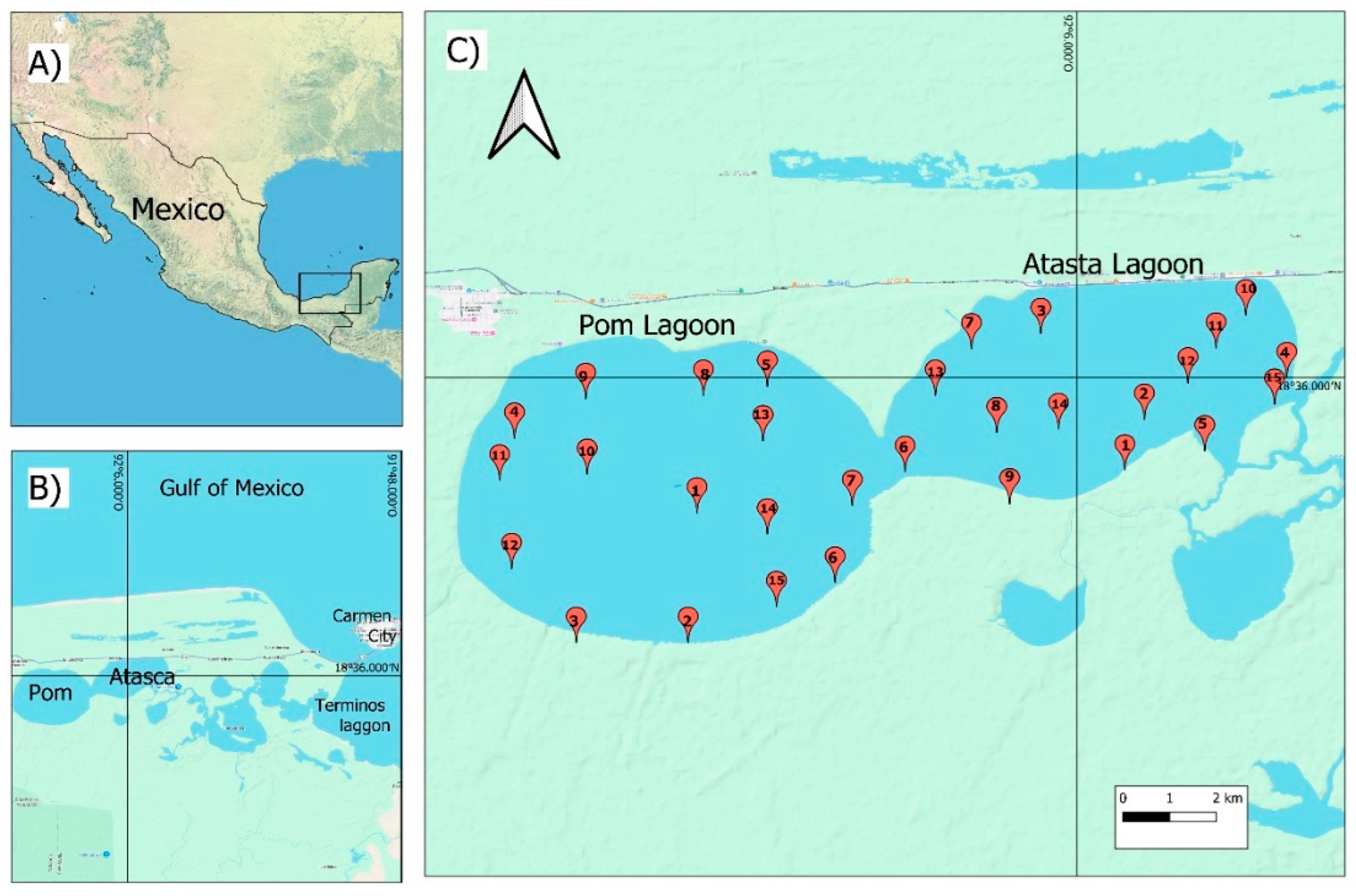
Figure 2.
Ecological risk levels (ERI) and Toxic Potential (TRI) in sediments of the Pom-Atasta fluvial lagoon system.
Figure 2.
Ecological risk levels (ERI) and Toxic Potential (TRI) in sediments of the Pom-Atasta fluvial lagoon system.
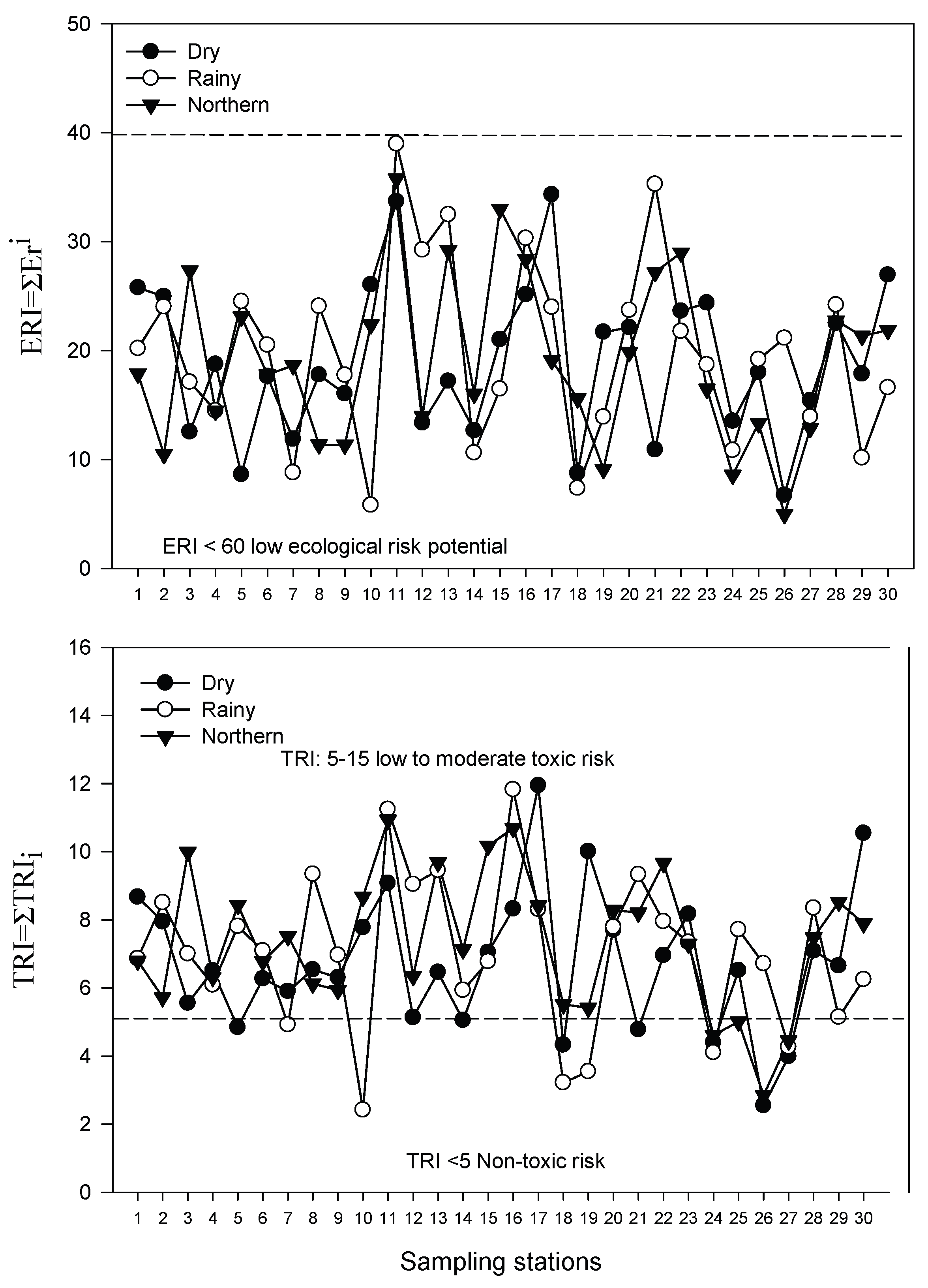
Table 1.
TRI and Cd criteria for the level of heavy metal contamination in sediment.
| TRI | Toxic risk | Cd | Degree of contamination |
| <5 | No | Cd < 8 | Low |
| 5-10 | Low | 8 ≤ Cd < 16 | Moderate |
| 10-15 | Moderate | 16 ≤ Cd < 32 | Considerable |
| 15-20 | Considerable | Cd ≥ 32 | Very high |
| >20 | Very high |
Table 2.
Sediment texture, organic matter (OM), and organic carbon (TOC) in the Pom–Atasta lagoon system across climatic seasons (mean ± SD). Different letters indicate significant differences (p < 0.05).
Table 2.
Sediment texture, organic matter (OM), and organic carbon (TOC) in the Pom–Atasta lagoon system across climatic seasons (mean ± SD). Different letters indicate significant differences (p < 0.05).
| Climate season | Sand (%) | Silt (%) | Clay (%) | OM (%) | TOC (%) |
| Dry | 76.47±8.89a | 19.73±8.55a | 3.79±1.56a | 3.94±2.13a | 2.28±1.24a |
| Rains | 73.96±9.81a | 22.73±10.02a | 3.31±1.65a | 2.97±2.21a | 1.72±1.28a |
| Northerly | 67.27±16.74b | 29.59±16.54b | 3.14±1.14a | 3.03±2.33a | 1.76±1.35a |
*a,b = Different letters indicate significant differences (p < 0.05).
Table 3.
Average concentration of heavy metals in sediment, ISQG-TEL and Upper Continental Crust (UC). Metals in Rangia cuneata (±SD) and sediment-biota accumulation factor (SBAF).
Table 3.
Average concentration of heavy metals in sediment, ISQG-TEL and Upper Continental Crust (UC). Metals in Rangia cuneata (±SD) and sediment-biota accumulation factor (SBAF).
| Metal (µg g-1) |
Clam | Sediment Climatic seasons |
UC | ||||
|
Rangia cuneata |
SBAF | Dry | Rains | Northern | ISQG-TEL | Wedepohl [22] | |
| As | < 0.3 | 0.14 | 15.4± 8.9a | 16.0± 10.6 a | 12.7± 9.8 a | 5.9 | 2.0 |
| Cr | 9.48± 3.36 | 0.37 | 128.3± 72.5 b | 115.0± 29.5 b | 130.4± 37 b | 52.3 | 35 |
| Ni | 21.36± 6.55 | 1.51 | 60.5± 22.4 c | 68.2± 27.4 c | 75.9± 22.8 d | 15.9 | 18.6 |
| Pb | <1 | 0.65 | 8.3± 2.9 e | 9.3± 5.3 e | 14.7± 5.2 f | 30.2 | 17 |
| V | nd | - | 33.6± 7.6 g | 32.0± 8.9 g | 35.7± 8.8 g | - | 53 |
| Cd | 0.44 | - | nd | Nd | Nd | 0.68 | 0.102 |
| Hg | 0.51 | - | nd | Nd | Nd | - | - |
*Different letters show significant differences (Tukey p≤0.05); nd: not detected.
Table 5.
The Pearson’s correlation coefficients of trace metals in sediment.
| 1As | 1Cr | 1Ni | 1Pb | 1V | 2As | 2Cr | 2Ni | 2Pb | 2V | 3As | 3Cr | 3Ni | 3Pb | 3V | ||
| Dry | 1As | 1.0 | ||||||||||||||
| 1Cr | 0.03 | 1.0 | ||||||||||||||
| 1Ni | 0.26 | 0.06 | 1.0 | |||||||||||||
| 1Pb | 0.00 | -0.09 | 0.32 | 1.0 | ||||||||||||
| 1V | 0.28 | 0.39 | 0.82 | 0.27 | 1.0 | |||||||||||
| Rain | 2As | 0.23 | 0.04 | -0.07 | 0.03 | 0.03 | 1.0 | |||||||||
| 2Cr | 0.12 | -0.33 | 0.28 | -0.01 | 0.21 | 0.04 | 1.0 | |||||||||
| 2Ni | 0.24 | -0.22 | 0.38 | 0.31 | 0.35 | 0.23 | 0.47 | 1.0 | ||||||||
| 2Pb | 0.09 | -0.32 | 0.14 | -0.02 | 0.01 | 0.08 | 0.34 | 0.11 | 1.0 | |||||||
| 2V | 0.21 | -0.30 | 0.45 | 0.14 | 0.37 | 0.16 | 0.62 | 0.88 | 0.42 | 1.0 | ||||||
| Northerly | 3As | 0.29 | -0.19 | 0.14 | 0.02 | 0.13 | 0.40 | 0.09 | 0.20 | 0.10 | 0.13 | 1.0 | ||||
| 3Cr | 0.05 | 0.80 | -0.04 | -0.03 | 0.30 | 0.04 | -0.25 | -0.18 | -0.34 | -0.33 | -0.10 | 1.0 | ||||
| 3Ni | 0.34 | -0.18 | 0.60 | 0.38 | 0.61 | 0.01 | 0.29 | 0.67 | 0.20 | 0.63 | 0.40 | -0.06 | 1.0 | |||
| 3Pb | 0.06 | -0.15 | 0.21 | 0.48 | 0.37 | -0.11 | 0.25 | 0.40 | 0.23 | 0.36 | 0.13 | 0.11 | 0.58 | 1.0 | ||
| 3V | 0.19 | 0.07 | 0.44 | 0.37 | 0.62 | -0.06 | 0.20 | 0.54 | -0.02 | 0.43 | 0.20 | 0.37 | 0.74 | 0.80 | 1.0 |
Disclaimer/Publisher’s Note: The statements, opinions and data contained in all publications are solely those of the individual author(s) and contributor(s) and not of MDPI and/or the editor(s). MDPI and/or the editor(s) disclaim responsibility for any injury to people or property resulting from any ideas, methods, instructions or products referred to in the content. |
© 2026 by the authors. Licensee MDPI, Basel, Switzerland. This article is an open access article distributed under the terms and conditions of the Creative Commons Attribution (CC BY) license (http://creativecommons.org/licenses/by/4.0/).
Copyright: This open access article is published under a Creative Commons CC BY 4.0 license, which permit the free download, distribution, and reuse, provided that the author and preprint are cited in any reuse.


