
Submitted:
02 March 2026
Posted:
03 March 2026
You are already at the latest version
Abstract
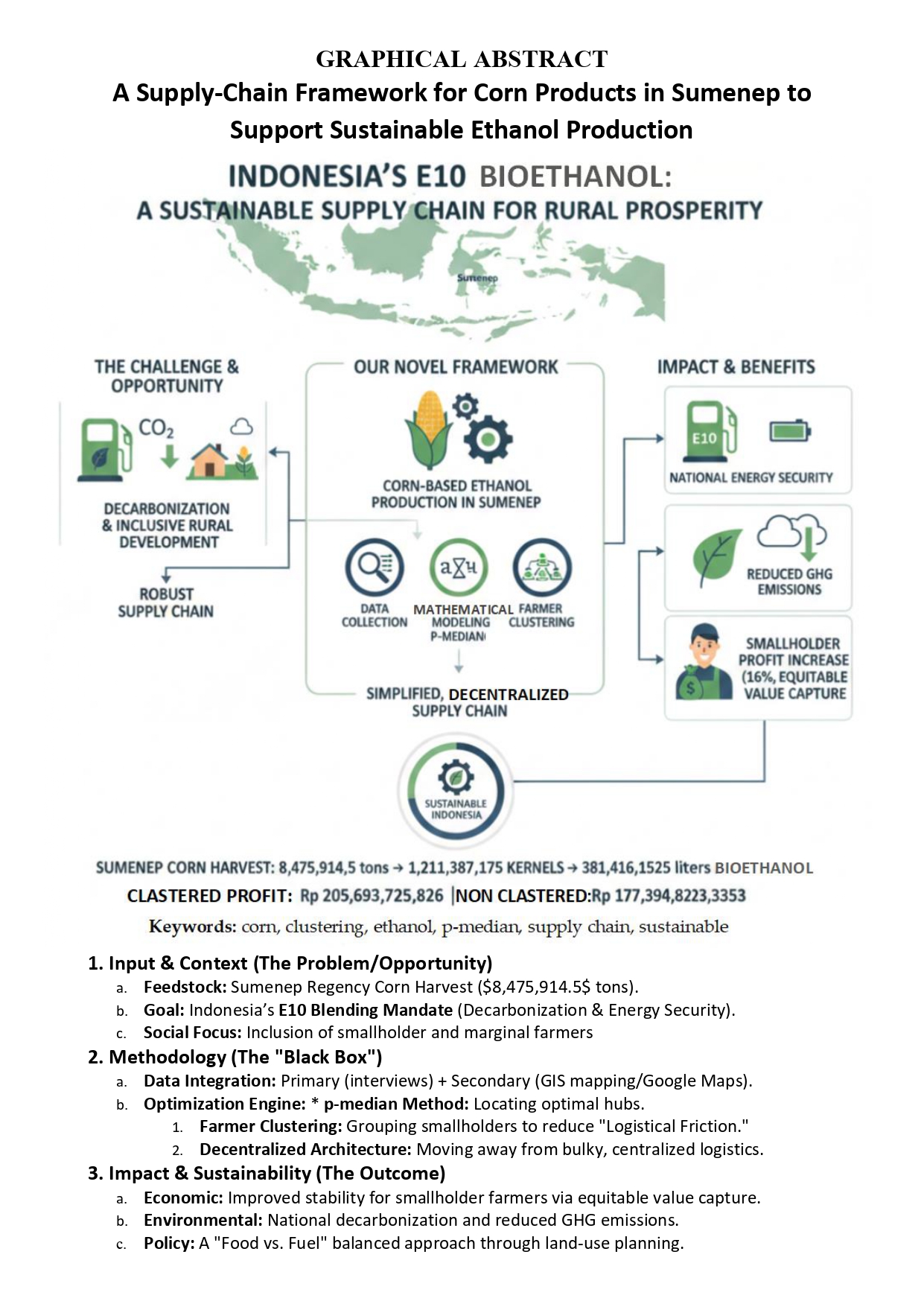
Indonesia's E10 blending mandate presents a strategic opportunity for decarbonization and inclusive rural development, contingent on a robust supply chain integrating smallholder farmers. This study developed a novel supply-chain framework for corn products in Sumenep to facilitate sustainable ethanol production. Methods involved comprehensive data collection, mathematical modeling using the p-median method, and farmer clustering techniques. Findings reveal that Sumenep Regency's substantial corn harvest of 8,475,914.5 tons, yielding 1,271,387.175 tons of kernels, can produce 381,416.1525 liters of bioethanol. By applying clustering supply chain model, the farmers' group profit is Rp 205,693,725,826, while Rp 177,394,823,353 profit for non-clustering model. It increasing profit 16% compared to the model without clustering. This localized production, enabled by a simplified, decentralized supply-chain architecture, significantly enhances national energy security, reduces greenhouse gas emissions, and improves the economic stability of smallholder farmers through equitable value capture and minimized logistical costs. The framework offers a practical, implementable strategy for Indonesia's energy transition, fostering environmental sustainability and inclusive socio-economic development.
Keywords:
corn
; clustering
; ethanol
; p-median
; supply chain
; sustainable
1. Introduction
The suspension of carbon emission is essential at a global scale; one way to achieve this is by adding ethanol to current fuel [1]. Corn (Zea mays) based ethanol still a major feedstock in many countries because of advanced conversion technology and established agricultural infrastructure [2]. Current research proof that corn-based ethanol could be substitution until replace fossil fuels, by transforming 100 kg of milled corn became 30liter pure ethanol after cooking, liquefaction, saccharification, fermentation and distillation [3]. Another research developing corn-based ethanol using thin stillage anaerobic digestion methods, it a ton corn resulting 10.000 liter of ethanol. This had capability to supply 119.9 MJ of heat and 24.7 kWh of electricity [4]. It appears to offer both a circular economy and sustainability energy. The sustainability of corn-based ethanol faces numerous challenges throughout supply chain, such as competition for land use, substantial and the complexities of feedstock collection to distribution [5]. In addition, effective supply chain management has been identified as a critical enabler of economic and environmental viability. As stated in the aforementioned article, the optimization of production, transportation, storage, and distribution networks is of paramount importance in the context of ethanol supply chains, with the objective of reducing costs and the carbon footprint [6]. Moreover, the valorization of corn coproducts, including distillers grains, straw-grass, and corn oil, in conjunction with the integration of circular-economy principles, serves to further substantiate the argument for sustainable corn-based ethanol supply systems [7].
The strategic opportunity for decarbonisation and the potential pathway to inclusive rural development represented by Indonesia’s plan to increase ethanol blending into gasoline are predicated on supply chain design explicitly addressing smallholder readiness. Recent government and industry signals suggest that a national ethanol blending mandate of E10 is gaining momentum. This is driven by a combination of factors, including the need to enhance energy security and meet emissions targets, as well as the potential to substitute imported fuel with domestically produced bioethanol [8]. However, the current production and logistics capacity in Indonesia is both limited and regionally fragmented. A number of studies and policy reviews have highlighted the fact that, despite the existence of substantial theoretical feedstock options, such as cassava, sugarcane, corn and waste alcohol streams [9]. Within the context of the national picture, the social dimension is of critical importance. In Madura’s Sumenep district, many rural households engaged in salt production, as well as smallholders and marginal farmers, encounter economic precariousness and constrained access to value-chain benefits. The pervasiveness of poverty is attributable to depressed product prices, inadequate market linkages, and constrained access to inputs and finance [10]. The judicious configuration of ethanol supply chains has the potential to generate novel off-take markets for feedstocks cultivated by smallholders (e.g. corn or cassava). However, this endeavor necessitates the implementation of deliberate measures to avert deleterious impacts between food and fuel competition and to guarantee that value capture is realized at the farm level [11]. A simplified, decentralized supply-chain architecture is a promising route to facilitate the connection of farmers from Sumenep who are experiencing economic disadvantage to the emerging ethanol market. This approach has the potential to minimize logistical costs and ensure that benefits are not lost [12]. From a sustainability perspective, policy and industry interventions must couple the physical redesign of the chain with safeguards: sustainable feedstock criteria, land-use planning to avoid indirect land use change, and technical assistance to raise yields without expanding cultivated area. The findings of research and modelling work on biofuel supply chains highlight the necessity of optimization across site selection, transport modes and processing scale in order to achieve favorable outcomes with regard to greenhouse gases and economy [13].
This research addresses a critical gap in the extant literature by developing a novel supply-chain framework for corn products in Sumenep, Indonesia, explicitly designed to support sustainable ethanol production. While the strategic opportunity for Indonesia’s E10 blending mandate in achieving decarbonization and inclusive rural development is increasingly recognised, current research often overlooks the practical integration and readiness of smallholder farmers within such systems. The distinguishing feature of our work is the proposal and analysis of a simplified, decentralised supply-chain architecture. This innovative approach is specifically tailored to establish a direct connection between economically disadvantaged farmers in Sumenep and the emerging bioethanol market. This connection minimises logistical costs and ensures equitable value capture at the farm level. It is evident that the implementation of this framework provides a pragmatic, socially inclusive, and economically viable pathway to enhance national energy security and achieve emissions targets through the utilisation of domestically produced bioethanol. This represents a significant advancement in the field, as it transitions beyond theoretical feedstock options to concrete implementation strategies.
2. Materials and Methods
The primary data utilized in this study is derived from direct interviews with the relevant parties. This includes data on crop prices, the location of farmer groups, warehouse capacity, and demand. The secondary data utilized in this study is sourced from various institutions or other reliable sources of information, which elucidate the necessary data for ascertaining the supply chain of corn product in Sumenep recency Madura island. This includes data from the Sumenep District Food Crops, Horticulture and Plantation Service on the location/address of each farmer group, supplier, branch, and representative warehouse. The data was then utilized to ascertain the points of the corn supply chain by employing Google Maps. The data types in this study are qualitative and quantitative data. In this study, there are two types of qualitative data used as measurement scales, namely nominal data and ordinal data. Service satisfaction data uses a nominal scale, while corn quality grades use an ordinal scale. In addition, there are two types of quantitative data used as measurement scales, namely interval data for distance using an interval scale and ratio data for the amount of fertilizer and the amount of corn using a ratio scale.
Objective Function
Constrain Function
The equation uses Index with notation i as the farmer group and j as the center point of the group. The parameters are n as the total number of farmer group points, dij as the distance between points i and j, and p to indicate the desired number of clusters. The decision variable xij has a notation of 1 if point i is a member of cluster point j; 0 for others. yj=1 if the cluster point is located at point j; 0 for others. Once the points of each cluster and cluster members are known, the next step is to determine the objective function and constraint function. This equation then used as the basis for creating a Matlab program to solve the farmer group clustering, similar to this research [14,15]. The next step is to verify the model that has been created by declaring each unit in the model and checking the final output results as desired. The following is the mathematical model
Objective function of breeders and farmer groups
Objective Function Fertilizer shops and farmer groups
Objective Functions of Farmer Groups and Agricultural Product Collectors
The provided set of variables delineates key parameters within a multi-echelon agricultural supply chain model, specifically focusing on the distribution of corn seeds and fertilizers to farmer groups and the subsequent movement of agricultural products. These variables collectively quantify the logistical and cost implications across various nodes in the network, facilitating a comprehensive analysis of supply chain efficiency and optimization opportunities. The cost structure is represented by several fixed and variable shipping costs. btpik denotes the fixed shipping cost associated with transporting materials from breeder i to farmer group k, while btpjk represents the fixed shipping cost from fertilizer store j to farmer group k. Complementing these are the variable shipping costs: bpik for corn seed raw materials from breeder i to farmer group k, bpjk for fertilizer raw materials from fertilizer store j to farmer group k, and bpkc for the onward shipment of agricultural products from farmer group k to an agricultural warehouse c. These cost parameters are crucial for evaluating the economic viability of different distribution strategies.
Material flow and capacity are captured by several quantity variables. TDSik signifies the number of seeds shipped from breeder i to farmer group k, and TDSjk indicates the amount of fertilizer transported from fertilizer store j to farmer group k. The supply capacities at the initial nodes are defined by TSi, representing the total amount of seeds produced by breeder i, and TDj, indicating the total amount of fertilizer available at fertilizer store j. Finally, TP_k quantifies the amounts of agricultural products produced by farmer group k, signifying the output of the farming stage. Geographical considerations, which directly influence shipping costs and transit times, are represented by distance variables. dik measures the distance between breeder i and farmer group k, djk measures the distance between fertilizer store j and farmer group k, and d_kc measures the distance between farmer group k and agricultural warehouse c. These distances are fundamental inputs for calculating transportation costs and for spatial optimization within the supply chain network.
3. Result and Discussion
The data collated in this study comprised information on farmer groups that cultivated corn in March 2025, data on subsidized corn seed breeders from the Sumenep District Food Crops, Horticulture, and Plantation Service, and fertilizer stores that received subsidized fertilizer. The data presented herein was collected through in-depth interviews with the heads of each farmer group. The subsequent section will present the results of the farmer group data and managed land in Table 2.

Table 2.
Farmer group and managed agricultural land.
| Sub-District | Number | Farmer Group | Established | Members | Farmland (Ha) |
Field (Ha) |
Yard (Ha) |
|---|---|---|---|---|---|---|---|
| Pragaan | 1 | Kwt. Mekar Sari | 2008 | 30 | - | 24.70 | 0.12 |
| 2 | Kwt. Melati | 2008 | 37 | - | 8.40 | 0.61 | |
| 3 | Sumber Jaya Patean Selatan | 2011 | 28 | - | 8.60 | 0.26 | |
| 4 | Rizqi Indah | 2013 | 26 | - | 24.70 | 0.26 | |
| 5 | Kwt.. Mawar Merah | 2008 | 30 | - | 26.40 | 0.29 | |
| 6 | Bina Karya Ii | 2007 | 35 | - | 27.30 | 0.21 | |
| 7 | Mekkar Melati | 2007 | 54 | - | 28.90 | 0.25 | |
| 8 | Bunga Mawar | 1998 | 28 | - | 24.80 | 0.38 | |
| 9 | Putra Bahari | 2005 | 42 | - | 14.50 | 0.60 | |
| 10 | Wiraraja | 2006 | 39 | - | 20.60 | 0.77 | |
| 11 | Nurul Jadid | 1996 | 57 | - | 23.70 | 0.25 | |
| 12 | Bumi Sumekar | 1995 | 50 | - | 28.50 | 0.62 | |
| 13 | Suka Maju | 2007 | 32 | - | 5.60 | 4.50 | |
| 14 | Al-Ijtima | 2013 | 23 | - | 16.10 | 3.70 | |
| 15 | Dempa Abang | 2007 | 26 | 9 | 20.00 | 2.25 | |
| 16 | Karya Bhakti | 2007 | 36 | 9 | 30.00 | 1.90 | |
| Kota Sumenep | 74 | Prima Sakti | 2009 | 23 | 8.7 | 12.9 | 0.45 |
| 75 | Putra Cahaya | 2008 | 21 | - | 25 | 0.3 | |
| 76 | Remaja Harapan | 2005 | 25 | - | 22 | - | |
| 77 | Sinar Bumi Putra | 2008 | 25 | 4.75 | 30.5 | 0.175 | |
| 78 | Suka Subur | 2008 | 20 | - | 26 | 2 | |
| Batuan | 79 | Kwt. Karya Bersatu Torbang | 2003 | 26 | 4.50 | 5.00 | 0.56 |
| 80 | Karya Usaha Tani | 2001 | 24 | 10.00 | 2.00 | 0.43 | |
| 81 | Sumber Jaya Dusun Toros | 2007 | 27 | 15.00 | 6.00 | 0.72 | |
| 82 | Suka Maju Babbalan | 1998 | 20 | 14.50 | 7.00 | 0.45 | |
| 83 | Barokah | 2005 | 23 | 11.00 | 7.50 | 0.54 | |
| Pasongsongan | 274 | Lembah Bukit | 2007 | 63 | 0 | 284.8 | 3.37 |
| 292 | Rahdatul Ihsan | 2008 | 81 | 8.35 | 17.65 | 256.15 | |
| 293 | Al-Rohim | 2007 | 75 | 8.85 | 20.61 | 255.3 | |
| Gapura | 380 | Kwt. Nor Hikmah | 2007 | 20 | 1.1 | 20.75 | 2.6 |
| 381 | Kuda Terbang | 2013 | 21 | 0 | 20.95 | 0.62 | |
| 382 | Jokotole | 2008 | 24 | 4.5 | 20.26 | 0.9 | |
| 383 | Kwt. Megah | 1990 | 24 | 0.43 | 28.2 | 1.16 | |
| 384 | Al Mustofa | 2007 | 20 | 1.48 | 26.7 | 0.58 | |
| 385 | Al Ikhlas Beraji | 2007 | 31 | 0.75 | 29.5 | 0.49 | |
| Total | 9799 | 1790 | 7409 | 1630 |
As illustrated in Table 1, the number of farmer groups intending to plant corn in 2024 is 385, which 9799 farmers. The cultivation areas are divided into three distinct categories: yards, fields, and farmland. Yards are privately owned land attached to houses. Fields are defined as dry land, the irrigation of which is dependent on precipitation. Farmland is comparable to fields in this regard however it is distinguished by the presence of a regular irrigation system. It is customary to plant rice during the rainy season, while corn and tobacco are planted during the dry season. The total area of cultivated land is 1,630 hectares for yards, 7,409 hectares for fields, and 1,790 hectares for farmland. The agricultural land profiles of three distinct farmer groups, Lembah Bukit, Rahdatul Ihsan, and Al-Rohim, reveal varied land utilization patterns. Lembah Bukit, situated in Campaka subvillage, Panaongan village possesses a total agricultural land area of 288.17 Ha. This land is predominantly comprised of 284.8 Ha of field land and 3.37 Ha of yard land, notably lacking any dedicated farmland. In contrast, RAHDATUL IHSAN, located in Platokan subvillage, Prancak village, manages a total of 284.76 Ha, with a more diversified allocation including 8.85 Ha of farmland, 20.61 Ha of field land, and a substantial 255.3 Ha of yard land, supported by 75 members. Similarly, Al-Rohim located similar to Rahfatul Ihsan, managed by 81 members, oversees 282.15 Ha of total land, distributed as 8.35 Ha of farmland, 17.65 Ha of field land, and 256.15 Ha designated as yard land. These variations in land type distribution and total area underscore the diverse agricultural contexts within which these groups operate, potentially influencing their farming practices and resource requirements. Such heterogeneity in land characteristics among farmer groups is a common feature in agricultural landscapes, often reflecting local ecological conditions, historical land use, and socio-economic factors influencing land management decision[16]. Following map on Figure 1 is illustrates the distribution of farmer groups engaged in the cultivation of corn in Sumenep Regency
This study uses primary data obtained from direct interviews with the relevant parties. This includes information on crop prices, the location of farming groups, warehouse capacity and demand. The secondary data used in this study was obtained from institutions or other sources of information needed to determine the corn supply chain, such as data from the Sumenep District Food Crops, Horticulture and Plantation Service on the location and address of each farmer group, supplier, branch and representative warehouse. This data was used to plot the locations of the corn supply chain on Google Maps.
Table 2.
Data on subsidized seed breeders in Sumenep Regency.
| Code | Farmer Group | Capacity | Code | Farmer Group | Capacity |
|---|---|---|---|---|---|
| B1 | Sumber Jaya Patean Selatan | 8,876,000 | B22 | Sumber Rejeki | 700,000 |
| B2 | Wiraraja | 7,800,000 | B23 | KWT. Sari Jaya | 7,526,000 |
| B3 | KWT. Torikul Hidayah | 6,853,000 | B24 | Campaka Putih | 12,000,000 |
| B4 | KWT. Melati | 8,575,000 | B25 | Empat Saudara | 3,000,000 |
| B5 | KWT. Sumber Rejeki | 7,500,000 | B26 | Sumber Sejahtera | 18,995,000 |
| B6 | Madu Sari | 3,000,000 | B27 | Jampareng | 8,500,000 |
| B7 | Makmur Jaya 1 | 9,800,000 | B28 | Cahaya | 7,200,000 |
| B8 | KWT. Sumber Madu | 8,073,000 | B29 | Timur Jaya | 9,000,000 |
| B9 | Tambak Sari | 4,726,000 | B30 | Fatahillah | 8,186,000 |
| B10 | Remaja Harapan | 6,000,000 | B31 | Jaya Abadi | 2,000,000 |
| B11 | Suka Maju Babbalan | 5,850,000 | B32 | Suka Maju | 22,046,000 |
| B12 | Al-Faqiyah | 5,800,000 | B33 | Kompak Barokah | 8,806,000 |
| B13 | Darma Tani Iii | 11,927,000 | B34 | Al-Amin | 13,208,000 |
| B14 | Sumber Kebun | 7,857,000 | B35 | Tunas Jaya | 3,000,000 |
| B15 | Tani Barokah Poreh | 5,774,000 | B36 | Al - Huda | 6,850,000 |
| B16 | KWT. Nurul Hidayah Ii | 1,000,000 | B37 | KWT. Mawar Indah | 270,000 |
| B17 | Remaja Harapan | 9,958,000 | B38 | Semi Agung | 7,144,000 |
| B18 | Sumber Hasil | 8,804,000 | B39 | Sindi Mas | 7,265,000 |
| B19 | Meranggi Jaya | 8,200,000 | B40 | KWT. Al-Hikam | 6,500,000 |
| B20 | KWT. Pasra | 5,800,000 | B41 | Al-Faidzin | 8,500,000 |
| B21 | Jaya Kusuma | 14,980,000 | B42 | KWT. Megah | 7,053,000 |
Table 2 show there are 42 seed breeders in Sumenep district. The highest capacity is held by the Sumber Sejahtera farmer group with a capacity of 18,995,000 seeds, while the lowest capacity is held by the KWT. Mawar Indah farmer group with a capacity of 270,000 seeds. These seed breeders are entrusted by the Food Crops, Horticulture and Plantation Service to cultivate the seeds provided, which are then distributed to farmer groups throughout Sumenep Regency. The following is a map of the distribution of seed nurseries in Sumenep Regency.
These fertilizer stores are trusted by the Sumenep district government to distribute subsidized fertilizer to farmers. The following is data on fertilizer stores that receive subsidized fertilizer in Sumenep district, as shown in Table 3.
From the table above, it can be seen that there are 28 stores that distribute subsidized fertilizer, spread across the entire Sumenep district. The largest distributor is UD. Wahana Usaha Lancar with a capacity of 5,820 tons, while the smallest are UD. Garuda Berlian Kencana with a capacity of 370 tons and UD. Yosomulyo Jajag with a capacity of 370 tons. Figure 3 shows a map of the distribution of fertilizer stores that receive subsidized fertilizer.
Farmers sell their harvest to warehouses in Sumenep Regency. This is recommended so that farmers can obtain high prices for their corn and reduce the risk of price manipulation in sales. Farmers generally store part of their corn harvest to be used as feed for livestock in the future. The following is data on company warehouses in Sumenep Regency describe on Table 4.
Table 4 shows warehouse data and capacity. Based on ownership, there are three types of warehouses in Sumenep Regency, namely company-owned warehouses, village cooperative-owned warehouses, and privately-owned warehouses. Company-owned warehouses tend to purchase agricultural products from farmers at higher prices. The company-owned warehouses are PT PN XI, located in Patean Village, and Guluk Guluk. Warehouses owned by village cooperatives have purchase prices that are slightly lower than those of company-owned warehouses. In Sumenep, there is only one cooperative warehouse that stores corn, namely KUD POJUR, located in Lenteng. Two privately owned warehouses, named KMD and HZA, tend to purchase agricultural products at lower prices than company-owned or village warehouses. However, the KMD warehouse tends to purchase at higher prices than HZA, but its capacity is smaller. Figure 4 show location of warehouse.
Effective management of corn distribution within Sumenep Regency necessitates a comprehensive regulatory framework addressing critical inputs such as corn seeds, fertilizers, and the optimization of corn yields. The intricate nature of agricultural supply chains, particularly for staple crops like corn, involves a dynamic interplay between various stakeholders and environmental factors. Consequently, successful distribution hinges upon meticulously addressing a specific set of demands and needs throughout the entire process, encompassing procurement, logistics, and market access. Understanding these multifaceted requirements is paramount for ensuring food security, enhancing farmer livelihoods, and fostering sustainable agricultural practices in the region, particularly given the challenges in managing agricultural inputs and outputs in developing economies. The results of the field observations are displayed in the Table 5.
Figure 5.
location of agricultural warehouse in Sumenep.
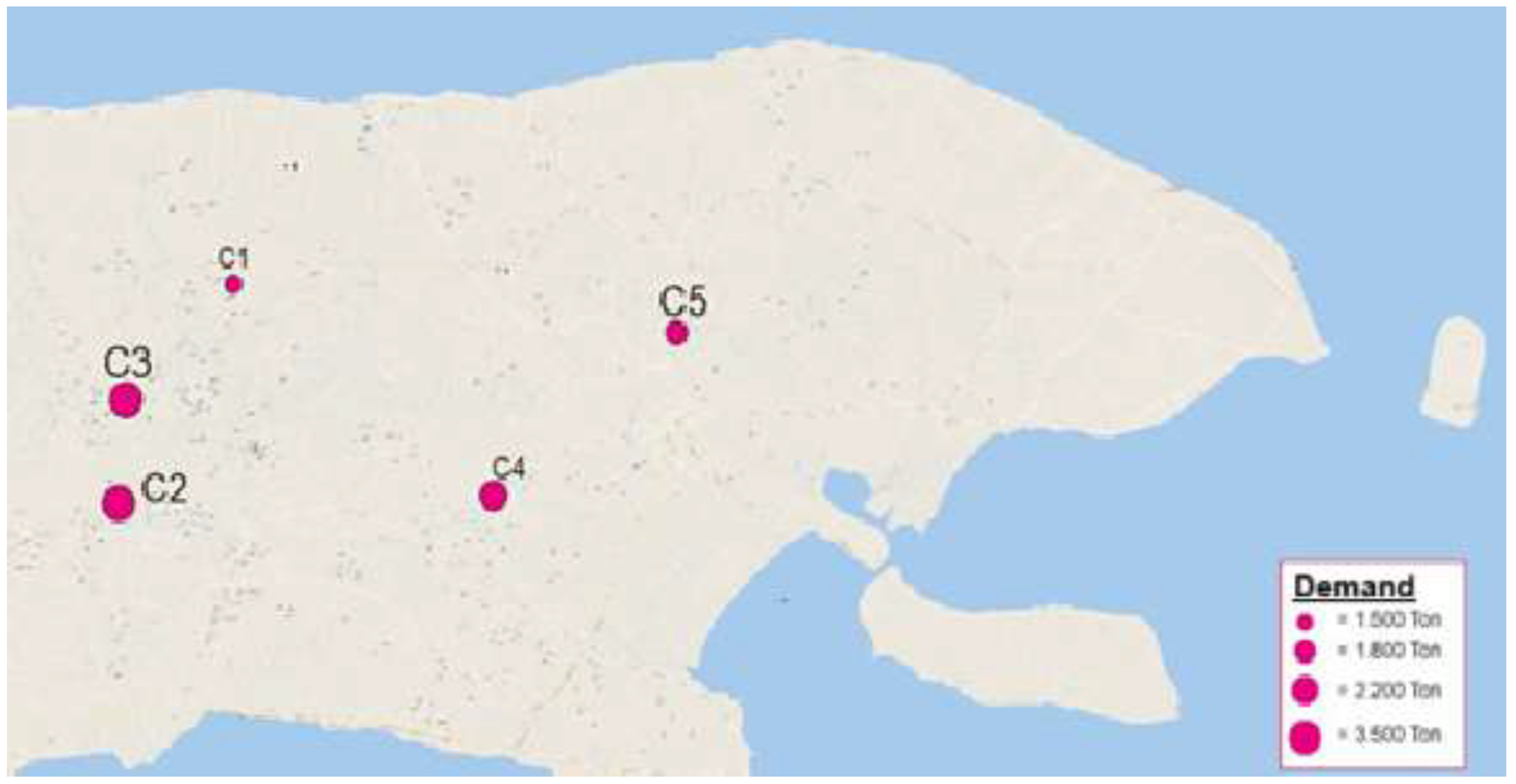
Table 5 display that Lembah Bukit, Rahdatul Ihsan, and Al-Rohim farmer group the top farmer group in corn seed and fertilizer demand, it linear to Table 1 compared. Cultivating corn over larger areas of land requires a proportional increase in agricultural inputs, such as corn seeds and fertilizers, to achieve optimal yields and maintain sustainable productivity [17]. This is due to corn’s inherent demand as a nutrient-intensive crop, requiring substantial quantities of essential nutrients throughout its growth cycle. Effective nutrient management scaled to the size of the cultivated area is therefore critical for replenishing soil fertility and supporting robust plant development. Among the various fertilizer types, NPK compounds are fundamental, providing a balanced supply of nitrogen (N), phosphorus (P) and potassium (K), which are crucial for overall plant health, vegetative growth, root development and grain filling [18]. Nitrogen, often supplied by fertilizers such as ZA (ammonium sulphate), is essential for chlorophyll synthesis and protein formation, which directly influence leaf area and photosynthetic efficiency [19]. Phosphorus, which is commonly supplied by SP36 (superphosphate 36%), is essential for energy transfer, establishing the root system, and reproductive processes, particularly during the early stages of growth [20]. Potassium, a key component of NPK formulations, plays a significant role in water regulation, disease resistance and overall plant vigor [21]. Therefore, the precise and appropriate application of these specific fertilizer types is essential for maximizing corn production efficiency and yield potential in extensive agricultural operations [22].
3.1. Clustering Distance of Farmer Group
The clustering stage of the farmer group analysis began with the recording of the distances between the groups. This was determined based on interviews about the routes they usually took and then verified using Google Maps. Reported by this current research [23,24] utilizing of Google Maps for distance calculations in service routing models, demonstrating how these platforms provide essential data and visualization capabilities that contribute to more efficient, cost-effective, and responsive supply chain operations. The results of distance matrix of each farmer group are shown in Table 6.
Based on 532 data displayed on Table 6. The FGN is refers to Farmer Group Number. The longest route is 61,8 km from 274 (Lembah Bukit) to 6 (Bina Karya II). This article on Digital Supply Chain Surveillance (DSCS) implicitly underscores the critical role of distance in supply chain management. It emphasizes that effective DSCS [25], leveraging artificial intelligence, is essential for proactive monitoring and risk detection across geographically dispersed global networks. Managing the spatial dimension, or distance, is fundamental to maintaining visibility, ensuring real-time tracking, and mitigating risks such as unethical practices throughout complex, extended supply chains. Another article [26] leveraging artificial intelligence, is essential for monitoring and analyzing data across geographically dispersed global networks. Managing this spatial dimension is crucial for maintaining visibility, enabling real-time tracking, and mitigating risks throughout extended supply chains. Following the acquisition of the distance matrix between farmer groups, the farmer groups were grouped using the p-median method. This was undertaken in accordance with the objective function and its constraints, as detailed in equations (1) to (7).
The provided data illustrates the clustering of farmer groups and their aggregated corn production volumes, offering crucial insights for optimizing the supply chain network. Across 15 identified clusters, corn production varies significantly, ranging from 180,267.5 tons in Cluster 1 to a substantial 1,113,646 tons in Cluster 3. The diverse composition of farmer groups within each cluster, indicated by numerous individual group names (e.g., “Asam Manis,” “Tani Jaya,” “KWT. Nurul Qomariyah”), underscores the localized and fragmented nature of corn cultivation in Sumenep. This clustering is instrumental for strategic supply chain design, as it allows for the identification of high-volume production hubs (e.g., Cluster 3, 5, 8) that may warrant dedicated collection points or direct transportation routes to processing facilities. Conversely, smaller clusters necessitate efficient aggregation strategies to consolidate feedstock, minimizing collection costs and ensuring viability. Effective networking within and between these clusters is paramount for establishing a robust and sustainable ethanol production supply chain, facilitating consistent feedstock flow and maximizing the economic benefits for smallholder farmers. The data of visualized clustering of farmers group in Sumenep shown on Figure 6.
Figure 6 provided visual data illustrates a compelling transformation in the spatial organization of corn farmer groups, moving from a dispersed configuration to a more structured, clustered arrangement through the application of the p-median method. The left panel depicts the initial state, characterized by a seemingly random and widespread distribution of individual farmer groups represented by red dots on Figure 1. This fragmented layout inherently implies extended transportation distances for both the delivery of agricultural inputs such as; seeds, fertilizers and employee include collection of harvested corn. In contrast to Figure 6 post-clustering, reveals several distinct color-coded clusters, each representing a group of farmer entities assigned to a specific median point. This visual aggregation signifies a significant simplification of the distribution network. The application of the p-median method, a classical facility location problem, aims to identify a predetermined number of facility locations as the medians that minimize the total distance or cost between demand points as the farmer groups and their assigned facilities [27]. In this context, each colored cluster on the right panel indicates that farmer groups within that cluster are now associated with a proximate central point, effectively “getting closer” to a designated hub. This strategic grouping inherently leads to a substantial reduction in the average and total travel distances within the supply chain [28]. From a supply chain perspective, this simplification offers multifaceted benefits. Firstly, the reduction in distances leads directly to a decrease in transportation costs for delivering essential agricultural inputs, such as corn seeds and fertilizers, to farmer groups. This optimization has the potential to result in more frequent and timely deliveries, which may in turn improve the freshness of the input and reduce storage requirements at the farm level [29]. Another benefit is output logistic, the clustered arrangement streamlines the collection of harvested corn. Instead of numerous disparate pick-up points, collection routes can now be optimized to serve concentrated areas, minimizing fuel consumption, vehicle wear, and labor hours. This efficiency can also contribute to reducing post-harvest losses by enabling faster aggregation and transport to processing facilities or markets [30]. Centralized collection or distribution points within each cluster can facilitate better inventory management, improved coordination between farmers and distributors, and more effective resource allocation. The minimized travel distances contribute to a more sustainable supply chain by reducing the carbon footprint associated with transportation activities [31]. In essence, the p-median clustering transforms a spatially complex distribution challenge into a manageable, cost-effective, and environmentally conscious network, fostering a more robust and responsive agricultural supply chain for corn farmers. The result of supply chain between corn seed breeder to farmer group show on Figure 6.
Figure 7.
visualization of supply chain network from seed breeder to farmer group clustering in Sumenep.
Figure 7.
visualization of supply chain network from seed breeder to farmer group clustering in Sumenep.
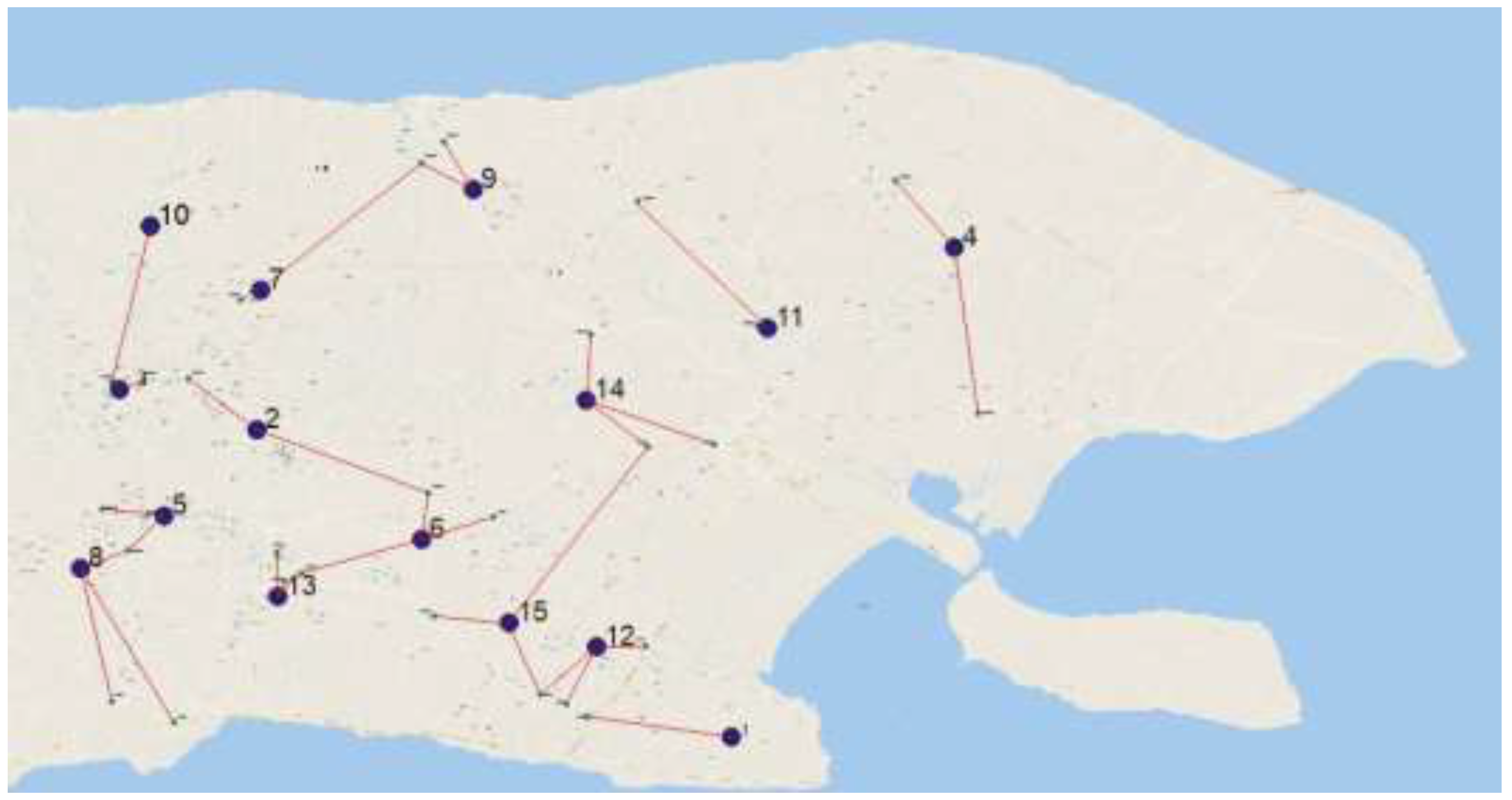
The provided image delineates a critical segment of an agricultural supply chain, specifically illustrating the distribution network for corn seeds from seed breeders to farmer group clusters. This visual representation, characterized by large blue numbered dots representing seed breeders, small green dots signifying farmer group clusters (the output of a prior p-median clustering process), and red lines depicting the supply routes, offers valuable insights into the logistical architecture designed for efficiency and optimization. The network structure evident in the image showcases a decentralized supply system where multiple seed breeders (15 distinct entities, numbered 1 through 15) are strategically positioned across the geographical expanse. Each breeder serves one or more farmer group clusters, forming a series of interconnected supply lines. This configuration suggests a deliberate design to minimize transportation distances and enhance the responsiveness of seed delivery to the clustered farmer groups. The prior application of p-median clustering to aggregate individual farmers into cohesive groups (the green dots) is fundamental to this network’s efficiency, as it consolidates demand points, thereby simplifying the routing problem for seed breeders [32,33]. From a supply chain perspective, this optimized network design offers several advantages. Firstly, cost efficiency is significantly improved. By minimizing the distances between breeders and their assigned farmer group clusters, transportation costs associated with fuel, labor, and vehicle maintenance are reduced [34]. This is particularly crucial for agricultural inputs, where margins can be tight, and efficient logistics directly impact farmer profitability and the overall cost of production. Secondly, enhanced service levels and lead time reduction are achieved. Shorter supply lines mean faster delivery of seeds, ensuring that farmers receive their inputs in a timely manner, which is critical for adherence to planting schedules and maximizing crop yield [35]. This responsiveness contributes to the reliability of the supply chain, a key factor in agricultural success. Furthermore, this network design contributes to risk mitigation and supply chain resilience. While some breeders appear to serve multiple clusters, indicating potential single points of failure if a breeder faces disruptions, the distributed nature of breeders across the region inherently provides a degree of redundancy. Should one breeder face issues, alternative breeders might be able to pick up the slack, albeit with potentially longer routes. The clustering of farmer groups also facilitates better communication and coordination, allowing for more agile responses to unforeseen events such as adverse weather conditions or sudden changes in demand [36]. On the other side optimized routing contributes to environmental sustainability by reducing the carbon footprint associated with seed distribution. Fewer kilometers traveled per unit of seed translates into lower greenhouse gas emissions, aligning with contemporary demands for greener supply chains in agriculture [37,38]. The depicted supply chain network, leveraging p-median clustering for farmer groups, represents a sophisticated approach to agricultural logistics. It underscores a strategic effort to optimize the flow of critical inputs by minimizing distances, enhancing cost-effectiveness, improving service delivery, and building resilience within the corn seed supply chain. Following the acquisition of the supply chain network from seed breeders to farmer groups, the distribution channels for corn production per farmer group from Table 7 are to be optimized to align with the demand of corn storage warehouses in Table 4. This is to be achieved through the implementation of equation (9) in MatLab, utilizing objective and constraint functions in equations (1-6). The result show on Table 8.
Table 8 presents the optimized supply chain network for corn farmer groups, detailing their production volumes, distances to two distinct corn storage warehouses (C1 and C5), and their assigned supply destinations. The data, generated using MATLAB, delineates the strategic allocation of corn produce from individual farmer groups to either C1 or C5. A total of 16 farmer groups are listed, with corn production volumes ranging from 302 tons (Farmer Group 381) to a substantial 1733 tons (Farmer Group 358), indicating a diverse range of production capacities within the network. A critical observation from the “Distance (km)” and “Supply (ton)” columns reveals that the assignment of farmer groups to warehouses is not solely dictated by the shortest geographical distance. For instance, Farmer Groups 74 through 357 consistently demonstrate shorter distances to warehouse C5 compared to C1 (e.g., Farmer Group 74 is 23.67 km from C1 and 6.73 km from C5), yet the majority of their production is allocated to C1. Conversely, Farmer Groups 358 through 384, which also exhibit shorter distances to C5, are predominantly assigned to supply C5. This discrepancy suggests that the MATLAB optimization model employs a more sophisticated objective function than simple distance minimization for individual farmer groups. Such assignments are characteristic of complex supply chain optimization problems, where factors like warehouse capacity constraints, specific demand requirements at each warehouse, overall network balancing, or varying operational costs (e.g., handling, storage, or differentiated transportation rates beyond mere distance) might influence the optimal allocation decisions [39,40]. The case of Farmer Group 357, which splits its production (419 tons to C1 and 31 tons to C5) despite C5 being closer (16.67 km to C1 vs. 6.66 km to C5), further underscores the multi-faceted nature of the optimization. This partial allocation could indicate an attempt to meet specific, smaller demand at C5 or to balance the load across warehouses, ensuring efficient utilization of resources and preventing bottlenecks [41,42]. This strategic assignment, moving beyond a greedy shortest-path approach, is crucial for achieving global optimality in a supply chain, minimizing total system costs, and enhancing overall network efficiency and resilience [43]. Therefore, the results in Table 8 illustrate a deliberate and optimized supply chain design that balances geographical proximity with other critical logistical and operational considerations to ensure effective corn distribution. The visualization of supply chain distribution from farmer group clustering to corn storage warehouse shown on figure
Figure 8.
visualization of supply chain network from farmer group clustering to corn storage warehouse in Sumenep.
Figure 8.
visualization of supply chain network from farmer group clustering to corn storage warehouse in Sumenep.
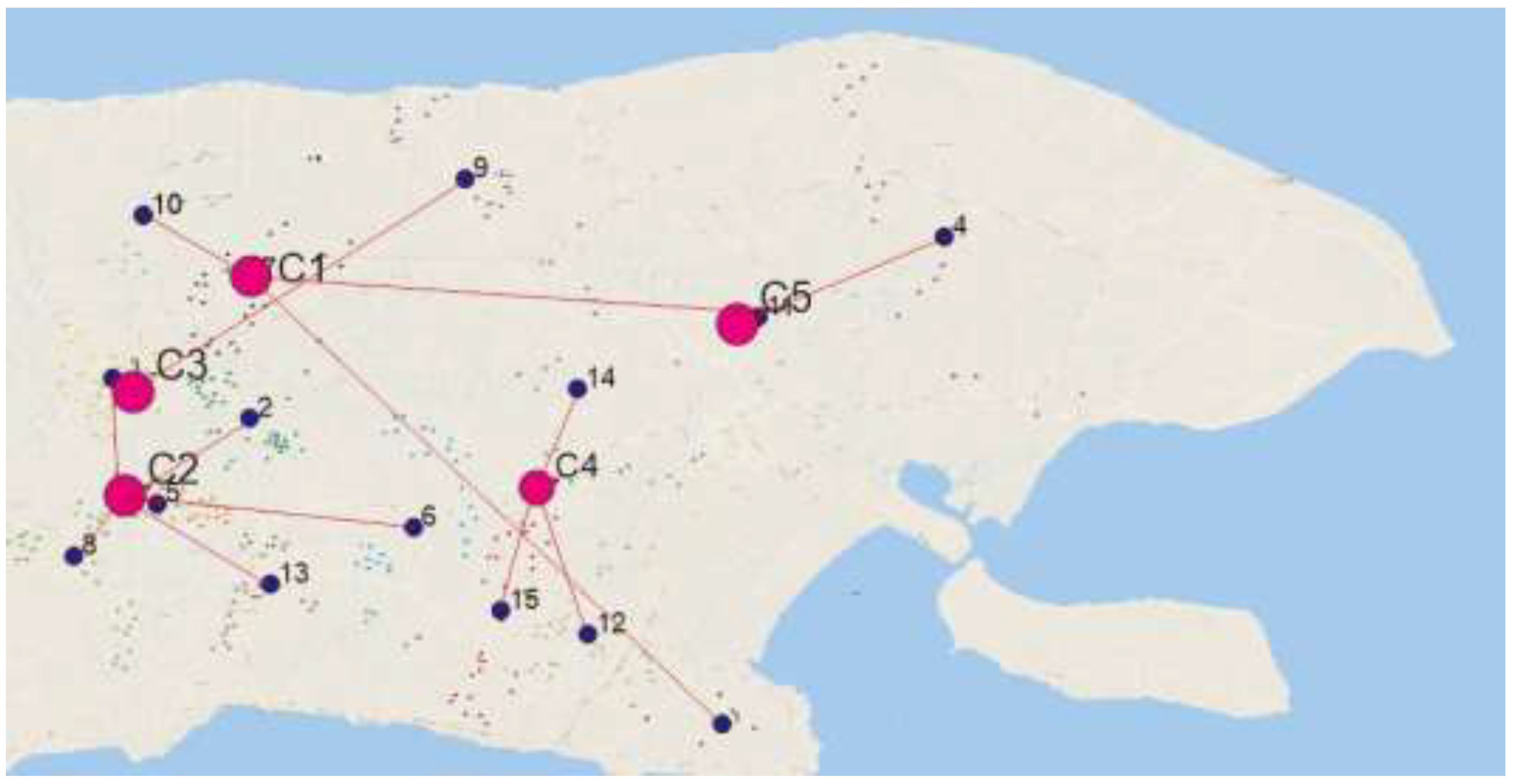
The substantial corn harvest in Sumenep Regency, totaling 8,475,914.5 tons, presents a compelling opportunity for localized bioethanol production, offering multifaceted benefits across agricultural, environmental, and energy sectors. With 15% of this yield comprising kernels, an estimated 1,271,387.175 tons of feedstock become available, capable of generating 381,416.1525 liters of bioethanol [44]. This localized production capacity holds significant implications for local farmers, as the increased demand for corn as a bioethanol feedstock can stimulate agricultural economic activity, enhance income stability, and foster rural development, aligning with findings that highlight biofuels’ role in creating employment and promoting sustainability [3,45,46]. Environmentally, the conversion of corn kernels to bioethanol contributes tangibly to sustainability objectives. Bioethanol, particularly when derived from agricultural biomass, offers a renewable alternative to fossil fuels, thereby reducing greenhouse gas (GHG) emissions and mitigating the carbon footprint associated with conventional fuel consumption [47,48]. Life cycle assessments consistently demonstrate that bioethanol production can significantly lower global warming potential and other environmental impacts compared to gasoline [49]. Furthermore, the produced bioethanol can be strategically integrated into the fuel supply chain, yielding positive impacts on vehicle performance. The 381,416.1525 liters of bioethanol are sufficient to create 3,814,161.525 liters of an E10 fuel blend, which is commonly used to enhance the octane rating of gasoline to 90 or higher [50]. Research indicates that ethanol-blended gasoline can improve engine power output, fuel efficiency, and significantly reduce harmful emissions such as carbon monoxide and hydrocarbons in various vehicle types, including two-wheelers and hybrid vehicles [51]. From the calculations using the new supply chain model, the farmers’ group profit is Rp 205,693,725,826. And for the old model, the profit is Rp 177,394,823,353. So, it is clear that the clustering supply chain model is better because the profit increases by 16% compared to the model without clustering. The average profit for members in the supply chain model without clustering is Rp 18,168,548, while in the new model it is Rp 20,896,889. While the generated volume represents a fraction of the national subsidized fuel quota of 30.71 million kiloliters, it underscores a viable pathway for Sumenep Regency to contribute to national energy security, promote a circular economy in agriculture, and advance environmental stewardship through the strategic valorization of its corn harvest.
4. Conclusion
This study rigorously addressed the critical need for an optimized supply-chain framework for corn products in Sumenep, Indonesia, specifically to bolster sustainable ethanol production. Through comprehensive data collection, including interviews and secondary sources, coupled with mathematical modeling and farmer clustering techniques, the research successfully identified an effective logistical approach. The findings underscore the significant potential for bioethanol production from local corn yields in Sumenep, which can concurrently stimulate economic growth and substantially enhance the livelihoods of local smallholder and marginal farmers. This implies a dual benefit: contributing to national decarbonization and energy security goals while fostering inclusive rural development. The primary contribution of this research lies in its proposal of a novel, simplified, and decentralized supply-chain architecture. This model is uniquely designed to integrate economically disadvantaged farmers directly into the emerging bioethanol market, thereby minimizing logistical costs and ensuring equitable value capture at the farm level. This study is significant as it moves beyond theoretical discussions of feedstock options by offering a practical and implementable strategy for Indonesia’s E10 blending mandate. While the provided summaries do not detail specific limitations, future research could benefit from a more granular analysis of dynamic cost models and a comprehensive quantitative life cycle assessment to further refine the proposed framework. The simplification of supply chains has been demonstrated to engender a 16% increase in the income of farmer groups. It is important to note that this does not include the possibility of an increase in corn prices due to its use in ethanol production. For practice and policy, it is strongly recommended that a balanced approach be adopted, ensuring that the integration of bioethanol production avoids competition between food and fuel. Policymakers should prioritize the implementation of sustainable feedstock criteria, robust land-use planning to prevent indirect land-use change, and provide technical assistance to smallholders to increase yields without expanding cultivated areas, thereby securing both environmental and socio-economic benefits.
References
- Guo, X.; Shi, R.; Ren, D. Reduce Carbon Emissions Efficiently: The Influencing Factors and Decoupling Relationships of Carbon Emission from High-Energy Consumption and High-Emission Industries in China. Energy & Environment 2024, 35, 1416–1433. [Google Scholar] [CrossRef]
- Sebos, I. Fossil Fraction of CO2 Emissions of Biofuels. Carbon Manag 2022, 13, 154–163. [Google Scholar] [CrossRef]
- Akdemir, Ş.; Miassi, Y.E.; Ismailla, I.S.; Dossa, K.F.; Oussou, K.F.; Zannou, O. Corn Production and Processing into Ethanol in Turkey: An Analysis of the Performance of Irrigation Systems at Different Altitudes on Energy Use and Production Costs. J Agric Food Res 2023, 14. [Google Scholar] [CrossRef]
- Ziero, H.D.D.; Ampese, L.C.; Buller, L.S.; Costa, J.M.; Berni, M.; Forster-Carneiro, T. Corn Ethanol Production with Thin Stillage Anaerobic Digestion for Bioenergy Recovery: A Technical and Economic Evaluation. Ind Crops Prod 2023, 206, 117618. [Google Scholar] [CrossRef]
- Assaf, J.C.; Mortada, Z.; Rezzoug, S.A.; Maache-Rezzoug, Z.; Debs, E.; Louka, N. Comparative Review on the Production and Purification of Bioethanol from Biomass: A Focus on Corn. Processes 2024, 12. [Google Scholar] [CrossRef]
- Koh, S.C.L.; Jia, F.; Gong, Y.; Zheng, X.; Dolgui, A. Achieving Carbon Neutrality via Supply Chain Management: Position Paper and Editorial for IJPR Special Issue. Int J Prod Res 2023, 61, 6081–6092. [Google Scholar] [CrossRef]
- Althuri, A.; Venkata Mohan, S. Emerging Innovations for Sustainable Production of Bioethanol and Other Mercantile Products from Circular Economy Perspective. Bioresour Technol 2022, 363, 128013. [Google Scholar] [CrossRef] [PubMed]
- Wirawan, S.S.; Setiapraja, H.; Mokhtar; Sugiyono, A.; Ibadurrohman, I.A.; Dian Nitamiwati, N.P.; Solikhah, M.D. Assessing the Readiness to Implement Bioethanol-Blended Fuel in Indonesia. Biomass Bioenergy 2025, 201, 108112. [Google Scholar] [CrossRef]
- Kazmi, A.; Sultana, T.; Ali, A.; Nijabat, A.; Li, G.; Hou, H. Innovations in Bioethanol Production: A Comprehensive Review of Feedstock Generations and Technology Advances. Energy Strategy Reviews 2025, 57, 101634. [Google Scholar] [CrossRef]
- Hidayaturrahman, M.; Laily, N.; Agusrianto, E. Empowerment Salt Farmers to Alleviate Poverty; 2017. [Google Scholar]
- Boly, M.; Sanou, A. Biofuels and Food Security: Evidence from Indonesia and Mexico. Energy Policy 2022, 163, 112834. [Google Scholar] [CrossRef]
- Kim, S.; Choi, Y.; Kim, S. Simulation Modeling in Supply Chain Management Research of Ethanol: A Review. Energies (Basel) 2023, 16. [Google Scholar] [CrossRef]
- Zaimes, G.G.; Vora, N.; Chopra, S.S.; Landis, A.E.; Khanna, V. Design of Sustainable Biofuel Processes and Supply Chains: Challenges and Opportunities. Processes 2015, 3, 634–663. [Google Scholar] [CrossRef]
- Adasme, P.; Viveros, A.; Dehghan Firoozabadi, A. Quadratic P-Median Problem: A Bender’s Decomposition and a Meta-Heuristic Local-Based Approach. Symmetry (Basel) 2024, 16. [Google Scholar] [CrossRef]
- Pérez-Mesa, J.C.; Serrano-Arcos, M.M.; Jiménez-Guerrero, J.F.; Sánchez-Fernández, R. Addressing the Location Problem of a Perishables Redistribution Center in the Middle of Europe. Foods 2021, 10. [Google Scholar] [CrossRef]
- Dogaru, D.; Petrisor, A.-I.; Angearu, C.-V.; Lupu, L.; Bălteanu, D. Land Governance and Fragmentation Patterns of Agricultural Land Use in Southern Romania during 1990–2020. Land (Basel) 2024, 13. [Google Scholar] [CrossRef]
- Rarun, G.B.; Kathiandagho, T.M.; Laoh, O.E. The Effect of Subsided Fertilizer Use and Land Area On The Total Corn Production in Watutambo Dua Village, Kauditan District. AGRIRUD 2023, 5, 22–32. [Google Scholar] [CrossRef]
- Rangaiah, K.M.; Nagaraju, B.; Kasturappa, G.; Nagendrachari, A.N.; Kadappa, B.P.; Narayanaswamy, U.K.S.; Sab, M.S.H.; Veerabadraiah, G.G.; Srivastava, S.; Dey, P. Inductive Cum Targeted Yield Model-Based Integrated Fertilizer Prescription for Sweet Corn (Zea Mays L. Saccharata) on Alfisols of Southern India. PLoS One 2024, 19, e0307168-. [Google Scholar] [CrossRef]
- Imani, R.; Samdeliri, M.; Mirkalaei, A.M. The Effect of Different Tillage Methods and Nitrogen Chemical Fertilizer on Quantitative and Qualitative Characteristics of Corn. Int J Anal Chem 2022, 2022. [Google Scholar] [CrossRef]
- Kaya, E.; Putinella, J.A.; Puturuhu, F. The Soil Available P, Plant P Uptake, Growth, and Yield of Corn in Regosol Soil Treated with Ela Sago Compost and SP-36 Fertilizer. JOURNAL OF TROPICAL SOILS 2024, 30, 1–8. [Google Scholar] [CrossRef]
- Sofyan, E.T.; Sara, D.S.; Agistin, A. The Effect of Granular KCl Fertilizer Dosage on K-Available, K-Uptake, and Yield of Sweet Corn (Zea Mays Saccharata Sturt.) in Inceptisol from Jatinangor. Journal of Agriculture and Ecology Research International 2023, 24, 9–17. [Google Scholar] [CrossRef]
- Musa, Y.; Farid, M.; Iswoyo, H.; Adzima, A.; Zaesar M, N.; Larasati, A. Growth and Production of Several Corn Varieties at Various NPK Fertilizer Dosages. Agrotech Journal 2023, 7, 121–127. [Google Scholar] [CrossRef]
- Moğol Sever, M. Service Supply Chain Management (SSCM) in an Old Town of Mardin: Service Routing. The Journal of International Lingual Social and Educational Sciences 2024, 10, 92–101. [Google Scholar] [CrossRef]
- Tian, S.; Luo, J. Enhancing International Logistics and Supply Chain Management: Deep Learning Strategies for Enhanced Route Planning and Warehouse Optimization. Journal of Machine and Computing 2024, 4, 943–952. [Google Scholar] [CrossRef]
- Brintrup, A.; Kosasih, E.; Schaffer, P.; Zheng, G.; Demirel, G.; MacCarthy, B.L. Digital Supply Chain Surveillance Using Artificial Intelligence: Definitions, Opportunities and Risks. Int J Prod Res 2024, 62, 4674–4695. [Google Scholar] [CrossRef]
- Momena, A.F.; Gazi, K.H.; Rahaman, M.; Sobczak, A.; Salahshour, S.; Mondal, S.P.; Ghosh, A. Ranking and Challenges of Supply Chain Companies Using MCDM Methodology. Logistics 2024, 8. [Google Scholar] [CrossRef]
- Khedr, A.M.; S, S.R. Enhancing Supply Chain Management with Deep Learning and Machine Learning Techniques: A Review. Journal of Open Innovation: Technology, Market, and Complexity 2024, 10. [Google Scholar] [CrossRef]
- Sibuea, F.; Sibuea, Mhd.; Rahman, A.; Hartanto, A. Supply Chain Performance Analysis of Corn Processed Animal Feed. HABITAT 2023, 34, 203–212. [Google Scholar] [CrossRef]
- Reyana, A.; Kautish, S. Chapter Eight - Machine Learning Techniques for Route Optimizations and Logistics Management Description. In Computational Intelligence Techniques for Sustainable Supply Chain Management; Paul, S.K., Kautish, S., Eds.; Academic Press, 2024; pp. 197–224. ISBN 978-0-443-18464-2. [Google Scholar]
- Tadić, S.; Krstić, M.; Stević, Ž.; Veljović, M. Locating Collection and Delivery Points Using the P-Median Location Problem. Logistics 2023, 7. [Google Scholar] [CrossRef]
- Brintrup, A.; Kosasih, E.E.; MacCarthy, B.L.; Demirel, G. Chapter 22 - Digital Supply Chain Surveillance: Concepts, Challenges, and Frameworks. In The Digital Supply Chain; MacCarthy, B.L., Ivanov, D., Eds.; Elsevier, 2022; pp. 379–396. ISBN 978-0-323-91614-1. [Google Scholar]
- Kaya, E.; Putinella, J.A.; Puturuhu, F. The Soil Available P, Plant P Uptake, Growth, and Yield of Corn in Regosol Soil Treated with Ela Sago Compost and SP-36 Fertilizer. JOURNAL OF TROPICAL SOILS 2024, 30, 1–8. [Google Scholar] [CrossRef]
- Kinerja, M.; Rantai, M.; Jagung, P.; Lombok, D.I. SUPPLY CHAIN MANAGEMENT PERFORMANCE OF CORN IN EAST LOMBOK; 2015; Vol. 16. [Google Scholar]
- Li, X.; Krivtsov, V.; Pan, C.; Nassehi, A.; Gao, R.X.; Ivanov, D. End-to-End Supply Chain Resilience Management Using Deep Learning, Survival Analysis, and Explainable Artificial Intelligence. Int J Prod Res 2025, 63, 1174–1202. [Google Scholar] [CrossRef]
- Aquino, Í.; Ferreira, J.; Guarnieri, P.; Silva, L. The Proposition of a Mathematical Model for the Location of Electrical and Electronic Waste Collection Points. Sustainability 2020, 13, 224. [Google Scholar] [CrossRef]
- Rangaiah, K.M.; Nagaraju, B.; Kasturappa, G.; Maragondanadibba Nanjundappa, S.; Sugaturu Narayanaswamy, U.K.; Srivastava, S.; Dey, P. Assessment of Fertilizer Prescription Equations, Crop and Soil Performance with Different Nutrient Management Practices for Green Gram (Vigna Radiata) in Southern India’s Alfisols. Sci Rep 2025, 15. [Google Scholar] [CrossRef]
- Growth and Production of Several Corn Varieties at Various NPK Fertilizer Dosages. Agrotech Journal 2023, 7. [CrossRef]
- Mulyana, E.; Rosyad, A.; Furqoni, H.; Khairullah, A.; Annas, S.; Suwarto, S. Growth and Production of Sweet Corn (Zea Mays Var. Saccharata Sturt.) at Various Doses of Micro Inorganic Fertilizers (3.14% Zn – 2.54% Cu). Buletin Agrohorti 2025, 13, 166–175. [Google Scholar] [CrossRef]
- Long, L.N.B.; Cuong, T.N.; Kim, H.-S.; You, S.-S. Sustainability and Robust Decision-Support Strategy for Multi-Echelon Supply Chain System against Disruptions. International Journal of Logistics Research and Applications 2024, 27, 1953–1983. [Google Scholar] [CrossRef]
- Lim, K.Y.H.; Van Dang, L.; Chen, C.-H. Incorporating Supply and Production Digital Twins to Mitigate Demand Disruptions in Multi-Echelon Networks. Int J Prod Econ 2024, 273, 109258. [Google Scholar] [CrossRef]
- Boutmir, Y.; Bannari, R.; Fedouaki, F.; Bannari, A.; Touil, A. Integrated Production–Distribution Planning for Paper Manufacturing Under Fuzzy Uncertainty. Engineering Proceedings 2025, 112. [Google Scholar] [CrossRef]
- Batista, M.; Goyannes Gusmão Caiado, R.; Gonçalves Quelhas, O.L.; Brito Alves Lima, G.; Leal Filho, W.; Rocha Yparraguirre, I.T. A Framework for Sustainable and Integrated Municipal Solid Waste Management: Barriers and Critical Factors to Developing Countries. J Clean Prod 2021, 312. [Google Scholar] [CrossRef]
- Foroozesh, N.; Karimi, B.; Mousavi, S.M. Green-Resilient Supply Chain Network Design for Perishable Products Considering Route Risk and Horizontal Collaboration under Robust Interval-Valued Type-2 Fuzzy Uncertainty: A Case Study in Food Industry. J Environ Manage 2022, 307, 114470. [Google Scholar] [CrossRef]
- Ruan, Z.; Wang, X.; Liu, Y.; Liao, W. Chapter 3 - Corn. In Integrated Processing Technologies for Food and Agricultural By-Products; Pan, Z., Zhang, R., Zicari, S., Eds.; Academic Press, 2019; pp. 59–72. ISBN 978-0-12-814138-0. [Google Scholar]
- Muazu, M.; Rabi’u, I.; Issa, S.B. Biofuels for Sustainable Development in Nigeria: A Review. UMYU Journal of Microbiology Research (UJMR) 2020, 5, 86–92. [Google Scholar] [CrossRef]
- Elaine Trisna, T.; Jai, J.; Shirleen, D.; Matthew, R. A Review on Bioethanol Production through the Valorization of Food Waste in Indonesia. Indonesian Journal of Life Sciences 2022, 4, 60–86. [Google Scholar] [CrossRef]
- Fansuri, H.; Purwandari, U.; Putra, S.; Adhiksana, A.; Junianto, I.D.; Oktavian, R.; Cordiner, J. A Review of the Technological Aspects and Process Optimization of Bioethanol Production From Corn Stover Biomass: Pretreatment Process, Hydrolysis, Fermentation, Purification Process, and Future Perspective. Environmental Quality Management 2024, 34, e22336. [Google Scholar] [CrossRef]
- Correia, B.; Matos, H.A.; Lopes, T.F.; Marques, S.; Gírio, F. Sustainability Assessment of 2G Bioethanol Production from Residual Lignocellulosic Biomass. Processes 2024, 12. [Google Scholar] [CrossRef]
- Yin, T.; Huhe, T.; Li, X.; Wang, Q.; Lei, T.; Zhou, Z. Research on Life Cycle Assessment and Performance Comparison of Bioethanol Production from Various Biomass Feedstocks. Sustainability 2024, 16. [Google Scholar] [CrossRef]
- Gajewski, M.; Wyrąbkiewicz, S.; Kaszkowiak, J. Effects of Ethanol–Gasoline Blends on the Performance and Emissions of a Vehicle Spark-Ignition Engine. Energies (Basel) 2025, 18. [Google Scholar] [CrossRef]
- Gupta, S.; Kanchan, S.; Kaur, R.; Sandhu, S.S. Investigation of Performance and Emission Characteristics Using Ethanol-Blended Gasoline Fuel as a Flex-Fuel in Two-Wheeler Vehicle Mounted on a Chassis Dynamometer. Clean Energy 2024, 8, 174–193. [Google Scholar] [CrossRef]
Figure 1.
visualization of distribution farmer groups in Sumenep district.
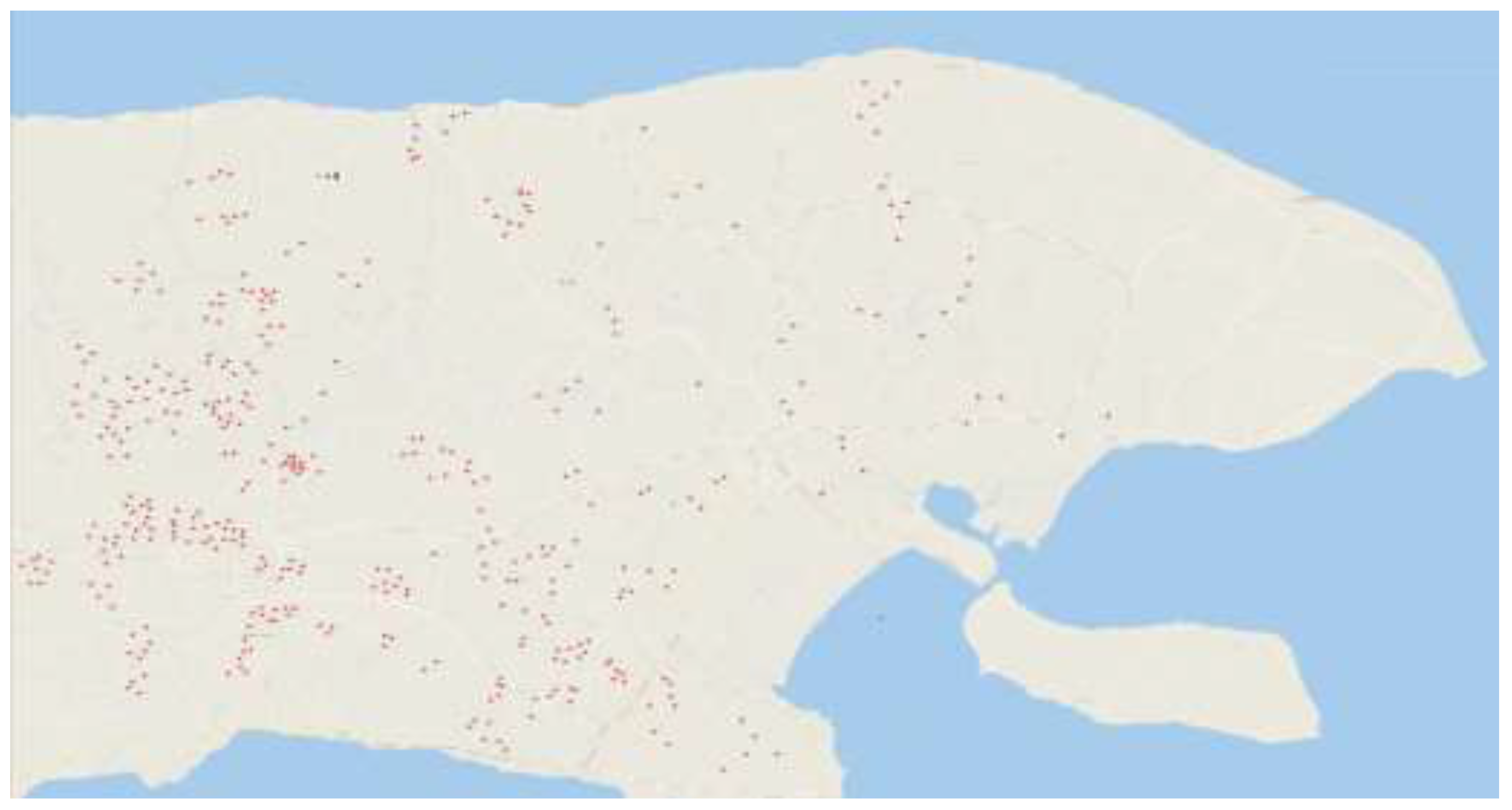
Figure 3.
distribution of seed breeders in Sumenep district.
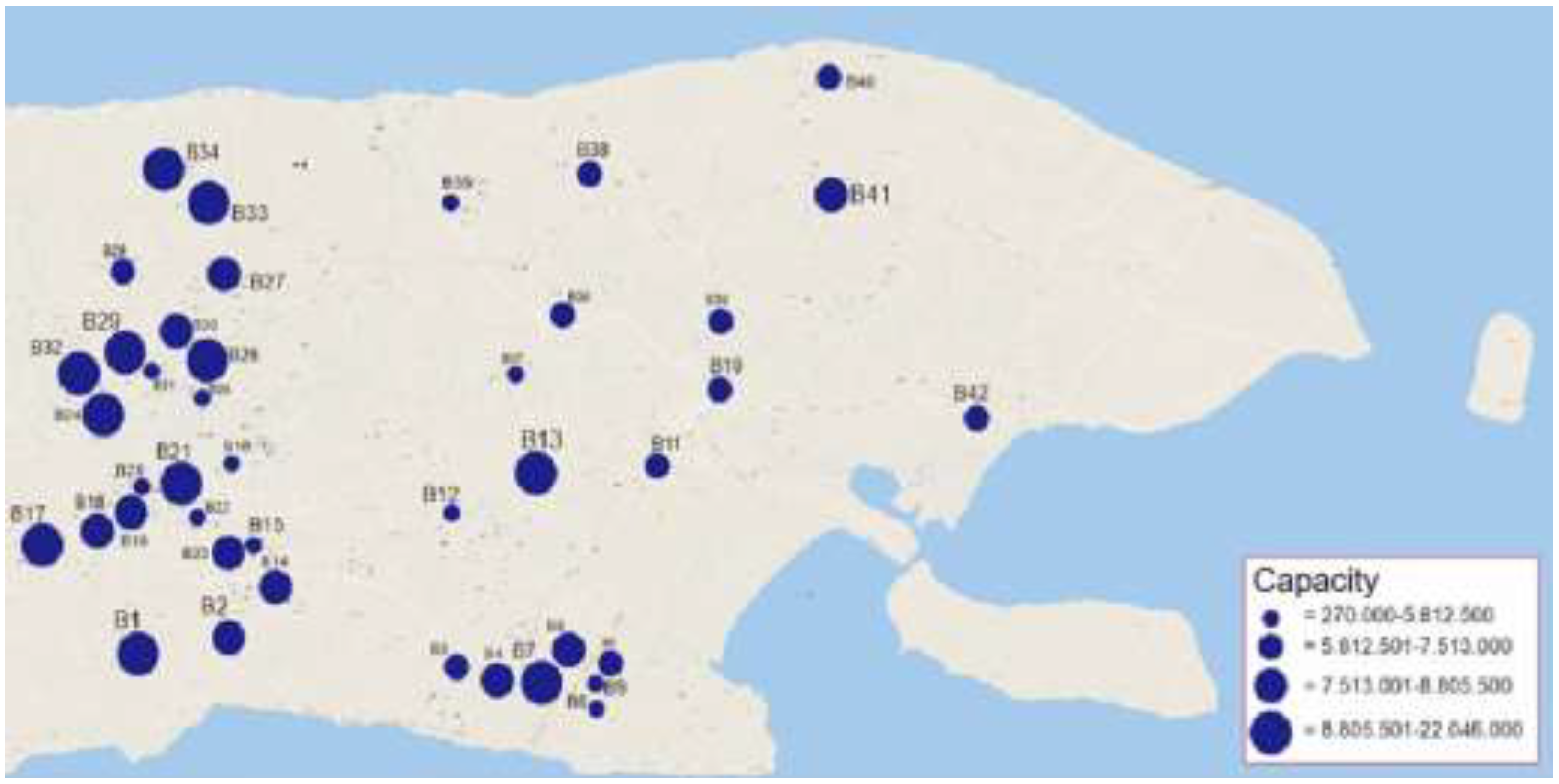
Figure 4.
Distribution of subsidized fertilizer stores in Sumenep district.
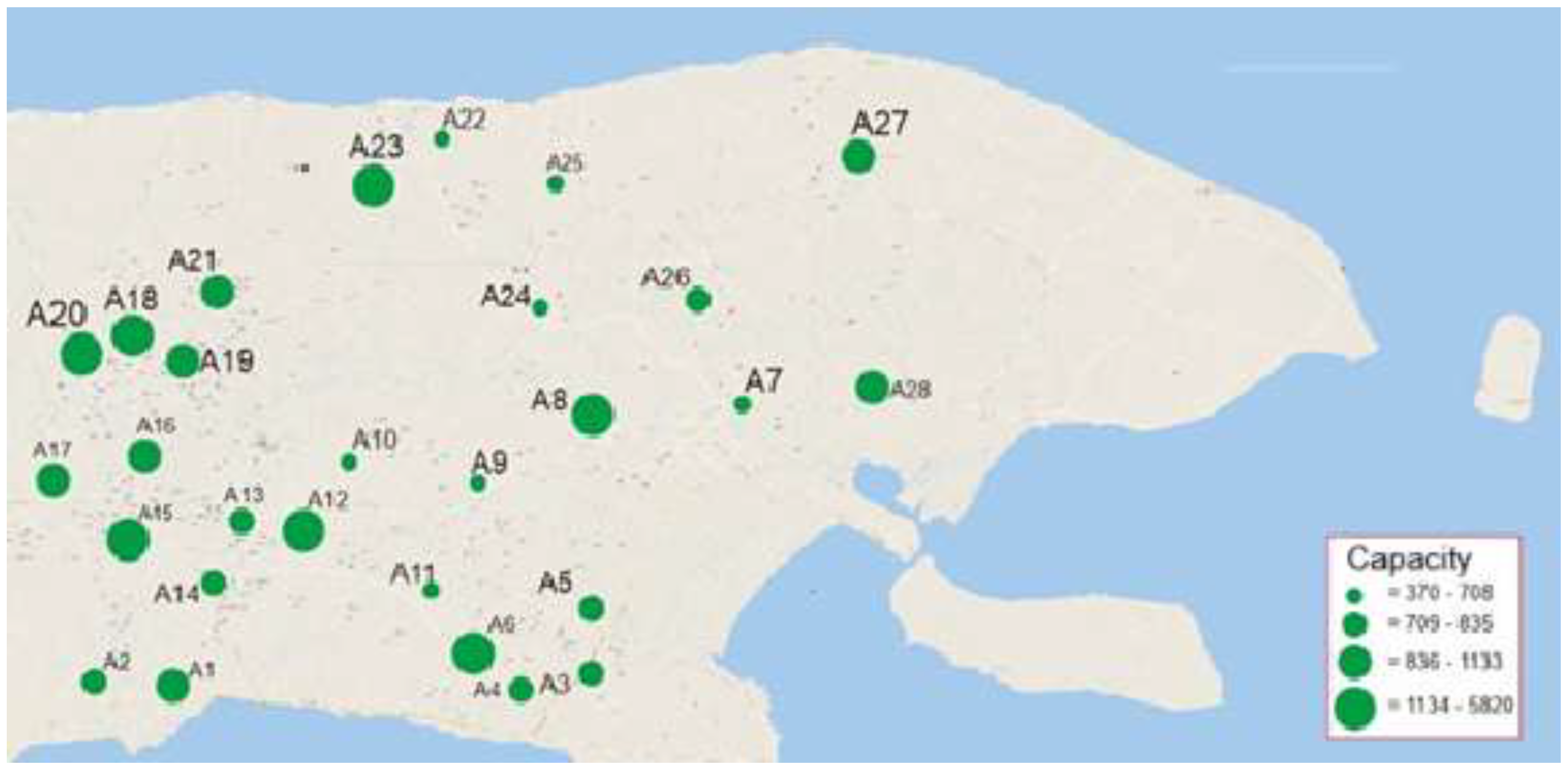
Figure 6.
Result of clustering using p-median for farmer group in Sumenep.
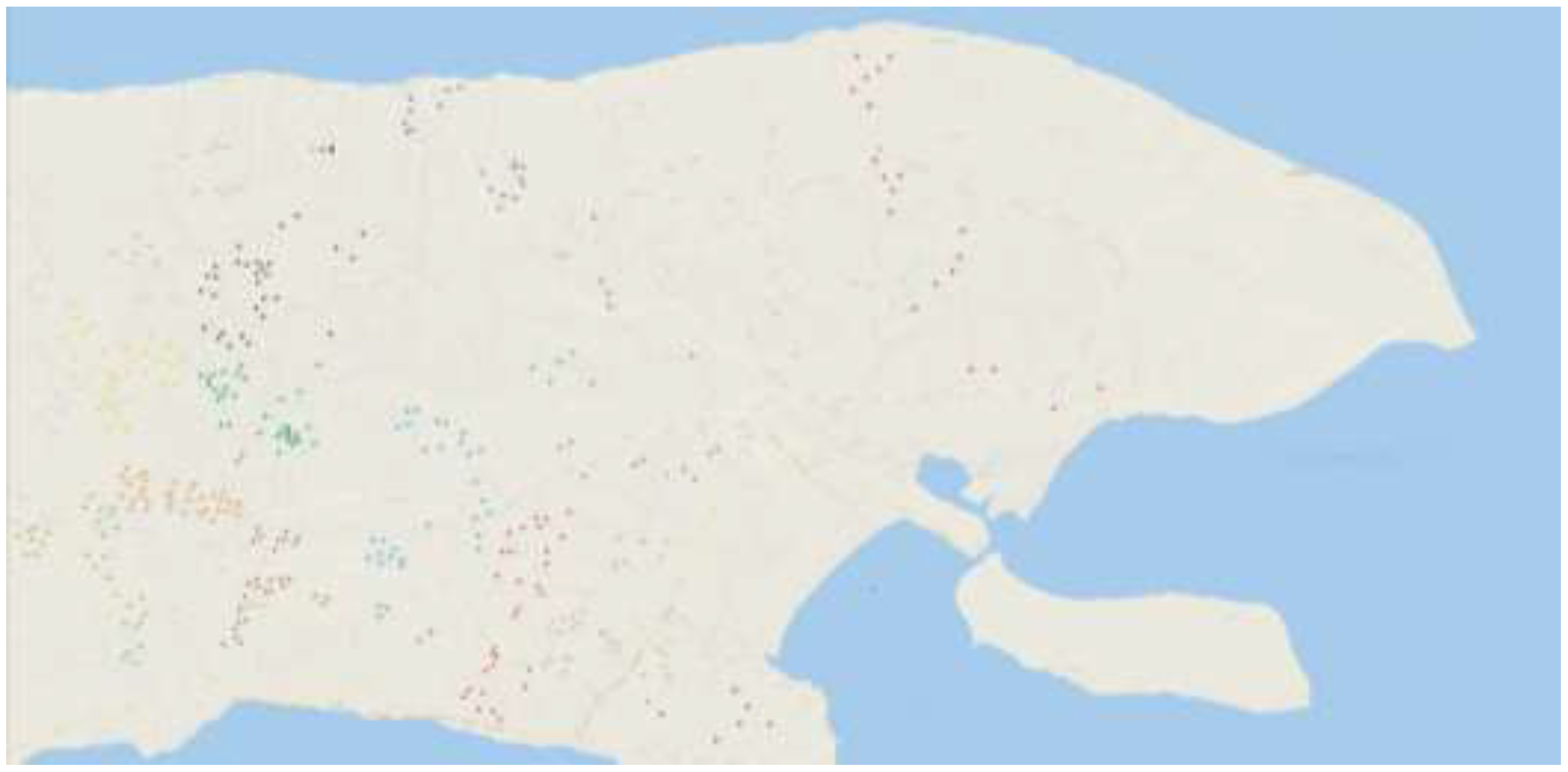
Table 3.
Data on subsidized fertilizer in Sumenep Regency.
| Code | Farmer Group | Capacity (Ton) |
Code | Farmer Group | Capacity (Ton) |
|---|---|---|---|---|---|
| A1 | CV. DI Chandra Sumekar | 930 | A15 | CV. Gaya Masa | 1780 |
| A2 | Koperasi Nurul Hikmah | 790 | A16 | CV. Rahman BersaUDara | 840 |
| A3 | CV. Makmur Sejahtera | 720 | A17 | UD. Citra Tani | 1090 |
| A4 | CV. Muara | 830 | A18 | UD. Utama BersaUDara | 1690 |
| A5 | CV. Tani Makmur | 710 | A19 | Koperasi Rukun Tani | 870 |
| A6 | UD. Tani Murni | 1420 | A20 | UD. Wahana Usaha Lancar | 5820 |
| A7 | UD. Sugesti | 410 | A21 | UD. Yosomulyo Jajag | 950 |
| A8 | CV.Marta Indah Jaya | 1140 | A22 | UD. Garuda Berlian Kencana | 370 |
| A9 | CV. Gaya Masa | 530 | A23 | CV. Sumber Hidup | 1820 |
| A10 | CV. Asa Perkasa | 550 | A24 | UD. Yosomulyo Jajag | 370 |
| A11 | CV. Adi Chandra Sumekar | 700 | A25 | UD. Bahtera Kurnia Abadi | 520 |
| A12 | UD. Utama Bersaudara | 1270 | A26 | CV. Bumi Teduh Bersinar | 780 |
| A13 | UD. Usaha Tani | 760 | A27 | UD. Dwi Rejeki | 1130 |
| A14 | UD. Puskud Jatim | 750 | A28 | Koperasi Surya Alam Raya | 920 |
Table 4.
Data on corn storage warehouses in Sumenep district.
| Code | Name of warehouse | Capacity (ton) |
|---|---|---|
| C1 | KMD | 1,500,000 |
| C2 | PT PN XI Patean | 3,500,000 |
| C3 | PT PN XI Guluk Guluk | 3,500,000 |
| C4 | KUD POJUR | 2,200,000 |
| C5 | HZA | 1,800,000 |
Table 5.
Demand of seed and fertilizer in Sumenep disctrict.
| Sub-District | Number | Farmer Group | Demand | Type of Fertilizer | |||
|---|---|---|---|---|---|---|---|
| Corn Seed | Fertilizer | NPK | SP36 | ZA | |||
| Pragaan | 1 | KWT. Mekar Sari | 744,600 | 3,400.34 | 2,233.80 | 620.50 | 546.04 |
| 2 | KWT. Melati | 270,300 | 1,234.37 | 810.90 | 225.25 | 198.22 | |
| 3 | Sumber Jaya Patean Selatan | 265,800 | 1,213.82 | 797.40 | 221.50 | 194.92 | |
| 4 | Rizqi Indah | 748,800 | 3,419.52 | 2,246.40 | 624.00 | 549.12 | |
| 5 | KWT. Mawar Merah | 800,700 | 3,656.53 | 2,402.10 | 667.25 | 587.18 | |
| 6 | Bina Karya Ii | 825,300 | 3,768.87 | 2,475.90 | 687.75 | 605.22 | |
| 7 | Mekkar Melati | 874,500 | 3,993.55 | 2,623.50 | 728.75 | 641.30 | |
| 8 | Bunga Mawar | 755,400 | 3,449.66 | 2,266.20 | 629.50 | 553.96 | |
| 9 | Putra Bahari | 453,000 | 2,068.70 | 1,359.00 | 377.50 | 332.20 | |
| 10 | Wiraraja | 641,100 | 2,927.69 | 1,923.30 | 534.25 | 470.14 | |
| 11 | Nurul Jadid | 718,500 | 3,281.15 | 2,155.50 | 598.75 | 526.90 | |
| 12 | Bumi Sumekar | 873,600 | 3,989.44 | 2,620.80 | 728.00 | 640.64 | |
| 13 | Suka Maju | 303,000 | 1,383.70 | 909.00 | 252.50 | 222.20 | |
| 14 | Al-Ijtima | 594,000 | 2,712.60 | 1,782.00 | 495.00 | 435.60 | |
| 15 | Dempa Abang | 937,500 | 4,281.25 | 2,812.50 | 781.25 | 687.50 | |
| 16 | Karya Bhakti | 1,227,000 | 8,843.30 | 6,921.00 | 1,022.50 | 899.80 | |
| Kota Sumenep | 74 | Prima Sakti | 661,500 | 7,123.45 | 1,984.50 | 551.25 | 485.10 |
| 75 | Putra Cahaya | 759,000 | 3,020.85 | 2,277.00 | 632.50 | 556.60 | |
| 76 | Remaja Harapan | 660,000 | 3,466.10 | 1,980.00 | 550.00 | 484.00 | |
| 77 | Sinar Bumi Putra | 1,062,750 | 3,014.00 | 3,188.25 | 885.63 | 779.35 | |
| 78 | Suka Subur | 825,000 | 4,853.23 | 2,475.00 | 687.50 | 605.00 | |
| Batuan | 79 | KWT. Karya Bersatu Torbang | 301,800 | 3,767.50 | 905.40 | 251.50 | 221.32 |
| 80 | Karya Usaha Tani | 372,900 | 1,378.22 | 1,118.70 | 310.75 | 273.46 | |
| 81 | Sumber Jaya Dusun Toros | 651,600 | 1,702.91 | 1,954.80 | 543.00 | 477.84 | |
| 82 | Suka Maju Babbalan | 658,500 | 2,975.64 | 1,975.50 | 548.75 | 482.90 | |
| 83 | Barokah | 571,200 | 3,007.15 | 1,713.60 | 476.00 | 418.88 | |
| Pasongsongan | 274 | Lembah Bukit | 8,645,100 | 39,479.29 | 25,935.30 | 7,204.25 | 6,339.74 |
| 292 | Rahdatul Ihsan | 8,464,500 | 38,654.55 | 25,393.50 | 7,053.75 | 6,207.30 | |
| 293 | Al-Rohim | 8,542,800 | 39,012.12 | 25,628.40 | 7,119.00 | 6,264.72 | |
| Gapura | 380 | KWT. Nor Hikmah | 733,500 | 3,349.65 | 2,200.50 | 611.25 | 537.90 |
| 381 | Kuda Terbang | 647,100 | 2,955.09 | 1,941.30 | 539.25 | 474.54 | |
| 382 | Jokotole | 769,800 | 3,515.42 | 2,309.40 | 641.50 | 564.52 | |
| 383 | KWT. Megah | 893,700 | 4,081.23 | 2,681.10 | 744.75 | 655.38 | |
| 384 | Al Mustofa | 862,800 | 3,940.12 | 2,588.40 | 719.00 | 632.72 | |
| 385 | Al Ikhlas Beraji | 922,200 | 4,211.38 | 2,766.60 | 768.50 | 676.28 | |
| Total | 324,891,450 | 1,486,910.96 | 977,914.35 | 270,742.88 | 238,253.73 | ||
Table 6.
Matrix of distance farmer group.
| FGN | 1 | 2 | 3 | 87 | 121 | 197 | 274 | 292 | 293 | 321 | 345 | 382 | 383 | 384 | 385 |
|---|---|---|---|---|---|---|---|---|---|---|---|---|---|---|---|
| 1 | 0.0 | 1.6 | 1.7 | 15.3 | 2.7 | 5.2 | 41.6 | 15.6 | 14.9 | 27.2 | 14.6 | 44.2 | 37.6 | 32.2 | 36.9 |
| 2 | 4.4 | 0.0 | 7.8 | 23.4 | 7.1 | 9.6 | 46.0 | 20.0 | 19.3 | 31.6 | 19.0 | 53.5 | 46.9 | 39.4 | 46.2 |
| 3 | 1.7 | 1.7 | 0.0 | 15.9 | 3.3 | 5.8 | 19.3 | 11.1 | 9.7 | 27.8 | 15.2 | 44.8 | 38.2 | 37.8 | 37.6 |
| 4 | 0.3 | 1.9 | 1.5 | 15.0 | 2.4 | 5.0 | 18.7 | 10.7 | 9.2 | 26.9 | 24.3 | 44.0 | 37.3 | 32.0 | 36.7 |
| 5 | 1.7 | 2.8 | 1.3 | 15.9 | 3.3 | 5.8 | 19.5 | 11.4 | 9.9 | 27.8 | 15.2 | 44.8 | 38.2 | 26.7 | 37.5 |
| 6 | 4.1 | 0.9 | 1.2 | 22.5 | 6.8 | 9.3 | 19.5 | 11.2 | 9.8 | 31.3 | 18.7 | 52.6 | 46.0 | 38.5 | 45.3 |
| 7 | 6.2 | 6.8 | 10.4 | 26.0 | 13.2 | 11.4 | 18.9 | 9.6 | 9.0 | 33.4 | 20.8 | 56.1 | 49.5 | 42.0 | 48.8 |
| 8 | 6.3 | 7.0 | 8.0 | 27.5 | 9.0 | 11.5 | 18.8 | 9.4 | 8.9 | 33.5 | 20.9 | 57.5 | 50.9 | 43.3 | 50.2 |
| 9 | 5.8 | 6.5 | 9.0 | 18.9 | 6.5 | 8.9 | 17.7 | 8.4 | 7.8 | 31.4 | 18.8 | 47.9 | 41.3 | 35.9 | 40.6 |
| 10 | 5.2 | 5.9 | 6.9 | 20.4 | 7.9 | 10.4 | 18.0 | 8.7 | 8.2 | 32.4 | 19.8 | 57.5 | 50.9 | 43.4 | 50.2 |
| 11 | 6.9 | 7.4 | 11.1 | 26.7 | 9.6 | 12.1 | 18.3 | 9.1 | 8.4 | 34.1 | 21.5 | 56.7 | 50.1 | 42.7 | 49.5 |
| 12 | 6.5 | 7.1 | 10.7 | 26.3 | 9.2 | 11.7 | 18.6 | 9.4 | 8.7 | 33.7 | 21.1 | 56.4 | 49.8 | 42.3 | 49.1 |
| 13 | 5.7 | 8.9 | 9.3 | 24.9 | 18.2 | 14.6 | 19.6 | 10.3 | 9.7 | 36.6 | 24.0 | 55.0 | 48.4 | 40.9 | 47.7 |
| 14 | 11.5 | 9.8 | 10.3 | 15.3 | 13.1 | 15.6 | 19.9 | 10.5 | 10.0 | 37.6 | 25.0 | 55.9 | 49.3 | 41.9 | 48.7 |
| 15 | 10.1 | 8.4 | 8.9 | 23.4 | 11.7 | 14.2 | 20.3 | 11.0 | 10.4 | 36.2 | 23.6 | 54.5 | 47.9 | 40.5 | 47.2 |
| 16 | 10.7 | 9.0 | 9.4 | 15.9 | 2.7 | 14.8 | 20.1 | 10.8 | 10.3 | 36.7 | 19.6 | 55.1 | 48.5 | 41.0 | 47.8 |
| 74 | 34.8 | 35.9 | 34.5 | 17.1 | 29.3 | 27.2 | 38.1 | 36.0 | 35.2 | 27.9 | 28.4 | 18.3 | 11.6 | 4.2 | 11.0 |
| 75 | 28.5 | 36.4 | 29.1 | 14.4 | 26.6 | 24.5 | 35.2 | 33.3 | 32.5 | 25.1 | 25.6 | 16.6 | 10.0 | 4.6 | 9.4 |
| 76 | 30.7 | 40.0 | 31.3 | 16.6 | 28.8 | 26.7 | 37.4 | 35.5 | 34.7 | 27.3 | 27.8 | 14.7 | 8.1 | 5.6 | 7.4 |
| 77 | 30.7 | 40.0 | 31.3 | 16.6 | 28.8 | 26.7 | 37.4 | 35.5 | 34.7 | 27.3 | 27.8 | 14.7 | 8.1 | 5.6 | 7.4 |
| 78 | 28.5 | 36.3 | 29.1 | 14.4 | 26.5 | 24.5 | 35.2 | 33.3 | 32.5 | 25.0 | 25.5 | 17.1 | 10.5 | 5.1 | 9.9 |
| 79 | 23.9 | 30.5 | 24.5 | 9.8 | 22.0 | 19.9 | 35.4 | 28.7 | 27.9 | 24.4 | 24.9 | 23.5 | 16.9 | 11.5 | 16.2 |
| 80 | 24.2 | 30.8 | 24.8 | 10.1 | 22.2 | 20.2 | 35.6 | 28.9 | 28.2 | 24.6 | 25.1 | 23.7 | 17.1 | 11.7 | 16.4 |
| 81 | 25.4 | 32.7 | 26.0 | 11.3 | 23.4 | 21.4 | 33.7 | 30.2 | 29.4 | 22.8 | 23.2 | 21.8 | 15.2 | 9.3 | 14.5 |
| 82 | 25.3 | 33.1 | 25.9 | 11.2 | 23.2 | 21.3 | 33.6 | 30.1 | 29.3 | 22.7 | 23.1 | 21.7 | 15.1 | 9.7 | 14.4 |
| 83 | 26.7 | 33.2 | 27.3 | 12.6 | 24.8 | 22.7 | 35.0 | 31.5 | 30.7 | 24.1 | 24.5 | 23.1 | 16.5 | 10.1 | 15.8 |
| 274 | 41.6 | 46.0 | 42.2 | 42.0 | 39.6 | 15.4 | 0.0 | 22.3 | 24.5 | 15.3 | 26.0 | 50.9 | 44.3 | 38.9 | 43.6 |
| 292 | 10.7 | 10.8 | 11.1 | 16.0 | 10.0 | 8.5 | 9.7 | 0.0 | 2.5 | 9.4 | 8.4 | 39.6 | 35.4 | 30.0 | 34.5 |
| 293 | 9.1 | 9.4 | 9.7 | 13.5 | 8.1 | 6.4 | 9.9 | 2.5 | 0.0 | 8.4 | 6.2 | 37.2 | 33.0 | 27.5 | 32.1 |
| 380 | 39.3 | 48.5 | 39.9 | 25.2 | 32.1 | 32.1 | 36.2 | 37.8 | 35.4 | 31.7 | 29.5 | 2.0 | 2.9 | 8.0 | 3.7 |
| 381 | 32.3 | 41.6 | 32.9 | 18.2 | 25.9 | 25.8 | 30.0 | 31.3 | 29.0 | 25.4 | 23.0 | 8.3 | 4.2 | 2.2 | 3.4 |
| 382 | 44.2 | 53.5 | 44.8 | 12.6 | 34.0 | 34.1 | 37.7 | 39.6 | 37.2 | 33.3 | 31.3 | 0.0 | 4.3 | 10.0 | 5.2 |
| 383 | 32.2 | 46.9 | 38.2 | 23.5 | 30.1 | 30.0 | 33.5 | 35.4 | 33.0 | 29.0 | 27.0 | 4.3 | 0.0 | 6.2 | 0.9 |
| 384 | 32.2 | 39.4 | 37.8 | 18.1 | 24.1 | 24.1 | 29.2 | 30.0 | 27.5 | 24.5 | 21.7 | 10.0 | 6.2 | 0.0 | 5.4 |
| 385 | 36.9 | 46.2 | 37.6 | 22.9 | 29.2 | 29.1 | 32.6 | 34.5 | 32.1 | 28.1 | 26.1 | 5.2 | 0.9 | 5.4 | 0.0 |
Table 7.
Result of clustering farmer group based on MatLab using p-median.
| Cluster | Color | Farmer Group Member | Corn Production (ton) |
|---|---|---|---|
| 1 | Asam Manis, Bukit Tandus, Bunga Desa, Bunga Melati, Guwa Mandalia, Karang Pandan | 180,267.5 | |
| 2 | Tani Jaya, Miftahul Jannah, Makmur Sejati, KWT. Arrahman I, KWT. Sekar Arum, Mekar Sari Ellak Daya, Mekar Sejati, Harapan Maju, Bahagia Ellak Daya, Albarokah Ii, Pajer Laggu, Pasra Pojur, Al-Mubarok, Tani Subur Ellak Daya, Abdika, Mathlubi, Hosnul Hotimah, Jambu Setia, Al-Mawaddah Jambu, Intani, Cinta Damai, Sumber Makmur, Mutiara Tani, KWT. Babussalam, Pesona, Campaka Putih, Al- Fallah, KWT. Cempaka Putih, Al – Jalali, KWT. Jati Emas, Putra Madura, Jampareng, Putra Kemala, KWT. Bintang Sembilan, Citra Pemuda | 599,611 | |
| 3 | Empat Saudara, Nurul Rahaman, Nurul Huda, KWT. Sumber Rejeki, Bangsoka, Fatahillah, Putra Madura, Sumber Makmur, Suka Tani, Hasil Bumi, Baiturrahman, Al-Amin, Rahdatul Ihsan, Al-Rohim, KWT. Murah Rejeki, Subur Rejeki, Al - Amhar I, Al - Azhar Ii, Sejati, KWT. Al-Muntaha, As–Sijar, Sinar Makmur, Al – Ikhwan, Sumber Urip, Karang Anom, Bunga Mawar, KWT. Arrohmah, Sumber Mas, Sumber Barokah, Sakinah, KWT. Sinar Barokah, Bunga Nusa Indah. KWT. Bintang Sari, Al - Amhar | 1,113,646 | |
| 4 | KWT. Nurul Qomariyah Giring, Pisang Emas, KWT. Al-Hikam, KWT. Al-Kautshar, KWT. Putri Muslimah, Sabilul Muttaqin Al Mujahid, KWT. Al Hikmah, Sumber Pajung, Nurul Hidayah, Al Hidayah, Sumber Ombak, Sumber Makmur, Al-Faidzin, KWT. Sumber Bening, Sumber Agung, KWT. Nor Hikmah |
534,964 | |
| 5 | KWT. Bunga Tani, KWT. Rahayu Indah Meranggi Jaya, KWT. Bunga Teratai, Sumber Bahagia, Harapan Indah, KWT. Pasra, Bima Sejahtera, Bina Karya, Cahaya Tani, Jaya Kusuma, KWT. Juwar Sari, Ar Rohmah, Bunga Sumekar 2, Halilintar, Indah Jaya Tanjung, Karunia Alam, Karya Usaha, KWT. Sari Jaya, KWT. Tanjung Sari, Sekar Wangi, Bumi Rahayu, KWT. Puspita Mitra, Sumber Hikmah, Sumur Razim, Sumber Taman, Sumber Usaha, Makmur Jaya, Karya Bersama, Rukun Muda II, KWT. Sumber Cemara, Maju Jaya, Sumber Hasil, Tunas Sampurna, KWT. Sumber Madu | 792,070.3 | |
| 6 | Kwt. Madu Muda, Kwt. Ar Rosyidin Langgundi Barat, Kwt. Melati Putih Lembung Timur, Miftahul Huda, Kwt. An Nisa, Al-Faqiyah, Bunga Melati, Al-Hamida, Al-Barokah, Kwt. An-Nur, Bunga Harapan, Ellak Laok, Kwt. Ar-Rohmah, Makmur Jaya, Sumber Baru Ellak Laok, Sangkuriang, Kwt. Sumber Hasil Desa Lembung Timur, Margo Rukun Moncek Tengah, Prima Desa, Al-Ifroh Kwt. Dian Muslimah, Kwt. Al-Khoiriyah, Ar-Rahman Sendir, Karya Makmur, Kwt. Nurul Hidayah II, Suka Maju Moncek Tengah, Awan Tawar, Kwt. Al-Harra, Cendana Bangsa, Arjuna Moncek Tengah, Darul Amin Poreh Tengah, Kwt. Kenanga, Subur Moncek Tengah |
454,171 | |
| 7 | Babul Rizqi, Al-Barokah, Dirgahayu, Sumber Jaya, Sumber Sejahtera, KWT. Darul Ulum, Untung Jaya, Al – Ikhlas, KWT. Surya Dharma, Remaja Tani, KWT. Srikandi, Timur Jaya, Den Timur, Sempong Makmur, KWT. Bunga Melati, Magar Sare, Suka Maju, Sinar Barokah, Berkat Mufakat, Sumber Rejeki, Suka Lancar Kompak Barokah, Subur Makmur, Sumber Raya, Baru Muncul, Nurul Hikmah II, Al – Huda, Calming, Subur Jaya, KWT. Mukarromah |
574,343 | |
| 8 | Mekkar Melati, Bunga Mawar, Putra Bahari, Wiraraja, Nurul Jadid, Bumi Sumekar, Suka Maju, Al-Ijtima, Dempa Abang, Karya Bhakti, Pertani, Putra Cahaya, Remaja Harapan, Sinar Bumi Putra, Suka Subur, Sumber Barokah, Sumber Hasil, Jaya Abadi, KWT. Melati, Cinta Damai, Harapan Indah, KWT. Sari Bunga, Makmur Jaya, Sumber Rejeki, Sumber Tani, Surya Tani, Usaha Jaya, Mahkota Jaya, Sari Subur, KWT. Sumber Jaya, KWT. Matahari Berseri | 728,607.5 | |
| 9 | KWT. Putri Barakas, KWT. Putri Lenteng, Tunas Jaya, KWT. Karya Utama, Bunga Harapan, KWT. Az – Zahroh, Haromain, Panca Usaha Sumber Bumi, Al – Fatah, Surya Tani Bunbarat, Batu Kencana, KWT. Nurus Shobah, Al-Hidayah, Adi Rasa, Al Jihad, Anugerah, KWT. Putri Barokah, Sumber Rizki |
304,749 | |
| 10 | Nurul Huda, Purnama, Al – Zahra, Tata Usaha, Cahaya, Berlian, Lembah Bukit, Jaya Abadi, Mekar Abadi, Sumber Mekar, KWT. Jokotole, Sari Bumi, Jaya Abadi, Sumber Bakonan | 524,874 | |
| 11 | Prima Sakti, Putra Cahaya, Remaja Harapan, Sinar Bumi Putra, Suka Subur, Semi Agung, Sumber Tani, Kalabang, Aman Jaya, Subur Jaya, Sakera Jaya, Lor Polor, Putra Mahkota, Kenanga II, Kuda Terbang, Al Mustofa | 418,226.5 | |
| 12 | KWT. Melati, Aeng Telor, Garuda Putih, Bunga Mbung, Al-Bubarok, KWT. Srikandi, Tembakau Indah, KWT. As-Syifa’, Asshobar, KWT. Sumber Rejeki, Ar – Rohman, KWT. Al-Hidayah, Sinar Pusaka, Zakila Madu Sari, Mega Jaya, Sejahtera, Sumber Hasil, Al-Firdaus, KWT. Sumber Madu, KWT. Tunjung Biru, Sinar Utama, Sumber Sari, Ikhtisar, KWT. Bunga Seroja, Sumber Barokah, Makmur Tani, Sumber Urip, Rukun Muda, Tambak Sari |
700,697.2 | |
| 13 | KWT. Mekar Sari, KWT. Melati, Sumber Jaya Patean Selatan, Rizqi Indah, KWT. Mawar Merah, Bina Karya II, KWT Flamboyan Sumber Kebun Suramadu, Gema Tani Jaya, Sumber Usaha I, Tani Maju I, Karya Daleman, Nurul Hikmah, Tani Barokah Poreh, KWT Putri Kano’, Sinar Dunia, KWT Nurul Amin Ii Poreh Tengah, Karya Makmur, Palapa, Risqi Indah Solok Barat, Kramat, Inayah I, KWT. Sakinah, Lestari, Pancoran Mas, Sumber Barokah, Sumber Harapan, Berkat Usaha, Sumber Rejeki, Sumber Urip |
587,871 | |
| 14 | KWT. Karya Bersatu Torbang, Karya Usaha Tani, Sumber Jaya Dusun Toros, Suka Maju Babbalan, Barokah, KWT. Larasati, KWT. Nurul Hasanah, Assasul Muttaqin, KWT. Hidayah, Gotong Royong, KWT. Al Maslahah, Rampak Naong, KWT. Mawar Indah, KWT. Al–Hidayah, Al - Mu’in, Pandawa Lima, KWT. Drupadi, Sindi Mas | 356,492 | |
| 15 | KWT. Al Hikmah, Sumber Pajung, Nurul Hidayah, Al Hidayah, KWT. Torikul Hidayah, Hasil Murni, KWT. Nurussibyan, Al-Qomar, Harapan Jaya, Sumber Jaya, Bunga Melati, Moga Jaya, Arjuna, KWT. Arjuna, Dewi Fortuna, Harapan Jaya, Karya Mandiri, KWT. Karya Abadi, Makmur Jaya 1, Putra Harapan, Tunas Karya, Karya Buana, Nurul Hidayah Banaresep Timur, Darma Tani Iii, Mulya Tani, Al – Ikhlas, KWT. Al-Mawadah, Nurul Yaqin, Al-Barokah Moncek Timur, Siding Purih Al-Faizin Desa Poreh, Sinar Baru | 605,324.5 |
Table 8.
Result of supply chain network from farmer group 11 to corn storage warehouse using MatLab.
Table 8.
Result of supply chain network from farmer group 11 to corn storage warehouse using MatLab.
| Farmer Group | Corn Production (ton) |
Distance (km) | Supply (ton) | ||
|---|---|---|---|---|---|
| C1 | C5 | C1 | C5 | ||
| 74 | 396 | 23.67 | 6.73 | 396 | - |
| 75 | 355 | 21.61 | 3.34 | 355 | - |
| 76 | 308 | 23.81 | 5.07 | 308 | - |
| 77 | 544 | 23.95 | 5.41 | 544 | - |
| 78 | 385 | 21.15 | 2.88 | 385 | - |
| 354 | 952 | 16.28 | 9.55 | 952 | - |
| 355 | 389 | 17.71 | 6.42 | 389 | - |
| 356 | 641 | 18.83 | 4.40 | 641 | - |
| 357 | 450 | 16.67 | 6.66 | 419 | 31 |
| 358 | 1733 | 20.70 | 0.50 | - | 1733 |
| 359 | 515 | 21.10 | 0.66 | - | 515 |
| 360 | 338 | 24.44 | 4.06 | - | 338 |
| 361 | 325 | 23.70 | 3.36 | - | 325 |
| 364 | 319 | 21.75 | 2.35 | - | 319 |
| 381 | 302 | 25.96 | 6.32 | - | 302 |
| 384 | 418 | 24.96 | 6.55 | - | 418 |
Disclaimer/Publisher’s Note: The statements, opinions and data contained in all publications are solely those of the individual author(s) and contributor(s) and not of MDPI and/or the editor(s). MDPI and/or the editor(s) disclaim responsibility for any injury to people or property resulting from any ideas, methods, instructions or products referred to in the content. |
© 2026 by the authors. Licensee MDPI, Basel, Switzerland. This article is an open access article distributed under the terms and conditions of the Creative Commons Attribution (CC BY) license (http://creativecommons.org/licenses/by/4.0/).
Copyright: This open access article is published under a Creative Commons CC BY 4.0 license, which permit the free download, distribution, and reuse, provided that the author and preprint are cited in any reuse.


