

Submitted:
04 October 2024
Posted:
07 October 2024
You are already at the latest version
Abstract
The circular economy is a tangible paradigm in response to the unsustainable model of production and consumption of resources in the agri-food system. The circular economy allows for a reduction in the environmental impact through the minimization of food waste or the maximal generation of renewable energy from waste. Despite the relevance, the extant literature is scat for indications on how to apply circular business models in agri-food systems. Hence, the paper aims to analyze the circular economy implementation level in the agri-food system in 29 European countries focusing on specific circular economy strategies. Selected indicators were analyzed to evaluate the level of circular economy implementation in the agri-food system (e.g., production values, energy sharing from renewable sources, and total waste emission) using a Panel data analysis method. The required variables were gained from the global databases within the recent five years (2014-2018). Results reveal an overall lack of circular economy implementation in the agri-food systems among European countries. A set of 12 managerial propositions was suggested to foster the implementation of the circular business models by interacting the recycling, extending, intensifying, and dematerializing strategies with aspects of the production process, waste emission, and renewable energy sharing in the agri-food system.
Keywords:
Circular Economy
; Agri-Food
; Food Production
; Food Waste
; Panel Data Analysis
; European Countries
1. Introduction
The valorization of supply-demand in the global food system is of paramount relevance for worldwide sustainable development. As the world’s population grows, the global food demand will grow significantly, and feeding a world population of 9.1 billion in 2050 will require food production to increase by 60-70% from 2005 levels (Henry et al. 2018). On the other hand, a third of global food production is hitherto wasted each year, amounting to about 1.3 billion tonnes (Huho et al. 2020). Furthermore, the agri-food system is responsible for almost one-quarter of global greenhouse gas emissions (Crippa et al. 2021) and it is one of the main contributors to global environmental change, entailing many socio-economic negative effects (FAO 2017), as it encompasses a multitude of actors, elements, and processes—i.e., production, processing, distribution, preparation, consumption, and disposal of food (Crippa et al. 2021).
The global food system is thus facing several interlinked problems with serious outcomes on the global scale, including growing consumer demand and generated food waste (Esposito et al. 2018). The adoption of the circular economy (CE) paradigm in the agri-food sector received attention in research and academic literature (e.g., Bruins and Sanders 2012, Barakat et al. 2013), specifically for the possible adoption of circular business models (CBMs). CE could help the agri-food sector by the recovery/ recycling of agri-food waste and could potentially also improve the agri-food supply chain (Verstraete et al. 2016), for example through the restoration of soil fertility (Zucchella and Previtali 2018).
Although some elements, such as leadership and legislation, have been recognized as fostering factors (Moktadir et al. 2020), clear indications on how to apply CE and CBMs in agri-food systems are scat, calling for additional research on the topic (Urbinati et al., 2021, Geissdoerfer et al. 2020). Especially, recently Donner et al. (2020) and Hamam et al. (2021) encouraged further studies to focus on the interest of agri-food enterprises in a circularity analysis.
Given the above, the present study aims a proposing an analysis of the level of CE in the agri-food system at the country level, so to provide concrete guidelines for managers and policy-makers who want to contribute to CE in the agri-food system. More in detail, the research aims at answering the following research questions:
RQ1. What is the circular economy implementation level in the agri-food system in European countries?
RQ2: How we can promote the circular economy implementation in agri-food in European countries?
The remainder of the paper follows: after a literature review and development of research hypotheses (Section 2), the methods used for the analysis are presented (Section 3); the results from the empirical investigation are presented (Section 4) and research questions are answered (Section 5); conclusions of the study are offered, together with limitations paving the way for future research (Section 6).
2. Literature Background and Hypotheses Development
2.1. Circular Business Models in the Agri-Food Sector
CE is a production and consumption model, which involves sharing, renting, reusing, repairing, renovating, and recycling existing materials and products for as long as possible and reducing waste. CE is a tangible paradigm in response to the unsustainable model of production and consumption resources (Hamam et al. 2021) focusing on narrowing and regenerating resource loops (Bocken and Ritala 2021). Literature has largely addressed the topic of circular business models (CBMs), so to insert aspects of CE within the traditional planned tool for business activities (Fraccascia et al. 2019; Kanda et al., 2021). Particularly, in a CBM the value creation, delivery, and capture appear to be strongly influenced by specific CBM strategies of close, slow, intensify, and dematerialize (Geissdoerfer et al. 2020). The four CBM strategies are overall recognized to support the reduction of system waste (Richardson 2008, Bocken et al. 2016, Geissdoerfer et al. 2018a, and Geissdoerfer et al. 2018b) and can be supported by the 10Rs proposed by Potting et al. (2017), namely refuse, rethink, reduce, reuse, repair, refurbish, remanufacture, repurpose, recycle, and recover. Additionally, CBMs can provide a sustainable bridge between CE and socio-environmental progress, working with a broad set of stakeholders (Weerawardena et al. 2010). Recently, researchers focused on the function of the CBMs in the agri-food sector, including food production, food waste (Corrado et al. 2018, Dora 2019, Esposito et al. 2020), and the technological level of agri-food systems (Kyriakopoulos et al. 2019). CBMs can be planned as one of the managerial solutions to respond to the agri-food grand challenges (Lewandowski 2016, Bocken et al. 2016). In CBMs, typical customer-supplier relationships are replaced by multi-stakeholder and multi-actor relations due to overlapping businesses and sharing responsibilities (Donner et al. 2020). However, the definition of CE cannot be directly translated into the agri-food system because agri-food production has a limited life without the possibility of reuse, repair, or remanufacture (Potting et al. 2017). Hence, CE in the agri-food sector should focus on applicable strategies such as recovery.
The agri-food industry to transit to a more sustainable development model needs to be in line with the principles of CE, particularly to face future challenges by recovering resources (Poponi et al. 2022). Opportunities might arise from the minimization of food waste or the generation of energy from the waste (Hamam et al. 2021). From this line, one of the aspects of recovery is the reprocessing of material/waste for renewable energy production, such as biofuel production from the food industry using waste-to-energy plants (Muradin et al. 2018). Also, the recovery of food waste is one of the important processes in the CBMs to decrease negative effects (Poponi et al., 2022). On the other hand, production and consumption can be optimized by resource-saving which would imply the reduction of waste (Tariq Majeed and Luni 2020).
2.2. Hypotheses Development
With this background, the research hypotheses are developed. Conventionally, the development of higher technologies of cooking and packing in agri-food production can result in lower waste emissions, higher levels of sharing renewable energy, and higher CE implementations (Popp et al. 2014). Hence, a direct relationship between the sharing of renewable energy and agri-food production can be a signal of the CE implementation and the circularity function of the CBMs (see Popp et al. 2014) in the given study area. The vice versa relates to a significant lack of CE implementation in the agri-food system. Furthermore, in a circular economy, a higher level of agri-food production should result in lower waste emissions. Hence, we obtain the following main hypotheses:
Hp 1: In the CE, the higher level of agri-food production can lead to a higher level of renewable energy from the agri-food system.
Hp 2: In the CE, the higher level of agri-food production can lead to a lower level of total waste emission from the agri-food system.
3. Materials and Methods
3.1. Data Preparation
The paper employs a Panel data analysis to analyze the level of circular economy in the agri-food system among European countries, leveraging on Dora (2019) and Jafari-Sadeghi et al. (2021). Particularly, we focused on 29 European countries, selected as they have a registered membership and continuous information without data restriction in the database of the European Agri-Food Data Portal. There were no other screening steps for the selection of the case studies. The selected countries are Austria; Belgium; Bulgaria; Croatia; Czech Republic; Denmark; Estonia; Finland; France; Germany; Greece; Hungary; Iceland; Ireland; Italy; Latvia; Lithuania; Luxembourg; Malta; Netherlands; Norway; Poland; Portugal; Romania; Slovakia; Slovenia; Spain; Sweden; the United Kingdom.
To evaluate the level of circular economy implementation, newly compared to the extant knowledge (Palmié et al. 2021; Urbinati et al. 2021), we selected the following indicators, based on (Poponi et al. 2022): i) production values ii) energy sharing from renewable sources, and iii) total waste emission. The required variables at the national level are settled on the relevant global databases comprised of the World Bank (2021) and European Commission (2021)—internationally verified data centers for agri-food and environmental subjects (Andrade et al. 2022). The required data were gained directly from the databases for the years from 2014 to 2018, so to avoid possible influences and biases related to the COVID-19 pandemic.
Leveraging on Andrade et al. (2022) and Agri-Food Data Archived by the European Commission (2021), three variables of agri-food production were gathered to represent the input aspects of the agri-food system, namely the production of meat, production of oil crops, and production of vegetable oils. Two dependent variables of the energy share from renewable sources of agri-food system and total waste emission from agri-food system were obtained for output aspects. Four control variables were assumed to explain the specification errors in the estimated model (Sewpersadh 2019), namely energy use in agriculture, electricity use in agriculture, renewable biofuels from the food industry, and the use of renewable biofuels for the food industry. The research framework is reported in Figure 1.
3.2. Data Analysis
The research stream of panel data modeling deals with complex constructs to test relationships incorporated into an integrated model (Sarstedt et al. 2014). Panel models can be assumed to analyze the data series through a random effect model or a fixed effect model (Dogan et al., 2022). Using fixed and random effects in a panel model analysis, the relationship between the dependent variables and each group of independent variables is tested separately to avoid any potential endogeneity. In the panel data analysis, the Hausman test is a specification test for heterogeneity presence based on the difference between the fixed effects (FE) and random effects (RE) estimators (Baltagi 2014), which is done using the automatic function within the Stata software. Also, concerning the research method, the very recent use of Panel data analysis to evaluate the circularity rate of the European countries is observed in the work of Kostakis and Tsagarakis (2022), revealing the successful role of the method in circular analysis.
4. Results
4.1. Data Description
We skimmed the data obtained from the European Agri-Food Data Portal and World Bank dataset. Two samples of raw data for the variables are given in Table 1 for the year 2014 and the year 2018.
The sorting of raw data revealed that the highest values of agri-food production variables, comprised of mean annual ~100,000, ~100,000, and 10,000 thousand tons of meat, oil crops, and vegetable oils production respectively, belong to Germany, Spain, and France. The mentioned countries have contributed to above 40-50% of agri-food production in the European Union.
The highest values of total waste emission from the agri-food system, comprised of mean annual ~3,700 thousand tonnes from a total of ~6,500 thousand tonnes also belong to Germany, France, and the United Kingdom. The initial facts of high production and high waste emission in the agri-food system revealed that the circular economy of the agri-food system in the mentioned major countries is probably at a low level for the implementation of the related strategies.
Besides, we observed that the highest values of energy sharing from renewable sources belong to Iceland, Norway, and Sweden (annually above 50%). The same countries are providing a negligible contribution to agri-food production among the European countries. This outcome shows that the highest energy sharing from renewable sources in some countries such as Norway has no connection with its food production system. Hence, this fact is another possible evidence of the weak level of the agri-food system in European countries.
4.2. Panel Data Analysis
The correlation matrix of the variables was produced initially by panel data analysis to affirm no significant collinearity between the dependent and independent variables (Ratner 2009). The regression coefficients between input and output aspects of the agri-food system were produced in Stata, revealing no significant relationships (p-value >0.1) between agri-food production and renewable energy sharing (Table 2). It means that the sharing of renewable energy has no direct relation with agri-food production, demonstrating the weak level of circular economy implementation in the agri-food system. On this basis, the first hypothesis (Hp 1) can be rejected for the given study area (29 European countries) in the given time interval (2014-2018).
On the other hand, the regression coefficients between input and output aspects were estimated and revealed significant relationships (p-value <0.1) between agri-food production (at least production of meat and vegetable oils) and total waste emission (Table 3). It means that the total waste emission has a direct relation with agri-food production, demonstrating no generation of renewable energy from agri-food waste. On this basis, the second hypothesis (Hp 2) can be also rejected for the given study area in the considered period.
Based on the results, the circular economy implementation level of the agri-food system in European countries appears low. Results revealed that the European countries seriously need to promote new circular-based propositions in the agri-food systems.
4.3. Hierarchical Clustering
The model approved that the sharing of renewable energy (as an indicator of circular economy implication) has no direct relationship with the agri-food system in the given periods and study countries. The findings are aligned with the insights derived from the data description, revealing the low level of circular economy implementation in the agri-food system, particularly in Germany and France, which have a high rate of agri-food production. On this basis, we can classify the countries using the hierarchical cluster analysis (HCA) approach. The HCA approach is a way to cluster the countries by using Ward’s method and a proximity matrix based on squared Euclidean distance (Khatami et al. 2021). Based on the interrelated homogeneity of the variables and proximity matrix of the countries (Table 3), the consequent clustering dendrogram (Figure 2) illustrated two main clusters, namely A and B. Cluster A includes six countries, i.e., France, Spain, Germany, Italy, the United Kingdom, and the Netherlands, which, on average have high values of agri-food production in addition to high amounts of agri-food wastes from 2014 to 2018. Cluster B includes other cases, i.e., 23 countries, which averagely have low values of agri-food production but present high amounts of share of energy from refinery sources in the agri-food system. Cluster A thus includes countries with a critical status in the agri-food system, with a low level of circular economy implementation.
5. Discussion
5.1. Circular Economy Implementation Level in the Agri-Food System in European Countries
The first research question depended on the CE implementation level in the agri-food system in European countries. The results of the HCA approach revealed that the critical status in the agri-food system of the Europe region belongs to the six countries of France, Spain, Germany, Italy, the United Kingdom, and the Netherlands, which have a weak level of CE implementation among the study area’s countries.
Therefore, the second research question depended on the promotion the CE implementation in agri-food in European countries. According to Donner et al. (2020), conceptual and management insights into circular economy implementation are still sparse in some European countries, such as France, Germany, Italy, and the Netherlands. However, these countries have the largest estimated agricultural bio-energy potential from the agri-food system (Popp et al. 2014). Hence, the promotion of the CE implementation in the study area needs to define the propositions for promoting the actual CBMs, working in the agri-food sector of the given countries.
5.2. Fostering the Circular Economy Implementation in the Agri-Food in European Countries
For overcoming the critical status of implementation of a circular economy in the European agri-food system, CBMs can be considered drivers of the flow of technical and biological circularity in the products, components, and materials, leading to reduce process wastes (Bocken and Ritala 2020). In CBMs, we should help to find innovative solutions for the environmental challenges in the agri-food system using a policy-based set of propositions. This means focusing on the guiding lines to circular, flexible, and zero-waste bio-refineries, integrating biomass, bio-fuel, biomaterials, and bio-energy cycles (Zuin and Ramin, 2018).
Using the extracted variables from the datasets and based on the model projected by Geissdoerfer et al. (2020), we proposed a set of three agri-food aspects, i.e., agri-food production, total waste emission, and renewable energy sharing to analyze the existence of the circular economy implementation level in the agri-food system of selected EU countries. The statistical results confirmed no significant relationship (p-value >0.1) between agri-food production and renewable energy (rejecting the first hypothesis Hp 1) and a direct relationship between the total waste emission and agri-food production (rejecting the second hypothesis Hp 2). Overall, results demonstrate the lack of CE implementations in agri-food CBMs within the agri-food system in the study areas.
Suggestions and insights are thus needed to foster the implementation of a circular economy in the specific context of an investigation, as well as circular-oriented business solutions to improve the existing linear models (Christensen 2016, Hofmann and Erben 2019). From this line, we here suggest propositions to improve the implementation of CBMs in the European agri-food system. As noted by Donner et al. (2020), the circular economy in the agri-food system is facing common challenges such as climate-change sensitivity or increasing urbanization resulting in uncertainties about changing legislation, laws, and regulations on the valorization pathways. Hence, managerial propositions of the circular economy should tackle the mentioned challenges by supporting the implementation of CBMs in the agri-food sector. For this purpose, we designed a matrix, matching the four circular strategies suggested by Geissdoerfer et al. (2020), namely extending, intensifying, dematerializing, and recycling, with three agri-food aspects, namely food production, waste emission, and energy sharing.
As for the considered strategies (Geissdoerfer et al. 2020): the extending strategy implies the extended use of products through long-lasting design, maintenance, and repair; the intensifying strategy implies the sharing economy and public uses; the dematerializing strategy describes the provision of product utility using digitalized service and software solutions; the recycling strategy relates to the recycling of material and energy within the system. Considering the agri-food system: the production process involves a set of chaining segments e.g., agricultural production and harvest, post-harvest operations, storage, packing, and processing to retail (FAO 2019); food waste is one of the substantial issues, directly related t production and consumption (Chiaraluce et al. 2021); renewable energy decreases waste generation and the extraction of limited resources (Hamam et al. 2021).
The intersections of strategies and aspects lead to the identification of 12 managerial propositions, reported in Table 4. Propositions are indeed needed to promote CBMs (Lewandowski, 2016) and can be used to establish a dialogue between national policymakers and practitioners (Vermeulen, 2015; Zucchella and Previtali, 2018).
- Enhancing durability of agri-food products [EP]. Lifetime of the agri-food production from farm to fork should be extended to optimize the processes and reduce the losses (Bressanelli et al. 2018; Ingemarsdotter et al. 2020).
- Innovative transport tracking and service management [IP]. This offers new transport routes should be offered together with new service tracking in the context of sustainable waste management (Parida et al. 2019; Geissdoerfer et al. 2020).
- Digitalization to generate end-of-life packing process [DP]. Digital technologies can be adopted and used to facilitate and initiate the generation of end-of-life packing processes in the food sector (Reike et al. 2018, Uçar et al. 2020).
- Biodegradable materials in agri-food packing [RP]. This suggests the use of materials for packing with a return capacity in the environment and without the harmful effects and toxic chemicals (Rabnawaz et al. 2017; Jafarzadeh et al. 2020). Biodegradable materials are greatly contributed to returning the resources contained in the agri-food system to the environment (Luttenberger 2020). Similar propositions need to be innovative in the agri-food system to decrease system costs and increase added value (Hamam et al. 2021).
- Cascading reuse to organic feedstock farms [EW]. Cascading biomass can be reused in organic feedstock farms, resulting in new products or applications of the agri-food system and low emission of waste (Lüdeke-Freund et al. 2019).
- Advanced system for handling agri-food waste [IW]. An advanced system can be used for monitoring and handling and variability of agri-food systems to create values from agri-food waste (Donner et al. 2020).
- Consumer education and demand rationalization [DW]. Consumers’ awareness should be changed to rationalize their demand and their acceptance of dematerialized agri-food packing products (Perito et al. 2019).
- Zero-waste bio-refineries process [RW]. The bio-refinery process attempts to use a variety of technologies to recover marketable energy during agri-food production, consumption, and waste management, such as bio-fuels and bio-materials (Donner et al. 2020).
- Refurbishing and retrofitting bio-fuel plants [EE]. It entails a transition from traditional behaviors to sustainable ways using zero-waste biofuel plants (Donner et al. 2020).
- Retailing energy from the agri-food system [IR]. This proposition offers retailing of stored energy during the innovative agri-food processes (Ingemarsdotter et al. 2020).
- Technologies to create marketable renewable energy [DE]. Technologies to create renewable energy from agri-food systems, particularly in the production process, with value addition and marketable capabilities (Donner et al. 2020).
- Integrating biomass, bio-fuel, biomaterials, and bio-energy cycles [RE]. This proposition offers to integrate the biological and technical approaches in the CE of the agri-food system to retain successful implementations (Kanda et al. 2021). For instance, a bio-refinery proposition for the agri-food process is a variety of technologies to produce biofuels, food and feed ingredients, organic feedstock, biomaterials, and energy from biomass materials to maximize the added value along three pillars of sustainability: environment, economy, and society (Donner et al. 2020)
6. Conclusions
The present study contributes to a better understanding of the level of circular economy adoption on the agri-food system in Europe and paves the way for further implementation by presenting a set of managerial propositions. The research shows several implications. As for academia, it calls for a broader knowledge of the agri-food system dealing with CBMs and circular economy. The current paper theoretically contributes to the literature on two types of recent scholarly research. The first implication is analyzing the level of circular economy implementation, especially selecting appropriate indicators at the national level (food production, waste, and energy sharing). The second implication is complementing specific findings and models in agri-food literature streams proposed by Hamam et al. (2021) and Donner et al. (2020) using statistical analysis and a set of managerial propositions.
Concerning practitioners, propositions are offered to adhere to a circular economy in the agri-food system; they can be proactive in adopting the mentioned propositions to reduce and modify agri-food waste, linking to the circular economy through flows of agri-food production and renewable bio-refinery energy.
The first limitation of this study depends on the availability of datasets for required variables and indicators in country-level of circularity analysis. It seems that to address this issue we need to prepare a broader set of raw and re-analyzed variables and indicators in different scales from different databases. Another limitation relates to the construction of the propositions. In the current study, we considered only one framework to propose the managerial propositions, while in future research, a broader set of strategic models could be made to obtain comprehensive policy-based recommendations. Moreover, future research can consider the circularity analysis of agri-food indicators directly in the CBM levels. Our research can pave the way for more research at the national level, regarding the lack of CE implementations in agri-food CBMs, which can be considered for further studies to make the applicable governmental propositions.
Author Contributions
Fahimeh Khatami: Conceptualization, Methodology, Software, Validation, Data Curation. Enrico Cagno: Conceptualization, Validation, Writing—Original Draft Preparation, Writing—Review & Editing, Project Administration. Rayeheh Khatami: Methodology, Software.
Funding
This study was not funded by any grant.
Institutional Review Board Statement
This article does not contain any studies with participants performed by any of the authors.
Informed Consent Statement
Informed consent was obtained from individual participant included in the study.
Data Availability Statement
The data that support the findings of this study are available from the corresponding author upon request.
Acknowledgments
We thank anonymous reviewers for technical suggestions on data interpretations.
Conflicts of Interest
The authors declare that they have no Competing interests.
References
- Andrade, E.P.; Bonmati, A.; Esteller, L.J.; Brunn, S.; Jensen, L.S.; Meers, E.; Anton, A. Selection and application of agri-environmental indicators to assess potential technologies for nutrient recovery in agriculture. Ecol. Indic. 2021, 134, 108471. [Google Scholar] [CrossRef]
- Baltagi, B.H. Panel Data and Difference-in-Differences Estimation. Encycl. Health Econ. 2014, 425–433. [Google Scholar] [CrossRef]
- Barakat, A.; de Vries, H.; Rouau, X. Dry fractionation process as an important step in current and future lignocellulose biorefineries: A review. Bioresour. Technol. 2013, 134, 362–373. [Google Scholar] [CrossRef] [PubMed]
- Bocken, N.M.; de Pauw, I.; Bakker, C.; van der Grinten, B. Product design and business model strategies for a circular economy. J. Ind. Prod. Eng. 2016, 33, 308–320. [Google Scholar] [CrossRef]
- Bocken, N.; Ritala, P. Six ways to build circular business models. J. Bus. Strat. 2021, 43, 184–192. [Google Scholar] [CrossRef]
- Bressanelli, G.; Adrodegari, F.; Perona, M.; Saccani, N. Exploring How Usage-Focused Business Models Enable Circular Economy through Digital Technologies. Sustainability 2018, 10, 639. [Google Scholar] [CrossRef]
- Bruins, M.E.; Sanders, J.P. Small-scale processing of biomass for biorefinery. Biofuels, Bioprod. Biorefining 2012, 6, 135–145. [Google Scholar] [CrossRef]
- Christensen, C.M. The Innovator’s Dilemma: When New Technologies Cause Great Firms to Fail; Harvard Business Review Press: Boston, MA, USA, 2013. [Google Scholar]
- Chiaraluce, G.; Bentivoglio, D.; Finco, A. Circular Economy for a Sustainable Agri-Food Supply Chain: A Review for Current Trends and Future Pathways. Sustainability 2021, 13, 9294. [Google Scholar] [CrossRef]
- Corrado, S.; Sala, S. Food waste accounting along global and European food supply chains: State of the art and outlook. Waste Manag. 2018, 79, 120–131. [Google Scholar] [CrossRef]
- Crippa, M.; Solazzo, E.; Guizzardi, D.; Monforti-Ferrario, F.; Tubiello, F.N.; Leip, A. Food systems are responsible for a third of global anthropogenic GHG emissions. Nat. Food 2021, 2, 198–209. [Google Scholar] [CrossRef]
- Dogan, E.; Chishti, M.Z.; Alavijeh, N.K.; Tzeremes, P. The roles of technology and Kyoto Protocol in energy transition towards COP26 targets: Evidence from the novel GMM-PVAR approach for G-7 countries. Technol. Forecast. Soc. Chang. 2022, 181. [Google Scholar] [CrossRef]
- Donner, M.; Gohier, R.; de Vries, H. A new circular business model typology for creating value from agro-waste. Sci. Total. Environ. 2020, 716, 137065. [Google Scholar] [CrossRef] [PubMed]
- Dora, M. Collaboration in a circular economy: Learning from the farmers to reduce food waste. J. Enterp. Inf. Manag. 2019, 33, 769–789. [Google Scholar]
- Esposito, M.; Tse, T.; Soufani, K. Introducing a Circular Economy: New Thinking with New Managerial and Policy Implications. Calif. Manag. Rev. 2018, 60, 5–19. [Google Scholar] [CrossRef]
- Esposito, B.; Sessa, M.R.; Sica, D.; Malandrino, O. Towards Circular Economy in the Agri-Food Sector. A Systematic Literature Review. Sustainability 2020, 12, 7401. [Google Scholar] [CrossRef]
- European Commission (2021). European Agri-Food Data Archived by European Commission. https://agridata.ec.europa.eu/extensions/DataPortal/home.html.
- FAO (2017). The Future of Food and Agriculture—Trends and Challenges. UN Food and Agriculture Organization, Rome.
- FAO—Food and Agriculture Organization of the United Nations. The State of Food and Agriculture 2019. Moving forward on Food Loss and Waste Reduction; FAO: Rome, Italy, 2019; Available online: https://www.fao.org/3/ca6030en/ca6030en.pdf (accessed on 5 September 2020).
- Fraccascia, L.; Giannoccaro, I.; Albino, V. Business models for industrial symbiosis: A taxonomy focused on the form of governance. Resour. Conserv. Recycl. 2019, 146, 114–126. [Google Scholar] [CrossRef]
- Geissdoerfer, M.; Morioka, S.N.; de Carvalho, M.M.; Evans, S. Business models and supply chains for the circular economy. J. Clean. Prod. 2018, 190, 712–721. [Google Scholar] [CrossRef]
- Geissdoerfer, M.; Pieroni, M.P.; Pigosso, D.C.; Soufani, K. Circular business models: A review. J. Clean. Prod. 2020, 277, 123741. [Google Scholar] [CrossRef]
- Geissdoerfer, M.; Vladimirova, D.; Evans, S. Sustainable business model innovation: A review. J. Clean. Prod. 2018, 198, 401–416. [Google Scholar] [CrossRef]
- Hamam, M.; Chinnici, G.; Di Vita, G.; Pappalardo, G.; Pecorino, B.; Maesano, G.; D’amico, M. Circular Economy Models in Agro-Food Systems: A Review. Sustainability 2021, 13, 3453. [Google Scholar] [CrossRef]
- Henry, R.C.; Engström, K.; Olin, S.; Alexander, P.; Arneth, A.; Rounsevell, M.D.A. Food supply and bioenergy production within the global cropland planetary boundary. PLoS ONE 2018, 13, e0194695. [Google Scholar] [CrossRef] [PubMed]
- Hofmann, F.; Erben, M.J. Organizational transition management of circular business model innovations. Bus. Strategy Environ. 2019, 29, 2770–2788. [Google Scholar] [CrossRef]
- Huho, J.M.; Kosonei, R.C.; Musyimi, P.K. Sociodemographic Determinants of Households’ Food Wastein Garissa Sub County, Kenya. Bp. Int. Res. Crit. Inst.-J. 2020, 3, 932–946. [Google Scholar]
- Ingemarsdotter, E.; Jamsin, E.; Balkenende, R. Opportunities and challenges in IoT-enabled circular business model implementation—A case study. Resour. Conserv. Recycl. 2020, 16, 105047. [Google Scholar] [CrossRef]
- Jafari-Sadeghi, V.; Garcia-Perez, A.; Candelo, E.; Couturier, J. Exploring the impact of digital transformation on technology entrepreneurship and technological market expansion: The role of technology readiness, exploration and exploitation. J. Bus. Res. 2020, 124, 100–111. [Google Scholar] [CrossRef]
- Jafarzadeh, S.; Jafari, S.M.; Salehabadi, A.; Nafchi, A.M.; Kumar, U.S.U.; Khalil, H.A. Biodegradable green packaging with antimicrobial functions based on the bioactive compounds from tropical plants and their by-products. Trends Food Sci. Technol. 2020, 100, 262–277. [Google Scholar] [CrossRef]
- Kanda, W.; Geissdoerfer, M.; Hjelm, O. From circular business models to circular business ecosystems. Bus. Strat. Environ. 2021, 30, 2814–2829. [Google Scholar] [CrossRef]
- Khatami, F.; Scuotto, V.; Krueger, N.; Cantino, V. The influence of the entrepreneurial ecosystem model on sustainable innovation from a macro-level lens. Int. Entrep. Manag. J. 2021, 18, 1419–1451. [Google Scholar] [CrossRef]
- Kostakis, I.; Tsagarakis, K.P. The role of entrepreneurship, innovation and socioeconomic development on circularity rate: Empirical evidence from selected European countries. J. Clean. Prod. 2022, 348. [Google Scholar] [CrossRef]
- Kyriakopoulos, G.L.; Kapsalis, V.C.; Aravossis, K.G.; Zamparas, M.; Mitsikas, A. Evaluating Circular Economy under a Multi-Parametric Approach: A Technological Review. Sustainability 2019, 11, 6139. [Google Scholar] [CrossRef]
- Lewandowski, M. Designing the Business Models for Circular Economy—Towards the Conceptual Framework. Sustainability 2016, 8, 43. [Google Scholar] [CrossRef]
- Lüdeke-Freund, F.; Gold, S.; Bocken, N.M. A Review and Typology of Circular Economy Business Model Patterns. J. Ind. Ecol. 2018, 23, 36–61. [Google Scholar] [CrossRef]
- Luttenberger, L.R. Waste management challenges in transition to circular economy – Case of Croatia. J. Clean. Prod. 2020, 256, 120495. [Google Scholar] [CrossRef]
- Moktadir, A.; Kumar, A.; Ali, S.M.; Paul, S.K.; Sultana, R.; Rezaei, J. Critical success factors for a circular economy: Implications for business strategy and the environment. Bus. Strat. Environ. 2020, 29, 3611–3635. [Google Scholar] [CrossRef]
- Muradin, M.; Joachimiak-Lechman, K.; Foltynowicz, Z. Evaluation of Eco-Efficiency of Two Alternative Agricultural BiogasPlants. Appl. Sci. 2018, 8, 2083. [Google Scholar] [CrossRef]
- Palmié, M.; Boehm, J.; Lekkas, C.-K.; Parida, V.; Wincent, J.; Gassmann, O. Circular business model implementation: Design choices, orchestration strategies, and transition pathways for resource-sharing solutions. J. Clean. Prod. 2020, 280, 124399. [Google Scholar] [CrossRef]
- Parida, V.; Sjödin, D.; Reim, W. Reviewing Literature on Digitalization, Business Model Innovation, and Sustainable Industry: Past Achievements and Future Promises. Sustainability 2019, 11, 391. [Google Scholar] [CrossRef]
- Perito, M.A.; Di Fonzo, A.; Sansone, M.; Russo, C. Consumer acceptance of food obtained from olive by-products: A survey of Italian consumers. Br. Food J. 2019, 122, 212–226. [Google Scholar] [CrossRef]
- Popp, J.; Lakner, Z.; Rákos, M.; Fári, M. The effect of bioenergy expansion: Food, energy, and environment. Renew. Sustain. Energy Rev. 2014, 32, 559–578. [Google Scholar] [CrossRef]
- Poponi, S.; Arcese, G.; Pacchera, F.; Martucci, O. Evaluating the transition to the circular economy in the agri-food sector: Selection of indicators. Resour. Conserv. Recycl. 2021, 176, 105916. [Google Scholar] [CrossRef]
- Potting j, Hekkert M, Worrell E, HanemaaijerA (2017). Circular economy: measuring innovation in the product chain. Policy Report of Netherlands Environmental Assessment Agency, PBL publication number: 2544.
- Rabnawaz, M.; Wyman, I.; Auras, R.; Cheng, S. A roadmap towards green packaging: the current status and future outlook for polyesters in the packaging industry. Green Chem. 2017, 19, 4737–4753. [Google Scholar] [CrossRef]
- Reike, D.; Vermeulen, W.J.V.; Witjes, S. The circular economy: New or Refurbished as CE 3. 0? — Exploring Controversies in the Conceptualization of the Circular Economy through a Focus on History and Resource Value Retention Options. Resour. Conserv. Recycl. 2018, 135, 246–264. [Google Scholar]
- Richardson, J. The business model: an integrative framework for strategy execution. Strat. Chang. 2008, 17, 133–144. [Google Scholar] [CrossRef]
- Ratner, B. The correlation coefficient: Its values range between +1/−1, or do they? J. Target. Meas. Anal. Mark. 2009, 17, 139–142. [Google Scholar] [CrossRef]
- Sarstedt, M.; Ringle, C.M.; Smith, D.; Reams, H.; Hair, J. F, Jr. Partial least squares structural equation modeling (PLS-SEM): A useful tool for family business researchers. J. Fam. Bus. Strategy 2014, 5, 105–115. [Google Scholar] [CrossRef]
- Sewpersadh, N.S. An examination of CEO power with board vigilance as a catalyst for firm growth in South Africa. Meas. Bus. Excel. 2019, 23, 377–395. [Google Scholar] [CrossRef]
- Tonini, D.; Albizzati, P.F.; Astrup, T.F. Environmental impacts of food waste: Learnings and challenges from a case study on UK. Waste Manag. 2018, 76, 744–766. [Google Scholar] [CrossRef]
- Tariq Majeed, M.; Luni, T. Renewable Energy, Circular Economy Indicators and Environmental Quality: A Global Evidence of 131 Countries with Heterogeneous Income Groups, Pakistan Journal of Commerce and Social Sciences 2022, 14, 866–912.
- Uçar, E.; Le Dain, M.-A.; Joly, I. Digital Technologies in Circular Economy Transition: Evidence from Case Studies. Procedia CIRP 2020, 90, 133–136. [Google Scholar] [CrossRef]
- Urbinati, A.; Franzò, S.; Chiaroni, D. Enablers and Barriers for Circular Business Models: an empirical analysis in the Italian automotive industry. Sustain. Prod. Consum. 2021, 27, 551–566. [Google Scholar] [CrossRef]
- Vermeulen, W. Self governance for sustainable global supply chains: Can it deliver the impacts needed? Business Strategy and the Environment 2015, 24, 73–85. [Google Scholar] [CrossRef]
- Verstraete, W.; Clauwaert, P.; Vlaeminck, S.E. Used water and nutrients: Recovery perspectives in a “pantarhei” context. Bioresour. Technol. 2016, 215, 199–208. [Google Scholar] [CrossRef] [PubMed]
- Weerawardena, J.; McDonald, R.E.; Mort, G.S. Sustainability of nonprofit organizations: An empirical investigation. J. World Bus. 2010, 45, 346–356. [Google Scholar] [CrossRef]
- World Bank (2020). World development indicators Archived by online public web resource of World Data Dank. https://data.worldbank.org/indicator/AG.PRD.FOOD.XD.
- Zucchella, A.; Previtali, P. Circular business models for sustainable development: A “waste is food” restorative ecosystem. Bus. Strat. Environ. 2018, 28, 274–285. [Google Scholar] [CrossRef]
- Zuin VG, Ramin LZ (2018). c: Review: green and sustainable separation of natural products from agro-industrial waste.
Figure 1.
The research framework.
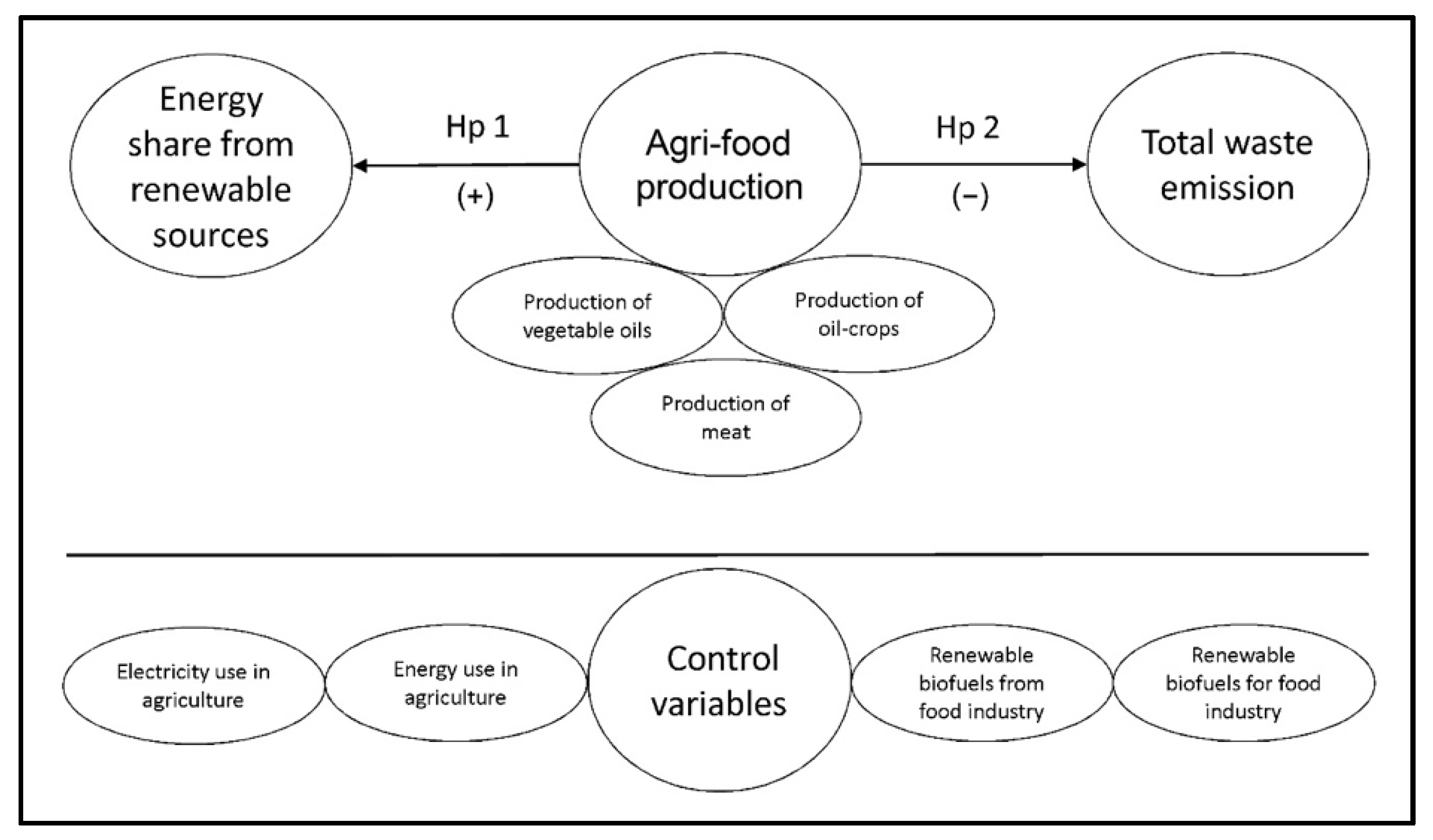
Figure 2.
Clustering dendrogram of the countries based on agri-food system (Source: extracted from SPSS software).
Figure 2.
Clustering dendrogram of the countries based on agri-food system (Source: extracted from SPSS software).
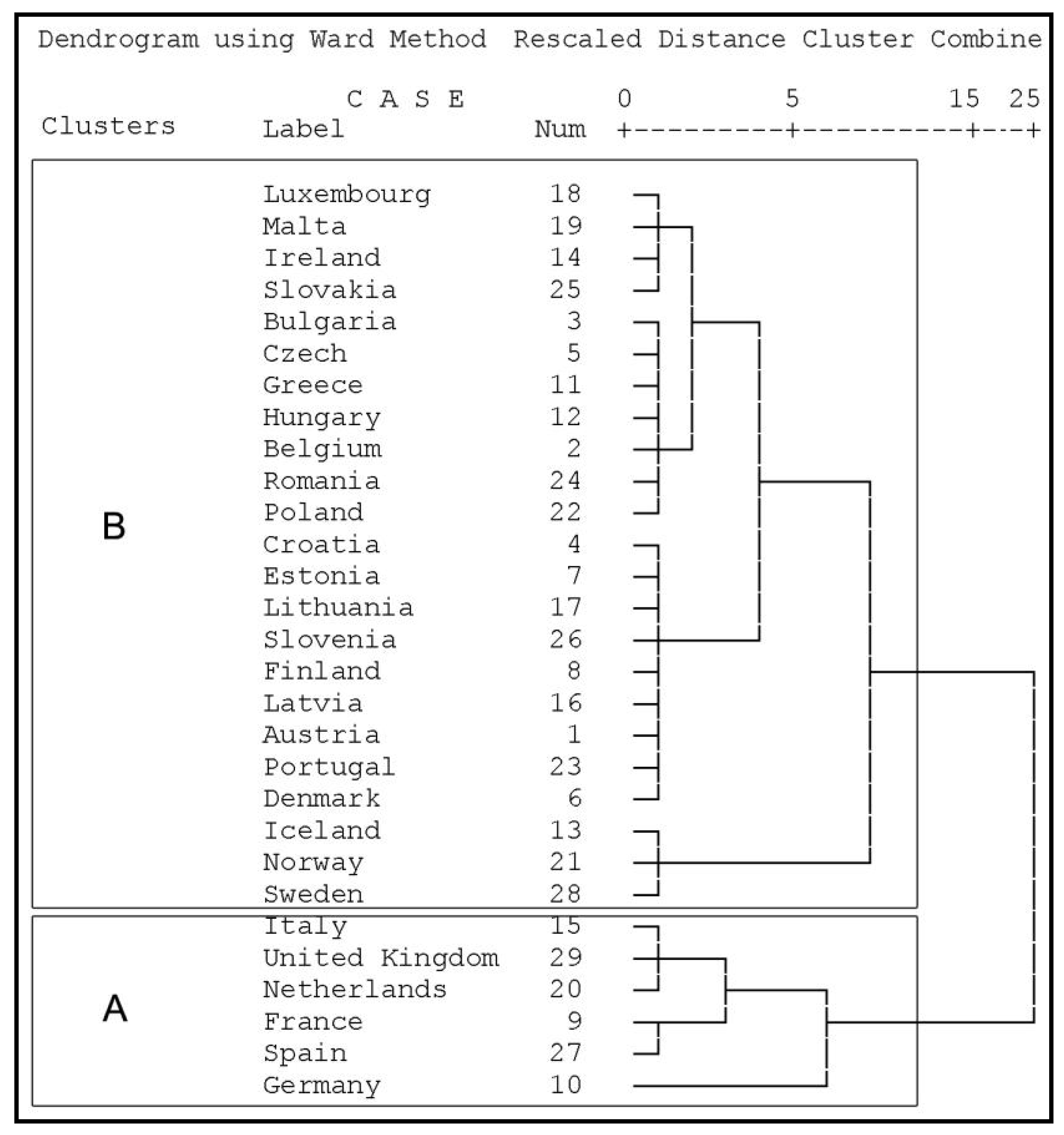

Table 1.
The summarized data for all variables in 2014 and in 2018.
| Variable Country |
Production of meat (K tonnes) |
Production of oil crops (K tonnes) |
Production of vegetable oils (K tonnes) | Total waste emission (K tonnes) |
Renewable energy sharing (%) | |||||
| 2014 | 2018 | 2014 | 2018 | 2014 | 2018 | 2014 | 2018 | 2014 | 2018 | |
| Austria | 900 | 910 | 390 | 387 | 219 | 255 | 185.95 | 186.16 | 33.55 | 33.81 |
| Belgium | 1814 | 1825 | 66 | 54 | 989 | 1205 | 116.33 | 116.39 | 8.04 | 9.48 |
| Bulgaria | 206 | 233 | 2547 | 2411 | 398 | 536 | 6.92 | 6.96 | 18.05 | 20.59 |
| Croatia | 210 | 231 | 315 | 548 | 54 | 54 | 65.58 | 65.73 | 27.82 | 28.05 |
| Czech | 519 | 515 | 1644 | 1511 | 463 | 592 | 28.34 | 28.52 | 15.07 | 15.14 |
| Denmark | 1889 | 1876 | 709 | 489 | 221 | 249 | 13.41 | 13.41 | 29.32 | 35.41 |
| Estonia | 71 | 75 | 167 | 114 | 57 | 58 | 47.29 | 47.57 | 26.14 | 29.99 |
| Finland | 384 | 393 | 62 | 71 | 111 | 76 | 22.38 | 22.39 | 38.78 | 41.16 |
| France | 5520 | 5551 | 7486 | 6829 | 2878 | 2721 | 984.03 | 983.25 | 14.42 | 16.44 |
| Germany | 8351 | 8189 | 6329 | 3778 | 4521 | 4145 | 1823.34 | 1824.39 | 14.39 | 16.67 |
| Greece | 428 | 446 | 3278 | 3461 | 488 | 605 | 174.81 | 174.25 | 15.68 | 18.05 |
| Hungary | 888 | 1032 | 2440 | 3039 | 625 | 848 | 44.33 | 44.53 | 14.62 | 12.54 |
| Iceland | 32 | 34 | 0 | 0 | 0 | 0 | 0.25 | 0.26 | 73.08 | 76.69 |
| Ireland | 1024 | 1165 | 34 | 41 | 25 | 40 | 26.32 | 26.72 | 8.57 | 10.89 |
| Italy | 3378 | 3661 | 3591 | 3633 | 1139 | 1154 | 627.44 | 626.68 | 17.08 | 17.80 |
| Latvia | 85 | 92 | 187 | 238 | 65 | 59 | 29.46 | 29.57 | 38.63 | 40.03 |
| Lithuania | 227 | 251 | 506 | 444 | 83 | 89 | 17.45 | 17.52 | 23.59 | 24.70 |
| Luxembourg | 21 | 24 | 16 | 11 | 0 | 0 | 18.63 | 18.68 | 4.47 | 8.97 |
| Malta | 13 | 12 | 0 | 0 | 0 | 0 | 0.17 | 0.17 | 4.74 | 7.97 |
| Netherlands | 2800 | 3012 | 161 | 65 | 1790 | 1765 | 592.21 | 592.77 | 5.42 | 7.34 |
| Norway | 345 | 359 | 10 | 7 | 89 | 93 | 12.43 | 12.37 | 68.21 | 71.80 |
| Poland | 4197 | 5260 | 3326 | 2170 | 1202 | 1278 | 188.62 | 189.14 | 11.61 | 11.48 |
| Portugal | 791 | 852 | 496 | 781 | 396 | 451 | 106.83 | 107.03 | 29.51 | 30.21 |
| Romania | 1054 | 1152 | 3476 | 5161 | 755 | 810 | 23.25 | 23.42 | 24.85 | 23.88 |
| Slovakia | 138 | 151 | 739 | 795 | 99 | 118 | 25.72 | 25.76 | 11.71 | 11.90 |
| Slovenia | 123 | 137 | 22 | 21 | 5 | 3 | 19.35 | 19.41 | 22.46 | 21.38 |
| Spain | 5722 | 7028 | 5728 | 11066 | 2228 | 3363 | 290.28 | 290.65 | 16.16 | 17.45 |
| Sweden | 530 | 570 | 334 | 222 | 129 | 146 | 98.97 | 98.80 | 51.82 | 54.65 |
| United Kingdom | 3694 | 4086 | 2504 | 2061 | 1017 | 1048 | 935.41 | 933.18 | 6.74 | 11.14 |
Table 2.
Results of the panel data analysis revealing the production of meat: PM, production of oil crops: PO, and production of vegetable oils: PV effects on the Renewable energy sharing: RE.
Table 2.
Results of the panel data analysis revealing the production of meat: PM, production of oil crops: PO, and production of vegetable oils: PV effects on the Renewable energy sharing: RE.
| Variables | PM | PO | PV |
| Renewable energy sharing: RE | -5.33 | -23.87 | 7.95 |
| 10.83 | 18.55 | 12.18 | |
| Energy use in agriculture: EN | 0.02* | 0.01 | 0.00 |
| 0.00 | 0.01 | 0.00 | |
| Electricity use in agriculture: EL | 0.04* | 0.03 | 0.00 |
| 0.01 | 0.04 | 0.02 | |
| Renewable bio-fuels from food industry: R from F | 0.04 | -0.02 | -0.06* |
| 0.03 | 0.08 | 0.03 | |
| Renewable bio-fuel for food industry: R for F | 0.07 | 0.17 | 0.11 |
| 0.07 | 0.19 | 0.08 | |
| Tests | |||
| R2 | 0.81 | 0.46 | 0.07 |
| F-test | 0.00 | 0.00 | 0.49 |
| p value | 0.00 | 1.44 | 0.00 |
| Hausman test | (Fixed) | (Random) | (Fixed) |
| Observations | 145 | 145 | 145 |
| Groups | 29 | 29 | 29 |
Coefficients (std. error)* depends on the p values < 0. 1.
Table 3.
Results of the panel data analysis revealing the production of meat: PM, production of oil crops: PO, and production of vegetable oils: PV effects on the total waste emission: WE.
Table 3.
Results of the panel data analysis revealing the production of meat: PM, production of oil crops: PO, and production of vegetable oils: PV effects on the total waste emission: WE.
| Variables | PM | PO | PV |
| Total waste emission: WE | 1.56* | 1.15 | 1.60* |
| 0.51 | 1.28 | 0.35 | |
| Energy use in agriculture: EN | 0.02* | 0.01* | 0.01* |
| 0.00 | 0.01 | 0.00 | |
| Electricity use in agriculture: EL | 0.03* | 0.02 | 0.01 |
| 0.01 | 0.04 | 0.01 | |
| Renewable bio-fuels from food industry: RfromF | 0.05* | -0.07 | -0.02 |
| 0.02 | 0.08 | 0.02 | |
| Renewable bio-fuel for food industry: RforF | 0.02 | 0.19 | 0.05 |
| 0.06 | 0.19 | 0.05 | |
| Tests | |||
| R2 | 0.85 | 0.41 | 0.80 |
| F-test | 0.00 | 0.00 | 0.00 |
| p value | 1.11 | 1.57 | 1.15 |
| Hausman test | (Random) | (Random) | (Random) |
| Observations | 145 | 145 | 145 |
| Groups | 29 | 29 | 29 |
Coefficients (std. error)* depends on the p values < 0. 1.
Table 3.
Average values of proximity matrix between 29 countries.
| Country Name | Value |
| Austria | 3.55 |
| Belgium | 3.91 |
| Bulgaria | 3.42 |
| Croatia | 3.64 |
| Czech | 3.61 |
| Denmark | 3.58 |
| Estonia | 3.81 |
| Finland | 4.56 |
| France | 12.06 |
| Germany | 26.61 |
| Greece | 3.22 |
| Hungary | 3.57 |
| Iceland | 12.35 |
| Ireland | 4.27 |
| Italy | 5.07 |
| Latvia | 4.45 |
| Lithuania | 3.68 |
| Luxembourg | 5.00 |
| Malta | 5.03 |
| Netherlands | 4.95 |
| Norway | 10.79 |
| Poland | 4.40 |
| Portugal | 3.38 |
| Romania | 3.40 |
| Slovakia | 4.11 |
| Slovenia | 3.87 |
| Spain | 10.08 |
| Sweden | 6.36 |
| United Kingdom | 7.29 |
Table 4.
Propositions in the agri-food CBMs.
| Aspects | Production Process [P] | Waste Emission [W] | Renewable Energy Sharing [E] | |
| Strategies | ||||
| Extending [E] | EP: Enhancing durability of the agri-food products | EW: Cascading reuse to organic feedstock farms | EE: Refurbishing and retrofitting bio-fuel plants | |
| Intensifying [I] | IP: Innovative transport tracking and service management | IW: Advanced system for handling agri-food waste | IE: Retailing energy from agri-food system | |
| Dematerializing [D] | DP: Digital capabilities to generate end-of-life packing process | DW: Consumer education and demand rationalization | DE: Technologies to create marketable renewable energy | |
| Recycling [R] | RP: Biodegradable materials in agri-food packing | RW: Zero-waste bio-refineries process | RE: Integrating biomass, bio-fuel, biomaterials, and bio-energy cycles | |
Disclaimer/Publisher’s Note: The statements, opinions and data contained in all publications are solely those of the individual author(s) and contributor(s) and not of MDPI and/or the editor(s). MDPI and/or the editor(s) disclaim responsibility for any injury to people or property resulting from any ideas, methods, instructions or products referred to in the content. |
© 2024 by the authors. Licensee MDPI, Basel, Switzerland. This article is an open access article distributed under the terms and conditions of the Creative Commons Attribution (CC BY) license (http://creativecommons.org/licenses/by/4.0/).
Copyright: This open access article is published under a Creative Commons CC BY 4.0 license, which permit the free download, distribution, and reuse, provided that the author and preprint are cited in any reuse.


