

Submitted:
20 May 2024
Posted:
28 May 2024
You are already at the latest version
Abstract
There is a growing consensus that the modern food system lies at the centre of the grand challenges facing humanity and requires urgent and profound changes in the way that food is produced, processed, distributed and consumed. This review analyses sustainability transitions within agrifood systems, focusing on the role of firms and industries as defined by the Sustainable Transitions Research Network (STRN). This paper conducts the first systematic literature review using bibliometric analysis to assess the current state of research on this theme. The findings reveal a significant increase in publications related to firms and industries within agrifood sustainability transitions. Furthermore, the current research is geographically concentrated in the European Union. The review identifies four key themes in the literature based on co-occurrence of keywords. These are agriculture, innovation, governance, food systems and agroecology. The review identifies increasing awareness of the role of farmers in driving sustainability transitions at the farm level. Furthermore, there is an increasing awareness of the interrelated characteristics of the agrifood system which acknowledges the need for sustainable innovations to occur at multiple stages of the agrifood system. It also shows that there is growing evidence that innovations can occur through disruptive as well as incremental innovation, and highlights the importance of governance influencing transitions. The literature raises questions about Alternative Food Networks as sustainable innovations, their potential for significant change in the established food system and the validity of their claims to food equity and environmental sustainability. A key theme emerging from the literature is an ecological perspective that identifies the complex biological processes and ecosystems as an integral part of agricultural production. These findings provide a greater understanding of the current literature landscape of agrifood sustainable transitions relating to firms and industries and lay a foundation for future research.
Keywords:
agrifood sustainability transitions
; agrifood
; agroecology
; sustainable innovation
; food systems
; transition governance
1. Introduction
1.1. The Global Agrifood System
The current global agrifood system has fed a rapidly growing population that has more than doubled from 3.5 billion to 7.8 billion in the last 50 years (Ahmad, 2001; Ezeh et al., 2012; United Nations, 2022). To achieve this, food production has tripled, contributing to a significant reduction in levels of malnutrition and hunger (Boliko, 2019; OECD, 2022; UNICEF, 2022). This improved nutrition has supported better human health outcomes such as reduced infant mortality and longer life expectancy (Marinova et al., 2022; Willett et al., 2019). Furthermore, this threefold increase in food production has been achieved with less than a 15% increase in agricultural land use (Godfray et al., 2010; OECD, 2022). This has been accomplished by focusing on increasing output through the intensification and efficiency of food production systems (Gaitán-Cremaschi et al., 2019; Hackfort, 2023; Mehrabi et al., 2022; Wojtynia et al., 2021, 2023). This has required greater inputs of fertiliser and agrochemicals combined with increases in mechanisation, plant breeding, water use and improved management practices (Godfray et al., 2010; OECD, 2022).
However, this increase in production has come at a significant cost to the environment with food production now the largest cause of global environmental change (Marinova et al., 2022; Meynard et al., 2017; Vinnari & Vinnari, 2014; Willett et al., 2019). Food production is a major contributor to climate change, biodiversity loss, contamination, overuse of water resources and land use change (El Bilali, 2019; Mehrabi et al., 2022; Vinnari & Vinnari, 2014). In addition to the environment, there are significant effects on human health (Meynard et al., 2017). It is estimated that 820 million people suffer from chronic malnutrition and two billion are classified as overweight or obese (El Bilali, 2019; Guh et al., 2009; WHO, 2021; Willett et al., 2019).
There is a growing consensus that the modern food system lies at the centre of the grand challenges facing humanity and requires urgent and profound changes in the way that food is produced, processed, distributed and consumed (Bui, 2021; El Bilali, 2019; Meynard et al., 2017; Willett et al., 2019; Wojtynia et al., 2021). For example, research by the Eat-Lancet Commission on healthy diets from sustainable food systems concluded that “the global food system needs to be transformed to reduce its effect on human health and environmental stability” (Willett et al., 2019, p. 450). However, this needs to be achieved with the world population expected to increase to 9 billion by 2050 combined with a global trend towards the adoption of western diets with the associated increase in consumption of animal proteins (Aschemann-Witzel et al., 2023; Vinnari & Vinnari, 2014). Furthermore, this must be achieved in a period where climate change will significantly impact crop yields (Godfray et al., 2010). There is increasing agreement among scholars that to address these multiple challenges requires more than incremental change but a “great food transformation” (Willett et al., 2019, p. 54) changing the way the food system operates requiring a transition to more sustainable practices (Béné, 2022; Bui, 2021; El Bilali, 2019; Kuokkanen et al., 2019; Willett et al., 2019).
1.2. Agrifood Sustainability Transitions
Agrifood sustainability transitions is a field of research that focuses on the systemic changes and reconfiguration of the agrifood system required to move towards more sustainable practices (Kuokkanen et al., 2019; Vinnari & Vinnari, 2014). The study of agrifood transitions sits within a wider body of research on sustainability transitions. Transitions are defined as long-term major shifts in established industries and socio-technical systems, as societies transition to more sustainable modes of production and consumption (Mehrabi et al., 2022; Sustainability Transition Research Network, 2021). Only recently has sustainability transition research been applied to agrifood systems (Aschemann-Witzel et al., 2023; El Bilali, 2019; Gosnell et al., 2019). In this context, agrifood systems refer to all the activities and actors involved in the production, processing, distribution, consumption, and disposal of food and agricultural products (El Bilali et al., 2021).
The initial focus of sustainability transitions research was on energy systems, transport and computing (Aschemann-Witzel et al., 2023; Van den Ende & Kemp, 1999; Verbong & Geels, 2007). Lachman (2013) and Loorbach et al. (2017) identify the major approaches to transition research. These are multi-Level perspective, strategic niche management, innovation systems, techno-economic paradigm and socio-metabolic transitions.
1.3. Sustainability Transitions Research
The multi-level perspective (MLP) is the dominant theoretical framework and is seen as a “fundamental heuristic underpinning transitions studies” (Bui, 2021, p. 1). This perspective views transitions as a multi-Level interaction between landscape, regime and niches (Geels, 2002; Kuokkanen et al., 2019; Lachman, 2013). The regime is a central concept of the MLP. It is defined as the dominant socio-technical system and is often seen as the established unsustainable mode of production requiring destabilisation and transformation (Kuokkanen et al., 2019). The regime has an established set of rules that regulate how the system functions and interacts with a network of actors and functions with existing technology. The regime is seen as resistant to systematic change due to strong path dependencies and vested interests of the existing actors (Bui, 2021; Kuokkanen et al., 2019; Lachman, 2013). The landscape and niches function outside the established regime. The concept of landscape refers to the context in which the regime operates and incorporates the economic, social and political environment. Examples of landscape changes include shifts in government policy, changing consumer preferences, changes in the economic environment and technological innovations. Niches are defined as experimental spaces where innovations can potentially take place. They often represent small networks of actors with more flexible rules and have some protection from the dominant regime (Bui, 2021; Lachman, 2013). The MLP proposes that certain interactions between the landscape, regime and niches can lead to systemic change that can ultimately lead to a transition to a new socio-technical regime (Bui, 2021; Lachman, 2013).
1.4. Agrifood Sustainability Transitions–Firms and Industries
Sustainability transition research has been applied to a variety of sectors including the agrifood sector. El Bilali (2019) evaluated the literature on agrifood transitions research between 2010 and 2017. This review looked at how the agrifood transitions literature aligned with the themes in the Sustainable Transitions Research Network (STRN) agenda (Köhler et al., 2019). The STRN has developed a research agenda on sustainable transitions with nine themes: understanding transitions, power and politics, governing transitions, civil society, culture and social movements in transitions, firms and industries in sustainability transitions, transitions in practice and everyday life, the geography of transitions, ethical aspects of transitions and methodologies (Köhler et al., 2019).
The STRN theme on firms and industries evaluates how established organisations and sectors contribute to transitions by either slowing down or speeding up the processes of transitions and how changes in these affect the broader aspects of transformation. Köhler et al. (2019) note that research on the theme of firms and industries was less advanced and a relatively new field of research. This was especially valid for studies relating to the agrifood system. More specifically, the review by El Bilali (2019) identified that the literature on agrifood sustainability transitions relating to the “role of industries and firms in enabling and supporting sustainable transitions was a marginal topic” (El Bilali, 2019, p. 358)
Based on the findings of the review by El Bilali (2019), there is a need for a systematic review of the agrifood sustainable transitions literature on firms and industries to identify how the research on firms and industries has developed. In particular, there is a need to evaluate if research on sustainability transitions has become a more central theme rather than a marginal topic. This paper addresses this knowledge gap by providing the first systematic review on this theme. It uses bibliometric analysis and visualisation tools to identify the current state of research on the role of firms and industries within the agrifood sustainability literature.
Within the context of agrifood transitions, the specific aims of this study are to:
- 1)
- Evaluate and describe the current state of the literature on the (STRN) theme of firms and industries.
- 2)
- Identify gaps and propose areas for future research to address these areas.
Specific research questions are:
- 1)
- Is the theme of “industries and firms” still a marginal topic within the agrifood sustainability transitions literature?
- 2)
- How has the agrifood sustainability transition literature on “industries and firms” evolved?
- 3)
- What are the main themes and topics within this theme and what gaps exist within this literature?
- 4)
- What are the potential areas for future research on firms and industries in sustainability transitions?
2. Materials and Methods
2.1. Data Collection
Data was collected from Scopus in the first step of bibliometric analysis. The following search query was used to gather data: ((“sustainability transition*”) AND (agri* OR agro* OR food) AND (firm* OR industry* OR business*)). The search terms were adapted from the STRN research themes. The search terms aimed to identify papers relating to agrifood that met the STRN research theme for the role of firms and industries in transitions (El Bilali, 2019; Köhler et al., 2019). Papers published between 2010 - 2023 were considered for this study. The search criteria covered the Scopus subject areas of Environmental Science, Business Management and Accounting, Agricultural and Biological Sciences, Social Sciences, Economics, Econometrics and Finance. This search identified 63 documents, which after further screening was reduced to 46 documents that were used for the bibliographic analysis (Figure 1).
2.2. Data Analysis
The Scopus database bibliometric tools were used for the initial descriptive analysis of the literature. The Scopus database was used for the search criteria due to its wider coverage of documents than other common databases (Visser et al., 2021).
Following the database search and the descriptive analysis, VOSviewer software was used to develop and analyse the network of relationships between bibliometric items evaluated by co-citations analysis and co-occurrence of keywords (Van Eck & Waltman, 2010).
Co-citation analysis was used to identify the network of relationships between publications based on the number of times an author, publication or journal are cited together in the same publication. Co-occurrence of keywords was used to identify common themes of publications based on the number of times the same keywords are used in the selected documents. The themes identified by the co-occurrence of keywords formed the basis of the themes for the literature review. The papers were then manually allocated to the different themes based on the main topic of the article.
3. Results
3.1. Descriptive Analysis of Publications
This section presents a descriptive analysis of the number of publications, authors, journals, institutions, geographic origin and citations to evaluate the characteristics of the published literature on the topic of sustainability transitions in firms and industries.
Figure 2 shows a recent increase in publications in agrifood sustainability transitions on the theme of firms and industries, with the number of publications increasing from three in 2017 to 19 in 2023. Figure 3 shows that this trend is also reflected in the number of citations of papers on the theme of firms and industries. These have increased from 14 in 2017 to 187 in 2023.
The growth in publications is evenly distributed across a number of authors with only Bui and Hekkert publishing more than two papers (Table 1). In contrast, there is a significant concentration in both institutional affiliation and geographic location. Specifically, only three research institutions have contributed more than three papers (Table 2). This concentration is even more apparent when examining publications by country, with the Netherlands leading significantly with 11 papers published (Table 3). An analysis of the geographic distribution underscores a clear dominance of European countries contributing to publications on this topic.
Eleven journals were identified as having published a minimum of two papers on the theme of transitions in firms and industries (Table 4). The Journal of Environmental Innovation and Societal Transitions had the highest number of publications, totalling six, closely followed by the journal Sustainability, with five publications.
In terms of journal quality, impact factors varied significantly from 3.4 for the journal Agriculture to 11.1 for the Journal of Cleaner Production. The journal Circular Economy and Sustainability lacked an impact factor or other quality measures. The range of impact factors highlights the diversity of journals publishing on firms and industries in agrifood transitions, encompassing a range of quality measures. Importantly, it signifies that there are high-quality journals that recognise the significance of this field of research.
The Source Normalised Impact per Paper (SNIP) provides a comparative ranking of journals within their respective research fields. All the identified journals exhibited a SNIP greater than 1, indicating their performance exceeds the average for journals in their fields (Table 4). It is noteworthy that only two of these journals deal with agriculture and agricultural systems and there are no journals in agribusiness management or agricultural economics. This suggests that sustainability transitions research has yet to emerge as a significant topic in mainstream agricultural economics or applied agribusiness management journals.
Table 5 identifies the ten most cited papers on the topic. The paper “Designing coupled innovations for the sustainability transition of agrifood systems” by Meynard et al. (2017) has received substantially more citations than all the other most cited papers with approximately 30 citations per year since 2021 (Figure 4). This high level of citation could be because this paper has been published in an agricultural journal (Agricultural Systems) that has a scope that includes a farm-level agricultural production focus (Elsevier, 2024). As a result, many of the citations of this paper have been in agricultural or agronomy journals that include this focus such as the European Journal of Agronomy, Agronomy for Sustainable Development and Agricultural Systems (Table 5). This highlights the potential for sustainable transitions research to provide a framework for understanding transitions in agriculture production systems.
3.2. Co-Citation Analysis
Co-citation is a bibliographic analysis that provides a structured and quantitative approach to evaluate the scholarly landscape. It identifies the number of times a journal article, author or journal are cited together in the same publication. It can provide an analysis of relationships, identifying influential articles, journals, and authors that contribute to the current scholarly discourse on agrifood sustainability transitions in firms and industries.
The construction of a co-citation network (Figure 5) visually portrays the scholarly interconnections. Each node represents an article, journal, or author. The links signify frequent co-citations, and the size of the node represents the number of articles, journals, or authors represented by the node.
The analysis of co-citation of publications (Table 6) and (Figure 6) highlights the central position of Geels (2002) article “Technological transitions as evolutionary reconfiguration processes: A multi-level perspective and a case-study within the network”. This paper has both the highest number of citations and link strength, signifying that it has extensive connections to other publications in the network. This indicates that the paper occupies a central position in the citations included in publications on firms and industries in agrifood sustainability transitions. In this paper, Geels (2002) addresses the questions about the mechanisms of technological transitions (TT). Drawing from insights in evolutionary economics and technology studies, the paper applies this to a case study on the technological shift from sailing ships to steamships during the period 1780–1900. Among the other strongly linked papers, Smith and Raven (2012) explore the role of “niches” as temporary protective spaces fostering the emergence of pathbreaking innovations. They illustrate this concept with the example of the evolution of solar photovoltaic cells from niche innovations within satellite technology in the 1960s to mainstream solar energy, challenging the established fossil fuel energy generation technology. The third most cited paper by Geels and Schot (2007) contributes to the conceptualisation of the multi-Level Perspective on transitions by developing a more differentiated typology of transition paths. This incorporates distinctions in the timing and nature of multi-level interactions. Although these three publications do not specifically relate to agrifood sustainability transitions, they collectively serve as a theoretical foundation for the examination of transitions in various domains, including firms and industries in agrifood sustainability transitions. It also indicates the strong theoretical roots that firms and industries in agrifood sustainability transitions have within the wider body of transitions literature.
Co-citation analysis by author (Figure 6) maps the number of times authors are cited together in the same publication. This analysis again highlights the central role of Geels as an author in the network and his foundational works on the conceptualisation of transitions. The analysis identifies three predominant clusters of authors (Figure 6). Cluster 1 is centred on authors Geels, Raven, Truffer, Markard and Schot. Cluster 2 is centred on Klerkx and Cluster 3 is centred on Loorbach and Smith. This indicates that there are three groups of authors that are commonly cited together, suggesting that these research groups have shared research themes or collaborations.
3.3. Co-Occurrence of Keyword Analysis
The final analysis uses the co-occurrence of keywords to provide an understanding of the knowledge structures of this field of research by examining the links between keywords in publications. Keywords were extracted from the Scopus file and processed through VOSViewer. VOSViewer identified 367 keywords from the 46 articles in the literature search. Keywords were selected based on occurring more than five times in the selected publications. This resulted in 11 keywords and identified five themes based on the following keywords: agriculture, innovation, governance, food system and agroecology. Keywords that had a similar meaning were combined (for example, sustainability transition and sustainability transitions). The five themes were used to structure the literature review by classifying articles into these categories.
3.3.1. Agriculture
Transitions in agricultural systems focus on the systematic changes needed to reduce the impact of agricultural production on the environment (Viola & Mendes, 2022). There is an emphasis on technological innovations as solutions to the environmental issues associated with agrifood production. These identify technologies such as remote sensors, artificial intelligence, precision agriculture, autonomous vehicles and high-technology urban agriculture as potential solutions (Farhangi et al., 2020; Hackfort, 2023). However, widespread adoption of these technologies is hindered by the significant capital investment required. This especially impacts small farmers with limited financial resources (Pant et al., 2014; Swaffield et al., 2019; Viola & Mendes, 2022). Furthermore, large-scale agribusinesses with significant capital and technological resources may adopt these technologies to improve productivity rather than transitioning to more sustainable practices (Hackfort, 2023). Financial barriers also exist when transitioning from conventional farming systems. These can include contractual obligations, high levels of debt, investments in existing farming methods and loss of income through reduced production and higher costs (van der Gaast et al., 2022). For example, converting to organic production can involve a period of up to two years, with reduced production and income and additional expenses for certification (Horn et al., 2023; van der Gaast et al., 2022).
Wojtynia et al. (2023) and Williams et al. (2023) highlight the central role farmers play in influencing sustainability transitions within agricultural production systems due to the significant impact of farm production on environmental sustainability (Williams et al., 2023; Wojtynia et al., 2023). These impacts include greenhouse gas emissions, nutrient losses, biodiversity, and land use changes. As a result, farmers’ agency becomes essential for implementing sustainable production at the farm level. However, studies show that farmers have diverse motivations for implementing sustainable farming practices (Davidson et al., 2016; Horn et al., 2023; Wojtynia et al., 2023). These include a recognition that conventional systems are unsustainable, awareness of the environmental impacts of their farming practices, proactively making changes ahead of regulatory requirements and a desire to create a legacy for future generations (Bulah et al., 2023). Farmers’ individual characteristics also affect the adoption of sustainable practices. These include openness to new ideas, reflective capacity, risk aversion, and sociability with peers (Williams et al., 2023; Wojtynia et al., 2023). Power dynamics, especially between farmers and large corporate agribusiness firms and retailers can also be an obstacle to farmers adopting sustainable practices (Hackfort, 2023; Williams et al., 2023). Although these businesses may adopt sustainability initiatives, they can also create “lock-ins” that perpetuate the status quo of productivist farming systems (Giagnocavo et al., 2022; Hackfort, 2023; Kinniburgh, 2023; Manuel-Navarrete & Gallopín, 2012; McInnes, 2019). Agribusiness firms and retailers who participate in sustainability initiatives often do this for a variety of motivations. These include meeting environmental regulations, improving food security, enhancing consumer confidence, competition, branding, adding value, strengthening relationships with local communities, maintaining social capital, workplace values, preserving a social license to operate and mitigating the risk or regulations and reducing compliance costs (Swaffield et al., 2019).
The literature on agriculture and transitions provides insights into challenges and opportunities in agricultural systems, highlighting the crucial role of farmers in adopting more sustainable practices. At the same time it identifies significant barriers including financial constraints, power imbalances and the need to understanding the diverse motivations and individual characteristics of farmers in adopting sustainable practices.
3.3.2. Innovation
Disruptive innovation is a core concept in the sustainability transitions literature. A clear distinction is made between disruptive and incremental innovation. Incremental innovations emerge within the established system or regime, whereas disruptive innovations aim to fundamentally transform the established regime (Marletto & Sillig, 2019; Meynard et al., 2017). Niches are another key concept and are identified as protective spaces for disruptive innovations to become established and then expand beyond the niche and destabilise the existing system (Davidson et al., 2016; Geels, 2011; Kuokkanen et al., 2019). However, recent studies have recognised that significant systemic change can unfold incrementally within the established system and that the regime can play a role in the adoption of sustainability practices (Bui, 2021; Kuokkanen et al., 2019). This suggests that both radical and incremental innovations are needed for transformation (Block et al., 2023). Furthermore definitions of sustainable innovations and their ability to transform the established regime are still highly contested (El Bilali, 2018; Meynard et al., 2017)
There are some sustainable innovations that are emerging within the agriculture and food system that aim to address the significant impact of conventional practices on the environment. These innovations include alternative protein sources, precision fermentation, alternative distribution channels and more sustainable production systems (Kuokkanen et al., 2019). Grassroots innovations are a category of innovations that are viewed as potential disruptive. These include practices such as community-supported agriculture, urban farming and local food networks, which emphasise innovation in the production and distribution of food outside of the dominant regime (Marletto & Sillig, 2019). These innovations promote local, small-scale and organic practices, which aim to shift away from large-scale monoculture systems and promote soil health, biodiversity and reduced use of agrochemicals. However, it is acknowledged that some innovations such as organic production, fair trade and veganism can be absorbed by the dominant regime and become mainstream (Marletto & Sillig, 2019). In this case, large agrifood companies and food retailers observe shifts in consumer demand and see these innovations as a profit opportunity (van der Gaast et al., 2022). The mainstreaming of these innovations can result in deviation from the values that initiated the innovation, and diminish the radical critique of the established system (Marletto & Sillig, 2019).
There is a growing understanding emerging from the complex nature of the agrifood system, suggesting that sustainable innovations need to encompass the whole food system, emphasising coordination along the supply chain, between agricultural production, processing, and consumers (Block et al., 2023; Meynard et al., 2017; Trotter et al., 2023). This means, for example, that transitions require multiple niche innovations that occur simultaneously at different components of the agrifood system (Bui, 2021; Long et al. 2019; Meynard et al., 2017). Furthermore, the regime can play a part in the transition process through the emergence of within-regime socio-technical configurations (Bui, 2021). The literature on this theme highlights the complex nature of innovation by firms and industries in agrifood systems, as well as the need for a more holistic understanding of sustainable innovation with coordination across various aspects of the food system.
3.3.3. Governance
Transition governance involves managing transitions to more sustainable food systems. Kinniburgh (2023) and Vinnari and Vinnari (2014) highlight the crucial role of governance in incentivising and supporting these transition processes. Transition governance is often implemented by policymakers and government bodies. However, Kinniburgh (2023) points out that government policy can oppose change due to embedded political interests that resist change by influencing government policies to support the status quo. illustrate the impact of the regime on government regulations that create barriers that don’t support transformation to new sustainable production systems. Horn et al. (2023) highlight the importance of devolving knowledge governance to farmer organisations to improve access to information on research that supports the adoption of sustainable farming practices.
Transition governance has its roots in complex systems theory (Vinnari & Vinnari, 2014). However, governance studies frequently overlook the characteristics of complex systems, in particular, the concept of emergence, where outcomes cannot be predetermined, making traditional planning approaches ineffective (Keating et al., 2017). Halbe and Pahl-Wostl (2019) emphasise that managing transitions is especially challenging in agrifood systems due to the high levels of uncertainty, complexity, ambiguity and distributed control. Rossing et al. (2021) try to address this through a co-innovation approach to the governance and management of sustainable transition projects. This explicitly acknowledges that sustainable transitions involve complex adaptive systems where different outcomes can arise despite similar approaches to governance and management. Their approach views project interventions as “sustainability experiments” and incorporates farmers and researchers in the process of co-innovation. It emphasises that supporting sustainable transitions requires a complex adaptive system perspective with an environment that supports social learning and incorporates dynamic project monitoring (Rossing et al., 2021). Despite the variety of approaches to transition governance and the challenges of implementation in complex agrifood systems, transition governance is likely to continue as an important focus of sustainable transitions research.
3.3.4. Food System
Transformation of the food system requires an understanding of the factors that support or hinder this process (Aschemann-Witzel et al., 2023; Farhangi et al., 2020). Food system transformation is a central principle in the sustainable transitions perspective. However, within the food system transformational literature, the concept of sustainability remains contentious and ill-defined (Ribeiro & Turner, 2021). Although there is some consensus as to the need for firms and industries to move away from the current unsustainable agrifood system, the notion of what represents a sustainable transition outcome has many definitions (McInnes, 2019; Ribeiro & Turner, 2021). Some sustainability outcomes include protecting the environment, supporting the development of alternative food networks, reconfiguration of value chains, reducing waste and addressing social equity (Bui et al., 2019; Davidson et al., 2016; Ribeiro & Turner, 2021). Marinova et al. (2022) emphasise the importance of situating transitions within the historical context of the evolution of human society from hunter-gatherer to the farming of crops and livestock through successive transformations until the recent development of industrialised agriculture. From this perspective, the current agrifood sustainability transitions are understood as the most recent transformation in a series of historical changes in food systems.
A dominant theme of the current food system transformation is the emergence of alternative food networks (AFN) that seek to transform or replace conventional food chains (Audet et al., 2017; Bui et al., 2019; Davidson et al., 2016; Stephens & Barbier, 2021; van Oers et al., 2023). AFNs are characterised as self-governing collectives with diverse objectives including reconnecting producers and consumers, promoting social and food justice, ensuring equitable access to food, and promoting healthy nutrition and sustainable practices (Audet et al., 2017). However, there are significant issues and challenges for AFNs. Evidence of substantial transformation of established food systems by AFNs is limited (Bui et al., 2019; Desa & Jia, 2020; Marletto & Sillig, 2019). Furthermore, many of these organisations struggle to scale up and often have to deal with tensions between social and environmental concerns and economic viability. (Audet et al., 2017; Desa & Jia, 2020; Donati et al., 2023; Ribeiro & Turner, 2021).
Research by Stephens and Barbier (2021) identifies that most customers of AFNs also purchase food from conventional channels such as supermarkets and specialty stores. This suggests that AFNs represent a niche food retail channel that sits alongside conventional production and food retail supply chains (Davidson et al., 2016). Furthermore, rather than the transformation of the regime, the established food system may assimilate certain aspects of the alternative food systems without there being a fundamental transformation. For example, supermarkets may offer local produce, organic, fair trade and vegan options as a part of their product offering, co-existing with conventional products (Aschemann-Witzel et al., 2023; Audet et al., 2017; Bui et al., 2019; Davidson et al., 2016; Gonera et al., 2023; Marletto & Sillig, 2019; Ribeiro & Turner, 2021). Additionally, the role of the regime is acknowledged in the transformation process (Aschemann-Witzel et al., 2023; Gonera et al., 2023; Kuokkanen et al., 2018). There is evidence that incumbent firms are incorporating sustainability priorities in their vision, goals and practices often driven by regulations or pressure from shareholders, customers and consumers (Bulah et al., 2023). In this way, incumbent agrifood firms and industries can become a positive force for food system sustainability (Bulah et al., 2023; Gonera et al., 2023). The literature in this cluster acknowledges that there are multiple perspectives on what transformation may look like and what problems need to be addressed (Kuokkanen et al., 2018; Wojtynia et al., 2021).
3.3.5. Agroecology
Agroecology is a production system that contests the conventional perspective of human control over nature and recognises humans as an integral part of the natural ecosystem. It challenges the assumptions of industrial or conventional agriculture with its reliance on substantial inputs such as chemical fertilisers, pesticides, mechanisation, and genetic technologies. It recognises soil as a living ecosystem interacting with the environment through dynamic biological processes (Giagnocavo et al., 2022). Agroecology proposes that the answer to the established unsustainable agrifood system lies in connecting with ecosystem services and the concept of natural capital in contrast to a technology-driven approach (Pellizzoni & Centemeri, 2022). Therefore, sustainable transitions from an agroecology perspective require a holistic long-term view that recognises the evolving complex and interacting biological systems involved in transitioning to more sustainable production practices (Vermunt et al., 2020). Systematic regime change therefore evolves over a long period and requires time for farmers to learn and adopt new practices that work with the natural systems (Giagnocavo et al., 2022).
Vermunt et al. (2020) argue that sustainability transitions in agrifood systems do not conform to the predominant transition models of socio-technical transitions in other sectors such as mobility and energy. This is due to place-based dependencies where landscapes show significant differences in geographical, biophysical and ecological dimensions. Furthermore, the public good nature of environmental sustainability requires incentive mechanisms for established farmers to adopt more sustainable practices. Agroecological principles also advocate for closer interaction between producers and consumers, enabling the latter to have a greater understanding of the biological processes in food production and a deep connection to the natural environment (Giagnocavo et al., 2022; Mehrabi et al., 2022).
Agroecology makes a distinct contribution to sustainable transitions literature due to its explicit acknowledgement of the complex biological systems involved in food production. It emphasises that supporting sustainability transitions requires an understanding of these natural systems and the adoption of agroecological principles that work with the natural environment to achieve more sustainable outcomes.
4. Discussion and Conclusion
4.2. Research Gaps and Future Research
This review identifies a number of gaps in the research and potential avenues for future research. Firstly, there is a need to expand the geographical scope of the research to non-western countries addressing critical issues of scarcity of resources, food safety, security and access to affordable nutritious food. Given the central role of agriculture and food in these economies, this is an urgent focus for research. Furthermore, there is a need to broaden the current Eurocentric focus of the research to develop a global perspective on agrifood sustainability transitions.
Secondly, there is an opportunity for research to focus on the dynamics of the current food system and if there can be substantial change generated from within. Research could identify the role of both disruptive and incremental innovations and the role of the influence of external landscape factors in supporting change. This could focus on the role of governments and regulations in supporting sustainability transitions and understanding how these affect the established regime and niches in sustainability transitions.
Thirdly, there is a need to empirically evaluate definitions of “sustainability” and validate the claims of sustainability of various alternative agrifood systems. There also is the opportunity to operationalise sustainability with concepts such as planetary boundaries (Willett et al., 2019), sustainable development goals (Hák et al., 2016) and the social, environmental and economic sustainability framework.
Finally, there is an opportunity to broaden the research methodology from the primary use of case study analysis and the MLP. This could involve comparative case studies across regions and industries as well as empirical studies that can enhance the ability to generalise study findings and test theoretical assumptions.
4.3. Theoretical Contribution
The review makes a valuable contribution to sustainable transitions theory by describing the development of the literature on agrifood sustainability transitions providing insight into the role of firms and industries. It highlights the development of key themes which include transitions in agriculture, innovation, food systems, governance and agroecology. The contribution of these themes to the wider body of agrifood transitions theory is identified and explained. Key contributions include the critical role of individual farmers and the effect of power dynamics in their adoption of sustainability practices. The effects of both disruptive and incremental innovations are highlighted and their potential for them to drive significant change including from within the regime. Furthermore, the review highlights governance challenges relating to the complexities of agrifood systems. The perspective of agroecology provides an important contribution to understanding the complex biological systems involved in agrifood systems. The review of the existing research provides a foundation for future research and the development of theory in the study of sustainable transitions in agrifood firms and industries.
4.4. Implications for Managers and Policymakers
The focus on firms and industries has significant implications for managers and policy makers. For managers involved in sustainability initiatives within established agrifood firms, it identifies the key challenges and opportunities for driving transformational change. The insights from agroecology, incremental innovation, sustainable agricultural production systems and the important role of farmers can inform strategies for effectively implementing sustainable practices.
The review is relevant for policymakers seeking to support sustainable transitions in the agrifood industry. Understanding how specific interventions can influence change is an important priority. Furthermore, for policy makers the insights into the challenges of governance of complex agrifood systems, as well as the role of individual farmers and the opportunities of agroecological practices can assist in the design of regulatory and policy interventions. The review also showed the interconnected nature of different stages of the food systems and emphasised the importance of engaging with actors at all stages of the supply chain to achieve transformational change.
Appendix A. List of Papers
| Reference | Definition of sustainability | Methodology | Sample | Theoretical framework |
| Agriculture | ||||
| (Davidson et al., 2016). Food safety risks, disruptive events and alternative beef production: A case study of agricultural transition in Alberta. | Alternative food producers, organic production. | Case study | Alternative beef producers, Alberta, Canada | Sustainable transitions theory. Multi-Level perspective |
| (Hackfort, 2023). The power of corporate lock-ins and how they shape digital agriculture in Germany | Critique of agro-industrial farming models | Case study | Stakeholders in the German agriculture industry | Political economy |
| (Horn et al., 2023). Translating Environmental Potential to Economic Reality: Assessment of Commercial Aquaponics through Sustainability Transitions | Circular economy | Semi-structured interviews, literature, and policy review | American aquaponic producers | Technology innovation system framework, Multi-Level Perspective (MLP). |
| (Kinniburgh, 2023). The politics of expertise in assessing alternatives to glyphosate in France. | Alternatives to pesticide use (glyphosate) | Case study | Actors in the agricultural sector and experts in pesticide policy | Boundary work concept |
| (McInnes, 2019). Integrating sustainability transitions and food systems research to examine consultation failures in Canadian food policymaking | Food sovereignty | Case study | Canadian food policy making | Multi-Level Perspective (MLP) |
| (Pant et al., 2014) Adaptive transition management for transformations to agricultural sustainability in the Karnali mountains of Nepal. | Resilience, biodiversity | Single case study | Karnali mountains Nepal | Multi-Level Perspective (MLP). Adaptive transition management |
| (Swaffield et al., 2019) Connecting business with the agricultural landscape: business strategies for sustainable rural development. | Agricultural landscape sustainability | Multiple case studies | Four cases of business-landscape engagement | Landscape perspective |
| (van der Gaast et al., 2022). Conceptualizing sustainable food entrepreneurship | Relocalisation | Literature review and case study | Dutch city region of Almere-Flevoland | Sustainable food entrepreneurship framework |
| (van Oers et al., 2021). Unlearning in sustainability transitions: Insight from two Dutch community-supported agriculture farms. | Community-supported agriculture | Case study | Phase out and ban on battery cages for laying hens in the Netherlands | Political economy |
| (Viola & Mendes, 2022). Agriculture 4.0 and climate change in Brazil. | low carbon/climate change | Single case study | Brazilian agribusiness | Multi-Level Perspective (MLP). |
| (Williams et al., 2023). Synthesising the diversity of European agri-food networks: A meta-study of actors and power-laden interactions. | None | Meta-analysis | European case studies | |
| (Wojtynia et al., 2023). Spheres of transformation: Exploring personal, political and practical drivers of farmer agency and behaviour change in the Netherlands | Regenerative farming practices | Case study | Dutch farmers adopting regenerative farming practices | Spheres of transformation |
| References in other clusters | Cluster | |||
| (Giagnocavo et al., 2022) | Agroecology | |||
| (McInnes, 2019) | Food system | |||
| (Farhangi et al., 2020) | Food System | |||
| (Manuel-Navarrete & Gallopín, 2012) | Governance | |||
| (van der Gaast et al., 2022). | Innovation | |||
| (van Oers et al., 2021 | Food System | |||
| (Kinniburgh, 2023) | Governance | |||
| Innovation | ||||
| (Block et al., 2023) Selecting technologies to engage in sustainability transitions—A multi-stakeholder perspective. | Sustainability transitions from a fossil-based toward a bio-based economy | Mixed-method research design | Stakeholders from multiple stages of the value chain | Transition theory. Selection criteria for Sustainability Orientated Technologies SOT’s |
| (Bui, 2021) Enacting transitions—the combined effect of multiple niches in whole system reconfiguration. | Organic farming | Ethnographic study and archival work | Drôme valley in southeast France | Multi-level perspective |
| (El Bilali, 2018). Relation between innovation and sustainability in the agro-food system. | UN Sustainable development goals | Literature review | Sustainability literature | Multi-Level Perspective (MLP). |
| (Kuokkanen et al., 2018) Agency in regime destabilization through the selection environment: The Finnish food system’s sustainability transition | Nutrient recycling, vegetarian diet and organic foods | Discourse analysis | Finish food system | Tripple embeddedness framework. Agency in the selection environment |
| (Kuokkanen et al., 2019) A framework of disruptive sustainable innovation: An example of the Finnish food system. | Reduced meat consumption, local food, direct farm sales, Organic production | Multiple case studies | Finnish food system | Practice-based view on disruptive innovation, Multi-Level Perspective (MLP). |
| (Long, et al., 2019). The diffusion of climate-smart agricultural innovations: Systems level factors that inhibit sustainable entrepreneurial action | Earth system biophysical threasholds, climat smart agriculture | QP-=[]’P Multi-Level Perspective (MLP). | Semistructured interviews. Climate smart providers and policy makersAZ | Multi-Level Perspective (MLP). Entrepreneurial ecosystem persperctive |
| (Marletto & Sillig, 2019). Lost in mainstreaming? Agrifood and urban mobility grassroots innovations with multiple pathways and outcomes | Grassroots innovation: Fairtrade, organic, veganism, carsharing, cycling, and shared space. | Multiple case studies | Grass root innovations | Sustainability transitions framework |
| (Meynard et al., 2017). Designing coupled innovations for the sustainability transition of agrifood systems. | Reduced energy use, increased biodiversity, improved soil and water quality, decreased pesticide use, preventing nutritional deficits and obesity | Multiple case study | Examples of coupled innovations | Multi-Level Perspective (MLP), Innovative design theory |
| (Trotter et al., 2023). The role of supply chains for the sustainability transformation of global food systems: A large-scale, systematic review of food cold chains. | Sustainable development goals | Literature review | Food cold chain | None |
| (van der Gaast et al., 2022). Conceptualizing sustainable food entrepreneurship | Relocalisation | Literature review and case study | Dutch city region of Almere-Flevoland | Sustainable food entrepreneurship framework |
| Governance | ||||
| (Dedeurwaerdere, et al., 2017). The governance features of social enterprise and social network activities of collective food buying groups | Collective food buying groups | Semi-structured questionsnaire | 104 collective buying groups, Belgium | Sustanablity transitions theory |
| (Halbe & Pahl-Wostl, 2019). A methodological framework to initiate and design transition governance processes | Alternate food systems, urban farming, community gardens, local production | Single case study | Sustainable Food Systems, Ontario, Canada | Multi-Level learning processes |
| (Horn et al., 2023). Translating Environmental Potential to Economic Reality: Assessment of Commercial Aquaponics through Sustainability Transitions Theory | Aquaponic food production, circular economy | Semi-structured interviews | 25 North American producers | Technological Innovation System (TIS) assessment Multi-Level Perspective (MLP) |
| (Kinniburgh, 2023). The politics of expertise in assessing alternatives to glyphosate in France. | Reduced pesticide use. | Single case study | French pesticide regulation on glyphosate alternatives | Concepts of co-production and boundary work |
| (Marletto & Sillig, 2019). Lost in mainstreaming? Agrifood and urban mobility grassroots innovations with multiple pathways and outcomes | Grassroots innovation: Fairtrade, organic, veganism, carsharing, cycling, and shared space. | Multiple case studies | Grass root innovations | Sustainability transitions framework |
| (Manuel-Navarrete & Gallopín, 2012). Feeding the world sustainably: Knowledge governance and sustainable agriculture in the Argentine Pampas. | No-till practices. Reduced soil degradation and ecosystem disruption | Single case study | Argentine farmers | Actor centred approach |
| (Rossing et al., 2021) Crafting actionable knowledge on ecological intensification: Lessons from co-innovation approaches in Uruguay and Europe | Ecological intensification | Six case studies from three co-innovation projects. | Co-innovation research projects in Uruguay and Europe | Complex adaptive systems, social learning, dynamic monitoring and evaluation |
| (Vinnari & Vinnari, 2014) A Framework for Sustainability Transition: The Case of Plant-Based Diets. | Social, Economic, environmental, cultural, and ethical dimensions of sustainability | Case study | Plant-based diets | Sustainability transitions theory |
| Food system | ||||
| (Aschemann-Witzel et al., 2023). Outside-in and bottom-up: Using sustainability transitions to understand the development phases of mainstreaming plant-based in the food sector in a meat and dairy focused economy. | Planetary boundaries, Reduce GHG, land use change and biodiversity loss | Semi-structured interviews with businesses and experts | Denmark plant-based products | Multi-Level Perspective (MLP). |
| (Audet et al., 2017). Structuring tensions and key relations of montreal seasonal food markets in the sustainability transition of the agri-food sector. | Local food, seasonal production | Action research, case study | Three Montreal seasonal food markets | Multi-Level Perspective (MLP) |
| (Bui et al., 2019). Systemic ethics and inclusive governance: two key prerequisites for sustainability transitions of agri-food systems | Small-scale production, local food | Case study | Belgian supermarkets | Sustainability transitions perspective |
| (Bui et al., 2019) Systemic ethics and inclusive governance: Two key prerequisites for sustainability transitions of agri-food systems | local, low-input, small-scale farmers’ products | Case study | local sourcing in Belgian supermarkets | Sustainability transitions perspective |
| (Bulah et al., 2023) Incumbent entry modes and entry timing in sustainable niches: The plant-based protein transition in the United States, Netherlands, and United Kingdom | Plant-based meat substitutes | Multiple case studies | Firms adopting plant-based meat substitutes in the US, The Netherlands and the UK. | Entry mode theory |
| (Crivits et al., 2018).Using policy discourses to open up the conceptual space of farm education: inspiration from a Belgian farm education network | Small-scale artisan bakers | Case study | Australian baking industry | Multifactor productivity |
| (Desa & Jia, 2020). Digital fooding, cashless marketplaces and reconnection in intermediated third places: Conceptualizing metropolitan food provision in the age of prosumption. | Sustainable food systems | Desktop analysis | Review of special issue literature in the journal Agriculture and Human Values | Sustainable development goals |
| (Donati et al., 2023). The evolutionary emergence of quintuple helix coalitions: A case study of place-based sustainability transition | Local food production, short supply chain, production and sales of ancient grains (wheat varieties) | Case study | Value chain of ancient wheat varieties in Tuscany | Triple Helix |
| (Farhangi et al., 2020) High-tech urban agriculture in Amsterdam: An actor-network analysis | High-tech urban agriculture | Case study | Amsterdam: Hi technology urban agriculture | Actor-network theory, /Multi-Level perspective, Technology driven transition framework |
| (Gonera et al., 2023). Incumbents’ capabilities for sustainability-oriented innovation in the Norwegian food sector—An integrated framework. | UN Sustainable development goals | Multiple case study | Norwegian food sector | Theory of dynamic capabilities |
| (Marinova et al., 2022). China and changing food trends: A sustainability transition perspective | Reduced environmental footprint and better human diets. Planetary boundaries | Desktop analysis of literature and secondary data. | Online sources related to major societal shifts in food consumption and production. | Transition theories |
| (McInnes, 2019). Integrating sustainability transitions and food systems research to examine consultation failures in Canadian food policymaking | Food sovereignty | Case study | Canadian food policy making | Multi-Level Perspective (MLP) |
| (Stephens & Barbier, 2021). Digital fooding, cashless marketplaces and reconnection in intermediated third places: Conceptualizing metropolitan food provision in the age of prosumption. | Local food (>250 km) | Case study | Ruche digital platform for food provisioning in France | Pro-Sumption |
| (van Oers et al., 2023). Unlearning in sustainability transitions: Insight from two Dutch community-supported agriculture farms. | Alternative food networks | Case study | Two Dutch Community Supported Agriculture groups | Organisational change theory, Sustainability transitions perspective |
| (Wojtynia et al., 2021). A new green revolution or agribusiness as usual? Uncovering alignment issues and potential transition complications in agri-food system transitions. | Identified issues: Agrochemical use, Biodiversity, antibiotic uses | Vision documents for Dutch agricultural transition | Dutch agrifood system | Mission-orientated perspective, Visioning |
| (Ribeiro & Turner, 2021) Sustainability buckets: A flexible heuristic for facilitating strategic investment on place-dependent sustainability narratives | Nourish the body, nourish the planet, socially just relationships, circular economy and economic viability | Two case studies | New Zealand egg sector and honey distributor | Multi-level perspective, sustainability cultures |
| References in other clusters | Cluster | |||
| (Bui et al., 2019) | Innovation | |||
| (Marletto & Sillig, 2019). | Innovation | |||
| (Davidson et al., 2016). | Agriculture | |||
| Agroecology | ||||
| (Giagnocavo et al., 2022). Reconnecting farmers with Nature through agroecological transitions: Interacting niches and experimentation and the role of agricultural knowledge and innovation systems. | Agroecology | Case study | Greenhouse sector, Almeria, Spain | Multi-Level perspective, agroecological frameworks |
| (Horn et al., 2023) Rranslating environmental potential to economic reality: Assessment of commercial aquaponics through sustainability transitions theory | Sustaining ecosystem services | Vision documents for Dutch agricultural transition | Dutch agrifood system | Mission-orientated perspective, Visioning |
| (Mehrabi et al., 2022). The role of consumer-citizens and connectedness to nature in the sustainable transition to agroecological food systems: The mediation of innovative business models and a Multi-Level perspective. | Agroecology | Theoretical | Multi-Level Perspective (MLP). | |
| (Vermunt et al., 2020) Sustainability transitions in the agrifood sector: How ecology affects transition dynamics | Biodiversity enhancement | Case study of four biodiversity initiatives | Dutch dairy sector | Multi-Level Perspective (MLP), Innovation system perspective |
| (Pellizzoni & Centemeri, 2022). Tackling material dependency in sustainability transition: Rationales and insights from the agriculture sector | Addressing the ecological crisis | Descriptive | Agriculture | Material dependency |
| References in other clusters | Cluster | |||
| (Horn et al., 2023). | Governance/Agriculture | |||
References
- Ahmad, K. Global population will increase to nine billion by 2050, says UN report. Lancet 2001, 357, 864. [Google Scholar] [CrossRef] [PubMed]
- Aschemann-Witzel, J.; Mulders, M.D.; Mouritzen, S.L.T. Outside-in and bottom-up: Using sustainability transitions to understand the development phases of mainstreaming plant-based in the food sector in a meat and dairy focused economy. Technol. Forecast. Soc. Chang. 2023, 197. [Google Scholar] [CrossRef]
- Audet, R.; Lefèvre, S.; Brisebois. ; El-Jed, M. Structuring Tensions and Key Relations of Montreal Seasonal Food Markets in the Sustainability Transition of the Agri-Food Sector. Sustainability 2017, 9, 320. [Google Scholar] [CrossRef]
- Béné, C. (2022). Why the Great Food Transformation may not happen–A deep-dive into our food systems’ political economy, controversies and politics of evidence. World Development, 154, 105881.
- Block, C.; Rennings, M.; Bröring, S. Selecting technologies to engage in sustainability transitions—A multi-stakeholder perspective. Bus. Strat. Environ. 2022, 32, 3569–3595. [Google Scholar] [CrossRef]
- Boliko, M.C. FAO and the Situation of Food Security and Nutrition in the World. J. Nutr. Sci. Vitaminol. 2019, 65, S4–S8. [Google Scholar] [CrossRef]
- Bui, S. Enacting Transitions—The Combined Effect of Multiple Niches in Whole System Reconfiguration. Sustainability 2021, 13, 6135. [Google Scholar] [CrossRef]
- Bui, S.; Costa, I.; De Schutter, O.; Dedeurwaerdere, T.; Hudon, M.; Feyereisen, M. Systemic ethics and inclusive governance: two key prerequisites for sustainability transitions of agri-food systems. Agric. Hum. Values 2019, 36, 277–288. [Google Scholar] [CrossRef]
- Bulah, B.M.; Tziva, M.; Bidmon, C.; Hekkert, M.P. Incumbent entry modes and entry timing in sustainable niches: The plant-based protein transition in the United States, Netherlands, and United Kingdom. Environ. Innov. Soc. Transitions 2023, 48. [Google Scholar] [CrossRef]
- Crivits, M.; de Krom, M.P.M.M.; Block, T.; Dessein, J. Using policy discourses to open up the conceptual space of farm education: inspiration from a Belgian farm education network. Environ. Educ. Res. 2018, 24, 1320–1339. [Google Scholar] [CrossRef]
- Davidson, D.J.; Jones, K.E.; Parkins, J.R. Food safety risks, disruptive events and alternative beef production: a case study of agricultural transition in Alberta. Agric. Hum. Values 2015, 33, 359–371. [Google Scholar] [CrossRef]
- Dedeurwaerdere, T.; De Schutter, O.; Hudon, M.; Mathijs, E.; Annaert, B.; Avermaete, T.; Bleeckx, T.; de Callataÿ, C.; De Snijder, P.; Fernández-Wulff, P.; et al. The Governance Features of Social Enterprise and Social Network Activities of Collective Food Buying Groups. Ecol. Econ. 2017, 140, 123–135. [Google Scholar] [CrossRef]
- Desa, G.; Jia, X. Sustainability transitions in the context of pandemic: an introduction to the focused issue on social innovation and systemic impact. Agric. Hum. Values 2020, 37, 1207–1215. [Google Scholar] [CrossRef]
- Donati, L.; Stefani, G.; Bellandi, M. The Evolutionary Emergence of Quintuple Helix Coalitions: A Case Study of Place-Based Sustainability Transition. Triple Helix 2023, 10, 125–155. [Google Scholar] [CrossRef]
- El Bilali, H. (2018). Relation between innovation and sustainability in the agro-food system. Italian Journal of Food Science, 30(2), 200-225.
- El Bilali, H. Research on agro-food sustainability transitions: A systematic review of research themes and an analysis of research gaps. J. Clean. Prod. 2019, 221, 353–364. [Google Scholar] [CrossRef]
- El Bilali, H.; Strassner, C.; Ben Hassen, T. Sustainable Agri-Food Systems: Environment, Economy, Society, and Policy. Sustainability 2021, 13, 6260. [Google Scholar] [CrossRef]
- Elsevier. (2024). Agricultural Systems - Aims & Scope. Retrieved 9th January from https://www.sciencedirect.
- Ezeh, A.C.; Bongaarts, J.; Mberu, B. Global population trends and policy options. Lancet 2012, 380, 142–148. [Google Scholar] [CrossRef] [PubMed]
- Farhangi, M.H.; Turvani, M.E.; van der Valk, A.; Carsjens, G.J. High-Tech Urban Agriculture in Amsterdam: An Actor Network Analysis. Sustainability 2020, 12, 3955. [Google Scholar] [CrossRef]
- Gaitán-Cremaschi, D.; Klerkx, L.; Duncan, J.; Trienekens, J.H.; Huenchuleo, C.; Dogliotti, S.; Contesse, M.E.; Rossing, W.A.H. Characterizing diversity of food systems in view of sustainability transitions. A review. Agron. Sustain. Dev. 2018, 39, 1–22. [Google Scholar] [CrossRef] [PubMed]
- Geels, F.W. Technological transitions as evolutionary reconfiguration processes: A multi-level perspective and a case-study. Res. Policy 2002, 31, 1257–1274. [Google Scholar] [CrossRef]
- Geels, F.W. The multi-level perspective on sustainability transitions: Responses to seven criticisms. Environ. Innov. Soc. Transit. 2011, 1, 24–40. [Google Scholar] [CrossRef]
- Geels, F.W. Reconceptualising the co-evolution of firms-in-industries and their environments: Developing an inter-disciplinary Triple Embeddedness Framework. Res. Policy 2014, 43, 261–277. [Google Scholar] [CrossRef]
- Geels, F.W. Regime Resistance against Low-Carbon Transitions: Introducing Politics and Power into the Multi-Level Perspective. Theory, Cult. Soc. 2014, 31, 21–40. [Google Scholar] [CrossRef]
- Geels, F. W. , & Schot, J. (2007). Typology of socio-technical transition pathways. Research Policy, 36(3), 399-417.
- Giagnocavo, C.; de Cara-García, M.; González, M.; Juan, M.; Marín-Guirao, J.I.; Mehrabi, S.; Rodríguez, E.; van der Blom, J.; Crisol-Martínez, E. Reconnecting Farmers with Nature through Agroecological Transitions: Interacting Niches and Experimentation and the Role of Agricultural Knowledge and Innovation Systems. Agriculture 2022, 12, 137. [Google Scholar] [CrossRef]
- Godfray, H.C.J.; Crute, I.R.; Haddad, L.; Lawrence, D.; Muir, J.F.; Nisbett, N.; Pretty, J.; Robinson, S.; Toulmin, C.; Whiteley, R. The future of the global food system. Philos. Trans. R. Soc. B Biol. Sci. 2010, 365, 2769–2777. [Google Scholar] [CrossRef] [PubMed]
- Gonera, A.; Nykamp, H.A.; Carraresi, L. Incumbents’ Capabilities for Sustainability-Oriented Innovation in the Norwegian Food Sector—an Integrated Framework. Circ. Econ. Sustain. 2022, 1–28. [Google Scholar] [CrossRef] [PubMed]
- Gosnell, H.; Gill, N.; Voyer, M. Transformational adaptation on the farm: Processes of change and persistence in transitions to ‘climate-smart’ regenerative agriculture. Glob. Environ. Chang. 2019, 59, 101965. [Google Scholar] [CrossRef]
- Guh, D. P. , Zhang, W., Bansback, N., Amarsi, Z., Birmingham, C. L., & Anis, A. H. (2009). The incidence of co-morbidities related to obesity and overweight: A systematic review and meta-analysis. BMC Public Health, 9(1), 1-20.
- Hackfort, S. Unlocking sustainability? The power of corporate lock-ins and how they shape digital agriculture in Germany. J. Rural. Stud. 2023, 101. [Google Scholar] [CrossRef]
- Hák, T.; Janoušková, S.; Moldan, B. Sustainable Development Goals: A need for relevant indicators. Ecol. Indic. 2016, 60, 565–573. [Google Scholar] [CrossRef]
- Halbe, J.; Pahl-Wostl, C. A Methodological Framework to Initiate and Design Transition Governance Processes. Sustainability 2019, 11, 844. [Google Scholar] [CrossRef]
- Horn, E.K.; Joyce, A.; Chowdhury, R.B.; Caputo, S.; Jacobs, B.; Winkler, M.; Proksch, G. Translating Environmental Potential to Economic Reality: Assessment of Commercial Aquaponics through Sustainability Transitions Theory. Circ. Econ. Sustain. 2023, 4, 523–554. [Google Scholar] [CrossRef]
- Keating, C. B. , Katina, P. F., Pyne, J. C., & Jaradat, R. M. (2017). Systemic intervention for complex system governance development. The American Society for Engineering Management 2017 International Annual Conference.
- Kinniburgh, F. The politics of expertise in assessing alternatives to glyphosate in France. Environ. Sci. Policy 2023, 145, 60–72. [Google Scholar] [CrossRef]
- Klerkx, L.; Aarts, N.; Leeuwis, C. Adaptive management in agricultural innovation systems: The interactions between innovation networks and their environment. Agric. Syst. 2010, 103, 390–400. [Google Scholar] [CrossRef]
- Köhler, J.; Geels, F.W.; Kern, F.; Markard, J.; Onsongo, E.; Wieczorek, A.; Alkemade, F.; Avelino, F.; Bergek, A.; Boons, F.; et al. An agenda for sustainability transitions research: State of the art and future directions. Environ. Innov. Soc. Transit. 2019, 31, 1–32. [Google Scholar] [CrossRef]
- Kuokkanen, A.; Nurmi, A.; Mikkilä, M.; Kuisma, M.; Kahiluoto, H.; Linnanen, L. Agency in regime destabilization through the selection environment: The Finnish food system’s sustainability transition. Res. Policy 2018, 47, 1513–1522. [Google Scholar] [CrossRef]
- Kuokkanen, A.; Uusitalo, V.; Koistinen, K. A framework of disruptive sustainable innovation: an example of the Finnish food system. Technol. Anal. Strat. Manag. 2018, 31, 749–764. [Google Scholar] [CrossRef]
- Lachman, D.A. A survey and review of approaches to study transitions. Energy Policy 2013, 58, 269–276. [Google Scholar] [CrossRef]
- Long, T.B.; Blok, V.; Coninx, I. The diffusion of climate-smart agricultural innovations: Systems level factors that inhibit sustainable entrepreneurial action. J. Clean. Prod. 2019, 232, 993–1004. [Google Scholar] [CrossRef]
- Loorbach, D.; Frantzeskaki, N.; Avelino, F. Sustainability Transitions Research: Transforming Science and Practice for Societal Change. Annu. Rev. Environ. Resour. 2017, 42, 599–626. [Google Scholar] [CrossRef]
- Manuel-Navarrete, D.; Gallopín, G.C. Feeding the world sustainably: knowledge governance and sustainable agriculture in the Argentine Pampas. Environ. Dev. Sustain. 2011, 14, 321–333. [Google Scholar] [CrossRef]
- Marinova, D.; Bogueva, D.; Wu, Y.; Guo, X. China and changing food trends: A sustainability transition perspective. Ukr. Food J. 2022, 11, 126–147. [Google Scholar] [CrossRef]
- Markard, J.; Raven, R.; Truffer, B. Sustainability transitions: An emerging field of research and its prospects. Res. Policy 2012, 41, 955–967. [Google Scholar] [CrossRef]
- Marletto, G.; Sillig, C. Lost in Mainstreaming? Agrifood and Urban Mobility Grassroots Innovations with Multiple Pathways and Outcomes. Ecol. Econ. 2019, 158, 88–100. [Google Scholar] [CrossRef]
- McInnes, A. Integrating sustainability transitions and food systems research to examine consultation failures in Canadian food policymaking. J. Environ. Policy Plan. 2019, 21, 407–426. [Google Scholar] [CrossRef]
- Mehrabi, S.; Perez-Mesa, J.C.; Giagnocavo, C. The Role of Consumer-Citizens and Connectedness to Nature in the Sustainable Transition to Agroecological Food Systems: The Mediation of Innovative Business Models and a Multi-Level Perspective. Agriculture 2022, 12, 203. [Google Scholar] [CrossRef]
- Meynard, J.-M.; Jeuffroy, M.-H.; Le Bail, M.; Lefevre, A.; Magrini, M.-B.; Michon, C. Designing coupled innovations for the sustainability transition of agrifood systems. Agric. Syst. 2017, 157, 330–339. [Google Scholar] [CrossRef]
- OECD. (2022). How we feed the world today. Retrieved 4 November from https://www.oecd.
- Pant, L.P.; Kc, K.B.; Fraser, E.D.G.; Shrestha, P.K.; Lama, A.B.; Jirel, S.K.; Chaudhary, P. Adaptive Transition Management for Transformations to Agricultural Sustainability in the Karnali Mountains of Nepal. Agroecol. Sustain. Food Syst. 2014, 38, 1156–1183. [Google Scholar] [CrossRef]
- Pellizzoni, L.; Centemeri, L. Tackling material dependency in sustainability transition: rationales and insights from the agriculture sector. J. Environ. Policy Plan. 2022, 24, 355–366. [Google Scholar] [CrossRef]
- Ribeiro, B.; Turner, J.A. Sustainability Buckets: A Flexible Heuristic for Facilitating Strategic Investment on Place-Dependent Sustainability Narratives. Sustainability 2021, 13, 9367. [Google Scholar] [CrossRef]
- Rossing, W.A.; Albicette, M.M.; Aguerre, V.; Leoni, C.; Ruggia, A.; Dogliotti, S. Crafting actionable knowledge on ecological intensification: Lessons from co-innovation approaches in Uruguay and Europe. Agric. Syst. 2021, 190. [Google Scholar] [CrossRef]
- Smith, A.; Raven, R. What is protective space? Reconsidering niches in transitions to sustainability. Res. Policy 2012, 41, 1025–1036. [Google Scholar] [CrossRef]
- Stephens, R.; Barbier, M. Digital fooding, cashless marketplaces and reconnection in intermediated third places: Conceptualizing metropolitan food provision in the age of prosumption. J. Rural. Stud. 2021, 82, 366–379. [Google Scholar] [CrossRef]
- Sustainability Transition Research Network. (2021, 2022). Retrieved 22 from https://transitionsnetwork. 20 July.
- Swaffield, S.R.; Corry, R.C.; Opdam, P.; McWilliam, W.; Primdahl, J. Connecting business with the agricultural landscape: business strategies for sustainable rural development. Bus. Strat. Environ. 2019, 28, 1357–1369. [Google Scholar] [CrossRef]
- Trotter, P. A. , Becker, T., Renaldi, R., Wang, X., Khosla, R., & Walther, G. (2023). The role of supply chains for the sustainability transformation of global food systems: A large-scale, systematic review of food cold chains. Journal of Industrial Ecology.
- UNICEF. (2022). In brief to the state of food security and nutrition in the world 2022. FAO, IFAD, UNICEF, WFP and WHO.
- United Nations—Population Division. World Population Prospects 2017. Available online: https://population.un.org/wpp/ (accessed on 17 February 2019).
- Ende, J.v.D.; Kemp, R. Technological transformations in history: how the computer regime grew out of existing computing regimes. Res. Policy 1999, 28, 833–851. [Google Scholar] [CrossRef]
- van der Gaast, K.; van Leeuwen, E.; Wertheim-Heck, S. Food systems in transition: conceptualizing sustainable food entrepreneurship. Int. J. Agric. Sustain. 2021, 20, 705–721. [Google Scholar] [CrossRef]
- Van Eck, N. , & Waltman, L. (2010). Software survey: VOSviewer, a computer program for bibliometric mapping. Scientometrics, 84(2), 523-538.
- van Oers, L.; Feola, G.; Moors, E.; Runhaar, H. The politics of deliberate destabilisation for sustainability transitions. Environ. Innov. Soc. Transitions 2021, 40, 159–171. [Google Scholar] [CrossRef]
- van Oers, L.; Feola, G.; Runhaar, H.; Moors, E. Unlearning in sustainability transitions: Insight from two Dutch community-supported agriculture farms. Environ. Innov. Soc. Transitions 2023, 46. [Google Scholar] [CrossRef]
- Verbong, G.; Geels, F. The ongoing energy transition: Lessons from a socio-technical, multi-level analysis of the Dutch electricity system (1960–2004). Energy Policy 2006, 35, 1025–1037. [Google Scholar] [CrossRef]
- Vermunt, D.; Negro, S.; Van Laerhoven, F.; Verweij, P.; Hekkert, M. Sustainability transitions in the agri-food sector: How ecology affects transition dynamics. Environ. Innov. Soc. Transitions 2020, 36, 236–249. [Google Scholar] [CrossRef]
- Vinnari, M.; Vinnari, E. A Framework for Sustainability Transition: The Case of Plant-Based Diets. J. Agric. Environ. Ethic- 2013, 27, 369–396. [Google Scholar] [CrossRef]
- Viola, E.; Mendes, V. Agriculture 4.0 and climate change in Brazil. Ambient. Soc. 2022, 25. [Google Scholar] [CrossRef]
- Visser, M.; van Eck, N.J.; Waltman, L. Large-scale comparison of bibliographic data sources: Scopus, Web of Science, Dimensions, Crossref, and Microsoft Academic. ArXiv 2020, arXiv:2005.10732. [Google Scholar] [CrossRef]
- World Health Organization. Obesity and Overweight. Available online: https://www.who.int/news-room/fact-sheets/detail/obesity-and-overweight (accessed on 15 May 2022).
- Willett, W.; Rockström, J.; Loken, B.; Springmann, M.; Lang, T.; Vermeulen, S.; Garnett, T.; Tilman, D.; DeClerck, F.; Wood, A.; et al. Food in the Anthropocene: the EAT–Lancet Commission on healthy diets from sustainable food systems. Lancet,.
- Williams, T.G.; Bui, S.; Conti, C.; Debonne, N.; Levers, C.; Swart, R.; Verburg, P.H. Synthesising the diversity of European agri-food networks: A meta-study of actors and power-laden interactions. Glob. Environ. Chang. 2023, 83. [Google Scholar] [CrossRef]
- Wojtynia, N.; van Dijk, J.; Derks, M.; Koerkamp, P.W.G.G.; Hekkert, M.P. A new green revolution or agribusiness as usual? Uncovering alignment issues and potential transition complications in agri-food system transitions. Agron. Sustain. Dev. 2021, 41, 1–20. [Google Scholar] [CrossRef]
- Wojtynia, N.; van Dijk, J.; Derks, M.; Koerkamp, P.W.G.; Hekkert, M.P. Spheres of transformation: exploring personal, political and practical drivers of farmer agency and behaviour change in the Netherlands. Environ. Innov. Soc. Transitions 2023, 49. [Google Scholar] [CrossRef]
Figure 1.
Data selection process.
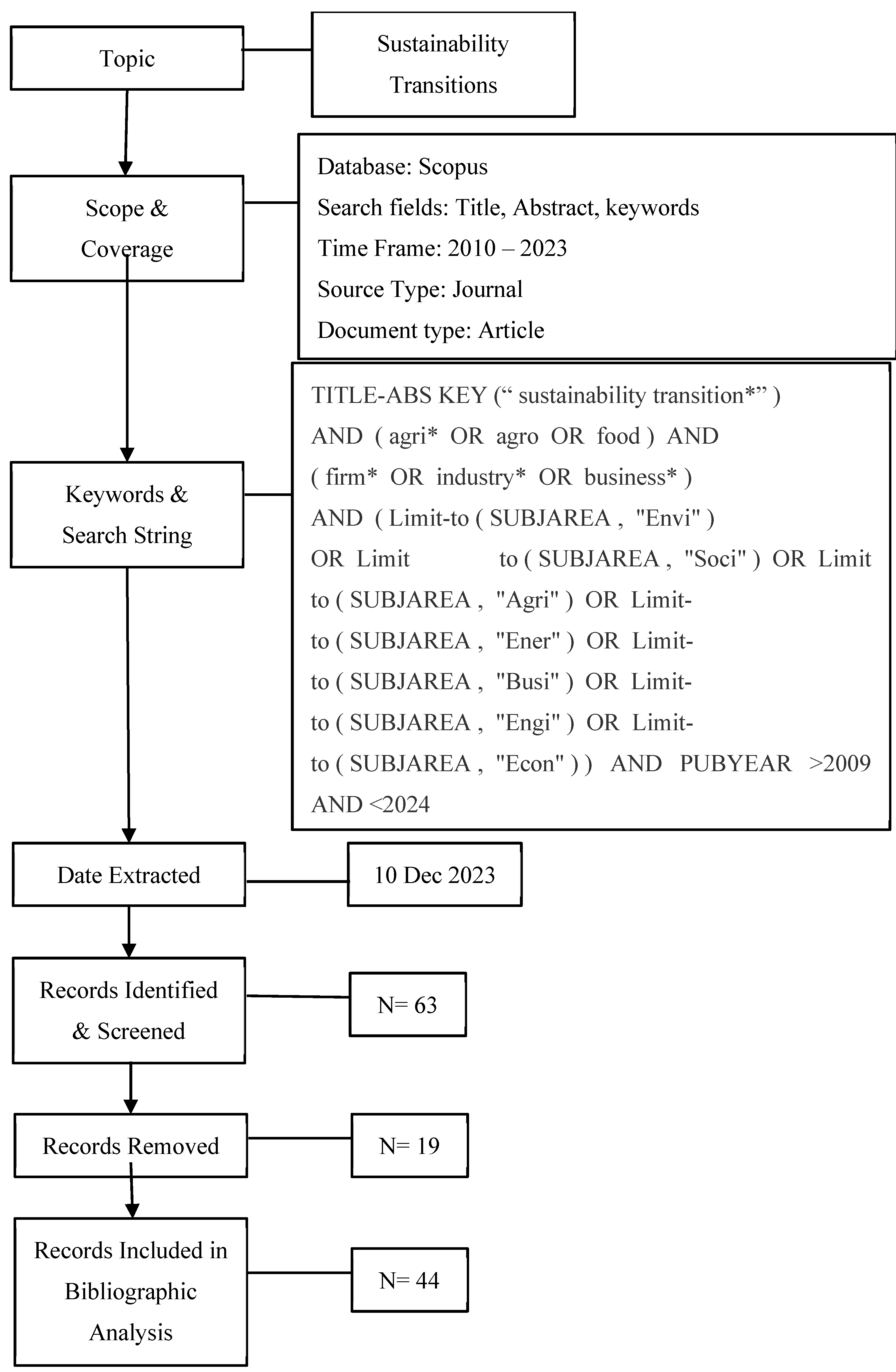
Figure 2.
Growth in publications on agrifood sustainability transitions in firms and industries.
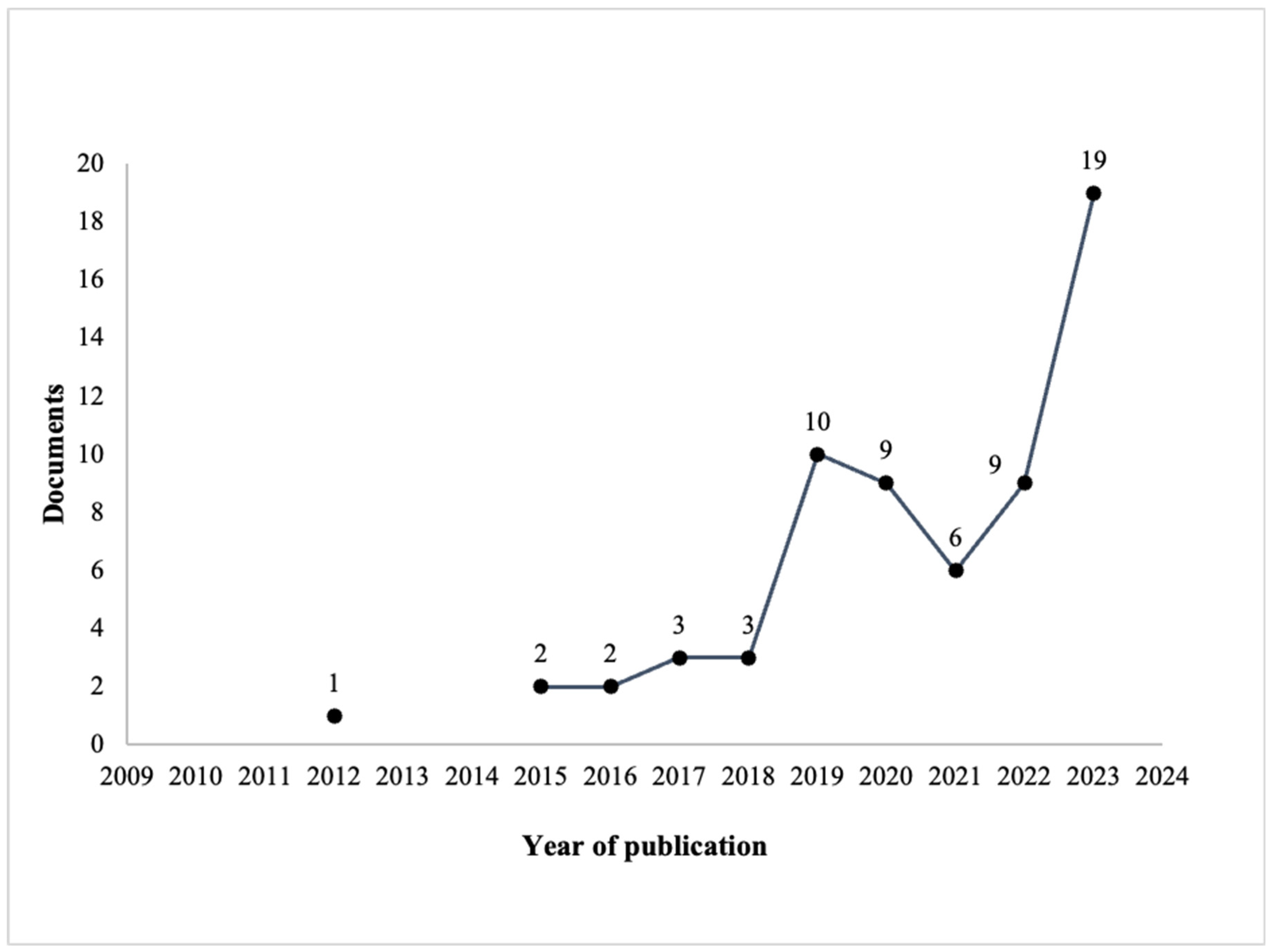
Figure 3.
Citations per year on the topic of agrifood “sustainability transitions” - The role of firms and industries.
Figure 3.
Citations per year on the topic of agrifood “sustainability transitions” - The role of firms and industries.
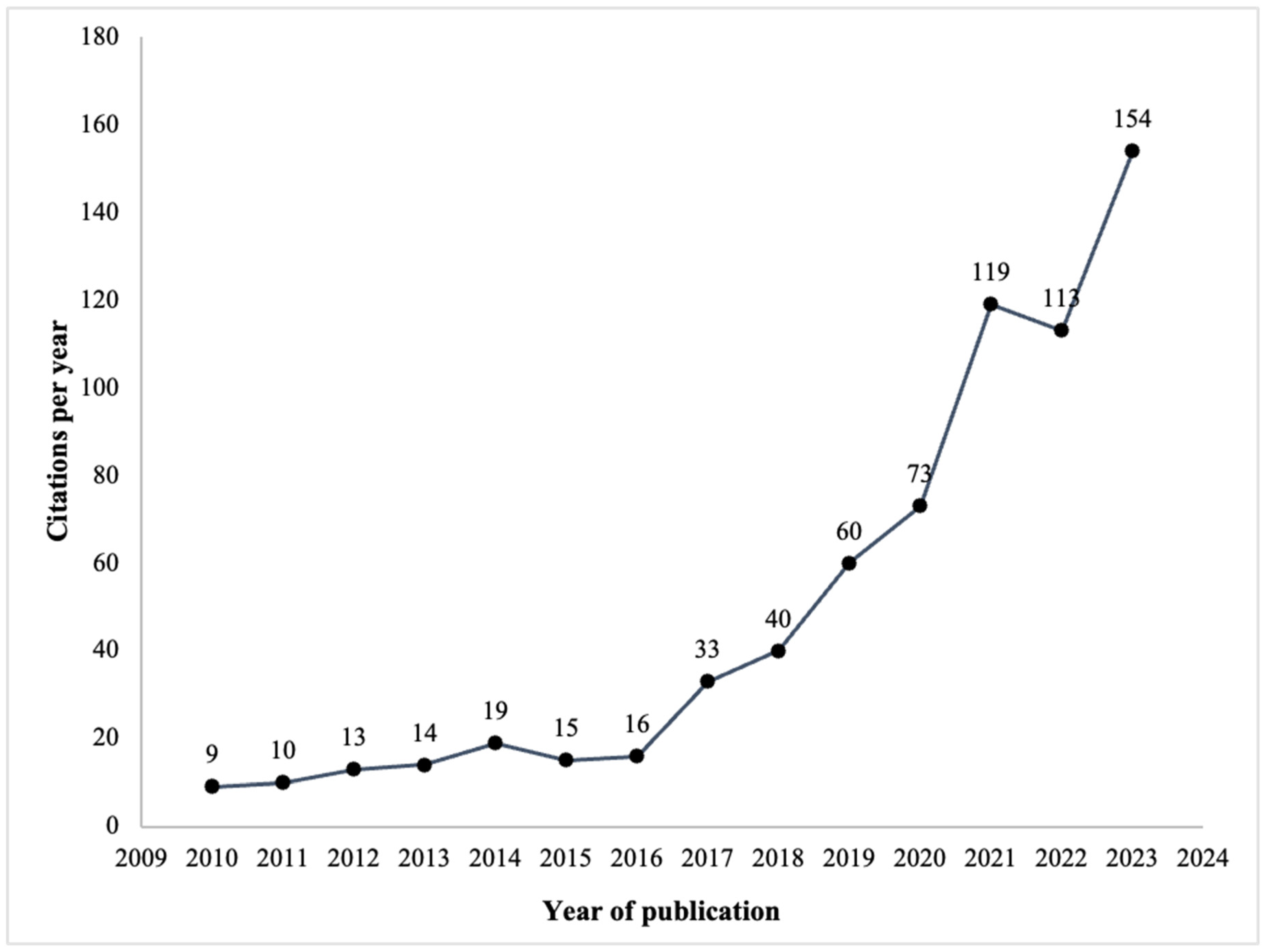
Figure 4.
Citations per year for the paper: Designing coupled innovations for the sustainability transition of agrifood systems (Meynard et al., 2017).
Figure 4.
Citations per year for the paper: Designing coupled innovations for the sustainability transition of agrifood systems (Meynard et al., 2017).
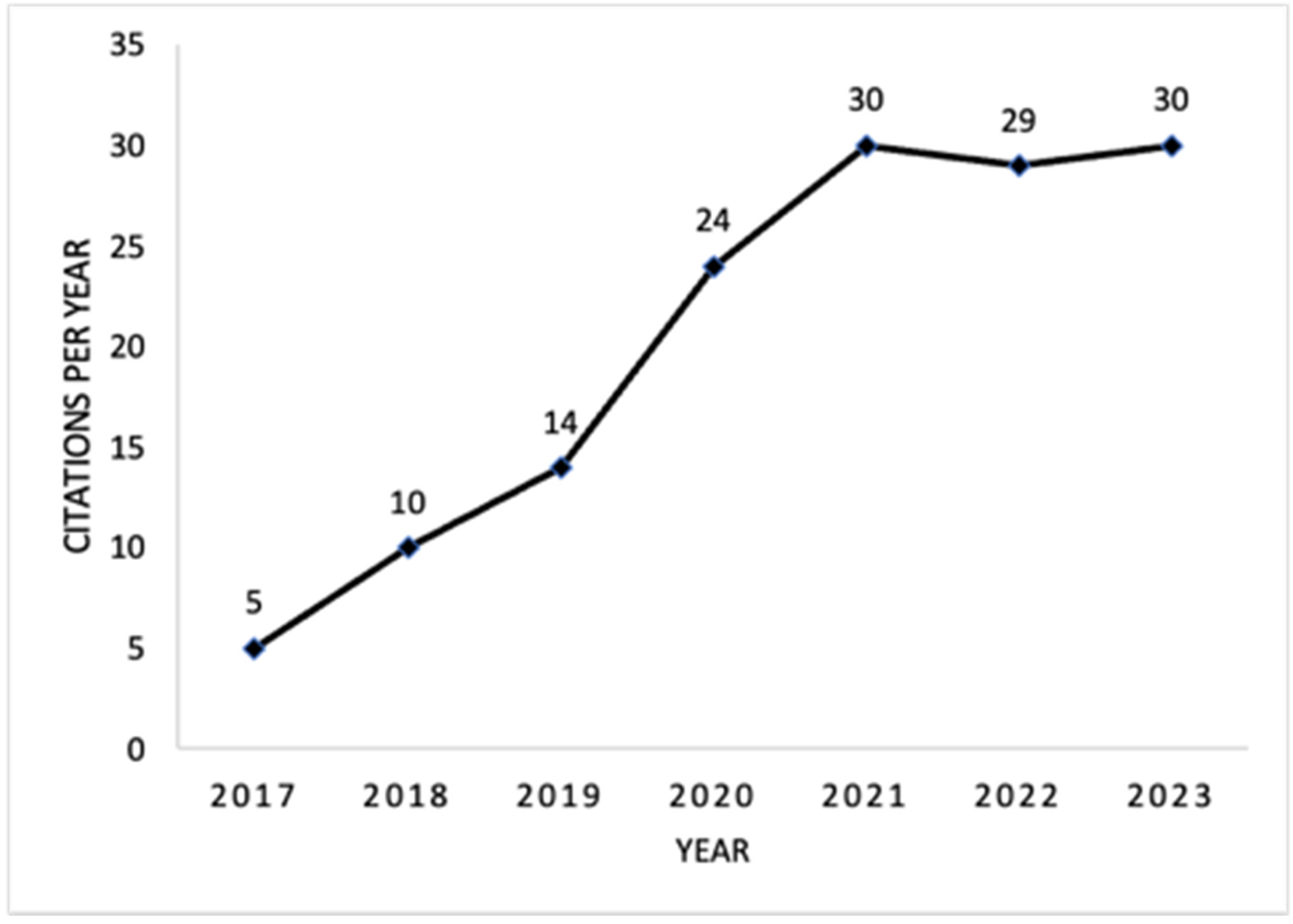
Figure 5.
VOSViewer Co-citation analysis by journal article.
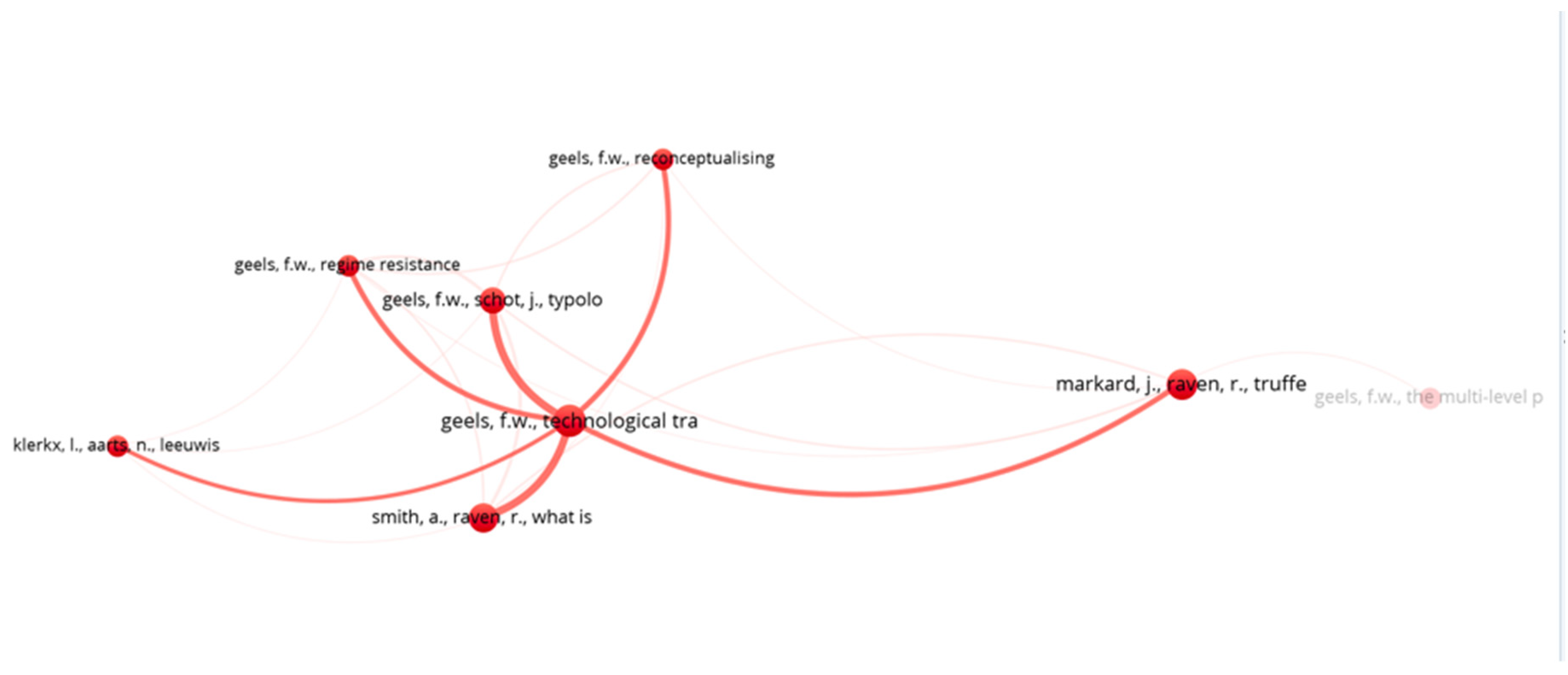
Figure 6.
VOSViewer co-citation analysis by author.
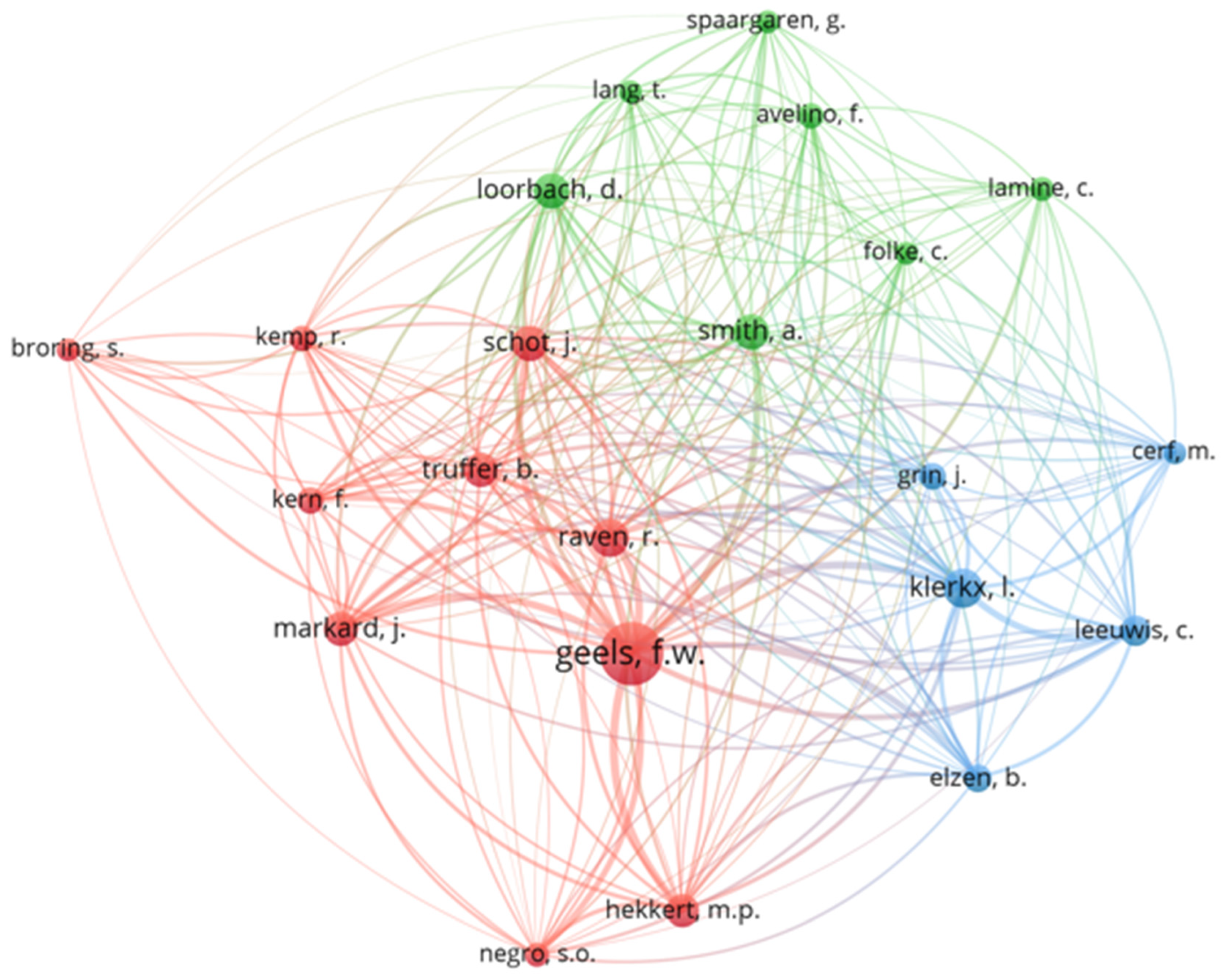
Figure 7.
Network analysis: Co-occurrence of keywords.
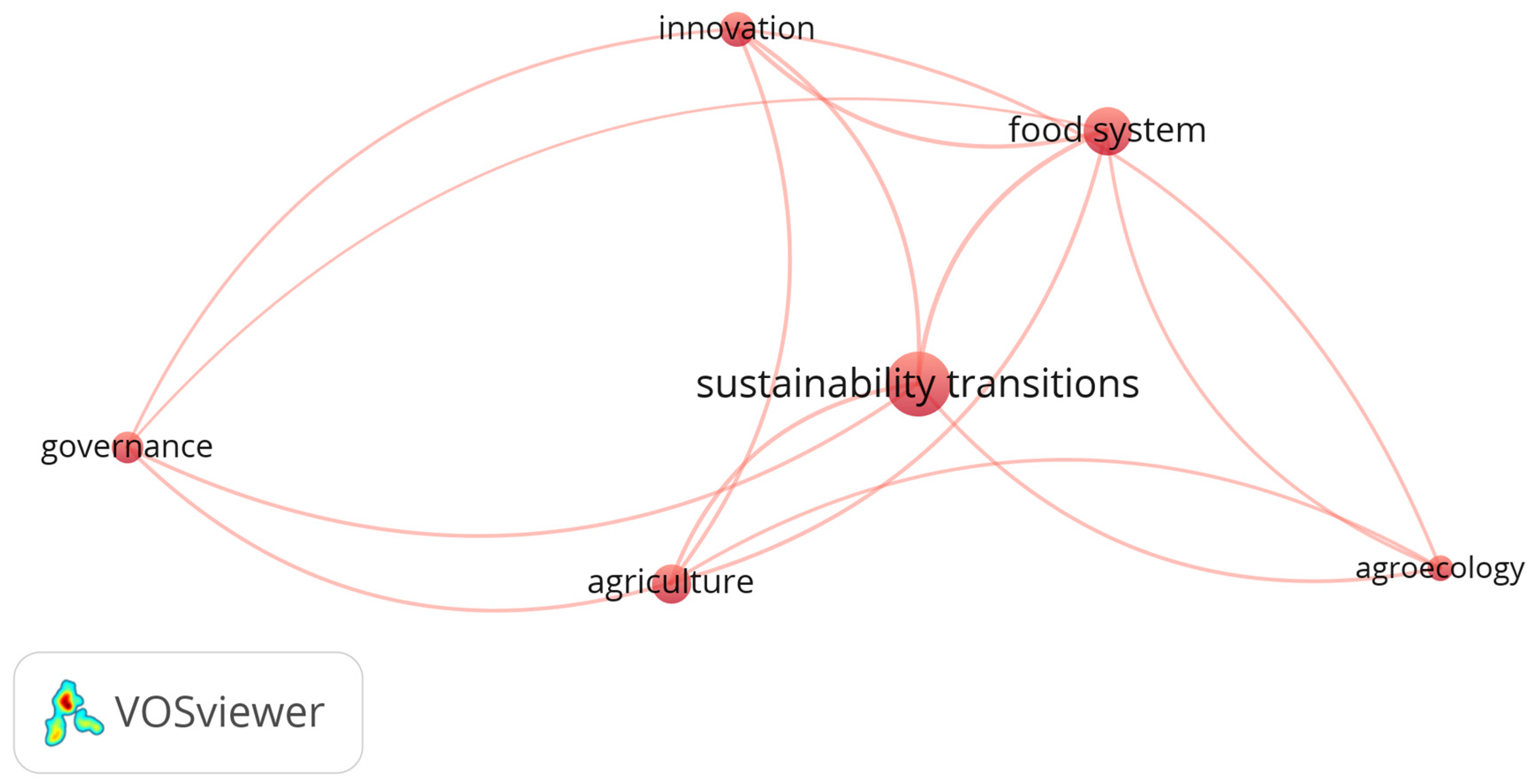

Table 1.
Publications by top 10 authors 2010 – 2023.
| Author | Publications |
| Bui, S. | 3 |
| Hekkert, M.P. | 3 |
| De Schutter, O. | 2 |
| Dedeurwaerdere, T. | 2 |
| Feola, G. | 2 |
| Giagnocavo, C. | 2 |
| Hudon, M. | 2 |
| Kuokkanen, A. | 2 |
| Mehrabi, S. | 2 |
| Moors, E. | 2 |
Table 2.
Affiliation of publications by university or research organisations publishing at least two publications.
Table 2.
Affiliation of publications by university or research organisations publishing at least two publications.
| Rank | Affiliation | No. of papers | Country |
| 1 | Wageningen University & Research | 6 | Netherlands |
| 2 | Universiteit Utrecht | 5 | Netherlands |
| 3 | Copernicus Institute of Sustainable Development | 5 | Germany |
| 4 | CNRS Centre National de la Recherche Scientifique | 3 | France |
| 5 | University of Guelph | 3 | Canada |
| 6 | Université Libre de Bruxelles | 2 | Belgium |
| 7 | Université Catholique de Louvain | 2 | Belgium |
| 8 | Lincoln University | 2 | New Zealand |
| 9 | LUT University | 2 | Finland |
| 10 | Universidad de Almería | 2 | Spain |
| 11 | Deakin University | 2 | USA |
| 12 | Groupe de Recherche en Droit, Économie et Gestion | 2 | France |
| 13 | Institut National de la Recherche Agronomique | 2 | France |
Table 3.
Publications by country.
| Country/territory | No. papers |
| Netherlands | 11 |
| Germany | 7 |
| Canada | 6 |
| France | 5 |
| Australia | 3 |
| Belgium | 3 |
| Finland | 3 |
| Italy | 3 |
| New Zealand | 3 |
| Sweden | 3 |
Table 4.
List of journals publishing more than two articles and their quality rating.
| Source | Publications | Impact factor | CiteScore | SJR | SNIP |
| Environmental Innovation and Societal Transitions | 6 | 9.4 | 13.1 | 2.4 | 1.9 |
| Sustainability | 5 | 3.9 | 5.8 | 0.7 | 1.2 |
| Agriculture and Human Values | 3 | 4.9 | 5.9 | 1.0 | 1.4 |
| Agricultural Systems | 2 | 6.8 | 11.9 | 1.6 | 2.0 |
| Agriculture | 2 | 3.4 | 3.6 | 0.6 | 1.2 |
| Business Strategy and the Environment | 2 | 10.8 | 17.8 | 2.9 | 2.8 |
| Circular Economy and Sustainability | 2 | N/A | N/A | N/A | N/A |
| Ecological Economics | 2 | 6.5 | 11.0 | 1.9 | 2.0 |
| Journal of Cleaner Production | 2 | 11.1 | 18.5 | 2.0 | 2.4 |
| Journal of Rural Studies | 2 | 5.1 | 8.1 | 1.3 | 1.9 |
Table 5.
The ten most cited papers.
| Rank | Authors | Title | Year | Source Title | Cited by |
| 1 | (Meynard et al., 2017) | Designing coupled innovations for the sustainability transition of agrifood systems. | 2017 | Agricultural Systems | 171 |
| 2 | (Vinnari & Vinnari, 2014) | A framework for sustainability transition: The case of plant-based diets. | 2014 | Journal of Agricultural and Environmental Ethics | 65 |
| 3 | (Kuokkanen et al., 2018) | Agency in regime destabilization through the selection environment: The Finnish food system’s sustainability transition. | 2018 | Research Policy | 43 |
| 4 | (El Bilali, 2018) | Relation between innovation and sustainability in the agro-food system. | 2018 | Italian Journal of Food Science | 41 |
| 5 | (Bui, 2021) | Systemic ethics and inclusive governance: Two key prerequisites for sustainability transitions of agrifood systems. | 2019 | Agriculture and Human Values | 40 |
| 6 | (Vermunt et al., 2020) | Sustainability transitions in the agrifood sector: How ecology affects transition dynamics. | 2020 | Environmental Innovation and Societal Transitions | 38 |
| 7 | (Dedeurwaerdere et al., 2017) | The governance features of social enterprise and social network activities of collective food buying groups. | 2017 | Ecological Economics | 35 |
| 8 | (Pant et al., 2014) | Adaptive transition management for transformations to agricultural sustainability in the Karnali mountains of Nepal. | 2014 | Agroecology and Sustainable Food Systems | 29 |
| 9 | (van Oers et al., 2021) | The politics of deliberate destabilisation for sustainability transitions. | 2021 | Environmental Innovation and Societal Transitions | 27 |
| 10 | (Kuokkanen et al., 2019) | A framework of disruptive sustainable innovation: An example of the Finnish food system. | 2019 | Technology Analysis and Strategic Management | 26 |
Table 6.
Co-citation of publications.
| Author(s) | Cited reference | Source | Citations | Total link strength |
| (Geels, 2002) | Technological transitions as evolutionary reconfiguration processes: a multi-level perspective and a case-study. | Research Policy | 8 | 18 |
| (Smith & Raven, 2012) | What is protective space? Reconsidering niches in transitions to sustainability. | Research Policy | 6 | 16 |
| (Geels & Schot, 2007) | Typology of socio-technical transition pathways. | Research Policy | 5 | 15 |
| (Geels, 2014b) | Regime resistance against low-carbon transitions: introducing politics and power into the multi-level perspective. | Theory Cult. Soc | 3 | 11 |
| (Markard et al., 2012) | Sustainability transitions: an emerging field of research and its prospects. | Research Policy | 7 | 9 |
| (Geels, 2014a) | Reconceptualising the co-evolution of firms-in-industries and their environments: developing an inter-disciplinary triple embeddedness framework. | Research Policy | 3 | 8 |
| (Klerkx et al., 2010) | Adaptive management in agricultural innovation systems: the interactions between innovation networks and their environment. | Agricultural Systems | 3 | 4 |
| (Geels, 2011) | The multi-level perspective on sustainability transitions: responses to seven criticisms. | Environmental Innovation and Societal Transitions | 4 | 1 |
Table 7.
Co-occurrence of keywords.
| Keywords | Occurrence | Links | Total Link strength |
| Sustainable transitions | 28 | 6 | 28 |
| Agriculture | 12 | 6 | 23 |
| Food system | 12 | 6 | 22 |
| Innovation | 10 | 5 | 21 |
| Governance | 9 | 5 | 14 |
| Agroecology | 6 | 4 | 12 |
Disclaimer/Publisher’s Note: The statements, opinions and data contained in all publications are solely those of the individual author(s) and contributor(s) and not of MDPI and/or the editor(s). MDPI and/or the editor(s) disclaim responsibility for any injury to people or property resulting from any ideas, methods, instructions or products referred to in the content. |
© 2024 by the authors. Licensee MDPI, Basel, Switzerland. This article is an open access article distributed under the terms and conditions of the Creative Commons Attribution (CC BY) license (https://creativecommons.org/licenses/by/4.0/).
Copyright: This open access article is published under a Creative Commons CC BY 4.0 license, which permit the free download, distribution, and reuse, provided that the author and preprint are cited in any reuse.


