
Submitted:
02 March 2026
Posted:
03 March 2026
You are already at the latest version
Abstract
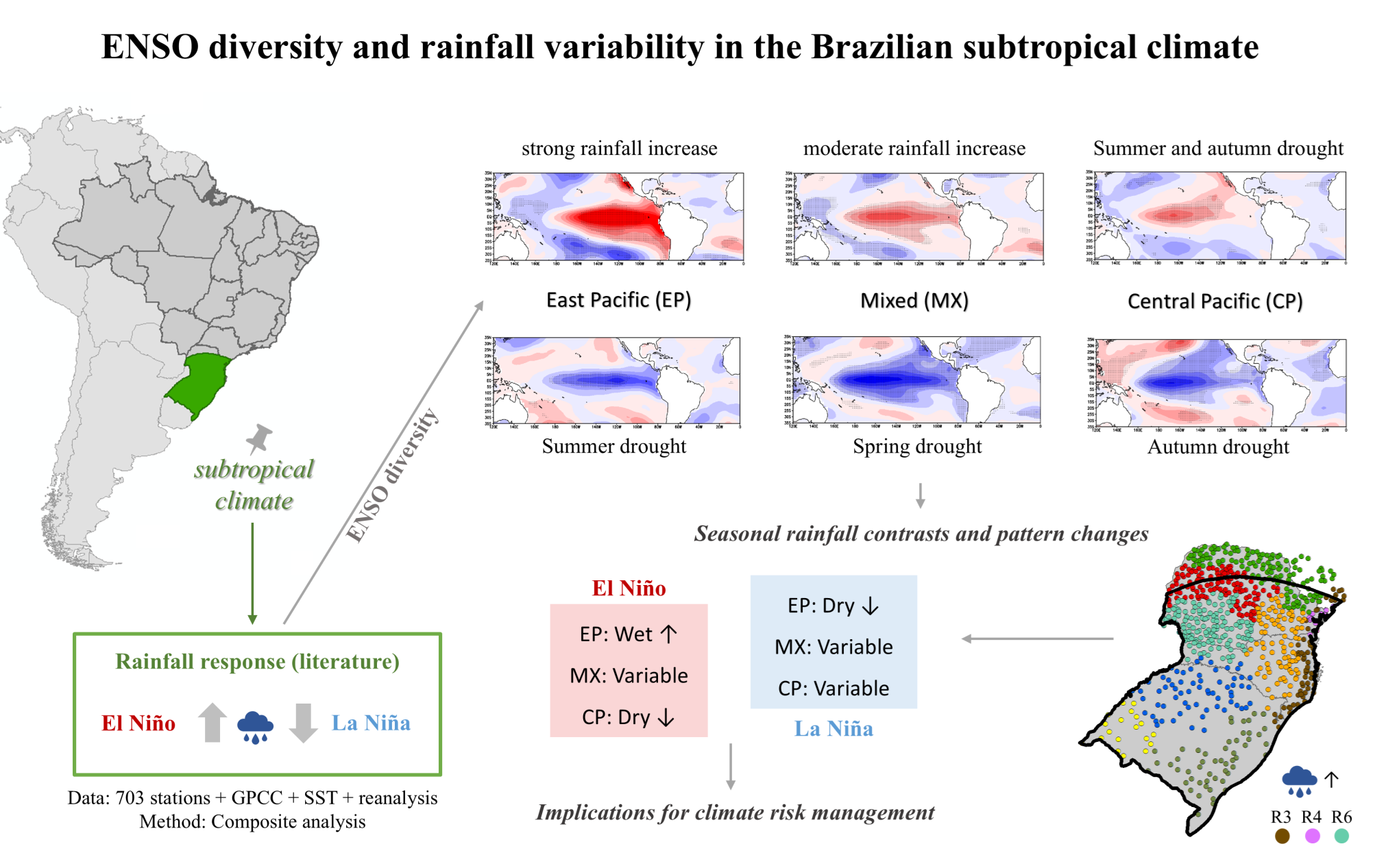
The El Niño–Southern Oscillation (ENSO) is the main driver of interannual climate variability, strongly influencing precipitation, temperature, and extreme events worldwide. In South America, its impacts are well documented. However, studies examining different ENSO types—Eastern Pacific (EP), Central Pacific (CP), and Mixed (MX), defined according to the location of sea surface temperature (SST) anomalies in the tropical Pacific—remain limited, particularly for the Brazilian subtropical climate. This study investigates rainfall variability in the Brazilian subtropical region associated with different ENSO types. Composite analyses of precipitation, wind, and SST anomalies were performed, and monthly rainfall data from 703 stations were used to identify homogeneous regions. The results show the intensity and spatial coherence of rainfall anomalies vary according to El Niño type, with EP events favoring widespread wet conditions and CP events producing more heterogeneous or locally negative anomalies. For La Niña, the intensity and seasonal distribution of negative rainfall anomalies vary by ENSO type: stronger impacts occur in summer (EP), spring (MX), and autumn (CP). These findings improve the understanding of ENSO-related rainfall variability in the Brazilian subtropical region and provide valuable insights for the management of climate-related risks in a region frequently affected by rainfall extremes.
Keywords:
climate variability
; ENSO types
; precipitation anomalies
; Southern Brazil
Copyright: This open access article is published under a Creative Commons CC BY 4.0 license, which permit the free download, distribution, and reuse, provided that the author and preprint are cited in any reuse.


