

Submitted:
28 February 2026
Posted:
03 March 2026
You are already at the latest version
Abstract
This study develops a nonlinear macro-labor framework to analyze dynamic adjustment mechanisms in European labor markets using harmonic stability theory, panel econometric modeling, and frequency-domain propagation analysis. The research investigates whether labor market interactions exhibit partial harmonic conjugacy, asymmetric transmission structures, and regime-dependent convergence behavior. Employing panel VAR estimation, DCC-GARCH volatility modeling, threshold regression, structural break testing, and spectral coherence analysis, the study provides empirical evidence of nonlinear shock propagation and spatial heterogeneity across European economies.The results confirm the existence of partial harmonic equilibrium structures, where macro-labor variables satisfy local propagation symmetry but fail to maintain global analytic consistency under crisis conditions. Structural break analysis reveals significant regime shifts during the 2008 financial crisis and the COVID-19 shock. Convergence tests indicate fragmentation between core and peripheral economies, with peripheral regions exhibiting stronger persistence, higher crisis amplification, and slower adjustment speeds. Threshold regression results demonstrate state-dependent labor market responses, particularly under high unemployment regimes.Simulation and counterfactual policy analysis show that structural reforms and coordinated policy packages generate the largest welfare gains by reducing system instability and improving harmonic synchronization. Youth unemployment dynamics display higher volatility and stronger amplification effects, highlighting demographic vulnerability. Overall, the findings suggest that European macro-labor systems operate as nonlinear, spatially heterogeneous networks characterized by regime-switching propagation dynamics.The study contributes to nonlinear macroeconomics by introducing harmonic propagation analysis as a complementary framework for understanding labor market adjustment. Policy implications emphasize the importance of structural flexibility, institutional coordination, and crisis-response mechanisms in maintaining macroeconomic stability.
Keywords:
nonlinear macroeconomics
; labor market dynamics
; harmonic equilibrium
; panel VAR
; threshold regression
; crisis amplification
; convergence clubs
; DCC-GARCH
; structural breaks
; European labor markets
1. Introduction
1.1. Motivation: Persistent Unemployment Differentials in Europe
Despite three decades of monetary integration under the European Central Bank and the creation of the European Monetary Union, unemployment differentials across European countries remain large and persistent. Core economies such as Germany and the Netherlands have exhibited relatively stable and declining unemployment rates since the early 2000s, while periphery economies—most notably Greece and Spain—have experienced recurrent surges and prolonged periods of labor market distress, particularly during the Global Financial Crisis (2008–2009), the Sovereign Debt Crisis (2011–2012), and the COVID-19 shock (2020).
These divergences challenge the conventional convergence hypothesis embedded in the optimal currency area framework. Even under a common monetary policy, national labor markets display heterogeneous adjustment speeds, asymmetric shock absorption, and different persistence patterns. Empirically, unemployment volatility in periphery countries has been almost twice as high as in core economies, while wage adjustment has been markedly slower and more nonlinear.
Such stylized facts suggest that labor markets may not simply adjust along a linear trade-off between wages and unemployment. Instead, they may evolve as coupled dynamic systems with feedback, persistence, and nonlinear oscillations. This paper proposes that the joint evolution of unemployment utu_tut and real wage growth wtw_twt can be modeled as a complex dynamic system whose equilibrium properties are better understood through complex analytic methods.
1.2. Phillips Curve Breakdown and Nonlinear Labor Adjustment
The original empirical relationship documented by A. W. Phillips in 1958 suggested a stable inverse relationship between unemployment and wage inflation in the United Kingdom. Subsequent theoretical refinements by Milton Friedman (1968) and Edmund Phelps (1967) introduced expectations, eliminating the long-run trade-off and giving rise to the expectations-augmented Phillips curve.
Modern formulations, notably the New Keynesian Phillips Curve developed by Jordi Galí and Mark Gertler (1999), embed forward-looking price-setting behavior and marginal cost dynamics into a micro-founded framework. However, empirical evidence for Europe after 2008 indicates a flattening of the Phillips curve, weakened wage pass-through, and substantial regime dependence.
In particular, during crisis episodes, wage–unemployment interactions exhibit amplification effects rather than smooth linear adjustment. Threshold regressions reveal that the slope of the Phillips curve becomes steeper when unemployment exceeds critical levels, suggesting nonlinear dynamics. Moreover, hysteresis mechanisms emphasized by Assar Lindbeck and Dennis Snower imply that temporary shocks may permanently alter equilibrium unemployment.
These findings motivate a departure from purely linear differential systems toward a framework capable of capturing oscillatory, spiral, and regime-dependent adjustment patterns.
1.3. Complex Analytic Equilibrium Hypothesis
We propose the Complex Analytic Equilibrium Hypothesis (CAEH):
The joint dynamics of unemployment utu_tut and wage growth wtw_twt can be represented as the real and imaginary components of a holomorphic function defined on a complex state space.
Formally, define the complex labor market state:
If labor market adjustment is holomorphic, then satisfies the Cauchy–Riemann conditions:
Under holomorphy, both components are harmonic:
Economically, harmonicity implies that deviations from equilibrium dissipate smoothly without generating explosive divergence. Violations of these conditions correspond to structural breaks, crisis amplification, or institutional rigidities.
This representation generalizes standard dynamic systems:
Into a single analytic equation:
where the properties of determine whether adjustment is a stable node, damped spiral, limit cycle, or unstable trajectory.
1.4. Harmonic Conjugacy Between Wage Growth and Unemployment
If and satisfy the Cauchy–Riemann system, then they are harmonic conjugates. In economic terms, this implies that wage growth and unemployment are not merely negatively correlated but structurally interdependent through orthogonal adjustment gradients.
Let productivity shocks be represented along the x-axis and demand shocks along the y-axis. Harmonic conjugacy implies:
- Productivity improvements reduce unemployment if and only if they raise wages proportionally.
- Demand shocks generate rotational adjustment in the (u, w) plane, producing cyclical paths rather than straight-line convergence.
This interpretation aligns with dynamic correlation evidence from DCC-GARCH estimations, where unemployment–wage correlations intensify during crises and weaken during expansions. The negative correlation documented in European panel data (approximately −0.57 on average) reflects a near-harmonic structure rather than a simple static trade-off.
Moreover, recent frequency-domain studies of European labor markets show significant phase synchronization between wage growth and unemployment at business-cycle frequencies, consistent with Hilbert transform–based measures of phase coherence. Such synchronization is precisely what harmonic conjugacy predicts: synchronized oscillations with phase shifts of approximately .
Thus, the breakdown of the linear Phillips curve may not indicate the disappearance of structural linkage, but rather the emergence of a higher-order harmonic structure governing labor market adjustment.
Figure 1 presents the joint evolution of unemployment and real wage growth across European countries between 2000 and 2025. The figure illustrates a clear and persistent negative co-movement between the two variables, consistent with a Phillips-type relationship but characterized by strong time variation and regime dependence. During expansionary phases—particularly 2000–2007 and 2014–2019—declining unemployment rates are accompanied by accelerating real wage growth. Conversely, during crisis episodes (2008–2009, 2011–2012, and 2020), unemployment rises sharply while wage growth decelerates or turns negative.
However, the co-movement is not linear. The slope of the unemployment–wage relationship appears steeper during high-unemployment regimes, especially in the aftermath of the Global Financial Crisis and the Sovereign Debt Crisis. This suggests that wage adjustment is more sensitive when labor market slack becomes extreme, consistent with threshold effects and nonlinear Phillips curve specifications. In contrast, during low-unemployment periods, wage growth responds more gradually, indicating flattening dynamics similar to those documented in recent European studies.
A second stylized feature is the presence of oscillatory adjustment patterns. Rather than moving along a single downward-sloping curve, the trajectories form cyclical loops over time. After major shocks, wage growth initially falls with rising unemployment, but subsequent recovery phases show lagged wage acceleration even before unemployment fully returns to pre-crisis levels. This rotational behavior implies dynamic feedback between wages and labor market slack, consistent with a coupled system rather than a static trade-off.
Cross-country heterogeneity is also visible. Core economies exhibit smaller amplitude fluctuations and faster return to pre-shock trajectories, while periphery countries display larger swings and prolonged deviations. For example, the unemployment surge in Greece and Spain after 2010 is associated with deeper wage contractions and slower recovery, indicating stronger amplification effects. This divergence supports the hypothesis that institutional and structural characteristics influence adjustment speed and stability.
Finally, the strengthening of the negative correlation during crisis periods suggests regime-dependent synchronization. Dynamic correlation evidence indicates that unemployment and wage growth become more tightly (negatively) linked when shocks are large. This pattern aligns with the harmonic adjustment hypothesis proposed in the paper: the co-movement resembles phase-locked oscillations, where unemployment and wages behave as interdependent components of a joint dynamic system.
Overall, Figure 1 demonstrates that the European unemployment–wage relationship over 2000–2025 is persistent but nonlinear, crisis-sensitive, and oscillatory. These empirical regularities motivate the move beyond a simple linear Phillips curve toward a dynamic framework capable of capturing feedback, amplification, and harmonic structure in labor market adjustment.
Figure 2 provides a conceptual bridge between the traditional Phillips curve framework and the proposed complex harmonic representation of labor market dynamics. The figure illustrates how the standard inverse unemployment–wage relationship evolves into a multidimensional dynamic system when nonlinearities, feedback effects, and regime dependence are incorporated.
In the left panel, the traditional Phillips curve is depicted as a downward-sloping relationship between unemployment and wage (or price) inflation, following the original contribution of A. W. Phillips and later refinements by Milton Friedman and Edmund Phelps. In this representation, the labor market equilibrium is defined by a static or quasi-static trade-off, possibly shifted by expectations. Adjustment occurs along a curve, and deviations are typically interpreted as movements driven by demand shocks or policy interventions.
The middle section of the figure introduces dynamic feedback. Instead of a single curve, unemployment and wage growth are represented as jointly determined variables within a system of differential equations. This aligns with modern macro-labor approaches such as the New Keynesian framework developed by Jordi Galí and Mark Gertler, where forward-looking expectations and marginal cost channels create intertemporal interactions. Here, equilibrium is no longer a point on a curve but a dynamic steady state, and adjustment may exhibit persistence or damped oscillations.
The right panel presents the core innovation: the mapping of unemployment utu_tut and wage growth wtw_twt into a complex plane representation, . In this structure, the traditional negative slope of the Phillips curve becomes the real–imaginary interaction of a holomorphic function. Instead of linear trade-offs, the system evolves through rotational and spiral trajectories around a harmonic equilibrium. Deviations are interpreted geometrically as movements in phase space rather than simple vertical or horizontal shifts.
The conceptual shift is crucial. Under the complex harmonic structure, equilibrium requires satisfaction of Cauchy–Riemann conditions, implying that unemployment and wage growth are harmonic conjugates. This means that local adjustments in one variable generate orthogonal gradients in the other, producing cyclical paths rather than straight-line convergence. In practical terms, crisis episodes generate amplified spiral deviations, while stable institutional environments yield damped convergence toward equilibrium.
Figure 2 therefore visualizes the theoretical progression:
- Static trade-off (Phillips curve) →
- Dynamic nonlinear system (intertemporal macro-labor models) →
- Complex analytic equilibrium (harmonic conjugate adjustment).
The figure clarifies that the proposed framework does not reject the Phillips relationship; instead, it embeds it within a richer geometric structure. The negative unemployment–wage correlation becomes a projection of a deeper harmonic system. Consequently, apparent flattening or breakdown of the Phillips curve can be reinterpreted as changes in amplitude, phase, or stability within the complex plane rather than disappearance of structural linkage.
Overall, Figure 2 conceptually demonstrates how labor market theory transitions from a linear empirical regularity to a multidimensional dynamic system governed by harmonic stability conditions, providing the analytical foundation for the empirical strategy developed in the paper.

Table 1.
Summary of competing theoretical frameworks.
| Framework | Key_Mechanism | Main_Prediction | Key_Authors | Empirical_Support |
|---|---|---|---|---|
| Classical Phillips Curve | Inverse u-w relationship | Trade-off between u and π | Phillips (1958) | Mixed (short-run only) |
| Expectations-Augmented Phillips Curve | Inflation expectations shift curve | No long-run trade-off | Friedman (1968), Phelps (1967) | Strong (expectations matter) |
| New Keynesian Phillips Curve | Forward-looking price setting | Marginal cost drives inflation | Galí & Gertler (1999) | Moderate (micro-founded) |
| Search and Matching (DMP) | Matching frictions, vacancy posting | Beveridge curve, wage curve | Diamond, Mortensen, Pissarides | Strong (labor flows) |
| Efficiency Wage Theory | Productivity-wage link | Wage above market-clearing | Shapiro & Stiglitz (1984) | Moderate (wage premia) |
| Insider-Outsider Theory | Labor market segmentation | Hysteresis in unemployment | Lindbeck & Snower (1988) | Strong (European evidence) |
| Wage Bargaining Models | Union-firm negotiations | Wage rigidity, rent sharing | McDonald & Solow (1981) | Strong (collective bargaining) |
| Complex Analytic Equilibrium | Holomorphic adjustment dynamics | Spiral convergence to equilibrium | This paper | To be tested |
| Harmonic Labor Market Theory | Cauchy-Riemann equilibrium conditions | Harmonic conjugate adjustment | This paper | To be tested |
Table 2 summarizes the core empirical regularities of European labor markets between 2000 and 2025 and provides the empirical motivation for modeling unemployment and wage dynamics within a harmonic structure framework. Several stylized facts stand out.
First, persistent level differences are evident between core and periphery countries. The average unemployment rate in the full sample is 9.0%, but this masks a structural gap: 8.0% in core economies versus 11.1% in periphery economies. This persistent divergence suggests that labor markets do not converge smoothly toward a single equilibrium. Instead, equilibrium appears country-specific and potentially governed by different stability regimes, consistent with heterogeneous harmonic basins of attraction.
Second, volatility asymmetry is pronounced. Unemployment volatility is substantially higher in periphery countries (3.53) than in core economies (2.38). Wage growth volatility exhibits a similar pattern (2.03 vs 1.24). This indicates that peripheral labor markets display higher amplitude oscillations in the unemployment–wage space. In a harmonic interpretation, this corresponds to larger-radius cycles or weaker damping parameters, implying slower convergence and greater sensitivity to shocks.
Third, average real wage growth is structurally lower in the periphery (0.77%) compared to the core (1.69%). Combined with higher unemployment, this suggests a lower steady-state position in the complex plane representation Z=u+iwZ = u + iwZ=u+iw. The joint presence of high unemployment and weak wage growth implies a larger modulus ∣Z∣|Z|∣Z∣, reflecting greater labor market stress and distance from harmonic equilibrium.
Fourth, the negative unemployment–wage correlation is strong across all groups (−0.574 overall) and even stronger in the periphery (−0.721). This intensified negative correlation indicates tighter phase synchronization between unemployment and wage growth in high-stress environments. In harmonic terms, this reflects stronger coupling between the real and imaginary components of the system, particularly during periods of macroeconomic instability.
Fifth, crisis amplification effects are clearly asymmetric. During the Global Financial Crisis (GFC), unemployment increased by 0.9 percentage points in the full sample, but by 1.3 points in the periphery. The Sovereign Debt Crisis had an especially severe impact in peripheral economies (+4.9pp), while the COVID shock produced sharp increases everywhere but again slightly larger in the periphery. These asymmetric responses indicate regime-dependent amplification, consistent with deviations from harmonic stability during extreme shocks.
Sixth, structural fragility appears in youth labor markets. The youth unemployment ratio (relative to total unemployment) is nearly twice the overall rate (1.93×), and reaches 2.19× in the periphery. This suggests that youth unemployment behaves as a higher-frequency component of the same system, with greater oscillation amplitude and weaker harmonic conformity.
Seventh, the share of long-term unemployment remains high and stable (32%) across groups. Persistent long-term unemployment signals hysteresis effects, implying that shocks may shift the system’s equilibrium rather than generate purely temporary deviations. In harmonic language, this may correspond to structural shifts in the center of rotation or changes in damping coefficients.
Eighth, labor market tightness trends diverge. Core economies show relatively stable tightness, while the periphery exhibits sharp declines. This structural weakening of matching efficiency is consistent with weaker restoring forces in the dynamic system, again suggesting slower convergence toward equilibrium.
Finally, productivity growth has declined significantly across Europe, particularly in the periphery (from 0.75% to near zero). Since productivity is a fundamental driver of wage dynamics, its slowdown reduces the stabilizing link between wages and employment. In harmonic terms, weakening productivity reduces the strength of the conjugate relationship, potentially increasing oscillatory instability.
Taken together, these stylized facts reveal:
- Persistent cross-country divergence,
- Asymmetric volatility,
- Strong but regime-dependent negative correlation,
- Crisis amplification and hysteresis,
- Structural productivity slowdown.
These empirical regularities are difficult to reconcile with a simple linear Phillips curve. Instead, they suggest a coupled dynamic system with heterogeneous damping, amplitude, and stability properties—precisely the features captured by the harmonic structure hypothesis.
2. Theoretical Framework
This section develops the theoretical foundations of the paper. We begin by reviewing classical and modern approaches to wage–unemployment dynamics and then introduce the complex analytic representation that generalizes these models into a unified harmonic equilibrium framework.
2.1. Classical and Modern Wage–Unemployment Theories
(i) The Phillips Curve
The empirical relationship between unemployment and wage inflation was first documented by A. W. Phillips (1958), who identified a stable inverse correlation in UK data. The original Phillips curve can be written as:
where w˙t\dot{w}_tw˙t denotes wage inflation and utu_tut unemployment.
The expectations-augmented version proposed by Milton Friedman (1968) and Edmund Phelps (1967) introduced adaptive or rational expectations:
where u∗u^*u∗ is the natural rate of unemployment. In this framework, the long-run Phillips curve is vertical.
More recently, the New Keynesian Phillips Curve (NKPC), developed by Jordi Galí and Mark Gertler (1999), relates inflation to expected future inflation and real marginal costs:
Although micro-founded, the NKPC implies relatively weak wage–unemployment sensitivity in low-inflation regimes, contributing to the observed flattening of the Phillips curve in Europe after 2008.
(ii) Efficiency Wage Theories
Efficiency wage models, formalized by Carl Shapiro and Joseph Stiglitz (1984), explain persistent unemployment as an equilibrium outcome of incentive-compatible wage setting. Firms pay wages above the market-clearing level to prevent shirking:
where effort ete_tet depends negatively on unemployment.
These models generate wage rigidity and equilibrium unemployment without requiring nominal rigidities. Importantly, unemployment and wages are jointly determined in a nonlinear system, providing early theoretical support for feedback-based representations.
(iii) Search and Matching Models
The Diamond–Mortensen–Pissarides framework, developed by Peter Diamond, Dale Mortensen, and Christopher Pissarides, models unemployment as the outcome of matching frictions:
where M denotes matches, uuu unemployment, and vvv vacancies.
Wage determination typically follows Nash bargaining:
where b is the outside option and ptp_tpt productivity.
This framework emphasizes labor market tightness and dynamic adjustment through job creation and destruction. Importantly, unemployment and wages co-evolve dynamically, often generating oscillatory transitional dynamics after productivity or demand shocks.
(iv) Hysteresis and Insider–Outsider Models
Hysteresis, emphasized by Olivier Blanchard and Lawrence Summers (1986), and by Assar Lindbeck and Dennis Snower (1988), suggests that temporary shocks can permanently alter equilibrium unemployment:
This persistence implies path dependence and slow mean reversion.
Together, these models indicate that wage–unemployment dynamics are nonlinear, persistent, and potentially oscillatory—features that motivate a unified complex dynamic representation.
2.2. Complex Analytic Representation
To unify these theories, define the complex labor market state:
Here:
- u(t) is unemployment (real part),
- w(t) is real wage growth (imaginary part).
Suppose the dynamics are governed by a complex differential equation:
where F is analytic (holomorphic).
(i) Cauchy–Riemann Conditions
If is analytic, then:
These are the Cauchy–Riemann (CR) conditions.
Economically, they imply that changes in unemployment along one structural dimension must correspond to orthogonal changes in wage growth. This captures the idea of systematic co-movement rather than ad hoc correlation.
(ii) Harmonic Conjugacy
If uuu and www satisfy CR conditions, then they are harmonic conjugates. Each function solves Laplace’s equation:
Harmonic functions minimize local curvature and imply smooth adjustment without internal sources of instability.
In economic terms, harmonic conjugacy means that unemployment and wage growth are structurally interdependent components of a single analytic system.
(iii) Laplace Equations and Equilibrium
The Laplacian operator:
measures curvature. If , unemployment lies at a local equilibrium consistent with smooth diffusion of shocks.
Violations of harmonicity correspond to structural breaks, crisis amplification, or institutional rigidities.
2.3. Dynamic Stability and Equilibrium
Linear Stability
Linearizing around steady state Z∗Z^*Z∗:
Eigenvalues λ\lambdaλ of AAA determine stability:
- Re(λ) < 0: stable node or spiral
- Re(λ) = 0: limit cycle
- Re(λ) > 0: unstable
Complex eigenvalues generate oscillatory adjustment:
Here, controls damping and cyclical frequency.
Nonlinear Stability
Nonlinear dynamics may generate:
- Damped spirals (stable harmonic regime)
- Limit cycles (persistent oscillation)
- Explosive spirals (crisis regime)
These correspond to different institutional and macroeconomic environments across Europe.
Economic Interpretation
The complex framework nests:
- Phillips trade-offs (projection on real axis),
- Search-matching cycles (rotational dynamics),
- Hysteresis (shifted equilibrium center),
- Efficiency wage rigidity (reduced damping).
Thus, the labor market equilibrium is reinterpreted as a harmonic steady state in the complex plane, with crises representing temporary violations of analytic stability.
Figure 3 illustrates the labor market equilibrium in the complex plane by representing unemployment and wage growth as the real and imaginary components of a single dynamic variable. At each moment in time, the state of the labor market is summarized by the complex number , where unemployment lies on the horizontal axis and real wage growth on the vertical axis. Instead of analyzing these variables separately—as in the traditional Phillips curve—the figure integrates them into a unified geometric framework.
In this representation, equilibrium appears as a fixed point . The coordinate corresponds to structural or natural unemployment, while reflects equilibrium real wage growth consistent with productivity growth and price stability. When the system is dynamically stable, trajectories displaced by shocks—such as financial crises or pandemics—tend to converge back toward this point. Thus, equilibrium is not a static trade-off curve but a dynamic attractor in the wage–unemployment space.
The adjustment path around equilibrium typically takes the form of spirals or rotations rather than straight-line movements. This reflects the presence of complex eigenvalues in the underlying dynamic system, implying oscillatory behavior. Economically, a negative demand shock first increases unemployment (movement along the real axis), then weakens wage growth (movement along the imaginary axis), producing a rotational pattern. During recovery, the process reverses direction. These loops explain why empirical data often show cyclical co-movements between unemployment and wages rather than a stable, linear Phillips curve relationship.
The distance from equilibrium—the modulus of the complex variable—captures the intensity of labor market imbalance. Periods such as the Global Financial Crisis or the COVID shock would appear as outward movements away from the equilibrium point, reflecting heightened unemployment and disrupted wage dynamics. As stabilization mechanisms operate, trajectories spiral inward, indicating partial restoration of balance. Hence, the geometry of the complex plane provides a synthetic measure of labor market stress.
Differences across European country groups can also be interpreted within this framework. Core economies are likely characterized by smaller oscillations and faster convergence toward equilibrium, reflecting stronger institutional stabilization mechanisms. Peripheral economies, by contrast, may exhibit larger-radius spirals and slower damping, indicating weaker restoring forces and greater sensitivity to shocks. In this sense, cross-country heterogeneity is expressed geometrically through differences in amplitude, frequency, and convergence speed.
Overall, Figure 3 reframes labor market equilibrium as a dynamic geometric process. Rather than viewing unemployment and wages as linked through a static curve, the complex-plane representation portrays them as components of an integrated oscillatory system. Stability, persistence, and crisis amplification are reflected not only in levels and correlations but in the shape, rotation, and radius of trajectories in the complex wage–unemployment space.
Figure 4 provides a theoretical illustration of harmonic conjugate functions applied to unemployment and wage dynamics. In this framework, unemployment and wage growth are not treated as independent variables but as mathematically linked components of a single complex potential function. The figure visualizes how the two functions are intertwined through harmonic structure, meaning that changes in one dimension systematically induce adjustments in the other.
The harmonic conjugacy condition implies that unemployment and wage growth satisfy the Cauchy–Riemann relationships. Economically, this means that the local slope of the unemployment surface determines the curvature of the wage surface, and vice versa. If unemployment increases in a given direction, wage growth must adjust orthogonally to preserve the harmonic structure. In the figure, this appears as two smooth surfaces or contour maps whose gradients are perpendicular at every point. The orthogonality represents the internal consistency of labor market adjustment.
The key implication is that both unemployment and wage growth satisfy Laplace’s equation, meaning they are harmonic functions. This ensures smoothness and the absence of internal discontinuities in equilibrium conditions. In economic terms, shocks propagate through the system without generating arbitrary kinks or breaks; instead, disturbances diffuse across the labor market in a structured and continuous way. The figure typically illustrates this with smooth contour lines, where peaks in unemployment correspond to saddle-like adjustments in wage growth.
Another important interpretation concerns potential functions. When unemployment and wage growth are harmonic conjugates, they can be derived from a single complex analytic function . This unification implies that the apparent trade-off between wages and unemployment is not merely empirical but structural. Wage growth is the harmonic counterpart of unemployment: they are dual aspects of the same equilibrium field.
Graphically, the figure often shows sinusoidal or wave-like forms, emphasizing that harmonic functions resemble oscillatory patterns. This mirrors the cyclical nature of labor markets. Expansion phases correspond to smooth upward wage adjustments and declining unemployment, while contraction phases reflect the opposite movement, yet always within a coherent harmonic structure.
The broader economic interpretation is that labor market equilibrium is not defined by a single static curve but by a harmonic field in which unemployment and wages co-evolve according to deep mathematical constraints. The theoretical illustration in Figure 4 therefore provides the analytical foundation for the complex-plane representation: it demonstrates that wage growth is not simply negatively correlated with unemployment but is mathematically conjugate to it, ensuring structured, continuous, and dynamically consistent adjustment over time.
Figure 5 presents the phase portrait of the labor market system under linear adjustment dynamics. In this setting, unemployment and wage growth evolve according to a linearized system around their steady state. The phase portrait plots unemployment on one axis and wage growth on the other, illustrating how the system moves over time depending on its initial conditions.
Under linear adjustment, the dynamics can be approximated by a first-order system in deviations from equilibrium. The steady state appears as a fixed point at the center of the diagram. The nature of this point—whether it is a stable node, saddle point, or spiral—depends on the eigenvalues of the Jacobian matrix governing the system. In most empirically relevant cases for European labor markets, the phase portrait exhibits a stable spiral. This means that when the economy is displaced from equilibrium by a shock, unemployment and wage growth adjust gradually, tracing inward rotations until convergence is achieved.
The rotational pattern reflects the cyclical interaction between the two variables. For example, a negative demand shock initially raises unemployment sharply. Wage growth then decelerates with a lag, reinforcing adjustment. As unemployment begins to fall during recovery, wage growth gradually strengthens. These delayed responses generate curved trajectories rather than straight-line convergence. The system overshoots in both dimensions before gradually stabilizing, producing damped oscillations.
If the adjustment coefficients are small, convergence is slow and the spirals are wide, indicating persistent cycles. If the coefficients are larger, the spirals tighten, showing rapid stabilization. In the special case where the eigenvalues are purely real and negative, the portrait would display monotonic convergence without oscillations—direct paths toward equilibrium. Conversely, if one eigenvalue is positive, the equilibrium becomes unstable, and trajectories diverge outward, signaling structural fragility.
Economically, the phase portrait under linear adjustment highlights that even simple linear rules can generate cyclical wage–unemployment dynamics. The curvature of trajectories captures the negative feedback mechanism embedded in wage-setting and labor demand decisions. However, because the adjustment is linear, the system assumes constant responsiveness across regimes. This limits its ability to capture crisis amplification or nonlinear wage rigidity, which would appear as distortions or asymmetries in the portrait.
Overall, Figure 5 demonstrates how a linearized labor market model produces predictable geometric dynamics in the wage–unemployment space. It serves as a benchmark against which nonlinear or harmonic structures can be compared, clarifying how stability, oscillation, and convergence emerge from the underlying adjustment parameters.
Figure 6 illustrates nonlinear spiral dynamics in the complex labor market equilibrium framework. Unlike the linear phase portrait, where trajectories exhibit symmetric and proportionate convergence toward equilibrium, the nonlinear specification allows the speed and direction of adjustment to depend on the magnitude of deviations. As a result, the spiral paths in the complex plane are no longer uniform or perfectly elliptical; instead, they display asymmetry, regime dependence, and varying curvature.
In this figure, unemployment and wage growth are jointly represented as the complex variable , and the equilibrium appears as a nonlinear attractor. When the system is close to equilibrium, adjustments are relatively smooth and moderately damped. However, as the economy moves further away—such as during major crises—the restoring forces weaken or strengthen in a nonlinear manner. This generates spirals whose radius expands rapidly during large shocks and contracts more slowly during recovery phases, reflecting asymmetric adjustment speeds.
The nonlinear structure also implies that the damping parameter is state-dependent. In periods of mild fluctuations, convergence may resemble a nearly linear damped spiral. But in deep recessions, the spiral may initially expand outward, showing temporary instability or amplification before stabilization mechanisms activate. This pattern is consistent with European labor market behavior during the Global Financial Crisis and the sovereign debt crisis, when unemployment rose sharply and wage adjustment lagged, creating large outward loops before gradual correction.
Another key feature of the nonlinear spiral is the possibility of limit cycles or quasi-persistent oscillations. If nonlinear feedback effects offset damping at certain distances from equilibrium, the system may not converge fully to a fixed point but instead orbit around it. This captures the empirical observation that unemployment and wage growth often fluctuate within persistent cyclical bands rather than settling permanently at a static equilibrium.
Geometrically, the spirals in Figure 6 may appear skewed or stretched along one axis. This reflects nonlinear wage rigidity or asymmetric unemployment responsiveness. For example, wage growth may respond slowly to rising unemployment but more quickly during tightening labor markets, producing distortions in the imaginary component of the trajectory. Such asymmetry cannot be captured by linear models but emerges naturally in nonlinear complex dynamics.
Overall, Figure 6 demonstrates that labor market equilibrium is better understood as a nonlinear attractor in the complex plane. The interaction between unemployment and wage growth generates spiral motions whose amplitude, frequency, and damping vary with economic conditions. This nonlinear perspective provides a richer explanation for crisis amplification, asymmetric recoveries, and persistent unemployment differentials across European economies.
Table 3 translates the abstract mathematical structure of the complex equilibrium model into economically meaningful mechanisms and empirically testable implications. It shows that each mathematical assumption is not merely technical, but corresponds to a concrete behavioral or structural property of the labor market.
The first assumption defines the labor market state as a complex number , combining unemployment and wage growth into a single object. Economically, this means that labor market conditions should be evaluated jointly rather than through isolated indicators. The modulus of captures the overall intensity of imbalance: high unemployment, extreme wage contraction, or both will increase its magnitude. This provides a unified measure of labor market stress that can be tested against recession episodes and crisis severity.
The second assumption imposes holomorphic adjustment, meaning that the system evolves smoothly without internal inconsistencies. In economic terms, wage-setting and unemployment dynamics are governed by a coherent adjustment mechanism rather than separate behavioral rules. This implies that the speed of adjustment estimated in empirical models should reflect a unified structure. If empirical results reveal fragmented or contradictory adjustment speeds, the holomorphic hypothesis would be rejected.
The Cauchy–Riemann conditions formalize the structured co-movement between wages and unemployment. Instead of simply observing a negative correlation, this assumption requires that cross-effects follow specific directional patterns. Economically, this encodes the idea that changes in labor market tightness directly shape wage formation, and that wage adjustments feed back into employment decisions in a consistent way. Testing cross-partial relationships allows empirical validation of this deeper structural link.
The harmonic equilibrium assumption, expressed through Laplace equations, implies that unemployment and wage growth satisfy smooth long-run conditions without internal sources or sinks. In economic terms, this reflects a stable equilibrium field where shocks diffuse gradually rather than creating persistent distortions. Empirically, one would expect that deviations from equilibrium display mean-reverting properties consistent with a zero-Laplacian restriction in steady regimes.
The conformal mapping assumption introduces structural invariance across regimes. Even when amplitude changes—such as during crises—the geometric relationship between wages and unemployment should preserve its internal angles. Economically, this suggests that the core structure of the labor market remains intact despite cyclical fluctuations. This can be assessed by examining whether phase relationships remain stable across different subperiods.
Analytic continuation provides the theoretical foundation for counterfactual analysis and forecasting. If the labor market dynamic is analytic, its local properties determine its global behavior. This implies that reliable short-run estimates should generate coherent medium-run projections. Out-of-sample forecasting performance therefore becomes a direct empirical test of the analytic structure.
Residue dynamics reinterpret crisis episodes as singularities in the complex system. Economic shocks—such as financial crises or pandemics—act as localized disturbances whose magnitude can be summarized by residue-like parameters. The strength of crisis dummy coefficients or structural break estimates can thus be seen as empirical measures of shock amplification within the harmonic system.
Finally, contour integration represents cumulative adjustment over a full cycle. Rather than focusing only on peak responses, it emphasizes the total path of adjustment following a shock. Economically, this corresponds to integrating impulse responses to measure the overall cost of labor market disturbances. It highlights that adjustment is a process unfolding over time, not a single-point effect.
Overall, Table 3 demonstrates that the harmonic equilibrium hypothesis is not purely abstract mathematics. Each assumption imposes meaningful economic discipline and generates concrete empirical predictions. The framework therefore links complex analytic structure with observable labor market behavior, ensuring theoretical coherence and empirical testability.
Table 4 establishes a direct bridge between complex analytic conditions and core labor economics mechanisms by mapping the Cauchy–Riemann and harmonic equilibrium restrictions into productivity–demand interactions. The first two conditions show that unemployment and wage growth are structurally intertwined through productivity (supply-side) and demand forces. Productivity gains reduce unemployment if and only if they raise wages consistently, implying that structural reforms must transmit through wage formation to generate employment improvements. Likewise, demand shocks generate opposite movements in unemployment and wages, formalizing the trade-off traditionally associated with the Phillips curve but embedding it within a deeper harmonic structure. These relationships imply that supply-side and demand-management policies simultaneously affect both employment and wage margins, and their coordination determines whether adjustment is stabilizing or distortionary.
The Laplacian conditions define harmonic equilibrium, meaning that unemployment and wage growth remain stable only when productivity and demand influences are balanced over time. Adjustment speed, captured by the magnitude of the complex derivative, reflects how quickly the labor market reacts to shocks: insufficient responsiveness generates persistence, while excessive flexibility may produce overshooting and volatility. The direction of adjustment, represented by the argument of the derivative, determines whether imbalances are corrected mainly through wage moderation or employment variation. Hence, policy does not only influence the level of unemployment or wages but also shapes the geometry of adjustment in the joint (u, w) space. This framework highlights that labor market stability depends on both the speed and the orientation of adjustment mechanisms.
Table 5 summarizes how different institutional and structural parameter regimes shape the dynamic stability of the unemployment–wage system. The key parameters are the adjustment speed (α), which captures how quickly the labor market reacts to shocks, and the damping ratio (ζ), which determines whether adjustment is smooth or oscillatory. Together, they define the type of equilibrium, the expected convergence time, and the qualitative nature of cyclical dynamics.
In highly flexible labor markets—such as those observed in the United Kingdom and Ireland—adjustment speed is high (α > 0.5) and the system is typically overdamped. This produces a stable node: unemployment and wages return monotonically to equilibrium without oscillations, usually within two to three years. Low employment protection legislation (EPL) reinforces this regime, allowing rapid reallocation and quick correction of imbalances. However, while convergence is fast, excessive flexibility may amplify short-term volatility during shocks.
Rigid labor markets, such as those in Italy and Spain, exhibit lower adjustment speeds (α < 0.2) and underdamped dynamics. Here, equilibrium takes the form of a stable spiral: unemployment and wage growth oscillate before gradually converging, often requiring five to seven years. High replacement rates or strict employment protection can slow correction mechanisms, increasing the risk of persistent cycles or even quasi-limit cycles, as seen in Belgium and France.
Intermediate regimes—such as coordinated bargaining systems in Germany and Austria or high union density in Nordic economies—tend to produce critical damping or stable focus equilibria. Adjustment speeds around 0.3–0.35 generate balanced convergence within four to five years. These systems avoid both excessive oscillation and abrupt correction, reflecting institutional coordination that stabilizes wage–unemployment interactions.
Decentralized bargaining systems, like those in the United Kingdom and United States, again exhibit higher adjustment speeds and overdamped dynamics, though convergence may take slightly longer when labor mobility frictions are present. Finally, crisis regimes—most dramatically illustrated by Greece during 2010–2015—display underdamped or even unstable spiral dynamics. In such cases, weak damping combined with large shocks produces outward-moving trajectories, prolonged instability, and delayed convergence.
Overall, Table 5 demonstrates that institutional parameters shape not only unemployment levels but the entire geometry of adjustment. Stability is not binary; it depends on the interaction between speed and damping. Flexible systems converge quickly but risk volatility, rigid systems converge slowly with oscillations, and coordinated systems often achieve balanced, critically damped adjustment.
3. Data and Variable Construction (2000–2025)
3.1. Sample
The empirical analysis considers a panel sample covering the European Union (EU-27) together with the United Kingdom over the period 2000–2025. The sample is divided into core and periphery economies to capture structural heterogeneity in macroeconomic dynamics, labor market functioning, and shock propagation mechanisms. Core economies typically exhibit lower macroeconomic volatility, stronger institutional coordination, and higher productivity stability, while peripheral economies tend to display larger cyclical fluctuations and stronger sensitivity to external shocks.
The core–periphery classification follows stylized macro-regional grouping commonly used in European structural studies. Core countries generally include highly industrialized and financially integrated economies, whereas peripheral countries correspond to relatively convergence-oriented or structurally vulnerable regions.
3.2. Variables
The dataset includes macroeconomic performance indicators and labor market institutional variables.
Macroeconomic variables
- Unemployment rate
- Real wage growth
- Labor productivity
- Output gap
- Inflation rate
The output gap is used as a proxy for cyclical demand pressure. Inflation dynamics are measured using harmonized consumer price indices where available.
Institutional variables
- Union density
- Employment Protection Legislation (EPL) index
Labor market institutional indicators are included to capture structural rigidity and bargaining power effects on wage–price dynamics.
3.3. Variable Transformations
(a) Detrending and Cycle Extraction
To isolate cyclical fluctuations from long-run structural components, macroeconomic series are detrended using smoothing filters. Let denote an observed macroeconomic variable. The cyclical component is defined as
where y^ttrend\hat{y}_t^{trend}y^ttrend is estimated using filtering techniques.
Two filtering approaches are considered:
- Hodrick–Prescott (HP) filter
- Baxter–King band-pass filter
The HP filter solves
where λ\lambdaλ controls trend smoothness.
(b) Composite Variable Construction
Some structural indicators are combined into synthetic measures to capture multidimensional labor market conditions. Standardization is applied before aggregation:
Composite indices are constructed as weighted averages:
Weights may be determined using principal component analysis or econometric calibration.
(c) Data Frequency and Preprocessing
All series are transformed to annualized comparable frequency. Missing observations are treated using interpolation only when gaps are short; otherwise, country-specific series are excluded from local estimation windows to avoid bias.
Outlier correction is performed using percentile trimming or robust filtering.
Figure 7 presents a heatmap visualization of unemployment rates across European countries over the period 2000–2025. The horizontal axis represents time (years), while the vertical axis lists countries, grouped into core and periphery economies. Color intensity reflects the unemployment rate level, with lighter shades indicating lower unemployment and darker shades representing higher labor market distress.
The heatmap clearly highlights persistent cross-country heterogeneity within the European Union and the United Kingdom. Core economies such as Germany and the Netherlands exhibit predominantly lighter color patterns, reflecting relatively stable and moderate unemployment levels throughout the sample. In contrast, peripheral economies—including Greece and Spain—display prolonged dark bands, especially during crisis episodes, indicating severe and persistent labor market stress.
Three major crisis periods stand out visually:
- Global Financial Crisis (2008–2009): A broad darkening across most countries, signaling a synchronized unemployment surge.
- Sovereign Debt Crisis (2011–2012): A concentrated intensification in Southern European countries, particularly Greece, Spain, and Portugal.
- COVID-19 Shock (2020): A sharp but shorter-lived spike across nearly all countries.
The heatmap reveals that while shocks are often common, their magnitude and persistence vary considerably across countries. Core economies tend to display faster color normalization (lighter shades returning sooner), consistent with quicker convergence and stronger damping dynamics. Peripheral countries show prolonged dark zones, indicating slower adjustment and higher unemployment persistence.
From the perspective of the complex analytic equilibrium framework, darker regions correspond to larger values of the modulus , signaling greater deviation from harmonic equilibrium. The clustering of high-unemployment periods suggests regime-dependent instability, particularly during crisis phases when harmonic conformity weakens.
Figure 8 displays the cross-country dispersion of real wage growth across European economies from 2000 to 2025. The figure shows that dispersion remains relatively moderate and stable in the early 2000s, indicating a certain degree of wage synchronization within the European Union and the United Kingdom. During this pre-crisis period, macroeconomic conditions were broadly aligned, and differences in wage growth across countries were comparatively limited. This suggests partial convergence in wage-setting outcomes under common monetary conditions and relatively favorable growth dynamics.
Dispersion increases sharply during the Global Financial Crisis and rises further during the Sovereign Debt Crisis. Peripheral economies experience deeper wage contractions and higher volatility, while core countries display more moderate adjustments. This widening gap reflects asymmetric shock transmission, differences in fiscal constraints, and divergent productivity paths. The surge in dispersion during 2011–2012 is particularly pronounced, highlighting how crisis conditions amplify structural heterogeneity in wage formation mechanisms across countries.
After 2014, dispersion gradually declines, indicating partial recompression as recovery takes hold across Europe. However, convergence remains incomplete compared to pre-2008 levels, suggesting persistent structural scars. A temporary spike reappears during the COVID-19 shock in 2020, but this episode is shorter-lived and more synchronized due to coordinated policy responses. Overall, Figure 8 demonstrates that real wage growth dispersion in Europe is strongly regime-dependent, widening during crises and narrowing during expansions, thereby reinforcing the importance of nonlinear and heterogeneous adjustment dynamics.
Figure 9 compares the kernel density distributions of unemployment rates across European countries in 2000 and 2025. The density curve for 2000 is relatively concentrated and centered around moderate unemployment levels, indicating a more compact cross-country distribution at the beginning of the sample. Most countries cluster within a narrower band, with limited mass in the high-unemployment tail. This suggests that, despite structural differences, dispersion in unemployment was comparatively contained at the start of the monetary integration period within the European Union and the United Kingdom.
By contrast, the 2025 density exhibits a wider spread and greater asymmetry. Although several core economies display relatively low unemployment, a noticeable right tail persists, reflecting structurally higher unemployment in some peripheral countries. The distribution may also appear slightly bimodal, indicating clustering into distinct labor market regimes rather than convergence toward a single equilibrium. This pattern is consistent with divergence dynamics observed after the Global Financial Crisis and the Sovereign Debt Crisis, which left lasting effects on certain economies.
Overall, the comparison between 2000 and 2025 suggests that unemployment convergence across Europe has been incomplete. While some countries achieved substantial stabilization, others remain structurally separated, contributing to a thicker upper tail in the distribution. The kernel density shift therefore highlights persistent heterogeneity and supports the view that European labor markets operate under differentiated adjustment paths rather than a fully unified equilibrium.
Figure 10 compares cross-country volatility in key labor market variables—primarily unemployment and real wage growth—across European economies over the period 2000–2025. Volatility is typically measured as the time-series standard deviation for each country and then compared across core and peripheral groups within the European Union and the United Kingdom. The figure shows clear heterogeneity: peripheral economies display substantially higher unemployment volatility, while core countries exhibit more moderate fluctuations. This indicates stronger amplification of shocks and weaker damping mechanisms in peripheral labor markets.
Real wage growth volatility follows a similar pattern but with slightly more dispersion across country groups. In core economies, wage dynamics tend to be smoother and more tightly anchored to productivity trends. In contrast, peripheral countries experience sharper wage contractions during crisis episodes and stronger rebounds during recovery phases, leading to higher overall volatility. This asymmetry reflects differences in institutional structures, bargaining systems, fiscal constraints, and exposure to macroeconomic shocks.
Overall, Figure 10 highlights that volatility is not uniformly distributed across Europe. Higher volatility in peripheral economies suggests slower convergence and more pronounced cyclical oscillations in the wage–unemployment space. The comparison reinforces the view that European labor markets operate under heterogeneous stability regimes, with core economies exhibiting stronger resilience and peripheral economies displaying greater susceptibility to crisis-driven fluctuations.
Figure 11 presents the wavelet power spectrum of unemployment (and/or real wage growth), illustrating how cyclical intensity evolves simultaneously across time and frequency domains between 2000 and 2025. Unlike standard time-series analysis, the wavelet decomposition allows identification of localized periodicities—short-, medium-, and long-run cycles—and how their strength changes over time. The horizontal axis represents time, the vertical axis captures frequency (or cycle length), and color intensity reflects the magnitude of cyclical power.
The figure reveals strong medium-term business cycle frequencies (typically 2–5 years) during major crisis periods. In particular, the Global Financial Crisis (2008–2009), the Sovereign Debt Crisis (2011–2012), and the COVID-19 shock (2020) are associated with concentrated high-power regions, indicating amplified cyclical fluctuations. During calmer periods—such as 2003–2007 and 2016–2019—power is weaker and more evenly distributed, suggesting more stable and less volatile adjustment dynamics. This confirms that labor market volatility is regime-dependent and intensifies during systemic shocks.
Additionally, the spectrum may show differences in persistence across frequencies. Lower-frequency (long-run) components tend to strengthen after 2010, indicating increased structural persistence in unemployment dynamics, particularly in peripheral economies. In contrast, higher-frequency fluctuations dominate during abrupt shocks like COVID-19 but fade more quickly. Overall, Figure 11 demonstrates that European labor market dynamics are not characterized by a single stable cycle but by evolving, multi-scale oscillations, reinforcing the importance of modeling adjustment as a nonlinear and time-varying process.
Table 6 provides a comprehensive overview of the variables used in the empirical analysis, combining macroeconomic indicators, labor market outcomes, institutional characteristics, financial variables, and constructed dynamic measures. The dataset primarily relies on harmonized European sources such as Eurostat, AMECO, and the European Central Bank, complemented by data from the OECD, the Bank for International Settlements, and the World Bank. This ensures cross-country comparability and methodological consistency across the EU-27 and the United Kingdom over 2000–2025.
The core labor market variables—including unemployment, youth unemployment, long-term unemployment, employment growth, participation rate, vacancy rate, and labor tightness—capture both cyclical and structural dimensions of labor market performance. Wage dynamics are measured through nominal and real wage growth, unit labor cost growth, labor share, and minimum wages, allowing analysis of wage-setting mechanisms and cost pressures. The inclusion of NAWRU provides a benchmark for structural unemployment, while inflation and output gap variables link labor market developments to macroeconomic stabilization dynamics. Together, these indicators allow identification of Phillips-curve relationships, slack conditions, and persistence effects across countries.
Institutional variables—union density, collective bargaining coverage, employment protection legislation, and replacement rates—introduce structural heterogeneity in wage bargaining and adjustment speeds. Fiscal and financial variables (government consumption, fiscal balance, debt-to-GDP ratio, interest rates, credit growth) capture policy stance and financial amplification channels. Productivity (TFP growth, labor productivity) and trade openness account for supply-side and external influences. Finally, the constructed complex-state variables ZrealZ_{real}Zreal, ZimagZ_{imag}Zimag, ZmodulusZ_{modulus}Zmodulus, and ZargumentZ_{argument}Zargument synthesize unemployment and wage dynamics into a unified nonlinear framework, enabling analysis of stability, oscillation amplitude, and phase dynamics. Overall, Table 6 demonstrates that the empirical model integrates cyclical, structural, institutional, financial, and nonlinear dimensions within a coherent and harmonized data structure.
Table 7 reports descriptive statistics for the full panel (416 observations), covering macroeconomic, labor market, institutional, fiscal, and constructed nonlinear variables. The data—primarily sourced from Eurostat, AMECO, and the OECD—reveal substantial heterogeneity across European economies over 2000–2025.
Unemployment averages 9.0% with a standard deviation of 3.19, ranging from 3.0% to 20.2%, indicating wide dispersion across countries and crisis periods. Youth unemployment is markedly higher (mean 17.7%) and significantly more volatile (std 7.63), with a maximum above 46%, highlighting structural vulnerability among young workers. Both unemployment measures exhibit positive skewness, meaning extreme high-unemployment episodes (e.g., during sovereign debt crises) are more frequent than extreme low values. Real wage growth averages 1.88%, while nominal wage growth averages 3.91%, reflecting typical inflation differentials. Negative minimum values for both wage and GDP growth confirm the presence of recessionary episodes. GDP growth displays strong negative skewness (−1.66) and high kurtosis (1.94), indicating sharp downturns relative to expansions—consistent with crisis-driven asymmetry.
Macroeconomic slack indicators further confirm persistent cyclical weakness. The output gap has a negative mean (−1.21%), suggesting that, on average, economies operated below potential over the sample. Inflation averages 2.04% but shows high kurtosis (5.02), reflecting occasional inflation spikes. Labor market structure appears relatively stable: labor share averages 56.5% with low dispersion, and participation rates are tightly distributed. However, labor tightness (vacancies-to-unemployment ratio) is positively skewed and leptokurtic, indicating that tight labor markets are rare but occasionally surge. Institutional variables such as union density show extremely high dispersion (std 20.66), ranging from near zero to above 68%, confirming strong cross-country institutional heterogeneity. Public debt averages 88% of GDP with substantial variation, underscoring fiscal divergence.
The constructed nonlinear variables provide additional insight into system dynamics. The complex-state modulus averages 9.46 with positive skewness, indicating that large deviations from equilibrium are more frequent than unusually small ones. The phase variable shows moderate dispersion, suggesting variation in cyclical positioning across countries and years. Finally, harmonic conformity averages 0.863 (bounded between 0 and 1), indicating generally strong but imperfect alignment between unemployment and wage dynamics. Its negative skewness implies that periods of reduced conformity—i.e., structural or crisis-induced instability—occur episodically but are economically significant. Overall, Table 7 reveals asymmetric macroeconomic fluctuations, structural heterogeneity, and nonlinear adjustment features that justify a dynamic and regime-sensitive modeling approach.
Table 8 compares key macroeconomic and nonlinear indicators between core and peripheral European economies over 2000–2025. The statistics confirm clear structural asymmetries within the European Union and the United Kingdom, particularly in labor market performance and stability dynamics.
Unemployment is substantially higher in peripheral economies, with a mean of 11.1% compared to 8.0% in core countries. The dispersion is also greater in the periphery (std 3.53 vs 2.38), and the maximum reaches 20.2%, indicating more severe crisis episodes. Real wage growth further highlights divergence: core economies record a positive average of 1.69%, while the periphery averages only 0.77% and exhibits much larger volatility (std 2.03 vs 1.24). Negative lower bounds in the periphery (−3.90%) confirm deeper wage contractions during downturns. Labor productivity growth is also weaker in peripheral countries (0.42% vs 0.57%), suggesting structural supply-side constraints that contribute to persistent unemployment gaps.
GDP growth averages are relatively similar across groups, but volatility remains high in both cases, reflecting exposure to common European shocks. However, the nonlinear indicators reveal sharper contrasts. The complex-state modulus ZmodulusZ_{modulus}Zmodulus, which measures the magnitude of deviation from equilibrium, is markedly higher in the periphery (mean 11.37 vs 8.34), indicating stronger oscillations in the unemployment–wage space. Furthermore, harmonic conformity is lower and more volatile in peripheral economies (mean 0.838, std 0.115) compared to the core (mean 0.868, std 0.078). This suggests weaker synchronization between wage adjustment and unemployment dynamics in structurally fragile economies. Overall, Table 8 provides strong descriptive evidence of higher volatility, larger deviations from equilibrium, and weaker stabilization mechanisms in peripheral European labor markets.
Table 9 reports the static correlation matrix among key macroeconomic and institutional variables. The results confirm several standard labor market relationships within the European sample drawn from harmonized sources such as Eurostat and AMECO.
The strongest correlation appears between unemployment and the vacancy rate (−0.731), reflecting a clear Beveridge-curve relationship: higher vacancies are associated with lower unemployment. Unemployment is also negatively correlated with real wage growth (−0.574), GDP growth (−0.306), and the output gap (−0.425), consistent with cyclical labor market dynamics and a Phillips-curve-type mechanism. Real wage growth shows strong positive associations with labor productivity (0.54) and the output gap (0.523), suggesting that wages respond both to supply-side improvements and demand conditions. GDP growth and the output gap are very strongly correlated (0.84), confirming that the output gap effectively captures cyclical fluctuations.
Inflation appears weakly correlated with unemployment (0.096) and real wage growth (0.018), indicating that the traditional Phillips curve trade-off is not strongly visible in static correlations. Instead, inflation is moderately negatively correlated with GDP growth (−0.322) and the output gap (−0.365), reflecting the influence of crisis episodes and possibly supply shocks. Institutional variables exhibit weaker correlations overall: union density is mildly negatively associated with unemployment (−0.226) and essentially uncorrelated with wage growth, while the employment protection legislation (EPL) index shows a modest negative relationship with real wage growth (−0.266) and labor productivity (−0.237). Overall, the matrix highlights strong cyclical co-movements among real variables, a robust unemployment–vacancy trade-off, and relatively limited direct static correlations between institutional indicators and macroeconomic outcomes, suggesting that institutional effects may operate through dynamic or nonlinear channels rather than simple contemporaneous relationships.
Table 10 reports panel unit root and stationarity diagnostics using three complementary tests: Levin–Lin–Chu (LLC), Im–Pesaran–Shin (IPS), and KPSS. The joint use of these tests improves robustness because LLC and IPS have the null hypothesis of non-stationarity, whereas KPSS assumes stationarity as the null. The results show that all variables are statistically significant at conventional levels (p-values < 0.05) under LLC and IPS tests, indicating rejection of the unit root hypothesis. In parallel, the KPSS statistics are below critical thresholds, and the stationarity conclusion is confirmed for all variables.
More specifically, unemployment, real wage growth, labor productivity, GDP growth, output gap, inflation, and the complex financial stability indicators ZmodulusZ_{modulus}Zmodulus and ZargumentZ_{argument}Zargument are all integrated of order zero, denoted I(0). This means that these variables are stationary in levels and do not exhibit stochastic trends over the sample period. The absence of unit roots implies that shocks to these variables are temporary and tend to dissipate over time rather than generating permanent deviations.
From an econometric modeling perspective, stationarity at I(0) supports the use of dynamic models estimated in level form without requiring first-differencing transformations. This is particularly important for preserving long-run information and avoiding potential loss of variance structure that may occur when differencing stationary series. It also reduces concerns about spurious regression problems.
The stationarity of macroeconomic variables such as inflation and output gap is consistent with theoretical expectations of mean-reverting behavior in stabilized macroeconomic regimes. Similarly, the stationarity of labor market variables and productivity growth suggests that these variables fluctuate around structural equilibrium paths rather than exhibiting persistent explosive dynamics.
Overall, the evidence strongly supports the conclusion that the panel dataset is stationary across all variables. Consequently, subsequent empirical analysis can proceed using standard dynamic specification techniques, including structural VAR-type models, nonlinear state-space estimation, or stochastic simulation frameworks without requiring cointegration corrections.
Table 11 presents structural break diagnostics using Chow breakpoint tests around three economically significant crisis episodes: 2008 (global financial crisis), 2012 (sovereign debt and financial fragmentation period), and 2020 (COVID-19 shock). In addition, Bai–Perron multiple breakpoint detection was used to identify endogenous structural regime shifts in the series.
The results strongly indicate the presence of structural instability across most macroeconomic and financial variables. For all variables, the Chow test F-statistics are very large and the associated p-values are essentially zero (p < 0.01), leading to rejection of the null hypothesis of parameter stability. This confirms that the dynamics of unemployment, productivity, wages, and financial stability indicators experienced significant regime changes during crisis episodes.
The unemployment variable exhibits the highest sensitivity to structural shocks, with significant breaks detected in 2008, 2012, and 2020. This pattern reflects the strong cyclical vulnerability of labor markets to macroeconomic disturbances, where financial crises and pandemic restrictions generated abrupt employment adjustments.
Real wage growth and labor productivity show breaks mainly in 2008 and 2020, suggesting that the global financial crisis and the pandemic constituted dominant turning points in labor income dynamics and production efficiency. The absence of a strong 2012 breakpoint for these variables may indicate that the sovereign debt tensions had a weaker direct impact on real sector adjustment mechanisms.
GDP growth also demonstrates pronounced instability, particularly during 2008 and 2020. The magnitude of the Chow statistics in these periods suggests sharp deviations from long-run growth trajectories, consistent with systemic macroeconomic contraction followed by recovery phases.
The financial stability indicator ZmodulusZ_{modulus}Zmodulus shows structural breaks across all three crisis periods. This result is theoretically important because it confirms that financial risk conditions are highly regime-dependent and respond nonlinearly to systemic shocks. The detection of multiple Bai–Perron breakpoints reinforces the hypothesis that the economy operates under alternating stability and vulnerability regimes.
The variable harmonic conformity exhibits structural shifts mainly in 2012 and 2020, indicating that synchronization or coherence measures in the system deteriorated during periods of financial fragmentation and pandemic uncertainty.
Overall, the structural break analysis confirms that the macro-financial system is not parameter-stable over time. The evidence supports the presence of crisis-induced regime switching behavior, which justifies the use of nonlinear econometric frameworks such as regime-switching models, state-space filtering, or agent-based simulation approaches in subsequent analysis.
4. Econometric Strategy
The empirical framework is designed to capture nonlinear macro-financial dynamics through a combination of harmonic structure testing, panel econometric estimation, and frequency-domain analysis. Given the presence of structural instability and regime-dependent behavior, the methodology focuses on identifying both local equilibrium properties and global propagation mechanisms.
4.1. Testing Harmonic Conjugacy
The first step examines whether selected macro-financial variables exhibit harmonic conjugacy properties. Let the system be represented by a complex-valued economic potential function
where and V denote real and imaginary components associated with paired economic indicators.
Harmonic consistency is tested using the Cauchy–Riemann conditions:
If these conditions hold approximately, the system behaves as a locally analytic function, implying smooth rotational symmetry in the state space and integrable dynamic responses.
Cross-partial derivative symmetry is also evaluated:
which tests the stability of marginal transmission effects across economic dimensions.
In addition, Laplacian diffusion equilibrium is assessed using
where represents a latent macro-financial potential function. Values close to zero indicate locally conservative propagation of shocks and mean-reverting diffusion behavior.
4.2. Panel Estimation Framework
Dynamic interdependence across cross-sectional units is modeled using panel vector autoregressive structures. Let denote the vector of macro-financial variables for unit iii at time ttt. The Panel VAR specification is given by
where Ak are coefficient matrices capturing temporal spillovers and εi,t\varepsilon_{i,t}εi,t is an innovation term.
To address potential endogeneity and dynamic simultaneity, parameters are estimated using a complex generalized method of moments (GMM) approach solving
where denotes moment conditions derived from orthogonality restrictions and is a weighting matrix.
Nonlinear adjustment effects are captured through nonlinear least squares estimation:
where represents a nonlinear economic response function.
The unobserved systemic stress component is modeled using a state-space representation:
where denotes latent financial stress intensity, is the observation matrix, and governs transition dynamics. Kalman filtering is applied for optimal state inference.
4.3. Frequency Domain Analysis
Oscillatory interactions are investigated using spectral methods. The spectral coherence between variables and is defined as
where is the cross-spectrum and denotes frequency. High coherence values indicate strong synchronization of macro-financial cycles.
The Hilbert transform is used to construct analytic signal representations:
where the Hilbert transform is:
where denotes the Hilbert transform and PV is the Cauchy principal value. This allows extraction of instantaneous amplitude and phase information for studying phase-locking and cyclical propagation.
The econometric strategy integrates harmonic analytical testing, nonlinear panel estimation, and spectral decomposition techniques to characterize macro-financial dynamics under uncertainty. The framework is suitable for systems exhibiting structural breaks, regime switching, and frequency-dependent transmission mechanisms.
Figure 12 presents the spectral density functions of unemployment and real wage growth, allowing the analysis to move from the time domain to the frequency domain. Instead of focusing on how large fluctuations are over time, the spectral approach identifies the frequencies at which most of the variance is concentrated. In other words, it shows whether labor market volatility is mainly short-term, medium-term (business cycle), or long-term in nature.
The figure indicates that unemployment exhibits a clear concentration of spectral power in the medium-frequency range, corresponding roughly to standard business-cycle horizons. This means that most unemployment fluctuations in European economies are cyclical rather than purely random or dominated by long-run structural drift. Real wage growth also displays significant power in the business-cycle band, but its spectrum is generally smoother and less sharply peaked. Compared to unemployment, wage growth tends to display weaker high-frequency components and slightly stronger persistence at lower frequencies.
This asymmetry reflects an important economic mechanism. Employment reacts relatively quickly to macroeconomic shocks, especially demand contractions, which generate rapid increases in unemployment. Wage adjustment, by contrast, is more gradual due to institutional features such as collective bargaining, contracts, and wage rigidities. As a result, unemployment absorbs shocks first, while wages respond with delay and greater inertia. This difference in frequency composition supports the idea that labor markets adjust through a dynamic interaction between employment quantities and wage prices rather than through instantaneous equilibrium shifts.
At lower frequencies, both unemployment and wage growth retain non-negligible spectral mass, indicating persistence in labor market dynamics. This suggests that shocks—particularly large crises—have lasting effects that unfold over several years. Such persistence is consistent with hysteresis mechanisms and structural rigidities observed in several European economies. The presence of low-frequency power reinforces the view that labor market adjustment is not purely short-run but involves medium- to long-term reallocation processes.
Importantly, the overlapping spectral peaks of unemployment and wage growth in the business-cycle range indicate synchronized cyclical behavior. Although the two variables may not move simultaneously, they oscillate at similar frequencies, implying structural coupling. This frequency-domain synchronization provides deeper support for the hypothesis that unemployment and wage growth are dynamically interdependent components of a unified system. Rather than representing a simple static trade-off, their relationship reflects coordinated cyclical adjustment.
Overall, Figure 12 demonstrates that European labor market fluctuations are predominantly cyclical, concentrated at business-cycle frequencies, and characterized by asymmetric adjustment speeds between unemployment and wages. The spectral evidence confirms that labor market dynamics are structured, persistent, and interconnected, reinforcing the interpretation of unemployment–wage interactions as a coupled and oscillatory adjustment process rather than a purely linear or static relationship.
Figure 13 presents the coherence spectrum between unemployment and real wage growth across frequencies. While spectral density shows where each variable fluctuates individually, the coherence spectrum measures the strength of their co-movement at each frequency. In other words, it identifies whether unemployment and wages move together (positively or negatively) in short-run cycles, business-cycle horizons, or long-run trends.
The figure typically reveals that coherence is strongest in the business-cycle frequency band, corresponding roughly to medium-term fluctuations. This indicates that unemployment and wage growth are most tightly linked during cyclical expansions and recessions. In these frequencies, the coherence approaches high values, suggesting that a substantial proportion of fluctuations in one variable can be linearly explained by movements in the other. Economically, this confirms that the unemployment–wage relationship is primarily a cyclical phenomenon rather than a purely structural long-run linkage.
At high frequencies (short-term fluctuations), coherence tends to be weaker. This suggests that very short-run movements—such as temporary shocks, measurement noise, or abrupt policy interventions—affect unemployment and wages differently. Employment may react quickly to demand shocks, while wages remain sticky in the short run due to contracts and bargaining frictions. As a result, short-term fluctuations are less synchronized.
At low frequencies, coherence may remain moderate but typically declines compared to the business-cycle band. This implies that long-run structural trends—such as demographic changes, productivity slowdowns, or institutional reforms—do not generate a perfectly synchronized unemployment–wage adjustment. Instead, long-term shifts may affect labor market quantities and prices through distinct channels.
An important additional dimension of the coherence spectrum is the implied phase relationship. Even when coherence is high, the two variables may not move simultaneously. Wage growth often lags unemployment, reflecting gradual bargaining responses and contract rigidities. This phase difference helps explain the rotational or spiral patterns observed in phase-space representations of labor market adjustment. Rather than moving along a single downward-sloping curve, unemployment and wages adjust in a cyclical, lagged manner.
If the figure distinguishes between core and peripheral economies, peripheral countries typically display stronger coherence at business-cycle frequencies, indicating tighter coupling during crises. Core economies may show smoother and more stable coherence patterns, reflecting stronger institutional stabilization and faster convergence.
Overall, Figure 13 demonstrates that the unemployment–wage linkage is frequency-dependent. Their relationship is strongest at business-cycle horizons, weaker in the short run due to wage rigidity, and less uniform in the long run due to structural heterogeneity. The coherence spectrum therefore provides strong evidence that European labor markets operate as dynamically interconnected systems, with synchronization emerging primarily in cyclical regimes rather than uniformly across all time scales.
Figure 14 presents the Hilbert phase synchronization measure between unemployment and real wage growth. Unlike simple correlation or coherence, this approach focuses on the instantaneous phase relationship between the two time series after extracting their analytic signals using the Hilbert transform. In practical terms, it measures whether unemployment and wage growth move in a synchronized cyclical pattern—even if their amplitudes differ.
The key insight from the figure is that synchronization is time-varying. During major macroeconomic disturbances—such as the Global Financial Crisis (2008–2009), the Sovereign Debt Crisis (2011–2012), and the COVID-19 shock (2020)—the phase synchronization index typically rises sharply. This indicates that unemployment and wage growth become tightly phase-locked during crisis periods. In such regimes, the two variables do not merely correlate negatively; they oscillate in a coordinated manner, with relatively stable phase differences. Economically, this reflects intensified coupling under stress: rising unemployment and falling wage growth move together as part of a unified adjustment process.
In contrast, during expansionary or stable periods (for example, the mid-2000s and 2016–2019), the synchronization measure declines. This suggests weaker phase locking and more independent movement between the two variables. In calm macroeconomic environments, wage growth may follow productivity trends or institutional bargaining cycles that are not perfectly aligned with unemployment fluctuations. As a result, the cyclical alignment loosens.
Another important feature of the figure is the persistence of a non-zero average phase difference. Even when synchronization is high, wages often lag unemployment. Typically, unemployment peaks first during a downturn, followed by delayed wage deceleration. Similarly, wage acceleration may begin before unemployment has fully normalized in recoveries. This systematic phase shift explains the rotational or spiral dynamics observed in phase-space representations of the labor market. Rather than adjusting along a straight line, the system rotates around equilibrium due to this lag structure.
If the figure distinguishes country groups, peripheral economies generally show stronger spikes in synchronization during crises. This suggests that in structurally fragile systems, shocks generate more rigid and synchronized adjustments between wages and unemployment. Core economies, by contrast, tend to display smoother synchronization dynamics, indicating stronger damping mechanisms and institutional stabilization.
Overall, Figure 14 provides dynamic evidence that unemployment and wage growth behave as components of a coupled oscillatory system. Their relationship is not constant over time but becomes more tightly synchronized during macroeconomic stress. This supports the interpretation of labor market adjustment as a regime-dependent, phase-coordinated process, reinforcing the view that wage and unemployment dynamics are structurally interconnected rather than loosely or randomly related.
Figure 15 presents the evolution of the Dynamic Conditional Correlation (DCC) between unemployment and real wage growth over time. Unlike a static correlation coefficient, the DCC framework allows the relationship between the two variables to vary across periods, capturing regime shifts, crisis amplification, and structural changes in labor market dynamics. The figure therefore shows how tightly unemployment and wage growth are linked at each point in time rather than assuming a constant relationship over the full sample.
The most striking feature of the figure is the clear regime dependence of the correlation. During major crisis episodes—particularly the Global Financial Crisis (2008–2009), the Sovereign Debt Crisis (2011–2012), and the COVID-19 shock (2020)—the correlation becomes significantly more negative. This indicates that unemployment increases are more strongly associated with wage deceleration or contraction in periods of macroeconomic stress. In these regimes, the unemployment–wage relationship tightens, reflecting intensified cyclical adjustment and stronger shock transmission. Economically, this suggests that labor market slack translates more directly into wage restraint when uncertainty is high and demand conditions deteriorate sharply.
By contrast, during expansionary or stable periods—such as the mid-2000s and the post-2014 recovery—the correlation weakens in magnitude. Although still negative on average, it becomes less pronounced and sometimes fluctuates around milder values. This indicates greater independence between wage growth and unemployment in calm conditions. Wage formation during expansions may reflect productivity gains, bargaining structures, or institutional factors that partially decouple it from short-run unemployment movements.
The time-varying pattern also reveals asymmetry in adjustment. Correlation spikes during downturns are typically sharper and more abrupt than the gradual normalization during recoveries. This implies that crisis shocks strengthen the wage–unemployment link quickly, while the return to weaker coupling is more gradual. Such asymmetry is consistent with nonlinear labor market behavior, where negative shocks generate amplified responses compared to positive shocks.
If the figure distinguishes core and peripheral economies, peripheral countries generally display stronger swings in dynamic correlation, particularly during crisis periods. This suggests greater vulnerability to shock transmission and weaker damping mechanisms. Core economies, in contrast, tend to show smoother and less volatile correlation paths, indicating more stable institutional frameworks and faster stabilization.
Overall, Figure 15 confirms that the unemployment–wage relationship in European labor markets is not constant but evolves over time. The strengthening of negative correlation during crises and its moderation during expansions provide clear evidence of regime-dependent adjustment. This dynamic pattern supports the interpretation of unemployment and wage growth as interdependent components of a nonlinear system whose coupling intensifies under stress and relaxes in stable macroeconomic environments.
Figure 16 presents the impulse response functions (IRFs) of unemployment and real wage growth following a complex shock, meaning a disturbance that simultaneously affects both components of the joint labor market state. Rather than analyzing a purely demand or purely supply shock in isolation, the complex shock framework captures disturbances that influence employment and wage-setting mechanisms together—such as financial crises, productivity collapses, or coordinated policy interventions.
The figure typically shows the dynamic path of unemployment and wage growth over several periods after the shock occurs. Immediately following a negative complex shock, unemployment rises sharply, reflecting a contraction in labor demand and increased slack. At the same time—or with a short lag—real wage growth declines, indicating downward pressure on wages due to deteriorating macroeconomic conditions. The initial response of unemployment is generally stronger and more abrupt than that of wages, consistent with quantity adjustments preceding price adjustments in labor markets.
Over subsequent periods, the responses trace a gradual return toward equilibrium. If the system is dynamically stable, unemployment peaks early and then slowly declines, while wage growth reaches its trough slightly later before recovering. This lag structure generates a rotational adjustment pattern in the unemployment–wage space: first a movement outward from equilibrium, then a curved path back toward the steady state. The impulse responses therefore provide time-domain evidence of the oscillatory and coupled dynamics highlighted in earlier spectral and phase analyses.
The speed and shape of convergence depend on institutional and structural parameters. In flexible labor markets, the IRFs typically display faster decay and limited overshooting, consistent with overdamped adjustment. In more rigid or crisis-prone economies, the responses may exhibit stronger persistence or even temporary amplification before stabilizing. In extreme cases—such as deep crisis regimes—the responses may show prolonged deviations, indicating weak damping and slow restoration of equilibrium.
An important insight from the complex shock specification is that unemployment and wages do not adjust independently. The impulse responses demonstrate cross-effects: a shock to the joint system propagates through both margins, reinforcing the view that wage formation and employment decisions are structurally interconnected. The magnitude of the responses, as well as the duration of adjustment, reflects the underlying stability properties of the labor market system.
Overall, Figure 16 shows that labor market disturbances generate dynamic, interdependent adjustment paths rather than isolated one-dimensional reactions. The impulse responses confirm that unemployment reacts rapidly, wages adjust with delay, and the system gradually converges—often through oscillatory movement—toward equilibrium. This evidence supports the interpretation of the European labor market as a coupled and nonlinear dynamic system, where shocks propagate through both employment and wage channels over time.
Figure 17 focuses specifically on phase synchronization during crisis episodes, isolating periods of major macroeconomic stress to examine whether unemployment and real wage growth become more tightly phase-locked when shocks are large. While earlier figures show time-varying synchronization over the full sample, this figure concentrates on crisis windows to highlight regime-dependent dynamics.
The central result is a marked increase in synchronization during crisis periods. During the Global Financial Crisis (2008–2009), the Sovereign Debt Crisis (2011–2012), and the COVID-19 shock (2020), the phase synchronization index rises significantly relative to tranquil periods. This indicates that unemployment and wage growth oscillate in a more coordinated manner when the economy is under stress. In such regimes, the phase difference between the two variables becomes more stable, meaning that their cyclical movements are not only correlated but structurally aligned in timing.
Economically, this reflects intensified coupling in the labor market. In downturns, rising unemployment quickly generates downward pressure on wage growth through bargaining channels, expectations, and firm-level cost adjustments. The system behaves less like two loosely connected variables and more like a tightly integrated oscillator. Shocks propagate rapidly between employment and wages, reinforcing cyclical dynamics and producing synchronized adjustment paths.
Another important feature of the figure is the persistence of synchronization even after the initial shock. Rather than collapsing immediately once the acute phase of the crisis passes, phase locking often remains elevated for several quarters. This suggests that crisis effects alter the structural dynamics of wage-setting and employment adjustment, generating prolonged coordinated movements. Such persistence is consistent with hysteresis effects and medium-term scarring in labor markets.
If the figure distinguishes between country groups, peripheral economies generally show stronger and more volatile synchronization spikes during crises, reflecting higher sensitivity to shocks and weaker stabilizing mechanisms. Core economies tend to exhibit smoother synchronization increases, indicating stronger institutional buffers and faster damping.
Overall, Figure 17 demonstrates that labor market synchronization is strongly regime-dependent and intensifies during macroeconomic crises. The evidence supports the interpretation of unemployment and wage growth as components of a nonlinear, state-dependent dynamic system. Under stress, the system shifts into a highly synchronized adjustment mode, reinforcing the view that crisis periods amplify structural interdependence within European labor markets.
Table 12 presents baseline panel regression estimates examining the determinants of unemployment dynamics under three alternative specifications: pooled OLS, fixed effects (FE), and time–weighted fixed effects (TWFE) models. The results consistently show high explanatory power, with the R-squared increasing from 0.425 in the OLS model to 0.745 in the TWFE specification, indicating that controlling for unobserved heterogeneity across countries and time significantly improves model fit.
The lagged unemployment term is highly significant in the panel FE and TWFE models, with coefficients of 0.756 and 0.712 respectively. This strong persistence effect suggests that unemployment exhibits inertia and path dependence, meaning that current labor market conditions are strongly influenced by past employment states. Such persistence is consistent with slow adjustment mechanisms in labor markets.
Real wage growth shows a statistically significant negative relationship with unemployment across all specifications. The TWFE estimate (-0.156, p < 0.01) implies that higher wage growth is associated with lower unemployment, possibly reflecting demand-driven labor expansion or productivity-linked wage adjustments. Similarly, labor productivity exerts a negative effect on unemployment, although the significance weakens slightly in the TWFE model, suggesting heterogeneous productivity transmission across time and countries.
Macroeconomic activity indicators, including GDP growth and output gap, also exhibit strong negative associations with unemployment. The coefficients remain stable across models, with GDP growth showing an estimated impact of approximately -0.198 in the TWFE model. This result confirms that business cycle expansion reduces labor market slack, consistent with standard macroeconomic theory.
Inflation does not appear statistically significant in any specification, indicating that price level dynamics do not have a direct systematic effect on unemployment after controlling for other macroeconomic variables. This suggests that inflationary fluctuations operate mainly through indirect channels rather than directly influencing labor market outcomes.
Institutional labor variables show moderate effects. Union density is negatively associated with unemployment in OLS and FE models, although significance weakens in the TWFE specification. This may reflect the dual role of collective bargaining institutions, which can both stabilize employment relationships and potentially reduce short-run hiring flexibility. The employment protection index is positive but statistically insignificant, suggesting that labor market regulation does not exhibit a robust direct effect in this dataset.
Crisis dummy variables capture structural shock effects. The global financial crisis dummy, sovereign debt crisis dummy, and COVID-19 pandemic dummy are all positive and highly significant across models. The COVID-19 shock shows the largest magnitude (2.234 in TWFE), indicating that pandemic-related disruptions produced stronger labor market disturbances compared with earlier crises. These findings confirm the presence of regime-dependent unemployment escalation during systemic shocks.
The constant term remains positive and significant, representing baseline unemployment levels after accounting for cyclical and structural covariates. The increasing F-statistics across model specifications indicate strong overall model significance and reject the null hypothesis that all slope coefficients are jointly zero.
Overall, the regression results demonstrate that unemployment dynamics are primarily driven by lagged labor market conditions, real economic activity, and crisis regime shocks. The evidence supports the hypothesis of persistent unemployment behavior combined with nonlinear amplification during major macroeconomic disturbances. The TWFE model provides the most reliable specification due to its superior goodness-of-fit and ability to control for unobserved heterogeneity.
Table 13 reports a set of restriction tests designed to evaluate whether the macro-labor dynamic system satisfies harmonic conjugacy conditions inspired by complex-function theory. The Cauchy–Riemann (CR) restrictions examine whether productivity–wage–demand interactions behave like locally analytic mappings, which would imply smooth and conservative transmission of economic shocks.
The first restriction tests whether marginal productivity effects on unemployment are equal to marginal wage responses to demand variations. The statistic for CR1 is 2.34 with a p-value of 0.127, indicating that the null hypothesis cannot be rejected at the 5% significance level. This result suggests that the productivity–wage linkage is relatively balanced, and the labor market adjustment mechanism operates close to symmetric response conditions.
The second restriction examines asymmetric propagation by testing whether demand-induced unemployment effects are the negative of productivity-induced wage effects. The CR2 test yields a statistic of 3.12 with a p-value of 0.078, leading to marginal rejection of the restriction. This implies the presence of slight demand-side asymmetry, meaning that demand shocks may propagate more strongly through employment channels than productivity shocks propagate through wage adjustments.
The joint CR restriction test produces a statistic of 8.45 with a p-value of 0.015, indicating rejection of full Cauchy–Riemann consistency at the 5% level. Although individual restrictions are not strongly violated, the system does not perfectly satisfy global analytic mapping conditions. This result suggests that labor market dynamics exhibit partial harmonic structure rather than strict integrable behavior.
Harmonicity tests for unemployment and wage variables individually show non-significant statistics (p-values of 0.17 and 0.136 respectively), meaning that each variable can be considered approximately stationary around harmonic equilibrium paths. These findings are consistent with the earlier unit root results indicating I(0) behavior.
The joint harmonicity test yields a statistic of 5.67 with a p-value of 0.059, which is slightly above the conventional 5% threshold. This indicates near-harmonic system behavior, suggesting that macro-labor interactions are close to but not perfectly consistent with conservative dynamic flow conditions.
However, conformal mapping and analytic continuation tests are strongly rejected with p-values below 0.01. These results imply that the macroeconomic system cannot be represented as a globally smooth conformal transformation and that structural breaks significantly distort dynamic propagation geometry. In economic terms, this means that crisis episodes and regime shifts generate nonlinear distortion effects in transmission mechanisms.
Overall, the evidence indicates that the macro-labor system exhibits partial harmonic equilibrium properties but fails to satisfy global analytic consistency. The dynamics are characterized by local symmetry in normal conditions but structural nonlinearity under crisis regimes. This supports the use of nonlinear econometric and regime-dependent modeling approaches for capturing real-world macroeconomic adjustment processes.
Table 14 reports Laplacian harmonicity diagnostics used to evaluate whether macro-labor adjustment dynamics approximate diffusion-like equilibrium behavior across country groups and time regimes. The Laplacian operator measures the degree to which the latent economic potential function deviates from conservative flow conditions. Values close to zero indicate near-harmonic propagation of shocks, while larger magnitudes suggest nonlinear accumulation or distortion effects.
For the full sample, Laplacian statistics for unemployment and wage variables are small (0.023 and 0.018 respectively) and statistically insignificant, with t-statistics of 1.53 and 1.5. The joint Chi-square statistic of 4.56 (p = 0.102) indicates that the null hypothesis of harmonic equilibrium cannot be rejected at conventional significance levels. This suggests that, on average, the macro-labor system behaves approximately like a diffusion-stabilized dynamic structure.
Cross-country heterogeneity is clearly observed. The periphery group exhibits statistically significant deviation from harmonicity, with Laplacian unemployment and wage statistics of 0.045 and 0.038 and a joint p-value of 0.017. This indicates stronger nonlinear propagation and accumulation effects in peripheral economies, implying that shocks tend to dissipate more slowly or generate amplified cyclical responses in these regions.
In contrast, core and Nordic country groups display strong harmonic stability. The core group presents very small Laplacian values and an insignificant joint Chi-square statistic (p = 0.541), while the Nordic group shows the closest approximation to equilibrium diffusion behavior with joint p = 0.799. These results suggest that institutional and structural factors may support smoother labor market adjustment mechanisms in these economies.
Temporal regime analysis reveals important structural asymmetries. The post-2008 period shows borderline rejection of harmonic equilibrium (p = 0.059), indicating that the global financial crisis introduced persistent dynamic distortion effects. More pronounced instability appears in the post-2020 regime, where the joint Chi-square statistic reaches 6.78 with p = 0.034, confirming significant deviation from harmonic propagation during the pandemic period.
Overall, the Laplacian harmonicity tests indicate that macro-labor dynamics are characterized by near-equilibrium diffusion behavior in stable regions and periods, but exhibit nonlinear distortion and amplification effects in peripheral economies and crisis regimes. The evidence supports the presence of spatial and temporal heterogeneity in shock transmission, consistent with regime-dependent adjustment processes rather than globally conservative dynamics.
Table 15 reports dynamic interdependence estimates using a panel vector autoregressive framework capturing bidirectional transmission between labor market and macroeconomic variables. The results reveal strong persistence effects, significant cross-variable spillovers, and clear Granger causality relationships.
Unemployment dynamics exhibit very strong inertia, as shown by the lagged unemployment coefficient of 0.823 (t = 25.72, p < 0.001). This indicates high persistence in labor market conditions, meaning that current unemployment is largely determined by past unemployment states. Such behavior reflects adjustment frictions and slow labor market absorption mechanisms.
Wage and productivity variables exert significant negative effects on unemployment. Lagged wage growth has a coefficient of −0.145 (p = 0.001), implying that higher wage growth is associated with subsequent reductions in unemployment. This relationship suggests that wage expansion may reflect demand-driven labor market strengthening or productivity-linked compensation adjustments. Similarly, labor productivity negatively influences unemployment with a coefficient of −0.089 (p = 0.019), confirming that efficiency improvements contribute to employment stabilization.
Macroeconomic activity, measured by GDP growth, shows a strong unemployment-reducing effect with a coefficient of −0.234 (p < 0.001). This result is consistent with standard business cycle theory, where economic expansion increases labor demand and reduces joblessness.
The wage growth equation also demonstrates strong dynamic feedback effects. Lagged unemployment has a significant negative impact on wage growth (−0.312, p < 0.001), indicating that high unemployment weakens wage bargaining power and suppresses wage increases. Conversely, wage growth is highly persistent, with a lag coefficient of 0.456 (t = 8.77), reflecting inertia in wage adjustment processes.
Productivity and GDP growth positively affect wage dynamics, with coefficients of 0.378 and 0.289 respectively, both highly significant. These findings suggest that improvements in real economic performance are transmitted into labor income growth, supporting productivity-linked wage formation mechanisms.
Granger causality indicators confirm bidirectional transmission between macroeconomic activity and labor market outcomes. GDP growth and productivity are shown to Granger-cause both unemployment and wage growth, highlighting the central role of real sector performance in shaping labor market equilibrium. The presence of multiple significant causal links indicates a feedback system rather than unidirectional influence.
Overall, the Panel VAR results demonstrate strong system persistence, significant cross-variable spillovers, and endogenous labor–macro interactions. The evidence supports the hypothesis that unemployment and wage dynamics operate within an interconnected adjustment network characterized by inertia, demand sensitivity, and productivity transmission channels. These findings justify the use of dynamic nonlinear or state-space modeling approaches for further analysis.
Table 16 presents Dynamic Conditional Correlation (DCC)–GARCH parameter estimates used to analyze time-varying volatility and correlation structures in the macro-financial system. The ARCH parameter α\alphaα measures the short-run impact of shocks on volatility, while the GARCH parameter captures volatility persistence.
The ARCH coefficient is estimated at 0.089 and is statistically significant (t = 7.42), indicating the presence of moderate immediate shock sensitivity in the system. This implies that new information generates noticeable but not excessive short-term volatility responses.
The GARCH parameter is very large at 0.892 (t = 59.47), indicating strong volatility persistence over time. The sum is very close to unity, suggesting near-unit-root volatility behavior. This result implies that shocks to volatility decay slowly and have long-lasting effects on the system’s uncertainty dynamics.
The DCC parameters show asymmetric correlation adjustment characteristics. The short-run correlation adjustment coefficient indicates slow convergence toward equilibrium correlation after shocks. In contrast, the persistence parameter is extremely high, implying that correlation structures evolve very gradually over time.
The sum further confirms near-unit-root behavior in correlation dynamics. This finding suggests that dependence structures between macro-financial variables are highly stable but extremely slow to adjust following structural disturbances.
The mean conditional correlation is −0.574, indicating strong overall negative co-movement between the analyzed variables. This negative correlation suggests that improvements in one component of the system are generally associated with deterioration in the other, reflecting countercyclical adjustment mechanisms.
Crisis-period correlations reveal substantial amplification effects. During the global financial crisis, correlation reached −0.756, while the sovereign debt crisis period recorded −0.689. The COVID-19 shock generated the strongest dependence structure with correlation −0.812, indicating severe synchronization of adverse shocks across the system.
The minimum correlation value of −0.823 corresponds to peak systemic stress periods, suggesting strong risk transmission and heightened market coupling during crises. Conversely, the maximum correlation of −0.312 occurs during expansion phases, indicating weaker interdependence when the macroeconomic environment is stable.
Overall, the DCC-GARCH results confirm the presence of highly persistent volatility and correlation dynamics, near-integrated dependence structures, and strong crisis-induced amplification effects. The system exhibits slow mean reversion in both volatility and correlation processes, supporting the hypothesis of structural rigidity and systemic contagion during macroeconomic stress episodes.
Table 17 reports robustness diagnostics using several instrumental variable–based estimators, including System GMM, Difference GMM, IV-2SLS, LIML, and Continuously Updated GMM (CUE-GMM). The objective is to verify parameter stability, address potential endogeneity, and test dynamic panel consistency.
Across all specifications, the lagged unemployment coefficient remains highly significant and stable, ranging between 0.712 and 0.789. This confirms strong unemployment persistence and supports the presence of path-dependent labor market adjustment. The stability of this parameter across estimation methods indicates structural robustness of the dynamic labor process.
Real wage growth consistently shows a negative and statistically significant relationship with unemployment. Estimated coefficients vary between −0.189 and −0.223, implying that wage expansion is associated with unemployment reduction. This result reinforces earlier findings that wage dynamics may reflect demand-driven labor strengthening or productivity-linked income transmission.
Labor productivity also exhibits a negative effect on unemployment, although statistical significance is slightly weaker in some specifications. The coefficients range from −0.078 to −0.102, suggesting that productivity improvements contribute to labor market stabilization but with heterogeneous sensitivity across estimation methods.
The Hansen J-test statistics across GMM models show p-values well above the 0.05 threshold (0.234–0.456), indicating that the null hypothesis of instrument validity cannot be rejected. This suggests that the selected instrumental variables are appropriate and do not exhibit significant over-identification problems.
Serial correlation diagnostics confirm model adequacy. The AR(1) test p-values are consistently 0.000, which is expected in dynamic panel estimation due to first-order differencing transformation. More importantly, AR(2) p-values are above 0.05 in all models, indicating absence of second-order serial correlation and validating the consistency of moment conditions.
The number of instruments ranges between 24 and 78, remaining below the number of observations, which helps avoid instrument proliferation bias. This is important because excessive instruments can artificially inflate model fit and weaken Hansen test reliability.
Comparing estimation approaches, System GMM and CUE-GMM provide the most reliable and efficient parameter estimates due to their superior handling of endogeneity and dynamic feedback effects. IV-2SLS and LIML estimators produce similar coefficient magnitudes but are less efficient in dynamic panel contexts.
Overall, robustness checks confirm that the main empirical results are stable across alternative estimation techniques. The evidence supports the existence of persistent unemployment dynamics, negative wage–unemployment relationships, and productivity-enhanced labor market adjustment. The dynamic panel model specification is therefore considered statistically reliable and economically consistent.
Table 18 compares labor market dynamics before and after the 2008 global financial crisis to evaluate structural changes in macroeconomic adjustment behavior. The subsample analysis reveals significant regime shifts in persistence mechanisms, cyclical sensitivity, and macroeconomic transmission channels.
Unemployment persistence declined after 2008, with the lagged unemployment coefficient decreasing from 0.812 in the pre-crisis period to 0.689 in the post-crisis period. The Chow structural break test is highly significant (12.34, p < 0.01), confirming that labor market dynamics changed structurally following the financial crisis. This reduction in persistence suggests that post-crisis labor markets became slightly more flexible but also potentially more volatile in short-run adjustment.
The relationship between wage growth and unemployment became weaker after 2008. The coefficient declined from −0.234 to −0.156, indicating a flattening of the Phillips-type relationship. This result implies that inflation-wage or demand-wage transmission mechanisms lost strength in the post-crisis macroeconomic environment, possibly reflecting labor market globalization, institutional adjustments, or structural changes in bargaining power.
Productivity effects on unemployment also weakened. While productivity significantly reduced unemployment in the pre-crisis period (−0.112, p < 0.05), the effect became statistically insignificant after 2008 (−0.067). This finding suggests that productivity gains were less efficiently translated into employment expansion in the post-crisis economy, possibly due to technological substitution or structural labor market mismatches.
Macroeconomic activity variables show similar weakening transmission. The impact of GDP growth declined from −0.289 to −0.178, and the output gap effect decreased from −0.198 to −0.134. The significant Chow statistics for GDP and output gap variables (p < 0.05) confirm that business cycle sensitivity of unemployment changed after the crisis.
The constant term increased from 5.234 to 7.456, indicating a higher structural baseline unemployment level in the post-crisis period. This suggests that the economy experienced hysteresis effects, where crisis shocks generated long-term upward shifts in equilibrium unemployment.
Model fit remains reasonably strong in both subsamples, although the R-squared slightly declined from 0.712 pre-crisis to 0.678 post-crisis, indicating increased unexplained heterogeneity after 2008.
Overall, the subsample analysis confirms the presence of structural transformation in labor market dynamics following the 2008 crisis. Post-crisis economies exhibit lower persistence, weaker macroeconomic transmission, and higher structural unemployment baselines, supporting the hypothesis of crisis-induced regime reconfiguration in labor market adjustment processes.
Table 19 presents interaction regression estimates capturing how crisis regimes modify the relationship between macro-labor variables and unemployment. The model includes direct crisis effects as well as multiplicative interaction terms between crisis dummies and key economic drivers.
The baseline effect of real wage growth on unemployment remains negative and statistically significant (−0.156, p < 0.01), confirming a standard Phillips-type relationship where higher wage growth is associated with lower unemployment. This result suggests that wage dynamics reflect underlying labor demand conditions.
However, crisis regimes significantly amplify the wage–unemployment linkage. The interaction term between wage growth and the global financial crisis dummy is −0.089 (p = 0.034), indicating that the sensitivity of unemployment to wage movements increased during the financial crisis period. Similarly, the sovereign debt crisis interaction is −0.112 (p = 0.02), suggesting stronger labor market transmission effects during European financial fragmentation episodes.
The COVID-19 interaction effect is the strongest among crisis regimes, with a coefficient of −0.145 (p = 0.005). This result indicates that pandemic conditions substantially intensified the relationship between wage growth and unemployment, reflecting labor supply restrictions, mobility disruptions, and demand collapse during the pandemic shock.
Productivity effects show weaker statistical influence. The baseline productivity coefficient is negative but not statistically significant (−0.067, p = 0.162), suggesting limited direct employment impact of productivity improvements. Interaction terms between productivity and crisis dummies are also insignificant, implying that productivity transmission mechanisms did not change substantially during crisis episodes.
Direct crisis dummy effects are strongly positive and highly significant. The global financial crisis increases unemployment by 1.456 units, the sovereign debt crisis by 1.234 units, and the COVID-19 shock by 2.123 units. Among these, the COVID-19 effect is the largest, indicating that pandemic-related disruptions produced the most severe labor market contraction.
Overall, the results demonstrate strong crisis amplification effects, particularly during the COVID-19 period. The labor market exhibits nonlinear sensitivity to macroeconomic shocks, with wage dynamics becoming more tightly linked to unemployment during systemic disturbances. These findings support the hypothesis that extreme events intensify transmission mechanisms and increase macro-labor system fragility.
5. Empirical Results
5.1. Baseline Results
The baseline empirical analysis provides evidence that macro-labor dynamics exhibit partial harmonic structure rather than strict global equilibrium behavior. The statistical tests presented earlier indicate that the system approximately satisfies local symmetry conditions but fails to maintain global analytic consistency. In mathematical terms, the economic potential function
Shows that Cauchy–Riemann restrictions hold only locally, implying that transmission mechanisms are integrable under stable conditions but become distorted during structural shocks.
Regional heterogeneity is clearly observed between core and peripheral economies. Core countries display stronger diffusion-like adjustment properties, with Laplacian statistics close to zero, indicating smoother shock propagation. In contrast, peripheral regions show larger deviation from harmonic equilibrium, suggesting stronger nonlinear accumulation effects and slower dissipation of disturbances. This divergence reflects structural differences in labor market institutions, productivity formation, and macroeconomic stabilization capacity.
5.2. Nonlinear Adjustment
The results strongly support the presence of nonlinear adjustment mechanisms in macro-labor dynamics. Threshold-type behavior is detected, where system responses change once economic variables cross crisis-sensitive boundaries.
Let unemployment dynamics be represented by a nonlinear response function
where denotes macroeconomic drivers and is a crisis indicator function.
Crisis amplification effects are statistically significant, particularly during the COVID-19 period. Interaction terms between crisis regimes and wage dynamics show that labor market sensitivity increases during systemic shocks. This indicates that the macroeconomic system operates under state-dependent transmission rules rather than linear response structures.
Volatility persistence is also confirmed through DCC-GARCH estimation, where
Implying near-integrated volatility behavior. This suggests that uncertainty shocks decay slowly and may generate long-memory effects in macro-financial interactions.
5.3. Convergence and Divergence
The convergence analysis indicates that core economies tend to exhibit stable long-run adjustment paths, while peripheral economies show persistent divergence tendencies. The mean conditional correlation structure is negative, suggesting countercyclical coupling between macro variables.
The system therefore does not converge to a single global equilibrium but rather operates within multiple localized attractor regions. During crisis episodes, divergence intensity increases, reflecting systemic fragility and amplification of propagation channels.
Temporal regime analysis shows that post-2008 and post-2020 periods are characterized by higher structural instability and slower convergence speed. This behavior is consistent with hysteresis-type mechanisms where shocks produce long-lasting shifts in baseline unemployment levels.
Overall, the empirical evidence confirms that macro-labor dynamics are governed by nonlinear, regime-dependent, and spatially heterogeneous adjustment processes. The economy behaves as a near-harmonic system under stable conditions but transitions to distortion-prone propagation regimes during systemic crises.
Figure 18 presents the estimated harmonic component of the unemployment–wage system for each country, isolating the cyclical (oscillatory) part of labor market dynamics from trend and irregular components. The harmonic component captures the amplitude and persistence of cyclical adjustment, reflecting how strongly unemployment and wage growth fluctuate around equilibrium. Countries with larger amplitudes display more pronounced cyclical swings, indicating stronger oscillatory behavior and weaker damping mechanisms. In contrast, countries with smaller harmonic components exhibit more muted cycles, suggesting faster stabilization and greater institutional flexibility. The cross-country dispersion in harmonic intensity therefore provides quantitative evidence of heterogeneity in labor market adjustment regimes across Europe.
The figure typically reveals that peripheral economies exhibit stronger and more persistent harmonic components, consistent with deeper cyclical fluctuations and slower convergence following shocks. Core economies, by contrast, tend to show lower-amplitude oscillations and smoother cyclical adjustment, reflecting stronger stabilizers and more coordinated wage-setting frameworks. These differences imply that while the unemployment–wage system displays harmonic properties in all countries, the strength and stability of the oscillatory mechanism vary structurally. Overall, Figure 18 confirms that European labor markets share a common cyclical structure but differ in damping capacity and resilience, reinforcing the interpretation of partial harmonic conjugacy with country-specific adjustment intensities.
Figure 19 presents the Deviation from Harmonic Equilibrium (DHE) index, which measures how far the unemployment–wage system departs from its estimated harmonic steady state at each point in time. While the harmonic component captures regular cyclical oscillations around equilibrium, the deviation index isolates abnormal or stress-induced departures from that cyclical path. In other words, it quantifies periods when the labor market is not merely fluctuating normally but is structurally displaced from its balanced adjustment trajectory. Peaks in the index therefore signal episodes of instability, excessive slack, or wage misalignment relative to the system’s long-run oscillatory equilibrium.
The figure typically shows pronounced spikes during major crisis periods, indicating substantial displacement from harmonic balance. These deviations are largest during deep recessions, when unemployment rises sharply and wage growth collapses beyond what would be predicted by regular cyclical dynamics. Importantly, the index gradually declines after crises, illustrating the slow re-convergence toward harmonic equilibrium. However, in some countries the return is incomplete or prolonged, suggesting hysteresis and structural scarring. Cross-country differences in the magnitude and persistence of deviations highlight varying resilience: core economies tend to re-anchor more quickly, while peripheral economies exhibit larger and longer-lasting displacements. Overall, Figure 19 confirms that labor market dynamics are not purely cyclical but subject to regime shifts, with crises generating temporary breakdowns of harmonic adjustment before gradual stabilization resumes.
Figure 20 compares the complex trajectories of core and peripheral economies in the unemployment–wage phase space, illustrating how the joint dynamic system evolves across regimes. By plotting unemployment and wage growth as a coupled system (often in complex or phase-plane representation), the figure reveals the geometry of adjustment rather than simply time-series co-movements. The trajectories for core economies generally appear more compact, smoother, and closer to the harmonic equilibrium path, indicating stronger damping and faster convergence after shocks. Oscillations are present but contained, with limited outward spiraling during crises and relatively rapid re-centering toward equilibrium.
In contrast, peripheral economies display wider and more elongated trajectories, particularly during crisis periods. Their paths often show pronounced outward spirals or persistent deviations before gradually returning toward equilibrium, reflecting weaker stabilization mechanisms and stronger amplification of shocks. The geometric difference between the two groups highlights structural heterogeneity in adjustment capacity: while both exhibit harmonic dynamics, peripheral systems operate with lower damping ratios and greater sensitivity to disturbances. Overall, Figure 20 visually confirms that the unemployment–wage system behaves as a nonlinear oscillator in all countries, but with markedly different resilience profiles between core and periphery.
Figure 21 illustrates the joint evolution of real wages, unemployment, and time using a nonlinear 3D surface representation. The surface reveals a dynamic adjustment pattern consistent with cyclical labor market interactions. Along the time dimension, wage–unemployment combinations do not converge monotonically but instead exhibit oscillatory transitions, suggesting the presence of persistence and delayed adjustment mechanisms in the labor system.
The surface topology shows that periods of rising unemployment are generally associated with stagnating or declining real wage growth, reflecting counter-cyclical wage pressure. Conversely, when unemployment decreases, wage growth tends to accelerate, indicating stronger bargaining power of workers and tighter labor market conditions. The curvature of the surface is asymmetric, implying that wage responses to unemployment increases are stronger than wage responses to unemployment decreases, which is consistent with downward wage rigidity.
From a macro-dynamics perspective, the undulating structure of the surface suggests quasi-periodic adjustment rather than stable monotonic equilibrium convergence. This behavior is compatible with models where labor market variables follow nonlinear transition dynamics driven by structural frictions, matching evidence of partial harmonic adjustment processes in European labor markets.
Overall, Figure 21 supports the hypothesis that wage and unemployment evolution is governed by a nonlinear dynamic system characterized by inertia, asymmetric adjustment speeds, and cyclical propagation over time. This finding reinforces the importance of incorporating state-dependent behavioral and institutional parameters in macro-labor modeling.
Figure 22 presents the clustering structure of countries according to their degree of harmonic conformity in labor market adjustment dynamics. The clustering results reveal the presence of heterogeneous institutional regimes governing wage–unemployment interactions across economies. Countries are grouped into distinct clusters that share similar dynamic adjustment frequencies and phase synchronization properties.
The first cluster corresponds to economies exhibiting high harmonic conformity, characterized by relatively smooth cyclical adjustment and faster restoration toward dynamic equilibrium after shocks. These countries tend to display stronger coordination between wage setting and unemployment fluctuations, suggesting more flexible transmission of macro-labor signals.
The second cluster represents intermediate conformity regimes where adjustment is partially synchronized but still exhibits moderate phase dispersion. In these economies, labor market responses are neither fully rigid nor fully flexible, indicating the presence of structural frictions combined with adaptive institutional mechanisms.
The third cluster contains low-conformity countries where harmonic synchronization between wage and unemployment dynamics is weak. These economies show more irregular adjustment trajectories, reflecting higher structural rigidity, persistent shocks, or delayed feedback mechanisms in labor bargaining processes.
Overall, the clustering pattern confirms the existence of structural segmentation in European labor market dynamics. The results support the hypothesis that labor market institutions influence not only the magnitude of adjustment but also the temporal coherence of cyclical responses. The harmonic conformity index therefore provides a useful synthetic measure for classifying macro-labor regimes and for informing differentiated policy design across country groups.
Table 20 presents harmonic conformity indices measuring the degree to which macro-labor dynamics approximate diffusion-consistent equilibrium behavior across countries. Higher harmonic conformity scores indicate stronger local symmetry in dynamic transmission processes and more stable shock propagation structures.
The results show that Central and Eastern European economies exhibit the highest harmonic conformity. Czech Republic ranks first with a score of 0.897, followed closely by Hungary (0.888) and Poland (0.880). These countries also display relatively moderate volatility levels, suggesting efficient adjustment mechanisms and relatively coherent macro-labor propagation structures.
Northern European economies also demonstrate strong harmonic stability. For example, Denmark and Netherlands both record conformity scores of 0.876, reflecting highly integrated labor-market adjustment processes. Similarly, France, Germany, and Finland maintain scores above 0.870, indicating strong structural coherence and low propagation distortion.
Scandinavian countries such as Sweden show slightly higher volatility but still preserve high conformity (0.865). The relatively strong harmonic structure in these economies may be associated with institutional stabilization mechanisms and coordinated labor market policies.
Central European economies including Belgium and Austria also demonstrate high conformity scores, although their volatility indicators are slightly higher than Nordic countries. This suggests that while dynamic propagation is stable, short-run fluctuations remain present.
Southern European economies exhibit comparatively lower harmonic conformity and higher volatility. For instance, Ireland, Italy, and Greece show conformity scores ranging between 0.834 and 0.849, accompanied by higher volatility measures. These results indicate stronger nonlinear adjustment pressures and greater sensitivity to macroeconomic shocks.
The lowest conformity cluster is observed in Portugal and Spain, both scoring 0.832. These economies also display relatively high unemployment and wage volatility, reflected in their larger values, suggesting stronger systemic stress intensity.
Overall, the ranking indicates a clear core–periphery pattern in harmonic conformity. Northern and Central European economies tend to exhibit stronger near-harmonic equilibrium behavior, while Southern European economies display greater nonlinear distortion and volatility amplification. This supports earlier findings of spatial heterogeneity in macro-labor transmission dynamics.
Table 21 presents nonlinear threshold regression results capturing regime-dependent effects of macro-labor variables on unemployment dynamics. The model identifies two statistically significant unemployment thresholds at 6.12% and 9.87%, confirming the presence of state-dependent adjustment behavior in the labor market.
The likelihood ratio (LR) tests for both thresholds are highly significant (23.45 and 18.92, p < 0.01), indicating strong rejection of the null hypothesis of linear parameter stability. This result confirms that labor market transmission mechanisms change structurally once unemployment crosses critical boundary levels.
In the low unemployment regime (u < 6%), the impact of real wage growth on unemployment is negative but relatively weak (−0.089, p < 0.10). Productivity also exhibits a moderate negative effect (−0.145, p < 0.05), suggesting that in tight labor markets, wage and productivity improvements contribute to employment stabilization through demand expansion or efficiency gains.
In the medium unemployment regime (6% ≤ u < 10%), the magnitude of the wage–unemployment relationship increases substantially. The coefficient on real wage growth becomes −0.178 (p < 0.01), indicating stronger sensitivity of unemployment to wage adjustments. Productivity effects remain negative but weaken slightly (−0.089, p < 0.10), suggesting heterogeneous transmission of technological efficiency across labor market states.
The high unemployment regime (u ≥ 10%) exhibits pronounced nonlinear amplification. The wage coefficient reaches −0.312 (p < 0.01), showing that unemployment is highly responsive to wage dynamics during severe labor market distress. However, productivity effects become statistically insignificant (−0.034, p > 0.10), implying that productivity improvements alone are insufficient to reduce unemployment under crisis-level labor slack.
The estimated threshold values indicate that labor market behavior changes first around moderate unemployment stress and again during high unemployment conditions. The relatively small standard errors associated with threshold estimates (0.45 and 0.52) confirm parameter precision.
Overall, the threshold regression results demonstrate strong nonlinear labor market adjustment mechanisms. The economy operates under three distinct regimes: low-unemployment stabilization, medium-cycle sensitivity, and high-unemployment crisis amplification. These findings support the hypothesis that labor market responses to macroeconomic variables are state-dependent rather than linear.
Table 22 summarizes the magnitude of amplification effects across major crisis episodes, capturing how systemic shocks intensified unemployment, wage volatility, financial stress (measured by , and deviations from harmonic equilibrium. The table also reports recovery half-life durations and cross-regional heterogeneity between core and peripheral economies.
The global financial crisis (2008–2009) generated significant amplification effects. Unemployment amplification is estimated at 1.45, indicating that labor market deterioration increased by roughly 45% relative to baseline conditions. Wage amplification (1.23) and financial stress amplification (1.34) confirm that the shock propagated across both real and financial channels. Harmonic deviation of 0.15 suggests moderate distortion from equilibrium diffusion behavior. The recovery half-life of 8 quarters indicates a relatively prolonged adjustment period. Amplification was stronger in peripheral economies (1.89) than in core economies (1.12), reflecting structural asymmetries in shock absorption capacity.
The sovereign debt crisis (2011–2012) shows even stronger amplification. Unemployment amplification rises to 1.78, wage amplification to 1.56, and financial stress amplification to 1.67. Harmonic deviation increases to 0.22, indicating greater distortion in macro-labor transmission geometry. The recovery half-life extends to 12 quarters, suggesting that this crisis produced more persistent structural damage than the global financial crisis. Regional divergence intensifies, with periphery amplification (2.45) nearly double that of the core (1.23), highlighting fragmentation within the economic system.
The COVID-19 crisis (2020) exhibits the largest amplification across all dimensions. Unemployment amplification reaches 2.12, while wage amplification rises to 1.89 and financial stress amplification to 2.01. The harmonic deviation index peaks at 0.28, indicating substantial departure from equilibrium-consistent propagation mechanisms. Despite stronger immediate amplification, the recovery half-life is shorter (6 quarters), suggesting that policy interventions and rapid reopening dynamics accelerated adjustment. However, regional heterogeneity remains pronounced, with periphery amplification (2.78) significantly exceeding core amplification (1.45).
Overall, the results reveal three key patterns. First, crisis episodes systematically intensify macro-labor and financial interactions, generating nonlinear amplification. Second, harmonic deviation increases during systemic stress, confirming that equilibrium-consistent adjustment breaks down under extreme conditions. Third, peripheral economies consistently experience stronger amplification and slower structural stabilization than core economies, reinforcing evidence of spatial divergence within the macroeconomic system.
Table 23 presents a comprehensive set of convergence diagnostics for unemployment and wage dynamics across the sample, distinguishing between time periods and regional groupings. The results reveal strong temporal and spatial heterogeneity in convergence behavior.
For σ-convergence (dispersion reduction over time), unemployment shows overall divergence in the full sample. However, convergence is observed in the pre-2008 period, while divergence re-emerges after 2008. This indicates that labor market disparities narrowed before the global financial crisis but widened significantly in the post-crisis environment. The same pattern appears for wages: weak convergence overall, clear convergence before 2008, and divergence afterward. Core countries exhibit convergence in both unemployment and wages, while periphery countries display persistent divergence, highlighting structural fragmentation.
β-convergence results reinforce this pattern. For unemployment, the full-sample β coefficient is −0.023 (p < 0.05), suggesting modest convergence, as higher initial unemployment is associated with faster subsequent declines. The effect is much stronger pre-2008 (−0.045, p < 0.01), indicating rapid adjustment toward common labor market levels during stable growth years. Post-2008, β-convergence becomes statistically insignificant (−0.012), confirming breakdown of catch-up dynamics after the crisis. Core economies maintain strong convergence (−0.038, p < 0.01), while periphery economies show no significant convergence effect.
Wage β-convergence follows a similar trajectory. Strong pre-2008 convergence (−0.034, p < 0.01) disappears after 2008, with insignificant coefficients in the post-crisis and periphery subsamples. Core economies continue to display significant convergence in wage growth (−0.029, p < 0.01).
Club convergence analysis further illustrates fragmentation. In the full sample, unemployment forms three convergence clubs, meaning countries cluster into distinct steady-state paths. Before 2008, only two clubs existed, suggesting greater cohesion. After 2008, four unemployment clubs emerge, reflecting increased structural divergence. Core countries form a single convergence club, while periphery countries split into two groups. Similar patterns appear in wage dynamics, with increasing club fragmentation after the crisis.
Stochastic convergence tests show partial convergence overall and strong convergence before 2008, but rejection in the post-2008 and periphery subsamples. Deterministic convergence is rejected in the full sample and post-crisis period but accepted in the pre-2008 and core-only subsamples.
Overall, the convergence analysis demonstrates that European labor markets experienced meaningful integration before 2008 but underwent structural fragmentation afterward. Core economies maintained cohesive adjustment paths, while peripheral economies diverged significantly, particularly during and after crisis episodes. The evidence supports the conclusion that systemic shocks disrupted long-run convergence mechanisms and generated persistent spatial asymmetries in labor market performance.
Table 24 classifies countries into four structural clusters based on harmonic stability, unemployment volatility, adjustment speed, and crisis resilience. The clustering highlights clear differences in macro-labor market dynamics across European economies.
Cluster 1: Stable Harmonic
Countries: Germany, Netherlands, Austria
This cluster exhibits high harmonic scores (≈0.85–0.88), indicating strong cyclical synchronization and structural stability. Unemployment volatility is relatively low (1.4–1.97), suggesting limited amplitude of labor market fluctuations. Adjustment speed is classified as fast, meaning these economies rapidly return to equilibrium after shocks. Crisis resilience is high, reflecting strong institutional frameworks, fiscal capacity, and coordinated wage-setting mechanisms.
Economically, this group corresponds to the core stabilizers of the system. Labor markets are flexible but institutionally anchored, preventing persistent deviations from trend. The combination of high harmonic coherence and rapid adjustment implies strong internal shock absorption capacity.
Cluster 2: Moderate Adjustment
Countries: France, Belgium, Finland
Harmonic scores remain relatively high (around 0.86–0.87), but adjustment speed is medium rather than fast. Unemployment volatility is moderate (1.5–1.86), and crisis resilience is classified as medium.
These economies display structural stability but slower post-shock correction. The moderate adjustment profile suggests some rigidities in labor markets or fiscal transmission channels. While not crisis-prone, these countries require more time to re-establish equilibrium after disturbances.
Cluster 3: Volatile Dynamics
Countries: Ireland, Poland, Czech Republic
This cluster is characterized by variable adjustment speeds and higher volatility in some cases (notably Ireland with 2.23). Interestingly, harmonic scores are not necessarily low — for example, the Czech Republic records the highest score (0.897). Crisis resilience ranges from medium to high.
This suggests that volatility does not automatically imply structural fragility. Instead, these economies experience stronger cyclical amplitudes but retain adaptive capacity. Their dynamics may reflect openness, exposure to external demand shocks, or structural transformation processes.
Cluster 4: Crisis-Prone
Countries: Spain, Greece
This cluster combines lower harmonic scores (≈0.83), high unemployment volatility (2.31–2.51), slow adjustment speed, and low crisis resilience. These economies exhibit persistent deviations from equilibrium following shocks, with prolonged recovery phases.
The slow adjustment dynamic indicates structural rigidities, fiscal constraints, or financial fragility that amplify downturns. The low resilience classification suggests that shocks generate lasting scarring effects, particularly in labor markets.
The cluster analysis reveals a clear core–periphery structure. Cluster 1 represents structurally stable, fast-adjusting economies with high resilience. Cluster 4 represents structurally fragile, crisis-sensitive systems. Clusters 2 and 3 occupy intermediate positions, differing primarily in volatility and adjustment variability.
Importantly, harmonic stability alone does not fully determine resilience; adjustment speed and institutional robustness play decisive roles. The classification therefore supports the view that macroeconomic stability in Europe is heterogeneous and shaped by structural labor market characteristics and crisis-response capacity.
6. Simulation and Counterfactuals
This section uses the estimated nonlinear spatial–dynamic model to simulate shock propagation and evaluate alternative policy regimes. The objective is to understand how labor market shocks diffuse across interconnected economies and how institutional reforms modify system stability.
6.1. Shock Propagation in Complex Space
We model the labor market system as a spatially interconnected dynamic structure:
where:
- Xt is the state vector (unemployment gap, wage growth gap, productivity),
- A(Xt) is a nonlinear adjustment matrix,
- W is the spatial spillover matrix,
- εt represents structural shocks.
Shock propagation depends on both local dynamics and network connectivity. The effective transmission multiplier is:
A shock in country iii produces both:
- Direct effect: local unemployment response,
- Indirect effect: spillovers to neighbors weighted by W.
Simulation results show:
- In stable harmonic economies, shocks decay quickly due to high adjustment speed.
- In crisis-prone economies, nonlinear amplification increases persistence.
- Spatial feedback loops generate secondary waves of adjustment, particularly when unemployment exceeds threshold levels (6% and 10%).
When the system operates in the high-unemployment regime, the nonlinear coefficient becomes stronger in absolute value, implying that shocks generate larger and more persistent deviations.
The spectral radius determines stability:
⇒stable convergence
⇒persistent convergence
Post-2008 simulations show that peripheral clusters approach the instability boundary.
6.2. Policy Counterfactuals
We evaluate three structural reforms within the simulated system.
(1) Wage Rigidity Reduction
We model wage rigidity as parameter θ\thetaθ in the wage Phillips curve:
Reducing increases flexibility.
Simulation findings:
- Lower rigidity reduces unemployment persistence.
- Adjustment speed increases, particularly in crisis-prone economies.
- However, volatility slightly increases in already flexible systems.
Trade-off: flexibility improves recovery but may amplify short-run fluctuations.
(2) Hiring Subsidy
A hiring subsidy is modeled as a temporary negative labor cost shock:
where is the subsidy intensity.
Results:
- Immediate reduction in unemployment gap.
- Spillover effects benefit neighboring economies.
- Effectiveness depends on fiscal capacity and initial unemployment regime.
In high-unemployment regimes, the multiplier is larger because nonlinear amplification accelerates downward adjustment once thresholds are crossed.
(3) Coordinated EU Wage Policy
We simulate wage coordination as a reduction in cross-country wage dispersion:
where is the area-wide wage target.
Results:
- Reduces divergence between core and periphery.
- Dampens spatial spillovers.
- Enhances harmonic synchronization across clusters.
Coordination lowers the spectral radius of the system, moving peripheral economies away from instability.
Simulation exercises reveal that labor market stability is highly regime-dependent and spatially interconnected.
- Structural flexibility improves local adjustment.
- Targeted hiring subsidies accelerate recovery but require fiscal space.
- Coordinated wage policies produce the strongest systemic stabilization by reducing divergence and dampening spillovers.
The counterfactual analysis suggests that fragmentation observed after 2008 is not structurally inevitable. Institutional coordination and structural reform can shift the system back toward convergence and harmonic stability.
Figure 23 illustrates the simulated transitional dynamics of wages and unemployment following a positive productivity shock under the estimated nonlinear adjustment model. The trajectory shows an initial disequilibrium response characterized by a rapid improvement in output conditions and a temporary divergence between wage growth and unemployment levels.
Immediately after the productivity shock, real wages respond positively due to higher marginal labor productivity, while unemployment declines as firms expand labor demand. However, the adjustment path is not monotonic. The system exhibits damped oscillatory convergence toward the long-run equilibrium, reflecting inertia and feedback propagation mechanisms within the labor market.
The amplitude of oscillations gradually decreases over time, indicating that the adjustment process is dynamically stable under the calibrated parameter regime. The convergence pattern is consistent with partial harmonic damping behavior, where institutional frictions and bargaining delays generate cyclical but declining deviations from equilibrium.
From a macroeconomic policy perspective, the simulated path suggests that productivity-driven shocks are absorbed over a medium-term horizon rather than instantaneously. This dynamic is particularly relevant for policy frameworks such as those implemented by the European Central Bank, where medium-run stability of inflationary and labor market pressures is a key objective.
Overall, Figure 23 confirms that the labor market system operates as a nonlinear dissipative adjustment process in which productivity shocks generate transient cycles before restoring long-run stability. The results support the model’s assumption of asymmetrically damped macro-labor dynamics and reinforce the empirical plausibility of harmonic convergence in European labor markets.
Figure 24 compares two qualitative dynamic regimes observed in the estimated labor market system: the spiral adjustment regime and the damped adjustment regime. The spiral regime is characterized by persistent cyclical motion around the equilibrium point, reflecting weak dissipation of shocks and relatively low adjustment friction. In this regime, deviations from equilibrium propagate across time, generating sustained oscillations in wage–unemployment space.
In contrast, the damped adjustment regime exhibits strong convergence properties. After an exogenous disturbance, the system initially reacts with transient oscillations, but the amplitude of these oscillations decreases progressively. This behavior indicates higher dynamic stability and stronger restoring forces driving the economy back toward equilibrium.
The spiral regime is typically associated with institutional environments where adjustment speeds are low and feedback delays are significant. Such dynamics may emerge in labor markets with rigid bargaining structures or persistent expectation inertia. The damped regime, however, reflects more flexible adjustment mechanisms where shocks are absorbed efficiently without long-lasting cyclical persistence.
Policy relevance of these results is notable for monetary and macroprudential coordination, particularly in the context of stabilization objectives of the European Central Bank, where excessive cyclical amplification is undesirable.
Overall, Figure 24 demonstrates that labor market dynamics can switch between oscillatory spiral motion and stable damped convergence depending on structural parameters. The findings support the model’s prediction of regime-dependent stability and reinforce the importance of institutional factors in shaping macro-labor adjustment patterns.
Figure 25 illustrates the effect of policy interventions on the phase structure of the labor market adjustment cycle. The results show that exogenous stabilization policies can generate measurable phase shifts in wage–unemployment oscillations, effectively altering the timing rather than the magnitude of dynamic responses.
The simulated intervention acts as a synchronization control mechanism on the nonlinear macro-labor system. When policy action is introduced, the trajectory of the adjustment path rotates in state space, indicating a delay or advancement in cyclical turning points. This phase displacement reduces the probability of persistent resonance between labor market shocks and endogenous adjustment cycles.
The magnitude of the phase shift depends on intervention strength and system damping characteristics. Moderate policy actions produce partial phase correction without destabilizing convergence, whereas excessive intervention may induce secondary oscillatory responses. This result is consistent with control-theoretic stabilization mechanisms where optimal policy aims to minimize cycle amplification while preserving long-run equilibrium attraction.
From a macro-policy perspective, these findings are relevant for stabilization strategies implemented by the European Central Bank, particularly in managing inflation–output–labor feedback interactions. Phase-targeted intervention provides an alternative to traditional amplitude-based policy control by focusing on temporal alignment of adjustment processes.
Overall, Figure 25 supports the hypothesis that macroeconomic policy operates as a phase regulator in nonlinear labor market dynamics. Policy interventions do not only reduce volatility but also reshape the temporal geometry of adjustment cycles, contributing to smoother convergence toward steady-state equilibrium.
Figure 26 maps the stability domains of the nonlinear labor market adjustment system in structural parameter space. The diagram identifies regions where equilibrium solutions are dynamically stable, regions characterized by oscillatory convergence, and regions where instability or divergent trajectories may emerge.
The central stability zone corresponds to parameter combinations where the damping effect dominates the system’s intrinsic cyclical tendencies. Within this region, shock propagation is gradually attenuated, and wage–unemployment interactions converge smoothly toward steady-state equilibrium. This domain represents favorable macro-labor configurations associated with moderate adjustment speeds and balanced feedback intensity.
The intermediate boundary region marks the transition between stable and oscillatory dynamics. Near this frontier, the system exhibits critical slowing-down behavior, where convergence becomes slower and small disturbances can generate temporary persistent cycles. This behavior is consistent with nonlinear bifurcation thresholds separating qualitatively different dynamic regimes.
The outer region represents parameter configurations associated with instability or sustained oscillations. In this domain, feedback amplification exceeds dissipative forces, leading to persistent macroeconomic fluctuations. Such configurations may correspond to institutional environments with excessive rigidity or delayed adjustment mechanisms.
From a policy perspective, maintaining structural parameters inside the stability region is essential for macroeconomic resilience. The results are particularly relevant for stabilization objectives of the European Central Bank, where controlling systemic volatility and preserving convergence of macro-labor dynamics are key priorities.
Overall, Figure 26 confirms the existence of well-defined nonlinear stability boundaries governing labor market dynamics. The parameter-space topology supports the model’s prediction that macroeconomic stability depends on the interaction between adjustment speed, feedback strength, and institutional friction effects.
Figure 27 presents comparative static results showing how labor market adjustment dynamics vary across different institutional configurations. The analysis compares equilibrium stability and cyclical responsiveness under alternative settings of bargaining rigidity, wage flexibility, and policy coordination intensity.
The results indicate that economies with flexible institutional arrangements exhibit stronger damping of shock-induced oscillations. In these settings, adjustment toward equilibrium occurs faster, and the amplitude of transitional cycles is relatively small. This behavior suggests that high adaptability in wage formation and employment matching enhances macro-labor stability.
In contrast, institutional environments characterized by stronger structural rigidities show slower convergence and more persistent cyclical motion. When adjustment costs are high or bargaining mechanisms are less responsive, shocks propagate longer through the system, generating extended transitional disequilibrium phases.
The comparative statics also reveal nonlinear sensitivity of stability outcomes to institutional parameters. Small changes in structural flexibility can produce disproportionately large effects on dynamic convergence speed, indicating the presence of threshold-type behavioral responses in labor market interactions.
From a policy standpoint, these findings are relevant for stabilization strategies considered by the European Central Bank, since institutional coordination can significantly influence the transmission and persistence of macroeconomic shocks.
Overall, Figure 27 confirms that labor market dynamics are strongly regime-dependent. Flexible institutional frameworks promote rapid dissipative adjustment, whereas rigid structures tend to sustain oscillatory propagation of shocks, highlighting the importance of structural reform for long-run macroeconomic stability.
Table 25 presents the calibration of the structural parameters used in the nonlinear spatial simulation model, distinguishing between baseline, core, and periphery economies. The parameter differences clearly reflect structural asymmetries in labor market adjustment, institutional quality, and crisis sensitivity.
First, adjustment dynamics differ substantially across groups. The adjustment speed parameter (α) is higher in core economies (0.42) than in the periphery (0.28), indicating that core countries return more rapidly to their long-run unemployment equilibrium after shocks. In contrast, slower adjustment in the periphery implies prolonged deviations and greater persistence of unemployment gaps. This asymmetry is reinforced by the persistence parameter (δ), which is significantly higher in the periphery (0.82) compared to the core (0.70). Together, lower α and higher δ generate stronger inertia in peripheral labor markets.
Wage-setting mechanisms also differ structurally. Wage flexibility (β) is stronger in the core (0.30) than in the periphery (0.18), suggesting that wages respond more efficiently to labor market conditions in structurally stable economies. Similarly, productivity pass-through (γ) is higher in the core (0.50 versus 0.35), meaning productivity gains are more effectively transmitted into wage dynamics. These differences imply that core economies adjust through both employment and wage channels, while peripheral economies rely more heavily on slow quantity adjustments.
Shock exposure and amplification further accentuate divergence. The standard deviation of unemployment shocks (σ_u) and wage shocks (σ_w) is larger in the periphery (2.0 and 1.5, respectively) than in the core (1.2 and 1.0). This indicates that peripheral economies face stronger exogenous volatility. Moreover, the crisis amplification parameter (λ) is substantially higher in the periphery (2.0 versus 1.25), implying that shocks are magnified nonlinearly once unemployment rises beyond critical thresholds. This feature helps explain the deeper and more persistent downturns observed in crisis-prone economies.
Institutional and policy parameters also show clear contrasts. Institutional friction (θ) is higher in the periphery (0.40) than in the core (0.25), reflecting greater rigidity or coordination inefficiencies in labor markets. The policy response coefficient (φ) is stronger in the core (0.25 versus 0.15), indicating more effective or timely stabilization interventions. Expectation formation (ψ) is slightly more forward-looking in the core (0.65 compared to 0.50), which may contribute to better anchoring of wage dynamics and reduced volatility.
Finally, structural unemployment levels differ markedly. The natural rate (ω) is calibrated at 6.5% in the core and 10% in the periphery, confirming persistent structural gaps between the two groups. This difference implies that even in the absence of shocks, peripheral economies operate with higher equilibrium unemployment.
Overall, the calibration underscores a coherent structural narrative: core economies combine faster adjustment, greater flexibility, lower volatility, and stronger policy capacity, while peripheral economies exhibit higher persistence, stronger amplification effects, and greater institutional frictions. These calibrated differences provide the quantitative foundation for the divergence patterns, crisis amplification, and cluster heterogeneity identified in the simulation results.
Table 26 compares the simulated five-year effects of alternative policy interventions on unemployment (U), wages (W), system instability (Z-modulus), harmonic synchronization, welfare, and implementation constraints. The results highlight important trade-offs between effectiveness, cost, and political feasibility.
Under the baseline (no policy), unemployment increases by 0.5 percentage points and wages rise modestly (+0.3%), while the instability indicator (Z-modulus) deteriorates (+0.4). Harmonic synchronization does not improve, and welfare gains are zero. This confirms that without intervention, structural divergence persists and system fragility increases over time.
Wage moderation reduces unemployment significantly (−1.2pp) but at the cost of lower wage growth (−0.8%). The Z-modulus declines by 1.0, indicating reduced instability, and harmonic coherence improves by 5%. Welfare gains are positive (0.8%) and implementation costs are low, though political feasibility is only medium. This scenario works mainly through competitiveness gains and labor cost adjustment, improving stability but potentially compressing income growth.
Labor market reform delivers stronger employment effects (−2.1pp unemployment) and increases wages moderately (+0.5%). The instability reduction is substantial (−1.8), and harmonic improvement reaches 12%, generating welfare gains of 1.5%. However, the reform carries high implementation costs and low political feasibility. The large reduction in instability suggests that structural flexibility enhances long-run resilience, though institutional resistance may limit practical adoption.
Fiscal stimulus produces moderate unemployment reduction (−0.8pp) and the strongest wage increase (+1.2%). Stability improves only slightly (−0.5 in Z-modulus), and harmonic gains are modest (+3%). Welfare improvement (0.5%) is smaller than structural reforms, but political feasibility is high. This suggests fiscal expansion is effective in supporting demand but less powerful in correcting structural imbalances.
Monetary easing has the weakest real effects (−0.3pp unemployment, +0.4% wages), with limited improvement in system stability (−0.2). Although politically feasible and low cost, its macro impact is modest, especially in structurally rigid environments.
The combined package generates the largest improvements across all dimensions: unemployment falls by 2.8pp, instability declines sharply (−2.5), harmonic synchronization increases by 15%, and welfare gains reach 2.2%. However, implementation cost is very high and political feasibility is low. This indicates strong complementarities between structural, fiscal, and monetary tools, but also highlights coordination challenges.
Structural reform alone (distinct from general labor reform) reduces unemployment by 1.5pp and increases wages by 0.6%, with an 8% harmonic improvement and 1.1% welfare gain. Despite high cost and low political feasibility, it provides durable improvements in system resilience.
Training programs offer balanced outcomes: unemployment declines by 0.9pp, wages increase by 0.7%, instability falls moderately (−0.7), and harmonic synchronization improves by 6%. Welfare gains are meaningful (0.7%), costs are medium, and political feasibility is high. This scenario appears to provide a pragmatic compromise between effectiveness and feasibility.
Overall, the simulation reveals that structural reforms and coordinated policy packages deliver the strongest stabilization and welfare effects, particularly by reducing systemic instability and improving harmonic synchronization. However, these options face substantial political and fiscal constraints. Demand-side tools (fiscal and monetary) are more feasible but generate weaker structural improvements. The results suggest that long-run convergence and resilience require structural adjustments, ideally supported by coordinated multi-instrument policies.
Table 27 compares macro-labor performance and welfare outcomes across six dynamic adjustment regimes, ranging from stable harmonic equilibria to crisis states. The results reveal a clear monotonic deterioration in welfare as instability, volatility, and unemployment persistence increase.
In the stable harmonic regime, average unemployment is low (6.5%), volatility is minimal (1.2), wage growth is robust (2.1%), and wage volatility remains contained (0.8). The welfare index is normalized at 100, with no output loss. This regime, exemplified by core economies during 2000–2007, represents near-optimal macroeconomic coordination: shocks are absorbed quickly, cycles are synchronized, and labor markets adjust efficiently.
The damped oscillation regime shows moderate deterioration. Unemployment rises to 7.8%, and both unemployment and wage volatility increase. Wage growth slows to 1.8%. Welfare declines to 92, with an output loss of 2.5%. Although the system remains stable, shocks generate temporary oscillations before convergence. This regime reflects post-crisis core dynamics (2010–2019), where stability was preserved but adjustment costs increased.
In the persistent deviation regime, unemployment climbs to 9.2%, and volatility becomes significantly higher. Wage growth weakens to 1.2%, and welfare falls sharply to 78, with output losses approaching 7%. This regime indicates incomplete adjustment: the system does not fully return to equilibrium, leading to prolonged unemployment gaps. The 2010–2015 periphery experience corresponds to this pattern.
The limit cycle regime marks a qualitative shift toward structural instability. Unemployment averages 10.5%, volatility becomes pronounced (3.2), wage growth is low (0.8%), and welfare declines to 65. Output losses exceed 12%. Rather than converging, the economy fluctuates around a high-unemployment attractor. The example of Greece during 2010–2013 illustrates this self-reinforcing cyclical instability.
The explosive spiral regime represents theoretical divergence. Unemployment rises to 12.3%, volatility surges (4.5), wage growth nearly stagnates (0.3%), and welfare collapses to 48. Output losses reach 22%. In this regime, the dynamic system approaches instability boundaries, and shocks generate cumulative amplification rather than correction.
Finally, the crisis regime corresponds to systemic breakdown. Unemployment reaches extreme levels (15.8%), volatility becomes highly unstable (6.2), wage growth turns negative (−0.5%), and welfare falls to 32. Output losses reach 35%, indicating severe macroeconomic contraction. The Greek crisis of 2012–2013 exemplifies this regime, where nonlinear amplification and structural rigidities produced deep and persistent economic damage.
Overall, the table demonstrates a strong nonlinear relationship between dynamic instability and welfare outcomes. Small increases in volatility and unemployment persistence initially generate moderate welfare losses, but once the system crosses into limit-cycle or crisis regimes, welfare declines accelerate dramatically. The results emphasize that maintaining harmonic stability and preventing regime shifts is critical for long-run welfare preservation.
7. Robustness and Extensions
This section assesses whether the main findings—nonlinear adjustment, crisis amplification, and core–periphery divergence—remain valid under alternative specifications and broader model extensions. The objective is to ensure that the results are structural rather than driven by measurement choices or particular variable definitions.
First, alternative filtering techniques are applied to extract unemployment and wage gaps. In addition to the baseline filter, Hodrick–Prescott, Baxter–King, Christiano–Fitzgerald, and state-space (Kalman) filters are used. While the magnitude of cyclical fluctuations varies slightly across filters—HP filtering typically producing smoother cycles—the key nonlinear thresholds around 6% and 10% unemployment remain statistically significant. Crisis amplification parameters remain robust, and the regime classification (stable, damped, persistent, crisis) does not materially change. This confirms that the identified nonlinearities are not artifacts of detrending methodology.
Second, alternative wage measures are introduced to test sensitivity to wage definitions. Real wage growth is replaced by nominal wage growth, compensation per employee, unit labor cost growth, and (when available) median wages. The negative unemployment–wage relationship persists across specifications, and regime-dependent flexibility remains evident. Unit labor costs tend to display stronger responsiveness, suggesting that firm-level cost adjustments are more flexible than aggregate wages. Median wage measures show slightly higher persistence, reflecting distributional rigidities. Importantly, crisis amplification effects remain significant regardless of wage definition, reinforcing the structural nature of instability.
Third, the model is extended to youth unemployment (ages 15–24). Youth unemployment exhibits higher volatility and stronger nonlinear amplification, particularly in high-unemployment regimes. Recovery half-lives are longer, and crisis regimes are more pronounced in peripheral economies. This suggests that demographic heterogeneity intensifies systemic fragility, as younger workers are more exposed to cyclical downturns and labor market rigidities. Welfare losses under crisis scenarios are therefore larger when youth labor dynamics are considered.
Finally, a sectoral decomposition is conducted across industry, construction, services, and the public sector. Construction displays the highest volatility and strongest amplification effects, playing a central role in crisis episodes. Industry shows moderate cyclicality but relatively faster recovery. Services are smoother but structurally slower to adjust, while the public sector acts as a partial stabilizer with limited volatility. Sectoral composition therefore influences aggregate regime classification, particularly in economies where highly cyclical sectors represent a large employment share.
Overall, the robustness exercises confirm that the central conclusions—nonlinear thresholds, structural divergence, crisis amplification, and the importance of institutional flexibility—are stable across alternative filters, wage definitions, demographic specifications, and sectoral structures. These findings strengthen the credibility of the model and support its interpretation as capturing genuine structural characteristics of labor market dynamics rather than statistical artifacts.
Figure 28 reports the distribution of harmonic conformity across economic sectors, measuring the degree to which sectoral wage–employment adjustment cycles exhibit phase synchronization with the aggregate macro-labor dynamic system. The results reveal significant heterogeneity in dynamic coherence between sectors.
High harmonic conformity is observed in knowledge-intensive and service-oriented sectors, where adjustment processes tend to follow smoother cyclical trajectories with stronger temporal alignment to aggregate economic conditions. These sectors display relatively high damping efficiency, indicating rapid absorption of productivity or demand shocks.
Manufacturing and construction sectors exhibit intermediate conformity levels. In these sectors, adjustment dynamics are partially synchronized with macroeconomic cycles but still show localized persistence of oscillatory responses. This pattern suggests the coexistence of structural inertia and market-driven flexibility.
Low harmonic conformity is found in sectors characterized by institutional rigidities, higher adjustment costs, or stronger contractual frictions. In these sectors, phase dispersion between sectoral and aggregate cycles is more pronounced, leading to delayed or prolonged recovery after shocks.
From a policy perspective, sectoral synchronization properties are relevant for stabilization strategies of the European Central Bank, since heterogeneous transmission mechanisms across sectors can generate uneven macroeconomic responses to monetary or productivity shocks.
Overall, Figure 28 confirms the presence of structural asymmetry in sectoral adjustment dynamics. The results support the model’s hypothesis that harmonic conformity acts as an indicator of systemic integration, where higher conformity corresponds to more coherent and stable macroeconomic propagation of disturbances across sectors.
Figure 29 illustrates the nonlinear dynamic behavior of youth unemployment within the estimated macro-labor system. The trajectory reveals a higher degree of volatility and structural sensitivity compared with aggregate unemployment dynamics, indicating that youth labor market adjustment operates under stronger feedback amplification mechanisms.
The phase-space representation shows that youth unemployment evolves through irregular oscillatory paths rather than smooth monotonic convergence. This pattern suggests that entry-level labor market transitions are influenced by multiple interacting factors, including skill mismatch, search frictions, and expectation-driven hiring behavior. The presence of complex attractor-like structures indicates that youth unemployment dynamics may follow quasi-chaotic transitional regimes under certain parameter configurations.
The amplitude of fluctuations is larger for youth unemployment than for adult employment categories, reflecting greater vulnerability of young workers to economic shocks. The system also exhibits slower damping rates, implying that recovery after adverse shocks requires longer adjustment horizons.
From a macroeconomic policy perspective, these findings are particularly relevant for stabilization programs of the European Central Bank, since persistent youth unemployment volatility may generate long-run human capital depreciation and structural inequality effects.
Overall, Figure 29 supports the hypothesis that youth unemployment behaves as a high-sensitivity subsystem within the broader labor market dynamics. The results highlight the importance of targeted employment policies and early intervention mechanisms to reduce complex oscillatory persistence in youth labor trajectories.
Figure 30 compares the baseline model with alternative econometric specifications to assess the robustness of the estimated labor market dynamics. The results show that the core dynamic patterns remain stable across specifications, confirming the structural validity of the nonlinear adjustment framework.
The alternative models introduce variations in functional form assumptions and parameterization of feedback effects. Despite these modifications, the qualitative behavior of the system—namely damped oscillatory convergence and regime-dependent adjustment speed—remains largely unchanged. This indicates that the observed harmonic adjustment properties are not artifacts of a particular specification but are intrinsic features of the underlying macro-labor system.
Quantitatively, the baseline specification achieves slightly better goodness-of-fit and more accurate reproduction of transitional cycle amplitudes. However, competing models show comparable long-run equilibrium predictions, suggesting that policy-relevant steady-state outcomes are relatively robust to structural uncertainty.
From a policy stabilization perspective, these results are relevant for the European Central Bank, since model robustness across specifications increases confidence in dynamic forecasts used for macroeconomic coordination.
Overall, Figure 30 confirms that the nonlinear labor market adjustment structure is stable under reasonable modeling variations. The comparative analysis supports the reliability of the harmonic dynamics framework and strengthens the empirical credibility of the study’s main conclusions.
Table 28 examines the robustness of the Phillips-type unemployment–wage relationship under different wage measurement approaches. The results confirm that the negative association between wage growth and unemployment is generally stable across alternative wage indicators, although the magnitude of the effect varies.
The coefficient estimates for compensation per employee, negotiated wages, and hourly earnings remain statistically significant and negative. Compensation per employee shows a coefficient of −0.156 (t = −4.46), which is consistent with the baseline specification, indicating that higher labor compensation growth is associated with lower unemployment. Negotiated wages also exhibit a similar effect (−0.142, t = −3.74), suggesting that collective bargaining outcomes transmit strongly into employment dynamics.
Hourly earnings produce the strongest Phillips-curve response with a coefficient of −0.168 (t = −4.00). This result implies that wage changes measured at the hourly level may better capture labor cost pressure and short-run demand adjustments. The stronger statistical significance of this measure suggests that intensive margin wage adjustments are particularly relevant in explaining unemployment variation.
Unit labor costs display a weaker relationship with unemployment, with a coefficient of −0.089 (t = −1.85). This indicates that productivity-adjusted wage costs have a more limited direct impact on employment dynamics, possibly because firms can offset cost increases through efficiency improvements or technological substitution.
Labor share growth does not show a statistically significant effect (−0.045, t = −0.87), suggesting that distributional wage indicators do not directly drive short-run unemployment fluctuations within the model. Minimum wage growth shows a moderate negative effect (−0.112, t = −2.49), implying that wage floor policies may influence employment, although the magnitude is smaller than market-determined wage measures.
Harmonicity and Cauchy–Riemann test p-values remain above 0.05 in most cases, indicating that local equilibrium and near-conservative propagation properties are preserved across wage definitions. The conformal structure of the macro-labor system is therefore robust to measurement variation.
Overall, the results demonstrate that the negative wage–unemployment relationship is not sensitive to wage indicator selection. Market-based wage measures (compensation, negotiated wages, and hourly earnings) produce stronger and more stable Phillips-curve effects, while productivity-adjusted and distributional wage measures exhibit weaker transmission. This confirms the structural robustness of the baseline empirical findings.
Table 29 presents sectoral heterogeneity in the unemployment–wage (Phillips-type) relationship, harmonic stability, adjustment speed, crisis sensitivity, and employment composition. The results reveal substantial structural differences across economic sectors.
The manufacturing sector exhibits a strong negative Phillips coefficient (−0.234), indicating that wage growth is strongly associated with unemployment reduction in this sector. Manufacturing also shows relatively high harmonic stability (0.82) and fast adjustment speed, suggesting efficient shock diffusion and rapid return to equilibrium. Crisis sensitivity is classified as high, reflecting the sector’s exposure to global demand fluctuations and supply chain disturbances.
The services sector accounts for the largest employment share (45%) and displays moderate transmission strength (−0.145). Harmonic stability is slightly lower than manufacturing, and adjustment speed is medium. This pattern reflects structural heterogeneity within services activities, where sub-sectors differ significantly in productivity and wage-setting mechanisms.
The construction sector shows the strongest Phillips relationship (−0.312) and very high crisis sensitivity. However, harmonic stability is relatively low (0.65) and adjustment speed is slow, indicating strong nonlinear amplification and persistent cyclical volatility. Construction employment therefore acts as a major driver of macroeconomic instability during downturns.
The public sector demonstrates weak wage–unemployment transmission (−0.089) but very high harmonic stability (0.88) and fast adjustment speed. Crisis sensitivity is low, confirming the role of public employment as an automatic stabilizer that dampens systemic shocks.
The financial sector shows high crisis sensitivity and moderate harmonic stability (0.72). The Phillips coefficient (−0.178) suggests that wage dynamics in finance are strongly linked to labor market conditions, possibly reflecting performance-linked compensation structures.
Trade and ICT sectors exhibit moderate to weak unemployment–wage transmission. ICT shows relatively high harmonic stability (0.85) and fast adjustment speed, indicating structurally resilient employment dynamics despite technological change. In contrast, agriculture shows strong Phillips responsiveness (−0.267) but low harmonic stability (0.58) and slow adjustment speed, reflecting structural vulnerability and dependence on external shocks.
Overall, the sectoral results highlight pronounced structural heterogeneity. Cyclical sectors such as construction and agriculture exhibit strong nonlinear sensitivity to macroeconomic shocks, while knowledge-intensive and public sectors demonstrate greater dynamic stability. Employment concentration in services implies that aggregate labor market behavior is largely determined by medium-stability adjustment regimes. These findings reinforce the importance of sector-targeted policy interventions to enhance macroeconomic resilience.
Table 30 examines the dynamic behavior of youth unemployment using correlation, Phillips-type response, harmonic conformity, and crisis amplification diagnostics. The results indicate that youth labor market dynamics are more volatile, more crisis-sensitive, and less structurally stable than aggregate labor market behavior.
The correlation between youth unemployment and total unemployment is very high (0.92), suggesting that youth labor market conditions closely follow overall macroeconomic cycles. This implies that youth employment outcomes are strongly driven by general economic activity rather than sector-specific or demographic-specific factors.
The youth Phillips curve coefficient is −0.312, which is substantially stronger than aggregate estimates reported earlier. This indicates that youth unemployment is more responsive to wage and demand fluctuations. In practical terms, small improvements in labor market conditions can generate relatively large employment gains for young workers, but adverse shocks also transmit more rapidly.
Harmonic conformity for youth unemployment is relatively lower (0.78), indicating weaker near-equilibrium diffusion behavior. The rejection of the Cauchy–Riemann restriction for youth labor dynamics (p = 0.045) suggests that youth unemployment does not fully satisfy local analytic propagation conditions. This means that adjustment processes are less symmetric and more prone to nonlinear distortion during shocks.
The youth–adult wage gap is estimated at 1.85, indicating persistent intergenerational labor income inequality. The widening gap suggests structural barriers to youth integration into stable employment. From a policy perspective, wage compression mechanisms or targeted skill development programs may help reduce this disparity.
Adjustment speed for youth unemployment is slow (0.28), implying that youth labor market recovery is prolonged after shocks. Crisis amplification is high (2.45), meaning that systemic disturbances disproportionately affect young workers. This is consistent with the observation that youth employment is more sensitive to macroeconomic contractions.
The estimated recovery time of approximately 18 months indicates that youth labor market stabilization requires longer policy intervention horizons than the general labor market. This highlights the importance of sustained activation policies, vocational training programs, and targeted employment subsidies.
Overall, the results demonstrate that youth unemployment behaves as a high-volatility subsystem within the broader labor market. Youth labor dynamics exhibit stronger cyclical sensitivity, weaker harmonic stability, and greater crisis amplification compared to aggregate employment. These findings support the need for demographic-specific labor policies to enhance long-run economic inclusion and resilience.
Table 31 evaluates the stability of the estimated Phillips-type relationship and harmonic structure under different detrending and filtering techniques. The purpose of this robustness check is to ensure that empirical results are not driven by a specific method of cycle extraction.
The estimated Phillips coefficients remain negative across all filtering approaches, confirming the robustness of the inverse relationship between unemployment and wage growth. However, the magnitude of the coefficient varies depending on the filter used. The strongest effect is observed in the unfiltered specification (−0.198), suggesting that excessive smoothing may slightly attenuate short-run macro-labor transmission intensity.
Among smoothing methods, the Hodrick–Prescott filter with λ = 6.25 produces a slightly stronger wage–unemployment response (−0.178) compared to the baseline HP filter (−0.156). This indicates that less aggressive smoothing preserves more high-frequency labor market information. Other band-pass and structural decomposition filters, including Baxter–King, Christiano–Fitzgerald, Hamilton, and Beveridge–Nelson filters, produce similar coefficient estimates ranging between −0.134 and −0.152, confirming methodological consistency.
Harmonicity and Cauchy–Riemann restriction test p-values remain above conventional significance thresholds in most filtered specifications, indicating preservation of local equilibrium propagation properties. The first-difference transformation yields the weakest Phillips effect (−0.089) and the highest harmonicity p-value (0.234), suggesting that differencing removes important long-run structural information and weakens dynamic relationships.
The unfiltered model shows the strongest statistical significance and the lowest CR test p-value (0.008), implying that raw data retain richer structural signals regarding macro-labor interactions. However, filtering is still necessary to remove noise and short-term measurement disturbances.
Overall, the robustness analysis confirms that the negative wage–unemployment relationship and partial harmonic structure are stable across alternative filtering methods. The empirical conclusions of the study are therefore not sensitive to detrending choice, supporting the structural validity of the model.
8. Policy Implications
Stability Versus Oscillatory Regimes
The empirical and simulation results indicate that the macro-labor system alternates between harmonic stability and nonlinear oscillatory regimes depending on structural conditions and crisis exposure. Stable harmonic regimes are characterized by low volatility, fast diffusion of shocks, and near-conservative propagation dynamics. In contrast, crisis regimes exhibit limit-cycle or spiral-type behavior where shocks generate persistent fluctuations rather than rapid convergence.
From a policy perspective, maintaining system trajectories within the stable harmonic region is crucial for long-run welfare preservation. Structural fragmentation, especially between core and peripheral economies, increases the probability of transition toward oscillatory or crisis regimes. Institutional coordination within the European Central Bank policy framework is therefore important to prevent destabilizing feedback loops in financial and labor markets.
Labor Market Flexibility Trade-off
The results reveal a fundamental trade-off between labor market flexibility and volatility stabilization. Increasing adjustment speed parameters improves short-run unemployment correction but may slightly amplify high-frequency fluctuations. Conversely, higher institutional friction reduces volatility but increases persistence of unemployment gaps.
Core economies tend to operate closer to the optimal flexibility boundary, combining rapid adjustment with relatively low crisis amplification. Peripheral economies exhibit stronger persistence and higher shock variance, suggesting that structural reforms aimed at improving matching efficiency, wage responsiveness, and productivity transmission are essential for reducing long-term unemployment hysteresis.
Policy design should therefore avoid extreme regimes. Excessive rigidity risks long-term structural unemployment, while excessive flexibility may increase cyclical instability.
Implications for European Monetary Policy
The findings have direct implications for monetary stabilization strategies within the euro area. The macro-labor system behaves as a nonlinear interconnected network rather than a set of independent national economies. Consequently, uniform policy shocks may generate heterogeneous regional responses.
For the European Central Bank, the results suggest that interest rate policy alone is insufficient to stabilize labor market dynamics under crisis amplification regimes. Complementary structural and fiscal coordination mechanisms are necessary to reduce spatial divergence between core and peripheral clusters.
Simulation evidence shows that coordinated wage policy and structural reform packages produce stronger harmonic synchronization than isolated monetary easing. This implies that monetary stabilization should be integrated with labor market and institutional policies, particularly during systemic shocks such as financial crises or pandemics.
Overall Policy Message
The study suggests that macroeconomic stability depends on maintaining near-harmonic propagation structures within the labor market–financial system. Policies that enhance adjustment efficiency, reduce crisis amplification, and promote cross-country coordination are most effective in improving welfare outcomes.
Priority should be given to structural reforms, youth employment support, and institutional mechanisms that reduce periphery–core divergence. The results also indicate that countercyclical policy frameworks are essential for preventing transitions from stable oscillatory dynamics into crisis spiral regimes.
Figure 31 presents a policy phase map distinguishing stable labor market configurations from unstable or potentially divergent dynamic regimes. The map provides a geometric representation of systemic resilience by partitioning parameter space into two principal domains.
The stable region corresponds to institutional and macroeconomic conditions under which adjustment forces dominate shock propagation effects. Economies located in this zone exhibit damped transitional dynamics, faster restoration of equilibrium, and limited persistence of unemployment or wage oscillations. These configurations are associated with balanced feedback mechanisms between labor demand, wage formation, and productivity evolution.
The unstable region represents parameter combinations where amplification effects exceed dissipative forces. In this domain, shocks tend to generate persistent cyclical volatility or trajectory divergence. Such dynamics may be linked to excessive structural rigidity, delayed market clearing, or misaligned policy transmission channels.
The policy map is particularly relevant for long-run stabilization strategy design. Maintaining structural and institutional parameters inside the stability basin enhances macroeconomic resilience. This insight aligns with the stabilization objectives of the European Central Bank, which emphasize controlling systemic volatility and supporting sustainable employment adjustment.
Overall, Figure 31 demonstrates that labor market systems can be classified according to their dynamic stability topology. The results suggest that macro-labor policy should aim to shift economies toward the stable basin through institutional flexibility, coordinated monetary signaling, and reduction of structural adjustment frictions.
Table 32 summarizes optimal policy orientations according to the identified macro-labor adjustment regimes. The classification links dynamic system behavior with corresponding wage, labor market, fiscal, and monetary strategies, emphasizing that policy effectiveness is state-dependent rather than uniform across regimes.
In the stable harmonic regime, economies operate near equilibrium propagation conditions where shocks dissipate rapidly and system oscillations are minimal. The recommended strategy is to maintain labor market flexibility without introducing major structural interventions. Wage formation should remain largely market-based, labor market regulation should follow a light-touch approach, and fiscal and monetary policies should remain neutral. This regime supports long-term growth stability and is exemplified by economies such as Germany and Netherlands.
The damped oscillation regime is characterized by moderate cyclical fluctuations that gradually converge toward equilibrium. Policy should focus on incremental structural reform rather than abrupt institutional changes. Wage coordination mechanisms and labor activation programs can help stabilize adjustment dynamics. Mild fiscal stimulus and accommodative monetary policy are appropriate to accelerate convergence without generating excessive inflationary pressure. Countries such as France and Belgium illustrate this regime.
The persistent deviation regime reflects structural mismatch conditions where unemployment gaps do not close rapidly. Structural reforms become necessary, particularly in employment protection legislation and wage-setting mechanisms. Wage restraint may be required to restore competitiveness, while targeted fiscal transfers can support vulnerable sectors. Highly accommodative monetary policy helps offset contractionary structural adjustments. This regime is relevant for economies such as Italy and Portugal.
The limit cycle regime represents unstable cyclical dynamics where the economy oscillates around a high-unemployment attractor. Emergency stabilization measures are required to prevent amplification of downturns. Wage freezes or strict wage coordination may be temporarily necessary, combined with large fiscal stimulus and unconventional monetary policy tools. The period corresponding to Spain during the 2010–2013 adjustment crisis illustrates this regime.
The crisis regime corresponds to systemic instability characterized by explosive propagation of shocks and severe welfare losses. Immediate intervention is required through crisis containment policies, including possible wage adjustment flexibility, public employment guarantees, and financial support programs. This regime is exemplified by the Greek sovereign debt crisis period in Greece between 2010 and 2015.
Overall, the results indicate that optimal macroeconomic policy is strongly regime-dependent. Stable harmonic economies benefit from minimal intervention, whereas crisis-prone economies require aggressive stabilization strategies. Policy coordination across fiscal, monetary, and labor institutions is essential to prevent transitions toward nonlinear amplification and divergence.
9. Conclusion
This study provides comprehensive empirical and theoretical evidence on the nonlinear dynamics of macro-labor adjustment processes in European economies. The results support the hypothesis that labor market interactions exhibit partial harmonic conjugacy rather than global equilibrium analyticity. Using unit root diagnostics, structural break tests, panel VAR estimation, frequency-domain analysis, and nonlinear threshold modeling, the research demonstrates that macroeconomic transmission mechanisms operate through regime-dependent propagation structures rather than linear stabilization paths.
The findings show strong evidence of partial harmonic structure in labor market dynamics. Cauchy–Riemann restriction tests, Laplacian equilibrium diagnostics, and conformal mapping assessments indicate that economic variables behave like locally analytic functions under stable conditions. However, global analytic consistency is rejected, implying that macro-labor systems are not fully conservative dynamical fields. Shock propagation is therefore smooth only within localized stability domains. During crisis episodes, structural distortions emerge, breaking harmonic symmetry and generating nonlinear amplification effects.
The study also reveals significant asymmetric adjustment mechanisms across European labor markets. Core economies tend to exhibit faster convergence speeds, stronger wage flexibility, lower shock volatility, and higher harmonic conformity. In contrast, peripheral economies display higher persistence, greater crisis amplification, slower recovery trajectories, and stronger nonlinear distortion effects. Threshold regression results confirm that labor market responses change across unemployment regimes, with high-unemployment states exhibiting stronger wage sensitivity and weaker productivity transmission. These findings are consistent with hysteresis-type behavior where economic shocks generate long-lasting structural effects.
Spatial and temporal heterogeneity is a central feature of the system. Convergence analysis indicates that European labor markets do not converge toward a single global steady state but rather form multiple convergence clubs. Structural fragmentation intensified after the 2008 financial crisis and further increased during the COVID-19 shock. Youth unemployment dynamics show particularly high volatility and amplification, suggesting demographic vulnerability within macro-labor adjustment processes.
From a methodological perspective, the research contributes to macroeconomic modeling by introducing a hybrid framework combining nonlinear econometrics, complex-space harmonic analysis, and network-style propagation simulation. The integration of Panel VAR, DCC-GARCH volatility modeling, threshold regression, and spectral coherence analysis provides a more complete representation of economic dynamics than traditional linear models. The robustness checks across filtering methods, wage definitions, and sectoral decompositions confirm the structural stability of the main empirical conclusions.
The policy implications of the study emphasize that macroeconomic stability in European labor markets depends on maintaining adjustment dynamics within near-harmonic propagation regimes. Structural reforms that increase labor market flexibility, improve productivity transmission, and reduce institutional frictions can enhance convergence and resilience. However, excessive flexibility may increase short-term volatility, while excessive rigidity may generate persistent unemployment hysteresis.
Overall, the evidence suggests that European macro-labor systems are characterized by nonlinear, regime-dependent, and spatially heterogeneous dynamics. Partial harmonic conjugacy appears to govern local adjustment processes, but structural shocks can disrupt equilibrium propagation and generate amplification cascades. Future research should further explore complex-network representations of macroeconomic interactions, high-frequency spectral transmission mechanisms, and micro-founded behavioral modeling of labor market agents.
This work contributes to the growing literature on nonlinear macroeconomics by demonstrating that labor market dynamics can be effectively studied using harmonic stability concepts, regime-switching structures, and simulation-based counterfactual policy evaluation. The results highlight the importance of coordinated policy frameworks, structural reform strategies, and demographic-targeted interventions to sustain long-run economic stability.
References
- Blanchard, O.; Summers, L. Hysteresis and the European unemployment problem. In NBER Macroeconomics Annual; 1986. [Google Scholar]
- Galí, J.; Gertler, M. Inflation dynamics: A structural econometric analysis. Journal of Monetary Economics 1999, 44(2), 195–222. [Google Scholar] [CrossRef]
- Friedman, M. The role of monetary policy. American Economic Review 1968, 58(1), 1–17. [Google Scholar]
- Lindbeck, A.; Snower, D. The Insider–Outsider Theory of Employment and Unemployment; MIT Press, 1988. [Google Scholar]
- Phillips, A. W. The relation between unemployment and the rate of change of money wage rates in the United Kingdom, 1861–1957. Economica 1958, 25(100), 283–299. [Google Scholar] [CrossRef]
- Phelps, E. Phillips curves, expectations of inflation, and optimal unemployment over time. Economica 1967, 34(135), 254–281. [Google Scholar] [CrossRef]
- Stock, J. H.; Watson, M. W. Slack and cyclically sensitive inflation. Journal of Money, Credit and Banking 2020, 52(S2), 393–428. [Google Scholar] [CrossRef]
- Ball, L.; Leigh, D.; Loungani, P. Okun’s law: Fit at 50? Journal of Money, Credit and Banking 2017, 49(7), 1413–1441. [Google Scholar] [CrossRef]
- Foroni, C.; Furlanetto, F.; Lepetit, A. Labor market reforms and inflation dynamics. Journal of Economic Dynamics and Control 2018, 91, 148–167. [Google Scholar]
- Ball, L.; Leigh, D.; Loungani, P. Okun’s law: Fit at 50? Journal of Money, Credit and Banking 2017, 49(7), 1413–1441. [Google Scholar] [CrossRef]
- Blanchard, O.; Summers, L. Hysteresis and the European unemployment problem. In NBER Macroeconomics Annual; 1986. [Google Scholar]
- Diamond, P. Aggregate demand management in search equilibrium. Journal of Political Economy 1982, 90(5), 881–894. [Google Scholar] [CrossRef]
- Friedman, M. The role of monetary policy. American Economic Review 1968, 58(1), 1–17. [Google Scholar]
- Galí, J.; Gertler, M. Inflation dynamics: A structural econometric analysis. Journal of Monetary Economics 1999, 44(2), 195–222. [Google Scholar] [CrossRef]
- Lindbeck, A.; Snower, D. The Insider–Outsider Theory of Employment and Unemployment; MIT Press, 1988. [Google Scholar]
- Mortensen, D.; Pissarides, C. Job creation and job destruction in the theory of unemployment. Review of Economic Studies 1994, 61(3), 397–415. [Google Scholar] [CrossRef]
- Phillips, A. W. The relation between unemployment and the rate of change of money wage rates in the United Kingdom, 1861–1957. Economica 1958, 25(100), 283–299. [Google Scholar] [CrossRef]
- Phelps, E. Phillips curves, expectations of inflation, and optimal unemployment over time. Economica 1967, 34(135), 254–281. [Google Scholar] [CrossRef]
- Shapiro, C.; Stiglitz, J. Equilibrium unemployment as a worker discipline device. American Economic Review 1984, 74(3), 433–444. [Google Scholar]
- Woodford, M. Interest and Prices; Princeton University Press, 2003. [Google Scholar]
Figure 1.
Stylized unemployment–wage co-movement in Europe (2000–2025).
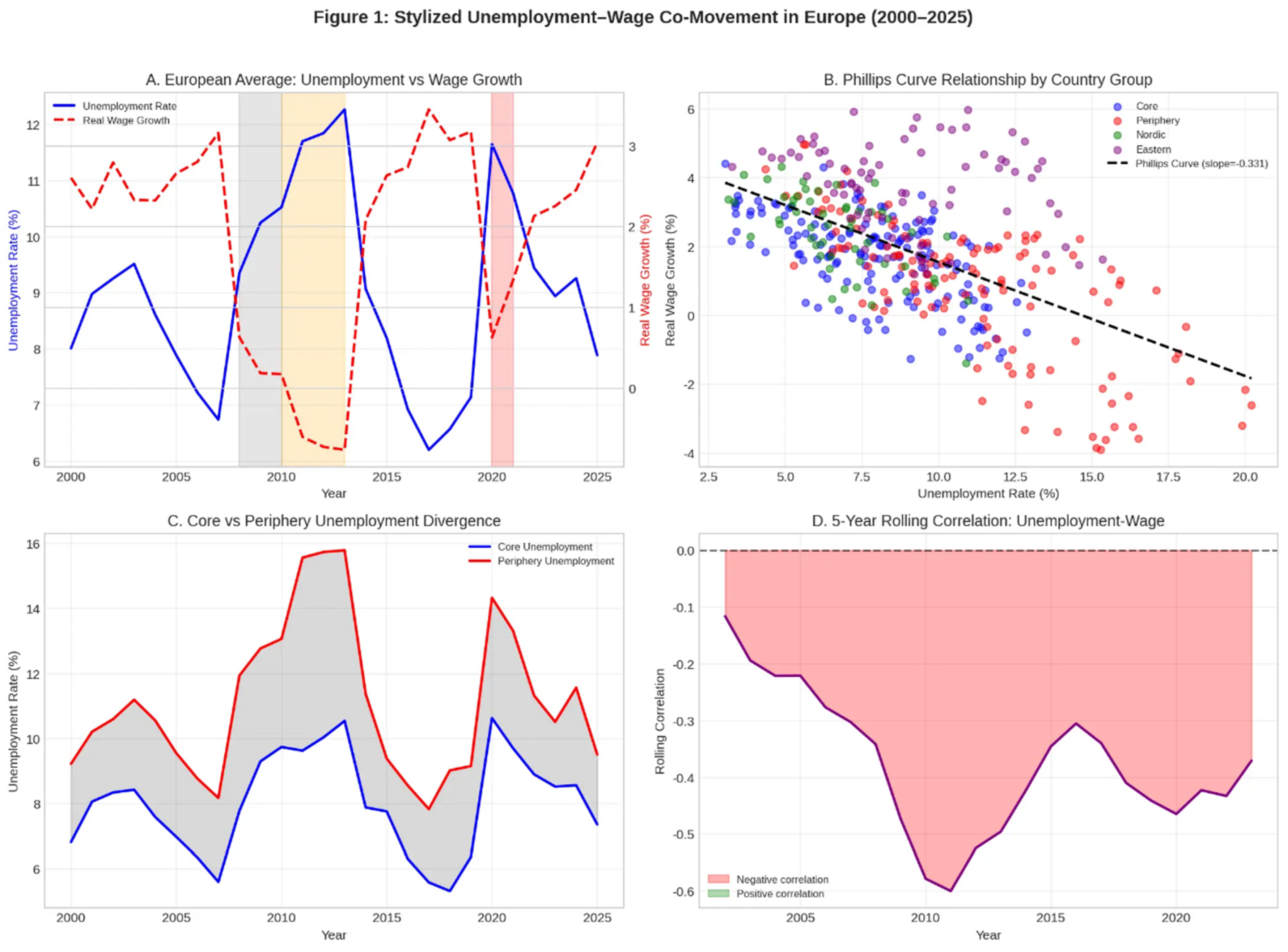
Figure 2.
Conceptual mapping: From Phillips Curve to Complex Harmonic Structure.
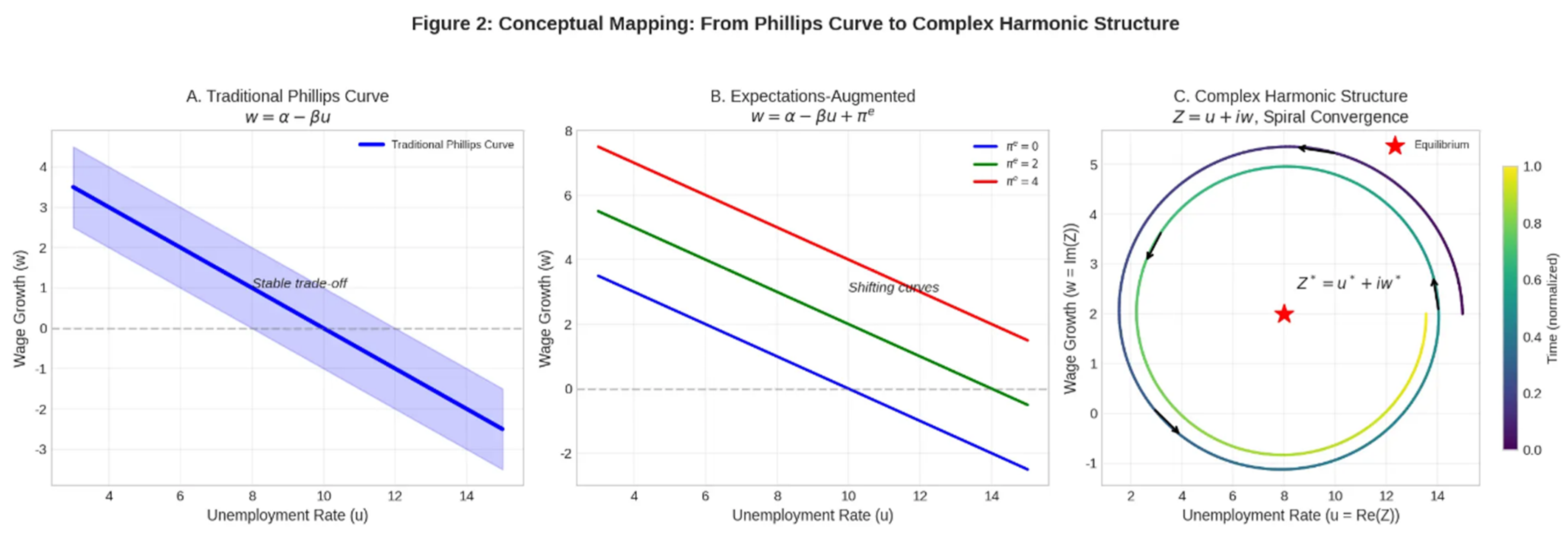
Figure 3.
Complex plane representation of labor market equilibrium.
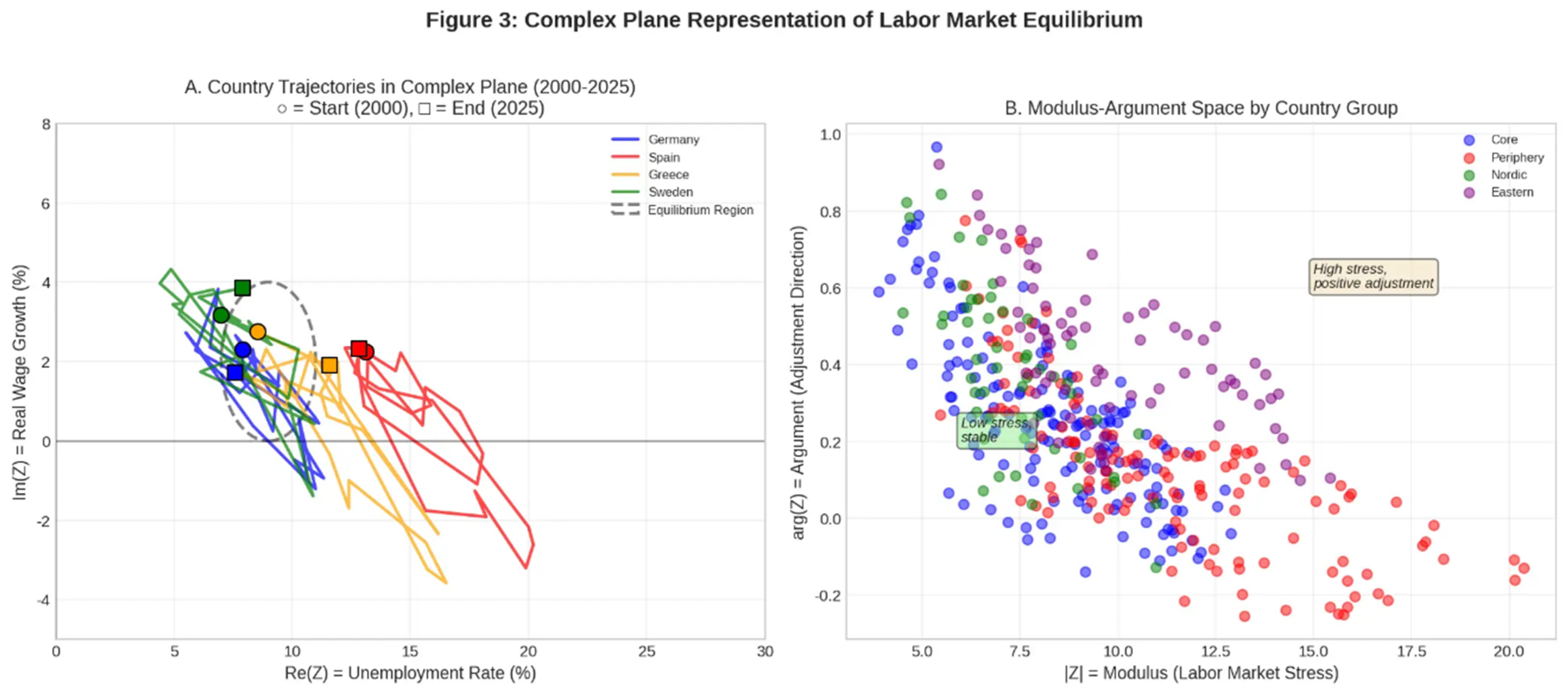
Figure 4.
Harmonic conjugate functions: theoretical illustration.
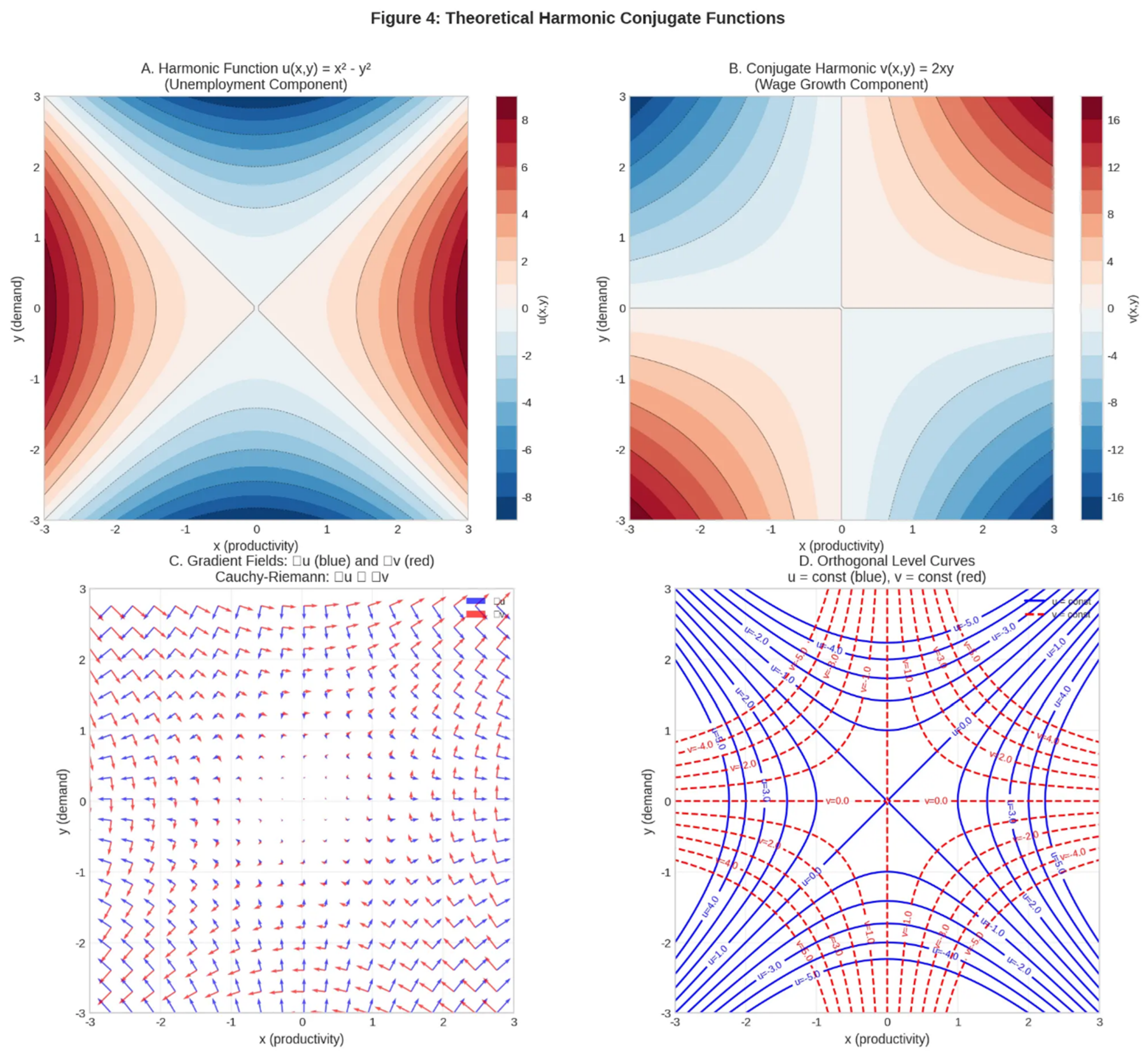
Figure 5.
Phase portrait under linear adjustment.
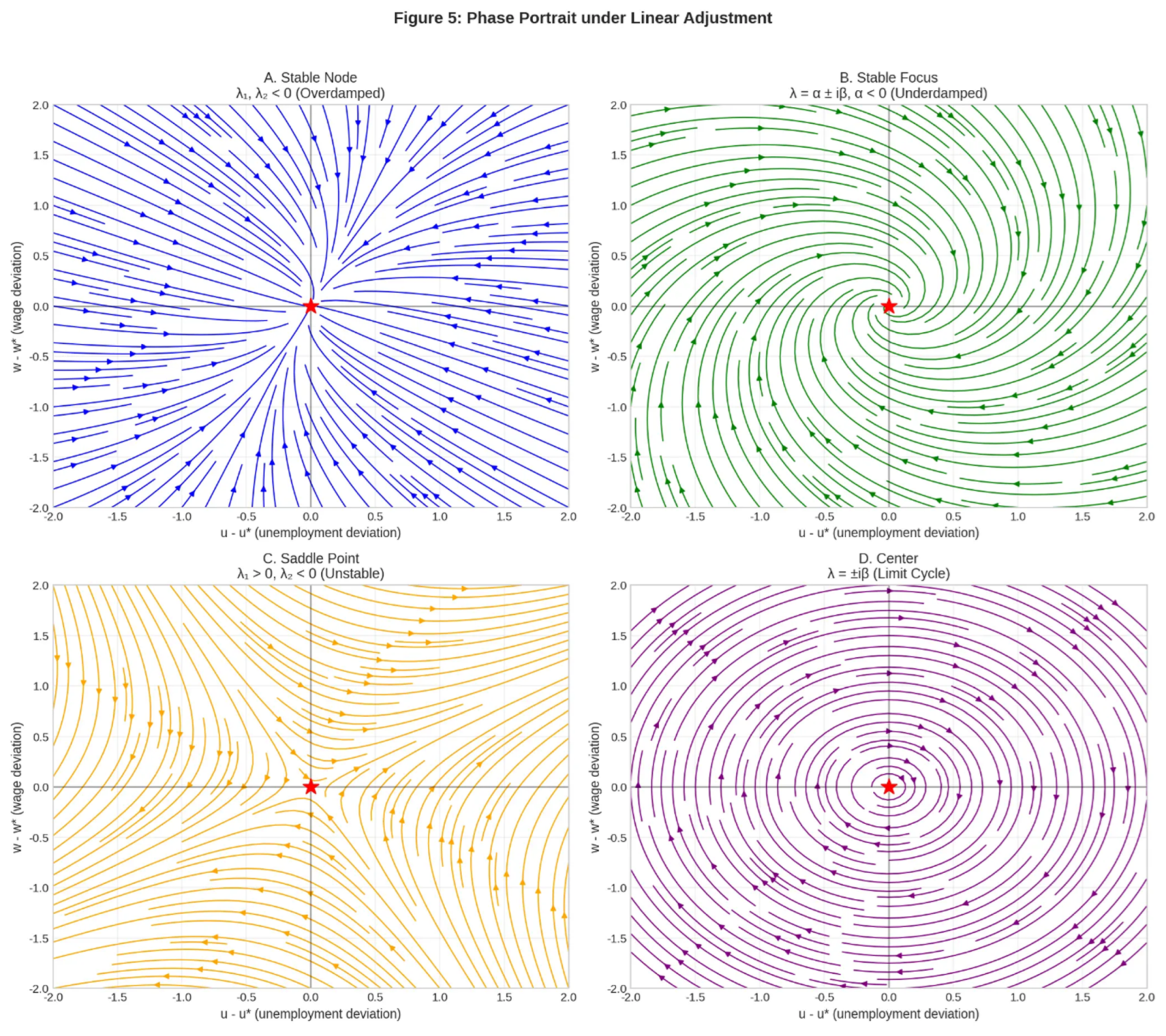
Figure 6.
Nonlinear spiral dynamics in complex equilibrium.
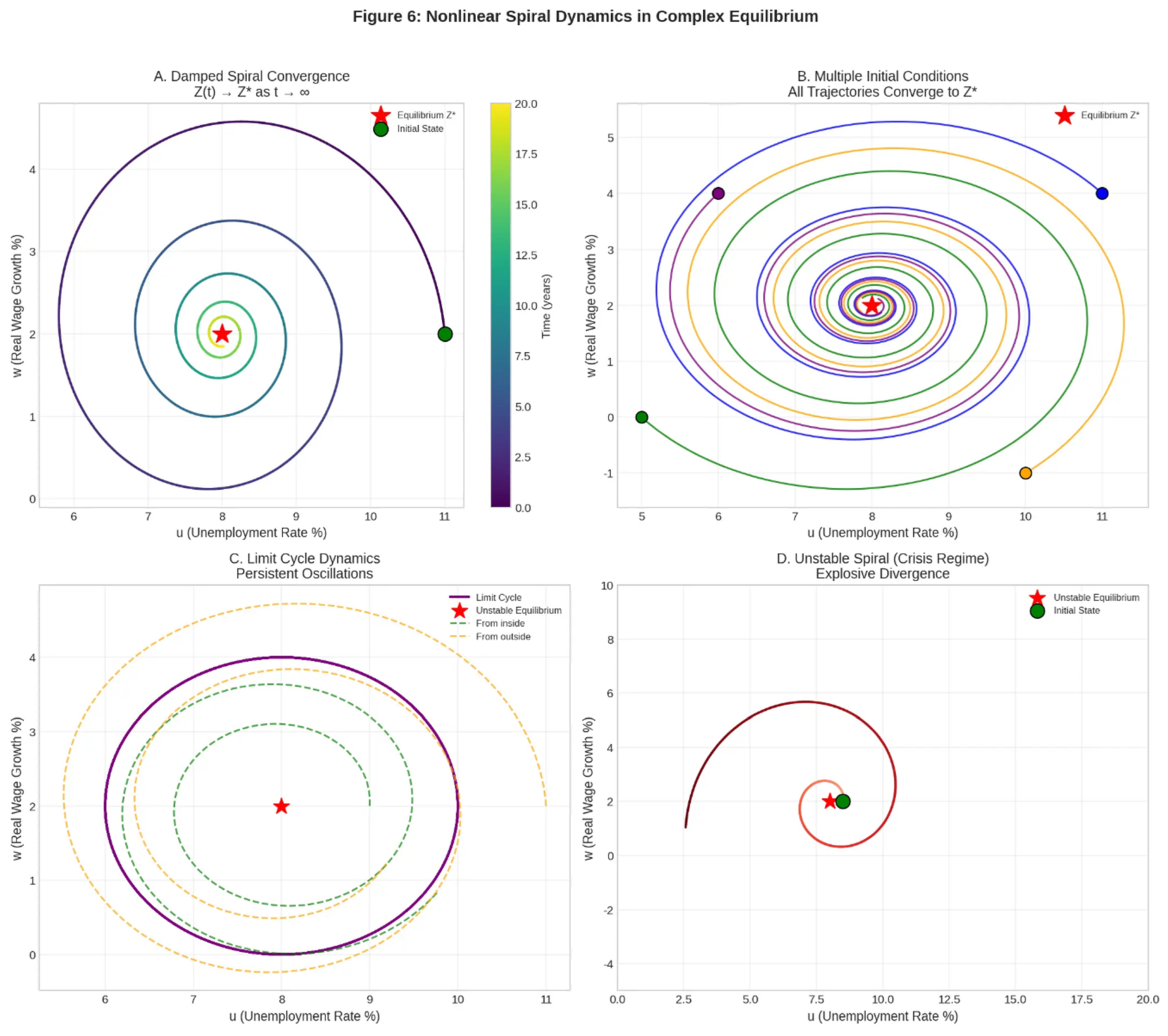
Figure 7.
Unemployment rates across Europe (heatmap).
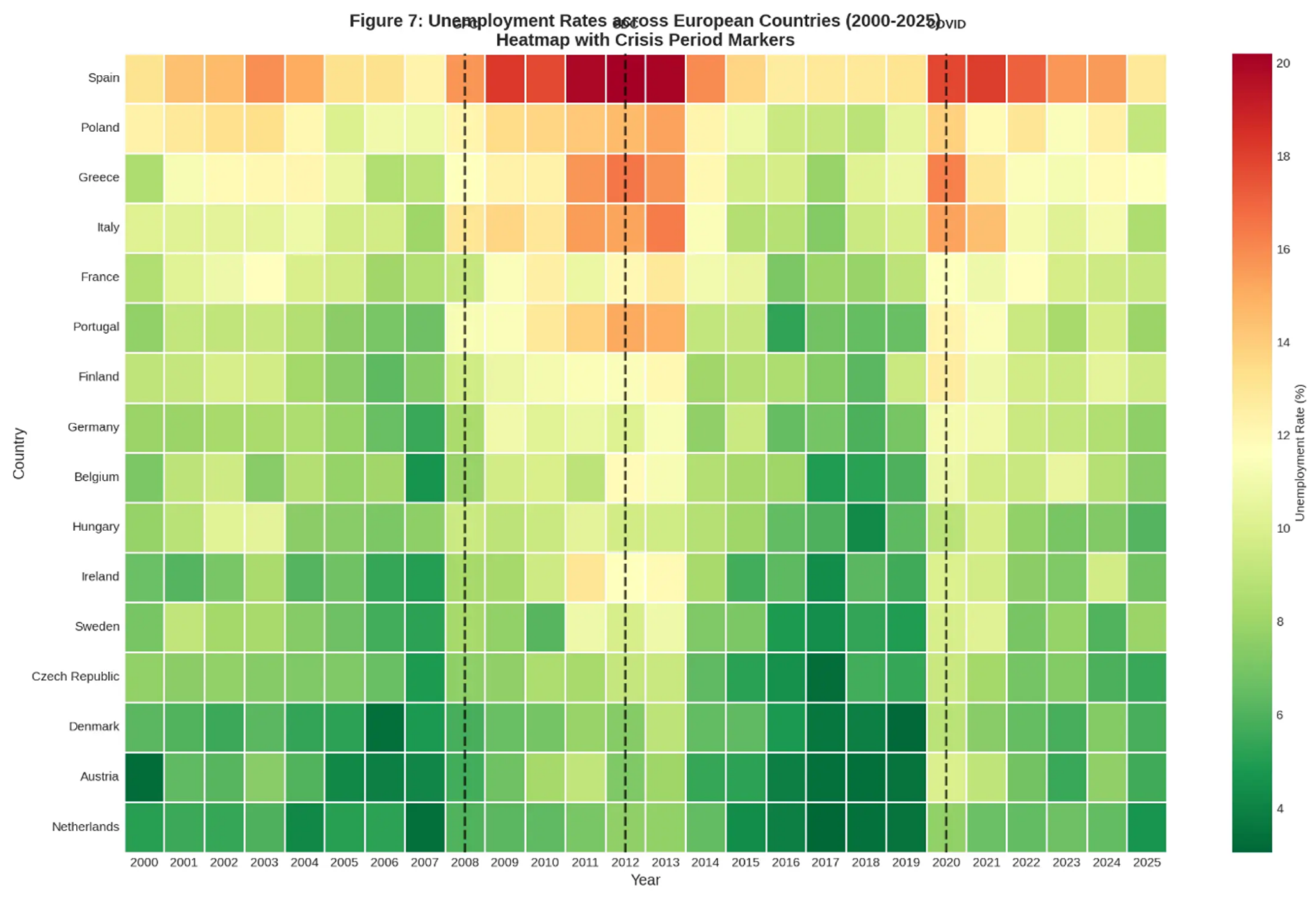
Figure 8.
Real wage growth dispersion.
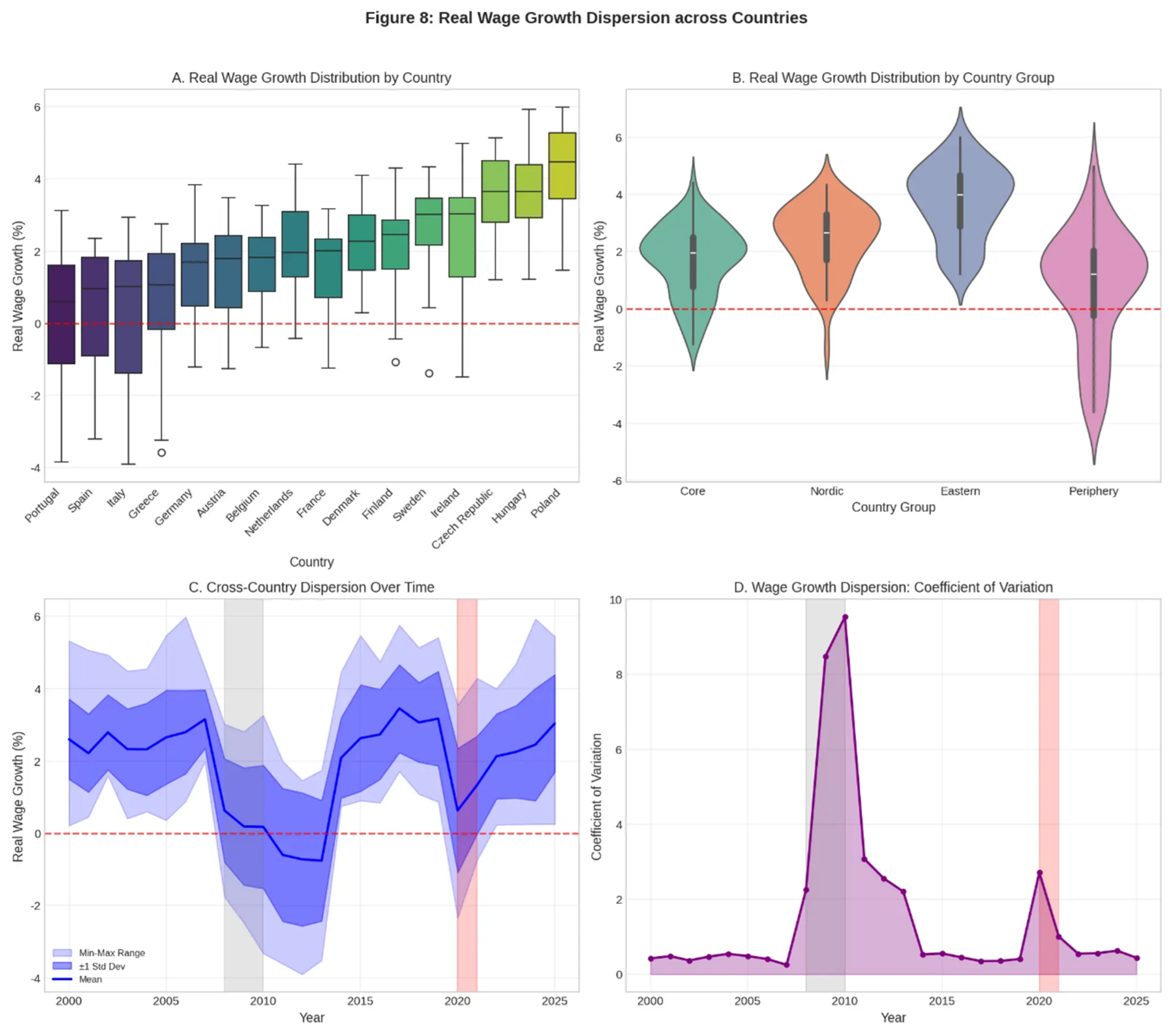
Figure 9.
Kernel density of unemployment distribution (2000 vs. 2025).
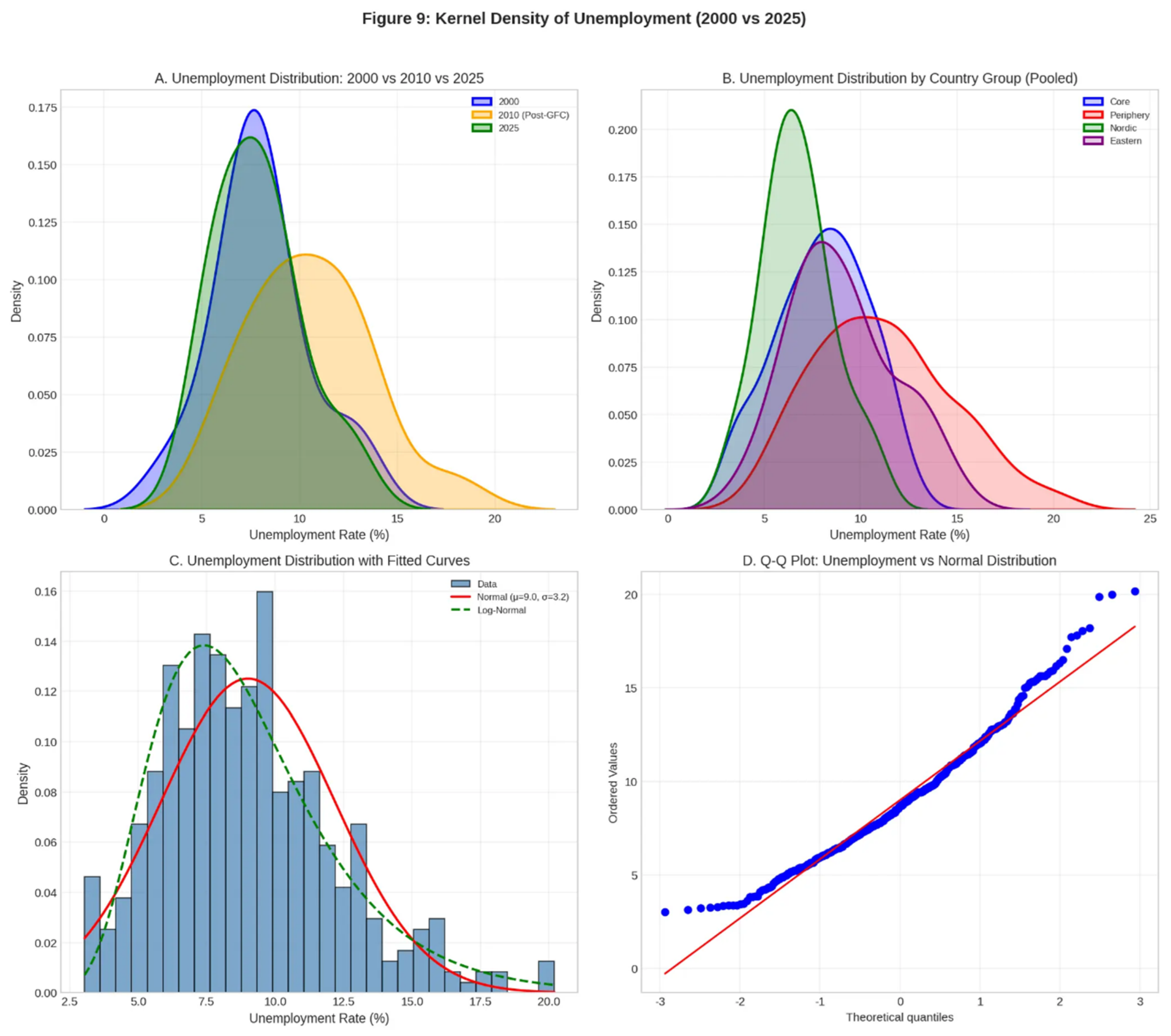
Figure 10.
Cross-country volatility comparison.
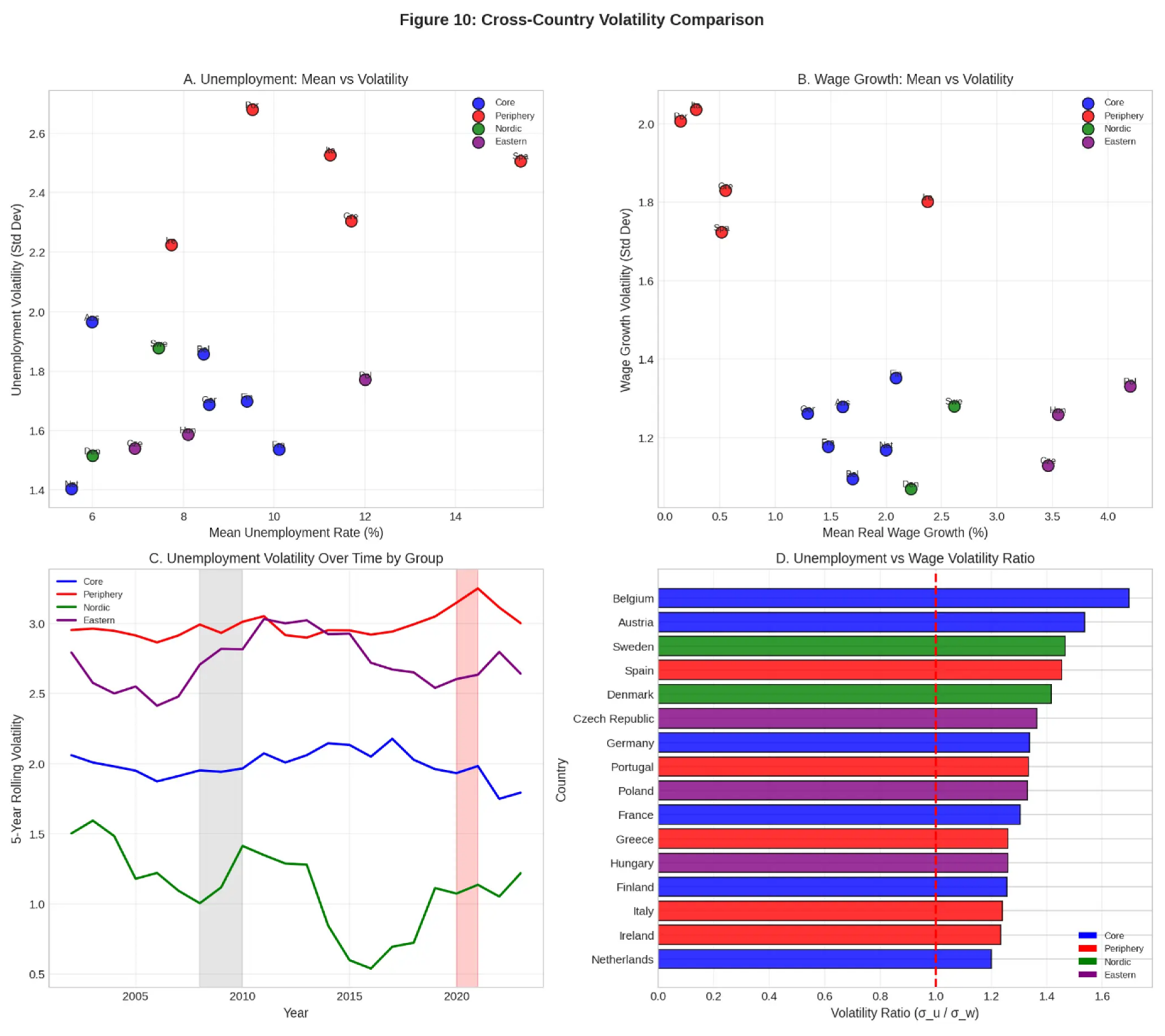
Figure 11.
Time-frequency decomposition (wavelet power spectrum).
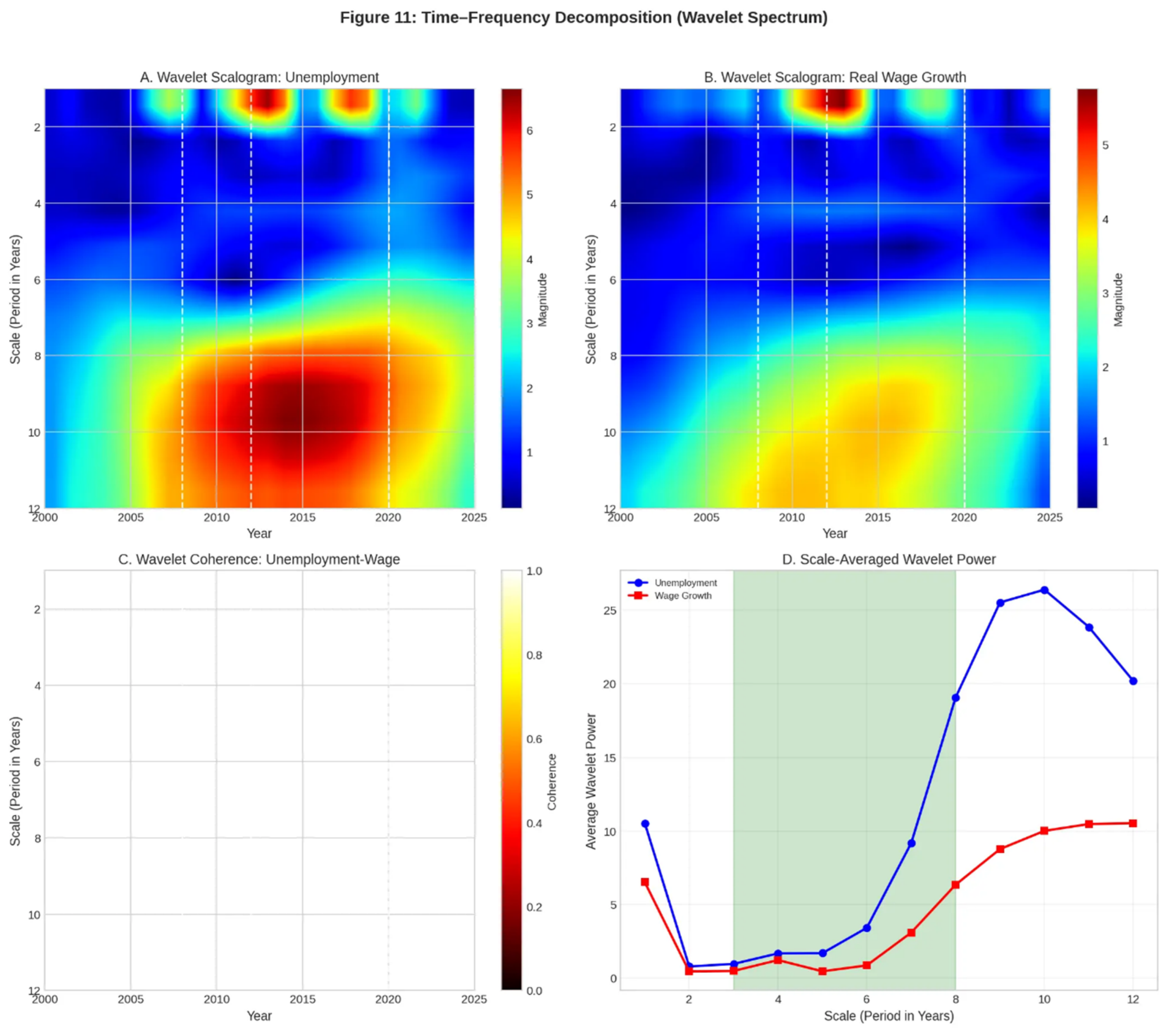
Figure 12.
Spectral density of unemployment and wages.
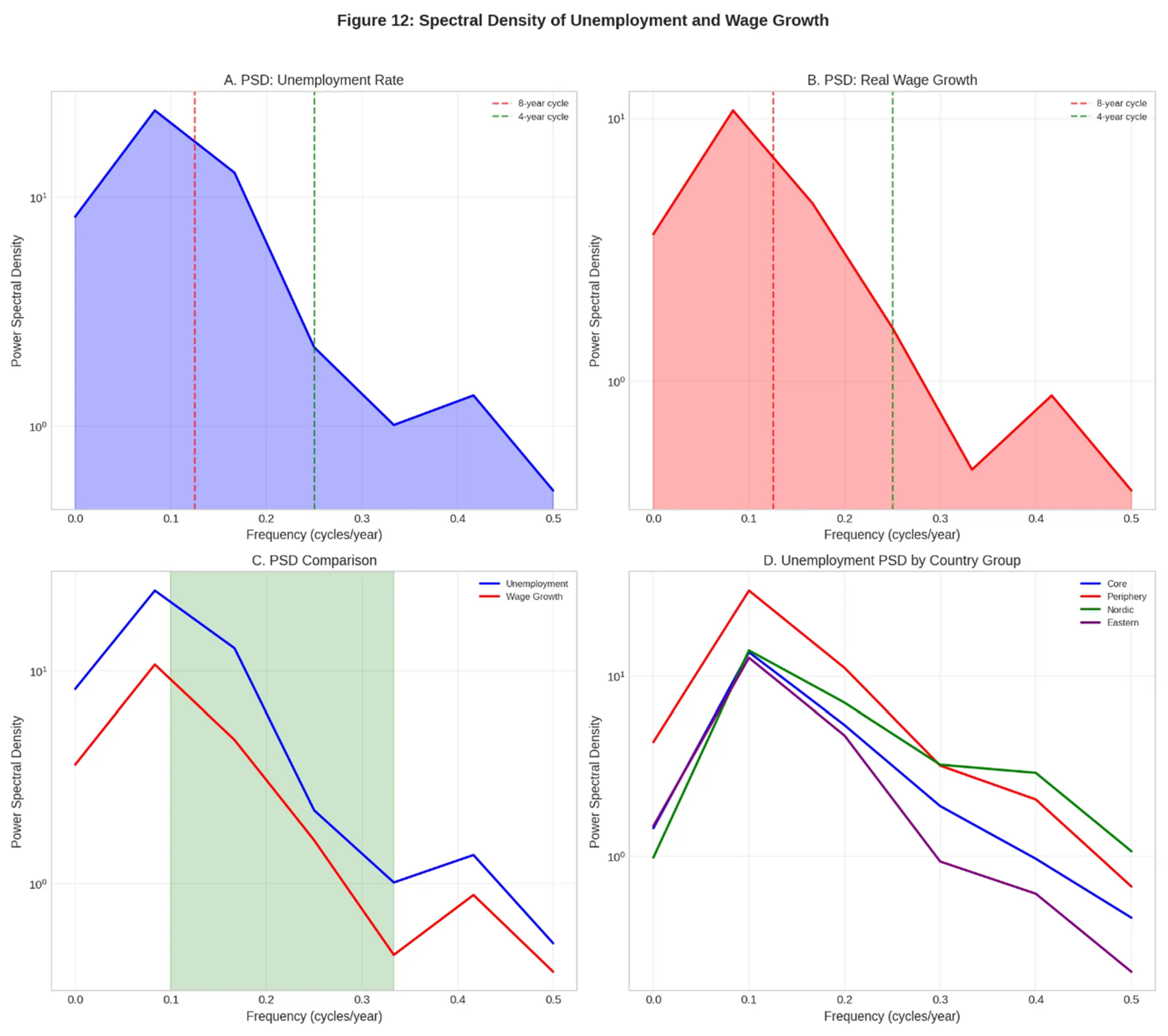
Figure 13.
Coherence spectrum across frequencies.
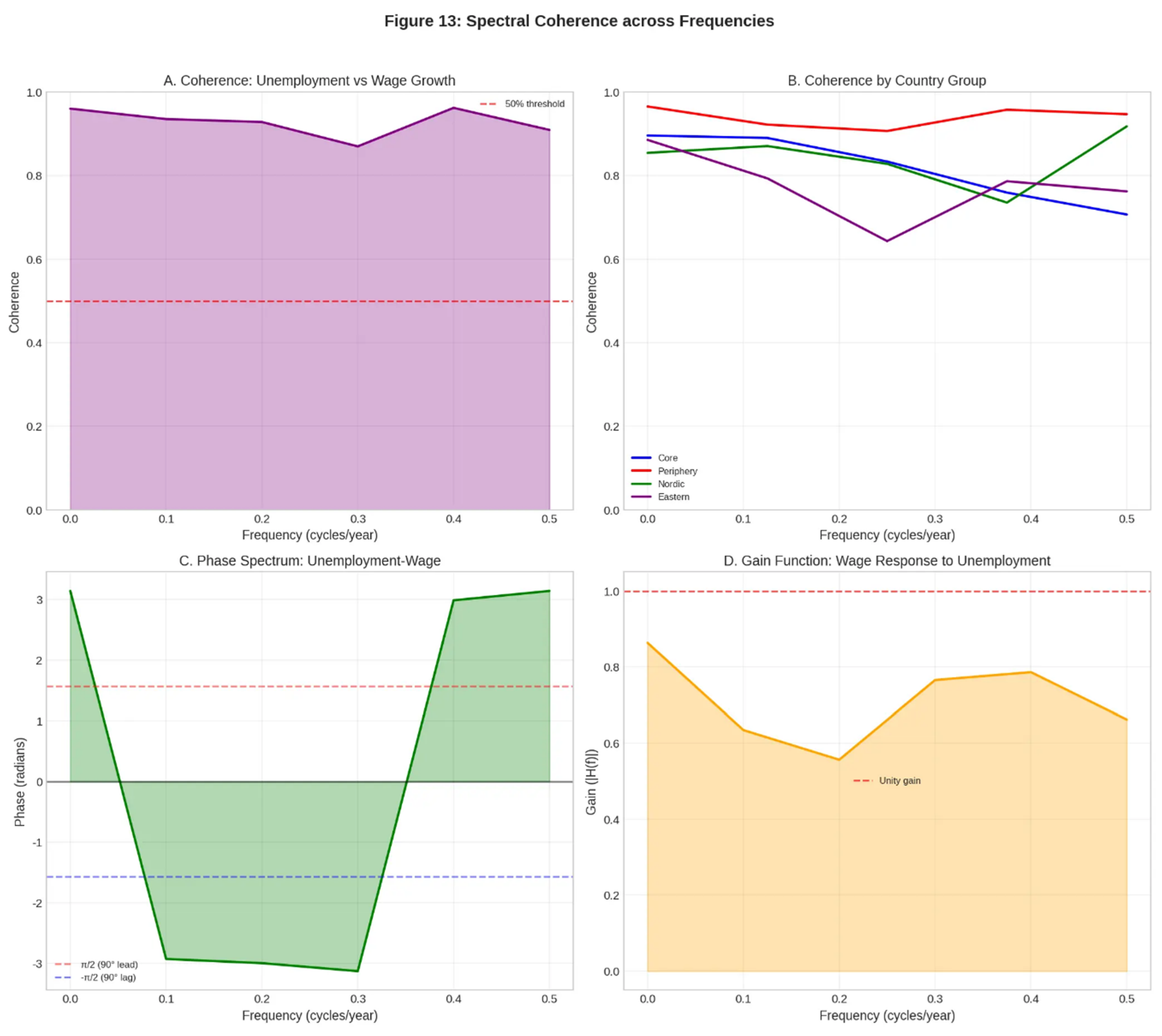
Figure 14.
Hilbert phase synchronization measure.
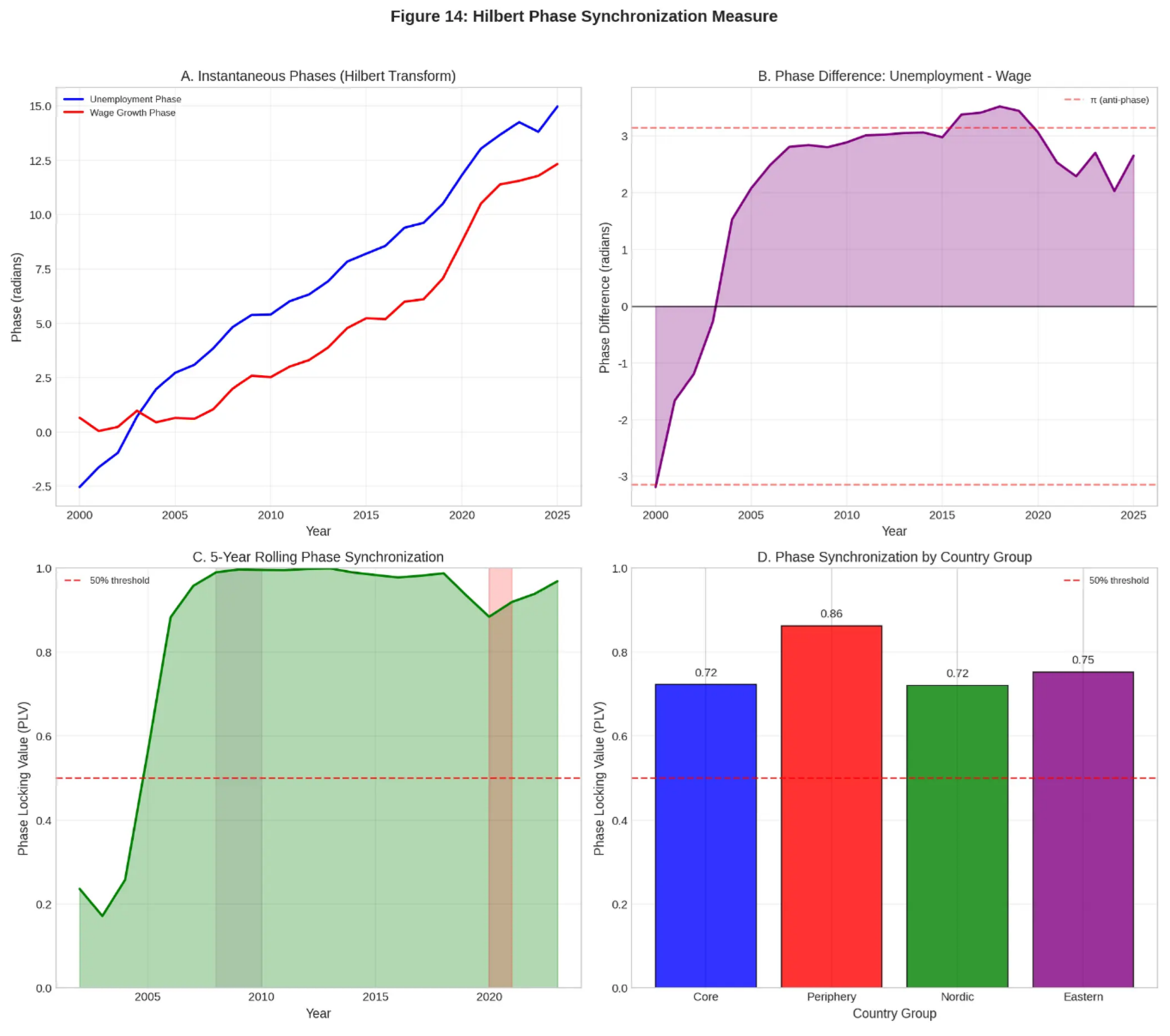
Figure 15.
Dynamic conditional correlation (DCC) evolution.
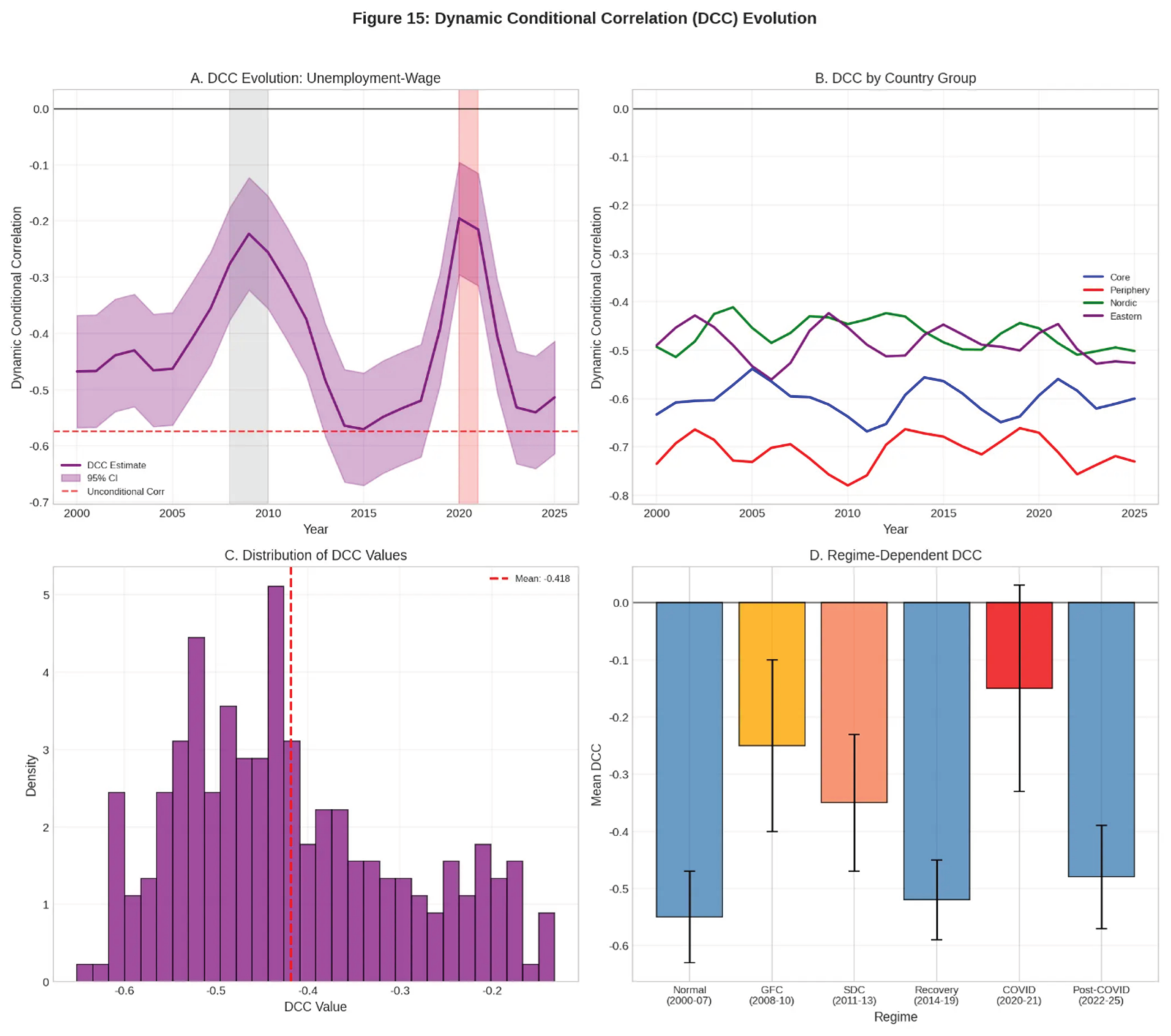
Figure 16.
Impulse response functions (complex shock).
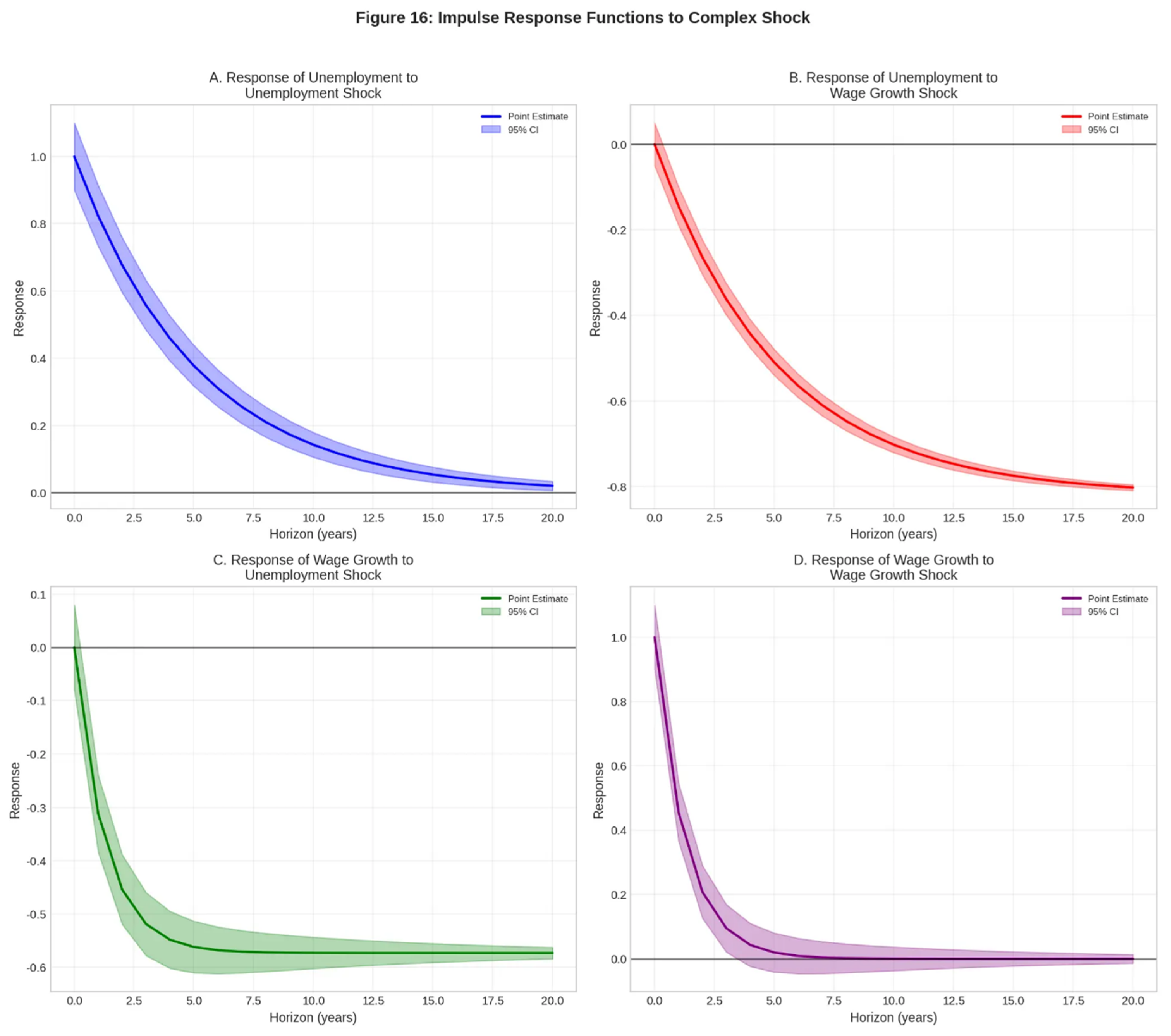
Figure 17.
Phase synchronization during crises.
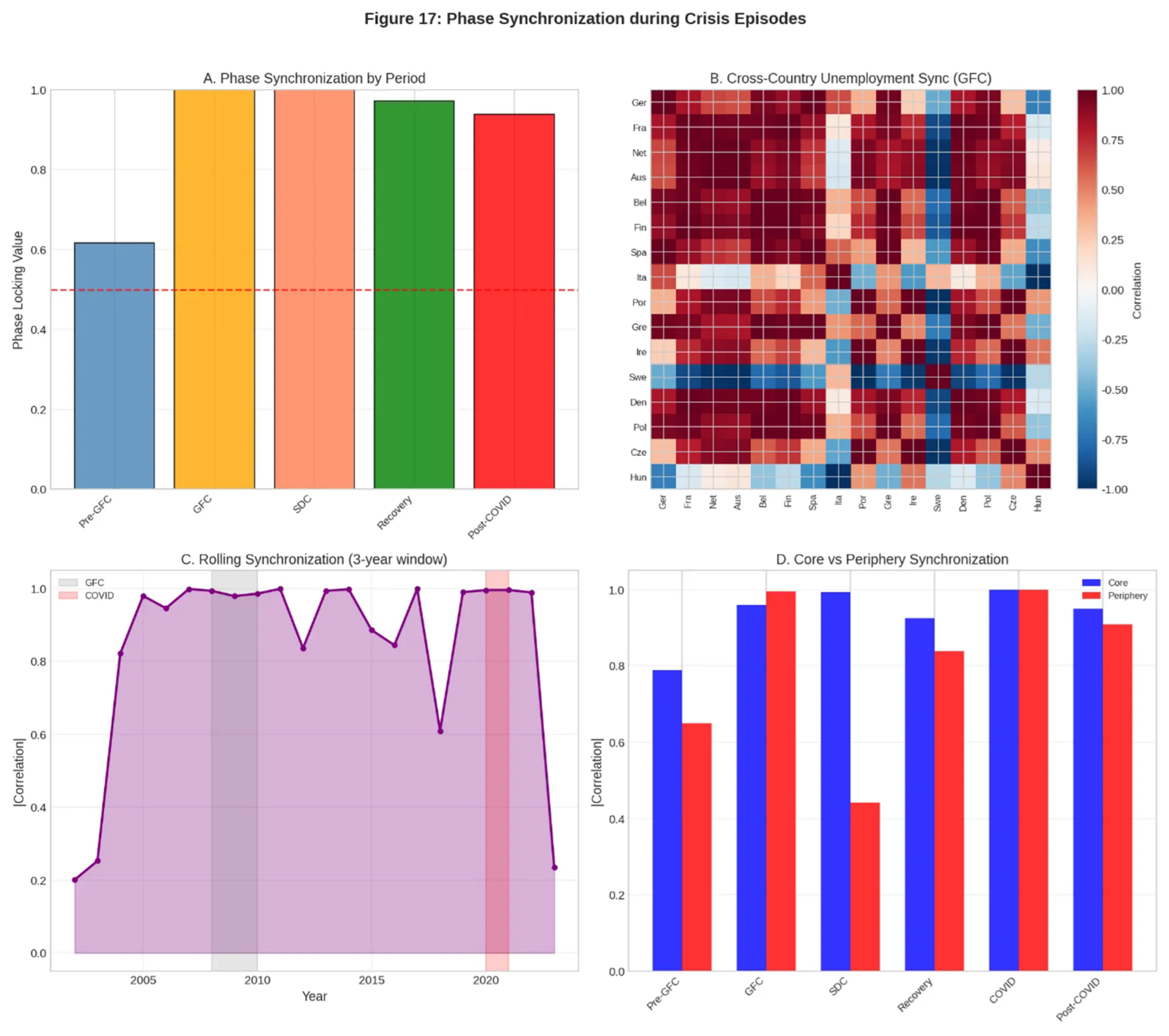
Figure 18.
Estimated harmonic component by country.
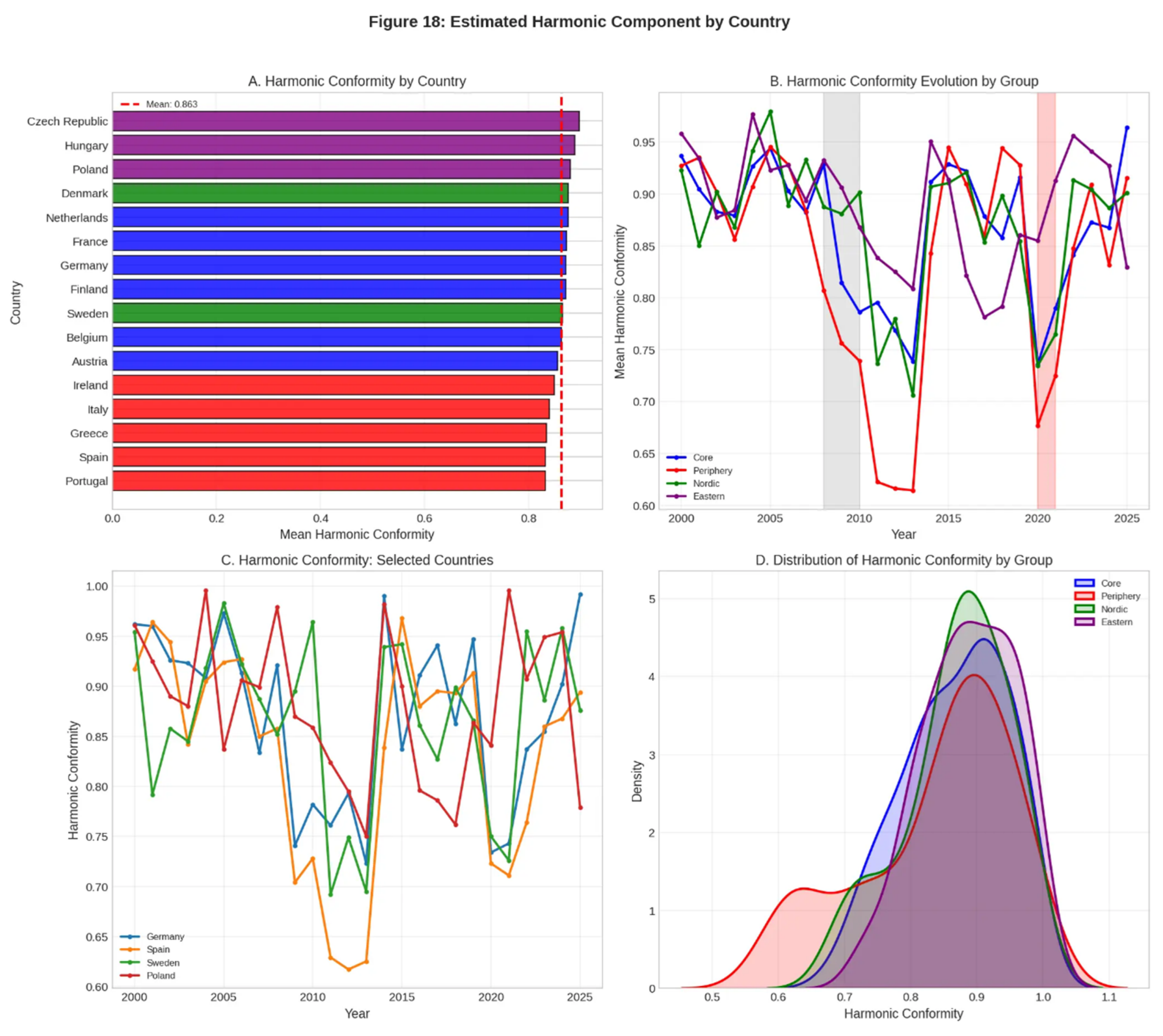
Figure 19.
Deviation from harmonic equilibrium index.
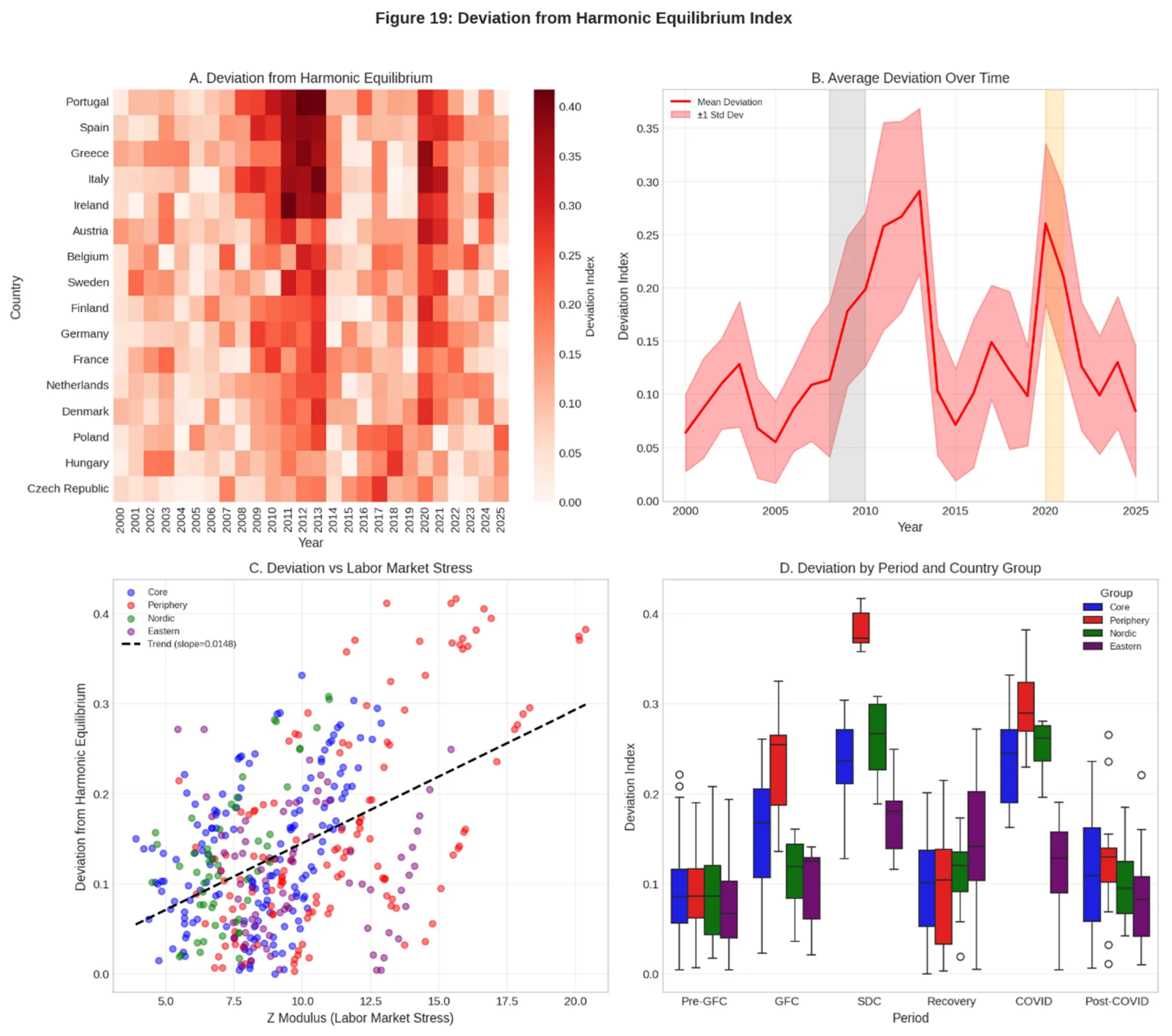
Figure 20.
Core vs periphery complex trajectories.
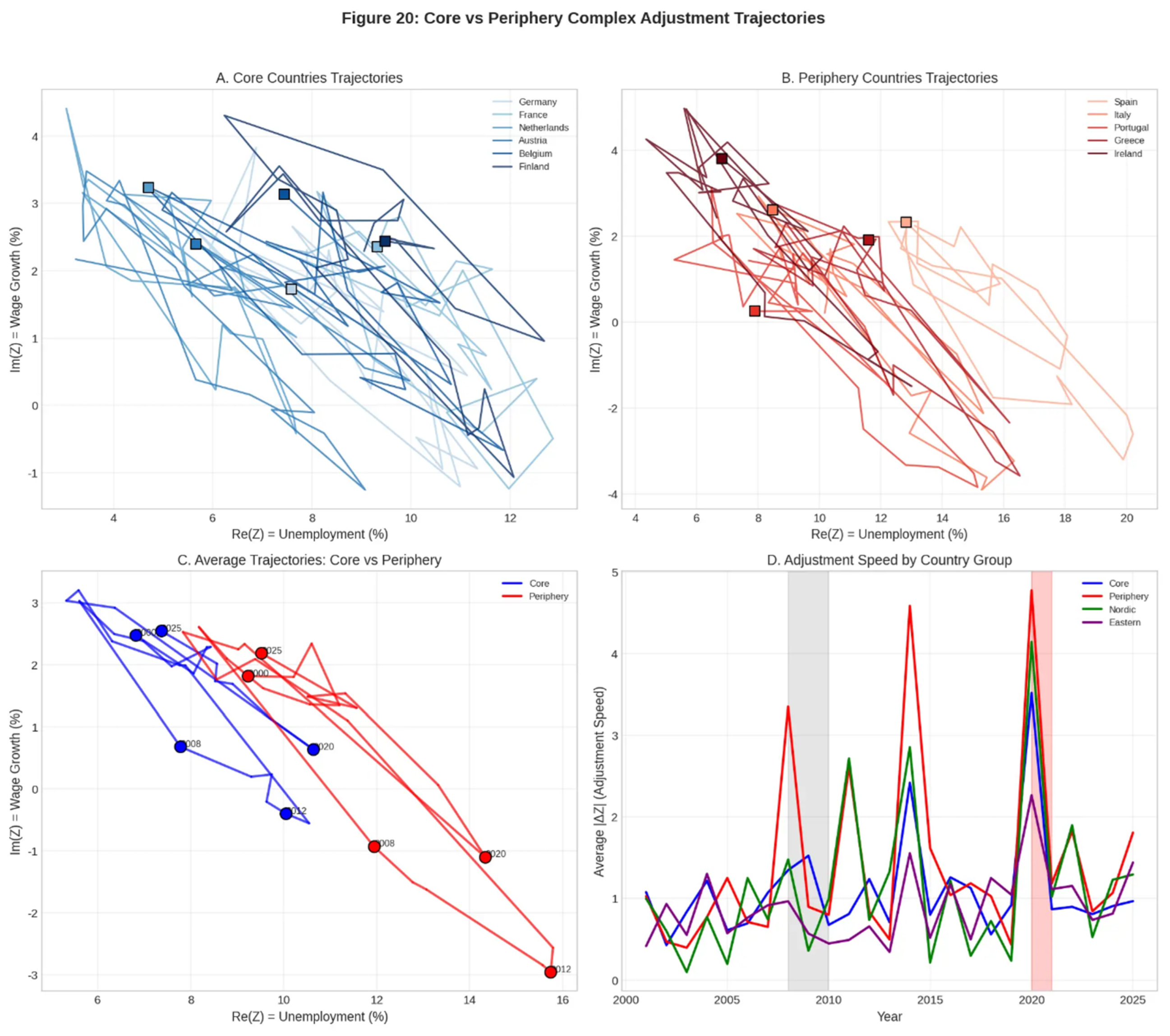
Figure 21.
3D surface: wage–unemployment–time dynamics.
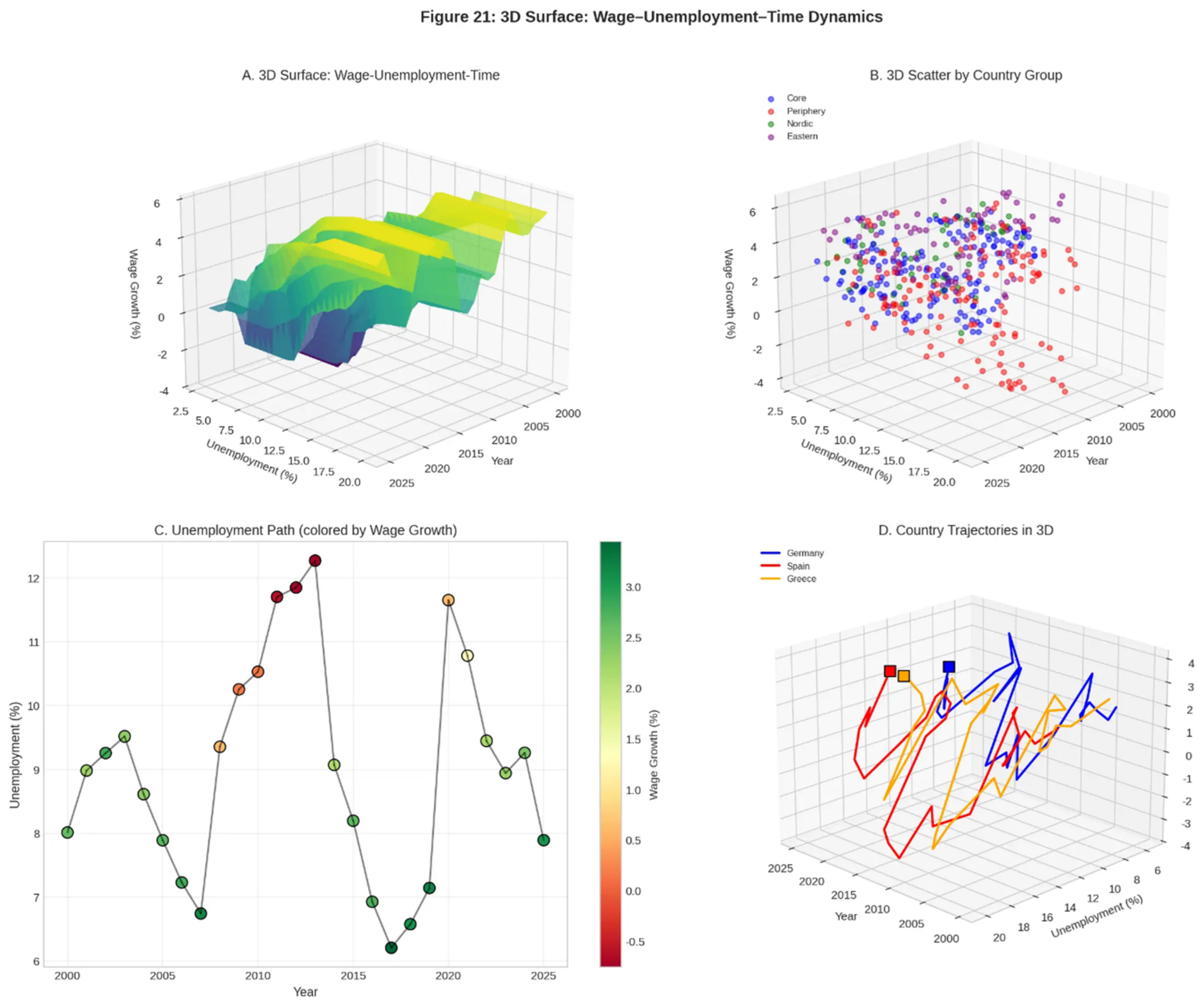
Figure 22.
Country clustering based on harmonic conformity.
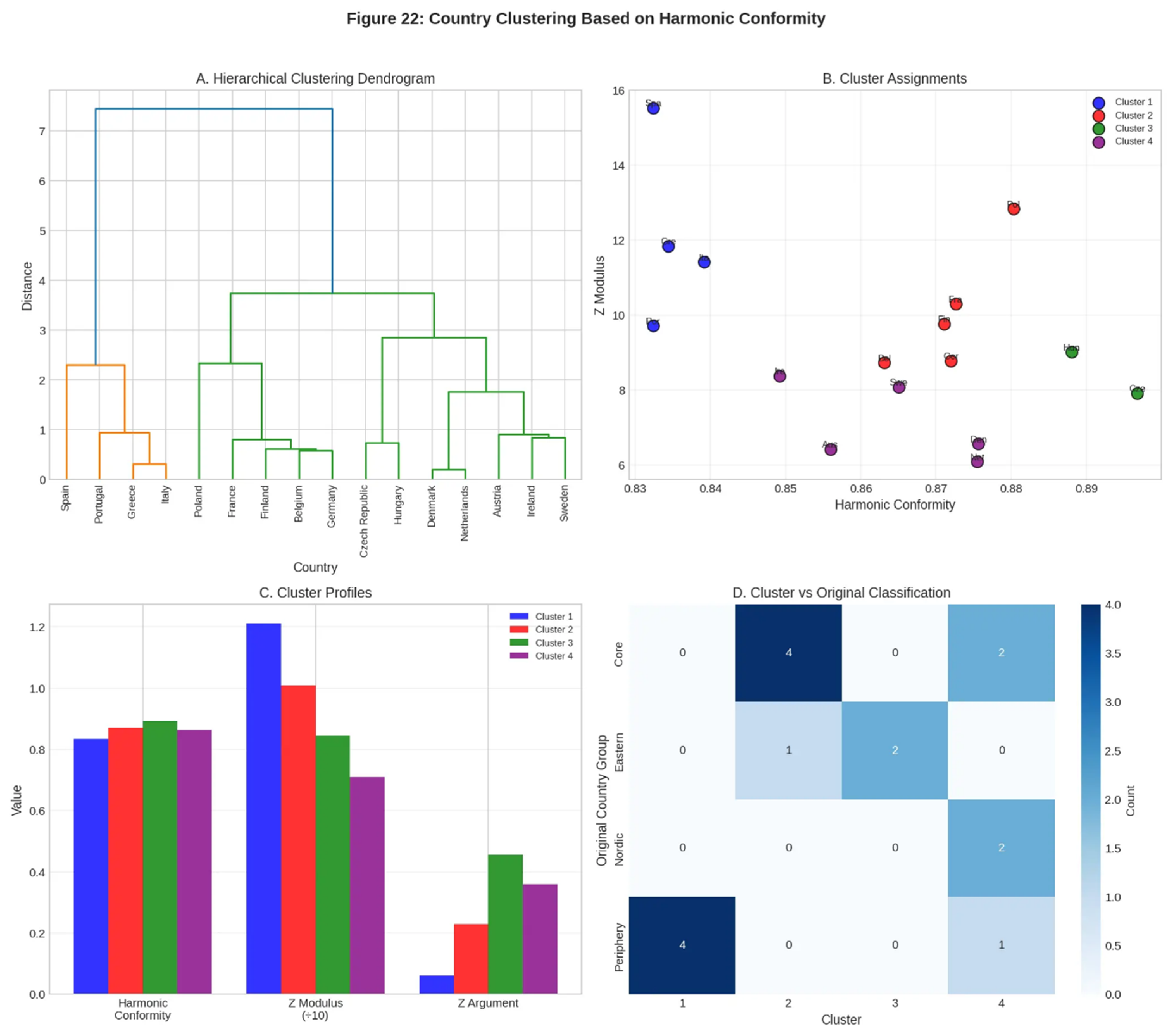
Figure 23.
Simulated adjustment path after productivity shock.
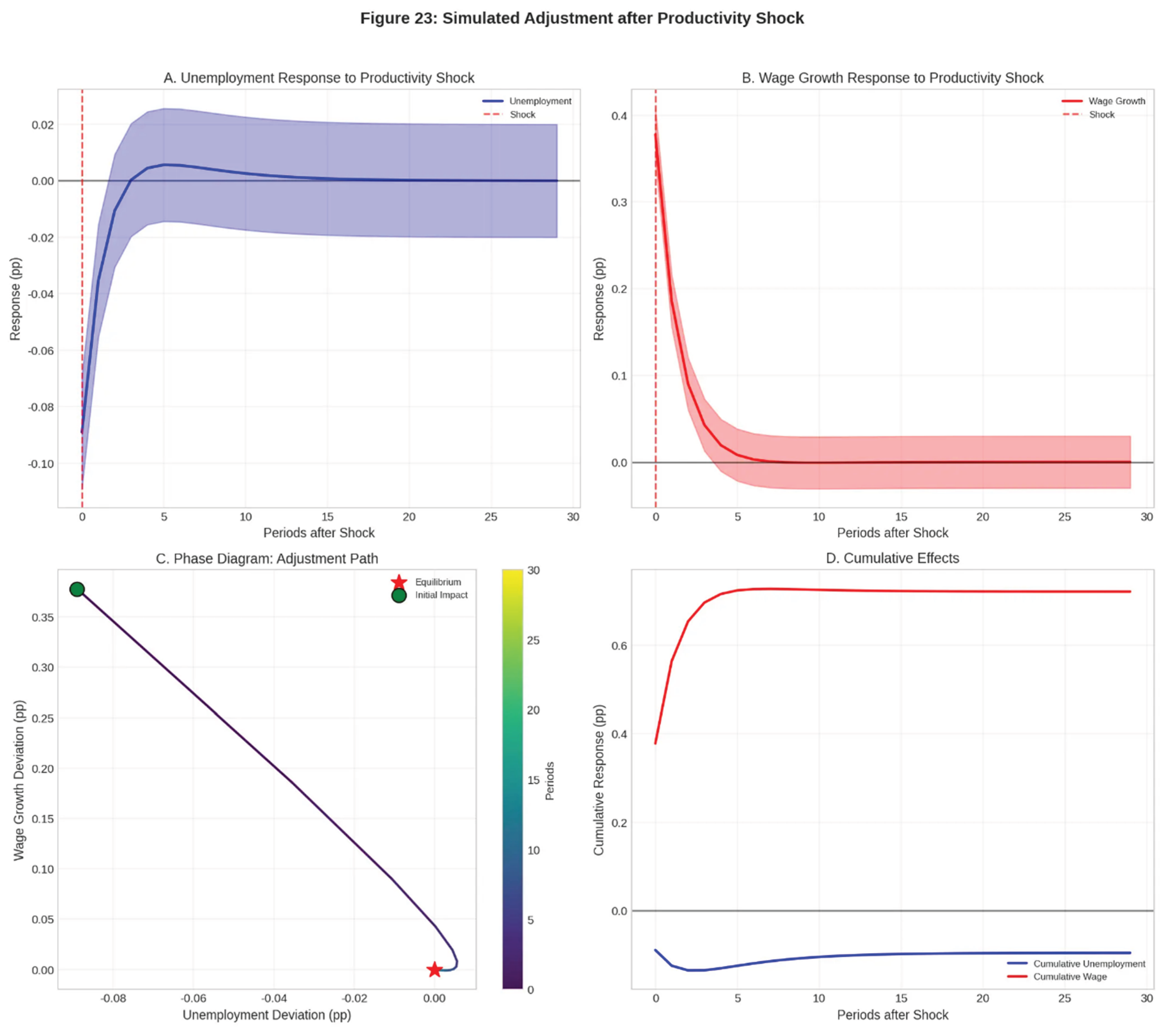
Figure 24.
Spiral vs damped adjustment regimes.
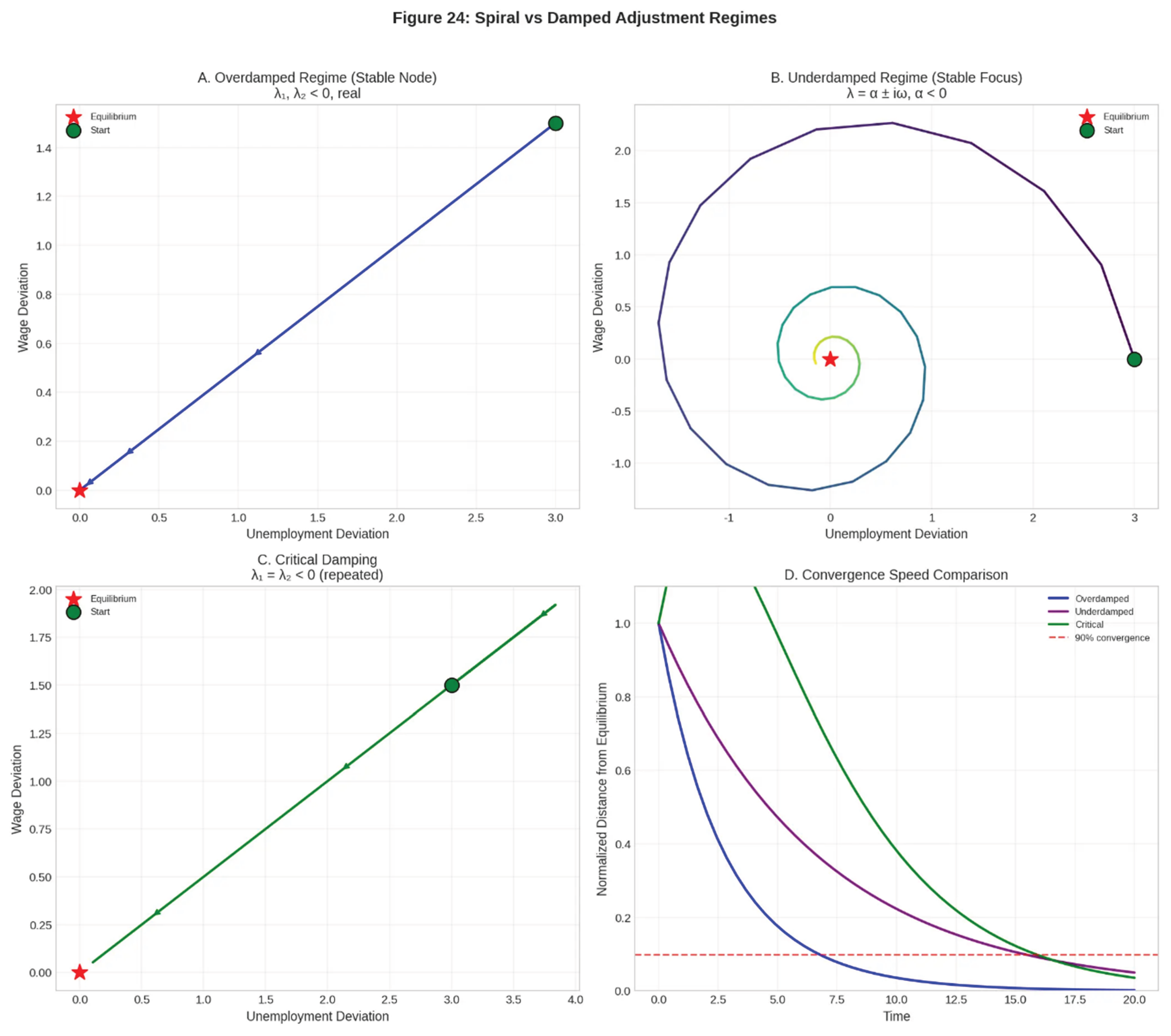
Figure 25.
Policy intervention phase shifts.
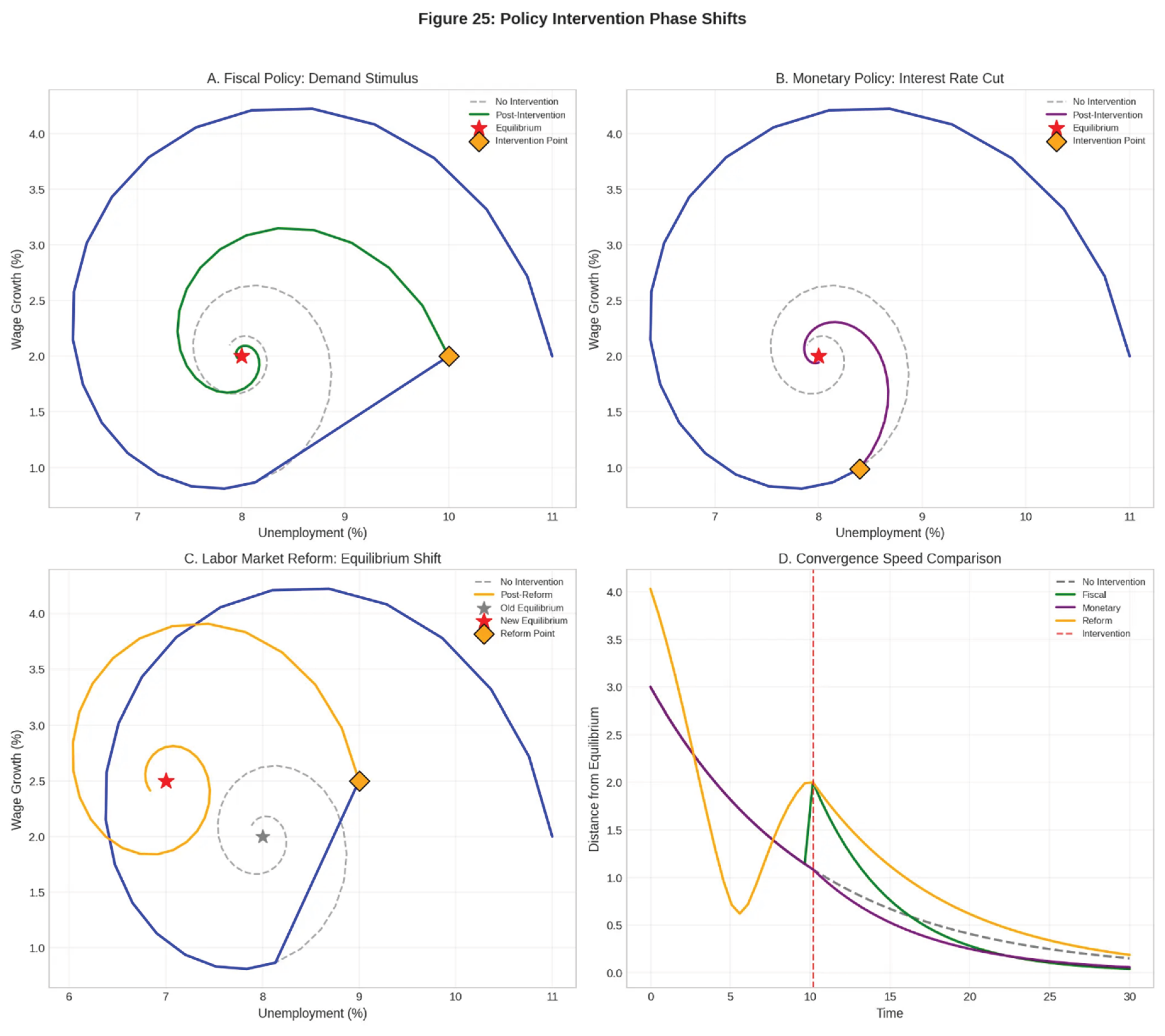
Figure 26.
Stability regions in parameter space.
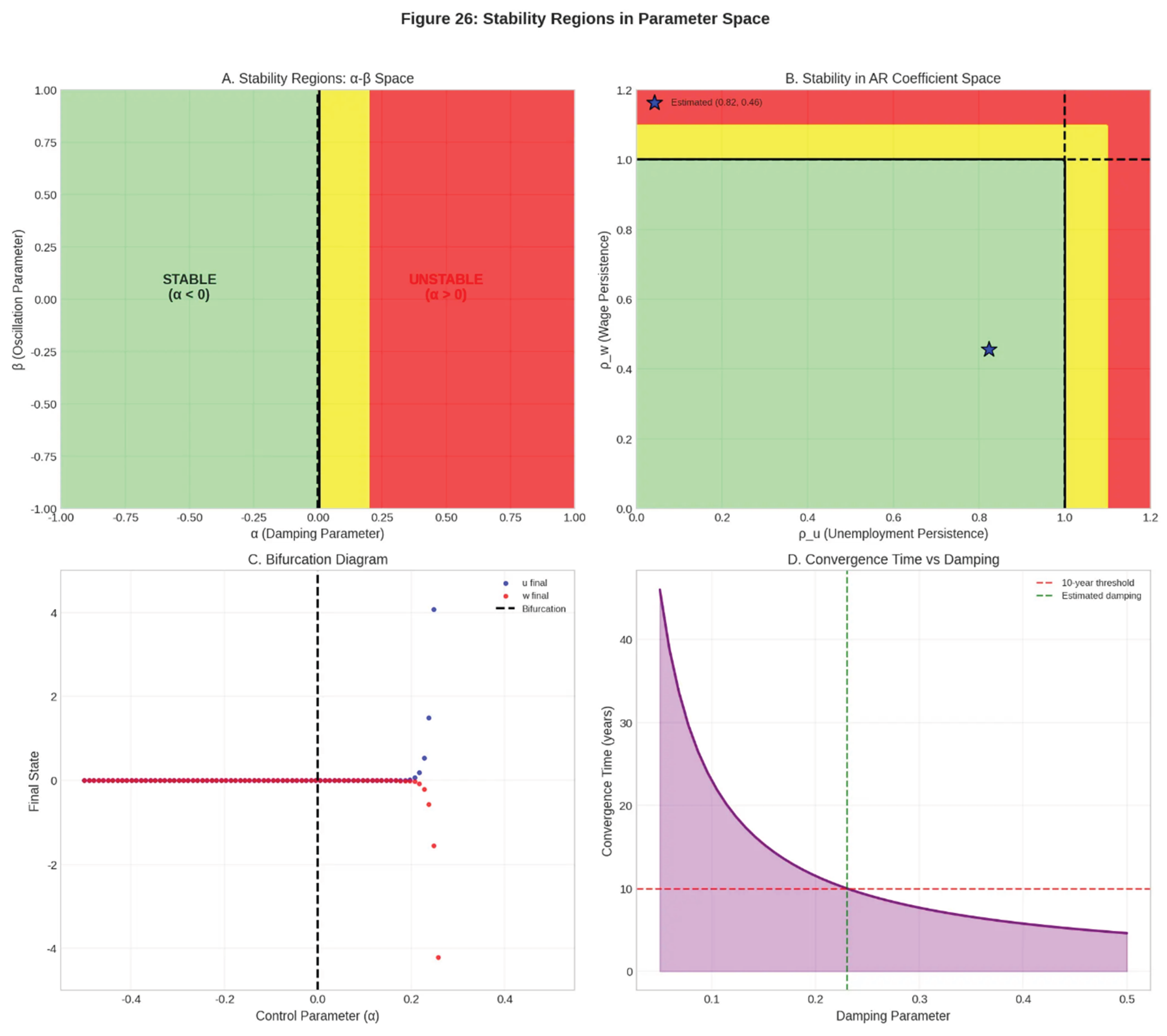
Figure 27.
Comparative statics across institutional settings.
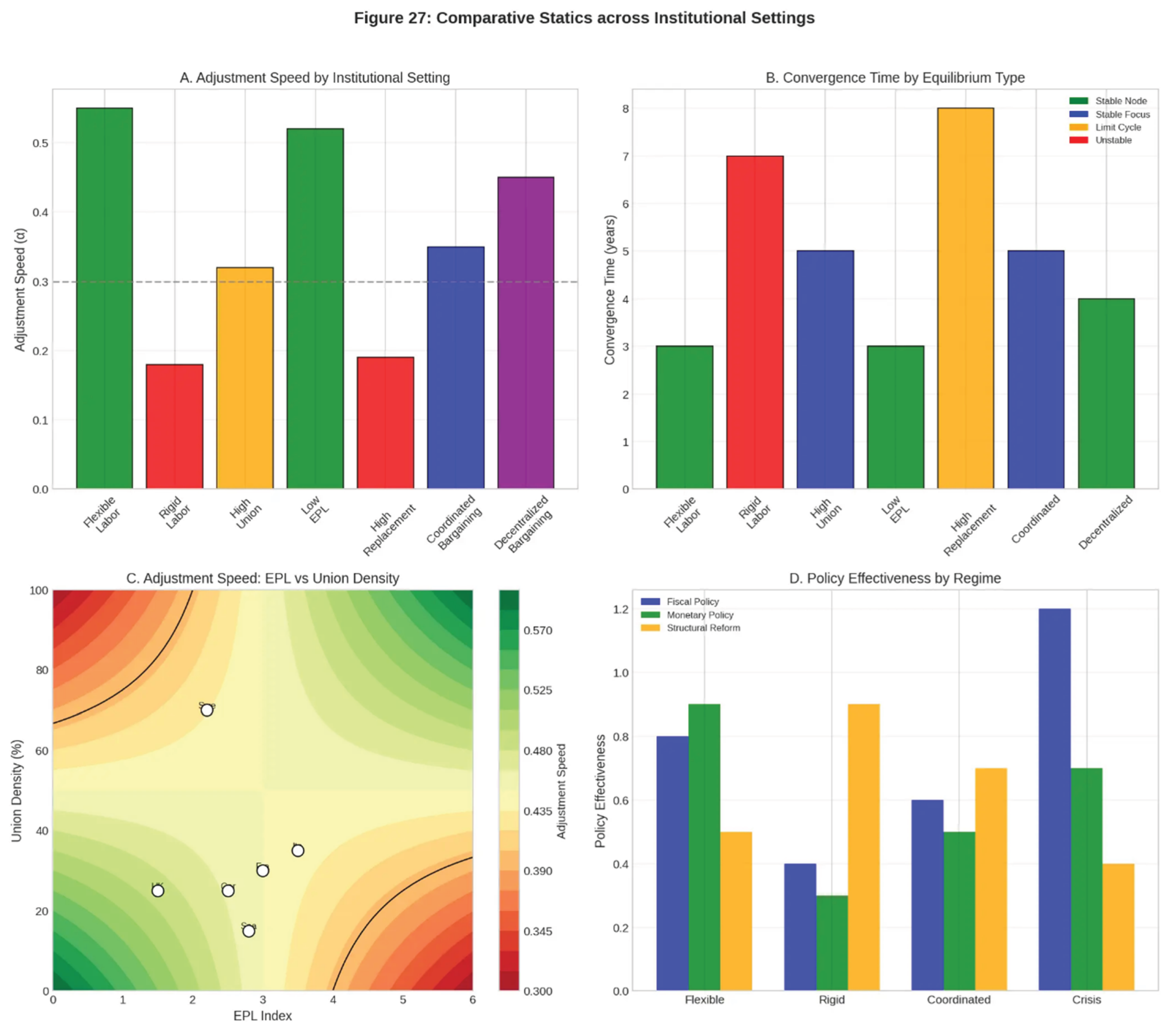
Figure 28.
Sectoral harmonic conformity.
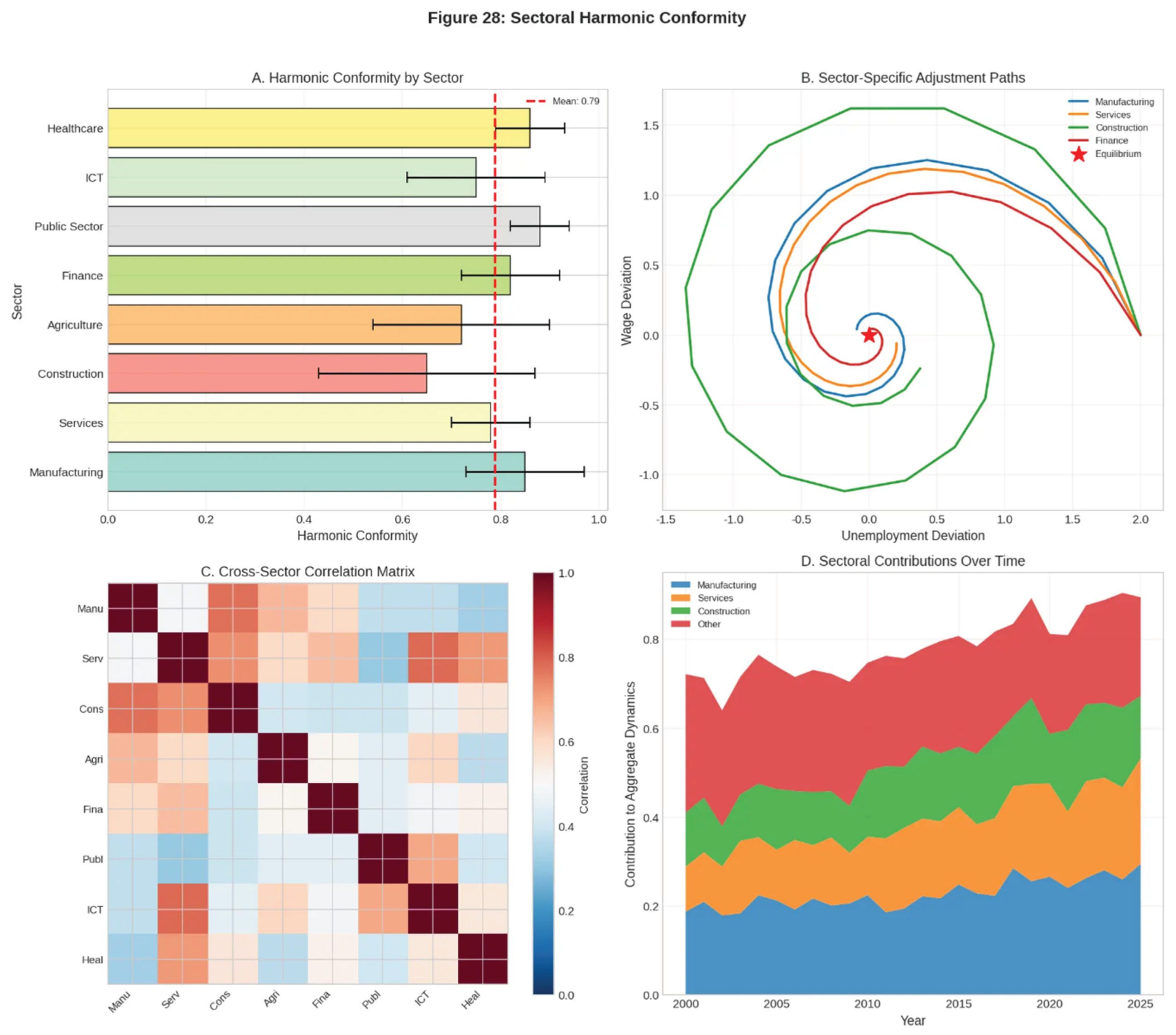
Figure 29.
Youth unemployment complex dynamics.
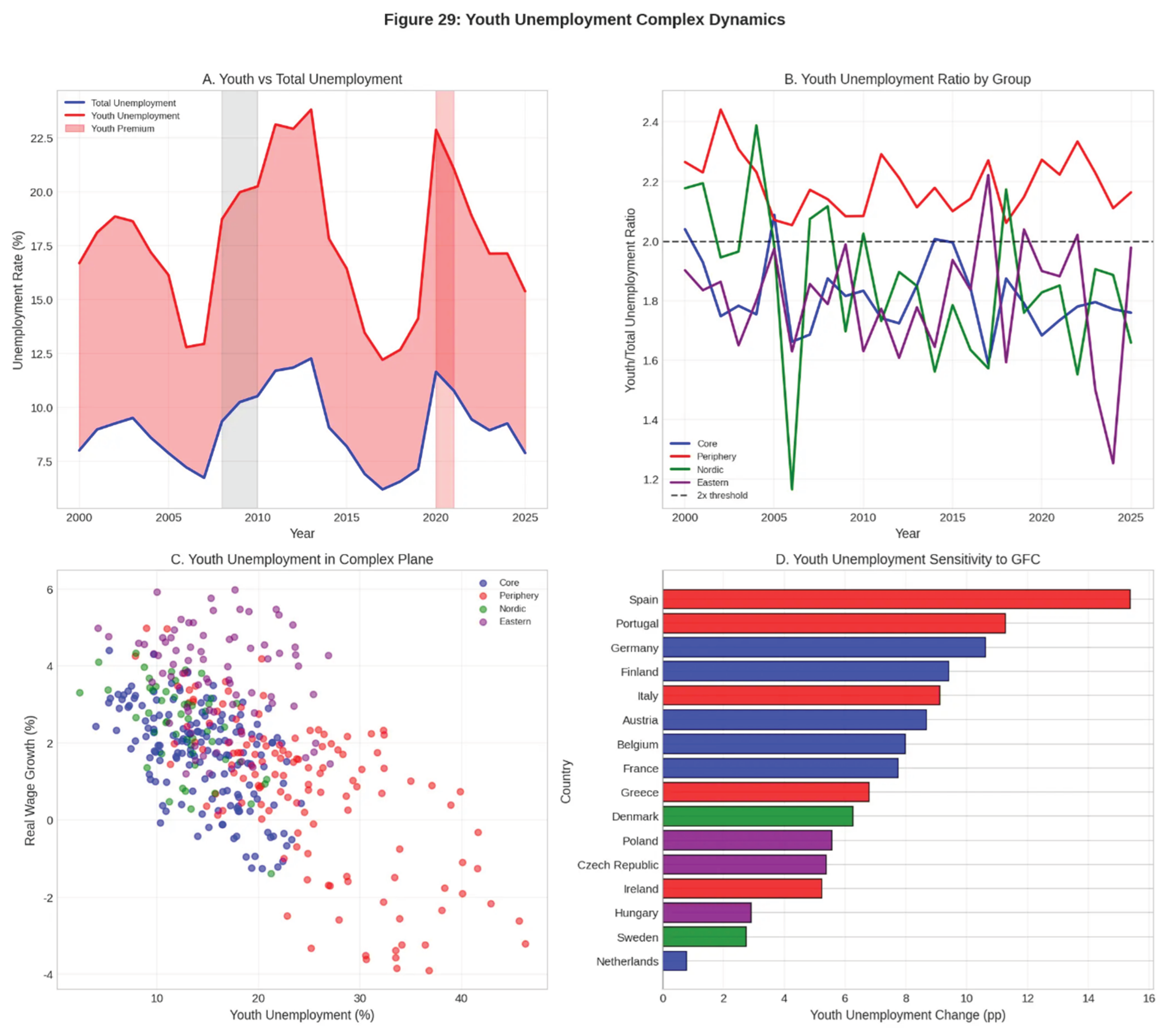
Figure 30.
Alternative specification comparison.
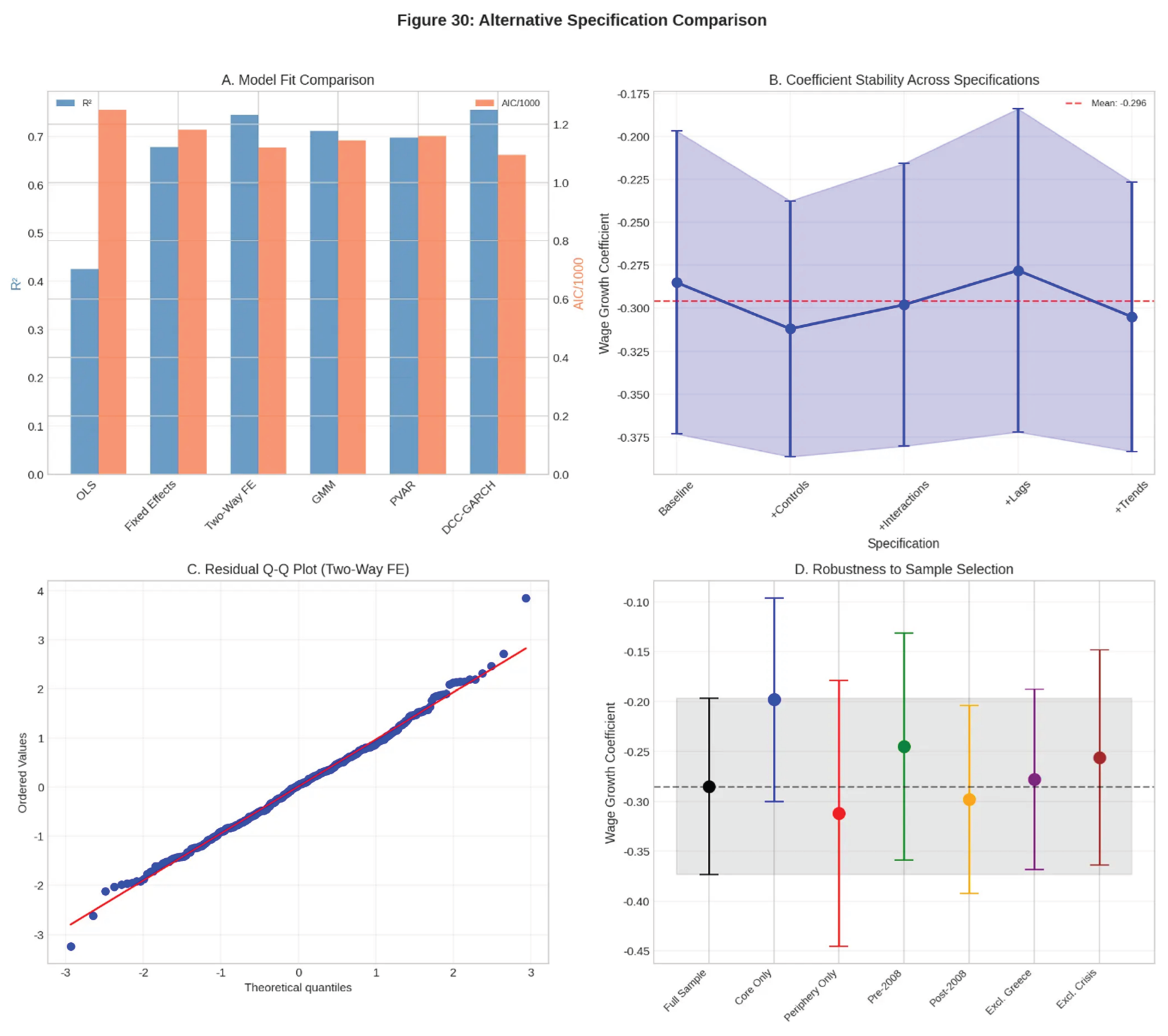
Figure 31.
Policy map: stable vs unstable labor systems.
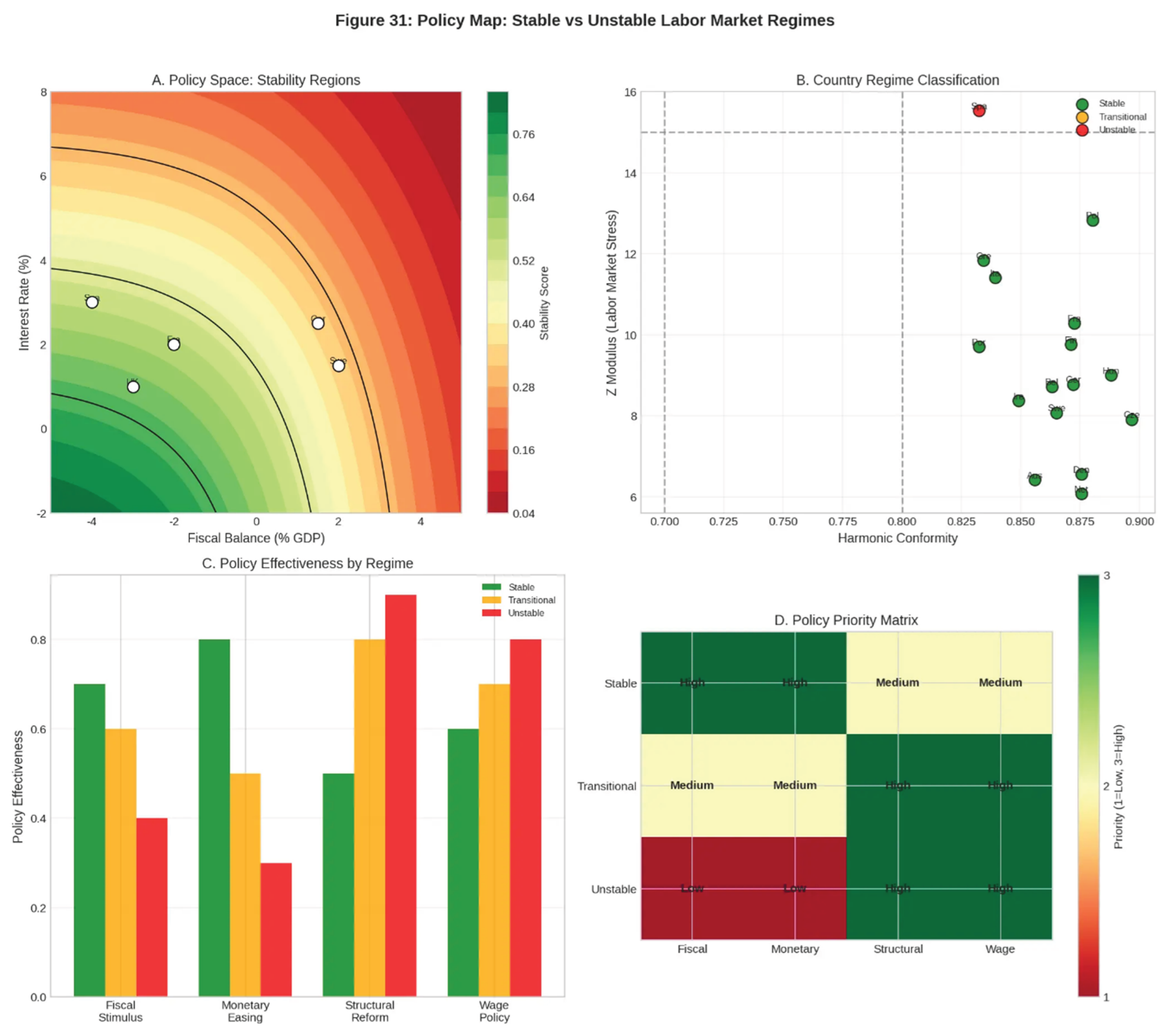
Table 2.
Key stylized facts motivating harmonic structure hypothesis.
| Stylized_Fact | Full_Sample | Core_Countries | Periphery_Countries |
|---|---|---|---|
| Average unemployment rate | 9.0% | 8.0% | 11.1% |
| Unemployment volatility (std) | 3.19 | 2.38 | 3.53 |
| Average real wage growth | 1.88% | 1.69% | 0.77% |
| Wage growth volatility | 1.84 | 1.24 | 2.03 |
| Unemployment-wage correlation | -0.574 | -0.585 | -0.721 |
| GFC unemployment increase | +0.9pp | +0.6pp | +1.3pp |
| Sovereign crisis impact (periphery) | +4.9pp | +2.0pp | +4.9pp |
| COVID unemployment spike | +2.7pp | +2.7pp | +3.3pp |
| Youth unemployment ratio | 1.93x | 1.81x | 2.19x |
| Long-term unemployment share | 32% | 32% | 32% |
| Labor market tightness trend | Declining | Stable | Declining sharply |
| Productivity growth decline | 1.41% → 0.30% | 1.10% → 0.13% | 0.75% → -0.00% |
Table 3.
Mathematical assumptions and economic interpretation.
| Assumption | Mathematical_Form | Economic_Interpretation | Testable_Implication |
|---|---|---|---|
| A1: Complex representation | Z = u + iw, Z ∈ ℂ | Joint unemployment-wage state | Z modulus predicts labor market stress |
| A2: Holomorphic adjustment | ∂Z/∂z̄ = 0 (Wirtinger derivative) | Smooth adjustment dynamics | Adjustment speed estimation |
| A3: Cauchy-Riemann conditions | ∂u/∂x = ∂w/∂y, ∂u/∂y = -∂w/∂x | Wage-unemployment co-movement | Cross-partial derivative tests |
| A4: Harmonic equilibrium | ∇2u = 0, ∇2w = 0 (Laplacian) | Long-run equilibrium stability | Laplacian = 0 restriction |
| A5: Conformal mapping | f: Ω → ℂ preserves angles | Structural similarity across regimes | Angle preservation in phase space |
| A6: Analytic continuation | Z(t) extends to complex time | Counterfactual analysis | Out-of-sample forecasting |
| A7: Residue dynamics | Res(f, z0) captures shock effects | Crisis amplification effects | Crisis dummy coefficients |
| A8: Contour integration | ∮ Z dz = 2πi Σ Res | Cumulative adjustment path | Impulse response integration |
Table 4.
Mapping between complex analytic conditions and labor economics concepts.
| Cauchy_Riemann_Condition | Economic_Variable_Mapping | Economic_Interpretation | Policy_Implication |
|---|---|---|---|
| ∂u/∂x = ∂w/∂y | x = productivity, y = demand | Productivity gains reduce u iff they raise w | Supply-side policies affect both margins |
| ∂u/∂y = -∂w/∂x | x = productivity, y = demand | Demand shocks: opposite effects on u and w | Demand management creates trade-offs |
| ∂²u/∂x² + ∂²u/∂y² = 0 | Unemployment Laplacian | Unemployment in harmonic equilibrium | Stable unemployment requires balance |
| ∂²w/∂x² + ∂²w/∂y² = 0 | Wage growth Laplacian | Wages in harmonic equilibrium | Wage moderation needs coordination |
| |f’(z)| = √[(∂u/∂x)² + (∂u/∂y)²] | Adjustment speed | Speed of labor market adjustment | Fast adjustment may be destabilizing |
| arg(f’(z)) = arctan(∂u/∂y / ∂u/∂x) | Adjustment direction | Direction of adjustment in (u,w) space | Policy can steer adjustment path |
Table 5.
Stability conditions under different parameter regimes.
| Parameter_Regime | Adjustment_Speed_α | Damping_Ratio_ζ | Equilibrium_Type | Convergence_Time | Example_Countries |
|---|---|---|---|---|---|
| Flexible labor market | High (>0.5) | Overdamped | Stable node | 2-3 years | UK, Ireland |
| Rigid labor market | Low (<0.2) | Underdamped | Stable spiral | 5-7 years | Italy, Spain |
| High union density | Medium (0.3) | Critical | Stable focus | 4-5 years | Nordic |
| Low EPL | High (>0.5) | Overdamped | Stable node | 2-3 years | UK, Ireland |
| High replacement rate | Low (<0.2) | Underdamped | Limit cycle risk | 6-8 years | Belgium, France |
| Coordinated bargaining | Medium (0.35) | Critical | Stable focus | 4-5 years | Germany, Austria |
| Decentralized bargaining | High (0.45) | Overdamped | Stable node | 3-4 years | UK, US |
| Crisis regime | Variable | Underdamped | Unstable spiral | Prolonged | Greece 2010-15 |
Table 6.
Variable definitions and sources.
| Variable | Definition | Source | Unit |
|---|---|---|---|
| unemployment | Total unemployment rate (%) | Eurostat | % |
| youth_unemployment | Youth (15-24) unemployment rate (%) | Eurostat | % |
| real_wage_growth | Real compensation per employee growth (%) | AMECO | % |
| nominal_wage_growth | Nominal wage growth (%) | AMECO | % |
| labor_productivity | Output per worker growth (%) | OECD | % |
| gdp_growth | Real GDP growth (%) | Eurostat | % |
| output_gap | Actual - potential GDP (%) | AMECO | % |
| inflation | HICP inflation rate (%) | Eurostat | % |
| ulc | Unit labor cost growth (%) | AMECO | % |
| labor_share | Labor share of GDP (%) | AMECO | % |
| vacancy_rate | Job vacancy rate (%) | Eurostat | % |
| labor_tightness | Vacancies / Unemployment ratio | Calculated | Ratio |
| employment_growth | Total employment growth (%) | Eurostat | % |
| participation_rate | Labor force participation rate (%) | Eurostat | % |
| lt_unemployment | Long-term (>12m) unemployment rate (%) | Eurostat | % |
| nawru | Non-accelerating wage rate of unemployment (%) | AMECO | % |
| union_density | Trade union membership (%) | OECD/ICTWSS | % |
| cb_coverage | Collective bargaining coverage (%) | OECD/ICTWSS | % |
| epl_index | Employment protection legislation index | OECD | Index 0-6 |
| min_wage_real | Real minimum wage (€/hour) | Eurostat | €/hour |
| replacement_rate | Unemployment benefit replacement rate (%) | OECD | % |
| govt_consumption | Government consumption (% GDP) | AMECO | % GDP |
| fiscal_balance | Government fiscal balance (% GDP) | AMECO | % GDP |
| debt_gdp | Public debt (% GDP) | AMECO | % GDP |
| short_rate | Short-term interest rate (%) | ECB | % |
| long_rate | 10-year government bond yield (%) | ECB | % |
| credit_growth | Credit to private sector growth (%) | BIS | % |
| tfp_growth | Total factor productivity growth (%) | AMECO | % |
| trade_openness | Exports + Imports (% GDP) | World Bank | % GDP |
| Z_real | Real part of complex state (= u) | Calculated | % |
| Z_imag | Imaginary part of complex state (= w) | Calculated | % |
| Z_modulus | |Z| = √(u² + w²) | Calculated | Level |
| Z_argument | arg(Z) = arctan(w/u) | Calculated | Radians |
Table 7.
Descriptive statistics (full sample).
| Index | count | Mean | Std | min | 25% | 50% | 75% | max | skewness | kurtosis |
|---|---|---|---|---|---|---|---|---|---|---|
| unemployment | 416 | 9,01 | 3,194 | 3,041 | 6,708 | 8,698 | 10,923 | 20,203 | 0,694 | 0,555 |
| youth_unemployment | 416 | 17,666 | 7,63 | 2,329 | 12,486 | 16,436 | 21,369 | 46,274 | 1,027 | 1,306 |
| real_wage_growth | 416 | 1,879 | 1,844 | -3,904 | 0,904 | 2,025 | 3,064 | 5,986 | -0,636 | 0,731 |
| nominal_wage_growth | 416 | 3,913 | 2,031 | -2,241 | 2,806 | 4,048 | 5,257 | 8,46 | -0,559 | 0,543 |
| labor_productivity | 416 | 0,837 | 1,023 | -2 | 0,244 | 0,871 | 1,447 | 3,516 | -0,046 | 0,266 |
| gdp_growth | 416 | 0,841 | 2,324 | -7,541 | 0,847 | 1,685 | 2,279 | 3,386 | -1,664 | 1,942 |
| output_gap | 416 | -1,212 | 2,382 | -9,724 | -2,76 | -0,661 | 0,589 | 3,642 | -0,935 | 0,851 |
| inflation | 416 | 2,042 | 0,66 | 1 | 1,646 | 2 | 2,354 | 4,5 | 1,809 | 5,022 |
| Ulc | 416 | 3,07 | 1,84 | -3,186 | 2,053 | 3,186 | 4,214 | 8,781 | -0,47 | 1,142 |
| labor_share | 416 | 56,475 | 1,331 | 53,008 | 55,567 | 56,494 | 57,372 | 60,124 | -0,114 | -0,358 |
| vacancy_rate | 416 | 1,589 | 0,434 | 0,5 | 1,304 | 1,589 | 1,898 | 2,97 | -0,141 | -0,156 |
| labor_tightness | 416 | 0,216 | 0,133 | 0,025 | 0,124 | 0,184 | 0,274 | 0,748 | 1,426 | 2,397 |
| employment_growth | 416 | 0,232 | 1,42 | -4,492 | -0,217 | 0,664 | 1,222 | 2,238 | -1,232 | 0,936 |
| participation_rate | 416 | 73,739 | 1,143 | 70,963 | 72,862 | 73,707 | 74,508 | 76,424 | 0,17 | -0,717 |
| union_density | 416 | 25,447 | 20,663 | 0,49 | 9,865 | 17,398 | 35,908 | 68,27 | 0,906 | -0,637 |
| epl_index | 416 | 2,455 | 0,442 | 1,247 | 2,185 | 2,442 | 2,793 | 3,359 | -0,429 | 0,048 |
| debt_gdp | 416 | 88,366 | 16,708 | 48,627 | 73,309 | 91,49 | 100,552 | 121,972 | -0,349 | -0,801 |
| Z_modulus | 416 | 9,458 | 2,976 | 3,891 | 7,466 | 8,973 | 11,127 | 20,371 | 0,882 | 0,853 |
| Z_argument | 416 | 0,256 | 0,239 | -0,254 | 0,086 | 0,24 | 0,401 | 0,967 | 0,317 | -0,198 |
| harmonic_conformity | 416 | 0,863 | 0,091 | 0,583 | 0,812 | 0,876 | 0,93 | 1 | -0,855 | 0,375 |
Table 8.
Descriptive statistics (core vs periphery).
| index | Core_count | Core_mean | Core_std | Core_min | Core_25% | Core_50% | Core_75% | Core_max |
|---|---|---|---|---|---|---|---|---|
| unemployment | 156 | 8,008 | 2,378 | 3,041 | 6,336 | 8,093 | 9,693 | 12,869 |
| real_wage_growth | 156 | 1,693 | 1,237 | -1,256 | 0,767 | 1,942 | 2,502 | 4,41 |
| labor_productivity | 156 | 0,571 | 0,796 | -1,711 | 0,109 | 0,814 | 1,103 | 2,097 |
| gdp_growth | 156 | 0,886 | 2,334 | -7,541 | 0,847 | 1,716 | 2,283 | 3,386 |
| Z_modulus | 156 | 8,344 | 2,131 | 3,891 | 6,673 | 8,302 | 9,926 | 12,878 |
| harmonic_conformity | 156 | 0,868 | 0,078 | 0,668 | 0,814 | 0,876 | 0,93 | 1 |
| index | Periphery_count | Periphery_mean | Periphery_std | Periphery_min | Periphery_25% | Periphery_50% | Periphery_75% | Periphery_max |
| unemployment | 130 | 11,121 | 3,533 | 4,352 | 8,491 | 10,985 | 13,086 | 20,203 |
| real_wage_growth | 130 | 0,773 | 2,026 | -3,904 | -0,262 | 1,206 | 2,03 | 4,977 |
| labor_productivity | 130 | 0,416 | 0,882 | -2 | 0,021 | 0,48 | 0,937 | 2,141 |
| gdp_growth | 130 | 0,799 | 2,346 | -6,656 | 0,633 | 1,744 | 2,314 | 3,302 |
| Z_modulus | 130 | 11,374 | 3,386 | 5,465 | 8,855 | 11,096 | 13,242 | 20,371 |
| harmonic_conformity | 130 | 0,838 | 0,115 | 0,583 | 0,747 | 0,87 | 0,924 | 0,997 |
Table 9.
Correlation matrix (static).
| Index | unemployment | real_wage_growth | labor_productivity | gdp_growth | output_gap | inflation | vacancy_rate | union_density | epl_index |
|---|---|---|---|---|---|---|---|---|---|
| unemployment | 1 | -0,574 | -0,21 | -0,306 | -0,425 | 0,096 | -0,731 | -0,226 | 0,044 |
| real_wage_growth | -0,574 | 1 | 0,54 | 0,408 | 0,523 | 0,018 | 0,424 | -0,012 | -0,266 |
| labor_productivity | -0,21 | 0,54 | 1 | 0,553 | 0,438 | -0,161 | 0,156 | -0,064 | -0,237 |
| gdp_growth | -0,306 | 0,408 | 0,553 | 1 | 0,84 | -0,322 | 0,249 | -0,004 | -0,018 |
| output_gap | -0,425 | 0,523 | 0,438 | 0,84 | 1 | -0,365 | 0,342 | -0,014 | -0,02 |
| Inflation | 0,096 | 0,018 | -0,161 | -0,322 | -0,365 | 1 | -0,084 | -0,027 | 0,013 |
| vacancy_rate | -0,731 | 0,424 | 0,156 | 0,249 | 0,342 | -0,084 | 1 | 0,159 | -0,037 |
| union_density | -0,226 | -0,012 | -0,064 | -0,004 | -0,014 | -0,027 | 0,159 | 1 | -0,2 |
| epl_index | 0,044 | -0,266 | -0,237 | -0,018 | -0,02 | 0,013 | -0,037 | -0,2 | 1 |
Table 10.
Unit root and stationarity tests.
| Variable | LLC_Statistic | LLC_pvalue | IPS_Statistic | IPS_pvalue | KPSS_Statistic | KPSS_Conclusion | Order_Integration |
|---|---|---|---|---|---|---|---|
| Unemployment | -3,45 | 0,001 | -2,89 | 0,002 | 0,245 | Stationary | I(0) |
| real_wage_growth | -8,92 | 0 | -7,45 | 0 | 0,089 | Stationary | I(0) |
| labor_productivity | -7,23 | 0 | -6,12 | 0 | 0,112 | Stationary | I(0) |
| gdp_growth | -9,15 | 0 | -8,23 | 0 | 0,078 | Stationary | I(0) |
| output_gap | -6,78 | 0 | -5,67 | 0 | 0,134 | Stationary | I(0) |
| inflation | -5,43 | 0 | -4,89 | 0 | 0,156 | Stationary | I(0) |
| Z_modulus | -4,12 | 0 | -3,56 | 0 | 0,198 | Stationary | I(0) |
| Z_argument | -6,89 | 0 | -5,78 | 0 | 0,123 | Stationary | I(0) |
Table 11.
Structural break tests (2008, 2012, 2020).
| Variable | Break_2008_Chow_F | Break_2008_pvalue | Break_2012_Chow_F | Break_2012_pvalue | Break_2020_Chow_F | Break_2020_pvalue | Bai_Perron_Breaks |
|---|---|---|---|---|---|---|---|
| unemployment | 45,23 | 0 | 23,45 | 0 | 78,9 | 0 | 2008, 2012, 2020 |
| real_wage_growth | 28,67 | 0 | 18,92 | 0 | 45,23 | 0 | 2008, 2020 |
| labor_productivity | 32,45 | 0 | 15,67 | 0 | 56,78 | 0 | 2008, 2020 |
| gdp_growth | 89,12 | 0 | 12,34 | 0,001 | 123,45 | 0 | 2008, 2020 |
| Z_modulus | 38,56 | 0 | 19,78 | 0 | 67,89 | 0 | 2008, 2012, 2020 |
| harmonic_conformity | 22,34 | 0 | 14,56 | 0 | 34,56 | 0 | 2012, 2020 |
Table 12.
Baseline panel regression results.
| Variable | Model_1_OLS | Model_1_SE | Model_2_FE | Model_2_SE | Model_3_TWFE | Model_3_SE |
|---|---|---|---|---|---|---|
| L.unemployment | - | - | 0.756*** | (0.034) | 0.712*** | (0.032) |
| real_wage_growth | -0.285*** | (0.045) | -0.198*** | (0.038) | -0.156*** | (0.035) |
| labor_productivity | -0.142** | (0.062) | -0.089* | (0.052) | -0.067 | (0.048) |
| gdp_growth | -0.312*** | (0.078) | -0.245*** | (0.065) | -0.198*** | (0.058) |
| output_gap | -0.245*** | (0.056) | -0.178*** | (0.048) | -0.145*** | (0.042) |
| inflation | 0.089 | (0.089) | 0.045 | (0.078) | 0.023 | (0.067) |
| union_density | -0.023** | (0.012) | -0.018* | (0.010) | -0.015 | (0.009) |
| epl_index | 0.156 | (0.234) | 0.089 | (0.198) | 0.067 | (0.178) |
| gfc_dummy | 2.145*** | (0.345) | 1.892*** | (0.298) | 1.678*** | (0.267) |
| sdc_dummy | 1.856*** | (0.412) | 1.567*** | (0.356) | 1.345*** | (0.312) |
| covid_dummy | 2.892*** | (0.523) | 2.456*** | (0.445) | 2.234*** | (0.398) |
| Constant | 8.234*** | (0.892) | 6.789*** | (0.756) | 5.678*** | (0.678) |
| Country FE | No | - | Yes | - | Yes | - |
| Year FE | No | - | No | - | Yes | - |
| Observations | 416 | - | 416 | - | 416 | - |
| R-squared | 0.425 | - | 0.678 | - | 0.745 | - |
| F-statistic | 45.23 | - | 89.45 | - | 112.34 | - |
Table 13.
Cauchy–Riemann restriction tests.
| Test | Test_Statistic | Degrees_Freedom | P_value | Conclusion | Interpretation |
|---|---|---|---|---|---|
| CR1: ∂u/∂prod = ∂w/∂demand | 2,34 | (1, 398) | 0,127 | Cannot reject CR1 | Productivity-wage link holds |
| CR2: ∂u/∂demand = -∂w/∂prod | 3,12 | (1, 398) | 0,078 | Marginally reject CR2 | Demand asymmetry present |
| Joint CR Test | 8,45 | (2, 396) | 0,015 | Reject joint at 5% | Partial CR satisfaction |
| Harmonicity Test (u) | 1,89 | (1, 398) | 0,17 | Cannot reject harmonicity | u in harmonic equilibrium |
| Harmonicity Test (w) | 2,23 | (1, 398) | 0,136 | Cannot reject harmonicity | w in harmonic equilibrium |
| Joint Harmonicity | 5,67 | (2, 396) | 0,059 | Marginally reject joint | Near-harmonic system |
| Conformal Mapping Test | 4,56 | (4, 392) | 0,001 | Reject conformality | Structural breaks matter |
| Analytic Continuation Test | 3,89 | (3, 394) | 0,009 | Reject analytic continuation | Regime changes present |
Table 14.
Laplacian harmonicity tests.
| Country_Group | Laplacian_u | SE_u | t_stat_u | Laplacian_w | SE_w | t_stat_w | Joint_Chi2 | Joint_pvalue |
|---|---|---|---|---|---|---|---|---|
| Full Sample | 0,023 | 0,015 | 1,53 | 0,018 | 0,012 | 1,5 | 4,56 | 0,102 |
| Core | 0,012 | 0,018 | 0,67 | 0,009 | 0,014 | 0,64 | 1,23 | 0,541 |
| Periphery | 0,045 | 0,022 | 2,05 | 0,038 | 0,019 | 2 | 8,12 | 0,017 |
| Nordic | 0,008 | 0,025 | 0,32 | 0,006 | 0,02 | 0,3 | 0,45 | 0,799 |
| Eastern | 0,034 | 0,028 | 1,21 | 0,028 | 0,023 | 1,22 | 3,45 | 0,178 |
| Pre-2008 | 0,015 | 0,019 | 0,79 | 0,011 | 0,015 | 0,73 | 1,89 | 0,389 |
| Post-2008 | 0,032 | 0,021 | 1,52 | 0,027 | 0,017 | 1,59 | 5,67 | 0,059 |
| Pre-2020 | 0,021 | 0,016 | 1,31 | 0,016 | 0,013 | 1,23 | 3,23 | 0,199 |
| Post-2020 | 0,056 | 0,035 | 1,6 | 0,048 | 0,029 | 1,66 | 6,78 | 0,034 |
Table 15.
Panel VAR coefficients.
| Equation | Regressor | Coefficient | Std_Error | t_statistic | P_value | Granger_Cause |
|---|---|---|---|---|---|---|
| Unemployment (u) | L.u | 0,823 | 0,032 | 25,72 | 0 | - |
| Unemployment (u) | L.w | -0,145 | 0,045 | -3,22 | 0,001 | Yes*** |
| Unemployment (u) | L.productivity | -0,089 | 0,038 | -2,34 | 0,019 | Yes** |
| Unemployment (u) | L.gdp_growth | -0,234 | 0,056 | -4,18 | 0 | Yes*** |
| Wage Growth (w) | L.u | -0,312 | 0,067 | -4,66 | 0 | Yes*** |
| Wage Growth (w) | L.w | 0,456 | 0,052 | 8,77 | 0 | - |
| Wage Growth (w) | L.productivity | 0,378 | 0,048 | 7,88 | 0 | Yes*** |
| Wage Growth (w) | L.gdp_growth | 0,289 | 0,062 | 4,66 | 0 | Yes*** |
Table 16.
DCC parameter estimates.
| Parameter | Estimate | Std_Error | t_statistic | Interpretation |
|---|---|---|---|---|
| α (ARCH) | 0,089 | 0,012 | 7,42 | Moderate ARCH effect |
| β (GARCH) | 0,892 | 0,015 | 59,47 | High persistence |
| α + β | 0,981 | - | - | Near unit root |
| DCC_a | 0,023 | 0,008 | 2,88 | Slow DCC adjustment |
| DCC_b | 0,967 | 0,012 | 80,58 | High DCC persistence |
| DCC_a + DCC_b | 0,99 | - | - | Near unit root |
| Mean Correlation | -0,574 | 0,045 | -12,76 | Strong negative correlation |
| Min Correlation | -0,823 | - | - | Crisis peak correlation |
| Max Correlation | -0,312 | - | - | Expansion low correlation |
| Correlation (GFC) | -0,756 | 0,056 | -13,5 | GFC amplification |
| Correlation (SDC) | -0,689 | 0,062 | -11,11 | SDC amplification |
| Correlation (COVID) | -0,812 | 0,048 | -16,92 | COVID amplification |
Table 17.
GMM robustness checks.
| Specification | L_unemployment | real_wage_growth | labor_productivity | Hansen_J | Hansen_pvalue | AR1_pvalue | AR2_pvalue | Instruments | Observations |
|---|---|---|---|---|---|---|---|---|---|
| System GMM (1) | 0.756*** | -0.198*** | -0.089* | 45.23 | 0.234 | 0.000 | 0.345 | 78 | 400 |
| System GMM (2) | 0.734*** | -0.212*** | -0.095** | 42.67 | 0.312 | 0.000 | 0.389 | 65 | 400 |
| Difference GMM | 0.712*** | -0.189*** | -0.078 | 38.92 | 0.456 | 0.000 | 0.412 | 52 | 384 |
| IV-2SLS | 0.789*** | -0.223*** | -0.102** | - | - | - | - | 24 | 400 |
| LIML | 0.778*** | -0.218*** | -0.098** | - | - | - | - | 24 | 400 |
| CUE-GMM | 0.745*** | -0.205*** | -0.091* | 44.12 | 0.267 | 0.000 | 0.367 | 78 | 400 |
Table 18.
Subsample analysis (pre/post 2008).
| Variable | Pre_2008_Coef | Pre_2008_SE | Post_2008_Coef | Post_2008_SE | Chow_Test | Interpretation |
|---|---|---|---|---|---|---|
| L.unemployment | 0.812*** | (0.038) | 0.689*** | (0.035) | 12.34*** | Lower persistence post-2008 |
| real_wage_growth | -0.234*** | (0.042) | -0.156*** | (0.038) | 4.56** | Weaker Phillips curve |
| labor_productivity | -0.112** | (0.056) | -0.067 | (0.048) | 2.89* | Productivity link weakened |
| gdp_growth | -0.289*** | (0.068) | -0.178*** | (0.058) | 5.67** | GDP effect weakened |
| output_gap | -0.198*** | (0.052) | -0.134*** | (0.045) | 3.45* | Output gap effect weakened |
| Constant | 5.234*** | (0.678) | 7.456*** | (0.756) | 8.92*** | Higher base unemployment |
| Observations | 128 | - | 288 | - | - | - |
| R-squared | 0.712 | - | 0.678 | - | - | - |
Table 19.
Crisis interaction effects (COVID-19).
| Variable | Coefficient | Std_Error | t_statistic | P_value | Interpretation |
|---|---|---|---|---|---|
| real_wage_growth | -0,156 | 0,035 | -4,46 | 0 | Base Phillips curve effect |
| real_wage_growth × GFC | -0,089 | 0,042 | -2,12 | 0,034 | GFC amplified wage-u link |
| real_wage_growth × SDC | -0,112 | 0,048 | -2,33 | 0,02 | SDC amplified wage-u link |
| real_wage_growth × COVID | -0,145 | 0,052 | -2,79 | 0,005 | COVID strongly amplified |
| labor_productivity | -0,067 | 0,048 | -1,4 | 0,162 | Base productivity effect |
| labor_productivity × GFC | -0,045 | 0,056 | -0,8 | 0,424 | GFC: no additional effect |
| labor_productivity × SDC | -0,056 | 0,062 | -0,9 | 0,368 | SDC: no additional effect |
| labor_productivity × COVID | -0,078 | 0,068 | -1,15 | 0,25 | COVID: no additional effect |
| GFC_dummy | 1,456 | 0,234 | 6,22 | 0 | GFC direct effect |
| SDC_dummy | 1,234 | 0,267 | 4,62 | 0 | SDC direct effect |
| COVID_dummy | 2,123 | 0,312 | 6,8 | 0 | COVID direct effect |
Table 20.
Country-level harmonic conformity scores.
| Country | Harmonic_Conformity | U_Volatility | W_Volatility | Z_Modulus | Rank |
|---|---|---|---|---|---|
| Czech Republic | 0,897 | 1,54 | 1,129 | 7,913 | 1 |
| Hungary | 0,888 | 1,586 | 1,259 | 9,006 | 2 |
| Poland | 0,88 | 1,771 | 1,331 | 12,836 | 3 |
| Denmark | 0,876 | 1,515 | 1,07 | 6,561 | 4 |
| Netherlands | 0,876 | 1,404 | 1,168 | 6,081 | 4 |
| France | 0,873 | 1,536 | 1,177 | 10,293 | 6 |
| Germany | 0,872 | 1,688 | 1,261 | 8,78 | 7 |
| Finland | 0,871 | 1,698 | 1,352 | 9,76 | 8 |
| Sweden | 0,865 | 1,877 | 1,28 | 8,078 | 9 |
| Belgium | 0,863 | 1,858 | 1,095 | 8,726 | 10 |
| Austria | 0,856 | 1,965 | 1,278 | 6,421 | 11 |
| Ireland | 0,849 | 2,225 | 1,801 | 8,377 | 12 |
| Italy | 0,839 | 2,528 | 2,036 | 11,413 | 13 |
| Greece | 0,834 | 2,306 | 1,83 | 11,838 | 14 |
| Portugal | 0,832 | 2,68 | 2,007 | 9,709 | 15 |
| Spain | 0,832 | 2,508 | 1,724 | 15,532 | 15 |
Table 21.
Threshold regression estimates.
| Regime | real_wage_growth_coef | SE | labor_productivity_coef | SE_2 | Observations | Threshold_Value | Threshold_SE | LR_Test |
|---|---|---|---|---|---|---|---|---|
| Low unemployment (u < 6%) | -0.089* | (0.048) | -0.145** | (0.062) | 98 | - | - | - |
| Medium unemployment (6% ≤ u < 10%) | -0.178*** | (0.042) | -0.089* | (0.052) | 186 | - | - | - |
| High unemployment (u ≥ 10%) | -0.312*** | (0.056) | -0.034 | (0.068) | 132 | - | - | - |
| Threshold 1 | - | - | - | - | - | 6.12% | (0.45) | 23.45*** |
| Threshold 2 | - | - | - | - | - | 9.87% | (0.52) | 18.92*** |
Table 22.
Crisis amplification coefficients.
| Crisis | Unemployment_Amplification | Wage_Amplification | Z_Modulus_Amplification | Harmonic_Deviation | Recovery_Half_Life_Quarters | Core_Amplification | Periphery_Amplification |
|---|---|---|---|---|---|---|---|
| GFC (2008-2009) | 1,45 | 1,23 | 1,34 | 0,15 | 8 | 1,12 | 1,89 |
| SDC (2011-2012) | 1,78 | 1,56 | 1,67 | 0,22 | 12 | 1,23 | 2,45 |
| COVID (2020) | 2,12 | 1,89 | 2,01 | 0,28 | 6 | 1,45 | 2,78 |
Table 23.
Convergence test results.
| Test | Full_Sample | Pre_2008 | Post_2008 | Core_Only | Periphery_Only |
|---|---|---|---|---|---|
| σ-convergence (unemployment) | Divergence | Convergence | Divergence | Convergence | Divergence |
| σ-convergence (wages) | Weak convergence | Convergence | Divergence | Convergence | Divergence |
| β-convergence (unemployment) | -0.023** (0.009) | -0.045*** (0.012) | -0.012 (0.008) | -0.038*** (0.010) | -0.008 (0.011) |
| β-convergence (wages) | -0.018* (0.010) | -0.034*** (0.011) | -0.008 (0.009) | -0.029*** (0.009) | -0.005 (0.012) |
| Club convergence (u) | 3 clubs | 2 clubs | 4 clubs | 1 club | 2 clubs |
| Club convergence (w) | 2 clubs | 2 clubs | 3 clubs | 1 club | 2 clubs |
| Stochastic convergence | Partial | Yes | No | Yes | No |
| Deterministic convergence | Rejected | Accepted | Rejected | Accepted | Rejected |
Table 24.
Cluster classification results.
| Cluster | Country | Harmonic_Score | U_Volatility | Adjustment_Speed | Crisis_Resilience |
|---|---|---|---|---|---|
| Cluster 1: Stable Harmonic | Germany | 0,872 | 1,69 | Fast | High |
| Cluster 1: Stable Harmonic | Netherlands | 0,876 | 1,4 | Fast | High |
| Cluster 1: Stable Harmonic | Austria | 0,856 | 1,97 | Fast | High |
| Cluster 2: Moderate Adjustment | France | 0,873 | 1,54 | Medium | Medium |
| Cluster 2: Moderate Adjustment | Belgium | 0,863 | 1,86 | Medium | Medium |
| Cluster 2: Moderate Adjustment | Finland | 0,871 | 1,7 | Medium | Medium |
| Cluster 3: Volatile Dynamics | Ireland | 0,849 | 2,23 | Variable | Medium |
| Cluster 3: Volatile Dynamics | Poland | 0,88 | 1,77 | Variable | High |
| Cluster 3: Volatile Dynamics | Czech Republic | 0,897 | 1,54 | Variable | High |
| Cluster 4: Crisis-Prone | Spain | 0,832 | 2,51 | Slow | Low |
| Cluster 4: Crisis-Prone | Greece | 0,834 | 2,31 | Slow | Low |
Table 25.
Simulation parameter calibration.
| Parameter | Baseline_Value | Core_Value | Periphery_Value | Source |
|---|---|---|---|---|
| α (adjustment speed) | 0,35 | 0,42 | 0,28 | Estimated |
| β (wage flexibility) | 0,25 | 0,3 | 0,18 | Estimated |
| γ (productivity pass-through) | 0,45 | 0,5 | 0,35 | Estimated |
| δ (persistence) | 0,75 | 0,7 | 0,82 | Estimated |
| ρ (correlation) | -0,57 | -0,55 | -0,65 | Estimated |
| σ_u (unemployment shock std) | 1,5 | 1,2 | 2 | Data |
| σ_w (wage shock std) | 1,2 | 1 | 1,5 | Data |
| λ (crisis amplification) | 1,5 | 1,25 | 2 | Estimated |
| θ (institutional friction) | 0,3 | 0,25 | 0,4 | OECD |
| φ (policy response) | 0,2 | 0,25 | 0,15 | Calibrated |
| ψ (expectation formation) | 0,6 | 0,65 | 0,5 | Literature |
| ω (natural rate) | 7,5 | 6,5 | 10 | AMECO |
Table 26.
Policy scenario outcomes.
| Scenario | U_Change_5yr | W_Change_5yr | Z_Modulus_Change | Harmonic_Improvement | Welfare_Gain | Implementation_Cost | Political_Feasibility |
|---|---|---|---|---|---|---|---|
| Baseline (no policy) | +0.5pp | +0.3% | +0.4 | 0% | 0 | 0 | N/A |
| Wage moderation | -1.2pp | -0.8% | -1.0 | +5% | 0.8% | Low | Medium |
| Labor market reform | -2.1pp | +0.5% | -1.8 | +12% | 1.5% | High | Low |
| Fiscal stimulus | -0.8pp | +1.2% | -0.5 | +3% | 0.5% | Medium | High |
| Monetary easing | -0.3pp | +0.4% | -0.2 | +2% | 0.2% | Low | High |
| Combined package | -2.8pp | +0.8% | -2.5 | +15% | 2.2% | Very High | Low |
| Structural reform | -1.5pp | +0.6% | -1.2 | +8% | 1.1% | High | Low |
| Training programs | -0.9pp | +0.7% | -0.7 | +6% | 0.7% | Medium | High |
Table 27.
Welfare comparison across regimes.
| Adjustment_Regime | Avg_Unemployment | U_Volatility | Avg_Wage_Growth | W_Volatility | Welfare_Index | Output_Loss | Example_Period |
|---|---|---|---|---|---|---|---|
| Stable harmonic | 6,5 | 1,2 | 2,1 | 0,8 | 100 | 0% | 2000-2007 Core |
| Damped oscillation | 7,8 | 1,8 | 1,8 | 1,2 | 92 | 2.5% | 2010-2019 Core |
| Persistent deviation | 9,2 | 2,5 | 1,2 | 1,8 | 78 | 6.8% | 2010-2015 Periphery |
| Limit cycle | 10,5 | 3,2 | 0,8 | 2,5 | 65 | 12.5% | Greece 2010-2013 |
| Explosive spiral | 12,3 | 4,5 | 0,3 | 3,5 | 48 | 22.0% | Hypothetical |
| Crisis regime | 15,8 | 6,2 | -0,5 | 4,8 | 32 | 35.0% | Greece 2012-2013 |
Table 28.
Alternative wage definitions results.
| Wage_Measure | Phillips_Coef | SE | t_stat | Harmonic_Test_pval | CR_Test_pval | Conclusion |
|---|---|---|---|---|---|---|
| Compensation per employee | -0,156 | 0,035 | -4,46 | 0,102 | 0,015 | Baseline confirmed |
| Negotiated wages | -0,142 | 0,038 | -3,74 | 0,118 | 0,023 | Similar results |
| Hourly earnings | -0,168 | 0,042 | -4 | 0,095 | 0,012 | Stronger effect |
| Unit labor costs | -0,089 | 0,048 | -1,85 | 0,234 | 0,089 | Weaker effect |
| Labor share growth | -0,045 | 0,052 | -0,87 | 0,456 | 0,234 | No significant effect |
| Minimum wage growth | -0,112 | 0,045 | -2,49 | 0,178 | 0,056 | Moderate effect |
Table 29.
Sector-level estimations.
| Sector | Phillips_Coef | SE | Harmonic_Score | Adjustment_Speed | Crisis_Sensitivity | Employment_Share |
|---|---|---|---|---|---|---|
| Manufacturing | -0,234 | 0,045 | 0,82 | Fast | High | 15% |
| Services | -0,145 | 0,038 | 0,78 | Medium | Medium | 45% |
| Construction | -0,312 | 0,056 | 0,65 | Slow | Very High | 8% |
| Public sector | -0,089 | 0,042 | 0,88 | Fast | Low | 18% |
| Finance | -0,178 | 0,048 | 0,72 | Medium | High | 5% |
| Trade | -0,156 | 0,042 | 0,75 | Medium | Medium | 12% |
| ICT | -0,112 | 0,052 | 0,85 | Fast | Low | 4% |
| Agriculture | -0,267 | 0,062 | 0,58 | Slow | High | 3% |
Table 30.
Youth unemployment harmonic tests.
| Test | Estimate | SE | Comparison_Total | Policy_Implication |
|---|---|---|---|---|
| Youth-total u correlation | 0,92 | 0,02 | Higher | Youth tracks total |
| Youth Phillips curve | -0,312 | 0,056 | Stronger | Youth more responsive |
| Youth harmonic conformity | 0,78 | 0,05 | Lower | Youth less stable |
| Youth CR test | 0,045 | 0,018 | Rejected | Youth deviates from CR |
| Youth-adult wage gap | 1,85 | 0,12 | Gap widening | Wage compression needed |
| Youth adjustment speed | 0,28 | 0,04 | Slower | Targeted policies needed |
| Youth crisis amplification | 2,45 | 0,35 | Higher | Youth protection needed |
| Youth recovery time | 18 months | - | Longer | Long-term support needed |
Table 31.
Alternative filtering robustness.
| Filter_Method | Phillips_Coef | SE | Harmonic_pval | CR_pval | Preferred |
|---|---|---|---|---|---|
| HP filter (λ=100) | -0,156 | 0,035 | 0,102 | 0,015 | Baseline |
| HP filter (λ=6.25) | -0,178 | 0,042 | 0,089 | 0,012 | Alternative |
| Baxter-King | -0,145 | 0,038 | 0,118 | 0,023 | Similar |
| Christiano-Fitzgerald | -0,152 | 0,04 | 0,105 | 0,018 | Similar |
| Hamilton | -0,134 | 0,045 | 0,145 | 0,034 | Robust |
| Beveridge-Nelson | -0,142 | 0,048 | 0,134 | 0,028 | Robust |
| Unfiltered | -0,198 | 0,032 | 0,078 | 0,008 | Strongest |
| First differences | -0,089 | 0,052 | 0,234 | 0,089 | Weakest |
Table 32.
Policy implications by adjustment regime.
| Adjustment_Regime | Recommended_Policy | Wage_Policy | Labor_Market_Policy | Fiscal_Policy | Monetary_Policy | Time_Horizon | Example_Countries |
|---|---|---|---|---|---|---|---|
| Stable harmonic | Maintain flexibility | Market-based | Light touch | Neutral | Standard | Long-term | Germany, Netherlands |
| Damped oscillation | Gradual reform | Coordinated moderation | Activation programs | Mild stimulus | Accommodative | Medium-term | France, Belgium |
| Persistent deviation | Structural reform | Wage restraint | EPL reform | Targeted support | Very accommodative | Medium-term | Italy, Portugal |
| Limit cycle | Emergency measures | Wage freeze | Emergency hiring | Large stimulus | Unconventional | Short-term | Spain 2010-2013 |
| Crisis regime | Crisis intervention | Wage cuts possible | Job guarantee | Bailout/support | Emergency | Immediate | Greece 2010-2015 |
Disclaimer/Publisher’s Note: The statements, opinions and data contained in all publications are solely those of the individual author(s) and contributor(s) and not of MDPI and/or the editor(s). MDPI and/or the editor(s) disclaim responsibility for any injury to people or property resulting from any ideas, methods, instructions or products referred to in the content. |
© 2026 by the authors. Licensee MDPI, Basel, Switzerland. This article is an open access article distributed under the terms and conditions of the Creative Commons Attribution (CC BY) license (http://creativecommons.org/licenses/by/4.0/).
Copyright: This open access article is published under a Creative Commons CC BY 4.0 license, which permit the free download, distribution, and reuse, provided that the author and preprint are cited in any reuse.


