

Submitted:
25 February 2026
Posted:
02 March 2026
You are already at the latest version
Abstract
The education of gifted individuals has strategic importance today. It aligns directly with the United Nations Sustainable Development Goals and it supports inclusive quality education (SDG 4). This study examines theoretical approaches and application models in gifted education with a cross-cultural perspective and the document analysis method is used. International models and the historical development of gifted education in Türkiye are compared. Findings show that gifted education evolved from one-dimensional intelligence tests to holistic models. These models support the affective, cognitive, and psychomotor well-being of students. The applications in different countries are shaped by their cultural values and education policies. Systemic barriers in identification processes prevent equal opportunities in many countries. The Science and Art Centers (BILSEM) and Gifted Education Program (UYEP) offer important institutional foundations in Türkiye. But recent literature shows that these centers continue to face physical and material problems. Students from all socio-economic backgrounds must have fair access to advanced learning. Gifted education is a long-term public policy area. Sustainable gifted education systems require social equity, institutional continuity, and dynamic curriculum structures. Policy implications are presented to build inclusive and sustainable education models from a Türkiye perspective.
Keywords:
gifted education
; sustainable education policies
; human capital
; cross-cultural analysis
; institutional continuity
; quality education
; Türkiye
1. Introduction
From past to present, the role of gifted individuals in the progress of societies in scientific discoveries, artistic activities, and technological developments has emerged as a determining factor. These individuals have creativity, original thinking skills, and a high motivation level. They do not only produce new works in their own fields. They also lead social progress and cultural change. Gifted individuals have above-average cognitive, creative, or artistic capacities. Also, noticing and developing these potentials provides a big gain at both individual and social levels [1,2,3]. So, the education of gifted individuals has a very important role in the development of the modern education system. The education of gifted individuals is not only about revealing individual potential. It also has strategic importance for strengthening human capital. This human capital supports the sustainable development of society and ensures cultural continuity.
In recent years, the sustainability concept is not only handled with environmental and economic dimensions. It is also handled as a basic principle. This principle ensures the long-term continuity of social, cultural, and educational systems. Education systems are evaluated as one of the most important parts of sustainable development. They train qualified human resources, ensure social equality, and protect cultural capital. In this context, the education of gifted individuals should be handled as a strategic sustainability policy area. This area strengthens the human capital of countries. It increases the capacity to produce new things and supports social change. The education of gifted individuals aligns directly with the United Nations Sustainable Development Goals (SDGs). Specifically, it supports SDG 4; this goal targets inclusive and equitable quality education. It also contributes to SDG 8; it promotes sustainable economic growth through strong human capital. Gifted education is not a luxury, it is a necessary component for reaching these global targets [4,5,6].
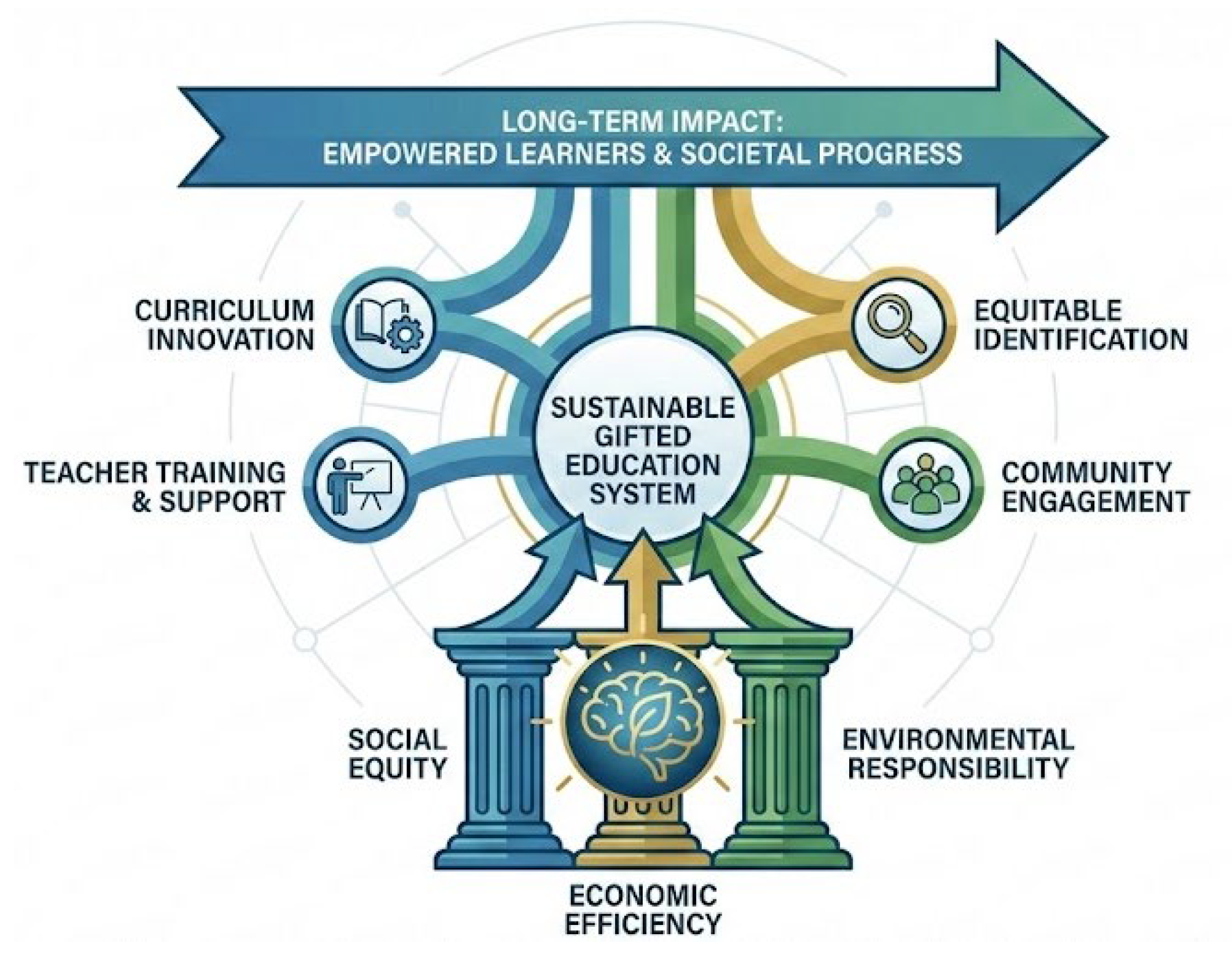
This study conceptualizes sustainability in gifted education over three basic dimensions. First is social justice, equal opportunity, and inclusion. Second is institutional continuity and policy stability. Third is the development of human capital and long-term social contribution. Sustainable gifted education also relates to SDG 3. This goal ensures healthy lives and promotes well-being. Gifted students often face emotional and social difficulties. Supporting their affective, cognitive, and psychomotor dimensions in a holistic way prevents school burnout. It protects their mental well-being [7]. So, creating healthy learning environments is a basic part of sustainable systems.
In this frame, sustainable gifted education needs a holistic education understanding. This understanding is based on fair identification processes for all individuals. It is also based on qualified teacher training systems, curriculum structures sensitive to cultural context, and continuity among institutional structures. So, gifted education should not be evaluated only as a pedagogical area. It should be evaluated as a public policy area. This area supports long-term social development and cultural sustainability. At this point, examining how intelligence and giftedness concepts transformed from philosophical foundations to scientific theories will provide a better understanding. It will help to understand the multi-dimensional structure that gifted education has reached today.
Intelligence and giftedness concepts have been one of the most debated areas of both philosophy and psychology throughout history. So, it is seen that these concepts are handled in different ways. Centuries ago, Plato, one of the ancient Greek thinkers, classified individuals in society as copper, bronze, and gold. He defined social roles based on innate qualities (Plato, 380 BC). This approach is accepted as one of the first philosophical views on the place of individual differences in society. In the 19th century, Sir Francis Galton became one of the first scientists to handle the intelligence concept in a modern sense. He evaluated intelligence over the skill of organizing information and using it [8,9,10,11,12]. Sternberg [13] handled intelligence in three dimensions as analytic, creative, and practical. Analytic intelligence covers cognitive processes. Creative intelligence covers innovative thinking. Practical intelligence covers the skill of the individual to develop behavior suitable for their environment [14].
Intelligence is explained with various theories in different historical periods. Also, gifted individuals play a role in social development. When these are considered, it can be said that giftedness is not limited only to academic success. It also includes multi-faceted features like problem solving, making and developing new projects, and adapting to the environment. It includes affective, social, and cognitive skills. The change of definitions related to intelligence in the historical process shows something else. It shows that the development of gifted individuals can transform depending on scientific and cultural conditions. This situation caused giftedness to stop being a structure evaluated only on the basis of cognitive skills over time. It evolved into an understanding based on the holistic development of the individual. This theoretical expansion created an important turning point in the development of gifted education both in the world and in our country. It helped the identification, education programs, and policy designs of gifted individuals to be reshaped. This reshaping is in line with a multi-dimensional giftedness understanding [15]. Like this, gifted education became one of the basic parts of sustainable education systems. This is in terms of long-term planning, institutional continuity, and the capacity to produce social benefit.
Today, the education of gifted individuals is based on flexible and integrative models. These models are sensitive to individual differences. This study aims to explain theoretical approaches and application processes in the field. It also aims to offer a developing perspective for the current applications in Türkiye. The importance of modern education systems is especially highlighted. This is for maximizing the potentials of gifted individuals and contributing to social development. In this context, gifted education is not evaluated only as a pedagogical area. It is also evaluated as a strategic policy area in ensuring sustainability in education. Since the middle of the 20th century, different models are developed in many countries. The aim is to identify, support, and meet the educational needs of gifted individuals [16]. Clear differences about both method and application emerged among researches conducted at national and international levels. This diversity shows the need to systematically synthesize the information accumulated in the literature. This synthesis is needed in line with the goal of creating sustainable education systems. The study prepared in this direction targets to evaluate comprehensively what theoretical approaches the education of gifted individuals is built on today. It targets to evaluate how international applications are structured and how these approaches reflect on the development process in Türkiye. The research examines theoretical foundations, application models, and policy developments related to the education of gifted individuals in the world and in Türkiye. It handles the experiences of different countries with a comparative perspective. In this process, historical accumulation, cultural values, and social expectations determine the education policies of countries. They directly affect the shaping process of the application of theoretical approaches in our country. In this context, analyzing national and international researches with the document analysis method will make the relationship between theoretical approaches and application examples visible. It will offer policy-based and long-term inferences for building sustainable gifted education systems in Türkiye.
Figure 1.
A Conceptual Framework for a Sustainable Gifted Education System, illustrating the core pillars sustainability and their translation into key policy areas for long-term impact.
Figure 1.
A Conceptual Framework for a Sustainable Gifted Education System, illustrating the core pillars sustainability and their translation into key policy areas for long-term impact.
2. Methods
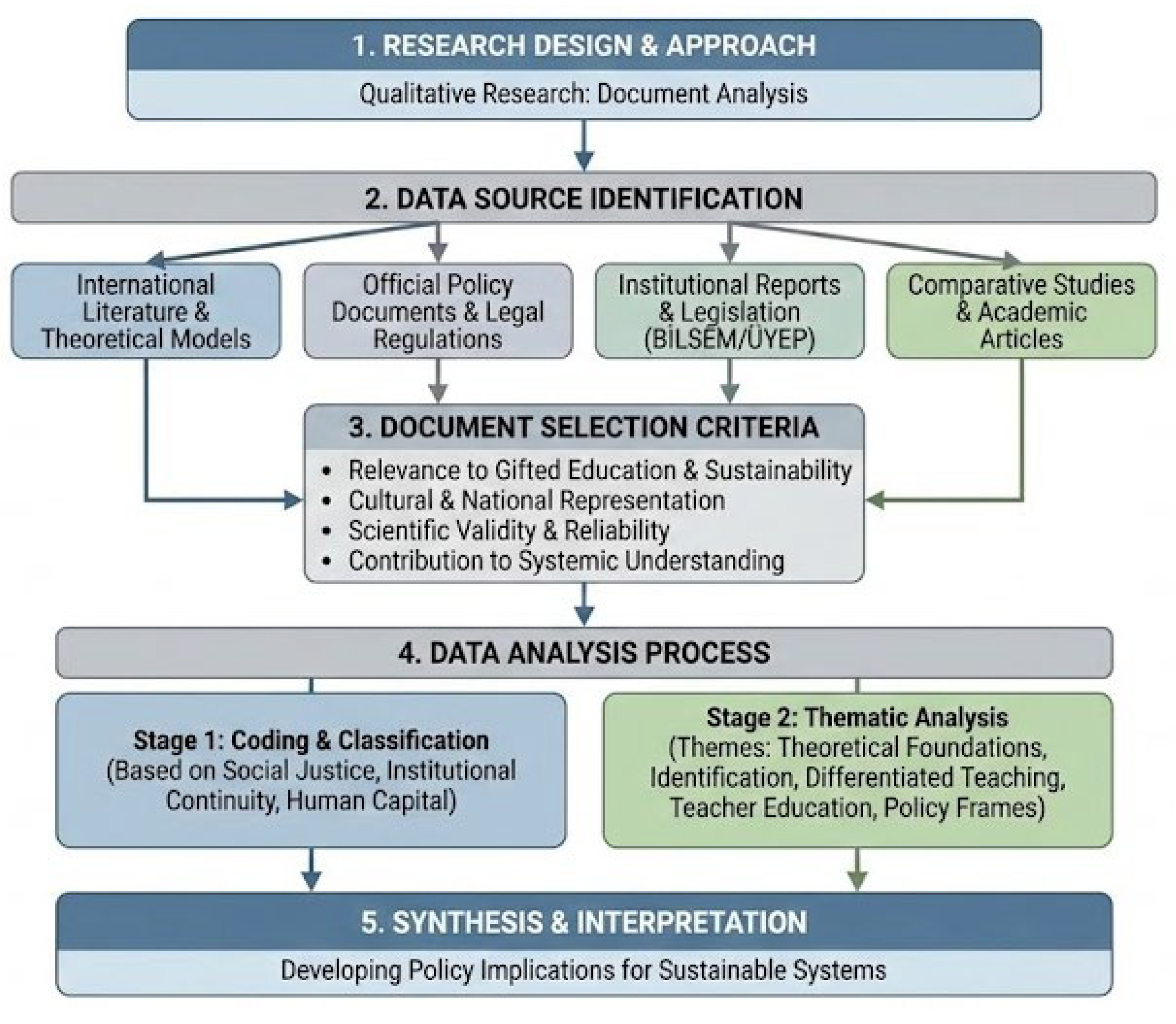
This study is designed using the document analysis method. This is in the frame of the qualitative research approach. Document analysis allows examining theoretical approaches, policy frames, and application models in different countries. It allows examining them with their cultural contexts systematically and deeply. So, this method is preferred. Thanks to this method, gifted education could be handled not only as a pedagogical area. It could also be handled as a sustainability-focused education policy area. National and international academic articles published in the gifted education field form the data sources of the research. Official policy documents, legal regulations, reports, and institutional publications also form them. In this scope, the main data sources are international literature handling theoretical models and approaches related to gifted education. Official documents reflecting gifted education policies in different countries are used. Legislation, reports, and institutional publications related to BILSEM and UYEP in Türkiye are used. Researches based on comparative studies between countries are used.
The following criteria are taken as a basis in selecting the documents. Being directly related to gifted education and sustainability-based education policies is a criterion. Being able to represent different cultural and national contexts is a criterion. Having scientific validity and academic reliability is a criterion. Contributing to the understanding of sustainable gifted education systems is a criterion. The thematic analysis method is used in the data analysis process. In the first stage, all documents are examined and coded in detail. The coding process is structured on the basis of three basic dimensions. These dimensions explain sustainability in gifted education. The first is social justice, equal opportunity, and inclusion. The second is institutional continuity, governance, and policy stability. The third is the development of human capital. In the second stage, the obtained data are classified under common themes. These themes are theoretical foundations, identification processes, and differentiated teaching applications. Teacher education, curriculum structures, and policy frames are also themes. Then, international applications and current structures in Türkiye are handled with a comparative perspective. Similarities, differences, and aspects open to development are shown. Thanks to this methodological frame, the study offers a chance. This chance is evaluating gifted education not only as an area targeting individual success. It is also evaluating it as a sustainable policy area. This area supports long-term social, cultural, and human development.
Figure 2.
Flowchart illustrating the document analysis methodology employed in the study.
3. Results
3.1. Education of the Gifted in the World
The education of the gifted in the world started to be handled in a systematic way from the beginning of the 20th century. In this period, IQ-based approaches are at the forefront in the identification of gifted individuals. From the 1970s, it is seen that gifted education policies started to become institutionalized. They turned into a long-term education policy area especially in the USA. Institutions like the Gifted Child Program and the National Association for Gifted Children established in this period led the education of gifted individuals. They helped it to be based on scientific foundations [17,18,19]. These developments showed a need. This need is gathering the models applied in different countries on a common ground. Also, it is making permanent, systematic, and sustainable education policies. Different programs are carried out on a state basis especially in the United States of America. The Marland Report was prepared in 1972 to handle these programs in a common definition and policy frame. This report is the first comprehensive document at the national level about the education of gifted individuals. Also, it can be evaluated as the start of the effort to build a sustainable gifted education system [16]. After the Marland Report, the idea of multi-dimensional models started to take the place of one-dimensional intelligence definitions related to giftedness [20].
In 1978, Renzulli’s Three-Ring Conception handled giftedness not only as high intelligence. It handled it under 3 main headings as above-average ability, task commitment, and creativity [15]. According to this model, giftedness is not only a cognitive feature. It is also a potential supported by interest, perseverance, and creativity [21]. According to Gardner’s Theory of Multiple Intelligences, the intelligence of individuals should not be reduced to a single dimension [22]. Instead, different intelligence types where individuals are strong should be discovered. He defends that individuals with potential in different intelligence areas should also be supported [23]. So, it can be said that the improvement of the education system cannot be provided only by supporting academically successful individuals. Gagne’s Differentiated Model defined giftedness and talent as the development of innate potentials under suitable environmental conditions [24,25]. This historical process shows that talent education is not limited only to revealing individual potential. It also shows that it became an education policy area. This area contributes to the cultural, economic, and scientific development of society. It guarantees the sustainability of human capital. Gifted students experience high academic expectations in competitive education systems. This situation causes school burnout sometimes. Physical literacy and affective support protect their mental health. Supporting the physical and psychological well-being of these students aligns with SDG 3. Healthy learning environments are a basic part of sustainable gifted education systems. They prevent burnout and ensure long-term productivity [7].
3.2. Prominent Countries in the World and Application Models
Approaches to the education of gifted individuals in the world show differences. These differences are in the direction of the education policies, socio-cultural structures, and historical developments of countries. In this context, models applied in various countries offer important examples. They show how the education needs of gifted individuals are met. These differences emerging in the education of gifted individuals are affected deeply not only by the education systems of countries. They are also affected by the cultural perceptions of societies about talent, success, and equal opportunity [26]. This situation shows that the sustainability of gifted education is not only related to pedagogical choices. It is directly related to cultural values, political determination, and institutional continuity.

Table 1.
Comparison of Gifted Education Models in Selected Countries.
| Country | Basic Approach | Key Institutions | Policy Features |
|---|---|---|---|
| Ireland | University-based enrichment | CTYI | Deep education in specific areas outside school |
| Austria | Long-term institutional model | Sir Karl Popper Schule | Project-based learning, social potentials |
| South Korea | Individualized learning, acceleration | GTEPA, Science High Schools | National development integration, strong legal ground |
| China | Limited privileged programs | Regional programs | Egalitarian limits, social biases, limited formal policy |
| United Kingdom | Inclusive model | Comprehensive Schools | Same class education, integration principles |
| Germany | State-based flexible models | ICBF | Local needs sensitive, early primary school start |
| USA | Enrichment, grouping, acceleration | NAGC | Identification limits, structural inequalities |
3.2.1. Ireland
The modern school system in Ireland started in 1931 during the British rule period. But until the 1990s, no application or program was developed to support gifted students educationally. This situation shows something. A sustainable and institutional policy approach for gifted education did not exist for a long time [27]. In 1992, the Centre for Talented Youth Ireland was established. Its aim is supporting gifted individuals aged 6-17 operating at Dublin City University in Ireland. The establishment of CTYI is an important turning point. It made a sustainable, university-based, and institutional model real in gifted education in Ireland. Similar institutions started to operate in countries like America, Malaysia, and Thailand with the establishment of CTYI [18,19]. The education programs given at CTYI target supporting gifted individuals. They give a deep education in numerical, verbal, and artistic areas in the school curriculum. CTYI programs offer cognitive stimulating and academically hard learning environments for gifted students. Students cannot see the support they need in school environments. They meet advanced contents through these programs. Also, they catch the chance to interact with peers having similar cognitive features [7]. With this aspect, CTYI can be evaluated as a sustainable education model. It handles the social, affective, and cognitive development of gifted individuals in a holistic way.
3.2.2. Austria
The opening of Sir Karl Popper Schule established for gifted students in Vienna in 1998 happened with intense protests. This was due to the debated education policies of the period. This situation showed that social and institutional support for gifted education in Austria was limited at the start [28,29]. But despite this debated start, the school developed in a stable way over time. It became a sustainable, innovative, and institutional model in the gifted education field. Today, Sir Karl Popper Schule continues its activities as an education institution. It is structured with long-term education goals. It aims to develop both academic and social potentials of gifted individuals. The philosophy of the school is based on an understanding. This understanding encourages students to take an active role in their individual learning processes. It focuses on developing critical thinking, taking responsibility, and self-regulation skills. This approach reflects a sustainable education understanding. It supports life-long learning capacities of students instead of focusing only on their short-term academic successes. The program of Sir Karl Popper Schule has a flexible structure. It is similar to systems applied in universities. It goes beyond the traditional curriculum. It supports the cognitive and social development of students with project-based learning, critical thinking, and interdisciplinary activities. With this aspect, the school offers a sustainable education model. It can adapt to changing individual, social, and academic needs instead of a fixed and hard program understanding. Also, the Sir Karl Popper Schule example shows something. The sustainability of gifted education can be possible not only with legal regulations. It can be possible with social acceptance, pedagogical innovation, and institutional flexibility. With these features, the school can be evaluated as a concrete example. It is an example of the effort to build a long-term, inclusive, and changing system for gifted education in Austria [30,31].
3.2.3. South Korea and China
Individualized learning plans stand out as a basic approach in the education of gifted individuals in South Korea. Ability grouping, differentiated curriculum and acceleration applications form the basic parts of the system in this direction [32]. Modern gifted education in the country started with the opening of Kyeonggi Science High School in 1983. It gained an institutional structure with the legalization of acceleration applications in 1987 and the Gifted and Talented Education Promotion Act in 2000 [33]. This law is based on early identification of gifted individuals. It directs students to suitable education opportunities for their abilities. It provided a strong legal ground to create a sustainable gifted education system. In this context, developing potentials of individuals, self-realization and contributing to the social development of the country are determined as basic goals. So, the goals of gifted education in South Korea are directly related to the high cultural value given to discipline, education and academic success in the country. This situation shows that gifted education is handled as a sustainable human resource policy integrated with national development goals [3]. Gifted education in South Korea is structured under two main categories as support system and education institutions. The support system consists of national and local committees and three national research centers. Education institutions cover high schools specialized in science, foreign language, art and sports, gifted education centers and special classes in public schools [33,34,35,36,37,38]. This multi-layered structure shows that the system focuses on institutional continuity and long-term sustainability, not only on short-term success.
But approaches to the education of gifted individuals in other countries in the region differ greatly. They differ in the direction of social values and ideological structure. China is the most striking example of this situation. A comprehensive legal regulation defining the education rights of gifted individuals clearly does not exist in China. So, special education programs for gifted students are mostly perceived as privileges offered to a limited student group. These programs are usually concentrated in economically developed regions like Beijing, Tianjin and Shanghai [39]. This situation causes unequal opportunities in education among students. It makes structuring gifted education as a sustainable, inclusive and fair system hard across the country. According to Fu, millions of gifted children exist in China. But institutional and systematic support for this area is very limited. Social biases and political opposite views about gifted individuals prevent the spread of programs. Egalitarianism, the search for justice in education and the socialist ideological structure cause interpreting these special programs as discrimination [40,41]. This situation limits the development of gifted education as a sustainable policy area in China significantly. This comparison over South Korea and China examples shows something clearly. The sustainability of gifted education can be possible with a strong legal frame, political determination, cultural acceptance and institutional continuity. It is not possible only with pedagogical approaches [27,39,41,42,43,44,45,46].
3.2.4. United Kingdom
The first step about the education of gifted individuals in the United Kingdom was taken with the Education Act passed in 1944. Gifted students were directed to newly established Grammar Schools in that period with this law. But criticisms about these schools creating an elitist structure increased over time. The system turned into the Comprehensive School model aiming to offer equal opportunity to all students. This change reflects the effort of gifted education in the United Kingdom to evolve into an inclusive and sustainable education understanding from a privilege-based structure. Today, approximately 5-10% of students in every school are identified as gifted with the gifted and talented concepts in the United Kingdom. This understanding is based on gifted students getting education in the same class with their peers [43,47]. Special support is provided only to a limited extent. Schools have the obligation to recognize individual differences and prepare a curriculum to meet the needs of both gifted and other students. Classes are grouped according to ability level from time to time in this direction. In general, the education of the gifted in the United Kingdom is carried out in the direction of inclusion and integration principles rather than privilege.
3.2.5. Germany
The education of gifted individuals in Germany is the responsibility of 16 federal states in the country. So, applications show differences between states. The giftedness concept clearly takes place in legal regulations in some states. So, flexible models are applied in certain states of the country. These models are starting primary school at an early age, grade skipping and accelerated education. Teachers, parents or students can usually nominate themselves in the identification of gifted individuals. Academic success and motivation are the basic criteria in the identification process [31,48]. Taking a special education for the education of gifted individuals is not mandatory for teachers. But institutions offer in-service training and certificate programs to teachers. The International Centre for the Study of Giftedness connected to Münster University is an example for this [29]. This state-based structure caused the emergence of very different applications in the education of the gifted in Germany. Gifted students are supported through special schools and boarding institutions in some states. Applications like acceleration, enrichment, parallel curriculum or the revolving door model are made real in the school environment in some other states. Also, programs carried out in cooperation with universities, foundations and research centers aim two things. They support the academic and cognitive developments of students. They also aim to increase the professional competencies of teachers in this field [49,50,51,52]. This situation shows something. The education of the gifted in Germany is not built on a central and single type planning. It is built on an understanding sensitive to local needs. It is supported by institutional cooperations and strengthens sustainability in the long term.
3.2.6. USA
The USA takes place among the countries where intense discussions are carried out for a long time about the education of gifted individuals. Various measures are made real in the direction of these discussions. In this process, approaches like enrichment and acceleration are developed. This is to answer the individual differences of gifted students. Also, applications like grouping and early transition to different education levels are developed [18,19,53,54,55]. The studies of researchers [56,57,58] show something; students coming from minority groups are systematically underrepresented in gifted programs in the USA. This situation is mostly related to cultural biases in identification processes. It is also related to structural inequalities and permanent success differences [59]. The underrepresentation of minority students in gifted programs is caused by many structural and cultural factors. These factors are inconsistencies in gifted definitions, limits in identification processes, education conditions and teacher biases. This situation shows that there are important obstacles. These obstacles are in ensuring the sustainability of gifted education in a fair and inclusive way in the USA. Similarly, the studies of [60,61] researchers state an issue in Australia. It states that there are identification and service inequalities affecting especially disadvantaged students. But it states that national organizations contribute to the formation of a more systematic, inclusive and fair approach in this field. The Australian Association for the Education of the Gifted and Talented is an example. They do this through advocacy, policy development and academic publishing. This example shows that civil society and professional organizations play an important role. They help gifted education become a sustainable and institutional policy area. In general, models for the education of gifted individuals show great diversity from country to country. But it can be said that more holistic, inclusive and sustainable policies are needed. These are needed to reduce inequalities and evaluate the potential effectively [3]. This situation shows a clear need. Gifted education policies must align with SDG 10. This goal aims to reduce inequalities. Systemic barriers in identification processes prevent equal opportunities. Sustainable systems must ensure something important. Students from all socio-economic backgrounds must have fair access to advanced learning [4,5,6].
3.3. Historical Development of the Education of the Gifted in Türkiye
The first steps for the education of gifted individuals in Türkiye were taken in the Ottoman Empire period [62]. One of the concrete examples in this field is the Enderun School established in the period of Murat II. This school was established to train military and administrative staff in the palace. Also, it is accepted as an important institution supporting the education of gifted individuals [63,64,65]. A multi-faceted and disciplined education was given to students in the Enderun School. This education ranged from religious sciences to language and science. It ranged from art branches to military and administrative skills. This institution was established for the education of gifted individuals. It is one of the first examples in this field in history. But it lost its function due to the disruptions in the system. This happened especially after the Suleiman the Magnificent period. It was closed in 1909 [66].
Table 2.
Historical Development of Gifted Education Institutions in Türkiye.
| Period | Key Institution or Policy | Focus Area | Impact Level |
|---|---|---|---|
| Ottoman Empire | Enderun School | Military, administrative, arts | Multi-faceted early model |
| Early Republic | Musiki Muallim Mektebi, Wonder Child Law | Art and music education | Systematic training abroad and state support |
| 1960s | Science High Schools, TUBITAK | Numerical fields, applied research | Strengthening cognitive and scientific human capital |
| 1970s-1980s | State Conservatories, Fine Arts High Schools | Music and art fields | Area-focused structured education |
| 1990s-Present | BILSEM | Creative, multi-faceted thinking | Widespread central institutional support |
| 2000s-Present | UYEP | High-level thinking, enrichment | University-based systematic development |
The historical development of the education given to gifted individuals in our country is examined. It is seen that serious steps were taken for the development of gifted individuals in Türkiye with the declaration of the Republic [67]. The importance given to ability-based education in the early period of the Republic became concrete in institutions. These institutions are the Musiki Muallim Mektebi established in 1929 and the Fine Arts Academy and State Conservatory opened later [68]. These institutions took a leading role. This role was in terms of training gifted individuals in a systematic way. This was especially in the art and music field [21]. The basic aim of education in these years was ensuring equal opportunity. It was also supporting social development. Art institutions like Darülbedayi opened in Istanbul in 1929 are evaluated among the early examples of this process. Equality and equal opportunity principles were brought to the forefront in education policies in this period. Systematic regulations were made to notice and support the individual abilities of children [31]. In this context, serious steps were taken to support and train gifted children. This happened with the Wonder Child Law passed in 1948. Meeting the education needs of gifted individuals and carrying their potentials to the highest point is aimed in our country with the Wonder Child Law [69]. In this scope, valuable state artists like İdil Biret and Suna Kan getting education abroad was targeted. Them getting education at international standards and gaining competence was targeted. This application is evaluated as an important turning point in terms of supporting gifted individuals in Türkiye [69].
These steps taken for the education and development of gifted children in Türkiye spread over time. This happened with the opening of new institutions and new laws coming into force. Decisions to open science high schools were made with the decisions taken after the National Education Council in 1962. This was to support the development of gifted individuals in the numerical field [3]. Ankara Science High School was opened in 1964 in this direction. It is the first science high school of our country [70,71]. TUBITAK established in 1963 started its activities. It targeted to encourage and support researchers basically for doing applied research in natural sciences [72,73]. A special status regulation was passed in State Conservatories in 1976. This was for condensed education for gifted children in the music field [74,75,76,77,78,79]. Departments giving music and art education at primary and high school levels were opened. Fine Arts High Schools were established in 1989 [80]. One more serious step was taken to support gifted individuals in 1992. BILSEMs emerged as an institution idea giving education only to these individuals [81]. BILSEMs were made real as a pilot application project of the Ministry of National Education in 1992. They were started as a pilot application in five cities in 1993. These cities are Istanbul, Ankara, Denizli, Izmir and Bayburt. But only Ankara Yasemin Karakaya Science and Art Center started its activities on September 17, 1995 [67]. 25 BILSEMs started to operate in our country as of 2005. 363 institutions are in activity in Türkiye as of 2025. 109,566 students actively get education in BILSEMs.
3.4. Application Examples in the Education of Gifted Individuals in Türkiye
3.4.1. BILSEM Model
Science and Art Centers (BILSEM) became the most institutional structure operating to support the education of gifted individuals in Türkiye today [67]. This model started as a pilot application at the end of the 1990s. It spread across the country over time. It became a basic institution for the support education of gifted students today. The establishment aim of BILSEMs is defined by the Ministry of National Education General Directorate of Special Education and Guidance Services. It is defined as noticing, developing, and turning individual abilities into production [82]. With this aspect, BILSEMs can be evaluated as a basic component of a system. This system is sustainable, institutional, and structured on a national scale for gifted education in Türkiye. This model targeted to offer an enriched learning environment according to individual differences. It does this by stretching the limits of the central curriculum [47]. In this context, students are not supported only according to their academic capacities. They are also supported according to their creativity, multi-faceted thinking, and artistic and productive potentials. Project-based learning applied in BILSEMs is a direct reflection of these targets [82].
Researches done on BILSEMs and the education of the gifted in the literature show the strong sides of the system. They also show its points open to development. Kazu and Şenol [83] stated that teachers working in BILSEM experience various difficulties. This is due to physical infrastructure lacks and material insufficiencies. Gökdere and Cepni [10,84] highlighted that in-service trainings for teachers should be increased in terms of quantity and quality. A recent comprehensive study confirms these structural needs. Şahin et al. [85] state that teachers in BILSEMs continue to face problems like material shortages and inadequate physical conditions. They also report that professional development opportunities are insufficient and some programs are not functional. Urhan [86] states that introduction seminars related to before identification and the institution have an important guidance function for both student and parent. They contribute to preventing wrong perceptions. The research of Kontaş [87] showed something. The problem-solving and creative thinking skills of gifted students are significantly higher than their peers showing normal development. Bıçakçı and Baloğlu [88] stated that gains supporting creative thinking skills exist in programs and books prepared for the gifted. But they need to be developed in terms of both number and scope. Su et al. [89] showed that gifted students perceive BILSEM more positively than the school environment. They find the school more routine and boring. Ciddi [90] evaluates BILSEMs as critical institutions. These institutions develop equal opportunity and offer support for students who could not reveal their potential fully.
When all these researches are evaluated, it is seen that BILSEMs have a central position. They support cognitive, creative, and social development in the gifted education field in Türkiye. But needs for developing physical infrastructure, material richness, teacher education, and program contents continue. So, the BILSEM model has importance as a strategic structure. This is not only for improving current applications. It is also for creating sustainable, inclusive, and long-term gifted education policies in Türkiye. Türkiye aims to integrate these global goals into national education policies. Reaching gifted students from different socio-economic backgrounds is a priority. This effort supports SDG 10 directly. It reduces inequalities in education. The BILSEM and UYEP models have the potential to provide fair access to advanced learning. Identifying unrecognized talent in rural areas makes the system truly sustainable [4,5,6].
3.4.2. Gifted Education Program
One of the important models developed for the education of gifted students in Türkiye became the Gifted Education Program (UYEP). It is carried out by Anadolu University [91]. The basic aim of the program is to develop high-level thinking, creativity, and problem-solving skills of students having high potential in a systematic way. UYEP was designed as a university-based structure. It offered a program model to meet the needs of gifted students in a holistic way. It is built on a frame including identification processes, differentiated teaching strategies, and comprehensive curriculum studies. It also includes program evaluation approaches and teacher education. This situation made the program an original model taking attention at both national and international levels [15]. A teaching understanding is offered to students in the scope of the model. This understanding includes enrichment and acceleration applications together, especially in mathematics and science fields [91]. UYEP was established in 2007 with the cooperation of Anadolu University and TUBITAK. It was structured as a program at the beginning. It was turned into a center status in 2014. This center can continue both research and application activities. With this aspect, it has the feature of being the first and only example created within a university and having a comprehensive structure in Türkiye. Today, the UYEP model is carried out by academics and expert teachers working at Anadolu University. Research studies are also made real in Turkish, Mathematics, and Science fields along with differentiated education applications designed for gifted students. Academic studies done on the program focused especially on effectiveness and program evaluation dimensions. Also, researches related to the validity of the curriculum model found a place in the literature [9]. The Gifted Education Program is built on six basic components. These are identification, curriculum development, program structure, teaching processes, evaluation, and teacher education. The curriculum model of UYEP adopts a differentiated learning approach. It uses acceleration and enrichment applications together. The theoretical foundation of the program is based on Sternberg’s Theory of Successful Intelligence [92]. The general frame of the center covers carrying out scientific researches on intelligence, giftedness, and creativity subjects. It also covers making the identification of students with scientific criteria. It offers differentiated education and guidance services to carry their cognitive potentials to the highest level. With this aspect, UYEP is not only an education model turned to application. It can also be evaluated as a strategic center contributing to gifted education in Türkiye gaining a sustainable, academic-based, and open-to-policy-production structure.
4. Conclusions
The findings of this study show a situation. The sustainability of gifted education is possible with long-term education policies. These policies should be holistic and institution-based [3]. Sustainable gifted education needs a policy understanding. This understanding handles social justice, institutional continuity and human capital development dimensions together. The following policy implications are suggested in this direction.
First, education policies need to be structured in a long-term and stable frame. Gifted education should not be limited to periodic projects. It should not be limited to temporary applications. It should be handled as a policy area having legal guarantee. This area should be followed and evaluated [93]. Statistical software can be used to analyses large datasets derived from educational programs to track longitudinal success. In this context, the Ministry of National Education should update its strategic plans. These plans should be in harmony with sustainable development goals.
Second, identification processes need to be structured again. This process must be inclusive and multi-dimensional. Identification should not be based only on cognitive criteria for a sustainable system. Multiple evaluation tools should be used. These tools should include creativity, motivation, social and affective features [15]. This approach will ensure the fair representation of disadvantaged groups in the system. Also, it supports the fair representation of cultural diversity [59].
Third, teacher training policies should be handled as a basic component. Teachers should be supported with graduate education in the gifted field. Application-based in-service programs should be spread. University and MEB cooperations should be strengthened. Qualified teacher training systems are a critical element. They ensure the institutional continuity of gifted education [47].
Fourth, coordination among institutional structures should be strengthened. A cooperation network should be established among BILSEM, UYEP, science high schools, fine arts high schools, conservatories and universities. This cooperation network should be systematic. This structure will turn gifted education into an integrated system in Türkiye. It will remove the fragmented view and provide a sustainable structure.
Fifth, teaching materials and curriculum structures should be enriched. This enrichment should support creativity-based and productive learning. A sustainable education understanding should raise students as information-producing individuals. Individuals who can develop solutions to social problems should be targeted. Students should not be only information consumers. Learning environments should be spread in this direction. These environments should be interdisciplinary, project-based and interacting with society.
Sixth, policies strengthening family and society participation should be developed. The sustainability of gifted education is possible with awareness in the general society. It cannot be provided only with school-based applications. Informative programs for families should be made systematic. Guidance services and social awareness studies should also be systematic.
Last, monitoring and evaluation studies of gifted education policies should be increased. The effectiveness of the established systems should be measured regularly [94]. Their accessibility and inclusiveness should also be evaluated. The obtained data should be reflected directly to policy making processes.
These policy implications show that gifted education is a strategic public policy area. This area supports long-term social development. It supports cultural sustainability and human capital development. In this context, Türkiye has the potential to build a sustainable gifted education system. This system should be sensitive to cultural context. It should be based on inclusiveness and institutional continuity.
Author Contributions
Conceptualization, G.C.S and S.E.; methodology, G.C.S and S.E.; software, G.C.S and S.E.; validation, G.C.S and S.E.; formal analysis G.C.S and S.E.; investigation, G.C.S and S.E.; resources, G.C.S and S.E.; data curation, G.C.S and S.E.; writing—original draft preparation, G.C.S and S.E.; writing—review and editing, G.C.S and S.E.; visualization, G.C.S and S.E.; supervision, G.C.S and S.E.; project administration, G.C.S and S.E.; funding acquisition, G.C.S and S.E. All authors have read and agreed to the published version of the manuscript.
Funding
This research received no external funding.
Institutional Review Board Statement
Ethical review and approval were waived for this study.
Acknowledgments
During the preparation of this manuscript/study, the author(s) used Gemini 3.1 Pro for the purposes of generating graphics. The authors have reviewed and edited the output and take full responsibility for the content of this publication.
Conflicts of Interest
The authors declare no conflicts of interest.
Abbreviations
The following abbreviations are used in this manuscript:
| BILSEM | Bilim ve Sanat Eğitim Merkezi (Education Center of Science and Art) |
References
- Dağlıoğlu, H.E. Üstün yetenekli çocuklarin eğitiminde öğretmen yeterlikleri ve özellikleri. Milli Eğitim Dergisi 2010, 40, 72–84. [Google Scholar]
- Pak, M.D.; Özden, S.A. Üstün yetenekli çocuklarin eğitim hakki. TSWR 2018, 2, 1–24. [Google Scholar]
- Subotnik, R.F.; Olszewski-Kubilius, P.; Worrell, F.C. Rethinking Giftedness and Gifted Education: A Proposed Direction Forward Based on Psychological Science. Psychol Sci Public Interest 2011, 12, 3–54. [Google Scholar] [CrossRef]
- Lee, B.X.; Kjaerulf, F.; Turner, S.; Cohen, L.; Donnelly, P.D.; Muggah, R.; Davis, R.; Realini, A.; Kieselbach, B.; MacGregor, L.S.; et al. Transforming Our World: Implementing the 2030 Agenda Through Sustainable Development Goal Indicators. J Public Health Pol 2016, 37, 13–31. [Google Scholar] [CrossRef] [PubMed]
- Colglazier, W. Sustainable Development Agenda: 2030. Science 2015, 349, 1048–1050. [Google Scholar] [CrossRef] [PubMed]
- Weiland, S.; Hickmann, T.; Lederer, M.; Schwindenhammer, S. The 2030 Agenda for Sustainable Development: Transformative Change through the Sustainable Development Goals? Politics and Governance 2021, 9, 90–95. [Google Scholar] [CrossRef]
- Cross, T.L.; Cross, J.R.; O’Reilly, C. Attitudes about Gifted Education among Irish Educators. High Ability Studies 2018, 29, 169–189. [Google Scholar] [CrossRef]
- Kaya, N. Üstün Yetenekli Öğrencilerin Eğitimi ve BİLSEM’ler. EUJEF 2013, 15, 115–122. [Google Scholar]
- Çitil, M. Türkiye’de üstün yeteneklilerin eğitimi politikalarinin değerlendirilmesi. Milli Eğitim Dergisi 2018, 47, 143–172. [Google Scholar]
- Gökdere, M.; Çepni, S. Üstün Yetenekli Çocuklara Verilen Değerler Eğitiminde Öğretmenin Rolü. ded 2003, 1, 93–103. [Google Scholar]
- Işık, A.; Güneş, E. Türk Tarihinde Özel Yeteneklilerin Eğitimi: Osmanlı Enderun Mektebi. JGEDC 2017, 4, 1–13. [Google Scholar]
- Doğan, G.A.; Tamul, Ö.F. Türkiye’de Üstün Yetenekli Öğrencilerin Tanılanması ve Eğitimi. OJEF 2024, 1, 12–34. [Google Scholar]
- Sternberg, R.J. Beyond IQ: A Triarchic Theory of Human Intelligence; CUP Archive, 1985. [Google Scholar]
- Ilgar, M.Z.; Ilgar, S.C. Sternberg’in başarılı (üçlü) zeka kuramı. Sternberg’s theory of successful intelligence 2018. [Google Scholar] [CrossRef]
- Renzulli, J.S. The Three-Ring Conception of Giftedness: A Developmental Model for Promoting Creative Productivity 4. In Reflections on Gifted Education; Routledge, 2016. [Google Scholar]
- Marland, S.P. Education of the Gifted and Talented - Volume 1: Report to the Congress of the United States by the U. S. Commissioner of Education; 1971. [Google Scholar]
- Davis, G.A.; Rimm, S.B. Education of the Gifted and Talented, 2nd Ed; Education of the gifted and talented, 2nd ed.; Prentice-Hall, Inc.: Englewood Cliffs, NJ, US, 1989; pp. xiii, 480. ISBN 978-0-13-236605-2. [Google Scholar]
- Colangelo, N.; Davis, G.A. Handbook on Gifted Education. Third Edition; Allyn & Bacon: Arlington St., 2002; ISBN 978-0-205-34063-7. [Google Scholar]
- Colangelo, N.; Assouline, S.G.; Gross, M.U.M. A Nation Deceived: How Schools Hold Back America’s Brightest Students. The Templeton National Report on Acceleration. Volume 2; Connie Belin & Jacqueline N, 2004; Volume 2. [Google Scholar]
- Sternberg, R.J.; Davidson, J.E. Conceptions of Giftedness; Cambridge University Press: New York, 2005; Vol. 2. [Google Scholar]
- McPherson, G. The Child as Musician: A Handbook of Musical Development; Oxford University Press, 2016; ISBN 978-0-19-874444-3. [Google Scholar]
- Gardner, H. Frames of Mind: The Theory of Multiple Intelligences; Hachette UK, 2011; ISBN 978-0-465-02434-6. [Google Scholar]
- Sivrikaya, A.H. Eğitimde Çoklu Zeka Kuramı/Multiple Intelligence Theory at Education. Atatürk Üniversitesi Sosyal Bilimler Dergisi 2018, 10, 123–132. [Google Scholar]
- Dingeç, Ş.D.; Kılıçarslan, S. Gelişimsel Üstün Yetenek Kuramlarının Meta Kurama Göre İncelenmesi. AJESI 2023, 13, 625–642. [Google Scholar] [CrossRef]
- Gagné, F. Transforming Gifts into Talents: The DMGT as a Developmental Theory1. High Ability Studies 2004, 15, 119–147. [Google Scholar] [CrossRef]
- Henrich, J.; Muthukrishna, M. What Makes Us Smart? Topics in Cognitive Science 2024, 16, 322–342. [Google Scholar] [CrossRef] [PubMed]
- Clark, B. Growing Up Gifted: Developing the Potential of Children at Home and at School; Charles E, 1979. [Google Scholar]
- Weyringer, S. Gifted Education in Austria. Journal for the Education of the Gifted 2013, 36, 365–383. [Google Scholar] [CrossRef]
- Mönks, F.J.; Pflüger, R. Gifted Education in 21 European Countries: Inventory and Perspective; Radboud Universiteit: Nijmegen, 2005; ISBN 978-90-90-19369-4. [Google Scholar]
- Heller, K.A.; Mönks, F.J.; Subotnik, R.; Sternberg, R.J. International Handbook of Giftedness and Talent; Elsevier, 2000; ISBN 978-0-08-054416-8. [Google Scholar]
- Heller, K.A. Identification of Gifted and Talented Students.
- VanTassel-Baska, J.; Brown, E.F. Toward Best Practice: An Analysis of the Efficacy of Curriculum Models in Gifted Education. Gifted Child Quarterly 2007, 51, 342–358. [Google Scholar] [CrossRef]
- Cho, S.; Suh, Y. Korean Gifted Education: Domain- Specific Developmental Focus. TALENT 2016, 6, 3–13. [Google Scholar]
- Ren, Z. Assessing the Failure of Korea’s Gifted and Talented Education Policy: The Role of New Public Management in Policy Delivery. The Educational Review, USA 2024, 8. [Google Scholar] [CrossRef]
- Choe, H.S. Critical Reflection on Teacher Training Programs in Korean Gifted and Talented Education. TALENT 2016, 6, 35–43. [Google Scholar]
- Lee, J.; Kang, B.; Lee, D. Law for Gifted and Talented Education in South Korea: Its Development, Issues, and Prospects. TALENT 2016, 6, 14–23. [Google Scholar]
- Kang, D.Y. Past, Present, and Future of Gifted Science Education in Korea: A Historical Perspective. Asia Pac. Sci. Educ. 2019, 5, 12. [Google Scholar] [CrossRef]
- Woo, H.; Cumming, T.M.; O’Neill, S.C. South Korean Pre-Service Primary School Teachers’ Attitudes towards Gifted Students and Gifted Education. Gifted Education International 2023, 39, 303–317. [Google Scholar] [CrossRef]
- Zhang, Z. Gifted Education in China. Cogent Education 2017, 4, 1364881. [Google Scholar] [CrossRef]
- Shu, X. Education and Gender Egalitarianism: The Case of China. Sociol Educ 2004, 77, 311–336. [Google Scholar] [CrossRef]
- Fu, T. Wandering in the Shadow of Egalitarianism and Equity: A Social and Cultural Explanation to the Underdeveloped Gifted Education in China. Global Education Review 2017, 4, 34–44. [Google Scholar]
- Jiang, H.F.; Yuen, M. The Challenges of Achieving Educational Equity and Addressing Diverse Needs in Gifted Education Programs within the Influence of Confucianism.
- Reid, E. Gifted Education Programmes. In The Routledge Handbook of Translation and Education; Routledge, 2019. [Google Scholar]
- Shi, J.; Li, P. New Century Gifted Education in Mainland China. The SAGE handbook of gifted and talented education 2018, 446–461. [Google Scholar]
- Parr, J.; Stevens, T. Challenges of Equity and Discrimination in the Education of Gifted Children. In Quality Education; Leal Filho, W., Azul, A.M., Brandli, L., Özuyar, P.G., Wall, T., Eds.; Encyclopedia of the UN Sustainable Development Goals; Springer International Publishing: Cham, 2020; pp. 67–78. ISBN 978-3-319-95869-9. [Google Scholar]
- Rimm, S. Growing Up Too Fast—and Gifted. In Parenting Gifted Children; Routledge, 2010. [Google Scholar]
- Tomlinson, C.A. The Differentiated Classroom: Responding to the Needs of All Learners, 2nd ed.; ASCD, 2014; ISBN 978-1-4166-1860-7. [Google Scholar]
- Callahan, C.M. Identification of Gifted and Talented Students. In Fundamentals of Gifted Education; Routledge, 2017. [Google Scholar]
- Fischer, C.; Müller, K. Gifted Education and Talent Support in Germany. Center for Educational Policy Studies Journal 2014, 4, 31–54. [Google Scholar] [CrossRef]
- Ziegler, A.; Raul, T. Myth and Reality: A Review of Empirical Studies on Giftedness. High Ability Studies 2000, 11, 113–136. [Google Scholar] [CrossRef]
- Ziegler, A.; Stoeger, H.; Harder, B.; Balestrini, D.P. Gifted Education in German-Speaking Europe. Journal for the Education of the Gifted 2013, 36, 384–411. [Google Scholar] [CrossRef]
- Er, K.O. Education Of Gifted And Talented Individuals İn Germany, The Netherlands, Sweden And Turkey: An Investigation Of Education Policies And Its Implementations. International Online Journal of Educational Sciences 2017. null. [Google Scholar] [CrossRef]
- Tortop, H.S. Olağanüstü Üstün Yetenekli Öğrencilerin Eğitim Sürecinde Radikal Hızlandırma ve Türkiye’nin Durumu. J Higher Edu Sci 2012, 106–113. [Google Scholar] [CrossRef]
- Güçlü, N.; Bayrakçı, M. Amerika Birleşik Devletleri Eğitim Sistemi Ve Hiçbir Çocuğun Eğitimsiz Kalmamasi Reformu. KEFAD 2004, 5, 51–64. [Google Scholar]
- Bilgibir, M.B. Üstün Zekâlı ve Yeteneklilerin Eğitimi. Çocuk ve Medeniyet 2024, 9, 142–146. [Google Scholar] [CrossRef]
- Erwin, J.O.; Worrell, F.C. Assessment Practices and the Underrepresentation of Minority Students in Gifted and Talented Education. Journal of Psychoeducational Assessment 2012, 30, 74–87. [Google Scholar] [CrossRef]
- Worrell, F.C.; Erwin, J.O. Best Practices in Identifying Students for Gifted and Talented Education Programs. Journal of Applied School Psychology 2011, 27, 319–340. [Google Scholar] [CrossRef]
- Worrell, F.C.; Subotnik, R.F.; Olszewski-Kubilius, P.; Dixson, D.D. Gifted Students. Annu. Rev. Psychol. 2019, 70, 551–576. [Google Scholar] [CrossRef]
- Ford, D.Y. The Underrepresentation of Minority Students in Gifted Education: Problems and Promises in Recruitment and Retention. J Spec Educ 1998, 32, 4–14. [Google Scholar] [CrossRef]
- Jolly, J.L.; Robins, J.H. Australian Gifted and Talented Education: An Analysis of Government Policies. Australian Journal of Teacher Education (Online) 2021, 46, 70–95. [Google Scholar] [CrossRef]
- Walsh, R.L.; Jolly, J.L. Gifted Education in the Australian Context. Gifted Child Today 2018, 41, 81–88. [Google Scholar] [CrossRef]
- Şenol, C. Üstün yetenekliler eğitimi; Eğitim Yayınevi: İstanbul, 2024. [Google Scholar]
- Akkaya, M.; Üyesi, Ö.; Menderes, A.; Türkçe, Ü.; Bilimler, S.; Bölümü-Aydın, E.; Öğrencisi, Y.; Üniversitesi, A.; Ve, T.; Eğitimi, S. Enderun Mektebi’ne Öğrenci Alım Usulleri The Reception Procedures of the Students to Enderun School. 2020, 15, 149–174.
- Simit, M.E. Kapatılış Sürecinde Enderun-ı Hümayun ve Enderun Mektebi. Uluslararası Tarih Araştırmaları Dergisi 2019, 4, 318–353. [Google Scholar] [CrossRef]
- Turan, Ş. Enderun eğitim sisteminin Türk eğitim sisteminde uygulanabilirliği üzerine bir araştırma. Master’s, 2018.
- Avaner, T.; Babaoğlu, C. İdari ve Askeri Bilginin Teşkilatlanması: Enderun Mektebinde Yönetici Eğitimi. Ankara Hacı Bayram Veli Üniversitesi İktisadi ve İdari Bilimler Fakültesi Dergisi 2020, 22, 805–826. [Google Scholar]
- Sak, U. Üstün Zekâlılar Özellikleri Tanılanmaları Eğitimleri; Maya Akademi: Ankara, 2010. [Google Scholar]
- Uçan, A. Müzik Eğitimi Temel Kavramlar-Ilkeler-Yaklaşımlar ve Türkiye’deki Durum. Ankara: Evrensel Müzikevi 2005, 60. [Google Scholar]
- İlyas, A. Cumhuriyetin İdeal Toplum Yetiştirme Yolu: 5245 Sayılı Harika Çocuk Yasası. Türk İslâm Medeniyeti Akademik Araştırmalar Dergisi 2017, 12, 165–179. [Google Scholar]
- Atılgan, H. Türkiye’de Kademeler Arası Geçiş: Dünü-Bugünü ve Bir Model Önerisi. Ege Eğitim Dergisi 2018, 19, 1–18. [Google Scholar] [CrossRef]
- Bal, R. Türkiye’de ilk fen lisesinin açiliş süreci, bilimsel gelişmeler ve değerlendirmeler. Kesit Akademi 2020, 6, 481–496. [Google Scholar] [CrossRef]
- Ayvacı, H.Ş.; Yurt, Ö. Çocuk ve Bilim Eğitimi. Çocuk ve Medeniyet 2016, 1, 15–28. [Google Scholar]
- Sülün, A.; Balkı, N. Türkiye’de fen ve teknoloji eğitimi ve kültür. Erzincan University Journal of Science and Technology 2014, 1, 85–98. [Google Scholar] [CrossRef]
- Maba, A. Türkiye’de Müzik Alanında Potansiyel Üstün Yetenekli Bireylerin Eğitimlerinin Incelenmesi. M.Ed. 2014. [Google Scholar]
- Maba, A. Özel Yetenekli Çocuklar Ve Ebeveynlerinin Çocukların Okulda Aldıkları Müzik Eğitiminin Yeterliliğine İlişkin Görüşlerinin İncelenmesi. Journal of International Scientific Researches 2019, 65–73. [Google Scholar] [CrossRef]
- Maba, A.; Sakar, M.H. Türkiye’de müziksel alanda üstün yetenekli bireylerin eğitimlerine genel bir bakiş. INES Journal 2015, 110–121. [Google Scholar]
- Güven, E.; Sezginsoy, B. Müzik Alanında Üstün Bir Yetenek: İdil Biret (Görüş ve Önerileri). 2009. [Google Scholar]
- Karagün, Ç. Bilsem’de görev yapan müzik öğretmenlerinin üstün yetenekli çocukların çalgı eğitimine yönelik görüşleri. 2022. [Google Scholar]
- Demir, A.; Laçin, G. Müzik alaninda özel yetenekli öğrencilerin bilsem eğitim süreci. Balkan Müzik ve Sanat Dergisi 2023, 5, 173–189. [Google Scholar] [CrossRef]
- Erdoğan, G. Türkiye’de Sanat Eğitiminin İşleyişi ve Gelişimi İçin Öneriler. Asya Studies 2025, 9, 203–222. [Google Scholar] [CrossRef]
- Güneş, A. Türkiye’de bilim sanat merkezleri. ASEAD 2018, 5, 185–193. [Google Scholar]
- Gümüş, M.M.; Kaya, A.; Gümüş, A.; Turan, E.; Değerli, H.; Gümüş, Y.Y. Türkiye’de Bilim Sanat Merkezleri, Özellikleri ve Sayıları. JSHSR 2023, 10, 3601–3607. [Google Scholar] [CrossRef]
- Kazu, İ.Y.; Şenol, C. Üstün yetenekliler eğitim programlarina ilişkin öğretmen görüşleri (bilsem örneği). E-Uluslararası Eğitim Araştırmaları Dergisi 2012, 3, 13–35. [Google Scholar]
- Gökdere, M.; Çepni, S. Üstün Yetenekli Öğrencilerin Fen Öğretmenlerinin Hizmet İçi İhtiyaçlarının Değerlendirilmesine Yönelik Bir Çalışma Bilim Sanat Merkezi Örneklemi. GUJGEF 2004, 24. [Google Scholar]
- Şahin, H.; Karataş, S.; Özkan, M.A.; Gök, R.; Eraslan, M.; Köse, E.; Azeken, N. A Systematic Compilation of the Problems Encountered by Teachers and Students in Science and Arts Centers in Turkey. Sustainability 2023, 15, 2537. [Google Scholar] [CrossRef]
- Urhan, G. Bilsem müzik sinavinda öğrencilerin ve velilerin sinava ilişkin farkindaliklarini arttirmaya yönelik bir çalişma (aksaray ili örneği). Mehmet Akif Ersoy University Journal of Education Faculty 2022, 422–443. [Google Scholar] [CrossRef]
- Kontaş, H. Üstün Yetenekli Öğrencilerin Problem Çözme Becerileri ve Kariyer Gelişimleri. jtst 2016, 11, 1569. [Google Scholar] [CrossRef]
- Bıçakcı, M.; Baloğlu, M. Türkiye’de Özel Yeteneklilerle Yapılan Araştırmalarda Yaratıcılık. INUEFD 2018, 19, 327–343. [Google Scholar] [CrossRef]
- Su, Ş.; Sağlam, A.; Mutlu, Y. Bilim ve Sanat Merkezi Öğrencilerinin “Bilsem” ve “Okul” Kavramlarına Ilişkin Algı Düzeylerinin Metaforlarla Karşılaştırılması. Journal of Gifted Education and Creativity 2017, 4, 91–108. [Google Scholar]
- Ciddi, M.L. Türkiye’de Cumhuriyet Öncesi ve Sonrası Resim Eğitiminin Gelişimi. BEST Dergi 2018, 3, 62–68. [Google Scholar] [CrossRef]
- Sak, U. Üstün Yetenekliler Eğitim Programları Modeli (ÜYEP) ve Sosyal Geçerliği. Education and Science 2011, 36, 213–229. [Google Scholar] [CrossRef]
- Bayar, S.; Arslan, D.; Avcı, G. Özel Eğitim Öğretmen Adaylarının Üstün Zekâ Kavramına Yönelik Algısı. AUJEF 2020, 4, 232–253. [Google Scholar] [CrossRef]
- Gallagher, J.J. Public Policy in Gifted Education; Corwin Press, 2004; ISBN 978-1-4129-0437-7. [Google Scholar]
- Callahan, C.M. Program Evaluation in Gifted Education; Corwin Press, 2004; ISBN 978-1-4522-1370-5. [Google Scholar]
Disclaimer/Publisher’s Note: The statements, opinions and data contained in all publications are solely those of the individual author(s) and contributor(s) and not of MDPI and/or the editor(s). MDPI and/or the editor(s) disclaim responsibility for any injury to people or property resulting from any ideas, methods, instructions or products referred to in the content. |
© 2026 by the authors. Licensee MDPI, Basel, Switzerland. This article is an open access article distributed under the terms and conditions of the Creative Commons Attribution (CC BY) license.
Copyright: This open access article is published under a Creative Commons CC BY 4.0 license, which permit the free download, distribution, and reuse, provided that the author and preprint are cited in any reuse.


