
Submitted:
30 July 2024
Posted:
31 July 2024
You are already at the latest version
Abstract
This study is dedicated to the economic valuation of human capital in the regions where the Indigenous peoples of Kamchatka reside. The entire Kamchatksky Krai is considered an Indigenous people's ancestral territory. However, in this study, only municipalities whose population is more than one-third Indigenous were chosen for the assessment. This includes six municipal districts and one urban district (Aleytsky, Bystrinsky, Karaginsky, Olyutorsky, Penzhinsky, Tigilsky municipal districts and Palana urban district). The study employs statistical analysis and integrated, situational approaches: the investment approach was deemed the most appropriate tool for the economic assessment of human capital in Indigenous territories. The document analysis was based on a content analysis of open-access government documents and included legal acts, resolutions, orders, and other documents issued by federal, regional, and local authorities and pertaining to the economic activities of Kamchatka Indigenous peoples. Based on proposed calculation algorithm the assessed combined monetized value of human capital for the Kamchatka territories with large Indigenous populations at 38.8 billion rubles (approximately 520 million U.S. dollars) in 2021. It was observed that the growth of human capital in the Indigenous areas of Kamchatka between the years 2017 and 2021. The mean regional value of human capital per capita increased by more than twofold over this period. The accurate and precise assessment of human capital in the Kamchatka Indigenous homelands is provides baseline information necessary for the decision-making about economic development and sustainable development policies, and the approach proposed in this paper can be utilized by the Indigenous communities worldwide.
Keywords:
sustainability
; human capital
; Indigenous peoples
; Kamchatka
1. Introduction
The Arctic economy rests on three pillars: extensive resource production for the global market, small-scale traditional production for local consumption, and transfers from higher tiers of government [1]. Hunting, reindeer herding, and fishing continue to play vital roles in the economy of the Northern regions, including the Arctic and Sub-Arctic. The significance of the traditional sector in the Northern Economy is undeniable, but there are limited means for comparing this economic activity to those taking place in the resources and public sectors. Developing methods for valuation and measurement of the extent and dynamics of the traditional sector would provide a more comprehensive understanding of the Northern economy and the economic activities of Indigenous communities [1,2]. Shifting the Northern regions’ from the dependence on non-renewable resources and the public sector to more diversified development connected to knowledge, and innovation-based economies is a critical aspect of sustainable development in the Arctic. Creative, cultural, and knowledge-based economies rely heavily on internal community capacities and intangible competitive advantages. Human capital is a crucial factor in regional economic growth development and is an important component in the “knowledge sector”. Furthermore, local communities nearby could benefit from leveraging Indigenous knowledge and traditions to aid in institution-building and the development of civil society [3,4].
The Northern territories present a complex picture in terms of social and economic development. Nominal monetary incomes are high, with relatively even distribution, and there is a high level of employment with low unemployment. However, northern regions suffer from a scarcity of specialists across various professional skill levels required for its economy [5]. There are demographic challenges in the Russian Arctic region related to living conditions and characterized by low development indexes. Increasing the economic development of human capital is a strategic priority to enhance the northern economy’s competitiveness in the face of globalization [6,7].
N. Biddle expands the definitions of cost and benefit to include health and well-being improvements, as well as social costs associated with discrimination and unfair treatment in schools [8]. Human capital (HC) encompasses not only economic productivity but also personal growth, social responsibility, and the overall advancement of a nation. This comprehensive perspective acknowledges that an individual’s skills, learning, talents, and attributes are valuable assets that can positively affect various aspects of life, both at the individual and social levels [9].
Preserving the human capital of northern and arctic territories is recognized as one of the most important tasks of sustainable development, and this issue is especially important for Indigenous people of the Arctic and the North [10,11]. Human capital as a subject of research, including in relation to Indigenous Peoples of the North, is considered by researchers from different angles: from the perspective of the labor market [12] and as a socio-cultural phenomenon [13]. A number of studies analyze individual components of human capital (education capital) [14], and health capital [15]).
The assessment of human capital for Indigenous peoples of the North is vital for sustainable development of the traditional homelands and enhancing quality of life. Human capital is a fundamental component of sustainable development, in conjunction with natural and physical capital. It is only when human capital is preserved and expanded that such development becomes possible at both the national and local levels. Thus, human capital valuation is a fundamental prerequisite for identifying potential avenues for transitioning toward sustainable development.
This assessment is of even greater urgency for Indigenous peoples, whose human capital is of critical importance not only for their development but also for their survival. Nevertheless, to date, only a limited number of such assessments have been conducted, and none exist for the Indigenous peoples of Kamchatksky Krai. The process of transition to sustainable development for the Indigenous peoples is contingent upon the preserving Indigenous ways of life and economic activities. The prevalence of the traditional economy can have a significant impact on the qualitative and quantitative characteristics of human capital among Indigenous peoples. An economic assessment must include these characteristics to accurately account for human capital, which is a challenging task.
The founders of the human capital modern theory are Th. Schultz [16,17,18] and G. Becker [19,20,21]. Significant contributions were also made by J. Kendrick [22], D. Jorgenson, and B. Fraumeni [23,24]. Among Russian researchers, the works of R.I. Kapelyushnikov [25,26], M.M. Kritskij [27], and S.A. Dyatlov [28] are particularly important. The approach used in this paper is based on the ideas outlined by K. N. Chigoryaev and co-authors [29].
The investment approach to estimating human capital is based on accounting for governmental funding in the following components: health capital and intellectual capital. In turn, funding for each of the components is made by area: health care, physical training and sports, social policy, education, and culture. Therefore, our estimation of human capital is the sum of all types of funding, considering certain correction factors and depreciation.
Using an investment approach this study assesses the human capital in the compact settlements of Indigenous peoples in the northern districts of Kamchatka to enable sustainable futures. This evaluation is crucial for determining the economic potential of traditional economic activities of the Indigenous Peoples and their role in regional economics.
2. Related Works
The models of human capital assessment at the regional present different options in terms of both the choice of assessment tools and the scale of analysis. Two main directions can be distinguished in the literature: index or rating-based integrated indicators and valuation-based assessments (see Table 1).
In the initial, more numerous groups of works, human capital assessment is based on the calculation of individual indicators of socio-economic development at the regional level, which characterize various elements of human capital. Both the elements of human capital and the indicators describing them vary markedly in the publications [31,32,33,34,35,36]. As a result, a generalized indicator is constructed, which allows ranking of the regions. This group includes studies whose authors use the Human Development Index (HDI) to quantitatively assess the level of regional human capital [30,39,40,41]. The index approach does not permit the estimation of human capital value, which restricts the applicability of factor analysis.
The second group of studies is more interesting because it allows us to obtain an estimate in value terms, both in absolute terms (for the whole territory) and in relative terms (per capita), which opens more possibilities for analytics and strategic planning [42,43,44,45,46,47]. Most often the scale of assessment was a group of regions, such as federal districts [33], regions in separate federal districts [34,42], and separate territories, for example, regions of the Karelian Arctic [40], the south of Russia [36] rural areas of regions [30], or a separate region - Kamchatsky Krai [46]. Most commonly, the object of assessment was groups of regions, such as federal districts [33], regions in individual federal districts [34,42], individual territories, such as regions of the Karelian Arctic [40], the south of Russia [36] rural areas of regions [30], or a separate region - Kamchatsky Krai [46]. Additionally, there is work with estimates for all regions of the Russian Federation [44,45]. For the first time, such estimates were presented for 2014 and 2019 using the valuation method. The methodological guidelines and the necessary data for the application of this approach are described in detail in the Guidelines for Measuring Human Capital prepared by the United Nations (UN) [48]. This approach estimates the costs of formal education (general and vocational) and opportunity costs of students receiving education. The employed population was considered an indicator of the number of individuals who have accumulated human capital through labor activity. The depreciation of professional education was also considered, with the linear method used for assessment [44,45].
In this paper to assess the monetary value of human capital, we rely on the open access information base, using indicators of population income and budget expenditures on education, health care, etc.
3. Materials and Methods
The data in this paper were gathered in different municipal districts of Kamchatka in 2019-2021. The data was comprised of regulatory documents articulating the economic activities of Indigenous Peoples of the North; materials of the Government of Kamchatsky Krai and the reports on the execution of the budgets of the municipalities for the years 2007-2021; database of indicators of municipalities of the Federal State Statistic Service; reports on the Observance of the Rights and Legal Interests of Indigenous peoples of Kamchatsky Krai and the Activities of the Commissioner for the Rights of Numerically Small Indigenous Peoples of the North in Kamchatsky Krai in 2014-2020 [49,50,51,52,53,54,55].
In the context of this study, the concept of human capital is operationalized through the investment approach [17,22]. According to this approach, “human capital of a region is a fund of abilities, knowledge, skills, health, moral values and cultural competencies accumulated in it as a result of investments, which is an integral factor of regional social reproduction” ([22], p. 560). This definition can be fully applied to regions with a predominantly Indigenous population. The first estimate of the value of human capital was conducted for the entire Kamchatka Territory by M. Yu. Dyakov [46].
Under the investment (cost) approach to human capital valuation, the volume (size) of human capital is assessed through investments in its components. In this case, these components include health capital and education (intellectual) capital. The concept of health capital encompasses physical education and sports, healthcare, and social policy. Intellectual capital, on the other hand, encompasses regional budget expenditures on “Education” and “Culture and Cinematography.” In this context, the term “investments” refers to expenditures on items relevant to the subject matter, as indicated by the budgetary expenditures.
Furthermore, human capital is divided into two categories: current and fixed. This division is necessary due to objective economic differences, such as the reproduction of its various components. While the labor remuneration fund and other current payments are fully reproduced within a relatively short period, education capital and health capital require a longer accumulation period and are spent for a longer period as well. Consequently, fixed human capital is defined as the capital invested in health and education, while the current capital is constituted by the labor remuneration fund and other current payments.
In our view, the investment (cost) approach is the optimal methodology for valuation of human capital at the regional level. The alternative rent (income) approach based on future income assessment [56] is not useful in this case since accurate estimates of future income are difficult to establish due to the lack of data and long-term population projections. In contrast, the cost (investment) approach applied by the authors in this study does not have these disadvantages. The same approach was followed in their classic studies by T. Schultz [16] and J. Kendrick [22].
Specifically, this paper employs the methodology proposed by K. N. Chigoryaev and co-authors for the assessment of human capital [29] and subsequently refined by M. Yu. Dyakov for the evaluation of human capital at the regional level [46]. Within the framework of this method, the value of human capital (HC - human capital) of the territory is determined by formula (1):
where:
HC – human capital
An – payroll fund (working human capital) in the n-th period;
В – intellectual capital cost;
C – health capital cost;
α1, α2 – coefficient, considering the age and sex structure of the population;
β1, β2, β3 – coefficient on the contribution health;
NA – amortization quota;
t=1,…n – account periods.
The coefficients β1, β2, and β3 reflect the returns of each component for total human capital. The coefficients α1 and α2 reflect the effect of education level on intellectual capital and age on health capital, respectively.
We use the value of 4.7 for coefficient α, calculated by M. Yu. Dyakov for Kamchatsky Krai [46]. The value of the coefficient β is taken to be 0.1, according to [57], based on the materials of the World Health Organization. Assuming full deprecation of basic human capital over a 50-year working life and using the straight-line method, we calculate a depreciation rate of 2%. The values of α1, β1, and β2 are taken as one, as there is currently insufficient data to determine them. This assumption introduces a certain degree of imprecision into the estimation process, potentially leading to an overestimation of the values in question.
4. Study Area
The study regions are the homelands of the Indigenous Peoples of Kamchatka. Kamchatsky Krai is part of the Far Eastern Federal District and covers the Kamchatka Peninsula, as well as the nearby mainland, Commander, and Karaginsky Islands. The region borders Magadan Oblast in the northwest, Chukotka Autonomous Okrug in the north, and Sakhalin Oblast in the south. Kamchatka is bounded by the Pacific Ocean in the east, the Bering Sea in the northeast, and the Sea of Okhotsk in the west (Figure 1).
The Government of Russian Federation Resolution established the List of Areas in the Far North and Localities Equal to the Far North in 2021. There are 24 constituent entities categorized within the Far North and equivalent areas. Among these entities, 13 are fully situated in the North zone such as Arhangelsk, Murmansk, and Sakhalin Regions, Republics of Sakha (Yakutia), Karelia, Tuva, and Komi; Kamchatsky Krai, Chukotka, Nenets, Yamalo-Nenets, and Khanty-Mansiysk Autonomous Okrugs. While the other 11 are partially situated. And these are Amur, Irkutsk, Tomsk, and Tyumen Regions; Republics of Altai and Buryatia; Zabaikalsky, Permsky, Primorsky, Krasnoayrsky, and Khabarovsky Krais [58].
Aleuts, Olyutortsy, Itelmen, Kamchadals, Koryaks, Chukchi, Evenks, Siberian Yupik, and representatives of other Numerically Small Indigenous Peoples of the North live in Kamchatka [59].
The definition of “Numerically Small Indigenous Peoples of the North, Siberia, and the Far East” is laid down in Russian legislation. According to the legislation they are to meet several qualities and requirements: a “Numerically Small Indigenous Peoples” must have less than 50,000 persons, must live on the territories of their ancestors’ traditional settlements, preserve their traditional way of life, economy and crafts, and consider themselves as separate ethnic communities” [60]. Further in this paper we refer to the “Numerically Small Indigenous Peoples of the North” as the Indigenous Peoples (of the North) recognizing that this definition may exclude certain groups that are not officially identified as Indigenous by the Russia’s laws. The distribution of the Numerically Small Indigenous Peoples of the North in Kamchatsky Krai is presented in Table 2.
In this study, municipalities where more than one-third of the total population was Indigenous were chosen to assess the value of the human capital. They include six municipal districts and one urban district (see Table 2) [61,62]. The largest proportion of the Indigenous Peoples of the North remains in the Koryak okrug, which includes Karaginsky, Tigilsky, Olyutorsky, and Penzinsky municipal districts, as well as the Palana urban district.
5. Results and Discussion
5.1. Demographic and Socio-Economic Background in Indigenous Regions in Kamchatka and Indigenous Communities
The entire territory of Kamchatsky Krai is referred to as a place of traditional residence and traditional economic activities of the Indigenous Peoples [59,70]. The areas of concentrated residence of the Indigenous Peoples of the North include Koryak okrug, the Aleuts (Commander Islands), and Bystrinsky district. In 2020 there were 12,784 Indigenous people in Kamchatsky Krai (Table 2). Of these, 2,396 people have not documented their affiliation with numerically small Indigenous peoples of the North. The decline in the number of Indigenous Peoples was observed in all municipal districts of Kamchatsky Krai in 2020 [61]. Compared to 2002, by 2010 the number of Indigenous peoples in Kamchatka decreased by 5.7%. According to the results of the All-Russian Population Census of 2010 [71], the number of Kamchadals and Aleuts decreased and the number of Itelmen, Evens, and Chukchi increased insignificantly. The number of Indigenous Peoples of the North is decreasing faster than the total population. From 2010 to 2020, the population of Russia increased by 3%, while in Kamchatsky Krai it decreased by 8%, and the number of Indigenous residents in Kamchatka decreased by 11% [62].
Russia has special institutions, Obshichiny collectives, created to support traditional economic activities and traditional subsistence. Obshichiny collectives are voluntary associations of citizens belonging to small-numbered Indigenous peoples in Russia and can be either kinship-based (rodovie obshichiny) or residence-based (territorialno-sosedskie), according to the Civil Code of the Russian Federation [72]. Obshichiny collectives aim to protect traditional livelihoods, preserve cultural heritage, crafts, and traditions through organized efforts [73]. Fishing, reindeer husbandry, hunting, sea mammal hunting, gathering and processing of wild plants, etc., form the basis of the traditional way of life and traditional economic activities of the Indigenous Peoples of the North in Kamchatka. In the study area, there are 156 registered Indigenous obshichiny, 14 hunting grounds and 142 fishing sites (Table 3).
The current nature management among Indigenous communities in Kamchatka can be categorized as ‘complex nature management’ with fishing serving as the primary pursuit. Though traditionally reindeer herding has been the primary occupation in Koryak okrug (Karaginsky, Olyutorsky, Penzhinsky, Tigilsky districts) and Bystrinsky district, presently only a small number of Indigenous peoples are involved in this activity. The majority of Indigenous families rely on wage-based employment for their livelihood. Indigenous residents devote considerable time to subsistence fishing, hunting, gathering and gardening. This underlines its importance in their traditional mixed economy and as an important source of subsistence.
5.2. Human Capital in the Indigenous Regions in Kamchatka
Initially, the human capital for each municipal district was calculated according to the formula (1). Table 4 provides an illustrative example of the calculation of human capital (HC) for the Karaginsky municipal district. To calculate the cost of basic human capital, data from the Reports on the execution of the local budget, published on the websites of municipalities, were utilized [64,65,66,67,68,69]. To estimate the circulating human resources, we employed the volume of social payments to the population and the taxable cash income of the population [74]. To eliminate the impact of inflation on the cost estimates, the results were brought to the initial period of calculation, namely 2017, using the deflator index [75].
Over the period under review, the nominal (in current prices) volume of human capital increased markedly (see Figure 2).
It is more accurate to describe the cost of human capital in terms of the impact of inflation. By means of deflation, we provided general estimates of HC in the context of districts of Kamchatsky Krai with concentrated residence of the Indigenous Peoples (see Table 5). The general trend of HC cost growth by districts over the whole period is noticeable, but the high level of the deflator index in 2021 had a significant impact on the fact that HC cost in 2021 decreased in all districts, except for Bystrinsky municipal district, where HC growth amounted to 126% in nominal prices, which is higher than the deflator index. The deflator index for 2021 amounted to 119%. One of the significant reasons for such price growth is the impact of the pandemic on economic activity.
For comparison purposes of HC dynamics the total HC value was divided by the average population of each district (see Figure 3). Karaginsky district is the leader in terms of human capital. The Aleytsky municipality is approaching it in 2021, showing rapid growth since 2020. This can be attributed to the fact that in 2020 the cash income of the population increased considerably by 40% due to the merge with Nikolsky rural settlement. In other districts, the value of human capital is also increasing, but at a lesser rate.
In general, in all districts, between 2017 and 2021 human capital increased by 65% or 1.65 times. The highest growth was in the Bystrynsky district – 2.4 times, lowest – was in the Olyutorsky district – 1.3. times, but this municipal district had the highest level of HC in 2017.
In 2021, the Karaginsky district had the greatest HC value in both absolute and relative terms, accounting for one-third of the total human capital in the study area. In the Tigilsky district, which has a comparable population, the HC is noticeably lower. In 2017, the value of HC in Karaginsky and Olyutorsky districts was close. The most significant factor influencing the value of HC is the monetary income of the population. Therefore, the greater the economic development of an area and the more opportunities the population has to find well-paying jobs, the higher the level of human capital will be.
The growth rates of HC differed markedly across the regions. The Bystrinsky district exhibited an increase in its share from 8% to 11%, whereas the Palana urban district demonstrated a decrease from 11% to 9%. In Bystrinsky district, there was an increase in funding for social projects. Palana urban district exhibited a decline in both economic activity and population.
To calculate the proportion of HC attributable to the Indigenous Peoples of the North, we employed the mean ratio of the number of Indigenous peoples in the total population by municipalities for 2017-2021 (Table 6).
The absolute value of human capital is greatly influenced by the size of the population, and it is more correct to compare per capita value. As can be seen in Figure 3 for the whole period there is no district where HC would be lower than 0.5 mln/person.
On average, for all districts, HC per capita was 0.93 million rubles in 2017 and 1.58 in 2021. Karaginsky District had the highest level of HC per capita, slightly higher than Penzhinsky district. Bystrinsky district had the highest per capita growth of 242% between 2017 and 2021, and thus overtook Palana urban district and Tigilsky district by 2021. Below average HC per capita growth rate was the Olyutorsky district: over 5 years it increased only by 38%, i.e. had an annual growth rate of 7%, while the average growth rate for all districts was 11%.
The Aleytsky district has the smallest share in HC - only 3%, and it was stable over the period under review. The districts population was also the smallest in the study area: 676 people in total, of which 342 people were Indigenous. The share of Penzhinsky district in the total regional HC was also stable, fluctuating between 13-15%.
In general, HC in the study area has been growing, although the growth rate varied across different districts. The leader not only in terms of total human capital but also per capita is Karaginsky municipal district. The HC growth is associated with investment and an increase in incomes in the district.
Our results can be compared with similar cost estimates in other regions of Russia. In one study [38] in 2018, the size of human capital per resident of the Udmur Republic amounted to about 0.4 million rubles, this is less than the estimates we obtained, which varied by region in the range of 0.73-2.18 million rubles/person. This discrepancy can be explained by the large share of income in the total value of HC, which is not considered in the Udmurt study methodology [38].
Another study [43] determined the value of human capital involved in organizations per employee and 2015 it amounted to 3.99 million rubles/person in the Russian Federation, 4.92 million rubles/person in the Central Federal District, the maximum level - Moscow - 7.5 million rubles/person, the minimum level - Ivanovskya region - 2.48 million rubles/person. Even though the income approach was used, the results obtained are quite close and of the same order.
In another paper [44], where estimates are given for all regions of the Russian Federation, it is shown that the accumulated amount of human capital in 2019 for Kamchatsky Krai amounted to 235.68 billion rubles, which is close to the estimate published by Dyakov M. Yu. for 2018 - 191 billion rubles [46]. The per capita value of HC amounted to 1.4 million rubles, which is only 3% less than the maximum level in the city of Moscow. This figure is also close to the 2019 estimates obtained in our study, which vary by district of Kamchatsky Krai in the range from 0.8 million rubles/person in the Palana urban district to 2.8 million rubles/person in the Karaginsky municipal district.
Summarizing the results obtained, we can conclude that in 2021 the amount of human capital for territories with concentrated residence of the Indigenous Peoples of the North exceeded 38.8 billion rubles. At the official September 2021 exchange rate of 60 RUR per $1 US dollar, this value is equal to $648 million. Our estimations revealed that the human capital in Kamchatsky Krai is growing while the number of Indigenous people is decreasing. At the same time, the observed dynamics of the human capital growth are mainly due to investment in education and healthcare in the study area.
6. Conclusions
In general, it can be pointed out that research in the field of human capital assessment of regions and territories, and especially of regions with a compact Indigenous population, is still at its initial stage in Russia and has broad prospects for continuation and development. Prospects for future research include:
- In general, it can be observed that the absolute values of the volume of human capital have increased in all the regions that have been studied. This is attributable to the substantial expansion of the population’s income, which represents the human capital of these territories. Concurrently, the available statistical data does not permit the tracing of the dynamics of health capital in detail. There is a dearth of data on healthcare at the municipal district level, and even less so in terms of year-on-year comparisons. It is challenging to conclude the development of human capital in the region without conducting a factor analysis. Such an analysis is necessary to substantiate the directions of development of human capital quality by municipalities.
- A more complex picture emerges when human capital per capita is considered. A slight decline in values can be observed in several regions, including the Karaginsky, Penzhinsky, and Olyutorsky municipal districts, as well as the Palana urban district. This picture can be caused by the specifics of individual territories associated with the population size, level of economic activity, and the volume of investment in human capital.
- Methodologically, the applied approach has demonstrated its suitability for the economic assessment of the human capital of Indigenous peoples’ regions. Consequently, the findings can serve as a foundation for further research in the field of sustainable development of northern territories and regions of compact settlement of Indigenous peoples. Furthermore, the results can serve as a foundation for research in the field of preserving and improving the quality of life of Indigenous Peoples of the North. In the practical sphere, the results can be utilized in the development of regional documents of conceptual, strategic, and programmatic nature.
The quantitative assessments of human capital in Indigenous regions are necessary and can be done with the emphasis on HC dynamics and structure, as well as compared with other regions and groups. In the future, these estimates can be used to study trends and dependencies in the socio-economic development of these territories. It is also important to compare the value of human capital with the results of other social studies, such as those on the quality of life and transition to sustainable development. This can become the basis for comprehensive research into the socio-economic development of Indigenous territories.
Human capital includes not only economic value that is presented in this study, but also personal growth, social responsibility, and the overall development of a nation. This comprehensive perspective acknowledges that an individual’s skills, learning, talents, and qualities represent valuable assets that can positively influence various aspects of life, both at the individual and social levels [8]. The study of interdependence between value and qualitative characteristics of human capital can be considered a promising direction.
Human capital assessments of regions large share of the Indigenous populations can be used in several ways. Firstly, they serve as an information base for the development of strategic and program-targeted documents concerning the sustainable development of the region, and of these areas in particular. The resulting estimates may allow policymakers to consider the human capital accumulated in these territories as an integral component of their sustainable development, to forecast and calculate the possible and desirable rates of its further accumulation. Secondly, the calculation method proposed and tested in this paper can be used to obtain estimates of human capital not only in Kamchatka but also in other regions of Russia, where there are territories with a compact residence of Indigenous peoples. Third, the proposed method can be further improved in terms of refining the coefficient values and estimating the depreciation rate more accurately, which will make it possible to obtain more accurate estimates.
The constructed series is insufficient for the formation of trends and a holistic picture of the emerging dynamics of the value of human capital. There is insufficient statistical data on municipal districts (health care), including on Indigenous peoples and their communities (sex and age structure, education level, unemployment, employment by type of activity, etc.).
Author Contributions
Conceptualization, V.S.; methodology, E.M., V.S.; investigation and data analysis, V.S., E.M.; writing-original draft preparations, V.S., E.M.; project administration, V.S.; formal analysis, V.S., E.M.; data curation, V.S., E.M.; writing – review and editing, V.S. All authors have read and agreed to the published version of the manuscript.
Funding
This work was supported by the NSF # 1928202 Navigating the New Arctic Track 1: Collaborative Research: ARC-NAV: Arctic Robust Communities-Navigating Adaptation to Variability.
Institutional Review Board Statement
Not applicable.
Informed Consent Statement
Not applicable.
Data Availability Statement
Not applicable.
Conflicts of Interest
The authors declare no conflicts of interest. The funders had no role in the design of the study; in the collection, analyses, or interpretation of data; in the writing of the manuscript; or in the decision to publish the results.
References
- Arctic Human Development Report II: Regional processes and global linkages (AHDR). Edited by J. Nymand Larsen, and G. Fondahl. Copenhagen: Nordic Council of Ministers, 2014; p. 507.
- The Economy of the North 2015. Edited by S. Glomsrod, G. Duhaime, and I. Aslaksen. Oslo: Statictics Norway,2017; p. 172.
- Petrov, A., Cavin, P. Creating a new path through creative capital: Theories and evidence from the Northern Periphery. Journal of Rural and Community Development, 2017, 12(2-3), pp. 127-142.
- Petrov, A.N. Human Capital and Sustainable Development in the Arctic: Towards Intellectual and Empirical Framing; Northern Sustainabilities: Understanding and Addressing Change in the Circumpolar World; 2017, pp. 203-220.
- Govorova, N.V. Himan capital – a key factor of the Arctic economic development. Arktika i Sever [Arctic and North], 2018, No. 31, pp. 45-50. [CrossRef]
- Kekkonen, A., Shabaeva, S., Gurtov, V. Human Capital Development in the Russian Arctic. In: Latola, K., Savela, H. (eds) The Interconnected Arctic - UArctic Congress 2016. Springer Polar Sciences. Springer, Cham; 2016. pp. 167-173. [CrossRef]
- Romashkina, G. F., Skipin, D. L., Yukhtanova, Yu. A., Dolgikh, A. I. Development of human capital in the Arctic regions of Russia. 2020 IOP Conf. Ser.: Earth Environ. Sci. 539 012111. [CrossRef]
- Biddle, N. Human Capital Development and Indigenous Peoples; Routledge: London; 2019; p. 128.
- Keeley, B. Human capital: How what you know shapes your life. Paris: Organisation for Economic Co-operation and Development (OECD; 2007; p150. ISBN-978-9-2640-2908-8.
- Brabakov, O.M.; Belonozhko, M.L.; et al. Human Capital of the Arctic Regions: System Problems and Technologies of the Solution. Ed. by Silin, A.N.; Markin. V.V. TIU: Tyumen, Russia, 2020; p. 180. ISBN 978-5-9961-2502-9.
- Concept for the Sustainable Development of the Indigenous Small-Numbered Peoples of the North, Siberia and the Far East. Approved by order No-132 No. 132. Of the Government of the Russian federation of February 4, 2009. (In Russian). Available online: http://www.consultant.ru/document/cons_doc_LAW_84814/d9c2efb4aea01de7f443b9e5f0c655df45e48b5f (accessed on 25 July 2023).
- Gassyi, V.V. Development of Human Capital in the Development of the Arctic: The Experience of Interaction between Indigenous Peoples and Business. Science and education in the Arctic Region, Murmansk, May 22-24. 2019, pp. 120-124 ISBN: 978-5-86285-993-6. Available online: https://www.elibrary.ru/qgbkjo (accessed on 25 July 2023).
- Markin, V.V.; Silin, K.O.; Malinina, K.O. Reproduction of human capital in the Arctic regions of Russia: Socio-cultural context. Economic and social changes: Facts, Trends, Forecast, 2021, Volume 14, No. 5, pp. 220–243. [CrossRef]
- Sinitsa, I.P. Improving the Educational Background Level and Quantity of the Indigenous Small-Numbered Peoples of the North: Problems and Prospects. Living Standards of Russia. 2019, Volume 3, No. 213, pp. 70-81. (In Russian). Available online: https://cyberleninka.ru/article/n/povyshenie-urovnya-i-kachestva-obrazovaniya-korennyh-malochislennyh-narodov-severa-problemy-i-perspektivy/viewer (accessed on 25 July 2023). [CrossRef]
- Buldakova, V.G. Peculiarities of Human Development of Indigenous Peoples of the North. Power and Management in the East of Russia. 2009, No. 2, pp. 127-135. (In Russian).
- Schultz, T.W. Investment in Human Capital. The American Economic Review 1961, Volume 51, No.1, pp.1-17.
- Schultz, T.W. The Economic Value of Education; Columbia University Press: New York, 1963; p. 92. [Google Scholar]
- Schultz, T.W. Human Capital, Family Planning, and Their Effects on Population Growth. American Economic Review Papers and Proceedings 1994, Volume 84, No. 2, pp. 255-260.
- Becker, G.S. Human Capital: A Theoretical and Empirical Analysis, with Special Reference to Education; National Bureau of Economic Research: New York, 1975; p. 268. [Google Scholar] [CrossRef]
- Becker, G. Human Capital; Columbia University Press: New York, USA, 1964. [Google Scholar]
- Becker, G.S. Investment in Human Capital: A Theoretical Analysis. Journal of Political Economy, 1962, Volume 70, No. 5, part 2, pp 9-49. DOI 10.1086/258724.
- Kendrick, J.W. The Formation and Stocks of Total Capital; Columbia University Press: 1976; p. 256.
- Jorgenson, D.W., Fraumeni B.M. The Accumulation of Human and Nonhuman Capital, 1948–1984. The Measurement of Savings, Investment and Wealth; The University of Chicago Press: Chicago,1989; pp. 227-285.
- Jorgenson, D.W., Fraumeni B.M. The Output of the Education Sector. The University of Chicago Press: Chicago, 1992, pp. 303-341.
- Kapeliushnikov, R.I. A Note on Domestic Human Capital; (In Russian). State University Higher School of Economics: Moscow, Russia, 2008; p. 56. [Google Scholar]
- Kapeliushnikov, R.I. How Much is Human Capital Worth in Russia? Higher School of Economics: Moscow, Russia, 2012; p. 76. (In Russian).
- Kritskij, M. M. Human capital; Leningrad University Publishing House: Leningrad; 1991; p. 120 (In Russian).
- Dyatlov, S.A. Fundamentals of Human Capital Theory; St. Petersburg State University Publishing House: St. Petersburg, 1994. (In Russian) [Google Scholar]
- Chigoryaev, K.N., Skopinseva, N.A., Ulyaschenko, V.V. Evaluation of cost human capital on the basis of incurred expenses. Bulletin of the Tomsk Polytechnic University, 2008, Volume 313, No. 6. pp.54-56. (In Russian).
- Koloskova, Yu.I. Methodological approach to rural territories human capital assessment. Socio-Economic and Humanitarian Journal, 2016, No.4. pp.115-132 (In Russian).
- Grachev, S.A., Donichev, O.A., Malkova, T.B. Human Capital as a resource of region’s innovative development. Economy Analysis: theory and prctice, 2016, No. 5. pp.64-77. (In Russian).
- Vlasyuk, L.I., Stroev, P.V. A metodology for determining the level of human capital development and its differentiation in the regions of Russia. Economics, Taxes ans Law, 2017, No. 4. pp. 86-95. (In Russia).
- Kappusheva, A.R. Tendencies of development of the human capital in regions in Russia. Fundamental research, 2017, No. 9. pp. 184-188. (In Russian).
- Mazelis, L.S., Lavrenyuk, K.I. Quantitive model of estimating regional human capital. Azimuth of Scientific Research: Economics and Administration, 2017, Volume 6, No, 4(21), pp. 167-170. (In Russian).
- Grachev, S.A. The value of human capital of the regions of the basis of multi-criteria approach. Management issues, 2018, No. 2(51), pp.46-53. (In Russian).
- Mikhalkina, E.V., Kryachko, V.I. The human capital of the south of Russia in the conditions of digitalization of economy: three component analytical model. State and municipal management. Scholarly Notes, 2019, No.3, pp. 126-137. (In Russian). [CrossRef]
- Serebryakova, N.A., Volkova, S.A., Volkova, T.A. Human integral assessment methodology capital of the region. Vestnik VGTUIT, 2019, Volume. 81, No. 3. pp. 375-380. (In Russian). [CrossRef]
- Ketova, K.V., Vavilova, D.D. Neural network forecasting algorithm as a tool for assessing human capital trends of the socio-economic system. Economic and Social Changes; Facts, Trends, Forecast, 2020. Volume 13, No. 6, pp. 117-133. (In Russian). [CrossRef]
- Shulgin, S.G., Zinkina, Y.V. Assessment of human capital in Russian macroregions. Ekonomika regiona [Economy of region], 2021, No. 17(3), pp. 888-901. (In Russia). [CrossRef]
- Moroshkina, M.V. Economic development of human capital and inequality of the regions of the AZRF in the areas of the Karelian arctic. Russian Arctic, 2022, No. 2(17), pp. 8-20. (In Russian). [CrossRef]
- Saveleva, M.V., Orekhov, V.D. Analysisi of the development of Russian regions and their human capital. Moscow economic journal, 2022, No. 4, pp. 1-33. (In Russian). [CrossRef]
- Muchametova, A.D. Comprehensive Assessment of Human Capital as a Factor of Regional Economic Development Management. Intellect. Innovations. Investments, 2016, No. 4, pp. 30-34. (In Russian).
- Anichin, V.L., Vashaeikin, Yu.,Yu. Differentiation of regions by value of human capital. Belgorod State University. Scientific Bulletin. Series: Economics. Information technologies, 2017, No. 23 (272), pp. 24-29. (In Russian).
- Minaev, N.N., Zharova E.A. Analiz nakaplenia chelovecheskogo kapitala v regionakh Rossii v usloviyakh sdigov I perekhoda k tsifrovoy ekonomike [Analysis of human capital’s accumulation in regions of Russia]. Economicka truda, 2021, No. 8(6), pp. 565-584. (In Russian). [CrossRef]
- Minaev, N.N., Zharova E.A. Otsenka sbalansiroyannosti chelovecheskogo kapitala v Rossiyskoy Federatsii [Assessing the human capital’s balance in the Russian Federation]. Economicka truda, 2022, No. 9(7), pp. 1115-1132. (In Russian). [CrossRef]
- Dyakov, M. Yu. Economic Assessment of Regional Human Capital. Economy of region 2022, Volume 18, No.2, pp. 556-568. (In Russian). [CrossRef]
- Gevrasyova, A.P. Valuation of regional capital. Economic and Management, Proceeding of BSTU, issues, 5, 2022, Volume 2(262), pp. 72-78. (In Russian).
- Guide on Measuring Human Capital. 2016. Available online: https://unstats.un.org/unsd/nationalaccount/consultationDocs/HumanCapitalGuide.web.pdf (accessed on 25 July 2022).
- Report of the Commissioner for the Rights of Indigenous Peoples in Kamchatsky Krai on the Observance and Protection of the Rights of Indigenous Peoples of the North, Siberia and the Far East in Kamchatsky Krai in 2014. P. 71. (In Russia). Available online: http://prava41.ru/dokdad-upolnomochennogo-po-pravam-kmn/ (accessed on 1 August 2023).
- Report of the Commissioner for the Rights of Indigenous Peoples of the North in Kamchatsky Krai on the observation and protection of the rights Indigenous Numerically Small Peoples of the North in Kamchatsky Krai in 2015. P. 62. (In Russian). Available online: http://prava41.ru/dokdad-upolnomochennogo-po-pravam-kmn/ (accessed on 13 August 2023).
- Report of the Commissioner for the Rights of Indigenous Peoples in Kamchatsky Krai on Observing and Protecting the Rights of Indigenous Peoples of the North in Kamchatsky Krai and on the Activities of the Commissioner for the Rights of Indigenous peoples in Kamchatka krai in 2017. P. 85. (In Russia). Available online: http://prava41.ru/dokdad-upolnomochennogo-po-pravam-kmn/ (accessed on 1 August 2022).
- Report on the Observation and Protection of the Rights of Indigenous Peoples of the North, Siberia and Far East Living in Kamchatsky Krai for 2018. P. 120. (In Russia). Available online: http://prava41.ru/dokdad-upolnomochennogo-po-pravam-kmn/ (accessed on 1 August 2022).
- Report on the Observance and Protection of the Rights of Numerically Small Indigenous Peoples of the North, Siberia and the Far East living in the territory of Kamchatsky Krai for 2019. P. 208. (In Russia). Available online: http://prava41.ru/dokdad-upolnomochennogo-po-pravam-kmn/ (accessed on 1 August 2022).
- Report on the Observance and Protection of the Rights of Indigenous Peoples of the North, Siberia and the Far East Living in Kamchatsky Krai in 2020. P. 269. (In Russia). Available online: http://prava41.ru/dokdad-upolnomochennogo-po-pravam-kmn/ (accessed on 1 August 2022).
- Report on the Observation and Protection of the Rights of Numerically Small Indigenous Peoples of the North, Siberia and the Far East of the Russian Federation living in Kamchatsky Krai for 2021. P. 285. (In Russia). Available online: http://prava41.ru/dokdad-upolnomochennogo-po-pravam-kmn/ (accessed on 1 August 2023).
- Abraham, K. G., Mallatt, J. Measuring Human Capital. Journal of Economic Perspectives, 2022, 36 (3): 103–30. [CrossRef]
- Samarukha, V.I.; Aksamentova, O.V. On the Formation of Human Capital of the Region. Proceedings of the Irkutsk State Economic Academy, 2008, Volume 1, No 57. pp. 31-34. (In Russian).
- Resolution of the Government of the Russian Federation, dated by November 16th, 2021 # 1946 “On Approval of the List of Far North Areas and Localities Equal to Far North Areas for Providing Stata Guarantees and Compensation to People Residing or Working in these Areas, Declaing Certain Acts of Russian Federation Government and the Council of Ministers of the USSR Invalid in the Territory of the Russian Faderation”. (In Russian). Available online: https://base.garant.ru/403069486/ (accessed on 25 July 2023).
- Resolution of the Government of the Russian Federation, dated March 24, 2000 #255 “On the Uniform List of Indigenous small-numbered peoples of the Russian Federation”(with amendment and additions). (In Russian). Available online: http://www.consultant.ru/document/cons_doc_LAW_26631/ (accessed on 25 July 2023).
- Federal Law on 30.04.1999 # 89-FZ “On Guaranteeing the Rights of Indigenous Small-numbered peoples of the Russian Federation”. (In Russian). Available online: https://www.consultant.ru/document/cons_doc_LAW_22928/ (accessed on 25 July 2022).
- KamGov (Kamchatka Government) 2020. Spravka o chislennosti i nacionalnom sostave korennyh malochislennyh narodov, prozhivayushih v Kamchatskom krae, za 2020 god [Information on the number and ethnic structure of Numerically Small Indigenous Peoples inhabiting Kamchatsky Krai in 2020]. (In Russian). Available online: https://www.kamgov.ru/agpublic/konkurs-kmns?page=5 (accessed on 25 July 2023).
- KamStat (Territorial Agency of Federal State Statistic Service of Kamchatka) 2020. Chislennost naseleniya Kamchatskogo kraya po sostoyaniyu na 1 yanvarya 2020 goda v razreze municipalnyh obrazovanij [Population of Kamchatsky Krai as of January 1, 2020, by municipalities. (In Russian). Available online: https://kamstat.gks.ru/storage/mediabank/EVjim9uo/Численнoсть%20населения%20Камчатскoгo%20края%20на%201%20января%202020%20гoда%20в%20разрезе%20муниципальных%20oбразoваний.htm (accessed on 15 August 2023).
- Report on the execution of the local budget of the Aleytsky municipal okrug. 2017-2021. (In Russian). Available online: http://aleut-admin.ru/budetamr/index.php (accessed on 13 August 2023).
- Report on the execution of the local budget of the Bystrinsky municipal district. 2017-2021. (In Russian). Available online: https://essobmr.ru/about/finansy-i-bukh-uchet/otchety-ob-ispolnenii-byudzheta/ (accessed on 13 August 2022).
- Report on the execution of the local budget of the Karaginsky municipal district. 2017-2021. (In Russian). Available online: https://карагинский.рф/adm-krg/strukturnye-podrazdelenija-akr/finansovoe-upravlenie/ispbud/ (accessed on 13 August 2023).
- Report on the execution of the local budget of the Olyutorsky municipal district. 2017-2021. (In Russian). Available online: https://oлютoрский-райoн.рф/ispolnenie-byudzheta.html (accessed on 13 August 2023).
- Report on the execution of the local budget of the Palana urban district. 2017-2021. (In Russian). Available online: https://palana.org/finans/doks/ispolnenie (accessed on 13 August 2023).
- Report on the execution of the local budget of the Penzinsky municipal district. 2017-2021. (In Russian). Available online: http://пенжинский-райoн.рф/2025.html (accessed on 13 August 2023).
- Report on the execution of the local budget of the Tigilsky municipal district. 2017-2021. (In Russian). Available online: https://www2.tigil.ru/administratsiya/finansovoe-upravlenie/ispolnenie-byudzheta (accessed on 13 August 2023).
- Order of the Government of the Russian Federation, dated May 8, 2009 # 631-p “On the Establishment of a List of Places of Traditional Residence and Traditional Economic Activities of Numerically Small Indigenous Peoples of the North and a List of Their Traditional Economic Activities”. (In Russian). Available online: http://government.ru/docs/30064/ (accessed on 25 July 2023).
- Socio-Demographic Portrait of Russia: Based on the Result on the 2010 All-Russian Population Census; Statistical Institute of Russia: Moscow, Russia, 2012; p. 183.
- State Duma of the Federal Assembly of the Russian Federation 1994. Grazhdanskij Kodeks Rossijskoj Federacii (chastʹ pervaja ot 30 nojabrja 1994 g. N 51-FZ) [The Civil Code of the Russian Federation (part one of November 30, 1994 N 51-FZ]. (In Russian).
- Federal Law on 20.07.2000 # 104-FZ “On General Principles on the Organization of Clan Communities among Indigenous small-numbered Peoples of the North, Siberia and the Far East of Russian Federation”. (In Russian). Available online: http://www.consultant.ru/document/cons_doc_LAW_27908/ (accessed on 25 July 2023).
- RosStat (Federal State Statistics Service) 2021. Ob”em social’nyh vyplat naseleniyu i nalogooblagaemyh denezhnyh dohodov naseleniya v razreze municipal’nyh obrazovanij. Dinamicheskie ryady (2010-2021 gg) [Volume of social payments to the population and taxable cash income of the population by municipalities. Dynamic series (2010-2021)]. (accessed on 20 December July 2023). (In Russian). Available online: https://rosstat.gov.ru/storage/mediabank/urov_munst.htm.
- RosStat (Federal State Statistic Service). 2017. Indeksy-deflyatory valovogo vnutrennego produkta v rynochnyh cenah v sootvetstvii s metodologiej SNS 2008 (procent) [ Index-deflators of gross domestic product in market prices in accordance with the methodology of the System of National Accounts 2008 (percentage)]. (accessed on 20 December July 2023). (In Russian). Available online: https://fedstat.ru/indicator/57352.
Figure 1.
Study area and municipals districts in Kamchatsky Krai.
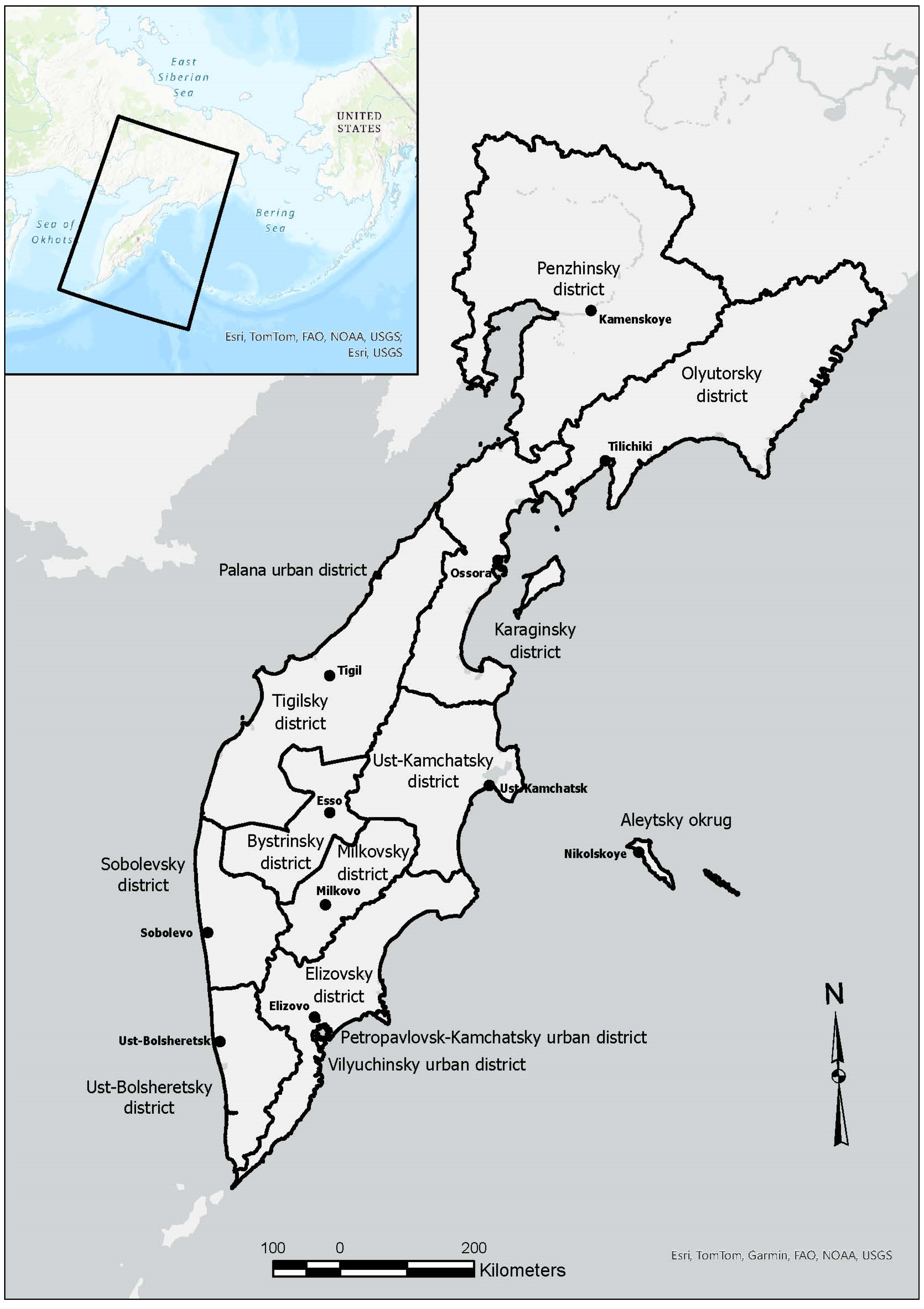
Figure 2.
Dynamic of human capital in current prices, millions of rubles.
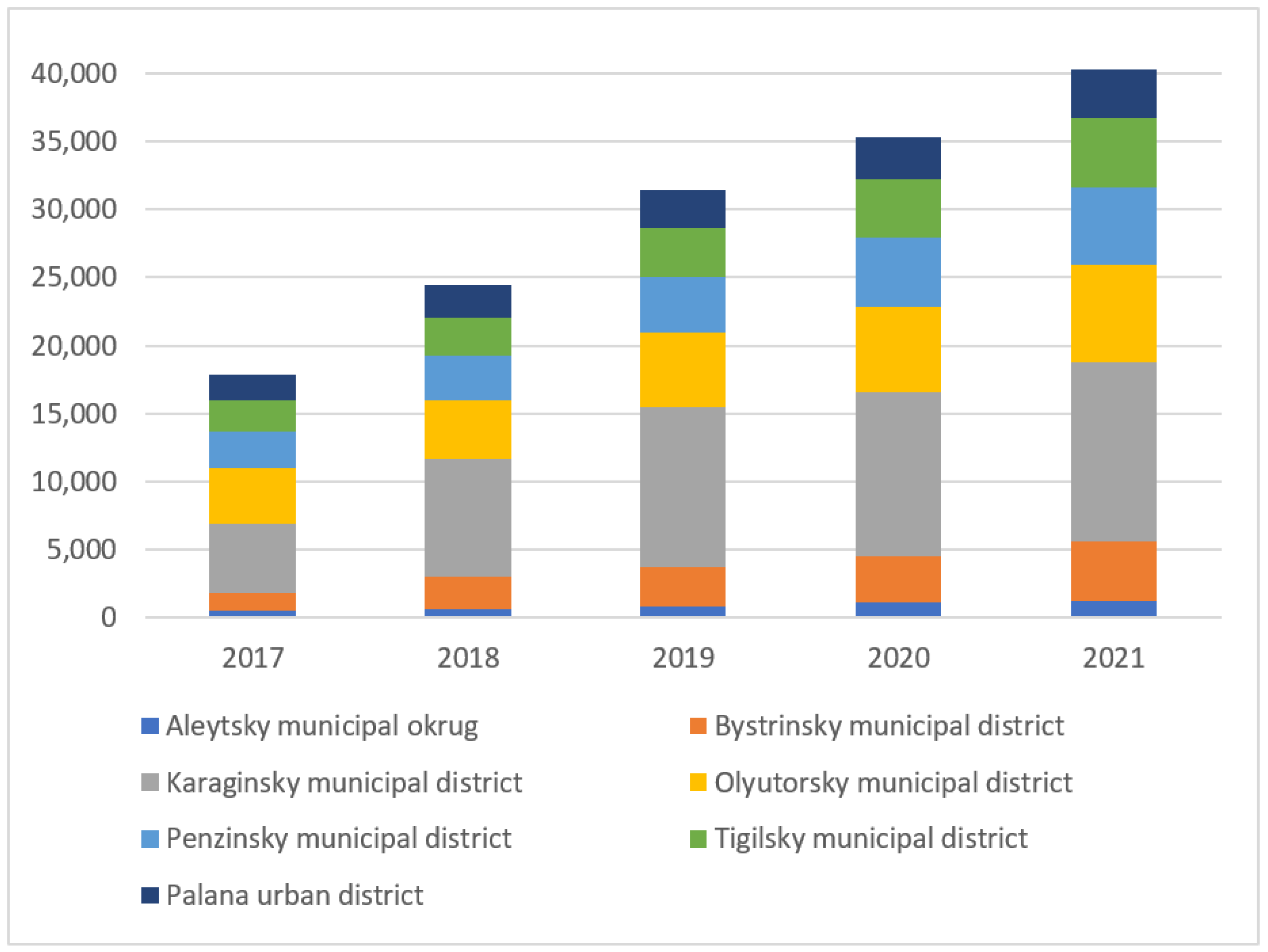
Figure 3.
Human capital in base prices 2017 per capita, millions of rubles/person.
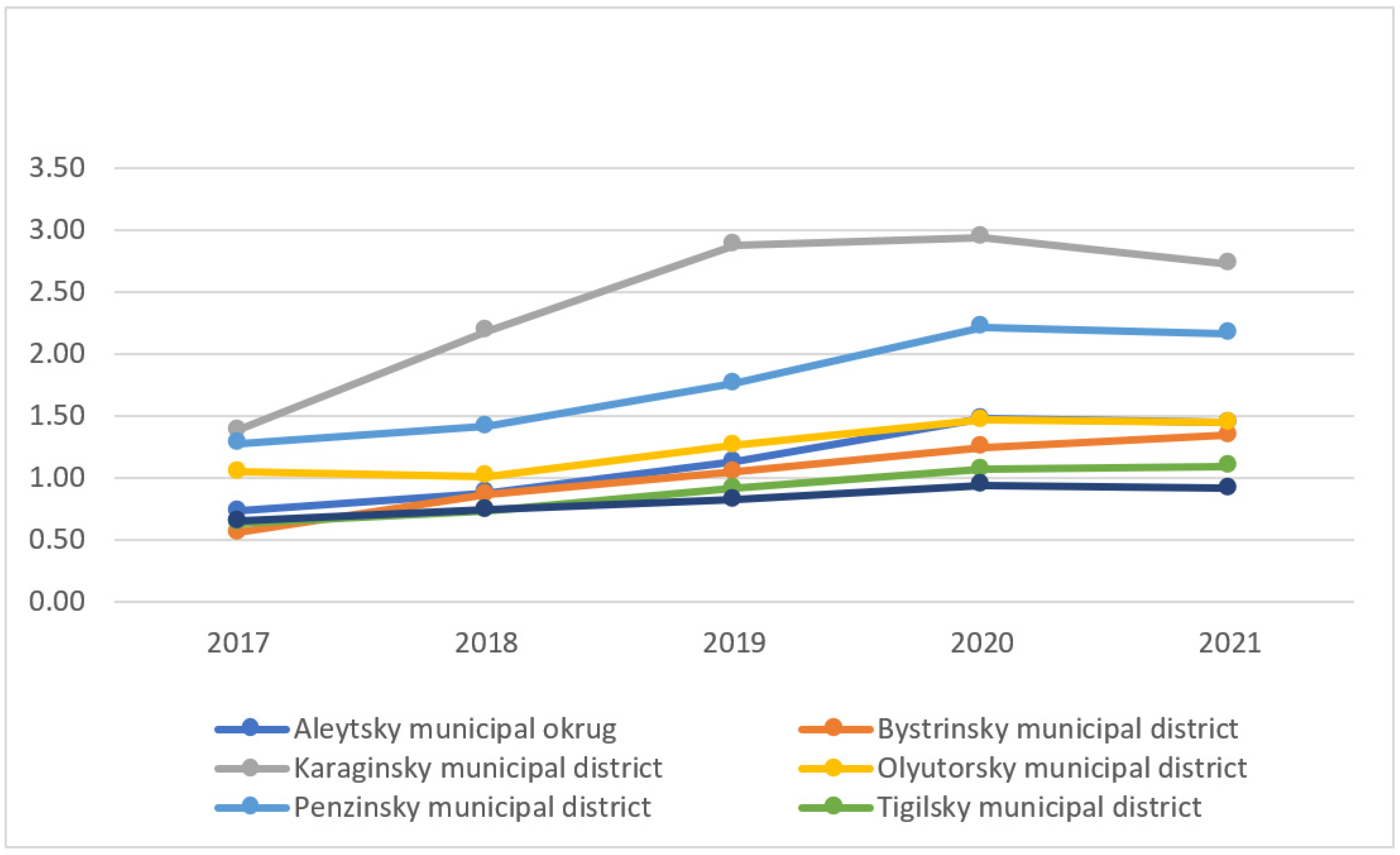

Table 1.
A review of the research on quantitative of human capital assessments.
| Authors and year of publication | Object, year of the assessments | Indicators |
|---|---|---|
| Index-based Assessments | ||
| Koloskova Yu., I., 2016 [30] | Rural areas of Krasnoyarsk Krai, 2010-2014. | Modification of HCI: life expectancy, completeness of education coverage, level of money income and level of entrepreneurial initiative in rural areas. |
| Grachev S.A. and co-authors, 2016 [31] | Regions of the Central Federal Districts in 2010-2013. | Integral index of HC by elements: Health, Labor, Intellectual, Cultural and Moral. |
| Vlasyuk L.I., Stroev P.V. 2017 [32] | Russia as a whole for the period 2002-2015, for the constituent entities of the Russian Federation for 2015. | HC includes types of capital: demographic, educational, labor, research and development, and socio-cultural. |
| Kappusheva A.P. 2017 [33] | Federal districts of the Russian Federation and regions of the North Caucasus Federal District, 2000-2015. | Components of HC: Health, Education, Culture, innovative activity. |
| Mazelis L.S., Lavrenyuk K.I., 2017 [34] | The 27 regions of the Far Eastern, Siberian and Ural Federal Districts, 2014-2015. | HC includes six extended groups: Level of Professionalism, Education, Scientific Development, Innovative Development, Health Care, Culture. |
| Grachev S.A., 2018 [35] | Central Federal District regions, 2012-2016. | Integral indicator according to three criteria of quantitative (number of labor force, number of personnel engaged in research and development, unemployment rate), qualitative (average per capita monetary income of the population, average monthly nominal accrued wages, average size of allocated pensions) and the resulting assessment (funded labor force, number of personnel engaged in research and development, GRP per capita). Average per capita monetary income of the population, Average nominal monthly accrued wages, Average size of pensions) and the resulting assessment (funded labor force, GRP per capita). |
| Michalkina E.V., Kryachko V.I., 2019 [36]. | Regions of Southern Russia | Indexes on socio-economic indicators: population size, natural growth rate, migration growth rate, graduation of specialists, bachelors and masters, share of youth in the total population, life expectancy (quality of life indicator), morbidity (health quality indicator). |
| Serebryakova N.A. and co-authors, 2019 [37] | Voronezh, Lipetsk, Belgorod regions and RF, 2018. | Integral assessment of the HC by the components: demographic, work and education, research and development, socio-cultural. |
| Ketova K.V., Vavilova D.D., 2020 [38] | Udmurt Republic, 2000-2018 and its forecast for the period 2019-2023. | Qualitative components of HC: health, education, culture. |
| Shulgin S.G., Zinkina Y.V. [39] | Federal Districts of the Russian Federation, 1990-2018. | Estimates for the federal districts of the Russian Federation are compared using two methods: The Human Development Index and the Human Life Indicator. The Human Life Indicator, as a complement to the HDI, considers inequality in life expectancy. |
| Moroshkina M.V., 2022 [40] | Territorial entities of the Karelian Arctic, 2020. | Ranking assessment by indicators: population, average number of employees, number of unemployed, migration growth, average monthly wages, investment in fixed capital. |
| Saveleva M.V., Orekhov V.D., 2016 [41] | Federal districts of the Russian Federation, 1990, 1995, 2000, 2005, 2010, 2015. | Modification of the HDI by including the indicator of human life, workers with tertiary education (the share of professionals with higher education plus the share of professionals with specialized secondary education for middle-level professionals). |
| Valuation Estimates | ||
| Muchametova A.D., 2016 [42] | regions of the Volga Federal District, 2014 | The cost of the consumer basket and spending on health care, education and science, housing and utilities, roads, infrastructure, social policy and culture (data from the consolidated budgets of the constituent territories of the Russian Federation). |
| Anichin V.L., Vasheikin Yu.Yu., 2017 [43] | RF, Central Federal District and regions of the Central Federal District, comparison of 2010 and 2015. | The amount of wages in the region, the expected period of income per employee, and the annual interest rate. |
| Minaev N.N., Zharova E.A. 2021 [44], 2022 [45] | All regions of the Russian Federation, 2019. | Cost approach - based on the costs associated with HC formation: the cost of education (general and vocational) and the opportunity cost of students receiving education. |
| Dyakov M.Yu., 2022 [46] | Kamchatsky Krai, 2011-2018 | The cost approach: The sum of the intellectual capital and the health capital forms the basic human capital, while the cash income forms the circulating human capital. |
| Gevrasyova A.P., 2022 [47] | Gomel region in the Republic of Belarus, 2015 and 2020. | Net income of the population and budgetary funds of the state allocated for implementation of social policy measures in the sphere of education, health care, physical education and sports, culture, mass media, strengthening of social protection of certain categories of citizens. |
Table 2.
Average share of Numerically Small Indigenous Peoples of the North in the total population of Kamchatsky Krai by municipalities.
Table 2.
Average share of Numerically Small Indigenous Peoples of the North in the total population of Kamchatsky Krai by municipalities.
| Municipal districts of Kamchatka krai | Population on 01.01.2010 | Indigenous residents, 2010 | Indigenous, residents, % | Population on 01.01.2020 | Indigenous residents, 2020 | Indigenous, residents, % | Average Indigenous resident 2010-2020,% |
|---|---|---|---|---|---|---|---|
| Petropavlovsk-Kamchatsky Urban district |
202,865 | 1,203 | 0.6 | 179,586 | 271 | 0.2 | 0.4 |
|
Penzinsky municipal district |
2,340 | 1449 | 61.9 | 2,009 | 1,508 | 75.1 | 68.5 |
|
Olyutorsky municipal district |
5,036 | 2,545 | 50.5 | 3,732 | 2,265 | 60.7 | 55.6 |
|
Bystrinsky municipal district |
2,560 | 1,104 | 43.1 | 2,416 | 1,333 | 55.2 | 49.1 |
|
Tigilsky municipal district |
4,152 | 2,010 | 48.4 | 3,494 | 1,689 | 48.3 | 48.4 |
|
Aleytsky municipal okrug |
676 | 261 | 38.6 | 676 | 342 | 50.6 | 44.6 |
|
Karaginsky municipal district |
4,076 | 1,216 | 29.8 | 3,555 | 1,489 | 41.9 | 35.9 |
|
Palana urban district |
3,155 | 1,428 | 45.3 | 2,915 | 566 | 19.4 | 32.3 |
| Elizovsky municipal district |
64,135 | 1,068 | 1.7 | 64,346 | 742 | 1.2 | 1.4 |
| Milkovsky municipal district |
10,585 | 1,515 | 14.3 | 9,258 | 1,772 | 19.1 | 16.7 |
| Sobolevsky municipal district |
2,604 | 107 | 4.1 | 2,484 | 282 | 11.4 | 7.7 |
| Ust-Bolsheretsky municipal district |
8,331 | 98 | 1.2 | 7,256 | 144 | 2.0 | 1.6 |
| Ust-Kamchatsky municipal district |
11,744 | 203 | 1.7 | 9,066 | 238 | 2.6 | 2.2 |
| Kamchatsky Krai | 322,079 | 14,207 | 4.4 | 313,016 | 12,784 | 4.1 | 4.3 |
Table 3.
Demographic and features of traditional economic activities by municipalities.
| Municipal districts | Indigenous residents, 2020 | Number of rodovie obshichiny | Number of Fishing sites | Number of Hunting grounds | Hunting grounds in Square (thousand hectares) |
Predominate traditional economic activity and subsistence |
|---|---|---|---|---|---|---|
| Aleytsky municipal okrug | 271 | 7 | 7 | - | - | Fishing/Sea mammal hunting |
| Bystrinsky municipal district | 342 | 15 | - | - | - | Reindeer herding/Gathering |
| Palana urban district | 566 | 16 | - | - | - | Fishing |
| Karaginsky municipal district | 1,489 | 43 | 28 | 3 | 551.81 | Fishing/Reindeer herding |
| Olyutorsky municipal district | 2,265 | 24 | 22 | 1 | 540.77 | Fishing/Reindeer herding |
| Penzinsky municipal district | 1,508 | 23 | 19 | 1 | 402.23 | Fishing/Reindeer herding |
| Tigilsky municipal district | 1,689 | 28 | 66 | 9 | 924.51 | Fishing/Reindeer herding |
| Total | 8,130 | 156 | 142 | 14 | 2419.32 |
Table 4.
Human capital dynamic of Indigenous peoples of the North in Karaginsky municipal district.
| Index | 2017 | 2018 | 2019 | 2020 | 2021 |
|---|---|---|---|---|---|
| 1. Budget expenditures on education, mln. rub. | 436 | 454 | 469 | 483 | 523 |
| 2. Budget expenditures on culture, cinematography, mln. rub. | 33 | 95 | 140 | 128 | 124 |
| 3. Investments in intellectual capital, mln. rub. (row 1+ row 2) | 468.8 | 549.3 | 609.0 | 611.2 | 647.0 |
| 4. Budget expenditures on physical culture and sports, mln. rub. | 4.6 | 9.6 | 19.0 | 4.1 | 24.9 |
| 5. Budget expenditures on social policy, mln. rub. | 39.5 | 42.2 | 52.6 | 44.9 | 44.2 |
| 6. Investments in health capital, mln. rub. | 44.1 | 51.8 | 71.5 | 49.0 | 69.1 |
| Coefficient β | 0.1 | 0.1 | 0.1 | 0.1 | 0.1 |
| Coefficient α | 4.7 | 4.7 | 4.7 | 4.7 | 4.7 |
| 7. Investments in health capital including coefficients, mln. rub. | 20.7 | 24.3 | 33.6 | 23.0 | 32.5 |
| 8. Fixed human capital in current prices, mln. rub. | 489.6 | 573.6 | 642.7 | 634.2 | 679.4 |
| Depreciation rate of investments in fixed capital | 0.02 | 0.02 | 0.02 | 0.02 | 0.02 |
| 9. Accumulated fixed human capital, mln. rub. | 479.8 | 1041.9 | 1671.7 | 2293.3 | 2959.1 |
| 10. Working human capital (cash income), mln. rub. | 4562 | 7637 | 10071 | 9734 | 10193 |
| 11. Human capital in current prices, mln. rub. | 5041.3 | 8679.4 | 11742.9 | 12027.3 | 13152.6 |
| Index-deflator to previous year, % [74] | 105.3 | 110 | 103.3 | 100.9 | 119 |
| Index-deflator to 2017 | 1 | 1.1 | 1.14 | 1.15 | 1.36 |
| 12. Fixed human capital in 2017 prices, mln. rub. | 479.8 | 947.2 | 1466.4 | 1994.1 | 2175.8 |
| 13. Current human capital in 2017 prices, mln. rub. | 4561.6 | 6943.1 | 8834.4 | 8464.4 | 7495.2 |
| 14. Human capital in 2017 prices, mln.rub | 5041.3 | 7890.3 | 10300.8 | 10458.5 | 9671.0 |
Table 5.
Dynamic of the cost of human capital by districts of Kamchatsky Krai with concentrated residence of the Indigenous Peoples of the North in base or 2017 prices, millions of rubles.
Table 5.
Dynamic of the cost of human capital by districts of Kamchatsky Krai with concentrated residence of the Indigenous Peoples of the North in base or 2017 prices, millions of rubles.
| Municipal districts | 2017 | 2018 | 2019 | 2020 | 2021 |
|---|---|---|---|---|---|
| Aleytsky municipal okrug | 513.9 | 620.1 | 774.3 | 993.6 | 936.4 |
| Bystrinsky municipal district | 1350.8 | 2107.4 | 2529.5 | 2988.1 | 3186.5 |
| Karaginsky municipal district | 5041.3 | 7890.3 | 10300.8 | 10458.5 | 9671.0 |
| Olyutorsky municipal district | 4102.0 | 3905.8 | 4775.5 | 5424.3 | 5246.3 |
| Penzinsky municipal district | 2701.2 | 2950.4 | 3573.9 | 4400.6 | 4221.7 |
| Tigilsky municipal district | 2285.5 | 2596.9 | 3182.8 | 3724.2 | 3720.8 |
| Palana urban district | 1897.0 | 2176.3 | 2403.3 | 2714.7 | 2603.1 |
| Total | 17891.7 | 22247.2 | 27540.1 | 30704.0 | 29585.8 |
Table 6.
Human capital of the Indigenous Peoples by municipal districts of Kamchatka Krai in 2017 prices, millions of rubles.
Table 6.
Human capital of the Indigenous Peoples by municipal districts of Kamchatka Krai in 2017 prices, millions of rubles.
| Municipal districts | 2017 | 2018 | 2019 | 2020 | 2021 |
|---|---|---|---|---|---|
| Aleytsky municipal okrug | 229.2 | 276.6 | 345.3 | 443.1 | 417.6 |
| Bystrinsky municipal district | 663.2 | 1034.7 | 1242.0 | 1467.2 | 1564.6 |
| Karaginsky municipal district | 1628.3 | 2548.6 | 3327.2 | 3378.1 | 3123.7 |
| Olyutorsky municipal district | 2280.7 | 2171.6 | 2655.2 | 3015.9 | 2916.9 |
| Penzinsky municipal district | 1850.3 | 2021.0 | 2448.1 | 3014.4 | 2891.9 |
| Tigilsky municipal district | 1106.2 | 1256.9 | 1540.5 | 1802.5 | 1800.9 |
| Palana urban district | 681.0 | 781.3 | 862.8 | 974.6 | 934.5 |
| Total | 8439.0 | 10090.7 | 12421.0 | 14095.8 | 13650.1 |
Disclaimer/Publisher’s Note: The statements, opinions and data contained in all publications are solely those of the individual author(s) and contributor(s) and not of MDPI and/or the editor(s). MDPI and/or the editor(s) disclaim responsibility for any injury to people or property resulting from any ideas, methods, instructions or products referred to in the content. |
© 2024 by the authors. Licensee MDPI, Basel, Switzerland. This article is an open access article distributed under the terms and conditions of the Creative Commons Attribution (CC BY) license (https://creativecommons.org/licenses/by/4.0/).
Copyright: This open access article is published under a Creative Commons CC BY 4.0 license, which permit the free download, distribution, and reuse, provided that the author and preprint are cited in any reuse.


