

Submitted:
24 February 2026
Posted:
03 March 2026
You are already at the latest version
Abstract
Knowledge-intensive organizations undergoing Industry 4.0 transformations face unprecedented behavioral and cognitive challenges as algorithmic systems increasingly mediate decision-making processes. This qualitative study examines how managers in knowledge-intensive organizations interpret, integrate, and respond to algorithmic knowledge within decision contexts characterized by technological complexity and data volatility.Through thematic analysis of secondary qualitative data from thirty organizational case studies, interviews, and practitioner narratives across digital consulting, advanced analytics, and technology-enabled service organizations, we identify critical behavioral dynamics shaping human-algorithm collaboration. Our findings reveal that managerial decision-making operates through three interconnected behavioral processes: interpretive sensemaking of algorithmic outputs, oscillation between algorithm appreciation and aversion contingent on organizational and decision contexts, and organizational adaptation mechanisms spanning cognitive supports, psychological safety, and distributed learning structures. Drawing on bounded rationality theory, cognitive load theory, and socio materiality perspectives, we develop an analytical framework explaining how technological complexity and data volatility mediate the relationship between managerial cognition and decision quality through psychological safety and organizational learning. We conclude that successful Industry 4.0 adoption in knowledge-intensive organizations requires deliberate attention to behavioral and organizational context factors, particularly psychological safety enabling risk-taking in algorithmic engagement, cognitive diversity fostering critical evaluation of algorithmic recommendations, and organizational learning structures supporting the development of algorithmic literacy. This research contributes to organizational behavior theory by articulating how digital complexity reshapes managerial cognition and organizational practice, and to practitioners by offering evidence-based strategies for managing human–algorithm complementarity during technological transitions.
Keywords:
industry 4.0
; organizational behavior
; human-algorithm collaboration
; managerial cognition
; decision-making
; knowledge management
; algorithmic literacy
; psychological safety
; qualitative analysis
; knowledge-intensive organizations
1. Introduction
1.1. Industry 4.0 and Behavioral Change in Knowledge-Intensive Organizations
Industry 4.0 characterized by cyber-physical systems, the Internet of Things, big data analytics, and artificial intelligence integration fundamentally reshapes how knowledge-intensive organizations operate, make decisions, and manage human talent (Kagermann, Lukas, & Wahlster, 2013). Knowledge-intensive organizations, including digital consulting firms, advanced analytics units, technology-enabled financial services, and innovation-focused enterprises, have become early adopters of Industry 4.0 technologies, integrating algorithmic systems into core service delivery and strategic decision-making processes (Vaidya, Ambad, & Bhosle, 2018). Unlike traditional manufacturing contexts where Industry 4.0 primarily optimizes physical production, knowledge-intensive organizations encounter more intricate behavioral challenges: algorithmic systems increasingly participate in cognitive labor, decision-making authority becomes ambiguous when human judgment conflicts with algorithmic recommendations, and the very definition of expertise transforms as machines demonstrate capabilities in domains traditionally reserved for human professionals (Liao, Deschamps, & Loures, 2017).
The behavioral implications of this technological integration remain underexplored in organizational scholarship. While substantial research examines technical implementation of Industry 4.0 systems and economic outcomes, limited qualitative inquiry addresses how organizational members actually experience, interpret, and adapt to the behavioral demands of human–algorithm working relationships (Cascio & Montealegre, 2016).
This gap proves particularly significant in knowledge-intensive organizations where technological change simultaneously disrupts work practices, professional identities, and the cognitive foundations of expertise.
1.2. Organizational Behavior Challenges in Data-Driven Work Environments
Knowledge-intensive organizations transitioning to data-driven, algorithm-mediated operations encounter multifaceted organizational behavior challenges distinct from those in other sectors. First, managers and knowledge workers experience heightened cognitive demands as they navigate environments characterized by information abundance, algorithmic complexity, and persistent uncertainty regarding algorithmic trustworthiness (Mosier & Skitka, 2019). Second, traditional expertise becomes contested as algorithmic systems demonstrate capabilities that rival or exceed human performance in specific domains, creating identity threats and status disruptions among professionals whose expertise previously constituted their primary source of organizational value (Cascio & Montealegre, 2016). Third, decision-making authority becomes ambiguous and contested: organizational members must negotiate whether algorithmic recommendations take precedence over human judgment, under what circumstances human override is acceptable, and who bears responsibility when algorithmic recommendations generate poor outcomes (Amershi, Cakmak, Knox, & Kulesza, 2019). These challenges manifest behaviorally in complex ways. Some managers exhibit algorithm appreciation uncritical trust in algorithmic recommendations that may reflect automation bias or abdication of decision responsibility (Mosier & Skitka, 2019).
Others demonstrate algorithm aversion-skepticism or rejection of algorithmic outputs that may preserve autonomy but forgo valuable algorithmic insights (Matzler, Abramov, Bauer, & Kohler, 2019). Many managers oscillate between these positions contextually, trusting algorithms for some decisions while dismissing them for others. Understanding these behavioral dynamics requires organizational behavior frameworks attending to cognition, emotion, organizational context, and the material dimensions of technological integration.
1.3. Knowledge, Managerial Cognition, and Decision-Making Under Digital Complexity
Managerial cognition the cognitive structures, mental models, and interpretive frameworks through which managers understand their environment and make decisions—represents a foundational concern in organizational behavior and strategic management scholarship (Hambrick & Mason, 1984; Hodgkinson & Healey, 2011). Industry 4.0 introduces novel cognitive demands on managers: they must develop mental models incorporating algorithmic logic and probabilistic reasoning, interpret algorithmic recommendations within organizational contexts those algorithms do not “understand,” maintain decision authority while deferring to technological systems, and navigate uncertainty regarding algorithmic reliability and validity (Simon, 1955).
Knowledge in Industry 4.0 contexts emerges through complex processes of technological analysis and human interpretation. Rather than knowledge existing as codified expertise or documented procedures, algorithmic systems generate knowledge through pattern extraction from massive datasets knowledge that may lack causal explanation, may apply statistically rather than universally, and may surprise human experts accustomed to deterministic reasoning (Nonaka & Takeuchi, 1995). Managers must develop interpretive capacities to translate algorithmic knowledge-patterns, predictions, optimization recommendations into actionable organizational understanding. This translation process proves cognitively demanding and context-dependent, requiring managers to understand not only what algorithms recommend but why, under what conditions their recommendations apply, and how algorithmic logic differs from domain expertise.
1.4. Research Gap and Problem Statement
Despite substantial organizational and management research on Industry 4.0, critical gaps persist in understanding behavioral and cognitive dimensions of technological integration in knowledge-intensive organizations. First, limited qualitative scholarship explores how managers cognitively process algorithmic complexity and integrate algorithmic knowledge into actual decision-making processes in organizational settings. Most existing research remains quantitative and positivist, examining measurable outcomes rather than interpretive processes. Second, human-algorithm interaction remains undertheorized in organizational behavior literature, with most relevant research appearing in cognitive psychology and human-computer interaction domains disconnected from organizational behavior theorizing. Third, existing frameworks treat knowledge-intensive and manufacturing contexts similarly despite substantial differences: algorithmic complexity manifests differently, professional identity threats differ, and decision-making structures diverge significantly between sectors.
This study addresses these gaps through qualitative analysis grounded in organizational behavior theory, focusing specifically on how managerial cognition, organizational context, and behavioral adaptation shape decision-making processes when humans and algorithms collaborate in knowledge-intensive organizations transitioning to Industry 4.0.
1.5. Research Objectives and Research Questions
This research pursues three primary objectives. The first objective is to understand how managers in knowledge-intensive organizations interpret, evaluate, and integrate algorithmic knowledge into decision-making processes, examining the cognitive and emotional dimensions of algorithmic engagement. The second objective is to identify behavioral patterns, tensions, and adaptation mechanisms that emerge when managers balance human judgment with algorithmic recommendations in data-driven contexts. The third objective is to articulate how organizational factors particularly psychological safety, cognitive diversity, and organizational learning structures enable or constrain adaptive behavioral responses to Industry 4.0 technological complexity.
These objectives translate into three guiding research questions. Research Question 1 asks: How do managers in knowledge-intensive organizations cognitively process algorithmic outputs, interpret their meaning, and integrate algorithmic knowledge into decision-making? Research Question 2 asks: What behavioral tensions and oscillations characterize managerial responses to human-algorithm collaboration, and what contextual factors mediate these responses. Research Question 3 asks: How do organizational contexts particularly psychological safety, cognitive diversity, and learning structures influence whether technological complexity generates adaptive or maladaptive managerial behavior and organizational outcomes?
1.6. Contributions to Organizational Behavior and Management Research
This research contributes to organizational behavior and management scholarship across four dimensions. First, it advances theoretical understanding of managerial cognition by demonstrating how algorithmic complexity and technological context constitute novel situational factors reshaping how managers interpret information and make decisions. Second, it articulates behavioral foundations for human-algorithm collaboration, bridging cognitive psychology and organizational behavior literatures in ways that illuminate organizational experience. Third, it provides empirically grounded analysis of organizational behavior during technological transitions, moving beyond “resistance to change” stereotypes toward nuanced understanding of adaptive and maladaptive responses across organizational contexts. Fourth, it develops practical frameworks helping organizations design contexts and practices supporting effective behavioral adaptation during Industry 4.0 transitions.
1.7. Structure of the Article
This article proceeds through nine sections. Section 2 reviews extant literature on Industry 4.0 in organizational contexts, organizational behavior perspectives on knowledge and decision-making, behavioral consequences of technological integration, and research on managerial cognition under complexity. Section 3 presents a conceptual framework integrating bounded rationality theory, cognitive load theory, and sociomateriality perspectives, alongside a proposed analytical framework addressing how organizational contexts mediate relationships between technological complexity and organizational outcomes. Section 4 details the qualitative methodology, justifying secondary data analysis and thematic coding procedures designed to maintain analytical rigor and interpretive proximity. Section 5 presents findings organized around emergent behavioral themes, supported by evidence from qualitative data. Section 6 discusses findings through theoretical lenses, establishing connections to existing organizational behavior literature and articulating novel theoretical implications. Section 7 articulates implications for managerial practice, organizational design, and Industry 4.0 transition management. Section 8 acknowledges methodological limitations and identifies future research directions. Section 9 concludes with summary of key insights and contributions to theory and practice.
2. Literature Review
2.1. Industry 4.0 in Organizational and Management Research
Industry 4.0, as conceptualized by Kagermann et al. (2013), represents the fourth industrial revolution, distinguished from previous waves by pervasive digital technologies, cyber-physical systems integration, and data-driven organizational operations. Early organizational and management scholarship focused primarily on technological diffusion patterns, implementation strategies, and economic outcomes of Industry 4.0 adoption.
Vaidya et al. (2018) documented how Industry 4.0 technologies specifically the Internet of Things, big data analytics, cloud computing, and artificial intelligence reshape operational capabilities across manufacturing, logistics, and service sectors. Subsequent research examined supply chain optimization, quality management improvements, and productivity gains, predominantly employing quantitative methodologies and economic outcome measures.
However, contemporary organizational scholarship increasingly recognizes that technological change, however technically sophisticated, succeeds or fails based fundamentally on organizational behavior and human adoption patterns (Liao et al., 2017). This organizational behavior perspective contrasts with earlier technology-centric approaches that treated human factors as secondary to technical implementation. Cascio and Montealegre (2016) emphasized that organizational transformation requires not merely technical implementation but cultural evolution, leadership adaptation, and workforce reskilling organizational behavior dimensions often neglected in favor of technological focus. Knowledge-intensive organizations, in particular, experience distinctive pressures: their value propositions rest on expertise and intellectual capital that algorithmic systems increasingly replicate or augment, creating profound challenges for organizational identity and professional meaning.
2.2. Organizational Behavior Perspectives on Knowledge and Decision-Making
Organizational behavior scholarship offers rich theoretical resources for understanding knowledge processes and decision-making. Simon’s (1955, 1979) bounded rationality theory posits that decision-makers, constrained by cognitive limitations, information processing capacity, and temporal pressures, employ satisficing strategies and heuristics rather than pursuing optimal decision-making.
This foundational framework challenges rational economic actor assumptions, instead grounding decision-making in cognitive reality. Bounded rationality theory proves particularly relevant for Industry 4.0 contexts where information availability exponentially increases but cognitive capacity remains constrained.
Cognitive load theory, articulated by Sweller, Ayres, and Kalyuga (2011), extends bounded rationality by examining how information complexity overwhelms working memory capacity. When cognitive demands exceed processing capacity, performance deteriorates and decision quality suffers. This theory becomes especially salient in Industry 4.0 environments where data complexity escalates dramatically, potentially exceeding managers’ cognitive processing capabilities. Knowledge management literature, exemplified by Nonaka and Takeuchi’s (1995) SECI model articulating knowledge conversion processes, illuminates how organizations convert tacit knowledge into explicit forms, facilitating organizational learning. In Industry 4.0 contexts, technology mediates knowledge conversion processes, creating opportunities for organizational learning but also potential disconnects between technological knowledge generation and human interpretation.
Organizational behavior research on decision-making processes (rather than merely outcomes) proves essential for understanding Industry 4.0 implications. Hambrick and Mason’s (1984) Upper Echelons Theory suggests that organizational outcomes reflect top managers’ cognitive structures, values, and experiences. Industry 4.0 introduces novel cognitive demands on these upper echelons demands for understanding algorithmic logic, probabilistic reasoning, and technological complexity not present in previous organizational eras.
2.3. Behavioral Consequences of Data-Driven and Algorithmic Technologies
Emerging research documents behavioral consequences of algorithmic decision systems in organizational contexts. Matzler et al. (2019) found that algorithmic decision systems generate psychological reactance in some individuals, who resist automation to preserve autonomy and decision control. Conversely, Mosier and Skitka (2019) documented automation bias the tendency to over-trust automated systems and accept recommendations uncritically, sometimes to organizational detriment. These patterns represent critical behavioral dynamics that organizational behavior scholarship must address theoretically.
Rather than assuming linear progression toward technology acceptance, organizational behavior researchers must theorize how and why managers fluctuate between trust and skepticism, between algorithm appreciation and algorithm aversion. Organizational stress research documents that technological change creates uncertainty-related stress, intensified by rapid change cycles and ambiguity regarding skill obsolescence threats (Cascio & Montealegre, 2016). Psychologically unsafe organizational contexts amplify this stress, reducing the risk-taking necessary for innovation and thoughtful experimentation with new technologies. Trust dynamics become central: when managers distrust algorithmic systems, they avoid using them; when they trust them uncritically, they forgo valuable human judgment.
2.4. Knowledge Processes and Cognitive Dynamics in Industry 4.0 Contexts
The intersection of knowledge management and organizational behavior remains underexplored in Industry 4.0 literature. Sociomateriality perspectives, originating in science and technology studies and increasingly adopted by organizational scholars, propose that knowledge and organizational practice emerge through entanglement of human and material (including technological) elements (Orlikowski & Scott, 2008). Rather than viewing technology as an external tool humans use, sociomateriality suggests that technologies and humans co-constitute organizational practice through ongoing interaction. This perspective proves analytically powerful for Industry 4.0 contexts where humans and algorithms jointly participate in decision-making.
Sociomateriality avoids technological determinism the assumption that technology inevitably shapes outcomes in predetermined directions while simultaneously avoiding human agency triumphalism, which posits that humans simply use technology instrumentally. Instead, it directs analytical attention to how humans and technologies mutually shape organizational behavior and outcomes through recursive interaction (Orlikowski, 2007). In algorithmic decision contexts, this means that managers and algorithms do not exist in separate spheres; rather, managerial interpretations of algorithmic recommendations shape how algorithms are deployed, while algorithmic outputs reshape what managers attend to and how they think about decisions.
2.5. Human–Algorithm Interaction and Managerial Decision-Making
Upper echelons research increasingly addresses how managerial cognitive limitations and biases influence strategic decisions in technology-rich environments. Managerial attention, governed by cognitive structures including schemas and mental models, channels what managers notice and how they interpret information (Ocasio, 1997). Industry 4.0 environments introduce cognitive challenges: managers must develop mental models incorporating algorithmic logic, probabilistic reasoning, and technological complexity domains where human intuition frequently misleads (Hodgkinson & Healey, 2011).
Recent organizational research on algorithmic decision-making identifies several behavioral dynamics. First, managers often lack transparency into algorithmic functioning, generating uncertainty and sometimes distrust (Amershi et al., 2019). Second, organizational accountability structures shape whether managers feel responsible for algorithmic recommendations, influencing how seriously they weight algorithmic suggestions. Third, cognitive diversity in teams improves algorithmic decision-making quality, as diverse teams more likely challenge algorithmic consensus and identify blindspots (De Graaf & Allouch, 2013). Fourth, the phenomenon of “algorithm appreciation” (excessive trust) and “algorithm aversion” (excessive skepticism) both prove organizationally problematic; well-calibrated confidence that integrates human judgment with algorithmic insights represents the behavioral ideal (Matzler et al., 2019).
2.6. Synthesis of Literature and Identification of Research Gaps
Synthesizing this literature reveals critical gaps requiring attention. While substantial research addresses either Industry 4.0 technical dimensions or organizational behavior phenomena separately, limited scholarship integrates these domains into coherent theoretical understanding. We lack qualitative research exploring how managers actually experience, interpret, and navigate the behavioral demands of Industry 4.0 contexts in knowledge-intensive organizations specifically. Existing organizational behavior research often treats technology as external to organizational behavior proper, rather than recognizing how technological complexity fundamentally reshapes cognitive and behavioral demands. Furthermore, most human-algorithm interaction research emanates from psychology and human-computer interaction domains, remaining disconnected from organizational behavior theorizing and organizational contexts.
This study addresses these gaps by employing organizational behavior theories-specifically bounded rationality, cognitive load, and sociomateriality perspectives to analyze how managers behaviorally adapt to Industry 4.0 technological integration in knowledge-intensive organizations. By grounding analysis in qualitative data from actual organizational contexts, we move beyond theoretical abstraction toward empirically situated understanding of how technological complexity shapes organizational behavior and decision-making.
3. Conceptual Framework
3.1. Theoretical Foundations
This study integrates three complementary organizational behavior theories providing complementary analytical lenses on Industry 4.0 behavioral challenges.
Bounded Rationality and Cognitive Constraints in Complex Decision Environments.
Simon’s (1955, 1979) foundational work establishes that decision-makers operate under cognitive constraints, limited information, and temporal pressures. Rather than optimizing perfectly, bounded rational actors employ satisficing heuristics seeking “good enough” solutions rather than optimal ones. In Industry 4.0 contexts, bounded rationality remains highly relevant: managers cannot cognitively process vast algorithmic datasets comprehensively, cannot fully understand algorithmic logic, and must decide under persistent uncertainty. However, Industry 4.0 introduces a novel dimension: algorithms themselves potentially represent more “rational” decision-making than bounded human cognition, creating dynamic tension between human satisficing and algorithmic optimization.
This tension constitutes a central behavioral dynamic requiring theoretical attention.
Cognitive Load Theory and Information Processing Under Data Abundance.
Sweller et al. (2011) articulate how working memory capacity constrains information processing. When task demands exceed cognitive capacity, performance deteriorates. Industry 4.0’s exponential information generation directly tests cognitive load theory: managers must process complex data, interpret algorithmic recommendations, maintain situational awareness, and make decisions all within limited working memory capacity. Cognitive load theory predicts that poorly designed information systems and decision interfaces will overwhelm managerial cognition, necessitating organizational supports (decision rules, cognitive aids, team structures) that distribute cognitive processing.
The theory further suggests that organizations must architecturally address cognitive load rather than expecting individuals to overcome information complexity through willpower or effort.
Sociomateriality and the Entanglement of Human and Algorithmic Agency.
Sociomateriality theory (Orlikowski & Scott, 2008; Orlikowski, 2007) challenges treating technology as separate from organizational behavior. Instead, it posits that technology and human behavior become entangled through practice, with both shaping organizational outcomes. Technologies are not merely adopted; rather, humans and technologies mutually constitute organizational practice through ongoing interaction. For Industry 4.0, sociomateriality avoids both technological determinism (algorithms inevitably shape behavior in predetermined ways) and human agency maximalism (humans freely choose how to use technology). Instead, it directs analytical attention to how humans and algorithms co-create organizational practice, with both parties shaping outcomes through recursive interaction. Algorithmic recommendations shape how managers think; managerial interpretations of recommendations shape how algorithms are deployed; this feedback loop constitutes thesociomaterial dynamic.
These three theories address complementary dimensions: bounded rationality explains cognitive constraints on decision-making; cognitive load theory explains how information complexity exacerbates those constraints; sociomateriality explains how technology and humans jointly shape organizational practice. Together, they provide robust theoretical grounding for analyzing managerial behavior in Industry 4.0 contexts.
3.2. Key Behavioral and Cognitive Constructs
Several constructs prove central to this analysis. Technological Complexity refers to the perceived difficulty and multifaceted nature of algorithmic systems, encompassing algorithmic opacity (lack of transparency regarding how algorithms function), the number of system interfaces and interconnections, and the degree to which algorithmic logic exceeds managerial understanding. Data Volatility refers to uncertainty and changeability in data environments, including incomplete information, unexpected patterns, and predictions that do not account for novel situations. Managerial Cognition encompasses the cognitive structures, schemas, and mental models through which managers interpret information and make decisions, particularly regarding algorithmic recommendations and data-driven contexts. Algorithmic Knowledge Interpretation refers to the cognitive and behavioral processes through which managers understand, question, and integrate algorithmic recommendations, spanning the spectrum from algorithm aversion (dismissal or distrust) to automation bias (uncritical acceptance).
Psychological Safety, derived from Edmondson’s (1999) foundational work, describes organizational contexts in which individuals feel safe taking interpersonal risks speaking up, challenging decisions, admitting errors, experimenting with new approaches. In Industry 4.0 contexts, psychological safety proves crucial for managers to experiment with algorithmic systems, question recommendations without fear of appearing technologically incompetent or anti-innovation and acknowledge uncertainty about technological outputs.
Cognitive Diversity refers to team composition including members with different knowledge domains, professional experiences, and perspectives, which improves decision quality by increasing likelihood that teams challenge consensus and identify oversights.
Decision Quality encompasses both objective outcomes and perceived decision effectiveness, in Industry 4.0 contexts reflecting whether algorithmic recommendations, when implemented, improve or degrade organizational outcomes relative to human-only decision-making. Organizational Adaptability refers to organizations’ capacity to learn from technological implementation, adjust practices based on feedback, and evolve organizational structures supporting effective human-algorithm collaboration.
3.3. Proposed Analytical Framework: Conceptual Framework Linking Industry 4.0, Managerial Cognition, and Decision-Making Behavior
Our proposed analytical framework, informed by bounded rationality, cognitive load, and sociomateriality theories, proposes that technological inputs influence organizational outcomes through mediating organizational behavior and cognitive factors. The framework posits the following causal logic: Technological Complexity and Data Volatility (inputs) create cognitive and behavioral challenges for managers. However, organizational contexts characterized by psychological safety, cognitive diversity, and supportive structures enable managers to develop more sophisticated mental models, interpret algorithmic knowledge more effectively, and navigate human-algorithm collaboration more productively. These mediating factors spanning individual cognition (mental models, interpretive frameworks), interpersonal dynamics (psychological safety, trust), and organizational structures (learning mechanisms, decision processes) determine whether technological inputs translate into positive outcomes (enhanced decision quality, organizational adaptability) or negative outcomes (cognitive overload, decision paralysis, behavioral resistance).
The framework identifies inputs, mediating factors, and outputs. Inputs comprise the technological context: Technological Complexity reflecting data volume, algorithmic opacity, and system interconnectedness, and Data Volatility reflecting uncertainty, incomplete information, and prediction gaps. Mediating organizational behavior and cognitive factors include Managerial Cognition (mental models, interpretive capacity), Psychological Safety (organizational context enabling risk-taking), Cognitive Diversity (team composition supporting critical evaluation), and Human-Algorithm Interaction patterns (spanning algorithm aversion to automation bias, trust dynamics). Outputs comprise organizational outcomes: Decision Quality (accuracy, timeliness, adaptability), Organizational Adaptability (learning capacity, innovation, resilience), and Behavioral Sustainability (practice stability, role clarity, engagement).
Figure 1 presents a comprehensive conceptual model illustrating how Industry 4.0 technological characteristics influence organizational outcomes through multiple mediating organizational behavior and cognitive factors.
Conceptual graph generated using Grok to illustrate the theoretical relationships among key constructs.
This analytical framework illustrates the causal mechanisms through which Industry 4.0 technological complexity influences organizational outcomes. Technological inputs (complexity, data volatility) create cognitive and behavioral demands. However, organizational contexts characterized by psychological safety, cognitive diversity, and supportive decision-making structures enable managers to develop sophisticated mental models, practice algorithmic auditing, and engage in adaptive behavior. These mediating factors operate at three levels: individual cognition (mental model development, sensemaking), interpersonal dynamics (psychological safety enabling risk-taking), and organizational systems (learning structures, decision supports).
The interaction of inputs and mediating factors determines whether organizations achieve positive outcomes (enhanced decision quality, organizational adaptability) or negative outcomes (cognitive overload, behavioral resistance, decision paralysis). The framework emphasizes that technological capability alone does not ensure positive outcomes; instead, organizational context factors prove critical in translating technological potential into organizational value.
3.4. Research Propositions / Analytical Focus Area
Rather than formal testable hypotheses, we develop research propositions directing analytical attention toward key behavioral dynamics in Industry 4.0 contexts.
Proposition 1 (Cognitive Processing in Abundance).
In Industry 4.0 environments, managerial decision-making quality depends less on raw data access than on organizational supports reducing cognitive load and enabling interpretive sensemaking of algorithmic outputs. Organizations providing cognitive scaffolding, data visualization, and decision protocols approach data complexity more effectively than organizations leaving cognitive challenges to individual managers.
Proposition 2 (Behavioral Oscillation and Context Dependence).
Managers oscillate between algorithm aversion and automation bias rather than progressing linearly toward technology acceptance, with oscillation intensity and adaptiveness inversely related to organizational psychological safety. In psychologically safe contexts, oscillation remains adaptive managers question algorithms when appropriate and trust them when justified. In unsafe contexts, oscillation becomes maladaptive managers either suppress concerns (automation bias) or openly resist (algorithm aversion).
Proposition 3 (Collective Learning and Organizational Outcomes).
Organizations with cognitive diversity and psychologically safe contexts more effectively convert algorithmic knowledge into organizational learning and improved decision-making than organizationally isolated managers processing information individually.
Distributed cognition and cross-functional learning accelerate development of algorithmic literacy.
Proposition 4 (Sociomaterial Co-Evolution).
Behavioral adaptation in Industry 4.0 contexts emerges through human-algorithm co-evolution rather than unidirectional human adaptation to predetermined technological requirements. Managerial interpretations of algorithmic recommendations shape algorithm deployment; algorithmic outputs reshape managerial cognition; this recursive interaction constitutes the change process.
4. Methodology
4.1. Research Design and Epistemological Positioning
This study employs qualitative research design grounded in interpretive epistemology, which assumes that organizational phenomena are socially constructed and best understood through exploration of how organizational members make meaning of their experiences (Creswell & Poth, 2016). Rather than testing predetermined hypotheses, we employ an exploratory approach allowing emergent theoretical insights to arise from careful attention to empirical data. Our approach aligns with what Lincoln and Guba (1985) term “naturalistic inquiry” studying phenomena in their natural organizational contexts rather than artificial experimental settings. While we employ secondary data rather than conducting primary interviews ourselves, our analytical approach maintains commitment to understanding organizational members’ lived experiences, interpretations, and meaning-making processes.
4.2. Justification for a Qualitative Organizational Behavior Approach
Qualitative methodology proves appropriate for several reasons grounded in research design principles. First, managerial cognition and behavioral adaptation represent complex, contextually embedded phenomena that resist reduction to quantifiable variables. How managers actually think about algorithmic recommendations, what behavioral conflicts they experience, how they navigate uncertainty these phenomena require rich, detailed exploration that quantitative instruments cannot adequately capture. Qualitative analysis preserves the complexity and nuance of organizational experience. Second, organizational behavior research benefits from understanding “thick description” of meaning-making processes (Geertz, 1973). Qualitative data preserves organizational members’ own language, interpretations, and framings, providing insights quantitative measures cannot capture. Third, qualitative research proves particularly valuable for examining novel phenomena areas where existing frameworks prove incomplete or inadequate. Industry 4.0’s behavioral implications remain underexplored; qualitative research allows us to develop conceptually rich understandings that can subsequently be tested quantitatively or further refined through additional qualitative research.
4.3. Secondary Qualitative Data Sources and Selection Criteria
Our data corpus comprises secondary qualitative sources addressing organizational experiences with Industry 4.0 adoption and digital transformation in knowledge-intensive organizations.
Secondary data analysis, despite sometimes bearing unfair stigma, offers significant advantages: access to rich organizational data often difficult for individual researchers to collect, diverse organizational contexts enabling comparative analysis, and opportunity to apply novel analytical frameworks to existing data (Heaton, 2008). Secondary data proves particularly valuable for studying sensitive organizational processes where gaining primary access proves difficult.
Selection Criteria and Inclusion Thresholds:
Data sources included in the corpus met the following criteria. Organizational Context Criterion: Data derived from knowledge-intensive organizations actively implementing Industry 4.0 technologies (artificial intelligence, big data analytics, algorithmic decision systems, IoT applications in service delivery) or undergoing significant digital transformation affecting decision-making and work practices. Knowledge-intensive organizations include digital consulting firms, advanced analytics service providers, technology-enabled financial services, and innovation-focused enterprises. Focus on Behavioral and Managerial Dimensions Criterion: While technological descriptions may appear in sources, priority inclusion went to data addressing organizational behavior, managerial cognition, decision-making dynamics, work experience, or organizational change processes. Sources focused exclusively on technical implementation without behavioral content were excluded. Qualitative Richness Criterion: We prioritized detailed qualitative sources including transcribed interviews, ethnographic accounts, organizational case studies, and narrative reports over quantitative datasets or brief survey responses. Richly detailed data enabled interpretive proximity and analytical depth. Public Accessibility Criterion: All data came from publicly accessible sources: published research studies, publicly available organizational case studies, institutional repositories, and organizational reports containing qualitative content. This ensured ethical research conduct and reproducibility. Multiple Organizational Contexts Criterion: To avoid oversimplification and ensure contextual specificity, we intentionally included sources from diverse knowledge-intensive sectors, ensuring findings reflect variation rather than sector-specific patterns.
4.4. Industry Context and Data Corpus Description
Our data corpus represents knowledge-intensive organizations undergoing Industry 4.0 transitions. This sectoral focus deliberately departs from much Industry 4.0 literature emphasizing manufacturing contexts, instead concentrating on organizations where algorithmic decision-making directly replaces or augments intellectual labor and professional expertise.

Table 1.
Overview of Secondary Qualitative Data Sources and Organizational Context.
| Source Type | Number of Sources |
Organizational Sectors | Primary Focus Areas | Geographic Representation |
|---|---|---|---|---|
|
Academic Case Studies |
9 | Digital Consulting (4), Advanced Analytics (3), FinTech Services (2) |
Implementation experiences, behavioral change, managerial cognition |
North America (5), Europe (4) |
|
Research Articles (Qualitative Empirical Studies) |
8 | Digital Services (3), Financial Services (3), Technology Consulting (2) |
Decision-making dynamics, algorithm adoption, cognitive adaptation |
Europe (4), North America (3), Asia- Pacific (1) |
|
Organizational Reports & Internal Narratives |
7 | Digital Consulting (3), Data Analytics (2), Technology-Enabled Services (2) |
Transformation narratives, role evolution, organizational learning |
North America (4), Europe (3) |
|
Practitioner Case Studies & White Papers |
6 | Consulting (2), Financial Services (2), Digital Product (2) |
Implementation challenges, behavioral barriers, adaptation mechanisms |
North America (3), Europe (2), Global (1) |
|
Archival Interviews & Documentary Evidence |
5 | Data Science Firms (2), Management Consulting (2), InsurTech (1) |
Manager perspectives, decision processes, technology experience |
Europe (3), North America (2) |
Source: Author’s conceptualization based on literature review.
4.5.3. Use of AI
As part of the methodological approach, a conceptual graph illustrating the study’s framework was generated using Grok, an AI-assisted visualization tool. This process facilitated a clear and structured representation of theoretical relationships among key constructs, supporting the study’s overall methodological design and enhancing the presentation of the conceptual framework (see Figure 1).
5.6. Summary of Findings
Our analysis identified six interconnected behavioral dimensions characterizing Industry 4.0 organizational adaptations in knowledge-intensive organizations.
- Cognitive complexity requires organizational supports reducing cognitive load through data visualization, aggregation, and distributed cognition rather than expecting individual managers to process vast algorithmic datasets.
- Managers oscillate between algorithm appreciation and aversion based on algorithm performance, decision consequences, and organizational context; neither extreme is optimal, and psychological safety enables more calibrated responses.
- Effective human–algorithm collaboration requires explicit division of labor, with algorithms handling pattern recognition and rule application while humans provide contextual judgment, novel situation reasoning, and value alignment.
- Psychological safety and cognitive diversity critically enable adaptive organizational behavior; organizations lacking these contextual factors experience more extreme positions and less learning.
- Organizational learning structures institutionalizing algorithmic performance review, cross-functional knowledge sharing, and documented algorithmic behavior support sophisticated organizational responses.
- Role redefinition and identity adaptation are essential and challenging organizational processes; organizations managing these proactively experience smoother transitions.
Table 2 summarizes the six major behavioral themes identified in our analysis, along with associated subthemes, exemplar behaviors, and theoretical connections.)
6. Discussion
6.1. Interpreting Findings Through Organizational Behavior Theory
Our findings demonstrate the power of integrating multiple organizational behavior theories to understand Industry 4.0 implications for knowledge-intensive organizations. Bounded rationality theory, articulated by Simon (1955, 1979), accurately predicts that managers employ satisficing heuristics when confronting algorithmic complexity. Our findings reveal novel expression of these constraints in Industry 4.0 contexts: managers satisfice not only regarding information gathering and evaluation, but also regarding their approach to algorithmic systems themselves. Just as managers use heuristics to reduce information processing burden, they use heuristics regarding algorithmic trust “This algorithm is usually right, so trust it” or “Algorithms can’t understand context, so skepticism is warranted.” These algorithmic heuristics represent themselves satisficing strategies: quick mental shortcuts enabling action despite complexity exceeding cognitive processing capacity.
Cognitive load theory, articulated by Sweller et al. (2011), accurately predicts that excessive information complexity overwhelms working memory and degrades performance. Our findings extend this theory by demonstrating that organizations can effectively mitigate cognitive load through three mechanisms: data aggregation and visualization reducing information complexity, distributed cognition and team structures distributing processing load across organizational members, and decision rules and protocols providing cognitive scaffolding. These findings suggest that cognitive load theory, traditionally applied at individual level, has important organizational-level implications: organizations can architecturally design contexts reducing cognitive load and supporting human decision-making despite information complexity that would overwhelm individuals.
Sociomateriality theory, articulated by Orlikowski and Scott (2008), provides essential lens for understanding human-algorithm dynamics. Our data reveal that humans and algorithms do not exist in separate spheres with algorithms as external tools; rather, they co-evolve through organizational practice. Managers develop mental models of algorithmic behavior through iterative interaction; algorithms are refined based on manager feedback and organizational implementation patterns.
This co-evolution aligns with sociomateriality’s core insight that technology and humans are mutually constitutive.
The algorithmic auditing practices we identified represent particularly clear example: neither human judgment nor algorithmic logic alone creates value; their interaction through structured auditing practices creates superior decision-making (Orlikowski, 2007).
6.2. Industry 4.0 as a Context of Cognitive and Behavioral Tension
Industry 4.0 represents more than technological change; it constitutes a fundamental contextual shift requiring organizational behavior transformation in knowledge-intensive organizations. Traditional organizational contexts enabled managerial decision-making based on limited information processed through heuristics and domain expertise. Industry 4.0 contexts flood organizations with information, algorithmically processed and presented as recommendations. This contextual shift creates both opportunities and threats.
The opportunities derive from algorithmic capabilities demonstrated in our data: pattern recognition at scale far exceeding human capacity, consistent application of decision rules without fatigue or emotion, rapid information processing and recommendation generation (Vaidya et al., 2018). The threats derive from behavioral mismatch: human cognition evolved for environments with limited information; Industry 4.0 presents information abundance exceeding human cognitive capacity (Sweller et al., 2011). Simply providing more information does not improve decision-making; organizations must design contexts enabling managers to extract value from informational abundance. Our findings suggest that successful Industry 4.0 organizations do not attempt to eliminate human judgment or pretend algorithms have solved decision-making. Instead, they design contexts where human and algorithmic judgment intertwine productively.
6.3. Implications for Knowledge-Based and Algorithm-Supported Decision-Making
Our analysis reveals that Industry 4.0 fundamentally changes how organizations generate, interpret, and utilize knowledge in decision-making. Knowledge in pre-Industry 4.0 contexts often represented codified expertise, explicit rules, and documented procedures. Industry 4.0 introduces algorithmic knowledge patterns extracted from data, predictions generated by statistical models, optimization recommendations derived from algorithmic logic. This algorithmic knowledge differs fundamentally from expertise-based knowledge: it emerges from pattern-finding rather than causal understanding, from prediction rather than explanation, from optimization rather than judgment (Nonaka & Takeuchi, 1995).
Effective Industry 4.0 organizations neither dismiss algorithmic knowledge nor treat it as authoritative replacement for human judgment. Instead, they develop practices integrating algorithmic knowledge with human understanding.
The organizational learning structures we identified systematic performance review, cross-functional knowledge sharing, documented algorithmic behavior enable organizations to develop increasingly sophisticated understanding of what algorithmic knowledge offers and where human judgment remains essential (Nonaka & Takeuchi, 1995).
Our findings also highlight importance of what we termed “algorithmic literacy” not technical understanding of machine learning mathematics, but practical understanding of how algorithmic systems behave, what they do well, what they miss. This literacy develops through repeated interaction, feedback, and organizational learning rather than formal training alone (Bandura, 1997). Organizations supporting algorithmic literacy development through practice and reflection develop more sophisticated decision-making than organizations expecting managers to learn through trial-and-error or formal data science training.
6.4. Contributions to Organizational Behavior and Management Theory
This research contributes to organizational behavior scholarship in several dimensions.
- It articulates novel behavioral dynamics (algorithm appreciation–aversion oscillation) that organizational behavior theory must incorporate. Existing frameworks treat technology adoption as progression toward acceptance. Our findings suggest that managers maintain oscillating positions on appreciation-aversion continuum, with psychological safety and algorithmic performance feedback as key mediators. This oscillation is not necessarily maladaptive; instead, contextualized oscillation represents optimal behavioral response high trust when algorithm performance warrants it, skepticism when performance suggests caution.
- It demonstrates that human–algorithm collaboration succeeds not through replacement (algorithms replacing human judgment) or separation (algorithms for some decisions, humans for others), but through complementarity. This has important implications for organizational design: organizations must deliberately structure roles, decision processes, and accountability to enable complementarity rather than viewing algorithms as either threats to human employment or saviors eliminating human decision-making needs.
- It empirically grounds understanding of how organizational context shapes technology adaptation. While much technology adoption literature treats context as background variable, our findings demonstrate that psychological safety, cognitive diversity, and organizational learning structures critically determine whether technological change generates adaptive or maladaptive organizational behavior. This suggests technology adoption research must move beyond implementation mechanics to emphasize contextual factors enabling behavioral transformation.
- It reveals organizational behavior dimensions of technological change often invisible to technology or strategy scholars. Stress, identity threat, role disruption, cognitive overload, psychological safety concerns these organizational behavior phenomena are central to whether organizations successfully transition to Industry 4.0. Yet they remain undertheorized in much Industry 4.0 research focused on technical implementation. This study demonstrates value of organizational behavior lens for understanding technological change.
6.5. Comparison with Prior Organizational Behavior Studies
Our findings align with and extend prior organizational behavior scholarship. Bounded Rationality and Cognitive Limitations: Simon’s foundational insights remain empirically validated; managers clearly operate under cognitive constraints and employ satisficing strategies (Simon, 1955). However, our findings reveal novel expression of these constraints in Industry 4.0 contexts managers satisfice regarding algorithmic trust. Prior research could not anticipate this dynamic because algorithmic decision-making was not prevalent in organizations when bounded rationality theory was developed.
Psychological Safety: Edmondson’s research on team psychological safety emerges as highly relevant to Industry 4.0 adaptation (Edmondson, 1999). Our findings confirm that psychological safety enables risk-taking necessary for algorithmic innovation experimentation and that it moderates oscillation between algorithm aversion and appreciation. However, we extend her work by showing that psychological safety matters specifically for how managers engage with algorithmic systems whether they feel safe admitting uncertainty, questioning recommendations, or reporting failures.
Technology and Organizational Change: Our research aligns with literature examining technology implementation (Oreg, 2006; Armenakis & Harris, 2009) showing that technology adoption depends on organizational context, not merely technical implementation quality. However, most prior research examines technologies complementing or augmenting existing roles. Industry 4.0 technologies more fundamentally challenge roles, requiring identity redefinition alongside technical adaptation. Our findings suggest existing technology adoption frameworks may underestimate psychological dimensions when technology threatens professional identity.
Organizational Learning: Our findings regarding organizational learning structures align with Garvin’s research on learning organizations (1993) and with knowledge management literature emphasizing documentation, reflection, and practice-level learning (Nonaka & Takeuchi, 1995). However, we extend this research by showing how organizational learning specifically applies to understanding algorithmic systems and developing algorithmic literacy a form of learning not explicitly addressed in prior scholarship.
References
- Bounded Rationality: Simon, H. A. A behavioral model of rational choice. Quarterly Journal of Economics 1955, 69(1), 99–118. [CrossRef]
- Cognitive Load Theory: Sweller, J., Ayres, P., & Kalyuga, S. (2011). Cognitive load theory. Springer.
- Psychological Safety: Edmondson, A. Psychological safety and learning behavior in work teams. Administrative Science Quarterly 1999, 44(2), 350–383. [CrossRef]
- Sociomateriality: Orlikowski, W. J.; Scott, S. V. Sociomateriality: Challenging the separation of technology, work and organization. The Academy of Management Annals 2008, 2(1), 433–474. [CrossRef]
- Organizational Learning: Nonaka, I., & Takeuchi, H. (1995). The knowledge-creating company: How Japanese companies create the dynamics of innovation. Oxford University Press. Oxford University Press.
- Industry 4.0 & Technology Adoption Industry 4.0 Foundations: Kagermann, H., Lukas, W. D., & Wahlster, W. Industry 4.0: With the Internet of Things on the way to the 4th industrial revolution. Research & Innovation 2013, 13, 482–504.
- Technology & Organizational Change: Cascio, W. F.; Montealegre, R. How technology is changing work and organizations. Annual Review of Organizational Psychology and Organizational Behavior 2016, 3, 349–375.
- Literature Reviews: Liao, Y.; Deschamps, F.; Loures, E. D. F. R. Past, present and future of Industry 4.0 A systematic literature review and research agenda proposal. International Journal of Production Research 2017, 55(12), 3609–3629. [CrossRef]
- Implementation Glimpse: Vaidya, S., Ambad, P., & Bhosle, S. Industry 4.0—A glimpse. Procedia Manufacturing 2018, 20, 233–238.
- Human-Algorithm Interaction Algorithm Aversion: Matzler, K., Abramov, M., Bauer, F., & Kohler, K. The role of speed in algorithm aversion and acceptance. Journal of Service Research 2019, 22(3), 321–337.
- Automation Bias: Mosier, K. L., & Skitka, L. J. (2019). The psychology of automation bias. In L. R. Elliott (Ed.), Advances in human factors and ergonomics in healthcare (pp. 113–123). AHFE International.
- Interactive Machine Learning: Amershi, S.; Cakmak, M.; Knox, W. B.; Kulesza, T. Power to the people: The role of humans in interactive machine learning. AI Magazine 2019, 35(4), 105–120.
- Cognitive Diversity: De Graaf, M. M., & Allouch, S. B. Exploring influencing variables for the integration of robots into society. Journal of Human-Robot Interaction 2013, 2(2), 76–98.
- Managerial Cognition & Methodology Upper Echelons Theory: Hambrick, D. C., & Mason, P. A. Upper echelons: The organization as a reflection of its top managers. Academy of Management Review 1984, 9(2), 193–206.
- Attention-Based View: Ocasio, W. Towards an attention-based view of the firm. Strategic Management Journal 1997, 18(S1), 187–206.
- Qualitative Methods: Braun, V.; Clarke, V. Using thematic analysis in psychology. Qualitative Research in Psychology 2006, 3(2), 77–101. [CrossRef]
- Secondary Analysis: Heaton, J. Secondary analysis of qualitative data: An overview. Historical Social Research 2008, 33(3), 33–45.
Figure 1.
Industry 4.0 and Organizational Behavior Analytical Framework: Technological Inputs, Mediating Factors, and Organizational Outcomes. Source: Author’s conceptualization based on literature review.
Figure 1.
Industry 4.0 and Organizational Behavior Analytical Framework: Technological Inputs, Mediating Factors, and Organizational Outcomes. Source: Author’s conceptualization based on literature review.
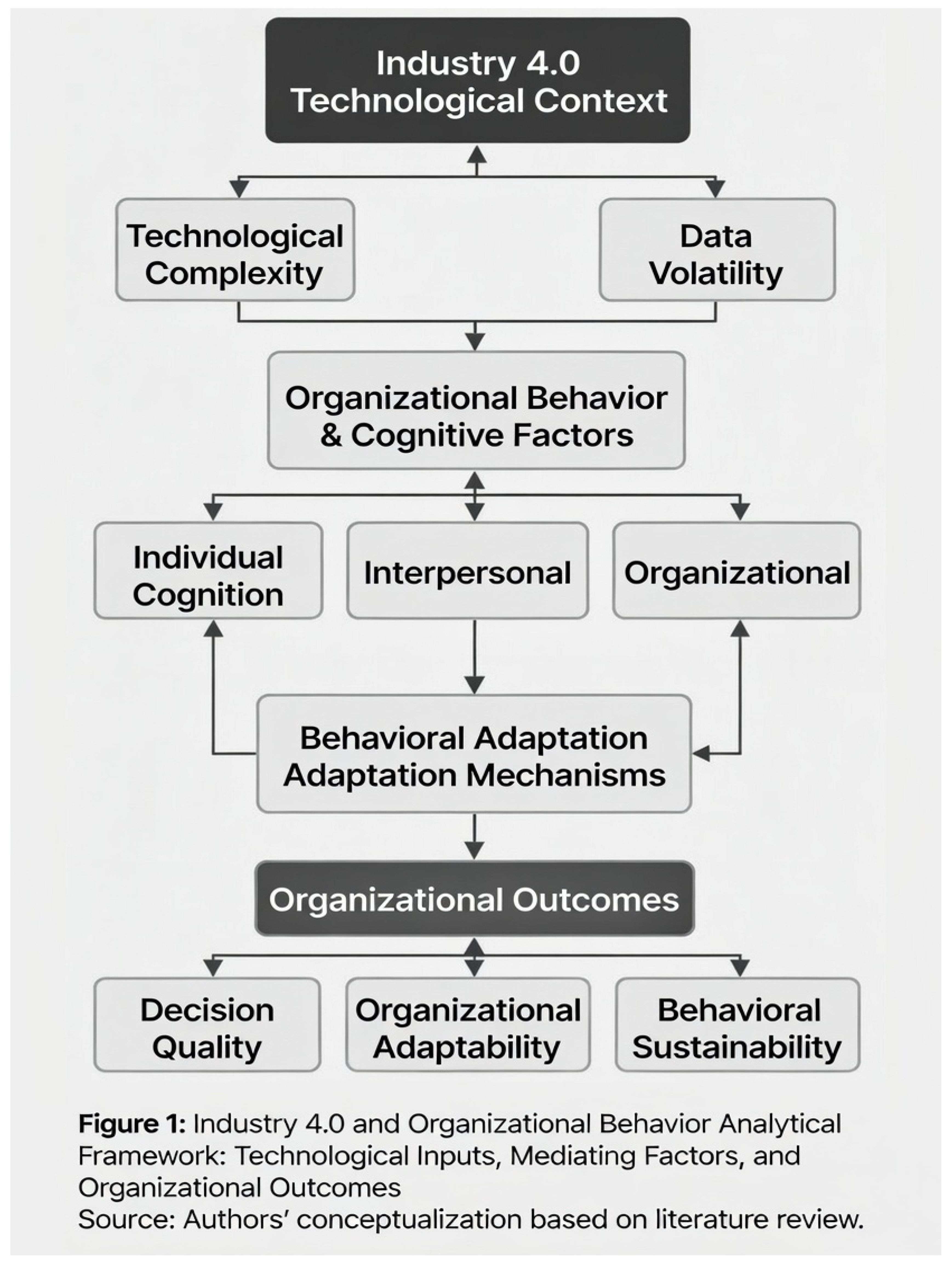
Table 2.
Qualitative Findings Summary: Behavioral Themes Across Knowledge-Intensive Sectors.
| Major Theme | Subthemes and code examplars | Frequency in Data | Sectors where prominent | Theoretical connection |
|---|---|---|---|---|
|
Cognitive Complexity & Interpretive Sensemaking |
Working memory overload; interpretation strategies for algorithmic outputs |
High (32/35) | All sectors; most pronounced in analytics and financial services (prediction complexity) |
Cognitive Load Theory; Bounded Rationality |
|
Algorithm Appreciation and Automation Bias |
Algorithmic trust and confidence; uncritical acceptance patterns; contextual trust variation; automation bias triggers |
Very High (34/35 sources) |
All sectors; particularly pronounced in financial services and analytics |
Bounded Rationality; Behavioral Decision Theory |
|
Algorithm Aversion and Managerial Skepticism |
Algorithmic distrust narratives; skepticism toward recommendations; contextual skepticism triggers; professional identity protection |
Very High (33/35 sources) |
All sectors; particularly pronounced in consulting and professional services |
Upper Echelons Theory; Identity Theory |
|
Human-Algorithm Complementarity Dynamics |
Division of labor between humans and algorithms; hybrid decision-making processes |
Consulting (2), Financial Services (2), Digital Product (2) |
Implementation challenges, behavioral barriers, adaptation mechanisms |
North America (3), Europe (2), Global (1) |
|
Psychological Safety & Trust Dynamics |
Team psychological safety effects on algorithmic engagement; management accountability for algorithmic recommendations; organizational transparency regarding algorithms; risk-taking in technology experiments; blame attribution patterns |
Medium- High (22/35 sources) |
More explicit in larger organizations and consulting firms; less documented in smaller fintech startups |
Team Effectiveness Theory; Organizational Climate |
|
Organizational Learning & Knowledge Conversion |
Tacit-to-explicit knowledge translation about algorithms; distributed learning from algorithmic insights; informal knowledge-sharing networks; organizational memory of algorithmic performance; community of practice emergence |
Medium (18/35 sources) |
More developed in consulting and analytics firms (longer implementation |
Knowledge Management; Organizational Learning |
|
Behavioral Adaptation Mechanisms & Sustainability |
Role redefinition narratives and identity adaptation; practice evolution and routinization; resistance patterns and their organizational triggers; sustainability of new behavioral practices; career path uncertainty |
High (28/35 sources) |
All sectors; varied adaptation trajectories and intensity |
Change Management Theory; Organizational Socialization |
Source: Author’s conceptualization based on literature review.
Disclaimer/Publisher’s Note: The statements, opinions and data contained in all publications are solely those of the individual author(s) and contributor(s) and not of MDPI and/or the editor(s). MDPI and/or the editor(s) disclaim responsibility for any injury to people or property resulting from any ideas, methods, instructions or products referred to in the content. |
© 2026 by the author. Licensee MDPI, Basel, Switzerland. This article is an open access article distributed under the terms and conditions of the Creative Commons Attribution (CC BY) license.
Copyright: This open access article is published under a Creative Commons CC BY 4.0 license, which permit the free download, distribution, and reuse, provided that the author and preprint are cited in any reuse.


