
Submitted:
27 February 2026
Posted:
02 March 2026
You are already at the latest version
Abstract
Municipal waste management is one of the most pressing challenges today, with the UN report (2024) estimating that global waste volumes will increase to 3.8 billion tons by 2050. This scenario highlights the need to implement the circular economy and ef-fective waste reduction tools. At the European level, Directive 2008/98/EC establishes the waste hierarchy, where prevention is central, and the Pay-as-you-throw (PAYT) system, based on the "polluter pays" principle, proves to be a fiscal mechanism capable of stimulating recycling and reducing the volume of mixed waste. The paper proposes the development of an integrated framework for smart waste management, including emerging technologies such as the Internet of Things, Artificial Intelligence, and Web 3.0. The first part of the research establishes the hypotheses and objectives: cost reduc-tion, increased efficiency, and process traceability. The second part analyses the use-fulness of digital technologies and the role of smart containers in collection, as well as the structure of processing and management costs, highlighting the framework's direct contribution to achieving SDG 11 and SDG 13. The third part describes a closed system with digital key-based access that monitors the number of disposals and assigns re-sponsibility for the waste deposited. By combining PAYT with advanced technological solutions, the research demonstrates the practical applicability and legal basis of an innovative model designed to support sustainability and strengthen European circular economy policies.
Keywords:
smart waste management
; Pay-As-You-Throw
; IoT
; AI
; Web 3.0
; SDG 11
; SDG 13
; smart containers
; conceptual framework
1. Introduction
According to the United Nations report of February 28, 2024, on global waste management, the amount of municipal solid waste is expected to increase from 2.3 billion tonnes in 2023 to 3.8 billion tonnes by 2050, which will lead to a rise in pollution-related costs to 640.3 billion dollars [1]. This projected increase is more than 1.8 times the 2020 levels and is mainly driven by rapid population growth, accelerated urbanisation, and unsustainable consumption and production patterns [2].
Moreover, structural deficiencies in waste governance exacerbate the crisis. Over one-third of waste generated globally is not managed in an environmentally sound manner, resulting in contaminated air, water, and soil, and increasing risks to public health and biodiversity [2]. The dominance of landfilling and open dumping further intensifies methane emissions and resource losses [3].
At the same time, the data highlight not only environmental risks but also missed economic opportunities. Current global waste management systems offset only 12% of their total virgin material substitution potential, yet they already generate approximately $201.5 billion annually in economic benefits through resource recovery [4].
The solution promoted by the report and research community involves adopting prevention and waste management measures, which could limit net annual costs to $ 270 billion by 2050, thereby promoting a circular economy model in which waste generation and economic growth are decoupled through the prevention of waste production and its comprehensive management [1]. The core objective of these strategies is to achieve decoupling, where economic development no longer leads to an automatic increase in waste generation [5]. This requires a shift from a linear “take, make, dispose” model to a circular economy where products and materials are designed to be reused, repaired, and recycled for as long as possible [5,6].
At the level of the European Union, to address the global waste problem, a series of legislative measures have been adopted aimed at preventing waste generation and ensuring proper waste management, as defined in Directive 2008/98/EC of the European Parliament and of the Council of 19 November 2008 on waste and repealing certain Directives [7]. In accordance with Article 4 of the Directive, the most preferable action in addressing the waste problem is prevention, as it is more effective than reuse, recycling, and recovery [8].
Waste management is closely linked to SDG 13 – Climate Action, as the way waste is generated, collected, and treated directly influences greenhouse gas emissions. Landfilling produces methane, and inefficient transport and processing generate additional CO2 emissions [9]. By preventing waste generation, increasing recycling, and optimising collection systems, the carbon footprint is reduced, and climate change mitigation measures are supported. Thus, sustainable waste management becomes a concrete tool for implementing SDG 13, integrating climate policies into current urban and economic practices [10].
Considering the waste hierarchy established by Directive 2008/98/EC of the European Parliament and of the Council of 19 November 2008 on waste and repealing certain Directives, the Pay-as-you-throw (PAYT) program includes some of the most effective instruments for reducing waste generation. The PAYT system is based on charging the community according to the quantity of mixed waste delivered to the waste management system. Its purpose is to implement the “polluter pays” principle in a fair manner. The system is capable of increasing the amount of waste collected separately and sent for recycling, while at the same time reducing mixed waste [11].
Currently, there are a number of advanced technologies that can optimise the implementation of the Pay-As-You-Throw program, facilitating the automation of the mixed waste segregation process and determining individual fees based on the quantity delivered to collection points [12].
These technologies include the IoT, AI, and blockchain technology, each of which plays a specific role in improving the traceability and transparency of the waste management process.
The purpose of this research is to develop an integrated conceptual framework for smart municipal waste management that incorporates emerging technologies such as the IoT, AI, and Web 3.0, in conjunction with the PAYT mechanism.
The importance of such a framework stems from the fragmented nature of existing solutions, where fiscal instruments, legal principles, and digital technologies are often implemented separately rather than within a unified operational structure. By integrating regulatory foundations, economic incentives, and technological infrastructures into a coherent system, the research not only advances the circular economy literature but also directly supports the objectives of SDG 11 – Sustainable Cities and Communities, which calls for inclusive, safe, resilient, and sustainable urban development. A structured and transparent waste management model contributes to improving urban environmental quality and strengthening municipal service efficiency.
The novelty of the framework lies in its integrative architecture: it does not merely digitise waste collection but restructures the governance model through real-time monitoring, allocation of individual responsibility, data-driven optimisation, and enhanced process traceability.
By embedding IoT-based smart bins, AI-driven analytics, and Web 3.0 features that enhance transparency and secure data management, the model goes beyond traditional PAYT systems and creates a digitally enabled urban infrastructure. In doing so, it supports SDG 11 targets related to reducing the environmental impact of cities, improving waste management systems, and promoting sustainable urban governance.
From a practical standpoint, the framework offers local administrations a scalable and replicable solution capable of reducing mixed waste volumes, improving recycling rates, and optimising management costs while remaining aligned with European circular economy objectives.
The general research hypothesis is based on the premise that integrating the PAYT mechanism with advanced digital technologies produces superior outcomes compared to traditional waste collection systems.
The main objective of the research is to develop and theoretically substantiate an integrated conceptual framework that correlates the PAYT mechanism with emerging digital technologies, with a view to modelling a system capable, at the architectural and functional level, of generating the conditions for reducing the volume of mixed waste, optimizing operational costs through the use of real-time data, and strengthening traceability through digital monitoring.
The research does not aim at immediate empirical validation of the quantitative impact, but at the construction of a coherent conceptual structure, based on an interdisciplinary approach, which can serve as a basis for further implementation and testing.
Starting from the main objective, the research develops several interconnected directions of analysis.
The first direction concerns the legal foundation of the proposed model. This involves examining the European regulatory framework on the waste hierarchy and the application of the “polluter pays” principle, particularly in the context of Directive 2008/98/EC. The purpose is to demonstrate that the proposed framework is not merely a technological solution, but one that is anchored in an already established legal logic at the European level, offering a consolidated and digitalised implementation of these principles.
The second direction focuses on assessing the technological impact on operational efficiency. This includes evaluating how IoT and AI technologies can enhance the performance of waste collection systems by optimising collection routes, monitoring container fill levels, reducing logistical costs, and increasing separate collection rates through behavioural feedback mechanisms and predictive data analysis.
The third direction addresses the design of the digitalised operational model. It aims to structure a concrete system based on smart bins and digital access infrastructure capable of identifying users and assigning responsibility for the waste generated.
The current context, characterised by the accelerated growth of waste volumes and increasing pressure to meet climate targets, demonstrates that traditional waste management systems are no longer sufficient. Although the European regulatory framework establishes prevention and the “polluter pays” principle as core pillars, their implementation remains fragmented and insufficiently supported by integrated digital mechanisms.
The proposed framework seeks to address this gap through a data-driven structure based on traceability and individual accountability. However, its relevance ultimately depends on delivering concrete and measurable results in reducing mixed waste and optimising management costs. Without such outcomes, the transition toward a circular economy risk remaining a declarative ambition rather than an operational reality.
2. Materials and Methods
The research is based on a systematic literature review regarding the application of IoT, AI, and Web 3.0 technologies in waste management systems, with a focus on their integration into the Pay-as-you-throw mechanism.
Scientific sources were identified through the use of the Web of Science and Scopus databases by searching with various keywords such as “waste management”, “Internet of Things”, “IoT”, “Artificial Intelligence”, “AI”, “blockchain”, “smart contracts”, “Web 3.0”, “PAYT”, “pay as you throw”, “circular economy”, etc., (Table 1).
The methodological framework of the research is divided into three major stages. The first stage involves the identification and filtering of relevant articles. The second stage involves content analysis to identify the role of each technology and the application of each in the field of waste management. The third stage focused on integrating the results into a unified conceptual framework that correlates the PAYT mechanism with the digital technologies analysed.
The methodology used is qualitative and conceptual, based on synthesis and comparative analysis of existing literature. The research does not include empirical testing or experimental validation, but aims to provide a theoretical foundation for an integrated framework that can serve as a basis for future implementation and research.
GenAI was employed to optimise and refine complex search queries for the Web of Science (WoS) and Scopus databases, ensuring improved keyword combinations, Boolean logic structuring, and thematic coverage of interdisciplinary sources. Additionally, GenAI assisted in refining the structure and clarity of figures, enhancing coherence and academic consistency. It was also used for translation support, ensuring terminological accuracy and linguistic precision while preserving the original scientific meaning. All outputs were critically reviewed and validated by the author to maintain methodological rigour and academic integrity.
3. Research Utility
The value of the study lies primarily in its analysis of the implications of IoT, AI, and Web 3.0 technologies in municipal waste management systems, particularly in the context of the constantly increasing global waste generation. The study focuses on the potential of these technologies to improve efficiency, traceability, and data-informed decision-making through the use of real-time data collection.
Moreover, the research proposes an integrated conceptual framework of smart collection point design, particularly in residential areas such as apartment buildings, housing groups, or condominiums. This model describes a functional architecture that allows controlled access, monitoring of the number of deposits, and association of each operation with a digitally identified user. Although not implemented in practice, the framework provides a clear structure that can form the basis for pilot projects or local public policies.
The utility of this framework is reflected in its contribution to the development of SDG 13 and SDG 11.
SDG 13 (“Climate Action”) calls for urgent action to combat climate change and its effects by reducing emissions, integrating climate measures into policies and planning, and increasing education/institutional capacity [13].
Waste management is a direct lever for achieving SDG 13, as the waste sector contributes significantly to global greenhouse gas emissions, particularly through methane generated in landfills. Methane (CH4) has a much higher global warming potential than carbon dioxide in the short term, which amplifies the climate impact of uncontrolled or poorly managed landfills. The literature, based on IPCC data, indicates that approximately 64 million tons of CH4 are predominantly associated with landfills and waste management activities per year, confirming the critical role of this sector in the global climate balance [14].
In contrast, an optimised system—based on the PAYT principle, supported by smart containers (IoT), predictive analysis based on Artificial Intelligence, and digital traceability tools—restructures the waste governance model. Prevention and separation at source reduce the amount of waste sent to landfill, thereby reducing methane emissions. Route optimisation and real-time monitoring reduce fuel consumption and CO2 emissions (Figure 1).
Regarding Sustainable Development Goal 11 (SDG 11) — “Make cities and human settlements inclusive, safe, resilient, and sustainable”, Waste management is explicitly linked to this under Target 11.6, which calls for reducing the adverse per capita environmental impact of cities, with one of its indicators being how municipal waste is collected and managed (proportion of municipal waste properly handled versus total generated – Figure 2) [15].
A sustainable city in 2030 must therefore address not only the issues of housing and transport but also the management of waste streams, since inefficient waste management practices result in overflowing trash, littered streets, deteriorated public spaces, pollution, and resource waste, which are factors that affect the sustainability of cities that SDG 11 aims to achieve [16].
By encouraging waste prevention and source separation, reducing mixed waste and optimising collection routes, the system increases the proportion of waste properly managed, lowers operational inefficiencies and improves overall urban environmental quality.
Beyond technical efficiency, the framework strengthens integrated and data-driven urban governance, enabling municipalities to plan and manage waste services more transparently and proactively. By embedding circular economy principles and improving service reliability, it supports cleaner public spaces, more resilient infrastructure and more sustainable urban development—core dimensions of SDG 11’s vision for inclusive and sustainable cities.
4. Literature Review
4.1. IoT and Its Impact on the Waste Management System
In the context of society’s accelerated digital transformation, the IoT has emerged as one of the essential technologies that ensures efficiency, continuity, and automation of operational processes [17,18]. The IoT enables real-time data collection and transmission, eliminating the need for constant human intervention in repetitive and time-consuming activities, which has created a pronounced dependence of contemporary society on interconnected technologies, which are becoming indispensable in resource management, public service optimisation, and urban sustainability.
The Internet of Things refers to the network of interconnected devices that collect, transmit, and analyse data in real time without direct human intervention [19]. These technologies enable intelligent monitoring and management of resources, facilitating data-driven decisions. The application of IoT in the waste sector brings significant benefits in terms of operational efficiency, traceability, and cost reduction.
The waste management system is also undergoing a digital transformation process, involving the integration of new technologies and the redefinition of traditional waste management processes [19,20,21]. The specialised literature includes a multitude of studies on the implementation of IoT in the waste management system.
An intelligent waste management framework for smart cities can be developed using Wireless Sensor Networks (WSN) and machine learning algorithms, integrated within a layered IoT architecture. Such an architecture acts as the core infrastructure of the system, supporting the automated collection, transmission, and analysis of data to improve efficiency and decision-making in urban waste management [19].
Another implementation model has been advanced in the field of smart waste management through the development of IoT-enabled smart dustbins designed for real-time monitoring and operational optimisation in smart cities. The proposed system integrates ultrasonic sensors for fill-level detection, GPS and GSM modules for geolocation and communication, as well as an LCD interface and status indicator LEDs [22].
Upon reaching maximum capacity, the system automatically transmits the bin’s precise location and status information via SMS to the local administrative authorities. The primary objective of this approach is to enhance route optimisation, reduce operational and logistical costs, and support sustainable urban waste management practices within the broader smart city ecosystem.
A systematic and comprehensive examination of intelligent municipal waste management systems within the smart city paradigm highlights the growing convergence of AI and IoT technologies. The reviewed frameworks are grounded in integrated architectures that combine IoT-based sensing infrastructures with AI-driven analytical and optimisation mechanisms. IoT sensors enable real-time detection and transmission of data regarding waste bin fill levels, while AI algorithms process these data streams to optimise route planning and operational logistics [20].
This data-driven and technologically integrated approach enhances operational efficiency, reduces fuel consumption and associated costs, and mitigates environmental impact, thereby supporting the development of more sustainable and resilient urban governance models.
M. Arun (2025) advances an innovative smart waste management solution that integrates Internet of Things technologies with deep learning algorithms to enhance the processes of waste collection, sorting, and material recovery. The proposed system is designed for application in recycling facilities, municipal waste management infrastructures, and electronic waste (e-waste) treatment centres [21].
By synergistically combining IoT-enabled data acquisition with deep learning–based analytical capabilities, the model establishes a scalable, efficient, and sustainable framework for material recovery. This integrated technological approach contributes to improved resource valorisation and generates a substantial positive impact on the urban environment.
Another significant example of IoT integration in waste management systems involves the development of an automated plastic waste identification framework based on unmanned aerial vehicles (UAVs). The proposed system employs drones equipped with high-resolution cameras, combined with deep learning and machine learning techniques, to detect and classify plastic waste.
Data processing is performed through edge computing mechanisms, enabling real-time analysis in complex and hard-to-access environments, such as river ecosystems. Within this architecture, the Internet of Things functions as the underlying monitoring and communication infrastructure, ensuring continuous data transmission and coordination between data acquisition devices and processing systems [23].
IoT and ICT-based digitalisation demonstrates significant potential to transform informal recycling – understood as waste collection and recovery activities carried out by independent or marginalised waste pickers operating outside formal municipal systems – into a more efficient, traceable, and transparent structure [24].
Within the Regenize model implemented in Cape Town, the Internet of Things is deployed as a digital connectivity infrastructure linking households and waste reclaimers through an integrated platform that enables scheduling, tracking, and systematic recording of recycling activities. Through the use of mobile applications and smart devices, reclaimers receive real-time notifications regarding collection points and register data on the type and quantity of waste collected [24].
This IoT-enabled ecosystem enhances operational coordination, improves data accuracy, and facilitates the formal recognition and integration of informal waste collectors into structured urban recycling systems, thereby contributing to greater efficiency, accountability, and socio-economic inclusion.
A comparable framework has been advanced by Govindan et al. (2024) in the context of enhancing consumer participation in electronic waste return systems to support the transition toward a circular economy. The proposed model establishes a structured mechanism aimed at influencing consumer behaviour by incentivising the return of end-of-life electronic devices [25].
Within this framework, Internet of Things technologies facilitate connectivity between consumers and e-waste collection and recycling centres. Through dedicated mobile applications, users are able to register obsolete devices, schedule home collection services, and track the lifecycle of returned products through the recycling process.
IoT-enabled sensors further support real-time communication of data concerning waste volumes, energy consumption, and equipment status. This data-driven infrastructure enables informed and timely decision-making, contributing to cost optimisation, improved logistical routing, and the reduction of environmental externalities.
4.2. Artificial Intelligence and Its Impact on Waste Management Systems
Like IoT, artificial intelligence is one of the emerging technologies that is having a powerful impact on today’s society. AI is a set of technologies and algorithms capable of performing cognitive functions similar to those of humans, such as learning, reasoning, and decision-making [26]. AI systems are capable of analysing data and generating predictive and decision-making models without completely replacing human intervention [27]. Currently, thanks to developments in large language models, artificial intelligence is capable of more than just data analysis, namely generating creative content similar to that produced by humans [28].
Various studies highlight the profound impact of artificial intelligence on society. This technology streamlines traditional processes by automating tasks, increasing operational efficiency, and optimising decision-making [29]. However, AI raises significant challenges regarding fairness, transparency, and accountability because algorithms can reflect and amplify pre-existing biases in training data, thereby reinforcing existing social inequalities.
Concerning the waste management sector, various recent studies highlight the positive impact of artificial intelligence, with technology revolutionising every stage of the waste management cycle, from collection and sorting to recycling and traceability [30,31,32].
One of the main advantages of implementing AI is the optimization of waste collection. Machine learning algorithms prioritize collection based on the fill level detected in real time, reducing the frequency of unnecessary collections and increasing the efficiency of operations [20,33,34].
Automated waste sorting is another major impact of AI. Studies conducted by Mahmudi et al. (2025) and Ortiz-Mata et al. (2025) show that robots equipped with computer vision systems can identify and sort recyclable materials with high accuracy, overcoming the limitations of manual sorting [35,36].
At the same time, predictive models developed by Wei Liu et al. facilitate waste generation prediction. By analysing historical and seasonal data, these models enable more efficient planning of resources and collection infrastructure [32,33].
The implementation of AI also brings significant benefits in terms of reducing operational costs. Automating collection and sorting, as demonstrated by Devi et al. (2025), enables significant savings in labour and logistics resources [30,34].
The positive impact on the environment is doubled by the reduction in carbon emissions, thanks to route optimisation and the reduction of unnecessary travel, according to studies by Singh et al. (2025) [30,34].
At the same time, AI supports collaboration between humans and machines in manual sorting processes. Recent studies have shown that visual recognition-based assistance systems can guide workers, reducing physical effort and increasing productivity [36,37,38].
Another emerging field is the detection of illegal waste dumping. A. Lakhouit (2025) have demonstrated that computer vision algorithms can quickly and accurately detect locations where waste is illegally dumped [32].
The development of artificial intelligence has a significant impact on society, streamlining various human activities. In the field of waste management, the literature reviewed has highlighted the usefulness of AI at every stage of the process, from waste collection and sorting to recycling and traceability.
Recent research highlights artificial intelligence as an essential element for increasing operational efficiency, reducing costs, diminishing environmental impact, and promoting the circular economy. In this context, AI not only optimises waste management but also accelerates the transformation of cities into smart, sustainable, and resilient communities.
4.3. Blockchain and Its Impact on the Waste Management System
Alongside IoT and AI, blockchain has been one of the greatest technological innovations, facilitating a new stage in the evolution of the internet by decentralising control over data. Thanks to the emergence and development of blockchain technology, the internet has entered a new phase of evolution, known as Web 3.0. According to Nita & Mihailescu (2024) and Petcu et al. (2023), Web 3.0 represents a paradigm shift from centralised, platform-controlled ecosystems to decentralised environments where users have control over their personal data and digital interactions [39,40].
Many authors in the specialized literature, such as Y. Lin et al. (2022), Ray (2023), Ren et al. (2024), and Waheed et al. (2023), highlight the essential role of blockchain in facilitating the Web 3.0 ecosystem, providing a secure, transparent, and decentralized framework for interactions and data exchange [41,42,43,44] (p. 3).
According to Guo & Yu (2022a), Niranjanamurthy et al. (2019), and R. Zhang et al. (2019), blockchain represents a distributed ledger technology that maintains a shared and synchronised database across a network of nodes, thereby eliminating the need for a central authority. Information is stored and transmitted in a chronological chain in the form of encrypted blocks, each containing a set of transaction data, a timestamp, a unique identifier (hash), and the hash of the previous block [45,46,47].
This cryptographic linkage ensures that even minor modifications to a single block would compromise the integrity of the entire chain, thereby guaranteeing data transparency and trustworthiness [48,49].
According to Rashmi P. Sarode et al. (2021), the functioning of blockchain is supported by a decentralised peer-to-peer network in which each participant, referred to as a node, operates both as a client and as a server, maintaining a copy of the distributed ledger. When a new transaction occurs, it is broadcast to the network and validated through a consensus mechanism. The most commonly employed mechanisms are Proof of Work (PoW) and Proof of Stake (PoS) [50,51,52].
Under PoW, nodes—commonly known as miners—compete to solve complex mathematical puzzles using computational power. The first node to solve the puzzle validates the block and receives a cryptocurrency reward [53,54,55]. Although highly secure, this mechanism entails substantial energy consumption.
In contrast, PoS selects validators based on the amount of cryptocurrency they hold and are willing to “stake” as collateral. Validators are randomly chosen to confirm transactions, making PoS more energy-efficient and scalable compared to PoW [53,54,55,56].
Once validated, the transaction is appended to the chain and recorded as a new block. This mechanism ensures transparency, data immutability, and trustless validation, all without relying on intermediaries or centralised oversight [57,58].
The integration of blockchain technology into waste management systems enhances transparency and traceability across circular economy processes. The academic literature highlights its role in tracking the lifecycle of materials, enabling digital certification of recycling activities, and fostering citizen engagement through decentralised incentive and reward mechanisms.
In the field of plastic waste management, blockchain technology has been employed to ensure material traceability and to combat greenwashing practices by creating immutable registries that verify recycling processes. Such solutions have been implemented in platforms such as Plastic Bank, where waste collection is incentivised through tokenised reward mechanisms [59].
This digital infrastructure has also been proposed for the integration of smart collection points with systems based on AI and the IoT, enabling both automated waste segregation and real-time validation of collected data [34].
A functional implementation is exemplified by the Regenize system in Cape Town, which utilizes blockchain technology to record transactions between households, waste collectors, and recycling centers. This model ensures material traceability and enables the automated distribution of digital rewards to citizens who actively participate in recycling activities [24].
Another direction explored in the literature concerns the application of blockchain technology within circular supply chains, particularly for monitoring product life cycles and facilitating return and recycling processes.
In this context, blockchain operates as a foundational component of Web 3.0 infrastructures, linking material traceability to automated systems governed by clear, transparent, and verifiable rules [60].
In urban environments, blockchain-based distributed systems enable the secure exchange of information among public authorities, citizens, and waste management operators. In this context, smart contracts can automate notifications, payments, and verification procedures associated with waste collection processes, thereby establishing a decentralised and efficient control framework [56].
Blockchain technology is also regarded as essential for the decentralised governance of resources, offering mechanisms to verify the origin and composition of products through digital labels anchored to distributed ledgers. Such an approach supports accurate and transparent recycling practices within collection centres [61,62].
Blockchain-based solutions are further explored in the field of reverse logistics, where the movement of returned products and recyclable components is tracked in a decentralised manner. This mechanism enables the tokenisation of incentives, allowing actors within the circular supply chain to receive automated rewards based on predefined behavioral criteria [63,64].
An applied approach is illustrated by Pandey et al. (2022), who propose an AI- and blockchain-based recycling system that generates reuse recommendations and records expert-validated ideas within a distributed ledger through smart contracts managing the verification process [65].
Comparable systems are described in the context of automated waste collection infrastructures integrating AI and IoT, where blockchain is employed to prevent fraud and validate collection routes, collected quantities, and compliance with local regulations [66].
Smart contracts play a central role in these architectures. They are self-executing digital programs deployed on blockchain networks, automatically triggering predefined actions once specified conditions are met. In waste management contexts, they are utilised to confirm collection activities, allocate operational tasks, and distribute rewards proportionally to the volume of waste collected. Their interoperability with IoT sensors makes them particularly suitable for decentralised and automated infrastructures [67].
In more complex configurations, smart contracts facilitate coordination between operators and public authorities through distributed blockchain networks. Such architectures have been proposed for municipal service management, where waste collection becomes integrated into a broader automated urban ecosystem [68].
Overall, blockchain applications in waste management demonstrate substantial transformative potential for traditional systems. In conjunction with IoT and AI technologies, blockchain enhances operational efficiency, strengthens material traceability, promotes accountability among stakeholders, and encourages sustainable behaviours within a secure and decentralised digital governance framework.
4.4. Pay-as-You-Throw (PAYT)
The Pay-as-you-Throw (PAYT) system is a waste management financing model that charges households based on the actual amount of waste they throw away, applying the “polluter pays” principle at the local level [69]. Unlike traditional systems based on property taxes, Pay-as-you-own (PAYT) introduces variable fees linked to household waste generation, thereby internalizing the environmental costs of disposal [70].
Economically speaking, PAYT works similarly to a Pigouvian tax, i.e., it corrects the market failure of waste disposal at undervalued prices by making waste producers financially responsible for the externalities they produce [70]. From a technical standpoint, PAYT is implemented through mechanisms such as volume-based billing, weight-based pricing, or collection frequency, often supported by technologies such as RFID chips or barcode systems [71].
Weight-based PAYT systems charge properties based on the exact weight of the waste they dispose of. This model involves the use of smart containers equipped with RFID (radio frequency identification) tags and weight sensors that record the amount of waste for each collection event [72]. The UrbanWINS initiative, a pilot system that provided users with personalised trash bins connected to a digital platform, allowed for real-time tracking of each disposal event and weight-based billing. In addition, the system produced behavioural data that was used to provide households with personalised feedback on their waste generation habits [73].
Volume-based payment systems charge households based on the volume of waste disposed of, generally using standardised bags, tags, or bins. The most common implementation involves households purchasing officially designated garbage bags or stickers for containers of certain sizes. The cost of each bag or sticker internalises the cost of waste disposal and provides a visible price that encourages waste minimisation and recycling [74].
According to Peng and Yi (2024), volume-based PAYT systems are more politically acceptable and operationally viable in municipalities with limited financial and administrative capacities. These systems require minimal investment in infrastructure, which reduces the high costs of weight sensors in weight-based PAYT systems [75].
However, although these systems reduce the barrier to entry, they can sacrifice granularity and fairness, as volume-based pricing does not distinguish between the type and density of waste placed in the bag. For example, households using the same size bag may generate different amounts of residual and recyclable waste [75].
PAYT is regulated at the supranational level in Directive 2008/98/EC on waste, which is based on Article 191(2) of the TFEU. The PPAYT system is recognised as an economic and legal instrument based on the waste hierarchy as defined in Article 4 of the WFD, which gives priority to waste prevention and reuse over recycling and disposal [7].
Despite the common EU legal basis, the legal implementation of PAYT varies between member states. In Germany, municipal waste management falls under the jurisdiction of the federal states and is regulated by state-level circular economy laws. In Aschaffenburg, PAYT was implemented through municipal statutes that set mandatory standards for container sizes, collection frequency, and fee structures. The legal framework combined fixed fees (Grundgebühr) with volume-based fees (Leistungsgebühr) and was supported by legal obligations regarding selective waste collection, in accordance with federal legislation [76].
Italy, as discussed by Magrini et al. (2020), presents a more fragmented implementation model. Although PAYT is recognised nationally through the Environmental Code (D.Lgs. 152/2006), its effective application is based on decentralised municipal regulations. There are several pilot projects, often supported by regional laws, but widespread adoption remains uneven. In particular, Italian municipalities using RFID-based systems (e.g., in Trento and Treviso) have adopted binding resolutions (delibere comunali) that establish mandatory waste registration and billing procedures linked to digital identification systems.
However, the benefits of the system are undeniable due to its preventive effect on household waste generation. In Belgium, within 10 years of implementing PAYT, the amount of waste generated decreased by approximately 9.1% [7].
In addition to minimising waste, PAYT is associated with an increase in recycling rates and sorting accuracy. Data obtained by Romane and Masserini (2023) on 105 Italian municipalities reflects an average annual reduction of 22.4 kg of residual waste per capita. The system has also led to an increase in sorted organic waste of 12.6 kg per capita and paper waste of 5.7 kg per capita [77].
Furthermore, according to Ukkonen and Sahimaa (2021), increasing the household waste sorting rate in Finland from 40% to 80% would lead to a recovery of biodegradable waste and plastics. This change translates into a 32% reduction in waste management fees for households [77].
As documented in several European contexts, the successful implementation of PAYT programs is often linked to clear regulatory frameworks, continuous public involvement, and the integration of smart technologies for monitoring and billing.
Increasing recycling rates reduces dependence on virgin materials, cuts greenhouse gas emissions, and eases the pressure that landfills put on land use. These results are in line with the EU’s policy objectives under the Circular Economy Action Plan and the Waste Framework Directive, which prioritise prevention, reuse, and high-quality recycling.
5. Conceptual Framework
Current technological advancements enable the optimisation of waste collection systems by providing digital solutions capable of supporting the transition toward a circular economy. The objective of this chapter is, therefore to develop a comprehensive framework that integrates IoT, Artificial Intelligence, and blockchain technologies for the implementation of a smart Pay-As-You-Throw collection point, aligned with the core objectives and fundamental principles of the circular economy.
The proposed framework is structured around the following pillars:
- Prevention and waste reduction, by incentivising individual responsibility and behavioural change;
- Reuse and recycling, by facilitating separate collection and ensuring accurate monitoring of waste streams;
- Traceability and transparency, through the secure recording of all collection-related events;
- Efficiency and sustainability, by leveraging digital technologies to reduce operational costs and environmental impact;
- Equity and data protection, through proportional tariff mechanisms and strict compliance with data privacy standards.
Accordingly, the proposed framework is designed to support public authorities and waste management operators in establishing a collection system that not only operationalises the “polluter pays” principle but also contributes to the achievement of sustainable development goals and the reduction of environmental pollution.
5.1. Architecture
Building upon the objectives and core principles of the circular economy, the proposed framework architecture is structured into four complementary layers that integrate IoT, AI, and blockchain functionalities into a coherent and interoperable system. Each layer fulfils a distinct role, collectively ensuring efficiency, accountability, and transparency throughout the collection process.
The first layer – User Access and Identification – defines the mechanisms through which the waste generator is identified at the moment of disposal. Depending on the local digital maturity and socio-technical context, multiple implementation options may be adopted. One option consists of a decentralised application (dApp) through which users generate a unique QR code for each disposal event. This solution provides enhanced flexibility and enables direct integration with smart contracts for automated recording of events and associated costs.
An alternative approach involves smart access cards linked to residential units in proximity to the collection point, allowing all residents to access the system collectively. This model reduces digital barriers and ensures easier deployment in communities with lower mobile application adoption rates. Both approaches guarantee unique user identification, data protection through pseudonymization mechanisms, and direct linkage to proportional tariffing mechanisms consistent with the “polluter pays” principle.
The second layer – IoT Infrastructure – transforms the physical act of waste disposal into a verifiable digital event. It comprises sensors, actuators, and an edge gateway responsible for accurate measurement, waste-type identification, and secure data transmission to upper layers.
The hardware configuration includes weight cells per fraction, level sensors, lid-contact and presence sensors, as well as a camera for visual contamination detection. Each compartment operates with controlled access mechanisms. The edge gateway authenticates devices, aggregates signals, performs pre-processing operations, like filtering, calibration, threshold validation, and executes lightweight AI models for fraction confirmation and contamination assessment.
The resulting event is locally signed, using TPM/HSM modules, timestamped, encrypted, and transmitted together with metadata such as physical location, container identification, weight per fraction, contamination score, and system error flags.
This layer enforces accuracy and integrity policies, including periodic scale calibration, self-diagnostics and watchdog mechanisms, maintenance logs, drift tolerance thresholds, and exception management procedures, like overload detection, blocked lid or camera malfunction. In case of connectivity loss, the gateway operates under an offline-first logic, buffering events locally and securely retransmitting them once network connectivity is restored.
The third layer – AI Processing and Optimisation – processes the data generated by the IoT infrastructure and converts it into actionable intelligence. AI algorithms analyse weights, visual inputs, and telemetric data to determine waste fraction classification, contamination levels, anomaly detection, and predictive fill-rate estimations.
Core functionalities include visual waste classification, contamination detection, identification of anomalous behaviours or fraud attempts, prediction of container fill levels and generated waste volumes over time, route optimisation support through predictive analytics, and data quality validation via filtering of erroneous values.
The fourth layer – Blockchain and Smart Contracts – ensures transparency, immutability, and fairness in the implementation of the PAYT tariffing mechanism. All collection events generated at smart collection points are recorded as immutable hashes on the blockchain.
Smart contracts define the operational rules of the system, automatically calculating tariffs for each disposal event based on waste type and quantity, applying reductions or credits for recyclable fractions, and generating a digital receipt accessible to users. Additionally, these contracts may administer complementary incentive mechanisms, such as fiscal bonuses or token-based rewards integrated into local sustainability schemes.
A fundamental advantage of this layer lies in its capacity for independent auditing. Public authorities, operators, and external auditors may verify tariff calculations and applied reductions by comparing off-chain stored data with the corresponding blockchain hashes.
Through this mechanism, the blockchain layer not only reinforces trust and procedural equity but also operationalises the “polluter pays” principle by ensuring a transparent, verifiable, and tamper-resistant record of each disposal event within a decentralised digital governance framework (Figure 3).
5.2. Sustainability Analysis
The sustainability of the proposed framework is grounded in its capacity to reconcile technological efficiency with environmental and social objectives in a manner that ensures long-term viability. From an environmental perspective, the system supports waste prevention, recognised as the most desirable strategy in waste management under Article 4 of Directive 2008/98/EC on waste and repealing certain Directives. Accurate waste-type identification and contamination detection enhance recycling quality, thereby reducing material loss and minimising the costs associated with processing non-recyclable fractions.
From an economic standpoint, the framework promotes efficiency through the automation of collection processes, the reduction of operational costs, and the optimisation of transportation routes based on AI-driven predictive models. This contributes to a more rational allocation of resources and supports balanced management of both public and private budgets. The integration of the PAYT mechanism further strengthens economic equity by ensuring that tariffs are proportionate to the actual level of waste generated.
Socially, the PAYT mechanism fosters individual accountability by directly linking each user to the quantity and type of waste produced, requiring them to internalise the associated costs. This approach not only incentivises more responsible consumption and waste separation practices but also establishes a fairer system in which the broader community no longer bears the collective burden of individual irresponsibility.
Additionally, the framework responds to community needs by offering adaptable solutions aligned with varying levels of digital literacy and infrastructure. The use of smart cards or decentralised mobile applications promotes both digital inclusion and accessibility, mitigating the risk of excluding vulnerable groups. Blockchain-enabled transparency further enhances user trust and reinforces institutional legitimacy by enabling public authorities to demonstrate procedural fairness.
From a technological perspective, sustainability is reinforced through a scalable and resilient architecture. The IoT infrastructure is designed to operate under reduced connectivity conditions via offline-first mechanisms, while blockchain ensures data integrity and independent auditability. Consequently, the framework exhibits strong potential for replication and contextual adaptation across diverse urban environments.
Overall, the sustainability of the proposed model derives from a balanced integration of technological innovation and circular economy principles. By combining IoT, AI, and blockchain within a unified governance architecture, the framework not only enhances the efficiency of waste collection processes but also contributes to the development of a transparent, equitable, and sustainability-oriented model of digital urban governance.
6. Conclusion
The main objective of the research was to develop and theoretically substantial an integrated conceptual framework that correlates the PAYT mechanism with emerging digital technologies, with a view to modelling a system capable, at the architectural and functional level, to create the condition for reducing the volume of mixed waste, optimising operational costs through the use of real-time data and strengthening traceability through digital monitoring.
The analysis of the literature has shown that there is already relevant research on the application of IoT, AI and Web 3.0 in the field of waste management. These technologies are often analysed separately, but the results highlight the potential for their integration into a unified system. On this basis, the paper proposes a realistic model for a smart municipal collection point, capable of recording each deposit and applying the “polluter pays” mechanism according to the quantity and type of waste generated.
The proposed framework is based on clear principles: waste prevention and reduction, reuse and recycling, traceability and transparency, efficiency and sustainability, as well as fairness and data protection. The model’s architecture is structured in four layers. The first layer involves identifying the user via QR code integrated into a decentralised application or via an access card, which allows each deposit to be associated with a person or a place of consumption, like appartement or a house. The second layer is the IoT infrastructure, which digitalises storage events and ensures communication between systems. The third layer is AI processing and optimisation, which analyses weight, image, and telemetry data to classify waste, identify contamination level, or detect abnormal behaviour. The fourth layer is blockchain and smart contracts, which ensure transparency, data immutability, and fair application of the PAYT mechanism.
A system built on this framework is capable of promoting principles of the circular economy, and the integrated technologies not only ensure operational efficiency but also contribute to the development of a transparent, fair, and sustainable governance process.
The main limitation of the research is its conceptual nature. The proposed model has not been empirically tested, and, at this stage, there is no quantitative data to confirm its direct impact on reducing waste volumes.
A next step in the research could be to assess the interest and acceptability of such a system among the population. Depending on the results, a detailed technical study and a pilot project could be developed to enable practical testing of the framework and measurement of its real impact on the municipal waste management system.
Abbreviations
| UN | United Nations |
| SDG | Sustainable Development Goal |
| PAYT | Pay-as-you-throw |
| IoT | Internet of Things |
| AI | Artificial Intelligence |
| IPCC | Intergovernmental Panel on Climate Change |
| WSN | Wireless Sensor Networks |
| GPS | Global Positioning System |
| GSM | Global System for Mobile Communications |
| LCD | Liquid Crystal Display |
| LED | Light-Emitting Diode |
| UAV | Unmanned Aerial Vehicles |
| ICT | Information and Communication Technology |
| PoW | Proof of Work |
| PoS | Proof of Stake |
| RFID | Radio Frequency Identification |
| dApp | Decentralized Applications |
| TPM | Trusted Platform Module |
| HSM | Hardware Security Module |
References
- UN. ‘World must move beyond waste era and turn rubbish into resource: UN Report’. 01 Mar 2025. Available online: https://www.unep.org/news-and-stories/press-release/world-must-move-beyond-waste-era-and-turn-rubbish-resource-un-report.
- Kaur, H.; Kaur, P. ‘Factors Determining Household Waste Segregation Behaviour: An Indian Case Study’. Int. J. Exp. Res. Rev. 2024, vol. 41, no. Spl Vol, 83–95. [Google Scholar] [CrossRef]
- Oo, P. Z. ‘The role of global waste management and circular economy towards carbon neutrality’. Sustain. Prod. Consum. 2024, vol. 52, 498–510. [Google Scholar] [CrossRef]
- Zaman, U. ‘A comprehensive study of the environmental and economic benefits of resource recovery from global waste management systems’. J. Clean. Prod. 2016, vol. 124, 41–50. [Google Scholar] [CrossRef]
- Programme, U. N. E.; I. S. W. Association. ‘Global Waste Management Outlook 2024: Beyond an Age of Waste – Turning Rubbish into a Resource’. In United Nations Environment Programme; Feb 2024. [Google Scholar] [CrossRef]
- Aiguobarueghian; Adanma, U. M.; Ogunbiyi, E. O.; Solomon, N. O. ‘Waste management and circular economy: A review of sustainable practices and economic benefits’. World J. Adv. Res. Rev. 2024, vol. 22(no. 2), 1708–1719. [Google Scholar] [CrossRef]
- Magrini, C.; D’Addato, F.; Bonoli, A. ‘Municipal solid waste prevention: A review of market-based instruments in six European Union countries’. Waste Manag. Res. J. Int. Solid Wastes Public Clean. Assoc. ISWA 2020, vol. 38(no. 1_) suppl, 3–22. [Google Scholar] [CrossRef]
- CE. ‘DIRECTIVE 2008/98/EC OF THE EUROPEAN PARLIAMENT AND OF THE COUNCIL of 19 November 2008 on waste and repealing certain Directives’. 01 Mar 2025. Available online: https://eur-lex.europa.eu/legal-content/EN/TXT/?uri=CELEX%3A02008L0098-20240218.
- Hoog, D; Ballinger, A. The Potential Contribution of Waste Management to a Low Carbon Economy, Main Report, Zero Waste Europe.; 2015. [Google Scholar]
- ‘Goal 13 | Department of Economic and Social Affairs’. 23 Feb 2026. Available online: https://sdgs.un.org/goals/goal13.
- European Commission. Joint Research Centre., Best environmental management practice for the waste management sector: learning from frontrunners.; Publications Office: LU, 2018. [Google Scholar] [CrossRef]
- ‘(PDF) Blockchain for Waste Management in Smart Cities: A Survey’. ResearchGate. [CrossRef]
- Martin. ‘Goal 13: Climate Change’, United Nations Sustainable Development. 23 Feb 2026. Available online: https://www.un.org/sustainabledevelopment/climate-change/.
- Kopecká, R.; Hrad, M.; Huber-Humer, M. ‘The role of the waste sector in the sustainable development goals and the IPCC assessment reports’. Österr. Wasser- Abfallwirtsch. 2024, vol. 76(no. 5), 300–307. [Google Scholar] [CrossRef]
- ‘Goal 11 | Department of Economic and Social Affairs’. 24 Feb 2026. Available online: https://sdgs.un.org/goals/goal11.
- ‘Goal 11: Sustainable cities and communities’, The Global Goals. 24 Feb 2026. Available online: https://globalgoals.org/goals/11-sustainable-cities-and-communities/.
- Babayigit, B.; Abubaker, M. ‘Industrial Internet of Things: A Review of Improvements Over Traditional SCADA Systems for Industrial Automation’. IEEE Syst. J. 2024, vol. 18(no. 1), 120–133. [Google Scholar] [CrossRef]
- Jain, S.; Chandrasekaran, K. ‘Industrial Automation Using Internet of Things’. In Advances in Information Security, Privacy, and Ethics; Ahlawat, P., Dave, M., Eds.; IGI Global, 2020; pp. 28–64. [Google Scholar] [CrossRef]
- Hussain; Elomri, A.; Kerbache, L.; El Omri, A. ‘Smart city solutions: Comparative analysis of waste management models in IoT-enabled environments using multiagent simulation’. Sustain. Cities Soc. 2024, vol. 103, 105247. [Google Scholar] [CrossRef]
- Ahmed; Kumar Dubey, M.; Kumar, A.; Dubey, S. ‘Artificial intelligence and IoT driven system architecture for municipality waste management in smart cities: A review’. Meas. Sens. 2024, vol. 36, 101395. [Google Scholar] [CrossRef]
- Arun, M. ‘Investigation of a deep learning-based waste recovery framework for sustainability and a clean environment using IoT’. Sustain. Food Technol 2025, vol. 3(no. 2), 599–611. [Google Scholar] [CrossRef]
- Maturi, S. M.; Dhanikonda, S. R.; Giddaluru, S. ‘Smart Dustbins: Real-Time Monitoring and Optimization for Waste Management in Smart Cities through IoT Devices’. Eng Technol Appl Sci Res 2025, vol. 15(no. 1), 19246–19252. [Google Scholar] [CrossRef]
- Denih. ‘Identification of plastic waste with unmanned aerial vehicle (UAV) using deep learning and internet of things (IoT)’. J. Hazard. Mater. Adv. 2025, vol. 18, 100622. [Google Scholar] [CrossRef]
- Siwawa, V. ‘Effect of the ICT-enabled reclaimer system on the informal waste recycling system in Cape Town, South Africa: The Regenize model’. Electron. J. Inf. Syst. Dev. Ctries. vol. 91(no. 1), e12345, 2025. [CrossRef]
- Govindan; Asgari, F.; Naieni Fard, F. S.; Mina, H. ‘Application of IoT technology for enhancing the consumer willingness to return E-waste for achieving circular economy: A Lagrangian relaxation approach’. J. Clean. Prod. 2024, vol. 459, 142421. [Google Scholar] [CrossRef]
- ‘Full article: Understanding Human-Centred AI: a review of its defining elements and a research agenda’. 23 Feb 2026. Available online: https://www.tandfonline.com/doi/full/10.1080/0144929X.2024.2448719.
- Zhang, Z.-M.; Zhang. ‘Ethics and governance of trustworthy medical artificial intelligence’. BMC Med. Inform. Decis. Mak. 2023, vol. 23(no. 1), 7. [Google Scholar] [CrossRef]
- ‘(PDF) A Review on Large Language Models: Architectures, Applications, Taxonomies, Open Issues and Challenges’. 23 Feb 2026. Available online: https://www.researchgate.net/publication/378289524_A_Review_on_Large_Language_Models_Architectures_Applications_Taxonomies_Open_Issues_and_Challenges.
- Birhane. ‘Algorithmic injustice: a relational ethics approach’. Patterns 2021, vol. 2(no. 2), 100205. [Google Scholar] [CrossRef]
- ‘Artificial intelligence for waste management in smart cities: a review | Environmental Chemistry Letters | Springer Nature Link’. 23 Feb 2026. Available online: https://link.springer.com/article/10.1007/s10311-023-01604-3.
- Abdallah; Abu Talib, M.; Feroz, S.; Nasir, Q.; Abdalla, H.; Mahfood, B. ‘Artificial intelligence applications in solid waste management: A systematic research review’. Waste Manag. 2020, vol. 109, 231–246. [Google Scholar] [CrossRef]
- Lakhouit. ‘Revolutionizing urban solid waste management with AI and IoT: A review of smart solutions for waste collection, sorting, and recycling’. Results Eng. 2025, vol. 25, 104018. [Google Scholar] [CrossRef]
- ‘Research on Service Design of Garbage Classification Driven by Artificial Intelligence’. 23 Feb 2026. Available online: https://www.mdpi.com/2071-1050/15/23/16454.
- Devi; Singh, N.; Thandra, N.; Gupta, N.; Salman, Z. N.; Natarajan, K. ‘AI and IoT-Enabled Smart Urban Waste Management System for Efficient Collection, Segregation, and Disposal’. E3S Web Conf. vol. 619, 03002, 2025. [CrossRef]
- ‘(PDF) AI for Enhanced Efficiency in Business Waste Sorting Strategies’. ResearchGate 2025. [CrossRef]
- Ortiz-Mata, D.; Oleas-Vélez, X. J.; Valencia-Castillo, N. A.; Villamar-Aveiga, M. del R.; Dáger-López, D. E. ‘Comparison of Vertex AI and Convolutional Neural Networks for Automatic Waste Sorting’. Sustainability 2025, vol. 17(no. 4), 1481. [Google Scholar] [CrossRef]
- Cheng, T.; Kojima, D.; Hu, H.; Onoda, H.; Pandyaswargo, A. H. ‘Optimizing Waste Sorting for Sustainability: An AI-Powered Robotic Solution for Beverage Container Recycling’. Sustainability 2024, vol. 16(no. 23), 10155. [Google Scholar] [CrossRef]
- Aberger, J.; Shami, S.; Häcker, B.; Pestana, J.; Khodier, K.; Sarc, R. ‘Prototype of AI-powered assistance system for digitalisation of manual waste sorting’. Waste Manag. 2025, vol. 194, 366–378. [Google Scholar] [CrossRef] [PubMed]
- ‘A Novel Authentication Scheme Based on Verifiable Credentials Using Digital Identity in the Context of Web 3.0’. 23 Feb 2026. Available online: https://www.mdpi.com/2079-9292/13/6/1137.
- Petcu; Pahontu, B.; Frunzete, M.; Stoichescu, D. A. ‘A Secure and Decentralized Authentication Mechanism Based on Web 3.0 and Ethereum Blockchain Technology’. Appl. Sci. 2023, vol. 13(no. 4), 2231. [Google Scholar] [CrossRef]
- Waheed; Dhupia, B.; Aldossary, S. ‘Recapitulation Web 3.0: Architecture, Features and Technologies, Opportunities and Challenges’. Intell. Autom. Soft Comput. 2023, vol. 37(no. 2), 1609–1620. [Google Scholar] [CrossRef]
- Lin, Y. ‘A Unified Blockchain-Semantic Framework for Wireless Edge Intelligence Enabled Web 3.0’. arXiv 2022, arXiv:2210.15130arXiv. [Google Scholar] [CrossRef]
- Ray, P. P. ‘Web3: A comprehensive review on background, technologies, applications, zero-trust architectures, challenges and future directions’. Internet Things Cyber-Phys. Syst. 2023, vol. 3, 213–248. [Google Scholar] [CrossRef]
- Ren, X. ‘Building resilient Web 3.0 infrastructure with quantum information technologies and blockchain: an ambilateral view’. Proc. IEEE 2024, vol. 112(no. 11), 1686–1715. [Google Scholar] [CrossRef]
- Guo, H.; Yu, X. ‘A survey on blockchain technology and its security’. Blockchain Res. Appl. 2022, vol. 3(no. 2), 100067. [Google Scholar] [CrossRef]
- Niranjanamurthy; Nithya, B. N.; Jagannatha, S. ‘Analysis of Blockchain technology: pros, cons and SWOT’. Clust. Comput. 2019, vol. 22(no. S6), 14743–14757. [Google Scholar] [CrossRef]
- Zhang, R.; Xue, R.; Liu, L. ‘Security and Privacy on Blockchain’. ACM Comput Surv 2019, vol. 52(no. 3), 51:1–51:34. [Google Scholar] [CrossRef]
- Fernandez-Carames, T. M.; Fraga-Lamas, P. ‘A Review on the Application of Blockchain for the Next Generation of Cybersecure Industry 4.0 Smart Factories’. IEEE Access 2019, vol. 7, 45201–45218. [Google Scholar] [CrossRef]
- Jafar, U.; Aziz, M. J. A.; Shukur, Z. ‘Blockchain for Electronic Voting System—Review and Open Research Challenges’. Sensors 2021, vol. 21(no. 17), 5874. [Google Scholar] [CrossRef]
- ‘Blockchain for committing peer-to-peer transactions using distributed ledger technologies’. Int. J. Comput. Sci. Eng. 23 Feb 2026. Available online: https://dl.acm.org/doi/10.1504/ijcse.2021.115651.
- Paiva, S.; Ahad, M. A.; Tripathi, G.; Feroz, N.; Casalino, G. ‘Enabling Technologies for Urban Smart Mobility: Recent Trends, Opportunities and Challenges’. Sensors 2021, vol. 21(no. 6), 2143. [Google Scholar] [CrossRef]
- Wu, J.; Tran, N. K. ‘Application of Blockchain Technology in Sustainable Energy Systems: An Overview’. Sustainability 2018, vol. 10(no. 9), 3067. [Google Scholar] [CrossRef]
- John, K.; Rivera, T. J.; Saleh, F. ‘Proof-of-Work versus Proof-of-Stake: A Comparative Economic Analysis’. Rev. Financ. Stud. 2025, p. hhaf013. [Google Scholar] [CrossRef]
- Lin, S. ‘Proof of Work vs. Proof of Stake in Cryptocurrency’. Highlights Sci. Eng. Technol. 2023, vol. 39, 953–961. [Google Scholar] [CrossRef]
- Yan, S. ‘Analysis on Blockchain Consensus Mechanism Based on Proof of Work and Proof of Stake’. 2022 International Conference on Data Analytics, Computing and Artificial Intelligence (ICDACAI), Aug. 2022; pp. 464–467. [Google Scholar] [CrossRef]
- Habib, G.; Sharma, S.; Ibrahim, S.; Ahmad, I.; Qureshi, S.; Ishfaq, M. ‘Blockchain Technology: Benefits, Challenges, Applications, and Integration of Blockchain Technology with Cloud Computing’. Future Internet 2022, vol. 14(no. 11), 341. [Google Scholar] [CrossRef]
- Chen. ‘When Digital Economy Meets Web3.0: Applications and Challenges’. IEEE Open J. Comput. Soc. 2022, vol. 3, 233–245. [Google Scholar] [CrossRef]
- Demestichas, K.; Peppes, N.; Alexakis, T.; Adamopoulou, E. ‘Blockchain in Agriculture Traceability Systems: A Review’. Appl. Sci. 2020, vol. 10(no. 12), 4113. [Google Scholar] [CrossRef]
- Steenmans, K.; Taylor, P.; Steenmans, I. ‘Blockchain Technology for Governance of Plastic Waste Management: Where Are We?’. Soc. Sci. 2021, vol. 10(no. 11), 434. [Google Scholar] [CrossRef]
- Liu; Song, W.; Liu, Y. ‘Leveraging digital capabilities toward a circular economy: Reinforcing sustainable supply chain management with Industry 4.0 technologies’. Comput. Ind. Eng. 2023, vol. 178, 109113. [Google Scholar] [CrossRef]
- ‘Digitisation and Sustainable Development: The Opportunities and Risks of Using Digital Technologies for the Implementation of a Circular Economy - Benjamin Kottmeyer, 2021’. 23 Feb 2026. Available online: https://journals.sagepub.com/doi/abs/10.1177/2393957520967799.
- ‘Application of digital technologies for sustainable product management in a circular economy: A review - Rusch - 2023 - Business Strategy and the Environment - Wiley Online Library’. 23 Feb 2026. Available online: https://onlinelibrary.wiley.com/doi/full/10.1002/bse.3099.
- Chauhan; Parida, V.; Dhir, A. ‘Linking circular economy and digitalisation technologies: A systematic literature review of past achievements and future promises’. Technol. Forecast. Soc. Change 2022, vol. 177, 121508. [Google Scholar] [CrossRef]
- Chang, S. E.; Chen, Y. ‘When Blockchain Meets Supply Chain: A Systematic Literature Review on Current Development and Potential Applications’. IEEE Access 2020, vol. 8, 62478–62494. [Google Scholar] [CrossRef]
- ‘(PDF) Do-It-Yourself Recommender System: Reusing and Recycling With Blockchain and Deep Learning’. ResearchGate. [CrossRef]
- Nesmachnow, S.; Rossit, D.; Moreno-Bernal, P. ‘A Literature Review of Recent Advances on Innovative Computational Tools for Waste Management in Smart Cities’. Urban Sci. 2025, vol. 9(no. 1), 16. [Google Scholar] [CrossRef]
- Akram, S. V. ‘Blockchain Enabled Automatic Reward System in Solid Waste Management’. Secur. Commun. Netw. 2021, vol. 2021(no. 1), 6952121. [Google Scholar] [CrossRef]
- Siddiqui, S.; Hameed, S.; Shah, S. A.; Khan, A. K.; Aneiba, A. ‘Smart contract-based security architecture for collaborative services in municipal smart cities’. J. Syst. Archit. 2023, vol. 135, 102802. [Google Scholar] [CrossRef]
- De Faria, R. F. ‘The Efficient Management OS Urban Waste to Promote the Circular Economy’. J. Eng. Appl. Sci. Technol. 2024, 1–2. [Google Scholar] [CrossRef]
- Messina, G.; Tomasi, A.; Ivaldi, G.; Vidoli, F. Pay as you own” or “pay as you throw”? A counterfactual evaluation of alternative financing schemes for waste services’. J. Clean. Prod. 2023, vol. 412, 137363. [Google Scholar] [CrossRef]
- Lakhan. ‘Stakeholder Perceptions of Unit Based Waste Disposal Schemes in Ontario, Canada’. Resources 2015, vol. 4(no. 3), 434–456. [Google Scholar] [CrossRef]
- Chowdhury, B.; Chowdhury, M. U. ‘RFID-based real-time smart waste management system’. 2007 Australasian Telecommunication Networks and Applications Conference, Dec. 2007; pp. 175–180. [Google Scholar] [CrossRef]
- ‘ASSESSMENT OF DETERMINANTS AND EFFECTS OF WASTE PREVENTION AND MANAGEMENT STRATEGIES POLICIES AND STRATEGIES’.
- van der Werf, P.; Larsen, K.; Seabrook, J. A.; Gilliland, J. ‘How Neighbourhood Food Environments and a Pay-as-You-Throw (PAYT) Waste Program Impact Household Food Waste Disposal in the City of Toronto’. Sustainability 2020, vol. 12(no. 17), 1–20. [Google Scholar] [CrossRef]
- ‘Incentivizing recycling in local governments: the moderating role of fiscal conditions in the adoption of Pay-As-You-Throw recycling programs | Request PDF’. ResearchGate. [CrossRef]
- Morlok, J.; Schoenberger, H.; Styles, D.; Galvez-Martos, J.-L.; Zeschmar-Lahl, B. ‘The Impact of Pay-As-You-Throw Schemes on Municipal Solid Waste Management: The Exemplar Case of the County of Aschaffenburg, Germany’. Resources 2017, vol. 6(no. 1), 8. [Google Scholar] [CrossRef]
- Romano, G.; Masserini, L. ‘Pay-as-you-throw tariff and sustainable urban waste management: An empirical analysis of relevant effects’. J. Environ. Manage. 2023, vol. 347, 119211. [Google Scholar] [CrossRef]
Figure 1.
The graphic suggests that traditional waste systems, built on mixed collection and landfill reliance, structurally sustain high CH4 and CO2 emissions and remain misaligned with climate objectives. By contrast, the PAYT-based digital model reframes waste governance through prevention, monitoring, and data-driven accountability, indicating that effective climate action under SDG 13 depends not only on technology but on systemic institutional redesign (figure designed by the authors).
Figure 1.
The graphic suggests that traditional waste systems, built on mixed collection and landfill reliance, structurally sustain high CH4 and CO2 emissions and remain misaligned with climate objectives. By contrast, the PAYT-based digital model reframes waste governance through prevention, monitoring, and data-driven accountability, indicating that effective climate action under SDG 13 depends not only on technology but on systemic institutional redesign (figure designed by the authors).
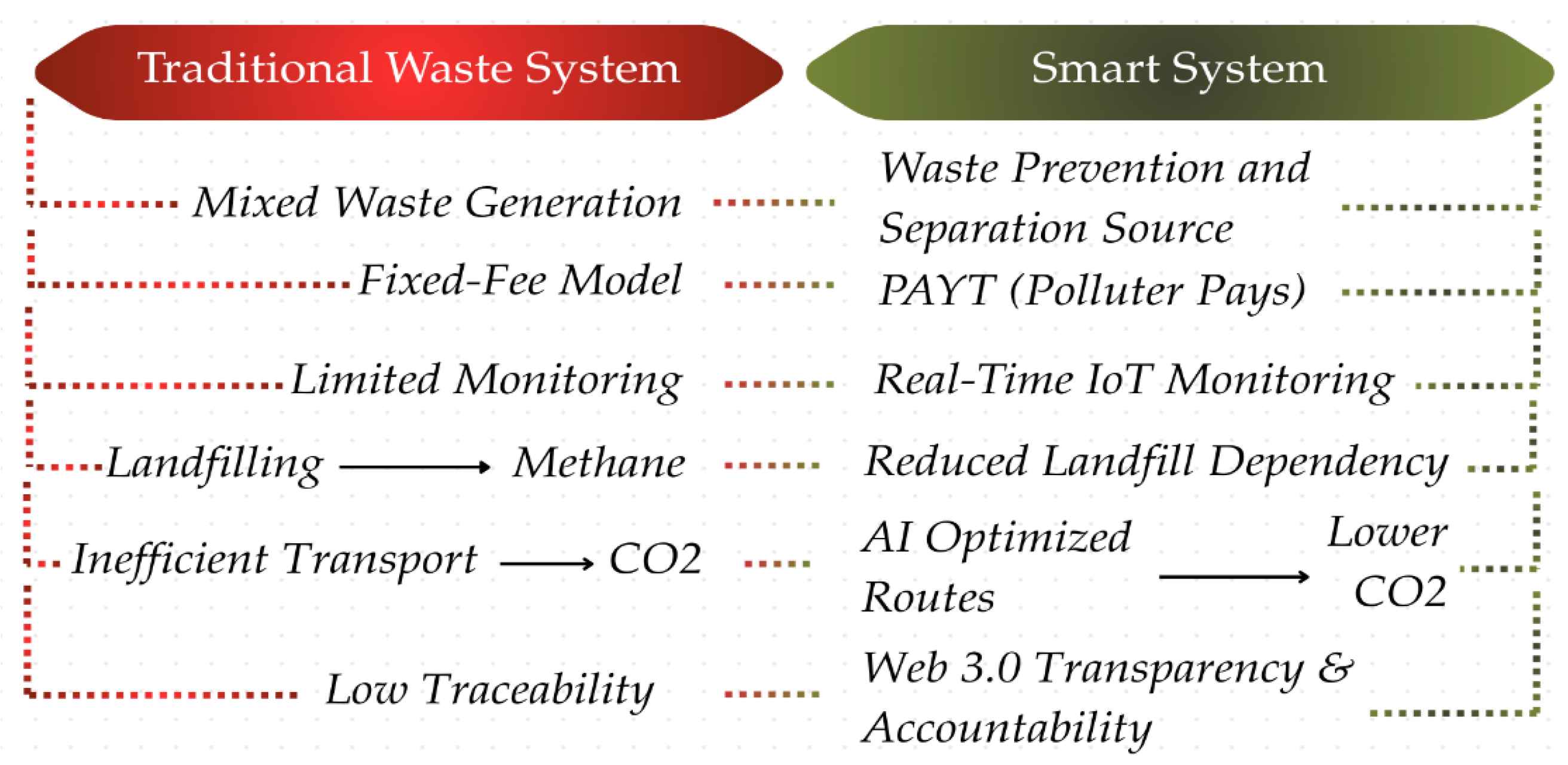
Figure 2.
The graphical representation illustrates the direct connection between SDG 11 – Sustainable Cities and Communities and Target 11.6, which focuses on reducing the adverse per capita environmental impact of cities through improved municipal waste management ([15], adapted by authors using GenAI).
Figure 2.
The graphical representation illustrates the direct connection between SDG 11 – Sustainable Cities and Communities and Target 11.6, which focuses on reducing the adverse per capita environmental impact of cities through improved municipal waste management ([15], adapted by authors using GenAI).
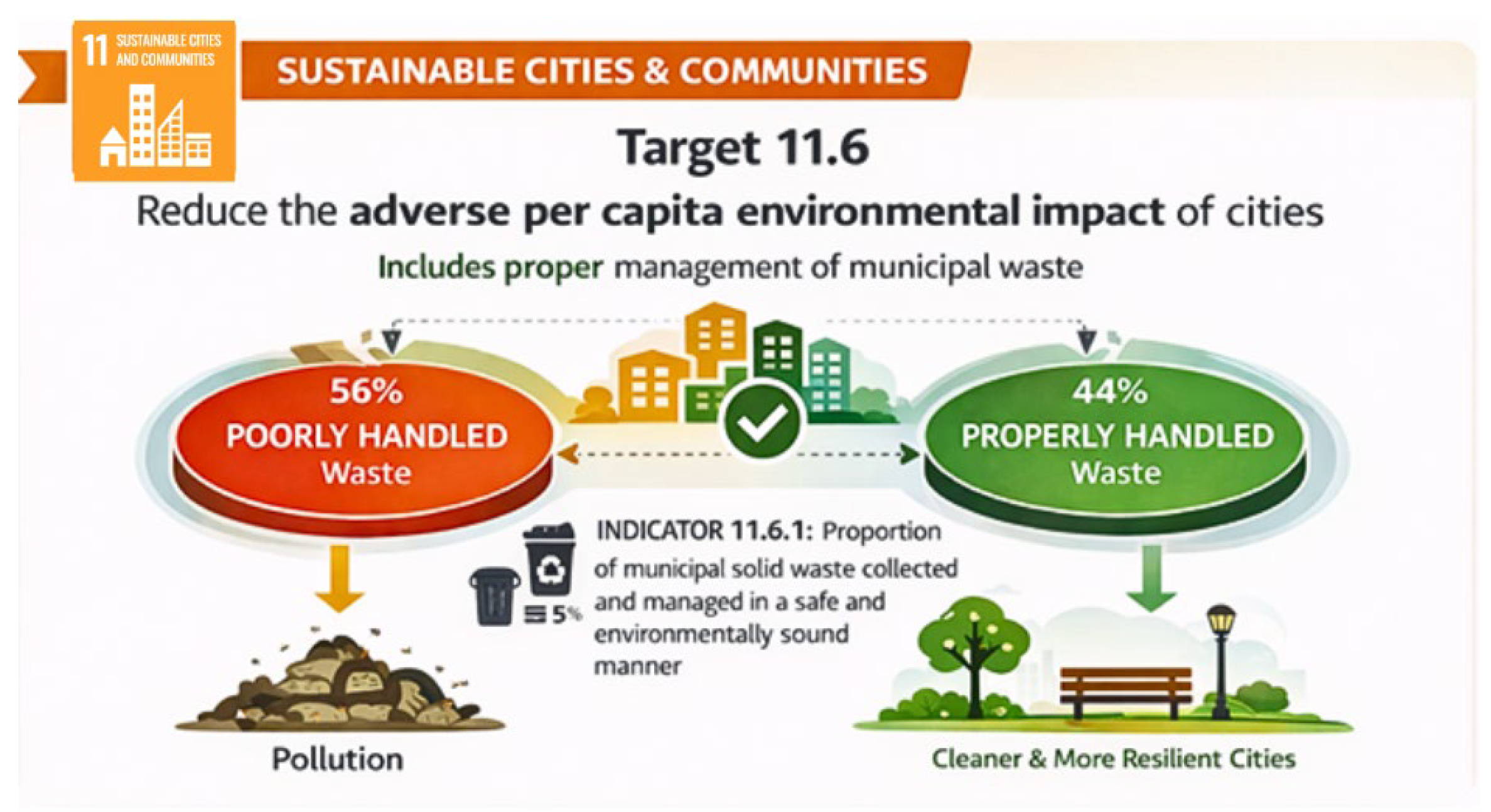
Figure 3.
The diagram illustrates the four-layer architecture of the Smart PAYT framework, showing the flow from user identification to automated tariffing. L1 – User Access & Identification enables resident authentication via QR code (dApp) and links each disposal event to the “polluter pays” principle; L2 – IoT Infrastructure records the physical disposal through sensors and an edge gateway, generating validated event data; L3 – AI Services analyze this data for waste classification, fill-level prediction, anomaly detection, and route optimization; L4 – Blockchain & Smart Contracts ensure immutable recording, automatic PAYT tariff calculation, and digital receipt issuance (figure designed by the authors).
Figure 3.
The diagram illustrates the four-layer architecture of the Smart PAYT framework, showing the flow from user identification to automated tariffing. L1 – User Access & Identification enables resident authentication via QR code (dApp) and links each disposal event to the “polluter pays” principle; L2 – IoT Infrastructure records the physical disposal through sensors and an edge gateway, generating validated event data; L3 – AI Services analyze this data for waste classification, fill-level prediction, anomaly detection, and route optimization; L4 – Blockchain & Smart Contracts ensure immutable recording, automatic PAYT tariff calculation, and digital receipt issuance (figure designed by the authors).
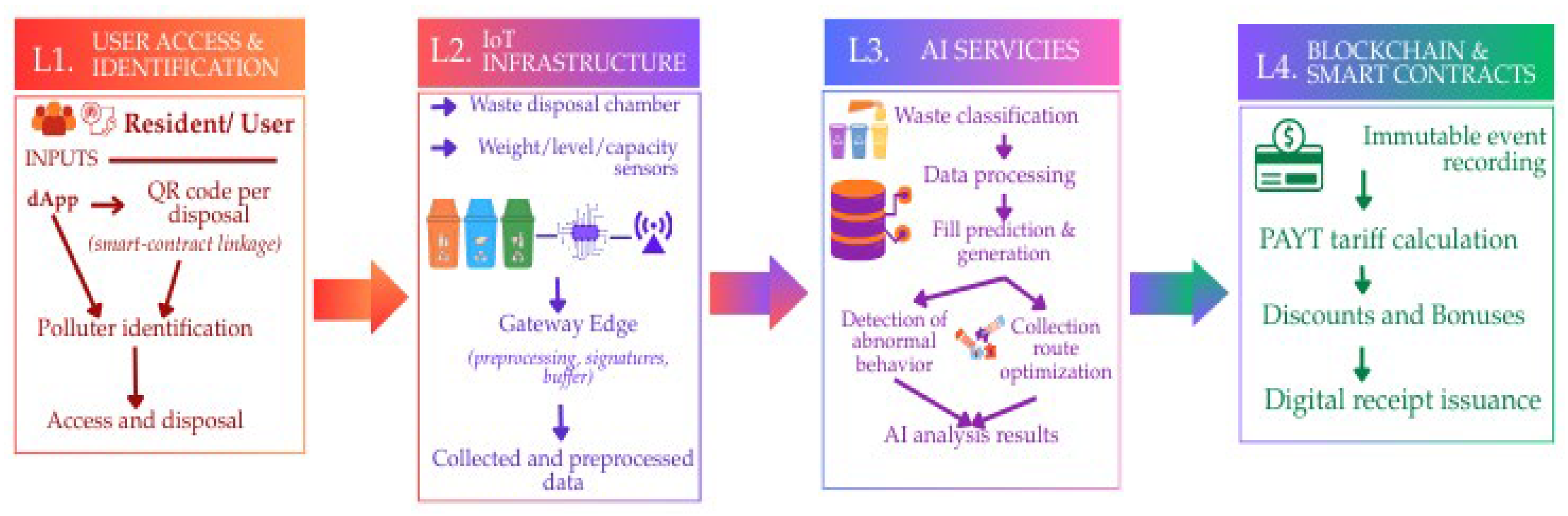

Table 1.
Literature Review Search Strategy Table.
| Research Cluster | Basic Search Query | Advanced WoS Query | Advanced Scopus Query |
|---|---|---|---|
| IoT in Waste Management | IoT AND waste management | TS=(“Internet of Things” OR IoT) AND TS=(“waste management” OR “municipal solid waste” OR “smart waste”) | TITLE-ABS-KEY((“Internet of Things” OR IoT) AND (“waste management” OR “municipal solid waste” OR “smart waste”)) |
| AI in Waste Management | Artificial Intelligence AND waste management | TS=(“Artificial Intelligence” OR “machine learning” OR “deep learning” OR “computer vision”) AND TS=(“waste collection” OR sorting OR recycling) | TITLE-ABS-KEY((“Artificial Intelligence” OR “machine learning” OR “deep learning” OR “computer vision”) AND (“waste collection” OR sorting OR recycling)) |
| Blockchain & Circular Economy | Blockchain AND waste traceability | TS=(blockchain OR “distributed ledger” OR “smart contracts”) AND TS=(“waste management” OR recycling OR traceability OR “circular economy”) | TITLE-ABS-KEY((blockchain OR “distributed ledger” OR “smart contracts”) AND (“waste management” OR recycling OR traceability OR “circular economy”)) |
| Web 3.0 Governance Models | Web 3.0 AND decentralised governance | TS=(“Web 3.0” OR decentralised OR “digital governance”) AND TS=(“resource management” OR “urban systems”) | TITLE-ABS-KEY((“Web 3.0” OR decentralised OR “digital governance”) AND (“resource management” OR “urban systems”)) |
| PAYT Systems | Pay-as-you-Throw AND waste | TS=(“Pay-as-you-Throw” OR PAYT) AND TS=(“municipal waste” OR recycling OR “polluter pays”) | TITLE-ABS-KEY((“Pay-as-you-Throw” OR PAYT) AND (“municipal waste” OR recycling OR “polluter pays”)) |
| Integrated Smart Systems | IoT AND AI AND Blockchain AND waste | TS=((“Internet of Things” OR IoT) AND (“Artificial Intelligence” OR blockchain) AND (“waste management”)) | TITLE-ABS-KEY(((“Internet of Things” OR IoT) AND (“Artificial Intelligence” OR blockchain) AND (“waste management”))) |
Disclaimer/Publisher’s Note: The statements, opinions and data contained in all publications are solely those of the individual author(s) and contributor(s) and not of MDPI and/or the editor(s). MDPI and/or the editor(s) disclaim responsibility for any injury to people or property resulting from any ideas, methods, instructions or products referred to in the content. |
© 2026 by the authors. Licensee MDPI, Basel, Switzerland. This article is an open access article distributed under the terms and conditions of the Creative Commons Attribution (CC BY) license (http://creativecommons.org/licenses/by/4.0/).
Copyright: This open access article is published under a Creative Commons CC BY 4.0 license, which permit the free download, distribution, and reuse, provided that the author and preprint are cited in any reuse.


