

Submitted:
28 May 2024
Posted:
29 May 2024
You are already at the latest version
Abstract
Ghana Tamale's current waste management system is overwhelmed by the growing waste crisis, necessitating the exploration of Waste-to-Energy technologies as an innovative solution. This study explores challenges and opportunities for integrating Waste-to-Energy (WtE) technologies into Tamale's existing waste management system. Qualitative research identified policy hurdles, financial constraints, social concerns, and institutional weaknesses as key barriers. Conversely, stakeholder collaboration, public education, and capacity building emerged as some success fac-tors. A proposed implementation plan emphasizes feasibility studies, public engagement, pub-lic-private partnerships (PPPs), and technology selection based on waste composition. Addition-ally, a novel framework for WtE integration within a broader Integrated Solid Waste Manage-ment (ISWM) system is presented. This framework incorporates waste sorting, recycling, WtE alternatives, and responsible management of residuals. Validation by key stakeholders con-firmed the framework's potential to improve waste management in Tamale. By overcoming identified challenges and implementing the proposed framework, Tamale can achieve environ-mental sustainability, energy generation, and progress towards UN SDGs 7, 11, and 12. This re-search offers valuable insights for policymakers and paves the way for a cleaner and more sus-tainable future for Tamale, potentially serving as a model for other developing cities.
Keywords:
waste-to-energy
; NVivo software
; biomass
; landfill
; technologies
; livelihoods
1. Introduction
It is estimated that the municipal solid waste (MSW) generation rate in residential, commercial and institutional areas is expected to increase to 2.2 billion tons per year by 2025 worldwide (Sharma et al., 2020; Khan et al., 2022). MSW differ worldwide and are influenced by social, financial, cultural, psychological, educational and technological factors (Batista et al., 2021; Banks et al., 2021). Thus, the quantities and contents of MSW also differ according to the standard of living and the degree of urbanization (Han et al., 2020; Cheng et al., 2023).
The prevailing sanitation and integrated waste management plans in developing countries are often not thorough, impairing municipal waste management implementation processes (Serge Kubanza et al., 2020). The municipalities, for the most part, lack systematic information and specialized technical staff, which obliges them to handle and treat solid waste ineffectively (Fereja et al., 2022; Kadhila, 2019). In addition, there are challenges in setting clear goals, actions and procedures that ensure the objectives of waste management corresponds with municipals’ reality (Schalch et al., 2019). Also, there is a lack of organizational resources and competitiveness (Zuñiga-Collazos et al., 2019; Swab et al., 2019), and efficient performance measurement systems (Dahinine et al., 2024). Thus, the developing countries context demonstrates the presence of obstacles for integrated solid waste management (ISWM) (AlManssoor, 2020).
The scenario above reveals in principle that the waste management frameworks used today are not effective and sustainable (Di Vaio et al., 2023; Schroeder, 2019). This highlights the urgent need for alternative solutions (Seddon et al., 2020; Unwin et al., 2020). The growth of the WtE sector offers a promising alternative, but its development has faced significant challenges such as inadequate funds, insufficient expertise, the lack of favorable national policies and legislation, as well as weak enforcement of existing regulations (Asante et al., 2022; Martinsen et al., 2022). To overcome these barriers and solve numerous liabilities related to the environment, especially the mountains of MSW discarded daily, it is necessary to apply facilitating instruments for the social control of public policies, emphasizing strategic guidelines, institutional arrangements, legal aspects and financing mechanisms (Howlett, 2019). The issues of waste management in Ghana, as well as the Tamale Metropolis, are not different from the general perspectives drawn from studies in other developing countries (Asare et al., 2021; Asare et al., 2020). However, in the Tamale Metropolis, the informal sector is actively involved in solid waste recyclables trading and is operating in almost all the communities in the Metropolis (Oteng-Ababio et al., 2020; Adjei-Asomani, 2021; Volsuuri et al., 2022). Moreover, there is no operational solid waste-to-energy plant in place as such mixed wastes are indiscriminately dumped in open spaces, burnt or transported to the decommissioned landfill for disposal (Yousif, 2020; Roy et al., 2022). In addition. The delays in disbursement of funds to the Metropolitan Assemblies by the central government coupled with low user-fee turnovers in most cases makes it difficult for waste management authorities and contractors to invest in new facilities and treatment technologies to support waste resources recovery and energy production (Asare et al., 2020; Ghaffar et al., 2020). These and several other factors have made the Tamale Metropolitan Assembly (TaMA) incapable of rendering effective waste management services in the Metropolis (Orton, 2023; Majeed, 2019). As far as the researchers are aware, despite the significant generation of solid waste in Tamale and its potential for energy production, no WtE (Waste-to-Energy) plant has been implemented since the decommissioning of the only landfill site at Gbalahi, a suburb of Tamale (Gyabaah et al., 2023; Nyimakan et al., 2022). This lack of action leaves the city facing a growing solid waste crisis (Valavanidis, 2023; Sarfo-Mensah et al., 2019).
While existing literature explores Waste-to-Energy (WtE) technologies in Ghana, the focus has primarily been on documenting successful pilot trials or planned projects, with less attention given to integrating WtE into existing waste management systems. As a result, there is a gap in intellectual discourse on WtE in Ghana as a component of an integrated solid waste management system. Additionally, existing studies do not emphasize designing a framework that incorporates WtE into the existing waste management structure to overcome prevailing barriers, especially considering the low success rate of many WtE projects in developing countries (Knickmeyer, 2020). Moreover, although mentioned in the National Solid Waste Management Strategy of Ghana (NSWMS), the exploration of themes on energy recovery from waste is superficial both in practice and academic research (Omari, 2022). Consequently, the indiscriminate use of open dumps and burning as final disposal methods for MSW persists, leading to the depletion of natural resources and public health concerns (Abdul-kadri, 2022; Noor et al., 2020). There is also a potential mismatch between the solid waste management capacity of the Tamale Metropolitan area and the rapid increase in waste generation, as evidenced by the limitations of the current waste disposal system (Asare et al., 2021; Kosoe et al., 2021). Furthermore, considering the abundance of literature highlighting the role of innovative solutions such as waste-to-energy technologies in enhancing waste treatment and energy production simultaneously, conducting a study to inform the incorporation of waste-to-energy into the existing solid waste management system in the Tamale metropolis is imperative (Loizidou et al., 2021; SITE, 2019). Central to this study are two primary research questions: (1) What are the barriers hindering effective waste management and the adoption of Waste-to-Energy (WtE) in Tamale’s current solid waste management system? Additionally, the study aimed to address the question (2) What are the Critical Success Factors (CSFs) for the realization of an improved solid waste management system encompassing WtE in the Tamale metropolis?
These questions serve as the guiding framework for the investigation, guiding exploration of diverse facets of waste management in the Tamale metropolis. Through rigorous data collection and analysis using focus group discussions and in-depth interviews, this study aims to provide actionable insights informing the development of effective waste management system incorporating viable waste-to-energy strategies. In addition to identifying barriers and critical success factors, this study aims to develop a novel framework offering a theoretical perspective and roadmap for the rollout of a Sustainable and Improved Solid Waste Management for Tamale. Integrating interdisciplinary perspectives and best practices, the framework seeks to address the challenges of solid waste management in the Tamale metropolis by incorporating WtE into the existing system. Finally, the insights gleaned from this study hold significant implications for policymakers and stakeholders in Tamale as they move forward with integrating WtE into the city’s waste management system.
2. Materials and Methods
Study Area
The study was conducted in the Tamale Metropolis, situated between latitude 9°16 and 9°34 North and longitudes 0°36 and 0°57 West. In 2017, the estimated population of the area was 485,000, with an annual growth rate of 3.5% (Asare et al., 2021). The elevation is approximately 180 meters above sea level, covering a total land area of 550 km2. Notably, the Metropolis has an urban population of 67.1%, making it the only predominantly urban district in the region (Figure 1). The population density is around 319 persons per square kilometer for the Metropolis, significantly higher than the regional average density of 25.9 persons per square kilometer. Functioning as the capital and main commercial center for the Northern region of Ghana, the Metropolis grapples with waste management challenges due to rapid socio-economic growth (Abdul-kadri, 2022).
The current municipal solid waste (MSW) management in the Tamale Metropolis is characterized by several challenges. Indiscriminate disposal, insufficient waste collection and transportation, and open dumping are the predominant practices, with the majority of waste being openly dumped without any pre-treatment (Asare et al., 2021). Additionally, the waste management bodies in Tamale collect only 7.5 tonnes of MSW per day, leaving a backlog of 142.5 tonnes per day (Ghana Districts, 2014; Issahaku et al., 2014). There is a minimal provision of MSW disposal infrastructures and communal collection containers (Bowan et al., 2021). Furthermore, a major challenge to effective MSW disposal in Ghana and other developing countries is the non-segregation of wastes at the various generation sources and throughout the waste management chain (Adedara et al., 2023; Zhang et al., 2022; Kassah, 2020). This is despite the significant stake of recyclable materials in the waste composition, which comprises both hazardous and non-hazardous waste.
As an illustration, In Tamale, mixed municipal solid waste (MSW) is often stored in single bins, improperly disposed of (e.g., burned, buried, or dumped in bushes), or collected through door-to-door services and communal containers before being openly dumped at an unregulated landfill site (Ramli et al., 2021; Asare et al., 2021). This system has detrimental environmental and public health consequences, including pollution of natural resources, ecological damage, and long-term health complications (Alabi et al., 2019; Chu, 2019; Akoto-Bamfo, 2020). While informal material recovery by scavengers and metal waste merchants partially mitigates the impact and provides livelihoods (Singh, 2021), there is no formal waste recovery or recycling system in place. As in many developing countries, informal recovery diverts some materials from the municipal waste stream (Khan et al., 2022; Cole et al., 2019). Therefore, implementing formal waste segregation, recovery, and recycling programs could significantly reduce the amount of MSW requiring disposal, thereby mitigating the adverse effects of current practices. Given these challenges, Tamale urgently needs to expand and invest in innovative waste management strategies, such as waste-to-energy (WtE) technologies.
Qualitative Survey
To understand the barriers and critical success factors associated with integrating waste-to-energy into MSWM in the Tamale metropolitan area, and to avoid bias, data was gathered from a variety of participants in the waste management sector using a variety of techniques including focus groups, in-depth interviews, observation, and site visits. This study represents the views of various stakeholders, including mainly MSWM service providers. Stakeholders were chosen according to recommendations from the literature (Batista et a., 2021; Rathnayake et al., 2022). All participants in the study were over 18 years of age. They were selected from various entities, including the Tamale Metropolitan Assembly’s Department of Waste and Sanitation, Zoomlion Ghana Ltd., the Environmental Protection Agency (EPA), researchers, and other waste service providers. Participants comprised directors, official staff, and operational staff. The University for development studies Research Ethics Committee approved this study on the 21 November, 2022.
Fieldwork was undertaken between 1st January, 2024 and 5th February 2024. Firstly, the primary researcher met informally with the Manager of Zoomlion Gh. ltd, Manager of waste under the department of waste, environment and sanitation – local government and Director of the Environmental Protection Agency (EPA). A formal letter and all relating documents were sent. Between January and February 2023, the primary researcher received acceptance letters from the aforementioned stakeholders, including Zoomlion Ghana Ltd. and the Tamale Metropolitan Assembly, among others, indicating their willingness to participate in the study. The methodology involved conducting focus group discussions and in-depth interviews. The principal investigator also visited the Gbalahi landfill site in the study area to view and take photos of its state and condition.
Figure 2.
Presents some evidence of pollution.
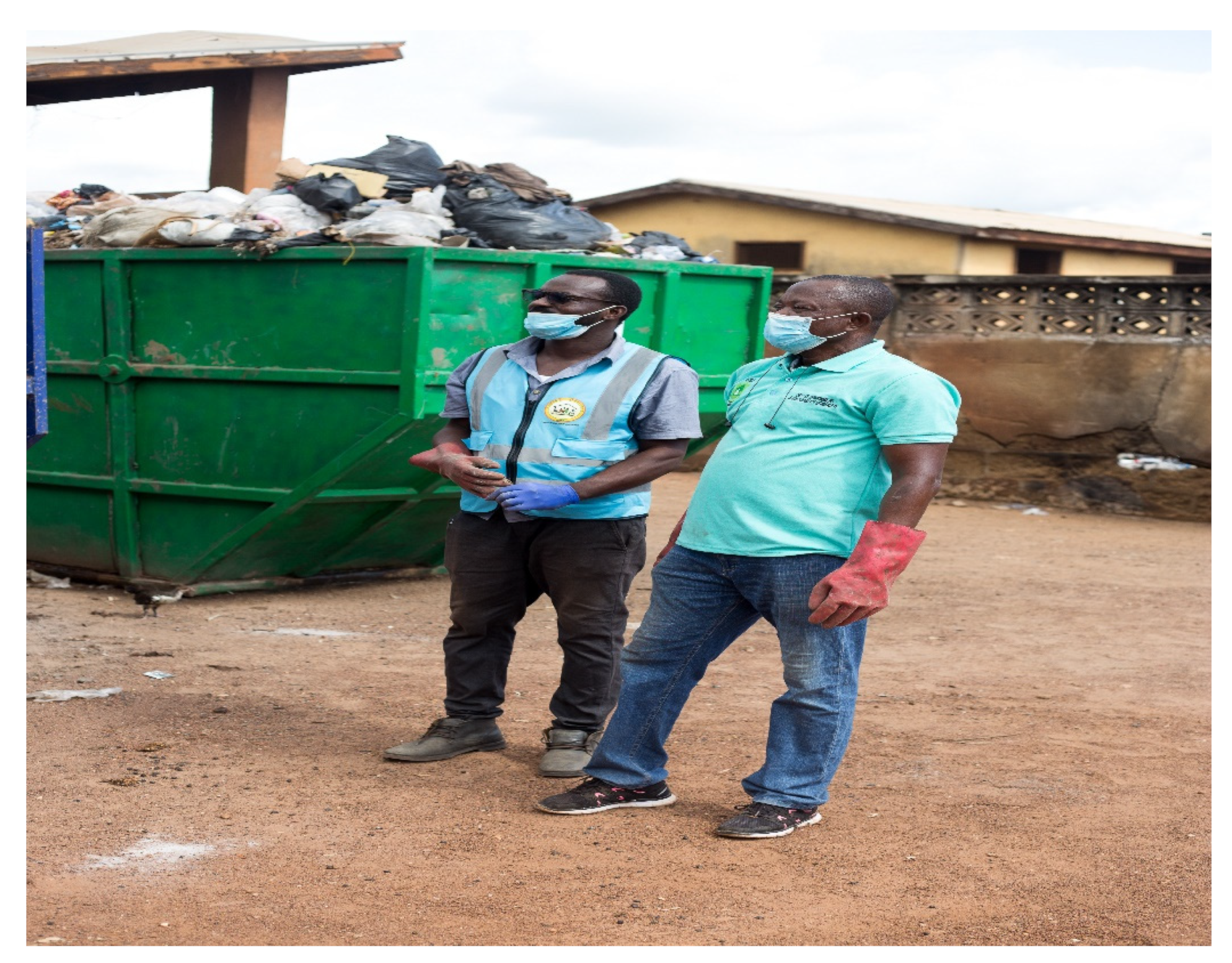
Between January 2024 and February 2024, the principal investigator conducted 10 face-to-face, semi-structured interviews with managers, researchers, administrators and other staffer of organizations related to MSWM of Tamale (Table 1). Interviews took between 20 and 40 min per person. Times differed between stakeholders to accommodate technical and cultural backgrounds of interviewees. On deciding to participate, principal investigator contacted the potential interviewees and made an appointment. Nonprobability sampling (Sambo & Wetnwan, 2021) was used for participant selection, the technique deployed is explained here; The primary researcher sent an invitation to two potential participants (academia, industry, community etc.) to request their participation in the study, the research instruments were attached to the invite. Using a Snowball technique (Khosravani et al., 2023; Soltanian et al., 2022), potential participant was asked to recommend other participants in the related field who might be willing to participate. There were no more than fifteen participants in each focus group. Focus group sessions lasted for 60 to 90 min. In each focus group session, the research team consisted of the researcher, moderator, note taker, audio recorder and organizer. An audio recording of the focus group conversation was made for later review. During focus group discussions, participants were guided by the moderator who kept the discussion focused, ensured that everyone participated, and encouraged participants to explain their answers.
The audio files generated from the 10 face-to-face semi-structured interviews and two focus group discussions were transcribed by the researcher onto a word processor and later uploaded and analysed for thematic content using NVivo software (Allsop et al., 2022). Analysis was undertaken immediately to prevent bias or loss of nuance that might arise from translated terms or expressions. Salient quotes were captured for use in publication.
The analytical framework for this study was built upon factors or aspects identified in the literature on solid waste management, drawing from sources such as the US EPA (2002), Parikh et al. (1995), and a cross-national study by Wang et al. (2021) that specifically examined developing countries. Thematic aspects of the framework include technical, institutional, socio-political, and financial matters.
3. Results and Discussions
Content Analysis
The following analysis includes findings from in-depth interviews and focus group discussions. The results present the most frequently cited issues.
Policy Perspectives
The absence of clear and consistent government policies regarding Waste-to-Energy (WtE) technologies presents a significant hurdle to their adoption in Tamale, Ghana. Both employees at Zoomlion Gh. Ltd. and officials from the Waste Department of the Tamale Metropolitan Assembly (TaMA) stress the importance of supportive regulations and policy coherence at both national and sub-national levels. These measures are vital for encouraging investment and facilitating the effective implementation of WtE projects. Without such policies, private sector involvement and investment in WtE initiatives are discouraged, and local authorities face difficulties navigating the regulatory landscape and accessing resources for project success. Consequently, the fragmented policy framework obstructs the sustainable integration of WtE technologies into Tamale’s waste management infrastructure, hindering progress towards environmental sustainability and energy security goals.
“There is a need for clear government policies supporting the adoption of WtE technologies. Without supportive regulations, it’s challenging to incentivize investment in these initiatives.” Zoomlion staff – ID Z4 (focus group)
“Policy coherence between national and local levels is crucial. Local authorities need guidance and support from the central government to effectively implement WtE projects.” Local government staff – ID LG2 (in-depth interview)
While the dominant narrative suggests a lack of effective policy, a minority of interviewees presented a different viewpoint. Three local government representatives (15%) in a focus group expressed the belief that existing policies are sufficient. For example,
“Policy is not the problem.” Local government staff – ID LG5 (focus group).
“We at Zoomlion Gh. Ltd. have recently commissioned a €20-million wastewater treatment plant at Gbalahi, a suburb of Tamale. This feat was achieved with funding from the Hungarian Government. Therefore, with the right funding and willpower from the Ghanaian government, we should be able to smoothly integrate WtE into the existing solid waste management system to address issues of solid waste ” Zoomlion Gh ltd staff - ID Z3 (in-depth interview)
Financial Implications
Amidst considerable financial hurdles linked to municipal solid waste management in the Tamale Metropolis, Ghana, both Zoomlion Staff and TaMA Waste Department Officials emphasize the urgent need for sufficient financing and thorough cost-effectiveness assessments to support the implementation and long-term viability of WtE initiatives. The paucity of accessible financial incentives and investment mechanisms hampers private sector engagement in the sector, while the absence of comprehensive economic feasibility studies poses risks to the financial sustainability of WtE projects. Therefore, without addressing these financial obstacles, the realization of WtE as an effective waste management solution in Tamale remains uncertain, undermining efforts towards environmental preservation and energy generation objectives.
“Securing adequate financing for WtE projects is a major challenge. Financial incentives and investment mechanisms are needed to attract private capital into the sector.” Zoomlion Gh ltd Staff -ID Z1 (in-depth interview)
“Waste-to-Energy (WtE) plants require a high initial investment, coupled with ongoing maintenance and operation costs. Economic viability studies are therefore crucial to assess their long-term financial sustainability and ensure value for money. Unlike the Gbalahi landfill site in Tamale, which fell short of expectations, WtE plants, when properly assessed and managed, can deliver a more sustainable waste management solution.” Local Government Staff- ID LG3 (Focus group)
“While WtE offers potential advantages, the high upfront costs and ongoing expenses raise concerns about affordability, especially considering Tamale’s limited resources. Exploring alternative, potentially less expensive waste management solutions that are more readily adaptable to our local context might be a more prudent approach in the short term.” - Community Representative - ID CR2 (Focus Group Discussion)
However, it’s important to acknowledge a minority (10%) viewpoint within the focus group discussions. Some participants expressed concerns that the social burden of WtE projects might outweigh the potential financial benefits.
“While WtE offers potential benefits, we shouldn’t rush into significant debt for these projects. A thorough cost analysis is crucial, but the long-term social implications on the community need careful consideration.” - Community Representative - ID CR8 (Focus group discussion)
Socio-Political Dynamics
Participants, comprising private waste service providers, waste researchers (experts), local assembly staff, Zoomlion Gh Ltd. staff, and others, emphasize the significance of social acceptance, public awareness campaigns, community engagement, political will, and stakeholder involvement in the success of WtE initiatives. Failure to address misconceptions, concerns, and secure public support through effective communication strategies may result in resistance from communities and obstacles in project implementation. Furthermore, the lack of political dedication and inclusive decision-making processes may impede the prioritization and advancement of sustainable waste management solutions, hindering progress towards environmental sustainability and energy generation objectives in Tamale.
“Political will and stakeholder engagement are key determinants of WtE success. Decision-makers must prioritize sustainable waste management solutions and involve relevant stakeholders in the decision-making process.” Waste Researcher -ID WR 1 (in-depth interview)
“The acceptance of WtE technologies by society is crucial. It requires public awareness initiatives and community engagement endeavors to tackle misunderstandings and apprehensions among local residents” Private Waste Service Provider – ID PWS 3 (in-depth interview)
Although a majority of participants (80%) agree with the need for stakeholder engagement and political will, not everyone (20%) agrees that the level of public engagement is necessary. Some participants expressed concerns that extensive public discussions could delay project implementation and potentially lead to misinformation campaigns.
“While public awareness is important, shouldn’t the focus be on technical expertise and ensuring the proper functioning of the plant? Extensive community engagement can be time-consuming and potentially delay progress.” – Community representative - ID CR10 (in-depth interview)
“There’s a fear that community concerns might be used to stall the project altogether. While some engagement is necessary, the final decisions should be left to the experts.” – Local Government Staff - ID LG4 (in-depth interview)
Additionally, a minority group (15%) represented by waste pickers voiced apprehension about the potential impact of WtE on their livelihoods in focus group discussions. They expressed concerns that WtE plants could reduce the amount of recyclable materials available for collection, impacting their income.
“We support sustainable waste management, but WtE shouldn’t come at the expense of our livelihoods. We need assurances that WtE won’t significantly reduce the amount of recyclable materials available for collection.” - Private Waste Service Provider – ID PWS 1 (Focus group discussion)
These quotes from minority viewpoints (15%) in the focus group discussion highlight contrasting perspectives on the importance of social engagement. They raise concerns about potential delays and the impact on waste pickers’ livelihoods, suggesting a need to balance public participation with project efficiency and social responsibility.
Institutional Framework
Majority of participants (70%) stress the importance of efficient collaboration between public and private entities and highlight the need to enhance institutional capacity for successful implementation of Waste-to-Energy (WtE) initiatives. Without strong partnerships between the public and private sectors, the effective operation and maintenance of WtE facilities may be compromised. Similarly, the absence of institutional capacity and trained personnel could hinder the planning, execution, and management of WtE projects. Therefore, addressing these institutional challenges is crucial to fully harnessing the potential of WtE as a sustainable waste management solution in Tamale.
“Building institutional capacity is crucial for successful WtE implementation. Training and skill development programs are necessary for waste management personnel.” Local Government Staff – ID LG 1 (focus group discussion)
“Public-private partnerships (PPPs) are not just essential, they offer the most promising path forward for WtE in Tamale. By leveraging the expertise of the private sector alongside public resources, we can ensure efficient operation and maintenance of WtE facilities, while mitigating financial risks for the government. PPPs can also foster innovation and technology transfer, leading to a more sustainable WtE solution for the city” Zoomlion Gh. Staff – ID Z2 (in-depth interview)
While many stakeholders emphasized collaboration, a researcher expressed reservations about private sector involvement in WtE projects.
“I understand the potential benefits of PPPs, but concerns exist about potential profit motives overriding environmental considerations. Local businesses should be given a fair chance to participate in WtE initiatives, ensuring transparency and community benefit.” – Waste researcher - ID WR1 (In-depth interview)
Additionally, the minority group (30%) voiced concerns about potential knowledge gaps within the local government when entering into PPPs with private waste management companies.
“Collaboration is crucial, but capacity building within the government sector is essential. We need to ensure local authorities have the necessary expertise to effectively negotiate and manage PPP agreements related to WtE projects.” – Environmental protection agency - ID EPA 2 (In-depth interview)
These quotes from the focus group discussion and in-depth interviews highlight contrasting perspectives on institutional collaboration. They raise concerns about potential profit motives and knowledge gaps within the government, suggesting a need for a balanced approach that emphasizes transparency, local participation, and capacity building.
Technical Considerations
In terms of the technical aspects involved in implementing waste-to-energy (WtE) projects in the Tamale Metropolis, Ghana, a significant majority emphasizes the importance of conducting feasibility assessments, embracing technological advancements, and promoting ongoing research and innovation to optimize WtE processes. Factors such as waste composition, available technology, and infrastructure significantly impact the feasibility and success of WtE initiatives. Without comprehensive feasibility studies and advancements in technology to improve efficiency and environmental sustainability, the execution of WtE projects may encounter technical obstacles and fail to realize their potential benefits. Addressing these technical considerations is vital to ensure the effective integration of WtE technologies into the waste management framework in Tamale, thereby contributing to sustainable development and resource utilization in the region.
“Thorough feasibility studies are crucial, but we should also consider adaptable technologies that can accommodate the evolving nature of our waste stream. Tamale’s waste composition may change over time, and we need WtE solutions that can adapt to maintain efficiency and environmental benefits.” - Environmental Protection Agency - ID EPA3 (in-depth interview)
“Technological advancements play a vital role in optimizing WtE processes. Continuous research and innovation are necessary to improve efficiency and environmental sustainability.” Waste researcher – ID WR 3 (in-depth interviews)
While the focus on technical considerations was widely shared, some dissenting voices emerged within the focus groups.
“The focus on high-tech solutions may not be the most practical approach for Tamale. Simpler, low-maintenance WtE technologies might be more suitable for our context, considering limited resources and technical expertise.” – Local Government staff – LG2 (Focus group discussion)
Additionally, an environmental expert (10%) expressed concerns about potential limitations of current WtE technologies.
“While advancements are promising, WtE still carries inherent environmental risks. We need to prioritize stricter emissions regulations and ongoing monitoring to ensure WtE projects in Tamale are truly sustainable and don’t create new environmental burdens.” - Environmental Protection Agency Representative - ID EPA 2 (In-depth interview)
These quotes from participants in the study highlight contrasting perspectives on the technical aspects of WtE implementation. They raise concerns about the suitability of complex technologies and the potential environmental impact, suggesting a need to consider simpler solutions and prioritize robust environmental safeguards.
Further Analysis
The integration of Waste-to-Energy (WtE) technologies into Tamale ‘s existing waste management system encounters numerous challenges, as uncovered by the qualitative survey findings presented in this study. The results, demonstrate a consensus on major challenges and opportunities, as well as intriguing divergent perspectives.
Policy and Financial Hurdles
A consensus among stakeholders emphasizes the critical necessity for supportive government policies and clear regulations to incentivize investment in Waste-to-Energy (WtE) projects, a finding reflected in the literature (Lazaro et al., 2023; Lewis et al., 2021). Participants underscored the importance of conducting financial feasibility studies to ensure long-term economic viability, a sentiment echoed in the literature (Debnath et al., 2023; Dokter et al., 2021; Nyimakan, 2022). Similarly, Ali et al. (2021) reported similar findings, highlighting that like many cities in developing countries, the majority of Municipal Solid Waste Management (MSWM) budgets are allocated to collection and disposal rather than supporting innovative waste minimization efforts.
Moreover, a significant majority of stakeholders identify financial hurdles as a major barrier to implementing Waste-to-Energy (WtE) initiatives. Concerns primarily revolve around the substantial upfront costs, operational and maintenance expenses, and the lack of readily available financing mechanisms to support these projects. Additionally, limited access to financial incentives and investment options discourages private sector participation, while the absence of comprehensive economic feasibility studies raises doubts about long-term financial sustainability. This uncertainty surrounding the viability of WtE as a solution could potentially hinder progress towards environmental and energy goals in Tamale. Moving forward, it is imperative to explore WtE alternatives that are potentially less expensive for waste management, alongside conducting thorough examinations of WtE’s financial feasibility and social impact. This aligns with findings from the literature (Schroeder et al., 2021; Govindan & Hasanagic, 2018; Manamela, 2022), where finance emerges as one of the primary barriers to developing a Waste-to-Energy (WtE) system in developing nations.
Conversely, a minority viewpoint (23%) in this study suggests that existing policies might be sufficient. This underscores a potential gap in understanding and/or the need for more targeted policy interventions (Williams et al., 2023; Giest and Samuels, 2020; Pillai et al., 2023; Lafont, 2020; Norris, 2023).
Social and Political Considerations
The research underscores the importance of public awareness campaigns, community engagement, and stakeholder involvement for successful WtE implementation, Ogutu et al., (2021) and Han et al., (2021) found similar outcomes in their study on sustainable cities as options for improving solid waste management in Nairobi city. Notably, some concerns were raised about potential delays in WtE projects due to extensive public engagements, this is not different from the account in literature by (McLaren et al., 2023; Karmacharya, 2022; Volsuuri et al., 2022). Additionally, waste pickers expressed apprehension about the impact of WtE on their livelihoods a concern that resonates with earlier research by Hayoun, (2021) where he explored the link between waste governance structures and livelihood options for urban waste pickers. These contrasting viewpoints suggest a need for a balanced approach that prioritizes transparency, community education, and social impact assessments alongside project efficiency (Bahadorestani et al., 2020)
Institutional Collaboration and Capacity Building
Stakeholders in the study widely recognize the value of public-private partnerships (PPPs) for tapping into expertise and reducing financial risks, a sentiment supported by existing literature (Knickmeyer, D. 2020; Debela, 2021; Akomea-Frimpong, et al., 2022). However, concerns have arisen regarding the possibility of profit motives overshadowing environmental concerns, echoing findings in the literature (H et al., 2020; Williams et al., 2023; El Meouchy, 2020). Also, a critical challenge lies in the observed knowledge gaps and know-how within the local government and waste industry in Tamale. This is highlighted in the limited experience in both entering Public-Private Partnership (PPP) agreements and managing waste-to-energy plants. This situation underscores the need for robust PPP frameworks that prioritize transparency, local participation, and capacity building initiatives.
Technical Considerations and Innovation
The importance of conducting feasibility studies, embracing technological advancements, and promoting ongoing research for efficient and environmentally sustainable WtE processes were dominant under the technical and innovation theme, echoing findings in the literature (Burke et al., 2023; Adapa, 2018; Velasco-Herrejón et al., 2022). However, dissenting voices advocated for simpler, low-maintenance technologies suitable for Tamale’s context and emphasized the need for stricter environmental regulations to mitigate potential risks. Even though not so contrasting perspectives, the findings highlight the importance of considering both technical efficiency and environmental safeguards when selecting and implementing WtE technologies as echoed in the literature (Moss et al., 2021; Koene et al., 2019). Overall, the integration of WtE technologies in Tamale’s waste management system requires addressing policy perspectives, financial implications, socio-political dynamics, institutional framework, and technical considerations. By overcoming these challenges, Tamale can harness the potential of WtE technologies to achieve environmental sustainability, energy generation, and waste management objectives.
Barriers, Success Factors and Practical Implementation of WtE in the Existing System of Solid Waste Management in Tamale
Leveraging insights from focus group discussions, in-depth interviews, and literature, this section outlines a framework for effective WtE integration within Tamale’s Municipal Solid Waste (MSW) management system. While WtE holds promise, successful implementation hinges on careful consideration of three crucial elements: stakeholders, barriers, and success factors, as detailed in Figure 3.
The framework begins with a cluster of stakeholders, whose active participation is essential for the successful implementation of a Waste-to-Energy (WtE) project. The stakeholder group includes government agencies, particularly the Tamale Metropolitan Assembly (TaMA) and the Environmental Protection Agency (EPA), which play crucial roles in creating a supportive policy framework and ensuring environmental compliance. Private sector entities and waste management service providers, such as Zoomlion Ghana Ltd. and Sama Sama, contribute by leveraging their existing infrastructure and expertise for efficient waste collection, technology and delivery to proposed WtE facility. Community leaders, such as chiefs and assembly members, serve as vital bridges between a WtE project and residents, fostering public acceptance and facilitating smooth project execution. Finally, residents of Tamale, as waste generators, play crucial roles in waste segregation and responsible disposal practices. Engaging them through educational campaigns and promoting community ownership of the project are essential steps.
The key barriers hindering a successful Waste-to-Energy (WtE) implementation in Tamale include the following: Firstly, the high initial investment required for infrastructure development poses a significant hurdle. Public-private partnerships (PPPs) can play a crucial role in mitigating this challenge by sharing costs and leveraging private sector expertise. Secondly, the limited technical expertise in operating and maintaining WtE plants presents another barrier, which can be addressed through capacity-building programs. Public perception is also a critical barrier, with concerns about potential air and water pollution needing proactive addressing. Comprehensive environmental impact assessments and transparent communication strategies are essential to ensure public safety and garner community support. Furthermore, Tamale’s waste stream, characterized by its high organic content, may require pre-treatment processes before conversion to energy. Careful technology selection and feasibility studies are necessary to address this challenge by identifying WtE technologies suitable for the specific waste composition. Lastly, the lack of clear policies and regulations surrounding WtE projects is a major hurdle. Collaborative efforts between government agencies and industry stakeholders can help develop a regulatory framework to incentivize WtE development and ensure responsible operation.
Drawing insights from focus group discussions, in-depth interviews, and existing literature, the following success factors are compiled for the effective implementation of Waste-to-Energy (WtE) in Tamale (See Figure 3). Firstly, conducting a comprehensive feasibility study is vital to assess the technical and economic viability of a WtE plant in the local context. Secondly, public awareness campaigns are necessary to educate residents about the benefits of WtE technology, including waste reduction, energy generation, and environmental conservation practices. Thirdly, public-private partnerships that leverage government resources, private sector expertise, and community participation are crucial for ensuring the long-term sustainability of the project. Additionally, selecting the most appropriate technology based on Tamale’s specific waste composition and energy needs is essential. Finally, capacity building through training programs for local personnel ensures the efficient operation and maintenance of the WtE plant.
Lastly, moving from planning to action requires a well-defined implementation plan. This can be found in the fourth cluster of Figure 3. Firstly, a comprehensive assessment will be carried out to detail Tamale’s waste generation, composition, energy potential, and current management practices. This data will inform the selection of the most suitable technology. Identifying a suitable site for the plant that minimizes environmental and social impacts is crucial. Stakeholder engagement throughout the process fosters trust, addresses concerns, and ensures community buy-in. Financing and investment strategies, as key implementation activities, will involve a combination of public-private partnerships, government grants, or private investments. A sustainable waste collection system is essential to ensure a consistent supply of waste to the WtE plant. Construction and operation of the plant require careful planning, adherence to safety standards, and comprehensive training for personnel. Lastly, monitoring and evaluation will be carried out to assess the plant’s performance, environmental impact, and make necessary adjustments for sustained success.
Development of an Integrated Sustainable Waste Management Framework That Integrates WtE System in Tamale
The block diagram below (Figure 4) illustrates an integrated waste management system encompassing WtE plants. This comprehensive waste management framework tailored for Tamale seamlessly integrates waste-to-energy (WtE) technologies, heralding a new era of sustainability and circularity in waste management practices.
At its core, the system addresses the multifaceted challenges posed by municipal solid waste (MSW) generation from both commercial and residential sources. The schematic diagram begins with the meticulous collection and transportation of MSW to a centralized sorting facility. Here, manual and automated sorting techniques are employed to segregate recyclable materials, effectively minimizing waste and maximizing resource recovery.
A pivotal aspect of the system lies in its treatment of mixed waste streams, a common challenge in the prevailing solid waste management system in Tamale. Following the sorting processes, non-recyclable materials are directed towards a specialized material recovery chamber for pre-processing of non-recyclables towards WtE plant utility.
Organic waste, a significant fraction of MSW is channeled to the anaerobic digestion plant, yielding biogas for energy production and compost for soil enrichment. This dual benefit not only reduces the carbon footprint but also fosters sustainable agricultural practices, promoting soil fertility and crop productivity.
Meanwhile, other non-recyclable materials from the material recovery chamber together with residual waste, unsuitable for conventional recycling or composting, finds their way to landfill plant equipped with gas capture and scrubber capabilities. Here, energy is harnessed through methan production for the generation of heat and electricity while mitigating environmental impacts. Notably, stringent measures are implemented to minimize emissions, ensuring that odour, NOx, and other pollutants are kept at minimal levels.
The energy and resources harvested through these processes form the cornerstone of a circular economy paradigm. Recycled materials are seamlessly reintegrated into the consumption and production cycle, reducing reliance on virgin resources and mitigating environmental degradation. Clean energy derived from biogas and landfill WtE processes meets both the WtE plants’ energy requirement and the city’s energy needs sustainably, fostering resilience and independence.
Furthermore, the production of compost enriches soil fertility, fostering sustainable agricultural practices and reducing dependence on chemical fertilizers. By championing a circular economy, the framework not only addresses the immediate challenges posed by MSW but also paves the way for long-term environmental sustainability and economic resilience in Tamale.
In essence, this waste management framework represents a paradigm shift towards holistic and sustainable practices, embodying the principles of circularity, resource efficiency, and environmental stewardship. By harnessing the potential of WtE technologies and embracing innovative solutions, Tamale is poised to lead the way towards a greener, cleaner, and more prosperous future.
Framework Validation
Considering that the best practice for managing solid waste involves an Integrated Solid Waste Management (ISWM) system, and recognizing that the Tamale Metropolitan Assembly (TaMA) is solely responsible for managing Municipal Solid Waste (MSW) in Ghana, it was essential to involve staff from TaMA, Environmental Protection Agency (EPA) which is responsible for environmental regulation within the country and Zoomlion Ghana Limited which is a waste service provider with extensive expertise in the field of waste in Ghana in validating the developed framework. Their participation allowed for confirmation or challenge of the framework’s findings. By selecting representatives from waste management regulators, service providers, and government sector, the validation process aimed to assess the framework’s theoretical standpoint for the concept of MSW management integrated with waste-to-energy for adoption in Tamale against the practical considerations of these key stakeholders. Answers to the framework validation questions are presented in Table 2. A consensus emerged among participants regarding the framework’s logical structure, its effectiveness in addressing WtE and MSW management issues, its adequacy, and its feasibility.
This framework can assist waste management decision-makers to take the guesswork out of decisions for waste management planning in the metropolis, as the framework incorporates a better picture of how a waste management system encompassing WtE works and how that could improve the solid waste issues of Tamale. Thus, the application of this framework has the potential to increase the level of decision-makers’ awareness of the challenges of prevailing MSWM and possibly lead to the effective take-off of WtE technologies in Tamale.
By reducing reliance on landfills, generating renewable energy, and promoting responsible waste management practices, the framework can contribute to a cleaner and more sustainable future for Tamale. However, successful rollout requires collaboration and ongoing communication among all stakeholders to address concerns and ensure a smooth transition. The framework can also be adapted and serve as a valuable blueprint for other cities facing similar waste management challenges.
5. Conclusion
This comprehensive study delved into the imperative task of integrating Waste-to-Energy (WtE) technology within Tamale’s existing solid waste management (MSWM) system (Bediako, 2020). By meticulously examining potential barriers, delineating success factors, and formulating a pragmatic implementation plan, this research furnishes invaluable insights for guiding future endeavors and policy formulations. Using focus group discussions and in-depth interviews, the study unearthed five pivotal barriers impeding WtE integration in Tamale, including unclear policy frameworks, financial constraints, institutional inefficiencies, negative public perceptions, and a deficient waste segregation culture. To surmount these hurdles, it advocates for the development of comprehensive policies, exploring public-private partnerships (PPPs) to alleviate financial constraints, and augmenting institutional capacities. Furthermore, it underscores the importance of public awareness campaigns and fostering responsible waste disposal practices to assuage public concerns and garner community support.
Conversely, the research proposed key implementation strategies essential for the successful rollout of WtE technology in Tamale. These encompass conducting thorough feasibility studies, embarking on robust public awareness campaigns, fostering PPPs to leverage resources and expertise, selecting suitable WtE technology tailored to Tamale’s waste composition, and investing in capacity building through training programs. This research not only provided valuable insights but also guided the development of a novel framework for MSW management with viable WtE alternatives. If adopted by the Tamale Metropolitan Assembly, this framework has the potential to significantly accelerate progress towards achieving SDGs 7, 11, and 12 and can pave the way for tangible progress towards a cleaner, more sustainable future for Tamale and serve as a beacon for sustainable waste management practices in other developing regions.
Further, the insights gleaned from this study hold significant implications for policymakers and stakeholders in Tamale as they contemplate the integration of WtE into the city’s waste management system. By adeptly addressing the identified barriers and leveraging the outlined success factors, Tamale stands poised to realize substantial advancements towards a sustainable future.
Author Contributions
Conceptualisation, A-W.T, S.J.C and A.W; methodology, A.W and A-W.T; validation, all authors, writing—original draft preparation, A-W.T. and A.W; writing—review and editing, S.J.C, A-W.T. and A.W; visualisation, A-W.T. All authors have read and agreed to the published version of the manuscript.
Funding
This research received no external funding.
Data Availability Statement
The original contributions presented in this study are included in the article; further inquiries can be directed to the corresponding author.
Acknowledgements
The authors thank everyone who has contributed to improving the quality of this study.
Conflicts of Interest
The authors declare no conflicts of interest.
References
- Abdul-Kadri, Y., Samuel, A., & Abdullah, A. (2022). Sustainable eco-tourism in Ghana: An assessment of environmental and economic impacts in selected sites in the Upper East Region. Journal of Geography and Regional Planning, 15(2), 18-30.
- Abdullah, N., Al-Wesabi, O. A., Mohammed, B. A., Al-Mekhlafi, Z. G., Alazmi, M., Alsaffar, M.,... & Sumari, P. (2022). Integrated approach to achieve a sustainable organic waste management system in Saudi Arabia. Foods, 11(9), 1214.
- Adapa, S. (2018). Indian smart cities and cleaner production initiatives–Integrated framework and recommendations. Journal of cleaner production, 172, 3351-3366.
- Adedara, M. L., Taiwo, R., & Bork, H. R. (2023, April). Municipal Solid Waste Collection and Coverage Rates in Sub-Saharan African Countries: A Comprehensive Systematic Review and Meta-Analysis. In Waste (Vol. 1, No. 2, pp. 389-413). MDPI.
- Adjei-Asomani, B. (2021). An assessment of public-private partnership and spatial distribution of solid waste collection services in the Tema Metropolis (Doctoral dissertation).
- Akomea-Frimpong, I., Jin, X., & Osei-Kyei, R. (2022). Managing financial risks to improve financial success of public—private partnership projects: a theoretical framework. Journal of Facilities Management, 20(5), 629-651.
- Akoto-Bamfo, A. (2020). AN EXAMINATION OF THE IMPLEMENTATION OF SDG 6: THE CASE OF GHANA (Doctoral dissertation, UNIVERSITY OF GHANA, LEGON).
- Alabi, O. A., Ologbonjaye, K. I., Awosolu, O., & Alalade, O. E. (2019). Public and environmental health effects of plastic wastes disposal: a review. J Toxicol Risk Assess, 5(021), 1-13.
- Alao, M. A., Popoola, O. M., & Ayodele, T. R. (2022). Waste-to-energy nexus: An overview of technologies and implementation for sustainable development. Cleaner Energy Systems, 3, 100034.
- Ali, E. B., Anufriev, V. P., & Amfo, B. (2021). Green economy implementation in Ghana as a road map for a sustainable development drive: A review. Scientific African, 12, e00756.
- Allsop, D. B., Chelladurai, J. M., Kimball, E. R., Marks, L. D., & Hendricks, J. J. (2022). Qualitative methods with Nvivo software: A practical guide for analyzing qualitative data. Psych, 4(2), 142-159.
- AlManssoor, A. (2020). Obstacles and Opportunities in Planning and Implementing Integrated Sustainable Municipal Solid Waste Management (ISMSWM) in Kuwait–a Gulf Cooperation Council.
- Asante, D., Ampah, J. D., Afrane, S., Adjei-Darko, P., Asante, B., Fosu, E.,... & Amoh, P. O. (2022). Prioritizing strategies to eliminate barriers to renewable energy adoption and development in Ghana: A CRITIC-fuzzy TOPSIS approach. Renewable Energy, 195, 47-65.
- Asare, W., Oduro Kwarteng, S., Donkor, E. A., & Rockson, M. A. (2020). Recovery of municipal solid waste recyclables under different incentive schemes in Tamale, Ghana. Sustainability, 12(23), 9869.
- Asare, W., Oduro-Kwarteng, S., Donkor, E. A., & Rockson, M. A. (2021). Incentives for improving municipal solid waste source separation behaviour: The case of Tamale Metropolis, Ghana. SN Social Sciences, 1, 1-33.
- Asefi, H., Shahparvari, S., & Chhetri, P. (2020). Advances in sustainable integrated solid waste management systems: lessons learned over the decade 2007–2018. Journal of Environmental Planning and Management, 63(13), 2287-2312.
- Babaee Tirkolaee, E., Goli, A., Pahlevan, M., & Malekalipour Kordestanizadeh, R. (2019). A robust bi-objective multi-trip periodic capacitated arc routing problem for urban waste collection using a multi-objective invasive weed optimization. Waste Management & Research, 37(11), 1089-1101.
- Badgett, A., & Milbrandt, A. (2020). A summary of standards and practices for wet waste streams used in waste-to-energy technologies in the United States. Renewable and Sustainable Energy Reviews, 117, 109425.
- Bahadorestani, A., Naderpajouh, N., & Sadiq, R. (2020). Planning for sustainable stakeholder engagement based on the assessment of conflicting interests in projects. Journal of Cleaner Production, 242, 118402.
- Balafoutis, A. T., Evert, F. K. V., & Fountas, S. (2020). Smart farming technology trends: economic and environmental effects, labor impact, and adoption readiness. Agronomy, 10(5), 743.
- Banks, S., Cai, T., De Jonge, E., Shears, J., Shum, M., Sobočan, A. M.,... & Weinberg, M. (2020). Practising ethically during COVID-19: Social work challenges and responses. International Social Work, 63(5), 569-583.
- Batista, M., Caiado, R. G. G., Quelhas, O. L. G., Lima, G. B. A., Leal Filho, W., & Yparraguirre, I. T. R. (2021). A framework for sustainable and integrated municipal solid waste management: Barriers and critical factors to developing countries. Journal of Cleaner Production, 312, 127516.
- Bediako, Y. A. (2020). The use of explicit instruction on writing, the case of St. Monica’s College of Education (Doctoral dissertation, University of Education, Winneba).
- Bertazzi, L., & Speranza, M. G. (2012). Inventory routing problems: an introduction. EURO Journal on Transportation and Logistics, 1, 307-326.
- Bibri, S. E. (2021). The underlying components of data-driven smart sustainable cities of the future: a case study approach to an applied theoretical framework. European Journal of Futures Research, 9(1), 13.
- Boré, A., Cui, J., Huang, Z., Huang, Q., Fellner, J., & Ma, W. (2022). Monitored air pollutants from waste-to-energy facilities in China: Human health risk, and buffer distance assessment. Atmospheric Pollution Research, 13(7), 101484.
- Bowan, P. A., Kayaga, S., & Fisher, J. (2020). A baseline scenario of municipal solid waste management. International Journal of Environment and Waste Management, 26(4), 438-457.
- Burke, H., Zhang, A., & Wang, J. X. (2023). Integrating product design and supply chain management for a circular economy. Production Planning & Control, 34(11), 1097-1113.
- Chen, J., He, X., Cui, C., Xia, B., Skitmore, M., & Liu, Y. (2023). Effects of perceived stress on public acceptance of waste incineration projects: evidence from three cities in China. Environmental Science and Pollution Research, 30(12), 34952-34965.
- Cheng, J., Shi, F., Yi, J., & Fu, H. (2020). Analysis of the factors that affect the production of municipal solid waste in China. Journal of cleaner production, 259, 120808.
- Chu, J. (2019). Vindicating Public Environmental Interest. Ecology law quarterly, 45(3), 485-532.
- Cole, C., Gnanapragasam, A., Cooper, T., & Singh, J. (2019). An assessment of achievements of the WEEE Directive in promoting movement up the waste hierarchy: experiences in the UK. Waste Management, 87, 417-427.
- Craig, J. K., & Link, J. S. (2023). It is past time to use ecosystem models tactically to support ecosystem-based fisheries management: Case studies using Ecopath with Ecosim in an operational management context. Fish and Fisheries, 24(3), 381-406.
- Dahinine, B., Laghouag, A., Bensahel, W., Alsolamy, M., & Guendouz, T. (2024). Evaluating Performance Measurement Metrics for Lean and Agile Supply Chain Strategies in Large Enterprises. Sustainability, 16(6), 2586.
- Das, S., Lee, S. H., Kumar, P., Kim, K. H., Lee, S. S., & Bhattacharya, S. S. (2019). Solid waste management: Scope and the challenge of sustainability. Journal of cleaner production, 228, 658-678.
- De Mello, K., Taniwaki, R. H., de Paula, F. R., Valente, R. A., Randhir, T. O., Macedo, D. R.,... & Hughes, R. M. (2020). Multiscale land use impacts on water quality: Assessment, planning, and future perspectives in Brazil. Journal of Environmental Management, 270, 110879.
- Debela, G. Y. (2021). Assessment of government policies and regulations in the process of adopting Public-Private Partnership for infrastructure development in Ethiopia (Doctoral dissertation, University of Birmingham).
- Debnath, B., Shakur, M. S., Siraj, M. T., Bari, A. M., & Islam, A. R. M. T. (2023). Analyzing the factors influencing the wind energy adoption in Bangladesh: A pathway to sustainability for emerging economies. Energy Strategy Reviews, 50, 101265.
- Deshpande, P. C., Skaar, C., Brattebø, H., & Fet, A. M. (2020). Multi-criteria decision analysis (MCDA) method for assessing the sustainability of end-of-life alternatives for waste plastics: A case study of Norway. Science of the total environment, 719, 137353.
- Di Vaio, A., Hasan, S., Palladino, R., & Hassan, R. (2023). The transition towards circular economy and waste within accounting and accountability models: A systematic literature review and conceptual framework. Environment, development and sustainability, 25(1), 734-810. (GCC) Country.
- Ding, A., Zhang, R., Ngo, H. H., He, X., Ma, J., Nan, J., & Li, G. (2021). Life cycle assessment of sewage sludge treatment and disposal based on nutrient and energy recovery: A review. Science of the Total Environment, 769, 144451.
- Dokter, G., Thuvander, L., & Rahe, U. (2021). How circular is current design practice? Investigating perspectives across industrial design and architecture in the transition towards a circular economy. Sustainable Production and Consumption, 26, 692-708.
- Donais, F. M., Abi-Zeid, I., Waygood, E. O., & Lavoie, R. (2019). A review of cost–benefit analysis and multicriteria decision analysis from the perspective of sustainable transport in project evaluation. EURO Journal on Decision Processes, 7(3-4), 327-358.
- Dyckhoff, H., & Souren, R. (2022). Integrating multiple criteria decision analysis and production theory for performance evaluation: Framework and review. European Journal of Operational Research, 297(3), 795-816.
- El Meouchy, P. (2020). MSW Management via PPP in Lebanese Medium-size communities (Doctoral dissertation, Notre Dame University-Louaize).
- ElSaid, S., & Aghezzaf, E. H. (2020). Alternative strategies towards a sustainable municipal solid waste management system: A case study in Cairo. Waste Management & Research, 38(9), 995-1006.
- Fereja, W. M., & Chemeda, D. D. (2022). Status, characterization, and quantification of municipal solid waste as a measure towards effective solid waste management: The case of Dilla Town, Southern Ethiopia. Journal of the Air & Waste Management Association, 72(2), 187-201.
- Ferreira, J. C., Steiner, M. T. A., & Canciglieri Junior, O. (2020). Multi-objective optimization for the green vehicle routing problem: A systematic literature review and future directions. Cogent Engineering, 7(1), 1807082.
- Ghaffar, S. H., Burman, M., & Braimah, N. (2020). Pathways to circular construction: An integrated management of construction and demolition waste for resource recovery. Journal of cleaner production, 244, 118710.
- Ghosh, S. K., Ghosh, S. K., & Baidya, R. (2021). Circular economy in India: Reduce, reuse, and recycle through policy framework. In Circular Economy: Recent Trends in Global Perspective (pp. 183-217). Singapore: Springer Nature Singapore.
- Giest, S., & Samuels, A. (2020). ‘For good measure’: data gaps in a big data world. Policy Sciences, 53(3), 559-569.
- Gläser, S. (2022). A waste collection problem with service type option. European Journal of Operational Research, 303(3), 1216-1230.
- Govindan, K., & Hasanagic, M. (2018). A systematic review on drivers, barriers, and practices towards circular economy: a supply chain perspective. International Journal of Production Research, 56(1-2), 278-311.
- Gungor, B., & Dincer, I. (2021). Development of a sustainable community with an integrated renewable and waste to energy system for multiple useful outputs. Journal of Cleaner Production, 312, 127704.
- Gyabaah, D., Awuah, E., Antwi-Agyei, P., & Kuffour, R. A. (2023). Characterization of dumpsite waste of different ages in Ghana. Heliyon, 9(5).
- Haag, F. (2019). Advancing decision analysis methods for environmental management: Including stakeholder values in wastewater infrastructure planning and river assessment (Doctoral dissertation, ETH Zurich).
- Hajam, Y. A., Kumar, R., & Kumar, A. (2023). Environmental waste management strategies and vermi transformation for sustainable development. Environmental Challenges, 100747.
- Han, H. R., Xu, A., Mendez, K. J., Okoye, S., Cudjoe, J., Bahouth, M.,... & Dennison-Himmelfarb, C. (2021). Exploring community engaged research experiences and preferences: a multi-level qualitative investigation. Research Involvement and Engagement, 7, 1-9.
- Han, X., Hu, C., & Lin, L. (2020). A study on the impact of China’s urbanization on the quantity of municipal solid waste produced. Waste Management & Research, 38(2), 184-192.
- Hariram, N. P., Mekha, K. B., Suganthan, V., & Sudhakar, K. (2023). Sustainalism: An integrated socio-economic-environmental model to address sustainable development and sustainability. Sustainability, 15(13), 10682.
- Hartley, K., Tortajada, C., & Biswas, A. K. (2019). A formal model concerning policy strategies to build public acceptance of potable water reuse. Journal of Environmental Management, 250, 109505.
- Hashemi-Amiri, O., Mohammadi, M., Rahmanifar, G., Hajiaghaei-Keshteli, M., Fusco, G., & Colombaroni, C. (2023). An allocation-routing optimization model for integrated solid waste management. Expert Systems with Applications, 227, 120364.
- Hayoun, N. L. (2021). Exploring the link between waste governance structures and livelihood options for urban waste pickers (Master’s thesis).
- Hess, C., Dragomir, A. G., Doerner, K. F., & Vigo, D. (2023). Waste collection routing: a survey on problems and methods. Central European Journal of Operations Research, 1-36.
- Howlett, M. (2019). Designing public policies: Principles and instruments. Routledge.
- Jalalipour, H., Ahmadi, M., Jaafarzadeh, N., Morscheck, G., Narra, S., & Nelles, M. (2021). Provision of extended producer responsibility system for products packaging: A case study of Iran. Waste Management & Research, 39(10), 1291-1301.
- Jia, X., Macário, R., & Buyle, S. (2023). Expanding horizons: a review of sustainability evaluation methodologies in the airport sector and beyond. Sustainability, 15(15), 11584.
- Kadhila, T. (2019). Implementation of a municipal solid waste management system in Swakopmund, Namibia (Doctoral dissertation, Stellenbosch: Stellenbosch University).
- KARMACHARYA, Y. M. (2022). RECOGNISING INFORMAL WASTE WORKERS: CHANGING SOCIAL ACCEPTANCE AND LIVELIHOODS THROUGH SAMYUKTA SAFAI JAGARAN (Doctoral dissertation, DEPARTMENT OF SOCIOLOGY PATAN MULTIPLE CAMPUS, TRIBHUVAN UNIVERSITY).
- Kassah, S. (2020). A study of factors influencing development of unofficial waste disposal sites in developing countries: A case study of Minna, Nigeria (Doctoral dissertation, University of Central Lancashire).
- Khan, A. H., López-Maldonado, E. A., Khan, N. A., Villarreal-Gómez, L. J., Munshi, F. M., Alsabhan, A. H., & Perveen, K. (2022). Current solid waste management strategies and energy recovery in developing countries-State of art review. Chemosphere, 291, 133088.
- Khan, I., Chowdhury, S., & Techato, K. (2022). Waste to energy in developing countries—A rapid review: Opportunities, challenges, and policies in selected countries of Sub-Saharan Africa and South Asia towards sustainability. Sustainability, 14(7), 3740.
- Khosravani, F., Abbasi, E., Choobchian, S., & Jalili Ghazizade, M. (2023). A comprehensive study on criteria of sustainable urban waste management system: using content analysis. Scientific Reports, 13(1), 22526.
- Kirchherr, J., Yang, N. H. N., Schulze-Spüntrup, F., Heerink, M. J., & Hartley, K. (2023). Conceptualizing the circular economy (revisited): an analysis of 221 definitions. Resources, Conservation and Recycling, 194, 107001.
- Knickmeyer, D. (2020). Social factors influencing household waste separation: A literature review on good practices to improve the recycling performance of urban areas. Journal of cleaner production, 245, 118605.
- Koene, A., Clifton, C., Hatada, Y., Webb, H., & Richardson, R. (2019). A governance framework for algorithmic accountability and transparency.
- Kosoe, E. A., Osumanu, I. K., & Darko, F. D. (2021). Connecting solid waste management to sustainable urban development in Africa. In Sustainable Urban Futures in Africa (pp. 288-310). Routledge.
- Kumari, T., & Raghubanshi, A. S. (2023). Waste management practices in the developing nations: challenges and opportunities. Waste Management and Resource Recycling in the Developing World, 773-797.
- Lafont, C. (2020). Democracy without shortcuts. Oxford: Oxford University Press.
- Lazaro, L. L. B., Grangeia, C. S., Santos, L., & Giatti, L. L. (2023). What is green finance, after all?–Exploring definitions and their implications under the Brazilian biofuel policy (RenovaBio). Journal of Climate Finance, 2, 100009.
- Lewis, D. J., Yang, X., Moise, D., & Roddy, S. J. (2021). Dynamic synergies between China’s belt and road initiative and the UN’s sustainable development goals. Journal of International Business Policy, 4, 58-79.
- Lodhia, S., Martin, N., & Rice, J. (2020). Regulatory pluralism: positing priority actions in waste and recycling management. Australasian Journal of Environmental Management, 27(4), 415-433.
- Loizidou, M., Moustakas, K., Rehan, M., Nizami, A. S., & Tabatabaei, M. (2021). New developments in sustainable waste-to-energy systems. Renewable and Sustainable Energy Reviews, 151, 111581.
- Majeed, A. B. D. U. L. A. I. (2019). SERVICE QUALITY AND CUSTOMER SATISFACTION OF MOBILE TELECOM SERVICES IN TAMALE, GHANA (Doctoral dissertation).
- Manamela, T. A. (2022). Effect of municipal waste management budget on waste management service delivery (Doctoral dissertation).
- Martinsen, D. S., Mastenbroek, E., & Schrama, R. (2022). The power of ‘weak’institutions: assessing the EU’s emerging institutional architecture for improving the implementation and enforcement of joint policies. Journal of European Public Policy, 29(10), 1529-1545.
- McLaren, D., Willis, R., Szerszynski, B., Tyfield, D., & Markusson, N. (2023). Attractions of delay: Using deliberative engagement to investigate the political and strategic impacts of greenhouse gas removal technologies. Environment and Planning E: Nature and Space, 6(1), 578-599.
- Moss, E., Watkins, E. A., Singh, R., Elish, M. C., & Metcalf, J. (2021). Assembling accountability: algorithmic impact assessment for the public interest. Available at SSRN 3877437.
- Muturi, E. (2021). Influence of stakeholders participation and management of solid waste disposal. A critical literature review. Journal of Environment, 1(1), 14-29.
- Nath, M. P., Mohanty, S. N., & Priyadarshini, S. B. B. (2021). A Review of Decision Making Using Multiple Criteria. Decision Making And Problem Solving: A Practical Guide For Applied Research, 27-46.
- Noor, T., Javid, A., Hussain, A., Bukhari, S. M., Ali, W., Akmal, M., & Hussain, S. M. (2020). Types, sources and management of urban wastes. In Urban ecology (pp. 239-263). Elsevier.
- Norris, P. (2023). Cancel culture: Myth or reality?. Political studies, 71(1), 145-174.
- Nyimakan, S. (2022). Renewable energy challenges and opportunities. The prospect of adopting a new policy and legal paradigm in Ghana.
- Obule-Abila, B. (2020). Knowledge management approach for sustainable waste management: evolving a conceptual framework.
- Ogutu, F. A., Kimata, D. M., & Kweyu, R. M. (2021). Partnerships for sustainable cities as options for improving solid waste management in Nairobi city. Waste Management & Research, 39(1), 25-31.
- Omari, R. (2022). The Role of Regulatory Framework on E-waste in Kenya: Case of Nairobi County (2010-2022) (Doctoral dissertation, University of Nairobi).
- Opoku, L., Gyimah, A. G., & Addai, B. (2022). Harnessing waste-to-energy potential in developing countries: a case study of rural Ghana. Environmental Science and Pollution Research, 29(38), 58011-58021.
- Orton, J. (2023). The Andes and the Amazon. BoD–Books on Demand.
- Oteng-Ababio, M., & Nikoi, E. (2020). Westernizing’solid waste management practices in Accra, Ghana-a case of ‘negotiated waste collection. Ghana Social Science Journal, 17(1), 20-20.
- Parikh, J., & Shukla, V. (1995). Urbanization, energy use and greenhouse effects in economic development: Results from a cross-national study of developing countries. Global environmental change, 5(2), 87-103.
- Patwa, N., Sivarajah, U., Seetharaman, A., Sarkar, S., Maiti, K., & Hingorani, K. (2021). Towards a circular economy: An emerging economies context. Journal of business research, 122, 725-735.
- Pillai, A., Reaños, M. A. T., & Curtis, J. (2023). Keep out the cold: An analysis of potential gaps in fuel poverty policies in Ireland. Energy Research & Social Science, 98, 103012.
- Raa, B., & Aouam, T. (2022). Buffering variability in stochastic cyclic inventory routing. In 32nd European Conference on Operational Research (EURO2022) (pp. 277-277).
- Ramli, H., Aziz, H. A., & Hung, Y. T. (2021). Practices of solid waste processing and disposal. Solid Waste Engineering and Management: Volume 1, 625-673.
- Rathnayake, R. M. N. M., & Sellahewa, W. N (2022). Solid Waste Management Challenges in Urban Councils of Developing Countries Case Study with special reference to Boralesgamuwa Urban Council. Sri Lanka. population, 5(1), 17-34.
- Roy, H., Alam, S. R., Bin-Masud, R., Prantika, T. R., Pervez, M. N., Islam, M. S., & Naddeo, V. (2022). A review on characteristics, techniques, and waste-to-energy aspects of municipal solid waste management: Bangladesh perspective. Sustainability, 14(16), 10265.
- Salem, K. S., Clayson, K., Salas, M., Haque, N., Rao, R., Agate, S.,... & Pal, L. (2023). A critical review of existing and emerging technologies and systems to optimize solid waste management for feedstocks and energy conversion. Matter.
- Salvado, L. L., Villeneuve, E., Masson, D., Abi Akle, A., & Bur, N. (2022). Decision Support System for technology selection based on multi-criteria ranking: Application to NZEB refurbishment. Building and Environment, 212, 108786.
- Sambo, M. D., & Wetnwan, P. M. (2021). Assessment of Community Participation in Solid Waste Management in Selected Slum Settlements of Jos Town, Plateau State, Nigeria. Public Policy, 4(2).
- Sarfo-Mensah, P., Obeng-Okrah, K., Arhin, A. A., Amaning, T. K., & Oblitei, R. T. (2019). Solid waste management in urban communities in Ghana: A case study of the Kumasi metropolis. African Journal of Environmental Science and Technology, 13(9), 342-353.
- Schroeder, P., Anggraeni, K., & Weber, U. (2019). The relevance of circular economy practices to the sustainable development goals. Journal of Industrial Ecology, 23(1), 77-95.
- Seddon, N., Chausson, A., Berry, P., Girardin, C. A., Smith, A., & Turner, B. (2020). Understanding the value and limits of nature-based solutions to climate change and other global challenges. Philosophical Transactions of the Royal Society B, 375(1794), 20190120.
- Serge Kubanza, N., & Simatele, M. D. (2020). Sustainable solid waste management in developing countries: a study of institutional strengthening for solid waste management in Johannesburg, South Africa. Journal of Environmental Planning and Management, 63(2), 175-188.
- Sharifi, A., & Khavarian-Garmsir, A. R. (2020). The COVID-19 pandemic: Impacts on cities and major lessons for urban planning, design, and management. Science of the total environment, 749, 142391.
- Sharma, K. D., & Jain, S. (2020). Municipal solid waste generation, composition, and management: the global scenario. Social responsibility journal, 16(6), 917-948.
- Shittu, O. S., Williams, I. D., & Shaw, P. J. (2021). Global E-waste management: Can WEEE make a difference? A review of e-waste trends, legislation, contemporary issues and future challenges. Waste Management, 120, 549-563.
- Shukla, K. A., Sofian, A. D. A. B. A., Singh, A., Chen, W. H., Show, P. L., & Chan, Y. J. (2024). Food waste management and sustainable waste to energy: Current efforts, anaerobic digestion, incinerator and hydrothermal carbonization with a focus in Malaysia. Journal of Cleaner Production, 448, 141457.
- Singh, R. (2021). Integration of informal sector in solid waste management: Strategies and approaches. Centre for Science and Environment, New Delhi, 18.
- SITE, T. L. (2019). METHANE GENERATION POTENTIAL AND ENERGY PRODUCTION BENEFITS OF LANDFILLS IN GHANA: A CASE STUDY OF THE (Doctoral dissertation, KWAME NKRUMAH UNIVERSITY OF SCIENCE AND TECHNOLOGY, KUMASI).
- Soltanian, S., Kalogirou, S. A., Ranjbari, M., Amiri, H., Mahian, O., Khoshnevisan, B.,... & Aghbashlo, M. (2022). Exergetic sustainability analysis of municipal solid waste treatment systems: A systematic critical review. Renewable and Sustainable Energy Reviews, 156, 111975.
- Subramanyam, A., Mufalli, F., Laínez-Aguirre, J. M., Pinto, J. M., & Gounaris, C. E. (2021). Robust multiperiod vehicle routing under customer order uncertainty. Operations Research, 69(1), 30-60.
- Swab, R. G., & Johnson, P. D. (2019). Steel sharpens steel: A review of multilevel competition and competitiveness in organizations. Journal of Organizational Behavior, 40(2), 147-165.
- Tahiru, A. W., Cobbina, S. J., Asare, W., & Takal, S. U. (2024). Unlocking Energy from Waste: A Comprehensive Analysis of Municipal Solid Waste Recovery Potential in Ghana. World, 5(2), 192-218.
- Tanguay-Rioux, F., Héroux, M., & Legros, R. (2021). Physical properties of recyclable materials and implications for resource recovery. Waste management, 136, 195-203.
- Tirkolaee, E. B., Goli, A., Gütmen, S., Weber, G. W., & Szwedzka, K. (2023). A novel model for sustainable waste collection arc routing problem: Pareto-based algorithms. Annals of Operations Research, 324(1), 189-214.
- Turner, T., Wheeler, R., Stone, A., & Oliver, I. (2019). Potential alternative reuse pathways for water treatment residuals: Remaining barriers and questions—A review. Water, Air, & Soil Pollution, 230(9), 227.
- United States Environmental Protection Agency (USEPA) (2002). Solid Waste Management: A Local Challenge with Global Impacts; United States Environmental Protection Agency: Washington, DC, USA.
- Unwin, M., Crisp, E., Stankovich, J., McCann, D., & Kinsman, L. (2020). Socioeconomic disadvantage as a driver of non-urgent emergency department presentations: A retrospective data analysis. PLoS One, 15(4), e0231429.
- Valavanidis, A. (2023). Global Municipal Solid Waste (MSW) in Crisis. Two billion tonnes of MSW every year, a worrying worldwide environmental problem, 1, 1-28.
- Velasco-Herrejón, P., Bauwens, T., & Friant, M. C. (2022). Challenging dominant sustainability worldviews on the energy transition: Lessons from Indigenous communities in Mexico and a plea for pluriversal technologies. World Development, 150, 105725.
- Vidaurre-Arbizu, M., Pérez-Bou, S., Zuazua-Ros, A., & Martín-Gómez, C. (2021). From the leather industry to building sector: Exploration of potential applications of discarded solid wastes. Journal of cleaner production, 291, 125960.
- Volsuuri, E., Owusu-Sekyere, E., & Imoro, A. Z. (2022). Rethinking solid waste governance in Ghana. Heliyon, 8(12).
- Von Winckelmann, S. L. (2023). Predictive algorithms and racial bias: a qualitative descriptive study on the perceptions of algorithm accuracy in higher education. Information and Learning Sciences, 124(9/10), 349-371.
- Wainaina, S., Awasthi, M. K., Sarsaiya, S., Chen, H., Singh, E., Kumar, A.,... & Taherzadeh, M. J. (2020). Resource recovery and circular economy from organic solid waste using aerobic and anaerobic digestion technologies. Bioresource Technology, 301, 122778.
- Wan, C., Shen, G. Q., & Choi, S. (2019). Waste management strategies for sustainable development. In Encyclopedia of sustainability in higher education (pp. 2020-2028). Cham: Springer International Publishing.
- Wang, Z., Safdar, M., Zhong, S., Liu, J., & Xiao, F. (2021). Public preferences of shared autonomous vehicles in developing countries: a cross-national study of Pakistan and China. Journal of Advanced Transportation, 2021, 1-19.
- Williams, P. A., Narra, S., Antwi, E., Quaye, W., Hagan, E., Asare, R.,... & Ekanthalu, V. S. (2023, March). Review of barriers to effective implementation of waste and energy management policies in Ghana: Implications for the promotion of waste-to-energy technologies. In Waste (Vol. 1, No. 2, pp. 313-332). MDPI.
- Yazdani, M., Kabirifar, K., Frimpong, B. E., Shariati, M., Mirmozaffari, M., & Boskabadi, A. (2021). Improving construction and demolition waste collection service in an urban area using a simheuristic approach: A case study in Sydney, Australia. Journal of Cleaner Production, 280, 124138.
- Yousif, N. A. M. (2020). Analysis of the municipal solid waste management and treatment in Khartoum state and design of a mixed waste processing facility.
- Zhang, Z., Malik, M. Z., Khan, A., Ali, N., Malik, S., & Bilal, M. (2022). Environmental impacts of hazardous waste, and management strategies to reconcile circular economy and eco-sustainability. Science of The Total Environment, 807, 150856.
- Zorpas, A. A. (2020). Strategy development in the framework of waste management. Science of the total environment, 716, 137088.
- Zuñiga-Collazos, A., Castillo-Palacio, M., & Padilla-Delgado, L. M. (2019). Organizational competitiveness: The conceptualization and its evolution. Journal of Tourism and Hospitality Management, 7(1), 195-211.
Figure 1.
Location map of Tamale in the Northern Region of Ghana (Source; Author’s construct).
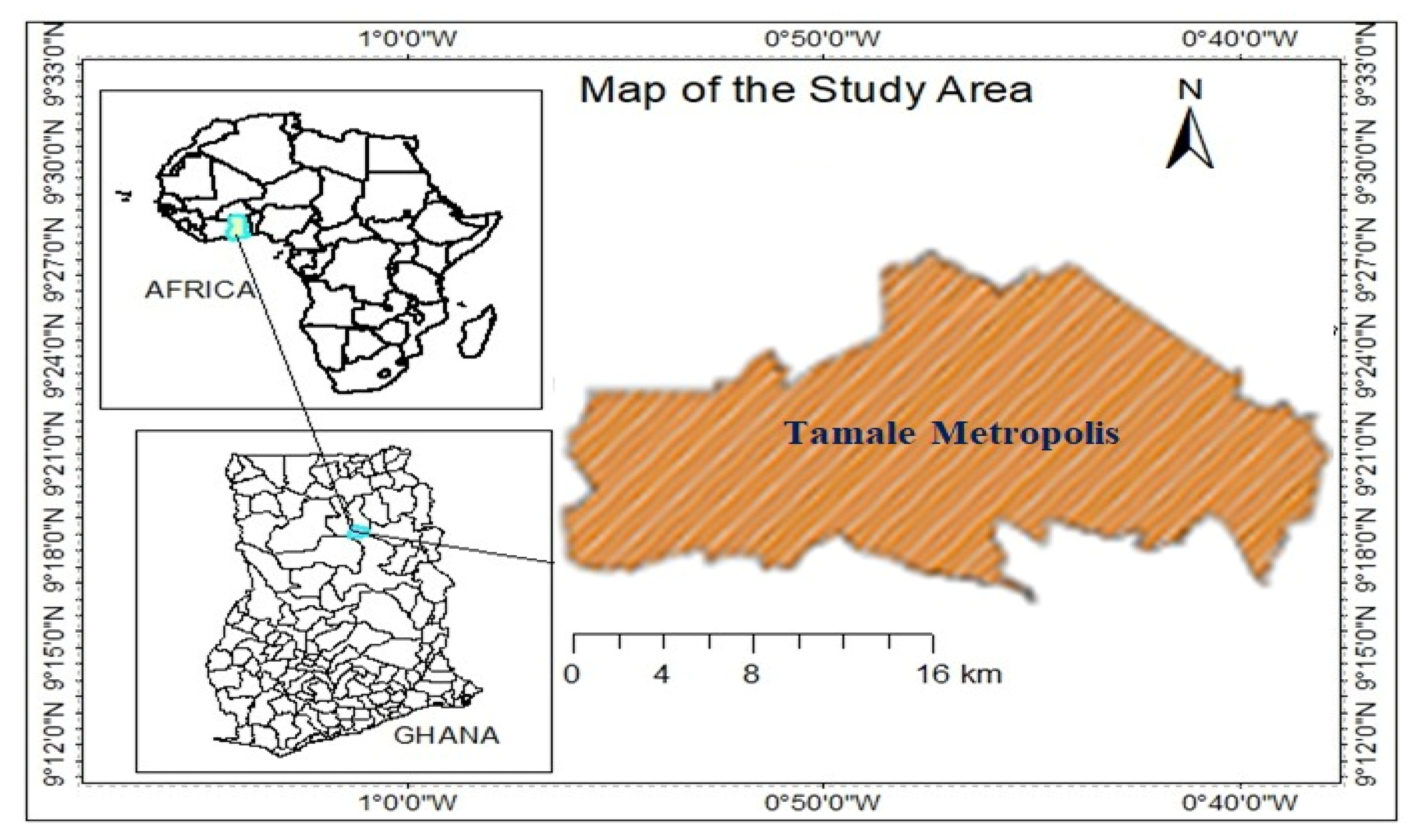
Figure 3.
Barriers, success factors and practical implementation of WtE in the existing system of solid waste management in Tamale.
Figure 3.
Barriers, success factors and practical implementation of WtE in the existing system of solid waste management in Tamale.
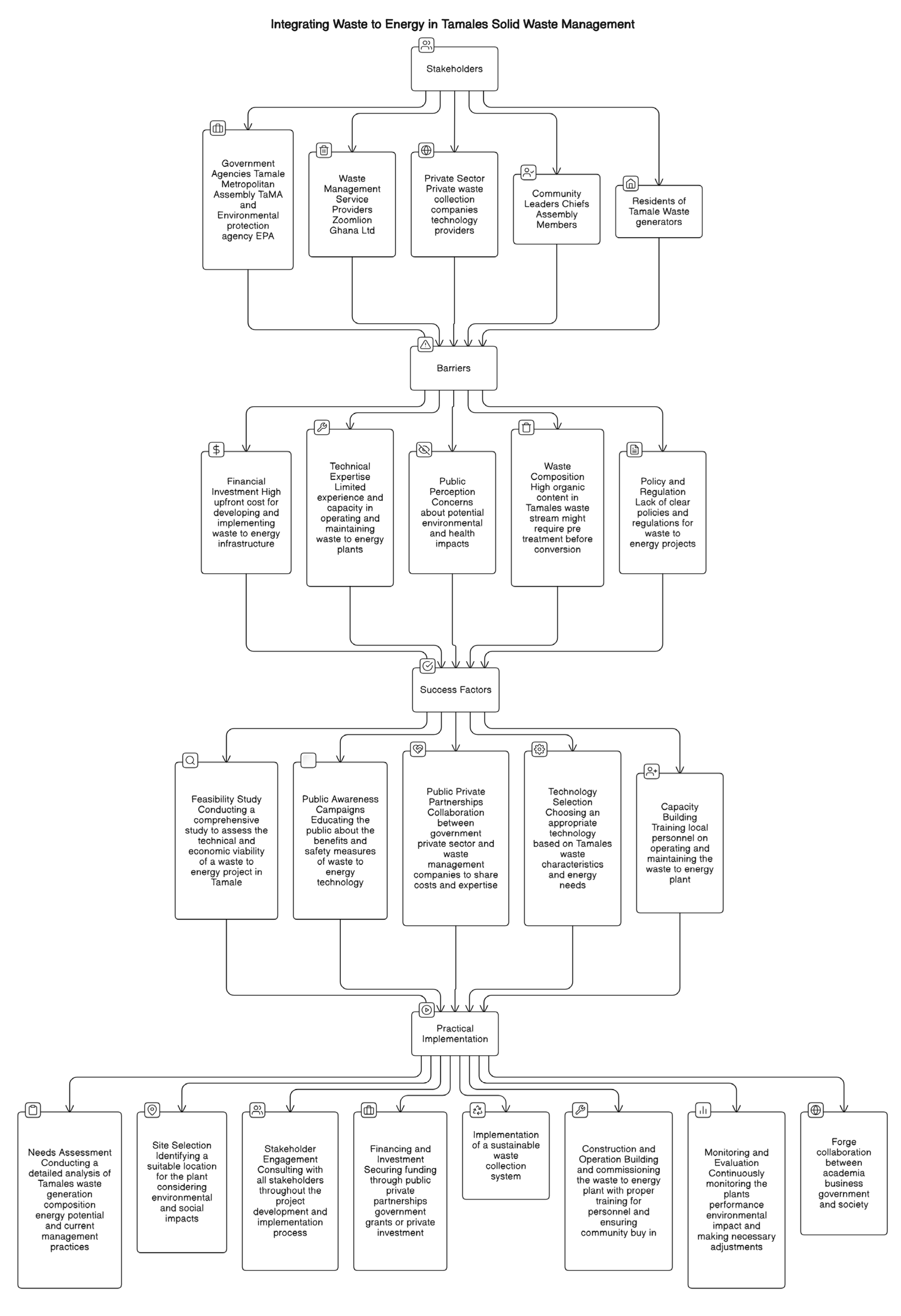
Figure 4.
Roadmap for WtE focused IWMS for Tamale.
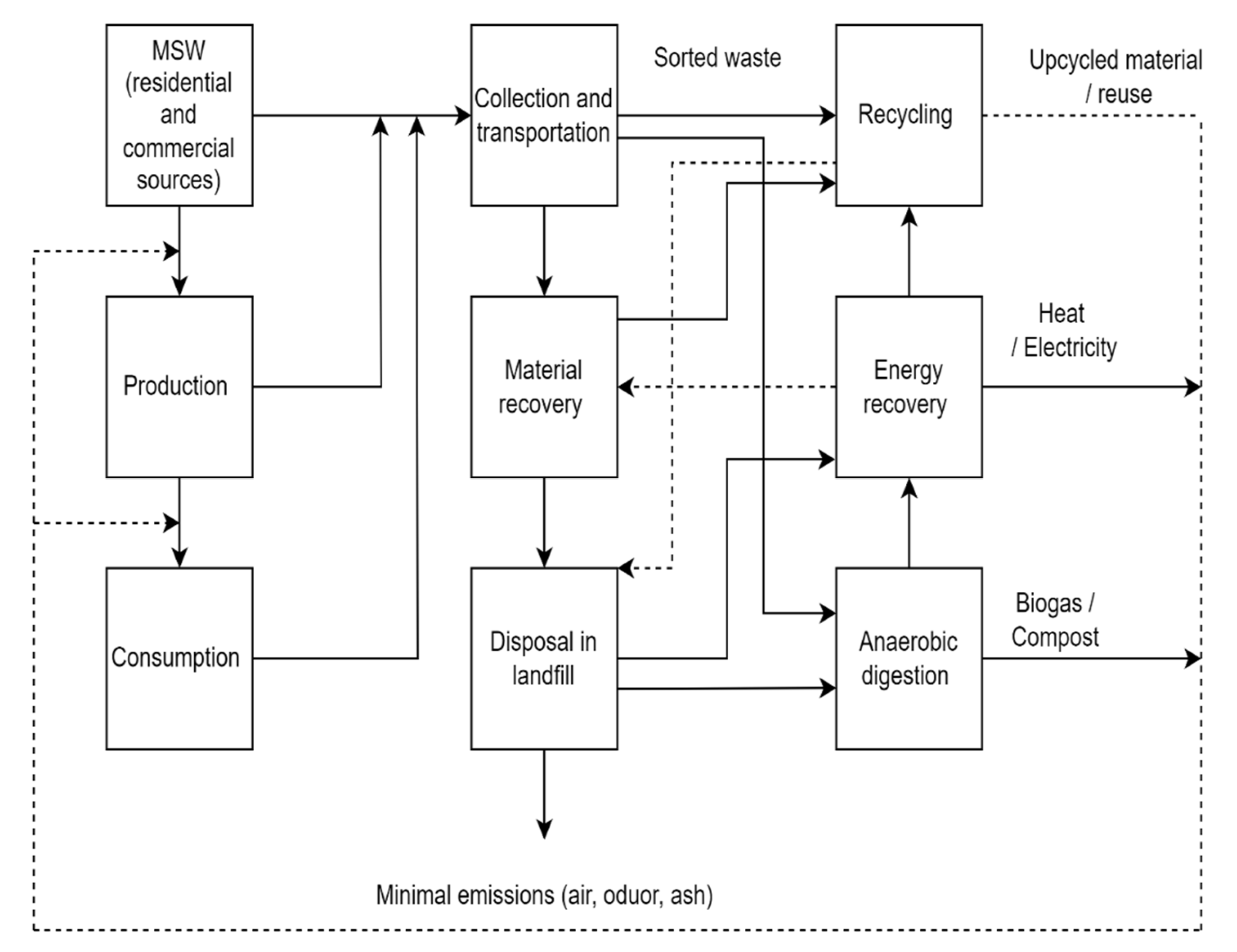

Table 1.
In-depth interviews.
| Group | Number |
|---|---|
| Zoomlion Ghana limited | 2 |
| Tamale Metropolitan Assembly | 3 |
| Community leaders | 2 |
| Environmental Protection Agency | 2 |
| Institute of Local Governance | 1 |
| Total | 10 |
Table 2.
Findings from framework validation.
| Question | Responses | ||
|---|---|---|---|
| EPA | Zoomlion Gh. Ltd. | TaMA | |
| How important are all the elements of waste-to-energy in the framework to effective MSW management? | Crucial. All elements in the framework are essential for a comprehensive MSW management | Highly important. The framework provides a roadmap for integrating WtE seamlessly into existing system | Essential. WtE can address waste challenges, but a holistic approach as this is needed for long-term success. |
| How easy is it to understand the framework? | The framework is well structured and easy to follow. | Easy to understand and focus on key action points. | The framework is straightforward. |
| To what extent will you say this framework is adequate for effective MSW management decision-making? | A well-developed framework. It provides a strong starting point for informed decision-making. | Valuable tool. The framework helps asses the feasibility and optimize WtE integration for Tamale’s specific needs. | The framework offers an innovative approach to effective MSW management. |
| To what extent is this framework logical? | Logical and well organized. The framework builds on a sequential process, ensuring a comprehensive approach | Logical | Makes good sense. Framework aligns with best practices for sustainable waste management. |
| Do the elements suggested in the framework address MSW siege in the metropolis? | The framework, if implemented effectively, can significantly reduce reliance on landfills and promote waste diversion through WtE. | By addressing waste composition and optimizing WtE technology, the framework tackles MSW challenges. | The framework offers a strategic approach to tackling the waste crisis in Tamale. |
| How transferrable is this framework to other jurisdictions with similar challenges as Tamale? | The framework can be adapted to other cities with similar waste composition and development level. However, local context needs to be considered. | We see potential for adaptation of this framework in other cities with similar waste management needs. | The framework can be a valuable blueprint for other cities facing similar waste issues, with necessary adjustments for local specifics. |
| What do you consider as the strengths and weaknesses of the framework? | Strengths: Holistic approach, focus on public engagement, and emphasis on financial sustainability. Weaknesses: None | Strengths: Clear focus on WtE integration. Weakness: Financial projections might need collaboration withrelevant stakeholders. | Strengths: Addresses long-term waste management needs. Weakness: None |
| What can be added to and/or removed from the framework? | Add or remove nothing | Nothing | Remove nothing |
Disclaimer/Publisher’s Note: The statements, opinions and data contained in all publications are solely those of the individual author(s) and contributor(s) and not of MDPI and/or the editor(s). MDPI and/or the editor(s) disclaim responsibility for any injury to people or property resulting from any ideas, methods, instructions or products referred to in the content. |
© 2024 by the authors. Licensee MDPI, Basel, Switzerland. This article is an open access article distributed under the terms and conditions of the Creative Commons Attribution (CC BY) license (http://creativecommons.org/licenses/by/4.0/).
Copyright: This open access article is published under a Creative Commons CC BY 4.0 license, which permit the free download, distribution, and reuse, provided that the author and preprint are cited in any reuse.


