

Submitted:
17 February 2026
Posted:
28 February 2026
You are already at the latest version
Abstract
This is a follow-on review of progress in development and applications of hollow core optical fibers (HCFs) after publication of earlier review in 2023 [1], to be read together with it. Progress after 2023 in several fields is significant. Loss of best HCFs was reduced down to 0.05–0.10 dB/km at 1550 nm [2–6], while lowest loss achieved in single mode fiber with pure silica core is 0.14 dB/km [7]. Polarization mode dispersion (PMD) has been reduced to a level typical for SMFs by means of fiber spinning [8]. In November 2024, Microsoft announced a 2-year plan to install 15,000 km of HCF cables between data centers providing data processing for Microsoft Azure cloud services, and inside these facilities [9,10]. Besides UK-based Microsoft Azure Fiber and two Microsoft subcontractors: Corning Inc. and Heraeus Covantics, two major HFC manufacturers: YOFC and Linfiber emerged in China. Unfortunately, progress in standardization and elimination of loss introduced by contaminants in the fiber was absent. Standardization is blocked by multiple fiber designs being tried, with no clear winner yet. Despite this, hollow core fibers have successfully made large-scale commercial debut in Microsoft Azure data centers.
Keywords:
Hollow Core Fiber (HCF)
; development
; structure
; DNANF
; attenuation
; PMD
; optical fiber amplifier
; production
1. Introduction
Single-mode optical fibers made of solid fused silica with dopants have, following their commercial introduction in NTT network in 1982 and standardization by ITU-T in 1984 [11] gradually became the dominant medium for telecommunication and data transmission networks, mobile backhaul and to a growing extent, data centers, steadily replacing coaxial and twisted-pair cables in the process. Single-mode fibers have also replaced most microwave radio backhaul links to 4G and 5G mobile radio sites. Worldwide consumption of single-mode fibers in 2025 is expected to reach 568 million kilometers according to data published by CRU [12].
Developments and production of telecom fibers in the 1975–2020 period have been essentially limited to fibers made of fused silica, with a single solid core. Fiber’s core and optionally some adjacent areas are doped with germania (SiO2) and optionally fluorine (F2). Fibers of this type are mass produced at low cost, with prices in 2025 down to 3–4 $/km in large contracts in China [13], simple to install and reliable in service.
Developments in the 2010–2025 period brought two fundamentally new classes of telecom/datacom fibers to the threshold of commercial introduction:
- Ø Multi core fibers (MCF) with several (2, 4, 7, 8, etc.) single-mode cores packed into a common cladding with a spacing of approx. 40–45 μm [14];
- Ø Hollow core fibers (HCF) having single empty core filled with gas, and optical barrier made of thin-walled glass structures, usually nested tubes [15] preventing escape of radiation; both this barrier and cladding are made of undoped fused silica.
Single-mode MCFs offer high density of cores and uniform latency of multiple optical paths in the fiber [14], while attenuation, cutoff wavelength, chromatic dispersion, optical nonlinearities, core dimensions and MFD, etc. are identical to single-core single-mode fibers.
Hollow core fibers replace glass with gas (or maybe vacuum in the future) as the medium for light propagation, with dramatic reduction of interaction of guided radiation with glass by a factor of 10,000 to 100,000 a typical NANF (Nested Antiresonant Nodeless Fiber) [1]. Hollow core fiber filled with gas—usually air with contaminants like CO2, hydrocarbons, and water vapor, has fundamentally different optical properties than solid fiber made of fused silica. Many are good: low loss, latency reduced by a factor of 1.46 with respect to solid core fibers, wide and tunable optical bandwidth, negligible nonlinearity, low chromatic dispersion and scattering; some other bad: lack of hermeticity, absorption by contaminants, high PMD, and difficult splicing. A review of these subjects is included in the preceding paper [1], and documents referenced there. As a result, HCFs enable dramatic improvements in performance of core and metro DWDM networks: optical bandwidth, link capacity, elimination of nonlinear effects, increased power budget and repeater spacing. Other improvements include resistance to ionizing radiation and possible remote powering via dielectric optical fiber.
The rest of this paper is devoted to HCFs, specifically the low-loss, low-latency and wideband DNANF fibers developed for telecommunications and data transmission.
In the following parts of this paper, Section 2 gives comparison of latency (or velocity of propagation) in the air, HCF, solid core telecom fibers and twisted pair cables, as low latency is currently the most important advantage of all HCFs.
Section 3 presents progress in reducing HCF attenuation since 2023 and new low-loss fiber designs. In Section 4, some issues in HCF manufacturing are presented, including reduction of PMD by fiber spinning and detrimental impact of gas absorption. Section 5 explains possible role for HCFs in telecom and data networking, once available in quantity, and prospects for standardization, while Section 6 presents optical amplifiers for new transmission bands, incorporating active fibers with new dopants: bismuth (Bi), thulium (Tm), and holmium (Ho). Commercial deployment in Microsoft Azure AI infrastructure is covered in Section 7. Section 8 lists technologies and devices the author deems desirable for making full use of HCFs in future networks. Section 9 is a discussion of findings.
2. Latency in HCF-NANF and Other Transmission Media
Low latency of HCFs is currently their main advantage over all other optical fibers and twisted pair cables used in data centers and networks.
Relative latency of fibers is proportional to the ratio of effective refractive indices of telecom single-mode fibers conforming to ITU-T Recommendation G.652, G.654 or G.657 (neff = 1.46–1.48) or OM3, OM4 or OM5 50/125 μm graded index multimode fibers, covered by TIA-492AAAD and IEC 60793-2-10 standards, used in data centers, servers and LANs (neff = 1.47–1.50), and hollow core fibers (neff = 1.00–1.01). There is a number of latency-related parameters used in the communications industry:
- effective refractive index (neff)—applicable to optical fibers only;
- absolute latency per unit of length, e.g., μs/km;
- velocity of propagation (VP) related to speed of light in vacuum (c);
- absolute velocity of propagation (VP), usually in m/μs.
Typical values are presented in Table 1. Published data on HCF latency are only approximate, and presented as ratio between latencies of HCF and solid-core fused silica fibers: ≈1.46 or latency reduction in HCF link of the same length ≈31%. The lowest latency is achieved in straight-line microwave or optical link, with propagation in the air (in terrestrial systems) or vacuum (in space systems). These technologies were once used in High Speed Trading (HST) networks [1]. However, bit rates and availability of both alternatives are substantially inferior to optical fiber links.
Further meaningful reduction of latency in hollow-core fibers is impossible, even when the filler gas is replaced with vacuum.

Table 1.
Comparison of latency and related parameters in HCF-NANF, other fibers and twisted pair cables used in data centers and telecom networks (typical specifications). Data for air and OM4 fiber and air [16] are for 850 nm wavelength; data for NANF and SMF are for 1550 nm.
Table 1.
Comparison of latency and related parameters in HCF-NANF, other fibers and twisted pair cables used in data centers and telecom networks (typical specifications). Data for air and OM4 fiber and air [16] are for 850 nm wavelength; data for NANF and SMF are for 1550 nm.
| Transmission medium | Air | HCF -NANF |
SMF G.652 |
MMF OM4 |
Cat. 7 FTP1 |
|---|---|---|---|---|---|
| Effective refractive index (neff) | 1.000274 | 1.002 | 1.468 | 1.482 | 2 |
| Velocity of propagation (VP) [c]3,4 | .99972 | .9980 | .6812 | .6748 | .79005 |
| Velocity of propagation (VP) [%c] | 99.972 | 99.80 | 68.12 | 67.48 | 79.00 |
| Absolute VP [m/μs] | 299.71 | 299.19 | 204.22 | 202.29 | 236.84 |
| Absolute unit latency [μs/km] | 3336.7 | 3342.3 | 4896.7 | 4943.4 | 4222.3 |
Notes:
- (1)
- Foiled twisted pair cable: each pair is individually screened with a metal foil.
- (2)
- This term is not used for metallic cables.
- (3)
- Frequently named “Nominal Velocity of Propagation” (NVP), can be given in %c.
- (4)
- c: speed of light in vacuum (299 792 458 m/s).
- (5)
- Manufacturing tolerances for VP in metallic cables are larger than for fibers: ±1–3%.
OM4 multimode fibers and Cat. 7 twisted pair cables are latest generations of such products in mass use. NVP of older Cat. 5e and Cat. 6 UTP twisted pair cables is lower: 0.59–0.70 because of a solid rather than foamed dielectric. NVP of a coaxial cable whose dielectric is made substantially of gas pockets can exceed 0.90. Because of dispersive properties of solid dielectric like LDPE, parameters given above are wavelength/frequency-dependent; this effect is very weak in gas and small in HCF [1].
One must realize that actual length of fiber in outdoor link is approx. 3–10% larger than cable route length due to:
- fiber overlength in the cable (0.15–4%);
- extra lengths of cable due to sag and vertical lengths fixed to poles or pylons (3-6%) in aerial networks;
- spare lengths of cables adjacent to joint closures (1–2%), etc.
Even larger differences often exist between straight line distance and route length, as available routes are restricted by obstructions (rivers, mountains, etc.) and use of existing infrastructure, e.g., cable ducts, and rights-of-way. The same problem exists inside data centers. Careful design of cable route and method of installation, avoiding aerial links and long spare lengths can substantially reduce fiber length and latency.
3. Reduction of HCF Attenuation and New Fiber Designs
Low loss of hollow core fibers is especially important in networks spanning large areas, with numerous nodes separated by large distances. Such a network has fewer nodes with active equipment needing buildings or containers and electric power, resulting in considerable savings on construction and operation costs (CAPEX, OPEX).
When the previous review paper [1] was written, the lowest loss of 5-tube NANF was 0.174 dB/km [17]—comparable to lowest loss conventional fibers with pure silica core (0.144–0.18 dB/km) covered by ITU-T Recommendation G.654 [18]. Data of such fibers can be found in Refs. [19,20,21,22,23]. The lowest specified attenuation of commercially available fiber at 1550 nm was (and still is) 0.144 dB/km in a G.654.D fiber Sumitomo Z-PLUS Fiber 150 for transoceanic networks [23]. The lowest attenuation achieved in the lab at Sumitomo in 2025 was 0.1397 dB/km at 1566 nm and 0.1406 dB/km at 1550 nm [24]. The fiber was similar to Z-PLUS Fiber 150, with large mode area (MFD = 13.3 μm, Aeff = 147 μm2); both core and inner cladding were doped exclusively with fluorine in different concentrations. The potential for further progress in reducing loss of solid core fibers is very limited, but even the 0.002 dB/km reduction with respect to previous record fiber made at the same company in 2017 [25] can decrease cost of transoceanic link due to reduction of number of submerged repeaters by approx. 2%.
3.1. Ultra Low-Loss DNANF Fibers for Operation at 1550 nm: 2024
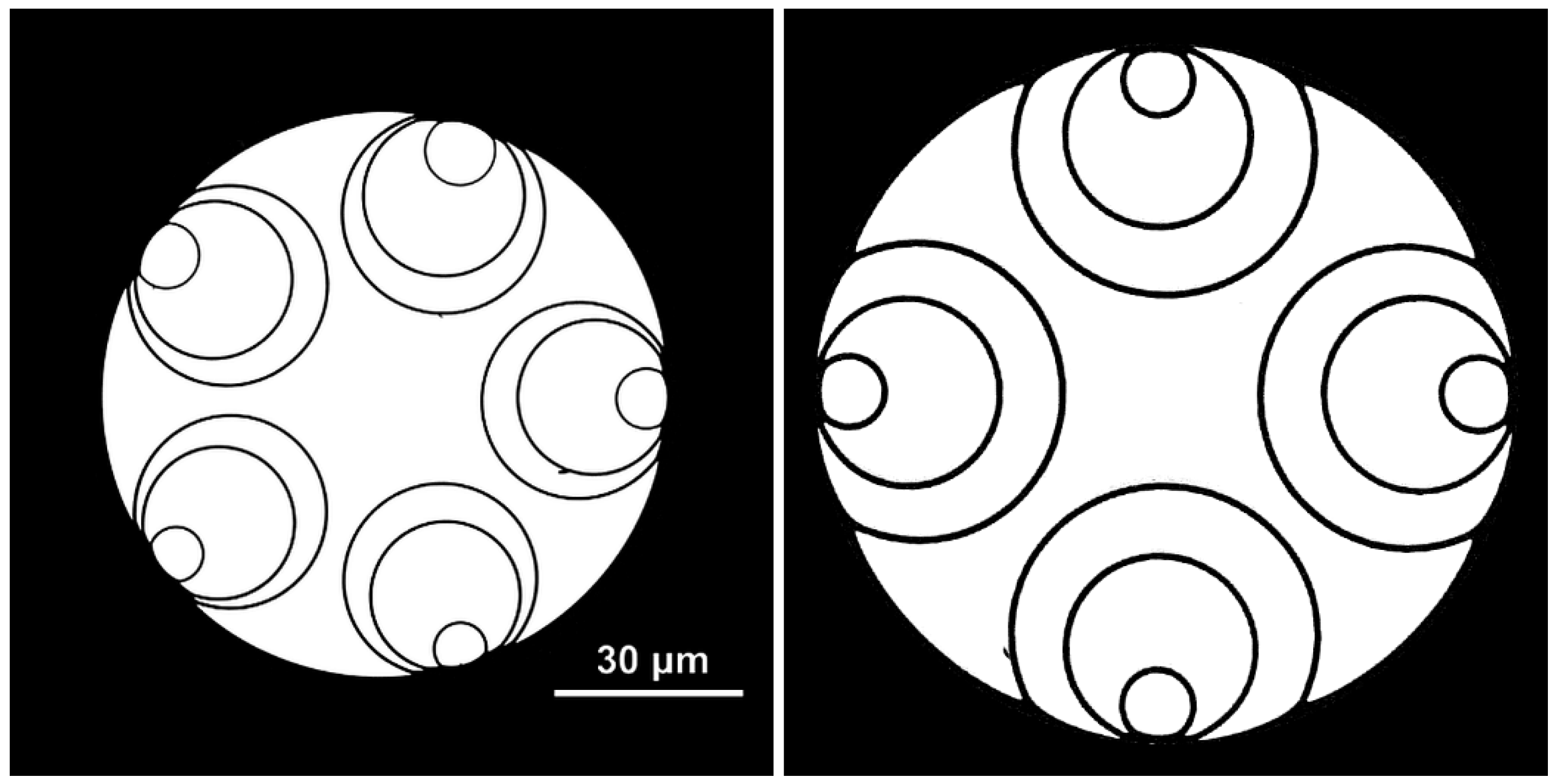
Hollow core fibers of DNANF type exhibiting very low attenuation were developed: one with 5 truncated nested tubes (5T-DNANF) at University of Southampton and Microsoft Azure Fiber in the UK [4,5] and one with 4 truncated nested tubes (4T-DNANF) at Jinan University and Linfiber Technology in China [6], both in 2024. While attenuation was similar, several details were different, as shown in Table 2 and Figure 1. One difference are thicker walls (membranes) of nested tubes in the Chinese fiber ≈ 1.1 μm vs ≈ 0.5 μm [4,26] because this fiber is designed to operate in the second NANF transmission window [1] (pp. 11–12). This feature reduces low-loss bandwidth, but simplifies preform production.
Table 2.
Comparison of record low loss DNANF fibers developed in the UK [4,5] (fiber HCF2) and in China [6] (fiber #1).
| Place of Development | U. of Southampton & Microsoft Azure Fiber |
U. of Jinan & Linfiber Technology |
|---|---|---|
| Fiber design | 5T-DNANF | 4T-DNANF |
| Length of fiber [km] | 15.0 | 4.2 |
| Angle of truncation [º]4 | ≈100 | ≈120 |
| Transmission window | first | second |
| Effective refractive index (neff) | (no data) | 1.001 |
| Attenuation at 1550 nm [dB/km]1 | 0.091 ± 0.10 | 0.10 ± 0.02 |
| Low loss band(s) [nm]2 | 1292–1716, 1292–1347 | ≈ 1504–16543 |
| Attenuation at 1320 nm [dB/km] | 0.122 | (no data) |
| Low loss bandwidth [THz] | 54.3 + 9.5 | 18.1 |
| CD at 1550 nm [ps/nm*km] | 3.2 (simulated) | 3 (measured) |
| HOMER | (no data) | 4300 |
| PMD [ps/√km] | 0.10 | (no data) |
| Main absorption bands [nm] | 1340–1450, 1720–1850 | 1570–1585, 1600–16203 |
| Core diameter [μm] | 29.4 | 30.6 |
| MSD [μm]4 | 92 | 114 |
| Cladding (jacket) diameter [μm] | (no data) | 240 |
Notes:
(1) Differences between multiple loss measurements were quite large.
(6) Attenuation ≤0.14 dB/km; gas absorption peaks excluded.
(7) Measurements performed only between 1565 nm and 1620 nm.
(8) Dimension estimated from fiber photographs.
Spectral loss of the British fiber is shown in Figure 9 in Section 4.2.
The higher-order mode extinction ratio (HOMER) is the ratio of attenuation for fundamental mode (FM) and dominant higher order mode (HOM) in a given fiber. Higher HOMER means superior modal purity of transmitted signal, important in Fiber Optic Gyroscopes (FOGs) and polarization-based measurement systems, but much less so in telecom networks and data centers.
Figure 1.
Structures of lowest-loss HCFs in 2024: 5T-DNANF (left) and 4T-DNANF (right) shown at the same scale. Glass is shown black and air white. Outer part of fiber jacket not shown.
Figure 1.
Structures of lowest-loss HCFs in 2024: 5T-DNANF (left) and 4T-DNANF (right) shown at the same scale. Glass is shown black and air white. Outer part of fiber jacket not shown.
3.2. Truncated Nested Tubes
Record low-loss HCFs shared a new feature: nested tubes “truncated” on the side of jacket tube (Figure 1, Figure 2 and Figure 5). This solution was proposed by researchers from Jinan University, Guangdong, China in 2024 [26]. Truncation was already present in early low-loss 5T-DNANFs [15] (Figure 2). It is a byproduct of heating and softening of preform to draw a fiber. The novelty is in employing this phenomenon, at controlled magnitude, for reduction of fiber microstructure diameter (MSD) and cladding (jacket) diameter. Truncation of nested tubes away from fiber core has only limited influence on confinement loss of the fiber, as most of radiation propagating in the fiber is reflected back by walls (membranes) closest to the core [26].
Figure 2.
Structure of the first low-loss DNANF reported by Jasion et al. in 2022 [17]. Estimated truncation angle of nested tubes: 65º.
Figure 2.
Structure of the first low-loss DNANF reported by Jasion et al. in 2022 [17]. Estimated truncation angle of nested tubes: 65º.
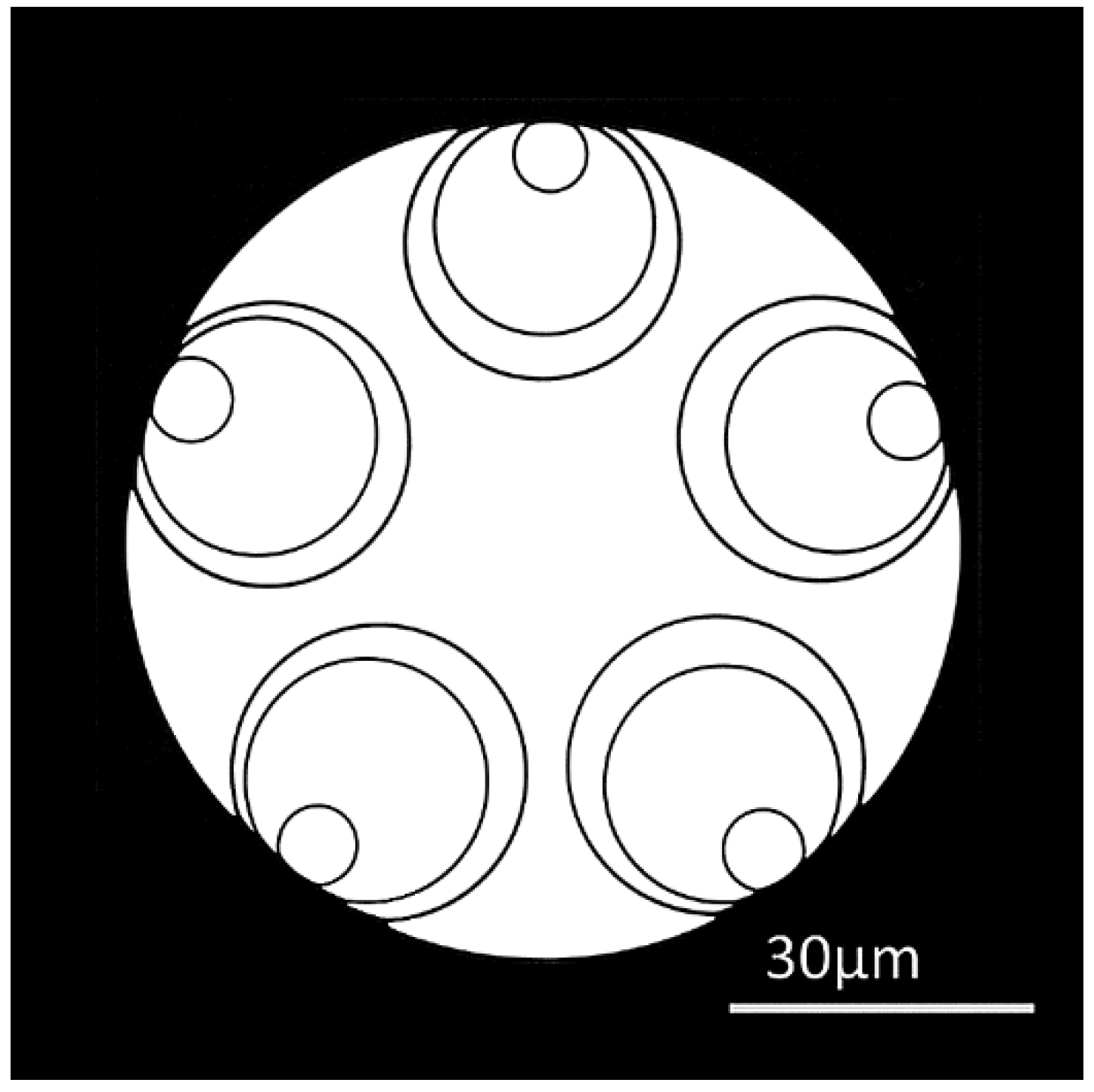
Truncation is measured in degrees, indicating part of total circumference of nested tube (360°) sunk into the cladding tube; typical values in ultra-low-loss DNANFs are in the 70–130° range. Further truncation is detrimental, increasing confinement loss [24].
3.3. Ultra Low-Loss DNANF Fibers for Operation at 1550 nm: 2025
At the ECOC-2025 conference, two groups from China reported making DNANFs with attenuation at 1550 nm close to 0.05 dB/km [2,3]. Technical data of fibers are presented in Table 3, and their structures in Figure 3.
Structure of fiber developed at Linfiber [2] incorporated small interstitial tubes located between the nested tubes (Figure 3 right). This modification ensures effective blocking of light escape even with large gaps between nested tubes, up to 13 μm. A gap much larger than in typical DNANF (3-5 μm) prevents contact of tubes despite local expansion of them during drawing. Larger drawdown ratio without risk of preform destruction is possible, opening the way to faster production of fiber from larger preforms. Linfiber researchers made a preform equivalent to 100 km of 240 μm glass diameter IT-4DNANF, from which 83 km of low-loss (0.076 dB/km at 1550 nm) fiber was drawn.
Table 3.
Comparison of lowest loss HCFs developed in China at Linfiber [2] (fiber IT-4DNANF-B) and Yangtze Optical Fiber and Cable (YOFC) [3].
| Place of Development | Univ. of Jinan & Linfiber Technology |
YOFC & Optics Valley Laboratory |
|---|---|---|
| Fiber design | IT-4DNANF | ST-HCF |
| Length of fiber [km] | 40 | 9.1 |
| Angle of truncation [º]3 | ≈70 | none |
| Transmission window | second | second |
| Attenuation at 1550 nm [dB/km] | 0.052 ± 0.004 | 0.050 ± 0.01 |
| Attenuation at 1590 nm [dB/km] | 0.050 ± 0.004 | ≈ 0.050 |
| Low loss band [nm]1 | ≈ 1450–16502 | 1450-1660 |
| Low loss bandwidth [THz] | ≥ 25 | 26 |
| CD at 1550 nm [ps/nm*km] | ≤ 5 | no data |
| PMD [ps/√km] | ≤ 0.20 | no data |
| Core diameter [μm] | 38 | 30 |
| MSD [μm]3 | 133 | 943 |
| Cladding (jacket) diameter [μm] | 260 | no data |
Notes:
- (1)
- Attenuation ≤0.14 dB/km; gas absorption peaks excluded.
- (2)
- Measured from 1450 nm to 1650 nm. Actual band is wider at long wavelengths.
- (3)
- Dimension estimated from fiber photographs.
Figure 3.
Structures of 0.05 dB/km fibers reported in 2025: ST-HCF made by YOFC (left) and IT-4DNANF-B made by Linfiber (right). Note: scale is different.
Figure 3.
Structures of 0.05 dB/km fibers reported in 2025: ST-HCF made by YOFC (left) and IT-4DNANF-B made by Linfiber (right). Note: scale is different.
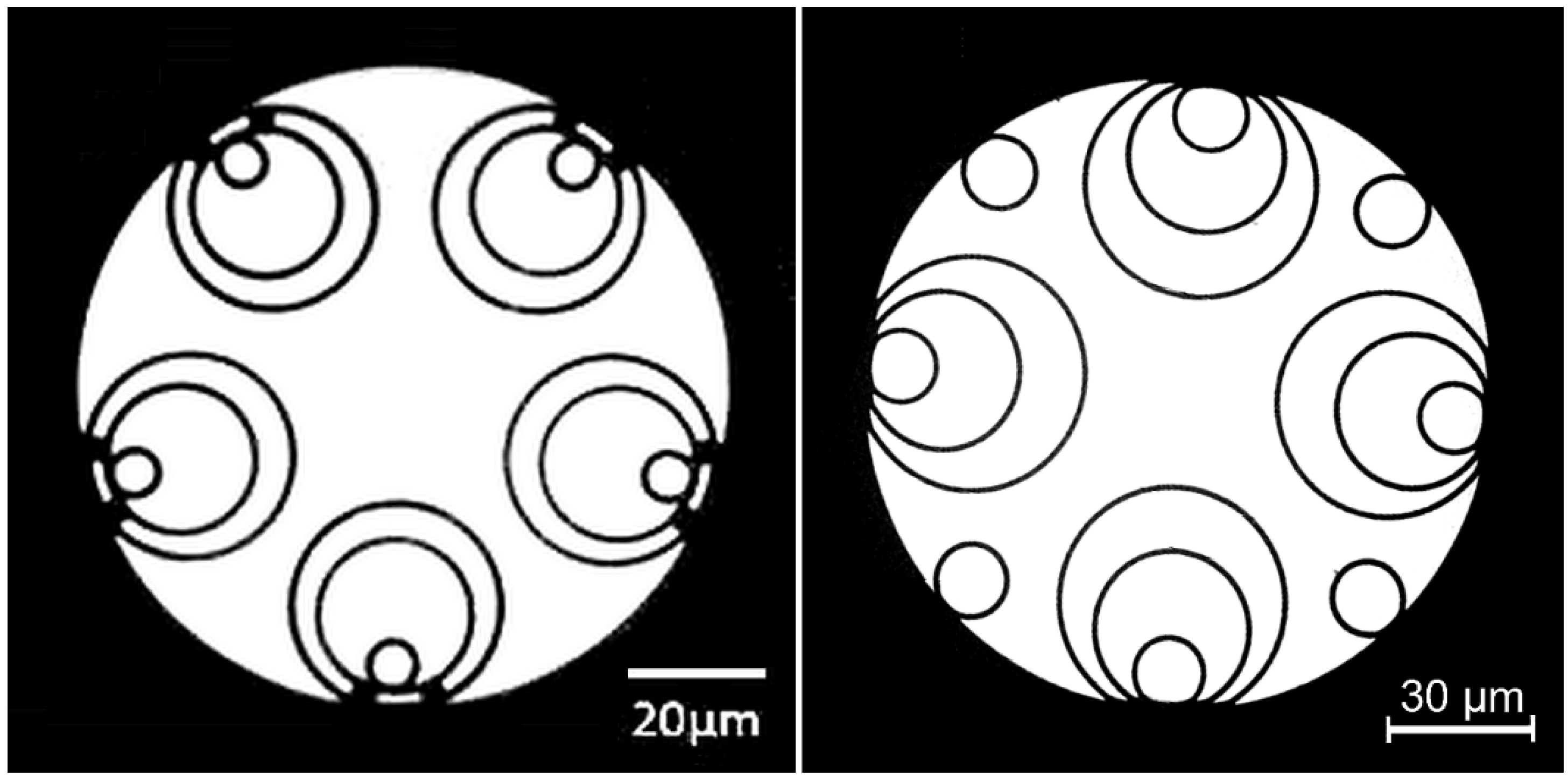
YOFC fiber [3] had no truncation, but included a pair of thick glass support for each set of 5 doubly nested tubes, separated by a small gap from the jacket tube. Gaps between nested tubes were small: 4.5 μm. YOFC published statistical distribution of attenuation in a 733 km batch of ST-HCF fiber, with average value of 0.147 dB/km.
3.4. History of Loss Reduction in NANF/DNANF Fibers
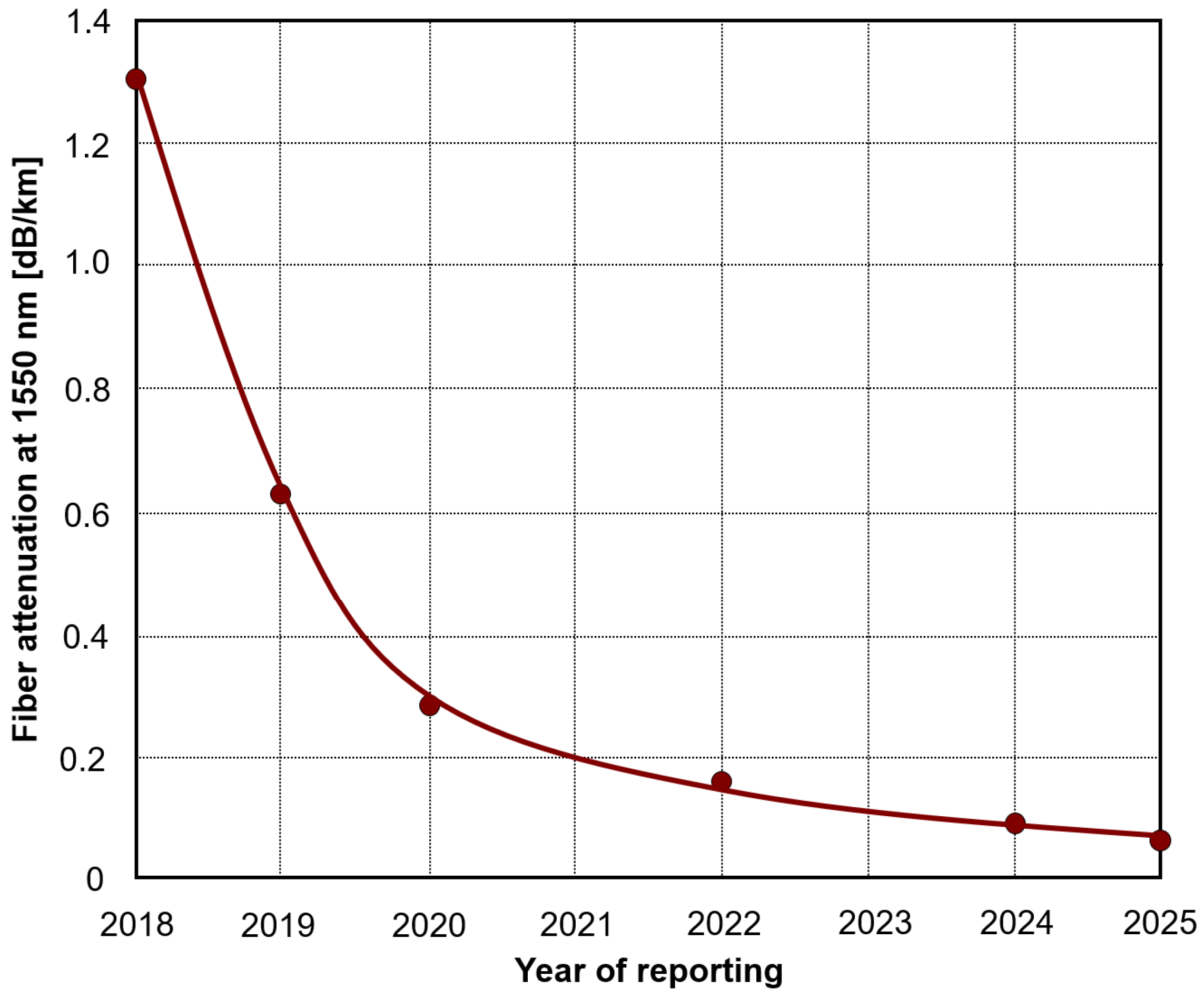
A 15-fold reduction of attenuation of lowest-loss NANF and later DNANF fibers at 1550 nm wavelength (for which low-loss designs are usually optimized) took place between 2018 and 2024, as shown in Table 4 and Figure 4. Before 2018, the lowest loss in HCF was achieved in a HC-PBGF fiber: 1.7 dB/km.
Table 4.
Record low loss NANF and DNANF fibers reported since 2018.
| Year of publication |
Ref. | Loss @ 1550 nm [dB/km] |
Fiber design |
|---|---|---|---|
| 2018 | [27] | 1.30 | 6-NANF |
| 2019 | [28] | 0.63 | 6-NANF |
| 2020 | [29] | 0.28 | 6-NANF |
| 2022 | [17] | 0.174 | 5T-DNANF |
| 2024 | [4] | 0.09 | 5T-DNANF |
| 2025 | [2] | 0.052 | IT-4DNANF |
| 2025 | [3] | 0.050 | ST-HCF |
Note: The 2018 non-optimized fiber exhibited lowest loss at 1450 nm.
Figure 4.
Fall of record-low attenuation of NANF/DNANF fibers with time.
3.5. Compact TNANF Fibers for Use at 1550 nm
While progress in developing low-loss DNANF variants is impressive (Figure 4), approaching theoretical predictions for this class of fibers (Figure 6), there remains a problem of large cladding diameter, about twice the diameter of telecom type SMF or MMF: 200-260 μm vs. 125 μm. This has several undesirable consequences:
- decreased fiber density in a cable, up to 4x;
- incompatibility with current fiber connectors (larger hole required), hardware (larger bending diameter of fiber) and tools (e.g., nonstandard fiber adapters);
- limitations in tight cable bending, e.g., in data centers;
- delayed standardization of HCFs until (hopefully) a 125 μm version appears.
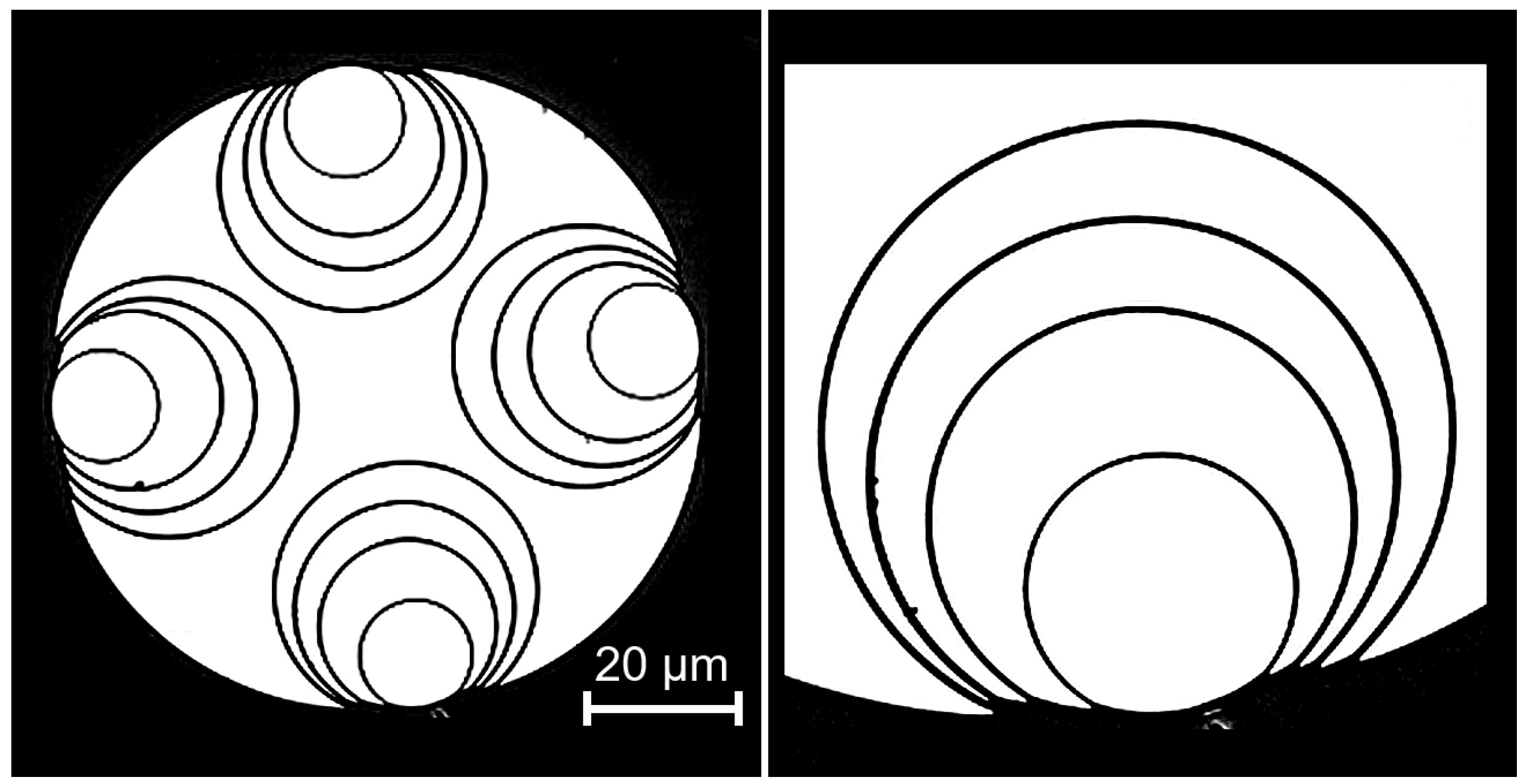
Progress in this respect was made in 2025 at Microsoft Azure Fiber, where a compact 5T-TNANF (5 Tube Triple-Nested Antiresonant Nodeless Fiber) for the 1550 nm band was developed [30]. The key is reduction of core diameter to 15 μm from 28–40 μm in other designs (Table 2 and Table 3), and mode field diameter (MFD) to ≈10.5 μm as in SMF. To avoid large rise of confinement loss, one more tube was added in each nested set (Figure 5). 5T-TNANF has larger loss than SMF and new DNANFs presented in Section 3.2, Section 3.3 and Section 3.4, but low enough for most uses except for long-distance and undersea networks.
This change allowed to make two compact fibers (Table 5):
- SMF-compatible HCF with 125 μm cladding and 250 μm coating diameter;
- similar fiber with 20 μm core and 145 μm cladding, but lower loss.
Table 5.
Data of compact, medium loss 5T-TNANF fibers developed in the UK [29].
Table 5.
Data of compact, medium loss 5T-TNANF fibers developed in the UK [29].
| Place of development | Microsoft Azure Fiber, UK |
Microsoft Azure Fiber, UK |
|---|---|---|
| Fiber design | 5T-TNANF | 5T-TNANF |
| Sample designation | TNANF A | TNANF B |
| Angle of truncation [º]1 | (no data) | ≈100 |
| Transmission window | first | first |
| Attenuation at 1550 nm [dB/km] | 0.54 | 0.25 |
| Low loss band(s) with 1:2 ratio [nm]2 | 1480–1700, 1290–1330 | 1440-1700 |
| Lowest attenuation [dB/km] | 0.40 ± 0.02 (1660 nm) | 0.25 (1500–1550 nm) |
| HOMER | 190 | 380 |
| Absorption bands [nm] | 1340–1490 nm | 1340–1500 nm |
| Core diameter [μm] | 14.8 | 20.2 |
| MSD [μm]1 | (no data) | 88 |
| Cladding diameter [μm] | 125 | 145 |
| Coating diameter [μm] | 250 | 250 |
- (1)
- Dimension estimated from photograph of the fiber.
- (2)
- Loss characterization performed up to 1700 nm, low-loss band extends farther.
Figure 5.
Structure of 5-TNANF fiber, probably TNANF B [30]. Right: a triple nested tube.
Figure 5.
Structure of 5-TNANF fiber, probably TNANF B [30]. Right: a triple nested tube.
Thanks to effective light confinement, TNANF A has extremely low macrobending loss at 1550 nm, smaller that required for the “bending-insensitive” ITU-T G.657.B3 fiber. Bending performance of TNANF B is comparable ITU-T G.652.D SMF.
3.6. Ultra Low-Loss DNANF Fibers for Operation at 850 nm
The team from Microsoft Azure Fiber designed also a single-mode low-loss 5T-DNANF for operation in the 850 nm band in 2024 [31]. This band is now used for data transmission at short distances (≤1 km) over OM2, OM3, OM4, or OM5 50/125 μm multimode graded index fibers. New fiber is similar to one shown in Figure 1 and Figure 2, but with size of its parts scaled down. Main parameters are presented in Table 6.
Table 6.
Data of low-loss 4T DNANF for operation at 850 nm fibers developed in the UK [31].
Table 6.
Data of low-loss 4T DNANF for operation at 850 nm fibers developed in the UK [31].
| Place of development | Microsoft Azure Fiber, UK |
|---|---|
| Fiber design | 5T-DNANF |
| Length of fiber [km] | 10.9 |
| Angle of truncation [º]* | ≈80 |
| Transmission window | first |
| Attenuation at 850 nm [dB/km] | 0.33 |
| Low loss band (≤ 0.5 dB/km) [nm] | 803–897 |
| Lowest attenuation [dB/km] | 0.30 ± 0.02 at 860 nm |
| Low loss bandwidth [THz] | 39.2 |
| CD at 850 nm [ps/nm*km] | 2.3 (simulated) |
| Absorption bands [nm] | None (770–900 nm) |
| Core diameter [μm]* | 24.5 |
| MSD [μm]1 | 81 |
* Dimension estimated from photograph of the fiber.
This shortwave 5T-DNANF is a quantum leap in transmission performance. Attenuation of 0.30–0.33 dB/km and CD of 2.3 ps/nm*km are typical for solid core SMFs at 1310 nm, while multimode fibers exhibit loss of 2.2–2.5 dB/km and chromatic dispersion around –100 ps/nm*km at 850 nm, accompanied by modal dispersion.
3.7. Estimates of Lowest HCF Loss
Theoretical studies on loss optimization of NANF and DNANF fibers with conventional nested tubes having circular cross-sections (thus and ensuring simple preform manufacturing), published until 2023 [32] indicated that practically achievable attenuation including all components was about 0.05 dB/km. 2024 conference paper [5] on record-low-loss DNANF (Section 3.1) included also estimate of achievable loss of DNANF of current design with circular nested tubes, with minimum of 0.04 dB/km at 2000 nm.
The lowest attenuation of DNANF fibers reported by a number of teams in 2024–2025 was in the 0.05–0.11 dB/km range, taking into account considerable margin of loss measurement error, unless reasonably uniform fiber samples with length of 40 km or more are manufactured [2]. However, the classic DNANF can be greatly improved by eliminating impurities and widening low-loss bandwidth (Section 4.2).
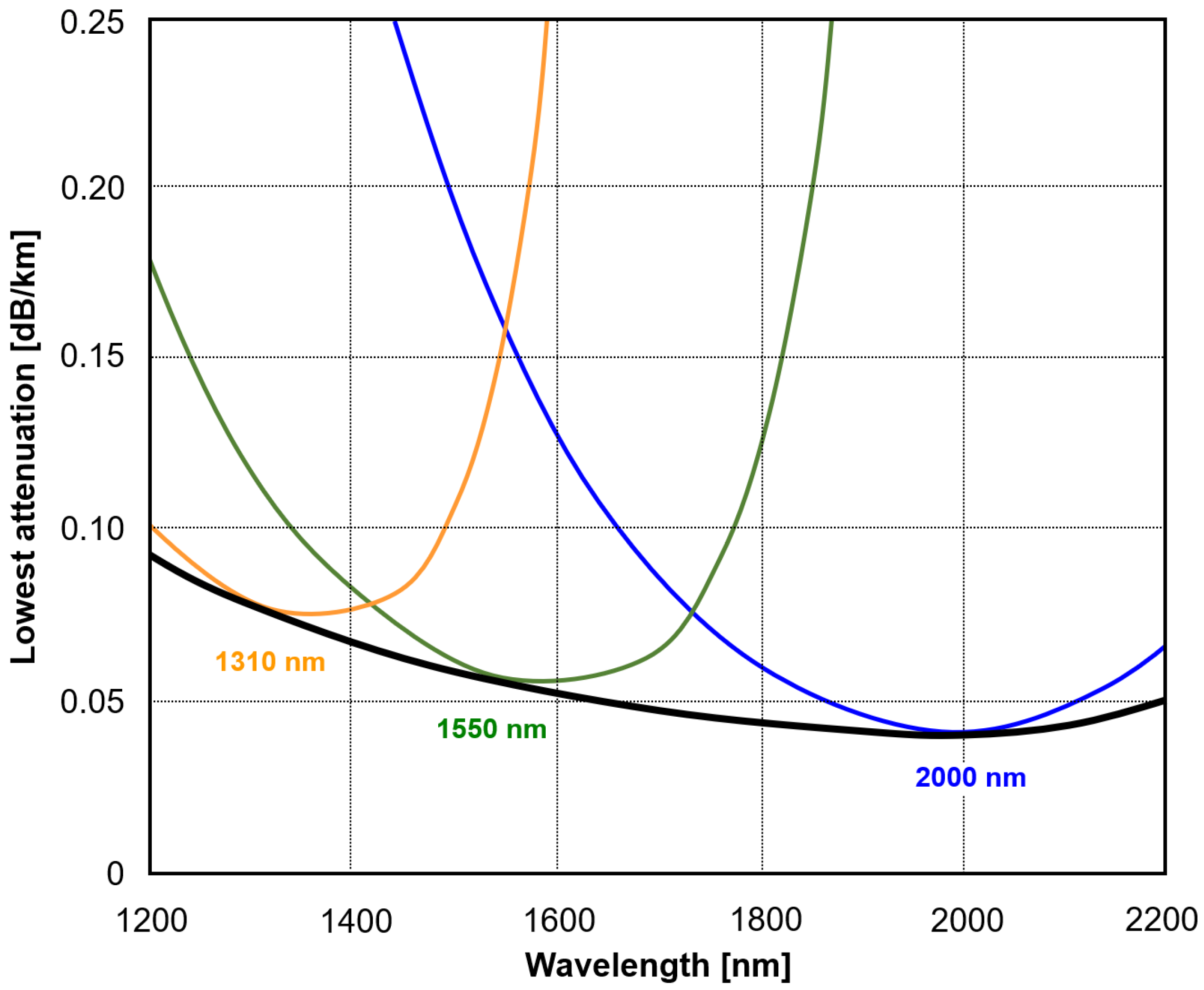
While NANF/DNAF fibers with low loss at multiple wavelengths from 600 nm to 2000 nm were demonstrated, the lowest loss is achieved only around wavelength for which the fiber is designed. This range is widest when fiber operates in the first transmission window. For 5T-DNANF fibers of this type, the low-loss band limited by 2-fold increase of the lowest loss is 500–600 nm [4]. At the edges of low-loss band, loss rises fast (Figure 6).
Figure 6.
Loss spectra of 5-tube DNANF fibers optimized for several wavelengths. Graph based on data from paper [4]. The black line shows loss achievable (in theory) in a fiber designed for a given wavelength.
Figure 6.
Loss spectra of 5-tube DNANF fibers optimized for several wavelengths. Graph based on data from paper [4]. The black line shows loss achievable (in theory) in a fiber designed for a given wavelength.
A solution being subject of several studies (so far simulations only) is to modify the geometry of nested tubes and reduce “permeability” of anti-resonant structure by:
- a)
- Insertion of additional membrane(s) within or close to nested tubes: new parts increase reflection in the transmission band and reduce confinement loss (CL) of the fiber. Unfortunately, most such structures are complicated to make and require tight dimensional tolerances to be effective.
- b)
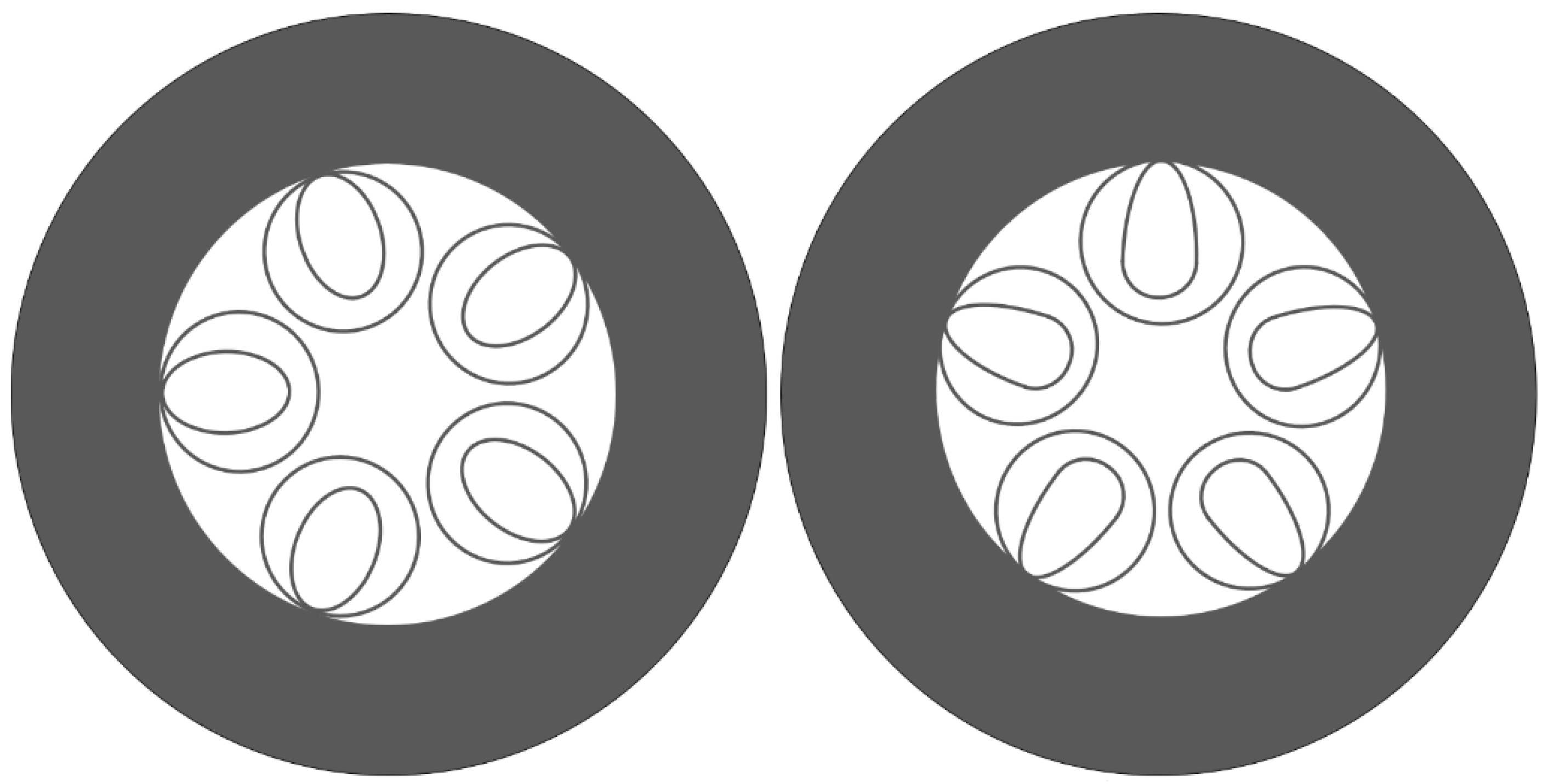
- Changing the cross-section of nested tubes (or only one of them) to elliptical or waterdrop-like for reduced interaction of light with jacket tube. This design shall be fairly simple to implement by blowing fused silica tubes of standardized non-circular shape, and assembling the preform using stack-and-draw method.
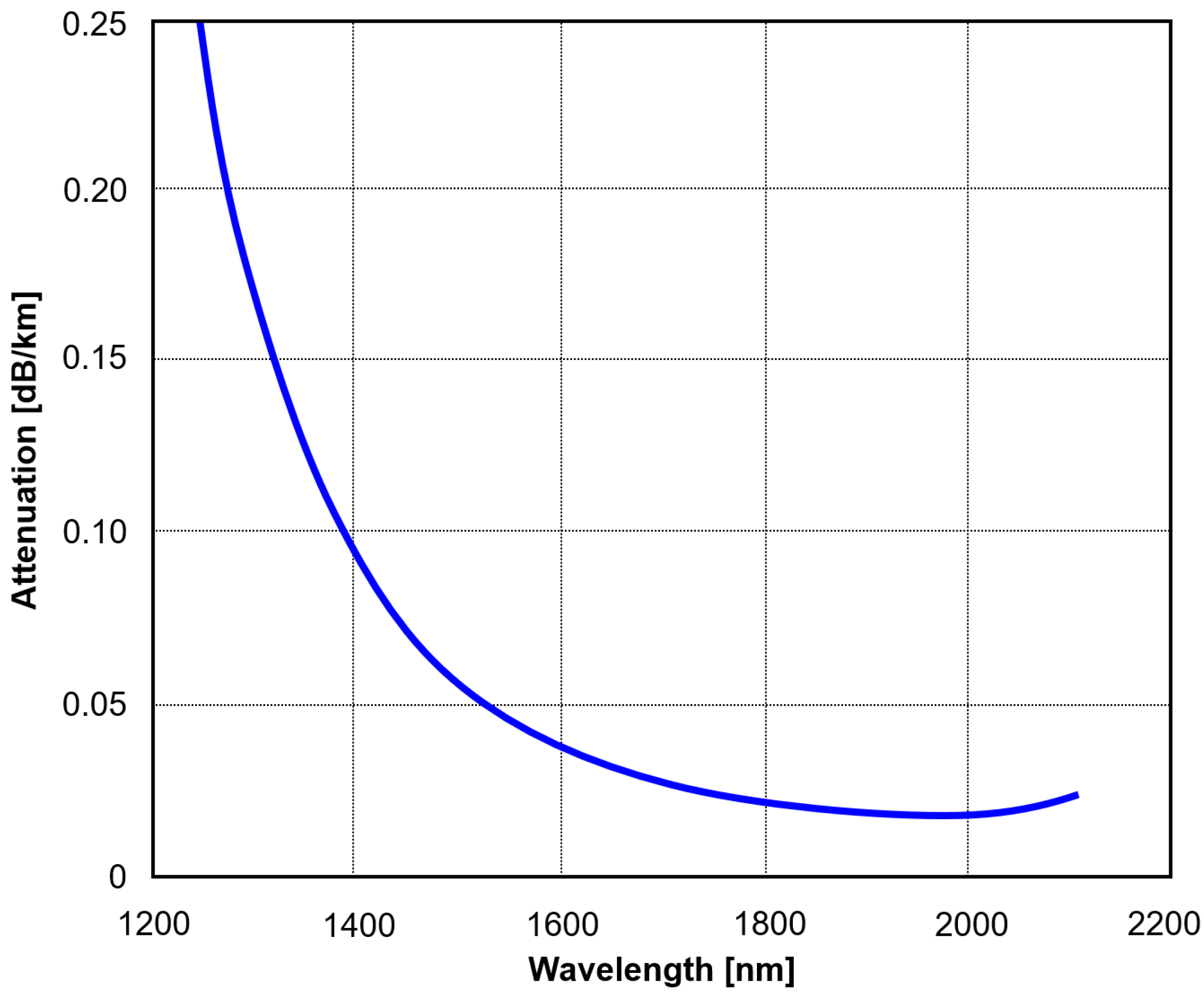
Design (b) is not a new idea; one study by Shaha et al. [33] indicating reduction of confinement loss to ≈ 0.001 dB/km [1] (p. 15) was published in 2021. More recent study by Zhang et. al. [34] proposed nested tubes including one of waterdrop-like shape; the best CL over a wide spectral range was obtained with wider part of nested tube oriented towards the hollow core in fiber named there NWANF1#, having relatively large core diameter of 40 μm. Opposite orientation of nested tubes reduced low-loss band (CL ≤ 0.005 dB/km) of 5–DNANF by almost 50%, from 1200–2100 nm (107 THz) to 1200–1650 nm (68 THz). While the wavelength of lowest attenuation of the first fiber was ≈1970 nm, close to predicted in [5] for conventional DNANF, this attenuation was reduced to 0.021 dB/km. This is 40% of attenuation in best current HCFs (Section 3.3).
Structures of such loss-optimized DNANFs including non-circular tubes are shown in Figure 7. Exact shapes and dimensions are not fixed as prototype fibers were not reported. Predicted minimum loss spectrum of “waterdrop” 5T-DNANF designed for first order transmission, free of geometry imperfections and absorption by contaminants is shown in Figure 8. The bandwidth limited by 1:2 loss variation is about 600 nm.
The prospect of lower loss shall entice researchers to try similar designs, although elongated tubes increase MSD and are distorted (rounded) when heated and softened.
Figure 7.
Proposed DNANF structures with theoretical potential of achieving ultra-low confinement loss in order of 0.001 dB/km. Left: Shaha et al. [33]. Right: Zhang et al. [34].
4. Fiber Manufacturing
4.1. General
The stack-and-draw method remains dominant, with pure fused silica as the default material for all parts of fiber. In need to increase production rates and decrease fiber loss, manufacturers have to improve control of shape of fiber parts and multiple dimensions, in particular diameters of 13–21 tubes, and truncation angles.
For comparison, during drawing of all solid core fibers, the only diameter requiring precise control is cladding diameter, accompanied by spin pattern in some single-mode fibers for PMD reduction and stabilization. The latter solution has been successfully applied to HC-PBGF fibers in 2021 [35] and to NANF fibers in 2025 [8]. However, opposite to SMF, the PMD of hollow core fiber cannot be reduced by twisting of cold fiber, as it lacks a glass core which can be subjected to circular strain [36] (pp. 211–212).
Increase of HCF manufacturing rate requires larger preforms and drawing speeds (also during preform assembly). Progress in this respect will certainly follow patterns from manufacturing of solid-core fibers, where preforms 4 m long, production runs of 4000 km from a single preform, and drawing speeds up to 20 m/s are the norm.
New structure of fiber with small interstitial tubes presented by Linfiber [2](Section 3.3) allowing to draw 100 km long fibers from larger preforms is a step in this direction.
Efficient HCF manufacturing with good yield requires multi-dimensional monitoring and closed-loop adjustment of tube dimensions, effected primarily by varying pressure of gas fed independently to sets of all tubes of each size via glass manifold attached to preform, furnace temperature and drawing tension. Systems of this kind are usually a closely guarded company secret. The most detailed descriptions of drawing process known to the author were published in 2019 [37].
4.2. Absorption by Contaminants in the Fiber
There is a serious problem, particularly with HCFs intended for coherent DWDM transmission systems: multiple gas and vapor absorption bands, of which the strongest one correspond to water vapor; water deposited on surfaces of fused silica reacts with it, producing silanol (SiOH) strongly absorbing light at 1364 nm. Non-polar constituents of air–nitrogen, oxygen and argon do not attach to fused silica surfaces. Other species present in preform production plant are typically:
- light hydrocarbons—methane (CH4), ethane (C2H6), propane (C3H8), and butane (C4H10) used as fuels for gas burners in glass working;
- fluorine, chlorine and hydrogen chloride (HCl) outgassing from hot fused silica tubes (Cl2 and F2 are used to remove traces of hydroxyl ions from fused silica);
- carbon dioxide (CO2).
More data on this subject are in previous paper [1](pp. 18–20). Carbon dioxide exhibits fine spectral structure of absorption made of large number of equally spaced narrow absorption lines. There are several other species with this property, e.g., hydrogen cyanide used in wavelength reference cells.
Figure 9.
Loss spectra of record-low loss 5T-DNANF made at Univ. of Southampton and Microsoft Azure Fiber in 2024 [3] (Section 3.1). Absorption peaks, primarily of H2O and silanol (1330–1460 nm) and CO2 (1720–1830 nm) occupy ≈ 280 nm (40%) of 700 nm wide loss spectrum shown. 0.14 dB/km is the lowest loss in conventional single mode fiber [7,23,24,25]. Two main absorption peaks are very wide, and situation in this respect is worse than in SMFs before drying of preforms with hot chlorine gas was introduced in 1999. Courtesy of Univ. of Southampton.
Figure 9.
Loss spectra of record-low loss 5T-DNANF made at Univ. of Southampton and Microsoft Azure Fiber in 2024 [3] (Section 3.1). Absorption peaks, primarily of H2O and silanol (1330–1460 nm) and CO2 (1720–1830 nm) occupy ≈ 280 nm (40%) of 700 nm wide loss spectrum shown. 0.14 dB/km is the lowest loss in conventional single mode fiber [7,23,24,25]. Two main absorption peaks are very wide, and situation in this respect is worse than in SMFs before drying of preforms with hot chlorine gas was introduced in 1999. Courtesy of Univ. of Southampton.
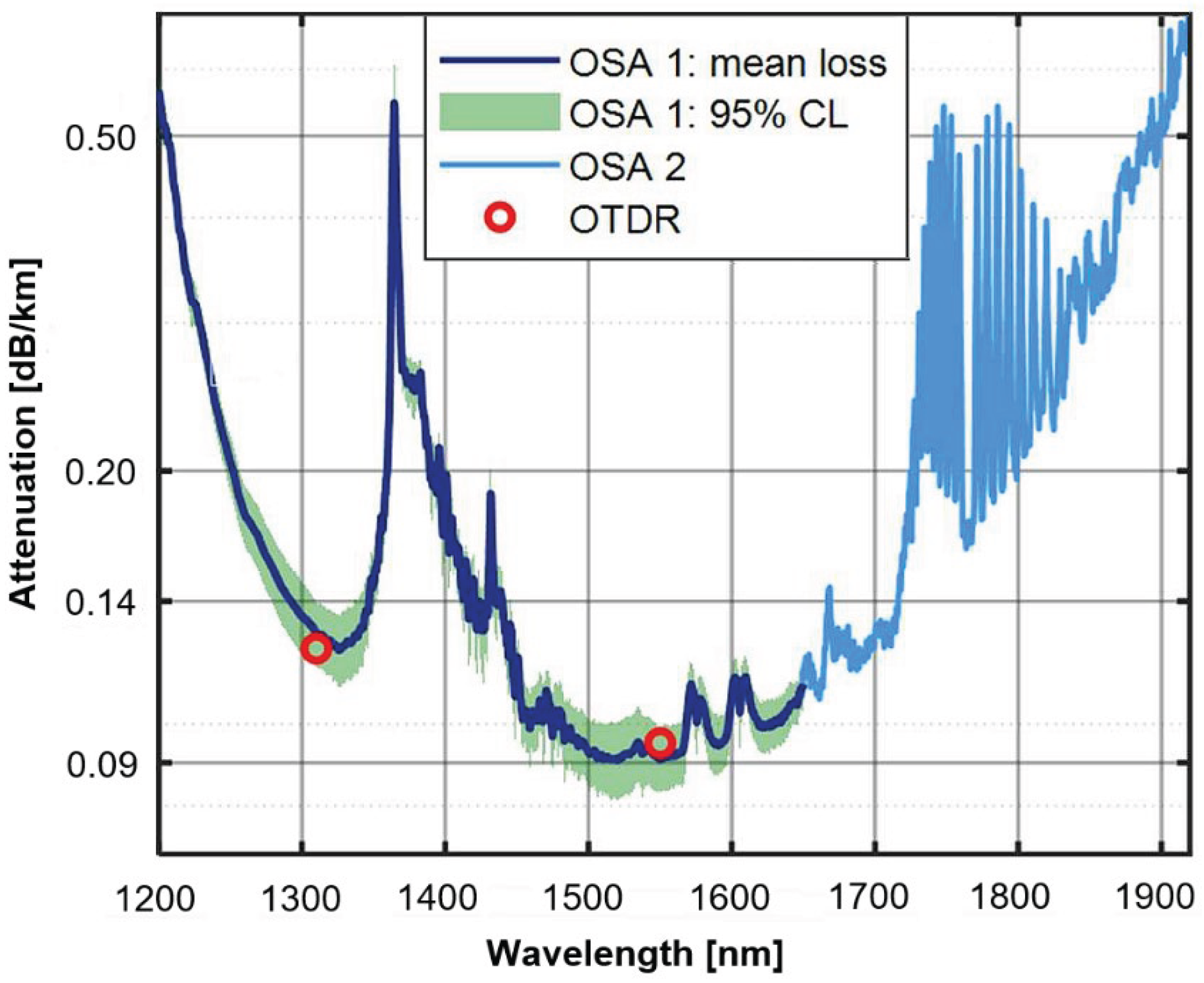
Narrow, periodic absorption bands of CO2 can be detected by measuring fiber loss with optical spectrum analyzer set to resolution of 0.05 nm or better, or tunable laser with wavelength step of the same size. Such measurement reveals a sub-nm fine spectral loss structure; peak added attenuation can exceed attenuation of “clean” fiber [6].
To suppress loss added by impurities it will be necessary to establish atmosphere free of the above mentioned contaminants in the HCF manufacturing plant, or introduce purging of preforms with dry, highly pure filler gas like argon and prevent entry of air afterwards, with the ends of finished fiber sealed by fusion.
5. Role and Standardization of Hollow Core Fibers
5.1. SMF, MCF, and HCF Market Segments
Looking at expected applications, the three main categories of telecom fibers: SMF, MCF and HCF appear complementary, with distinct applications:
- SMF: low-cost, established technology for most networks, especially when applications are cost-sensitive, e.g., in fiber access networks (FTTH);
- MCF: fibers compatible with SMFs for high density applications and parallel transmission; splicing MCF to a bunch of SMFs requires expensive “fanout”;
- HCF: fibers with unique properties for applications with special requirements (low latency, low loss, low nonlinearity, wide bandwidth, high power transmission), but incompatible with other fibers.
5.2. Standardization of New Optical Fibers
HCFs are fundamentally different from solid-core fibers, MCF included, and cannot be simply substituted for them without first creating and standardizing an “ecosystem” of passive components, splicing and coupling techniques (including HCF–SMF splicing), dedicated test instruments, in particular OTDRs and light sources operating at new wavelengths. Later, also transceivers and optical amplifiers for new bands, e.g., 1650–2050 nm, and power levels will be required. While current HCFs are optimized for the C band (1528–1565 nm) in order to be compatible with widely used SMFs and associated active equipment, this may change later, as the longwave band (1600–2100 nm) promises lowest attenuation in fused silica HCF (Figure 6).
Commercial deployment started in 2024 for both HCF [9,10,12] and MCF [38]. Standardization work on MCFs began at ITU-T in 2024 [39], with important applications expected in submarine cables where compactness of optical core is critical.
Standardization of HCFs is absent because fiber designs still evolve (Section 3). The critical issue are dimensions: core, MSD, and cladding diameters, which need to be identical (within one category of HCFs) to allow splicing of fibers from different vendors. Considering recently developed “compact” Microsoft Azure fiber (Section 3.5), there is a good chance that a satisfactory medium-loss HCFs for 1550 nm and 850 nm bands with 125 μm cladding and 200 or 250 μm protective coating (as in SMFs and MMFs) will be developed and manufactured. However, the same is rather unlikely for ultra-low-loss HCFs intended for long-distance networks (Section 3.1 and Section 3.3).
5.2. Demise of HC-PBGF Fibers
While in 2022 this older type of hollow core fiber known as Hollow-Core Photonic Bandgap Fiber [1](pp. 5–10) was still manufactured and developed, primarily at Furukawa/OFS [35,40], and commercially deployed on a modest scale, after 2023 there are no reports on further research at Furukawa [41] or elsewhere. The reasons for HC-PBGFs losing market to DNANFs include:
- complicated, labor intensive, and expensive preform manufacturing involving 250– 300 glass tubes instead of less than 20 in a 4-DNANF or 5-DNANF;
- high attenuation, typically 2.5–5.0 dB/km in (some parts of the) 1550 nm band;
- narrow low-loss band usually made of several sub-bands only 10–30 nm wide [40],
- high polarization mode dispersion (PMD) despite spinning at 100 rev/m rate [35].
6. Optical Amplifiers for Use with HCFs
Current DNANFs designed for telecom networks work well at 1550 nm (sections 3.1 and 3.3) and can operate with Erbium Doped Fiber Amplifiers (EDFAs) covering the 1530–1565 nm and 1565–1620 nm wavelength bands (C+L), depending on type of host glass used. These amplifiers are nowadays widely used with solid core single mode fibers, which exhibit rising attenuation above 1700 nm due to intensifying phonon absorption and macrobending losses.
Amplification in the adjacent 1360–1530 nm band (E+S) is in principle possible with a Bismuth Doped Fiber Amplifier (BDFA). Unfortunately, current status of this technology, in particular difficult manufacturing of active fibers with high bismuth concentration, severely limit amplifier performance. Prospects for improvement aren’t clear [42].
However, the low-loss band of perfected DNANF, including new designs with elongated tubes, extends towards longer wavelengths, with predicted minimum roughly in the 1700–2050 nm (146–176 THz) range (Figure 6) offering 30 THz of optical bandwidth, in comparison to ≈ 9 THz (185–196 THz with a gap) available in EDFAs of both types. As the optical nonlinearity of gas-filled HCF is negligible, Raman amplification in the transmission fiber is impossible, while inserting sections of solid core fibers as amplification medium would introduce unacceptable optical nonlinearity.
Suitable Thulium Doped Fiber Amplifier (TDFA) was demonstrated at University of Southampton back in 2013 [43], with wide bandwidth of ≈ 1900–2020 nm (short- and long-wavelength gain sections), peak gain ≈40 dB and noise figure about 6 dB, similar to one of EDFA, and high slope efficiency of ≈50% at 1565 nm pump wavelength compared to ≈40% in typical short-wave EDFA pumped at 980 nm. Later research at University of Southampton [44] proved it is possible to operate a set of four or more optimized TDFAs covering the 1660–2050 nm spectrum, albeit with significant spectral variability of gain. A theoretical study of advanced TDFA with a flat gain profile in a more than 300 nm wide (1690–1986 nm) spectrum was published in 2025 [45], but similar device is yet to be assembled in the lab and used in DWDM transmission experiments.
Amplification in the adjacent 2000–2130 nm band–the longwave end of low-loss spectrum of DNANF (Figure 4) may be possible with Holmium Doped Fiber Amplifier (HDFA) pumped with a 1950 nm laser, currently in early stage of development [46].
Amplifiers listed above, once fully developed, may together provide amplification over a spectrum well matched to characteristics of 5-DNANF, ca. 1400–2130 nm (73 THz), but at high cost, justified only in most advanced DWDM networks.
7. Deployment of HCFs in Microsoft Azure Data Centers and Links
In November 2024, Microsoft announced a large project of 2-year duration involving multiple data centers for Microsoft Azure AI services [10,12]. One novelty was large-scale (15,000 km of hollow core fibers) deployment of cables with a mix of HCF and SMF fibers between data centers, e.g., 32 HCF + 48 SMF [10]. For this solution to be cost-effective, separation of latency-sensitive and latency-insensitive traffic is needed.
HCFs are also installed inside data centers for reduction of latency and increase of processing power, replacing SMF, MMF and twisted pair cables (Section 2). In this application, HCF properties of interest include primarily:
- low latency,
- bending tolerance,
- small core diameter and MFD for splicing to SMFs.
The latter explains interest at Microsoft in developing compact HCFs (Section 3.5).
Due to short lengths of fiber links even in large data centers: ≤ 500 m, most ≤ 200 m, fiber attenuation similar to one of multimode fibers operating at 850 nm (≤ 2.5 dB/km) is acceptable. With considerable deviation of attenuation values of currently manufactured HCFs [3], one can imagine selection of HCFs at the production plant into at least two separate “outside plant/low loss” and “indoor plant/high loss” grades; such practice was adopted at the beginning of manufacturing of SMFs and MMFs in mid-1980s.
Microsoft Azure Fiber did not publish official specification of its 5T-DNANF fiber. While some websites indicate that average attenuation close to 0.10 dB/km is achieved, this value likely came from research papers presenting lowest-loss fiber samples from their plant [4,5]. Blog by Forster et al. [10] revealed that average loss of HCF-HCF fusion splice in one 2025 network project was 0.16 dB. For 2 km length of cable section with 0.10 dB/km fiber, which is an ambitious target considering YOFC data [3], the loss of installed cable line is no less than 0.18 dB/km. It was also revealed by one of key researchers at Microsoft Azure Fiber, F. Poletti, that “pilot” phase of the project included installation of 1,200 km of HCF with satisfactory results [47]. The decision to build large network linking Microsoft Azure data centers supporting premium AI services indicates high level of trust in fiber manufacturing capabilities. Despite having its own manufacturing plant in Romsey, UK, Microsoft made agreements with Corning Inc.—world’s largest manufacturer of optical fibers and Heraeus Covantics—German manufacturer of specialty fused silica glass, and recently also manufacturer of preforms and fibers to arrange HCF production by those companies at two sites in the U.S. [48].
So far, no other large digital corporation announced a similar plan.
8. HCF-Related Future Technologies
Fibers themselves do not constitute a telecom or datacom network or even a simple point-to-point data link. Here is a list of components and instruments necessary in the high-end HCF “ecosystem” of medium-term future, some of which may already exist, but aren’t yet offered commercially for this purpose. The list is not exhaustive:
- Passive components for HCFs: DWDM multiplexers, filters, splitters, optical switches and circulators for the 1700–2050 nm band.
- Low-noise photodiodes and DFB lasers for transmitters and receivers operating at wavelengths up to 2050 nm. “Extended InGaAs” photodiodes with indium content increased beyond standard 53% and lasers on InP substrate covering this band are manufactured on small scale, being expensive. Extended InGaAs photodiodes exhibit larger dark current and may need thermoelectric coolers to reduce noise.
- Complete optical transponders for the 1700–2050 nm band.
- OTDRs, power meters, and portable light sources for the 1700–2050 nm band.
- Portable TV cameras sensitive up to 2050 nm for inspection of radiation leakage in facilities with high power transmission/amplification.
Situation has not apparently changed since previous review [1], despite commercial deployments of HCFs, because:
- these networks are operating at established wavelengths like 1550 nm or (maybe) 850 nm for compatibility with SMF or MMF “ecosystem”, respectively;
- Microsoft, the only large HCF user for now (Section 7) is able to custom order components and test equipment.
9. Discussion
The most dynamic developments occurred in development of low-loss, compact, and easier to make hollow core fibers. There are 3 major competing manufacturers: Microsoft, YOFC and Linfiber, with Corning and Heraeus Covantics engaged in fiber production for Microsoft, but not reporting own fiber designs. While this competition ensures rapid advances of technology, multiplying fiber designs are incompatible. Standardization, most likely with several HCF categories formulated for different applications, as in ITU-T G.652, G.654 or G.657 recommendations is essential for mass adoption of HCFs.
The second issue for future work is elimination of absorption by contaminants trapped inside fiber, as currently a majority of (theoretically) available fiber bandwidth is (actually) not available because of multiple loss peaks (Figure 9). Looking at the research papers, it seems nobody cares, as the 1550 nm band is unaffected.
Large scale manufacturing of HCFs at relatively low cost is within reach if the solutions reported by Linfiber [2] for drawing long lengths of HCFs are implemented and further developed, but another big issue is manufacturing consistency and yield of low-loss fibers. YOFC data [3] show that while some 5% of manufactured ST-HCF had loss close to 0.05 dB/km advertised at conferences, average value (0.147 dB/km) was 3x larger, and the worst 5% exceeded 0.22 dB/km—value familiar from cheap SMFs.
Development of passive components, transceivers and test equipment capable to cover extended range of wavelengths available in hollow core fibers, up to 2200 nm, is largely absent. This is explained by current focus on data centers by a single company.
Finally, existence of Microsoft-Corning-Heraeus closed manufacturing alliance operating in secrecy is worrying, albeit the Chinese competitors are ready to fill the gap.
10. Materials and Methods
This paper is of review type, based on data already published, mostly in the 2022–2025 period. Data collected during work on this paper include the following:
- scientific and technical publications, standards and product data sheets;
- copies of press releases and company publications, usually with photos and other graphics saved as separate files,
- drawings and photographs extracted from publications in PDF format or saved from websites for further analysis, particularly of fiber geometry.
The author maintains a full set of these data indefinitely (until retirement, at least). Their availability to third parties, however, is limited by the fact that large proportion of this material is not of “open access” type. All other data are available to anyone with reasonable request.
Generative artificial intelligence (GenAI) was not used.
Funding
This research and APC were funded by Polish Ministry of Science and Higher Education by financing statutory activities of National Institute of Telecommunications. Work at the Institute was done within Project No. 12.30.002.6 “Design of photonic structures, including diffractive optical components for fiber optic communications and measurements”.
Institutional Review Board Statement
Not applicable.
Informed Consent Statement
Not applicable.
Data Availability Statement
The author maintains a full set of these data indefinitely (until retirement, at least). Their availability to third parties, however, is restricted by the fact that large proportion of this material is not of “open access” type. All other data are available to anyone with reasonable request.
Conflicts of Interest
The author declares no conflicts of interest. The funders had no role in the design of the study; in the collection, analyses, or interpretation of data; in the writing of the manuscript; or in the decision to publish the results.
Abbreviations
The following abbreviations are used in this manuscript:
| 4-DNANF | Double Nested Anti-Resonant Nodeless Fiber with 4 non-truncated tube sets |
| 5-DNANF | Double Nested Anti-Resonant Nodeless Fiber with 5 non-truncated tube sets |
| 4T-DNANF | Double Nested Anti-Resonant Nodeless Fiber with 4 truncated tube sets |
| 5T-DNANF | Double Nested Anti-Resonant Nodeless Fiber with 5 truncated tube sets |
| AI | Artificial Intelligence |
| ARF | Anti-Resonant Fiber |
| ARROW | Anti-Resonant Reflecting Optical Waveguide |
| BDFA | Bismuth-Doped Fiber Amplifier |
| C band | 1530-1565 nm optical band (Conventional Band) |
| CAPEX | Capital Expenses |
| CD | Chromatic Dispersion |
| CL | Confinement Loss |
| DNANF | Double Nested Anti-Resonant Nodeless Fiber |
| DWDM | Dense Wavelength Division Multiplexing |
| E band | 1360-1460 nm optical band (Extended Wavelength Band) |
| EDFA | Erbium-Doped Fiber Amplifier |
| FOG | Fiber Optic Gyroscope |
| FTTH | Fiber to the Home (fully fiber optic broadband access network) |
| HST | High Speed Trading |
| HCF | Hollow-Core Fiber |
| HC-PBGF | Hollow-Core Photonic Bandgap Fiber |
| HOM | Higher Order Mode |
| HOMER | Higher Order Mode Extinction Ratio |
| IT-DNANF | Interstitial-Tube assisted Double Nested Anti-Resonant Nodeless Fiber |
| ITU-T | International Telecommunication Union–Technical Standardization Sector |
| MCF | Multi-Core Fiber |
| L band | 1565-1625 nm optical band (Longwave Band) |
| MFD | Mode Field Diameter |
| MMF NA |
Multimode Fiber (with solid core) Numerical Aperture |
| MSD | Micro Structure Diameter (diameter of HCF without solid jacket tube) |
| NANF | Nested Anti-Resonant Nodeless Fiber |
| O band | 1260-1360 nm optical band (Old Band—the first one used with SMF) |
| OPEX | Operating Expenses |
| OTDR | Optical Time Domain Reflectometer |
| OTN | Optical Transport Network |
| PBGF | Photonic Bandgap Fiber |
| PMD | Polarization Mode Dispersion |
| PSCF | Pure Silica Core Fiber |
| S Band | 1460-1530 nm optical band (Shortwave Band) |
| SMF | Single-Mode Fiber (with solid core and cladding) |
| SPM | Self-Phase Mixing |
| SSL | Surface Scattering Loss |
| TDFA | Thulium-Doped Fiber Amplifier |
| U band | 1625-1675 nm optical band (Ultralong Wavelength Band) |
References
- Borzycki, K.; Osuch, T. Hollow-Core Optical Fibers for Telecommunications and Data Transmission. Applied Sciences accessed on. 2023, 13, 10699. (accessed on 1 February 2026). (special issue “Recent Developments, Emerging Trends and Technologies for Optical Networks”, ISSN 2076-3417). [Google Scholar] [CrossRef]
- Gao, S.; Chen, H.; Xiong, Y.; Sun, Y.; Ding, W.; Wang, Y. 40 km, 0.052 dB/km and 83 Km, 0.076 dB/km in Interstitial-Tube-Assisted Hollow-Core Fibre paper Th.03.01.1. In proc. 2025 European Conference on Optical Communications (ECOC), accessed on. Copenhagen, Denmark, 28 Sept.–2 Oct. 2025; (accessed on 13 February 2026). [Google Scholar] [CrossRef]
- Ding, Y.; Li, P.; Chen, G.; Chu, J.; Jia, A.; Zhang, L.; Luo, J. Support Tube Hollow-Core Fiber with 0.05 dB/km Attenuation. Proc. 2025 European Conference on Optical Communications (ECOC), accessed on. Copenhagen, Denmark, 28 Sept.–2 Oct. 2025; (accessed on 14 February 2026). [Google Scholar] [CrossRef]
- Petrovich, M.; Numkam Fokoua, E.; Chen, Y.; Sakr, H.; Adamu, A.I.; Hassan, R.; Wu, D.; Ando, R.F.; Papadimopoulos, A.; Sandoghchi, S.R.; Jasion, G.; Poletti, F. Broadband optical fibre with an attenuation lower than 0.1 decibel per kilometre. Nat. Photonics accessed on. 2025, 19, 1203–1208. (accessed on 25 April 2025). [Google Scholar] [CrossRef] [PubMed]
- Chen, Y.; Petrovich, M.N.; Numkam Fokoua, E.; Adamu, A.I.; Hassan, M.R.A.; Sakr, H.; Slavík, R.; Bakhtiari Gorajoobi, S.; Alonso, M.; Fatobene Ando, R.; Papadimopoulos, A.; Varghese, T.; Wu, D.; Fatobene Ando, M.; Wisniowski, K.; Sandoghchi, S.R.; Jasion, G.T.; Richardson, D.J.; Poletti, F. Hollow Core DNANF Optical Fiber with . Proc. of 2024 Optical Fiber Communications Conference (OFC), accessed on. San Diego, CA, USA, 24–28 March 2024; p. paper Th4A.8. (accessed on 5 May 2025). [Google Scholar] [CrossRef]
- Gao, S.; Chen, H.; Sun, Y.; Xiong, Y.; Yang, Z.; Zhao, R.; Ding, W.; Wang, Y. Fourfold truncated double-nested antiresonant hollow-core fiber with ultralow loss and ultrahigh mode purity. Optica accessed on. 2025, 12, 56–61. (accessed on 24 November 2025). [Google Scholar] [CrossRef]
- Sato, S.; Kawaguchi, Y.; Sakuma, H.; Haruna, T.; Hasegawa, T. Ultra-low Loss 0.1397dB/km Silica-core Single-mode Fiber. in Optical Fiber Communication Conference (OFC) 2025, accessed on. 2025; Technical Digest Series (Optica Publishing Group; paper M1F.4. (accessed on 25 November 2025). [Google Scholar] [CrossRef]
- Hou, Ch; Chen, G.; Wang, X; Mao, M.; Zhang, L.; Li, P.; Zhang, L.; Luo, J.; Ding, J.; Duan, Z.; Liang, S. Hollow-core Double Nested Antiresonant Nodeless Fiber Cable with Polarization Mode Dispersion<0.1 ps/km1/2. Proc. of Optical Fiber Communication Conference (OFC) 2025, accessed on. San Francisco, CA, USA, 30 March–3 April 2025; Technical Digest Series (Optica Publishing Group, 2025; paper M1F.2. (accessed on 5 November 2025). [Google Scholar] [CrossRef]
- Nadella, S. Microsoft Ignite Keynote. 19 Nov 2024. Available online: https://pub-c2c1d9230f0b4abb9b0d2d95e06fd4ef.r2.dev/2024/11/11192024-Ignite-KEY01-Satya-Nadella2.pdf (accessed on 24 November 24 2025).
- Forster, Ch.; Gaudette, J.; Rey, F.; Pearson, T.; Ellis, R.; Badgley, Ch.; Saljoghei, A. The Deployment of Hollow Core Fiber (HCF) in Azure’s Network. Microsoft Community Hub—Azure Networking Blog. Mar 20, 2025 (updated 28 May 2025. Available online: https://techcommunity.microsoft.com/blog/azurenetworkingblog/the-deployment-of-hollow-core-fiber-hcf-in-azure%e2%80%99s-network/4395340 (accessed on 24 November 2025).
- ITU-T Recommendation G.652: Characteristics of a single-mode optical fibre cable. Geneva, Switzerland, Oct. 1984; CCITT (The International Telegraph and Telephone Consultative Committee). Available online: https://www.itu.int/itu-t/recommendations/rec.aspx?rec=4091&lang=en (accessed on 25 November 2025).
- Zhang, E. Why is Hollow-Core Fiber So Popular? LinkedIn, Jan. 13, 2025. Available online: https://www.linkedin.com/pulse/why-hollow-core-fiber-so-popular-evelyn-zhang-cwx4c (accessed on 2 December 2025).
- Wang, Ch. 2025/2026 China Mobile optical cable tender awards released. CRU Group. 11 June 2025. Available online: https://www.crugroup.com/en/communities/thought-leadership/2025/2025-2026-China-Mobile-optical-cable-tender-awards-released/ (accessed on 12 December 2025).
- Saitoh, K.; Matsuo, S. : Multicore Fiber Technology. J. Lightwave Technol. accessed on. 2015, 1, 55–66. (accessed on 14 February 2026). [Google Scholar] [CrossRef]
- Pryamikov, A.D.; Biriukov, A.S.; Kosolapov, A.F.; Plotnichenko, V.G.; Semjonov, S.L.; Dianov, E.M. Demonstration of a waveguide regime for a silica hollow-core microstructured optical fiber with a negative curvature of the core boundary in the spectral. Opt. Express accessed on. 2011, 19, 1441–1448. (accessed on 14 February 2026). [Google Scholar] [CrossRef] [PubMed]
- Ciddor, P.E. Refractive Index of Air: New Equations for the Visible and Near Infrared. Appl. Optics 1996, 35, 1566–1573. [Google Scholar] [CrossRef] [PubMed]
- Jasion, G.T.; Sakr, H.; Hayes, J.R.; Sandoghchi, S.R.; Hooper, L.; Numkam Fokoua, E.; Saljoghei, A.; Mulvad, H.C.; Alonso, M.; Taranta, A. 0.174 dB/km Hollow Core Double Nested Antiresonant Nodeless Fiber (DNANF). Proc. 2022 Optical Fiber Communications Conference and Exhibition (OFC), accessed on. San Diego, CA, USA, 6–10 March 2022; p. Th4C.7. (accessed on 14 February 2026). [Google Scholar] [CrossRef]
- ITU-T Recommendation G.654: Characteristics of a cut-off shifted single-mode optical fibre and cable (08/2024). Available online: https://www.itu.int/itu-t/recommendations/rec.aspx?rec=16061 (accessed on 29 January 2026).
- FarBand Ultra Low Loss and Large Effective Area Single-mode Fibre. Yangtze Optical Fibre and Cable, 2019. Available online: https://yofc-oss.oss-cn-beijing.aliyuncs.com/en/upload/20190702/1deoels8o13po8kkr.pdf (accessed on 29 January 2026).
- Corning TXF Optical Fiber Product Information PI1433. Corning Inc. Nov 2022. Available online: https://www.corning.com/media/worldwide/coc/documents/Fiber/product-information-sheets/PI-1433-AEN.pdf (accessed on 24 January 2026).
- Corning Vascade EX2000 Optical Fiber Product Information PI-1440. Corning Inc., March 2023. Available online: https://www.corning.com/media/worldwide/coc/documents/Fiber/product-information-sheets/PI-1440.pdf (accessed on 29 January 2026).
- Corning® SMF-28® ULL S+ Optical Fiber Product Information PI-1471. Corning Inc., March 2023. Available online: https://www.corning.com/media/worldwide/coc/documents/Fiber/product-information-sheets/PI-1471.pdf (accessed on 29 January 2026).
- Z-PLUS Fiber 150 Advanced Pure Silica Core Single Mode Optical Fiber TR-21268A. Sumitomo Electric. 2021. Available online: https://sumitomoelectriceurope.com/wp-content/uploads/2022/08/Datasheet-for-TR-21268A_Z-PLUS_Fiber_150.pdf (accessed on 29 January 2026).
- Sato, S.; Kawaguchi, Y.; Sakuma, H.; Haruna, T.; Hasegawa, T. Record Low Loss Optical Fiber with 0.1397 dB/km. In Proceedings of the 2024 Optical Fiber Communications Conference and Exhibition (OFC), accessed on. San Diego, CA, USA, 24–28 March 2024; Tu2E.1. (accessed on 30 January 2026). [Google Scholar]
- Tamura, Y.; Sakuma, H.; Morita, K.; Suzuki, M.; Yamamoto, Y.; Shimada, K.; Honma, Y.; Sohma, K.; Fuji, T.; Hasegawa, T. The First 0.14-dB/km Loss Optical Fiber and its Impact on Submarine Transmission. Journal Lightwave Technol. accessed on. 2018, 36, 44–49. (accessed on 30 January 2026). [Google Scholar] [CrossRef]
- Gao, S.; Chen, H.; Sun, Y.; Ding, W.; Wang, Y. Truncated anti-resonant hollow-core fiber for reduced microstructure diameter. Journal Lightwave Technol. accessed on. 2024, 42, 6077–6082. (accessed on 24 November 2025). [Google Scholar] [CrossRef]
- Bradley, T.D.; Hayes, J.R.; Chen, Y.; Jasion, G.T.; Sandoghchi, S.R.; Slavik, R.; Numkam Fokoua, E.; Bawn, S.; Sakr, H.; Davidson, I.A.; Taranta, A.; Thomas, J.P.; Petrovich, M.N.; Richardson, D.J.; Poletti, F. Record Low-Loss 1.3dB/km Data Transmitting Antiresonant Hollow Core Fibre. Proc. of 2018 European Conference on Optical Communication (ECOC 2018), accessed on. Rome, Italy, 23–27 September 2018; (accessed on 10 February 2026). [Google Scholar] [CrossRef]
- Bradley, T.; Jasion, G.; Hayes, J.; Chen, Y.; Hooper, L.; Sakr, H.; Alonso, M.; Taranta, A.; Saljoghei, A.; Mulvad, H.C.; Fake, M.; Davidson, I.; Wheeler, N.; Numkam Fokoua, E.; Wang, W.; Sandoghchi, S.R.; Richardson, D.J.; Poletti, F. Antiresonant Hollow Core Fibre with 0.65 dB/km Attenuation across the C and L Telecommunication bands. Proc. European Conference on Optical Communication (ECOC 2019), accessed on. Dublin, Ireland, 22-26 September 2019; 2019. (accessed on 10 February 2026). [Google Scholar] [CrossRef]
- Jasion, G.T.; Bradley, T.D.; Harrington, K.; Sakr, H.; Chen, Y.; Numkam Fokoua, E.; Davidson, I.A.; Taranta, A.; Hayes, J.R.; Richardson, D.J.; et al. Hollow Core NANF with 0.28 dB/km Attenuation in the C and L Bands. In Proceedings of the 2020 Optical Fiber Communications Conference and Exhibition (OFC) paper Th4B.4, accessed on. San Diego, CA, USA, 8–12 March 2020; (accessed on 10 February 2026). [Google Scholar]
- Mahdiraji, G.A.; Jackson, G.; Abokhamis Mousavi, S.M.; Baddela, N.K.; Rzegocki, J.; Guerra, G.; Rahman, M.; Saw, Ch.P.; Davidson, I.A.; Jasion, G.T.; Taranta, A.; Poletti, F. First Triple Nested Antiresonant Nodeless Hollow Core Fiber (TNANF) Achieving 0.25 dB/km Loss with Small 145/250 μm Glass/Coating Diameters. In proc. 2025 European Conference on Optical Communications (ECOC), accessed on. Copenhagen, Denmark, 28 Sept.–2 Oct. 2025; (accessed on 14 February 2026). [Google Scholar] [CrossRef]
- Adamu, A.I.; Hassan, M.R.A.; Chen, Y.; Numkam Fokoua, E.; Alonso, M.; Sakr, H.; Richardson, D.J.; Poletti, F.; Petrovich, M.N. 10.9km Hollow Core Double Nested Antiresonant Nodeless Fiber (DNANF) with 0.33dB/km loss at 850nm. Proc. of 2024 Optical Fiber Communications Conference (OFC), accessed on. San Diego, CA, USA, 24–28 March 2024; paper M3J.1. (accessed on 8 February 2026). [Google Scholar] [CrossRef]
- Numkam Fokoua, E.; Abokhamis Mousavi, S.; Jasion, G.T.; Richardson, D.J.; Poletti, F. Loss in hollow-core optical fibers: Mechanisms, scaling rules, and limits (Tutorial). Adv. Opt. Photonics accessed on. 2023, 15, 1–85. (accessed on 6 February 2026). [Google Scholar] [CrossRef]
- Sumi Rani Shaha, K.; Khaleque, A.; Hosen, S. Wideband Low Loss Hollow Core Fiber with Nested Hybrid Cladding Elements. Journal Light. Technol. accessed on. 2021, 39, 6585–6591. (accessed on 6 February 2026). [Google Scholar] [CrossRef]
- Zhang, H.; He, J.M.; Wang, J.Q.; Zhang, X.; Xi, L.X.; Zhang, X. Ultralow loss and broadband hollow core anti-resonant fiber with nested waterdrop-shaped tube. Optics Express accessed on. 2025, 33(Issue 12), 26812–26825. (accessed on 6 February 2026). [Google Scholar] [CrossRef] [PubMed]
- Mangan, B.J.; Zhu, B.; Puc, G.S.; Kremp, T.; Irid, M. Low latency transmission in a hollow core fiber cable. In Proceedings of the CLEO 2021, accessed on. Virtual Event, 9–14 May 2021; p. STu1Q.1. (accessed on 16 February 2026). [Google Scholar] [CrossRef]
- Borzycki, K.; Jaworski, M. Temperature Dependence of PMD in Optical Fibres and Cables—Part II. Proc. 2006 International Conference on Transparent Optical Networks (ICTON), accessed on. Nottingham, UK, 18–22 June 2006; Vol. 4, pp. 209–212. (accessed on 7 February 2026). [Google Scholar] [CrossRef]
- Jasion, G.T.; Hayes, J.R.; Wheeler, N.V.; Chen, Y.; Bradley, T.D.; Richardson, D.J.; Poletti, F. Fabrication of tubular anti-resonant hollow core fibers: Modelling, draw dynamics and process optimization. Opt. Express accessed on. 2019, 27, 20567–20582. (accessed on 6 February 2026). [Google Scholar] [CrossRef] [PubMed]
- Sumitomo Electric Launches World’s First Mass-produced Ultra-low Loss, Multi-core Fiber. Sumitomo Electric press release. 22 September 2023. Available online: https://sumitomoelectric.com/press/2023/09/prs049 (accessed on 10 December 2025).
- ITU-T G Suppl. 87: Standardization framework for optical fibres for space division multiplexing (03/2025). Available online: https://www.itu.int/epublications/fr/publication/itu-t-g-suppl-87-2025-03-standardization-framework-for-optical-fibres-for-space-division-multiplexing (accessed on 9 December 2025).
- Mukasa, K. Hollow Core Fiber Cable. Furukawa Electric Rev. 2021, 52, 36–43. Available online: https://www.furukawa.co.jp/en/rd/review/fr052/fr52_09.pdf (accessed on 6 February 2026).
- Mukasa, K. Recent progress of hollow core fibers. JSAP Rev. 2025, p. 250301. Available online: https://www.jstage.jst.go.jp/article/jsaprev/2025/0/2025_250301/_pdf/-char/en (accessed on 7 February 2026). [CrossRef]
- Alyshev, S.; Khegai, A.; Umnikov, A.; Firstov, S. Bismuth-Doped Fiber Lasers and Amplifiers Operating from O- to U-Band: Current State of the Art and Outlook. Photonics accessed on. 2024, 11(7), 663. (accessed on 8 February 2026). [Google Scholar] [CrossRef]
- Li, Z.; Heidt, A.M.; Daniel, J.M.O.; Jung, Y.; Alam, S.U.; Richardson, D.J. Thulium-doped fiber amplifier for optical communications at 2 μm. Opt. Express accessed on. 2013, 21, 9289–9297. (accessed on 7 February 2026). [Google Scholar] [CrossRef] [PubMed]
- Chen, S.; Jung, Y.; Alam, S.U.; Richardson, D.J.; Sidhrthan, R.; Ho, D.; Yoo, S.; Daniel, J.M.O. Ultra-short wavelength operation of thulium-doped fiber amplifiers and lasers. Optics Express accessed on. 2019, 27(No. 25), 36699–36707. (accessed on 7 February 2026). [Google Scholar] [CrossRef] [PubMed]
- Jose, A.; Guasoni, M.; Coillet, A.; Dinda, P.T.; Grelu, P.; Nithyanandan, K. Towards a broadband gain-flattened thulium doped fiber amplifier. Optics Communications accessed on. 2025, 578, 131452. (accessed on 7 February 2026). [Google Scholar] [CrossRef]
- Holmen, L.G.; Fonnum, H. Holmium-doped fiber amplifier for pumping a ZnGeP2 optical parametric oscillator. Optics Express accessed on. 2021, 29(6), 8477–8489. (accessed on 8 February 2026). [Google Scholar] [CrossRef] [PubMed]
- Swain, G. : Microsoft’s hollow core fiber delivers the lowest signal loss ever. NetworkWorld, Sept. 2, 2025. Available online: https://www.networkworld.com/article/4049666/microsofts-hollow-core-fiber-delivers-the-lowest-signal-loss-ever.html (accessed on 12 February 2026).
- Frey, F. Microsoft Azure scales Hollow Core Fiber (HCF) production through outsourced manufacturing. Microsoft Community Hub—Azure Networking Blog, Sep 23, 2025. Available online: https://techcommunity.microsoft.com/blog/azurenetworkingblog/microsoft-azure-scales-hollow-core-fiber-hcf-production-through-outsourced-manuf/4455953 (accessed on 12 February 2026).
Disclaimer/Publisher’s Note: The statements, opinions and data contained in all publications are solely those of the individual author(s) and contributor(s) and not of MDPI and/or the editor(s). MDPI and/or the editor(s) disclaim responsibility for any injury to people or property resulting from any ideas, methods, instructions or products referred to in the content. |
© 2026 by the authors. Licensee MDPI, Basel, Switzerland. This article is an open access article distributed under the terms and conditions of the Creative Commons Attribution (CC BY) license (http://creativecommons.org/licenses/by/4.0/).
Copyright: This open access article is published under a Creative Commons CC BY 4.0 license, which permit the free download, distribution, and reuse, provided that the author and preprint are cited in any reuse.


