

Submitted:
18 February 2026
Posted:
28 February 2026
You are already at the latest version
Abstract
Environmental, Social, and Governance (ESG) analytics increasingly uses knowledge graphs (KGs) to encode framework-grounded semantics, align partially overlapping standards, and attach provenance for auditable querying. Yet ESG evidence is mainly text-first (disclosures, regulations, policies, news, incident narratives), so quality depends on the KG–NLP interface. Research remains fragmented across topics, modalities, and pipelines, limiting reuse. To this end, we first introduce the ESG Research Focus Map (ESG-RFM), a vendor-agnostic pillar–theme–focus taxonomy crosswalked to major ESG frameworks and standards (MSCI, GRI, ESRS, and SASB), which serves as the organizing lens for KG4ESG, an atlas-style survey of 337 ESG knowledge graph (KG) papers (2015–2025). KG4ESG is curated via a query dictionary and PRISMA-style screening across 4 academic search engines, and provides a structured, evaluative atlas and reusable resource that organizes the field into two coupled stages: Data→KG and KG→App. For Data→KG, we summarize evidence sources and distill 4 construction paradigms: P1 ontology-first lifting/integration, P2 rule/supervised NLP/ML extraction, P3 LLM-assisted structuring/alignment, and P4 agentic/tool-using pipelines with iterative validation/repair. For KG→App, we group apps into reporting & compliance, monitoring & risk intelligence, and decision support, and synthesize recurring language interfaces. A corpus-level meta-analysis highlights gaps in evaluation, openness, and multimodal grounding motivating auditable benchmarks and reusable resources. We will release all the artifacts.
Keywords:
ESG analytics
; knowledge graphs
; LLMs
1. Introduction
Environmental, Social, and Governance (ESG) regulation, sustainable finance, and corporate accountability increasingly depend on heterogeneous evidence: sustainability reports, regulatory texts with cross-references and exceptions, and narrative incident or controversy records. Because this evidence is largely language-mediated, knowledge graphs (KGs) provide a natural backbone: they encode standards-grounded semantics, represent qualifiers (e.g., time/unit/scope), and attach provenance so that querying and explanation remain auditable.
However, ESG KG research is difficult to synthesize. Works often draw inconsistent topical boundaries, combine partially overlapping standards without explicit alignment, or treat KG construction and language-facing access in isolation. This separation hides a key dependency: what downstream systems can retrieve, verify, and justify through NLP interfaces is determined upstream by representational choices (schema, qualification, and provenance). In regulatory contexts, the validity of a system’s output is contingent upon the auditability of its evidence chain.
We therefore frame the field end-to-end (Figure 1) as two coupled stages: Data→KG (evidence → schema-governed, provenance-bearing KGs) and KG→App (reporting/compliance, monitoring/risk intelligence, decision support) mediated by KG–NLP interfaces such as extraction/linking, text-to-query/KGQA, graph-grounded synthesis, and provenance-aware verification. To make results comparable across topics and standards, we introduce the ESG Research Focus Map (ESG-RFM), a vendor-agnostic pillar–theme–focus taxonomy crosswalked to major frameworks (MSCI/GRI/ESRS/SASB).
Prior surveys offer valuable perspectives but rarely connect construction choices in ESG knowledge graphs to audit-facing behavior in downstream language interfaces. Large sustainable-finance meta-analyses typically operate at the level of study outcomes, rather than on evidence-linked, machine-readable representations [1]. Ontology surveys in circular-economy and related sustainability domains catalog conceptual artifacts and alignment challenges, but are often decoupled from disclosure- and compliance-oriented pipelines [2]. More general roadmaps on integrating KGs with LLMs, RAG, and agentic workflows provide transferable design patterns, yet do not address ESG-specific cross-framework semantics, qualification, and provenance constraints that govern what systems can safely assert [3,4,5]. Extended illustrations are provided in Appendix A. We additionally position KG4ESG relative to primary technical work on disclosure structuring and cross-standard alignment, compliance- and governance-oriented KGs, and graph-grounded LLM/agent interfaces with validation and provenance in Appendix B.
Contributions. We provide: (1) ESG-RFM, a reusable topic map aligned with major ESG standards; (2) the KG4ESG corpus of works (2015–2025) retrieved via an ESG-RFM-grounded query dictionary and PRISMA-style screening; (3) a Data→KG synthesis that categorizes evidence sources and distills four construction paradigms (P1–P4) together with shifting expert roles; (4) a KG→App synthesis that organizes applications into reporting/compliance, monitoring/risk intelligence, and decision support, and summarizes recurring KG–NLP interfaces (extraction/linking, KGQA/text-to-query, GraphRAG/RAG-style synthesis, provenance-aware verification); (5) a corpus-level meta-analysis of resources, evaluation, and openness signals; and (6) a future research agenda grounded in these findings. All the artifacts will be released.
2. Survey Methodology
The KG4ESG corpus contains papers (2015–2025) whose primary contribution is to construct, extend, or apply an ESG/sustainability knowledge graph. We follow a taxonomy-driven, PRISMA-style workflow (Appendix D): (1) define ESG-RFM, a vendor-agnostic pillar–theme–focus map aligned with MSCI/GRI/ESRS/SASB (Appendix C); (2) derive a focus-level query dictionary and retrieve candidates from Google Scholar, ACL Anthology, OpenAlex, and Semantic Scholar, augmented with backward/forward citation chasing; and (3) merge, deduplicate, and screen records using explicit inclusion/exclusion criteria.
Each included work is annotated to connect Data→KG choices to KG→App behavior through an NLP lens: ESG-RFM topical tags, dominant construction paradigm (P1–P4), evidence modalities and resource statistics, dominant KG–NLP interfaces. Because ESG topics are cross-cutting, we retain multi-focus tags but record a single primary focus per paper for aggregation.
3. Data-to-KG: Constructing ESG KGs
The Data→KG stage turns heterogeneous ESG evidence into a schema-constrained, provenance-preserving graph. Across environmental (E), social (S), governance (G), and holistic (H) settings, this stage behaves less like “extracting triples” and more like enforcing an evidence-to-structure contract: entity and relation types must be typed, qualified (time, boundary/scope, unit, method), and linked back to supporting evidence so that downstream language interfaces can retrieve, explain, and verify claims under shifting standards [6,7,8,9]. The contract is especially non-negotiable in H and G applications (reporting, rating, and compliance) where a statement’s meaning depends on definitions and scope, but it is equally decisive in E systems where numeric comparability and spatiotemporal context dominate (e.g., risk, hazards, footprints) [10,11,12,13,14].
Two representation imperatives recur across all pillars. The first is qualification completeness: numeric indicators and event facts must carry units, temporal validity, and boundary/method metadata to remain computable rather than merely retrievable [8,14,15,16]. This is most visible in E and H pipelines that compute footprints, LCA metrics, or climate-risk indicators, but it also matters in S contexts such as health, safety, and inclusion metrics that require consistent definitions [17,18]. The second is evidence and provenance linking, where graph assertions point to clauses, spans, tables, logs, or geospatial products; this turns the KG into a verification surface that survives review, re-labeling, and re-alignment [9,11,13,19,20].
3.1. Evidence Sources and Modalities
Despite the diversity of domains, most ESG KGs draw from a few recurring evidence families, each with pillar-specific constraints. Standards, taxonomies, and indicator definitions provide semantic anchors for H and E work (metric meaning, unit semantics, formulas, cross-framework mapping), enabling comparable computation and alignment across reporting regimes [6,7,14,21]. Regulations, policies, and legal corpora are central in G and increasingly in H, where obligations, scope, exceptions, and cross-references must be modeled explicitly to support traceable compliance reasoning and review [11,22,23,24,25]. Corporate disclosures and enterprise records (reports, filings, ERP/MES/CRM tables, process models, event logs) appear throughout, but they are most structurally exploited in G/H reporting and governance workflows, where disclosure structuring, gap detection, and auditable metric management are primary [19,26,27,28,29]; in S settings, the same “enterprise record” category often shifts toward people- and safety-centered artifacts such as accident/near-miss narratives, dispute or inspection cases, OHS documentation, HR profiles and mobility histories, resumes and job ads linked to skills taxonomies, and privacy/security documentation (privacy policies, CTI reports, and operational logs), which require tighter context modeling (roles, responsibilities, exposure, and governance constraints) to remain actionable [30,31,32,33,34,35,36,37,38,39,40]. External narratives and literature (news/web/literature) frequently supply H monitoring signals (controversies, trends, reputational risk) and also feed E knowledge acquisition (climate, biodiversity, circular economy) [41,42,43,44,45,46]; they also appear as S-facing evidence when incident reporting and cyber/privacy risk intelligence are constructed from vendor reports, public disclosures, and narrative sources that must be grounded and normalized before use [38,47,48]. Finally, multimodal measurements (geospatial layers, remote sensing, imagery, sensor/time-series telemetry, CAD/BIM artifacts) are disproportionately important in E and many H systems, making spatiotemporal qualification, multi-resolution linking, and update mechanisms core design goals [12,13,49,50,51,52]; importantly, these modalities also surface in S deployments where OHS and product-quality settings combine sensor streams and event logs with text to support monitoring, diagnosis, and safety decision support [53,54,55,56].
This modality mix yields two recurring construction regimes that often coexist. Text-first pipelines (reports, regulations, news) emphasize schema-conditioned NLP: extraction, entity/relation linking, normalization to indicators, and evidence links to clauses/spans, typical in G and H compliance/reporting and in S policy/incident narratives [20,21,26,43]. Sensor/geo-first pipelines emphasize integration, spatiotemporal semantics, and provenance over derived products, typical in E monitoring (hazards, infrastructure resilience, water/energy) and in H disparity/impact analytics that blend geo-data with socio-economic context [12,13,16,50]. Hybrid designs increasingly bind narrative evidence to geospatial and imagery context for disaster and climate-risk analysis, or bind built-environment models to IoT streams for multi-scale sustainability evaluation [51,57,58,59,60]. Thus, text-to-typed-structure problem is dominant in ESG KGs.
3.2. Construction Paradigms (P1–P4) and Pillar Pressures
Four recurring construction paradigms appear across E/S/G/H. They differ in their dominant evidence-to-schema mapping operator, but all rely on explicit schema conformance, constraint checking, and provenance-aware validation to prevent semantic drift and to preserve auditability in ESG-grade settings [6,7,9]. A detailed methodological treatment, formal definitions, and supplementary analyses are provided in Appendix E.
3.2.1. P1: Ontology-First Lifting and Deterministic Integration
P1 approaches prioritize ontology stewardship and deterministic mappings. They are common in E and H contexts where interoperability and computability are non-negotiable: emissions-factor semantics and provenance of calculations [8], LCA indicator computation and cross-organization comparability [6,14,61], and large-scale geo-semantic integration over heterogeneous datasets [13,49,62]. They also appear in E/H built-environment and IoT settings where reused vocabularies enable consistent linking of devices, spaces, and measurements [50,60,63]. The strength is replayable semantics and clean computation; the trade-off is that coverage and agility depend on curated mappings and disciplined schema evolution as standards and data sources change [6,8].
3.2.2. P2: Rule/Supervised NLP/ML Extraction
P2 pipelines treat the schema as a label space populated by supervised NLP, patterns, and hybrid rules. This is prominent in S pipelines that structure incidents and occupational safety narratives for causal or risk analysis [32,33,64,65,66], and in security/privacy-adjacent S applications where structured representations are extracted from reports and logs [48,67,68]. In G and H settings, P2-style extraction also appears in filings/news monitoring and in fraud/risk corpora when the target labels are stable [41,69,70,71]. P2 scales ingestion effectively, but ESG concept drift (new reporting requirements, new controversy categories, evolving definitions) increases maintenance costs, motivating alignment-aware and validation-first extensions when target semantics move [6,41].
3.2.3. P3: LLM-Assisted Structuring and Alignment
P3 pipelines use LLMs to produce schema-conditioned structured outputs, typically coupled with retrieval grounding and validation. This has become especially influential in H and G systems that must structure sustainability reports, align indicators across frameworks, and maintain traceable links to definitions and evidence [9,19,21,26]. Similar patterns increasingly support S domains (policy, health, safety guidance) where heterogeneous narratives and long-tail terminology make brittle rules less attractive [18,72]. Because LLM outputs can introduce silent schema drift, robust P3 systems emphasize provenance preservation and explicit validation hooks (type/unit checks, constraint verification, evidence links), framing evaluation at both fact level and schema/ontology level [9,10,20].
3.2.4. P4: Agentic/Tool-Using Pipelines with Validation and Repair
P4 workflows treat construction as a controlled retrieve–extract–validate–repair loop, integrating query engines, calculators, geospatial operators, and optimization tools, and producing replayable traces for audit and continual updates [12,59,73]. This is common in G/H audit-facing applications (traceable compliance QA, evidence-backed explanations) [24,73], in H benchmarking-oriented ESG extraction and scoring where quality criteria are enforced iteratively [10], and in E operational sustainability analytics where completion, enrichment, and emissions accounting couple KG completion with optimization and scenario comparison [14,74,75]. Here, trust is externalized into constraints and traces, turning the KG into a governed process artifact rather than a one-shot output [10,73].
3.3. Cross-Cutting Representation Choices
Three representation choices consistently determine downstream feasibility. Unit and quantity modeling is essential once the KG must support numeric retrieval and indicator computation, particularly in E/H footprints and operational carbon traces, but also in S/H equity and health metrics where comparability depends on explicit definitions [8,14,15,17]. Spatiotemporal modeling becomes mandatory in E and many H settings that integrate sensor streams, geospatial layers, and event logs, enabling multi-resolution analysis for hazards, infrastructure resilience, and disparity assessment [12,13,16,50]. Provenance modeling bridges extraction and audit across all pillars: it supports inspection, re-evaluation, and dispute resolution as standards, contexts, and evidence quality shift [9,11,19,20].
3.4. How Construction Shifted over Time
Early systems (roughly prior to 2021) emphasized interoperability and curated semantics, favoring ontology-first integration in E and early cross-domain settings [76,77,78]. As monitoring and extraction expanded (2021–2023), supervised and rule-based pipelines grew for S incident/safety corpora and for G/H disclosure and risk corpora [64,67,69,79]. From 2022 onward, rapid growth in standards and cross-framework pressure pushed H and G systems toward flexible alignment and long-tail coverage, accelerating LLM-assisted structuring with explicit validation [6,9,21,26]. In parallel, auditability and streaming updates in E/H settings strengthened iterative, validation-first workflows that expose traces and constraints as part of the construction contract [10,59,73].
3.5. Quality Control and Expert Roles
Expert oversight remains central, but its leverage point shifts with the paradigm and the pillar. In E and H, experts often shape ontologies and calculation semantics (units, boundaries, conversion factors, indicator formulas) [6,8,14]. In S settings, expert labor frequently concentrates on annotation and validation of incident factors, causal chains, and safety/health categories [31,33,64]. In G and H compliance, expertise concentrates on encoding scope/exceptions, validating obligations, and governing acceptance via constraints and audit procedures [11,23,24,73]. Across pillars, the same reliability hooks recur: qualification completeness (time, unit, scope, method) for KPIs and events [8,15,16]; standards-to-KG traceability for indicator mapping and disclosure alignment [6,7,21]; evidence links to clauses, spans, tables, logs, and geospatial products [11,13,20]; constraint enforcement and quality reporting [9,10]; and reproducible update traces for longitudinal monitoring and audit [59,73,80].
4. KG-to-App: ESG Applications
The KG→App stage operationalizes ESG KGs as structured backbones for reporting and compliance, monitoring and risk intelligence, and decision support across E, S, G, and H needs. Here the KG acts simultaneously as a structured index over heterogeneous evidence and a reasoning substrate whose schema, qualifiers, and provenance make outputs inspectable and auditable [6,8,11]. Crucially, ESG systems are typically interacted with through language: users ask questions, reviewers demand justifications, and evidence is authored in text. As a result, the dominant integration point is the KG–NLP interface: controlled retrieval (often over evidence-linked subgraphs), text-to-query/KGQA, graph-grounded context expansion (GraphRAG/RAG), and provenance-aware verification [10,24,73]. This is why provenance-aware retrieval and graph-grounded context construction are increasingly used as the default interface for narrative-heavy evidence, particularly in H/G reporting and compliance, and in H monitoring of controversies and reputational risk [20,81,82]. A more detailed discussion is in Appendix F.
4.1. Interaction Patterns Across E/S/G/H
Four interaction patterns recur across pillars. First, the KG enables evidence grounding, binding answers and scores to explicit evidence so reviewers can verify what was used; this is especially central in G/H compliance and in H claim verification [20,24,73,83]. Second, it supports querying and KGQA, including natural-language access for relational exploration and structured search; this appears in E/H administrative and regulatory settings and in S safety/health QA where the value is controlled retrieval over structured relations [24,72,81,84]. Third, it enables KG-enhanced learning and prediction, where graph features and reasoning paths support interpretable modeling of fraud, risk propagation, controversies, and operational risks, spanning G financial governance, H ESG intelligence, and S safety/security settings [43,70,71,85,86,87]. Fourth, it supports optimization and scenario evaluation, where entities, constraints, and KPIs define a world model for planning and benchmarking, common in E circular economy and sustainable logistics, and increasingly used in H policy/SDG planning scenarios [14,74,75,88].
A distinctive ESG-wide requirement is numeric indicator computation under semantic constraints. When the output is a KPI (emissions, footprint, risk score), the system must reconcile units, methods, and boundaries rather than merely retrieving numbers, which is most visible in E/H footprinting and climate-risk analytics but also applies to S/H equity and health indicators [8,14,15,17]. This drives tight coupling between KG semantics and application logic in lifecycle, circular-economy, and infrastructure contexts where constraint-aware planning and comparable computation are core objectives [12,89,90,91].
4.2. Application Families with Pillar Emphasis
Reporting and compliance applications lean heavily on H and G semantics: they structure disclosures, align indicators across standards, compute or normalize metrics, and detect gaps or inconsistencies between claims and requirements [6,9,19,21,26,27]. Legal and governance deployments emphasize clause-level reasoning with cross-references and scope, enabling traceable compliance checking and audit-ready review [11,22,23,24]. Parallel patterns appear in privacy, AI governance, and tax settings, where obligations are represented structurally and outputs are backed by evidence-linked access paths designed for audit [20,24,25,92,93]. As these systems become audit-facing by default, they increasingly return provenance-grounded traces and inspectable supporting subgraphs so judgments remain verifiable end-to-end [24,73].
Monitoring and risk-intelligence applications are primarily H, but they draw signals from E, S, and G sources. They include controversy and violation detection from news and web streams [41,42,43], event-centric S safety analytics from accident and near-miss corpora [31,32,33,64,72], and supply-chain transparency/risk monitoring where graph completion and path reasoning surface hidden dependencies and support evidence-linked risk narratives [94,95,96,97,98]. E-facing monitoring extends to geo/sensor domains such as outage disparity analysis and multi-resolution spatiotemporal reasoning [13], and to disaster/climate-risk representations that combine narrative reports with geospatial and imagery evidence for interpretable comparison and decision support [12,57,58,99]. Where misinformation, greenwashing, or claim manipulation is central (often H), claim-verification and fact-checking graphs provide provenance-linked structures for transparent retrieval and explanation [82,83,100].
Decision-support apps are strongest in E and S but regularly couple into G/H governance requirements. E KGs act as constraint-aware substrates for optimization and scenario evaluation in sustainable logistics and circular economy planning [46,74,75,89]. Infrastructure and process contexts (water/energy/buildings) integrate telemetry, process knowledge, standards, and enterprise records to support querying, diagnosis, and operational planning [16,51,59,60,101,102]. Product-quality and lifecycle settings combine S safety expectations with operational traceability, supporting end-to-end tracing and feedback control [55,103,104], and disassembly/recycling planning under dependency constraints [91,105,106]. Social-oriented decision support spans nutrition/health guidance and equity analytics (S/H), as well as skills and education pathway recommendation (S) [17,18,35,107,108,109,110].
4.3. Cross-Cutting Tasks, Scale, and Evolution
Three task clusters recur across application families. One is benchmarking and scoring with explanations, including H ESG evaluation and G fraud/risk modeling where explanations must be tied to structured evidence and interpretable factors [10,71,85,111]. Another is SDG and sustainability analytics (H) that compute indicators and analyze interlinkages from heterogeneous open data with provenance and conflict resolution [88,112,113]. The third is audit-facing interaction contracts (especially G/H) requiring evidence links and reproducible traces rather than narrative-only outputs [11,24,73].
Scale strongly shapes app design and tends to correlate with pillar data modalities. Document- or case-level systems are common in G/H compliance and standards alignment, where controlled review is central [9,21,73]. Very large-scale graphs more often occur in E/H geo/sensor integration and monitoring, where update strategies, multi-resolution reasoning, and performance constraints dominate [13,16,49,50]. Historically, early work often treated KGs primarily as interoperability and querying layers over curated semantics [76,77,78]; later, S incident/safety corpora and G/H disclosure/news monitoring expanded the risk-intelligence surface [41,64,69]; and more recently, the rapid expansion of standards and streaming signals increased demand for cross-framework alignment and auditable, validation-first interactions where traceability is an explicit output rather than an afterthought [9,10,21,26,73,80].
5. Meta Analysis
(i) Trend signal from query volumes. The query-volume analysis shows monotonic KG uptake from 2015–2025 with a clear acceleration after 2021 across engines, while KG-based work remains a small fraction of the broader ESG literature (Figure A11, Figure A12, Figure A13). At the focus level, KG activity consistently concentrates in Data Protection & Cybersecurity, Energy Consumption & Fuel Mix, and Digital Responsibility, Data & AI Ethics, alongside core climate indicators (GHG emissions, product footprints) and SDG analytics (Figure A7, Figure A9, Figure A10). Notably, governance-heavy foci such as Digital Responsibility, Data & AI Ethics exhibit among the highest KG adoption rates in high-volume topics (e.g., exceeding on Google Scholar), while the ACL Anthology shows substantially higher per-focus KG rates (often 10–; Figure A8), indicating that KG4ESG progress is amplified through NLP-facing interfaces such as schema-conditioned extraction, alignment, KGQA/text-to-query, and evidence-grounded verification. (ii) Resource–application mismatch. A recurring gap is misalignment between Data→KG and KG→App contributions: construction papers introduce schemas or pipelines without releasing machine-readable artifacts, while application papers often rely on proprietary graphs or undisclosed mappings; we recommend reporting an explicit contribution footprint per work (schema + provenance model + validation rules + KG access; or task protocol + evaluation + explicit output→evidence linkage), aligned to pipeline stage. (iii) Openness remains uneven. Fully reusable releases (schema and non-trivial KG access) remain a minority, limiting reproducibility and benchmark formation; a lightweight “openness profile” (schema, data, code, endpoint) should become standard, and a small set of fully open ESG KGs spanning multiple pillars would anchor shared evaluation. (iv) Shift toward validation-first pipelines. LLM- and tool-driven workflows increasingly wrap (rather than replace) ontology- and supervised components, shifting technical risk to grounding, constraint enforcement, provenance integrity, and audit trails; consequently, validation-first design (typed outputs, unit and scope checks, evidence links, conflict reporting) is becoming the default for high-stakes ESG use. (v) Modality skew and topical long tail. E/H systems more often integrate geospatial or sensor evidence, while S/G work is dominated by text and tabular sources, leaving multimodal grounding under-explored; focus-level activity is uneven, with infrastructure- and governance-heavy foci (cybersecurity, AI ethics, energy and emissions) leading KG uptake, while many sensitive S/G foci remain under-served. Full distributions and trend plots are reported in Appendix G.
6. Future Research Agenda
Given post-2021 acceleration and sustained topical pull from cybersecurity, digital responsibility/AI ethics, and climate–energy indicators (Figure A11–Figure A13), the next breakthroughs are likely to come from auditable end-to-end contracts rather than isolated components: cross-framework normalization that preserves units/scope, compliance-grade KGQA/verification that returns evidence-linked subgraphs and traces, and evaluation that scores extraction/alignment/grounded generation under explicit schema and provenance constraints.
(1) Data→KG benchmarks for extraction, normalization, and alignment. Shared benchmarks should test schema-constrained extraction and linking with qualification (time, unit, scope, method) and provenance completeness, and explicitly evaluate cross-standard mappings (GRI–ESRS–SASB–MSCI–SDGs) while penalizing silent schema drift. Recent ESG LLM evaluation benchmarks (e.g., ESGenius) provide complementary task scaffolds that could be extended with KG-grounded provenance/qualification scoring and schema-conformance evaluation [114].
(2) KG→App task suites with auditable reasoning. Downstream evaluation needs shared task suites (compliance QA, disclosure gap detection, claim verification, due diligence, risk monitoring) whose protocols require KG-level evidence (nodes, edges, provenance) alongside answers. (3) Expert-in-the-loop and stakeholder-aware workflows. Expert roles (schema design, annotation, validation, governance) should be reported and linked to provenance and versioning; research should measure the marginal value of expert feedback in P3–P4 pipelines and design escalation paths for sensitive topics. (4) Closing the text–evidence gap with multimodal ESG KGs. Progress requires KGs that unify text, tables, sensor streams, and geospatial layers with consistent entity and event models and cross-modal linking, enabling “show the evidence” behavior for both narrative and numeric outputs. This need is consistent with emerging multimodal ESG reasoning benchmarks such as MMESGBench, which further motivate unified cross-modal grounding and evaluation protocols [115]. (5) Green NLP and sustainable KG pipelines as operational constraints. Future work should report compute and energy cost for construction and querying, and develop incremental update strategies that avoid full rebuilds; provenance should record pipeline stages and model or tool configurations to make efficiency–quality trade-offs comparable. (6) Community reuse and extension of ESG-RFM. ESG-RFM should evolve as a versioned community artifact with stable identifiers and maintainable crosswalks to evolving standards; reusing it to tag datasets, benchmarks, and systems can reduce fragmentation and make coverage comparable across the ecosystem. (7) Illuminate ESG-FTM blind spots. Across pillars, several high-stakes foci remain under-studied in KG4ESG and warrant explicit targeting: SuppEnvDD; FoACollB; Loc HirMarPre; FinProt; RespMkt; BoardOvr; ExecPay; PolEngage; RespProc; Whistle; and ImpInv. Addressing these gaps likely requires more efforts and attention in the future.
7. Conclusion
KG4ESG provides ESG-RFM and a curated corpus of ESG KG works (2015–2025), organized as Data→KG construction and KG→App use. Query-volume trends show accelerating KG uptake after 2021, led by compliance- and governance-constrained foci alongside core climate/energy indicators. Across domains, ESG KGs are increasingly operationalized through language interfaces—which makes qualification and evidence linkage first-class constraints. These patterns motivate auditable, validation-first pipelines and shared benchmarks that require evidence-linked outputs.
8. Limitations
Our survey is constrained by the scope of the KG4ESG corpus and the search strategy used to construct it. The papers we analyze are the result of a PRISMA-style pipeline driven by a query dictionary anchored on the phrase “knowledge graph”, combined with manual venue search and citation chasing. This setup privileges work that explicitly self-identifies as KG- or ontology-based and is discoverable through mainstream search engines, which means that adjacent literature framed in terms of databases, graphs, or ontologies but not using the “knowledge graph” label may be under-represented. Likewise, research published in non-indexed venues, paywalled reports, and grey literature is only partially captured. Although we attempted to harmonize coverage across environmental, social, governance, and holistic topics, the resulting corpus should be interpreted as a carefully curated but incomplete sample rather than an exhaustive census of ESG KGs.
The taxonomy and coding scheme we introduce are also subject to design choices and subjective judgment. Mapping multiple industrial standards (ESRS, GRI, SASB, MSCI) into a single pillar–theme–focus hierarchy necessarily involves simplification and normative decisions about which distinctions to preserve and which to merge. Similarly, assigning each paper to a primary pillar, theme, and focus area, as well as to a single dominant construction paradigm (P1–P4), abstracts over the fact that many systems span multiple topics and methodological families. We do not assume focus areas are mutually exclusive: ESG phenomena, standards, and applications are structurally cross-cutting (e.g., transition planning couples climate metrics with governance controls and workforce impacts; biodiversity overlaps with land use and water; privacy and cybersecurity often intersect both social and governance concerns). Enforcing strict exclusivity would either duplicate papers across categories or require arbitrary splitting that obscures real dependencies. We therefore allow multi-focus tagging, and use a single primary focus only for aggregation; as a result, focus-level plots should be interpreted as “dominant emphasis” rather than “exclusive membership.” The released annotations are designed to preserve these overlaps explicitly so that readers can regroup or re-aggregate the corpus under alternative (but still valid) interpretations. Quantitative summaries and visualizations should therefore be read as indicative patterns rather than precise measurements. In addition, ESG-RFM is primarily a topic-level research map that we use consistently across the survey: it structures corpus retrieval (via the query dictionary), supports comparable coding of both Data→KG and KG→App papers, and provides a shared index for summarizing how data sources, KG artifacts, and downstream systems distribute across ESG topics. At the same time, some infrastructure- or standards-centric contributions do not naturally align with a single focus area; these papers are therefore best interpreted through the construction paradigm and released-artifact lens rather than through a single topical assignment.
The temporal analysis is limited by both the collection window and the fast-moving nature of LLM- and agentic methods. Our search was conducted in late 2025 and focuses on work published between 2015 and 2025. New KGs, paradigms, and benchmarks are likely to appear after this window, and some very recent preprints or industrial systems may not yet have been captured at the time of coding. In addition, we rely on publication year as a coarse proxy for methodological evolution, even though development and deployment timelines can lag behind publication, and older systems may have been retrofitted with LLM- or agentic components that are not described in the original papers.
Methodologically, our meta-analysis is based entirely on reported descriptions; we do not re-implement systems, re-run extraction pipelines, or independently audit evaluation setups. Claims about performance, scalability, or robustness are therefore taken from the original publications and may not be directly comparable across domains and tasks. The same caveat applies to openness and resource availability: many KGs are only partially released (e.g., schema but not data, or code without underlying corpora), and in some cases we were unable to verify whether promised artifacts are still hosted or maintained. Our own commitment to open-sourcing the taxonomy, query dictionary, annotations, and analysis code is likewise constrained by licensing and confidentiality restrictions on the underlying papers and datasets; we can share derived metadata and coding decisions, but not proprietary corpora.
Finally, the perspective of this survey is deliberately centered on NLP- and KG-driven views of ESG and sustainability. We focus on text-centric pipelines and multimodal integrations where KGs are explicit artifacts, and do not attempt to synthesize the much broader literature in climate science, ecology, public policy, economics, or critical social sciences that study ESG topics without using KG terminology. As a result, some substantive debates about the meaning and validity of ESG metrics, materiality, or just transition appear here only indirectly, through how they are encoded in KGs. Our identification of “gaps” and “opportunities” reflects this KG4ESG lens and should not be read as a prescriptive statement about what ESG research as a whole ought to prioritize.
9. Ethics Statement
This work is a secondary analysis of published research on ESG and sustainability knowledge graphs. We do not collect new human-subject data, conduct experiments with users, or work with personally identifiable information beyond what is already present in scientific publications and bibliographic metadata. Our corpus consists of papers that have themselves passed peer review and, where applicable, institutional ethics procedures. Nevertheless, by systematizing this literature and proposing a taxonomy and meta-analysis, we can influence how KG4ESG technologies are developed and deployed, and it is important to reflect on the associated ethical dimensions.
A first concern is representation and epistemic fairness. Our search strategy, reliance on English-language venues, and focus on widely indexed conferences and journals biases the corpus toward systems built by institutions in the Global North and toward domains with strong digital or regulatory infrastructures. KGs and applications originating from under-represented regions, languages, and communities are likely under-sampled, and topics that are salient in Global South contexts (e.g., informal economies, customary land tenure, community-led monitoring) may be under-exposed. By releasing our taxonomy and corpus annotations, we hope to make these biases visible and enable other researchers to augment or contest our coverage, but this survey does not resolve underlying structural imbalances in who produces ESG data and knowledge.
Second, many of the KGs we survey operate in high-stakes domains such as credit and insurance, taxation, health equity, labor management, and compliance. Techniques for ESG scoring, risk modeling, and supply-chain visibility can be used to advance sustainability and social protection, but they can also enable more granular worker surveillance, exclusionary lending, or the externalization of risk to vulnerable communities. Similarly, graph-based and LLM-assisted ESG analytics can lend an unwarranted air of objectivity to indicators that remain politically contested. Our role in this survey is descriptive rather than prescriptive: we summarize systems and highlight emerging capabilities, but do not endorse specific ESG metrics or rating practices. We encourage practitioners to use KG4ESG methods within robust governance frameworks that include domain experts, affected stakeholders, and mechanisms for appeal and redress.
Third, although KG4ESG is a survey, the accompanying artifacts we plan to release (ESG-RFM, the query dictionary, and corpus-level annotations/metadata) may lower the barrier to building ESG monitoring, scoring, and compliance systems. This creates dual-use and misuse risks: (i) automated ESG screening in hiring, lending, insurance, procurement, or supply-chain due diligence could amplify biases present in source evidence and lead to unfair exclusion; (ii) fine-grained monitoring pipelines may enable intrusive worker, supplier, or community surveillance under the guise of sustainability oversight; (iii) controversy- and incident-centric graphs sourced from news or narrative reports can propagate unverified allegations and cause reputational harm if treated as ground truth; and (iv) cross-framework crosswalks and graph-backed explanations can project a misleading sense of certainty (“false authority”), even when standards are ambiguous, evolving, or contested. We therefore frame KG4ESG outputs as decision support rather than automated adjudication, and we encourage downstream users to (a) require provenance-linked evidence and explicit uncertainty/confidence reporting, (b) keep humans in the loop for high-stakes determinations, (c) perform bias and harm assessments with domain experts and (where feasible) affected stakeholders, and (d) apply appropriate access controls, security review, and governance when KGs incorporate proprietary or personal data. To further reduce harm from errors, we will version and time-stamp released artifacts and maintain a mechanism for reporting and correcting problematic mappings or annotations.
Fourth, there is a risk that the tools and architectures surveyed here contribute to more sophisticated forms of greenwashing or “sustainability-washing”. KGs can be used to curate narratives of alignment with standards, taxonomies, and SDGs without a commensurate change in underlying practices, and LLM-based interfaces may make it easier to generate plausible but misleading sustainability stories. Our discussion of future research emphasizes provenance, evidence grounding, and links to physical and regulatory data precisely because these can support external scrutiny and falsifiability, but implementing such safeguards ultimately depends on how organizations choose to use the technologies we describe. Because ESG KGs span both Data→KG (what is encoded and how it is validated) and KG→App (how it is queried and acted upon), governance risks arise end-to-end: weak provenance or schema drift in construction can propagate into downstream decisions, while persuasive language interfaces can obscure uncertainty unless outputs are explicitly linked to KG evidence and versioned artifacts.
Fifth, the environmental footprint of KG4ESG pipelines is itself non-negligible. While many ontology-first and rule-based systems are relatively lightweight, the recent shift toward large neural models, multimodal fusion, and agentic workflows implies substantial compute and energy use. As a survey, we do not estimate the carbon footprint of individual KGs or models, and many of the primary papers do not report energy metrics. Nonetheless, we see it as ethically important that future KG4ESG work reports training and inference costs where feasible, considers lower-footprint alternatives, and avoids deploying unnecessarily heavy models in settings where simpler methods suffice.
Finally, some of the KGs in our corpus are built on sensitive or proprietary data (e.g., financial statements, tax records, HR databases, clinical or claims data). We interact with these systems only through their published descriptions and do not attempt to reconstruct or redistribute underlying datasets. When we release our own artifacts, we restrict ourselves to bibliographic and high-level metadata about the papers and systems, without including any personal data beyond what is already public in author lists and affiliations. We encourage future work building on our resources to follow privacy- and security-preserving best practices, including data minimization, appropriate access controls, and attention to the risks faced by individuals and communities represented in ESG KGs. We also avoid redistributing copyrighted full texts or any underlying proprietary corpora, and instead release only derived metadata and annotations needed for reproducibility.
Acknowledgments
This research is supported by the RIE2025 Industry Alignment Fund (Award I2301E0026) and the Alibaba-NTU Global e-Sustainability CorpLab.
Appendix A. Extended Discussion of Prior Surveys
This section expands the positioning of prior survey strands briefly referenced in sec:introduction. It does not introduce new notation or assumptions.
Appendix A.1. ESG and Sustainable Finance Surveys
A major strand of prior work in sustainable finance consists of large-scale reviews and meta-analyses that synthesize evidence on the association between environmental, social, and governance (ESG) criteria and corporate financial performance across a very large body of empirical studies [1]. These reviews organize findings by study design (e.g., portfolio vs. non-portfolio studies), regions, and asset classes, and they highlight that results can vary with methodological choices and context [1]. From the perspective of KG4ESG, the key limitation is that this literature is not primarily concerned with producing explicit, machine-readable representations of the underlying evidence (standards, disclosures, policies, and narratives); instead, it aggregates conclusions reported in the finance literature. KG4ESG is complementary in that it targets evidence-to-structure representations that can be queried, aligned across standards, and audited.
Appendix A.2. Sustainability Ontologies and Domain Knowledge Graphs
Surveys of sustainability- and circular-economy-related ontologies provide a complementary perspective by cataloguing conceptual artifacts for representing cross-industry sustainability domains. For example, [2] surveys general ontologies relevant to the circular-economy domain and related cross-industry areas (e.g., sustainability, materials, manufacturing, products, and logistics), and discusses interoperability challenges that arise when reusing and aligning heterogeneous ontologies. Such work underscores the importance of explicit schemas and alignment strategies when integrating sustainability data.
Appendix A.3. Knowledge Graph Construction, LLMs, RAG, and Agentic Workflows
General KG surveys provide methodological context for KG4ESG. [116] offers a broad introduction to knowledge graphs, including data models, querying and validation, and deductive/inductive techniques for making knowledge explicit. Complementary surveys review KG representation learning, acquisition and completion, temporal KGs, and knowledge-aware applications [117]. In the LLM era, recent work also evaluates how LLMs can be used for KG construction and reasoning tasks (e.g., extraction, link prediction, and KGQA) and discusses future opportunities, including multi-agent approaches for KG workflows [118].
A parallel survey strand focuses on how to unify KGs with LLMs. [3] frames the space as (i) KG-enhanced LLMs, (ii) LLM-augmented KGs, and (iii) synergized LLM+KG systems, and surveys representative techniques across these directions. Surveys of retrieval-augmented generation systematize design choices for retrieval, augmentation, and answer synthesis in LLM pipelines [4], while GraphRAG surveys focus specifically on graph-structured indexing and retrieval that leverages entity and relation structure for more precise context construction [119]. Finally, surveys of LLM-based multi-agent systems analyze how collections of LLM-driven agents coordinate roles, communicate, and use tools and environments, and they summarize emerging benchmarks for evaluating such systems [5].
KG4ESG draws on these methodological insights but instantiates them in an ESG setting where cross-framework semantics, qualification (time/unit/scope/method), provenance, and auditability are first-class constraints.
Appendix B. Related Technical Work Beyond Prior Surveys
This section complements Appendix A by highlighting primary technical threads that are most closely adjacent to KG4ESG’s end-to-end framing. The emphasis is on concrete systems and artifacts (rather than survey/meta-review work) that instantiate parts of the Data→KG and KG→App pipeline under standards, qualification, provenance, and auditability constraints.
Appendix B.1. Disclosure Structuring and Cross-Framework Indicator Alignment
A growing set of ESG systems uses KGs as intermediate representations for turning narrative disclosures into comparable, framework-grounded indicators. These pipelines typically perform schema-conditioned structuring and alignment while retaining fine-grained evidence pointers (clauses/tables/spans) to support reviewer-facing traceability and re-auditing as standards evolve [9,19,21,26]. Closely related work emphasizes indicator semantics and computation provenance (units, boundaries, and method metadata) so that downstream analytics remain computable rather than merely retrievable [6,8,14]. KG4ESG differs by organizing these contributions as an atlas across ESG-RFM foci and by explicitly coupling construction choices to the behavior of downstream language interfaces.
Appendix B.2. Compliance- and Governance-Oriented Knowledge Graphs
In regulatory and governance deployments, the central representational problem is often clause-level modeling of obligations, scope, exceptions, and cross-references, together with provenance structures that keep the evidence chain inspectable. Representative work includes compliance-oriented legal/policy graphs [11,23], audit-facing LLM+KG systems that answer with evidence-backed traces [24,73], and privacy/governance graphs that prioritize verifiable retrieval and justification under policy constraints [20,25,92]. These lines motivate KG4ESG’s focus on provenance and qualification as first-class constraints, because they define the interaction contract between extraction, reasoning, and external review.
Appendix B.3. Graph-Grounded LLM Interfaces and Validation-First Workflows
Recent systems increasingly treat graph-grounded interfaces (KGQA, text-to-query, GraphRAG-style context construction) as the default access pattern for narrative-heavy ESG evidence, but pair them with explicit validation and conflict reporting to prevent silent semantic drift. In practice, this means typed outputs with constraint checks (e.g., units, scope, temporal validity), provenance enforcement, and replayable traces when tools or agents are used [9,10,73,81]. KG4ESG abstracts these trends into P3 (LLM-assisted structuring/alignment) and P4 (agentic/tool-using workflows) so that reporting and evaluation practices become comparable across ESG topics and application contexts.
Appendix B.4. Monitoring, Controversy Intelligence, and Claim Verification
For monitoring and risk intelligence, KGs often act as event- and entity-centric indices over noisy narrative signals such as news, web pages, and reports. Works in this direction construct or align graphs for controversy tracking and ESG risk intelligence [41,42,43], and build claim- or fact-centric structures for transparent evidence-backed verification [82,83,100]. Compared to disclosure structuring, these settings face more severe uncertainty and source conflict, further amplifying the need for explicit provenance, versioning, and “show the evidence” interaction contracts—themes that recur in KG4ESG’s meta-analysis and future research agenda.
Appendix C. Construction of the ESG Research Focus Map (ESG-RFM)
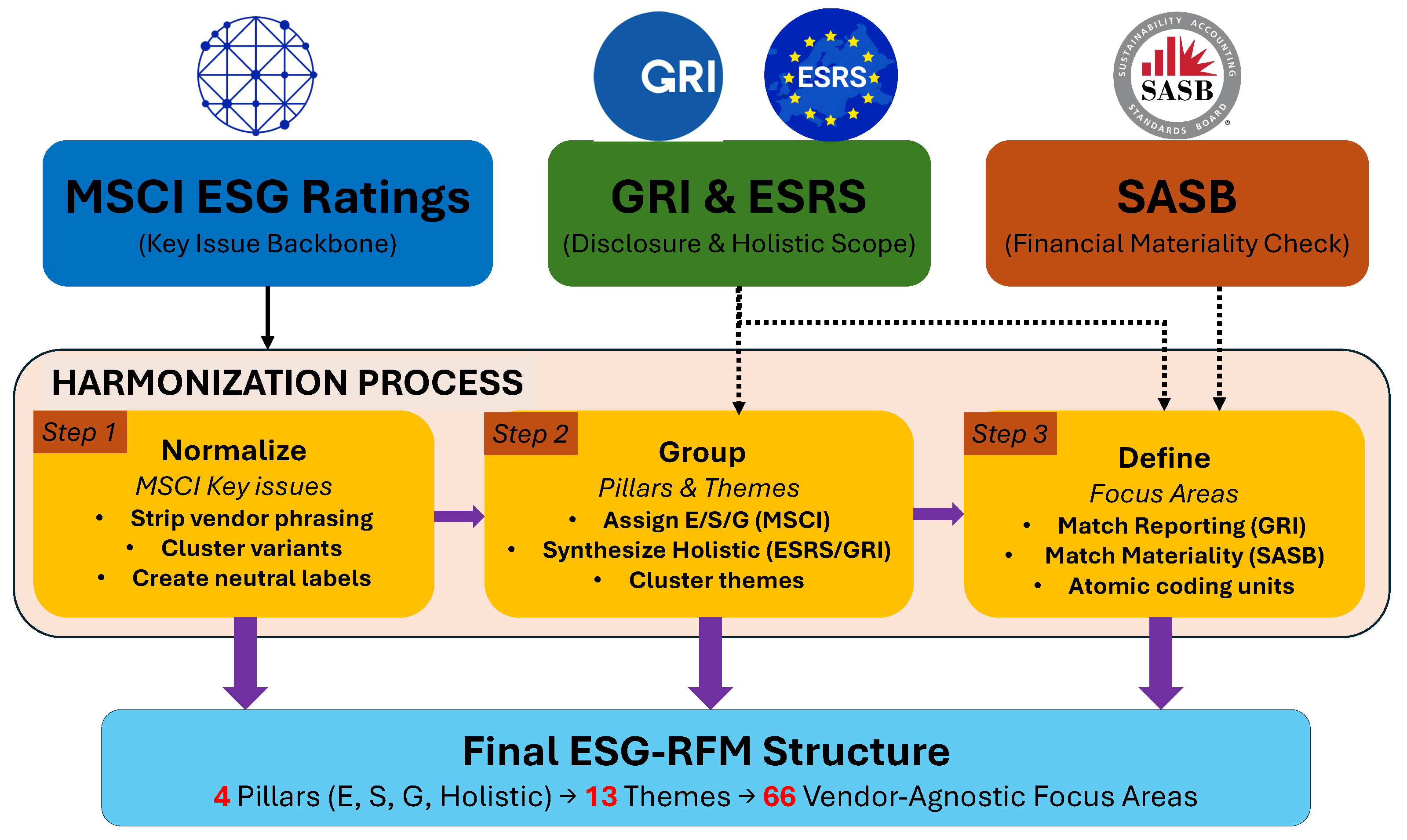
Figure A1 provides a visual overview of the three-step workflow used to construct and harmonize the ESG-RFM.
Appendix C.1. Source Frameworks and Priority Order
We integrate one widely used ESG rating methodology (MSCI1) with three prominent ESG standards families (GRI2, ESRS3, SASB4) to construct the ESG-RFM. These sources differ in purpose and scope, and this shapes the hierarchy we apply in organizing topics.
Figure A1.
Visual overview of the ESG-RFM construction process. The process involves three main steps: (1) Normalizing MSCI Key Issues, (2) Grouping them into pillars and themes with holistic input from GRI and ESRS, and (3) Defining focus areas by matching with GRI reporting and SASB materiality. This results in the final ESG-RFM structure comprising 4 pillars, 13 themes, and 66 focus areas.
Figure A1.
Visual overview of the ESG-RFM construction process. The process involves three main steps: (1) Normalizing MSCI Key Issues, (2) Grouping them into pillars and themes with holistic input from GRI and ESRS, and (3) Defining focus areas by matching with GRI reporting and SASB materiality. This results in the final ESG-RFM structure comprising 4 pillars, 13 themes, and 66 focus areas.
MSCI as the Structural Backbone MSCI’s ESG Ratings assess company performance on environmental, social, and governance issues relative to peers, focusing on how exposed a company is to ESG risks and how effectively it manages those risks. The methodology centers on a hierarchy of ESG topics (pillar → theme → key issue), and is broadly adopted by investors for comparative assessment of corporate sustainability performance. We use MSCI’s Environmental, Social, and Governance pillar assignments as the structural backbone of the map and as the starting point for topic normalization and cross-framework alignment.
GRI for Detailed Vocabulary and Reporting Practice The Global Reporting Initiative (GRI) Standards provide comprehensive guidance for sustainability reporting on a wide range of environmental, social, and governance topics. GRI’s standards support organizations in identifying material sustainability issues and disclosing performance using standardized indicators and terminology, which enhances clarity and comparability in reporting. Because GRI elaborates specific indicators and reporting expectations, we use its standards to refine and articulate the terminology of broader ESG topics, anchoring them in widely recognized disclosure practice.
ESRS for double materiality and holistic expansion The European Sustainability Reporting Standards (ESRS), developed under the Corporate Sustainability Reporting Directive (CSRD), require companies to assess sustainability matters through a double materiality lens, considering both how sustainability issues affect the company and how the company’s activities impact society and the environment. This dual approach goes beyond a solely investor-centric perspective by integrating both financial and impact materiality. ESRS’s structured topical standards allow broad issues to be conceptually unpacked into distinct material components and support formulation of broader themes that extend beyond the core three pillars of ESG.
SASB as a financial-materiality lens The SASB Standards (now maintained by the IFRS Foundation) provide industry-based disclosure standards that focus on sustainability issues most likely to have material impacts on a company’s financial performance. Rather than adopting SASB’s detailed industry-level standards wholesale, we use SASB’s emphasis on financial materiality as a consistency check to ensure that theme groupings in the map align with considerations that matter for investor decision-making.
Across all four pillars of ESG-RFM, the integration of these sources ensures broad coverage: MSCI defines the structural backbone of environmental, social, and governance categories; GRI supplies reporting terminology and disclosure scope; ESRS embeds double materiality and supports extension into expansive sustainability concepts; and SASB reinforces financial-materiality interpretation for thematic coherence. This priority structure is reflected in the crosswalk Table A1 and Table A2, which map ESG-RFM labels to their upstream sources.
Appendix C.2. ESG-RFM Construction and Harmonization Process
The harmonization proceeds in three steps.
Step 1: Normalizing MSCI key issues into neutral labels
We begin by taking the full set of MSCI ESG Ratings key issues as the initial universe of issuer-level ESG topics and normalizing them into a vendor-agnostic pool of candidate labels. This normalization removes framework-specific phrasing and consolidates semantically equivalent issues into neutral ESG focus candidates, while preserving the original Environmental, Social, and Governance pillar assignments defined by MSCI. The result is a standardized topic layer that retains MSCI’s coverage and structural backbone, while enabling consistent cross-framework alignment and subsequent harmonization with ESRS, GRI, SASB, and the broader ESG literature.
Step 2: Grouping topics into pillars and themes
Next, we organize the normalized candidate topics into a four-pillar structure, with a set of themes defined within each pillar. Topics originating from MSCI Environmental, Social, and Governance key issues retain their original pillar assignments and are mapped directly to the Environmental, Social, and Governance pillars, respectively. In addition, we introduce a Holistic pillar to capture cross-cutting concepts that are not modeled as a separate pillar in MSCI but are explicitly articulated in ESRS, GRI, SASB, and the broader ESG literature. This pillar covers concepts such as materiality analysis, just transition, circular-economy perspectives, and systemic sustainability models.
Within each pillar, we define themes by clustering candidate topics that are conceptually related and that form coherent blocks in disclosure practice and rating methodologies across MSCI, GRI, ESRS, and SASB. While MSCI also defines themes, we apply vendor-agnostic naming and (where needed) slight re-scoping to support cross-standard alignment and to accommodate the additional Holistic pillar.
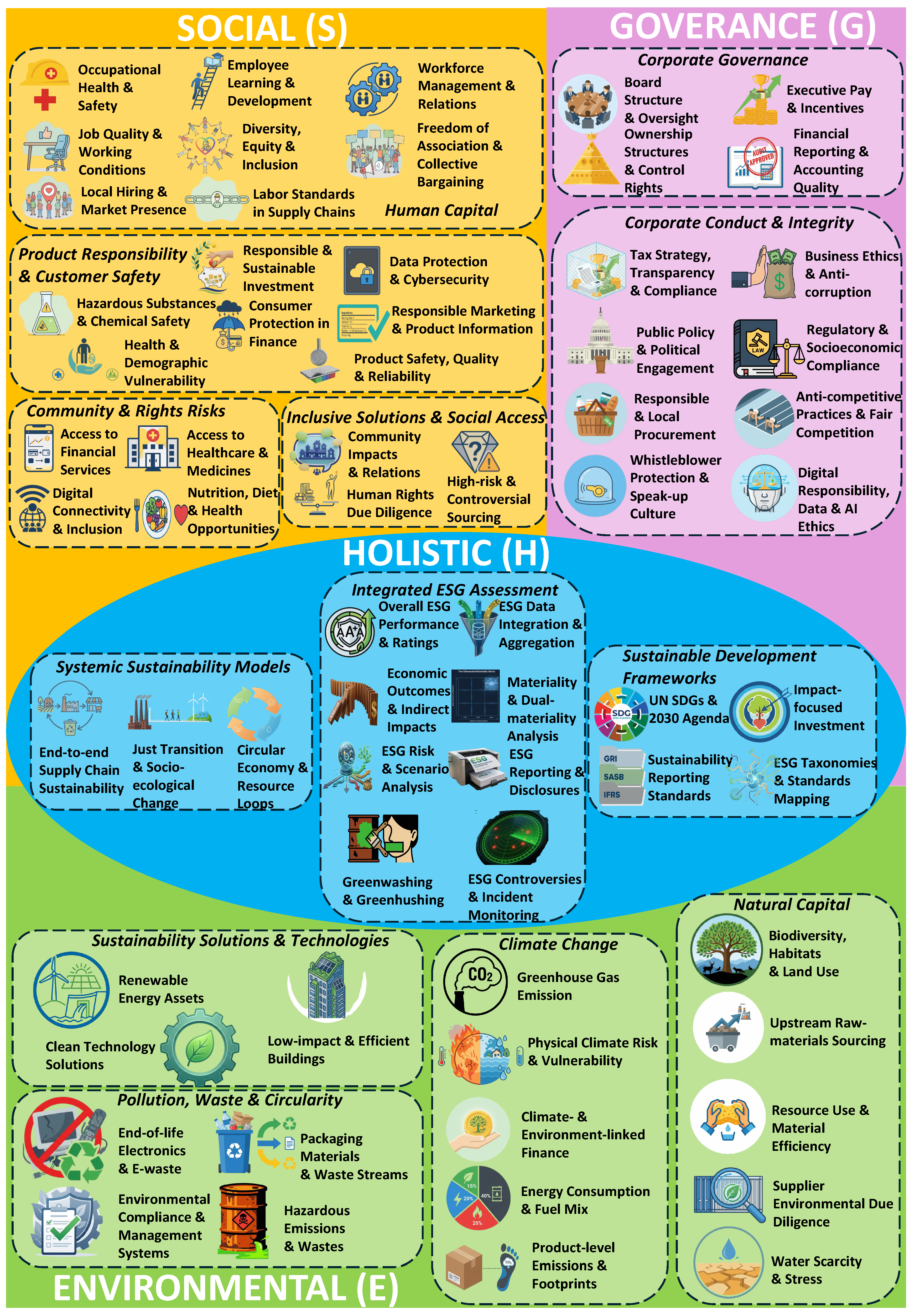
The Environmental pillar is organized into four themes: (i) Climate Change, (ii) Natural Capital, (iii) Pollution, Waste and Circularity, and (iv) Sustainability Solutions and Technologies.
The Social pillar comprises four themes: (i) Human Capital, (ii) Product Responsibility and Customer Safety, (iii) Community and Rights Risks, and (iv) Inclusive Solutions and Social Access.
The Governance pillar is structured around two themes: (i) Corporate Governance and (ii) Corporate Conduct and Integrity.
Finally, the Holistic pillar is divided into three themes: (i) Integrated ESG Assessment, (ii) Sustainable Development Frameworks, and (iii) Systemic Sustainability Models. These themes draw primarily on ESRS and GRI, with additional support from SASB and recurring practices observed in the academic literature, rather than from standalone MSCI key issues.
At this stage, we use GRI and ESRS primarily to check that theme boundaries correspond to coherent disclosure blocks. For instance, MSCI’s “Water Stress” key issue is grouped with other water- and ecosystem-related topics under Natural Capital, in line with GRI 303 (Water and Effluents) and ESRS E3 (Water and marine resources). The resulting mapping between KG4ESG pillars and themes and representative MSCI, GRI, ESRS, and SASB topics is summarized in Table A1.
Step 3: Defining focus areas as units of analysis
Within each theme, we define focus as the atomic units of analysis used for querying and coding the KG4ESG corpus. Each focus area is anchored in one or more MSCI key issues, or in cross-cutting MSCI metrics for the Environmental, Social, and Governance pillars, which serve as the structural backbone of the taxonomy.
For the Holistic pillar, focus areas are instead grounded in explicit cross-cutting constructs defined in ESRS and GRI, with additional support from SASB and recurring patterns observed in the academic literature, rather than being tied to a single MSCI key issue.
Across all pillars, each focus area is required to have at least one clear correspondence in GRI or ESRS, ensuring well-defined disclosure scope and impact materiality, and typically aligns with one or more SASB general issue categories where applicable, providing a complementary perspective on financial materiality.
Table A2 presents each ESG-RFM focus as one row, with the right-hand columns showing the closest upstream topics in MSCI, GRI, ESRS and SASB. This mapping is deliberately compact and non-exhaustive: it records the main anchors that informed the KG4ESG label rather than attempting to list all possible standard references.
Appendix C.3. Pillar–Theme Mapping Between the ESG-RFM and ESG Frameworks
To document the construction of the ESG-RFM, this subsection sets out how the pillar–theme structure aligns with upstream ESG standards and ratings. The KG4ESG labels are deliberately paraphrased and vendor-agnostic, so the mapping is indicative rather than strictly one-to-one. The right-hand columns of Table A1 summarise, in a compact and non-exhaustive way, the most closely related topics in MSCI, GRI, ESRS and SASB.

Table A1.
Conceptual crosswalk between the ESG-RFM (pillar–theme; abbreviations per Table A3) and representative topics in MSCI, GRI, ESRS and SASB. Multiple upstream issues can map to a single KG4ESG theme and vice versa. Wording in the right-hand columns is summarised and does not reproduce the original frameworks.
Table A1.
Conceptual crosswalk between the ESG-RFM (pillar–theme; abbreviations per Table A3) and representative topics in MSCI, GRI, ESRS and SASB. Multiple upstream issues can map to a single KG4ESG theme and vice versa. Wording in the right-hand columns is summarised and does not reproduce the original frameworks.
| Pillar | Theme | MSCI key issues (representative) | GRI / ESRS topics (representative) | SASB issue categories (representative) |
|---|---|---|---|---|
| E | ClimChg | Carbon Emissions; Climate Change Vulnerability; Financing Environmental Impact; Product Carbon Footprint | GRI: GRI 102: Climate Change 2025; GRI 103: Energy 2025 (legacy: GRI 302/305, GRI 201-2); ESRS: E1 Climate change (transition and physical risks, decarbonisation) | Environment: GHG Emissions; Energy Management; Physical impacts of climate change |
| E | NatCap | Biodiversity & Land Use; Raw Material Sourcing; Water Stress; Materials Use & Resource Efficiency (via resource-related indicators) | GRI: Materials, Water and Effluents, Biodiversity, Supplier Environmental Assessment; ESRS: E3 Water and marine resources, E4 Biodiversity and ecosystems, E5 Resource use and circular economy, S2 Workers in the value chain | Environment: Water & Wastewater Management; Ecological Impacts; Resource Efficiency; Supply Chain Management |
| E | PolWasCiru | Toxic Emissions & Waste; Packaging Material & Waste; Electronic Waste; cross-cutting compliance indicators | GRI: Emissions, Waste, Environmental Compliance; ESRS: E2 Pollution, E5 Resource use and circular economy | Environment: Air Quality; Waste & Hazardous Materials Management; Product Design & Lifecycle Management |
| E | SustSolTech | Opportunities in Clean Tech; Opportunities in Renewable Energy; Opportunities in Green Building | GRI: Energy, Emissions, Indirect Economic Impacts; ESRS: E1 Climate change, E5 Resource use and circular economy | Environment: GHG Emissions; Energy Management; Business Model & Innovation (low-carbon products) |
| S | HumCap | Health & Safety; Human Capital Development; Labor Management; Supply Chain Labor Standards (plus diversity- and job-quality-related metrics) | GRI: Employment, Labour/Management Relations, Occupational Health and Safety, Training and Education, Diversity and Equal Opportunity, Non-discrimination, Market Presence, Supplier Social Assessment; ESRS: S1 Own workforce, S2 Workers in the value chain | Human Capital: Employee Health & Safety; Labor Practices; Employee Engagement, Diversity & Inclusion; Supply Chain Management |
| S | ProdRespCustSafe | Chemical Safety; Consumer Financial Protection; Privacy & Data Security; Product Safety & Quality; Health & Demographic Risk; Responsible Marketing & Product Labeling; Responsible Investment | GRI: Product Quality and Safety, Marketing and Labeling, Customer Health and Safety, Customer Privacy, Financial sector supplements; ESRS: S4 Consumers and end-users, E2 Pollution (hazardous substances) | Social Capital: Product Quality & Safety; Customer Welfare; Customer Privacy; Access & Affordability; Leadership & Governance (Financials) |
| S | ComRigRisks | Community Relations; Controversial Sourcing; human-rights-related factors across social key issues | GRI: Local Communities, Human Rights series, Supplier Social Assessment; ESRS: S2 Workers in the value chain, S3 Affected communities | Social Capital: Human Rights & Community Relations; Supply Chain Management |
| S | IncSolSocAcc | Access to Finance; Access to Health Care; Access to Communications; Opportunities in Nutrition & Health | GRI: Product and Service Labelling, Indirect Economic Impacts, sector standards (financial, health, telecom); ESRS: S3 Affected communities, S4 Consumers and end-users | Social Capital: Access & Affordability; Product Quality & Safety; Business Model & Innovation (inclusive products) |
| G | CorpGov | Board; Pay; Ownership & Control; Accounting | GRI: Governance structure and composition, Remuneration; ESRS: ESRS 2 General disclosures (governance) | Leadership & Governance: Board structure & oversight; Incentive structure; Systemic risk management |
| G | CorpCondInt | Business Ethics; Tax Transparency; Public Policy; cross-cutting compliance and controversy indicators | GRI: Anti-corruption, Anti-competitive Behaviour, Tax, Socioeconomic Compliance, Procurement Practices, Customer Privacy; ESRS: G1 Business conduct, ESRS 2 Governance disclosures | Leadership & Governance: Business Ethics; Competitive Behaviour; Tax Transparency; Regulatory environment; Social Capital: Customer Privacy; Supply Chain Management |
| H | ESGIntAss | Overall ESG performance and rating; ESG risk management; data integration; materiality assessment; scenario analysis; reporting & disclosure; controversies | GRI: Material topics and general disclosures; ESRS: ESRS 1 General requirements, ESRS 2 General disclosures and cross-topic matters | Cross-cutting: Topic selection and materiality; Risk Management; Data security & reporting across all SASB dimensions |
| H | SDFrame | SDG alignment; impact investing; reporting frameworks; ESG taxonomies and standards alignment | GRI: SDG mapping and sector-specific standards; ESRS: references to EU Taxonomy and SDGs, interoperability guidance | Cross-cutting: SDG alignment; Impact metrics; Framework mapping (e.g. GRI / SASB / TCFD) |
| H | SysSustMod | Circular economy; holistic supply chain sustainability; just transition and socio-ecological transformation | GRI: Materials, Waste, Economic, Social topics; ESRS: E5 Resource use and circular economy, S1–S4 social standards | Environment: Resource Efficiency & Waste; Social Capital: Community Relations; Human Capital: Labor Practices; Business Model & Innovation |
Figure A2.
The ESG Research Focus Map (ESG-RFM). The map organizes ESG research into a three-level hierarchy of pillars, themes, and research focus, integrating ESG rating methodologies and reporting standards to provide a unified semantic structure for corpus annotation, cross-study comparison, and downstream knowledge graph construction.
Figure A2.
The ESG Research Focus Map (ESG-RFM). The map organizes ESG research into a three-level hierarchy of pillars, themes, and research focus, integrating ESG rating methodologies and reporting standards to provide a unified semantic structure for corpus annotation, cross-study comparison, and downstream knowledge graph construction.
Appendix C.4. Focus-Level Mapping Between the ESG-RFM and ESG Frameworks
Appendix C.5. Focus-Level Mapping Between the ESG-RFM and ESG Frameworks
At the focus level, the ESG-RFM becomes more granular. In what follows, each focus is linked to the closest upstream topics across the four frameworks. MSCI ESG key issues remain the main starting point for issuer-level topics, but for many focus areas—especially social sub-topics and holistic concepts such as dual materiality or just transition—the most informative upstream anchors come from GRI, ESRS or SASB rather than from a single MSCI key issue. The long table below provides a compact, non-exhaustive crosswalk. Where no dedicated MSCI key issue exists, the MSCI column explicitly notes that the concept is covered via cross-cutting metrics or through several key issues combined.
Table A2.
Focus-level crosswalk between the ESG-RFM (pillar–theme–focus) and representative topics in MSCI, GRI, ESRS and SASB. Multiple upstream issues can map to a single KG4ESG focus area and vice versa. Wording in the right-hand columns is summarized and does not reproduce the original frameworks.
Table A2.
Focus-level crosswalk between the ESG-RFM (pillar–theme–focus) and representative topics in MSCI, GRI, ESRS and SASB. Multiple upstream issues can map to a single KG4ESG focus area and vice versa. Wording in the right-hand columns is summarized and does not reproduce the original frameworks.
| Pillar | Theme | Focus | MSCI topics (representative) | GRI / ESRS topics (representative) | SASB issue categories (representative) |
|---|---|---|---|---|---|
| E | ClimChg | GHG | Carbon Emissions; (partly) Product Carbon Footprint | GRI 102: Climate Change 2025; GRI 103: Energy 2025 (legacy: GRI 302: Energy; GRI 305: Emissions); ESRS E1 Climate change (GHG emissions, energy use) | Environment: GHG Emissions; Energy Management |
| E | ClimChg | PhysClimRisk | Climate Change Vulnerability | GRI 201: Economic Performance (climate-related financial implications; legacy: GRI 201-2); GRI 102: Climate Change 2025; ESRS E1 Climate change (physical risks, scenario analysis) | Environment: Physical impacts of climate change; cross-cutting climate risk metrics |
| E | ClimChg | ClimFin | Financing Environmental Impact | GRI 201: Economic Performance; GRI 203: Indirect Economic Impacts; GRI 102: Climate Change 2025; ESRS E1 Climate change (transition plans, financed emissions); ESRS E5 Resource use and circular economy (green finance for circular solutions) | Environment & Business Model/Innovation: GHG Emissions and Energy Management for financed activities; Product Design & Lifecycle for green products |
| E | ClimChg | EnergyMix | Primarily captured within Carbon Emissions key issue (energy intensity and fuel mix metrics) | GRI 103: Energy 2025; GRI 102: Climate Change 2025 (legacy: GRI 302/305); ESRS E1 Climate change (energy consumption and mix) | Environment: Energy Management; Fuel Management |
| E | ClimChg | ProdFoot | Product Carbon Footprint | GRI 102: Climate Change 2025 (value-chain emissions); GRI 301: Materials (legacy: GRI 305: Emissions); ESRS E1 Climate change (value-chain emissions) | Environment & Business Model/Innovation: GHG Emissions; Product Design & Lifecycle Management |
| E | NatCap | BiodivLU | Biodiversity & Land Use | GRI 304: Biodiversity; ESRS E4 Biodiversity and ecosystems | Environment: Ecological Impacts |
| E | NatCap | RawSrc | Raw Material Sourcing | GRI 301: Materials; GRI 204: Procurement Practices; GRI 308: Supplier Environmental Assessment; ESRS E5 Resource use and circular economy; ESRS S2 Workers in the value chain | Environment & Social Capital: Ecological Impacts; Supply Chain Management |
| E | NatCap | ResUseMatEff | Raw Material Sourcing; (indirectly) Electronic Waste and Packaging Material & Waste where resource efficiency affects downstream waste | GRI 301: Materials; GRI 302: Energy; GRI 306: Waste; ESRS E5 Resource use and circular economy | Environment & Business Model/Innovation: Waste & Hazardous Materials Management; Product Design & Lifecycle Management |
| E | NatCap | SuppEnvDD | No dedicated key issue; mainly reflected through Raw Material Sourcing, Electronic Waste and sector-specific supply-chain indicators across the Environmental pillar | GRI 308: Supplier Environmental Assessment; GRI 204: Procurement Practices; ESRS E2–E5 environmental standards and ESRS S2 Workers in the value chain | Environment & Social Capital: Supply Chain Management; Ecological Impacts |
| E | NatCap | WaterSS | Water Stress | GRI 303: Water and Effluents; ESRS E3 Water and marine resources | Environment: Water & Wastewater Management |
| E | PolWasCiru | EWaste | Electronic Waste | GRI 301: Materials; GRI 306: Waste; GRI 303: Water and Effluents (where relevant); ESRS E2 Pollution; ESRS E5 Resource use and circular economy | Environment: Waste & Hazardous Materials Management; Product Design & Lifecycle Management |
| E | PolWasCiru | PackWaste | Packaging Material & Waste | GRI 301: Materials; GRI 306: Waste; ESRS E2 Pollution; ESRS E5 Resource use and circular economy | Environment: Waste & Hazardous Materials Management; Product Design & Lifecycle Management |
| E | PolWasCiru | EnvComp | No single dedicated key issue; environmental compliance and management systems are cross-cutting metrics used to assess performance on all Environmental key issues | GRI 307: Environmental Compliance; GRI 305: Emissions; GRI 306: Waste; ESRS 2 General disclosures (compliance with laws and regulations); ESRS E2 Pollution | Environment & Leadership/Governance: Air Quality; Waste & Hazardous Materials Management; Systemic risk and compliance management |
| E | PolWasCiru | HazWaste | Toxic Emissions & Waste | GRI 305: Emissions; GRI 306: Waste; GRI 303: Water and Effluents; GRI 307: Environmental Compliance; ESRS E2 Pollution | Environment: Air Quality; Waste & Hazardous Materials Management |
| E | SustSolTech | CleanTech | Opportunities in Clean Tech | GRI 302: Energy; GRI 305: Emissions; GRI 201: Economic Performance (green revenues); ESRS E1 Climate change (transition plans, low-carbon products); ESRS E5 Resource use and circular economy | Environment & Business Model/Innovation: GHG Emissions; Energy Management; Product Design & Lifecycle Management (low-carbon solutions) |
| E | SustSolTech | GreenBldg | Opportunities in Green Building | GRI 302: Energy; GRI 305: Emissions; GRI 303: Water and Effluents; GRI 306: Waste; ESRS E1 Climate change (building energy performance); ESRS E3 Water and marine resources; ESRS E5 Resource use and circular economy | Environment: Energy Management; Water & Wastewater Management; Waste & Hazardous Materials Management; Business Model/Innovation: Product Design & Lifecycle Management (building design) |
| E | SustSolTech | ReEneg | Opportunities in Renewable Energy | GRI 302: Energy; GRI 305: Emissions; GRI 201: Economic Performance (renewable investments); ESRS E1 Climate change (renewable energy generation and use) | Environment: GHG Emissions; Energy Management; Business Model/Innovation: Product Design & Lifecycle Management (renewable offerings) |
| S | HumCap | OHS | Health & Safety | GRI 403: Occupational Health and Safety; GRI 401: Employment; ESRS S1 Own workforce (health and safety); ESRS S2 Workers in the value chain (OHS in supply chains) | Human Capital: Employee Health & Safety |
| S | HumCap | LearnDev | Human Capital Development | GRI 404: Training and Education; GRI 401: Employment; ESRS S1 Own workforce (skills, training, career development) | Human Capital: Labor Practices; Employee Engagement, Diversity & Inclusion (training, retention) |
| S | HumCap | WorkManRel | Labor Management | GRI 402: Labour/Management Relations; GRI 401: Employment; ESRS S1 Own workforce; ESRS S2 Workers in the value chain | Human Capital: Labor Practices; Employee Engagement, Diversity & Inclusion |
| S | HumCap | JobQual | No dedicated key issue; mainly reflected in Health & Safety and Labor Management key issues and related Human Capital metrics | GRI 401: Employment; GRI 403: Occupational Health and Safety; GRI 404: Training and Education; ESRS S1 Own workforce (fair wages, work conditions) | Human Capital: Labor Practices; Employee Health & Safety; Employee Engagement, Diversity & Inclusion |
| S | HumCap | DEI | Assessed as part of Human Capital theme (e.g. workforce diversity metrics under Labor Management and Human Capital Development) | GRI 405: Diversity and Equal Opportunity; GRI 406: Non-discrimination; ESRS S1 Own workforce (diversity, equal treatment) | Human Capital: Employee Engagement, Diversity & Inclusion |
| S | HumCap | FoACollB | Assessed primarily within Labor Management key issue (unionization, collective bargaining) and related controversy indicators | GRI 407: Freedom of Association and Collective Bargaining; GRI 402: Labour/Management Relations; ESRS S1 Own workforce and ESRS S2 Workers in the value chain (freedom of association and CB) | Human Capital & Social Capital: Labor Practices; Supply Chain Management |
| S | HumCap | LocHirMarPre | Addressed through market-presence and employment-related metrics within the Human Capital theme, rather than a standalone key issue | GRI 202: Market Presence; GRI 203: Indirect Economic Impacts; GRI 401: Employment; ESRS S1 Own workforce; ESRS S3 Affected communities | Human Capital & Social Capital: Labor Practices; Human Rights & Community Relations |
| S | HumCap | LabStanSC | Supply Chain Labor Standards | GRI 414: Supplier Social Assessment; GRI 408: Child Labor; GRI 409: Forced or Compulsory Labour; ESRS S2 Workers in the value chain; ESRS S3 Affected communities | Social Capital & Human Capital: Supply Chain Management; Human Rights & Community Relations |
| S | ProdRespCustSafe | ChemSafe | Chemical Safety | GRI 416: Customer Health and Safety; GRI 306: Waste; GRI 303: Water and Effluents (discharges of hazardous substances); ESRS E2 Pollution; ESRS S4 Consumers and end-users | Environment & Social Capital: Waste & Hazardous Materials Management; Product Quality & Safety; Customer Welfare |
| S | ProdRespCustSafe | FinProt | Consumer Financial Protection | GRI 416: Customer Health and Safety; GRI 417: Marketing and Labeling; GRI 418: Customer Privacy; financial sector GRI supplements; ESRS S4 Consumers and end-users (fair treatment, product suitability) | Social Capital: Customer Welfare; Product Quality & Safety; Customer Privacy & Data Security |
| S | ProdRespCustSafe | DataSec | Privacy & Data Security | GRI 418: Customer Privacy; GRI 419: Socioeconomic Compliance (for data-related fines); ESRS S4 Consumers and end-users (privacy, security); ESRS G1 Business conduct (data and digital ethics) | Social Capital & Leadership/Governance: Customer Privacy; Data Security; Business Ethics |
| S | ProdRespCustSafe | ProdQual | Product Safety & Quality | GRI 416: Customer Health and Safety; GRI 417: Marketing and Labelling; ESRS S4 Consumers and end-users (product safety and quality) | Social Capital: Product Quality & Safety; Customer Welfare; Selling Practices & Product Labeling |
| S | ProdRespCustSafe | HealVuln | Health & Demographic Risk | GRI 416: Customer Health and Safety; GRI 203: Indirect Economic Impacts; GRI 413: Local Communities; ESRS S3 Affected communities; ESRS S4 Consumers and end-users | Social Capital: Customer Welfare; Human Rights & Community Relations |
| S | ProdRespCustSafe | RespMkt | Responsible Marketing & Product Labeling | GRI 417: Marketing and Labeling; GRI 416: Customer Health and Safety; ESRS S4 Consumers and end-users (marketing, communication, fair treatment) | Social Capital: Selling Practices & Product Labeling; Customer Welfare |
| S | ProdRespCustSafe | RSInv | Responsible Investment | GRI 201: Economic Performance; GRI 203: Indirect Economic Impacts; financial-sector GRI standards; ESRS E1–E5 and S1–S4 as underlying sustainability impacts considered in investment products | Cross-cutting across SASB dimensions for financials (e.g. GHG Emissions, Customer Welfare, Human Capital, Business Ethics) |
| S | ComRigRisks | ComRel | Community Relations | GRI 413: Local Communities; GRI 411: Rights of Indigenous Peoples; ESRS S3 Affected communities | Social Capital: Human Rights & Community Relations |
| S | ComRigRisks | HRDD | Addressed across Social key issues (e.g. Labor Management, Supply Chain Labor Standards, Community Relations) rather than a single named key issue | GRI 408: Child Labor; GRI 409: Forced or Compulsory Labor; GRI 410: Security Practices; GRI 414: Supplier Social Assessment; ESRS S1–S3 social standards; ESRS G1 Business conduct | Social Capital & Human Capital: Human Rights & Community Relations; Labor Practices; Supply Chain Management |
| S | ComRigRisks | RiskSrc | Controversial Sourcing | GRI 204: Procurement Practices; GRI 308: Supplier Environmental Assessment; GRI 414: Supplier Social Assessment; ESRS S2 Workers in the value chain; ESRS S3 Affected communities; ESRS E3/E5 (high-risk raw materials) | Environment & Social Capital: Supply Chain Management; Ecological Impacts; Human Rights & Community Relations |
| S | IncSolSocAcc | FinAcc | Access to Finance | GRI 203: Indirect Economic Impacts; GRI 416: Customer Health and Safety; sector-specific financial services Standards; ESRS S4 Consumers and end-users (access and affordability of financial services) | Social Capital: Access & Affordability; Customer Welfare |
| S | IncSolSocAcc | HealAcc | Access to Health Care | GRI 416: Customer Health and Safety; GRI 203: Indirect Economic Impacts; GRI 413: Local Communities; ESRS S3 Affected communities; ESRS S4 Consumers and end-users | Social Capital: Access & Affordability; Customer Welfare; Product Quality & Safety |
| S | IncSolSocAcc | DigIncl | Access to Communications | GRI 203: Indirect Economic Impacts; GRI 413: Local Communities; GRI 416: Customer Health and Safety; ESRS S1 Own workforce (digital inclusion of employees); ESRS S4 Consumers and end-users (digital access, inclusion) | Social Capital: Access & Affordability; Customer Welfare; Data Security |
| S | IncSolSocAcc | NutriHeal | Opportunities in Nutrition & Health | GRI 416: Customer Health and Safety; GRI 203: Indirect Economic Impacts; GRI 413: Local Communities; ESRS S3 Affected communities; ESRS S4 Consumers and end-users | Social Capital: Customer Welfare; Access & Affordability; Product Quality & Safety |
| G | CorpGov | BoardOvr | Board | GRI 2: General Disclosures (governance structure and composition); ESRS 2 General disclosures (governance, strategy and management of impacts and risks) | Leadership & Governance: Board structure and oversight; Systemic risk management |
| G | CorpGov | ExecPay | Pay | GRI 2: General Disclosures (remuneration policies and practices); GRI 201: Economic Performance (links to variable remuneration); ESRS 2 General disclosures (incentives linked to sustainability performance) | Leadership & Governance: Incentive and remuneration alignment; Business Ethics |
| G | CorpGov | OwnCtrl | Ownership & Control | GRI 2: General Disclosures (ownership and control); GRI 207: Tax (transparency on structures); ESRS 2 General disclosures; ESRS G1 Business conduct (transparency, beneficial ownership) | Leadership & Governance: Business Ethics; Competitive Behavior; Systemic risk management |
| G | CorpGov | FinRepQ | Accounting | GRI 201: Economic Performance; GRI 2: General Disclosures (internal controls, audit, governance); ESRS 1 General requirements and ESRS 2 General disclosures (link between sustainability and financial information) | Leadership & Governance: Systemic risk management; Business Ethics |
| G | CorpCondInt | EthicsAC | Business Ethics | GRI 205: Anti-corruption; GRI 206: Anti-competitive Behavior; GRI 419: Socioeconomic Compliance; ESRS G1 Business conduct | Leadership & Governance: Business Ethics; Competitive Behavior; Systemic risk management |
| G | CorpCondInt | TaxTrans | Tax Transparency | GRI 207: Tax; GRI 201: Economic Performance; GRI 419: Socioeconomic Compliance; ESRS G1 Business conduct (tax governance, country-by-country reporting) | Leadership & Governance: Business Ethics (tax planning and transparency); Systemic risk management |
| G | CorpCondInt | PolEngage | Public Policy | GRI 415: Public Policy; GRI 201: Economic Performance (public subsidies); GRI 419: Socioeconomic Compliance; ESRS G1 Business conduct; ESRS 2 General disclosures (lobbying, political engagement) | Leadership & Governance: Business Ethics; Systemic risk management; Social Capital: Human Rights & Community Relations (policy impacts) |
| G | CorpCondInt | RegComp | Reflected through cross-cutting compliance indicators rather than a named key issue (e.g. fines and controversies across Environmental, Social and Governance topics) | GRI 419: Socioeconomic Compliance; GRI 307: Environmental Compliance; GRI 2-27: Compliance with laws and regulations; ESRS 2 General disclosures (compliance and litigation) | Leadership & Governance: Business Ethics; Systemic risk and compliance management |
| G | CorpCondInt | RespProc | Assessed mainly through Community Relations, Raw Material Sourcing and Supply Chain Labor Standards key issues, depending on impact type | GRI 204: Procurement Practices; GRI 308: Supplier Environmental Assessment; GRI 414: Supplier Social Assessment; GRI 413: Local Communities; ESRS S2 Workers in the value chain; ESRS E5 Resource use and circular economy | Environment, Human Capital & Social Capital: Supply Chain Management; Human Rights & Community Relations |
| G | CorpCondInt | FairComp | Covered primarily within Business Ethics key issue (anti-competitive conduct, market abuse) and related controversy indicators | GRI 206: Anti-competitive Behavior; GRI 205: Anti-corruption; ESRS G1 Business conduct | Leadership & Governance: Competitive Behavior; Business Ethics |
| G | CorpCondInt | Whistle | Included within Business Ethics key issue (whistleblower mechanisms, retaliation risks) and across governance controversy indicators | GRI 2: General Disclosures (ethics, integrity, speaking up); GRI 205: Anti-corruption; GRI 406: Non-discrimination; ESRS G1 Business conduct | Leadership & Governance: Business Ethics; Systemic risk and compliance management |
| G | CorpCondInt | AIEthics | Most closely linked to Privacy & Data Security and Business Ethics key issues, as well as to emerging “digital responsibility” assessments in ESG ratings | GRI 418: Customer Privacy; GRI 416: Customer Health and Safety (digital products); GRI 205: Anti-corruption; ESRS S4 Consumers and end-users (digital services, privacy and safety); ESRS G1 Business conduct (AI and digital conduct) | Social Capital & Leadership/Governance: Customer Privacy; Data Security; Business Ethics |
| H | ESGIntAss | ESGRate | Overall MSCI ESG rating derived from the full set of Environmental, Social and Governance key issues | GRI 1: Foundation; GRI 2: General Disclosures; GRI 3: Material Topics; full suite of topic Standards; ESRS 1 General requirements; ESRS 2 General disclosures | Cross-cutting across all Environment, Social Capital, Human Capital, Business Model & Innovation, and Leadership & Governance issues |
| H | ESGIntAss | ESGData | Data architecture and aggregation rules underlying the ESG Ratings methodology rather than a discrete key issue | GRI 2: General Disclosures (data quality, boundaries, restatements); GRI 3: Material Topics; ESRS 2 General disclosures (data, estimates, and value-chain coverage) | Leadership & Governance: Systemic risk management and disclosure quality; cross-cutting use of SASB indicators |
| H | ESGIntAss | EconImp | Indirect economic and social effects captured across E, S and G key issues (e.g. community impacts, employment, innovation) rather than a separate key issue | GRI 201: Economic Performance; GRI 203: Indirect Economic Impacts; GRI 204: Procurement Practices; ESRS E1–E5 and S1–S4 (impacts, risks and opportunities on economy and society) | Cross-cutting: Business Model & Innovation (economic resilience); Social Capital and Human Capital (distributional and community effects) |
| H | ESGIntAss | DualMat | Internal process for issue weighting and materiality mapping that determines the selection and weight of key issues in the overall rating | GRI 3: Material Topics (materiality determination); GRI 1: Foundation (impact materiality); ESRS 1 General requirements (double materiality) and ESRS 2 General disclosures (material impacts, risks and opportunities) | All SASB dimensions, via the SASB Materiality Map used to identify financially material issues |
| H | ESGIntAss | ESGScen | Climate and ESG risk assessment embedded in key issues such as Carbon Emissions, Climate Change Vulnerability, Business Ethics and others | GRI Climate Change and Energy Standards (GRI 102 Climate Change 2025 and revised GRI 302/305); GRI 201: Economic Performance (climate-related financial implications); ESRS E1 Climate change (risk and scenario analysis) and other topical ESRS standards | Environment & Leadership/Governance: Physical impacts of climate change; Systemic risk management; cross-cutting risk metrics |
| H | ESGIntAss | ESGRept | Underlying disclosure coverage and transparency assessments across all key issues and pillars | GRI 1, GRI 2 and GRI 3 (overall reporting architecture); all topic Standards; ESRS 1 General requirements; ESRS 2 General disclosures | Cross-cutting: all SASB issues to the extent disclosed using SASB metrics and narrative |
| H | ESGIntAss | GreenWH | Reflected mainly in Business Ethics and ESG controversy indicators (misleading claims, selective disclosure, controversies on sustainability claims) | GRI 2-22 and 2-27 (sustainable development strategy and compliance); GRI 417: Marketing and Labelling; GRI 419: Socioeconomic Compliance; ESRS 2 General disclosures; ESRS G1 Business conduct | Leadership & Governance: Business Ethics; Social Capital: Selling Practices & Product Labelling; Systemic risk and reputation management |
| H | ESGIntAss | ESGIncid | MSCI ESG Controversies framework, which flags incidents across all Environmental, Social and Governance key issues | GRI 2-27: Compliance with laws and regulations; GRI 307: Environmental Compliance; GRI 419: Socioeconomic Compliance; ESRS 2 General disclosures (incidents, severe impacts) and topical ESRS incident-related requirements | Cross-cutting across all SASB issues, captured via incident, controversy and regulatory metrics |
| H | SDFrame | SDGs | MSCI SDG-alignment analytics linking key issues and revenues to SDG targets | GRI SDG mapping guidance (linking topic Standards to SDGs); ESRS references to EU Taxonomy and SDG alignment in ESRS 1 and ESRS 2 | Cross-cutting: SASB SDG mapping linking general issue categories and industry metrics to SDG targets |
| H | SDFrame | ImpInv | MSCI impact and thematic ESG indexes and solutions derived from key issue exposures (e.g. climate, natural capital, social themes) | GRI 201: Economic Performance; GRI 203: Indirect Economic Impacts; sector-specific financial services Standards; ESRS E1–E5 and S1–S4 as impact lenses for investment products | Cross-cutting: environment, social and governance issues that underpin impact investing taxonomies and metrics |
| H | SDFrame | ReptStd | Considered as upstream frameworks informing MSCI data inputs and methodologies rather than key issues per se | GRI 1, GRI 2, GRI 3 and all topic Standards (full GRI architecture); ESRS 1 and ESRS 2 as the EU sustainability reporting baseline | All SASB industry-specific Standards and general issue categories, used as reporting and disclosure benchmarks |
| H | SDFrame | TaxMap | Internal mapping of MSCI key issues to regulations and taxonomies (e.g. EU Taxonomy, SFDR), used in product construction | GRI taxonomy of topics; ESRS references to EU Taxonomy and other frameworks (in ESRS 1 and topical appendices) | Cross-cutting mapping between SASB issues, SDGs, TCFD and other sustainability frameworks |
| H | SysSustMod | CircLoop | Reflected mainly in Raw Material Sourcing, Electronic Waste, Packaging Material & Waste and related key issues on resource efficiency | GRI 301: Materials; GRI 306: Waste; GRI 303: Water and Effluents; GRI 305: Emissions; ESRS E5 Resource use and circular economy | Environment & Business Model/Innovation: Waste & Hazardous Materials Management; Product Design & Lifecycle Management; Resource efficiency |
| H | SysSustMod | JustTrans | Cross-cutting across Carbon Emissions, Climate Change Vulnerability, Supply Chain Labor Standards and Community Relations key issues (transition impacts on workers and communities) | GRI 201: Economic Performance; GRI 203: Indirect Economic Impacts; GRI 413: Local Communities; GRI 408/409 on labour rights; ESRS E1 Climate change (just transition references); ESRS S1–S3 social standards | Environment, Human Capital & Social Capital: GHG Emissions; Labor Practices; Human Rights & Community Relations |
| H | SysSustMod | SCSust | Combination of Raw Material Sourcing, Supply Chain Labor Standards, Electronic Waste, Packaging Material & Waste, Controversial Sourcing and other value-chain key issues | GRI 204: Procurement Practices; GRI 308: Supplier Environmental Assessment; GRI 414: Supplier Social Assessment; GRI 303, 305 and 306 for environmental impacts; ESRS S2 Workers in the value chain; ESRS S3 Affected communities; ESRS E2–E5 environmental standards | Environment, Human Capital & Social Capital: Supply Chain Management; Ecological Impacts; Human Rights & Community Relations |
Appendix C.6. Abbreviation Dictionary for Pillars, Themes, and Focus
Table A3.
Pillar and theme abbreviations (E/S/G/H).
| Pillar (abbr.) | Theme | Theme abbr. |
|---|---|---|
| Environmental (E) | Climate Change | ClimChg |
| Natural Capital | NatCap | |
| Pollution, Waste & Circularity | PolWasCiru | |
| Sustainability Solutions & Technologies | SustSolTech | |
| Social (S) | Human Capital | HumCap |
| Product Responsibility & Customer Safety | ProdRespCustSafe | |
| Community & Rights Risks | ComRigRisks | |
| Inclusive Solutions & Social Access | IncSolSocAcc | |
| Governance (G) | Corporate Governance | CorpGov |
| Corporate Conduct & Integrity | CorpCondInt | |
| Holistic (H) | Integrated ESG Assessment | ESGIntAss |
| Sustainable Development Frameworks | SDFrame | |
| Systemic Sustainability Models | SysSustMod |
Table A4.
Focus abbreviations keyed by Pillar/Theme (e.g., E/ClimChg, S/HumCap).
| Pillar/Theme | Focus | Focus abbr. |
|---|---|---|
| E/ClimChg | Greenhouse Gas Emissions | GHG |
| E/ClimChg | Physical Climate Risk & Vulnerability | PhysClimRisk |
| E/ClimChg | Climate-& Environment-linked Finance | ClimFin |
| E/ClimChg | Energy Consumption & Fuel Mix | EnergyMix |
| E/ClimChg | Product-level Emissions & Footprints | ProdFoot |
| E/NatCap | Biodiversity, Habitats & Land Use | BiodivLU |
| E/NatCap | Upstream Raw-materials Sourcing | RawSrc |
| E/NatCap | Resource Use & Material Efficiency | ResUseMatEff |
| E/NatCap | Supplier Environmental Due Diligence | SuppEnvDD |
| E/NatCap | Water Scarcity & Stress | WaterSS |
| E/PolWasCiru | End-of-life Electronics & E-waste | EWaste |
| E/PolWasCiru | Packaging Materials & Waste Streams | PackWaste |
| E/PolWasCiru | Environmental Compliance & Management Systems | EnvComp |
| E/PolWasCiru | Hazardous Emissions & Wastes | HazWaste |
| E/SustSolTech | Clean Technology Solutions | CleanTech |
| E/SustSolTech | Low-impact & Efficient Buildings | GreenBldg |
| E/SustSolTech | Renewable Energy Assets | ReEneg |
| S/HumCap | Occupational Health & Safety | OHS |
| S/HumCap | Employee Learning & Development | LearnDev |
| S/HumCap | Workforce Management & Relations | WorkManRel |
| S/HumCap | Job Quality & Working Conditions | JobQual |
| S/HumCap | Diversity, Equity & Inclusion | DEI |
| S/HumCap | Freedom of Association & Collective Bargaining | FoACollB |
| S/HumCap | Local Hiring & Market Presence | LocHirMarPre |
| S/HumCap | Labor Standards in Supply Chains | LabStanSC |
| S/ProdRespCustSafe | Hazardous Substances & Chemical Safety | ChemSafe |
| S/ProdRespCustSafe | Consumer Protection in Finance | FinProt |
| S/ProdRespCustSafe | Data Protection & Cybersecurity | DataSec |
| S/ProdRespCustSafe | Product Safety, Quality & Reliability | ProdQual |
| S/ProdRespCustSafe | Health & Demographic Vulnerability | HealVuln |
| S/ProdRespCustSafe | Responsible Marketing & Product Information | RespMkt |
| S/ProdRespCustSafe | Responsible & Sustainable Investment | RSInv |
| S/ComRigRisks | Community Impacts & Relations | ComRel |
| S/ComRigRisks | Human Rights Due Diligence | HRDD |
| S/ComRigRisks | High-risk & Controversial Sourcing | RiskSrc |
| S/IncSolSocAcc | Access to Financial Services | FinAcc |
| S/IncSolSocAcc | Access to Healthcare & Medicines | HealAcc |
| S/IncSolSocAcc | Digital Connectivity & Inclusion | DigIncl |
| S/IncSolSocAcc | Nutrition, Diet & Health Opportunities | NutriHeal |
| G/CorpGov | Board Structure & Oversight | BoardOvr |
| G/CorpGov | Executive Pay & Incentives | ExecPay |
| G/CorpGov | Ownership Structures & Control Rights | OwnCtrl |
| G/CorpGov | Financial Reporting & Accounting Quality | FinRepQ |
| G/CorpCondInt | Business Ethics & Anti-corruption | EthicsAC |
| G/CorpCondInt | Tax Strategy, Transparency & Compliance | TaxTrans |
| G/CorpCondInt | Public Policy & Political Engagement | PolEngage |
| G/CorpCondInt | Regulatory & Socioeconomic Compliance | RegComp |
| G/CorpCondInt | Responsible & Local Procurement | RespProc |
| G/CorpCondInt | Anti-competitive Practices & Fair Competition | FairComp |
| G/CorpCondInt | Whistleblower Protection & Speak-up Culture | Whistle |
| G/CorpCondInt | Digital Responsibility, Data & AI Ethics | AIEthics |
| H/ESGIntAss | Overall ESG Performance & Ratings | ESGRate |
| H/ESGIntAss | ESG Data Integration & Aggregation | ESGData |
| H/ESGIntAss | Economic Outcomes & Indirect Impacts | EconImp |
| H/ESGIntAss | Materiality & Dual-materiality Analysis | DualMat |
| H/ESGIntAss | ESG Risk & Scenario Analysis | ESGScen |
| H/ESGIntAss | ESG Reporting & Disclosures | ESGRept |
| H/ESGIntAss | Greenwashing & Greenhushing | GreenWH |
| H/ESGIntAss | ESG Controversies & Incident Monitoring | ESGIncid |
| H/SDFrame | UN SDGs & 2030 Agenda | SDGs |
| H/SDFrame | Impact-focused Investment | ImpInv |
| H/SDFrame | Sustainability Reporting Standards (e.g. GRI/SASB) | ReptStd |
| H/SDFrame | ESG Taxonomies & Standards Mapping | TaxMap |
| H/SysSustMod | Circular Economy & Resource Loops | CircLoop |
| H/SysSustMod | End-to-end Supply Chain Sustainability | SCSust |
| H/SysSustMod | Just Transition & Socio-ecological Change | JustTrans |
Appendix D. Construction of the KG4ESG Corpus
This section expands the survey methodology in sec:methodology and documents how we curated the KG4ESG corpus. The focus is on corpus construction: defining an ESG-aware search space, designing query patterns, harvesting candidate records, and applying PRISMA-style screening and deduplication to obtain the final set of selected works that underpins all analyses in the main text. Figure A3 summarizes this workflow.
Figure A3.
Curation workflow for the KG4ESG corpus. We start from the ESG taxonomy and query dictionary, harvest candidate papers using KG-anchored queries, and apply PRISMA-style screening and deduplication to arrive at a curated corpus of ESG KG papers. Subsequent coding and quantitative meta-analysis are performed on top of this curated corpus and are described elsewhere in the paper.
Figure A3.
Curation workflow for the KG4ESG corpus. We start from the ESG taxonomy and query dictionary, harvest candidate papers using KG-anchored queries, and apply PRISMA-style screening and deduplication to arrive at a curated corpus of ESG KG papers. Subsequent coding and quantitative meta-analysis are performed on top of this curated corpus and are described elsewhere in the paper.
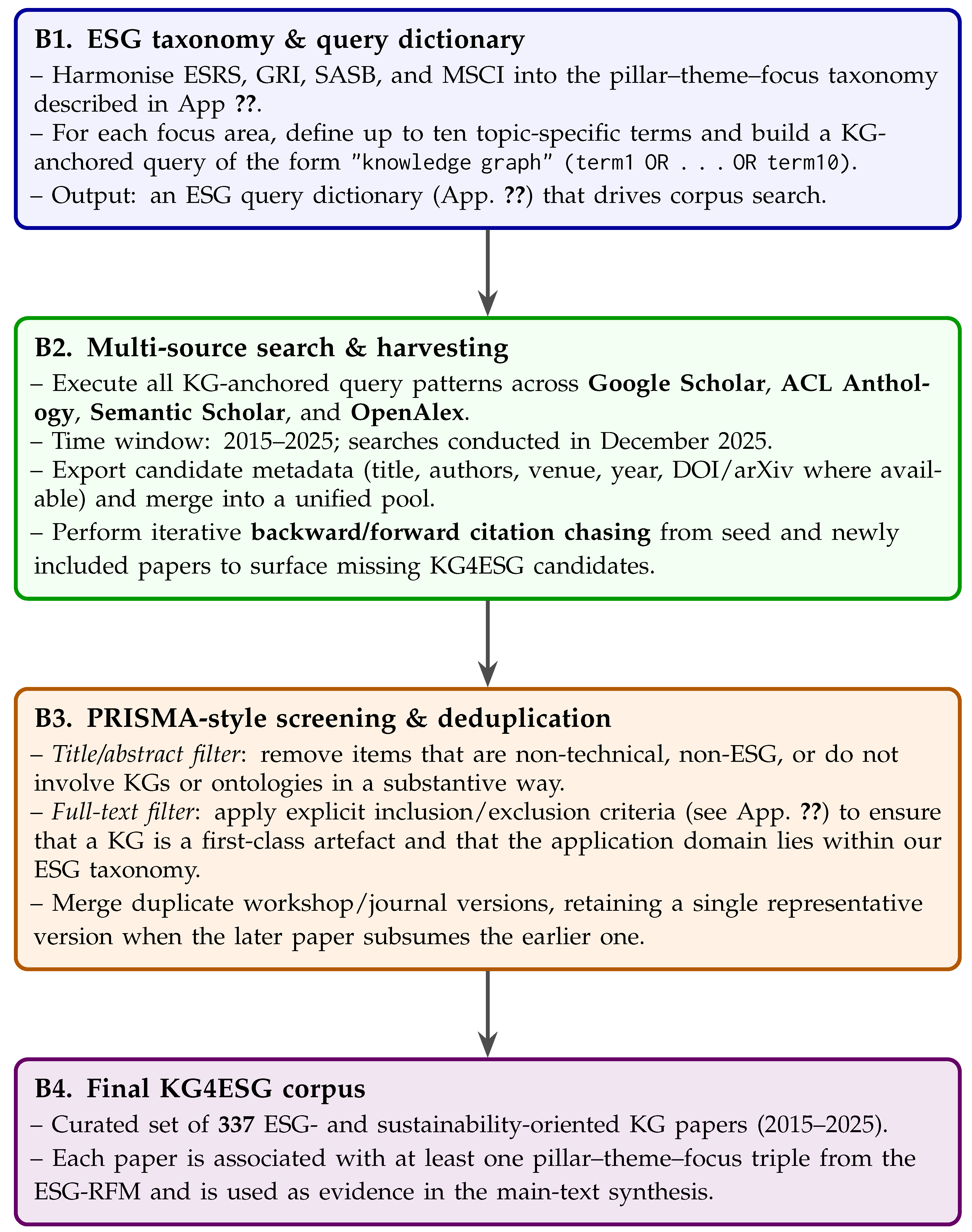
Appendix D.1. Query Construction and Per–Focus Queries
For each focus in the ESG-RFM pillar–theme–focus hierarchy we construct two families of search queries:
- a KG-anchored query, which requires the phrase “knowledge graph” and combines it with up to ten topic-specific terms; and
- a background query, which uses the same topic-specific terms but omits the “knowledge graph” anchor, so that it reflects the broader ESG/sustainability literature on that focus.
The exact KG-anchored query strings appear in the Full Google Scholar query column of Table A5. We run the background queries during corpus harvesting, but we do not report Google Scholar hit counts in the table because they are noisy and time-dependent.
Table A5.
KG4ESG search-term dictionary across pillars, themes, and focus areas (all searches executed in December 2025).
Table A5.
KG4ESG search-term dictionary across pillars, themes, and focus areas (all searches executed in December 2025).
| Pillar | Theme | Focus | Search Query Terms | Selected Works |
|---|---|---|---|---|
| E | ClimChg | GHG | "GHG emissions" | "CO2 emissions" | "carbon emissions" | "carbon intensity" | "emissions inventory" | "emissions factor" | "carbon disclosure" | "Scope 1 emissions" | "Scope 2 emissions" | "Scope 3 emissions" | [123]; [124]; [125]; CarbonKGwu2024carbonkg; NW1xie2024dynamic; Machine Knowledge Graph (MKG)chatterjee2024representation; [128]; [129]; [130]; [131]; E-Liability Knowledge Grapholadeji2023ai; Emission Conversion Factors Knowledge Graph (ECF KG / CFKG)markovic2023tec; [133] |
| E | ClimChg | PhysClimRisk | "physical climate risk" | "climate resilience" | "climate vulnerability" | "climate risk assessment" | "climate adaptation" | "climate transition risk" | "acute climate risk" | "TCFD reporting" | "climate scenario analysis" | "climate risk disclosure" | [84]; ClimaFactsKGburel2025climafactskg; [134]; [57]; Remote Sensing Early Warning Knowledge Graph (RSEW-KG)chen2025constructionb; [135]; [12]; [136]; Extreme Climate Architecture Knowledge Graphtu2024constructing; SILVANUS Knowledge Graphmarotta2024unified; I-KNOW-FOO knowledge graphsimsek2023know; KnowUREnvironmentislam2022knowurenvironment; [79] |
| E | ClimChg | ClimFin | "financing environmental impact" | "sustainable finance" | "green finance" | "transition finance" | "coal financing" | "green bonds" | "ESG lending" | "sustainability-linked loans" | "climate finance" | "green investment banking" | [81]; NatureKGsheikh8naturekg; [140]; [141]; ESG Knowledge Graphzhoua2022green |
| E | ClimChg | EnergyMix | "energy use" | "energy consumption" | "energy efficiency" | "energy intensity" | "fuel mix" | "electricity mix" | "renewable energy consumption" | "electricity consumption" | "energy management system" | "energy performance" | Energy Knowledge Graph (EKG)wu2025intelligent; [60]; [144]; OfficeGraphvan2024officegraph; [145]; [146]; [147]; [148]; [149]; [150]; [151]; Power Knowledge Graphjiang2020constructing; [153]; [154] |
| E | ClimChg | ProdFoot | "product carbon footprint" | "product GHG accounting" | "product life cycle emissions" | "life cycle assessment" | "LCA" | "product environmental footprint" | "product carbon intensity" | "ISO 14067" | "product carbon label" | "product-level emissions disclosure" | LCA Knowledge Graphdiamantini2025knowledge; LCI knowledge graphguo2025semantic; ForestFoodKG-KGyan2025forestfoodkg; Asset Life Cycle Knowledge Graph (ALC KG)shaw2024end; [158]; [159]; [160]; LCIKGsaad2023graph; [161] |
| E | NatCap | BiodivLU | "biodiversity loss" | "biodiversity conservation" | "land use change" | "deforestation" | "habitat conversion" | "ecosystem services" | "nature-related risk" | "nature loss" | "TNFD" | "biodiversity impact assessment" | CropDP-KGyan2025knowledge; [163]; Firmographicahuseynov2025firmographica; FooDShamed2025foods; GeoKG (Habitat GeoKG)xiao2025geokg; SOCKGshirvani2025knowledge; ECOLOPES KGahmeti2025enabling; METRIN-KGtandon2025metrin; KG-PLUBmartinez2025knowledge; [171]; Semantic Knowledge Graph of European Mountain Value Chainsbartalesi2024semantic; [173]; Nature FIRST KGahmeti2023towards; [175]; OpenBiodiv biodiversity knowledge graphpenev2022biodiversity; Biospytial Knowledge Graphescamilla2020biospytial |
| E | NatCap | RawSrc | "raw material sourcing" | "raw material supply" | "responsible raw materials" | "origin of raw materials" | "upstream commodity sourcing" | "raw material traceability" | "mineral sourcing" | "agricultural commodity sourcing" | "certified raw materials" | "conflict-free sourcing" | [96]; [177]; [178] |
| E | NatCap | ResUseMatEff | "materials use" | "material consumption" | "resource efficiency" | "material efficiency" | "resource productivity" | "material intensity" | "resource use reduction" | "use of recycled materials" | "recycled content" | "resource conservation" | [58] |
| E | NatCap | SuppEnvDD | "supplier environmental assessment" | "supplier environmental performance" | "environmental supplier audit" | "environmental supplier evaluation" | "environmental supplier questionnaire" | "green supplier selection" | "supplier environmental scorecard" | "supplier environmental rating" | "environmental supply chain assessment" | "environmental supplier monitoring" | N.A. |
| E | NatCap | WaterSS | "water scarcity" | "water stress" | "water risk" | "water footprint" | "basin water risk" | "water withdrawal" | "water consumption" | "water availability" | "water use efficiency" | "water stewardship" | WHOW-KGlippolis2025water; [179]; [102]; [180]; [181]; [182]; [183]; [101]; [184]; [185]; [186]; [187]; [106]; [188]; Water Knowledge Graph (WKG) and Water Information Network (WIN)mezni2022smartwater; [190]; Water Affair Knowledge Graphyan2018construction |
| E | PolWasCiru | EWaste | "electronic waste" | "e-waste" | "WEEE" | "end-of-life electronics" | "electronic waste recycling" | "e-waste management" | "e-waste collection" | "e-waste disposal" | "informal e-waste sector" | "e-waste policy" | [75]; [191]; [91]; [105]; Global EEE Green Design Knowledge Graphdang2023green; [193] |
| E | PolWasCiru | PackWaste | "plastic packaging" | "single-use packaging" | "single-use plastics" | "packaging waste" | "packaging circularity" | "recyclable packaging" | "packaging design for recycling" | "packaging recyclability" | "packaging extended producer responsibility" | "sustainable packaging design" | [194]; [195] |
| E | PolWasCiru | EnvComp | "environmental compliance" | "environmental regulation compliance" | "environmental fines" | "environmental violations" | "environmental management system" | "EMS certification" | "environmental policy" | "environmental audit" | "environmental legal compliance" | "environmental enforcement" | KnowWhereGraph (KWG)zhu2025knowwheregraph; [196]; Knowledge Graph of Dangerous Goods (KGDG)thimm2022relation; [198]; [199] |
| E | PolWasCiru | HazWaste | "hazardous waste" | "toxic releases" | "toxic emissions" | "industrial air pollution" | "industrial water pollution" | "soil contamination" | "hazardous substances" | "toxic waste management" | "industrial waste management" | "pollutant discharge" | [200]; [201]; [202]; [203]; [204] |
| E | SustSolTech | CleanTech | "clean technology" | "cleantech innovation" | "low-carbon technology" | "industrial decarbonization technology" | "energy-efficient technologies" | "emissions-reduction technologies" | "green technology innovation" | "climate technology solutions" | "clean technology adoption" | "industrial clean tech" | [205] |
| E | SustSolTech | GreenBldg | "green building" | "sustainable building" | "energy-efficient buildings" | "building energy performance" | "LEED certification" | "BREEAM certification" | "zero-energy buildings" | "net zero buildings" | "green building certification" | "green building design" | [206]; [207]; [59]; PGD-KGwu2024knowledge; [63] |
| E | SustSolTech | ReEneg | "renewable energy" | "solar power" | "solar photovoltaics" | "wind power" | "onshore wind power" | "offshore wind power" | "hydropower projects" | "renewable energy projects" | "renewable energy investment" | "corporate renewable sourcing" | knowledge graph structurezhang2025multi; Multi-modal Process Knowledge Graph for Wind Turbines (MPKG-WT)hu2025question; [211]; Energy Knowledge Graphpopadic2023toward; XAI4Wind Knowledge Graphchatterjee2020xai4wind; Energy Knowledge Graph (EKG)chun2020designing; Energy Knowledge Graph (EKG)chun2018knowledge |
| S | HumCap | OHS | "occupational health and safety" | "workplace health and safety" | "workplace injuries" | "safety incidents" | "lost time injury" | "lost time injury frequency rate" | "safety management systems" | "process safety management" | "safety culture" | "occupational safety" | AEC-KGwu2025construction; FFHKGliu2025automated; [72]; [33]; [66]; [53]; [216]; [54]; MAKGliu2024makg; [217]; Construction Accident Knowledge Graph (CAKG)chen2023knowledge; [218]; [219]; Job Hazard Analysis Knowledge Graph (JHAKG)pandithawatta2023development; Risk Knowledge Graph in Railway Safety (RKGRS)liu2022using; [221]; [222]; [223] |
| S | HumCap | LearnDev | "human capital development" | "employee development" | "learning and development" | "upskilling" | "reskilling" | "talent development" | "workforce development" | "employee training" | "skills development" | "continuous learning culture" | Person–Job Temporal Knowledge Graphzhang2025construction; [110]; MetaKGyang2023contextualized; [225]; [109]; Skills & Occupation Knowledge Graphde2021job |
| S | HumCap | WorkManRel | "labor management" | "employee relations" | "workforce relations" | "employee relations strategy" | "employee engagement" | "labor dispute resolution" | "employee voice mechanisms" | "workplace dialogue" | "labor-management cooperation" | "employee relations climate" | JobEdKG and T-JobEdKGfettach2025skill; KG-IRDMyang2025knowledge; [228] |
| S | HumCap | JobQual | "employment quality" | "decent work" | "fair wages" | "living wage" | "working conditions" | "job security" | "precarious employment" | "working time" | "employee benefits" | "employment contracts" | Human-Centered Knowledge Graph (HCKG)nagy2024knowledge; Salary Knowledge Graphhuang2023kosa; [231] |
| S | HumCap | DEI | "workplace diversity" | "equal opportunity" | "non-discrimination" | "workforce diversity" | "gender diversity" | "racial diversity" | "pay equity" | "inclusive workplace" | "diversity and inclusion" | "DEI program" | [232] |
| S | HumCap | FoACollB | "freedom of association" | "collective bargaining" | "trade union rights" | "unionization" | "collective labor agreements" | "collective agreements coverage" | "social dialogue" | "works council" | "employee representation" | "union density" | N.A. |
| S | HumCap | LocHirMarPre | "market presence" | "local hiring" | "local employment" | "local recruitment" | "local wage levels" | "local management hiring" | "local content in employment" | "local workforce development" | "local economic integration" | "local talent pipeline" | N.A. |
| S | HumCap | LabStanSC | "supplier labor standards" | "forced labor" | "child labor" | "modern slavery" | "decent work in supply chains" | "supply chain human rights" | "labor exploitation in supply chains" | "supply chain due diligence" | "ethical supply chains" | "labor rights in supply chains" | [233]; [234] |
| S | ProdRespCustSafe | ChemSafe | "chemical safety" | "hazardous substances" | "toxic chemicals" | "substance restrictions" | "REACH regulation" | "chemical risk management" | "chemical hazard assessment" | "chemical exposure limits" | "hazard communication" | "chemical safety regulation" | CPSKGzheng2025chemical; Hazardous Chemical Accident Knowledge Graph (HCAKG)zhao2025data; Multimodal Knowledge Graph (MMKG)xu5938365kgc; [238]; TERAmyklebust2022prediction; SEARCH-KGshin2022knowledge; [241] |
| S | ProdRespCustSafe | FinProt | "consumer financial protection" | "financial consumer protection" | "fair lending" | "predatory lending" | "consumer credit risk" | "responsible lending" | "over-indebtedness" | "consumer protection regulation" | "financial conduct regulation" | "consumer financial rights" | N.A. |
| S | ProdRespCustSafe | DataSec | "data privacy" | "information privacy" | "cybersecurity" | "information security" | "personal data protection" | "data protection regulation" | "GDPR compliance" | "data breach" | "privacy by design" | "data security management" | [36]; [242]; [37]; IoT-Reg Knowledge Graphechenim2025automating; [39]; [244]; AttacKG+zhang2024attackg+; [38]; PrivComp-KGgarza2024privcomp; VulKGyin2024compact; [245]; [40]; [246]; [247]; IoT-Reg Knowledge Graphechenim2023iot; PRIVAFRAMEgambarelli2022privaframe; AttacKGli2022attackg; CSKG4APTren2022cskg4apt; Open-CyKGsarhan2021open; Cybersecurity Knowledge Graph (CSKG)shen2020data; SEPSES Cybersecurity Knowledge Graphkiesling2019sepses; [77]; [253] |
| S | ProdRespCustSafe | ProdQual | "product safety" | "product safety incidents" | "product recalls" | "safety defects" | "product quality" | "product quality assurance" | "product reliability" | "consumer product safety" | "product safety regulation" | "product conformity assessment" | [254]; ESKGzang2025event; MPKGwu2025automatic; QChsGwen2025novel; [103]; Causal Quality-related Knowledge Graph (CQKG)zhou2024causalkgpt; [55]; Human–Cyber–Physical Knowledge Graphwang2024intelligent; [258]; [259]; [260]; [261]; [262]; Manufacturing Knowledge Graph (MKG)he2019manufacturing |
| S | ProdRespCustSafe | HealVuln | "health and demographic risk" | "demographic risk" | "aging population risk" | "population aging" | "epidemiological transition" | "chronic disease burden" | "pandemic risk" | "population health trends" | "demographic change" | "health risk exposure" | Elderly Advantages Knowledge Graphli2025aging; [265]; [266] |
| S | ProdRespCustSafe | RespMkt | "responsible marketing" | "responsible advertising" | "product labeling" | "product labeling" | "marketing ethics" | "misleading advertising" | "green marketing claims" | "sustainability claims" | "fair marketing practices" | "truthful product information" | N.A. |
| S | ProdRespCustSafe | RSInv | "responsible investment" | "responsible investing" | "sustainable investing" | "ESG investing" | "ESG integration" | "ESG screening" | "stewardship investing" | "shareholder engagement" | "active ownership" | "fiduciary duty and ESG" | Social-Impact Funding Knowledge Graphli2020domain |
| S | ComRigRisks | ComRel | "community engagement" | "stakeholder engagement" | "social license to operate" | "indigenous rights" | "community impact" | "local community opposition" | "community consultation" | "community grievance mechanisms" | "community development programs" | "community benefit agreements" | [268] |
| S | ComRigRisks | HRDD | "human rights" | "human rights impact assessment" | "HRIA" | "salient human rights issues" | "UN Guiding Principles" | "UNGP implementation" | "OECD due diligence" | "corporate human rights assessment" | "human rights risk assessment" | "human rights grievance mechanism" | PREJUST4WOMANdamato2025automated; Observatory Knowledge Graph (OKG)blin2023okg |
| S | ComRigRisks | RiskSrc | "controversial sourcing" | "conflict minerals" | "responsible mineral sourcing" | "cobalt supply chain" | "palm oil sourcing" | "high-risk sourcing countries" | "responsible mineral supply chains" | "ethical mineral sourcing" | "responsible cobalt sourcing" | "responsible palm oil" | Supply Chain Knowledge Graph (SC-KG)kosasih2024towards |
| S | IncSolSocAcc | FinAcc | "access to finance" | "access to financial services" | "financial inclusion" | "microfinance" | "digital financial services" | "inclusive finance" | "unbanked populations" | "underserved customers" | "mobile money" | "SME access to finance" | [271]; [272]; [273] |
| S | IncSolSocAcc | HealAcc | "access to health care" | "access to medicines" | "affordable medicines" | "healthcare affordability" | "telemedicine services" | "healthcare availability" | "universal health coverage" | "healthcare equity" | "rural health care access" | "primary health care access" | HealthEQKGnananukul2025healtheqkg; [274]; NHANES Knowledge Graphqi2023demographic; Diseasomics knowledge graphtalukder2022diseasomics; [277] |
| S | IncSolSocAcc | DigIncl | "access to communications" | "digital inclusion" | "digital divide" | "access to internet" | "broadband access" | "mobile connectivity" | "ICT access" | "affordable connectivity" | "digital infrastructure" | "telecommunications access" | [278]; [279] |
| S | IncSolSocAcc | NutriHeal | "nutrition and health" | "healthy foods" | "fortified foods" | "nutrition interventions" | "obesity prevention" | "diet-related health" | "healthy diet" | "nutrition security" | "functional foods" | "nutrition labeling" | [18]; [108]; NRKGma2024nutrition; Food4healthKGfu2023food4healthkg; GENAdang2023gena; KG4NHfu2023kg4nh; KG4NHfu2023multimodal; FoodKGchen2021personalized; [285] |
| G | CorpGov | BoardOvr | "corporate board" | "board independence" | "independent directors" | "board diversity" | "board gender diversity" | "board oversight" | "board composition" | "director overboarding" | "board refreshment" | "board tenure" | N.A. |
| G | CorpGov | ExecPay | "executive compensation" | "CEO compensation" | "CEO salary" | "say on pay" | "CEO pay ratio" | "incentive alignment" | "performance-based pay" | "remuneration policy" | "compensation committee" | "executive pay governance" | N.A. |
| G | CorpGov | OwnCtrl | "ownership and control" | "dual-class shares" | "pyramidal ownership" | "control rights" | "controlling shareholders" | "ownership concentration" | "ownership structure" | "family ownership" | "blockholder ownership" | "minority shareholder protection" | Equity Knowledge Graph (EKG)xu2025disclosing; LCAIM Knowledge Graphshaw2025knowledge; Company Knowledge Graphmagnanimi2023reactive; [78] |
| G | CorpGov | FinRepQ | "accounting irregularities" | "financial restatement" | "earnings management" | "aggressive accounting" | "audit quality" | "financial reporting quality" | "accounting fraud" | "financial statement fraud" | "creative accounting" | "accounting enforcement" | Financial Knowledge Graph (FKG)wang2025corporate; [289]; [87]; [28]; FSFD-TLKGcai2024explainable; Supplier–Customer Knowledge Graphli2023tracking; [71]; Manager Knowledge Graphwen2022analysis; Financial Knowledge Graph (FKG)zehra2021financial; FSFDshen2021financial |
| G | CorpCondInt | EthicsAC | "business ethics" | "corporate ethics" | "anti-corruption" | "anti-bribery" | "corruption risk" | "integrity management" | "ethics training" | "ethics and compliance program" | "corporate misconduct" | "ethical culture" | [293]; [294] |
| G | CorpCondInt | TaxTrans | "tax transparency" | "tax disclosure" | "tax avoidance" | "tax planning" | "effective tax rate" | "country-by-country reporting" | "tax policy" | "corporate tax strategy" | "tax justice" | "aggressive tax planning" | [93]; Tax Law Knowledge Graph (TaxKG)tan2025llama; Enterprise Knowledge Graphzheng2023machine; TaxGraph – Global Multinational Tax Planning Knowledge Graphludemann2020knowledge |
| G | CorpCondInt | PolEngage | "corporate political activity" | "corporate political engagement" | "lobbying activities" | "public policy advocacy" | "political contributions" | "political donations" | "policy influence" | "trade association lobbying" | "political spending disclosure" | "regulatory lobbying" | N.A. |
| G | CorpCondInt | RegComp | "socioeconomic compliance" | "regulatory compliance" | "non-financial compliance" | "competition law compliance" | "product regulatory compliance" | "social regulation compliance" | "legal non-compliance" | "fines and sanctions" | "compliance violations" | "regulatory enforcement actions" | GovGraphma2025govgraph; [80]; [23]; [73]; [22]; Regulatory Knowledge Graphershov2023case; [92] |
| G | CorpCondInt | RespProc | "responsible procurement" | "local procurement" | "local suppliers" | "inclusive procurement" | "responsible purchasing" | "sustainable purchasing policy" | "ethical procurement" | "supplier diversity" | "community-focused procurement" | "procurement sustainability" | N.A. |
| G | CorpCondInt | FairComp | "anti-competitive behavior" | "anti-competitive behavior" | "competition law" | "antitrust violations" | "cartel" | "price fixing" | "abuse of dominance" | "market collusion" | "bid rigging" | "fair competition" | [298] |
| G | CorpCondInt | Whistle | "whistleblower protection" | "whistleblowing system" | "speak-up culture" | "whistleblowing hotline" | "retaliation against whistleblowers" | "internal reporting channels" | "ethics reporting" | "whistleblower policy" | "whistleblowing in organizations" | "speak-up mechanism" | N.A. |
| G | CorpCondInt | AIEthics | "AI ethics" | "algorithmic accountability" | "algorithmic fairness" | "responsible AI" | "digital responsibility" | "AI governance" | "data ethics" | "ethical AI principles" | "AI risk management" | "trustworthy AI" | TAIR (Trustworthy AI Requirements) knowledge graphhernandez2025open |
| H | ESGIntAss | ESGRate | "ESG performance" | "ESG rating" | "overall ESG score" | "ESG benchmarking" | "sustainability score" | "ESG assessment" | "ESG index rating" | "issuer ESG rating" | "portfolio ESG rating" | "ESG ranking" | [10]; [111]; [51]; ESG-KGangioni2024exploring; [69] |
| H | ESGIntAss | ESGData | "ESG data integration" | "ESG data aggregation" | "ESG data harmonization" | "sustainability data platforms" | "ESG data pipelines" | "ESG data quality" | "ESG datasets" | "ESG data sources" | "ESG database integration" | "ESG data interoperability" | [42] |
| H | ESGIntAss | EconImp | "economic performance" | "economic value generated" | "economic value distributed" | "indirect economic impacts" | "local economic impact" | "inclusive economic growth" | "economic development impact" | "social return on investment" | "socioeconomic impact assessment" | "economic contribution analysis" | Spatiotemporal Knowledge Graph (STKG)wang2025intelligent |
| H | ESGIntAss | DualMat | "materiality assessment" | "ESG materiality" | "double materiality" | "impact materiality" | "financial materiality" | "sustainability materiality" | "materiality matrix" | "stakeholder materiality assessment" | "ESG topic prioritization" | "material issues identification" | [26] |
| H | ESGIntAss | ESGScen | "ESG risk management" | "sustainability risk modeling" | "climate-related financial risk analysis" | "transition and physical climate risk evaluation" | "ESG scenario-based analytics" | "climate-aligned scenario planning" | "ESG exposure and vulnerability assessment" | "sustainability stress-test analytics" | "climate-financial impact projection" | "climate-ESG risk propagation" | LinkClimate knowledge graphwu2022linkclimate |
| H | ESGIntAss | ESGRept | "ESG reporting" | "sustainability disclosure" | "ESG disclosure" | "sustainability statement" | "ESG transparency" | "corporate sustainability reporting" | "non-financial disclosure" | "integrated ESG reporting" | "ESG narrative reporting" | "ESG metrics disclosure" | [9]; ESGSenticNetong2025esgsenticnet; [29]; Power Equipment Management Using Knowledge Graphdriller2024unlocking; [301] |
| H | ESGIntAss | GreenWH | "greenwashing" | "green hushing" | "greenhushing" | "misleading environmental claims" | "misleading sustainability claims" | "green claims" | "environmental claim substantiation" | "sustainability claim verification" | "green claims directive" | "ESG communication integrity" | [82]; EmeraldGraphKaoukis2025EmeraldMindAK |
| H | ESGIntAss | ESGIncid | "ESG controversies" | "ESG controversy" | "sustainability controversies" | "ESG incident database" | "ESG incident detection" | "ESG news monitoring" | "adverse ESG events" | "ESG negative screening" | "controversial business practices" | "controversy scoring" | [43] |
| H | SDFrame | SDGs | "SDGs" | "Sustainable Development Goals" | "Agenda 2030" | "sustainability targets" | "SDG indicators" | "SDG alignment" | "SDG monitoring" | "SDG integration" | "SDG evaluation" | "sustainable development framework" | SDG-KGbenjira2025sdg; [302]; Regional Graph (RG) + Intent Graph (IG)wang2025unveiling; [304]; [305]; [306]; [307]; UrbanKGandrona2024knowledge; SustainGraphfotopoulou2022sustaingraph; DaanMatch Knowledge Graph (DaanKG)debellis2023daankg; [309]; [310]; [311]; [312] |
| H | SDFrame | ImpInv | "impact investing" | "impact investment funds" | "impact measurement" | "impact financing" | "social impact investing" | "environmental impact investing" | "impact evaluation" | "impact reporting" | "impact fund strategies" | "sustainable impact investing" | N.A. |
| H | SDFrame | ReptStd | "sustainability reporting" | "GRI standards" | "SASB standards" | "GRI/SASB alignment" | "sustainability reporting framework" | "non-financial reporting standards" | "GRI-compliant reporting" | "SASB-based disclosure" | "sustainability reporting taxonomy" | "ESG reporting standards" | ESG Metric Knowledge Graph (ESGMKG)yu2024ontology; [19]; RSOKGzhou2024towards; [21]; [314]; [6] |
| H | SDFrame | TaxMap | "ESG taxonomy" | "sustainable finance taxonomy" | "EU taxonomy" | "green taxonomy" | "ESG classification system" | "ESG standard mapping" | "ESG standards alignment" | "sustainability reporting standards" | "ESG ontology" | "sustainability ontology" | [315] |
| H | SysSustMod | CircLoop | "circular economy" | "closed-loop supply chains" | "resource circularity" | "material circularity" | "product life extension" | "reuse and remanufacturing" | "circular business models" | "industrial symbiosis" | "circular value chains" | "circular economy metrics" | [89]; [316]; Housing Passport Knowledge Graph (HPKG)keena2025housing; W2RKGzhao2025construction; [317]; [90]; ScrapKGvasileiadis2023leveraging; [319] |
| H | SysSustMod | SCSust | "sustainable supply chains" | "end-to-end supply chain sustainability" | "ESG in supply chains" | "supply chain sustainability assessment" | "multi-tier supply chain ESG" | "responsible global supply chains" | "sustainable sourcing and logistics" | "supply chain sustainability metrics" | "supply chain ESG performance" | "holistic supply chain risk" | [74]; [95]; [97]; [98] |
| H | SysSustMod | JustTrans | "just transition" | "climate justice" | "energy justice" | "low-carbon transition pathways" | "socially just decarbonization" | "green jobs transition" | "coal phase-out justice" | "inclusive climate transition" | "socio-ecological transformation" | "just transition planning" | GeoOutageKGfrakes2025geooutagekg |
Finally, the Selected Works column lists one or more representative KGs from our curated corpus that we judged to be closely aligned with the corresponding focus. These examples are obtained via manual inspection of titles, abstracts, and skimming full texts, not automatically from search results.
Why selected exemplars can surface under multiple foci. Because focus term lists intentionally include synonyms, disclosure hooks, and closely related terminology to increase recall, the same KG paper can be retrieved by multiple focus-level searches. We treat this overlap as a feature rather than a defect: it reduces false negatives in ESG, where vocabulary is inconsistent across sectors, jurisdictions, and standards, and where many systems are genuinely multi-topic.
Accordingly, all retrieved candidates are merged and deduplicated before screening, and each included work appears only once in the KG4ESG corpus even if it was surfaced by several focus queries. The Selected Works column in the query dictionary is therefore illustrative: we list each exemplar under the single focus that it most directly instantiates based on manual judgement from title/abstract plus full-text inspection. This choice is made for table readability and to provide a clean “most-suitable anchor” for readers, not to claim exclusivity; multi-focus relevance is preserved in our internal coding (and will be retained in the released annotations).
Appendix D.2. Scope and Corpus Construction
We target research whose primary contribution is to construct, extend, or apply a knowledge graph (or closely related ontology-style graph) for ESG- or sustainability-related tasks. We accept both academic and industrial papers, including system descriptions, provided that the KG is a first-class artefact rather than a minor internal component.
Starting from the union of all KG-anchored query results and additional manual venue searches (e.g., ACL-like venues, environmental informatics, sustainability and climate conferences, finance and accounting venues), we harvest candidate papers and apply the screening steps shown in Figure A3. After deduplication of workshop and journal versions, this yields the papers that form the KG4ESG corpus used throughout the survey.
Appendix D.3. Search Sources and Workflow
The query dictionary in Appendix D.7 encodes the search patterns used for corpus construction. Each row corresponds to one focus area in the ESG-RFM and provides a KG-anchored query of the form “knowledge graph” (term1 OR ...OR term10). We execute these queries across four complementary sources: Google Scholar5 (broad recall), ACL Anthology6 (NLP venue completeness), and Semantic Scholar7 + OpenAlex8 (structured metadata and citation-graph support). We additionally perform backward/forward citation chasing from seed and newly included papers to reduce keyword and indexing bias. All candidates are merged and deduplicated before PRISMA-style screening.
Primary aggregator (Google Scholar). We use Google Scholar as a first-stage aggregator because of its broad, cross-disciplinary coverage and documented high recall relative to single-publisher databases [120,121]. At the same time, relevance ranking and metadata quality can be noisy [120,121]. We mitigate this by (i) deriving structured, taxonomy-grounded queries (Appendix C and Appendix D.7), (ii) explicitly anchoring searches on the phrase “knowledge graph”, and (iii) applying PRISMA-style screening with pre-defined criteria.
Targeted NLP venue coverage (ACL Anthology). Because KG4ESG is NLP-centered and many relevant papers appear in ACL-family venues, we additionally run targeted searches in the ACL Anthology to reduce the chance that conference/workshop papers are missed or poorly indexed by general-purpose aggregators. Results are merged into the same candidate pool prior to screening.
Structured metadata and citation graph (Semantic Scholar and OpenAlex). We use Semantic Scholar and OpenAlex to (i) cross-check bibliographic fields (venue, year, identifiers), (ii) support high-precision deduplication via DOI/arXiv/normalized titles, and (iii) enable citation-based expansion and verification. In practice, these databases improve reproducibility and reduce errors caused by inconsistent metadata across engines.
Citation chasing and saturation logic. To reduce keyword and indexing bias, we perform backward (reference list) and forward (citing papers) citation chasing from (i) a seed set of high-centrality ESG/sustainability KGs and (ii) borderline-but-included papers discovered during screening. Citation chasing continues iteratively until newly surfaced candidates are predominantly out-of-scope or duplicates under our criteria.
Deduplication and counting conventions. All retrieved candidates from the four sources are merged prior to screening. We deduplicate using a layered strategy: DOI/arXiv identifiers when available, followed by normalized-title matching with manual verification for collisions (e.g., workshop vs. journal extensions). Query-level hit counts are treated only as coarse indicators of topical volume (rather than stable statistics), consistent with bibliometric practice [120,122]. Our overall workflow follows the logic of systematic reviews and meta-analyses [1,122], adapted to the evolving KG/NLP landscape in which many contributions explicitly self-identify with the “knowledge graph” label.
Appendix D.4. Inclusion and Exclusion Criteria
We include a paper in the KG4ESG corpus only if it satisfies all of the following:
- It defines, instantiates, or operationalises a knowledge graph or ontology that is used as a central computational artefact (e.g., for retrieval, reasoning, recommendation, or downstream analytics).
- Its application domain lies within the ESG and sustainability topics delineated by our taxonomy (i.e., we can assign at least one pillar–theme–focus label).
- It contains a non-trivial text-centric component (e.g., extraction from reports, scientific articles, regulations, news, or user-generated content), even if the overall system is multimodal.
We exclude works that:
- do not use KGs or ontologies in a substantive way (e.g., purely vector-space or tabular models);
- conduct general ESG text mining (topic modelling, sentiment analysis, etc.) without a KG layer;
- focus exclusively on bibliometric analysis of publications rather than on domain-level ESG KGs;
- operate far outside the corporate-oriented ESG space (e.g., purely scientific climate or ecological models) even if they use KGs, while still acknowledging that insights from those communities are highly relevant.
Appendix D.5. Threats to Validity
The curation process introduces several sources of bias:
- Search bias. Anchoring queries on “knowledge graph” risks missing ontology- or graph-based work that does not use that exact phrase. We mitigate this by complementing Google Scholar with ACL Anthology (NLP venue coverage), Semantic Scholar and OpenAlex (structured metadata and citation graph), and iterative backward/forward citation chasing from prominent KGs and newly included papers.
- Hit-count noise. Google Scholar hit counts are approximate and time-dependent. The volume labels in Table A5 should be read as coarse activity indicators, not as precise bibliometric measures.
Appendix D.6. Limitations
The KG4ESG corpus should be interpreted as a carefully curated but non-exhaustive sample of ESG and sustainability KGs. It is shaped by our taxonomy, our query patterns, and our inclusion criteria. In particular:
- some adjacent graph or ontology work may be missing because it does not self-identify as a “knowledge graph”;
- fast-moving areas (e.g., LLM- and agentic KG workflows) may be under-represented in the most recent years;
- borderline cases between pillars or themes may reasonably admit alternative classifications.
We therefore release the taxonomy and query dictionary as reusable artefacts so that future work can extend, refine, or contest the KG4ESG corpus as the literature evolves.
Appendix D.7. KG4ESG Corpus Query Dictionary
For every focus in ESG-RFM, we define a small query dictionary used to retrieve candidate literature.
KG-anchored query construction. Because this survey targets knowledge graph methods, every retrieval query is anchored with the fixed phrase “knowledge graph”. The table below reports only the focus-specific term list (an OR-list). On engines that accept multi-term keyword queries (Google Scholar, ACL Anthology, OpenAlex), the executable KG-anchored query is instantiated by prepending the anchor phrase and grouping the terms with OR. Concretely:
“knowledge graph” ( OR OR ...OR ), .
For example, the Greenhouse Gas Emissions focus instantiates:
“knowledge graph” (“GHG emissions” OR “CO2 emissions” OR ...OR “Scope 3 emissions”).
All searches were executed in December 2025.
Two query patterns and year-wise execution. For each focus area, we execute two complementary query patterns: (i) a KG-anchored query that explicitly includes the “knowledge graph” constraint, and (ii) a background query that omits this anchor while reusing the same focus-specific term list. For Google Scholar and OpenAlex, both query patterns are executed year-wise for each year from 2015 to 2025 using the corresponding year filters provided by the platforms. For ACL Anthology, due to search-engine limitations that do not support reliable year-level filtering, each query pattern is executed without explicit year constraints, and publication years are subsequently resolved from the retrieved metadata during corpus curation.
Semantic Scholar execution (OR-by-union). Semantic Scholar’s public web search does not support Boolean operators (e.g., OR-lists), although it supports quoted phrases.9 Therefore, the OR-list cannot be issued as a single query. Instead, we decompose each focus-year query into k single-term sub-queries (with phrases quoted) and then combine the results by set union:
“knowledge graph” “term1”, “knowledge graph” “term2”, ..., “knowledge graph” “termk”.
We apply the same decomposition for background retrieval (dropping the anchor and querying “termi”).
Why up to ten terms per focus? We cap each focus term list at ten terms () as a practical compromise between (i) recall (covering common synonyms, abbreviations, metric/reporting language, and standard-specific hooks) and (ii) portability and auditability (keeping queries short enough to run consistently across engines and to inspect/maintain as a curated dictionary). Term lists are derived from the focus definition and the MSCI/GRI/ESRS/SASB crosswalk vocabulary, then augmented with frequently used synonyms and abbreviations observed in pilot searches and seed papers. The cap is also important for Semantic Scholar: because OR must be implemented by decomposition, k directly controls the number of required sub-queries.
Illustration (coverage-oriented term selection). To increase topical coverage beyond a single keyword, term sets intentionally mix (i) phenomenon-level language and (ii) disclosure / reporting language. For instance, the Physical Climate Risk & Vulnerability focus includes both risk/hazard terms (e.g., “physical climate risk”, “climate vulnerability”) and disclosure hooks (e.g., “TCFD reporting”, “scenario analysis”), while Biodiversity, Habitats & Land Use combines ecological processes (e.g., “deforestation”, “land use change”) with emerging standards vocabulary (e.g., “TNFD”). Despite these safeguards, no fixed dictionary can be exhaustive in ESG: terminology is sector-, jurisdiction-, and time-dependent. We therefore treat the query dictionary as a recall-oriented scaffold and further mitigate residual keyword/indexing bias through backward/forward citation chasing and iterative screening refinement (Appendix D.3).
Each row in the table below corresponds to one focus area and contains the following fields:
- Pillar / Theme / Focus — the position of the focus in the ESG-RFM pillar–theme–focus hierarchy.
- Searched Terms — the focus-specific term list of up to ten phrases used to instantiate the KG-anchored query (and the corresponding background query).
- Selected Works — one or more representative KG4ESG papers from our curated corpus that directly instantiate or strongly target the focus. These examples are selected manually via full-text inspection.
Appendix E. Supplementary Analysis for Construction Paradigms
Paradigms are defined by the dominant evidence-to-schema mapping operator rather than by the mere presence of an ontology. P1 denotes ontology-first lifting and deterministic integration in which the semantic contract is the primary artifact and population is largely manual or ETL-style; typical exemplars emphasize standards interoperability and metric semantics [6,7,300,315]. P2 denotes rule/supervised NLP/ML extraction that treats the schema as a label space for extraction and classification [69,100,270,320]. P3 denotes LLM-assisted structuring and alignment in which structured outputs are generated under schema constraints, commonly with retrieval grounding [9,19,21,26,43]. P4 denotes agentic/tool-using pipelines with iterative validation and repair, where explicit controllers decompose construction or querying into multi-step actions, enabling traceability, constraint checks, and correction loops; this includes both LLM+tool systems for text-to-graph interaction [321,322] and tool-centric dynamic KG systems without LLMs [12,59,126,323].
Table A6.
Conceptual distinctions among P1–P4 framed around the evidence-to-schema mapping operator and ESG-grade validation requirements.
Table A6.
Conceptual distinctions among P1–P4 framed around the evidence-to-schema mapping operator and ESG-grade validation requirements.
| P | Dominant mapping operator | Primary bottleneck addressed | What is fixed vs. adaptive | Typical failure modes | Validation hooks aligned with ESG use |
|---|---|---|---|---|---|
| P1 | Schema/ontology engineering + deterministic lifting | Semantic precision, interoperability, provenance design | Schema fixed; mappings largely fixed; updates costly | Coverage limits; slow updates; brittle mappings under drift | Schema scope/versioning; provenance model; constraint completeness; update policy |
| P2 | Supervised/rule-based NLP over a label space | Scalable, repeatable extraction from text | Schema fixed; models learn mapping to types/relations | Label scarcity; domain shift; pipeline compounding; weak alignment | Extraction metrics; error propagation analysis; conformance rate; linking quality |
| P3 | Schema-conditioned generation (often with retrieval) | Semantic elasticity, long-tail coverage, cross-standard alignment | Schema as constrained IR; mapping flexible and context-dependent | Hallucinated triples; inconsistent typing; silent schema drift | Grounding strategy; structured output validation; provenance enforcement; constraint checks |
| P4 | Tool-using controllers with iterative validation/repair | End-to-end reliability under high-stakes workflows | Schema as callable contract; adaptive action sequences | Tool misuse; feedback loops; hidden cascades without governance | Action traces; explicit constraint checks; conflict resolution; escalation protocols |
Figure A4.
Horizontal evolution of ESG KG construction paradigms (P1–P4). All paradigms assume and reuse a shared ontology/schema backbone (middle), which encodes ESG vocabularies, reporting standards and constraints. The Human Expert Layer (bottom) supports all paradigms, shifting from direct authoring and ontology design in P1 to governance and feedback in P4.
Figure A4.
Horizontal evolution of ESG KG construction paradigms (P1–P4). All paradigms assume and reuse a shared ontology/schema backbone (middle), which encodes ESG vocabularies, reporting standards and constraints. The Human Expert Layer (bottom) supports all paradigms, shifting from direct authoring and ontology design in P1 to governance and feedback in P4.
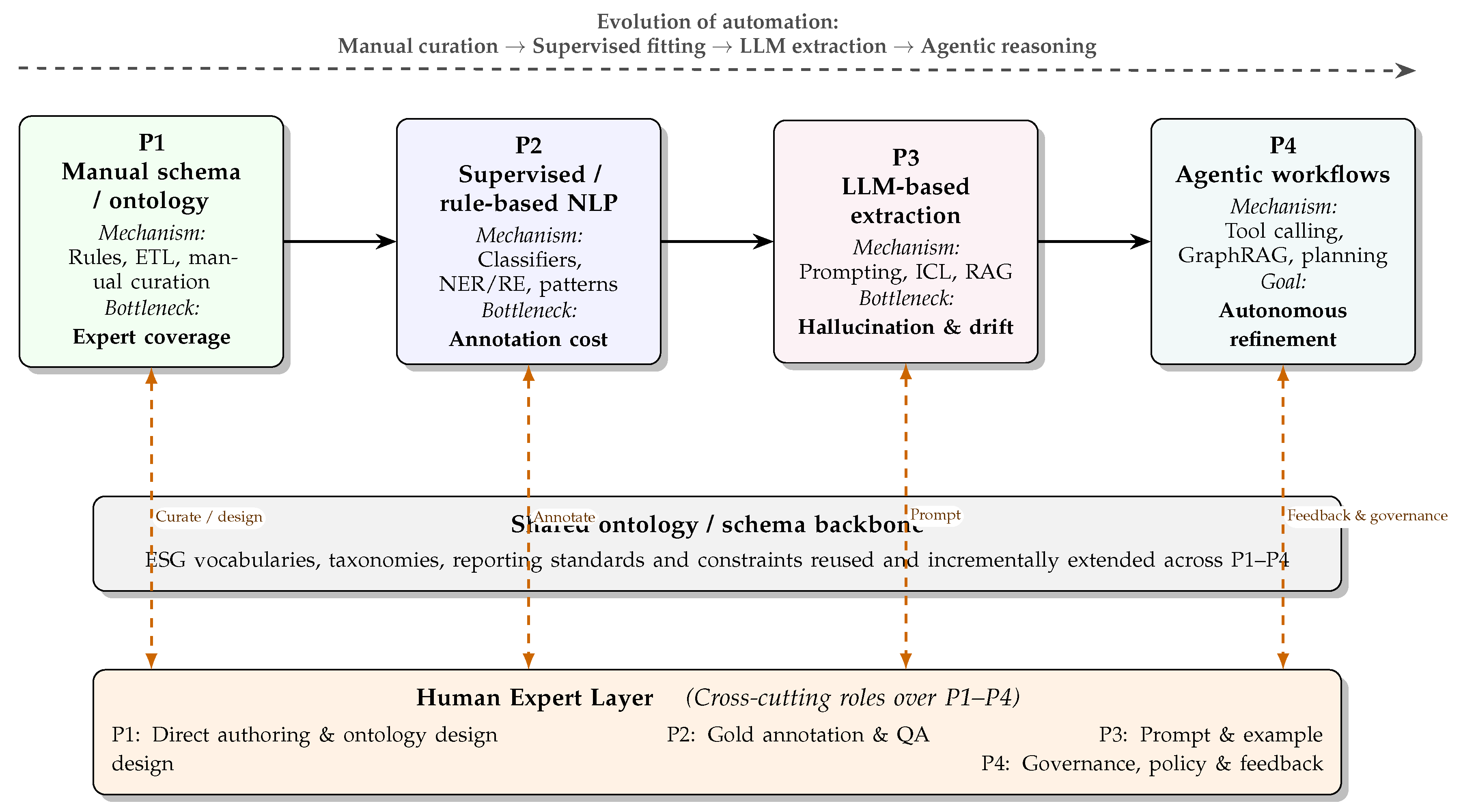
Figure A5.
Dominant paradigms per year for the 310 KGs. The chart visualizes the steady baseline of manual/schema methods (P1) and the rapid rise of LLM-based methods (P3 & P4) from 2023 onwards.
Figure A5.
Dominant paradigms per year for the 310 KGs. The chart visualizes the steady baseline of manual/schema methods (P1) and the rapid rise of LLM-based methods (P3 & P4) from 2023 onwards.
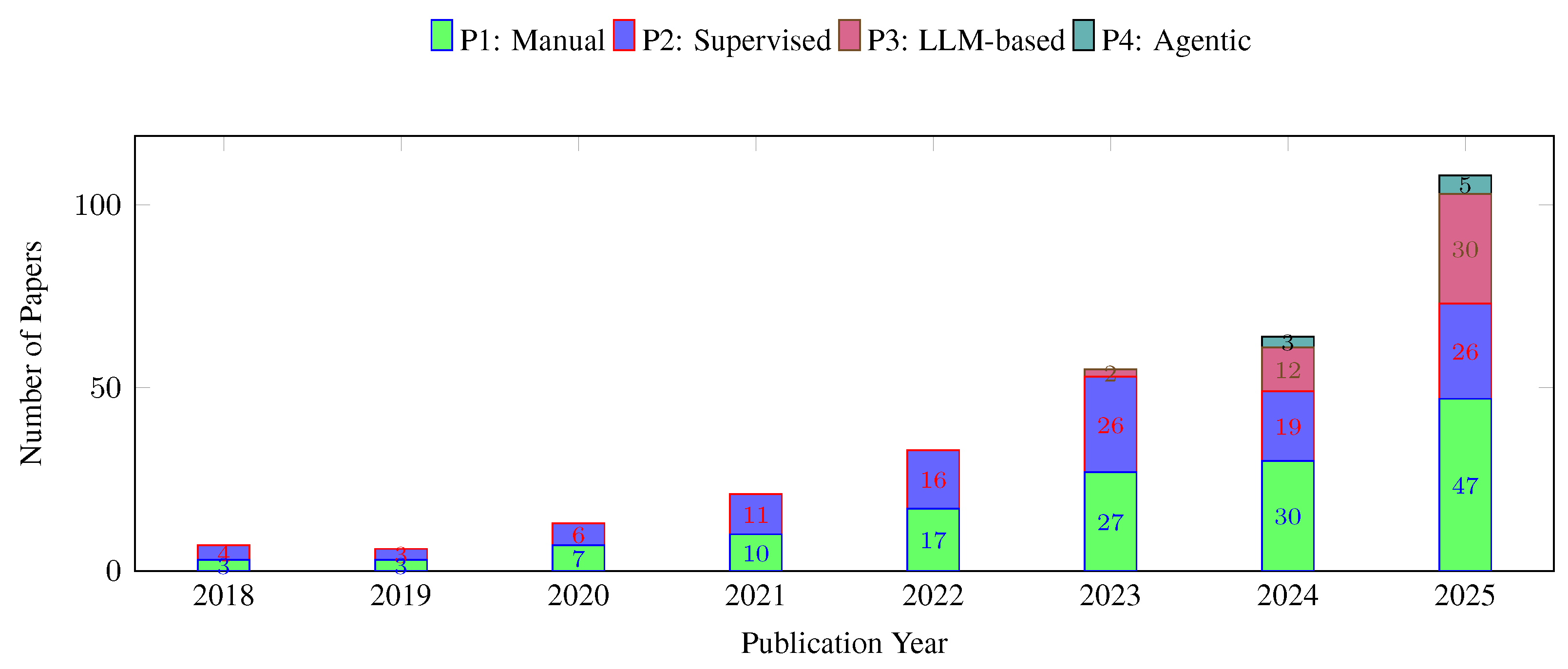
Appendix F. KG Usage
Table A7 defines the categories and their typical interfaces to NLP pipelines (e.g., IE/EL and alignment for ingestion; KGQA/text-to-SPARQL/GraphRAG for querying; verification and provenance tracing for auditable outputs; and KG-enhanced representation learning for prediction). We use this taxonomy as an orthogonal axis to ESG topics: it is not meant to replace pillar–theme–focus labeling, but to clarify the functional role that the KG plays in end-to-end ESG applications.
Table A8–Table A11 summarize representative KG→App systems across the Environmental (E), Social (S), Governance (G), and Holistic (H) pillars, organized by the ESG-RFM pillar–theme–focus taxonomy. In addition to the topical placement, each row is annotated with the KG usage taxonomy that captures how the KG is operationalized in the downstream system (Appendix F, Table A7). We report: (i) the focus (taxonomy anchor), (ii) the dominant KG usage pattern(s) (INT/MON/QA/AUG/PRED/REC/PROV/DT/VIS/SHARE), (iii) the dominant NLP/ML blocks used to build/query the KG, and (iv) representative works.
Figure A6.
Overall distribution of dominant construction paradigms among the 310 KGs (2018–2025): P1 (Manual/Ontology-first, 145 KGs; 46.8%) remains the most common for high-precision domains, followed closely by P2 (Supervised/Rule-based NLP, 115 KGs; 37.1%). P3 (LLM-based, 42 KGs; 13.5%) and P4 (Agentic, 8 KGs; 2.6%) represent the emerging generation of resources.
Figure A6.
Overall distribution of dominant construction paradigms among the 310 KGs (2018–2025): P1 (Manual/Ontology-first, 145 KGs; 46.8%) remains the most common for high-precision domains, followed closely by P2 (Supervised/Rule-based NLP, 115 KGs; 37.1%). P3 (LLM-based, 42 KGs; 13.5%) and P4 (Agentic, 8 KGs; 2.6%) represent the emerging generation of resources.
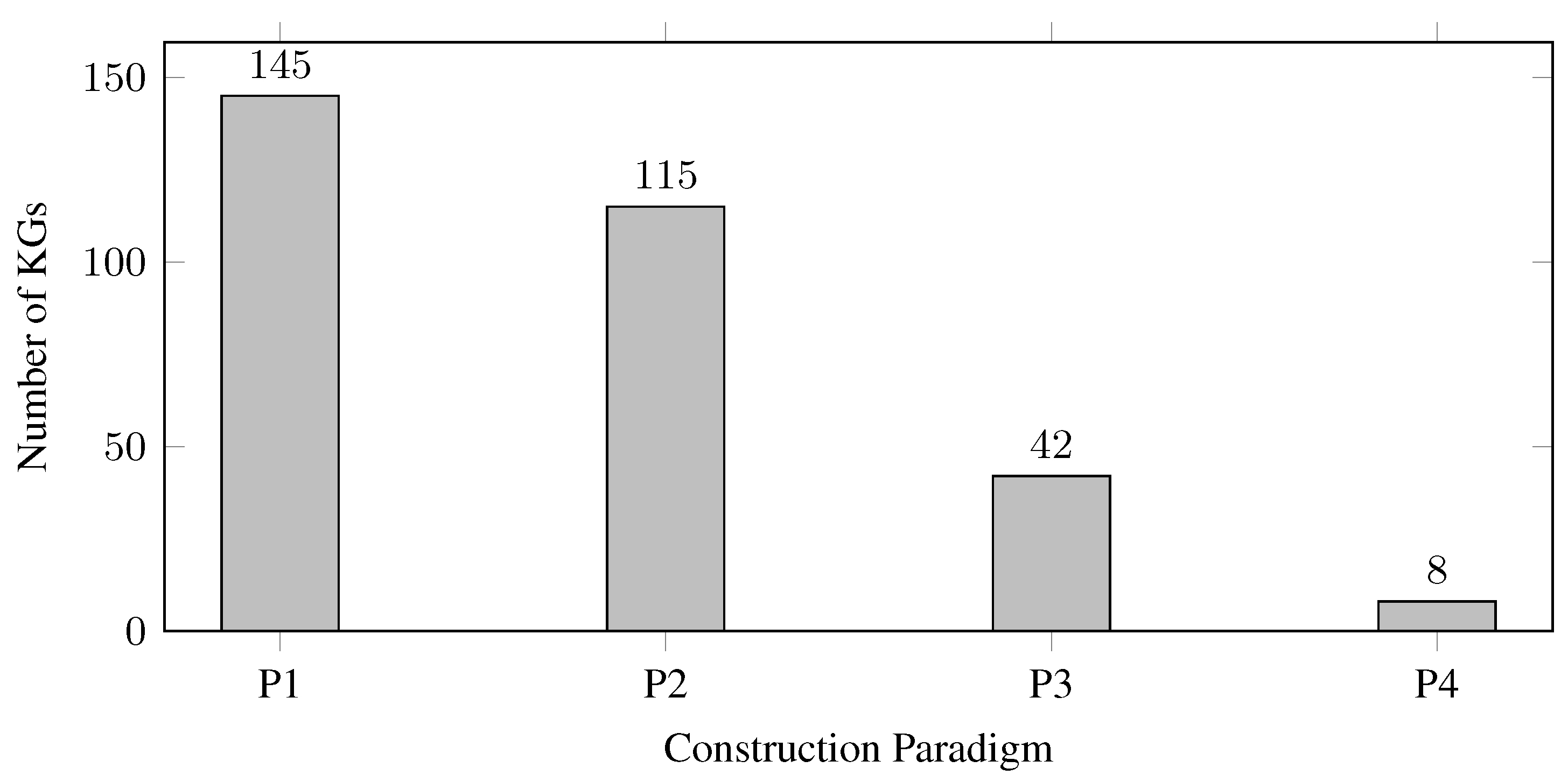
Table A7.
A usage taxonomy for the KG→App stage: how a KG is operationalized inside ESG applications, and the corresponding NLP interface blocks.
Table A7.
A usage taxonomy for the KG→App stage: how a KG is operationalized inside ESG applications, and the corresponding NLP interface blocks.
| Use Abbr | What the KG is doing | NLP interface (typical blocks) | Representative exemplars |
|---|---|---|---|
| INT | Unifies heterogeneous ESG evidence under a shared schema; enables cross-source joins and cross-standard comparability. | Entity linking/canonicalization; normalization (time/unit/boundary); schema-aligned retrieval and joins. | KnowWhereGraphjanowicz2022know; SustainGraphfotopoulou2022sustaingraph |
| MON | Tracks risks/events over time; supports alerts, screening, incident/claim monitoring, and compliance surveillance. | Streaming/periodic extraction; event linking; temporal KG updates; retrieval + classification. | ClimaFactsKGburel2025climafactskg; FFHKGliu2025automated |
| QA | Answers compliance / reporting / evidence questions using KG structure as the retrieval spine (often with RAG). | Text-to-SPARQL/Cypher; KGQA; GraphRAG-style graph-conditioned retrieval and synthesis. | Glitterbronzini2024glitter; GraphRAG-CEEDERstade2025evidence |
| AUG | Feeds graph signals into ML models (KGE/GNN/HIN) for scoring, ranking, classification, and prediction. | IE/EL → KG; embeddings/GNN features; learning-to-rank or classification with graph signals. | ESG-HINhisano2020prediction; OntoMetricyu2025ontometric |
| PRED | Uses graph structure for reasoning/prediction (rules, paths, link prediction, forecasting). | Rule/path reasoning; graph completion; causal/temporal linking; constrained inference. | Reactive CKGmagnanimi2023reactive; GovGraphma2025govgraph |
| REC | Matches entities/opportunities (suppliers, flows, interventions, curricula, materials) using KG constraints. | Candidate retrieval + constraint checking; KG similarity; sometimes LLM reasoning over KG context. | SmartSCfelder2025smart; KG-based Skillsweichselbraun2022building |
| PROV | Supports auditability: lineage, traceability, and evidence chains for ESG claims/metrics. | Provenance capture; citation linking; qualified statements; validation and contradiction checks. | CarbonKGwu2024carbonkg; TaxGraphludemann2020knowledge |
| DT | Acts as a digital twin / world model for control, simulation, optimization, or dynamic planning. | Sensor/geo ingestion; state updates; tool execution; sometimes agentic querying/control. | TWA-dKGquek2024dynamic; WorldAvatar-dKGxie2024dynamic |
| VIS | Enables exploratory analytics, dashboards, and narrative inspection via graph views. | Graph summarization; community detection; lightweight IE for labels/edges. | ESG Narrative Networksangioni2024exploring |
| SHARE | Supports multi-stakeholder sharing and governed interoperability (data spaces, DPP ecosystems). | Schema alignment; access control metadata; provenance + versioning for exchange. | Solid-based ESG data spacesde2024open; DPP Ontologiesbelova2025digital |
Table A8.
Environmental (E) KG→App systems annotated with KG usage.
| Theme | Focus | Use | NLP/ML backbone (build + query) | Representative systems |
|---|---|---|---|---|
| ClimChg | GHG, ProdFoot | PROV, INT, AUG | Ontology/ETL or IE over inventories; factor normalization; KGE/GNN for footprint completion; provenance-linked roll-ups | CF-KGsharma2022carbon; CarbonKGwu2024carbonkg; E-Liabilityoladeji2023ai |
| PhysClimRisk | MON, INT, PRED | NER/RE over news + geo-entity linking; GeoSPARQL; semantic-web geo KGs; dynamic/digital-twin updates | CC-KGmishra2021neuralnere; KnowWhereGraphjanowicz2022know; LinkClimatewu2022linkclimate; TWA Floodhofmeister2024cross | |
| ClimFin | AUG, INT | IE over reports; heterogeneous information networks; graph-based scoring (GNN/HIN); cross-source linkage | Green Premium KGzhoua2022green; ESG-HINhisano2020prediction | |
| ProdFoot | REC, INT, QA | Schema-guided retrieval of background flows; Cypher/SPARQL querying; LLM-assisted parameter completion | LCIKGsaad2023graph; LCA-KGgreif2024knowledge; Ecoinvent-KGpeng2024knowledge | |
| NatCap | BiodivLU | INT, MON, VIS | Scientific-text NER/EL; ontology alignment; geo-alignment to RS/GIS layers; hybrid RE + validation | Nature FIRSTahmeti2023towards; GeoKG-HSAxiao2025geokg; FooDShamed2025foods |
| RawSrc | PROV, INT, MON | Traceability ontologies; rule/path reasoning; supplier/entity linking; optional LLM IE | SCT-KGameri2023agri; SCN-KGliu2023knowledge; SCKG-MSjin2025enhancing | |
| WaterSS | MON, INT, PRED | Semantic sensor/geo integration; event extraction; graph learning over spatiotemporal KGs | WHOW-KGlippolis2025water; WQHR-KGgautam2023leveraging; SmartWater-KGmezni2022smartwater | |
| PolWasCiru | EWaste | MON, PRED, INT | NER/RE from incident text; rule extraction; KGE/GNN for planning | EEE-GDKGdang2023green; EVB-DKGyin2025sequential; AIRQ-KGkatzenstein2025fair |
| PackWaste | VIS, REC, INT | Topic/sentiment mining; ontology-driven metadata; stakeholder linkage | PRIME-KGaprilia2023deep; Circular Factory KGthapa2025roadmap | |
| SustSolTech | CleanTech | VIS, INT | Topic modeling; co-occurrence and citation graph analytics | Green-tech KGsharma2022carbon |
| GreenBldg | DT, INT, PRED | Built-environment ontologies (Brick/BOT); rule reasoning; KGQA + optimization | Building KGhe2025smart; TWA-dKGquek2024dynamic; Housing KGkeena2025housing | |
| ReEneg | DT, MON, INT | Multimodal KGC (SCADA/manuals); anomaly detection + KG reasoning | XAI4Windchatterjee2020xai4wind; SCADA-KGong2022embedding; WorldAvatar-dKGxie2024dynamic |
Table A9.
Social (S) KG→App systems annotated with KG usage.
| Theme | Focus | Use | NLP/ML backbone (build + query) | Representative systems |
|---|---|---|---|---|
| HumCap | OHS | MON, PRED, INT | Incident-report IE; causal/event linking; graph analytics; multimodal safety evidence | SCH-KGfang2020knowledge; Rail-Risk KGliu2022using; FFHKGliu2025automated |
| LearnDev | REC, INT, QA | NER/EL over course/job text; taxonomy alignment; KG recommenders | KG-based Skillsweichselbraun2022building | |
| WorkManRel | MON, AUG, PRED | Web/report IE; graph learning for attrition; link prediction for risk propagation | Industry-chain KGli2021industry; Attrition KGal2024enhancing; Labor-risk KGzheng2025enhancing | |
| ProdRespCustSafe | ChemSafe | MON, PRED, INT | Ontology-grounded IE; dictionary/rule mappings; KGE + rules | Soil-Toxic KGhan2022construction; Toxicity KGda2024combining |
| DataSec | QA, MON, PROV | Compliance-rule modeling; KG-augmented RAG; CTI entity/event extraction | PrivCompgarza2024privcomp; AttacKG+zhang2024attackg+; VulKGyin2024compact | |
| ProdQual | MON, QA, INT | Safety/quality IE; KG-backed reasoning; QA interfaces | HCPchen2023knowledge; QChsGwen2025novel | |
| ComRigRisks | ComRel | INT, VIS | Ontology modeling; GeoSPARQL; web IE + graph analytics | People KGgordon2021people; Trafficking KGszekely2015building |
| RiskSrc | MON, PROV, AUG | Event extraction; neurosymbolic reasoning; deep-tier link prediction | Deep-tier SCbrockmann2022supply; Supplier-LLM KGalmahri2025enhancing | |
| IncSolSocAcc | HealAcc | INT, AUG, QA | Tabular+text integration; KG-augmented querying; NL-to-Cypher agents | HealthEQKGnananukul2025healtheqkg; Health-Service KGuddin2025hybrid |
| NutriHeal | REC, PRED | KBQA over food/health ontologies; constraint-aware recommendation | FoodRec-KGchen2021personalized |
Table A10.
Governance (G) KG→App systems annotated with KG usage.
| Theme | Focus | Use | NLP/ML backbone (build + query) | Representative systems |
|---|---|---|---|---|
| CorpGov | OwnCtrl | PRED, MON, INT | Registry integration; rule/path reasoning (Datalog/Vadalog); temporal path analysis | VL-CO-KGatzeni2020weaving; Reactive CKGmagnanimi2023reactive; Equity KGxu2025disclosing |
| FinRepQ | MON, AUG, PROV | Firm–statement graphs; heterogeneous GNNs; evidence tracing | CLFFGshen2021financial; AI-KGwu2022financial; SC-fraud KGli2023tracking | |
| CorpCondInt | TaxTrans | QA, PROV, PRED | KG-centric retrieval; RAG-style explanation; audit signals | TaxGraphludemann2020knowledge; TaxKG-RAGtan2025llama; Multimodal TaxKGzhang2025knowledge |
| EthicsAC | MON, PRED | Case IE; community detection; rule/pattern mining | DIS-KGliu2021construction; DIC-KGgao2021latent |
Table A11.
Holistic (H) KG→App systems annotated with KG usage.
| Theme | Focus | Use | NLP/ML backbone (build + query) | Representative systems |
|---|---|---|---|---|
| ESGIntAss | ESGRate | AUG, VIS, INT | Dynamic ESG networks; lexicon/sentiment KGs; graph-enhanced scoring | ESG Narrative Networksangioni2024exploring; ESG-HINhisano2020prediction; ESGSenticNetong2025esgsenticnet |
| ESGRept | QA, INT, PROV | Schema mapping across standards; RAG-style interpretation; provenance chains | ESRS–GRI RAGzhou2024accessing; Glitterbronzini2024glitter; OntoMetricyu2025ontometric | |
| ESGData | QA, AUG | GraphRAG-style indexing; graph-conditioned retrieval + summarization | GraphRAG-CEEDERstade2025evidence | |
| SDFrame | SDGs | INT, QA, SHARE | Indicator/ontology alignment; KG-grounded retrieval across policy corpora | SustainGraphfotopoulou2022sustaingraph; ESGOntvijaya2025esgont; SDG-KGkilanioti2023knowledge |
| SysSustMod | CircLoop | SHARE, DT, INT | Ontology networks for DPP ecosystems; governed data spaces; agentic tool chains | DPP Ontologiesbelova2025digital; Solid-based ESG data spacesde2024open; Agentic CEzhao2025agentict |
Appendix G. Quantitative Trend Meta-Analysis
Based on the curated catalog of KG-producing papers and the cross-engine query volume analysis defined by Table A5, we characterize how research demand and knowledge-graph adoption interact across the ESG Research Focus Map (ESG-RFM). Figure A7–Figure A10 present focus-level intensity and KG uptake across four major scholarly indices, while Figure A11–Figure A13 trace long-term temporal dynamics.
Three consistent trends emerge.
(T1) Demand–KG misalignment at the focus level. Across all engines, high-demand ESG foci—such as Energy Consumption & Fuel Mix, Greenhouse Gas Emissions, Data Protection & Cybersecurity, and Digital Responsibility, Data & AI Ethics—dominate absolute query volumes (Figure A7–Figure A9). However, KG adoption rates vary sharply across these foci, revealing systematic gaps where topic importance does not translate into structured knowledge representations.
(T2) Governance and data-centric topics exhibit higher KG penetration. While Environmental foci account for the largest absolute volumes, Governance- and data-heavy Social foci consistently show higher KG usage rates relative to their total volume, particularly in the ACL Anthology and Semantic Scholar (Figure A8, Figure A10). This pattern reflects the structural suitability of KGs for compliance reasoning, data governance, and formal policy modeling.
(T3) Accelerated KG uptake after 2021 across engines. Yearly trends reveal monotonic growth in ESG-related research since 2015, with a marked acceleration in KG-inclusive work after 2021 across Google Scholar, OpenAlex, and Semantic Scholar (Figure A11–Figure A13). Despite this acceleration, KG-based studies remain a small fraction of the overall ESG literature, underscoring substantial headroom for structured, machine-interpretable ESG knowledge.
Taken together, these quantitative signals position KG4ESG as a response to both scale imbalance (high-demand but weakly structured topics) and methodological concentration (KG-heavy adoption clustered in governance and analytics-oriented domains), motivating the need for a systematic atlas spanning all ESG pillars.
Figure A7.
Query volume distribution across 66 ESG research focuses on Google Scholar. Bars indicate log-scaled absolute paper counts with and without knowledge graphs, while the overlaid curve reports the KG adoption rate. Focuses are ranked by total KG-inclusive volume.
Figure A7.
Query volume distribution across 66 ESG research focuses on Google Scholar. Bars indicate log-scaled absolute paper counts with and without knowledge graphs, while the overlaid curve reports the KG adoption rate. Focuses are ranked by total KG-inclusive volume.
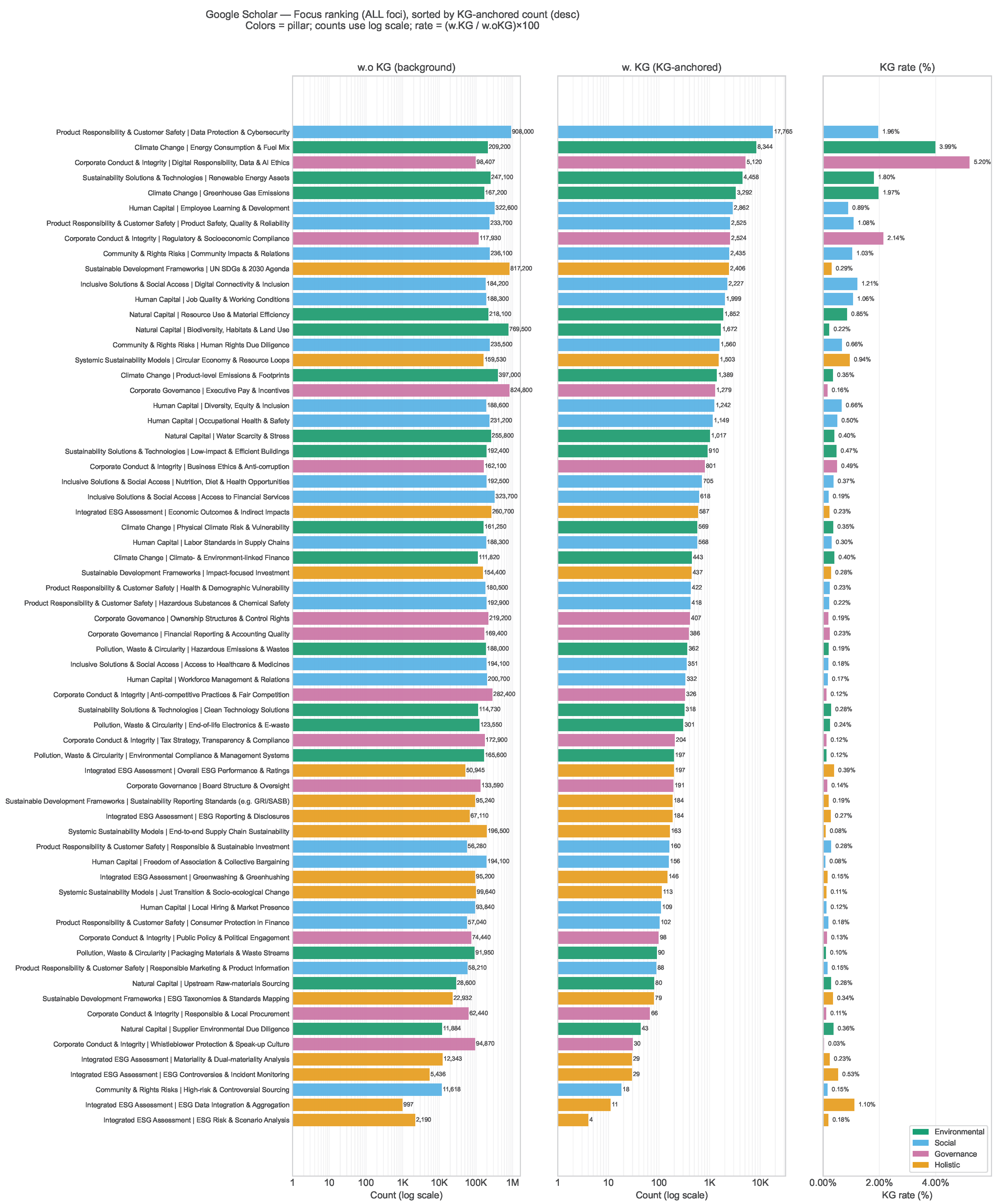
Figure A8.
Query volume distribution across 66 ESG research focuses in the ACL Anthology. Log-scaled absolute counts contrast KG-based and non-KG works, with the KG usage rate overlaid and focuses sorted by total KG-inclusive volume.
Figure A8.
Query volume distribution across 66 ESG research focuses in the ACL Anthology. Log-scaled absolute counts contrast KG-based and non-KG works, with the KG usage rate overlaid and focuses sorted by total KG-inclusive volume.
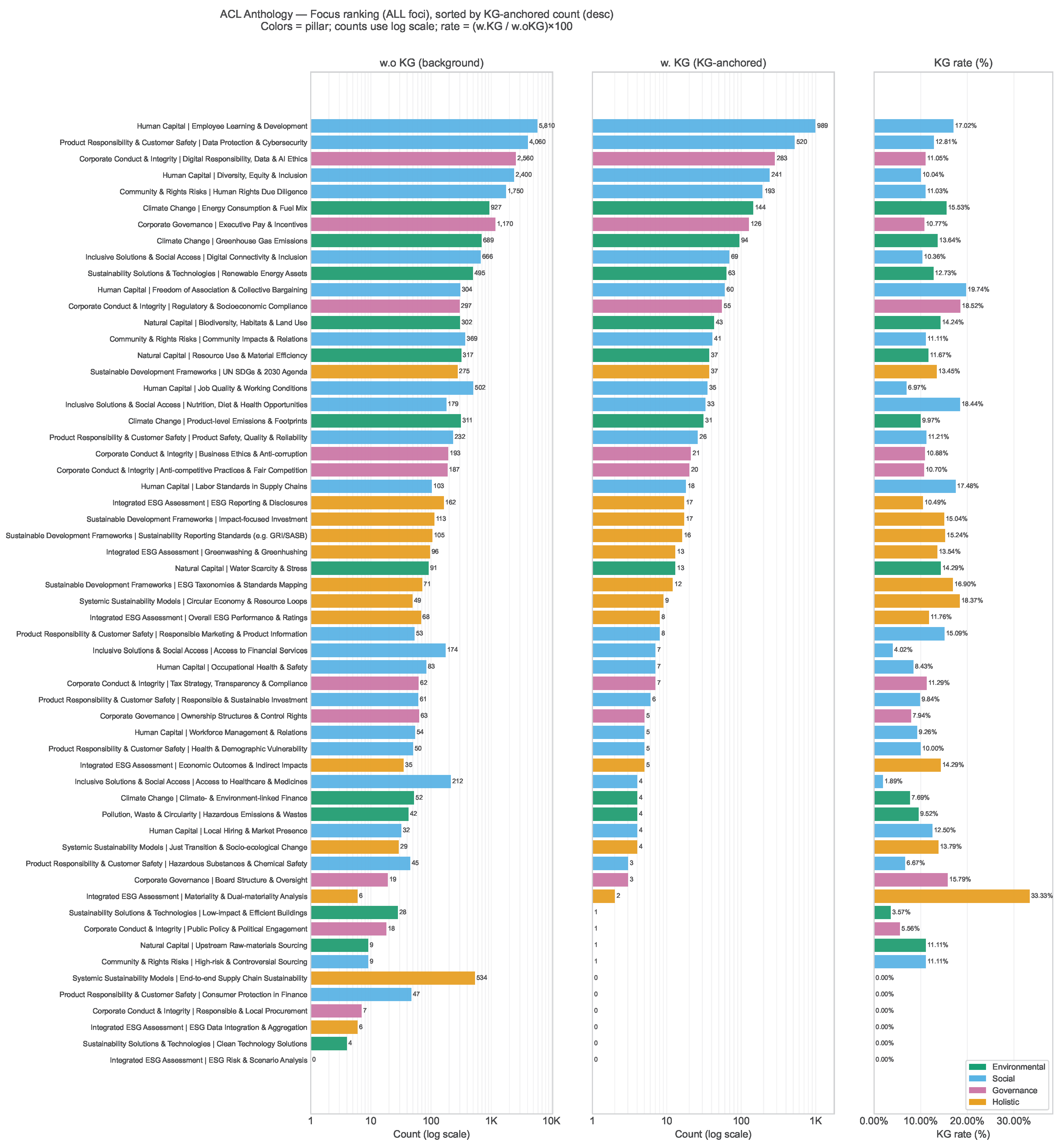
Figure A9.
Query volume distribution across 66 ESG research focuses in OpenAlex. Absolute paper counts are shown on a log scale, together with the corresponding KG adoption rate, with focuses ranked by total KG-inclusive volume.
Figure A9.
Query volume distribution across 66 ESG research focuses in OpenAlex. Absolute paper counts are shown on a log scale, together with the corresponding KG adoption rate, with focuses ranked by total KG-inclusive volume.
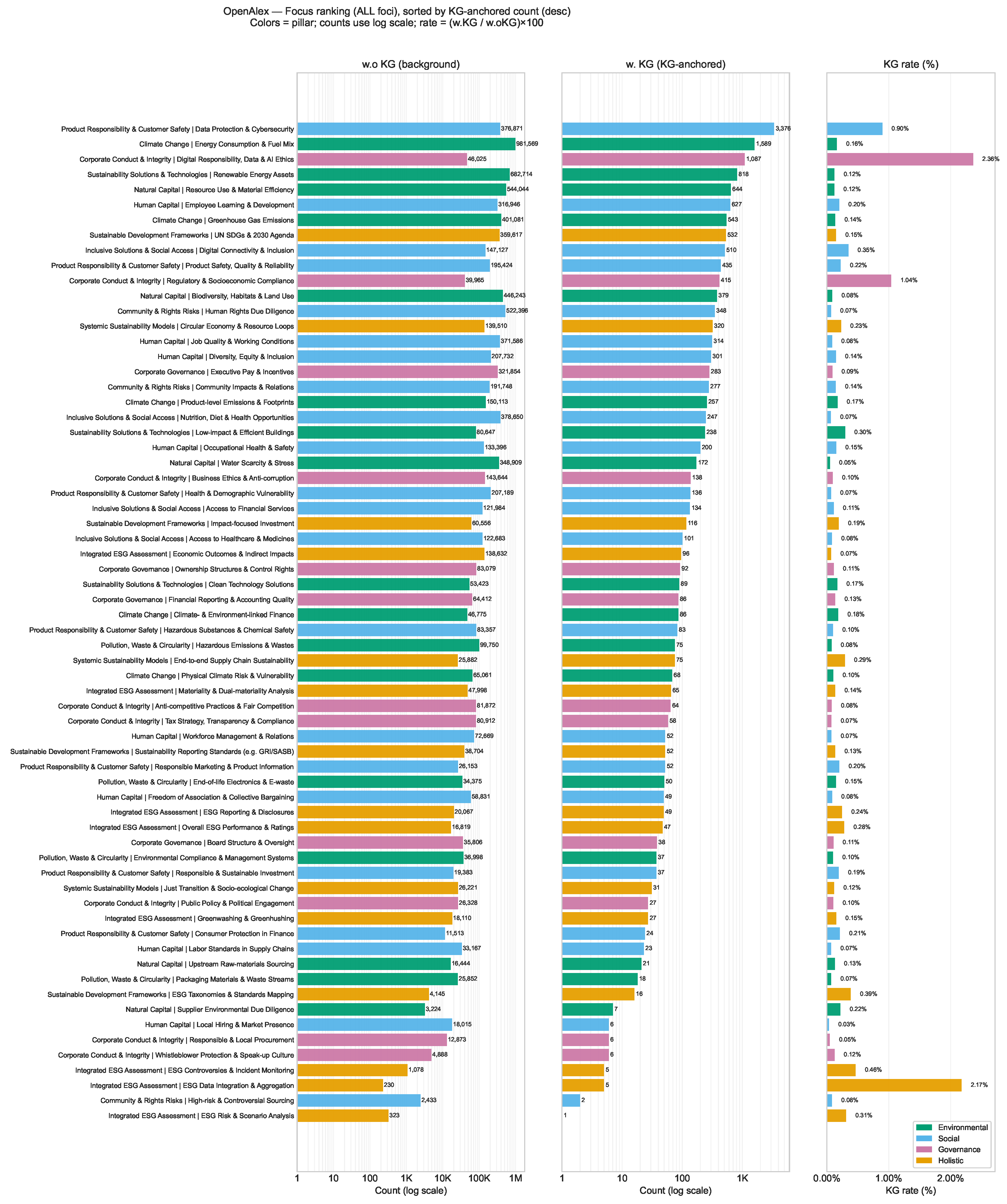
Figure A10.
Query volume distribution across 66 ESG research focuses on Semantic Scholar. Log-scaled absolute volumes with and without knowledge graphs are shown, accompanied by KG usage rates, and focuses ranked by total KG-inclusive volume.
Figure A10.
Query volume distribution across 66 ESG research focuses on Semantic Scholar. Log-scaled absolute volumes with and without knowledge graphs are shown, accompanied by KG usage rates, and focuses ranked by total KG-inclusive volume.
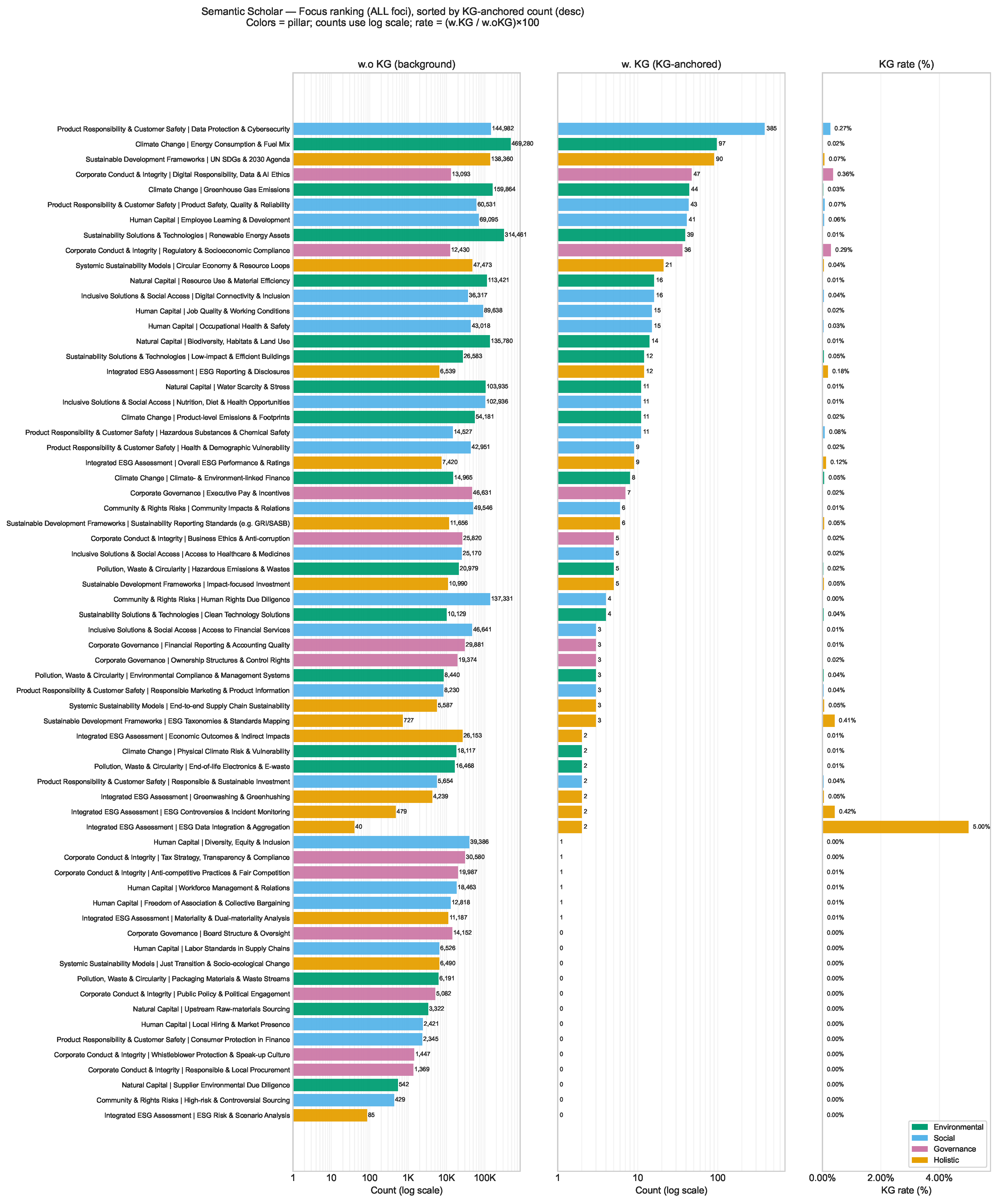
Figure A11.
Yearly query volume trends for ESG-related research on Google Scholar. Log-scaled absolute counts of publications with and without knowledge graphs are shown by year, together with the corresponding KG adoption rate, revealing long-term growth dynamics and KG uptake over time.
Figure A11.
Yearly query volume trends for ESG-related research on Google Scholar. Log-scaled absolute counts of publications with and without knowledge graphs are shown by year, together with the corresponding KG adoption rate, revealing long-term growth dynamics and KG uptake over time.
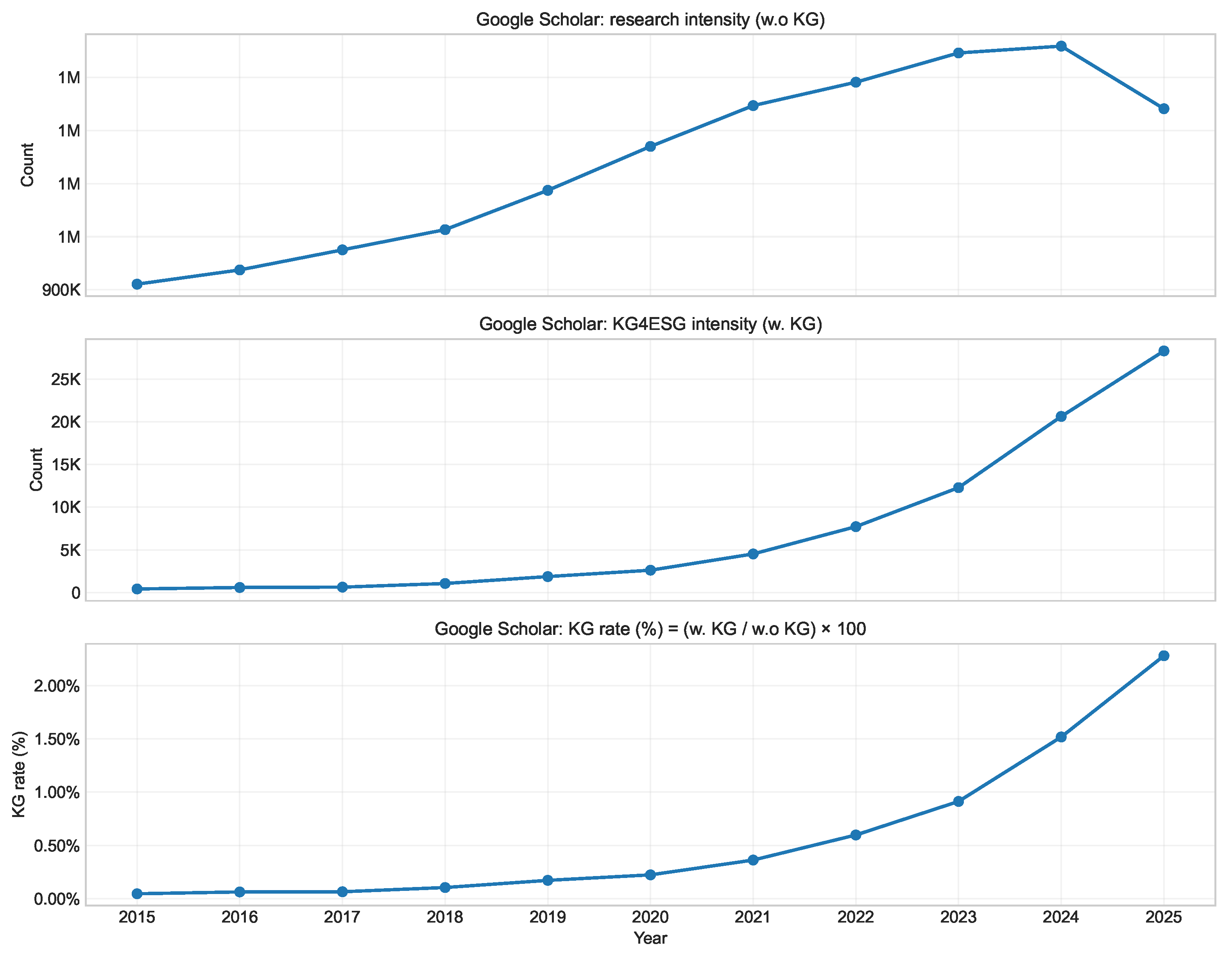
Figure A12.
Yearly query volume trends for ESG-related research indexed in OpenAlex. Absolute publication counts with and without knowledge graphs are plotted on a log scale, alongside yearly KG usage rates, highlighting temporal shifts in corpus coverage and KG intensity.
Figure A12.
Yearly query volume trends for ESG-related research indexed in OpenAlex. Absolute publication counts with and without knowledge graphs are plotted on a log scale, alongside yearly KG usage rates, highlighting temporal shifts in corpus coverage and KG intensity.
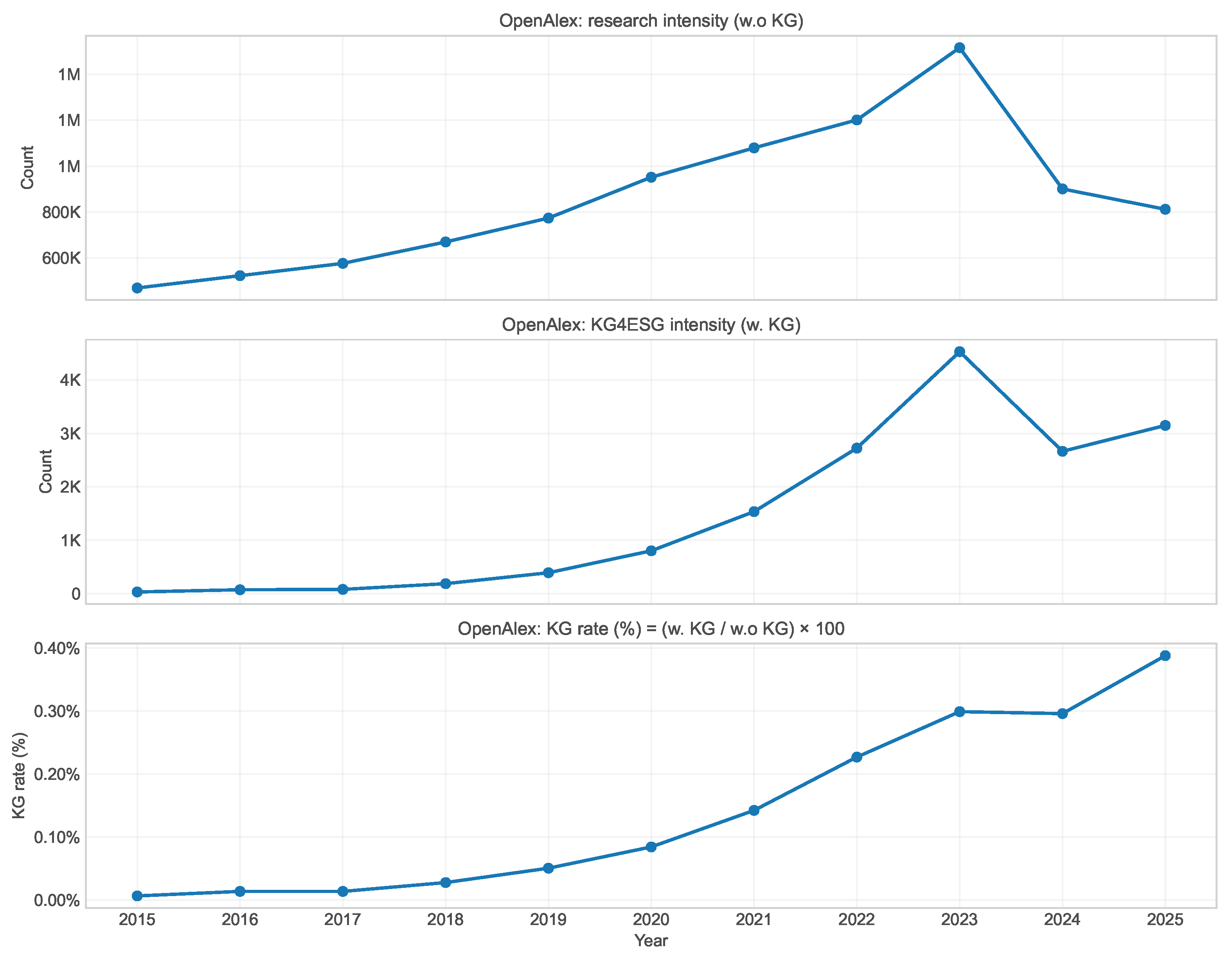
Figure A13.
Yearly query volume trends for ESG-related research on Semantic Scholar. Log-scaled yearly counts contrast KG-based and non-KG works, with an overlaid KG adoption rate illustrating the evolution of KG usage across time.
Figure A13.
Yearly query volume trends for ESG-related research on Semantic Scholar. Log-scaled yearly counts contrast KG-based and non-KG works, with an overlaid KG adoption rate illustrating the evolution of KG usage across time.
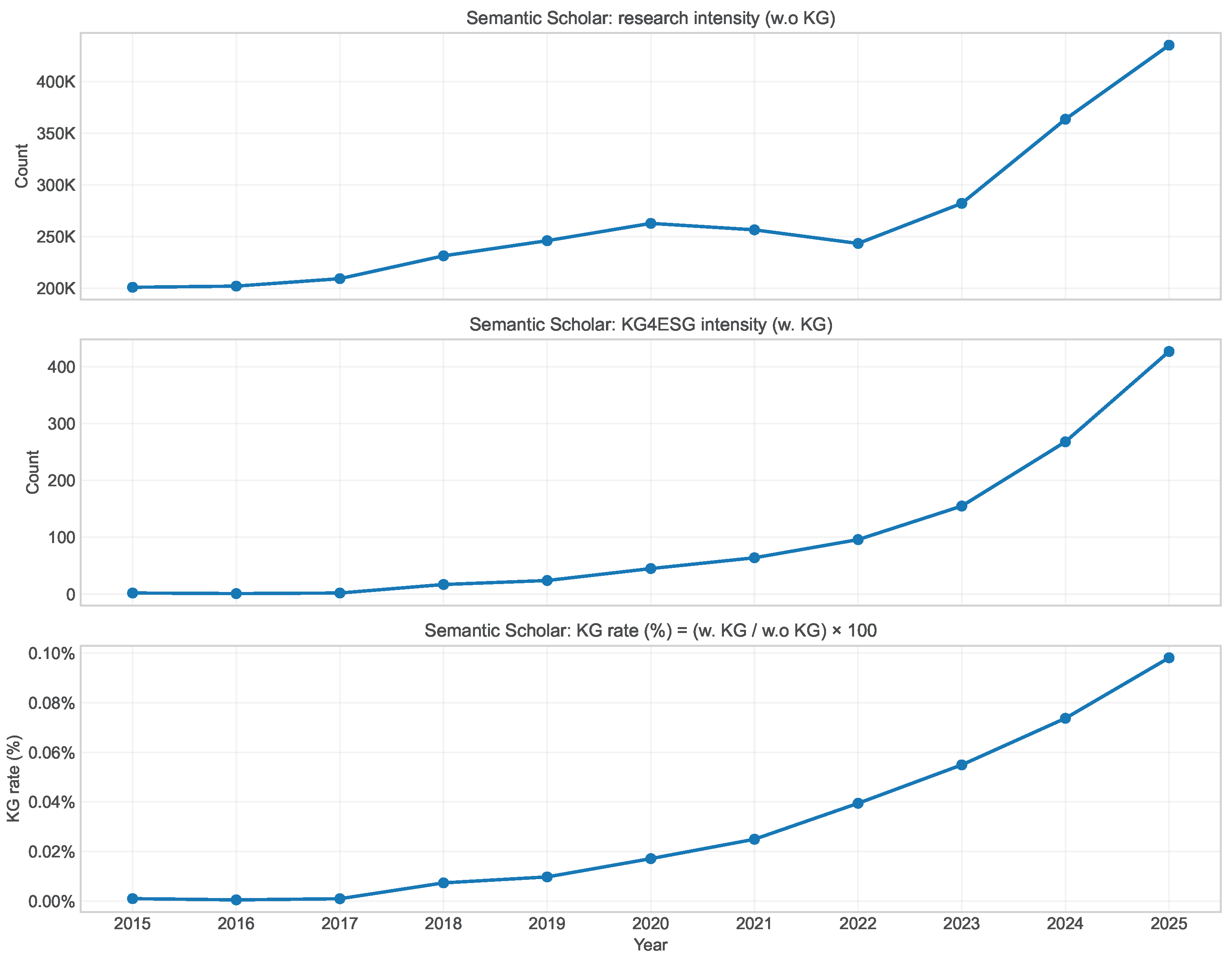
Appendix H. Knowledge Graph Resource Catalog
This section catalogs 310 ESG-related knowledge graph (KG) resources published between 2018 and 2025 (Table A12). Across the full survey, we review a total of 337 works; the remaining 27 works are application-only studies that leverage pre-existing KGs or external graph resources without constructing a new ESG-specific KG, and are therefore excluded from this construction-focused catalog.
The temporal distribution is strongly skewed toward recent years, highlighting the rapid acceleration of KG-based ESG research. Only 13 resources appear before 2020, followed by sustained growth from 2020 onward (13 in 2020, 21 in 2021, 33 in 2022, and 55 in 2023), and a pronounced surge over the past two years, with 67 resources in 2024 and 108 in 2025 alone. This pattern reflects both the maturation of enabling technologies (e.g., LLM-assisted extraction and graph tooling) and the rising demand for structured, traceable, and auditable ESG intelligence.
The catalog spans all four ESG pillars—Environmental (E), Social (S), Governance (G), and holistic/cross-cutting (H)—and covers a wide range of themes, including climate change and climate finance, natural capital and biodiversity, human capital and occupational health and safety, corporate governance and regulatory compliance, product responsibility (including cybersecurity and data security), sustainable solutions and technologies (e.g., renewable energy and green buildings), as well as supply-chain, circular-economy, and SDG-oriented frameworks.
Across the corpus, text and tabular sources dominate, but many resources integrate multiple modalities such as sensor and time-series streams, geospatial layers, imagery, graphs, CAD/BIM artifacts, and event logs. For each resource, the longtable reports ontology choices (existing, created, or mixed), construction paradigms, downstream KG usage and tasks, and scale; it also records—where stated—domain-expert involvement in ontology engineering, annotation, and validation. Finally, the availability field indicates the degree to which schemas, KG artifacts, extraction code, datasets, documentation, and access endpoints are publicly released, partially shared under restricted licenses, or remain proprietary and inaccessible to external researchers.
Table A12.
Catalog of ESG-related knowledge-graph resources (2018–2025). Columns summarize ESG pillar (P), theme (T), focus (F), data sources and modalities, ontology, construction paradigm (Cstr; P1–P4), expert involvement, KG usage and tasks, graph scale, and availability.
Table A12.
Catalog of ESG-related knowledge-graph resources (2018–2025). Columns summarize ESG pillar (P), theme (T), focus (F), data sources and modalities, ontology, construction paradigm (Cstr; P1–P4), expert involvement, KG usage and tasks, graph scale, and availability.
| Resource | Year | P | T | F | Data Source | Modality | Ontology | Cstr | Expert | KG Usage | Tasks | KG Scale | Availability |
|---|---|---|---|---|---|---|---|---|---|---|---|---|---|
| [84] | 2025 | E | ClimChg | PhysClimRisk | 10247 Academic Papers | Text | N.A. | P3 | Yes (Val) | KGQA | RE; Align; Retr; QA; Other | Ent:23156; Rel:89472; Trip:127834 | N.A. |
| [36] | 2025 | S | ProdRespCustSafe | DataSec | 63 Privacy Policies | Text | N.A. | P3 | Yes (Annot,Val) | Bayesian Nets | Compliance Auditing | N.A. | N.A. |
| [242] | 2025 | S | ProdRespCustSafe | DataSec | Academic Papers | Text; Tabular | N.A. | P3 | Yes (Corpus, Prompt, Sys Design) | RAG | Security, Privacy, Compliance | N.A. | N.A. |
| AEC-KGwu2025construction | 2025 | S | HumCap | OHS | 6107 cases of China public accident reports and dispute cases | Text | Created | P2 | Yes(Onto, Annot) | RiskMon | NER | N.A. | N.A. |
| [43] | 2025 | H | ESGIntAss | ESGIncid | 800–2,000 News Articles | Text | Meta ESG Ontology | P3 | Yes (Onto,Eval,Val) | Alignment | ESG controversy / violation detection; principle-level ESG classification (UNGC principles); interpretable ESG compliance analysis; downstream ESG trend tracking and risk prediction | N.A. | https://github.com/tsuyoshiiwataRR/NEWS_LLM_UT_RR |
| [200] | 2025 | E | PolWasCiru | HazWaste | Safety Management Data | Text; Tabular | Created | P1 | Yes(Onto, Annot) | KGQA | Retr;QA | N.A. | N.A. |
| [9] | 2025 | H | ESGIntAss | ESGRept | ESG regulatory PDFs | Text | ESGMKGyu2024ontology | P3 | Yes(Prompt, Val) | validated, provenance-preserving ESG regulatory representation | ESG compliance analysis, cross-framework alignment, RAG, sustainable-finance analytics, transparency tools | Document-level counts (42–68 entities, 42–65 relations per document) | N.A. |
| [179] | 2025 | E | NatCap | WaterSS | 64,512 risk inspection cases | Text; Geospatial; Event logs | Created | P2 | Yes (Onto, Annot, Val) | mapping to risk evolution networks + spatio-temporal causal evolution analysis | causal propagation/diffusion analysis, temporal emergence rate, spatial associations, prevention/control strategy support | N.A. | N.A. |
| [74] | 2025 | H | SysSustMod | SCSust | Enterprise Data(ERP / MES / CRM etc.) | Tabular; Geospatial; Graph; Other | a property graph ontology within the Neo4j GDB | P4 | Yes(Onto,Prompt,Val) | multimodal route completion + optimization + emissions accounting for sustainable logistics/LCA | route enrichment, route optimization, emissions estimation, scenario benchmarking, sustainability reporting support | Ent:281; Trip:996 | N.A. |
| ClimaFactsKGburel2025climafactskg | 2025 | E | ClimChg | PhysClimRisk | SSkeptical Science (SkS) website articles, CimpleKG | Text; Graph | Schema.org, CARDS taxonomy | P1 | Yes (Link) | Retr/QA | Cls; Retr; Other | N.A. | https://github.com/climatesense-project/climafacts-kg; https://purl.net/climatesense/climafactskg |
| [82] | 2025 | H | ESGIntAss | GreenWH | Databases: 1.ASA & CAP advertising rulings; 2.Climate Change Litigation ; 3.DeSmog databases; 50 papers, web pages, book summaries, newspaper articles | Text; Tabular | Created and Dublin Core vocabulary; Gist Upper Model; Universal Moral Grammar ... | P1 | Yes (Onto, Val) | RAG | Retr; QA; Other | N.A. | https://github.com/mdebellis/Climate_Obstruction |
| [254] | 2025 | S | ProdRespCustSafe | ProdQual | Equipment maintenance documents, Operation manuals, Technical specifications, Maintenance records, Alarm logs | Text; Event logs | Created | P3 | Yes(Onto, Prompt) | Semantic backbone | Fault diagnosis support | N.A. | |
| CPSKGzheng2025chemical | 2025 | S | ProdRespCustSafe | ChemSafe | Disaster Scenario Monitoring Data, Equipment Operation Data, Directories of Hazardous Chemicals, Accident Investigation Reports, Laws and Regulations, Emergency Plans | Text; Tabular; Sensor / time-series | CIPSR ontology | P3 | Yes (Ont,Prompt, Val) | RAG | Emergency Decision Response | N.A. | N.A. |
| CropDP-KGyan2025knowledge | 2025 | E | NatCap | BiodivLU | Chinese crop diseases and pests image-text database | Text; Tabular | Created | P2 | Yes (Annot,Val) | Semantic backbone | QA; Decision Support | Ent:13840; Rel:7; Trip:21961 | https://github.com/dadadaray/CropDP-KG/tree/Knowledge-System; https://doi.org/10.6084/m9.figshare.28015541 |
| [37] | 2025 | S | ProdRespCustSafe | DataSec | 150 real-world CTI reports | Text | MALOnt | P3 | Yes (Annot, Prompt, Val) | Threat profiling / structured representation | CTI knowledge extraction / CSKG construction | N.A. | https://ctinexus.github.io/ |
| [75] | 2025 | E | PolWasCiru | EWaste | Solomon vehicle routing dataset | Tabular | A Schema | P1 | Yes(Schema) | Knowledge memory for optimization | Dynamic vehicle routing optimization;Decision Support | N.A. | N.A. |
| [163] | 2025 | E | NatCap | BiodivLU | COPIOUS biodiversity corpus; CABI Digital Library forestry compendium | Text | Not Mention | P2 | Yes(Annot) | Reason/Pred | NER | N.A. | https://github.com/BiodivNER/BiodivNERModels |
| [191] | 2025 | E | PolWasCiru | EWaste | Technical standards, policies, enterprise documents, disassembly reports; Historical databases of transformer models, materials, prices, and disassembly cases; Multimodal sensing (RGB-D images, gas concentration, resistance, oil quality, energy meters) | Text; Image; Sensor | A Schema | P3 | Yes (Schema, Val) | KG+ML | NER; RE; Align; Retr; Other | Ent:3800; Trip:12500 | N.A. |
| [123] | 2025 | E | ClimChg | GHG | 523 “dual carbon” policies; CNKI publications | Text | A policy ontology | P2 | Yes (Onto, Annot,Val) | Reason/Pred | Retrival | Ent:23736; Trip:119744 | https://github.com/yeahqiona/Dual-carbon-policies |
| [316] | 2025 | H | SysSustMod | CircLoop | Enterprise data sources; Supplier-provided DPP data assets (KGs) | Tabular | Created | P1 | Yes (Onto, Val) | Semantic backbone for DPP data assets | Carbon footprint tracking | N.A. | N.A. |
| Elderly Advantages Knowledge Graphli2025aging | 2025 | S | ProdRespCustSafe | HealVuln | Elderly Interviews and Brainstorming Data | Text; Tabular | Created | P1 | Yes (Ont,Val,Part) | Semantic backbone | Retrieval | N.A. | N.A. |
| EmeraldGraphKaoukis2025EmeraldMindAK | 2025 | H | ESGIntAss | GreenWH | 37 publicly available ESG reports;KPI definitions; Claim collections | Text; Tabular; Image | Created ESG domain schema | P3 | Yes(Onto, Val) | RAG | Greenwashing detection / claim verification | Ent:53748; Rel:59344 | N.A. |
| [124] | 2025 | E | ClimChg | GHG | Public research results / literature; Policy documents; Industry reports / technical reports | Text; Tabular | Created: ontology framework for carbon emission reduction | P2 | Yes (Val) | multi-source integration and semantic organization layer | Carbon emission reduction pathway analysis and optimization; Decision Support | N.A. | N.A. |
| Energy Knowledge Graph (EKG)wu2025intelligent | 2025 | E | ClimChg | EnergyMix | Structured, semi-structured, and unstructured manufacturing data; expert knowledge; third-party knowledge base | Text; Tabular; Sensor / time-series | manufacturing energy management ontology via Stanford Seven-Step Method | P2 | Yes (Onto, Val) | Semantic backbone | QA; Retr; Rec; Decision Support | N.A. | N.A. |
| [196] | 2025 | E | PolWasCiru | EnvComp | Policy corpus for Niger | Text | Created: Enhanced ontology | P3 | Yes (Annot,Val) | KG+ML | NER; RE; QA; Other | Ent:61912; Rel:81389 | N.A. |
| Equity Knowledge Graph (EKG)xu2025disclosing | 2025 | G | CorpGov | OwnCtrl | CSMAR database;Online news;Official website | Text; Tabular | Created | P1 | Yes(Data) | Unified representation; Learning substrate; Explainability | Actual Controller (AC) disclosure framed as control relation prediction between a shareholder and a company | Ent:1262542; Rel:1869448 | N.A. |
| ESGSenticNetong2025esgsenticnet | 2025 | H | ESGIntAss | ESGRept | 1,998 SGX company sustainability reports | Text | Created | P3 | Yes (Ont,Annot,Val) | knowledge base | ESG topic analysis | Ent:23245; Trip:44232 | N.A. |
| PREJUST4WOMANdamato2025automated | 2025 | S | ComRigRisks | HRDD | 73 ECHR judgments/decisions | Text; Tabular; Graph | Created | P3 | Yes (Annot,Val) | Knowledge-intensive legal information access | SPARQL-based legal querying; support legal decision-making; potential predictive-justice link prediction over KG | Ent:5185; Rel:22; Trip:10325 | https://github.com/Fra3005/PreJust4Womans; https://github.com/Fra3005/PreJust4Womans/blob/main/Commons/final_onto.ttl;https://lod-cloud.net/dataset/PREJUST4WOMAN_PROJECT |
| ESKGzang2025event | 2025 | S | ProdRespCustSafe | ProdQual | Supply-chain node I-O data; ERP/MES; quality/inspection/after-sales orders; unstructured text; multi-modal data | Text; Tabular; Sensor / time-series; Image / raster; Event logs; Other | Created | P1 | Yes(Onto) | Integration, reasoning, and feedback control for full-chain product quality tracing | Point/chain/network tracing and quality feedback control | N.A. | N.A. |
| FFHKGliu2025automated | 2025 | S | HumCap | OHS | 1,097 accident reports | Text | AcciMap-based FFHKG ontology | P3 | Yes (Annot,Val) | Causal knowledge representation | Automated risk factor extraction, causal analysis, and safety risk assessment | Ent:14466; Trip:49788 | N.A. |
| Financial Knowledge Graph (FKG)wang2025corporate | 2025 | G | CorpGov | FinRepQ | CSMAR databases | Tabular; Graph | A schema | P1 | Yes(Schema) | relational substrate | Cls; GraphComp | MBM (Ent:790374; Trip:5580916); SME:(Ent:295461; Trip:2311465); GEM(Ent:220060; Trip:1651936) | https://github.com/wangskyGit/KeHGN-R |
| Firmographicahuseynov2025firmographica | 2025 | E | NatCap | BiodivLU | FINRA short-interest reports; SEC 13-D/13-G filings and insider trades; LSEG PermID; Yahoo Finance indicators (216 banking firms, Jan–Oct 2024) | Tabular | A schema | P1 | Unk | Ownership network representation and feature extraction for risk modeling | Short-selling position and volatility prediction | N.A. | N.A. |
| [18] | 2025 | S | IncSolSocAcc | NutriHeal | Digital receipts; Food Composition Database (FCD); Product metadata; Nutritional standards; User survey data | Tabular | NutriLink ontology | P1 | Yes (Ont) | Semantic integration and querying backbone for automated nutrition assessment and recommendations | Fully automated diet counseling, nutrition assessment, and personalized dietary recommendations | N.A. | https://purl.org/nutrilink ;11https://purl.org/foodcoach-system |
| [108] | 2025 | S | IncSolSocAcc | NutriHeal | 12,500 recipes from two professional nutritional cookbooks; nutrients, ingredients, dietary constraints; multilingual expansion | Text | A schema | P3 | Yes(Onto | Semantic, explainable knowledge backbone for LLM-grounded dietary guidance | Personalized recipe recommendation, constraint-aware dietary guidance, interactive nutrition exploration | https://github.com/astridesa/HealthGenie | |
| FooDShamed2025foods | 2025 | E | NatCap | BiodivLU | Soil, vegetation, GPS collar sensor data, and camera trap image metadata from wildlife observatories. | Tabular; Sensor / time-series; Image / raster; Geospatial | Forest Observatory Ontology (FOO) | P1 | Yes (Ont,Val) | Semantic integration, reasoning, and linked-data access for wildlife monitoring | Wildlife tracking, habitat analysis, hazard detection, and conservation decision support | 4 KGs (soil, vegetation, GPS collar, camera trap) | https://w3id.org/def/foo; https://w3id.org/def/fooDocshttps://w3id.org/def/fooDS; andhttps://ontology.forest-observatory.org |
| ForestFoodKG-KGyan2025forestfoodkg | 2025 | E | ClimChg | ProdFoot | Lit: Web-scraped documents / web pages; Scientific literature / scholarly articles | Text; Tabular | Existing: PROV | P2 | Yes (Annot,Val) | Integration | NER; RE | Ent:4492; Trip:14130 | https://github.com/dadadaray/FTAND |
| [89] | 2025 | H | SysSustMod | CircLoop | Ecoinvent Waste Treatment & Recycling (3,896 entries), multi-code systems (EWC/HS/NACE/CPA/ISIC/SSIC/WZ/CPC), GWP100 factors, facility/provider/receiver metadata, regulatory constraints | Text; Tabular | Created: incorporates ontology | P1 | Yes (Onto, Annot, Val) | Fact-checked grounding and multi-hop reasoning for circular economy waste-to-resource decision support | Single-hop QA, multi-hop synergy discovery, GWP100 numeric retrieval and ranking, regulatory-ready planning support | Ent:117380; Trip:753145 | N.A. |
| Spatiotemporal Knowledge Graph (STKG)wang2025intelligent | 2025 | H | ESGIntAss | EconImp | AIS trajectories; berth/port administrative records; vessel attributes; archive text; remote sensing imagery | Text; Tabular; Sensor / time-series; Image / raster; Geospatial | Created | P1 | Yes(Onto) | Structured representation and reasoning backbone for berth allocation and optimization | Intelligent berth recommendation, utilization optimization, waiting-time reduction, port decision support | N.A. | N.A. |
| GeoKG (Habitat GeoKG)xiao2025geokg | 2025 | E | NatCap | BiodivLU | Species occurrence records; remote sensing (NDVI, land cover, humidity); DEM-derived topography; hydrology; road networks | Tabular; Sensor / time-series; Image / raster; Geospatial | Wetland Monitoring Ontology (WMO) | P2 | Unk | Semantic integration and feature generation to enhance habitat suitability modeling | Habitat suitability prediction, spatial generalization, and environmental factor analysis | N.A. | N.A. |
| GeoOutageKGfrakes2025geooutagekg | 2025 | H | SysSustMod | JustTrans | NASA Black Marble NTL imagery (county-masked), EAGLE-I county outage time series (15-min), derived outage severity maps, plus DBpedia/GEOSatDB/media ontologies for linking | Tabular; Sensor / time-series; Image / raster; Geospatial; Graph | GeoOutageOnto | P1 | Yes(Onto) | Multimodal geospatiotemporal integration and multi-resolution reasoning for outage analysis | Outage severity evaluation, vulnerability/disparity analysis, and grid decision support | 10,965,241 instances; 88,971,709 RDF triples; OutageRecord 10,635,995; NTLImage 313,702; OutageMap 15,544 | https://doi.org/10.17605/OSF.IO/QVD8B; https://purl.org/geooutagekg; https://purl.org/geooutageonto |
| GovGraphma2025govgraph | 2025 | G | CorpCondInt | RegComp | 385 social governance innovation cases (29 regions), think tank expert opinions, 1,390 CNKI academic papers | Text | Created | P3 | Yes(Onto, Annot, Val) | Structured representation and inference for forecasting social governance innovation networks | Entity extraction, node prediction, link prediction, and governance pathway discovery | Extracted entities: 14,386 stakeholders; 18,318 objects; 18,852 means; 5,624 environment; predicted 352 new nodes and 25,098 links (model outputs) | N.A. |
| [81] | 2025 | E | ClimChg | ClimFin | Administrative meeting minutes | Text; Tabular | Not named | P1 | Yes(Onto) | Semantic grounding and graph-based context expansion for QA | Administrative QA, relational exploration, aggregation, and policy analysis | N.A. | N.A. |
| Hazardous Chemical Accident Knowledge Graph (HCAKG)zhao2025data | 2025 | S | ProdRespCustSafe | ChemSafe | 461 unstructured HCA investigation reports; safety regulations and chemical standards | Text; Tabular | HCA Ontology | P2 | Yes (Ont,Val) | Structured risk knowledge representation and quantitative accident risk analysis | Risk factor extraction, causal network analysis, and safety decision support | N.A. | N.A. |
| HealthEQKGnananukul2025healtheqkg | 2025 | S | IncSolSocAcc | HealAcc | CMS Provider Data Catalog, Area Deprivation Index, USPS Crosswalk, DBpedia | Text; Tabular; Graph | HealthEQKG Ontology | P1 | Yes(Onto,Annot,Val) | Semantic, queryable foundation for national-scale health equity research | Health equity analysis, workforce disparity assessment, and policy-support querying | 198,997 nodes; 318,978 relationships; 72,658 physicians; 28,346 ADI-linked ZIP areas | https://doi.org/10.5281/zenodo.15708535; http://healtheqkg.myftp.org/sparql; https://github.com/navapatn/HealthEQKG |
| KnowWhereGraph (KWG)zhu2025knowwheregraph | 2025 | E | PolWasCiru | EnvComp | 30+ open government and third-party geospatial datasets across environment, hazards, public health, transportation, and humanitarian relief | Text; Tabular; Image / raster; Geospatial; Graph | KnowWhereGraph Ontology | P1 | Yes (Ont,Part) | Large-scale geo-semantic integration, enrichment, and reasoning | Disaster response, supply-chain analysis, land valuation, expert discovery, and geo-enrichment | Trip:29B | https://github.com/KnowWhereGraph; https://knowwheregraph.org/; https://stko-kwg.geog.ucsb.edu/graphdb/ |
| Person–Job Temporal Knowledge Graphzhang2025construction | 2025 | S | HumCap | LearnDev | 2000 unstructured Chinese resumes; external KBs for alignment | Text | A Schema | P3 | Yes(Schema, Val) | Temporal modeling of person–job dynamics and reasoning | Career analysis, relational reasoning, and person–job matching | N.A. | https://tianchi.aliyun.com/competition/entrance/231771/information; https://github.com/spohon/PJLLMsTKG- |
| JobEdKG and T-JobEdKGfettach2025skill | 2025 | S | HumCap | WorkManRel | 99,676 job ads (Rekrute.com), 10,180 MOOCs (Coursera), ESCO/ROME skill taxonomies | Text; Tabular | A custom metamodel | P2 | Yes(Onto) | Temporal representation and completion of job–skill relations | Skill demand forecasting and temporal link prediction | Ent:55718; Rel:12; Trip:1296374 | Sch:partial; KG:yes; Data:yes; Code:yes; EP:3; https://github.com/team611/JobEd; https://github.com/BahajAdil/TempTorchKGE; https://shorturl.at/divxC |
| ECOLOPES KGahmeti2025enabling | 2025 | E | NatCap | BiodivLU | GLoBI, GBIF (API + backbone RDF), Wikidata, Nature FIRST KG; local Vienna datasets; internal PFG/AFG; voxel model in Postgres; CAD/Grasshopper node networks | Text; Tabular; Geospatial; Graph; CAD/BIM | EIM (ECOLOPES Information Model) ontology | P1 | Yes (Ont,Part) | Semantic mediator and constraint-validation substrate linking ecology data with architectural geometry for biodiversity-informed design | Solar/proximity/prey constraint validation and biodiversity-aware building/site design decision support | Dataset-level triple counts reported (e.g., 2,454,463 materialized; 136,865,946 federated; 1,329,096 virtualized) | https://github.com/aahmeti/Ecolopes |
| Regional Graph (RG) + Intent Graph (IG)wang2025unveiling | 2025 | H | SDFrame | SDGs | County-level indicators (geographic, economic, environmental, cultural), 94 SDPs, 7,830 historical region–SDP interactions | Text; Tabular; Geospatial | Not Mention | P1 | Unk | Interpretable semantic backbone for regional SDP recommendation | SDP recommendation, explainable policy pathway discovery | 2,596 regions; 94 SDPs; 7,830 interactions; RG attributes reduced from 39,744 to 1,669 after pruning | KG:partial; Data:partial |
| [302] | 2025 | H | SDFrame | SDGs | UN SDG metadata text; INSEE and French open datasets (census, facilities); Sport Ministry facilities; other open data sources used in examples | Text; Tabular; Geospatial | A SDG schema | P3 | Yes (Ont,Val) | Structured schema alignment and indicator computation via queryable mappings | LLM-augmented schema mapping and SDG indicator computation | Case-level excerpt for Goal 11: 508 nodes | N.A. |
| IoT-Reg Knowledge Graphechenim2025automating | 2025 | S | ProdRespCustSafe | DataSec | Synthetic IoT GDPR scenarios; GDPR articles encoded as deontic rules | Text; Other | IoT-Reg Ontology | P1 | Yes (Onto, Val) | Structured, deontic grounding of IoT GDPR compliance reasoning | Natural-language compliance QA, automated compliance checking, explainable regulatory advice | N.A. | N.A. |
| [42] | 2025 | H | ESGIntAss | ESGData | 1,098 ESG news articles from NewsAPI/Guardian/BBC/CNN; 550-company registry (FTSE 100/250, ASX 200) | Text; Tabular | Not named | P2 | Yes(Schema) | Semantic integration and inferential ESG intelligence from real-time news | ESG sentiment analysis, sector/index comparison, explainable ESG insights | Ent:3942; Rel:6; Trip:7007 | https://github.com/WCKDNaz/KG-ESG-UEL |
| [102] | 2025 | E | NatCap | WaterSS | Literature-derived process/model knowledge; PMF XML files from simulation tools; CSV KPI datasets; operational sensor/ERP data (supported) | Text; Tabular; Sensor / time-series; Geospatial; Other | Not named | P1 | Yes (Ont) | Integrating processes + models + KPIs for explainable knowledge management and query answering | Process-related QA, model/KPI discovery, and process optimization support | N.A. | N.A. |
| knowledge graph structurezhang2025multi | 2025 | E | SustSolTech | ReEneg | Forecasted wind/solar output, hydro inflow, and power load (SWLSTM-GPR + Monte Carlo); system constraints from Yalong River WSH base | Tabular; Sensor / time-series | Created: knowledge graph schema | P1 | Yes(Onto) | Interpretable, traversable dispatch-rule representation and optimization container | Multi-objective WSH dispatch rule optimization and load-matching decision support | N.A. | https://github.com/zzdzzdzzdzzd/KG-for-Yalong-River-Operation-Rule |
| [304] | 2025 | H | SDFrame | SDGs | UN SDG indicator docs; Elsevier SDG keywords; TED transcripts (269 pilot; 1,127 formal) | Text; Tabular | Not named | P3 | Yes(Curate,Prompt) | Speculative SDG interconnection analysis and new-goal ideation | Speculative SDG interconnection analysis and new-goal ideation | SDG relationship mining, simulated discussion analysis, new SDG goal generation, visualization | https://kg-web-4-0.vercel.app/about.html |
| LCA Knowledge Graphdiamantini2025knowledge | 2025 | E | ClimChg | ProdFoot | Ecoinvent datasets and glossary; enterprise internal data sources mapped to indicators | Tabular; Graph | Ecoinvent vocabulary / Data Glossary (JSON-LD), KPIOnto | P1 | Yes | Formalizing and computing LCA impact indicators and enabling consistent comparisons across organizations | Indicator computation, formula derivation, missing-data identification, and multi-enterprise dependency analysis | N.A. | https://glossary.ecoinvent.org/ |
| LCAIM Knowledge Graphshaw2025knowledge | 2025 | G | CorpGov | OwnCtrl | Asset registers, BMS energy data, supplier databases, analysis metadata | Tabular; Sensor / time-series | LCAIM Ontology | P1 | Yes (Ont,Val,Part,Reg) | Integrated life-cycle analysis, reporting, enrichment, and auditing | LCC analysis, sustainability reporting, asset portfolio decision support, data quality checks | N.A. | Link Not Found |
| [29] | 2025 | H | ESGIntAss | ESGRept | ESG-enriched BPMN process models; ESG regulations/standards as semantic drivers | Text; Graph; Other | Existing: RDF | P1 | Yes (Part) | Process-centric ESG knowledge management and LLM grounding | ESG analysis, reporting, decision support, and process redesign | N.A. | N.A. |
| [10] | 2025 | H | ESGIntAss | ESGRate | 1,500 Fortune Global 500 sustainability reports (2020–2023); standards-based KGs; 300-report ground truth sample | Text; Tabular | Created: and ontology | P4 | Yes (Annot,Val) | Semantic alignment of sustainability metrics to support benchmark-ready extraction | Benchmark dataset creation, extraction, data-quality scoring, and rating-method validation | N.A. | N.A. |
| [57] | 2025 | E | ClimChg | PhysClimRisk | ReliefWeb flood reports + metadata; OSM natural features; Microsoft Planetary Computer RGB/NIR/NDWI satellite imagery | Text; Tabular; Image / raster; Geospatial | Not named | P3 | Yes() | Transparent, queryable disaster representations enabling interpretable comparison and decision support | Disaster impact querying, event similarity retrieval, geospatial and image-based flood analysis | N.A. | https://github.com/teoaivalis/XtremeKG |
| Multi-modal Process Knowledge Graph for Wind Turbines (MPKG-WT)hu2025question | 2025 | E | SustSolTech | ReEneg | Industrial wind-turbine manuals, images, CAD models, JSON process documents | Text; Tabular; Image / raster; Graph; CAD/BIM | MPKG-WT Ontology | P2 | Yes (Ont,Annot,Val) | Semantic integration and grounding for assembly process QA | Multi-modal QA, assembly process design support, and knowledge reuse | Ent:1576; Trip:3480 | N.A. |
| [194] | 2025 | E | PolWasCiru | PackWaste | Subproject research outputs; files/metadata in Kadi4Mat; structured RDF in triple store | Tabular; Other | Not named | P1 | Yes (Ont,Part) | FAIR-aligned, interoperable knowledge exchange and future automated circular-factory operations | Integration, querying, metadata retrieval, and automation support (planned) | N.A. | N.A. |
| [93] | 2025 | G | CorpCondInt | TaxTrans | Invoice images, ERP texts/emails/policies, transactional tables | Text; Tabular; Image / raster | Not mentioned | P2 | Yes | Semantic integration and reasoning for intelligent tax compliance | Compliance risk detection, audit automation, explainable tax governance | N.A. | N.A. |
| METRIN-KGtandon2025metrin | 2025 | E | NatCap | BiodivLU | ENPKG metabolomes; TRY plant traits; GloBI biotic interactions; Wikidata taxonomy | Tabular | Earth Metabolome Ontology (EMI ontology) | P1 | Yes(Onto) | Integrated, FAIR, queryable biodiversity–metabolome–interaction knowledge | Ecological analysis, natural-product discovery, conservation and agriculture research | 1.8M traits, 12.9M interactions, 65k species mapped; ENPKG 1,600 extracts | https://github.com/earth-metabolome-initiative/metrin-kg; https://kg.earthmetabolome.org/metrin/; https://github.com/earth-metabolome-initiative/earth_metabolome_ontology; https://doi.org/10.5281/zenodo.16874620 |
| Multimodal Knowledge Graph (MMKG)xu5938365kgc | 2025 | S | ProdRespCustSafe | ChemSafe | Chinese MSDS PDFs; molecular structure images; ChEMBL images (pre-training) | Text; Image / raster | A Domain Schema | P2 | Yes | Structural knowledge injection to guide vision–language alignment | Image-to-text retrieval for hazardous chemical identification; emergency safety support | 31,264 nodes; 108,823 relations; 2,380 chemical entities | N.A. |
| [201] | 2025 | E | PolWasCiru | HazWaste | Inventory of Hazardous Chemicals (2015) + GHS (CAS mapping) | Text; Tabular | Created: OntoRXN ontology | P2 | Yes | Domain-knowledge embedding to improve hazardous chemical text recognition and attribute classification | Recovery identification and hazard-category classification (21 subcategories) | Trip:18481 | N.A. |
| [91] | 2025 | E | PolWasCiru | EWaste | Battery disassembly manuals; experimental disassembly measurements; derived cost/carbon attributes | Text; Tabular; Event logs | Not Mention | P1 | Yes | Representing and reasoning over disassembly dependencies for optimization | Disassembly sequence optimization for power-battery remanufacturing | N.A. | N.A. |
| Housing Passport Knowledge Graph (HPKG)keena2025housing | 2025 | H | SysSustMod | CircLoop | BIM archetypes (Revit), GIS geospatial + socioeconomic datasets (ArcGIS), multi-provider Canadian open data; SDG-linked context | Tabular; Geospatial; CAD/BIM | Data Homebase ontology | P1 | Yes (Ont) | Standardized semantic infrastructure enabling multi-scale housing circularity and affordability analysis | Housing passport generation, spatiotemporal analytics, footprint assessment, circular material scenario evaluation | N.A. | N.A. |
| [125] | 2025 | E | ClimChg | GHG | Space-air-ground-social multi-source sensing; structured carbon flux/CO2/trajectory data; unstructured policy/reports/literature | Text; Tabular; Sensor / time-series; Geospatial | Not Named | P3 | Yes | Data-driven carbon governance with dynamic monitoring and fine-grained analysis | Sequestration assessment, emissions trading support, spatiotemporal carbon analytics | 1M nodes; 1.3M edges | N.A. |
| [180] | 2025 | E | NatCap | WaterSS | Inspection images/text from Middle Route Project; risk manuals/guidelines; Milvus/web sources for MAAR retrieval | Text; Image / raster | Not Named | P2 | Yes (Annot) | Grounding and structured retrieval for risk decision-making generation | Multimodal risk identification and contingency-plan generation via MAAR | Ent:14228 | N.A. |
| NatureKGsheikh8naturekg | 2025 | E | ClimChg | ClimFin | ENCORE, SBTN, academic/gray literature (built environment focus) | Text; Tabular | Not named | P1 | Yes (Ont,Val) | Structured representation of nature-finance dependencies/risks/actions and LLM-grounded querying | Text2Cypher QA over NatureKG; evidence-backed nature-finance insights | Ent:320; Trip:540 | https://zenodo.org/records/16965298 |
| [95] | 2025 | H | SysSustMod | SCSust | Public web text (news, websites, Wikipedia) | Text | Not mentioned | P3 | Yes | Enhancing multi-tier supply chain visibility without direct partner information sharing | Supply chain mapping, risk analysis, alternative sourcing identification | Ent:1158; Rel:641 | N.A. |
| [97] | 2025 | H | SysSustMod | SCSust | MSCI MAC factors + methodology; LexisNexis news; synthetic supply chain KG; FAISS indices | Text; Tabular; Graph | Not Mentioned | P4 | Unk | Centrality-guided path discovery and explainable prompt scaffolding for risk narratives | Agentic supply chain risk analysis with multi-modal evidence synthesis | N.A. | N.A. |
| [289] | 2025 | G | CorpGov | FinRepQ | Multilingual financial reports, XBRL filings, MD&A, footnotes, regulatory standards | Text; Tabular; Image / raster | Both: master ontology; shared ontology | P2 | Yes (Ont,Val) | Semantic harmonization, compliance reasoning, explainable financial governance | Cross-border reporting harmonization, summarization, compliance checking, risk and investor analysis | Trip:10000000 | N.A. |
| [171] | 2025 | E | NatCap | BiodivLU | Forage Data Hub (52,997 entries, 108 locations, 51 years), weather/soil data, EPA ecoregions | Tabular | Not Mentioned | P1 | Yes(Onto) | Integrated semantic-spatial reasoning on forage system resilience | Climate-resilient forage system identification and regional decision support | N.A. | https://doi.org/10.15482/USDA.ADC/1529174 |
| [39] | 2025 | S | ProdRespCustSafe | DataSec | AIT-LDS benchmark logs; Cowrie honeypot logs (Aug 4–14, 2025); optional context metadata | Text; Event logs | Not Mentioned | P4 | Yes (Annot) | Ontology-grounded CTI extraction and explainable evidence for ATT&CK mapping | Log-to-KG CTI extraction and MITRE ATT&CK tactics prediction | N.A. | N.A. |
| [98] | 2025 | H | SysSustMod | SCSust | Open data (news/government reports); case study: >7,000 cyclone-related news articles via open API | Text | NaturalHazard, NaturalHazardSupplyChainImpact, Conflict/MilitaryConflict; user-specified ontology | P3 | Yes | Structured semantic risk monitoring and explainable impact annotation | Risk extraction and impact-aware risk alerting for procurement | Ent:30881; Trip:51893 | N.A. l |
| [244] | 2025 | S | ProdRespCustSafe | DataSec | Other: Unspecified data source (see data_sources_summary) | Text; Tabular; Graph | Not named | P2 | Yes | Privacy evaluation backbone (indicator/logic/case + data entity graph) and rule/indicator retrieval for scenario-based assessment; supports privacy-vs-availability trade-off analysis and gating | Privacy protection effectiveness scoring; operational decision support (trade-off + export gating + anonymization prompt) | N.A. | N.A. |
| [134] | 2025 | E | ClimChg | PhysClimRisk | Other: Unspecified data source (see data_sources_summary) | Text; Tabular | Created: lacks ontology | P3 | Unk | KG+ML | NER; RE; Summ; Retr; QA; Other | Ent:90230; Rel:70895 | Sch:no; KG:partial; Data:partial; EP:3; https://environmentalevidence.org/ceeder-search/ |
| KG-PLUBmartinez2025knowledge | 2025 | E | NatCap | BiodivLU | Standards: UN Sustainable Development Goals (SDGs); Web-scraped documents / web pages; Scientific literature / scholarly articles | Text | Not named | P3 | Yes (Val,Part) | Semantic knowledge infrastructure for biodiversity-oriented pattern language; supports structured exploration and KG-grounded generation of design guidance | Biodiversity design recommendations via chatbot; KG query/exploration for education and design decision support; workshop-validated learning improvements | Ent:368; Rel:16 | https://doi.org/10.57760/sciencedb.27653 |
| [80] | 2025 | G | CorpCondInt | RegComp | Web-crawled regulatory websites/portals/legislative DBs + RSS feeds + news outlets; extracted outputs structured as JSON/CSV into KG | Text; Tabular | Not named | P1 | Unk | Real-time, explainable policy backbone; metadata enrichment for LLM analytics; querying substrate for impact analysis | Monitoring + alerts, change summarization, deduplication, impact analysis, obligation/risk identification, and change prediction | N.A. | https://github.com/Kishorevb/policyinsight |
| [111] | 2025 | H | ESGIntAss | ESGRate | ESG reports (PDF), multi-agency ESG ratings, derived sentence/action/SHAP data | Text; Tabular | Not named | P1 | Yes(Onto) | Semantic and interpretability backbone for KG-augmented LLM ESG evaluation | ESG scoring, rating prediction, explainable analysis, and recommendation support | 5 entity types; 5 relation types | N.A. |
| [23] | 2025 | G | CorpCondInt | RegComp | GDPR regulatory text; unstructured scenario narratives; first-party legal decisions for labels | Text | Not named | P3 | Yes | Structural reasoning scaffold for regulatory compliance, handling cross-references, exceptions, and scope before LLM judgment | Automated GDPR compliance checking and article-level violation detection | N.A. | N.A. |
| MPKGwu2025automatic | 2025 | S | ProdRespCustSafe | ProdQual | Enterprise machining process texts and multi-modal industrial records (text/image/video) over 2013–2024; structured/semi/unstructured | Text; Tabular; Sensor / time-series; Image / raster; Event logs | Not named | P2 | Yes (Val) | Graph-based fault knowledge base and reasoning scaffold embedded into LLM to improve inference and reduce hallucination | CNC machine fault diagnosis/localization and troubleshooting recommendation generation | N.A. | N.A. |
| QChsGwen2025novel | 2025 | S | ProdRespCustSafe | ProdQual | Quality standards, technical specifications, inspection reports (structured/semi/unstructured); RPV case data | Text; Tabular | Quality Characteristics Ontology Model (QChsOM) and Quality Formation Ontology Model (QFOM) | P2 | Yes | Interpretable modeling of quality formation and importance analysis of QChs | KQChs identification and quality management decision support | Case-level: Ent:226; Trip:535 | N.A. |
| [202] | 2025 | E | PolWasCiru | HazWaste | Sensor streams and third-party agencies; Uruguay MA data (2021–2023) | Tabular; Sensor / time-series; Geospatial | AIRQorg, AIRQreg, AIRQmed | P1 | Yes | Provenance-aware, quality-aware air quality data management across the lifecycle | N.A. | https://gitlab.fing.edu.uy/air-data-quality/vocabularies-and-ontologies | |
| [73] | 2025 | G | CorpCondInt | RegComp | Regulatory documents segmented into atomic sections (domain: regulated health/life sciences mentioned) | Text | Not named, A Schema | P4 | Yes | Triplet-first retrieval + provenance grounding + subgraph visualization for traceable compliance QA | Regulatory compliance QA with auditable evidence | N.A. | N.A. |
| Remote Sensing Early Warning Knowledge Graph (RSEW-KG)chen2025constructionb | 2025 | E | ClimChg | PhysClimRisk | EM-DAT; sector websites; encyclopedias/news; GF-2 & Sentinel-1 imagery (attributes) | Text; Tabular; Image / raster; Geospatial | Remote Sensing Early Warning ontology/schema | P2 | Yes | RS-driven, rule-based early warning and decision support | Automated warning issuance; disaster knowledge querying/visualization | N.A. | https://public.emdat.be/data |
| KG-IRDMyang2025knowledge | 2025 | S | HumCap | WorkManRel | Employee profiles, job descriptions, resumes, surveys, historical transfer records | Text; Tabular | Not explicitly named | P2 | Yes (Annot,Val) | Semantic HR modeling and dynamic decision support | Job recommendation, personnel–position matching, HR supply–demand forecasting | N.A. | N.A. |
| [305] | 2025 | H | SDFrame | SDGs | Public unstructured data (news/social media/Wikipedia/blogs) + private curated datasets for NER/RE | Text | Not named | P2 | Yes | Knowledge base to reason about SDG/climate indicator relationships and cascading effects of actions/policies | Climate-change decision support via KG-based relationship/cascade exploration; ontology/KG generation from text | N.A. | N.A. |
| TAIR (Trustworthy AI Requirements) knowledge graphhernandez2025open | 2025 | G | CorpCondInt | AIEthics | EU AI Act text; international standards (ISO/IEC SC42, AI MSS templates) | Text | TAIR ontology | P1 | Yes | Mapping standards conformance to regulatory compliance with traceability | Compliance mapping, gap analysis, regulatory decision support | N.A. | https://tair.adaptcentre.ie/; https://tair.adaptcentre.ie/demo.html |
| SDG-KGbenjira2025sdg | 2025 | H | SDFrame | SDGs | Heterogeneous open data (RDB, NoSQL, APIs); UN SDG metadata; population datasets; OpenStreetMap | Tabular; Geospatial | SDG Graph; Metadata Graph | P3 | Yes (Ont,Val) | Metadata-driven integration and automated SDG indicator computation with provenance | SDG indicator computation, conflict resolution, provenance-aware visualization | N.A. | https://github.com/wissalbenjira/sdg-kg |
| [51] | 2025 | H | ESGIntAss | ESGRate | IFC BIM models (Revit/IFC/ifcopenshell), GIS web services, real-time sensor data (WAQI) | Text; Tabular; Sensor / time-series; Geospatial; CAD/BIM | Both: foundational ontology; Foundational ontology | P1 | Yes (Part) | Semantic integration and ontology-driven reasoning to compute ESG indicators from GIS/BIM/IoT data | Real-time multi-scale ESG evaluation and interactive 3D urban planning visualization | N.A. | N.A. |
| LCI knowledge graphguo2025semantic | 2025 | E | ClimChg | ProdFoot | KBOB LCI database; Bauteilkatalog component catalog (structured/semi-structured) | Tabular | Not named | P1 | Yes | Semantic enrichment of LCI data and cross-level reasoning for embodied environmental impact | Early-stage building LCA and sustainable design decision support | N.A. | N.A. |
| [72] | 2025 | S | HumCap | OHS | 198 iron & steel accident reports (2010–2024), public official/regulatory/media reports | Text | Not named | P3 | Yes (Val) | RAG grounding + multi-hop causal reasoning scaffold to improve trustworthiness/interpretability | Safety QA, hazard identification, accident cause/root cause analysis, and safety recommendations | Ent:1637; Rel:4; Trip:2285 | N.A. |
| SOCKGshirvani2025knowledge | 2025 | E | NatCap | BiodivLU | AgCROS experimental dataset (USDA); NALT for terminology alignment | Tabular; Geospatial | Not Named | P1 | Yes (Ont,Val) | Semantic integration and large-scale querying of soil carbon experimentation data | SOC modeling support, treatment comparison, carbon sequestration analysis, decision support | https://idir.uta.edu/sockg/ | |
| [96] | 2025 | E | NatCap | RawSrc | Industry research reports; online web content retrieved via search engines | Text | Not Mentioned | P3 | Yes | Supply chain transparency enhancement and network-level analysis | Supply chain mapping, transparency assessment, and risk-related network analysis | 300k nodes; 640k relationships | N.A. |
| [233] | 2025 | S | HumCap | LabStanSC | Third-party supply chain dataset (automotive/MarkLines) | Tabular | Not named | P1 | Yes | Factual anchor to ground GenAI embeddings and reduce hallucination in relationship prediction | Supply chain visibility via (contextual) relationship prediction (quintuplet prediction) | N.A. | N.A. |
| [87] | 2025 | G | CorpGov | FinRepQ | CSMAR financial database; supplier–customer disclosures; regulatory fraud labels | Tabular | Not Named | P1 | Yes | Integrating financial data with supply chain structure for fraud detection and interpretation | Multi-year financial fraud detection and supply chain risk propagation analysis | Up to 44,611 nodes; >190k edges (10-year graph) | N.A. |
| Tax Law Knowledge Graph (TaxKG)tan2025llama | 2025 | G | CorpCondInt | TaxTrans | IRC, Treasury Regulations, IRS guidance, court cases; expert-annotated UTP scenarios | Text | Not Named | P2 | Yes (Val) | Structured legal reasoning, citation expansion, and explanation grounding | UTP risk classification and legally grounded explanation generation | Ent:50000; Trip:180000 | N.A. |
| [298] | 2025 | G | CorpCondInt | FairComp | Zhihu antitrust discussions (2010–2021), 8,169 discussions | Text; Tabular | Not Named | P1 | Unk | Network-structure + sentiment-propagation analysis of serialized corporate emergencies | Crisis/public opinion monitoring, risk node identification, regression-based factor analysis | N.A. | N.A. |
| [60] | 2025 | E | ClimChg | EnergyMix | IFC BIM data; IoT sensor streams; equipment data sheets | Text; Tabular; Sensor / time-series; Image / raster; CAD/BIM | Brick Schema; RealEstateCore Ontology | P1 | Yes | Semantic integration and context-aware querying for smart-district energy performance | Energy assessment, semantic analytics, natural language building data access | Energy assessment, semantic analytics, natural language building data access | N.A. |
| [278] | 2025 | S | IncSolSocAcc | DigIncl | Hexa-X-II enabler metadata, KPIs/KVIs, design principles, use-case specs | Tabular; Sensor / time-series | Not Named | P1 | Yes | Explainable, sustainability-aware 6G E2E system design | Enabler selection, KPI/KVI alignment, sustainable system architecture design | N.A. | N.A. |
| [58] | 2025 | E | NatCap | ResUseMatEff | Professional literature + statistical yearbooks (China/Changsha 2021) | Text; Tabular | Not Named | P1 | Yes | Structured representation of iron/steel constituent mapping and mineralization lifecycle drivers for urban mining | Urban minerals constituent estimation support; lifecycle mineralization process modeling; sustainability/circular economy analysis | N.A. | N.A. |
| [274] | 2025 | S | IncSolSocAcc | HealAcc | Kaggle US Health Insurance dataset; Kaggle synthetic healthcare dataset (KG triples from medical-condition/treatment/test fields) | Tabular | Not Named | P2 | Yes(Onto) | Semantic enrichment of patient representation for context-aware RL billing optimization | Cost-aware billing decision optimization with diagnostic accuracy retention | N.A. | https://www.kaggle.com/datasets/teertha/ushealthinsurancedataset; https://www.kaggle.com/datasets/prasad22/healthcare-dataset |
| W2RKGzhao2025construction | 2025 | H | SysSustMod | CircLoop | 4,499 Scopus papers (abstracts + review full texts) | Text; Tabular | A schema | P3 | Yes (Annot, Prompt) | Scalable, standardized W2R knowledge base to support industrial symbiosis matching | IS opportunity identification (partner matching + network planning) and interactive exploration | 3,518 waste entities; 4,471 resource entities; 33,679 W2R relations | https://github.com/nancycyzl/W2RKG-construction-with-LLMs; https://github.com/nancycyzl/W2RKG_application; |
| WHOW-KGlippolis2025water | 2025 | E | NatCap | WaterSS | 19 datasets (CSV/RDF) from ISPRA and ARIA/Lombardy plus controlled vocabularies | Tabular;Text; Sensor | WHOW ontology network (Hydrography, Water Monitoring, Water Indicator, Weather Monitoring, Health Monitoring; total 8 modules) | P1 | Yes (Ont,Val,Part,Reg) | Distributed, FAIR semantic integration of water and health monitoring data | Cross-domain monitoring queries and decision support for water quality, health indicators, and extreme events | Trip:265453111 | https://lod.dati.lombardia.it/sparql; https://doi.org/10.5281/zenodo.14510373 |
| [144] | 2025 | E | ClimChg | EnergyMix | 20 open household electricity datasets + external socio-economic metadata | Tabular; Sensor / time-series; Geospatial; Graph | Not named | P1 | Yes(Onto) | Semantic integration and large-scale analysis of residential electricity consumption | Energy analytics, forecasting, disaggregation, and policy support | Ent:791813; Rel:38; Trip:1577483 | https://github.com/sensorlab/energy-knowledge-graph; https://sparqlelec.ijs.si/sparql |
| [105] | 2024 | E | PolWasCiru | EWaste | Real end-of-life power battery pack; structural and disassembly knowledge | Tabular; Other | Not Named | P1 | Yes(Onto) | Structured reasoning and optimization of disassembly sequences | End-of-life battery disassembly planning and recycling efficiency improvement | N.A. | N.A. |
| [181] | 2024 | E | NatCap | WaterSS | Structured hydrological tables; scheduling rules and historical records; Pihe River Basin case data | Text; Tabular; Sensor / time-series | Not Named | P3 | Yes | Automatic, flexible reservoir optimization modeling and dynamic scheduling decision support | Flood control optimization, multi-objective reservoir scheduling, operational instruction generation | N.A. | N.A. |
| Semantic Knowledge Graph of European Mountain Value Chainsbartalesi2024semantic | 2024 | E | NatCap | BiodivLU | Expert textual documents; Excel summaries; Wikidata; OpenStreetMap; Eurostat GISCO | Text; Tabular; Image / raster; Geospatial; Graph | Narrative Ontology (NOnt) | P2 | Yes (Val,Part) | Narrative-based semantic integration and cross-region knowledge discovery | Policy analysis, territorial comparison, semantic/geospatial querying, interactive storytelling | 504k RDF triples; 454 value-chain subgraphs | https://doi.org/10.6084/m9.figshare.c.7098079 |
| [28] | 2024 | G | CorpGov | FinRepQ | BPMN process models, organizational models, ESG data/knowledge objects | Graph; Other | Not Named | P1 | Yes (Part) | ESG knowledge management, semantic traceability, and enterprise-level reasoning | ESG-aware BPM analysis, traceability, and conceptual decision support | N.A. | N.A. |
| [103] | 2024 | S | ProdRespCustSafe | ProdQual | Multi-source agricultural supply chain data (inspection, production, processing, sales) | Text; Tabular | Not Named | P2 | Yes | End-to-end agricultural product quality traceability and safety supervision | Traceability, quality problem localization, recall decision support | N.A. | N.A. |
| [306] | 2024 | H | SDFrame | SDGs | UN Statistics Division SDG API (TypeScript/node.js scripts); harvested SDG dataset; SDG taxonomy/ontology as linked open data | Text; Tabular | SDG ontology | P2 | Yes | Collab | Faster similarity search and distributed knowledge matching; claimed support for causal analysis/inference, influence measurement, explainable decisions/recommendations | N.A. | https://unstats.un.org/sdgs/indicators/indicators-list/ |
| [110] | 2024 | S | HumCap | LearnDev | Education-provider APIs; web data (ads, portals, government sites); external labor market KGs | Text; Tabular; Graph; Event logs | Not Named | P1 | Yes | Semantic backbone, data enrichment, reasoning support, cold-start mitigation | Educational and career recommendation, reskilling/upskilling guidance, explainable decision support | N.A. | N.A. |
| Asset Life Cycle Knowledge Graph (ALC KG)shaw2024end | 2024 | E | ClimChg | ProdFoot | Enterprise CSV datasets (asset register, BMS, suppliers, application server); 4,000-asset case study | Tabular | Not Named | P1 | Yes (Part,Val) | Semantic backbone and analytical substrate for asset life-cycle management and sustainability reporting | Asset querying, cost analysis, life-cycle cost and sustainability decision support | N.A. | N.A. |
| AttacKG+zhang2024attackg+ | 2024 | S | ProdRespCustSafe | DataSec | 500 unstructured CTI reports; MITRE ATT&CK TTP matrix; STIX/D3FEND references | Text; Graph | Not named | P3 | Yes (Annot,Val) | Semantic and temporal representation of cyber attacks, attack reconstruction, threat analysis | CTI parsing, technique identification, attack reconstruction, security decision support | Ent:20350; Rel:10175 | https://anonymous.4open.science/r/CTKEG_Appendix-19DC/ |
| [182] | 2024 | E | NatCap | WaterSS | 97,056 inspection records (text + images) from South-to-North Water Diversion Project | Text; Image / raster | Created: multimodal risk knowledge graph ontology | P2 | Yes (Annot) | Multimodal risk integration, propagation analysis, and engineering safety assessment | Risk identification, diffusion analysis, and decision support in water diversion projects | Ent:550471 | N.A. |
| Causal Quality-related Knowledge Graph (CQKG)zhou2024causalkgpt | 2024 | S | ProdRespCustSafe | ProdQual | Aerospace manufacturing documents (defect surveys, inspections, maintenance reports) | Text; Tabular | Both: knowledge graph schema | P2 | Yes (Val) | Causal reasoning, LLM augmentation, interpretability in quality analysis. | Root cause analysis and decision support for aerospace product manufacturing | N.A. | N.A. |
| CarbonKGwu2024carbonkg | 2024 | E | ClimChg | GHG | ERP systems, process event logs, equipment/energy/material/personnel records | Tabular; Sensor / time-series; Event logs | Not Named | P1 | Yes | Carbon traceability, integration, and predictive analysis | Carbon accounting, flow analysis, and emission prediction in complex manufacturing | N.A. | N.A. |
| [206] | 2024 | E | SustSolTech | GreenBldg | Construction standards documents; bridge construction scheme texts | Text | Created: utilized ontology | P1 | Yes | Constraint and semantic backbone to guide LLM reasoning | Automated compliance checking of construction schemes | N.A. | N.A. |
| [317] | 2024 | H | SysSustMod | CircLoop | PLM/MPM data (eBOM, assembly/disassembly plans), material prices, labor rates, expert DfX/DfCD knowledge | Tabular; CAD/BIM; Other | Not named | P1 | Yes | Context-aware recommendation and decision support for sustainable design | Proactive circular disassembly design, sustainability assessment, and cost estimation | N.A. | N.A. |
| [22] | 2024 | G | CorpCondInt | RegComp | Banking regulations (multi-jurisdictional texts); annotated regulatory corpus; organizational compliance data | Text; Tabular; Event logs | Not Named | P2 | Yes (Annot,Val) | Compliance reasoning, dependency modeling, and regulatory risk analysis | Automated compliance checking, violation detection, and legal risk management in banking | N.A. | N.A. |
| [12] | 2024 | E | ClimChg | PhysClimRisk | Geospatial building data, property sales, population grids, weather sensors, flood monitoring APIs, infrastructure datasets | Tabular; Sensor / time-series; Geospatial; Graph | Existing: GeoSPARQL | P4 | Yes | Cross-domain integration, dynamic risk reasoning, and evidence-based decision support | Flood impact assessment, real-time monitoring, scenario planning, infrastructure resilience analysis | N.A. | https://github.com/cambridge-cares/TheWorldAvatar |
| [183] | 2024 | E | NatCap | WaterSS | 28 irrigation districts basic info; reports/manuals from 7 management offices; inspection log short texts | Text; Tabular | Not named | P2 | Yes | Cross-source integration, visualization, and decision-support for irrigation issue management | Inspection issue understanding, measure retrieval, and intelligent decision option generation | Ent:4255; Rel:11; Trip:14839 | N.A. |
| [53] | 2024 | S | HumCap | OHS | Crane safety standards, 86 accident reports, real-time sensor data from a digital twin | Text; Sensor / time-series; CAD/BIM | Not Named | P1 | Yes | Semantic reasoning and early-warning within a digital twin | Unsafe hoisting detection, safety alerting, and construction safety decision support | N.A. | N.A. |
| [228] | 2024 | S | HumCap | WorkManRel | IBM HR Analytics tabular dataset (1,470 employees) | Tabular | A schema | P2 | Yes(Eval) | Relational feature learning to enhance ML prediction | Employee turnover prediction and explainable HR analytics | Ent:1470 | N.A. |
| [203] | 2024 | E | PolWasCiru | HazWaste | Government hazardous chemical incident reports; regulatory knowledge (conceptual) | Text | Not Named | P2 | Yes (Ont) | Semantic integration, incident analysis, and safety decision support | Incident retrieval, profiling, statistical analysis, and hazardous chemical safety management | N.A. | N.A. |
| [314] | 2024 | H | SDFrame | ReptStd | GRI standards; FinSim4-ESG taxonomy; 4,331 Reuters sustainability news articles | Text | Both: GRI sustainability reporting framework; FinSim4-ESG 2022 shared task ESG ... | P2 | Yes (Annot,Val) | ESG-aware retrieval and grounding for LLM-based QA | ESG news QA, investor insight generation, sustainability analysis | N.A. | N.A. |
| ESG-KGangioni2024exploring | 2024 | H | ESGIntAss | ESGRate | 850k ESG-related Dow Jones news articles (1980–2022) | Text; Tabular | Not named | P2 | Yes (Ont,Annot,Val) | Large-scale ESG discourse analysis and monitoring | Trend analysis, media monitoring, ESG research support | 4M entities | N.A. |
| ESG Metric Knowledge Graph (ESGMKG)yu2024ontology | 2024 | H | SDFrame | ReptStd | ESG reporting frameworks (IFRS, TCFD, TNFD, SASB); ESG datasets and organisational data | Text; Tabular | Both: proposed ontology; standard ontology | P1 | Yes (Ont,Val,Part) | Semantic integration and decision support for ESG metric management | ESG reporting, metric alignment, compliance, and investment decision support | 4M entities | N.A. |
| [54] | 2024 | S | HumCap | OHS | CSTR simulation data; operation logs; inspection records; 47 HAZOP sheets | Text; Sensor / time-series; Event logs | Not Named; risk ontology | P2 | Yes(Onto) | Safety knowledge representation and proactive decision support | Risk identification, causal analysis, and proactive safety management | Ent:176; Trip:260 | N.A. |
| [238] | 2024 | S | ProdRespCustSafe | ChemSafe | ECHA REACH, EPA CTD, NIOSH toxicology databases | Text; Tabular | Not Named | P1 | Yes(Onto) | Integrated chemical knowledge access and LLM grounding | Chemical risk retrieval, healthcare decision support, natural-language querying | N.A. | N.A. |
| Extreme Climate Architecture Knowledge Graphtu2024constructing | 2024 | E | ClimChg | PhysClimRisk | Polar architecture case databases; COMNAP data; OwnThink, CN-DBpedia; Antarctic environmental datasets | Text; Tabular; Graph | Created: DBpedia | P3 | Yes | Knowledge organization, retrieval, and LLM grounding for architectural decision support | KGQA, design support, visualization, and early-stage planning for extreme climate architecture | Ent:432; Trip:1491 | N.A. |
| [21] | 2024 | H | SDFrame | ReptStd | GRI and ESRS reporting standards; prior sustainability KG subgraphs | Text; Graph | RSO (Reporting Standards Ontology) | P3 | Yes (Annot,Val) | Indicator alignment, retrieval enhancement, and semantic interoperability | Mapping indicators across sustainability reporting standards | Ent:52; Trip:214 | https://github.com/OntoSustain/RSO |
| FSFD-TLKGcai2024explainable | 2024 | G | CorpGov | FinRepQ | Structured financial statements (74 companies, 2009–2022) and regulatory fraud labels | Text; Tabular | Created: detection ontology | P1 | Yes | Explainable fraud reasoning and pattern extraction | Financial statement fraud detection and regulatory decision support | N.A. | N.A. |
| [207] | 2024 | E | SustSolTech | GreenBldg | IFC-based BIM models (ARC & MEP), geometric relations, equipment manuals, schedules | Text; Tabular; Sensor / time-series; CAD/BIM | Brick Schema | P1 | Yes | HVAC topology reasoning and BIM-to-BEM integration | Automated building energy model generation and performance simulation | N.A. | N.A. |
| Human–Cyber–Physical Knowledge Graphwang2024intelligent | 2024 | S | ProdRespCustSafe | ProdQual | Expert knowledge, algorithms/models, sensor and production process data | Text; Tabular; Sensor / time-series; Image / raster; Other | Not Named | P2 | Yes | Integrated reasoning and decision support in manufacturing quality control | Quality monitoring, diagnosis, and intelligent quality-control decision making | Case-level: >500 entities | N.A. |
| [140] | 2024 | E | ClimChg | ClimFin | Historical stock and commodity time-series; fundamental, technical, ESG, and sentiment indicators | Tabular | Not named | P1 | Semantic integration and correlation-aware synthetic data generation | Extreme-scale synthetic financial time-series generation and algorithm testing | N.A. | https://graph-massivizer.eu/ | |
| [301] | 2024 | H | ESGIntAss | ESGRept | Journalism datasets, Google Knowledge Graph, Web 3.0 metadata, eBooks, glossaries | Text; Tabular; Graph | Both: particular ontology | P2 | Yes (Val) | Semantic enrichment and population for sustainable journalism | KG population, sustainability-focused journalism analytics, knowledge reuse | N.A. | N.A. |
| [19] | 2024 | H | SDFrame | ReptStd | Sustainability reports (124 companies); ESG categorization; Refinitiv ESG scores | Text; Tabular | Existing: PROV | P3 | Yes | ESG disclosure analytics and interpretability | ESG analysis, similarity studies, and ESG score explanation | Trip:40000 | https://github.com/saturnMars/derivingStructuredInsightsFromSustainabilityReportsViaLargeLanguageModels |
| [160] | 2024 | E | ClimChg | ProdFoot | Engineering lifecycle data; CPCD and other emission factor databases; construction standards | Tabular | Not Named | P1 | Yes | Carbon footprint traceability and inventory completeness | Carbon footprint accounting and lifecycle-based carbon-reduction support | N.A. | N.A. |
| SILVANUS Knowledge Graphmarotta2024unified | 2024 | E | ClimChg | PhysClimRisk | IoT sensors, climate/weather data, forestry data, social media sensing, standard fire ontologies | Text; Sensor / time-series; Geospatial; Graph | SILVANUS Wildfire Management Ontology | P1 | Yes (Ont,Val,Part) | Semantic data fusion and decision support in wildfire management | Wildfire monitoring, crisis response, risk assessment, and operational decision support. | N.A. | https://silvanus-project.eu/results/resources/ontology/; https://silvanus-project.eu/ |
| Human-Centered Knowledge Graph (HCKG)nagy2024knowledge | 2024 | S | HumCap | JobQual | Manufacturing PPR data, operator data, IoT/sensor data, industrial standards | Tabular; Sensor / time-series; Event logs | Not Named | P1 | Yes (Val) | Human-centered reasoning, analytics, and decision support in Industry 5.0 | Collaboration assessment, KPI analysis, resource allocation, and operator support | N.A. | https://github.com/abonyilab/HCKG |
| [59] | 2024 | E | SustSolTech | GreenBldg | BIM, GIS, IoT sensors, simulations, spreadsheets | Text; Tabular | Modular TWA ontologies (OntoBuiltEnv, OntoBIM, OntoCityGML, etc.) | P4 | Yes | Interoperability, dynamic reasoning, and knowledge discovery in built environments | Urban energy analysis, digital twins, laboratory automation, decision support | N.A. | https://github.com/cambridge-cares/TheWorldAvatar |
| [33] | 2024 | S | HumCap | OHS | Unstructured elevator accident report texts (102 used for extraction/KG); 50 labeled reports for training; additional accident cases used for statistical risk analysis are mentioned but not clearly as KG inputs | Text | Elevator Safety Accident Ontology Model | P2 | Yes (Val) | Structuring accident knowledge + retrieval; deriving data-driven causal influence matrix to support DEMATEL/ISM/MICMAC risk analysis and decision support | Risk-factor analysis (DEMATEL), hierarchical modeling (ISM), driving/dependence classification (MICMAC), prevention/control decision support | Ent:1829; Trip:2918 | N.A. |
| [159] | 2024 | E | ClimChg | ProdFoot | Ecoinvent 3.7 LCA database (structured); enterprise LCI tables (semi-structured); translation APIs for thesaurus | Tabular | Both: established ontology | P1 | Yes | Semantic representation, background data recommendation, and LCA automation | Flow/process recommendation, automated LCI/LCIA, decision support for environmental impact assessment | Ent:22968; Rel:3; Trip:41479 | N.A. |
| [66] | 2024 | S | HumCap | OHS | 3,500 unstructured OSHA construction accident reports | Text; Tabular | Not named | P2 | Yes (Val) | Grounding and validating LLM-based safety risk identification | Construction safety risk identification, hazard recognition, decision support | N.A. | N.A. |
| [26] | 2024 | H | ESGIntAss | DualMat | Unstructured corporate sustainability reports (14 EU-based companies) | Text | OntoSustain (extended) | P3 | Yes (Annot,Val) | Structured ESRS representation, reasoning, and gap identification in sustainability reporting | ESRS compliance structuring, disclosure analysis, gap detection, ESG transparency | N.A. | N.A. |
| [307] | 2024 | H | SDFrame | SDGs | Web open data (French census; sport facilities) + UN SDG metadata | Text; Tabular | SDG schema from UN metadata | P3 | Yes | Semantic integration and computation of SDG indicators | SDG indicator calculation, schema mapping, sustainability analytics | N.A. | N.A. |
| [38] | 2024 | S | ProdRespCustSafe | DataSec | Unstructured OSCTI reports (security vendors/news/blogs) + MITRE ATT&CK | Text | Both: knowledge graph schema | P3 | Yes | Integrating IoCs, entities, and TTPs for interpretable threat analysis | Threat hunting, attack attribution, intrusion analysis | Ent:50745; Trip:64948 | https://github.com/Netsec-SJTU/LLM-TIKG-dataset |
| [271] | 2024 | S | IncSolSocAcc | FinAcc | Structured CMIE databases (ProwessIQ, Industry Outlook), Indian MSMEs (2016–2021) | Tabular | Created: knowledge graph schema | P1 | Yes | Relational feature learning and enhanced credit risk assessment | MSME credit risk prediction, default classification | N.A. | N.A. |
| Machine Knowledge Graph (MKG)chatterjee2024representation | 2024 | E | ClimChg | GHG | Enterprise BOMs, component metadata, qualified substitute component pairs | Tabular | Not Named | P2 | Yes | Learning component similarity under non-homophily to improve Scope 3 emissions estimation | Substitute part identification, Scope 3 emissions calculation support | 11,270 entities; 50,251 connectedTo and 1,613 similarTo relations | N.A. |
| [173] | 2024 | E | NatCap | BiodivLU | National forest inventory reports (7th–9th), forestry yearbook/statistics, official bureaus (NBS/meteorology/forestry), China Weather Network air-quality data | Tabular | Not named | P1 | Yes | Visual correlation analysis and interpretation of forest–environment relationships; policy insight | Visualization dashboards, correlation analysis, trend forecasting, decision support | N.A. | N.A. |
| [135] | 2024 | E | ClimChg | PhysClimRisk | Literature (CNKI), social media (Weibo, Zhihu), disaster statistics, Sentinel-1/2 remote sensing, meteorological/seismic data | Text; Sensor / time-series; Image / raster; Geospatial | Not named | P3 | Yes | Semantic integration, spatio-temporal reasoning, and automated monitoring orchestration | Landslide monitoring, deformation analysis, impact assessment, disaster decision support | Ent:106 | N.A. |
| [216] | 2024 | S | HumCap | OHS | Safety regulations, construction safety reports, on-site construction images | Text; Image / raster | Not named | P3 | Yes | Multimodal safety knowledge integration, reasoning, and querying | Safety incident analysis, causal reasoning, decision support for power grid construction safety | N.A. | N.A. |
| MAKGliu2024makg | 2024 | S | HumCap | OHS | 581 China MSA accident reports; auxiliary maritime corpora for model pretraining | Text | Not named | P2 | Yes | Knowledge storage, querying, reasoning, and decision support for maritime safety | Accident analysis, causal reasoning, pattern recognition, aggregation analytics, safety management | Ent:16090; Trip:20809 | N.A. |
| [90] | 2024 | H | SysSustMod | CircLoop | BIM (IFC/OmniClass), building standards, USEPA and local policies, environmental datasets | Text | DiCon ontology | P1 | Yes (Val) | Semantic integration and reasoning for material recycling/reuse assessment | CD&W material evaluation, recycling/reuse decision support, circular economy planning | N.A. | N.A. |
| [55] | 2024 | S | ProdRespCustSafe | ProdQual | Multimodal cold chain data—sensor readings, logistics records, text logs, and images | Text; Tabular; Image | Not named | P2 | Yes | Semantic integration and real-time monitoring of cold chain product quality | Product quality traceability, anomaly detection, visualization, and decision support in cold chain logistics | N.A. | N.A. |
| NRKGma2024nutrition | 2024 | S | IncSolSocAcc | NutriHeal | Food.com recipe and review dataset; derived nutritional attributes | Tabular | Not named | P1 | Yes | Nutrition-aware representation learning and recommendation | Personalized food recommendation; healthy diet promotion | N.A. | https://www.kaggle.com/code/aayushmishra1512/food-recommender |
| NW1xie2024dynamic | 2024 | E | ClimChg | GHG | Web/social: Wikipedia | Tabular; Geospatial; Graph | OntoEnergySystem, OntoPowSys, OntoEIP, OntoCAPE | P4 | Yes | Interoperable, provenance-aware power system modelling and scenario reasoning | Power system simulation, decarbonisation analysis, SMR deployment planning, energy policy decision support | N.A. | https://github.com/cambridge-cares/TheWorldAvatar |
| OfficeGraphvan2024officegraph | 2024 | E | ClimChg | EnergyMix | Real-world IoT sensor logs (444 devices, 17 models), building metadata, Wikidata | Sensor | SAREF | P1 | Yes (Ont,Part) | Interoperable IoT data integration, analytics, and ML | Building management analytics, sustainability monitoring, graph-based ML experiments | Trip:89599577 | https://github.com/RoderickvanderWeerdt/OfficeGraph; https://zenodo.org/records/10245815; https://data.interconnect.labs.vu.nl |
| [245] | 2024 | S | ProdRespCustSafe | DataSec | CVE/CWE/CAPEC/CPE, Snort IDS alerts, AIT log dataset, system configuration scans | Graph; Event logs | Both: for ontology | P1 | Yes | Semantic integration and automated reasoning for cyber attack detection | Intrusion detection, attack pattern inference, cybersecurity decision support | N.A. | N.A. |
| PGD-KGwu2024knowledge | 2024 | E | SustSolTech | GreenBldg | Parametric design models, regulatory codes, sustainable design literature, expert semantic templates | Text; CAD/BIM; Other | PGD-KG schema | P1 | Yes | Knowledge-informed reasoning to prune solution space and accelerate PGD optimization | Sustainable building generative design, compliance checking, performance evaluation, multi-objective optimization | N.A. | https://github.com/GeorgeZWu/PGD_KG_Schema |
| Power Equipment Management Using Knowledge Graphdriller2024unlocking | 2024 | H | ESGIntAss | ESGRept | Standards: TCFD Recommendations; Corporate sustainability / ESG reports; Internal enterprise data (logs, maintenance, operations) | Text; Tabular | Not Named | P1 | Yes | Semantic integration and management of ESG metrics for reporting | ESG metrics extraction, standardized sustainability reporting, ESG data management | N.A. | N.A. |
| PrivComp-KGgarza2024privcomp | 2024 | S | ProdRespCustSafe | DataSec | GDPR text (chunked to vector DB), vendor privacy policies (OPP-115), regulatory/obligation knowledge encoded as KG instances | Text; Graph | Not named | P3 | Yes | Compliance inference and gap analysis between privacy policies and regulatory requirements | GDPR compliance verification, missing-article detection, policy improvement support | N.A. | https://github.com/ <anonauthor>/PrivComp-KG.git |
| RSOKGzhou2024towards | 2024 | H | SDFrame | ReptStd | GRI and ESRS standards; one real-world sustainability report; reused ontologies (ORG, QUDT, SKOS, DCMI) | Text | Sustainability Reporting Standards Ontology (RSO) | P1 | Yes (Ont,Part) | Semantic interoperability and indicator mapping between sustainability reporting standards | N.A. | https://github.com/OntoSustain/RSO | |
| [158] | 2024 | E | ClimChg | ProdFoot | Ökobau.dat LCI database, expert domain knowledge, LLM-generated synthetic data, 3DP case data | Text; Tabular | Not named | P1 | Yes | Integrated LCA reasoning and early-stage sustainability decision support | LCA analysis, emission calculation, scenario comparison, sustainable design optimization | Ent:135; Rel:128 | N.A. |
| Supply Chain Knowledge Graph (SC-KG)kosasih2024towards | 2024 | S | ComRigRisks | RiskSrc | Structured supply chain databases (Marklines, Achilles) | Tabular; Graph | Not named | P1 | Yes | Neurosymbolic reasoning and hidden risk discovery | Supply chain risk management, hidden dependency inference, complex risk querying | N.A. | N.A. |
| [40] | 2024 | S | ProdRespCustSafe | DataSec | Local logs/events/infrastructure info + public threat intel (CVE/CWE/CAPEC/MITRE ATT&CK, etc.); log use case uses AIT-derived dataset | Text; Tabular; Graph; Event logs | Created: Unified Cybersecurity Ontology (UCO); UCO | P3 | Yes | Knowledge-grounded RAG context retrieval (graph queries + embedding-based similarity) to support cybersecurity analysis and reduce ungrounded responses | Threat-intel QA, CVE/vulnerability assessment over updated data, and security log analysis QA | N.A. | https://w3id.org/sepses/ |
| KGSCSli2024kgscs | 2024 | S | ProdRespCustSafe | HealVuln | Questionnaires, smart device sensor data, nursing publications, open-source medical knowledge | Text; Tabular; Sensor / time-series | Not named | P1 | Yes (Annot,Val,Part) | Semantic integration, reasoning, risk identification, and personalized care support | Care report generation, KG-based QA, risk analysis, caregiver decision support | N.A. | N.A. |
| [211] | 2024 | E | SustSolTech | ReEneg | Technical documents, project reports, databases, logs, and real-time PV sensor data | Text; Tabular; Sensor / time-series; Event logs | Not named | P2 | Yes (Val) | Knowledge management, data fusion, querying, and report automation | Automated engineering reports, PV project analytics, visualization, decision support | N.A. | N.A. |
| [136] | 2024 | E | ClimChg | PhysClimRisk | Eurostat, World Bank, OECD, WHO, Copernicus, EEA, UN datasets, policy documents | Text; Tabular; Sensor / time-series; Image / raster; Geospatial | Existing: SDGs | P1 | Yes | Interoperable climate vulnerability knowledge management and analysis | CCVA, indicator aggregation, risk mapping, sensitivity analysis, policy support | N.A. | https://gitlab.com/netmode/sustaingraph |
| UrbanKGandrona2024knowledge | 2024 | H | SDFrame | SDGs | UN SDG database, EU SDG indicators (Eurostat), Copernicus, policy documents | Text; Tabular; Sensor / time-series; Geospatial | Existing: SDGs | P1 | Yes | Semantic integration and analysis of SDG interlinkages | Synergy/trade-off analysis, SDG network analysis, multi-scale sustainability assessment | N.A. | https://gitlab.com/netmode/sustaingraph |
| VulKGyin2024compact | 2024 | S | ProdRespCustSafe | DataSec | NVD, CVE Details, CWE, Exploit Database (EDB) | Text; Tabular | Not named | P1 | Yes | Structural vulnerability reasoning and risk assessment | Co-exploitation discovery, vulnerability prioritization, link prediction | Ent:276676; Trip:833456 | https://github.com/happyResearcher/VulKG.git |
| [279] | 2023 | S | IncSolSocAcc | DigIncl | Shanghai government open data platforms, elderly care service platforms, user profiles | Text; Tabular; Other | Not named | P1 | Yes (Val) | Semantic storage and reasoning over elderly care policies and services | Personalized policy recommendation, care information QA, senior-friendly decision support | N.A. | N.A. |
| Emission Conversion Factors Knowledge Graph (ECF KG / CFKG)markovic2023tec | 2023 | E | ClimChg | GHG | OpenKB/ont: Wikidata; ECF | Tabular; Graph | ECFO — Emission Conversion Factor Ontology; PECO — Provenance of Emission Calculations Ontology | P1 | Yes (Ont,Val) | Transparent, machine-understandable emissions accounting and provenance | Carbon footprint calculation, provenance explanation, validation, ML emissions reporting | Ent:42400; Trip:662992 | https://w3id.org/tec-toolkit; https://github.com/TEC-Toolkit/cfkg; https://github.com/TEC-Toolkit/Data-Validation |
| [106] | 2023 | E | NatCap | WaterSS | Academic papers; EV manufacturers’ and battery suppliers’ reports | Text; Tabular | Not named | P2 | Yes | Structural reasoning and decision support for robotic disassembly | Disassembly sequence planning, recycling optimization, operator guidance | N.A. | N.A. |
| [129] | 2023 | E | ClimChg | GHG | NOAA climate data, AviationStack flight data, SimpleMaps cities, Climatiq emissions API | Tabular; Sensor / time-series; Geospatial | Not named | P1 | Yes | Semantic integration and analytics of climate–tourism interactions | Tourism analytics, climate-aware recommendations, emissions analysis, travel decision support | N.A. | https://github.com/futaoo/climate-tourism-kg |
| [178] | 2023 | E | NatCap | RawSrc | Simulated CSV and JSON datasets based on grain elevator–processor scenarios; IFT CTE/KDE framework | Tabular; Event logs | Supply Chain Traceability Ontology (SCT) | P1 | Yes (Ont) | Semantic traceability, reasoning over custody/ownership, and interoperability | Food traceability, contamination investigation, compliance, and supply-chain analytics | N.A. | N.A. |
| [130] | 2023 | E | ClimChg | GHG | Earnings call transcripts; Bill of Lading shipping records; synthetic emissions values | Text; Tabular | Both: knowledge graph schema | P3 | Yes (Annot,Unk) | Conceptual modeling and analysis of supply-chain E-liability flows | Carbon accounting, auditing, benchmarking, policy analysis | N.A. | N.A. |
| [188] | 2023 | E | NatCap | WaterSS | Emergency plan documents (unstructured | semi-structured) and structured monitoring data | Not named | P2 | Yes | Knowledge integration and intelligent emergency decision support | Emergency plan recommendation, water diversion risk management | N.A. | http://www.mwr.gov.cn/ |
| [131] | 2023 | E | ClimChg | GHG | Bridge construction documents, organization designs, carbon emission analysis reports | Text; Tabular | Not Named | P2 | Yes (Val) | Knowledge integration and low-carbon decision support in bridge construction | Construction scheme recommendation, carbon-aware comparison, green construction planning | N.A. | N.A. |
| [141] | 2023 | E | ClimChg | ClimFin | Tianjin carbon market platforms (unstructured; paper also notes possible structured DB + semi-structured logs/JSON + unstructured HTML/reports) | Text | Not Named | P2 | Yes | Crawled text (news announcements/other info) from Guangdong | Data integration/management + Neo4j-based visualization, semantic querying, and cross-region comparison & Comparative analysis and visualization; semantic query | Trip:30047 | N.A. |
| [205] | 2023 | E | SustSolTech | CleanTech | IEA reports; GDELT 3.0 global news; custom topical document collections (unstructured/semi-structured) | Text; Tabular; Graph | Both: knowledge graph schema | P2 | Yes (Annot) | Knowledge reconstruction, semantic linkage, novelty and sentiment monitoring | QA, novelty detection, market intelligence, decision support | N.A. | N.A. |
| Company Knowledge Graphmagnanimi2023reactive | 2023 | G | CorpGov | OwnCtrl | Regulatory / enterprise ownership databases (structured) | Tabular; Graph | Not named | P1 | Yes | Reactive reasoning, control detection, simulation | Company control analysis, regulatory supervision, what-if simulations | Ent:8589000; Trip:7749000 | N.A. |
| Construction Accident Knowledge Graph (CAKG)chen2023knowledge | 2023 | S | HumCap | OHS | OSHA accident reports (2017–2021); real-time site BBS observations | Text; Tabular; Event logs | Not named | P1 | Yes (Ont,Val,Part) | Objective risk quantification, dynamic safety analysis | Construction risk assessment, key behavior identification, safety decision support | 1,543 accident records; 104 entities; 458 relations; 30 BBS indicators | N.A. |
| [218] | 2023 | S | HumCap | OHS | OSHA 29 CFR 1926 fall-protection regulations | Text | Not named | P2 | Yes (Annot) | Semantic representation and reasoning over safety requirements | Automated compliance checking, violation detection, safety analytics | Trip:7927 | N.A. |
| [246] | 2023 | S | ProdRespCustSafe | DataSec | NYT10, SemEval-2010, WikiData5M | Text | Not named | P2 | Unk | Semantic representation and management of sensitive personal information | Privacy protection, sensitive data analysis, KG construction automation | N.A. | N.A. |
| DaanMatch Knowledge Graph (DaanKG)debellis2023daankg | 2023 | H | SDFrame | SDGs | UN SDG metadata; NGO relational databases; scraped NGO web data; Wikidata geography; media evidence | Text; Tabular; Geospatial; Graph; Other | DaanKG Ontology (SDG, NGO, Geography sub-ontologies) | P1 | Yes | Semantic integration, reasoning, CSR compliance and impact analysis | CSR–NGO matching, auditing, monitoring, decision support | N.A. | https://github.com/mdebellis/Daan_Knowledge_Graph |
| [232] | 2023 | S | HumCap | DEI | DEI document datasets; NELL; DBpedia; Google KG API; web-crawled data | Text; Graph | Not named (DEI ontology) | P2 | Yes | Semantic integration, reasoning, inclusive DEI knowledge modeling | Ontology generation, DEI analytics, policy and research support | N.A. | N.A. |
| E-Liability Knowledge Grapholadeji2023ai | 2023 | E | ClimChg | GHG | Proposed use of corporate reports, logs, sensors, news, social media | Text; Tabular; Sensor / time-series; Image / raster; Event logs | Not named | P2 | Yes | Carbon accounting transparency and E-liability tracking | Supply-chain emissions accounting, liability management, policy support | N.A. | N.A. |
| [334] | 2023 | E | ClimChg | ReEneg | Dispatch cloud systems, D5000 alarms, fault logs, regulations, historical records | Text; Tabular; Sensor / time-series; Event logs | Created: fault-handling ontology | P2 | Yes | Semantic reasoning and real-time fault-handling decision support | Fault diagnosis, rule-based reasoning, dispatch decision assistance | Ent:160000; Rel:547000 | N.A. |
| Food4healthKGfu2023food4healthkg | 2023 | S | IncSolSocAcc | NutriHeal | FoodData Central, FoodOn, Chinese Food Ontology, KEGG, NCBI, MENDA, MiKG, MeSH, SNOMED CT | Text; Tabular; Graph | Both: food-centered ontology; Biomedical ontology | P1 | Yes (Val) | Semantic integration, reasoning, nutrition intelligence | Food recommendation, mental health decision support | Ent:1637915; Rel:140; Trip:13346991 | https://github.com/ccszbd/Food4healthKG |
| I-KNOW-FOO knowledge graphsimsek2023know | 2023 | E | ClimChg | PhysClimRisk | ECOCROP, FoodOn, FIO, NEVO, FAOSTAT, synthetic pricing data | Tabular; Graph | Not named | P1 | Yes (Ont) | Semantic reasoning on climate-resilient, low-CO2 diets | Food substitution, sustainable diet decision support | N.A. | https://git.wur.nl/FoodInformatics/i-know-foo.git |
| [319] | 2023 | H | SysSustMod | CircLoop | Conceptual product lifecycle and compliance data | Other | Not named | P1 | Yes | Conceptual support for Digital Product Passports and circular economy | CE decision support, lifecycle transparency, DPP implementation | N.A. | N.A. |
| GENAdang2023gena | 2023 | S | IncSolSocAcc | NutriHeal | PubMed abstracts; DOID, CHEBI, FOODON, MFOMD, APADISORDERS, ASDTTO, PR, FMA, SYMP; BC5CDR | Text; Graph | Not named | P2 | Yes (Annot,Val) | Semantic integration and discovery of nutrition–mental health knowledge | Knowledge retrieval, relation discovery, biomedical research support | Ent:28598; Trip:43367 | https://github.com/ddlinh/gena-db |
| [193] | 2023 | E | PolWasCiru | EWaste | EV battery papers, reports, manufacturer/supplier documents | Text; Tabular | OWL-based EV battery ontology | P2 | Yes | Semantic modeling and reasoning for robotic disassembly | Disassembly sequence planning, recycling optimization | N.A. | N.A. |
| [101] | 2023 | E | NatCap | WaterSS | Industrial process knowledge, sensor data, enterprise systems, simulation outputs | Tabular; Sensor / time-series; Other | Not named | P1 | Yes | Semantic integration and querying of water treatment process knowledge | Knowledge retrieval, KPI analysis, process optimization support | N.A. | N.A. |
| IoT-Reg Knowledge Graphechenim2023iot | 2023 | S | ProdRespCustSafe | DataSec | GDPR, HIPAA, NISTIR 8228; reused IoT and privacy ontologies | Text; Sensor / time-series; Geospatial; Graph | IoT-Reg ontology | P1 | Yes | Semantic integration and reasoning for IoT privacy compliance | Real-time compliance checking, risk mitigation, privacy decision support | N.A. | N.A. |
| [195] | 2023 | E | PolWasCiru | PackWaste | Consumer opinion text (questionnaire responses) | Text | Both: knowledge graph schema | P2 | Yes (Curate) | Semantic exploration of consumer cognition in sustainable packaging | Concept discovery, brainstorming, design decision support | N.A. | N.A. |
| Job Hazard Analysis Knowledge Graph (JHAKG)pandithawatta2023development | 2023 | S | HumCap | OHS | 115 JHA documents; 12 Codes of Practice; expert interviews | Text | O-JHAKG | P1 | Yes (Ont,Val,Part) | Semantic reasoning and automation of JHA knowledge | Hazard identification, risk evaluation, control-measure planning | N.A. | N.A. |
| KG4NHfu2023kg4nh | 2023 | S | IncSolSocAcc | NutriHeal | PubMed literature; FoodData Central; KEGG; MENDA; DMDA; FoodOn; SNOMED-CT | Text; Tabular; Graph | Not Named | P2 | Yes (Ont,Annot,Val) | Semantic integration and reasoning for nutrition–health knowledge | KGQA, diet recommendation, clinical and research support | Ent:7437819; Rel:154; Trip:255017496 | https://github.com/ccszbd/KG4NH |
| Regulatory Knowledge Graphershov2023case | 2023 | G | CorpCondInt | RegComp | ADGM regulatory documents (COBS, rulebooks) | Text | Existing: PROV | P2 | Yes (Ont,Annot,Val,Reg) | Explainable, executable compliance automation | Compliance checking, rule interpretation, decision support | 231k nodes; 1.2M relations | https://github.com/Vladimir-Ershov/adgm-kg1 |
| KG4NHfu2023multimodal | 2023 | S | IncSolSocAcc | NutriHeal | FDC, KEGG, NCBI Taxonomy, SNOMED-CT (structured ontologies) + biomedical literature (unstructured; text-mined associations) | Text; Tabular; Graph | Not named | P2 | Yes | Knowledge reasoning / predicting reliable relations (triple existence) over nutrition–microbe–disease KG | Link prediction / missing relation completion (predicting new knowledge) | Ent:2367; Rel:3; Trip:65082 | |
| [309] | 2023 | H | SDFrame | SDGs | Policy documents (EGD, CSRs), OSDG dataset, SDG indicators, third-party data | Text; Tabular | Not Named | P2 | Yes | SDG tracking, policy analysis, data enrichment | Policy–SDG mapping, analytics, decision support | https://gitlab.com/netmode/sdg-detector | |
| [184] | 2023 | E | NatCap | WaterSS | Sensors, regulations, national statistics, PDFs, web tables, Wikipedia | Text; Tabular; Sensor / time-series; Geospatial | Not named | P1 | Yes | Semantic integration, reasoning, decision support, spatiotemporal analysis | Water quality monitoring, pollution assessment, health correlation, sustainability planning | N.A. | https://github.com/Titrom025/PyTableMiner/tree/main/ontology |
| [217] | 2023 | S | HumCap | OHS | Standards: Regulatory / policy documents; Incident / safety / accident reports | Text; Tabular | Created: predefined ontology; comprising ontology | P2 | Yes | Semantic integration and decision support for hazard management | Hazard querying, analysis, and control-measure recommendation | 328 hazard entities; 776 relations | N.A. |
| Salary Knowledge Graphhuang2023kosa | 2023 | S | HumCap | JobQual | University salary records (2013–2022) | Tabular | Not Named | P1 | Yes | KBQA, analytics, reasoning, optimization | Salary QA, ranking, prediction, allocation decision support | N.A. | N.A. |
| LCIKGsaad2023graph | 2023 | E | ClimChg | ProdFoot | Ecoinvent LCI datasets (UPR, cumulative LCI, product systems) | Tabular | Not named | P1 | Yes | Semantic LCI data management, querying, interoperability | LCI retrieval, LCA analysis, activity comparison, sustainability decision support | Ent:40000000; Trip:100000000 | N.A. |
| MetaKGyang2023contextualized | 2023 | S | HumCap | LearnDev | Enterprise talent–course logs, skill profiles, organizational relations; Last.FM for evaluation | Tabular | A schema | P1 | Yes | Context modeling and explainability in recommendation | Explainable course recommendation, CTR prediction, cold-start recommendation | Ent:30279; Rel:13; Trip:2039676 | N.A. |
| Nature FIRST KGahmeti2023towards | 2023 | E | NatCap | BiodivLU | EUNIS, IUCN, Natura 2000, Corine Land Cover; RDF, CSV/XLS, shapefiles | Text; Tabular; Geospatial; Graph | Created: SiteOntology | P1 | Yes (Annot) | Semantic integration, geospatial reasoning, FAIR biodiversity data backbone | Biodiversity preservation, wildlife movement prediction, recommender systems | Ent:371411 | https://sensingclues.poolparty.biz/ |
| NHANES Knowledge Graphqi2023demographic | 2023 | S | IncSolSocAcc | HealAcc | NHANES survey data, codebooks, data dictionaries (2013–2018) | Tabular; Graph | Created: employing ontology; employed ontology | P1 | Yes | Semantic data integration and equity-focused health analytics | Disparity analysis, equity measurement, policy-oriented healthcare access evaluation | N.A. | http://nhanes.eci.ufmg.br:9000/hadatac |
| Observatory Knowledge Graph (OKG) blin2023okg | 2023 | S | ComRigRisks | HRDD | Twitter posts on inequality; NLP-derived annotations (entities, dependencies, rolesets) | Text; Graph | OBservatory Integrated Ontology (OBIO) | P2 | Yes | Semantic backbone for fine-grained, explainable discourse analysis | Social media observatories, inequality discourse analysis, policy-relevant insights | 9.24M triples; 1.08M entities | https://github.com/muhai-project/okg_media_discoursehttps://api.druid.datalegend.net/datasets/lisestork/OKG/services/OKG/sparql |
| [247] | 2023 | S | ProdRespCustSafe | DataSec | Unstructured CTI reports; rule-extracted IoCs | Text | Both: Unified Cybersecurity Ontology (UCO); CTI-specific ontology | P3 | Yes | Not named | CTI extraction, attack knowledge modeling, cybersecurity analysis | N.A. | N.A. |
| [187] | 2023 | E | NatCap | WaterSS | Water diversion emergency plan documents (2014–2021) | Text | Not Named | P2 | Yes | Emergency knowledge integration and decision support | Emergency entity/relation extraction, KG construction, emergency response support | Trip:790000 | https://www.kaggle.com/datasets/lihuwang/ptm-mfgcn |
| [128] | 2023 | E | ClimChg | GHG | Electric-vehicle patent texts | Text; Tabular | Not Named | P2 | Yes | Technology value quantification and carbon credit calculation | Carbon emission technology valuation, carbon trading decision support | N.A. | N.A. |
| [186] | 2023 | E | NatCap | WaterSS | Web pages (Wikipedia, Baidu), scientific literature (CNKI) | Text; Sensor / time-series | Both: water ontology | P2 | Yes (Annot) | Knowledge-enhanced feature weighting and correlation modeling | Water quality prediction, parameter importance learning | Ent:468; Trip:340 | N.A. |
| [219] | 2023 | S | HumCap | OHS | Near-miss reports from Seveso industrial establishments | Text | Near-miss safety ontology | P2 | Yes (Val) | Safety meta-analysis and completeness assessment | Near-miss reporting evaluation, safety management decision support | Ent:45000; Rel:75000 | N.A. |
| ScrapKGvasileiadis2023leveraging | 2023 | H | SysSustMod | CircLoop | ISRI standards, UNS, proprietary company scrap data, textual scrap descriptions | Text; Tabular | Not Named | P1 | Yes | Semantic integration and ML-driven inference for circular economy | Scrap classification, material identification, circular economy decision support | N.A. | N.A. |
| [177] | 2023 | E | NatCap | RawSrc | Siemens internal supply data; public/private customs data; media data | Text; Tabular | Created: knowledge graph schema | P2 | Yes | Transparency, reasoning, and resilience analysis | Link prediction, critical supplier detection, supply-chain risk management | Ent:65277; Rel:11; Trip:311676 | N.A. |
| [185] | 2023 | E | NatCap | WaterSS | Maps, national agencies, water bulletins, historical records, expert knowledge | Text; Tabular; Geospatial | Not named | P2 | Yes | Semantic integration and smart recommendation | Water-use policy recommendation, probability-based decision support | Ent:200; Rel:9 | N.A. |
| [145] | 2023 | E | ClimChg | EnergyMix | Smart meter electricity data (450 households, 2021–2022) | Tabular; Sensor / time-series | Both: and ontology | P1 | Yes | Safety-oriented knowledge integration and explainable analytics | Unsafe electricity prediction, early warning, household similarity analysis | N.A. | N.A. |
| Supplier–Customer Knowledge Graphli2023tracking | 2023 | G | CorpGov | FinRepQ | CSMAR supplier–customer disclosures and financial statements (2017–2020) | Tabular | Not named | P2 | Yes | Relational enrichment and graph-based fraud reasoning | Financial statement fraud detection, supply-chain risk analysis | Ent:3921; Rel:2; Trip:6681 | N.A. |
| [175] | 2023 | E | NatCap | BiodivLU | FunFun, BETSI, GloBI (CSV/API); taxonomic references | Tabular; Other | NCBITaxon; Soil Food Web Ontology (SFWO) | P1 | Yes | Semantic integration and ecological reasoning | Multitrophic analysis, trophic group inference, soil food-web studies | N.A. | https://zenodo.org/record/1216257) ; https://github.com/nleguillarme/inteGraph |
| Food Safety Temporal Knowledge Graphshi2023temporal | 2023 | S | ProdRespCustSafe | ProdQual | National food safety sampling data (China, 2018–2021) | Tabular | Created: food ontology; core ontology | P1 | Yes | Temporal modeling and interpretable food risk prediction | Food risk forecasting, hazard prediction, regulatory decision support | Ent:19732; Rel:6; Trip:143021 | N.A. |
| Energy Knowledge Graphpopadic2023toward | 2023 | E | SustSolTech | ReEneg | SCADA systems, MySQL time-series, weather and plant metadata | Tabular; Sensor / time-series; Geospatial | Not Named | P1 | Yes | Semantic interoperability, explainable analytics, energy data spaces | Smart grid analytics, energy monitoring, service integration | 18.3M triples | N.A. |
| Global EEE Green Design Knowledge Graphdang2023green | 2023 | E | PolWasCiru | EWaste | Global standards, regulations, certifications (PDF/HTML/XLS/CSV/XML) | Text; Tabular | Created: Reference ontology | P1 | Yes | Objective, comprehensive green design evaluation | Index weighting, green degree calculation, product comparison, design decision support | Ent:6300; Trip:22000 | N.A. |
| Enterprise Knowledge Graphzheng2023machine | 2023 | G | CorpCondInt | TaxTrans | Enterprise credit data, tax arrears records, trust-breaking events, macroeconomic statistics | Text; Tabular | Not named | P1 | Yes | Feature extraction and modeling of tax-risk contagion | Tax arrears prediction, enterprise risk management | Ent:2845112; Rel:142945345; Trip:142945345 | N.A. |
| [336] | 2023 | E | NatCap | WaterSS | Structural representation and feature learning for water usage analysis | Tabular; Sensor / time-series | A schema | P1 | Yes (Ont) | Structural representation and feature learning for water usage analysis | Water usage clustering, anomaly detection, resource management decision support | N.A. | N.A. |
| [272] | 2022 | S | IncSolSocAcc | FinAcc | Home Credit Default Risk dataset | Tabular | The Financial Industry Business Ontology (FIBO) | P1 | Yes | Feature enrichment and explainable credit-risk modeling | Loan default prediction, credit risk management | 1.63M nodes; 12 relationship types | N.A. |
| [225] | 2022 | S | HumCap | LearnDev | Skills Framework, job descriptions, surveys, SGA interview data | Text | Not Named | P1 | Yes (Ont) | Guided reasoning and explainable conversational control | Skills gap analysis, workplace learning, talent development | N.A. | N.A. |
| AttacKGli2022attackg | 2022 | S | ProdRespCustSafe | DataSec | CTI reports; MITRE ATT&CK procedure examples | Text | MITRE ATT&CK | P2 | Yes | Aggregating and enriching attack technique knowledge | Technique identification, attack reconstruction, variant detection, cybersecurity analysis | N.A. | https://github.com/li-zhenyuan/Knowledge-enhanced-Attack-Graph |
| [71] | 2022 | G | CorpGov | FinRepQ | CSMAR audit data (2013–2019) + audit opinion reports; web-crawled historical names for disambiguation | Text; Tabular | Both: knowledge graph schema | P1 | Yes | Path-search reasoning to find potential fraud corporations and mine interpretable fraud features | Fraud risk analysis / detection; audit-feature mining via reasoning paths | Ent:2980; Rel:7; Trip:6934 | N.A. |
| [133] | 2022 | E | ClimChg | GHG | Web-crawled climate/carbon articles + Our World in Data CO2 datasets | Text; Tabular | Existing: SDGs | P2 | Yes | Semantic integration, querying, reasoning, and enrichment for carbon footprint analysis | Carbon footprint analysis, semantic search, policy and decision support | N.A. | N.A. |
| [92] | 2022 | G | CorpCondInt | RegComp | Digitally modeled contracts (structured RDF); manually provided contract instances | Tabular; Graph | smashHitCore ontology | P1 | Yes (Val) | Semantic representation and reasoning for GDPR contract compliance | Contract compliance verification, auditing, violation detection, decision support | N.A. | https://github.com/AmarTauqeer/Contract/tree/master/backend/ |
| CSKG4APTren2022cskg4apt | 2022 | S | ProdRespCustSafe | DataSec | OSCTI reports; CTI standards (STIX, CAPEC, CVE, NVD); expert-curated corpora | Text; Tabular | Not Named | P2 | Yes | Threat knowledge integration, reasoning, and attribution | APT attribution, threat hunting, cybersecurity decision support | Ent:2608327; Rel:7; Trip:12935201 | N.A. |
| [221] | 2022 | S | HumCap | OHS | OSHA accident dataset (structured CSV); 200 curated construction cases | Text; Tabular | Construction Safety Ontology | P1 | Yes | Semantic sharing, integration, and analytics of construction safety information | Accident retrieval, safety knowledge sharing, trend analysis, decision support | Case-level KG with 200 accident instances | https://github.com/lanrepedro3/constructionsafetyontology |
| [146] | 2022 | E | ClimChg | EnergyMix | SCADA/MySQL, IoT/PMU, meteorological JSON/XML, ENTSO-E; external KGs | Tabular; Sensor / time-series; Graph | Not named | P1 | Yes | Interoperable, responsible knowledge management in energy data ecosystems | Forecasting, balancing, predictive maintenance, analytics, decision support | N.A. | N.A. |
| [109] | 2022 | S | HumCap | LearnDev | Education provider websites (unstructured) + curated occupation knowledge base | Text; Tabular; Graph | Both: education ontology | P2 | Yes (Ont,Val) | Semantic integration and enrichment for reskilling/upskilling intelligence | Career path recommendation, education recommendation, semantic search | Ent:73969; Trip:734447 | https://github.com/fhgr/careercoach2022 |
| Risk Knowledge Graph in Railway Safety (RKGRS)liu2022using | 2022 | S | HumCap | OHS | British railway accident/incident reports (427 documents, GOV.UK) | Text; Tabular | Created: infrastructure ontology; topology ontology | P2 | Yes | Causal modeling and quantitative risk assessment | Hazard identification, risk evaluation, safety decision support | N.A. | N.A. |
| ESG Knowledge Graphzhoua2022green | 2022 | E | ClimChg | ClimFin | ESG reports, sustainability reports, public ESG datasets | Text; Tabular | Not Named | P2 | Yes | Transparent ESG evaluation and green premium reduction | ESG scoring, green premium ranking, persuasive AI decision support | N.A. | N.A. |
| Diseasomics knowledge graphtalukder2022diseasomics | 2022 | S | IncSolSocAcc | HealAcc | Biomedical ontologies; Wikipedia/PubMed/textbooks; EHR comorbidity data; DisGeNET; PharmGKB | Text; Tabular; Graph | Both: The Symptom Ontology (SYMP); Human Disease Ontology (DO) | P2 | Yes (Annot,Val) | Machine-interpretable disease knowledge and clinical reasoning | Differential diagnosis, decision support, knowledge discovery | Ent:75642; Trip:6292931 | https://triage.cyberneticcare.com/diseasePrediction; https://zenodo.org/doi/10.5281/zenodo.6416938 |
| [190] | 2022 | E | NatCap | WaterSS | Statistical yearbooks; hydrological/meteorological/socio-economic inputs | Tabular; Geospatial | Not Named | P1 | Yes | Visual orchestration and decision support for water regulation | Dynamic, multi-scenario water resources regulation and simulation | N.A. | http://www.yunqishui.com/pages/g/gamePost.shtml?view=true&postId=298&u=99999 |
| Knowledge Graph of Dangerous Goods (KGDG)thimm2022relation | 2022 | E | PolWasCiru | EnvComp | Web-crawled DG descriptions; standard DG reference documents | Text | Existing: SDGs | P2 | Yes | Semantic representation and inference of DG knowledge | DG safety management, transport/storage decisions, emergency support | N.A. | N.A. |
| SustainGraphfotopoulou2022sustaingraph | 2022 | H | SDFrame | SDGs | UN SDG, Eurostat, NDCs, policy documents, climate hazards, innovation and case-study datasets | Text; Tabular; Sensor / time-series; Image / raster; Geospatial; Graph | SustainGraph Ontology | P2 | Yes | Semantic integration, interoperability, reasoning, participatory modeling | SDG monitoring, policy alignment, nexus analysis, decision support | N.A. | https://gitlab.com/netmode/sustaingraph |
| [69] | 2022 | H | ESGIntAss | ESGRate | SEC 10-K filings | Text; Tabular | Not Named | P2 | Yes | Explainable knowledge discovery and scoring from financial texts | ESG-related company scoring, financial analysis, index support | N.A. | N.A. |
| [231] | 2022 | S | HumCap | JobQual | CVs, job descriptions, Wikipedia, Google Maps | Text; Geospatial; Graph | Not Named | P2 | Yes (Val) | Semantic reasoning and optimization for staffing recommendations | Job matching, cross-domain staffing recommendation, location-aware decision support | N.A. | N.A. |
| KnowUREnvironmentislam2022knowurenvironment | 2022 | E | ClimChg | PhysClimRisk | Scientific article abstracts from S2ORC | Text | Created: Standardized ontology; concept ontology | P2 | Yes | Explainable climate knowledge representation and reasoning | QA, IR, recommendation, fact-checking, knowledge discovery | Ent:10321; Rel:4323; Trip:24263 | https://github.com/saiful1105020/KnowUREnvironment |
| [161] | 2022 | E | ClimChg | ProdFoot | LCA databases (Ecoinvent), enterprise systems, scientific literature, equipment manuals | Text; Tabular | Created: process-flow ontology; through ontology | P2 | Yes (Ont,Annot,Val) | Knowledge-enriched LCA reasoning and inventory data support | LCI recommendation, process–flow identification, impact indicator selection | N.A. | N.A. |
| Manager Knowledge Graphwen2022analysis | 2022 | G | CorpGov | FinRepQ | Manager employment data; CSMAR financial databases (China A-share, 2011–2017) | Tabular | Not Named | P1 | Yes | Generating topological features capturing managerial interlocks | Financial fraud detection and classification using ML | Trip:473918 | N.A. |
| OpenBiodiv biodiversity knowledge graphpenev2022biodiversity | 2022 | E | NatCap | BiodivLU | Biodiversity literature; RI databases (GBIF, CoL, ELIXIR, ENA); repositories (Zenodo, PMC) | Text; Tabular; Image / raster; Geospatial; Graph | OpenBiodiv-O; TaxPub; EML | P2 | Yes (Val,Part) | Semantic integration, FAIR data linking, interoperability | Data discovery, integration, analytics support | N.A. | N.A. |
| LinkClimate knowledge graphwu2022linkclimate | 2022 | H | ESGIntAss | ESGScen | NOAA climate APIs; OpenStreetMap; Wikidata | Tabular; Sensor / time-series; Geospatial; Graph | Climate Analysis (CA) ontology | P1 | Yes (Val) | Semantic integration, data enrichment, interoperable climate analysis | Climate querying, time-series analysis, cross-domain data exploration, decision support | Trip:14000000 | https://github.com/futaoo/LinkClimate |
| PRIVAFRAMEgambarelli2022privaframe | 2022 | S | ProdRespCustSafe | DataSec | DPV/DPV-PD taxonomy; FrameNet; WordNet; Framester | Text; Graph | PRIVAFRAME | P1 | Yes | Explainable, logic-based representation of sensitive personal data | Sensitive information detection; fine-grained privacy analysis; hybrid symbolic–neural privacy protection | N.A. | https://w3id.org/framester/dpv2fn |
| [204] | 2022 | E | PolWasCiru | HazWaste | Survey reports, government documents, statistical yearbooks, web encyclopedias, vector maps, remote sensing data | Text; Tabular; Image / raster; Geospatial | Both: multi-facets ontology; generalized ontology | P1 | Yes (Ont,Annot,Unk) | Semantic integration, reasoning, visualization, environmental risk analysis | Information retrieval, knowledge reasoning, pollutant pattern discovery, decision support | 20,000 entities, 10,000 relations | https://github.com/Feng-David/Tranform-the-information-of-sites-into-neo4j.git |
| [258] | 2022 | S | ProdRespCustSafe | ProdQual | Structured quality reliability databases; unstructured failure/quality documents; domain dictionaries | Text; Tabular | Created: reliability ontology; portable ontology | P2 | Yes | Semantic integration, reasoning, and decision support in aviation quality reliability | Smart Q&A, entity retrieval, failure cause analysis, corrective measure recommendation, decision support | N.A. | N.A. |
| [6](Ongoing) | 2022 | H | SDFrame | ReptStd | ESG standards documents (DVFA-EFFAS, GRI) | Text | KPIOntodiamantini2016sempi | P1 | Yes | Semantic reference, reasoning, interoperability, and comparability of ESG metrics | Indicator calculation, dependency reasoning, consistency checking, ESG comparison and harmonization | N.A. | https://kdmg.dii.univpm.it/kpionto/specification/ |
| [147] | 2022 | E | ClimChg | EnergyMix | Building configuration metadata; BAS operational sensor time-series data | Tabular; Sensor / time-series | Both: assessment ontology; detection ontology | P1 | Yes | Semantic representation, reasoning, and fault diagnosis support | Fault detection, fault localization, interpretability and commissioning support | N.A. | N.A. |
| SEARCH-KGshin2022knowledge | 2022 | S | ProdRespCustSafe | ChemSafe | WISER, PubChem, CAMEO Chemicals, ICSCs, NIOSH; SMILES → MACCS fingerprints | Text; Tabular | Not named | P1 | Yes | Semantic integration, reasoning, verification, real-time analytics support | Chemical diagnosis from symptoms, emergency response decision support | Ent:3263; Rel:171; Trip:196631 | N.A. |
| [63] | 2022 | E | SustSolTech | GreenBldg | Building automation data, equipment metadata, spatial, temporal, and unit information | Sensor | Multiple reused ontologies (Brick, SOSA, BOT, SAREF4BLDG, QUDT, Time) + core ontology | P1 | Yes | Semantic integration, inference, and decision support | FDD, context-aware control, spatial & temporal reasoning, asset management, compliance | N.A. | N.A. |
| TERAmyklebust2022prediction | 2022 | S | ProdRespCustSafe | ChemSafe | ECOTOX, NCBI Taxonomy, EOL, PubChem, ChEMBL, MeSH, Wikidata | Tabular; Graph | Not named | P1 | Yes | Semantic integration, background knowledge, embedding-based reasoning | Chemical adverse effect prediction, ecological risk assessment support | reduced KGC 241k triples, KGS 59k triples | https://doi.org/10.5281/zenodo.3559865; https://github.com/NIVA-Knowledge-Graph/TERA; https://github.com/NIVA-Knowledge-Graph/KGs_and_Effect_Prediction_2020 |
| [315] | 2022 | H | SDFrame | TaxMap | Financial report sentences; WordNet; Wikidata5m | Text; Graph | Existing: PROV | P2 | Yes | Knowledge-informed feature enrichment | ESG sustainability detection in short financial texts | N.A. | https://gitlab.com/boshko.koloski/formicca-finsem-esg |
| Water Knowledge Graph (WKG) and Water Information Network (WIN)mezni2022smartwater | 2022 | E | NatCap | WaterSS | Sensors: Sensor / telemetry / spatiotemporal data | Tabular; Sensor / time-series | Not named | P1 | Yes | Semantic modeling + embedding-based analytics to support grouping and decision-making for water management | Water zone quality classification; decision support/recommendation of corrective actions | N.A. | N.A. |
| [294] | 2021 | G | CorpCondInt | EthicsAC | Standards: CARDS taxonomy | Tabular; Event logs | Not Named | P1 | Yes (Ont,Part,Reg) | Semantic integration, anomaly analysis, and investigative analytics | Latent clue discovery, anomaly detection, community detection, core/key node identification, decision support | N.A. | N.A. |
| [259] | 2021 | S | ProdRespCustSafe | ProdQual | Structured enterprise quality databases, audit and non-conformance records, domain and synonym thesauri | Text; Tabular | Not named | P1 | Yes (Val) | Semantic integration, visualization, and decision support for aerospace product quality management | Querying, analytics, visualization, and quality-improvement decision support | Ent:12000; Rel:11 | N.A. |
| [151] | 2021 | E | ClimChg | EnergyMix | Remote signaling, telemetry measurements, component databases, simulated IEEE systems, real provincial grid data | Tabular; Sensor / time-series | Not Named | P1 | Yes | Semantic representation and inference substrate for topology identification | Topology identification, fault-tolerant connectivity inference, island detection, operational decision support | N.A. | N.A. |
| [293] | 2021 | G | CorpCondInt | EthicsAC | Unstructured disciplinary inspection notifications and reports from official supervision bodies | Text | Not Named | P2 | Yes | Semantic organization, reasoning, and decision support in discipline inspection | Querying, relationship discovery, risk prevention, and anti-corruption support | Ent:27689; Trip:14909 | N.A. |
| [198] | 2021 | E | PolWasCiru | EnvComp | Public government environmental websites, policy documents, enterprise and pollutant data | Text; Tabular | Created: knowledge graph schema | P2 | Yes | Semantic integration and relational analysis to support enterprise forecasting | Enterprise development prediction, risk assessment, and decision support | Ent:20000 | N.A. |
| [261] | 2021 | S | ProdRespCustSafe | ProdQual | Unstructured/semi-structured supervision texts, public opinion, inspection results, MSRA corpus | Text; Tabular | Not named | P2 | Yes | Information integration and traceability across the supervision chain | Quality/safety supervision, product traceability, inspection analysis, regulatory decision support | Ent:66184; Trip:223640 | N.A. |
| [241] | 2021 | S | ProdRespCustSafe | ChemSafe | National chemical catalogs; enterprise datasets; unstructured accident/procedure texts | Text; Tabular | Not mentioned | P2 | Yes | Lifecycle-wide semantic integration and risk-management support | Knowledge retrieval, risk analysis, visualization, and QA preparation | Ent:66184; Trip:223640 | N.A. |
| [199] | 2021 | E | PolWasCiru | EnvComp | Environmental policy texts, public enterprise records, national industry classification standards | Text; Tabular | Existing: PROV | P2 | Yes | Quantified semantic representation of policy–enterprise impacts | Enterprise-level policy impact prediction, risk analysis, and investment decision support | N.A. | N.A. |
| Financial Knowledge Graph (FKG)zehra2021financial | 2021 | G | CorpGov | FinRepQ | PDF annual financial reports, semi-structured company data, structured financial databases | Text | Financial Ontology | P2 | Yes | Semantic integration, querying, and financial storytelling | Financial QA, comparative analysis, decision support, report summarization | N.A. | N.A. |
| FoodKGchen2021personalized | 2021 | S | IncSolSocAcc | NutriHeal | FoodKG (recipes, ingredients, nutrition); ADA health guidelines; Reddit-derived query patterns | Text; Tabular; Graph | Not named | P1 | Yes | Constraint-aware reasoning and personalized retrieval | Personalized food recommendation, health-aware QA, dietary decision support | Trip:67000000 | https://github.com/hugochan/PFoodReq |
| FSFDshen2021financial | 2021 | G | CorpGov | FinRepQ | RESSET financial statements; computed Pearson correlations | Tabular | Not Named | P2 | Yes | Correlation-aware feature embedding | Financial statement fraud detection | N.A. | N.A. |
| Skills & Occupation Knowledge Graphde2021job | 2021 | S | HumCap | LearnDev | ISCO taxonomy, ESCO skills, 600k job postings, Textkernel Extract | Text; Graph | Not Named | P2 | No (None) | Modeling labor-market skills demand and relationships | Skill-based matching, link prediction, career pathfinding, skill relevance analysis | Ent:1220; Trip:3910 | N.A. |
| [79] | 2021 | E | ClimChg | PhysClimRisk | SciDCC dataset (11,539 Science Daily climate-change news articles) | Text | Both: knowledge graph schema | P2 | Yes | Relationship analysis and reasoning on climate change factors | Climate-change KG construction, insight extraction, policy support | N.A. | https://sites.google.com/view/scidccdataset |
| Open-CyKGsarhan2021open | 2021 | S | ProdRespCustSafe | DataSec | Unstructured APT and cybersecurity reports; MalwareDB and CTI datasets | Text | Created: cybersecurity ontology | P2 | Yes | Cyber threat intelligence querying and analysis | Threat retrieval, relationship discovery, and cybersecurity decision support. | N.A. | https://github.com/IS5882/Open-CyKG |
| [149] | 2021 | E | ClimChg | EnergyMix | Dispatching-domain norms/standards/regulations + dynamic dispatching knowledge (document-based) | Text | Existing: RDF | P1 | Yes | Knowledge organization + faster query/reasoning; supports knowledge learning/training/aux decision-making | Knowledge learning; skill training; online auxiliary decision-making | Ent:530; Rel:656 | N.A. |
| [260] | 2021 | S | ProdRespCustSafe | ProdQual | Thousands of quality problem records; dictionary data; unstructured descriptive texts | Text; Tabular | Created: knowledge graph schema | P1 | Yes (Annot,Val) | Semantic knowledge backbone and retrieval/reasoning for quality management | Knowledge QA; decision support | N.A. | N.A. |
| [310] | 2021 | H | SDFrame | SDGs | CKAN open datasets; official UN SDG data; external linked open data sources | Text; Tabular; Graph | Not Named | P2 | Yes | Semantic enrichment, interoperability, and knowledge integration for SDG open data | Semantic enrichment; linked data exploration; decision support | N.A. | N.A. |
| [338] | 2021 | S | HumCap | ChemSafe | NIH WISER; PubChem; ChemSpider | Tabular; Other | Not named | P1 | Yes | Reasoning and decision support in chemical hazard response | Chemical identification; emergency response guidance; symptom prediction for new chemicals | N.A. | N.A. |
| [148] | 2021 | E | ClimChg | EnergyMix | BIFROST simulation data (topology, measurements, actuations); external context (weather, customer data); expert causality knowledge | Tabular; Sensor / time-series; Other | ExpCPS knowledge graph | P1 | Yes (Ont) | Explainability and causality reasoning in cyber-physical energy systems | Event explanation; root-cause analysis; decision support | N.A. | https://pebbie.org/expcps/ |
| [268] | 2021 | S | ComRigRisks | ComRel | Manually curated REPD stakeholder data; reports, datasets, tools; external geospatial web services | Tabular; Geospatial | PPOp | P1 | Yes (Ont,Annot,Part) | Semantic integration and coordination across multi-stakeholder environmental planning networks | Stakeholder discovery; coordination analysis; environmental decision support | N.A. | https://github.com/SDS-OKN/PPOp/ |
| [150] | 2021 | E | ClimChg | EnergyMix | SCADA and operational energy data; market platforms; meteorological data; external KGs (Wikidata/DBpedia) | Tabular; Sensor / time-series; Graph | Both: REFerence ontology; target ontology | P1 | Yes | Semantic interoperability and controlled data exchange in energy data spaces | Energy balancing; forecasting; predictive maintenance; federated analytics | N.A. | N.A. |
| [311] | 2020 | H | SDFrame | SDGs | CKAN open data portals; UN SDG API; external LOD (DBpedia) | Text; Tabular; Graph | Not named | P2 | Yes | Semantic integration and discoverability of SDG-related open data | Semantic integration and discoverability of SDG-related open data | Trip:2900000 | https://jamesjose7.github.io/sdg-od/ |
| [78] | 2020 | G | CorpGov | OwnCtrl | Italian Chambers of Commerce enterprise ownership database (2005–2018) | Tabular; Graph | Existing: OWL | P1 | Unk | Logic-based reasoning and augmentation of enterprise ownership knowledge | Company control; close-link/asset eligibility; family-link detection; financial supervision support | 4.1M nodes, 4.0M edges per year | N.A. |
| Biospytial Knowledge Graphescamilla2020biospytial | 2020 | E | NatCap | BiodivLU | GBIF occurrences and taxonomy; WorldClim climate data; ETOPO1 DEM; IUCN Red List | Tabular; Image / raster; Geospatial; Graph | Existing: MeSH | P1 | Yes | Semantic integration and spatial–taxonomic reasoning in ecology | Co-occurrence analysis; species distribution studies; biodiversity and conservation analytics | N.A. | https://github.com/molgor/biospytial |
| [223] | 2020 | S | HumCap | OHS | Construction site images; safety codes; historical hazard reports | Text; Tabular; Image / raster; Event logs | Not Named | P1 | Yes | Semantic reasoning and regulation-aware hazard detection | Automated hazard identification; FFH detection; safety compliance checking | N.A. | N.A. |
| [153] | 2020 | E | ClimChg | EnergyMix | Power grid operational data; textual power-network data processed via NLP | Text; Tabular; Sensor / time-series; Image / raster | Not named | P2 | Yes | Visual analytics and semantic organization of power network data | Topology visualization; data mining; decision-support visualization | N.A. | N.A. |
| [273] | 2020 | S | IncSolSocAcc | FinAcc | Financial data lake; lending domain knowledge; external business ontologies | Tabular | Not Named | P1 | Yes | Semantic data mediation, transfer learning, explainability in credit risk | Credit risk scoring; cross-domain transfer learning; synthetic data generation | N.A. | N.A. |
| Cybersecurity Knowledge Graph (CSKG)shen2020data | 2020 | S | ProdRespCustSafe | DataSec | Vulnerability databases (CVE/CWE/NVD/CISA); security texts; ICS asset/network data | Text; Tabular; Graph | Created: and ontology | P2 | Yes | Semantic integration and analysis of ICS cybersecurity threats | Threat correlation; vulnerability analysis; security decision support | 3,878 relations (case-level EPIC KG); 19,838 training instances; 11 relation types. | N.A. |
| Power Knowledge Graphjiang2020constructing | 2020 | E | ClimChg | EnergyMix | Provincial electricity consumption; national industrial electricity statistics | Text; Tabular | Not Named | P2 | Yes | Integration and querying of heterogeneous power statistics | Electricity consumption retrieval; visualization; data integration | N.A. | N.A. |
| [222] | 2020 | S | HumCap | OHS | HAZOP reports; process diagrams; operational documents; relational databases | Text; Tabular; CAD/BIM | Created: constructed ontology; Methodology ontology | P2 | Yes (Ont,Part) | Knowledge integration, reasoning, and decision support in process safety | Safety visualization; information retrieval; causal-chain extraction; emergency decision support | Ent:5615; Rel:2680 | N.A. |
| Energy Knowledge Graph (EKG)chun2020designing | 2020 | E | SustSolTech | ReEneg | Energy standards (CIM, IEC 61850, EMIX), existing ontologies (IoT-ARM, OWL-S, SSN), scenario specifications | Text; Tabular; Sensor / time-series; Geospatial; Graph | Both: Suggested Upper Merged Ontology (SUMO); systematic ontology | P1 | Yes (Ont,Part) | Semantic interoperability, reasoning, and integration of decentralized smart energy services | Microgrid modeling; energy trading; service composition; inference; complex event processing | N.A. | N.A. |
| Social-Impact Funding Knowledge Graphli2020domain | 2020 | S | ProdRespCustSafe | RSInv | IRS 990 data; federal grants portals; official nonprofit/foundation sites; UN SDG documents | Text; Tabular | Both: both ontology | P2 | Yes (Ont,Annot,Val,Part) | Semantic integration, reasoning, and public knowledge access for social-impact funding | Funding discovery; partner matching; SDG-aligned impact analysis; decision support | Ent:1046847; Rel:936419 | N.A. |
| [296] | 2020 | G | CorpCondInt | TaxTrans | GLEIF; OECD tax rates; World Bank indicators; Wikidata | Tabular; Graph | Created: populated ontology | P1 | Yes | Reasoning and anomaly detection in international taxation | Detect aggressive tax planning; identify anomalous ownership and address patterns | Ent:1587960; Trip:22839123 | http://taxgraph.informatik.uni-mannheim.de/ |
| XAI4Wind Knowledge Graphchatterjee2020xai4wind | 2020 | E | SustSolTech | ReEneg | Skillwind maintenance manual; SCADA data; alarm logs; fault labels; images | Text; Sensor / time-series; Image / raster; Event logs | Not Named | P1 | Yes | Explainable, multimodal decision support in wind turbine O&M | Anomaly explanation; maintenance recommendation; interactive O&M decision support | Ent:537; Rel:9; Trip:1059 | http://github.com/joyjitchatterjee/XAI4Wind |
| Manufacturing Knowledge Graph (MKG)he2019manufacturing | 2019 | S | ProdRespCustSafe | ProdQual | Sensors: DBpedia; Wikipedia; Sensor / telemetry / spatiotemporal data; ... | Text; Tabular; Sensor / time-series; CAD/BIM | Both: structured ontology; STRUCTURED ontology | P1 | Yes (Annot,Val,Part) | Semantic backbone for MK reuse, similarity-based ranking, navigation/matching, decision support in production problem solving | Problem query answering + solution recommendation; knowledge matching/navigation | Ent:4568; Rel:12658 | http://58.206.100.146/fishbone/ |
| [277] | 2019 | S | IncSolSocAcc | HealAcc | Three Chinese healthcare websites (unstructured/semi-structured), Chinese Food Composition Table 2004, Chinese symptom KB | Text; Tabular; Graph | Not Named | P2 | Yes (Ont) | Semantic integration, reasoning, and knowledge services for healthy diet management | Diet recommendation, semantic retrieval, intelligent QA, healthcare decision support | Ent:21443; Rel:5; Trip:281205 | N.A. |
| [154] | 2019 | E | ClimChg | EnergyMix | Multi-system enterprise data, operation & inspection records, equipment parameters, specifications, organizational info | Text; Tabular | Created: large-scale ontology; open-source ontology | P2 | Yes | Semantic integration, traceability, and efficient equipment information retrieval | Equipment search, fault analysis, lifecycle management decision support | N.A. | N.A. |
| [312] | 2019 | H | SDFrame | SDGs | CKAN Open Data portals (CSV/XLS/XLSX), UN SDG textual descriptions | Text; Tabular | Existing: DCAT; RDF Data Cube; Dublin Core; SKOS; DBpedia | P2 | Yes | Semantic integration and linking of Open Data to SDGs | SDG-oriented dataset discovery, visualization, and decision support | Ent:42924 | N.A. |
| SEPSES Cybersecurity Knowledge Graphkiesling2019sepses | 2019 | S | ProdRespCustSafe | DataSec | CVE, NVD, CVSS, CPE, CWE, CAPEC, Snort rules (CSV/XML/JSON) | Text; Tabular; Event logs | Not named (uses DCAT, Data Cube, SKOS) | P1 | Yes | Semantic integration and linking of Open Data to SDGs | SDG-oriented dataset discovery, visualization, and decision support | Ent:644732; Trip:36594388 | https://w3id.org/sepses;https://github.com/sepses/cyber-kg-converter;https://github.com/sepses/vocab |
| [262] | 2019 | S | ProdRespCustSafe | ProdQual | TE process simulation data (22 variables, 20 fault types) + prior knowledge | Tabular; Sensor / time-series | Created: knowledge graph schema | P1 | Yes | Structural change detection and Bayesian fault reasoning | Multi-source fault detection and diagnosis; root-cause inference; efficiency comparison | N.A. | N.A. |
| [77] | 2018 | S | ProdRespCustSafe | DataSec | GDPR text, PCI DSS standard, CSA controls, cloud provider privacy policies | Text | Not Named | P2 | Yes | Semantic representation and automation of data compliance | GDPR/PCI DSS compliance checking, policy validation, decision support | N.A. | N.A. |
| [253] | 2018 | S | ProdRespCustSafe | DataSec | Vulnerability databases (CVE/NVD/CNVD/CNNVD etc.), security websites and forums, enterprise response centers, unstructured web text | Text; Tabular | Not named | P2 | Yes | Semantic integration and deductive reasoning over cybersecurity knowledge | Entity extraction, knowledge deduction, intrusion detection support, situational awareness | N.A. | N.A. |
| [266] | 2018 | S | ProdRespCustSafe | HealVuln | International eldercare guidelines; professional nursing literature | Text | Not Named | P1 | Yes | Procedure representation and semantic integration of eldercare knowledge | Eldercare procedure generation, nursing decision support, caregiver guidance | N.A. | N.A. |
| [234] | 2018 | S | HumCap | LabStanSC | Dirty List of Slavery, Brazilian electoral and donation data, NGO and religious organization datasets | Tabular | POLARE ontology | P1 | Unk | Semantic integration and political power analysis | Power/influence measurement, SNA, investigative exploration and transparency analysis | 1,853 nodes; 2,156 edges | http://www.trabalhoescravo.info |
| Energy Knowledge Graph (EKG)chun2018knowledge | 2018 | E | SustSolTech | ReEneg | Smart-grid standards (CIM, IEC 61850), IoT-ARM, OWL-S; domain knowledge for energy services | Other | Both: Generic ontology; Web ontology | P1 | Yes | Semantic integration and interoperability of energy services | Micro-grid modeling, prosumer community formation, energy trading negotiation, service/process composition | N.A. | N.A. |
| [285] | 2018 | S | IncSolSocAcc | NutriHeal | China Food Composition; Chinese health websites; TCM theory and culture | Text | Not Named | P2 | Yes (Annot,Val) | Knowledge integration, semantic retrieval, diet education, recommendation | Healthy diet knowledge retrieval, personalized food recommendation, healthcare education support | N.A. | N.A. |
| Water Affair Knowledge Graphyan2018construction | 2018 | E | NatCap | WaterSS | Oracle monitoring tables; water affair texts; WordNet, DBpedia, CN-DBpedia, standards, expert knowledge | Text; Tabular; Graph | Created: Enterprise ontology; enterprise ontology | P2 | Yes | Semantic integration and similarity-based reasoning | Water information recommendation, retrieval, and decision support. | N.A. | N.A. |
Appendix I. Glossary of Key Terms
This survey intersects ESG reporting practice, knowledge-graph engineering, and NLP/LLM system design. To keep terminology consistent across the Data→KG and KG→App stages, we group definitions into three tables: (i) ESG and reporting frameworks, (ii) KG and data-modeling concepts (including provenance/qualification), and (iii) NLP/LLM pipeline terminology (including agentic and validation-first workflows).
Table A13.
Glossary of Key ESG, Reporting, and Sustainability Terms.
| Term | Definition |
|---|---|
| ESG | Environmental, Social, and Governance. An umbrella framing for assessing sustainability- and ethics-relevant risks, impacts, and management practices, often operationalized through indicators and disclosures. |
| ESG-RFM | ESG Research Focus Map. The survey’s vendor-agnostic pillar–theme–focus taxonomy (with crosswalks to major standards/ratings families) used to drive literature retrieval, coding, and analysis. |
| KG4ESG | The atlas-style survey and curated corpus of ESG/sustainability knowledge-graph works (2015–2025), organized as two coupled stages: Data→KG (construction) and KG→App (downstream use). |
| Materiality | A principle for determining which sustainability topics and indicators are relevant enough to report and manage. In practice, materiality criteria differ by audience (e.g., investors vs. broader stakeholders) and by reporting regime. |
| Double materiality | A reporting principle that considers both (i) financial materiality (how sustainability issues affect the firm) and (ii) impact materiality (how the firm affects people and the environment). |
| ESRS | European Sustainability Reporting Standards. A set of EU sustainability reporting standards that specify topical and cross-cutting disclosure requirements, including structured concepts such as materiality assessment and metric definitions. |
| CSRD | Corporate Sustainability Reporting Directive. EU legislation that expands and strengthens sustainability reporting requirements and is operationalized through ESRS-based disclosures. |
| GRI | Global Reporting Initiative. A widely used global standards family for sustainability reporting, emphasizing comparable disclosures on economic, environmental, and social impacts. |
| SASB | Sustainability Accounting Standards Board (Standards). Industry-oriented disclosure standards focusing on sustainability issues likely to be financially material, often used as an investor-facing materiality lens. |
| MSCI | MSCI ESG Ratings (methodology). A widely used ratings framework that structures ESG issues and evaluates company performance relative to peers, commonly used as a practical topic backbone in ESG analytics. |
| SDGs | Sustainable Development Goals. A set of 17 UN goals (2030 Agenda) used to frame cross-cutting sustainability targets and indicators across sectors and policy contexts. |
| TCFD | Task Force on Climate-related Financial Disclosures. A disclosure framework emphasizing climate-related risks/opportunities, governance, strategy, risk management, and metrics/targets (often tied to scenario analysis). |
| Scope 1–3 emissions | A categorization of GHG emissions commonly used in reporting: Scope 1 (direct emissions from owned/controlled sources), Scope 2 (indirect emissions from purchased energy), Scope 3 (other indirect value-chain emissions). |
| LCA | Life Cycle Assessment. A methodology for quantifying environmental impacts across a product/service life cycle (e.g., cradle-to-gate or cradle-to-grave), requiring explicit assumptions, system boundaries, and units. |
| Greenwashing | Misleading claims or selective disclosures that create an unjustified impression of sustainability performance or alignment with standards (often motivating provenance- and evidence-linked verification). |
Table A14.
Glossary of Key Knowledge Graph, Representation, and Data-Management Terms.
| Term | Definition |
|---|---|
| Knowledge Graph (KG) | A structured knowledge base representing entities as nodes and relationships as edges, typically governed by a schema/ontology; used for integration, querying, reasoning, and evidence-backed analytics. |
| Ontology | A formal specification of a domain conceptualization (classes, relations, constraints, and intended meaning). In KG4ESG, ontologies support standards-bound semantics and consistent indicator interpretation. |
| Schema | The structural blueprint that defines allowable entity types, relations, attributes, and constraints for a KG (including expected qualifiers such as time/unit/scope). |
| RDF | Resource Description Framework. A standard graph data model where facts are represented as triples (subject–predicate–object), enabling interoperable knowledge representation. |
| OWL | Web Ontology Language. A standard for expressing ontologies with formal semantics (e.g., class hierarchies, property constraints), commonly used to support reasoning over RDF data. |
| SPARQL | A standard query language for RDF graphs, supporting pattern matching and joins over triples (often used for compliance-style retrieval, KGQA backends, and auditable querying). |
| SHACL | Shapes Constraint Language. A standard for validating RDF graphs against schema-like constraints (e.g., required properties, value types, cardinalities), aligning with validation-first KG pipelines. |
| Triple (s, p, o) | The fundamental KG fact unit: subject (entity), predicate (relation/property), object (entity or literal value). |
| Qualification / qualifiers | Additional metadata required to make facts computable and comparable (e.g., time validity, unit, boundary/scope, method, uncertainty). Central for ESG indicators and event facts. |
| Provenance | Metadata capturing the origin and lineage of a claim (source document/span/table row/sensor product, extraction method, version), enabling auditability, re-evaluation, and dispute/appeal workflows. |
| Alignment / crosswalk | A mapping between semantically related concepts across standards, taxonomies, or schemas (e.g., linking ESRS/GRI/SASB/MSCI labels), often required for cross-framework normalization. |
| Spatiotemporal modeling | Representing time and location explicitly (intervals, events, geospatial features, trajectories) to support hazard/risk analytics, monitoring, and multi-resolution environmental reasoning. |
| Unit & quantity modeling | Representing numeric values together with units and quantity kinds so that indicators remain computable (conversion, aggregation, comparability) rather than merely retrievable. |
| FAIR Principles | Guiding principles stating that data should be Findable, Accessible, Interoperable, and Reusable; often used to motivate open KG artifacts and standardized metadata. |
Table A15.
Glossary of Key NLP, LLM, and Graph-Enabled Pipeline Terms.
| Term | Definition |
|---|---|
| Data→KG / KG→App | The survey’s pipeline lens: Data→KG covers evidence-to-schema construction (typing, qualification, provenance); KG→App covers downstream use (retrieval, QA, verification, prediction, optimization) mediated by KG–NLP interfaces. |
| P1–P4 paradigms | Construction paradigm labels: P1 ontology-first lifting and deterministic integration; P2 rule/supervised extraction over a fixed schema; P3 LLM-assisted structuring and alignment (with grounding/validation); P4 tool-using/agentic pipelines with iterative validation and repair. |
| NLP | Natural Language Processing. Methods for analyzing and generating language, including extraction/linking, classification, retrieval, QA, summarization, and verification. |
| LLM | Large Language Model. A neural model trained on large text corpora for language understanding/generation; in KG4ESG often used for schema-conditioned extraction, alignment, KGQA, and evidence-backed synthesis. |
| Information Extraction (IE) | A family of tasks that converts unstructured text into structured representations, typically including entity recognition, relation/event extraction, and (often) entity linking to a KG schema. |
| Entity linking (EL) | Mapping text mentions to canonical entities/identifiers (and sometimes to schema types), enabling consistent aggregation across documents, disclosures, and registries. |
| RAG | Retrieval-Augmented Generation. A pipeline where a retriever selects evidence (documents/spans/KG subgraphs) that is then used as context for generation, improving factuality and traceability when evidence links are preserved. |
| GraphRAG | A RAG variant where retrieval is guided by graph structure (e.g., traversing multi-hop neighborhoods, relation-aware expansion), often used to assemble more coherent, entity-centered context for ESG queries. |
| KGQA / text-to-query | Question answering over KGs using structured queries (e.g., SPARQL) or graph-guided retrieval. Includes text-to-SPARQL and related interfaces that translate natural language into controlled KG access. |
| Agentic workflow | A multi-step controller (often LLM-driven) that plans actions, calls tools (retrievers, query engines, validators), and iteratively refines outputs; emphasized in P4 for traceability and reliability. |
| Tool use (tool calling) | Invoking external functions/systems (e.g., KG queries, calculators, rule checkers, geospatial operators) from within a pipeline; central for constraint enforcement and replayable audit traces. |
| Structured output | Producing machine-readable outputs under explicit formatting and type constraints (e.g., JSON schemas, ontology-aligned slots), used to reduce silent schema drift and ease validation. |
| Validation / constraint checking | Automatic checks that outputs conform to schema rules and ESG semantics (types, cardinalities, units, temporal scope, evidence links), often implemented with schema validators and domain rules. |
| Hallucination | A failure mode where a generative model produces plausible but unsupported statements or structure (e.g., invented triples, wrong units/scopes), motivating grounding and validation-first design. |
References
- Friede, G.; Busch, T.; Bassen, A. ESG and financial performance: aggregated evidence from more than 2000 empirical studies. Journal of sustainable finance & investment 2015, 5, 210–233. [Google Scholar]
- Li, H.; Abd Nikooie Pour, M.; Li, Y.; Lindecrantz, M.; Blomqvist, E.; Lambrix, P. A survey of general ontologies for the cross-industry domain of circular economy. In Proceedings of the Companion Proceedings of the ACM Web Conference 2023, 2023; pp. 731–741. [Google Scholar]
- Pan, S.; Luo, L.; Wang, Y.; Chen, C.; Wang, J.; Wu, X. Unifying large language models and knowledge graphs: A roadmap. IEEE Transactions on Knowledge and Data Engineering 2024, 36, 3580–3599. [Google Scholar] [CrossRef]
- Gao, Y.; Xiong, Y.; Gao, X.; Jia, K.; Pan, J.; Bi, Y.; Dai, Y.; Sun, J.; Wang, H.; Wang, H. Retrieval-augmented generation for large language models: A survey. arXiv 2023, arXiv:2312.109972. [Google Scholar]
- Guo, T.; Chen, X.; Wang, Y.; Chang, R.; Pei, S.; Chawla, N.V.; Wiest, O.; Zhang, X. Large language model based multi-agents: A survey of progress and challenges. arXiv 2024, arXiv:2402.01680. [Google Scholar] [CrossRef]
- Diamantini, C.; Khan, T.; Potena, D.; Storti, E.; et al. Shared Metrics of Sustainability: a Knowledge Graph Approach. In Proceedings of the SEBD, 2022; pp. 244–255. [Google Scholar]
- Yu, M.; Rabhi, F.A.; Bandara, M. Ontology-driven architecture for managing environmental, social, and governance metrics. Electronics 2024, 13, 1719. [Google Scholar] [CrossRef]
- Markovic, M.; Garijo, D.; Germano, S.; Naja, I. TEC: Transparent emissions calculation toolkit. In Proceedings of the International Semantic Web Conference, 2023; Springer; pp. 76–93. [Google Scholar]
- Yu, M.; Rabhi, F.; Xia, B.; Yang, Z.; Tan, F.; Lu, Q. OntoMetric: An Ontology-Guided Framework for Automated ESG Knowledge Graph Construction. arXiv 2025, arXiv:2512.01289. [Google Scholar]
- Cai, X.; Ma, M.; Hera, C.; Zulechner, B.; Fu, J.; Dawkins, J.; Lopez Uy, S.L.; Wang, X.; Wang, X. Evaluating Sustainability Rating Methodologies Using a Universal Dataset and AI Framework for Interpretive Integrity. Available at SSRN 5267508 2025.
- Ershov, V. A case study for compliance as code with graphs and language models: Public release of the regulatory knowledge graph. arXiv 2023, arXiv:2302.01842. [Google Scholar] [CrossRef]
- Hofmeister, M.; Brownbridge, G.; Hillman, M.; Mosbach, S.; Akroyd, J.; Lee, K.F.; Kraft, M. Cross-domain flood risk assessment for smart cities using dynamic knowledge graphs. Sustainable Cities and Society 2024, 101, 105113. [Google Scholar] [CrossRef]
- Frakes, E.; Wu, Y.; French, R.H.; Li, M. GeoOutageKG: A Multimodal Geospatiotemporal Knowledge Graph for Multiresolution Power Outage Analysis. In Proceedings of the International Semantic Web Conference, 2025; Springer; pp. 221–239. [Google Scholar]
- Diamantini, C.; Potena, D.; Rossetti, C.; Storti, E. A Knowledge Graph Framework for Impact Calculation in Life-Cycle Assessment. 2025. [Google Scholar]
- Wu, T.; Li, J.; Bao, J.; Liu, Q.; Jin, Z.; Gao, J. CarbonKG: industrial carbon emission knowledge graph-based modeling and application for carbon traceability of complex manufacturing process. Journal of Computing and Information Science in Engineering 2024, 24, 081001. [Google Scholar] [CrossRef]
- Lippolis, A.S.; Lodi, G.; Nuzzolese, A.G. The Water Health Open Knowledge Graph. Scientific Data 2025, 12, 274. [Google Scholar] [CrossRef] [PubMed]
- Nananukul, N.; Kejriwal, M. HealthEQKG: A Knowledge Graph and Data Model for Health Equity Research. In Proceedings of the International Semantic Web Conference, 2025; Springer; pp. 183–202. [Google Scholar]
- Wu, J.; Mayer, S.; Pilz, S.; Antille, Y.S.; Albert, J.L.; Stoll, M.; Garcia, K.; Fuchs, K.; Bally, L.; Eichelberger, L.; et al. FoodCoach: Fully Automated Diet Counseling. IEEE Journal of Biomedical and Health Informatics 2025. [Google Scholar] [CrossRef]
- Bronzini, M.; Nicolini, C.; Lepri, B.; Passerini, A.; Staiano, J. Glitter or gold? Deriving structured insights from sustainability reports via large language models. EPJ Data Science 2024, 13, 41. [Google Scholar] [CrossRef]
- Garza, L.; Elluri, L.; Kotal, A.; Piplai, A.; Gupta, D.; Joshi, A. Privcomp-kg: Leveraging knowledge graph and large language models for privacy policy compliance verification. arXiv 2024, arXiv:2404.19744. [Google Scholar]
- Zhou, Y.; Gu, X.; Ding, J.; Chen, S.; Perzylo, A. Accessing the Capabilities of KGs and LLMs in Mapping Indicators within Sustainability Reporting Standards. In Proceedings of the Workshop on Natural Language Processing for Knowledge Graph Creation (NLP4KGC) at International Conference on Semantic Systems (SEMANTICS), 2024. [Google Scholar]
- Boukhelifa, Y.; Merabet, R. Evaluating the Role of Natural Language Processing in Automating Regulatory Compliance and Legal Risk Management in the Banking Sector. Studies in Knowledge Discovery, Intelligent Systems, and Distributed Analytics 2024, 14, 1–13. [Google Scholar]
- Chung, J.; Ko, R.; Yoo, W.; Onizuka, M.; Kim, S.; Kim, T.W.; Shin, W.Y. GraphCompliance: Aligning Policy and Context Graphs for LLM-Based Regulatory Compliance. arXiv 2025, arXiv:2510.26309. [Google Scholar]
- Tan, Y.; Wu, B.; Cao, J.; Jiang, B. LLaMA-UTP: Knowledge-Guided Expert Mixture for Analyzing Uncertain Tax Positions. IEEE Access 2025. [Google Scholar] [CrossRef]
- Hernandez, J.; Golpayegani, D.; Lewis, D. An open knowledge graph-based approach for mapping concepts and requirements between the eu ai act and international standards. AI and Ethics 2025, 1–12. [Google Scholar] [CrossRef]
- Usmanova, A.; Usbeck, R. Structuring sustainability reports for environmental standards with LLMs guided by ontology. In Proceedings of the Proceedings of the 1st Workshop on Natural Language Processing Meets Climate Change (ClimateNLP 2024), 2024; pp. 168–177. [Google Scholar]
- Ong, K.; Mao, R.; Varshney, D.; Xing, F.; Satapathy, R.; Sulaeman, J.; Cambria, E.; Mengaldo, G. ESGSenticNet: A neurosymbolic knowledge base for corporate sustainability analysis. arXiv 2025, arXiv:2501.15720. [Google Scholar] [CrossRef]
- Osman, C.C.; Ghiran, A.M.; Buchmann, R.A. Towards a Knowledge Management Capability for ESG Accounting with the Help of Enterprise Modeling and Knowledge Graphs. In Proceedings of the Companion Proceedings of the 17th IFIP WG 8.1 Working Conference on the Practice of Enterprise Modeling Forum, M4S, FACETE, AEM, Tools and Demos co-located with PoEM 2024, 2024. [Google Scholar]
- Dolha, D.N.; Osman, C.C.; Chiș, A. KM4ESG: BPMN and AI-powered knowledge management platform for ESG analysis and reporting. 2025. [Google Scholar]
- Wu, W.; Wen, C.; Yuan, Q.; Chen, Q.; Cao, Y. Construction and application of knowledge graph for construction accidents based on deep learning. Engineering, construction and architectural management 2025, 32, 1097–1121. [Google Scholar] [CrossRef]
- Liu, Q.; Ding, Y.; Luo, X. Automated knowledge graph-based risk assessment for fall-from-height accidents in construction. Automation in Construction 2025, 179, 106482. [Google Scholar] [CrossRef]
- Chen, Q.; Long, D.; Yang, C.; Xu, H. Knowledge graph improved dynamic risk analysis method for behavior-based safety management on a construction site. Journal of Management in Engineering 2023, 39, 04023023. [Google Scholar] [CrossRef]
- Shi, F.; Wu, Z. Construction of knowledge graph of the elevator safety accidents and analysis of key risk factors based on KG-DEMATEL-ISM-MICMAC method. IEEE Access 2024, 12, 43615–43631. [Google Scholar] [CrossRef]
- Zhang, Z.; Wang, J.; Li, B.; Lin, X.; Liu, M. Construction of a Person–Job Temporal Knowledge Graph Using Large Language Models. Big Data and Cognitive Computing 2025, 9, 287. [Google Scholar] [CrossRef]
- Fettach, Y.; Bahaj, A.; Ghogho, M. Skill Demand Forecasting Using Temporal Knowledge Graph Embeddings. arXiv 2025, arXiv:2504.07233. [Google Scholar] [CrossRef]
- Liu, H.; Zhang, N.; Su, Z. A Knowledge Graph Framework for Purpose-Driven Privacy Policy Compliance Auditing. In Proceedings of the International Symposium on Knowledge and Systems Sciences, 2025; Springer; pp. 69–83. [Google Scholar]
- Cheng, Y.; Bajaber, O.; Tsegai, S.A.; Song, D.; Gao, P. Ctinexus: Automatic cyber threat intelligence knowledge graph construction using large language models. In Proceedings of the 2025 IEEE 10th European Symposium on Security and Privacy (EuroS&P), 2025; IEEE; pp. 923–938. [Google Scholar]
- Hu, Y.; Zou, F.; Han, J.; Sun, X.; Wang, Y. Llm-tikg: Threat intelligence knowledge graph construction utilizing large language model. Computers & Security 2024, 145, 103999. [Google Scholar] [CrossRef]
- Cotti, L.; Drago, I.; Rula, A.; Bianchini, D.; Cerutti, F. OntoLogX: Ontology-Guided Knowledge Graph Extraction from Cybersecurity Logs with Large Language Models. arXiv 2025, arXiv:2510.01409. [Google Scholar]
- Kurniawan, K.; Kiesling, E.; Ekelhart, A. CyKG-RAG: Towards knowledge-graph enhanced retrieval augmented generation for cybersecurity. 2024. [Google Scholar]
- Angioni, S.; Consoli, S.; Dessì, D.; Osborne, F.; Recupero, D.R.; Salatino, A. Exploring environmental, social, and governance (esg) discourse in news: An ai-powered investigation through knowledge graph analysis. IEEE Access 2024, 12, 77269–77283. [Google Scholar] [CrossRef]
- Hassan Nassar, O.M.; Jafari, F.; Jain, C. From News to Knowledge: Leveraging AI and Knowledge Graphs for Real-Time ESG Insights. Sustainability 2025, 17, 11128. [Google Scholar] [CrossRef]
- Iwata, T.; Comte, G.; Flores, M.; Kondo, R.; Hisano, R. Aligning ESG Controversy Data with International Guidelines through Semi-Automatic Ontology Construction. arXiv 2025, arXiv:2509.10922. [Google Scholar] [CrossRef]
- Islam, M.S. KnowUREnvironment: An Automated Knowledge Graph for Climate Change and Environmental Issues. In Proceedings of the AAAI 2022 Fall Symposium: The Role of AI in Responding to Climate Challenges, 2022. [Google Scholar]
- Penev, L.; Koureas, D.; Groom, Q.; Lanfear, J.; Agosti, D.; Casino, A.; Miller, J.; Arvanitidis, C.; Cochrane, G.; Hobern, D.; et al. Biodiversity community integrated knowledge library (BiCIKL). Research Ideas and Outcomes 2022, 8, e81136. [Google Scholar] [CrossRef]
- Zhao, L.; Sun, Y.; Ren, J.; Gao, H.; Xiao, G. Construction of waste-to-resource knowledge graph for industrial symbiosis identification using large language models. Nature Communications 2025. [Google Scholar] [CrossRef]
- Zhang, Y.; Du, T.; Ma, Y.; Wang, X.; Xie, Y.; Yang, G.; Lu, Y.; Chang, E.C. Attackg+: Boosting attack knowledge graph construction with large language models. arXiv 2024, arXiv:2405.04753. [Google Scholar] [CrossRef]
- Ren, Y.; Xiao, Y.; Zhou, Y.; Zhang, Z.; Tian, Z. CSKG4APT: A cybersecurity knowledge graph for advanced persistent threat organization attribution. IEEE Transactions on Knowledge and Data Engineering 2022, 35, 5695–5709. [Google Scholar] [CrossRef]
- Zhu, R.; Shimizu, C.; Stephen, S.; Fisher, C.K.; Thelen, T.; Currier, K.; Janowicz, K.; Hitzler, P.; Schildhauer, M.; Li, W.; et al. The knowwheregraph: A large-scale geo-knowledge graph for interdisciplinary knowledge discovery and geo-enrichment. arXiv 2025, arXiv:2502.13874. [Google Scholar] [CrossRef]
- van der Weerdt, R.; de Boer, V.; Siebes, R.; Groenewold, R.; van Harmelen, F. OfficeGraph: a knowledge graph of office building IoT measurements. In Proceedings of the European Semantic Web Conference, 2024; Springer; pp. 94–109. [Google Scholar]
- Wu, Z.; Islam, S.; Tang, L. Visualizing ESG Performance in an Integrated GIS–BIM–IoT Platform for Strategic Urban Planning. Buildings 2025, 15, 3394. [Google Scholar] [CrossRef]
- Keena, N.; Friedman, A.; Parsaee, M.; Mussio, M.; Klein, A.; Pomasonco-Alvis, M.; Pinheiro, P. Housing Passport knowledge graph: Promoting a circular economy in urban residential buildings. Sustainable Cities and Society 2025, 119, 106050. [Google Scholar] [CrossRef]
- Jiang, W.; Liu, Y.; Chen, K.; Liu, Y.; Ding, L. Early-warning of unsafe hoisting operations: An integration of digital twin and knowledge graph. Developments in the Built Environment 2024, 19, 100490. [Google Scholar] [CrossRef]
- Wen, H. A Model of Proactive Safety Based on Knowledge Graph. arXiv 2024, arXiv:2407.15127. [Google Scholar] [CrossRef]
- Ren, S.; Ma, Z.; Wang, M. Product Qulity Traceability of Cold Chain Logistics Based on Multimodal Knowledge Graph. In Proceedings of the 2024 20th International Conference on Natural Computation, Fuzzy Systems and Knowledge Discovery (ICNC-FSKD), 2024; IEEE; pp. 1–6. [Google Scholar]
- Wang, S.; Yang, J.; Yang, B.; Li, D.; Kang, L. An intelligent quality control method for manufacturing processes based on a Human–Cyber–Physical knowledge graph. Engineering 2024, 41, 242–260. [Google Scholar] [CrossRef]
- Aivalis, T.; Klampanos, I.A.; Troumpoukis, A. LLM-Driven Knowledge Graph Construction from Earth Observation Data for Extreme Events. 2025. [Google Scholar]
- Chen, Y.; Zhang, L.; Chen, L.; Shi, Y. Construction of Knowledge Graphs for the Constituent Elements and Mineralization Process of Urban Minerals: A Case of Iron and Steel Resources. Sustainability 2025, 17, 4136. [Google Scholar] [CrossRef]
- Quek, H.Y.; Hofmeister, M.; Rihm, S.D.; Yan, J.; Lai, J.; Brownbridge, G.; Hillman, M.; Mosbach, S.; Ang, W.; Tsai, Y.K.; et al. Dynamic knowledge graph applications for augmented built environments through “The World Avatar”. Journal of Building Engineering 2024, 91, 109507. [Google Scholar] [CrossRef]
- Karjou, P.F.; Berktold, M.; Saryazdi, S.K.; Rätz, M.; Müller, D. Integrating IoT, large language models, and knowledge graphs for future smart districts: A semantic approach for energy performance assessment. Proceedings of the Journal of Physics: Conference Series. IOP Publishing 2025, Vol. 3140, 042006. [Google Scholar] [CrossRef]
- Saad, M.; Zhang, Y.; Tian, J.; Jia, J. A graph database for life cycle inventory using Neo4j. Journal of Cleaner Production 2023, 393, 136344. [Google Scholar] [CrossRef]
- Wu, J.; Orlandi, F.; O’Sullivan, D.; Dev, S. LinkClimate: An interoperable knowledge graph platform for climate data. Computers & Geosciences 2022, 169, 105215. [Google Scholar] [CrossRef]
- Delgoshaei, P.; Heidarinejad, M.; Austin, M.A. A semantic approach for building system operations: Knowledge representation and reasoning. Sustainability 2022, 14, 5810. [Google Scholar] [CrossRef]
- Liu, C.; Yang, S. Using text mining to establish knowledge graph from accident/incident reports in risk assessment. Expert Systems with Applications 2022, 207, 117991. [Google Scholar] [CrossRef]
- Liu, D.; Cheng, L. MAKG: A maritime accident knowledge graph for intelligent accident analysis and management. Ocean Engineering 2024, 312, 119280. [Google Scholar] [CrossRef]
- Li, Y.; Xu, F.; Zhang, Z.; Mei, X. Construction Behavior Safety Risk Identification Based on Knowledge Graph and Large Language Model. In Computing in Civil Engineering; 2024; pp. 895–903. [Google Scholar]
- Shen, G.; Wang, W.; Mu, Q.; Pu, Y.; Qin, Y.; Yu, M. Data-Driven Cybersecurity Knowledge Graph Construction for Industrial Control System Security. Wireless Communications and Mobile Computing 2020, 2020, 8883696. [Google Scholar] [CrossRef]
- Yin, J.; Hong, W.; Wang, H.; Cao, J.; Miao, Y.; Zhang, Y. A compact vulnerability knowledge graph for risk assessment. ACM Transactions on Knowledge Discovery from Data 2024, 18, 1–17. [Google Scholar] [CrossRef]
- Oksanen, J.; Majumder, A.; Saunack, K.; Toni, F.; Dhondiyal, A. A graph-based method for unsupervised knowledge discovery from financial texts. In Proceedings of the Proceedings of the Thirteenth Language Resources and Evaluation Conference, 2022; pp. 5412–5417. [Google Scholar]
- Shen, Y.; Guo, C.; Li, H.; Chen, J.; Guo, Y.; Qiu, X. Financial feature embedding with knowledge representation learning for financial statement fraud detection. Procedia Computer Science 2021, 187, 420–425. [Google Scholar] [CrossRef]
- Wu, H.; Chang, Y.; Li, J.; Zhu, X. Financial fraud risk analysis based on audit information knowledge graph. Procedia Computer Science 2022, 199, 780–787. [Google Scholar] [CrossRef]
- Zhang, J.; Zhang, W.; Wei, Q.; Zhong, H.; Miao, Y. GRAG-ProSafe QAS: Graph retrieval-augmented generation for process production safety intelligent question and answer system. Expert Systems with Applications 2025, 129947. [Google Scholar] [CrossRef]
- Jomraj, H.S.; Agarwal, B.; Rojkova, V. RAGulating Compliance: A Multi-Agent Schema-Light Knowledge Graph for Regulatory Compliance QA. 2025. [Google Scholar]
- Felder, M.; De Marchi, M.; Dallasega, P.; Rauch, E. Smart Routing for Sustainable Supply Chain Networks: An AI and Knowledge Graph Driven Approach. Applied Sciences 2025, 15, 8001. [Google Scholar] [CrossRef]
- Hou, Y.; Qiao, D.; Han, H.; Huang, J. Knowledge Graph-Based Dynamic Differential Evolution Algorithm for E-Waste Recycling Vehicle Routing Problem. Proceedings of the 2025 IEEE 6th International Seminar on Artificial Intelligence, Networking and Information Technology (AINIT) 2025, 1–6. [Google Scholar]
- Yan, J.; Lv, T.; Yu, Y. Construction and recommendation of a water affair knowledge graph. Sustainability 2018, 10, 3429. [Google Scholar] [CrossRef]
- Elluri, L.; Nagar, A.; Joshi, K.P. An integrated knowledge graph to automate gdpr and pci dss compliance. In Proceedings of the 2018 IEEE International Conference on Big Data (Big Data), 2018; IEEE; pp. 1266–1271. [Google Scholar]
- Atzeni, P.; Bellomarini, L.; Iezzi, M.; Sallinger, E.; Vlad, A. Weaving Enterprise Knowledge Graphs: The Case of Company Ownership Graphs. In Proceedings of the EDBT, 2020; pp. 555–566. [Google Scholar]
- Mishra, P.; Mittal, R. NeuralNERE: Neural Named Entity Relationship Extraction for End-to-End Climate Change Knowledge Graph Construction. In Proceedings of the ICML 2021 Workshop on Tackling Climate Change with Machine Learning, 2021. [Google Scholar]
- Vanapalli, K.; Kilaru, A.; Shafiq, O.; Khan, S. Unifying Large Language Models and Knowledge Graphs for efficient Regulatory Information Retrieval and Answer Generation. COLING 2025, 22. [Google Scholar]
- Ushio, K.; Tsuji, D.; Kobashi, Y. GraphRAG with Knowledge Graphs for Question Answering on Administrative Meeting Records. 2025. [Google Scholar]
- DeBellis, M.; Gino, G.; Balaji, A.; Gino, J. Using Retrieval Augmented Generation and Knowledge Graphs to Understand Climate Obstruction. 2025. [Google Scholar] [CrossRef]
- Kaoukis, G.; Koufopoulos, I.A.; Psaroudaki, E.; Karidi, D.P.; Pitoura, E.; Papastefanatos, G.; Tsaparas, P. EmeraldMind: A Knowledge Graph-Augmented Framework for Greenwashing Detection. 2025.
- Wang, Y.; Huang, T.Y.; Gao, Q.; Zhang, J. HeDA: An Intelligent Agent System for Heatwave Risk Discovery through Automated Knowledge Graph Construction and Multi-layer Risk Propagation Analysis. arXiv arXiv:2509.25112.
- Cai, S.; Xie, Z. Explainable fraud detection of financial statement data driven by two-layer knowledge graph. Expert Systems with Applications 2024, 246, 123126. [Google Scholar] [CrossRef]
- Wang, S.; Zhang, Z.; Fang, L.; Nguyen, C.T.; Li, W. Corporate Fraud Detection in Rich-yet-Noisy Financial Graph. arXiv 2025, arXiv:2502.19305. [Google Scholar]
- Zhu, S.; Ma, T.; Wu, H.; Ren, J.; He, D.; Li, Y.; Ge, R. Expanding and Interpreting Financial Statement Fraud Detection Using Supply Chain Knowledge Graphs. Journal of Theoretical and Applied Electronic Commerce Research 2025, 20, 26. [Google Scholar] [CrossRef]
- Benjira, W.; Travers, N.; Atigui, F.; Bucher, B.; Grim-Yefsah, M. SDG-KG: A Framework to Compute SDG Indicators with Open Data. Proceedings of the VLDB Endowment 2025, 18, 5367–5370. [Google Scholar] [CrossRef]
- Zhao, Y.; Dai, C.; Niyato, D.; Tan, C.F.; Xiang, K.; Wang, Y.; Yeo, Z.; Loong, D.T.Z.; Zhaozhi, J.L.; HO, E.H. A Graph-Retrieval-Augmented Generation Framework Enhances Decision-Making in the Circular Economy. arXiv 2025, arXiv:2506.04252. [Google Scholar]
- Lu, Z.; Sun, C.; Hu, Y.; Kumar, A. BIM and Knowledge Graph-Based Building Material Recycle and Reuse Assessment Framework. Computing in Civil Engineering 2023 2024, 517–525. [Google Scholar]
- Yin, L.; Wang, C.; Cong, L.; Du, Q. A sequential disassembly planning approach based on knowledge graph and graph isomorphism network for supporting power battery remanufacturing. Journal of Cleaner Production 2025, 145558. [Google Scholar] [CrossRef]
- Tauqeer, A.; Kurteva, A.; Chhetri, T.R.; Ahmeti, A.; Fensel, A. Automated GDPR contract compliance verification using knowledge graphs. Information 2022, 13, 447. [Google Scholar] [CrossRef]
- Zhang, T. A Knowledge Graph-Enhanced Multimodal AI Framework for Intelligent Tax Data Integration and Compliance Enhancement. Frontiers in Business and Finance 2025, 2, 247–261. [Google Scholar] [CrossRef]
- Kosasih, E.E.; Margaroli, F.; Gelli, S.; Aziz, A.; Wildgoose, N.; Brintrup, A. Towards knowledge graph reasoning for supply chain risk management using graph neural networks. International Journal of Production Research 2024, 62, 5596–5612. [Google Scholar] [CrossRef]
- AlMahri, S.; Xu, L.; Brintrup, A. Enhancing supply chain visibility with knowledge graphs and large language models. International Journal of Production Research 2025, 1–32. [Google Scholar] [CrossRef]
- Jin, B.; Sun, Q.; Chen, L. Enhancing Supply Chain Transparency in Emerging Economies Using Online Contents and LLMs. In Proceedings of the 2025 International Conference on Information Networking (ICOIN), 2025; IEEE; pp. 487–492. [Google Scholar]
- Heus, E.; Bookstaber, R.; Sharma, D. Exploring Network-Knowledge Graph Duality: A Case Study in Agentic Supply Chain Risk Analysis. arXiv 2025, arXiv:2510.01115. [Google Scholar] [CrossRef]
- Zheng, S.; Mizushina, K.; Naono, K. Empowering Supply Chain Risk Monitoring with Ontology-Guided Knowledge Graph Extraction by LLMs. 2025. [Google Scholar]
- Marotta, S.M.; Masucci, V.; Kontogiannis, S.; Avgerinakis, K. From Unified Ontology to Knowledge Base: Data Fusion for Enhanced Wildfire Management. In Proceedings of the International conference on WorldS4, 2024; Springer; pp. 131–150. [Google Scholar]
- Burel, G.; Alani, H. ClimaFactsKG: Towards an Interlinked Knowledge Graph of Scientific Evidence to Fight Climate Misinformation. Proceedings of the CEUR Workshop Proceedings 2025, Vol. 4065, 134–140. [Google Scholar]
- Papageorgiou, N.; Pournara, D.; Apostolou, D.; Mentzas, G. A Graph-Based Approach for Representing Water Treatment Process Knowledge. In Proceedings of the 2023 14th International Conference on Information, Intelligence, Systems & Applications (IISA), 2023; IEEE; pp. 1–8. [Google Scholar]
- Papageorgiou, N.; Pournara, D.; Apostolou, D.; Mentzas, G. Managing industrial water treatment processes knowledge with knowledge graphs. Intelligent Decision Technologies 2025, 19, 687–717. [Google Scholar] [CrossRef]
- Jing, R.; Li, P. Knowledge graph for integration and quality traceability of agricultural product information. Frontiers in sustainable food systems 2024, 8, 1389945. [Google Scholar] [CrossRef]
- Zang, T.; Yang, M.; Jiang, P. Event State Knowledge Graph-driven Full-chain Product Quality Tracing. Procedia CIRP 2025, 134, 538–543. [Google Scholar] [CrossRef]
- Wu, H.; Jiang, Z.; Zhu, S.; Zhang, H. A knowledge graph based disassembly sequence planning for end-of-life power battery. International Journal of Precision Engineering and Manufacturing-Green Technology 2024, 11, 849–861. [Google Scholar] [CrossRef]
- Wang, L.; Liu, X.; Liu, Y.; Li, H.; Liu, J.; Yang, L. Knowledge graph-based method for intelligent generation of emergency plans for water conservancy projects. IEEE Access 2023, 11, 84414–84429. [Google Scholar] [CrossRef]
- Fu, C.; Huang, Z.; van Harmelen, F.; He, T.; Jiang, X. Food4healthKG: Knowledge graphs for food recommendations based on gut microbiota and mental health. Artificial Intelligence in Medicine 2023, 145, 102677. [Google Scholar] [CrossRef]
- Gao, F.; Zhao, X.; Xia, D.; Zhou, Z.; Yang, R.; Lu, J.; Jiang, H.; Park, C.; Li, I. HealthGenie: A Knowledge-Driven LLM Framework for Tailored Dietary Guidance. In Proceedings of the Proceedings of the 34th ACM International Conference on Information and Knowledge Management, 2025; pp. 6639–6643. [Google Scholar]
- Weichselbraun, A.; Waldvogel, R.; Fraefel, A.; van Schie, A.; Kuntschik, P. Building knowledge graphs and recommender systems for suggesting reskilling and upskilling options from the web. Information 2022, 13, 510. [Google Scholar] [CrossRef]
- Fathi, F. AIREG: Enhanced Educational Recommender System with Large Language Models and Knowledge Graphs. In Proceedings of the European Semantic Web Conference, 2024; Springer; pp. 84–93. [Google Scholar]
- Cai, B.; Ye, Z.; Chen, S. Intelligent ESG Evaluation for Construction Enterprises in China: An LLM-Based Model. Buildings 2025, 15, 2710. [Google Scholar] [CrossRef]
- Fotopoulou, E.; Mandilara, I.; Zafeiropoulos, A.; Laspidou, C.; Adamos, G.; Koundouri, P.; Papavassiliou, S. SustainGraph: A knowledge graph for tracking the progress and the interlinking among the sustainable development goals’ targets. Frontiers in Environmental Science 2022, 10, 1003599. [Google Scholar] [CrossRef]
- Androna, C.M.; Mandilara, I.; Fotopoulou, E.; Zafeiropoulos, A.; Papavassiliou, S. A Knowledge Graph-Driven Analysis of the Interlinkages among the Sustainable Development Goal Indicators in Different Spatial Resolutions. Sustainability 2024, 16, 4328. [Google Scholar] [CrossRef]
- He, C.; Zhou, X.; Wu, Y.; Yu, X.; Zhang, Y.; Zhang, L.; Wang, D.; Lyu, S.; Xu, H.; Xiaoqiao, W.; et al. Esgenius: Benchmarking llms on environmental, social, and governance (esg) and sustainability knowledge. Proceedings of the Proceedings of the 2025 Conference on Empirical Methods in Natural Language Processing 2025, 14623–14664. [Google Scholar]
- Zhang, L.; Zhou, X.; He, C.; Wang, D.; Wu, Y.; Xu, H.; Liu, W.; Miao, C. Mmesgbench: Pioneering multimodal understanding and complex reasoning benchmark for esg tasks. In Proceedings of the Proceedings of the 33rd ACM International Conference on Multimedia, 2025; pp. 12829–12836. [Google Scholar]
- Hogan, A.; Blomqvist, E.; Cochez, M.; d’Amato, C.; Melo, G.D.; Gutierrez, C.; Kirrane, S.; Gayo, J.E.L.; Navigli, R.; Neumaier, S.; et al. Knowledge graphs. ACM Computing Surveys (Csur) 2021, 54, 1–37. [Google Scholar] [CrossRef]
- Ji, S.; Pan, S.; Cambria, E.; Marttinen, P.; Yu, P.S. A survey on knowledge graphs: Representation, acquisition, and applications. IEEE transactions on neural networks and learning systems 2021, 33, 494–514. [Google Scholar] [CrossRef]
- Zhu, Y.; Wang, X.; Chen, J.; Qiao, S.; Ou, Y.; Yao, Y.; Deng, S.; Chen, H.; Zhang, N. Llms for knowledge graph construction and reasoning: Recent capabilities and future opportunities. World Wide Web 2024, 27, 58. [Google Scholar] [CrossRef]
- Peng, B.; Zhu, Y.; Liu, Y.; Bo, X.; Shi, H.; Hong, C.; Zhang, Y.; Tang, S. Graph retrieval-augmented generation: A survey. ACM Transactions on Information Systems, 2024. [Google Scholar]
- Gusenbauer, M. Google Scholar to overshadow them all? Comparing the sizes of 12 academic search engines and bibliographic databases. Scientometrics 2019, 118, 177–214. [Google Scholar] [CrossRef]
- Bramer, W.M.; De Jonge, G.B.; Rethlefsen, M.L.; Mast, F.; Kleijnen, J. A systematic approach to searching: an efficient and complete method to develop literature searches. Journal of the Medical Library Association: JMLA 2018, 106, 531. [Google Scholar] [CrossRef]
- Moher, D.; Liberati, A.; Tetzlaff, J.; Altman, D.G.; Group, P.; et al. Preferred reporting items for systematic reviews and meta-analyses: the PRISMA statement. International journal of surgery 2010, 8, 336–341. [Google Scholar] [CrossRef]
- Fu, Y.; Wen, P.; Wu, J.; Shu, Y. Exploring knowledge structure of “dual carbon” policies: Combining computational text mining and knowledge graph. Energy Strategy Reviews 2025, 62, 101976. [Google Scholar] [CrossRef]
- Ji, X.; Fu, Q.; Wang, H.; Gao, Z. Carbon Emission Reduction Path Analysis and Decision Support Based on Knowledge Graphs. In Proceedings of the 2025 2nd International Symposium on New Energy Technologies and Power Systems (NETPS), 2025; IEEE; pp. 363–369. [Google Scholar]
- Sheng, X.; Shi, W.; Wei, S.; Yang, Q.; Wang, S.; Li, M. Construction of a Spatiotemporal Knowledge Graph for Carbon Source and Sink Dynamics Driven by Multi-Source Sensing Collaboration. In Proceedings of the 2025 32nd International Conference on Geoinformatics. IEEE, 2025; pp. 1–6. [Google Scholar]
- Xie, W.; Farazi, F.; Atherton, J.; Bai, J.; Mosbach, S.; Akroyd, J.; Kraft, M. Dynamic knowledge graph approach for modelling the decarbonisation of power systems. Energy and AI 2024, 17, 100359. [Google Scholar] [CrossRef]
- Chatterjee, A.; Ranganathan, S. Representation Learning of Complex Assemblies, An Effort to Improve Corporate Scope 3 Emissions Calculation. arXiv 2024, arXiv:2409.03769. [Google Scholar]
- Zhao, Z. Quantification of Carbon Emission Technologies Based on Knowledge Graph Bert-BiLSTM-Attention-CRF Model. In Proceedings of the 2023 International Conference on Electronics and Devices, Computational Science (ICEDCS), 2023; IEEE; pp. 42–47. [Google Scholar]
- Wu, J.; Pierse, J.; Orlandi, F.; O’Sullivan, D.; Dev, S. Improving tourism analytics from climate data using knowledge graphs. IEEE Journal of Selected Topics in Applied Earth Observations and Remote Sensing 2023, 16, 2402–2412. [Google Scholar] [CrossRef]
- Oladeji, O.; Mousavi, S.S. Leveraging AI-Derived Data for Carbon Accounting: Information Extraction from Alternative Sources. Proceedings of the Proceedings of the AAAI Symposium Series 2023, Vol. 2, 135–139. [Google Scholar] [CrossRef]
- Ma, Z.; Zhang, S.; Jia, H.; Liu, K.; Xie, X.; Qu, Y. A knowledge graph-based approach to recommending low-carbon construction schemes of bridges. Buildings 2023, 13, 1352. [Google Scholar] [CrossRef]
- Oladeji, O.; Mousavi, S.S.; Roston, M. AI-driven E-Liability Knowledge Graphs: A Comprehensive Framework for Supply Chain Carbon Accounting and Emissions Liability Management. Proceedings of the Proceedings of the AAAI Symposium Series 2023, Vol. 2, 124–134. [Google Scholar] [CrossRef]
- Sharma, S.; Roy Chowdhury, M.; Sirmokadam, S. Carbon footprint analysis using knowledge graph. In Intelligent Sustainable Systems: Selected Papers of WorldS4 2021; Springer, 2022; Volume 1, pp. 587–595. [Google Scholar]
- Stade, C.; Schneider, J.; Fu, Y. From Evidence to Insights: GraphRAG as a Dynamic Knowledge Layer for the Collaboration for Environmental Evidence’s Database of Evidence Reviews. 2025. [Google Scholar]
- Wu, Z.; Yang, H.; Cai, Y.; Yu, B.; Liang, C.; Duan, Z.; Liang, Q. Intelligent monitoring applications of landslide disaster knowledge graphs based on ChatGLM2. Remote Sensing 2024, 16, 4056. [Google Scholar] [CrossRef]
- Androna, C.M.; Mandilara, I.; Fotopoulou, E.; Zafeiropoulos, A.; Papavassiliou, S.; Ziliaskopoulos, K.; Laspidou, C. An open and interoperable Knowledge Management framework for Climate Change Vulnerability Assessment. ACM Journal on Computing and Sustainable Societies 2024, 2, 1–30. [Google Scholar] [CrossRef]
- Tu, S.; Zhuang, W.; Ren, F. Constructing a Knowledge Graph for Extreme Climate Architecture Based on Large Language Models (LLMs). In Proceedings of the The International Conference on Computational Design and Robotic Fabrication, 2024; Springer; pp. 251–261. [Google Scholar]
- Simsek-Senel, G.; Rijgersberg, H.; Öztürk, B.; Weits, J.; Fensel, A. I-know-foo: interlinking and creating knowledge graphs for near-zero co2 emission diets and sustainable food production. In Proceedings of the International Symposium on AI, Data and Digitalization, Springer Nature Switzerland Cham, 2023; pp. 106–119. [Google Scholar]
- Sheikh, H.A.; Kushwaha, N.; Singh, A. NATUREKG: AN ONTOLOGY AND KNOWLEDGE GRAPH FOR NATURE FINANCE WITH A TEXT2CYPHER APPLICATION. Frontiers in Artificial Intelligence 8, 1693843.
- Vasiliu, L.; Dizaji, S.; Eberhart, A.; Roman, D.; Prodan, R. Modeling and generating extreme volumes of financial synthetic time-series data with knowledge graphs. In Proceedings of the Proceedings of the 26th CEUR Workshop on Financial Knowledge Graphs, 2024. [Google Scholar]
- Peng, Y.; Guo, J.; Liu, Y. Comparative Analysis of China’s Pilot Carbon Market Based on Knowledge Graph. In Proceedings of the 2023 3rd Asia-Pacific Conference on Communications Technology and Computer Science (ACCTCS), 2023; IEEE; pp. 521–525. [Google Scholar]
- Zhoua, X.; Zhanga, L.; Leungb, C. Green Premium: Evaluating and Diminishing the Environmental Surcharge. International Journal of Information Technology 2022, 28. [Google Scholar]
- Wu, P.; Tu, H.; Mou, X.; Gong, L. An intelligent energy management method for the manufacturing systems using the knowledge graph and large language model. Journal of Intelligent Manufacturing 2025, 1–20. [Google Scholar] [CrossRef]
- Hanžel, V.; Bertalanič, B.; Fortuna, C. Towards data-driven electricity management: multi-region uniform data and knowledge graph. Scientific Data 2025, 12, 38. [Google Scholar] [CrossRef] [PubMed]
- Wang, R.G.; Ho, W.J.; Chiang, K.C.; Hung, Y.C.; Tai, J.K.; Tan, J.C.; Chuang, M.L.; Ke, C.Y.; Chien, Y.F.; Jeng, A.P.; et al. Analyzing long-term and high instantaneous power consumption of buildings from smart meter big data with deep learning and knowledge graph techniques. Energies 2023, 16, 6893. [Google Scholar] [CrossRef]
- Janev, V.; Vidal, M.E.; Pujić, D.; Popadić, D.; Iglesias, E.; Sakor, A.; Čampa, A. Responsible knowledge management in energy data ecosystems. Energies 2022, 15, 3973. [Google Scholar] [CrossRef]
- Li, T.; Zhao, Y.; Zhang, C.; Zhou, K.; Zhang, X. A semantic model-based fault detection approach for building energy systems. Building and Environment 2022, 207, 108548. [Google Scholar] [CrossRef]
- Aryan, P.R.; Ekaputra, F.J.; Sabou, M.; Hauer, D.; Mosshammer, R.; Einfalt, A.; Miksa, T.; Rauber, A. Explainable cyber-physical energy systems based on knowledge graph. In Proceedings of the Proceedings of the 9th Workshop on Modeling and Simulation of Cyber-Physical Energy Systems, 2021; pp. 1–6. [Google Scholar]
- Xiaoping, G.; Mengyu, R.; Hong, Z.; Ping, W.; Ruijun, R.; Feng, G. Construction technology of knowledge graph and its application in power grid. Proceedings of the E3S Web of Conferences. EDP Sciences 2021, Vol. 256, 01039. [Google Scholar] [CrossRef]
- Janev, V.; Vidal, M.E.; Endris, K.; Pujic, D. Managing knowledge in energy data spaces. In Proceedings of the Companion Proceedings of the Web Conference 2021, 2021; pp. 7–15. [Google Scholar]
- Wang, C.; An, J.; Mu, G. Power system network topology identification based on knowledge graph and graph neural network. Frontiers in Energy Research 2021, 8, 613331. [Google Scholar] [CrossRef]
- Jiang, G.; Su, L.; Liu, H.; Cao, Y.; Sun, R.; Diao, F. Constructing the power knowledge graph by multi-source electricity data. In Proceedings of the 2020 International Conference on Computer, Information and Telecommunication Systems (CITS), 2020; IEEE; pp. 1–5. [Google Scholar]
- Zhao, L.; Zhao, Z.; Xu, H.; Zhang, Y.; Xu, Y. Visual analysis and mining of knowledge graph for power network data based on natural language processing. In Proceedings of the 2020 Fourth International Conference on Computing Methodologies and Communication (ICCMC), 2020; IEEE; pp. 410–413. [Google Scholar]
- Tang, Y.; Liu, T.; Liu, G.; Li, J.; Dai, R.; Yuan, C. Enhancement of power equipment management using knowledge graph. In Proceedings of the 2019 IEEE Innovative Smart Grid Technologies-Asia (ISGT Asia), 2019; IEEE; pp. 905–910. [Google Scholar]
- Guo, D.; Di Modica, P.; La Rosa, A.D. A Semantic-enriched LCI database for the Embodied Environmental Evaluation of Buildings through Knowledge Graph Technologies. IFAC-PapersOnLine 2025, 59, 2474–2478. [Google Scholar] [CrossRef]
- Yan, R.; Chen, Z.; Zhou, S.; Niu, G.; Li, Y.; Liu, Z.; Wang, J.; Wu, X.; Luo, Q.; Zhou, Y.; et al. ForestFoodKG: A Structured Dataset and Knowledge Graph for Forest Food Taxonomy and Nutrition. Foods 2025, 14, 4186. [Google Scholar] [CrossRef]
- Shaw, C.; Hoare, C.; de Riet, M.; de Andrade Pereira, F.; O’Donnell, J. An end-to-end Asset Life Cycle Knowledge Graph. In Proceedings of the Proceedings of the 2024 W78 Conference, CIB W; Vol. 78, pp. 81–90.
- Greif, L.; Hauck, S.; Kimmig, A.; Ovtcharova, J. A Knowledge Graph Framework to Support Life Cycle Assessment for Sustainable Decision-Making. Applied Sciences 2024, 15, 175. [Google Scholar] [CrossRef]
- Peng, T.; Gao, L.; Agbozo, R.S.; Xu, Y.; Svynarenko, K.; Wu, Q.; Li, C.; Tang, R. Knowledge graph-based mapping and recommendation to automate life cycle assessment. Advanced Engineering Informatics 2024, 62, 102752. [Google Scholar] [CrossRef]
- Li, J.; Li, S.; Jiang, J.; Zhang, F.; Liu, C. A Method for Generating Carbon Footprint Inventory of Substation Engineering Based on Knowledge Graph. In Proceedings of the 2024 IEEE 2nd International Conference on Image Processing and Computer Applications (ICIPCA), 2024; IEEE; pp. 88–92. [Google Scholar]
- Wang, Y.; Tao, J.; Liu, W.; Peng, T.; Tang, R.; Wu, Q. A knowledge-enriched framework for life cycle assessment in manufacturing. Procedia CIRP 2022, 105, 55–60. [Google Scholar] [CrossRef]
- Yan, R.; An, P.; Meng, X.; Li, Y.; Li, D.; Xu, F.; Dang, D. A knowledge graph for crop diseases and pests in China. Scientific Data 2025, 12, 222. [Google Scholar] [CrossRef]
- Tabanao, G.; Pagdanganan, A.M.; Batista-Navarro, R.; Gabud, R. Towards the Curation of Environment-related Knowledge Graphs: Fine-tuning General-domain Language Models for Biodiversity Named Entity Recognition. In Proceedings of the ICLR 2025 Workshop on Tackling Climate Change with Machine Learning, 2025. [Google Scholar]
- Huseynov, J.; Dalal, S.; Shepelenko, V. Firmographica: Knowledge Graph and AI-based Framework for Short-Selling Risk Assessment. Journal of Computer Science and Digital Technologies 2025, 1, 39–49. [Google Scholar]
- Hamed, N.; Rana, O.; Orozco Ter Wengel, P.; Goossens, B.; Perera, C. FOODS: Ontology-based knowledge graphs for forest observatories. ACM Journal on Computing and Sustainable Societies 2025, 3, 1–42. [Google Scholar] [CrossRef]
- Xiao, X.; Wang, P.; Ge, Y.; Luo, J.; Chen, H.; He, Y.; Zhang, D.; Li, Y.; Fang, C.; Lin, H. GeoKG-HSA: A framework for habitat suitability assessment with geospatial knowledge graphs. International Journal of Applied Earth Observation and Geoinformation 2025, 144, 104921. [Google Scholar] [CrossRef]
- Shirvani-Mahdavi, N.; Wingfield, D.; Gutierrez, J.G.; Tran, M.; Zhu, Z.; Zhang, Z.; Zhang, H.; Goudar, A.D.; Li, C.; Jin, V.; et al. A knowledge graph informing soil carbon modeling. In Proceedings of the International Conference on Web Engineering, 2025; Springer; pp. 226–241. [Google Scholar]
- Ahmeti, A.; Hensel, D.S.; Pruski, C.; Tyc, J.; Hensel, M. Enabling Biodiversity-Informed Architecture Through Ontology-Driven Data Integration. Applied Sciences 2025, 15, 5311. [Google Scholar] [CrossRef]
- Tandon, D.; De Farias, T.M.; Allard, P.M.; Defossez, E. METRIN-KG: A knowledge graph integrating plant metabolites, traits and biotic interactions. bioRxiv 2025, 2025–08. [Google Scholar] [CrossRef]
- Martinez Otalora, J.D.; Shen, J.; Rojas Celis, A.P. Knowledge graph-enhanced pattern language for biodiversity integration in architectural education. Humanities and Social Sciences Communications 2025, 12, 1762. [Google Scholar] [CrossRef]
- Ashworth, A.J.; Tyson, A.; Propst, T.; Marshall, L.; Li, C.; Volenec, J.J.; Berti, M.T.; Picasso, V.; Foster, J.L.; Su, J. Knowledge graph applications for identifying resilient forage systems. Agricultural & Environmental Letters 2025, 10, e70021. [Google Scholar] [CrossRef]
- Bartalesi, V.; Coro, G.; Lenzi, E.; Pratelli, N.; Pagano, P.; Moretti, M.; Brunori, G. A Semantic Knowledge Graph of European Mountain Value Chains. Scientific Data 2024, 11, 978. [Google Scholar] [CrossRef]
- Wen, X.; Shi, J.; Chen, S. Visualizing and analyzing the impact of Chinese forests on the environment using a knowledge graph. In Proceedings of the Proceedings of the 2024 8th International Conference on Electronic Information Technology and Computer Engineering, 2024; pp. 60–64. [Google Scholar]
- Ahmeti, A.; Schakel, J.K.; David, R.; Revenko, A. Towards preserving Biodiversity using Nature FIRST Knowledge Graph with Crossovers. In Proceedings of the ISWC (Posters/Demos/Industry), 2023. [Google Scholar]
- Le Guillarme, N.; Thuiller, W. A practical approach to constructing a knowledge graph for soil ecological research. European Journal of Soil Biology 2023, 117, 103497. [Google Scholar] [CrossRef]
- Escamilla Molgora, J.M.; Sedda, L.; Atkinson, P.M. Biospytial: spatial graph-based computing for ecological Big Data. GigaScience 2020, 9, giaa039. [Google Scholar] [CrossRef]
- Liu, Y.; He, B.; Hildebrandt, M.; Buchner, M.; Inzko, D.; Wernert, R.; Weigel, E.; Beyer, D.; Berbalk, M.; Tresp, V. A knowledge graph perspective on supply chain resilience. arXiv 2023, arXiv:2305.08506. [Google Scholar] [CrossRef]
- Ameri, F.; Wallace, E.; Yoder, R.; Riddick, F. Agri-food supply chain traceability supported by a formal ontology: A grain elevator to processor use case. Proceedings of the International Design Engineering Technical Conferences and Computers and Information in Engineering Conference 2023, Vol. 87295, V002T02A051. [Google Scholar]
- Wang, L.; Liu, X.; Dong, Y.; Zhao, D.; Wang, Z.; Chen, X. Risk evolution analysis of cross-regional water diversion projects based on spatio-temporal knowledge graphs. Journal of Hydrology 2025, 650, 132533. [Google Scholar] [CrossRef]
- Yang, L.; Li, Y.; Tan, J.; Mao, L. Research on risk decision-making generation method for water conservancy project based on multimodal knowledge graph and large language model. PLoS One 2025, 20, e0330258. [Google Scholar] [CrossRef]
- Tang, H.; Feng, J.; Zhou, S. Reservoir Optimization Scheduling Driven by Knowledge Graphs. Electronics 2024, 13, 2283. [Google Scholar] [CrossRef]
- Wang, L.; Liu, X.; Liu, Y.; Li, H.; Liu, J.; Yang, L. Multimodal knowledge graph construction for risk identification in water diversion projects. Journal of Hydrology 2024, 635, 131155. [Google Scholar] [CrossRef]
- Sun, S.; Ding, Y.; Dong, G.; Wang, A. Application of knowledge graph in smart irrigation district management decision making. Heliyon 2024, 10. [Google Scholar] [CrossRef] [PubMed]
- Ospan, A.; Mansurova, M.; Barakhnin, V.; Nugumanova, A.; Titkov, R. The development of a water resource monitoring ontology as a research tool for sustainable regional development. Data 2023, 8, 162. [Google Scholar] [CrossRef]
- He, L.; Ye, W.; Wang, Y.; Feng, H.; Chen, B.; Liang, D. Using knowledge graph and RippleNet algorithms to fulfill smart recommendation of water use policies during shale resources development. Journal of Hydrology 2023, 617, 128970. [Google Scholar] [CrossRef]
- Yan, J.; Gao, Q.; Yu, Y.; Chen, L.; Xu, Z.; Chen, J. Combining knowledge graph with deep adversarial network for water quality prediction. Environmental Science and Pollution Research 2023, 30, 10360–10376. [Google Scholar] [CrossRef]
- Wang, L.H.; Liu, X.M.; Liu, Y.; Li, H.R.; Liu, J.Q.; Yang, L.B. Emergency entity relationship extraction for water diversion project based on pre-trained model and multi-featured graph convolutional network. Plos one 2023, 18, e0292004. [Google Scholar] [CrossRef] [PubMed]
- Wang, L.; Liu, X.; Liu, Y.; Li, H.; Liu, J. Knowledge-driven intelligent recommendation method for emergency plans in water diversion projects. Journal of hydroinformatics 2023, 25, 2522–2540. [Google Scholar] [CrossRef]
- Mezni, H.; Driss, M.; Boulila, W.; Atitallah, S.B.; Sellami, M.; Alharbi, N. Smartwater: A service-oriented and sensor cloud-based framework for smart monitoring of water environments. Remote Sensing 2022, 14, 922. [Google Scholar] [CrossRef]
- Liang, J.; Xie, J.; Wang, X.; Wang, S.; Yu, M. Visualization of multi scenario water resources regulation based on a dualistic water cycle framework. Water 2022, 14, 1128. [Google Scholar] [CrossRef]
- Wang, L.; Hu, Y.; Zheng, Z.; Wu, G.; Lin, J.; Li, J.; Zhang, K. Fine-Grained Dismantling Decision-Making for Distribution Transformers Based on Knowledge Graph Subgraph Contrast and Multimodal Fusion Perception. Electronics 2025, 14, 2754. [Google Scholar] [CrossRef]
- Dang, M.Y.; Wang, Q.C.; Qi, J.; Liu, G.; Li, N.; Chen, W.Q. Green design evaluation of electrical and electronic equipment based on knowledge graph. ACS Sustainable Chemistry & Engineering 2023, 11, 18011–18020. [Google Scholar] [CrossRef]
- Wang, J.; Huang, J.; Li, R. Knowledge graph construction of end-of-life electric vehicle batteries for robotic disassembly. Applied Sciences 2023, 13, 13153. [Google Scholar] [CrossRef]
- Thapa, R.B.; Hernández, D.; Brandt, N.; Klein, J.F.; Hoffmann, E.; Staab, S.; Selzer, M.; Lanza, G. A Roadmap to Create a Knowledge Graph for the Circular Factory for the Perpetual Product. 2025. [Google Scholar]
- Aprilia, A.; Djatna, T.; Indrasti, N.S.; Sugiarto. Deep walk and PCA based conceptual model of sustainable packaging design. Proceedings of the AIP Conference Proceedings 2023, Vol. 2485, 020019. [Google Scholar]
- Yang, Y.; Liu, X.; Tu, X.; Lu, Y.; Wang, Y. Automating the Construction of Environmental Policy Knowledge Graph with Large Language Models. Sustainability (2071-1050) 2025, 17. [Google Scholar] [CrossRef]
- Thimm, H.; Schneider, P. Relation Extraction from Environmental Law Text Using Natural Language Understanding. In Proceedings of the EnviroInfo 2022, 2022; Gesellschaft für Informatik eV; p. 43. [Google Scholar]
- Zhang, Z.; Wang, X.; Meng, L.; Wang, Q. Enterprise development forecast analysis under environmental policy based on knowledge graph. Proceedings of the IOP Conference Series: Earth and Environmental Science 2021, Vol. 675, 012111. [Google Scholar] [CrossRef]
- Wang, X.; Meng, L.; Wang, X.; Wang, Q. The construction of environmental-policy-enterprise knowledge graph based on PTA model and PSA model. Resources, Conservation & Recycling Advances 2021, 12, 200057. [Google Scholar]
- Zheng, C.; Saif, W.; Tang, Y.; Su, X.; Kassem, M. INTELLIGENT KNOWLEDGE GRAPH QUESTION ANSWERING METHOD FOR HEALTH AND SAFETY HAZARD MANAGEMENT USING LARGE LANGUAGE MODELS. 2025. [Google Scholar] [CrossRef]
- Cheng, Q.; Zhang, S.; Yang, L. A text feature extraction model for hazardous chemical recovery identification and attribute classification embedded in domain knowledge graph. Environmental Monitoring and Assessment 2025, 197, 415. [Google Scholar] [CrossRef] [PubMed]
- Katzenstein, M.; Etcheverry, L. FAIR and Quality-Aware Air Quality Data Management: A Knowledge Graph-Based Approach. 2025. [Google Scholar]
- Du, W.; Wang, X.; Zhu, Q.; Jing, X.; Liu, X. CPBA-CLIM: An entity-relation extraction model for ontology-based knowledge graph construction in hazardous chemical incident management. Science progress 2024, 107, 00368504241235510. [Google Scholar] [CrossRef]
- Han, F.; Deng, Y.; Liu, Q.; Zhou, Y.; Wang, J.; Huang, Y.; Zhang, Q.; Bian, J. Construction and application of the knowledge graph method in management of soil pollution in contaminated sites: A case study in South China. Journal of Environmental Management 2022, 319, 115685. [Google Scholar] [CrossRef]
- Stagnol, L.; Cherief, A.; Farah, Z.; Le Guenedal, T.; Sakout, S.; Sekine, T. Answering clean tech questions with large language models. Available at SSRN 2023. [Google Scholar] [CrossRef]
- Li, H.; Yang, R.; Xu, S.; Xiao, Y.; Zhao, H. Intelligent checking method for construction schemes via fusion of knowledge graph and large language models. Buildings 2024, 14, 2502. [Google Scholar] [CrossRef]
- Wang, M.; Lilis, G.N.; Mavrokapnidis, D.; Katsigarakis, K.; Korolija, I.; Rovas, D. A knowledge graph-based framework to automate the generation of building energy models using geometric relation checking and HVAC topology establishment. Energy and Buildings 2024, 325, 115035. [Google Scholar] [CrossRef]
- Wu, Z.; Wang, Z.; Cheng, J.C.; Kwok, H.H. A knowledge-informed optimization framework for performance-based generative design of sustainable buildings. Applied Energy 2024, 367, 123318. [Google Scholar] [CrossRef]
- Zhang, Z.; Dai, H.; Jiang, D.; Yu, Y. Multi-objective operation rule optimization of wind-solar-hydro hybrid power system based on knowledge graph structure. Journal of Cleaner Production 2025, 486, 144514. [Google Scholar] [CrossRef]
- Hu, Z.; Li, X.; Pan, X.; Wen, S.; Bao, J. A question answering system for assembly process of wind turbines based on multi-modal knowledge graph and large language model. Journal of engineering design 2025, 36, 1093–1117. [Google Scholar] [CrossRef]
- Pang, A.; Wang, S.; Wu, M.; Zhang, J. Automated Report Generation and Knowledge Management System for Photovoltaic Power Stations using Knowledge Graphs. In Proceedings of the 2024 3rd International Conference on Engineering Management and Information Science (EMIS 2024), 2024; Atlantis Press; pp. 360–375. [Google Scholar]
- Popadić, D.; Iglesias, E.; Sakor, A.; Janev, V.; Vidal, M.E. Toward a solution for an energy knowledge graph. In Semantic Intelligence: Select Proceedings of ISIC 2022; Springer, 2023; pp. 3–12. [Google Scholar]
- Chatterjee, J.; Dethlefs, N. XAI4Wind: A multimodal knowledge graph database for explainable decision support in operations & maintenance of wind turbines. arXiv 2020, arXiv:2012.10489. [Google Scholar]
- Chun, S.; Jung, J.; Jin, X.; Seo, S.; Lee, K.H. Designing an integrated knowledge graph for smart energy services. Journal of Supercomputing 2020, 76. [Google Scholar] [CrossRef]
- Chun, S.; Jin, X.; Seo, S.; Lee, K.H.; Shin, Y.; Lee, I. Knowledge graph modeling for semantic integration of energy services. In Proceedings of the 2018 IEEE international conference on big data and smart computing (BigComp), 2018; IEEE; pp. 732–735. [Google Scholar]
- Zhou, X.; Shi, J.; Dong, L.; Zhang, Y.; Pan, J.; Huang, H. Construction of a Multimodal Knowledge Graph for Power Grid Construction Safety Based on Large Language Models. In Proceedings of the 2024 International Conference on New Power System and Power Electronics (NPSPE), 2024; IEEE; pp. 21–28. [Google Scholar]
- Peng, F.L.; Qiao, Y.K.; Yang, C. Building a knowledge graph for operational hazard management of utility tunnels. Expert Systems with Applications 2023, 223, 119901. [Google Scholar] [CrossRef]
- Wang, X.; El-Gohary, N. Deep learning-based relation extraction and knowledge graph-based representation of construction safety requirements. Automation in Construction 2023, 147, 104696. [Google Scholar] [CrossRef]
- Simone, F.; Ansaldi, S.M.; Agnello, P.; Di Gravio, G.; Patriarca, R. Knowledge in graphs: investigating the completeness of industrial near miss reports. Safety science 2023, 168, 106305. [Google Scholar] [CrossRef]
- Pandithawatta, S.; Ahn, S.; Rameezdeen, R.; Chow, C.W.; Gorjian, N.; Kim, T.W. Development of a knowledge graph for automatic job hazard analysis: The schema. Sensors 2023, 23, 3893. [Google Scholar] [CrossRef]
- Pedro, A.; Pham-Hang, A.T.; Nguyen, P.T.; Pham, H.C. Data-driven construction safety information sharing system based on linked data, ontologies, and knowledge graph technologies. International journal of environmental research and public health 2022, 19, 794. [Google Scholar] [CrossRef] [PubMed]
- Mao, S.; Zhao, Y.; Chen, J.; Wang, B.; Tang, Y. Development of process safety knowledge graph: A Case study on delayed coking process. Computers & chemical engineering 2020, 143, 107094. [Google Scholar]
- Fang, W.; Ma, L.; Love, P.E.; Luo, H.; Ding, L.; Zhou, A. Knowledge graph for identifying hazards on construction sites: Integrating computer vision with ontology. Automation in Construction 2020, 119, 103310. [Google Scholar] [CrossRef]
- Yang, Y.; Zhang, C.; Song, X.; Dong, Z.; Zhu, H.; Li, W. Contextualized knowledge graph embedding for explainable talent training course recommendation. ACM Transactions on Information Systems 2023, 42, 1–27. [Google Scholar] [CrossRef]
- Loh, C.H.; Wei, S.; Phua, C.T.; Mohd, A.; Tan, A.; Seow, B.K. Nacelle: Knowledge graph-based conversational ai for skills gap analysis to achieve sustainable learning at workplace. In Proceedings of the Proceedings of 2nd International Conference on Artificial Intelligence: Advances and Applications: ICAIAA 2021, 2022; Springer; pp. 359–371. [Google Scholar]
- de Groot, M.; Schutte, J.; Graus, D. Job posting-enriched knowledge graph for skills-based matching. arXiv 2021, arXiv:2109.02554. [Google Scholar]
- Yang, J. Knowledge Graph-Based Intelligent Recommendation and Dynamic Matching System for Tobacco Industry Human Resources. In Proceedings of the Proceedings of the 2025 International Conference on Economic Management and Big Data Application, 2025; pp. 478–482. [Google Scholar]
- Al Akasheh, M.; Hujran, O.; Malik, E.F.; Zaki, N. Enhancing the prediction of employee turnover with knowledge graphs and explainable AI. IEEE Access 2024, 12, 77041–77053. [Google Scholar] [CrossRef]
- Nagy, L.; Abonyi, J.; Ruppert, T. Knowledge Graph-Based Framework to Support Human-Centered Collaborative Manufacturing in Industry 5.0. Applied Sciences 2024, 14, 3398. [Google Scholar] [CrossRef]
- Huang, F.; Deng, Y.; Zhang, C.; Guo, M.; Zhan, K.; Sun, S.; Jiang, J.; Sun, Z.; Wu, X. KOSA: KO enhanced salary analytics based on knowledge graph and LLM capabilities. In Proceedings of the 2023 IEEE International Conference on Data Mining Workshops (ICDMW), 2023; IEEE; pp. 499–505. [Google Scholar]
- Wang, Y.; Henni, A.; Fotouhi, A.; Ze, L.M. Leveraging K-hop based Graph for the Staffing Recommender System with Parametric Geolocation. In Proceedings of the 2022 International Conference on Computational Science and Computational Intelligence (CSCI), 2022; IEEE; pp. 664–669. [Google Scholar]
- Aravind Krishnan, A.; Deepak, G. OGDES: An Automatic Ontology Generation Mechanism for Diversity, Equity and Inclusion Studies as a Prospective Domain of Choice Integrating Semantic Intelligence. In Proceedings of the International Conference on Hybrid Intelligent Systems, 2023; Springer; pp. 12–21. [Google Scholar]
- Zheng, G.; Brintrup, A. Enhancing supply chain visibility with generative AI: an exploratory case study on relationship prediction in knowledge graphs. International Journal of Production Research 2025, 1–23. [Google Scholar] [CrossRef]
- Verona, L.D.; Lopes, G.R.; Campos, M.L.M. Using Government Data to Uncover Political Power and Influence of Contemporary Slavery Agents in Brazil. In Proceedings of the Workshop on Big Social Data and Urban Computing, 2018; Springer; pp. 123–138. [Google Scholar]
- Zheng, C.; Chen, G.; Chen, H.; Xu, Q.; Zhao, Y.; Zhao, Y.; Yang, Y. Chemical process safety domain knowledge graph-enhanced LLM for efficient emergency response decision support. The Canadian Journal of Chemical Engineering 2025. [Google Scholar] [CrossRef]
- Zhao, K.; Lu, X.; Wan, L.; Zhang, L.; Jin, Y.; Wen, P.; Gao, J.; He, M.; Wang, Q.; Zhan, L. From data to insight: Building a knowledge graph for risk analysis of hazardous chemical accidents. Chinese Journal of Chemical Engineering 2025. [Google Scholar] [CrossRef]
- Xu, Y.; Chen, G.; Wang, J. KGC-CLIP: Structure-Aware Vision-Language Pre-training for Hazardous Chemical Identification via Knowledge Graph Enhancement. Available at SSRN 5938365.
- Da Silveira, M.; Deladiennee, L.; Acem, K.; Freudenthal, O. Combining knowledge graphs and LLMs for hazardous chemical information management and reuse. In Proceedings of the 2024 IEEE International Conference on Bioinformatics and Biomedicine (BIBM), 2024; IEEE; pp. 6766–6773. [Google Scholar]
- Myklebust, E.B.; Jiménez-Ruiz, E.; Chen, J.; Wolf, R.; Tollefsen, K.E. Prediction of adverse biological effects of chemicals using knowledge graph embeddings. Semantic Web 2022, 13, 299–338. [Google Scholar] [CrossRef]
- Shin, E.; Yoo, S.; Ju, Y.; Shin, D. Knowledge graph embedding and reasoning for real-time analytics support of chemical diagnosis from exposure symptoms. Process Safety and Environmental Protection 2022, 157, 92–105. [Google Scholar] [CrossRef]
- Zheng, X.; Wang, B.; Zhao, Y.; Mao, S.; Tang, Y. A knowledge graph method for hazardous chemical management: Ontology design and entity identification. Neurocomputing 2021, 430, 104–111. [Google Scholar] [CrossRef]
- Sharma, A.N.; Akbar, K.A.; Thuraisingham, B.; Khan, L. Enhancing Security Insights with KnowGen-RAG: Combining Knowledge Graphs, LLMs, and Multimodal Interpretability. In Proceedings of the Proceedings of the 2025 ACM International Workshop on Security and Privacy Analytics, 2025; pp. 2–12. [Google Scholar]
- Echenim, K.U.; Joshi, K.P. Automating IoT Data Privacy Compliance by Integrating Knowledge Graphs With Large Language Models. IEEE Access 2025. [Google Scholar] [CrossRef]
- Qiao, W.; Geng, Z.; Liu, H. KG-PEM: A Data Privacy Protection Assessment Framework Based on Knowledge Graph. In Proceedings of the 2025 10th International Conference on Computer and Communication System (ICCCS), 2025; IEEE; pp. 221–227. [Google Scholar]
- Gilliard, E.; Liu, J.; Aliyu, A.A. Knowledge graph reasoning for cyber attack detection. IET Communications 2024, 18, 297–308. [Google Scholar] [CrossRef]
- Li, P.; Bai, X.; Li, J.; Dong, Y.; Yang, J. Automatic Construction of Knowledge Graph for Personal Sensitive Data. In Proceedings of the International Conference on Frontiers in Cyber Security, 2023; Springer; pp. 252–264. [Google Scholar]
- Liu, J.; Zhan, J. Constructing knowledge graph from cyber threat intelligence using large language model. In Proceedings of the 2023 IEEE International Conference on Big Data (BigData), 2023; IEEE; pp. 516–521. [Google Scholar]
- Echenim, K.U.; Joshi, K.P. Iot-reg: A comprehensive knowledge graph for real-time iot data privacy compliance. In Proceedings of the 2023 IEEE International conference on big data (BigData). IEEE, 2023; pp. 2897–2906. [Google Scholar]
- Gambarelli, G.; Gangemi, A. PRIVAFRAME: a frame-based knowledge graph for sensitive personal data. Big Data and Cognitive Computing 2022, 6, 90. [Google Scholar] [CrossRef]
- Li, Z.; Zeng, J.; Chen, Y.; Liang, Z. AttacKG: Constructing technique knowledge graph from cyber threat intelligence reports. In Proceedings of the European Symposium on Research in Computer Security, 2022; Springer; pp. 589–609. [Google Scholar]
- Sarhan, I.; Spruit, M. Open-cykg: An open cyber threat intelligence knowledge graph. Knowledge-based systems 2021, 233, 107524. [Google Scholar] [CrossRef]
- Kiesling, E.; Ekelhart, A.; Kurniawan, K.; Ekaputra, F. The SEPSES knowledge graph: an integrated resource for cybersecurity. In Proceedings of the International Semantic Web Conference, 2019; Springer; pp. 198–214. [Google Scholar]
- Jia, Y.; Qi, Y.; Shang, H.; Jiang, R.; Li, A. A practical approach to constructing a knowledge graph for cybersecurity. Engineering 2018, 4, 53–60. [Google Scholar] [CrossRef]
- Huang, Y.; Song, X. A Method for Constructing Equipment Fault Diagnosis Knowledge Graph Based on Large Language Model. In Proceedings of the China Simulation Conference, 2025; Springer; pp. 203–217. [Google Scholar]
- Wu, P.; Mou, X.; Gong, L.; Tu, H.; Qiu, L.; Yang, B. An automatic machine fault identification method using the knowledge graph–embedded large language model. The International Journal of Advanced Manufacturing Technology 2025, 1–15. [Google Scholar] [CrossRef]
- Wen, P.; Zhang, T.; Hu, Y.; Tao, L. A novel knowledge graph-based identification method for key quality characteristics of complex products. Expert Systems with Applications 2025, 129112. [Google Scholar] [CrossRef]
- Zhou, B.; Li, X.; Liu, T.; Xu, K.; Liu, W.; Bao, J. CausalKGPT: Industrial structure causal knowledge-enhanced large language model for cause analysis of quality problems in aerospace product manufacturing. Advanced Engineering Informatics 2024, 59, 102333. [Google Scholar] [CrossRef]
- Yang, Y.; Huang, M.; Zhang, C.; Yu, M. Put Theory into Practice Knowledge Graph Based Aviation Quality Reliability Knowledge System. In Proceedings of the 2022 4th International Conference on System Reliability and Safety Engineering (SRSE), 2022; IEEE; pp. 30–34. [Google Scholar]
- Wang, M.; Dong, F.; Liu, H.; Lin, Q. Construction and Application of Knowledge Graph for Aerospace Product Quality Problems. In Proceedings of the 2021 2nd International Conference on Information Science and Education (ICISE-IE), 2021; IEEE; pp. 546–552. [Google Scholar]
- Liu, H.; Dong, F.; Wang, M.; Lin, Q. Modelling and implementation of a knowledge question-answering system for product quality problem based on knowledge graph. In Proceedings of the Journal of Physics: Conference Series; IOP Publishing, 2021; Vol. 2068, p. 012051. [Google Scholar]
- Zhang, J.; Liu, J.; Zhu, Y.; He, F.; Feng, S.; Li, J. Whole-chain supervision method of industrial product quality and safety based on knowledge graph. In Proceedings of the 2021 IEEE International Conference on Industrial Application of Artificial Intelligence (IAAI), 2021; IEEE; pp. 74–78. [Google Scholar]
- Sun, T.; Wang, Q. Multi-source fault detection and diagnosis based on multi-level Knowledge Graph and Bayesian theory reasoning (S). In Proceedings of the SEKE, 2019; pp. 177–232. [Google Scholar]
- He, L.; Jiang, P. Manufacturing knowledge graph: a connectivism to answer production problems query with knowledge reuse. Ieee Access 2019, 7, 101231–101244. [Google Scholar] [CrossRef]
- Li, X.; Wang, X.; Li, G. Aging-Friendly Design Research: Knowledge Graph Construction for Elderly Advantage Applications. Applied Sciences 2025, 15, 2848. [Google Scholar] [CrossRef]
- Li, A.; Han, C.; Xing, X.; Wei, Q.; Chi, Y.; Pu, F. KGSCS—a smart care system for elderly with geriatric chronic diseases: a knowledge graph approach. BMC Medical Informatics and Decision Making 2024, 24, 73. [Google Scholar] [CrossRef] [PubMed]
- Duan, Y.; Ji, P.; Jin, L.; Zou, A.; Yang, J.; Xie, H.; An, N. A knowledge graph for eldercare: Constructing a domain entity graph with guidelines. In Proceedings of the International Conference on Human Aspects of IT for the Aged Population, 2018; Springer; pp. 25–35. [Google Scholar]
- Li, Y.; Zakhozhyi, V.; Zhu, D.; Salazar, L.J. Domain specific knowledge graphs as a service to the public: Powering social-impact funding in the us. In Proceedings of the Proceedings of the 26th ACM SIGKDD International Conference on Knowledge Discovery & Data Mining, 2020; pp. 2793–2801. [Google Scholar]
- Gordon, S.N.; Murphy, P.J.; Gallo, J.A.; Huber, P.; Hollander, A.; Edwards, A.; Jankowski, P. People, projects, organizations, and products: Designing a knowledge graph to support multi-stakeholder environmental planning and design. ISPRS International Journal of Geo-Information 2021, 10, 823. [Google Scholar] [CrossRef]
- dAmato, C.; Rubini, G.; Didio, F.; Francioso, D.; Amara, F.Z.; Fanizzi, N. Automated Creation of the Legal Knowledge Graph Addressing Legislation on Violence Against Women: Resource, Methodology and Lessons Learned. arXiv 2025, arXiv:2508.06368. [Google Scholar] [CrossRef]
- Blin, I.; Stork, L.; Spillner, L.; Santagiustina, C. OKG: A Knowledge Graph for Fine-grained Understanding of Social Media Discourse on Inequality. In Proceedings of the Proceedings of the 12th Knowledge Capture Conference 2023, 2023; pp. 166–174. [Google Scholar]
- Mitra, R.; Dongre, A.; Dangare, P.; Goswami, A.; Tiwari, M.K. Knowledge graph driven credit risk assessment for micro, small and medium-sized enterprises. International Journal of Production Research 2024, 62, 4273–4289. [Google Scholar] [CrossRef]
- Alam, M.N.; Ali, M.M. Loan default risk prediction using knowledge graph. In Proceedings of the 2022 14th International Conference on Knowledge and Smart Technology (KST), 2022; IEEE; pp. 34–39. [Google Scholar]
- Beydon, G.; Suryanto, H.; Guan, C.; Guan, A.; Sugumaran, V. Knowledge Graphs in Support of Credit Risk Assessment. 2020. [Google Scholar]
- Uddin, M.S.; Ahmed, A.; Aktarujjaman, M.; Moniruzzaman, M.; Ahmed, M.; Mridha, M.; Hossen, M.J. A hybrid reinforcement learning and knowledge graph framework for financial risk optimization in healthcare systems. Scientific Reports 2025, 15, 29057. [Google Scholar] [CrossRef]
- Qi, M.; Santos, H.; Pinheiro, P.; McGuinness, D.L.; Bennett, K.P. Demographic and socioeconomic determinants of access to care: A subgroup disparity analysis using new equity-focused measurements. PLoS One 2023, 18, e0290692. [Google Scholar] [CrossRef]
- Talukder, A.K.; Schriml, L.; Ghosh, A.; Biswas, R.; Chakrabarti, P.; Haas, R.E. Diseasomics: Actionable machine interpretable disease knowledge at the point-of-care. PLOS Digital Health 2022, 1, e0000128. [Google Scholar] [CrossRef]
- Huang, L.; Yu, C.; Chi, Y.; Qi, X.; Xu, H. Towards smart healthcare management based on knowledge graph technology. In Proceedings of the Proceedings of the 2019 8th International Conference on Software and Computer Applications, 2019; pp. 330–337. [Google Scholar]
- Jain, A.; Kerboeuf, S.; Barmpounakis, S.; Wendt, S.; Bui, D.T.; Alemany, P.; Nicolicchia, R.; Valero, J.M.J.; Korpi, D.; Moghaddam, M.H.; et al. Knowledge Graph-Based approach for Sustainable 6G End-to-End System Design. arXiv 2025, arXiv:2507.08717. [Google Scholar]
- Xiao, H.; Sun, Y. policies look for the elderly": A knowledge graph based care information recommendation system. In Proceedings of the 2023 26th International conference on computer supported cooperative work in design (CSCWD), 2023; IEEE; pp. 1754–1759. [Google Scholar]
- Ma, W.; Li, M.; Dai, J.; Ding, J.; Chu, Z.; Chen, H. Nutrition-related knowledge graph neural network for food recommendation. Foods 2024, 13, 2144. [Google Scholar] [CrossRef]
- Dang, L.D.; Phan, U.T.; Nguyen, N.T. GENA: A knowledge graph for nutrition and mental health. Journal of Biomedical Informatics 2023, 145, 104460. [Google Scholar] [CrossRef]
- Fu, C.; Pan, X.; Wu, J.; Cai, J.; Huang, Z.; van Harmelen, F.; Zhao, W.; Jiang, X.; He, T. KG4NH: a comprehensive knowledge graph for question answering in dietary nutrition and human health. IEEE journal of biomedical and health informatics 2023. [Google Scholar] [CrossRef]
- Fu, C.; Yao, Y.; Wu, J.; Zhao, W.; He, T.; Jiang, X. Multimodal reasoning for nutrition and human health via knowledge graph embedding. In Proceedings of the 2023 IEEE International Conference on Bioinformatics and Biomedicine (BIBM), 2023; IEEE; pp. 1901–1904. [Google Scholar]
- Chen, Y.; Subburathinam, A.; Chen, C.H.; Zaki, M.J. Personalized food recommendation as constrained question answering over a large-scale food knowledge graph. In Proceedings of the Proceedings of the 14th ACM international conference on web search and data mining, 2021; pp. 544–552. [Google Scholar]
- Chi, Y.; Yu, C.; Qi, X.; Xu, H. Knowledge management in healthcare sustainability: a smart healthy diet assistant in traditional Chinese medicine culture. Sustainability 2018, 10, 4197. [Google Scholar] [CrossRef]
- Xu, Q.; Hong, L.; Shen, M.; Yi, B. Disclosing Actual Controller based on Equity Knowledge Graph Learning. Proceedings of the Proceedings of the 31st ACM SIGKDD Conference on Knowledge Discovery and Data Mining 2025, V. 1(2025), 2735–2744. [Google Scholar]
- Shaw, C.; de Andrade Pereira, F.; de Riet, M.; Hoare, C.; Farghaly, K.; O’Donnell, J. Knowledge graph for policy-and practice-aligned life cycle analysis and reporting. Automation in Construction 2025, 176, 106282. [Google Scholar] [CrossRef]
- Magnanimi, D.; Bellomarini, L.; Ceri, S.; Martinenghi, D. Reactive company control in company knowledge graphs. In Proceedings of the 2023 IEEE 39th International Conference on Data Engineering (ICDE), 2023; IEEE; pp. 3336–3348. [Google Scholar]
- Badmus, O.; Ikumapayi, O.J.; Toromade, R.O.; Sunday, A. Integrating AI-powered knowledge graphs and NLP for intelligent interpretation, summarization, and cross-border financial reporting harmonization. World Journal of Advanced Research and Reviews 2025, 27, 42–62. [Google Scholar] [CrossRef]
- Li, J.; Chang, Y.; Wang, Y.; Zhu, X. Tracking down financial statement fraud by analyzing the supplier-customer relationship network. Computers & Industrial Engineering 2023, 178, 109118. [Google Scholar] [CrossRef]
- Wen, S.; Li, J.; Zhu, X.; Liu, M.; et al. Analysis of financial fraud based on manager knowledge graph. Procedia computer science 2022, 199, 773–779. [Google Scholar] [CrossRef]
- Zehra, S.; Mohsin, S.F.M.; Wasi, S.; Jami, S.I.; Siddiqui, M.S.; Syed, M.K.U.R.R. Financial knowledge graph based financial report query system. IEEE Access 2021, 9, 69766–69782. [Google Scholar] [CrossRef]
- Liu, Y.; Guo, W.; Zhang, H.; Bian, H.; He, Y.; Zhang, X.; Gong, Y.; Dong, J.; Liu, Z. Construction of knowledge graph based on discipline inspection and supervision. In Proceedings of the 2021 IEEE 20th International Conference on Trust, Security and Privacy in Computing and Communications (TrustCom). IEEE, 2021; pp. 1467–1472. [Google Scholar]
- Gao, Y.; Liu, J. Latent Clues Investigation in Discipline Inspection and Supervision Based on Knowledge Graph Analysis. In Proceedings of the 2021 IEEE 24th International Conference on Computer Supported Cooperative Work in Design (CSCWD), 2021; IEEE; pp. 204–209. [Google Scholar]
- Zheng, J.; Li, Y. Machine learning model of tax arrears prediction based on knowledge graph. Electronic Research Archive 2023, 31. [Google Scholar] [CrossRef]
- Lüdemann, N.; Shiba, A.; Thymianis, N.; Heist, N.; Ludwig, C.; Paulheim, H. A knowledge graph for assessing agressive tax planning strategies. In Proceedings of the International Semantic Web Conference, 2020; Springer; pp. 395–410. [Google Scholar]
- Ma, Y.; Shu, Y.; Hu, G. GovGraph: Unveiling Social Governance Innovation Networks with an Integrated Model Framework and Diverse Data for Link Prediction. Expert Systems with Applications 2025, 130214. [Google Scholar] [CrossRef]
- Tang, Z.; Chi, Y. Research on the Impact of Corporate Serial Emergencies Based on Knowledge Graph. Procedia Computer Science 2025, 266, 987–995. [Google Scholar] [CrossRef]
- Wang, P.; Hu, Q.; Mei, Q.; Wang, S.; Yang, Y.; Guo, D.; Liu, X.; Hu, W.; Chen, J. Intelligent port logistics: A spatiotemporal knowledge graph and AI-agent framework for berth allocation. Advanced Engineering Informatics 2025, 68, 103633. [Google Scholar] [CrossRef]
- Driller, J.; Trang, S.T.N. Unlocking sustainable reporting: Leveraging knowledge graphs for ESG metrics extraction: The role of knowledge graphs in sustainability reporting. Proceedings of the INFORMATIK 2024. Gesellschaft fur Informatik eV 2024, 1877–1883. [Google Scholar]
- Raikar, G.V.; Deepak, G. SGKPS: A Semantic AI-Driven Strategy for Knowledge Graph Population for Sustainable Journalism as a domain of choice. 2024. [Google Scholar]
- Benjira, W.; Atigui, F.; Bucher, B.; Grim-Yefsah, M.; Travers, N. Automated mapping between SDG indicators and open data: An LLM-augmented knowledge graph approach. Data & Knowledge Engineering 2025, 156, 102405. [Google Scholar] [CrossRef]
- Wang, Q.; Yu, Z.; Wang, S.; Zhu, Y.; Dai, X.; Zou, Z.; Huang, W.; Claramunt, C. Unveiling optimal SDG pathways: an innovative automated recommendation approach integrating graph pruning, intent graph, and attention mechanism. International Journal of Digital Earth 2025, 18, 2513048. [Google Scholar] [CrossRef]
- Lin, Y.D.; Liao, G.Z. Large Language Model-Based Knowledge Graph System Construction for Sustainable Development Goals: An AI-Based Speculative Design Perspective. arXiv 2025, arXiv:2504.12309. [Google Scholar]
- Mishra, P.; Narayanasamy, S.K.; Srinivasan, K. Context-Aware Embedded Language Transformers for Evaluating Climate Change based Sustainable Development Goals. IEEE Access 2025. [Google Scholar] [CrossRef]
- Kilanioti, I.; Papadopoulos, G.A. AI-based knowledge graph construction and distributed storage for collaboration on the Sustainable Development Goals. In Proceedings of the Proceedings of the 13th Hellenic Conference on Artificial Intelligence, 2024; pp. 1–6. [Google Scholar]
- Benjira, W.; Atigui, F.; Bucher, B.; Grim-Yefsah, M.; Travers, N. Web Open Data to SDG Indicators: Towards an LLM-Augmented Knowledge Graph Solution. In Proceedings of the International Conference on Web Information Systems Engineering, 2024; Springer; pp. 90–100. [Google Scholar]
- DeBellis, M.; Arellano, C.; Guo, P.; Jyothi, T.; Suresh, V.; Kron, K. DaanKG: An Ontology model of the UN Sustainable Development Goals to Facilitate and Improve Corporate Social Responsibility. In Proceedings of the JOWO, 2023. [Google Scholar]
- Mandilara, I.; Fotopoulou, E.; Mariarona, C.; Zafeiropoulos, A.; Papavassiliou, S. Knowledge Graph Data Enrichment based on a Software Library for Text Mapping to the Sustainable Development Goals. In Proceedings of the TEXT2KG/BiKE@ ESWC, 2023; pp. 51–69. [Google Scholar]
- Orellana, D.F.P.; Piedra, N. Semantic Enrichment of Open Dataset related to sustainable Development Goals using Open Knowledge Graphs. In Proceedings of the 2021 XVI Latin American Conference on Learning Technologies (LACLO), 2021; IEEE; pp. 470–473. [Google Scholar]
- Eguiguren, J.; Piedra, N. Description of Open Data Sets as Semantic Knowledge Graphs to Contribute to Actions Related to the 2030 Agenda and the Sustainable Development Goals. In Proceedings of the Iberoamerican Knowledge Graphs and Semantic Web Conference, 2020; Springer; pp. 181–194. [Google Scholar]
- Eguiguren, J.E.; Piedra, N. Connecting Open Data and Sustainable Development Goals using a Semantic Knowledge Graph approach. 2019. [Google Scholar]
- Zhou, Y.; Cao, Y.; Perzylo, A. Towards digital sustainability reporting: An ontology for mapping of indicators in gri and esrs. In Knowledge Graphs in the Age of Language Models and Neuro-Symbolic AI; IOS Press, 2024; pp. 191–207. [Google Scholar]
- Gupta, T.K.; Goel, T.; Verma, I.; Dey, L.; Bhardwaj, S. Knowledge graph aided llm based esg question-answering from news. In Proceedings of the Proceedings of the 2nd International Workshop on Knowledge Graphs for Sustainability (KG4S2024), co-located with ESWC, 2024; Vol. 3753. [Google Scholar]
- Koloski, B.; Montariol, S.; Purver, M.; Pollak, S. Knowledge informed sustainability detection from short financial texts. In Proceedings of the Proceedings of the fourth workshop on financial technology and natural language processing (FinNLP), 2022; pp. 228–234. [Google Scholar]
- Belova, A.; Gallina, V.; Revenko, A.; Ahmeti, A. Digital Product Passport: Initial System Architecture with Knowledge Graphs and Data Spaces. 2025. [Google Scholar]
- Marconnet, B.; Gaha, R.; Eynard, B. Context-Aware Sustainable Design: Knowledge Graph-Based Methodology for Proactive Circular Disassembly of Smart Products. In Proceedings of the Technological Systems, Sustainability and Safety, 2024. [Google Scholar]
- Vasileiadis, M.; Mexis, K.; Trokanas, N.; Dalamagas, T.; Papageorgiou, T.; Kokossis, A. Leveraging Semantics and Machine Learning to Automate Circular Economy Operations for the Scrap Metals Industry. In Computer Aided Chemical Engineering; Elsevier, 2023; Vol. 52, pp. 3441–3446. [Google Scholar]
- Kebede, R.; Moscati, A.; Tan, H.; Johansson, P. Circular economy in the built environment: a framework for implementing digital product passports with knowledge graphs. In Proceedings of the EC3 Conference 2023, European Council on Computing in Construction, 2023; Vol. 4, pp. 0–0. [Google Scholar]
- Bauer, D.; Longley, T.; Ma, Y.; Wilson, T. NLP in Human Rights Research–Extracting Knowledge Graphs About Police and Army Units and Their Commanders. arXiv 2022, arXiv:2201.05230. [Google Scholar]
- Zhao, Y.; Dai, C.; Zhuo, W.; Fu, T.C.; Xiu, Y.; Niyato, D.; Low, J.Z.; Zhuang, E.H.H.; Tan, D.Z.L. AGENTICT 2 S: Robust Text-to-SPARQL via Agentic Collaborative Reasoning over Heterogeneous Knowledge Graphs for the Circular Economy. arXiv 2025, arXiv:2508.01815. [Google Scholar]
- Karimanzira, D.; Rauschenbach, T.; Hellmund, T.; Ritzau, L. Improved Flood Management and Risk Communication Through Large Language Models. Algorithms 2025, 18, 713. [Google Scholar] [CrossRef]
- Ong, L.; Karmakar, G.; Atherton, J.; Zhou, X.; Lim, M.Q.; Chadzynski, A.; Li, L.; Wang, X.; Kraft, M. Embedding energy storage systems into a dynamic knowledge graph. Industrial & Engineering Chemistry Research 2022, 61, 8390–8398. [Google Scholar] [CrossRef]
- Janowicz, K.; Hitzler, P.; Li, W.; Rehberger, D.; Schildhauer, M.; Zhu, R.; Shimizu, C.; Fisher, C.; Cai, L.; Mai, G.; et al. Know, Know Where, KnowWhereGraph: A densely connected, cross-domain knowledge graph and geo-enrichment service stack for applications in environmental intelligence. AI Magazine 2022, 43, 30–39. [Google Scholar]
- Hisano, R.; Sornette, D.; Mizuno, T. Prediction of ESG compliance using a heterogeneous information network. Journal of Big Data 2020, 7, 22. [Google Scholar] [CrossRef]
- De Mulder, G.; de Vleeschauwer, E.; De Meester, B.; Colpaert, P.; Hartig, O. The Open Circularity Platform: a Decentralized Data Sharing Platform for Circular Value Networks. Proceedings of the 2nd International Workshop on Knowledge Graphs for Sustainability (KG4S 2024) colocated with the 21st Extended Semantic Web Conference (ESWC 2024) 2024, Vol. 3753, 42–52. [Google Scholar]
- Gautam, N.; Shumway, D.; Kowalcyk, M.; Khanal, S.; Caragea, D.; Caragea, C.; Mcginty, H.; Dorevitch, S. Leveraging existing literature on the web and deep neural models to build a knowledge graph focused on water quality and health risks. In Proceedings of the Proceedings of the ACM Web Conference 2023, 2023; pp. 4161–4171. [Google Scholar]
- He, F.; Fan, J.; Deng, Y.; Zhang, X.; Lau, K.T.; Wang, D. Smart metering data enhancement in sustainable buildings via knowledge graph-guided graph neural networks. Knowledge-Based Systems 2025, 114016. [Google Scholar] [CrossRef]
- Li, J.; Sun, Y.; Li, C.; Hu, Y.; Wang, C. Industry chain graph building based on text semantic association mining. In Proceedings of the 2021 International Joint Conference on Neural Networks (IJCNN), 2021; IEEE; pp. 1–8. [Google Scholar]
- Szekely, P.; Knoblock, C.A.; Slepicka, J.; Philpot, A.; Singh, A.; Yin, C.; Kapoor, D.; Natarajan, P.; Marcu, D.; Knight, K.; et al. Building and using a knowledge graph to combat human trafficking. In Proceedings of the International Semantic Web Conference, 2015; Springer; pp. 205–221. [Google Scholar]
- Brockmann, N.; Elson Kosasih, E.; Brintrup, A. Supply chain link prediction on uncertain knowledge graph. ACM SIGKDD Explorations Newsletter 2022, 24, 124–130. [Google Scholar] [CrossRef]
- Vijaya, A.; Qadri, F.D.; Angreani, L.S.; Wicaksono, H. ESGOnt: An ontology-based framework for Enhancing Environmental, Social, and Governance (ESG) assessments and aligning with Sustainable Development Goals (SDG). Resources, Environment and Sustainability 2025, 100262. [Google Scholar] [CrossRef]
- Kilanioti, I.; Papadopoulos, A.G. A knowledge graph-based deep learning framework for efficient content similarity search of Sustainable Development Goals data. Data Intelligence 2023, 5, 663–684. [Google Scholar] [CrossRef]
- Ji, Z.; Wang, X.; Zhang, J.; Wu, D. Construction and application of knowledge graph for grid dispatch fault handling based on pre-trained model. Global Energy Interconnection 2023, 6, 493–504. [Google Scholar] [CrossRef]
- Shi, Y.; Zhou, K.; Zhou, M.; Li, S.; Liu, W. Temporal knowledge graph for food risk prediction. IEEE Transactions on Artificial Intelligence 2023, 5, 2217–2226. [Google Scholar] [CrossRef]
- Yan, J.; Jiao, H.; Zhang, H.; Yu, Y.; Chen, J.; Zhou, S. Clustering Analysis of Water Usage Structures Based on Knowledge Graph. In Proceedings of the 2023 4th International Conference on Computer, Big Data and Artificial Intelligence (ICCBD+ AI), 2023; IEEE; pp. 241–250. [Google Scholar]
- Diamantini, C.; Potena, D.; Storti, E. SemPI: A semantic framework for the collaborative construction and maintenance of a shared dictionary of performance indicators. Future Generation Computer Systems 2016, 54, 352–365. [Google Scholar] [CrossRef]
- Yoo, S.; Shin, E.; Shin, D. SEARCH: A Symptom-based Expert for Advanced Response to Chemical Hazards. In Computer Aided Chemical Engineering; Elsevier, 2021; Vol. 50, pp. 1029–1034. [Google Scholar]
| 1 | |
| 2 | |
| 3 | |
| 4 | |
| 5 | |
| 6 | |
| 7 | |
| 8 | |
| 9 |
Figure 1.
KG4ESG overview. Left: the ESG Research Focus Map (ESG-RFM) (enlarged in Figure A2); Right: a two-stage pipeline comprising Data→KG construction (evidence to schema-governed, provenance-aware knowledge graphs; P1–P4) and KG→App utilization (reporting and compliance, monitoring and risk intelligence, and decision support), linked through reusable KG–NLP interfaces.
Figure 1.
KG4ESG overview. Left: the ESG Research Focus Map (ESG-RFM) (enlarged in Figure A2); Right: a two-stage pipeline comprising Data→KG construction (evidence to schema-governed, provenance-aware knowledge graphs; P1–P4) and KG→App utilization (reporting and compliance, monitoring and risk intelligence, and decision support), linked through reusable KG–NLP interfaces.
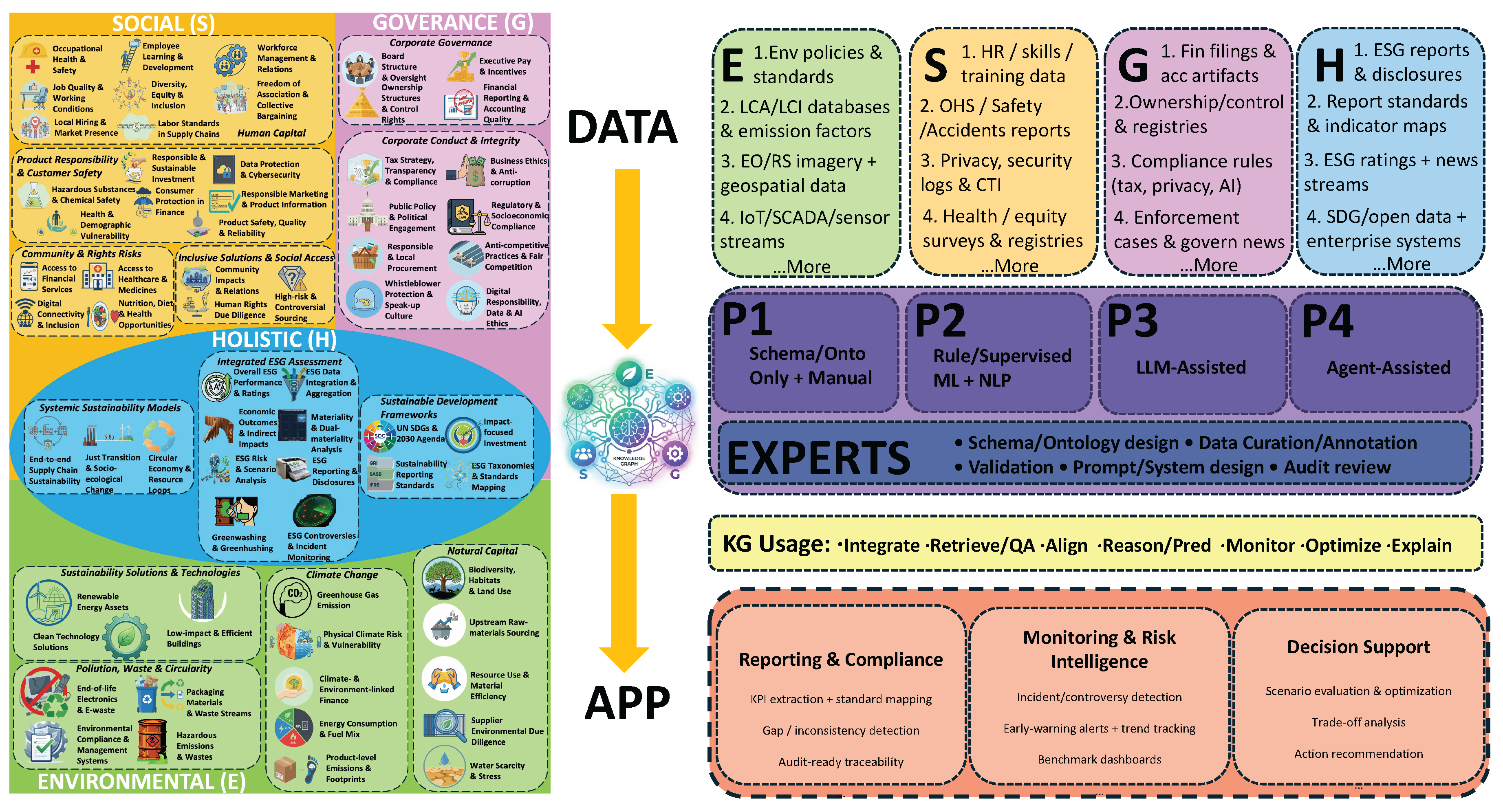
Disclaimer/Publisher’s Note: The statements, opinions and data contained in all publications are solely those of the individual author(s) and contributor(s) and not of MDPI and/or the editor(s). MDPI and/or the editor(s) disclaim responsibility for any injury to people or property resulting from any ideas, methods, instructions or products referred to in the content. |
© 2026 by the authors. Licensee MDPI, Basel, Switzerland. This article is an open access article distributed under the terms and conditions of the Creative Commons Attribution (CC BY) license (http://creativecommons.org/licenses/by/4.0/).
Copyright: This open access article is published under a Creative Commons CC BY 4.0 license, which permit the free download, distribution, and reuse, provided that the author and preprint are cited in any reuse.


