

Submitted:
26 February 2026
Posted:
28 February 2026
You are already at the latest version
Abstract
Micronutrient deficiencies, particularly of vitamins A, D3, and B9, remain a significant global health challenge despite established dietary recommendations. This study proposes a novel fortification strategy using advanced emulsion technology to enrich extra-virgin olive oil (EVOO) with these essential micronutrients. Water-in-oil (W/O) and double oil-in-water-in-oil (O/W/O) emulsions were designed to enable the simultaneous encapsulation of lipophilic (A and D3) and hydrophilic (B9) vitamins within a single functional food matrix. Vitamin concentrations were quantified using high-performance liquid chromatography (HPLC) coupled with a photodiode detector (PDA) to evaluate retention during processing. Bioaccessibility was assessed by subjecting vitamin-enriched emulsions to a standardized in vitro digestion model simulating gastrointestinal conditions. Results showed significantly higher incorporation efficiency in the O/W/O system compared to conventional W/O emulsions, regardless of the physicochemical properties of the vitamins. Both lipophilic (A and D3) and hydrophilic (B9) compounds exhibited satisfactory retention, highlighting the versatility of the double-emulsion approach. This study represents the first report of simple and multiple oil-continuous emulsions that simultaneously incorporate vitamins A, D3, and B9, providing preliminary evidence of their stability and gastrointestinal release under simulated digestion conditions.
Keywords:
emulsion
; olive oil
; bioactive compounds
; vitamins
; food fortification
; in vitro digestion
1. Introduction
In recent decades, the role of food has significantly shifted. Historically, food has been regarded solely as a source of energy and essential nutrients. However, more recently emerging evidence indicates that it has been recognized as a key determinant of long-term health and well-being. This transition has driven the growing demand for functional foods, reflecting consumer expectations for products that not only provide nourishment but also actively promote health. Functional foods are defined as foods that, in addition to their nutritional value, contain biologically active components that provide added health benefits by reducing disease risk. These can be categorized as either natural products or products that have undergone enrichment or modification to increase the content of these beneficial compounds or those from which certain components have been removed [1]. These bioactive compounds, which offer long-term benefits in the diet, influence consumers, health professionals, and the food industry itself [2]. In response, the food industry faces the challenge of moving beyond its traditional focus on safety and caloric content to develop formulations enriched with bioactive compounds that can address nutrient deficiencies and mitigate the risk of chronic diseases.
Food fortification has become a central strategy for creating value-added products with enhanced nutritional profiles and recognized health benefits [3,4,5]. However, the successful incorporation of bioactive compounds into food matrices requires careful consideration of their stability, bioaccessibility, and compatibility with processing technologies [6,7]. The effectiveness of fortified foods depends on several factors [4,8]. First, the presence of active compounds is important, but it is also necessary for the food to resist degradation during processing [9]. Furthermore, these compounds must be effectively released from the matrix and subsequently absorbed by the human body [10,11].
Advanced encapsulation technologies have been investigated to address these requirements. Among the diverse encapsulation systems, multiple emulsions have emerged as promising delivery vehicles for stabilizing bioactive compounds, so choosing the right emulsification protocols is crucial for obtaining the desired structural and functional properties [12,13,14]. To date, most research has been focused on water-in-oil-in-water (W/O/W) emulsions, which have traditionally been prioritized in the pharmaceutical sector [15,16].
W/O/W multiphase structures enable the simultaneous encapsulation of both hydrophilic and lipophilic compounds, thereby protecting delicate molecules from environmental degradation and facilitating their controlled release during digestion [14,17]. The versatility of double emulsions lies in their ability to accommodate compounds with diverse solubility profiles through compartmentalization within different phases [18]. Lipophilic bioactive compounds, including carotenoids (e.g., β-carotene) and tocopherols with low water solubility, can be encapsulated within the oil phase of these systems, where they are protected from oxidative degradation [19,20,21]. Conversely, hydrophilic compounds, such as water-soluble vitamins, bioactive peptides, amino acids, and hydrophilic polyphenols (e.g., anthocyanins and catechins), can be entrapped within the internal aqueous phase of W/O/W systems, providing protection against enzymatic degradation in the gastrointestinal tract and controlling their release kinetics [22,23,24,25,26]. Indeed, recent studies have demonstrated the efficacy of these double emulsions in protecting and delivering bioactive compounds. W/O/W systems have achieved encapsulation efficiencies exceeding 90% for hydrophilic collagen peptides, highlighting their capacity to entrap and retain bioactives within the internal aqueous phase [27]. Furthermore, double emulsion systems have been successfully used to encapsulate hydrophilic and lipophilic compounds with different solubility characteristics, as demonstrated by W/O/W emulsions containing either trans-resveratrol (lipophilic) or vitamin B12 (hydrophilic), which were prepared with high encapsulation efficiencies using membrane emulsification [28]. Collectively, these findings underscore the robustness and versatility of double emulsions as multifunctional carriers for bioactive compounds with diverse physicochemical properties [18,29].
While most scientific reports have focused on W/O/W systems, there is a growing interest in oil-in-water-in-oil (O/W/O) emulsions for specific lipid-based and food-grade formulations. In this application, a primary O/W emulsion is dispersed in an external oil phase stabilized by a lipophilic emulsifier, and the lipophilic ingredient meant for encapsulation is contained in the internal oil phase to create an O/W/O emulsion. O/W/O double emulsions exemplify a more intricate multiphase configuration, wherein oil droplets enclosing encapsulated water droplets are dispersed within an external oil phase. These intricate structures also facilitate the concurrent encapsulation of both hydrophilic and hydrophobic ingredients, thereby providing advanced delivery strategies, including sequential and targeted release profiles [30,31].
Consequently, O/W/O emulsions represent a potential alternative for incorporating both lipophilic and hydrophilic vitamins with functional properties into lipid-based matrices. Adequate vitamin intake is an essential component of human health. Vitamin A, for example, is essential for vision, immune function, and cellular communication. Deficiencies can lead to impaired growth, night blindness, and an increased risk of infection [32,33]. Vitamin D plays a central role in calcium and phosphorus homeostasis, bone integrity, and immune regulation. Its insufficiency is considered a global public health problem, affecting more than one billion people and contributing to rickets, osteomalacia, and increased risk of autoimmune and cardiovascular diseases [32,34]. Folate (vitamin B9) is essential for DNA synthesis and repair, red blood cell formation, and the prevention of neural tube defects during pregnancy [35,36]. Despite international recommendations, such as those from the European Food Safety Authority, which set daily intakes at 750 μg retinol equivalents for men, 650 μg for women, 15 μg of vitamin D (600 IU), and 330 μg of folate for adults [37], deficiencies in these micronutrients remain widespread. The limited availability of natural dietary sources, restricted eating patterns, and low bioavailability further exacerbate this problem, underscoring the need for innovative nutritional approaches.
The choice of lipid phase is critical for both stability and bioavailability. Extra virgin olive oil (EVOO) is an ideal candidate because it provides a lipid-rich environment for fat-soluble vitamin incorporation and contributes its own health-promoting properties. EVOO is rich in monounsaturated fatty acids, tocopherols, and polyphenols, which enhance oxidative stability and provide antioxidant protection to encapsulated compounds [38,39]. Furthermore, its sensory qualities and acceptance within the Mediterranean diet solidify its suitability as a vehicle for vitamin fortification strategies.
Despite the versatility of these novel formulations, studies on incorporating bioactive nutritional components, such as vitamins, are still scarce, particularly in studies that combine the evaluation of encapsulation efficiency with the assessment of their stability under simulated gastrointestinal conditions. Against this background, this study aims to provide a procedure for preliminary evaluation of the feasibility of incorporating vitamins A, D3, and B9 into an EVOO–based W/O and O/W/O emulsion. Specifically, it evaluates the extent of micronutrient incorporation into the oil matrix and their stability and gastrointestinal release under simulated digestion conditions as a first approach to exploring the potential of these systems as delivery vehicles for micronutrients.
2. Materials and Methods
2.1. Samples, bioactive ingredients, and emulsifiers.
The EVOO samples consisted of multivarietal blends of Arbequina, Picual, and Hojiblanca olives harvested during the crop season of 2024/2025, which were generously donated by Torres Morente SAU, located in Escúzar (Granada, Spain). The olives were processed in an industrial facility equipped with a hammer mill, horizontal malaxer, two-phase centrifugation system consisting of horizontal and vertical centrifuges, and a conical decanter to extract the oil. The resulting samples were collected in amber glass bottles filled to eliminate headspace. The bottles were then stored in the dark at ambient temperature until use. Vitamin A palmitate 1 MIU g−1 (550 mg/g) oily liquid and vitamin D3 1 MIU g−1 (25 mg/g) oily liquid were obtained from DSM Nutritional Products Ltd (Basel, Switzerland), and B9 powder of >95% purity was purchased from Nutrifoods (Barcelona, Spain).
Tween 20 and Span 80 were purchased from Sigma-Aldrich, Merck (Barcelona, Spain). κ-Carrageenan was purchased from Laguilhoat (Madrid, Spain), whereas polyglycerol polyricinoleate (PGPR) was purchased from Savannah (Barcelona, Spain). The products were stored in a dry and dark place at room temperature.
2.2. Preparation of the emulsions
2.2.1. W/O emulsions
The W/O emulsion was formulated with 97.5% (w/w) EVOO, 2% (w/w) distilled water, and 0.5% (w/w) PGPR as the emulsifier. This formulation was prepared according to the procedure described by Fregapane et al. [40], with slight modifications. To prepare the continuous oil phase, vitamins A and D3 were dissolved in EVOO along with PGPR to ensure uniform dispersion. The internal aqueous phase was obtained by dissolving B9 in distilled water. Subsequently, the aqueous solution was added dropwise to the oil phase while stirring at 300 rpm for 5 min. The emulsification process was executed using a high-power ultrasonic homogenizer (UP400St, Hielscher Ultrasonics, Teltow, Germany) equipped with a 14 mm sonotrode (s24d14D) operating at an amplitude of 46% and a temperature below 40°C. The resulting fine emulsions were transferred to glass vials and stored at 4°C.
2.2.2. O/W/O emulsions
O/W/O multiple emulsions were prepared using a two-step emulsification method as reported previously [41]. For this purpose, the initial oil phase (O1) was obtained by dissolving vitamins A and D₃ in EVOO. This mixture was stirred continuously at 300 rpm in complete darkness for at least 1 h to ensure complete solubilization. The aqueous phase (W) was prepared by dissolving 1 g of κ-carrageenan in 90 mL of distilled water to obtain a 1% (w/w) κ-carrageenan solution, which was subsequently used to dissolve B9. The preparation was mixed thoroughly and allowed to hydrate overnight at 4.0 ± 1.0°C. Tween 20 (0.5 g) was then incorporated as an additional stabilizer, followed by magnetic stirring at 500 rpm in the dark at room temperature for at least 1 h. Finally, the oil (10 mL) and aqueous phases were blended and processed using a high-speed homogenizer (IKA T25 Ultra Turrax, Barcelona, Spain) at 25,000 rpm for 5 min at room temperature.
The multiple emulsion was prepared by incorporating the previously obtained inner emulsion into the secondary oil phase (O2). The emulsifier Span 80 (0.5 g) was initially dissolved in 60 mL of oil and stirred at room temperature for at least 1 h using a magnetic stirrer (LLG Instruments, Am Hambuch 1, Germany). Then, 40 ml of the inner emulsion was added dropwise to the O2 oil phase. Finally, the mixture was homogenized at 10,000 rpm for 5 min using a high-speed homogenizer (IKA T25 Ultra Turrax, Barcelona, Spain) at room temperature. The resulting fine emulsions were transferred to glass vials and stored at 4°C.
For both emulsions, W/O and O/W/O, the incorporation efficiency of vitamins A, D₃, and B₉ was calculated relative to the initial amount of each compound added to reach target final concentrations of 45 mg/kg for vitamin A, 0.68 mg/kg for vitamin D₃, and 11.4 mg/kg for vitamin B₉.
2.3. Physicochemical characterization of emulsions.
Confocal laser scanning microscopy (CLSM) was used to evaluate the morphology and structure of the simple O/W and double O/W/O emulsions at 25× magnification. Images were acquired using a Leica TCS-SP5 II confocal microscope (Leica Microsystems, Wetzlar, Germany, CIC, UGR) equipped with a 25X water-immersion objective. The aqueous phase was dyed with fluorescein sodium (Sigma-Aldrich, Merck, Barcelona, Spain) (0.005% w/v). The samples were placed between two glass coverslides to keep them as flat as possible. A 488 nm excitation laser was used, and the detection band was set between 495-565 nm. The images were captured and stored at 512 x 512-pixel resolution, and the software used to analyze the images was ImageJ (National Institutes of Health, Bethesda, MD, USA).
High-performance liquid chromatography with photodiode detector (HPLC-PDA) was selected as the analytical technique for characterizing vitamins A, D3, and B9. Vitamin A was analyzed according to the European standards UNE-EN-12823-1 [42], whereas vitamin D3 was quantified as per the UNE-EN-12821 [43] standard. Vitamin B9 analysis was carried out according to the method developed by Keršienė et al. [44]. Briefly, sample treatments for vitamin A and D3 analysis involved saponification using butylhydroxytoluene (BHT) (Scharlab, Barcelona, Spain) as an antioxidant. A potassium hydroxide solution (Sigma-Aldrich, Barcelona, Spain) and methanol (Scharlab, Barcelona, Spain) were added, and the mixture was heated under reflux. After complete saponification, the mixture was extracted with n-hexane (Scharlab, Barcelona, Spain). For vitamin B9, samples were subjected to Carrez clarification (Sigma-Aldrich, Barcelona, Spain), centrifuged (Thermo Scientific/Sorvall ST 16R, Barcelona, Spain), and the supernatant was collected. At the end of the extraction procedure, all the extracts were evaporated to dryness using a rotary evaporator (Ika, Barcelona, Spain) at a temperature not exceeding 40°C and reconstituted before analysis. The analytical determinations of vitamin A, D3 and B9 were performed using an HPLC-PDA system (Agilent Technologies, Palo Alto, CA, USA). The separation was carried out by an analytical column, Zorbax Eclipse Plus C18, 150 mm × 4.6 mm internal diameter, 5 µm (Agilent Technologies, Palo Alto, CA, USA). Chromatographic conditions were defined according to previously validated methods as described above [42,43,44]. The detection wavelengths were set at 326 nm, 264 nm, and 280 nm for vitamins A, D3, and B9, respectively. To quantify the analytes identified in the samples, duplicate injections of each extraction replicate were conducted for each sample type. Quantification was performed using calibration curves prepared using the standard compounds retinyl palmitate, folic acid, and vitamin D3 solution (Sigma-Aldrich, Barcelona, Spain). For each standard, calibration curves were prepared using five points within the estimated range for the sample concentrations (R2 values = 0.999). The vitamin concentrations were determined by interpolating the peak areas from replicate analyses of each sample into appropriate calibration curves.
2.4. Simulated In Vitro Gastrointestinal Digestion
The emulsion containing EVOO and vitamins was subjected to static in vitro gastrointestinal digestion using the harmonized INFOGEST method [45]. For this purpose, pepsin (3412 U/mg) and pancreatin (4 × USP) were purchased from Sigma-Aldrich (Barcelona, Spain), along with bovine bile salts (Sigma B-3883). Rabbit gastric extract was obtained from Lipolytech (Marseille, France). Chemicals used for the preparation of simulated digestive fluids, including hydrochloric acid (HCl, 37%), calcium chloride (CaCl2), sodium hydroxide (NaOH), sodium chloride (NaCl), sodium bicarbonate (NaHCO3), potassium dihydrogen phosphate (KH2PO4), potassium chloride (KCl), magnesium chloride hexahydrate (MgCl2(H2O)6), and ammonium carbonate ([(NH4)2CO3]), were purchased from Sigma-Aldrich (Barcelona, Spain).
Briefly, 5 g of the samples were mixed with 5 mL of simulated salivary fluid in a 50 mL conical centrifuge tube shielded from light. The mixture was then incubated at 37°C (pH 7.0) for 5 min with shaking at 55 rpm. For the gastric digestion phase, 10 mL of simulated gastric fluid containing 2000 U/mL of pepsin and 60 U/mL of gastric lipase was added to the mixture, and 1 M HCl was used to adjust the pH to 3.0. The mixture was then homogenized and incubated at 55 rpm with constant agitation at 37°C for 2 h. Finally, 20 mL of simulated intestinal fluid containing 10 mM bile salts and 100 U/mL pancreatin was added to the mixture, and it was stirred for 2 h at 37°C. Milli-Q water was then added to achieve a final volume of 40 mL.
At the end of the intestinal digestion phase, the obtained samples were stored at -80°C until further analysis. Digestates were characterized according to the previously described methodology (section 2.3). The bioaccessibility and the cumulative presence of the bioaccessible fraction throughout the digestion process were calculated as previously described [31] using equations (1) and (2),
where VC represents vitamin content, DS refers to the digested samples for each phase (gastric and intestinal), and the initial VC content corresponds to the vitamin content present in the emulsion samples.
2.5. Statistical analysis
All assays were performed in triplicate. The data are expressed as mean values with standard deviations and were statistically processed using SPSS software (SPSS version 28; SPSS Inc., Chicago, IL, USA).
3. Results
3.1. Physical characterization of O/W and O/W/O emulsions using CLSM.
Figure 1 shows the appearances of the W/O and O/W/O double emulsions. CLSM images confirmed the successful formation of W/O simple and O/W/O multilayer emulsions comprising inner aqueous droplets dispersed in a continuous oil phase for the simple emulsion and inner oil droplets encapsulated within aqueous globules suspended in an external oil phase for the double-emulsion system.
The CLSM image of the simple W/O emulsion (Figure 1a) reveals a homogeneous distribution of aqueous droplets ranging in size from 1 to 3 µm, uniformly dispersed within the continuous oil matrix. The well-defined spherical morphology and absence of aggregates or coalescence indicate that the water-oil interface was effectively stabilized. This suggests that the emulsifier concentration and type, along with the homogenization conditions, were appropriate for generating a stable emulsion with vitamins. The ultrasound is based on the phenomenon of cavitation. Ultrasonic energy initiates emulsification by generating droplets in an acoustic field. Subsequently, intense turbulence and microjets are produced during the asymmetric collapse of the cavitation bubbles. These mechanisms result in the fragmentation of larger droplets into smaller ones, which are subsequently dispersed throughout the continuous phase of the emulsion. The stability of nanoemulsions produced via ultrasonication is enhanced by reducing the rate of Ostwald ripening [46].
The O/W/O emulsion (Figure 1b) exhibited the typical multilayer structure of a double-emulsion system, characterized by a large droplet with a diameter of approximately 5–10 µm. Multiple smaller droplets were encapsulated within this droplet, each with an approximate size of 1 µm. The observed architecture was indicative of a successful two-stage emulsification process. Primary O/W emulsions are typically prepared using hydrophilic surfactants with high hydrophilic–lipophilic balance (HLB). In the subsequent step, the primary emulsion is carefully re-emulsified into an external phase containing a lipophilic surfactant with a low HLB, resulting in the formation of O/W/O emulsions. Additionally, the primary O/W emulsion is produced under high-shear conditions to achieve small droplet sizes, whereas the secondary emulsification step is performed using lower shear forces to prevent disruption of the internal droplets [47]. The presence of these multiple, well-organized interfaces provides additional diffusion barriers that help retain both hydrophilic and hydrophobic encapsulated incorporated vitamins.
3.2. Quantification of vitamins in O/W and O/W/O emulsion systems
After confirming the microstructural integrity of both emulsion systems using CLSM, the vitamin content and stability of the vitamins incorporated into these systems were evaluated to assess their protective capacity.
Quantitative analysis of the fortified emulsions revealed clear differences in vitamin incorporation as a function of the encapsulation protocol. Both systems enabled the incorporation of vitamins A, D₃, and B₉; however, in terms of incorporation efficiency and final vitamin content, the O/W/O double emulsion consistently outperformed the simpler W/O emulsion (Table 1; Figure 2). For vitamin A, the W/O emulsion yielded 3316 ± 6 µg/100 g, whereas the O/W/O emulsion reached 3826 ± 12 µg/100 g, representing a significant improvement. Although both emulsions retained a substantial fraction of the initially added vitamin, the superior performance of the O/W/O structure suggests a greater capacity to encapsulate and stabilize this lipophilic compound during emulsification.
This enhanced retention suggests that the additional external oil phase in the O/W/O configuration provided a more effective barrier. Among the various environmental factors affecting retinyl palmitate stability, oxidation plays a crucial role [48]. In this system, vitamin A is encapsulated within the internal oil phase and surrounded by a multilayer of water and oil. This structure is proposed to suppress the incursion of oxygen from the surrounding atmosphere, thereby improving the stability of this liposoluble vitamin, a protective mechanism consistent with the findings of Yoshida et al. [49] for retinol. These authors reported higher retinol retention in O/W/O emulsions (56.9% after 4 weeks at 50 °C) compared to W/O (45.7%) and O/W (32.3%) systems, attributing the improved stability to the preferential localization of retinol within the inner oil phase. Overall, these results are in agreement with previous studies demonstrating the effectiveness of double emulsions for vitamin encapsulation. For instance, Keršienė et al. [44] reported stable emulsions enriched with vitamins B6, B12, C, A, and D3 designed for elderly nutrition, achieving encapsulation efficiencies of 75–99% and stability above 70% after 30 days of storage.
A similar trend was observed for vitamin D₃. The W/O emulsion incorporated 5.7 ± 0.6 µg/100 g, while the O/W/O formulation achieved 75 ± 3 µg/100 g, indicating nearly a thirteen-fold increase when the double emulsion method was employed. When hydrophobic compounds are incorporated into an emulsion, the physicochemical properties of the interfacial layer are altered. The presence of these hydrophobic molecules increases the interfacial tension at mixed interfaces, indicating that they influence the adsorption behavior of the employed emulsifiers [50]. Given the high susceptibility of vitamin D₃ to degradation upon exposure to light, heat, and oxygen, the marked improvement observed in the O/W/O system is particularly significant. Previous research has established that vitamin D₃ exhibits considerable instability in aqueous media and under elevated temperature and light conditions, with stability substantially enhanced when the vitamin is confined within lipophilic phases or protected by advanced encapsulation technologies [51,52].
The multilayered droplet structure of the O/W/O emulsion appears to provide a protective barrier, where the surrounding aqueous and oil phases restrict oxygen diffusion to the lipophilic core, thereby enhancing encapsulation efficiency and reducing vitamin D₃ losses through migration during processing. This advanced encapsulation effectively shields these lipophilic compounds from degradation factors, preserving their bioactivity and ensuring their targeted delivery within complex food systems [53,54]. This protective behavior, consistent with observations in other lipophilic vitamin delivery systems [55], is particularly crucial not only for D₃ but also for vitamin E, which inherently exhibits low water solubility and limited bioavailability when incorporated into aqueous food matrices without advanced encapsulation technologies [56,57]. Consequently, vitamin E, a potent antioxidant, also requires encapsulation due to its sensitivity to thermal processing and light, making emulsion-based systems crucial for maintaining its efficacy in functional beverages [58].
In terms of apparent incorporation, clear differences were observed between encapsulation protocols for vitamin D₃. The O/W/O double emulsion exhibited an apparent incorporation exceeding 100%, whereas the W/O system showed a substantially lower value (8.3%). As indicated above, the lower retention in the simple W/O emulsion reflects the vulnerability of vitamin D₃ when protected by only one interfacial layer. Although direct comparisons between W/O emulsions and other systems for vitamin D₃ are scarce in the literature, since most studies have primarily examined O/W or W/O/W emulsions, findings from O/W systems still provide valuable insights into the encapsulation efficiency, stability, and gastrointestinal fate of vitamin D₃. For instance, O/W nanoemulsions have shown vitamin D₃ retention values ranging from 55.1% to 94-95%, depending on formulation and processing conditions [59,60]. Consistent with these findings, previous studies on double emulsions have demonstrated high encapsulation efficiencies for vitamin D₃ under optimized conditions. Didar et al. [54] reported that a vitamin D₃ encapsulation efficiency of 93.26% was achieved in O/W/O double emulsions stabilized by psyllium gum and lecithin after 25 days at a temperature of 8°C, while Keršienė et al. [44] achieved 94.04% retention when vitamin D₃ was incorporated into yogurt using W/O/W double emulsions, compared to only 50.32% for the free form.
The most significant improvement was observed for vitamin B₉, a hydrophilic compound intended to reach a final concentration of 11.4 mg/kg. The O/W/O emulsion incorporated 99.4% of the initial amount, whereas the W/O system retained only 14.9%, highlighting the markedly superior performance of the double emulsion. Folic acid, a water-soluble vitamin, exhibits poor compatibility with the continuous oil phase of emulsions. As noted by Adi et al. [61], high folic acid concentrations induce an increase in the size of the globule, thereby resulting in cloudiness of the system. They explicitly state that when the amount of folic acid exceeds the oil phase capacity, it remains outside the droplets, thereby reducing the entrapment efficiency [61,62]. Furthermore, the emulsion preparation process conditions may have a slight effect on this vitamin, which could contribute to the values obtained in this study. In contrast, the O/W/O emulsion architecture achieved near-complete retention of folic acid. This contrast underscores the ability of the O/W/O system to entrap water-soluble actives within the internal aqueous phase, thereby minimizing leaching into the continuous phase and preventing diffusion-driven losses during processing. The additional interfacial barrier of the double-emulsion architecture likely plays a critical role in maintaining folic acid stability and maximizing entrapment. This exceptional performance aligns with previous reports on double emulsion systems, which have consistently demonstrated their ability to efficiently encapsulate and stabilize folic acid and other hydrophilic bioactives [63,64].
The encapsulation of vitamin B₉ in double emulsions is increasingly being explored for oral delivery to improve bioavailability, for topical formulations to enhance skin penetration and stability, and as a functional ingredient in fortified foods [65,66]. Although earlier research has demonstrated successful folic acid nano-encapsulation through optimization of formulation parameters in pectin–whey protein systems, to date, there are no reports describing the production of O/W/O emulsions for food applications incorporating this water-soluble vitamin, underscoring the novelty of the present approach. Moreover, the data suggest that the interfacial architecture of the double emulsion provides an additional diffusion barrier, contributing to the stabilization of hydrophilic compounds during both homogenization and storage.
Taken together, these results demonstrate that the O/W/O double-emulsion consistently outperformed the conventional W/O emulsion in the encapsulation and retention of vitamins A, D₃, and B₉. The significant differences observed across all three vitamins, regardless of solubility class, indicate that the multilayer emulsion structure enhances the incorporation of both lipophilic and hydrophilic bioactive compounds. These findings confirm that the O/W/O system may serve as a superior delivery platform for stabilizing and controlling the release of sensitive micronutrients, and could be advantageous for the development of functional foods enriched with bioactive compounds.
To evaluate the potential nutritional relevance of the fortified emulsions, the percentage of the Recommended Daily Allowance (RDA) provided by a 20 g serving of each formulation was calculated for vitamins A, D₃, and B₉. The serving amount was based on the recommended daily intake of the EVOO used in the formulation [67]. As presented in Figure 3, the O/W/O emulsion consistently delivered higher contributions to daily intake requirements across all vitamins compared with the conventional W/O system.
For vitamin A, consumption of a 20 g portion of the O/W/O emulsion would supply 46.4% of the RDA, whereas the same serving of the W/O formulation would provide 40.2%. While both emulsions offer substantial contributions to daily vitamin A intake, the O/W/O system delivers a notably higher percentage, indicative of its superior encapsulation performance and improved stabilization of lipophilic compounds.
A more pronounced difference was observed for vitamin D₃. The O/W/O emulsion exhibited a coverage of 99.6% of the RDA, indicating a substantial increase compared with the 7.6% provided by the W/O system. This considerable discrepancy aligns with the higher incorporation and retention efficiencies achieved for vitamin D₃ in the double-emulsion structure, further supporting the protective capacity of the O/W/O configuration in preserving this highly sensitive micronutrient.
Similar results were obtained for vitamin B₉. A 20 g serving of the O/W/O emulsion would provide 96.3% of the RDA, nearly fulfilling the entire daily requirement. In contrast, the W/O emulsion offered only 14.4% of the RDA. This difference reflects high retention and stability of B₉ within the internal aqueous phase of the double emulsion and underscores the limitations of the simpler W/O structure for carrying hydrophilic vitamins. Additionally, it has been established that K-carrageenan, the emulsifying agent utilized in the process of obtaining the double emulsion, functions as a thickening agent, possessing the capacity to augment the viscosity of water [68], a factor that may have contributed to the observed outcomes.
Collectively, these results demonstrate that the O/W/O emulsion not only exhibits superior incorporation efficiencies but also provides substantially greater nutritional value per serving. The enhanced RDA coverage observed for all three vitamins, particularly for vitamin D₃ and B9, highlights the potential of the double-emulsion system as an effective strategy for developing fortified food products capable of delivering meaningful amounts of essential micronutrients in small serving sizes.
3.3. In vitro digestion of O/W/O emulsion system
In vitro gastrointestinal digestion of multiple O/W/O emulsions loaded with vitamins D3, A, and B9 revealed differential behavior among the micronutrients in terms of gastric phase recovery and final bioaccessibility. This differential behavior can be attributed to the distinct physicochemical properties and intrinsic stability of the micronutrients, as well as to their interactions with the emulsion structure during gastrointestinal digestion.
Concerning lipophilic vitamins, previous studies have shown that the bioaccessibility of fat-soluble vitamins in emulsified systems primarily depends on lipid digestion efficiency, droplet size, and mixed micelle formation [69]. Data for vitamin D3 showed good stability with recovery rates of 100% in the gastric phase and bioaccessibility of 100%, suggesting high stability and efficient release into the micellar fraction under digestive conditions. This result is consistent with a previous study showing that double-emulsified systems provide high protection under simulated digestive conditions. In this regard, Li et al. [70] observed that double W/O/W emulsions using sodium alginate, sodium caseinate, PGPR, and beeswax as encapsulant agents provided an effective barrier that maintained the integrity of vitamin D3 during simulated digestion, facilitating its controlled release and transfer to micelles. In this context, when lipolysis is adequate and the emulsion structure favors transfer to the micellar phase, vitamin D₃ can achieve bioaccessibility close to 85%. Notably, certain emulsion systems have reported bioaccessibility levels exceeding 100%. In this regard, Salva-Trujillo et al.[71] found that in O/W emulsions prepared using Tween 80 as an encapsulant agent, the bioaccessibility of vitamin D2 appears to increase as the droplet size decreases, which could be due to the rapid and complete digestion of the smaller droplets, leading to faster generation of mixed micelles capable of solubilizing vitamin D2.
The most unfavorable behavior was observed for vitamin A (retinyl palmitate), with a gastric recovery of 37% and bioaccessibility that was unquantifiable. These results are consistent with the recognized digestive instability of retinyl palmitate, as described in the scientific literature. A comparative study on different forms of vitamin A has shown that retinyl palmitate has lower digestive stability and limited bioaccessibility after in vitro digestion, with losses of 93% after the complete digestion process [72]. These authors reported that retinyl palmitate decreased significantly by 48% during the oral phase and by a further 40% during the gastric phase, resulting in only 12% remaining at this stage. In line with these reports, our findings could suggest that lipase activity and the enzymatic activity of porcine bile extract during digestion promote the conversion of retinyl palmitate [73].
In an O/W emulsion model using quillaja saponin as a surfactant, it has been observed that the bioaccessibility of vitamin A decreases dramatically with increasing lipid droplet size due to the reduction in the interfacial area available for digestion and subsequent micellar solubilization [69]. Notably, even when a part of the retinyl palmitate is released from the oil phase, a significant fraction may remain associated with insoluble structures or sediment with the non-micellized fraction after centrifugation. These authors reported that approximately 90% of retinyl palmitate was hydrolyzed under simulated gastrointestinal conditions, leading to the release of free retinol, which is highly susceptible to oxidative degradation. The double emulsion nature of the present study may have initially provided partial protection during the gastric phase, as suggested by the 37% recovery. However, the exposure to intestinal elements, including bile salts and pancreatic enzymes such as esterases [69], could promote further degradation, leading to both complete hydrolysis of the ester and oxidative degradation of the released retinol, resulting in undetectable values in the micellar fraction.
Concerning the water-soluble vitamin, B9 poses particular challenges when encapsulated in double emulsion systems. This study found that this vitamin exhibited a gastric recovery of 56% and bioaccessibility of 45%. These values indicate that while there was a certain degree of loss during the digestive process, the vitamin also demonstrated notable retention in a biologically available form.
The 56% recovery in the gastric phase indicates that approximately half of the initially encapsulated vitamin B9 remained stable or retained in the system after digestion. This partial loss can be attributed to the chemical degradation of B9 released from the emulsion under acidic conditions in the stomach. During gastric digestion, the acidic pH environment and the action of digestive enzymes can facilitate the diffusion of B9 out of the emulsion and promote its partial degradation, thereby reducing the recoverable fraction. This phenomenon has previously been observed in multivitamin co-encapsulation systems within W/O/W multiple emulsions using PGPR as a lipophilic emulsifier, where moderate bioaccessibilities of vitamin B9 were recorded [62]. However, research has proved that the co-encapsulation of vitamin B9 and vitamin D3 results in a reduced release of vitamin B9, likely attributable to the delayed release of free fatty acids (delayed digestion), which limits exposure of the encapsulated B9 and consequently its degradation [70]. These findings suggest that further system structure optimization could enhance the bioaccessibility of folate.
To date, only a limited number of studies have evaluated the bioaccessibility of vitamins A, D₃, and B9 in emulsion-based formulations. Moreover, no studies have reported the development of an O/W/O emulsion designed to encapsulate and co-deliver these three vitamins, nor have they assessed such a system under simulated gastrointestinal conditions. The current studies on the incorporation of these vitamins into foods are primarily conducted using W/O and/or W/O/W emulsions, in which various types of emulsifying and encapsulating agents are employed along with diverse emulsion preparation techniques [53,60,62,74], which can significantly influence the release gradients of incorporated vitamins. Moreover, the studies did not comply with the standardized INFOGEST digestion protocol; instead, they used diverse gastrointestinal simulation conditions that may influence emulsion stability [46,70]. Consequently, this deviation from the INFOGEST protocol could result in variations in the protection capacity and bioaccessibility values obtained. Besides, the analytical methodologies employed for samples and digested samples determination vary across studies. In this sense, Keršienė et al. [44] determined vitamins A and D3 in a W/O/W emulsion, performing a subsequent clarification of the samples using Carrez reagents and filtering them through a cotton filter after an enzymatic hydrolysis process, whereas Li et al. [70] analyzed vitamin D3 and B9 in a W/O/W emulsion by centrifuging the sample and extracting it with anhydrous ethanol. In the study by Tan et al. [69], the bioaccessibility of vitamins A and D3 in O/W emulsions was determined using organic solvent extraction, followed by centrifugation and the addition of a saturated sodium chloride solution to enhance phase separation. In contrast, Wayenbergh et al. [73] performed the extraction of both the total digestive content and the micellar fraction for vitamin A using a liquid-liquid extraction procedure incorporating an internal standard and controlled temperature conditions. Additionally, detection is sometimes performed by spectrophotometry [75] and sometimes using liquid chromatography coupled to different detectors (SPD-20A- UV/VIS, MS/MS) [44,70], which implies differences in the sensitivity and specificity of the method. These methodological discrepancies complicate the reliable comparison of the reported bioaccessibility values across studies. Therefore, future research evaluating different formulations under a harmonized experimental framework is essential. This framework should apply the same in vitro digestion protocol, sample treatment procedures, and analytical methods for digested samples, ensuring truly comparable results within a consistent experimental scenario.
5. Conclusions
This study demonstrated that O/W/O double emulsions represent an effective encapsulation and delivery system for both lipophilic and hydrophilic vitamins. In this sense, substantial enhancements were observed for vitamins D3 and B9, with O/W/O emulsions exhibiting nearly complete retention and significantly higher RDA percentages with W/O systems.
In vitro digestion assays further confirmed the protective role of the O/W/O structure. Vitamin D₃ exhibited optimal stability and bioaccessibility. Conversely, vitamin B₉ exhibited moderate-to-high bioaccessible fractions despite undergoing partial degradation under acidic conditions. Vitamin A exhibited reduced digestive stability, suggesting its susceptibility to enzymatic hydrolysis and oxidative degradation during digestion.
Overall, these preliminary findings support the potential application of O/W/O double emulsions as promising vehicles for the fortification of functional foods with multiple micronutrients. Further studies are warranted for standardizing digestion and analytical protocols to improve comparability across studies and enhance stability and bioaccessibility of encapsulated bioactives.
Author Contributions
Conceptualization, J.L.-S., A.R.-R.; methodology, S.M.-A., A.R.-R., C.D.-S., J.R.-M., J.M.-M and J.L.-S.; investigation, S.M.-A.; writing—original draft preparation, S.M.A.; writing—review and editing, S.M.-A., C.D.-S., A.R.-R., J.R.M., J.M.-M. and J.L.-S.; supervision, J.L.-S. and A.R.-R.; project administration, J.L.-S.; funding acquisition, J.L.-S. All authors have read and agreed to the published version of the manuscript.
Funding
This research was funded by 23/1128 (Technological Corporation of Andalusia), and IDI-20230961 (CDTI, MICIN).
Institutional Review Board Statement
Not applicable.
Informed Consent Statement
Not applicable.
Data Availability Statement
The original contributions presented in this study are included in the article. Further inquiries can be directed to the corresponding author.
Acknowledgments
S.M.A. is grateful to the Results Transfer Office (OTRI), University of Granada, for her predoctoral grant P37/21/04. A.R.-R. is grateful to the MCIN for a postdoctoral researcher contract (PTQ2021-012110). S.M.-A. and C.D.-S thanks to the Doctoral Program in Nutrition and Food Sciences, University of Granada. All the authors are grateful to DSM Ltd, Nutrifoods, Savannah, and Torres Morente Company for kindly providing the products and samples, respectively. All the authors are grateful to Ana Santos Carro from CIC UGR for her assistance with the confocal analysis.
Conflicts of Interest
The authors declare no conflicts of interest.
Abbreviations
The following abbreviations are used in this manuscript:
| EVOO | Extra-virgin olive oil |
| W/O | Water-in-oil |
| O/W/O | Oil-in-water-in-oil |
| W/O/W | Water-in-oil-in-water |
| O/W | Oil-in-water |
| HPLC | High-performance liquid chromatography |
| HLB | Hydrophilic–lipophilic balance |
| PDA | Photodiode detector |
| PGPR | Polyglycerol polyricinoleate |
| CSLM | Confocal laser scanning microscopy |
| BHT | Butylhydroxytoluene |
References
- Temple, N.J. A rational definition for functional foods: A perspective. Front Nutr 2022, 9, 957516. [Google Scholar] [CrossRef]
- Jiménez-Colmenero, F. Potential applications of multiple emulsions in the development of healthy and functional foods. Food Res Int 2013, 52, 64–74. [Google Scholar] [CrossRef]
- Kaur, N.; Agarwal, A.; Sabharwal, M. Food fortification strategies to deliver nutrients for the management of iron deficiency anaemia. Curr Res Food Sci 2022, 5, 2094–2107. [Google Scholar] [CrossRef] [PubMed]
- Olson, R.; Gavin-Smith, B.; Ferraboschi, C.; Kraemer, K. Food Fortification: The Advantages, Disadvantages and Lessons from Sight and Life Programs. Nutrients 2021, 13. [Google Scholar] [CrossRef] [PubMed]
- Hossain, M.S.; Wazed, M.A.; Shuvo, S.D.; Sultana, Z.; Akhter Preya, M.S.; Khanom, H.; Asha, S.; Kamal, M.M.; Mondal, B.K.; Ahmad, T. Fortified and functional foods: Trends, innovations, and their public health impact for future nutrient enrichment. Journal of Agriculture and Food Research 2025, 23, 102275. [Google Scholar] [CrossRef]
- Rein, M.J.; Renouf, M.; Cruz-Hernandez, C.; Actis-Goretta, L.; Thakkar, S.K.; da Silva Pinto, M. Bioavailability of bioactive food compounds: a challenging journey to bioefficacy. British journal of clinical pharmacology 2013, 75, 588–602. [Google Scholar] [CrossRef] [PubMed]
- Lavelli, V.; D'Incecco, P.; Pellegrino, L. Vitamin D Incorporation in Foods: Formulation Strategies, Stability, and Bioaccessibility as Affected by the Food Matrix. Foods (Basel, Switzerland) 2021, 10. [Google Scholar] [CrossRef] [PubMed]
- Tang, W.; Zhuang, J.; Anselmo, A.C.; Xu, X.; Duan, A.; Zhang, R.; Sugarman, J.L.; Zeng, Y.; Rosenberg, E.; Graf, T.; et al. Enhanced stability and clinical absorption of a form of encapsulated vitamin A for food fortification. 2022, 119, e2211534119. [Google Scholar] [CrossRef]
- Orlien, V.; Bolumar, T. Biochemical and Nutritional Changes during Food Processing and Storage. Foods (Basel, Switzerland) 2019, 8. [Google Scholar] [CrossRef]
- Fairweather-Tait, S.J.; Teucher, B. Iron and calcium bioavailability of fortified foods and dietary supplements. Nutrition reviews 2002, 60, 360–367. [Google Scholar] [CrossRef]
- Melse-Boonstra, A. Bioavailability of Micronutrients From Nutrient-Dense Whole Foods: Zooming in on Dairy, Vegetables, and Fruits 2020, 7–2020. [CrossRef]
- Zhi, Z.; Liu, R.; Wang, W.; Dewettinck, K.; Van Bockstaele, F. Recent progress in oil-in-water-in-oil (O/W/O) double emulsions. Crit Rev Food Sci Nutr 2023, 63, 6196–6207. [Google Scholar] [CrossRef] [PubMed]
- Luo, T.; Wei, Z. Recent progress in food-grade double emulsions: Fabrication, stability, applications, and future trends. 2023, 4, 1622–1642. [Google Scholar] [CrossRef]
- McClements, D.J.; Li, Y. Structured emulsion-based delivery systems: Controlling the digestion and release of lipophilic food components. Advances in Colloid and Interface Science 2010, 159, 213–228. [Google Scholar] [CrossRef]
- Onuki, Y.; Morishita, M.; Takayama, K. Formulation optimization of water-in-oil-water multiple emulsion for intestinal insulin delivery. Journal of controlled release: official journal of the Controlled Release Society 2004, 97, 91–99. [Google Scholar] [CrossRef]
- Okochi, H.; Nakano, M. Preparation and evaluation of w/o/w type emulsions containing vancomycin. Advanced Drug Delivery Reviews 2000, 45, 5–26. [Google Scholar] [CrossRef] [PubMed]
- Kaimainen, M.; Marze, S.; Järvenpää, E.; Anton, M.; Huopalahti, R. Encapsulation of betalain into w/o/w double emulsion and release during in vitro intestinal lipid digestion. LWT - Food Science and Technology 2015, 60, 899–904. [Google Scholar] [CrossRef]
- Ghiasi, F.; Hashemi, H.; Esteghlal, S.; Hosseini, S.M.H. An Updated Comprehensive Overview of Different Food Applications of W1/O/W2 and O1/W/O2 Double Emulsions. 2024, 13, 485. [Google Scholar] [CrossRef]
- Geng, M.; Li, L.; Feng, X.; Xu, J.; Huang, Y.; Teng, F.; Li, Y. Encapsulation of β-carotene in high internal phase Pickering emulsions stabilized by soy protein isolate – epigallocatechin-3-gallate covalent composite microgel particles. Journal of Molecular Liquids 2022, 360, 119511. [Google Scholar] [CrossRef]
- Aboudzadeh, M.A.; Mehravar, E.; Fernandez, M.; Lezama, L.; Tomovska, R. Low-Energy Encapsulation of α-Tocopherol Using Fully Food Grade Oil-in-Water Microemulsions. ACS Omega 2018, 3, 10999–11008. [Google Scholar] [CrossRef]
- Kharat, M.; Du, Z.; Zhang, G.; McClements, D.J. Physical and Chemical Stability of Curcumin in Aqueous Solutions and Emulsions: Impact of pH, Temperature, and Molecular Environment. Journal of agricultural and food chemistry 2017, 65, 1525–1532. [Google Scholar] [CrossRef]
- de Almeida Paula, D.; Mota Ramos, A.; Basílio de Oliveira, E.; Maurício Furtado Martins, E.; Augusto Ribeiro de Barros, F.; Cristina Teixeira Ribeiro Vidigal, M.; de Almeida Costa, N.; Tatagiba da Rocha, C. Increased thermal stability of anthocyanins at pH 4.0 by guar gum in aqueous dispersions and in double emulsions W/O/W. International Journal of Biological Macromolecules 2018, 117, 665–672. [Google Scholar] [CrossRef]
- Ying, X.; Gao, J.; Lu, J.; Ma, C.; Lv, J.; Adhikari, B.; Wang, B. Preparation and drying of water-in-oil-in-water (W/O/W) double emulsion to encapsulate soy peptides. Food Res Int 2021, 141, 110148. [Google Scholar] [CrossRef]
- Li, B.; Jiang, Y.; Liu, F.; Chai, Z.; Li, Y.; Li, Y.; Leng, X. Synergistic effects of whey protein–polysaccharide complexes on the controlled release of lipid-soluble and water-soluble vitamins in W1/O/W2 double emulsion systems. International Journal of Food Science and Technology;%J International Journal of Food Science and Technology 2012, 47, 248–254. [Google Scholar] [CrossRef]
- Su, Y.; Sun, Y.; McClements, D.J.; Chang, C.; Li, J.; Xiong, W.; Sun, Y.; Cai, Y.; Gu, L.; Yang, Y. Encapsulation of amino acids in water-in-oil-in-water emulsions stabilized by gum arabic and xanthan gum. Int J Biol Macromol 2022, 220, 1493–1500. [Google Scholar] [CrossRef]
- Teixé-Roig, J.; Oms-Oliu, G.; Ballesté-Muñoz, S.; Odriozola-Serrano, I.; Martín-Belloso, O. Encapsulation and controlled release of phycocyanin during the in vitro digestion using polysaccharide-added double emulsions (W1/O/W2). Food Structure 2022, 31, 100249. [Google Scholar] [CrossRef]
- Jo, Y.J.; Karbstein, H.P.; van der Schaaf, U.S. Collagen peptide-loaded W(1)/O single emulsions and W(1)/O/W(2) double emulsions: influence of collagen peptide and salt concentration, dispersed phase fraction and type of hydrophilic emulsifier on droplet stability and encapsulation efficiency. Food Funct 2019, 10, 3312–3323. [Google Scholar] [CrossRef]
- Matos, M.; Gutiérrez, G.; Iglesias, O.; Coca, J.; Pazos, C. Enhancing encapsulation efficiency of food-grade double emulsions containing resveratrol or vitamin B12 by membrane emulsification. Journal of Food Engineering 2015, 166, 212–220. [Google Scholar] [CrossRef]
- Muschiolik, G.; Dickinson, E. Double Emulsions Relevant to Food Systems: Preparation, Stability, and Applications. 2017, 16, 532–555. [Google Scholar] [CrossRef]
- Shi, A.; Wang, J.; Guo, R.; Feng, X.; Ge, Y.; Liu, H.; Agyei, D.; Wang, Q. Improving resveratrol bioavailability using water-in-oil-in-water (W/O/W) emulsion: Physicochemical stability, in vitro digestion resistivity and transport properties. Journal of Functional Foods 2021, 87, 104717. [Google Scholar] [CrossRef]
- Montoro-Alonso, S.; Duque-Soto, C.; Rueda-Robles, A.; Reina-Manuel, J.; Quirantes-Piné, R.; Borrás-Linares, I.; Lozano-Sánchez, J. Functional Olive Oil Production via Emulsions: Evaluation of Phenolic Encapsulation Efficiency, Storage Stability, and Bioavailability. 2024, 16, 3909. [Google Scholar] [CrossRef]
- Wiseman, E.M.; Bar-El Dadon, S.; Reifen, R. The vicious cycle of vitamin a deficiency: A review. Critical Reviews in Food Science and Nutrition 2017, 57, 3703–3714. [Google Scholar] [CrossRef]
- Schmieder, H.; Leischner, C.; Piotrowsky, A.; Marongiu, L.; Venturelli, S.; Burkard, M. Exploring the link between fat-soluble vitamins and aging-associated immune system status: a literature review. Immunity & Ageing 2025, 22, 8. [Google Scholar] [CrossRef]
- Cui, A.; Zhang, T.; Xiao, P.; Fan, Z.; Wang, H.; Zhuang, Y. Global and regional prevalence of vitamin D deficiency in population-based studies from 2000 to 2022: A pooled analysis of 7.9 million participants. Front Nutr 2023, 10, 1070808. [Google Scholar] [CrossRef]
- Duthie, S.J.; Narayanan, S.; Brand, G.M.; Pirie, L.; Grant, G. Impact of Folate Deficiency on DNA Stability. The Journal of Nutrition 2002, 132, 2444S–2449S. [Google Scholar] [CrossRef] [PubMed]
- Seyoum Tola, F. The concept of folic acid supplementation and its role in prevention of neural tube defect among pregnant women: PRISMA. 2024, 103, e38154. [Google Scholar] [CrossRef] [PubMed]
- Authority, E.F.S. Dietary Reference Values for nutrients Summary report. 2017, 14, e15121E. [Google Scholar] [CrossRef]
- Jimenez-Lopez, C.; Carpena, M.; Lourenço-Lopes, C.; Gallardo-Gomez, M.; Lorenzo, J.M.; Barba, F.J.; Prieto, M.A.; Simal-Gandara, J. Bioactive Compounds and Quality of Extra Virgin Olive Oil. Foods (Basel, Switzerland) 2020, 9. [Google Scholar] [CrossRef]
- Serreli, G.; Deiana, M. Biological Relevance of Extra Virgin Olive Oil Polyphenols Metabolites. Antioxidants (Basel, Switzerland) 2018, 7. [Google Scholar] [CrossRef]
- Fregapane, G.; Cabezas Fernández, C.; Salvador, M.D. Emulsion and Microemulsion Systems to Improve Functional Edible Oils Enriched with Walnut and Pistachio Phenolic Extracts. Foods (Basel, Switzerland) 2022, 11. [Google Scholar] [CrossRef]
- Opustilová, K.; Lapčíková, B.; Kocourková, K.; Lapčík, L. The Composition Optimization of Curcumin-Loaded Double Oil–Water–Oil Emulsions and Their Stability Evaluation. 2024, 29, 4035. [Google Scholar] [CrossRef] [PubMed]
- AENOR. UNE-EN-12823-1 Determinación de vitamina A mediante cromatografía líquida de alta resolución. 2014. [Google Scholar]
- AENOR. UNE-EN-12821 Determinación de vitamina D mediante cromatografía líquida de alta eficacia. Medición de colecalciferol (D3) o ergocalciferol (D2). 2009.
- Keršienė, M.; Jasutienė, I.; Eisinaitė, V.; Venskutonis, P.R.; Leskauskaitė, D. Designing multiple bioactives loaded emulsions for the formulations for diets of elderly. Food & Function 2020, 11, 2195–2207. [Google Scholar] [CrossRef]
- Brodkorb, A.; Egger, L.; Alminger, M.; Alvito, P.; Assunção, R.; Ballance, S.; Bohn, T.; Bourlieu-Lacanal, C.; Boutrou, R.; Carrière, F.; et al. INFOGEST static in vitro simulation of gastrointestinal food digestion. Nature protocols 2019, 14, 991–1014. [Google Scholar] [CrossRef] [PubMed]
- Walia, N.; Dasgupta, N.; Ranjan, S.; Chen, L.; Ramalingam, C. Fish oil based vitamin D nanoencapsulation by ultrasonication and bioaccessibility analysis in simulated gastro-intestinal tract. Ultrasonics Sonochemistry 2017, 39, 623–635. [Google Scholar] [CrossRef] [PubMed]
- Lv, G.; Wang, F.; Cai, W.; Li, H.; Zhang, X. Influences of addition of hydrophilic surfactants on the W/O emulsions stabilized by lipophilic surfactants. Colloids and Surfaces A: Physicochemical and Engineering Aspects 2014, 457, 441–448. [Google Scholar] [CrossRef]
- Şahin Bodur, G.; Keser, A.; Akpinar Uzun, M.; Tekin, A. Evaluation of Oxidative Stability and Quality Parameters of Sunflower Oil Enriched With Different Levels of Retinyl Palmitate Under Different Storage Conditions. 2025, 13, e70463. [Google Scholar] [CrossRef]
- Yoshida, K.; Sekine, T.; Matsuzaki, F.; Yanaki, T.; Yamaguchi, M. Stability of vitamin A in oil-in-water-in-oil-type multiple emulsions. Journal of the American Oil Chemists' Society 1999, 76, 1–6. [Google Scholar] [CrossRef]
- Andrade, J.; Corredig, M. Vitamin D3 and phytosterols affect the properties of polyglycerol polyricinoleate (PGPR) and protein interfaces. Food Hydrocolloids 2016, 54, 278–283. [Google Scholar] [CrossRef]
- Temova Rakuša, Ž.; Pišlar, M.; Kristl, A.; Roškar, R. Comprehensive Stability Study of Vitamin D3 in Aqueous Solutions and Liquid Commercial Products. Pharmaceutics 2021, 13. [Google Scholar] [CrossRef]
- Khalid, A.; Arshad, M.U.; Imran, A.; Haroon Khalid, S.; Shah, M.A. Development, stabilization, and characterization of nanoemulsion of vitamin D(3)-enriched canola oil. Front Nutr 2023, 10, 1205200. [Google Scholar] [CrossRef]
- Ahamdi, N.; Ahranjani, P.J.; Rashidi, L.; Rezaei, K. Fortification of Sunflower Oil by Nanoemulsions Containing Vitamin-D3: Formation, Stability, and Release. 2025, 13, e4677. [Google Scholar] [CrossRef]
- Didar, Z.; Hesarinejad, M.A. Preparation of vitamin D3-loaded oil-in-water-in-oil double emulsions using psyllium gum: optimization using response surface methodology. Chemical and Biological Technologies in Agriculture 2022, 9, 81. [Google Scholar] [CrossRef]
- Mulrooney, S.L.; O'Neill, G.J.; Brougham, D.F.; Lyng, J.G.; O'Riordan, D. Improving vitamin D3 stability to environmental and processing stresses using mixed micelles. Food Chemistry 2021, 362, 130114. [Google Scholar] [CrossRef] [PubMed]
- Diana, G.; Milanesi, A.; Candiani, A.; Sodano, A.; Rassè, P.; Foglio Bonda, A.; Alessandroni, L.; Giovannelli, L.; Segale, L.; Coïsson, J.D. Spray drying of an oil-in-water emulsion containing vitamin D3: a synergy between formulation and process conditions to obtain microparticles. International Journal of Pharmaceutics 2025, 673, 125384. [Google Scholar] [CrossRef]
- Henao-Ardila, A.; Quintanilla-Carvajal, M.X.; Moreno, F.L. Emulsification and stabilisation technologies used for the inclusion of lipophilic functional ingredients in food systems. Heliyon 2024, 10, e32150. [Google Scholar] [CrossRef]
- Raikos, V. Encapsulation of vitamin E in edible orange oil-in-water emulsion beverages: Influence of heating temperature on physicochemical stability during chilled storage. Food Hydrocolloids 2017, 72, 155–162. [Google Scholar] [CrossRef]
- Peñuñuri-Pacheco, N.; Moreno-García, Y.A.; González-Ríos, H.; Astiazarán-García, H.; López-Franco, Y.L.; Tortoledo-Ortiz, O.; Pérez-Báez, A.J.; Dávila-Ramírez, J.L.; Lizardi-Mendoza, J.; Valenzuela-Melendres, M. Optimization of the Encapsulation of Vitamin D3 in Oil in Water Nanoemulsions: Preliminary Application in a Functional Meat Model System. 2024, 13, 2842. [Google Scholar] [CrossRef] [PubMed]
- Mehmood, T.; Ahmed, A. Tween 80 and Soya-Lecithin-Based Food-Grade Nanoemulsions for the Effective Delivery of Vitamin D. Langmuir 2020, 36, 2886–2892. [Google Scholar] [CrossRef] [PubMed]
- Adi, A.C.; Christanto, C.; Rachmawati, H.; Adlia, A. Vitamin E-based Folic Acid Nanoemulsion: Formulation and Physical Evaluation for Oral Administration. Pharmaceutical nanotechnology 2019, 7, 304–313. [Google Scholar] [CrossRef] [PubMed]
- Kižytė, E.; Bartkuvienė, I.; Jasutienė, I.; Keršienė, M.; Eisinaitė, V.; Leskauskaitė, D. Co-encapsulation of Vitamin C, B9 and D3 in the Double W/O/W Emulsion Composition: Emulsified vs Powdered Form. Food Biophysics 2025, 20, 95. [Google Scholar] [CrossRef]
- Niknam, S.M.; Escudero, I.; Benito, J.M. Formulation and Preparation of Water-In-Oil-In-Water Emulsions Loaded with a Phenolic-Rich Inner Aqueous Phase by Application of High Energy Emulsification Methods. 2020, 9, 1411. [Google Scholar] [CrossRef]
- Rigane, K.; Laurichesse, E.; Chouaibi, M.; Schmitt, V. Encapsulation of Polyphenols in Double Water-in-Oil-in-Water Emulsions Stabilized by Polyglycerol Polyricinoleate and Tunisian Arabic Gum. Langmuir 2025, 41, 9335–9347. [Google Scholar] [CrossRef] [PubMed]
- Assadpour, E.; Maghsoudlou, Y.; Jafari, S.-M.; Ghorbani, M.; Aalami, M. Evaluation of Folic Acid Nano-encapsulation by Double Emulsions. Food and Bioprocess Technology 2016, 9, 2024–2032. [Google Scholar] [CrossRef]
- Leister, N.; Götz, V.; Jan Bachmann, S.; Nachtigall, S.; Hosseinpour, S.; Peukert, W.; Karbstein, H. A comprehensive methodology to study double emulsion stability. Journal of Colloid and Interface Science 2023, 630, 534–548. [Google Scholar] [CrossRef]
- Mancebo-Campos, V.; Salvador, M.D.; Fregapane, G. EFSA Health Claims-Based Virgin Olive Oil Shelf-Life. 2023, 12, 1563. [Google Scholar] [CrossRef]
- Thanh Diep, T.; Phan Dao, T.; Vu, H.T.; Quoc Phan, B.; Ngoc Dao, D.; Huu Bui, T.; Truong, V.; Nguyen, V. Double emulsion oil-in water-in oil (O/W/O) stabilized by sodium caseinate and k-carrageenan. Journal of Dispersion Science and Technology 2018, 39, 1752–1757. [Google Scholar] [CrossRef]
- Tan, Y.; Zhou, H.; Zhang, Z.; McClements, D.J. Bioaccessibility of oil-soluble vitamins (A, D, E) in plant-based emulsions: impact of oil droplet size. Food & Function 2021, 12, 3883–3897. [Google Scholar] [CrossRef]
- Li, Y.; Tian, W.; Tian, F.; Zhao, Y.; Zhang, X.; Xiao, J. Spatiotemporally programmed co-delivery via double emulsions enables absorption synergy of 5-MTHF-Ca and vitamin D3. Food Res Int 2025, 217, 116800. [Google Scholar] [CrossRef] [PubMed]
- Salvia-Trujillo, L.; Fumiaki, B.; Park, Y.; McClements, D.J. The influence of lipid droplet size on the oral bioavailability of vitamin D2 encapsulated in emulsions: an in vitro and in vivo study. Food & Function 2017, 8, 767–777. [Google Scholar] [CrossRef]
- Courraud, J.; Berger, J.; Cristol, J.-P.; Avallone, S. Stability and bioaccessibility of different forms of carotenoids and vitamin A during in vitro digestion. Food Chemistry 2013, 136, 871–877. [Google Scholar] [CrossRef] [PubMed]
- Van Wayenbergh, E.; Verkempinck, S.H.E.; Courtin, C.M.; Grauwet, T. The impact of wheat bran on vitamin A bioaccessibility in lipid-containing systems. Food Chemistry 2025, 490, 145082. [Google Scholar] [CrossRef] [PubMed]
- Tanglao, E.J.; Nanda Kumar, A.B.; Noriega, R.R.; Punzalan, M.E.; Marcelo, P.J.M.W.C. Development and physico-chemical characterization of virgin coconut oil-in-water emulsion using polymerized whey protein as emulsifier for Vitamin A delivery. 2019, 268, 01002. [Google Scholar] [CrossRef]
- Jain, S.; Zhong, Q. Olive oil emulsions stabilized by pea protein-alginate conjugates and lecithin as potential delivery system of vitamin D3. International Journal of Biological Macromolecules 2026, 340, 150319. [Google Scholar] [CrossRef] [PubMed]
Figure 1.
(a) CLSM image of W/O emulsion. (b) CLSM image of O/W/O emulsion.
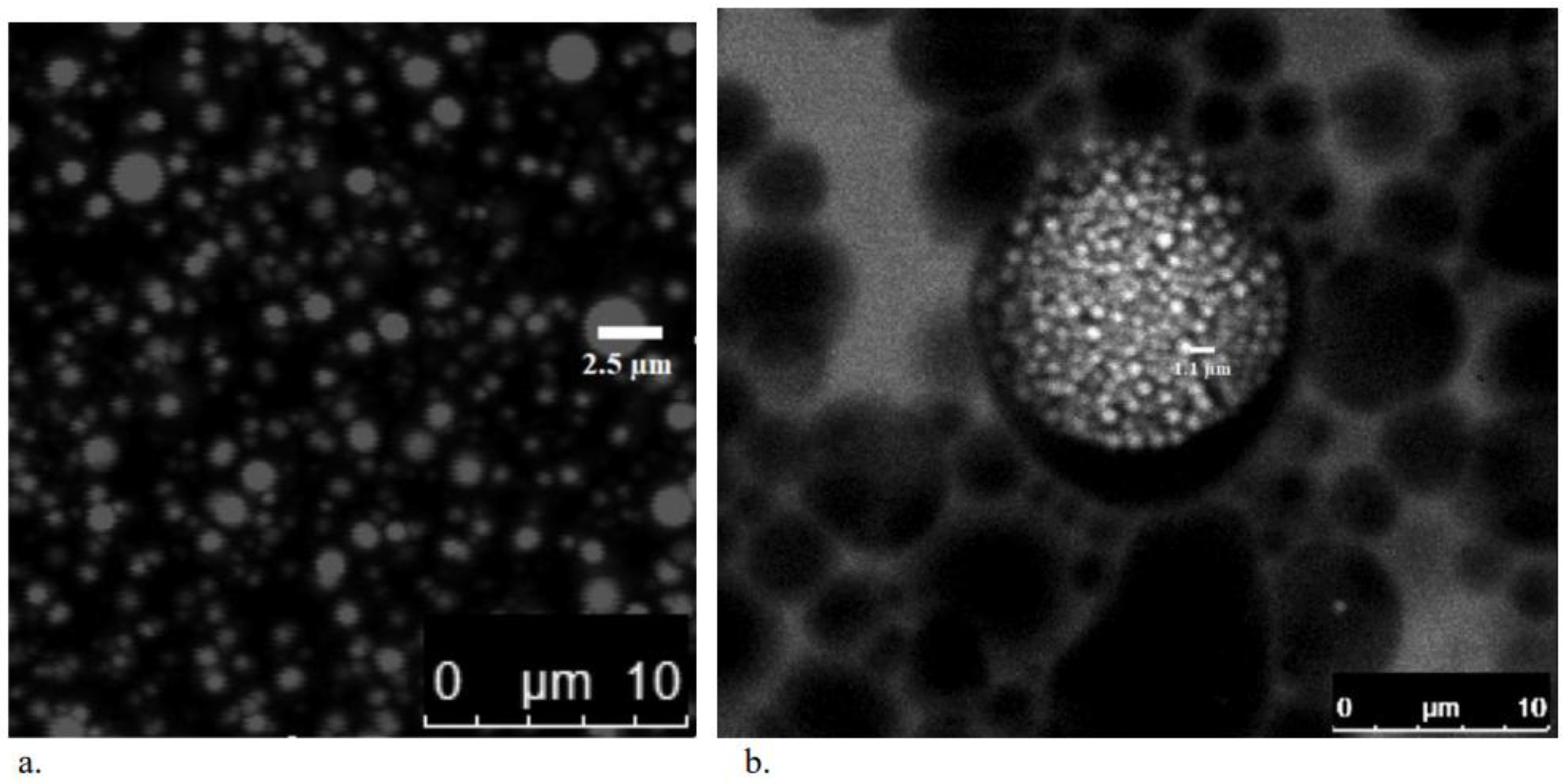
Figure 2.
Percentage of incorporation of vitamins A, D₃, and B₉ in W/O and O/W/O emulsions.
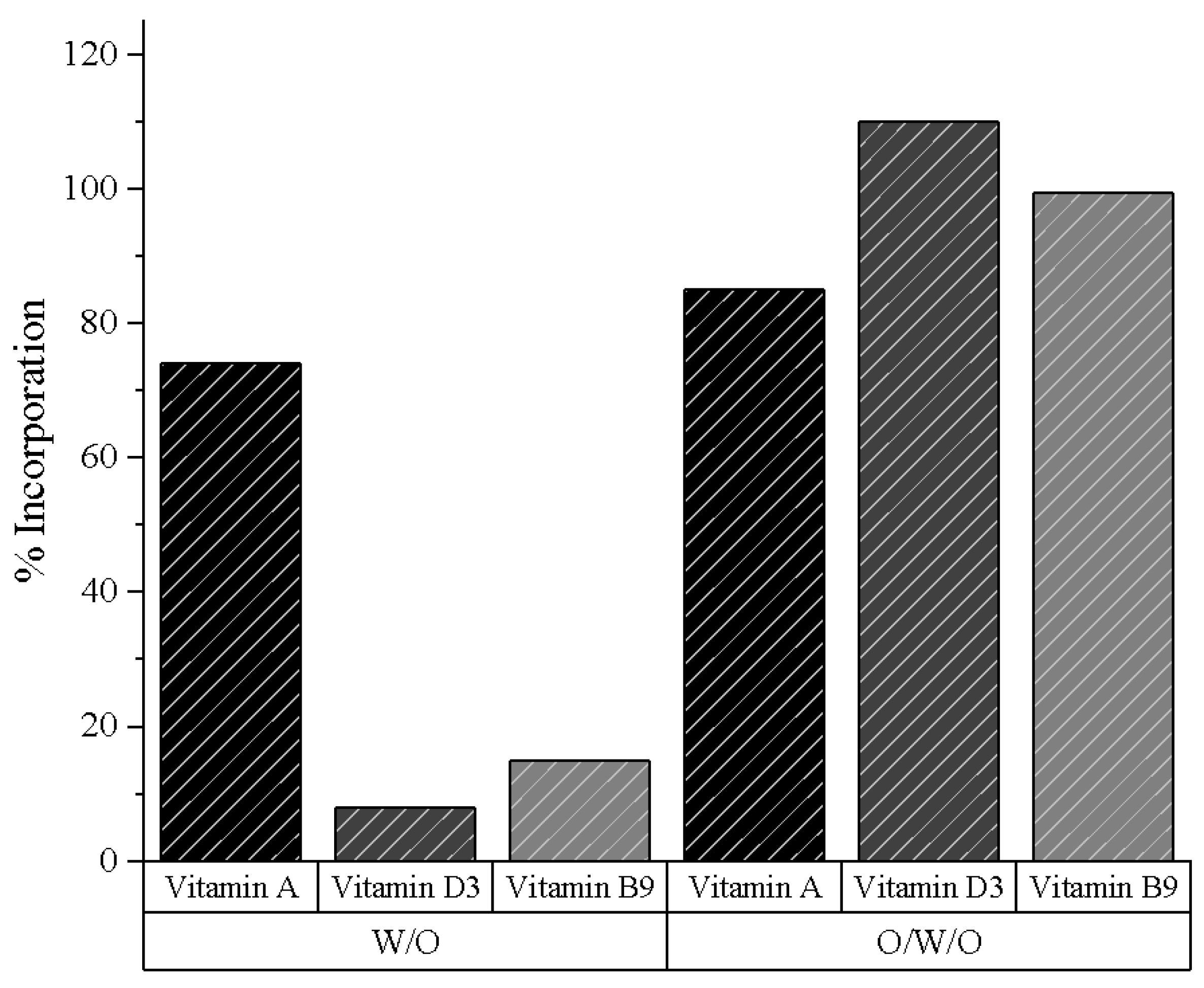
Figure 3.
Percentage of the Recommended Daily Allowance (RDA) provided by a 20 g serving emulsion.
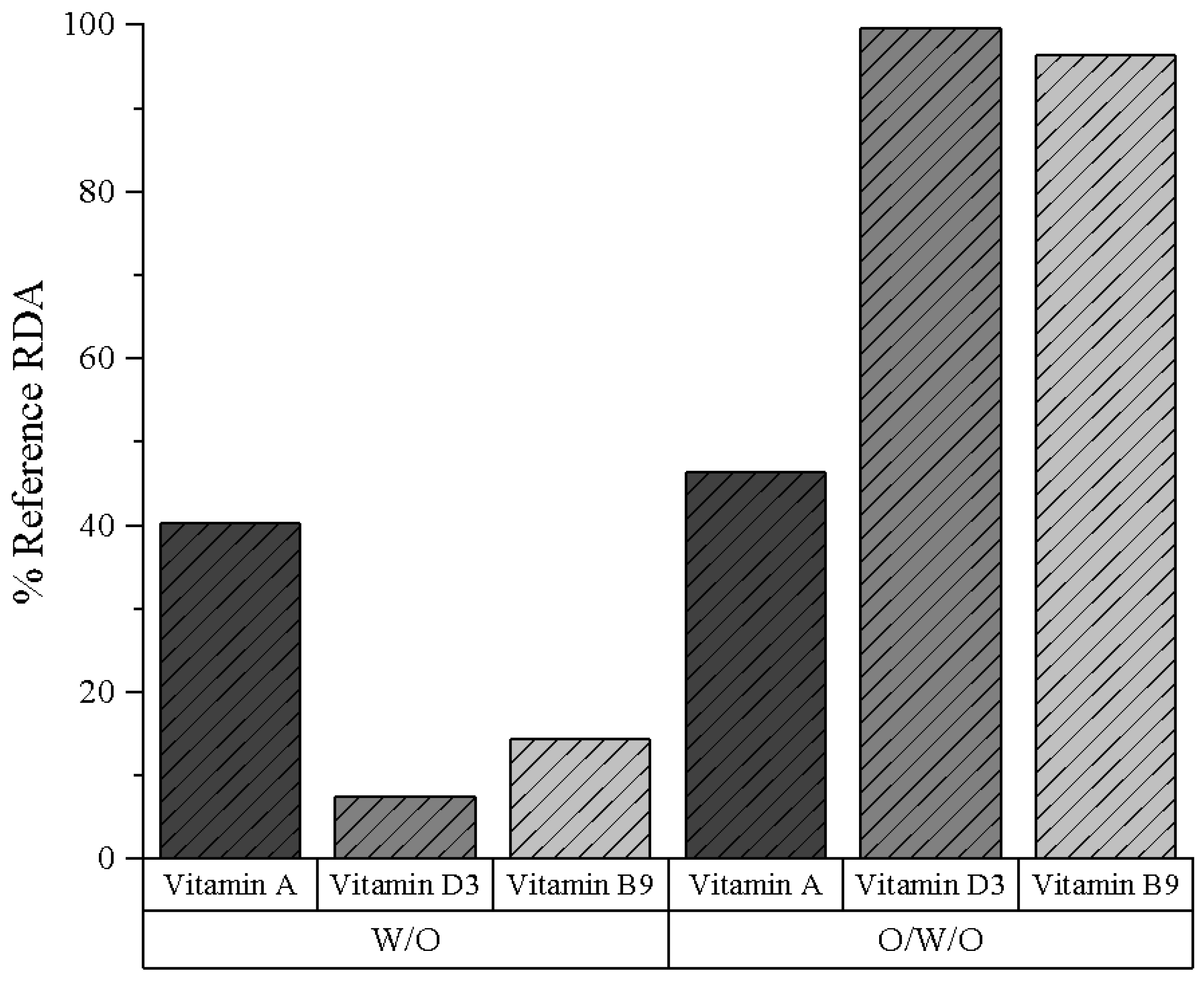

Table 1.
Vitamin Content in Oil-in-Water (O/W) and Water-in-Oil-in-Water (O/W/O) Emulsions.
| Emulsion | Vitamin A (µg/100 g) | Vitamin D₃ (µg/100 g) | Vitamin B₉ (µg/100 g) |
| O/W | 3316 ± 6a | 5.7 ± 0.6a | 169 ± 3a |
| O/W/O | 3826 ± 12b | 75 ± 3b | 1133 ± 12b |
*Values are the means ± SD (n = 3); different letters indicate a statistically significant difference between the two protocols (p < 0.05).
Disclaimer/Publisher’s Note: The statements, opinions and data contained in all publications are solely those of the individual author(s) and contributor(s) and not of MDPI and/or the editor(s). MDPI and/or the editor(s) disclaim responsibility for any injury to people or property resulting from any ideas, methods, instructions or products referred to in the content. |
© 2026 by the authors. Licensee MDPI, Basel, Switzerland. This article is an open access article distributed under the terms and conditions of the Creative Commons Attribution (CC BY) license.
Copyright: This open access article is published under a Creative Commons CC BY 4.0 license, which permit the free download, distribution, and reuse, provided that the author and preprint are cited in any reuse.