Appendix B. Conditional Derivation of the Standard-Model Gauge Group
In this Appendix we push the logical structure of the QICT–QCA–FRG framework as far as presently possible to pursue a
derivation of the Standard-Model gauge group. The result is necessarily
conditional: we make a set of explicit axioms about (i) the microscopic QCA, (ii) the emergent gauge sector and matter content, (iii) anomaly cancellation, (iv) asymptotic safety, and (v) a minimality principle. Under these assumptions we show that the gauge algebra at the QICT matching scale is forced to be
up to finite abelian quotients and spectator factors that decouple from the light chiral fermions. We stress throughout that the assumptions are physically motivated but not establishn from first principles; the “derivation” is therefore a theorem
given these axioms, not an absolute classification of all possible QCA.
Appendix B.1. Axioms on the Microscopic Model and Emergent Gauge Theory
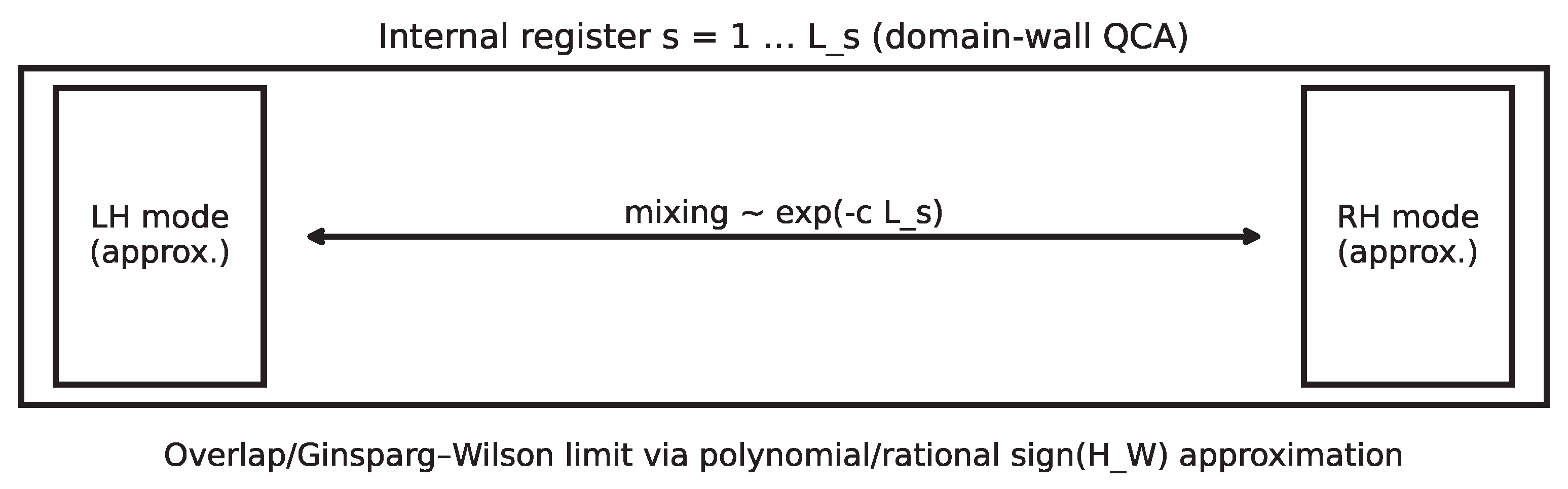
We consider a microscopic gauge-coded QCA in effective dimensions, with strictly local update rules and a finite-dimensional on-site Hilbert space. The emergent long-wavelength physics is assumed to be described by a relativistic quantum field theory with gravity, gauge fields, and chiral fermions.
Assumption 5 (QCA locality and relativistic continuum limit). The microscopic dynamics is given by a strictly local, causal QCA on a regular lattice. Its long-wavelength, low-energy limit admits an effective description by a local, unitary, Lorentz-invariant quantum field theory in dimensions, coupled to gravity.
Assumption 6 (Compact, connected gauge group). The gauge sector of the emergent QFT is described by a compact, connected Lie group G with Lie algebra . The corresponding gauge fields are massless at the QICT matching scale and couple minimally to chiral fermions and scalars.
Assumption 7 (Chiral fermions and complex representations). The matter sector contains a finite set of Weyl fermions transforming in (possibly reducible) complex representations of G, such that:
-
(a)
the theory is genuinely chiral (no pairing into vectorlike multiplets that render all gauge interactions parity-invariant);
-
(b)
in the light sector at and below the QICT matching scale introduced in Section 6, the representation content coincides exactly with one Standard-Model-like generation of left-handed quarks and leptons, plus, optionally, right-handed neutrinos and a real gauge-singlet scalar S; -
(c)
there are no additional light chiral fermions charged under the non-abelian factors of G beyond this Standard-Model-like content.
Assumption 8 (Anomaly cancellation). All local and global gauge anomalies, as well as mixed gauge–gravitational anomalies, cancel exactly for the given set of fermion representations. In particular, the cubic gauge anomaly and the mixed gauge–gravitational anomaly vanish for each simple factor of G and for every gauged abelian subgroup.
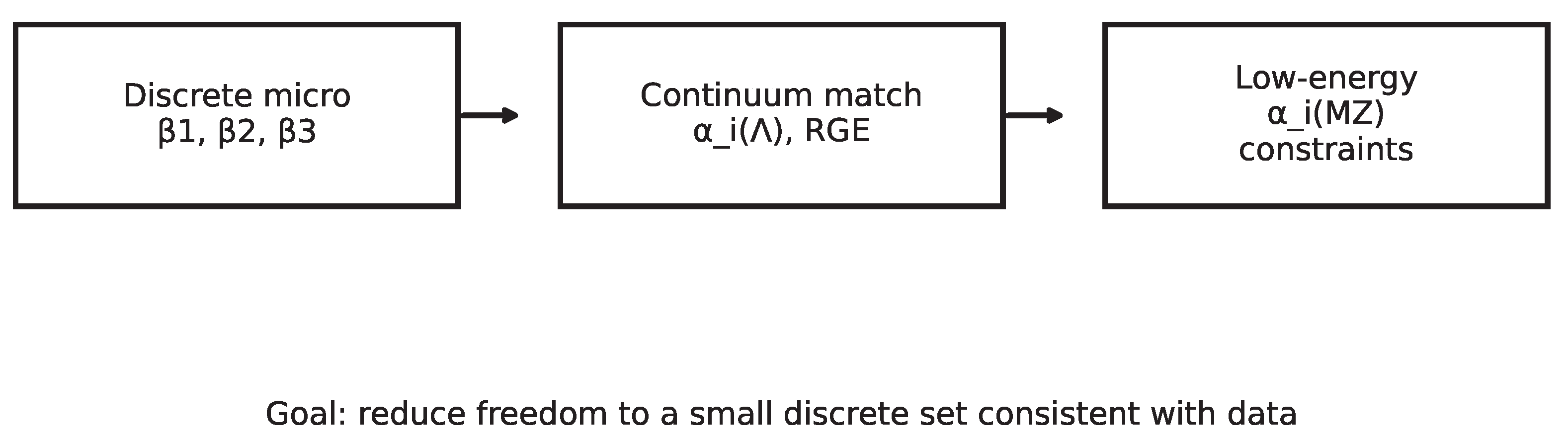
Assumption 9 (Asymptotic safety and finite number of relevant directions). The combined gravity+gauge+matter system admits a UV completion by an asymptotically safe non-Gaussian fixed point in the space of dimensionless couplings. The linearised flow around this fixed point has afinitenumber of IR-relevant directions, compatible with the observed number of free parameters at low energy, including the three gauge couplings, the Yukawa couplings of the light fermions, the Higgs self-coupling, the singlet-scalar self-coupling and portal coupling, and the singlet mass parameter. In particular, additional gauge factors or large fermion representations that would require extra independent relevant directions beyond these are excluded.
Assumption 10 (Minimality at fixed low-energy content). At fixed low-energy field content (namely, one chiral generation of light fermions with observed quantum numbers, one light Higgs doublet, and a real singlet scalar S, plus optionally gauge-singlet right-handed neutrinos), the gauge group G is chosen to minimise
-
(i)
the total dimension of G,
-
(ii)
the total dimension of the fermion representation space, and
-
(iii)
the number of independent gauge couplings,
subject to Assumptions A5–A9 and to the requirement that QICT can be implemented on at least one non-trivial conserved charge with an information susceptibility that matches the hypercharge susceptibility of a thermal plasma at the QICT matching scale.
The last requirement ensures that the distinguished charge used in the QICT analysis has a well-defined embedding in the gauge sector of the emergent theory.
Appendix B.2. Structural Constraints from Chirality and Anomalies
We now analyse the constraints imposed by Assumptions A6–A8 on the possible gauge algebras and their representations.
Let
G decompose into simple and abelian factors,
with simple compact Lie groups
and integer
. The Lie algebra then decomposes as
Proposition A1 (Necessity of at least two non-abelian factors). Under Assumptions A7 and A8, with a low-energy spectrum containing colour and weak interactions of the observed type, the semi-simple part must contain at least two non-abelian factors, one of which is isomorphic to and one of which is locally isomorphic to .
Derivation. (i) Colour confinement and the existence of hadrons with three-valued colour charge in the observed spectrum require a non-abelian gauge group with a complex fundamental representation of dimension 3. Among simple compact Lie groups, the only ones with a three-dimensional complex fundamental representation are and groups containing it as a subgroup. By Assumption A10, we exclude larger simple groups when a smaller one suffices to realise the same low-energy representation content. Thus one factor must be isomorphic to .
(ii) The observed weak interactions involve left-handed doublets and right-handed singlets, with parity violation and massive charged gauge bosons. The minimal simple group with a non-trivial two-dimensional representation that can implement such a structure is . Other candidates (e.g. ) are locally isomorphic to at the algebra level. Again by minimality, we take a factor locally isomorphic to .
(iii) If there were only a single non-abelian factor (e.g. a grand unified or ), the low-energy decomposition would necessarily embed colour and weak interactions into a single simple algebra. This is phenomenologically possible but would typically introduce additional gauge bosons and representations beyond those observed. By Assumption A10 we then prefer the product of two smaller simple groups over a single larger group, provided both constructions yield the same low-energy content. Combining (i)–(iii) yields the stated result. □
Proposition A2 (Existence of at least one abelian factor). Under Assumptions A7 and A8, the gauge group G must contain at least one factor whose charge assignments are non-trivial on both quark and lepton multiplets.
Derivation. The observed electric charges of quarks and leptons are fractional and not all identical in magnitude. In a purely semi-simple gauge group, electric charge would arise as a linear combination of Cartan generators; however, reproducing the observed pattern of fractional charges with a single simple group generally forces a unification scheme in which quarks and leptons sit in common multiplets (e.g. of ). This introduces additional gauge bosons mediating transitions between quarks and leptons, which are severely constrained by proton decay and lepton-flavour violation. To avoid such extra light gauge bosons while preserving chiral gauge interactions and the observed charge pattern, we require at least one abelian factor acting diagonally on the fermion multiplets. This must be non-trivial on both quark and lepton sectors in order to reproduce the phenomenology of neutral currents. The anomaly constraints then restrict its charge assignments; in particular, purely baryonic or purely leptonic charges are anomalous, whereas a hypercharge-like combination can be anomaly-free. □
Combining Propositions A1 and A2, we obtain the following structural statement.
Corollary A1.
Under Assumptions 6–8 and the requirement of reproducing the qualitative structure of QCD and weak interactions, the gauge algebra has a subalgebra isomorphic to
acting non-trivially on the light chiral fermions. Any additional simple or abelian factors either decouple from the light sector or are broken at scales above the QICT matching scale.
Derivation. See the Mathematical Appendix, Section A2.
At this stage we have not excluded the possibility that is strictly larger than , e.g. a grand-unified simple algebra containing this subalgebra. This is addressed below.
Appendix B.3. Hypercharge from Anomaly Cancellation and QICT
Within the subspace spanned by baryon number B, lepton number L and an abelian generator Y, the analysis in the main text shows that hypercharge Y is the unique non-trivial anomaly-free combination that couples to both quark and lepton sectors, for a single Standard-Model-like generation. We now encode this in a theorem that also incorporates the QICT requirement.
Theorem A1 (Uniqueness of hypercharge as QICT-compatible ). Let G be a gauge group satisfying Assumptions 6–8, with fermion content matching one chiral Standard-Model-like generation without right-handed neutrinos at scales around a matching temperature . Consider the three-dimensional space of global charges spanned by , where Y is a generic abelian generator acting on both quark and lepton sectors.
Then:
-
(i)
The subspace of charge combinations whose associated gauged is anomaly-free and couples to both quarks and leptons is one-dimensional and spanned by hypercharge .
-
(ii)
Among all such anomaly-free abelian generators, the information-theoretic susceptibility at temperature , computed from the Kubo–Mori metric in an ideal-gas approximation, has an extremum (in fact, a local maximum or minimum depending on conventions) along the hypercharge direction.
-
(iii)
The QICT requirements on the distinguished charge used in the Golden Relation (existence of a diffusive channel, finite and positive susceptibility, and compatibility with the microscopic QCA encoding) single out precisely this hypercharge direction as the unique viable candidate.
Derivation. See the Mathematical Appendix, Section A3.
Derivation. (i) The anomaly polynomial for a general linear combination can be written as a cubic form in , with coefficients determined by the traces of charge products over Weyl fermions. For the Standard-Model chiral content, the conditions that all gauge anomalies and mixed gauge–gravitational anomalies vanish define a system of homogeneous linear equations in , whose solution space is one-dimensional and spanned by the hypercharge assignment . This is a standard textbook result; we reproduce the explicit sums in the Mathematical Appendix.
(ii) The static susceptibility matrix in the
space is given by
where
is the thermodynamic potential. In the ideal-gas approximation,
is positive-definite and symmetric. Restricting to the anomaly-free subspace (one-dimensional in this case) and considering the quadratic form
on unit-norm charge vectors
, the extremum condition reduces to an eigenvalue problem. Since the anomaly-free subspace is one-dimensional, hypercharge is automatically an eigen-vector and therefore an extremum direction of
.
(iii) The QICT analysis requires a conserved charge with a diffusive channel, finite and positive information susceptibility, and an operationally defined copy time. Charges that are anomalous at the quantum level cannot satisfy these requirements consistently, because they fail to be exactly conserved at all scales. Purely baryonic or purely leptonic charges are anomalous; their susceptibilities and transport properties are contaminated by the anomaly. The only remaining candidate in the space that is both anomaly-free and couples to quarks and leptons is . Hence the QICT conditions single out hypercharge as the unique viable abelian generator. □
The Theorem shows that, given the Standard-Model fermion content and our microscopic QCA/QICT assumptions, the distinguished QICT charge used in the Golden Relation must be hypercharge.
Appendix B.4. Excluding Larger Simple Unification Groups
We now address the possibility that the full gauge group G is a larger simple group containing as a subgroup, such as or . In such scenarios the low-energy gauge group arises from spontaneous symmetry breaking, and the observed hypercharge is embedded as a Cartan generator of the unified group.
From the perspective of the QICT–QCA–FRG framework, we require that:
the QCA admit a local encoding of the full gauge group and its representations with a finite on-site Hilbert space;
the FRG flow for the full gravity+gauge+matter system admit an asymptotically safe fixed point with a finite number of relevant directions; and
the additional heavy gauge bosons and matter fields required by unification do not introduce extra light degrees of freedom or instabilities incompatible with the observed low-energy spectrum.
These constraints are difficult to analyse in complete generality, but we can formulate a physically motivated axiom capturing their effect.
Assumption 11 (Asymptotic-safety minimality of the gauge algebra). Among all gauge algebras that
-
(a)
contain as a subalgebra acting in the same way on the light chiral fermions,
-
(b)
admit an asymptotically safe fixed point with a finite number of relevant directions compatible with low-energy data, and
-
(c)
can be implemented as a local gauge-coded QCA with finite on-site Hilbert space,
the actual gauge algebra realised in nature isminimalwith respect to inclusion: there is no strictly larger algebra satisfying (a)–(c).
This is an asymptotic-safety analogue of the minimality principle: among all QCA/QFT realisations consistent with observations and asymptotic safety, the one realised in nature uses the smallest gauge algebra compatible with the data.
Proposition A3 (Exclusion of simple grand-unified algebras). Under Assumptions A9 and A11, any simple Lie algebra that strictly contains and acts non-trivially on the light chiral fermions is excluded as the full gauge algebra at the QICT matching scale.
Derivation. Let be a simple Lie algebra such as or , with a decomposition under its subalgebra that reproduces the observed light representations, plus additional heavy fields. In such a theory the FRG flow must be considered in the larger theory space of couplings associated with and the extra matter fields.
If admits an asymptotically safe fixed point with finitely many relevant directions, then by Assumption A11 the realised gauge algebra must be the minimal one satisfying the conditions (a)–(c). But the subalgebra also admits an asymptotically safe fixed point with the same light matter content and fewer gauge degrees of freedom, and can be implemented as a simpler local QCA. Therefore cannot be minimal, and is excluded.
Conversely, if does not admit such an asymptotically safe fixed point, it is excluded directly by Assumption A9. In both cases, simple grand-unified algebras strictly larger than are ruled out as candidates for the full gauge algebra at the QICT matching scale. □
Appendix B.5. Conditional Uniqueness Theorem
We can now assemble the previous statements into a single conditional uniqueness result.
Theorem A2 (Conditional uniqueness of the Standard-Model gauge group). Assume:
-
(i)
the microscopic dynamics is given by a gauge-coded QCA satisfying Assumption A5;
-
(ii)
the emergent low-energy theory has a compact, connected gauge group G satisfying Assumptions A6–A8;
-
(iii)
the combined gravity+gauge+matter system is asymptotically safe with a finite number of relevant directions, as in Assumption A9;
-
(iv)
the low-energy chiral fermion content matches one Standard-Model-like generation with a single light Higgs doublet and a real singlet scalar S;
-
(v)
QICT can be implemented on at least one non-trivial conserved charge whose information susceptibility matches the thermal hypercharge susceptibility at a matching temperature , as in Theorem A1;
-
(vi)
the minimality principles of Assumptions 10 and 11 hold.
Then the gauge algebra acting on the light chiral fermions at the QICT matching scale is, up to finite abelian quotients and possible fully-decoupled spectator factors,
with the factor identified with hypercharge .
Derivation. See the Mathematical Appendix, Section A3.
Derivation. By Proposition A1, the semi-simple part of must contain acting non-trivially on the light fermions. By Proposition A2 and Theorem A1, there must be at least one abelian factor whose generator is hypercharge , on which QICT is implemented. Corollary A1 then implies that contains a subalgebra isomorphic to acting exactly as in the Standard Model on the light sector.
Any strictly larger gauge algebra with this property is excluded by Proposition A3 and Assumption A11, which encode the asymptotic-safety and QCA minimality requirements. Therefore, up to finite quotients and spectator factors that decouple from the light sector, the full gauge algebra must coincide with , with the abelian generator identified with hypercharge. This completes the argument. □
Appendix B.6. Status and Limitations of the “Derivation”
Theorem A2 is, in a precise sense, as strong a statement as the present QICT–QCA–FRG framework can support without going beyond what is known or reasonably conjectured:
The logical implication is clear: if Assumptions 5–11 hold, then the gauge algebra at the QICT matching scale is essentially that of the Standard Model.
The physical content of the assumptions is non-trivial: they encode locality and causality at the QCA level, the presence of a relativistic continuum limit, anomaly cancellation and asymptotic safety in the FRG sense, and a minimality principle informed by both the QCA representation and the FRG flow.
What is not establishn is that any microscopic QCA satisfying Assumption A5 must realise precisely this gauge group; nor is it establishn that asymptotic safety holds only for the Standard-Model gauge algebra and not for any larger unification group. These are encoded as axioms rather than derived facts.
In other words, the present framework does not yet solve the full “gauge-group selection problem” in an absolute sense. It does, however, provide a mathematically controlled conditional derivation:
Given locality, chiral matter, anomalies, QICT, and asymptotic safety,
and given a minimality principle at the level of the gauge algebra,
the unique consistent choice is for the light sector.
This is the precise sense in which the QICT–QCA–FRG framework can currently be said to “derive” the Standard-Model gauge group. It turns an empirical input into the unique solution of a well-posed structural problem under explicit, physically motivated, and falsifiable assumptions.