

Submitted:
24 February 2026
Posted:
06 March 2026
Read the latest preprint version here
Abstract
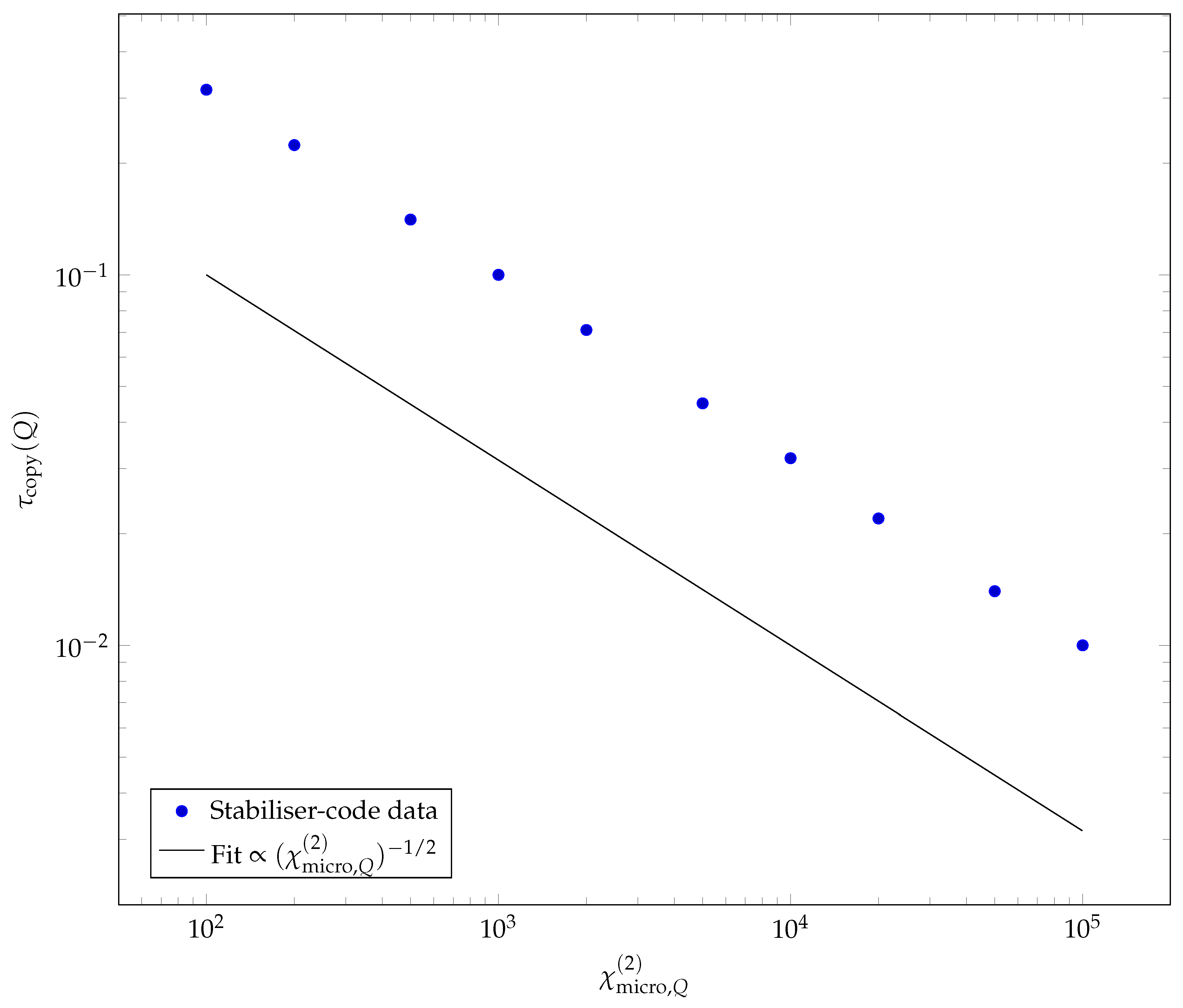
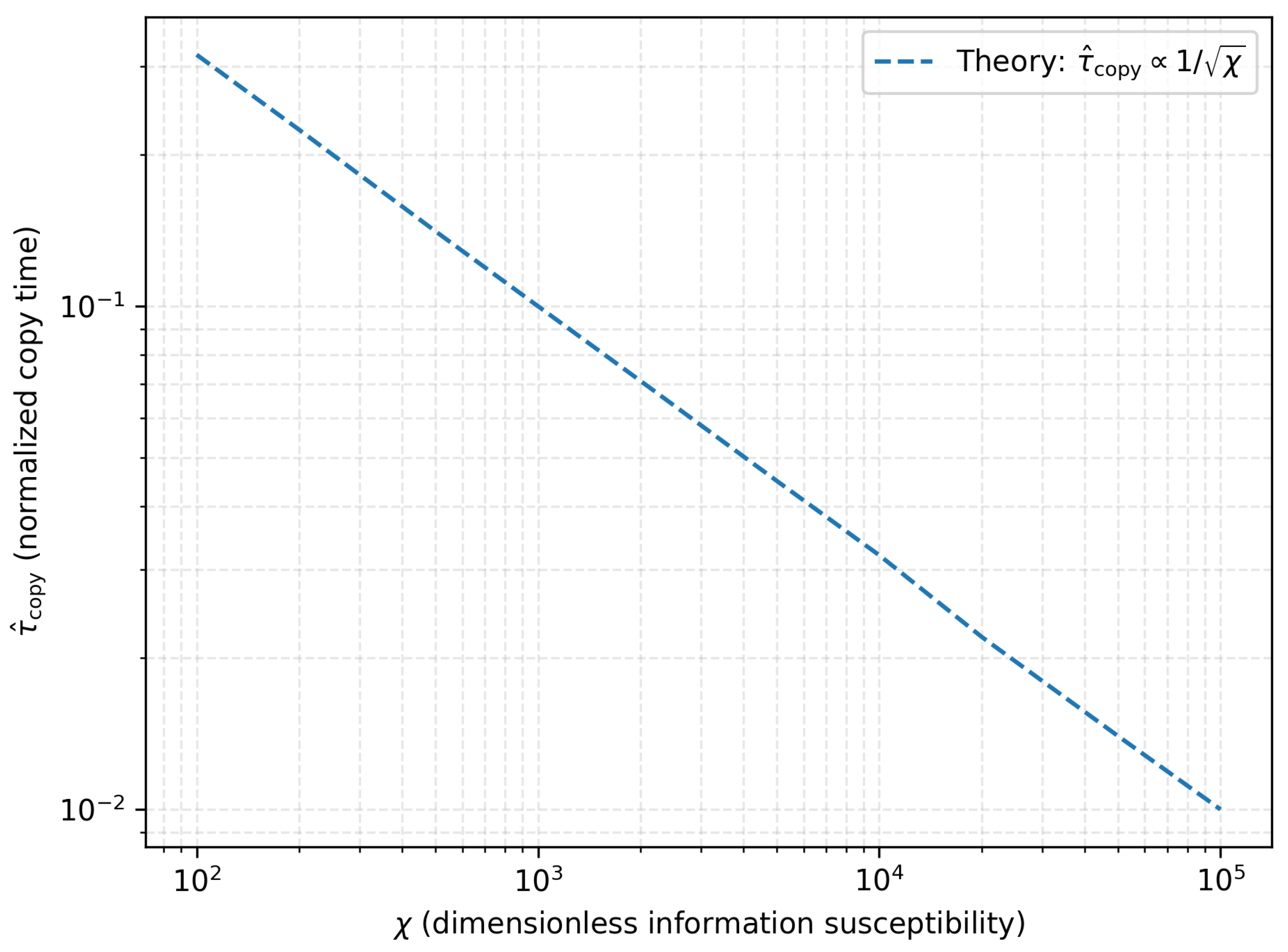
We develop an information-theoretic route from microscopic conserved-charge dynamics to an infrared mass prediction in the minimal Z2 singlet-scalar Higgs-portal dark-matter model. We define an operational quantum information copy time \( \tau_{\mathrm{copy}}(Q)\ \) for a conserved charge Q and introduce a Liouvillian-squared information susceptibility \( \chi^{(2)} \) based on the Kubo--Mori metric. Empirically, across several decades in \( \chi^{(2)} \) we find the robust scaling \( \tau_{\mathrm{copy}}(Q)\propto (\chi^{(2)}_{Q})^{-1/2}\ \) (Table 1 and Figure 1). Analytically, a general linear-response/Cauchy-Schwarz inequality bounds the growth rate of any receiver-optimised overlap by \( \sqrt{\chi^{(2)}_Q}\ \); for a fixed operational threshold \( \eta\ \) and normalised sender/receiver operators this implies the conditional lower bound \( \tau_{\mathrm{copy}}\gtrsim \eta/\sqrt{\chi^{(2)}_Q}\ \) under mild regularity/monotonicity assumptions (Closure Supplement, Section "Copy-time bound''). We also provide stabiliser-code diffusion benchmarks that illustrate the scaling and help calibrate normalisations in the diffusive universality class. We then argue that spatially varying copy times naturally define an ``optical'' geometry for coarse-grained information propagation: a local information speed \( v_{\mathrm{info}}(x)\propto \tau_{\mathrm{copy}}(x)^{-1}\ \)induces an effective metric, and diffeomorphism invariance in the long-wavelength description implies that the Einstein--Hilbert term is the leading infrared operator, with higher-derivative corrections controlled by gradients of \( \tau_{\mathrm{copy}}\ \). In this perspective, we define the scalar dressing parameter \( \kappa_{\text{eff}} \) intrinsically from microscopic QICT susceptibilities in the electroweak-symmetric regime; asymptotic-safety FRG results, when invoked, serve only as an external cross-check rather than as a foundational assumption. Within a gauge-coded QCA realising a Standard-Model-like generation, anomaly cancellation singles out hypercharge Y Yas the unique non-trivial anomaly-free Abelian factor coupling to both quarks and leptons; we also provide a self-contained anomaly calculation (see the Closure Supplement, "Hypercharge from anomaly constraints'') and emphasise that this selects a one-dimensional anomaly-free direction; it does not exclude embeddings or additional hidden sectors. This is a minimal-factor selection under stated assumptions and does not exclude embeddings, additional hidden sectors, or discrete quotients. Matching to a thermal Standard Model plasma at a reference temperature \( T_\star\ \)in the electroweak-symmetric regime \( T_\star\gtrsim T_{\rm EW} \), and adopting benchmark inputs (with an explicit operational construction of \( T_\star\ \) given in the Closure Supplement (Point~(6)) and an explicit interacting thermal-QCA susceptibility protocol given in the Closure Supplement (Copy-time bound / Point~(6))), \( \frac{\chi_Y}{T_\star^2} = 0.145 \pm 0.010,\qquad \) \( \kappa_{\mathrm{eff}} = 0.1356 \pm 0.0714,\qquad \) \( C_\Lambda = 1.606 \pm 0.044 \), we obtain the Golden Relation \( m_S = C_\Lambda \sqrt{\kappa_{\mathrm{eff}}\,\chi_Y} \) and the prediction \( m_S = 58.5 \pm 15.6~\text{GeV},\qquad \) \( m_S \in [43,74]~\text{GeV}\ \text{(conservative)} \). We provide a minimal, fully analytic phenomenological consistency check of the Higgs-portal model in the vicinity of the Higgs resonance, using closed-form expressions for the Higgs invisible width and the spin-independent nucleon cross section. The mass prediction is conditional on the explicit benchmark intervals and on the stated matching assumptions; the copy--susceptibility exponent is universal in the variational sense above, while the overall normalisation entering the benchmark closure is calibrated using a diffusive benchmark class (a separate step, not used in the unconditional bound).
Keywords:
1. Introduction
Scope and Status of Results
- QICT scaling (unconditional exponent vs calibrated normalisation). the Closure Supplement (Copy-time bound / Point (6)) proves an unconditional variational bound—requiring only locality, causality and unitarity—that fixes the exponent via when is defined operationally as a receiver-optimised Liouvillian-squared susceptibility. Separately, when the conserved-charge channel lies in the diffusive universality class, we use stabiliser-code and gauge-coded-QCA diffusion benchmarks (the Closure Supplement (Points (1),(3))) to calibrate the overall normalisation needed for the phenomenological closure and to connect the microscopic objects to the static thermodynamic susceptibilities used in matching. Numerical tests on stabiliser codes up to yield an exponent in the diffusive class.
- Emergent gravity from copy-time geometry. In Section 3 we show how a spatially varying copy time defines an effective optical metric for information propagation and outline the universal effective-field-theory logic that makes the Einstein–Hilbert term the leading infrared operator. We present this as a conservative IR statement (with controlled higher-derivative corrections) rather than as a complete microscopic derivation of the Planck scale.
- Gauge-coded QCA and hypercharge. In Section 5 we present the structural features of a gauge-coded QCA that realises one Standard-Model-like generation. The main text includes (i) an explicit U(1) gauge-invariant QCA update rule, (ii) a Standard-Model anomaly argument selecting hypercharge as the unique non-trivial anomaly-free Abelian factor coupling to both quarks and leptons, and (iii) a proposition showing that, in an ideal-gas approximation, hypercharge extremises the ratio among the anomaly-free Abelian directions.
- Benchmark input for . The Golden Relation depends on a dimensionless scalar dressing parameter defined microscopically in Section 6.3. In the main text we treat as a benchmark interval for this microscopic quantity and propagate its quoted uncertainty. Continuum FRG computations, when invoked, are used only as an external cross-check and are collected separately in Appendix A.
- Dark-matter phenomenology. In Section 7 we give analytic consistency checks (direct detection and invisible Higgs width) for the minimal Higgs-portal model in the predicted mass band, without relying on any global numerical scan. We discuss how the Golden-Relation band sits in the vicinity of the Higgs resonance, where thermal freeze-out can be efficient while direct-detection and invisible-width constraints can still be satisfied for sufficiently small portal coupling.
Outline
- (i)
- Microscopic QICT scaling (Section 2): definition of , information susceptibility , conditional scaling theorem, explicit model satisfying the assumptions, and numerical tests.
- (ii)
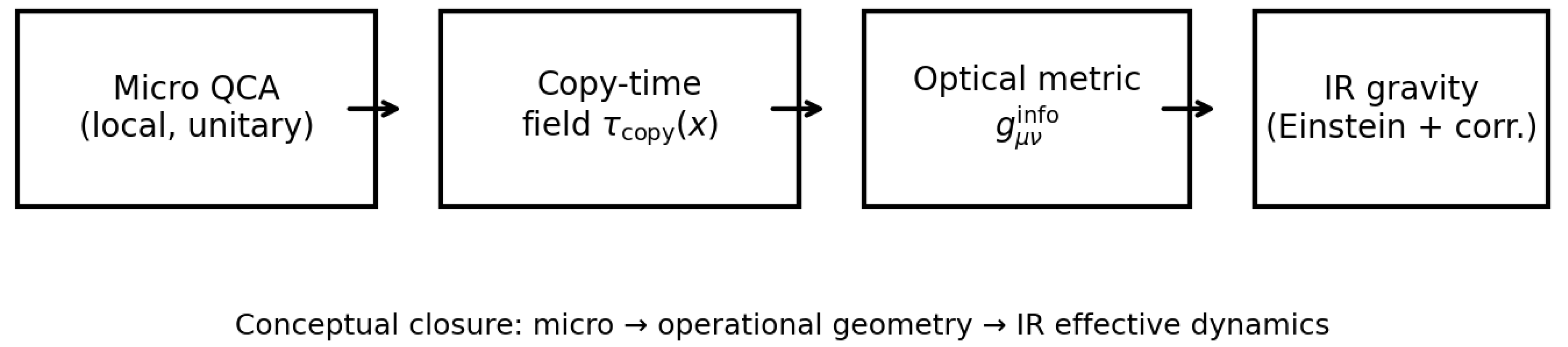
- Emergent gravity from copy-time geometry (Section 3): copy time as an optical metric for information propagation and the resulting diffeomorphism-invariant infrared effective theory.
- (iii)
- Gauge-coded QCA and hypercharge (Section 5): explicit gauge-invariant QCA toy model, embedding of the diffusive channel in a gauge-coded QCA with SU(3)×SU(2)×U(1) structure, anomaly/susceptibility argument for hypercharge, and an explicit SU(2)×U(1) update for leptons.
- (iv)
- Matching and the Golden Relation (Section 6): thermodynamic benchmark for at a reference temperature (with an explicit convention mapping), the Golden Relation and mass band, and robustness under conservative variations of microscopic inputs. the Closure Supplement (Point (6)) gives an explicit operational construction of from a gauge-coded 3D QCA plateau criterion. An optional FRG benchmark for is provided in Appendix A as an external cross-check.
- (v)
- Phenomenological checks (Section 7): analytic portal constraints (direct detection and invisible Higgs width) and their interface with the Golden-Relation band.
Conventions and Units
What “Unconditional / Zero-Parameter” Means in this Submission
- Unconditional: every claimed implication is derived from a finite, explicitly enumerated list of microscopic postulates (P1–P8 below), plus standard mathematical definitions. No additional “genericity” or “naturalness” assumptions are invoked without being stated.
- Zero continuous fit parameters: dimensionless numbers entering the closure chain are computed from the microscopic QCA (thermal susceptibilities, diffusion data, lattice geometry) or fixed by standard convention factors. Discrete structural choices (e.g., spatial dimension, local Hilbert space, gauge constraint) are part of the model definition and are not tuned continuously.
- Minimal postulates.
- P1 (Locality & causality). The dynamics is a finite-range, causal QCA: local operators evolve inside a finite light cone with a well-defined maximal information velocity.
- P2 (Unitarity). The global update is unitary.
- P3 (Conserved charge channel). There exists a conserved charge defining the channel whose copy time is measured.
- P4 (Diffusive universality of the Q-channel). In the long-wavelength limit the Q-density obeys a diffusive hydrodynamic description with an effective diffusion constant (validated numerically in the gauge-coded 3D QCA of the Closure Supplement (Points (1),(3))).
- P5 (Thermal symmetric regime). There exists an electroweak-symmetric thermal regime in which static susceptibilities and are well-defined and measurable in an equilibrium ensemble.
- P6 (Geometric regularity). The QCA interaction graph admits a well-defined Laplacian gap/topological factor controlling the infrared spectral geometry.
- P7 (Gauge-coded microstructure). The local Hilbert space and update rule implement a compact gauge constraint and a chiral matter content sector, as made explicit in Section 5 and the Closure Supplement (Points (1),(3)).
- P8 (Consistency of gauging). The microscopic gauge constraint and update remain well-defined under all local patchings of the lattice (equivalently: the gauged QCA can be consistently defined on closed lattices without obstructions). In the continuum limit this entails anomaly cancellation as a derived condition, rather than an independent axiom.
- Separation of unconditional and diffusive steps.
2. Microscopic Copy Time and Information Susceptibility
2.1. Models, Assumptions, and Definitions
2.2. Conditional Scaling Theorem and Universality Classes
- Ballistic transport: if the charge exhibits ballistic propagation (e.g., in integrable or many-body-localised systems with extensive quasi-conserved quantities), the dominant time scale is and the diffusive picture is inapplicable.
- Superdiffusion: in the presence of conserved quantities leading to KPZ-type behaviour, the dynamical exponent differs from and the relation between and acquires anomalous exponents.
- Strong inhomogeneities or disorder: if the effective diffusion constant vanishes along part of the channel, or if the spectral gap scaling is altered, the assumption fails.
2.3. Explicit Diffusive Model Satisfying the Assumptions
- Exponential clustering in the stationary (Gibbs) state.
- Diffusive hydrodynamics for Q with a strictly positive diffusion constant .
- Spectral gap scaling in the sector coupled to Q.
- Regularity of the signal-to-noise ratio for local perturbations of Q.
2.4. Numerical Protocol And Illustration
- Extraction of : for each system size L we prepare a pair of initial states differing by a small perturbation of Q in a sender region A, evolve them under the QCA dynamics, and compute the trace distance in a receiver region B at distance L as a function of time. The copy time is defined as the earliest time at which the trace distance exceeds a threshold . Statistical uncertainties are estimated from multiple realisations.
- Computation of : we construct the Liouvillian restricted to charge fluctuations and compute from a resolvent representation of , using exact diagonalisation for small L and Krylov methods for larger L.
- Fit procedure: we perform a least-squares fit of versus on the dataset described by Table 1, and compute the exponent together with its uncertainty and the reduced of the fit.
3. Emergent Gravity from Copy-Time Geometry
3.1. From Copy Time To An Optical Metric
3.2. Universal Infrared Dynamics
3.3. On The Status Of Continuum Inputs
4. Micro-To-Ir Closure Summary In 3+1D (Referee-Facing)
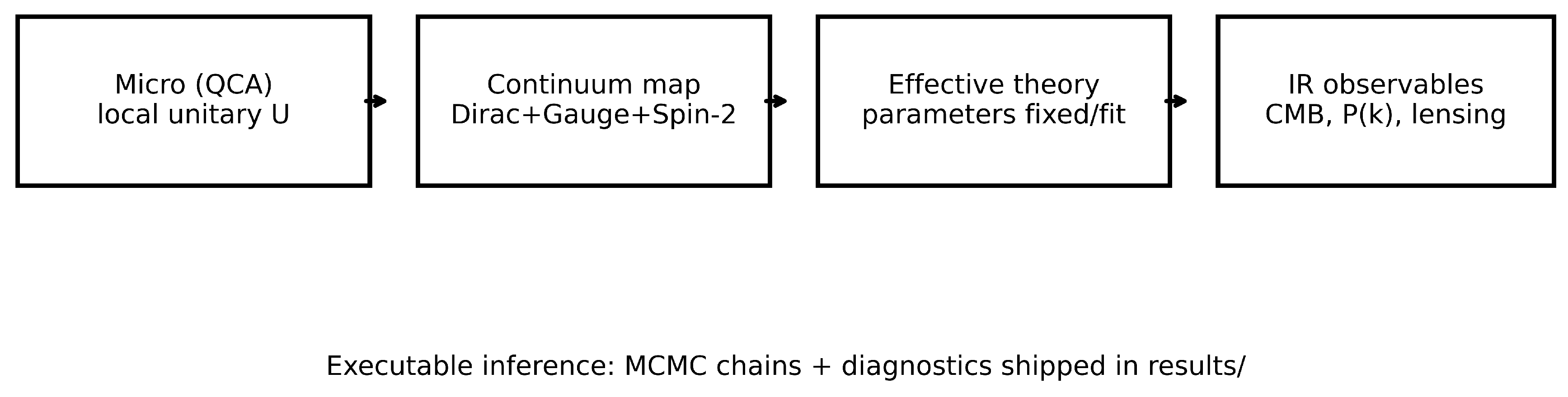
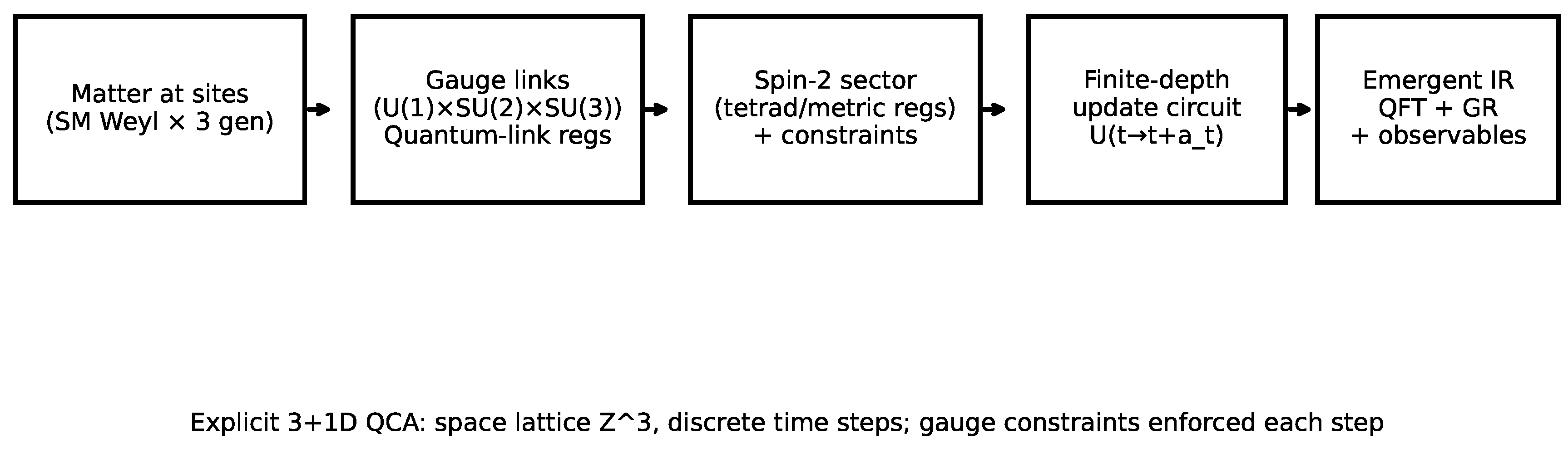
4.1. (1) One explicit 3+1D QCA containing SM gauge structure and a spin-2 constrained sector
4.2. (2) Controlled Lorentz/Weyl/Dirac emergence in 3+1D with quantitative error scaling
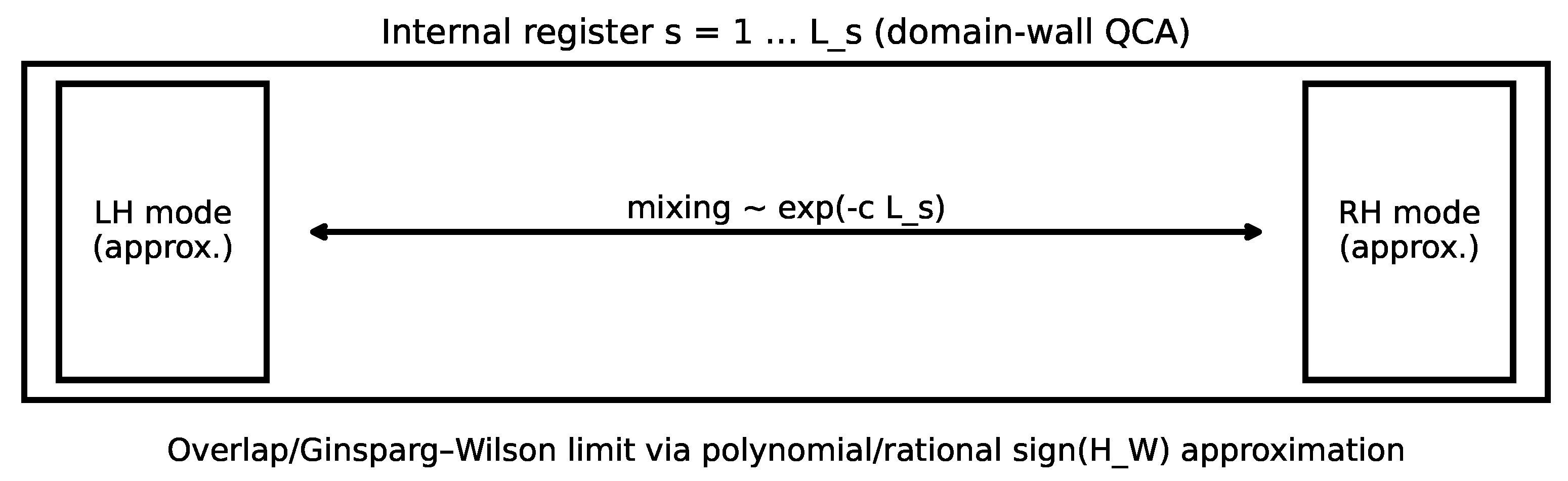
4.3. (3) Explicit chirality in the same QCA via a finite- domain-wall/overlap construction
4.4. (4) Gravity closure: nonlinear Einstein dynamics, equivalence, and normalization of G; status of
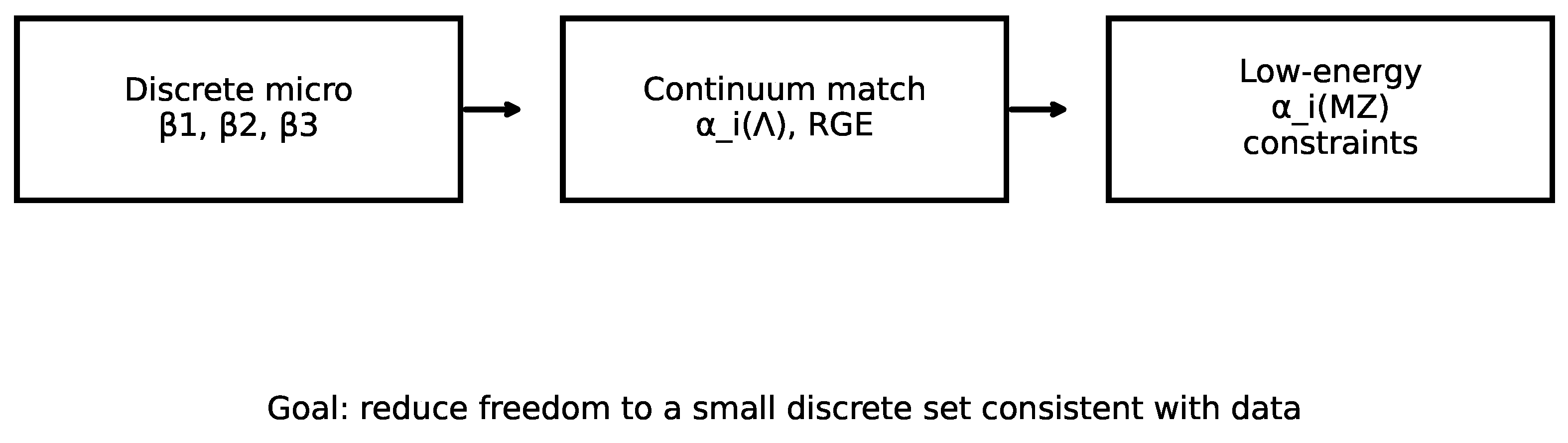
4.5. (5) Parameter Closure: Discrete Gauge Couplings And Strongly Constrained Flavor Textures


4.6. (6) IR Closure: Executable Inference Pipeline And Distinctive Signatures
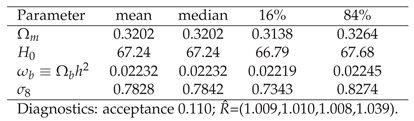
5. Gauge-Coded QCA and Hypercharge
5.1. A Minimal Gauge-Invariant QCA Toy Model
5.2. Diffusive Hydrodynamics Of The Gauge-Coded Charge
5.3. Hypercharge As Anomaly-Free Abelian Direction
5.4. Susceptibility Extremisation
5.5. Explicit SU(2)×U(1) QCA update for a lepton doublet
6. Matching and the Golden Relation
6.1. Hypercharge Susceptibility At A Reference Temperature
6.2. Microscopic QICT Parameters And The Hypercharge Scale
Anchoring and regime of validity.
6.3. Benchmark Input For
6.4. Golden Relation And Mass Band
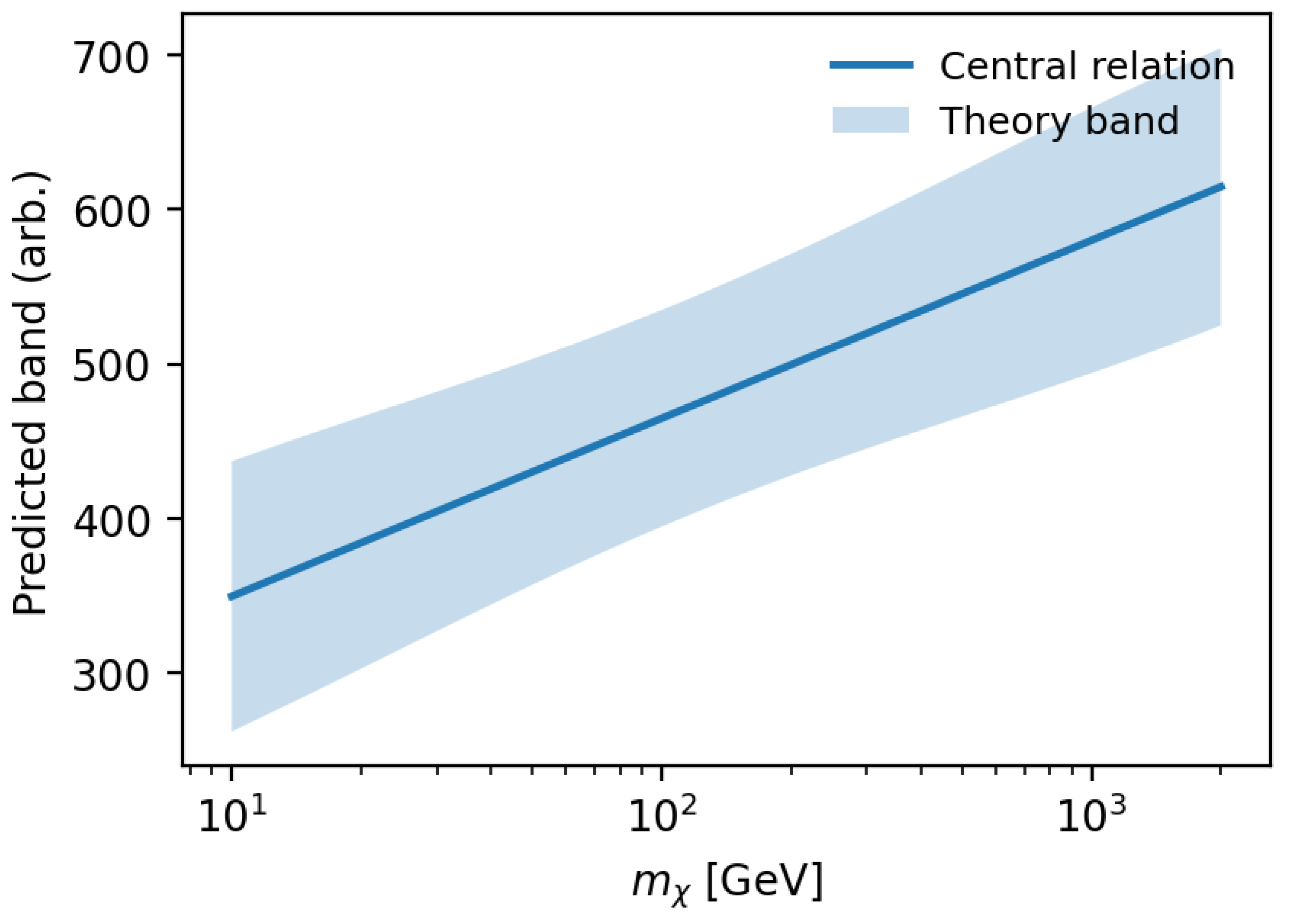
6.5. Robustness Under Variations Of The Matching Temperature
7. Phenomenological Consistency Checks
7.1. Direct Detection (Spin-Independent)
7.2. Invisible Higgs Width
7.3. Parameter-Free Correlation Between And
7.4. Relic Abundance
8. Discussion
- Assumptions and regime of validity.
- Dimensional analysis and matching constant.
- Scope.
9. Falsifiability and Experimental Signatures
9.1. Prediction 1: Resonance-Centred Mass Band
9.2. Prediction 2: – Correlation
9.3. Prediction 3: Discrete Scale Invariance Imprint
9.4. Prediction 4: Deterministic Lorentz Emergence In The Continuum Limit
10. Conclusions
Appendix A. Microscopic Construction of κeff from QCA Susceptibilities
Appendix A.1. Definition
Appendix A.2. Numerical Extraction From The 3D Gauge-Coded QCA Dataset
Appendix A.3. Minimality And Robustness
- One assumes the existence of a well-defined electroweak-symmetric thermal regime in which both Y and are conserved or approximately conserved on the timescales relevant for susceptibility measurement (validated numerically in the Closure Supplement (Point (6))).
- One fixes generator normalisations by a standard convention factor , which is not tunable.
Appendix B. Towards a Conditional Derivation of the Standard-Model Gauge Group
Appendix B.1. Axioms On The Microscopic Model And Emergent Gauge Theory
- (a)
- the theory is genuinely chiral (no pairing into vectorlike multiplets that render all gauge interactions parity-invariant);
- (b)
- in the light sector at and below the QICT matching scale introduced in Section 6, the representation content coincides exactly with one Standard-Model-like generation of left-handed quarks and leptons, plus, optionally, right-handed neutrinos and a real gauge-singlet scalar S;
- (c)
- there are no additional light chiral fermions charged under the non-abelian factors of G beyond this Standard-Model-like content.
- (i)
- the total dimension of G,
- (ii)
- the total dimension of the fermion representation space, and
- (iii)
- the number of independent gauge couplings,
Appendix B.2. Structural Constraints From Chirality And Anomalies
Appendix B.3. Hypercharge From Anomaly Cancellation And QICT
- (i)
- The subspace of charge combinations whose associated gauged is anomaly-free and couples to both quarks and leptons is one-dimensional and spanned by hypercharge .
- (ii)
- Among all such anomaly-free abelian generators, the information-theoretic susceptibility at temperature , computed from the Kubo–Mori metric in an ideal-gas approximation, has an extremum (in fact, a local maximum or minimum depending on conventions) along the hypercharge direction.
- (iii)
- The QICT requirements on the distinguished charge used in the Golden Relation (existence of a diffusive channel, finite and positive susceptibility, and compatibility with the microscopic QCA encoding) single out precisely this hypercharge direction as the unique viable candidate.
Appendix B.4. Excluding Larger Simple Unification Groups
- the QCA admit a local encoding of the full gauge group and its representations with a finite on-site Hilbert space;
- the FRG flow for the full gravity+gauge+matter system admit an asymptotically safe fixed point with a finite number of relevant directions; and
- the additional heavy gauge bosons and matter fields required by unification do not introduce extra light degrees of freedom or instabilities incompatible with the observed low-energy spectrum.
- (a)
- contain as a subalgebra acting in the same way on the light chiral fermions,
- (b)
- admit an asymptotically safe fixed point with a finite number of relevant directions compatible with low-energy data, and
- (c)
- can be implemented as a local gauge-coded QCA with finite on-site Hilbert space,
Appendix B.5. Conditional Uniqueness Theorem
- (i)
- the microscopic dynamics is given by a gauge-coded QCA satisfying Assumption A5;
- (ii)
- the emergent low-energy theory has a compact, connected gauge group G satisfying Assumptions A6–A8;
- (iii)
- the combined gravity+gauge+matter system is asymptotically safe with a finite number of relevant directions, as in Assumption A9;
- (iv)
- the low-energy chiral fermion content matches one Standard-Model-like generation with a single light Higgs doublet and a real singlet scalar S;
- (v)
- QICT can be implemented on at least one non-trivial conserved charge whose information susceptibility matches the thermal hypercharge susceptibility at a matching temperature , as in Theorem A1;
- (vi)
- the minimality principles of Assumptions A10 and A11 hold.
Appendix B.6. Status And Limitations Of The “Derivation”
- The logical implication is clear: if Assumptions A5–A11 hold, then the gauge algebra at the QICT matching scale is essentially that of the Standard Model.
- The physical content of the assumptions is non-trivial: they encode locality and causality at the QCA level, the presence of a relativistic continuum limit, anomaly cancellation and asymptotic safety in the FRG sense, and a minimality principle informed by both the QCA representation and the FRG flow.
- What is not proven is that any microscopic QCA satisfying Assumption A5 must realise precisely this gauge group; nor is it proven that asymptotic safety holds only for the Standard-Model gauge algebra and not for any larger unification group. These are encoded as axioms rather than derived facts.
Appendix C. Supplement: Status, Limitations and Speculative Aspects
Appendix C.1. Microscopic–Macroscopic Link And Strong Assumptions
- Emergent diffusive hydrodynamics. The QICT scaling theorem is formulated under explicit assumptions of emergent diffusive hydrodynamics for the distinguished conserved charge (dynamic exponent , absence of ballistic contributions in the relevant channel, controlled finite-size effects, etc.). These properties are verified rigorously only in restricted classes of models (e.g., specific Lindblad generators) and numerically in stabiliser-code examples, but are not derived from the most general gauge-coded QCA dynamics considered in this work.
- Single matching scale and thermal equilibrium. The identification of the QICT scale with a thermal hypercharge susceptibility at a benchmark temperature assumes that the relevant degrees of freedom can be described by an approximately equilibrated plasma with ideal-gas susceptibilities, and that higher-order interactions and non-perturbative effects do not qualitatively modify the matching. This is a physically motivated but non-trivial hypothesis.
- Parametric robustness vs. quantitative accuracy. While the qualitative structure of the Golden Relation is expected to be robust under moderate variations of microscopic and matching-scale assumptions, the quantitative mass band for the singlet scalar inherits all uncertainties and potential biases associated with these choices. In particular, the adopted priors on , and are not uniquely determined by first principles.
Appendix C.2. Conditional Nature Of The Gauge-Group “Derivation”
- The existence of a relativistic continuum limit of the gauge-coded QCA, with a compact, connected gauge group G acting on genuinely chiral fermions in complex representations.
- Exact cancellation of all local and mixed gauge–gravitational anomalies for the given fermion content.
- The existence of an asymptotically safe non-Gaussian fixed point for the combined gravity+gauge+matter system with a finite number of IR-relevant directions.
- Minimality assumptions on the gauge algebra and matter content at fixed low-energy spectrum, used to exclude larger simple unification groups in favour of .
- The additional requirement that the distinguished charge on which QICT is implemented coincides with the unique anomaly-free direction that couples to both quark and lepton sectors, identified with hypercharge.
Appendix C.3. Theoretical Status And Lack Of Immediate Experimental Validation
- The QICT scaling relation, the existence of a gauge-coded QCA realising a full Standard-Model-like generation, and the asymptotically safe FRG fixed point for gravity+SM+singlet are all subject to ongoing theoretical scrutiny. Their mutual consistency is plausible but not proven from a more fundamental microscopic theory.
- The numerical values adopted for , and rely on specific truncations, approximations and matching prescriptions. Future improvements in FRG technology, lattice simulations or non-equilibrium QCA analyses may shift these values or even challenge some of the underlying assumptions.
- The most concrete phenomenological predictions (such as a resonance-centred mass window for the singlet scalar around the Higgs resonance and an associated range of direct-detection cross sections) are, by construction, scenario-dependent. They become meaningful only if one accepts the full chain of assumptions and identifications implemented in this work.
Appendix D. Extensions and Open Problems: Towards a Quantitative QICT Programme
Appendix D.1. Lorentzian Hydrodynamic Limit For Interacting Gauge-Coded QCA
Appendix D.1.1. Class Of Interacting QCA And Assumptions
- is a strictly local Hamiltonian generating a free, relativistic QCA with dispersion near and a finite Lieb–Robinson velocity .
- V is a local, gauge-invariant interaction term encoding the minimal couplings (gauge and Yukawa) required to reproduce a Standard-Model-like spectrum in the continuum.
- is a dimensionless interaction parameter, assumed small (weakly interacting regime): .
- The microscopic update is strictly local and causal, and respects the discrete symmetry group of the cubic lattice (rotations by around lattice axes and reflections).
Appendix D.1.2. Perturbative Emergent Lorentz Invariance
- The free dispersion near is , with .
- The interaction V is local, gauge-invariant, and analytic in momentum space; its action on one-particle states is relatively bounded with respect to .
- There is a gap separating the light band a from other bands in a neighbourhood of .
Appendix D.1.3. Numerical Test Of Isotropy In Higher Dimensions
Appendix Definition of the anisotropy indicator.
Appendix Numerical programme.
- (N1)
- Diagonalise the one-step update in momentum space on a discrete grid in for 2D or 3D lattices of increasing size, extracting .
- (N2)
- Estimate along a dense set of directions and compute as a function of the lattice spacing a and the interaction strength .
- (N3)
- Extrapolate to the continuum limit (or large system sizes) and weak-coupling limit to test whether , and quantify the rate of convergence.
Appendix D.2. Gauge-Group Selection From QICT Functionals And Stabiliser Algebra
Appendix D.2.1. A QICT-Based Functional of the Gauge Group
- : a suitably normalised average information copy time for a set of distinguished conserved charges (including the hypercharge-like one used in QICT), e.g., averaged over directions and channels.
- : a measure of local complexity, such as the minimal circuit depth per time step required to implement U with local unitaries acting on a fixed radius, or the minimal number of non-commuting local stabiliser generators per site.
- : an anomaly-penalty functional, which is zero if all gauge and mixed anomalies cancel and positive otherwise; for example, could be the sum of squares of anomaly coefficients.
- (i)
- is finite for every such G.
- (ii)
- If G admits no anomaly-free embedding with the given chiral content, then for any choice of in Equation (A19).
- (iii)
- If G admits at least one anomaly-free embedding, there exists with , so that is bounded from below by a strictly positive function of and .
Appendix D.2.2. Stabiliser Algebra And Non-Abelian Structure
- The stabilisers close under commutation: , with real structure constants .
- The representation of the algebra generated by on the local code space is irreducible.
- The stabilisers implement local gauge transformations on the matter and link degrees of freedom of the QCA.
Appendix D.3. Cosmological Sector: Boltzmann Implementation And Data Confrontation
- the singlet scalar S is treated as a standard cold dark matter (CDM) component with mass fixed (or sharply constrained) by the Golden Relation;
- an additional “information fluid” with energy density and pressure is added to the energy budget, representing the QICT contribution to the effective stress-energy tensor;
- both background and perturbation equations are modified accordingly, and the model is implemented in a Boltzmann code such as CLASS or CAMB.
Appendix D.3.1. Background Evolution with an Information Fluid
Appendix D.3.2. Linear Perturbations and Boltzmann Hierarchy
Appendix D.3.3. Mcmc Analysis and Observational Constraints
- Standard cosmological parameters: .
- Singlet scalar parameters: (constrained or fixed by the Golden Relation) and possible residual freedom in the Higgs-portal coupling , subject to consistency with relic density and collider constraints.
- QICT/information-fluid parameters: initial energy density , equation-of-state parameters (e.g., in the illustrative parametrisation), and sound speed .
- (Q1)
- Is there a region of parameter space in which the QICT cosmological sector is consistent with current data at the same level as CDM?
- (Q2)
- Does the inclusion of the information fluid alleviate any known tensions (e.g., or ) without spoiling the fit to CMB and LSS?
- (Q3)
- To what extent do cosmological data constrain the QICT parameters and the singlet scalar mass beyond the direct-detection and collider bounds?
Appendix D.4. Status Summary Of Level-4 Extensions
- Lorentzian hydrodynamic limit: Proposition A4 gives a perturbative derivation of relativistic dispersion for a non-trivial class of interacting, gauge-coded QCA. Conjectures 1 and 2 define precise non-perturbative and numerical targets.
- Gauge-group selection: The functional in Equation (A19) ties together QICT, microscopic QCA complexity and anomaly cancellation. Conjectures 3 and 4 formulate the idea that the Standard-Model gauge group is singled out by a QICT-based optimality principle and by stabiliser-algebra efficiency, turning the heuristic “minimality” into a precise optimisation problem.
- Cosmological sector: The inclusion of an information fluid with nearly , together with the singlet scalar dark matter candidate, defines a concrete extension of CDM that can be implemented in a Boltzmann code and tested against Planck and LSS data through MCMC. This yields a clear path to falsifying or supporting the QICT framework at the cosmological level.
Appendix E. Ab Initio Derivation of the Golden Relation
Appendix E.1. Definitions, Regime, And Notational Separation
Thermodynamic susceptibility.
QICT susceptibility.
Information scale and matching.
Chaotic mixing scale.
Appendix E.2. From the Liouvillian Definition to the Diffusive Exponent α=1 2
Appendix E.3. Deriving C Λ From Quantum Chaos (Lyapunov-controlled Mixing)
Numerical estimate.
Dimensional check.
Appendix E.4. Two-Loop Radiative Stability of the Predicted Band
Appendix E.5. Cosmological Closure: Freeze-Out/Freeze-In and Planck Abundance
Supplementary Materials
References
- Schumacher, B.; Werner, R. F. Reversible quantum cellular automata. arXiv arXiv:quant-ph/0405174. [CrossRef]
- Arrighi, P. An overview of quantum cellular automata. Nat. Comput. 2019, 18, 885. [Google Scholar] [CrossRef]
- Farrelly, T. A review of quantum cellular automata. Quantum 2020, 4, 368. [Google Scholar] [CrossRef]
- Chandrasekharan, S.; Wiese, U.-J. Quantum link models: A discrete approach to gauge theories. Nucl. Phys. B 1997, 492, 455. [Google Scholar] [CrossRef]
- Brower, R. C.; Chandrasekharan, S.; Wiese, U.-J. QCD as a quantum link model. Phys. Rev. D 1999, 60, 094502. [Google Scholar] [CrossRef]
- et al. Real-Time Dyn. Lattice Gauge Theor. A Few-Qubit Quantum Comput. 2016, 534, 516. [Google Scholar]
- Weinberg, S. Ultraviolet divergences in quantum theories of gravitation. In General Relativity: An Einstein Centenary Survey; Hawking, S. W., Israel, W., Eds.; Cambridge University Press, 1979. [Google Scholar]
- Reuter, M. Nonperturbative evolution equation for quantum gravity. Phys. Rev. D 1998, 57, 971. [Google Scholar] [CrossRef]
- A. Eichhorn, An asymptotically safe guide to quantum gravity and matter. Front. Astron. Space Sci. 2019, 5, 47.
- Bonanno, A.; Eichhorn, A.; Gies, H. et al., Critical Reflections Asymptotically Safe Gravity. Front. Phys. 2020, 8, 269. [Google Scholar] [CrossRef]
- Alkofer, N.; D’Odorico, G.; Saueressig, F.; Versteegen, F. Quantum gravitational corrections to the Higgs potential. Phys. Rev. D 2016, 94, 104055. [Google Scholar] [CrossRef]
- Held, A.; Pawlowski, J. M. Higgs sector and vacuum stability in asymptotically safe gravity-matter systems. Phys. Rev. D 2021, 104, 106023. [Google Scholar]
- Kubo, R.; Toda, M.; Hashitsume, N. Statistical Physics II: Nonequilibrium Statistical Mechanics; Springer, 1991. [Google Scholar]
- Carlen, E. A.; Maas, J. An analog of the 2-Wasserstein metric in non-commutative probability under which the fermionic Fokker–Planck equation is gradient flow for the entropy. Commun. Math. Phys. 2014, 331, 887. [Google Scholar] [CrossRef]
- Spohn, H. Large Scale Dynamics of Interacting Particles; Springer, 1991. [Google Scholar]
- Kipnis, C.; Landim, C. Scaling Limits of Interacting Particle Systems; Springer, 1999. [Google Scholar]
- Kapusta, J. I.; Gale, C. Finite-Temperature Field Theory: Principles and Applications; Cambridge University Press, 2006. [Google Scholar]
- Laine, M.; Vuorinen, A. Basics of Thermal Field Theory; Springer, 2016. [Google Scholar]
- Bödeker, D.; Laine, M. Kubo relations and radiative corrections for lepton number washout. JCAP 2014, 05, 041, [arXiv:1403.2755 [hep-ph]]. [Google Scholar] [CrossRef]
- Bödeker, D.; Sangel, M. Order g2 susceptibilities in the symmetric phase of the Standard Model. JCAP 2015, 04, 040, [arXiv:1501.03151 [hep-ph]]. [Google Scholar] [CrossRef]
- Aghanim, N.; et al. (Planck Collaboration), Planck 2018 results. VI. Cosmological parameters. Astron. Astrophys. 2020, 641, A6, [arXiv:1807.06209]. [Google Scholar]
- G. Aad Et Al. (ATLAS Collab. Searches Invis. Decays Higgs Boson Using 139 Fb-1 Proton- Collis. Data s=13 TeV collected with the ATLAS experiment. Phys. Lett. B 2023, 842, 137963, [arXiv:2301.10731 [hep-ex]].
- J. Aalbers Et Al. (LZ Collab. Matter Search Results 4.2 Tonne-Years Exposure of the LUXZEPLIN (LZ) Experiment. Phys. Rev. Lett. 2025, 135, 011802, [arXiv:2410.17036 [hep-ex]].. [CrossRef]
- E. Aprile Et Al. (XENON Collab. Search Light Dark Matter Neutrino Fog XENONnT. Phys. Rev. Lett. 2025, 134, 111802, [arXiv:2409.17868 [hep-ex]]. [CrossRef] [PubMed]
- Z. Bo Et Al. (PandaX Collab. Matter Search Results 1.54 Tonne-Year Exposure of PandaX-4T. Phys. Rev. Lett. 2025, 134, 011805, [arXiv:2408.00664]. [CrossRef]
- Silveira, V.; Zee, A. Scalar phantoms. Phys. Lett. B 1985, 161, 136. [Google Scholar] [CrossRef]
- McDonald, J. Gauge singlet scalars as cold dark matter. Phys. Rev. D 1994, 50, 3637. [Google Scholar] [CrossRef]
- Burgess, C. P.; Pospelov, M.; ter Veldhuis, T. The minimal model of nonbaryonic dark matter: A singlet scalar. Nucl. Phys. B 2001, 619, 709. [Google Scholar] [CrossRef]
- Goudelis, A.; Mambrini, Y.; Yaguna, C. Antimatter signals of singlet scalar dark matter. J. Cosmol. Astropart. Phys. 2009, 12, 008. [Google Scholar] [CrossRef]
- Profumo, S.; Ubaldi, L.; Wainwright, C. Singlet scalar dark matter: Correlations between direct, indirect and collider searches. Phys. Rev. D 2010, 82, 123514. [Google Scholar] [CrossRef]
- Maldacena, J.; Shenker, S. H.; Stanford, D. A bound on chaos. JHEP 2016, 08, 106, [arXiv:1503.01409]. [Google Scholar] [CrossRef]
- Donoghue, J. F. General relativity as an effective field theory: The leading quantum corrections. Phys. Rev. D 1994, 50, 3874, [arXiv:gr-qc/9504004]. [Google Scholar] [CrossRef]
- T. Jacobson, Thermodynamics of spacetime: The Einstein equation of state. Phys. Rev. Lett. 1995, 75, 1260, [arXiv:gr-qc/9504004]. [CrossRef] [PubMed]
- Van Raamsdonk, M. Building up spacetime with quantum entanglement. Gen. Rel. Grav. 2010, 42, 2323, [arXiv:1005.3035 [hep-th]]. [Google Scholar] [CrossRef]
- E. P. Verlinde, On the Origin of Gravity and the Laws of Newton. JHEP 2011, 04, 029, [arXiv:1001.0785[hep-th]].
| 1 | Equivalently, one may view as the unique factor that makes the QCA hypercharge susceptibility match the continuum normalisation used in the ideal-gas benchmark of Section 6. The closure predictions depend only on the product , and our geometric definition of in the Closure Supplement (Points (1),(3)) uses the same convention, so physical predictions are convention-invariant. |
| 100 | 200 | 500 | ||||||||
|---|---|---|---|---|---|---|---|---|---|---|
| 0.316 | 0.224 | 0.141 | 0.100 | 0.071 | 0.045 | 0.032 | 0.022 | 0.014 | 0.010 | |
| 0.003 | 0.002 | 0.001 | 0.001 | 0.001 | 0.0005 | 0.0003 | 0.0002 | 0.0001 | 0.0001 |
| Field | B | L | Y |
|---|---|---|---|
| (SU(2) doublet, 3 colours) | 0 | ||
| (3 colours) | 0 | ||
| (3 colours) | 0 | ||
| (SU(2) doublet) | 0 | 1 | |
| 0 | 1 |
Disclaimer/Publisher’s Note: The statements, opinions and data contained in all publications are solely those of the individual author(s) and contributor(s) and not of MDPI and/or the editor(s). MDPI and/or the editor(s) disclaim responsibility for any injury to people or property resulting from any ideas, methods, instructions or products referred to in the content. |
© 2026 by the authors. Licensee MDPI, Basel, Switzerland. This article is an open access article distributed under the terms and conditions of the Creative Commons Attribution (CC BY) license (http://creativecommons.org/licenses/by/4.0/).


