

Submitted:
26 February 2026
Posted:
27 February 2026
You are already at the latest version
Abstract
The minimisation of substances of concern in packaging is a key objective of the European Union’s Packaging and Packaging Waste Regulation (PPWR). Per- and polyfluoroalkyl substances (PFAS) present particular challenges due to their persistence, chemical diver-sity, and widespread use in food contact materials. Article 5 of the PPWR requires pack-aging to be designed and manufactured to minimise such substances throughout the life cycle. This study develops a structured, material-based PFAS risk matrix to support com-pliance screening for food packaging under Article 5. The approach combines scientific evidence on PFAS occurrence, functional applications, and analytical detection with ma-terial classification systems used in recyclability assessments. Packaging materials are categorised by their likelihood of PFAS relevance, enabling proportionate prioritisation of minimisation and documentation efforts.
Application of the matrix shows that PFAS relevance is strongly material dependent. Fi-bre-based materials with grease- or water-resistant treatments exhibit higher relevance than glass, untreated paper, or polyethylene terephthalate (PET). The framework also clar-ifies the role of total fluorine (TF) and extractable organic fluorine (EOF) as supportive, material-specific indicators rather than standalone compliance metrics. By integrating PFAS considerations into design, sourcing, and portfolio management, the framework promotes proactive chemical risk governance aligned with circular economy objectives.
Keywords:
PFAS
; PPWR
; packaging
; substances of concern
; food contact materials
; circular economy
; PPWR compliance
; risk matrix
1. Introduction
Food packaging plays a critical role in protecting food quality and safety by preventing contamination, extending shelf life, and enabling efficient storage and distribution. At the same time, packaging represents a continuous interface between industrial materials and consumers, making it a relevant pathway for chemical exposure. In recent years, per- and polyfluoroalkyl substances (PFAS) have emerged as a prominent concern in this context due to their widespread use in packaging applications, high persistence, and increasing regulatory scrutiny[1,2].
PFAS are a large and diverse group of synthetic substances valued for their oil- and water-repellent properties, which have supported their use in certain food-contact materials, particularly where functional performance requirements are high. However, their chemical stability also leads to environmental persistence and challenges for material recovery and recycling. These characteristics have raised concerns not only about consumer exposure but also about compatibility with circular economy objectives. The scientific evidence on PFAS occurrence, migration behaviour, and material-specific differences in food contact materials is reviewed in Section 3.
From a regulatory perspective, food contact materials in the European Union are primarily governed by legislation aimed at protecting consumer health, while broader sustainability and circularity aspects of packaging are increasingly addressed through the Packaging and Packaging Waste Regulation (PPWR) [3]. Article 5 of the PPWR introduces a horizontal obligation to minimise substances of concern throughout the packaging life cycle, complemented by specific concentration limits for PFAS in food-contact packaging, creating new expectations for chemical risk management that extend beyond use-phase food safety. The implications of this regulatory shift, including the redistribution of responsibility across the packaging value chain, are treated in detail in the discussion chapter.
Against this background, the central challenge addressed in this paper is how to translate complex and heterogeneous scientific knowledge on PFAS in food packaging into a practical, material-based framework that supports compliance with Article 5 of the PPWR. This paper proposes an integrated PFAS risk matrix that links scientific evidence, packaging material composition, and regulatory requirements in order to enable proportionate, life-cycle-oriented risk classification. By focusing on Article 5 PPWR compliance risk rather than toxicological risk quantification, the proposed approach aims to support economic operators in prioritising minimisation efforts, documenting due diligence, and aligning food packaging design with circular economy objectives.
2. Materials and Methods
2.1. Literature Screening
A systematic screening of peer-reviewed scientific literature, regulatory assessments, and government reports was conducted to identify evidence on PFAS occurrence, functional use, migration behaviour, and analytical detection in food contact materials. The screening encompassed the main packaging material categories relevant to food applications, including paper and board, moulded fibre products, rigid and flexible plastics, multilayer materials, coatings, adhesives, auxiliary substances, and coated metal packaging.
The objective of the literature screening was not to establish quantitative exposure levels or conduct a risk assessment in toxicological terms, but rather to identify recurring associations between PFAS and specific packaging materials, constituents, or functional uses. Particular attention was given to functional drivers such as grease resistance, water repellency, release properties, and the use of polymer processing aids. These recurring associations form the empirical basis for the qualitative probability scoring applied in the PFAS risk matrix.
As a first analytical step, studies and monitoring reports documenting PFAS detection in food contact materials were reviewed to identify packaging types and applications with documented or historically reported PFAS relevance. Emphasis was placed on materials that recur across food packaging portfolios and that have been shown to exhibit distinct PFAS occurrence patterns, including fibre-based packaging, moulded fibre articles, plastics, multilayer structures, and coated substrates.
2.2. Material Disaggregation and Constituent Analysis
To avoid treating packaging materials as homogeneous entities, all materials identified in the literature were disaggregated into their relevant constituents and functional elements. This constituent-level analysis aimed to identify the underlying drivers of PFAS relevance and included, in particular, surface treatments and coatings, polymer processing aids, lamination and sealing adhesives, sealing compounds, and non-intentionally added substances (NIAS) introduced through recycled content.
This approach enables differentiation between PFAS presence that is functionally driven (e.g. surface treatments or processing aids) and PFAS occurrence that is incidental or contamination-related. By focusing on constituents rather than finished articles alone, the framework captures material-specific PFAS pathways that are relevant for compliance assessment under Article 5 of the PPWR.
2.3. Material Classification Framework
The German Mindeststandard für recyclinggerechte Verpackungen [4] was used as the structural backbone for material classification. The Mindeststandard represents the defacto reference framework for recyclability assessments in Germany and is embedded in widely used digital tools supporting packaging compliance and design decisions, such as Packaging Cockpit. Anchoring the PFAS risk matrix to this framework ensures operational relevance and facilitates integration into existing packaging assessment workflows.
However, the Mindeststandard does not explicitly differentiate all functional attributes relevant to PFAS occurrence, such as specific coating chemistries, grease-proof paper grades, recycled fibre or plastic content, or multilayer constructions. To address this limitation, additional PFAS-relevant modifiers were introduced.
It is acknowledged that harmonised European design-for-recycling standards are currently being developed by CEN for all packaging materials, including plastics (e.g. prEN 18120). These harmonised standards are expected to replace national approaches such as the Mindeststandard within the PPWR framework. Until these standards are fully implemented and operational, the Mindeststandard provides a pragmatic interim basis for material classification.
2.4. PFAS Risk Matrix Design
Based on the combined evidence from literature screening, constituent analysis, and material classification, a qualitative PFAS risk matrix was developed. Probability scores ranging from 1 (very low probability) to 4 (high probability) reflect the likelihood that a given packaging material or constituent is associated with PFAS relevance. The scores do not represent toxicological risk, but rather the probability of PFAS presence or regulatory relevance in the context of Article 5 of the PPWR.
Because certain PFAS-relevant drivers are not fully captured by base material categories alone, the matrix incorporates PFAS-relevant modifiers that allow classification by both base material (e.g. paper, plastic) and functional attributes that significantly influence PFAS probability. The combined evidence from literature, constituent analysis, and material classification was translated into qualitative probability scores for individual packaging constituents (see Figure 1).
In practical application, each packaging article is first assigned to the relevant material category as defined in the Mindeststandard. The corresponding PFAS probability score is then applied as a baseline classification. For composite and multilayer packaging, the highest probability score among the constituent materials is used as a conservative default, consistent with the precautionary logic underpinning Article 5 of the PPWR. Based on this approach, packaging articles are grouped into four PFAS risk classes ranging from very low to high probability of PFAS relevance.
2.5. Integration of Analytical Testing
Total fluorine (TF) and extractable organic fluorine (EOF) measurements were incorporated as supportive analytical screening tools within the framework. TF represents the sum of organic and inorganic fluorine present in a material, whereas EOF represents the fraction of extractable organic fluorine associated with PFAS and related substances.
These parameters are used for contextual screening and interpretation of PFAS relevance and do not replace the binding PFAS concentration limits or documentation requirements established under Article 5(5) of the PPWR. The interpretability of TF and EOF differs substantially between material classes, with stronger relevance for fibre-based materials than for plastics. Consequently, analytical results are interpreted in conjunction with material composition, functional use, and matrix-based risk classification rather than as standalone compliance indicators.
3. Results
3.1. PFAS in Food Contact Materials: Scientific Evidence
A substantial and growing body of scientific literature, supported by regulatory assessments and government surveys, documents the widespread presence of PFAS across a broad range of food contact materials (FCMs), including paper and board, plastics, and coated metals. Comprehensive reviews, regulatory mapping exercises, and large-scale monitoring studies consistently identify PFAS as one of the most prominent classes of substances of concern in food packaging, reflecting both historical uses and, in some cases, ongoing applications [1,2,5,6,7,8]. Early government-led inventories already highlighted food packaging as a key application area for highly fluorinated substances, alongside textiles and firefighting foams, underscoring the long-standing relevance of this exposure pathway [2,5].
Among FCMs, paper and board have been identified as particularly PFAS-relevant due to their frequent treatment with grease- and water-repellent coatings. Early analytical investigations demonstrated the widespread use of polyfluorinated surfactants and fluorotelomer-based coatings in paper and board food packaging [9]. The OECD’s assessment of PFAS use in paper and paperboard food packaging confirms that fluorinated substances have historically been applied to achieve oil and moisture resistance, particularly in fast food and takeaway applications such as wraps, boxes, cups, and microwave popcorn bags [6]. More recent scientific and regulatory evaluations further demonstrate that these materials exhibit a high potential for PFAS migration, especially when in contact with fatty foods or under elevated temperature conditions [1,10,11]. Migration experiments using standardised food simulants have repeatedly confirmed PFAS transfer from treated paper and board under realistic use conditions. [9,10]. Parallel to these findings, multiple research and development initiatives addressing PFAS substitution in paper-based food packaging have been reported in the literature and publicly available project documentation. Recent research projects, such as ZeroF, aim to identify and develop alternative materials to replace PFAS [11,12,13].
In contrast, PFAS detected in plastic FCMs are rarely associated with deliberate surface treatments designed to impart grease or moisture resistance. Reported occurrences are instead primarily linked to the use of fluorinated polymer processing aids, surface fluorination processes, impurities in additives, or contamination introduced via recycling streams [14]. Typical PFAS-containing additives include fluorinated masterbatches used to reduce melt fracture and the so-called “shark skin” phenomenon in film manufacturing [15,16,17], as well as certain slip and anti-block additives [18,19]. Reviews of PFAS use patterns indicate that these substances are typically present at low concentrations [5]. Table 1 summarises packaging applications in which PFAS presence has been documented in the peer-reviewed literature.
Analytical investigations across Europe and beyond have identified a large number of individual PFAS and PFAS-related substances in FCMs. Reviews of the available analytical literature report the detection of several dozen distinct PFAS, spanning long- and short-chain perfluoroalkyl acids, fluorotelomer alcohols, sulfonates, and a wide range of precursor substances [1,10]. Importantly, long-chain PFAS targeted by regulatory restrictions and voluntary phase-outs continue to be detected in certain packaging materials, indicating the persistence of legacy contamination, transformation of precursor compounds, and the influence of recycling pathways [2,5,11].
Government inventories and market overviews further suggest that the total number of PFAS placed on the global market likely exceeds several thousand substances, many of which are used at low concentrations and remain insufficiently characterised from a toxicological perspective [2,6]. This high substance diversity presents substantial challenges for comprehensive analytical characterisation and regulatory control.
In addition to intentionally added PFAS, FCMs frequently contain NIAS, including impurities, polymerisation by-products, degradation products, and contaminants introduced via recycling streams. NIAS reported in FCMs include impurities, polymerisation by-products, degradation products, and contaminants introduced via recycling streams, many of which are not covered by existing authorisation lists or substance-specific migration limits. Recent methodological studies demonstrate that conventional targeted PFAS analysis captures only a fraction of the total fluorinated substances present in FCMs, which has led to increasing use of sum-parameter approaches such as TF and EOF for screening purposes [20]. TF refers to the sum of organic and inorganic fluorine present in a material, whereas EOF represents the fraction of fluorine associated with extractable organic compounds, including PFAS and PFAS-related substances. In this study, TF and EOF are applied as supportive screening parameters and not as compliance metrics.
Interlaboratory comparison studies reveal considerable variability in TF and EOF results, particularly for paper-based materials, highlighting the analytical uncertainty associated with complex PFAS mixtures and heterogeneous material matrices [20].
Glass and metal packaging are typically free from PFAS, with the exception of certain organic coatings used for aluminium and metal cans, where PFAS may be present as defoamers, surfactants, or wetting agents [21]. For metal packaging, PFAS-free coating alternatives for metal packaging have been reported in the technical literature [21,22]. Printing inks can also represent a source of PFAS contamination. Historically, PTFE (polytetrafluoroethylene) waxes and fluorinated wetting agents have been used in inks, coatings, and varnishes, particularly for scratch-resistant applications [23].
3.2. Regulatory Framework and Implications for PFAS Assessment
European Union FCM legislation is primarily designed to protect consumer health by ensuring that materials and articles intended to come into contact with food do not transfer their constituents to food at levels that could endanger human health or cause unacceptable changes in food composition. Compliance is typically demonstrated through substance authorisation, migration testing, and conformity assessment under Regulation (EC) No 1935/2004 and related implementing measures. While this framework has proven effective in controlling individual substances during the use phase, it is largely oriented toward short-term consumer exposure and does not comprehensively address cumulative exposure, complex chemical mixtures, or impacts arising at the end of a product’s life cycle [1,10]. As there is currently no EU-wide positive list for paper and board food contact materials, the German BfR Recommendation XXXVI on paper and board intended for food contact is frequently used as a reference. This recommendation also includes provisions addressing PFAS [24]
The PPWR introduces a fundamentally different regulatory logic. Article 5 establishes a horizontal obligation to minimise substances of concern in packaging throughout the entire life cycle, explicitly linking chemical composition to recyclability, material recovery, and circular economy objectives. In addition, Article 5(5) specifies quantitative PFAS concentration limits for food-contact packaging applicable from August 2026, including thresholds for individual PFAS, the sum of PFAS determined by targeted analysis, and a total fluorine threshold triggering documentation obligations (Table 2). These limits complement, rather than replace, the general minimisation requirement and reinforce the need for material-level PFAS control.
The comparatively low concentration limit for individual PFAS (25 ppb) reflects the recognition that low-molecular-weight PFAS can be present at concentrations well below levels detectable by bulk fluorine screening alone. Such substances may occur either as impurities associated with polymeric PFAS or as intentionally added constituents at low concentrations that remain masked in total fluorine measurements. The inclusion of substance-specific limits therefore addresses regulatory blind spots inherent in sum-parameter approaches and ensures that mobile PFAS are captured even where TF concentrations remain low [25].
Unlike FCM legislation, Article 5 of the PPWR does not rely on migration limits but on the intrinsic composition of the packaging material. Compliance responsibility is assigned to the economic operator placing the packaging on the market, creating a shift from supplier-centric compliance toward shared but non-delegable responsibility across the packaging value chain. Within this context, risk-based, composition-oriented assessment frameworks,such as the clustering and matrix approach proposed in this study,are well aligned with the sustainability objectives of the PPWR.
For the purposes of Article 5, the PPWR adopts a structural definition of PFAS that is aligned with the OECD definition [7,26], encompassing substances containing at least one fully fluorinated methyl or methylene carbon atom, subject to specific regulatory clarifications and exclusions. This alignment ensures consistency between scientific PFAS assessments and regulatory implementation.
3.3. PFAS Risk Classification and Application of the Matrix
Anchoring the PFAS risk matrix to the Mindeststandard für recyclinggerechte Verpackungen enables direct integration of PFAS considerations into existing packaging assessment workflows and avoids the creation of parallel evaluation systems. The resulting classification supports risk-based prioritisation by allowing economic operators to focus resources on materials with the highest likelihood of Article 5 non-compliance rather than applying uniform controls across all packaging.
Table 3 and Table 4 present the PFAS risk classification of packaging constituents for plastic packaging (including multilayer structures) and for paper and board, aluminium, and steel packaging, respectively. No PFAS risks were identified for glass packaging. For rigid plastic packaging, PFAS relevance is generally low. In contrast, flexible plastic packaging exhibits a higher probability of PFAS relevance, primarily due to the use of polymer processing aids such as melt flow modifiers and slip agents. These additives are commonly applied to achieve high production throughput and to prevent surface defects such as sharkskin effects.
The PFAS risk associated with flexible plastic packaging is therefore driven less by individual polymer constituents and more by packaging characteristics, including film thickness, multilayer design, and production technology. Thin films and multilayer applications are associated with a higher probability of PFAS occurrence, albeit typically at low concentrations. Accordingly, flexible mono- and multilayer films are classified with a medium PFAS probability score. Given that processing aids represent the dominant PFAS risk pathway for plastic packaging, supplier declarations must explicitly address the use and control of such substances across the entire supply chain.
The matrix further facilitates targeted supplier engagement by identifying where detailed chemical information is most critical. For higher-risk materials, suppliers should provide transparency on PFAS presence and function, information on available alternatives, and evidence of compliance with evolving EU chemical restrictions. This requirement is particularly relevant for imported packaging, where equivalent documentation must be obtained for materials produced outside the EU.
Finally, the PFAS risk matrix is intended as a living tool. As scientific knowledge, regulatory requirements, and available alternatives evolve, classifications and supporting documentation should be reviewed and updated. By translating complex scientific and regulatory information into a transparent and reproducible system, the matrix supports systematic minimisation of substances of concern, prioritisation of substitution efforts, and alignment of food safety, chemical policy, and circular economy objectives under the PPWR.
The practical application of the packaging risk assessment is illustrated using a coated paper tray with a plastic multilayer lid and a paper banderole (see Figure 2). The assessment begins with an evaluation of each individual constituent of the packaging, taking into account both the material composition (see Table 5 for details) and the potential impact of contamination arising from the production process.
For the plastic-coated paper tray, all material constituents are classified as low or very low risk (risk classes 1 or 2). However, the production process involves the extrusion of a thin multilayer film, which is classified as risk class 3 and is therefore included in the assessment. Tray forming itself is not considered a relevant risk factor. Consequently, the overall PFAS risk of the tray is determined by the highest risk identified within the column, resulting in a risk class 3. The same approach is applied to the plastic multilayer lid. In this case, the component with the highest risk is the anti-fog coating, which is assigned a risk class 4 (high risk). The extrusion process is classified as risk class 3. As the highest value determines the overall risk, the PFAS risk of the lid is therefore risk class 4 (high risk). For the paper banderole, the assessed risk is also risk class 4, mainly due to the use of recycled paper. However, this classification has no regulatory consequence, as the banderole is not intended to come into contact with food, and PFAS limit values do not apply to non-food-contact materials.
4. Discussion
4.1. Interpretation of the PFAS Risk Matrix in the Context of PFAS Governance
This study proposes a PFAS risk matrix that translates heterogeneous scientific evidence on PFAS occurrence in food contact packaging into a material-based compliance screening tool aligned with Article 5 of the PPWR. It operationalises the PPWR requirement to minimise substances of concern across the packaging life cycle by distinguishing packaging materials according to their probability of PFAS relevance.
Application of the matrix reveals clear material-dependent patterns. Fibre-based packaging materials, particularly grease-resistant paper, moulded fibre products, and coated paperboard, consistently emerge as having the highest PFAS relevance. In contrast, materials such as glass, untreated paper, and PET show consistently low PFAS relevance. These findings underscore the importance of risk-based approaches rather than uniform controls across all packaging types.
From a regulatory perspective, these material-specific patterns reinforce the rationale for a proportional implementation of Article 5. By enabling prioritisation of substitution, documentation, and verification efforts where PFAS relevance is highest, the matrix supports a key principle of EU regulation and provides a transparent basis for compliance-related decision-making.
4.2. Contribution to Implementation of Article 5 of the PPWR
A central challenge associated with Article 5 of the PPWR is its open-textured formulation. While the obligation to minimise substances of concern is clearly established, the regulation does not prescribe how conformity should be demonstrated in practice. This creates uncertainty for economic operators and increases the risk of inconsistent interpretation and enforcement during early implementation phases.
The PFAS risk matrix addresses this gap by offering a structured, transparent, and reproducible approach to compliance screening. Anchoring the matrix to the German Mindeststandard für recyclinggerechte Verpackungen aligns PFAS risk management with existing packaging governance infrastructures and widely implemented digital tools used in recyclability assessments. This integration embeds chemical considerations into established packaging design and evaluation workflows, avoiding the creation of parallel compliance systems and supporting sustainability-oriented decision-making.
By focusing on material composition and functional use rather than migration behaviour, the matrix is well aligned with the intrinsic material-based logic of Article 5. It enables economic operators to demonstrate systematic minimisation of substances of concern at portfolio level, rather than relying on ad hoc or reactive measures.
4.3. Alignment of Analytical Testing with Risk-Based Classification
The integration of analytical PFAS testing approaches within the matrix framework further strengthens its applicability. Analytical results are often difficult to interpret in isolation, particularly where precursor or polymeric PFAS are present. By embedding testing within a matrix-informed workflow, analytical data gain contextual meaning and can be directly linked to compliance decisions under the PPWR.
Although Article 5(5) introduces a TF threshold that may trigger documentation obligations for food-contact packaging, measurements of TF or EOF do not in themselves demonstrate compliance. Such results must be interpreted in conjunction with material composition, functional use, and targeted PFAS analysis.
Importantly, the relevance of fluorine-based screening parameters differs markedly between material classes. For paper and board, elevated TF and EOF values correlate strongly with PFAS presence, reflecting the frequent use of fluorinated surface treatments. In this context, fluorine-based screening can serve as an effective trigger for further investigation. In contrast, such correlations do not hold for plastic packaging, where PFAS, if present, are typically associated with polymer processing aids, surface treatments, or recycling-related contamination rather than bulk material composition. Consequently, TF or EOF values in plastics do not reliably indicate the presence or concentration of individual PFAS and are not suitable as standalone screening tools.
The tiered testing strategy supported by the matrix enables proportionate evidence generation, avoiding unnecessary testing for low-probability materials while ensuring adequate scrutiny of higher-probability applications. In this way, the matrix functions as an interpretative layer between analytical data and regulatory obligations.
4.4. Implications for the Packaging Supply Chain
Brand owners, retailers, and private-label operators exert substantial influence over chemical outcomes in packaging through their control of specifications, material selection, and supplier approval processes. Under the PPWR, this influence is translated into explicit legal responsibility, as the economic operator placing packaging on the market must ensure minimisation of substances of concern across the entire packaging life cycle.
Packaging manufacturers and converters are central actors in this governance framework, as they determine material formulation, coating application, lamination, and processing conditions. While manufacturers are expected to provide transparent and verifiable information on PFAS presence, functional necessity, and substitution options, compliance responsibility cannot be transferred upstream. Information provided by suppliers must be actively evaluated and contextualised by downstream economic operators.
Importers occupy a particularly sensitive position, as they place packaging or packaged goods from third countries on the EU market while often having limited influence over upstream chemical choices. Nevertheless, compliance obligations apply in full. Importers must therefore exercise due diligence equivalent to that of EU-based manufacturers and brand owners, including obtaining substance-related information where feasible and verifying alignment with EU chemical safety and sustainability objectives. Generic compliance statements or reliance on non-EU regulatory standards are insufficient.
Within this governance context, the PFAS risk matrix operationalises these obligations by providing a structured mechanism to prioritise supplier engagement, documentation depth, analytical verification, and substitution efforts. By embedding Article 5 considerations into packaging design, sourcing, and supplier qualification processes, the matrix supports preventive action and reduces reliance on corrective measures triggered by enforcement or market pressure.
4.5. Implications for Circular Economy and Recyclability
PFAS present a particular challenge at the interface of chemical safety and circular economy policy. Their persistence and resistance to degradation mean that even low concentrations can compromise recycling streams and contribute to long-term contamination of secondary materials. By explicitly incorporating end-of-life and recyclability considerations into the compliance risk concept, the matrix extends beyond traditional food safety perspectives.
The findings indicate that packaging materials with high PFAS relevance often coincide with problematic recyclability profiles, particularly for fibre-based materials incorporating surface treatments. In this respect, the matrix contributes to a more integrated understanding of packaging sustainability.
4.6. Limitations and Future Perspectives
Several limitations of the proposed framework should be acknowledged. First, the matrix relies on qualitative probability scoring derived from literature evidence and functional use patterns rather than quantitative exposure or concentration data. While appropriate for Article 5 compliance screening, this limits its applicability for health risk assessment or regulatory limit-setting. Second, the scientific literature on PFAS in food packaging remains uneven across materials and regions and reported detection frequencies may partly reflect analytical focus rather than true absence of PFAS. As new data emerge, particularly for plastics, coatings, and recycled materials, matrix classifications may require updating.
Third, design-for-recycling frameworks are currently undergoing regulatory transition. Although the German Mindeststandard für recyclinggerechte Verpackungen provides a practical and widely applied classification basis, it does not explicitly differentiate all PFAS-relevant functional attributes. Harmonised European standards currently under development by CEN (e.g. prEN 18120) are expected to replace national approaches within the PPWR framework. Until these standards are fully implemented, some loss of granularity is unavoidable.
Finally, enforcement practices under the PPWR are still evolving. The extent to which authorities will accept qualitative, risk-based documentation as evidence of minimisation may vary across Member States, particularly during early implementation phases.
Future research should focus on validating and refining the matrix through empirical application, including case studies across diverse packaging portfolios and supply chains. Greater harmonisation of PFAS analytical methods and clearer regulatory guidance on acceptable evidence for Article 5 compliance would further strengthen the framework. More broadly, the approach developed in this study may be transferable to other substance groups of concern, supporting a shift toward group-based, life-cycle-oriented chemical governance in packaging.
5. Conclusions
This study develops a structured, material-based PFAS risk matrix to support compliance with Article 5 of the PPWR in the context of food packaging. By integrating scientific evidence on PFAS occurrence in food contact materials with material classification frameworks commonly used in recyclability assessments, the proposed approach translates complex and heterogeneous chemical information into a practical and operational compliance-screening tool.
The results demonstrate that PFAS relevance in food packaging is strongly material dependent. Fibrebased materials incorporating grease- or water-resistant treatments consistently exhibit higher compliance relevance than materials such as glass, untreated paper, or PET. These findings support a differentiated, risk-based implementation of Article 5, enabling economic operators to prioritise minimisation, substitution, and documentation efforts where they are most effective. While the matrix does not assess toxicological risk or consumer exposure, it provides a transparent and reproducible method for operationalising the preventive intent of the PPWR at material and portfolio level.
By embedding PFAS considerations into packaging design, sourcing decisions, supplier engagement, and portfolio-level reviews, the framework facilitates a shift from reactive compliance toward proactive chemical risk governance. The integration of tiered analytical testing within a matrix-based workflow further enhances proportionality and regulatory relevance, particularly in light of analytical uncertainty and evolving standardisation. TF and EOF measurements are positioned as supportive analytical tools within this framework and do not replace the binding PFAS concentration limits or documentation requirements established under Article 5(5) of the PPWR.
Overall, the proposed approach illustrates how life-cycle-oriented, risk-based classification can contribute to the systematic minimisation of substances of concern while supporting recyclability and circular economy objectives. As regulatory expectations under the PPWR and related EU chemical policies continue to evolve, such integrative frameworks provide a pragmatic pathway for aligning food packaging safety, sustainability, and governance in practice.
Abbreviations
The following abbreviations are used in this manuscript:
| EOF | Extractable organic fluorine |
| FCM | Food contact material |
| PFAS | Per- and polyfluoroalkyl substances |
| PPWR | Packaging and Packaging Waste Regulation |
| PTFE | Polytetrafluoroethylene |
| NIAS | Non-intentionally added substances |
| TF | Total fluorine |
References
- Barhoumi, B.; Sander, S.G.; Tolosa, I. A review on per- and polyfluorinated alkyl substances (PFASs) in microplastic and food-contact materials. Environ. Res. 2022, 206, 112595. [Google Scholar] [CrossRef] [PubMed]
- Swedish Chemicals Agency. Occurrence and use of highly fluorinated substances and alternatives: Report from a government assignment 7/15, Stockholm, 2015. Available online: https://www.enviro.wiki/images/d/df/KEMI2015.pdf (accessed on 8 February 2026).
- Regulation (EU) 2025/40 of the European Parliament and of the Council on packaging and packging waste: PPWR, 2024.
- Stiftung Zentrale Stelle Verpackungsregister. Mindeststandard für die Bemessung der Recyclingfähigkeit von systembeteiligungspflichtigen Verpackungen gemäß §21 Abs. 3 VerpackG. 2025. Available online: https://www.verpackungsregister.org/fileadmin/files/Mindeststandard/Mindeststandard_VerpackG_2025.pdf (accessed on 8 February 2026).
- Glüge, J.; Scheringer, M.; Cousins, I.T.; DeWitt, J.C.; Goldenman, G.; Herzke, D.; Lohmann, R.; Ng, C.A.; Trier, X.; Wang, Z. An overview of the uses of per- and polyfluoroalkyl substances (PFAS). Environ. Sci. Process. Impacts 2020, 22, 2345–2373. [Google Scholar] [CrossRef] [PubMed]
- OECD. PFASs and alternatives in food packaging (paper and paperboard): Report on the commercial availability and current uses; OECD Series on Risk Management No. 58, 2020. Available online: https://www.oecd.org/content/dam/oecd/en/publications/reports/2020/09/pfass-and-alternatives-in-food-packaging-paper-and-paperboard-report-on-the-commercial-availability-and-current-uses_e2df38c9/6db0c033-en.pdf (accessed on 8 February 2026).
- OECD. Reconciling Terminology of the Universe of Per- and Polyfluoroalkyl Substances: Recommendations and Practical Guidance; Series on Risk Management No. 61, 2021. Available online: https://www.oecd.org/content/dam/oecd/en/publications/reports/2021/07/reconciling-terminology-of-the-universe-of-per-and-polyfluoroalkyl-substances_a7fbcba8/e458e796-en.pdf (accessed on 8 February 2026).
- Phelps, D.W.; Parkinson, L.V.; Boucher, J.M.; Muncke, J.; Geueke, B. Per- and Polyfluoroalkyl Substances in Food Packaging: Migration, Toxicity, and Management Strategies. Environ. Sci. Technol. 2024, 58, 5670–5684. [Google Scholar] [CrossRef] [PubMed]
- Trier, X.; Granby, K.; Christensen, J.H. Polyfluorinated surfactants (PFS) in paper and board coatings for food packaging. Environ. Sci. Pollut. Res. Int. 2011, 18, 1108–1120. [Google Scholar] [CrossRef] [PubMed]
- Ramírez Carnero, A.; Lestido-Cardama, A.; Vazquez Loureiro, P.; Barbosa-Pereira, L.; Rodríguez Bernaldo de Quirós, A.; Sendón, R. Presence of Perfluoroalkyl and Polyfluoroalkyl Substances (PFAS) in Food Contact Materials (FCM) and Its Migration to Food. Foods 2021, 10. [Google Scholar] [CrossRef] [PubMed]
- Lendewig, M.; Marquez, R.; Franco, J.; Vera, R.E.; Vivas, K.A.; Forfora, N.; Venditti, R.A.; Gonzalez, R. Moving toward fiber-based products free of PFAS: Industry response to regulations for paper packaging, hygiene and textile products. Resources, Conservation and Recycling 2025, 222, 108428. [Google Scholar] [CrossRef]
- ZeroF Project. The ZeroF Project. Available online: https://www.zerof.eu/project (accessed on 8 February 2026).
- Kemira. Safe alternatives to PFAS in food packaging. Available online: https://www.kemira.com/stories/safe-alternatives-to-pfas-in-food-packaging/ (accessed on 8 February 2026).
- Morris, B.A. A perspective on additives for flexible packaging. Vinyl Additive Technology 2024, 30, 1359–1371. [Google Scholar] [CrossRef]
- Cargill. The clear FPPA alternative. Available online: https://www.cargill.com/bioindustrial/polymer-additives/incroflo-p50-the-clear-fppa-alternative?utm_source=google&utm_medium=cpc&utm_campaign=rmg-g-inf-leads-non-brand&gad_source=1&gad_campaignid=23094004015&gbraid=0AAAAAoj9-4oRCNFKvOxY7Rvnm-M09xPnZ&gclid=EAIaIQobChMImbblj-C8kgMVpoCDBx3-OjluEAAYASAAEgIpfvD_BwE (accessed on 8 February 2026).
- Baerlocher. PFAS-free solution: Baerolub Aid. Available online: https://www.zero-pfas.com/ (accessed on 8 February 2026).
- Clariant. Clariant launches inoovative PFAS-free polymer processing aids for more sustainable polyolefin extrusion. Available online: https://www.clariant.com/en/Corporate/News/2025/06/Clariant-launches-innovative-PFASfree-polymer-processing-aids-for-more-sustainable-polyolefin-extrus (accessed on 8 February 2026).
- Cargill. Optislip: A range of bio-based slip and anti-block additives. Available online: https://www.cargill.com/bioindustrial/polymer-additives/optimize-with-optislip?utm_source=google&utm_medium=cpc&utm_campaign=rmg-opt&gad_source=1&gad_campaignid=21529180003&gbraid=0AAAAAoj9-4qqrW7H1MQBqX_wYJyGLB8Th&gclid=EAIaIQobChMImbblj-C8kgMVpoCDBx3-OjluEAMYAiAAEgKwqvD_BwE (accessed on 8 February 2026).
- Rowa Group. Well positioned for tomorrow´s requirements: ROWA masterbatch develops PTFE alternatives. Available online: https://www.rowa-group.com/en/news/detail-view/news/well-positioned-for-tomorrows-requirements-rowa-masterbatch-develops-ptfe-alternatives.html (accessed on 8 February 2026).
- Omer, E.; Diallo, T.; Diaz, T.; Cotton, J.; Pasti, C.; Koster, S. Total organic fluorine to assess per- and polyfluoroalkyl substances (PFAS) in food contact materials: a call for harmonised methodologies. Food Addit. Contam. Part A Chem. Anal. Control Expo. Risk Assess. 2025, 42, 1424–1434. [Google Scholar] [CrossRef] [PubMed]
- Evonik. Can coatings: Alternatives to fluoropolymers for can coatings. Available online: https://products.evonik.com/assets/70/92/Fact_Sheet_Alternatives_PFAS_Can_Coatings_EN_Asset_2347092.pdf (accessed on 8 February 2026).
- AkzoNobel. AkzoNobel gives beverage can industry a taste of things to come. Available online: https://www.akzonobel.com/en/media/media-releases/Accelshield-300 (accessed on 8 February 2026).
- Clariant. Shaping the future of printing with safer and more sustainable inks. Available online: https://www.clariant.com/en/Corporate/Blog/2022-Blog-Posts/12/Shaping-the-future-of-printing (accessed on 8 February 2026).
- BfR. Recommendation XXXVI. Paper and board for food contact. 2023. Available online: https://www.bfr.bund.de/cm/349/XXXVI-Paper-and-Board-for-Food-Contact.pdf (accessed on 8 February 2026).
- Vestergren, R.; Appelblom, A.; Bălan, S.A.; Brandsma, S.H.; Bruton, T.A.; Cousins, I.T.; Gauthier, J.R.; Heggelund, A.; Ivarsson, J.; Kärrman, A.; et al. A Systematic Workflow for Compliance Testing of Emerging International Classwide Restrictions on PFAS. Environ. Sci. Technol. 2024, 58, 14968–14972. [Google Scholar] [CrossRef] [PubMed]
- Evich, M.G.; Davis, M.J.B.; McCord, J.P.; Acrey, B.; Awkerman, J.A.; Knappe, D.R.U.; Lindstrom, A.B.; Speth, T.F.; Tebes-Stevens, C.; Strynar, M.J.; et al. Per- and polyfluoroalkyl substances in the environment. Science 2022, 375, eabg9065. [Google Scholar] [CrossRef] [PubMed]
- Kaiser, A.-M. PFAS-Report 2022: Per- und polyfluorierte Alkylsubstanzen - Überblick und Situation in Österreich, Wien, 2022. Available online: https://www.umweltbundesamt.at/fileadmin/site/publikationen/rep0820.pdf (accessed on 6 February 2026).
- Ohoro, C.R.; Ngole-Jeme, V.M. PFAS contamination and its rising toll on food security: A hidden global threat. Food Control 2026, 180, 111611. [Google Scholar] [CrossRef]
- Du Rietz Dahlström, S.; Hysing, E.; Eriksson, U.; Ericson Jogsten, I. Corporate Accountability for PFAS Chemicals: The Translation of Private Rules in the Swedish Food Packaging Supply Chain. Business & Society 2026, 65, 113–148. [Google Scholar] [CrossRef]
- Bisht, B.; Dimri, S.; Vlaskin, M.S.; Dmitriev, A.A.; Verma, M.; Kumar, A.; Aayush, K.; Kim, H.; Kumar, V. Unravelling the chemistry of PFAS transfer from packaging to food. Trends in Food Science & Technology 2026, 168, 105467. [Google Scholar] [CrossRef]
- Strakowa, J.; Schneider, J.; Cingotti, N. Throwaway Packaging, Forever Chemicals: European wide survey of PFAS in disposable food packaging and tableware, Prague, 2021. Available online: https://arnika.org/en/publications/throwaway-packaging-forever-chemicals-european-wide-survey-of-pfas-in-disposable-food-packaging-and-tableware (accessed on 6 February 2026).
- Bokkers, B.G.; van de Ven, B.; Janssen, P. Per- and polyfluoroalkyl substances (PFASs) in food contact materials; RIVM Letter, Bilthoven, 2019. Available online: https://www.rivm.nl/bibliotheek/rapporten/2018-0181.pdf (accessed on 11 February 2026).
- Kiralan, M.; Toptanci, İ.; Kiralan, S.; Ketenoglu, O. Monitoring of various contaminants in takeaway articles made from paper and board food contact materials in Turkey. Food Addit. Contam. Part A Chem. Anal. Control Expo. Risk Assess. 2025, 42, 980–989. [Google Scholar] [CrossRef] [PubMed]
- Khanashyam, A.C.; Kanwal, S.; Laosam, P.; Sangsawad, P.; Thorakkattu, P.; Bandla, S.; Rathnakumar, K.; Omanakuttan, A.M.; Al-Asmari, F.; Bekhit, A.E.-D.A.; et al. Perfluoroalkyl and polyfluoroalkyl substances contamination in dairy: A global perspective. Sci. Total Environ. 2025, 1007, 180968. [Google Scholar] [CrossRef] [PubMed]
- Stroski, K.; Sapozhnikova, Y. Assessment of per- and polyfluoroalkyl substances (PFAS) in consumer food packaging. Chemosphere 2026, 395, 144824. [Google Scholar] [CrossRef] [PubMed]
- Teli, M.; Maruzzo, A.; Kurianowicz, A.; Chou, K. PFAS and Molded fiber: Challenges and opportunities, Berkeley, 2020. Available online: https://bcgc.berkeley.edu/sites/default/files/final_foodpackaging_pfas-2020.pdf (accessed on 8 February 2026).
- Tanzer, M.; Boissiere-O'Neill, T.; Sly, P.D.; Vilcins, D. Phthalates, bisphenols and per-and polyfluoroalkyl substances migration from food packaging into food: a systematic review. Rev. Environ. Health 2025, 40, 616–625. [Google Scholar] [CrossRef] [PubMed]
Figure 1.
Conceptual framework for the development of the PFAS risk matrix for food packaging, linking scientific evidence, material classification, and compliance-oriented probability assessment. .
Figure 1.
Conceptual framework for the development of the PFAS risk matrix for food packaging, linking scientific evidence, material classification, and compliance-oriented probability assessment. .
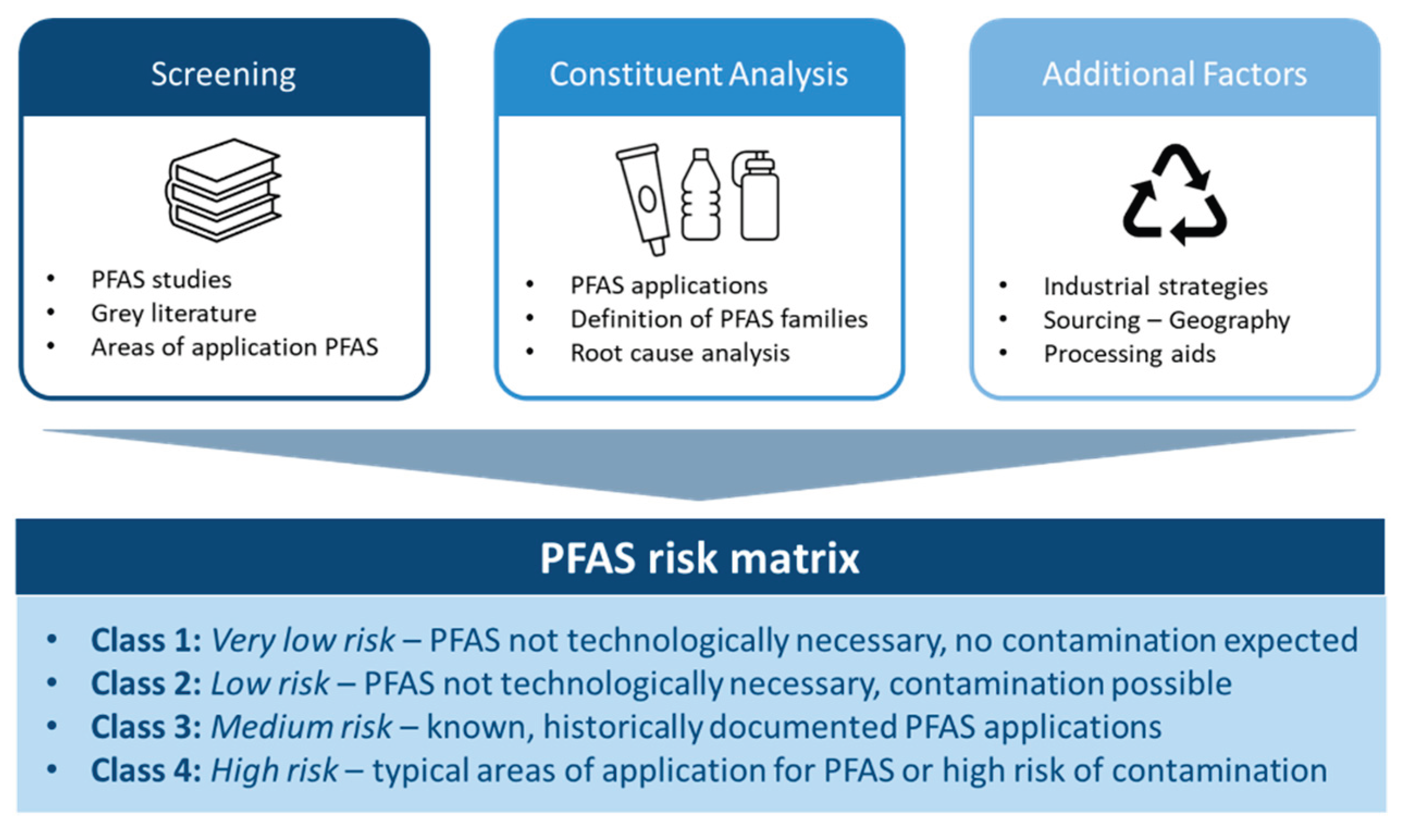

Table 1.
Packaging applications in which PFAS contamination has been documented in the published literature.
Table 1.
Packaging applications in which PFAS contamination has been documented in the published literature.
| Packaging application (PFAS-relevant) | Sources |
| Paper & Cardboard | |
| Fast food and takeaway paper packaging | [1,6,11,27,28,29,30,31] |
| Paper-based takeaway containers and trays | [11,27,30,31] |
| Cardboard packaging for pizza and hot food | [1,2,10,11,27,28,31,32,33] |
| Paper-based baking and cooking packaging (popcorn, baking paper, muffin cases, etc.) | [6,10,28,30,31,32,34] |
| "Compostable" or "bio-based" paper packaging with coating | [6,10,11,30,31] |
| Moulded fibre packaging made from plant-based materials (bagasse, palm leaves, straw, wheat fibres) | [11,20,27,30,31] |
| Paper packaging for baked goods and confectionery (bakery, pastry, doughnut and snack bags) | [1,2,11,27,29,30,31] |
| Paper and cardboard packaging for dry goods and confectionery (cereal, spaghetti and confectionery boxes) | [6,28,31,35] |
| Meat, fish and cheese wrapping paper (butcher's/delicatessen paper) | [34,35] |
| Paper-based beverage cups (coated) | [9] |
| Plastic | |
| Plastic bowls, trays, cups | [1,14,30,35] |
| Flexible plastic packaging in general (bags, tubular bags, films) | [1,14,30,35] |
| Metall | |
| Coated cans (interior paints/coatings) | [8] |
| Lids with fluorinated interior coatings | [8] |
| Composites | |
| Laminated or multi-layer films (e.g. butter packaging) | [1,14,30,34] |
| Beverage composite carton (e.g. milk cartons) | [34] |
Table 2.
Maximum concentrations of PFAS in food contact packaging as stated in PPWR Art. 5(5)(a)-(c).
Table 2.
Maximum concentrations of PFAS in food contact packaging as stated in PPWR Art. 5(5)(a)-(c).
| PPWR | Maximal concentration of PFAS in food contact packaging |
| Art. 5(5)(a) | 25 ppb for any PFAS with targeted PFAS analysis (polymeric PFAS excluded from quantification) |
| Art. 5(5)(b) | 250 ppb for the sum of PFAS measured as the sum of targeted PFAS analysis (polymeric PFAS excluded from quantification) |
| Art. 5(5)(c) | 50 ppm for PFAS (including polymeric PFAS) |
Table 3.
Qualitative PFAS probability classification of paper-based packaging constituents based on material composition and functional attributes.
Table 3.
Qualitative PFAS probability classification of paper-based packaging constituents based on material composition and functional attributes.
| Materials | Literature | Additional information | Risk | |
| Paper | ||||
| Main body | Virgin paper | 1 | ||
| Recycled paper | [6,11,14,27,29,31] | Raw materials/recycling: PFAS may already be present in the source material, even without intentional use. | 4 | |
| Fibre casting virgin | [11,20,27,31,36] | Increased risk with water-fat tightness: | 3 | |
| Fibre casting recycled material | [2,6,14,29,31] | Raw materials/recycling: PFAS may already be present in the source material, even without intentional use. | 4 | |
| Cellophane | Increased risk with coatings (moisture barrier; heat-seal lacquers): 3 | 1 | ||
| Starch moulded parts | 1 | |||
| Paper treatment | Drying agent PVOH | 1 | ||
| Drying agent starch | 1 | |||
| Drying agent other polymers | 1 | |||
| Wetting agent | 1 | |||
| Impregnating agent (e.g. for increased grease resistance) | [6,8,10,11,14,27,29,32,33,34] | Classic PFAS application area (also for paper straws, for example) | 4 | |
| Mineral fillers | [20] | 1 | ||
| Barriers and surface finishing of paper | Metallisation | Metallisation no PFAS; but risk possible from pre-paints, adhesion promoters; protective coatings; PFAS declaration best for metallisation & paint/adhesion promoters | 1 | |
| Polymer dispersion coating | [5,14] | Especially for claims such as grease resistance; moisture resistance/wet strength; easy clean; mostly additives; 4 | 3 | |
| Silicone coating | [1] | Low, except when additives are used for better wetting and for papers with additional grease resistance/easy clean properties. | 2 | |
| Paraffin, wax, oil | [1] | 1 | ||
| Additlaional layers | AlOx, SiOx, metallisation | 1 | ||
| Adhesive application in multi-layer construction | Dispersion adhesive | [5] | 2 | |
| Hot melt adhesive | 1 | |||
| Starch-based adhesive | 1 | |||
| Composite materials | Aluminium lamination | Increased risk with high-performance laminating adhesives/topcoats | 2 | |
| Plastic film lamination | PFAS possible in laminating adhesives, additives; protective coatings | 3 | ||
| Decoration | Direct printing | [5,31] | PFAS in printing inks to improve the wetting and distribution of the ink, stabilise the ink flow and make water-based inks water-repellent. They act primarily as wetting agents, dispersing aids and functional additives due to their very low surface tension. | 1 |
| Foil embossing | Film embossing is often multi-layered – PFAS were used in release/separating layers. | 3 | ||
| Varnish | [11] | If the top coat has dirt-repellent or easy-clean properties, the classification is: 4 | 3 | |
| Label | ||||
| a. Material | Paper (not wet-strength) | see respective material | 1 | |
| Paper (wet-strength) | see respective material | 2 | ||
| Plastic | see respective material | |||
| b. Adhesive | Dispersion | [5] | 2 | |
| Hot melt | [5] | 1 | ||
| Starch-based | [5] | 1 | ||
| c. Decoration | Direct printing | [5,31] | PFAS in printing inks to improve the wetting and distribution of the ink, stabilise the ink flow and make water-based inks water-repellent. They act primarily as wetting agents, dispersing aids and functional additives due to their very low surface tension. | 1 |
| Varnish | [11] | If the top coat has dirt- or grease-repellent or easy-clean properties, the classification is: 4 | 3 | |
|
Seam bonding Adhesives |
Dispersion | [5] | 2 | |
| Hot melt adhesive | 1 | |||
| Starch-based | 1 | |||
| Metal | ||||
| Aluminium | Aluminium | [8] | 1 | |
| Inner coating | [1,30] | Typical area of application: CO2-containing beverages with a long shelf life | 3 | |
| Outer coating | [8] | for high-performance coatings (abrasion-resistant, anti-fingerprint) | 2;3 | |
| Compound (in closures) | [5,32] | In closures (twist-off caps, crown caps, etc.) Classification 3 if formulation disclosed; otherwise 4 | 3;4 | |
| Steel | Steel cans | [8] | 1 | |
| Inner coating | [1,30] | Typical area of application: CO2-containing beverages with a long shelf life | 3 | |
| Outer coating | [8] | In high-performance coatings (abrasion-resistant, anti-fingerprint) | 2;3 | |
| Compound (in closures) | [5,32] | In closures (twist-off caps, crown caps, etc.) Classification 3 if the recipe is disclosed; otherwise 4 | 3;4 | |
Table 4.
Qualitative PFAS probability classification of constituents in plastic and metal packaging based on material composition and functional attributes
Table 4.
Qualitative PFAS probability classification of constituents in plastic and metal packaging based on material composition and functional attributes
| Materials | Literature | Additional information | Risk class | |
| Polymer | ||||
| Polymer Mono | PET-A; PET-G; PET-C (amorphous, glycol modified and crystalline Polyethyleneterephthalate) virgin | PFAS may enter the material during processing, such as extrusion, as contaminants from additives or processing aids, rather than being intentionally added to modify material properties | 1 | |
| rPET (recycled PET) | [1] | PFAS may enter the material during processing, such as extrusion, as contaminants from additives or processing aids, rather than being intentionally added to modify material properties | 1 | |
| HDPE (High Density Polyethylene) virgin | [1,14,37] | PFAS may enter the material during processing, such as extrusion, as contaminants from additives or processing aids, rather than being intentionally added to modify material properties | 1 | |
| rHDPE (recycled HDPE) | [1,14] | not in food contact materials | 2 | |
| LDPE (Low Density Polyethylene) virgin | [1,14] | PFAS may enter the material during processing, such as extrusion, as contaminants from additives or processing aids, rather than being intentionally added to modify material properties | 1 | |
| rLDPE (recycled LDPE) | [1,14] | not in food contact materials | 2 | |
| PP (Polypropylene) virgin |
[1] | PFAS may enter the material during processing, such as extrusion, as contaminants from additives or processing aids, rather than being intentionally added to modify material properties | 1 | |
| rPP (recycled PP) | [1] | not in food contact materials | 2 | |
| PEF (Polyethylenefuranoat) virgin | PFAS may enter the material during processing, such as extrusion, as contaminants from additives or processing aids, rather than being intentionally added to modify material properties | 1 | ||
| PS (Polystyrene) virgin | PFAS may enter the material during processing, such as extrusion, as contaminants from additives or processing aids, rather than being intentionally added to modify material properties | 1 | ||
| rPS (recycled PS) | not in food contact materials | 2 | ||
| PBT (Polybutadieneterephthalate) virgin | PFAS may enter the material during processing, such as extrusion, as contaminants from additives or processing aids, rather than being intentionally added to modify material properties | 1 | ||
| Polymer Multilayer | EVOH layer (Ethylenevinylalcohol-copolymer) | [1,27] | If tie layer not specified: 3; For multi-layer materials, always specify laminating adhesive. | 2 |
| PVOH layer (Polyvinylalcohol) | [1,27] | 3 | ||
| PE peel layer | [1,27] | 4 if not specified | 3 | |
| PP peel layer | [1,27] | 4 if not specified | 3 | |
| PVDC (Polyvinilydenedichloride) | [1,27] | 2 | ||
| Lamination adhesive | [27] | 3 | ||
| Coating/painting/vapor deposition | Coating (not defined) | 4 | ||
| AlOx | [5,27] | 2 | ||
| Antifog coating | [5,27] | 4 | ||
| EVOH coating | When applied as a dispersion | 3 | ||
| PVOH coating | [5,27] | When applied as a dispersion | 3 | |
| SiOx | [27] | Due to primer | 2 | |
| Metallisation | [27] | Due to primer | 2 | |
| Acrylate coating | [5,27] | 2 | ||
| Functional coating / varnish | [5,27] | 3;4 | ||
| Varnish | [27] | 2;3 | ||
| Direct printing | [27] | 2;3 | ||
| Adhesive | Adhesive (not defined) | 4 | ||
| Acrylate adhesive | [5] | 2 | ||
| PU adhesive | 3 | |||
| Hotmelt | 1 | |||
| Other | Compound/ sealing material | [5,32] | 3;4 | |
| Absorbent layers - PE, PP, PS | [1,5] | 3 | ||
Table 5.
PFAS compliance risk assessment and hotspot identification for a composite food packaging system (paper/PE tray, multilayer plastic lid, printed paper sleeve).
Table 5.
PFAS compliance risk assessment and hotspot identification for a composite food packaging system (paper/PE tray, multilayer plastic lid, printed paper sleeve).
| Packaging composition | Tray | Risk class | Lid | Risk class | Paper sleeve (printed) | Risk assessment |
| Constitutent 1 | PE | 1 | PE | 1 | paper (recycled) | 4 |
| Constitutent 2 | cardboard (virgin) | 1 | tie layer (specified) | 2 | 2 | |
| Constitutent 3 | PE | 1 | EVOH | 1 | hot melt adhesive | 1 |
| Constitutent 4 | tie layer (specified) | 2 | tie layer (specified) | 2 | ||
| Constitutent 5 | EVOH | 1 | PE | 1 | ||
| Constitutent 6 | tie layer (specified) | 2 | anti-fog coating | 4 | ||
| Constituent 7 | PE | 1 | ||||
| Production process 1 | Tray formation | 0 | flexible film extrusion | 3 | ||
| Production process 2 | flexible film extrusion | 3 | ||||
| Risk classification | PE/cardboard/tie layer/EVOH/tie layer/PE | 3 | PE/tie layer/EVOH/tie layer/PE | 4 | Paper (recycled) | 4 |
Disclaimer/Publisher’s Note: The statements, opinions and data contained in all publications are solely those of the individual author(s) and contributor(s) and not of MDPI and/or the editor(s). MDPI and/or the editor(s) disclaim responsibility for any injury to people or property resulting from any ideas, methods, instructions or products referred to in the content. |
© 2026 by the authors. Licensee MDPI, Basel, Switzerland. This article is an open access article distributed under the terms and conditions of the Creative Commons Attribution (CC BY) license (http://creativecommons.org/licenses/by/4.0/).
Copyright: This open access article is published under a Creative Commons CC BY 4.0 license, which permit the free download, distribution, and reuse, provided that the author and preprint are cited in any reuse.


