
Submitted:
19 February 2026
Posted:
13 March 2026
You are already at the latest version
Abstract
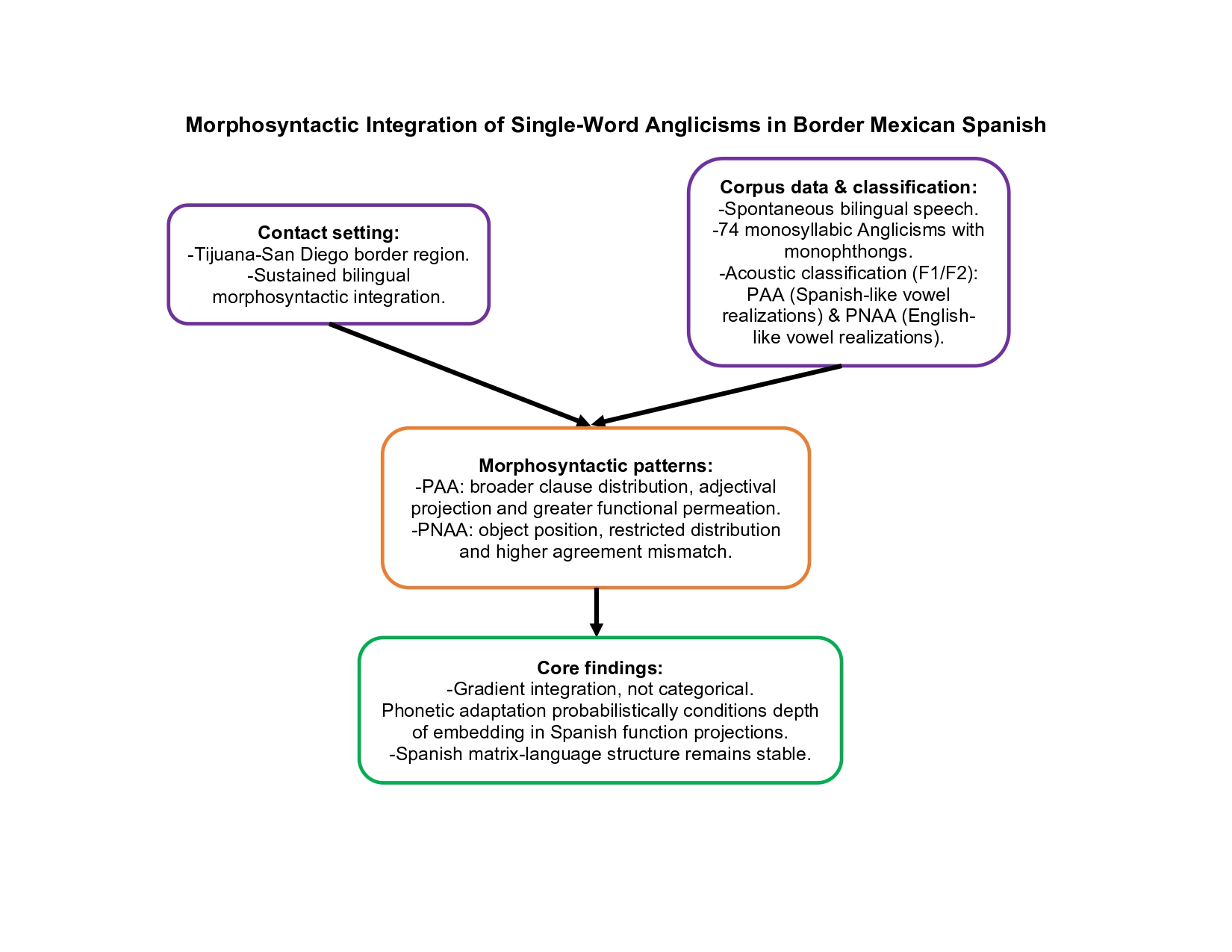
Loanword Research on Anglicisms has largely centered on lexical borrowing and phonological adaptation, with comparatively limited attention to morphosyntactic integration in recipient grammars. This study examines the syntactic behavior of single-word Anglicisms in Mexican Spanish, drawing on phonetically classified corpora of 131 monosyllabic Anglicisms with mon-ophthongs extracted from spontaneous speech by Spanish–English bilinguals in the Tijuana–San Diego border region. Building on prior acoustic analyses based on F1 and F2 vowel measure-ments, the study investigates the relationship between phonological adaptation and morphosyn-tactic integration. Results reveal a gradient pattern of incorporation. Anglicisms exhibiting Span-ish-like phonetic properties tend to occupy canonical syntactic positions and show greater com-patibility with Spanish functional morphology, whereas phonetically non-adapted forms more frequently resist morphological marking and display island-like behavior within otherwise Spanish clauses. The analysis examines distribution across nominal, adjectival, and prepositional domains, as well as object positions, enabling a fine-grained assessment of degrees of morpho-syntactic integration. The former is illustrated as follows: (1) Guardo cash ([kaʃ]) por si acaso (2) Si hacen match ([mæʧ]), puede funcionar Adopting a usage-based and contact-oriented perspective for syntactic borrowing (Bybee, 2015), the study is situated within the Matrix Language Frame model (Myers-Scotton, 1993; Muysken, 2000) and recent approaches to insertional borrowing (Poplack & Dion, 2012; Onysko & Win-ter-Froemel, 2011). A central contribution lies in establishing a principled link between morpho-syntactic behavior and an independently motivated phonetic classification, offering convergent evidence for the systematic integration of Anglicisms into Spanish grammar. At a broader ana-lytical level, the study advances debates on syntactic borrowing and contact-induced change by demonstrating that Anglicisms are subject to Spanish morphosyntactic constraints rather than functioning as unconstrained lexical insertions, and by developing an interface-based account of borrowing that captures the gradient nature of grammatical incorporation in contact settings and contributes a corpus-based, empirically grounded perspective to typologies of borrowing in Spanish contact linguistics
Keywords:
language contact shift
; morphosyntax
; Anglicisms
; Mexican Spanish
Copyright: This open access article is published under a Creative Commons CC BY 4.0 license, which permit the free download, distribution, and reuse, provided that the author and preprint are cited in any reuse.


